




Abstract
This ethnographic study of Feng Shui discourses and practices in Hong Kong examines consumer hope embedded within a specific sociocultural context, supplanting the current understanding of hope as purely an individual psychic phenomenon. The study investigates hope as a collective emotion, informed by key Chinese cultural resources drawn from Taoist and Confucian principles in both its pursuit and desired outcomes. As consumers incorporate hope within their lives and aspirational selves, they act within culturally prescribed pathways of prevailing social and moral rules. The research demonstrates the importance of culturally pervasive discourses in developing an overall sense of hope, one created, interpreted, and sustained within social networks. In the process, we also pay attention to the idea that in hope something still has to happen or become.
Keywords
Feng Shui
Feng Shui is a highly ritualized practice of spatial alignment and orientation, believed by adherents to improve their lives on a multitude of planes: physical, spiritual, emotional, and commercial (Bruun, 1995; Emmons, 1992). Above all, Feng Shui offers hope: hope as a market commodity providing solace in the present, and hope as a means of consumer negotiation with an uncertain future. Within the process of hoping, adherents adopt and deploy market forces embedded in a holistic cultural context that mediates their respective goals. Feng Shui masters play a key role in this process, transmitting and instilling hope by practicing rituals, ascribing meaning to symbols, and interacting with consumers. Our research investigates the cultural resources on which consumers rely in creating and sustaining hope in their lives, revealing the collective nature of hope. In Feng Shui practices, a consumer’s hope extends to the overall social network, whether within the family, the workplace, or other social settings. Feng Shui discourses and practices are a rich context for examining cultural resources endemic to the process of constructing and sustaining hope.
The cultivation of hope
The 3500-year-old discipline known as Feng Shui—literally “wind and water”—has roots in yijing, a source book on archaic systems of cosmology and philosophy. According to Chinese mythology, in the beginning there was nothingness (wuji) supplanted by the taiji, and symbolized by yin and yang. Yang, associated with the sun, embodies concepts of whiteness, energy, masculinity, and strength. Yin is associated with the moon, representing blackness, femininity, weakness, and negativity. Although opposites, yin and yang are complementary and dynamic forces, referencing the positive and negative duality of matter (Han, 2001). In addition to the taiji, the five basic elements (wuxing)—metal, wood, water, fire, and earth—are considered components of all matter and events, both concrete and abstract, providing a philosophical scaffolding that enables understanding of the universe (Hamilton, 1999). The relationship among these five elements is governed by the cycles of birth and of destruction. In the former, one element gives rise to another; in the latter, one element conquers another. These two cycles—which form the foundation of Feng Shui—are considered central to life; through them, one gains insight into all matter (Lam, 1996).
The Chinese philosophy of qi (energy) is the foundation of Feng Shui; qi is eternally in flux, and thus the qi of any living space is continuously, imperceptibly shifting. Feng Shui involves consideration of both natural and cultural elements when a practitioner chooses ideal locations for residential, business, and burial sites (Yang, 2004), with harmony between habitats and natural surroundings achieved by finding the proper amount of qi in a location (Han, 2001). Any disruption of harmony will create distress. The seemingly simple idea of interdependence among heaven, earth, and humans—a holistic understanding of our individual role in the larger environment—is key to understanding the culturally specific way in which Feng Shui cultivates hope (Belk et al., 2003; Joy, 2001). The research grounds the cultural aspects of hope in the phenomenon of Feng Shui, and examines how consumers use Feng Shui to produce hope.
Feng Shui masters serve as a sacred source to mediate hope for individuals, enabling the consumption of hope as a marketplace commodity. A master will visit a private home or office and thoroughly examine the designated site and surrounding area. He will then prescribe actions, which may include remodeling a room, rearranging furniture, and strategically placing certain items; he may even suggest that a person abandon a location. The items consumed in Feng Shui practices vary greatly: they can be objects such as clocks, fish tanks, copper coins, or wind chimes. Consumers purchase Feng Shui items not only to achieve their desired outcomes, but also for the hope created and sustained in the process of trying (de Mello and MacInnis, 2005). At the end of a consultation, the master charges a fee based on the size of the locale as well as the strength of his reputation. Real estate agents are heavily involved in Feng Shui, as the warrant of good Feng Shui significantly boosts property values (leaving some Feng Shui clients feeling that they were part of a scam promoted by real estate agents).
Literature on hope
Hope embodies a sense of harmony both within oneself and with the world. Existing consumer research literature on hope has viewed it primarily as an individual psychic phenomenon. Hope’s antecedents and consequences are seen as psychological factors, with products and services serving as stimuli or impediments to achieving hope. Although researchers have studied the interaction between culture and cognition in goal-setting and goal persistence (Fischer et al., 2007; Thompson and Tambyah, 1999), investigation of the emotional consequences of such processes, and their role within various social settings, has been lacking.
Until recently, studies on hope in the consumer literature were few (de Mello and MacInnis, 2005; de Mello et al., 2007; MacInnis and Chun, 2006; MacInnis and de Mello, 2005). Hope is oriented to a goal that, although uncertain, is deemed achievable. The goal-congruent dimension reflects the extent to which the environment is conducive to goal fulfillment. The goals consumers hope for, the interpretation of outcomes, and the means used to achieve those outcomes, vary by culture. In Western societies, personal achievement and independence are highly valued, and rules of hope focus on whether hope is realistic (Averill et al., 1990). Under Confucian values, the ideal is harmony with oneself, with others, and with nature (Nisbett, 2003).
In today’s world, both secular and sacred means are used to purvey hope to people. While Feng Shui is sometimes dismissed as superstition (Liu, 2003), it is an integral part of the decision-making process for many in Hong Kong, in conjunction with modern and Western means (Tsang, 2004). Feng Shui reflects society’s need for a spiritual or transcendental view of the universe that goes beyond religious tenets (MacInnis and Chun, 2006), with consumption playing a key role. Hope is not simply a self-generated emotion, but rather stems from core social beliefs in collective memories, ideologies, goals, and myths (Bar-Tal, 2001; Jarymowicz and Bar-Tal, 2006). With their precise rituals, Feng Shui masters encourage such beliefs, inducing hope in their clients and allowing them to interpret outcomes. Consumers of Feng Shui experience hope as both a common emotional experience, and as a commodity available to all. Fromm (1968) has long argued that hope is a social product, with every individual’s hope framed by sociocultural discourses.
This article examines hope as a collective emotion created, interpreted, and sustained within social networks. Since Feng Shui serves people of the same household and others in spatial proximity, it affects all who share a given space. What are the rules of hope adopted in a collective setting? How do people compromise and negotiate hope if Feng Shui practices have differing impacts on various members of a group? What are the social functions of hope for individuals and for social networks?
Both at work and in the home, the importance of the collective and feelings of interdependence are critical in a society such as Hong Kong, famed for its population density. Our research emphasizes hope as an emotional outcome that occurs over time and not merely as a situational phenomenon. Such an understanding of time (cyclical in nature, long term in perspective) is a feature of societies such as those in Hong Kong that practice a Taoist and Confucian philosophy of life.
Research methods
We gained an immersive understanding of Feng Shui by having Feng Shui readings of our own homes, joining Feng Shui tours of Hong Kong, attending two annual conferences on Feng Shui in the context of architecture and spatial organization, and observing Feng Shui print and television advertisements. We focused on Hong Kong participants because of the prevalence of Feng Shui practices in the city and the feasibility of data collection. Feng Shui thrives among individuals and families, as well as in businesses and government organizations, in Hong Kong (Tsang, 2004); discrete groups, such as business owners, students, employees, and homemakers, embraced a variety of approaches and interpretations of Feng Shui.
Description of participants.
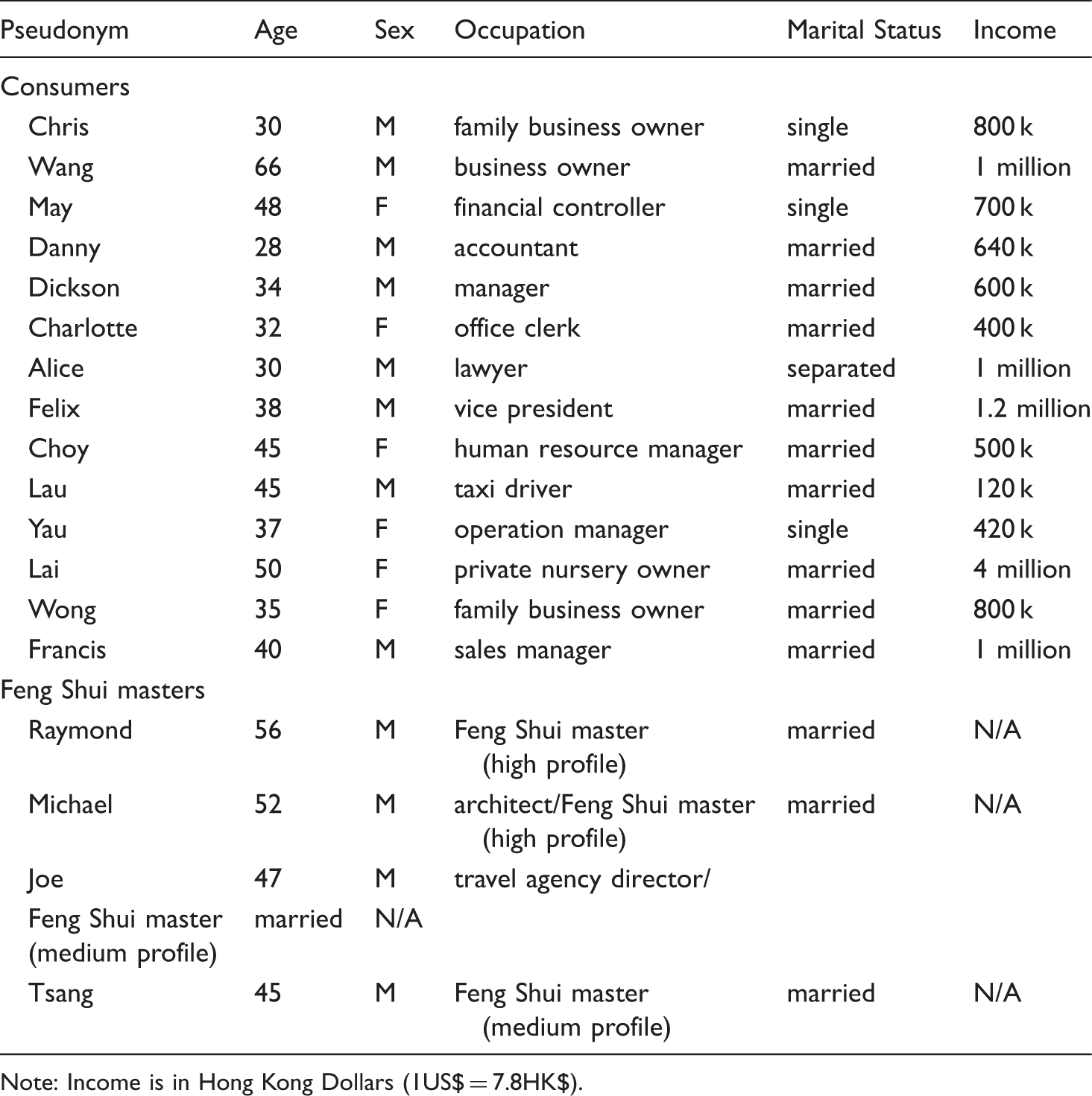
Note: Income is in Hong Kong Dollars (1US$ = 7.8HK$).
We used phenomenological interviews and participant observation in this two-year study. Existential phenomenology describes people’s real-life experiences and integrates them with their life-worlds (Thompson et al., 1989). First, we visited 11 participants’ homes and offices to observe and photograph their use of Feng Shui items in interior design. Second, we participated in two Feng Shui consultations with participants, and then probed the practices and meanings of the advice given. We subsequently arranged extensive observations to become more familiar with the Feng Shui context (Arnould and Wallendorf, 1994), observing additional Feng Shui readings in people’s homes, as well as interviewing participants at a later time. Our observations corroborated the interview information or, in some cases, revealed discrepancies between what participants reported and what actually occurred in their Feng Shui practices. Participants’ experiences with Feng Shui comprised the focus of our interviews. We speculated that a close study of the interview transcripts would enable us to discover deeper meanings of Feng Shui embedded in the general cultural background and individuals’ cultural frames (Joy, 1991; Thompson, 1997).
Interviews began with house tours, followed by inquiries about family background, occupation, consumption habits, and general lifestyle. Data collection began with no predetermined theories. Initial interviews uncovered participants’ experiences with Feng Shui, past and present, individual and collective, general and specific.
The field team comprised two authors and a Cantonese-speaking trained qualitative research assistant. Culturally and linguistically, as a mixed team we were able to access different domains of meaning, essential in an ethnographic study (Arnould and Wallendorf, 1994). Since no author spoke the Cantonese dialect used by local residents, the research assistant conducted interviews and participated in the observations. Researchers made field notes during the interviews and observations. All interviews were audiotaped and transcribed verbatim. Two Feng Shui practices were videotaped. One author analyzed the data in the original Chinese; the others analyzed the English translations. The research team verified the translation’s accuracy. Researchers analyzed the interview transcripts repeatedly to sift out relevant details. Key patterns within each participant’s story and across stories were categorized and summarized to draw comparisons and contrasts in the data (Thompson, 1997). Each theme derived from the data gave further insight into what we should explore at future interviews (Belk et al., 1988). We then summarized and concluded with the theoretical frameworks and respective themes as shown in this article. This approach generated a comprehensive view of the context and the embedded theoretical issues.
Findings
While Feng Shui adherents may sometimes feel in control of their lives, they are also well aware that such control is limited. They therefore willingly turn to Feng Shui masters, who offer pre-emptive protection against forces beyond their clients’ control. For participants, the Feng Shui master serves as a facilitator, enabling them to re-align with the forces of nature. Masters perform sacred rituals and use symbolic objects, while also catering to clients’ preferences in the profane world. The hope-inducing process is dynamic, involving interactions and compromises between masters and consumers. Hope is created as a consequence of re-connection with a power outside of the individual and greater than the self.
Our research further addresses hope as a collective emotion. The concept of benevolence (ren) is central to Chinese philosophy, and is the foundation for Confucian ethics (Ames, 1993; Tu, 1994). Co-presence, mutual awareness, common focus of attention, and common mood (Collins, 2004) are central and constant features of such an interdependent society. Participants’ use of Feng Shui demonstrates their moral values vis-à-vis their social circles. The notion of self in relation to others engenders tolerance of others, self-discipline, and continual efforts to preserve social harmony(Li et al., 2003). Rather than focusing on the individual psyche, our research views hope as shared within a social circle and bound by social and moral rules—a long-term emotional energy that endures and is sustained across situations, rather than a transient emotional response to a specific situation.
The cultural resources of hope
Destiny, fortune, and Feng Shui
Personal destiny (ming), annual fortune (yun), and Feng Shui are a hierarchy of forces believed to have varying, distinct impacts on individuals. According to Feng Shui, personal destiny, written in the horoscope (bazi, consisting of eight characters) and determined by one’s birth year, month, day, and hour, is fixed and cannot be changed. The same eight characters are also associated with the five elements referenced earlier, which help delineate an individual’s character, personality, style, strengths, and weaknesses, and even relationships with others. Destiny determines one’s life path. To some extent it creates a sense of futility and hopelessness in individuals. Annual fortune dictates events in the coming year. At the beginning of the Chinese New Year, many people hire experts to predict what lies ahead so that they can plan accordingly. To remove an obstruction to happiness, to regain a state of health, or to create a harmonious household, yin and yang must be in balance. Destiny and fortune lead to likely outcomes that are predictive and objective in nature. Feng Shui is aligned with one’s destiny and annual fortune, but enables an individual to exert control and agency. By practicing rituals and adopting symbolic objects, people manage their space so that negative forces are kept at bay and positive forces are encouraged, thus enhancing the flow of qi and maintaining harmony with the environment. Instead of experiencing fear and anxiety about destiny, people can feel confidence, and maintain concentration and hope with the help of Feng Shui.
Some participants choose not to ask about their destiny when they consult Feng Shui masters. Destiny readings identify an individual’s overall life path and reveal important events, which may work against one’s hope for a bright future. As a participant, Francis, told us: “I feel ambivalent about [knowing my destiny] … It’s been several years since I started asking for Feng Shui advice … but … I still find the need to take control of certain things in my life. I don’t want to just sit back and wait because I am told that I’ll get rich at 50”.
The implication of destiny is that one has little control over life and must accept what is written in the book of life. Yet, as Arkush (1984) notes, the Chinese have their own version of “God helps those who help themselves”— “if man works hard, the land will not be lazy”. In this study, agentic action is taken even when individuals believe that the problems plaguing them may be an outcome of destiny. By contrast, Feng Shui and annual fortune are flexible, interpretive, and hope-inducing. They highlight particular life aspects and offer ways to improve them. Efficacious Feng Shui rituals purport to enable individuals to achieve greater life power and avert whatever might diminish this life power (Tucker, 1994). A participant, Wong, compares Feng Shui with fate in its power and influence on people’s lives: “… I believe destiny is more powerful than Feng Shui. It must be the case that if your destiny is strong, you won’t be influenced however bad the Feng Shui is. It may have a small influence, but not a big one”.
Destiny places each individual in a specific category derived from yin and yang and the five elements. For example, in one interview, a husband was described as having “weak fire” (yinhuo) and his wife as having “strong fire” (yanghuo). Their respective life paths unfold according to their destinies. Their favorable elements, colors, and objects are also determined by their fates. The husband appeared happy because, according to his destiny chart, his hard times had passed, and he was destined to live in prosperity in the decades ahead.
Fortune is second only to destiny, according to Chinese metaphysics. Feng Shui is prescribed according to one’s annual fortune, and often a person is advised to change his/her environment to facilitate good luck. Some participants seek very specific advice on what to do in a given year or at a certain time of the year. A participant, Yau, said that she was looking for a Feng Shui master to explain her annual fortune for the Year of Dog (2006): “After I had given my birth date, he asked what my priorities were for the consultation and I … told him that I wanted to increase my chances of finding a romantic partner. He assured me that I would meet someone that year and if I wanted this to work out I should place a blonde doll on top of a bowl of water. He said that the doll would help me … with my love life. I purchased the blonde doll …”
The Feng Shui master assuaged her worries about finding the right partner, and allowed Yau to project herself into the future with confidence. As Barbalet (1998) suggests, confidence is an emotion through which a possible future is brought into the present. Swedberg (2007: 21) likewise argues that hope is a “wish for something to come true”. In what is suggested by the Feng Shui master, hope and waiting intersect and each precipitates an interest in the other (Crapanzano, 1985). Any form of self-realization must also be understood in terms of embeddedness, the degree to which the individual self is linked to the cosmic self in his/her life cycle. Goal-striving and hoping for a goal-congruent outcome are thus incontrovertibly culturally constructed, developed, and maintained.
Another participant, Chris, initiates the process of hope by hiring a Feng Shui master to help him deal with the uncertainties he experiences in his business: “I rely on Feng Shui, because in my business, many events are uncontrollable. No matter how hard you work at something, you just can’t always do well. When you cannot control events, you turn to Feng Shui … Feng Shui is like a path that will lead you in the right way”.
Feng Shui practices as a vehicle of hope practices and hoped-for outcomes.
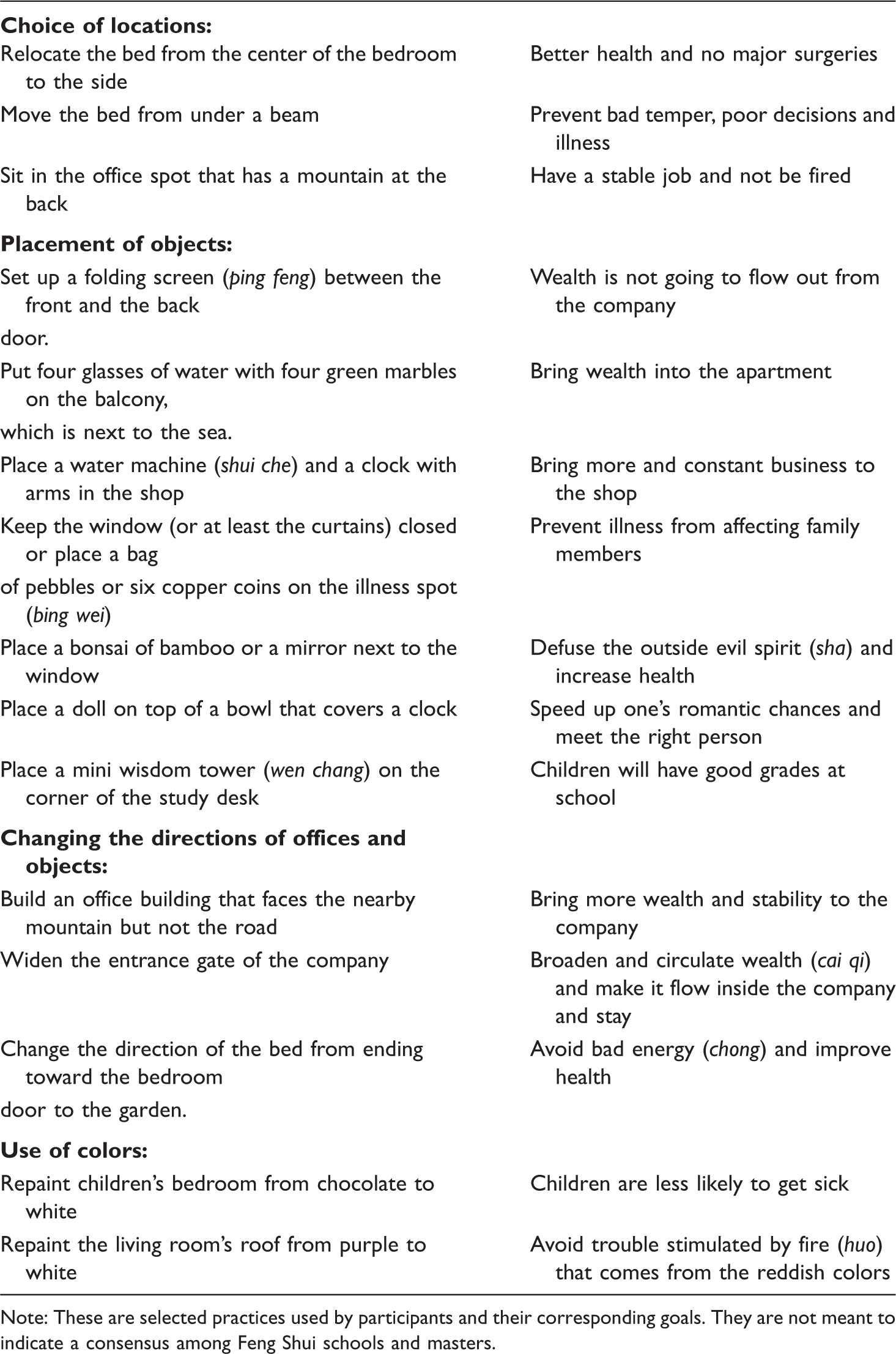
Note: These are selected practices used by participants and their corresponding goals. They are not meant to indicate a consensus among Feng Shui schools and masters.
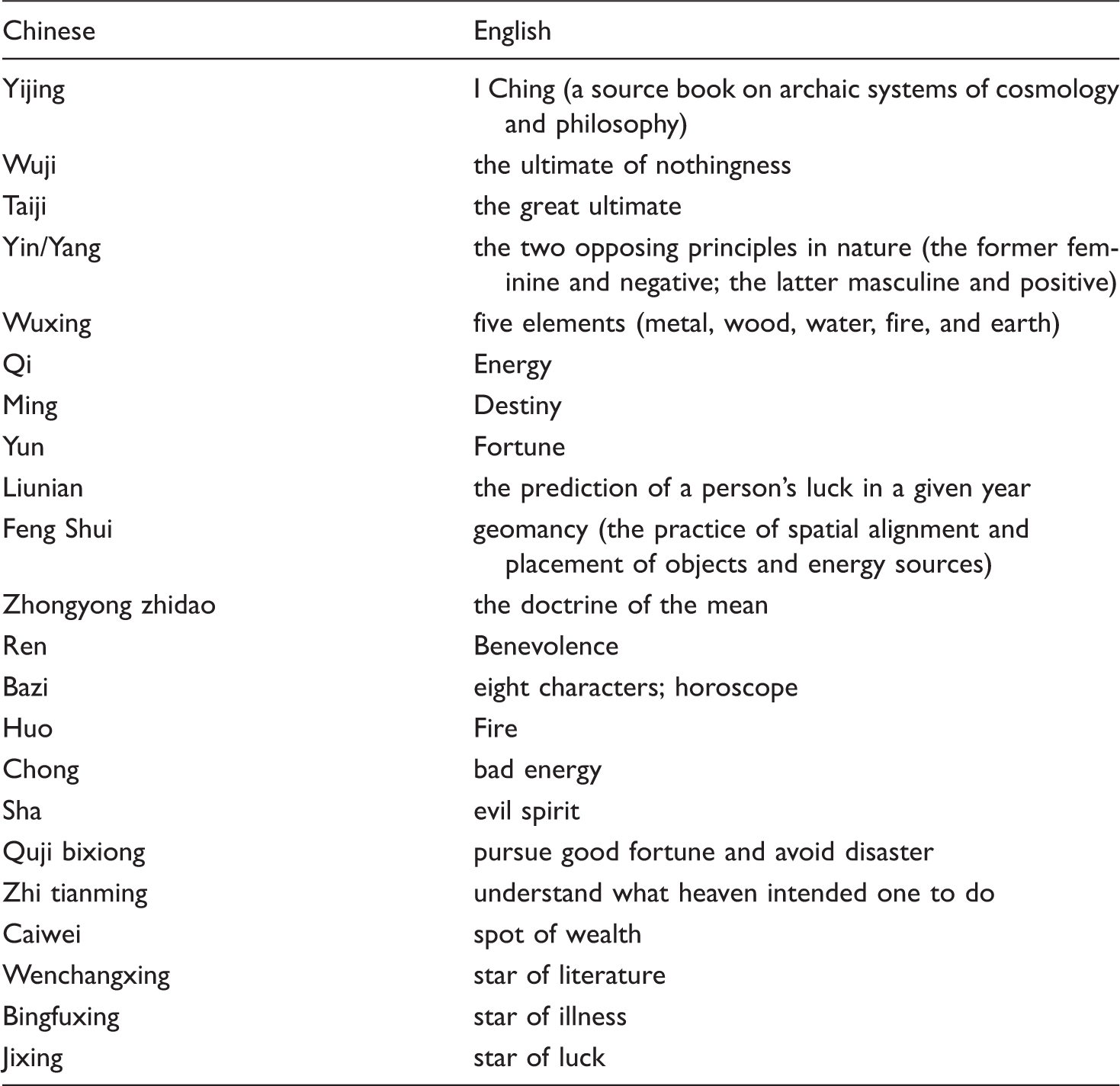
Glossary of Chinese terms.
Individuals use Feng Shui practices in tandem with secular approaches to achieve desired outcomes. For example, people may place a bamboo bonsai at a window to dissolve negative forces (sha) from outside and create a healthier environment, but their action does not prevent them from also consulting a medical practitioner.
Participants use Feng Shui to seek positive outcomes and also to avoid negative outcomes (quji bixiong), hoping to enhance or at least maintain the status quo through a better alignment with nature. Interestingly, a strong sense of avoidance permeates their discourses. Although people regard Feng Shui as a practical means for seeking good luck, they seldom depend solely on it. As Yau explained: “… I have hope, more or less … When he [the Feng Shui master] was finished with his Feng Shui arrangements, I didn’t see any man suddenly appearing in front of me. Do I get disappointed? I may have hope, but I would think to myself: ‘Do you think the Feng Shui arrangement will really work?’ If it did, the master should have become a billionaire … by now. I suppose … problems … can’t be solved just by Feng Shui … but of course there is hope”.
In hopes of finding a new relationship, Yau went through a ritual of changing the flowers in her apartment every two weeks. But while she believed Feng Shui practices would facilitate her endeavor, she also realized that they would not necessarily cause her to find the right person. Here Yau demonstrates her understanding of the differences between destiny and Feng Shui. Destiny is not controllable and it might lead to a sense of futility because of the lack of directionality. Individuals are not “waiting for something” as in Feng Shui but just “waiting it out” (Crapanzano, 2003). None of the participants depend solely on Feng Shui for the achievement of their goals; they understand that other factors influence outcomes. Many participants place more emphasis on the prevention mode of Feng Shui than on its role in bringing good luck. A participant, May, noted: “Actually it doesn’t matter if you don’t have good luck. What’s more frightening is bad luck … We don’t hope to get the best and the most, but I think to avoid bad luck is one’s instinct. If there is something I can do about that, then I will do it for the sake of peace of mind. That is why I use Feng Shui in my life”.
Several participants attribute bad luck to bad Feng Shui. They find it difficult or impossible to understand their misfortunes rationally, so they affix causality to an inadequate or incorrect Feng Shui setting. When they rearrange space, the focus is on alleviating current misfortune and avoiding bad luck in the future. They interpret misfortune as a consequence of not having taken appropriate actions previously.
Not only are goals embedded in participants’ broader life projects, but the outcomes after Feng Shui practices are also interpreted according to their understanding of life. As Chris said: “When I set up my office last year, things were generally going well and so I naturally aimed a step higher. But now that things did not turn out the way I wished, I still think that, had I not done the setup, things would have been even worse … I've always felt that although some people are better off, others have it worse. … Sometimes you are up, and sometimes you are down. Everyone has his day. Once you are in the bad days, let it be. But never give up hope. The good days are not far away”.
Chris is a firm believer who consults a Feng Shui master every year. At the time of his second interview, his company’s revenues had declined and his personal stock portfolio had plunged. Nonetheless, his Feng Shui practice gave him a sense of security that allowed him to be at peace with various outcomes. The phrase Chris used (“sometimes you are up; sometimes you are down”) roots hope in the idea of an embodied self (Joy and Sherry, 2003). Chris’s reference to “good days ahead” also helps us to see how hope opens a path to the future. As MacQuarrie (1978) observes, hope is an open road along which one can choose to move.
Thus Feng Shui is not simply a means to an end, it is also an instrument to alleviate anxiety about outcomes and consequences. Feng Shui functions as a form of therapy, easing psychological burdens by enabling adherents to sustain their hopes, even when outcomes are negative. Instead of setting specific goals when practicing Feng Shui, people may choose adaptable goals so that they can maintain a positive outlook in the goal-attaining process. When evaluating the results later, they may interpret the outcomes rather than measuring them according to a predetermined metric. It is, as McCracken (1988) argues, a form of displacement of meaning into the future. It seems individuals place more emphasis on the yearning process per se than on the eventuality of the outcome. Yearning bolsters their sense of resoluteness and gives them a feeling of optimism about the future. The condition of hope, especially in times of difficulty, is a belief that the pursuit itself is worthwhile regardless of outcomes, and that it is important to be patient (Webb, 2007).
Chris’ interpretation of the outcome may contradict Western logic, but it is in line with the “reasonable” mindset of Chinese people (Lin, 1998). Being reasonable means not indulging in excessive desires for good fortune, or to excessively fear misfortune. The Doctrine of the Mean, a fundamental tenet of Confucianism, states that the mean—the immutable position of constantly changing events—serves as the highest norm of the unchangeable eternal principle (Chih, 1981). Harmony is found in the mean, and consumption is therefore moderated accordingly. Amid the various changing phenomena in people’s lives, the search for the mean leads to the ultimate reality in the universal principle. The cyclical nature of life—the interchange between good and bad events—is prevalent in Eastern philosophy. Hope stems from an understanding of this dynamic, and a capacity to compromise when dealing with life events.
Feng Shui masters as purveyors of hope
Feng Shui rites are pragmatically oriented to exploit particular symbolic formations, shaping human perception and allowing for transformative experiences. Although the liminal aspects of rites involve the radical suspension of mundane realities (Turner, 1969/1995), drawing the chart and prescribing remedies based on dynamics within a given space and time allows the Feng Shui master to slow the tempo of daily reality experienced by clients, to essentially create a new, more comforting reality. Consider the experience of a participant, Lai. She told us her family was facing a potential financial crisis. Lai’s godmother suggested they consult a Feng Shui master. Lai reported: “We changed the settings as suggested by the master … The advice the Feng Shui master gave me seemed to tell me how to move on with my life. The master also told my husband that the money we lost would be recovered in two years. He definitely gave me hope for the future. I therefore did not worry any more about the future and was able to carry on with my life”.
The Feng Shui master advised her to use water, evergreens, gemstones, a dollar coin, a green cushion, and white porcelain as symbolic objects, now imbued with the power to arouse intense emotion among individuals (Durkheim, 2001). While anyone can acquire such objects, only a master can choose the right objects, select the right spot, pick the right time, and perform the appropriate Feng Shui ritual. These items, together with the rites performed by the master, enabled Lai to visualize hope for a desired outcome.
At Feng Shui consultations, clients listen carefully to the master’s advice and usually do not seek clarifications or explanations. The Feng Shui master is treated with respect, even awe, and is regarded as the sole connector between the sacred and profane worlds. Feng Shui masters generally become known through word of mouth. Some masters acquire status by regular appearances on mass media and in Feng Shui publications, becoming social phenomena (Liu, 2003). The collective image of Feng Shui masters makes them valuable resources for transmitting and instilling hope.
In one Feng Shui observation, we watched as a master analyzed space and time dimensions based on the natal charts of a husband and wife, as well as the energies of the year in which they consulted him. Before the master entered the clients’ apartment, he inspected the building, its neighboring buildings, and the road from outside. Once inside the apartment, he checked each room, including the kitchen and bathrooms, to identify good and bad spots. He took into account the year the building was built, the birth time of everyone, and who lived in which room. He held his compass with both hands and used it to trace the energies (qi) flowing inside the home. Table 2 shows various mechanisms, including colors, objects, and directions, through which a master holds the unfolding realities of clients’ daily lives in abeyance and enters into and readjusts the dynamics of reality formation.
A Feng Shui consultation usually leads to purchase and consumption, as objects are procured for use in aligning individuals with Feng Shui and facilitating specific goals. Some masters, for instance, advise clients to take particular herbal concoctions in order to regain failing health or to remain healthy. Feng Shui masters give purchasing advice on a variety of products, from personal items and household appliances to apartments and stocks. Many consumers comply with the advice because they have faith in Feng Shui masters. However, a Feng Shui master’s power is not always accepted without question. Several participants expressed reservations about Feng Shui masters and showed skepticism about their practices. One participant said of a master he had recently consulted: “[He] had a very old, worn little book for jotting things down. Most of the time, you can tell he depends only on his memory. So you will doubt whether he will confuse or miss out on something”.
While the outcome of a master’s advice unfolds over time, the equipment and methods a master uses make an immediate impression. Because a master's expertise is based on ancient Chinese metaphysics and is mysterious to the public, old-fashioned equipment and lack of cutting-edge technology can evoke skepticism. Clients apply secular standards to Feng Shui rituals, and they expect a master to adapt prescriptions to match their particular measures (little surprise, then, that Feng Shui apps for the iPhone and iPod Touch have been commercially available for several years as of this writing.)
Feng Shui theories may be universal, but Feng Shui practices must be tailored to each individual client. Participants discount strict and inconsiderate advice. Some negotiate with the master if they dislike a prescription. A participant, Alice, said, pointing to a spot in her home: “That spot is related to sickness. So, on that wall you should place a round metal clock … Because those traditional Feng Shui clocks are too ugly, my family wouldn’t have accepted it. But as long as my clock is round and has a metal frame, it will work … The master said [the kitchen’s] arrangement was good, except for the cabinets … We picked red and silver to match the whole decorating scheme ... But he said ‘Why red? Can’t you fix it?’ and I [said] ‘Sir, we spent $30,000 on those cabinets not long ago. They are not cheap. We can’t start over.’ When he hesitated, I asked, ‘What is wrong with red here?’ He answered that we already had enough fire (huo) and didn’t need more”.
Alice pressed for alternatives. The master then advised her to place pots of water in the kitchen. In this way, a balance between the sacred (Feng Shui practice) and profane (economic constraint and personal taste) as well as fire(heat) and water (cold) is established.
Hope as a collective emotion
Feng Shui practices usually take into account all family members in a household. One important practice is to identify good and bad locations. As Chris said: “Usually the master will tell you everything about the house, like which room has the wealth spot (caiwei), or which room has the star of literature (wenchangxing) so that children will do better if they study there. He will also tell you where the sick spot (bingfuxing) is so you should not sit or sleep there, [which is] especially [applicable to] … aged parents”.
In addition to identifying sacred spots, Feng Shui practice changes the flow of qi in a living space. Since Feng Shui is about people’s relationship with the environment, altering a setting is likely to affect all people who share the space. Generally, a master prescribes for the head of a household, but all members of the household are affected. Chris describes a dilemma in which Feng Shui practices would theoretically affect him and his mother in opposing ways: “The master explained to me that a certain arrangement would bring good fortune to me, but it would cause some other losses … my mother will easily fall down, have pains, get colds … So I had to make a decision: Do I do this or not? Do I want do it at the expense of a family member? I decided not to do it”.
When Chris consults a Feng Shui master, his goal is not solely his business success but also well-being for himself and his family. Thus his hope is created by his family role and his ongoing life project.
In one participant observation, we encountered a situation that required compromise between a husband and wife. The recommendations made by the Feng Shui master suited the entire family until it came to the master bedroom, which was located in the north corner of the home with mountain star three, a fading star symbolizing quarrel and conflict. To reduce the negative effects of this star, the master suggested the use of red pottery in the north corner of the room. Since the husband was a “weak fire” (yinhuo) person, according to his birth chart, he needed support from both fire and wood. The wife, on the other hand, was a “strong fire” (yanghuo) person, and she needed earth and metal to release her fire energy. While blue and green (wood colors) were good for the husband, they were to be avoided by the wife. So the master suggested color tones such as light red, pink or purple for the curtains and bed linen to mitigate the potential bad luck resulting from conflicting color selections. Although the solution was not optimal for either spouse, harmony in their relationship was maintained. When facing such a dilemma, a couple needs to understand and relate to each other’s feelings. An emphasis on the husband’s needs would have made the wife feel slighted. Moreover, the husband might feel uncomfortable or ashamed, because his hope would have been gained at the expense of his wife’s sacrifice. When personal goals are at odds with the goals of intimates, the interdependent self is activated. In this example, the optimal hope of one is replaced by a compromised hope for both.
Feng Shui outcomes are often interpreted by incorporating family members. As shown earlier, the importance of family in securing future prosperity and happiness is underscored in the creation of hope. In Alice’s first interview, she stated that a master told her there was a star of luck (jixing) in her apartment and a happy event would occur that year, but the master did not tell her what specific thing would happen or to whom. Her interpretation of a happy event was to get married or have a baby; however, she was now separated from her husband and did not expect to have a baby or remarry soon. After a year, when we asked her whether the happy event had occurred, she said: “I thought hard about what he said, and figured it wasn’t about me but maybe my oldest brother … At the end of the year, when I was about to say that his prediction was wrong, my second brother returned. The couple hadn’t told me until then that they had had a second child. I did the math and it was close to the date the master had predicted, around the end of the year”.
Alice believed her brother benefitted from her Feng Shui setting even though he lived in Canada and did not share living space with her. Notably, the shared hope is not the same hope. Alice’s brother might have had a more specific hope to have a baby in that particular year. In addition, the level and intensity of hope are likely to differ: Alice probably had a lower level of yearning than her brother, since her hope was more general and flexible. Regardless of the form or degree of hope, it can be shared and exert significant impact on family members.
Hope may be shared within a non-familial group, and may be interpreted differently by group members. Since Feng Shui affects everyone who shares space, it may result in inconsistent or even opposing effects on different people.
Yau, for example, asked a Feng Shui master to examine her office. The master discovered that the edge of a neighboring building was pointing toward her chair, which in Feng Shui theory represented a knife constantly probing her back. Yau was ill; the master attributed her poor health to the building’s position, and advised her to conduct specific Feng Shui practices to release the bad effect. After following his advice, she hoped to recover, but began to feel concerned and even guilty about a secretary who sat next to her. As Yau said: “… even though you manage to avoid those bad things, somebody else may have to suffer instead … Next time when I see Master Chou, I will ask him, ‘If I’m safe from the bad thing, will it get deflected to people near me?’ Actually I think it will, because we are all related”.
Yau’s hope was bound by a moral standard, an obligation not to harm others—a common tenet in Feng Shui: one should live in alignment with nature as well as maintain social harmony in interpersonal relationships. Although one could posit that Feng Shui could be used to harm others, hope is circumscribed by what is personally and socially acceptable (Averill et al., 1990). Yau’s hope is embedded in a system of values; wants and desires—inherently narcissistic emotions—are not.
Another participant, Choy, discussed a Feng Shui practice used for her small company. Two employees had recently died of cancer and a third was diagnosed with cancer. Choy explained that everyone became concerned that something was wrong with the Feng Shui of the office. She hired a Feng Shui master to examine the office; he checked every room and concluded that the main arrangement was good. He also answered questions from the staff, and listened to their concerns. He recommended a few small changes in some rooms to bring more good luck. Then the master calculated the destiny of the deceased employees, and concluded that their deaths were already predetermined and not due to bad Feng Shui. According to Choy, everyone felt relieved. In the participants’ belief system, destiny has its place and must be accepted. But, in this situation, the concern was to mitigate the sense of hopelessness by taking the right (Feng Shui) actions. Collective fears consequently turned to collective hope.
Collins (2004) suggests the importance of interaction rituals in generating shared emotions in social groups. Such rituals are particularly important for lasting emotions such as hope, because these emotions need continuous coproduction among people in a social group.
Discussion: Hope within reason
Feng Shui rituals as a cultural resource sustain a sense of hope among Chinese people in Hong Kong, with Feng Shui masters serving as purveyors and co-producers of hope. When faced with doubt or fear, individuals do not inevitably experience hopelessness or even helplessness, because they have accumulated hope over time, a form of cultural capital. Moreover, such hope can be transferred and collectively shared within social groups, with meanings and functions that relate to the overall group, all of whom operate within socially sanctioned moral rules.
While in both Eastern and Western cultures, people turn to horoscopes, lucky numbers and days, and other individual rituals when dealing with uncertain outcomes (Daniels, 2003), the participants’ discourses about Feng Shui reveal that they rely implicitly on Eastern cultural beliefs when they set goals and interpret outcomes. Unlike the Western concept of “hoping for the best”, Feng Shui adherents are more inclined to hope for what is reasonable. Yearning for optimal or maximum outcomes may cause a loss of balance in life. Such self-restraint is embedded in the Chinese philosophy of life. It devalues excessiveness, since a common belief in Chinese culture is that anything will turn to its opposite if pushed too far. Striving for harmony is valued over overt ambition, as reflected in the Feng Shui principle that people should align with nature rather than transform or conquer nature. Chinese culture further emphasizes that all things develop in a cyclical rather than a linear fashion. This philosophy informs popular Chinese adages such as “behind bad luck comes good luck” (saiweng shima, yanzhi feifu), with the implication that one should maintain peace of mind and wait for positive change. Participants turn to Feng Shui and take prescribed actions to reintegrate themselves into their daily lives with a renewed sense of hope, to stand firm in the face of negative or uncertain circumstances.
Hope for what is reasonable is also manifested in how people interpret the relationship between goals and outcomes. Chris did not lose hope when his business went sour; he realized he was still better off than many. His reaction reflects his understanding of what can be controlled in the face of uncertainties. As did many participants, Chris expressed a mature sense of hope, one that cannot be measured by precise metrics or proven by evidence. Whether an outcome is congruent with a goal and what emotions (including hope) are generated simply depend on individual agency. Too much or too little hope is likely to be counterproductive, but people can adjust their hope levels. The Doctrine of the Mean guides people to stay in balance. One may not achieve an optimal outcome, but one can still remain hopeful about the future.
Yet, despite these obvious cultural differences, there are similarities between cultures that are often overlooked. The distinguishing feature of hope, for instance, is its directionality and its inherent future orientation—that is, “ a something still has to happen” quality (Hage, 2003, 2009; Miyazaki, 2004). In hope studies in general and in anthropological research in particular, a distinction is made between “hope in the near future” and a generalized sense of hope in the future. In the hope that Feng Shui creates, the actions taken focus on an event or series of events in the near future. Likewise, when we conceive of hope there is also an acceptance of waiting that is necessary to the vitality of keeping hope alive (Crapanzano, 2003).
According to Feng Shui principles, time and space are given sacred meanings not apparent to ordinary people. In this imagined space and time, negative everyday events are neutralized, and participants are able to re-focus and re-orient themselves to return to their actual reality (Kapferer, 2004). Feng Shui is a product of both Chinese metaphysics and market commercialization, a prominent media topic as well as a form of folk culture.
Feng Shui masters are central to perpetuating belief in the practice of Feng Shui. Several participants talk about their masters’ accurate predictions. Feng Shui masters serve as mediators between the invisible and the visible, the sacred and the profane. Ordinary objects they prescribe acquire a spiritual power for specific purposes. To some people, Feng Shui practices can be intimidating: individuals are compelled to follow Feng Shui masters’ prescriptions. People may fear the consequences if they do not obey. Given Feng Shui masters’ high fees, clients try to get as much advice as possible during the consultation, and then follow the master’s recommendations, because the fee would otherwise be wasted.
Feng Shui masters are often compelled by customers to consider secular standards such as monetary and aesthetic requirements. While these requirements may not be perfectly aligned with Feng Shui principles, masters often take them into account to satisfy their clients. Some participants criticize masters for prescribing ugly objects or expensive items, or simply do not comply with their recommendations. Others expect masters to express understanding and empathy. An effective Feng Shui practice is an agentic action taken by both the Feng Shui master and the client, to avoid passivity or any form of resignation in hope (Crapanzano, 2003).
Feng Shui also facilitates hope in a given time frame, reflected in the forces of destiny, fortune and Feng Shui, in that order, when people interpret life’s possibilities. Destiny is predetermined at birth and has overarching power throughout one’s life. Fortune is prescribed annually, allowing Feng Shui masters to make precise predictions about gain and loss, opportunity and threat. The cycle of Feng Shui alters every 20 years and includes specific changes each year. The function and meaning of space alters accordingly; adherents must take actions annually and not regard Feng Shui as a one-time-for-all-times solution. The time dimension of rituals enables people to rejuvenate previous hopes and generate new hopes. Fortune and Feng Shui show people when they can hope for certain things and what they should do to grasp opportunities. They also indicate when not to desire outcomes that are not meant to happen, giving people a sense of optimism and confidence apart from their own effort and control. The resulting sense of hope offers a way forward, even if only a small step. As Neeras (2009) suggests, the energy of hope is the tool with which to break down closed doors. While the focus is on culturally specific ways of creating hope, it is clearly linked to other places and other times. Crapanzano (2003) and Hage (2009) articulate the relationship between hope and waiting in other contexts—both contain within them a prospective or anticipatory momentum. Waiting for good fortune by Feng Shui actions can be seen as a form of “not-yet consciousness” that revitalizes hope.
In sum, our research shows the intricate relationship involved in hope, consumption, and culture. People draw on cultural principles when they create and sustain hope, as well as when they interpret the hoped-for outcomes, all within the context of the market. Individuals are not entirely passive in their acceptance of their Feng Shui masters’ advice—each participant moderated his or her own consumption acts in keeping with the constraints of their personal ethics.
Hoped-for outcomes are not an objective measure, but rather a subjective interpretation, dependent on cultural beliefs. Hope for others, especially family members, is based on a common understanding of life projects. A family may identify key spots in an apartment that are important for particular members, and then use symbolic objects to facilitate individual goals. In this way, not only is an individual’s hope enhanced by Feng Shui settings, but a family’s hope for each individual is also made known, and transferred to the individual. There is a consensus between one’s hope for self and the collective’s hope for the person. The collective hope can support and strengthen an individual’s own hope.
Feng Shui settings are thought to benefit the entire lineage, which allows members of a social network, whether family, friends, or co-workers, to experience deeper emotional connections, in keeping with a time-honored sentiment: “shared joy is double joy; shared sorrow is half sorrow”. Happiness is achieved not only from perceived outcomes, but also from a sustained harmony during the hoping process.
This research sheds light on whether there are tradeoffs between hopes for self and others (MacInnis and Chun, 2006). When one’s hope is in conflict with others’ hope, we find that people engage in negotiation and compromise. An inter-relational view of hope is constructed: the hope that one builds for oneself is in relation to others, especially family members. When hope is related to intimates, it not only comes from the individual’s goal-striving, but also from the nature and dynamics of relationships. One’s hope is thus tied to the outcome’s impact on relevant others and others’ perception of the outcome.
Since Feng Shui affects people in spatial proximity, what benefits one may be perceived as detrimental to another. Hence care is taken to avoid disrupting social harmony, and moral standards are applied when participants negotiate hope. Nonetheless, moral rules are not always used in Feng Shui practices. There are many rumors of the deliberate use of Feng Shui settings to harm people or organizations. However when Feng Shui practice is used for such purposes, the underlying emotion is one of desire seduced by greed and ambition (Belk et al., 2003). Hope, by contrast, needs to be satisfactorily justified and help people to fulfill and validate character ideals.
Collective hope can have social functions at the group level (Keltner and Haidt, 1999). Collective hope strengthens bonds within social groups, and sustains a positive prospect for the future.
While we have delineated culturally specific themes of hope, we have also shown how our analysis articulates with the wider literature on consumer hope and waiting. We have also made references to destiny and its links to participants’ despondence and sense of hopelessness. In contrast, Feng Shui provides a sense of directionality and a series of actions that can help anticipate the immediate future.
Limitations and future research
There are as many questions raised as answered in this research. Participants recounted their earlier emotional experiences related to Feng Shui with post-hoc rationales rather than reporting temporal emotions. We can only uncover how participants make sense of their use of Feng Shui at a given time to manage goals, uncertainties, and fears. We cannot know what people’s actual emotional experiences have been over time, nor how interaction rituals play into their hope processes. Further ongoing research is needed to capture the interactions among people in a social group, and to understand how emotions are generated, sustained, altered, and dismissed over time, to more fully reveal how hope unfolds as a dynamic emotional experience.
Our research provides a sociocultural framework for hope through a focus on Feng Shui rituals, which is only one context in which hope is a culturally constructed pattern of behavior. While such contexts vary from culture to culture, overlap is clearly discernible, as Feng Shui involves revered masters, astrology, and totemic objects, all mystical elements common across many cultures. Yet Feng Shui, with its emphasis on acceptance of the inevitable and a pragmatic approach to hope, would be antithetical to the more individually oriented social order of Western ideals. Moreover, Eastern cultures embody a striving toward collective harmony with others and with nature that might seem at odds with Western cultures. Investigating cultures that hold a linear perception of life and value result maximization would provide a markedly different view, and begs the question: what happens when the individualism of the West increasingly integrates with the collective impulses in the East? Hope is among the most precious of all commodities. How it is constructed, shared, and sustained over time, in spheres both sacred and profane, both within discrete cultures and transculturally, is a research area rich with possibility.