



Abstract
The videos on YouTube come either from mass media or are created and uploaded by amateur individuals. This study focused on how amateur individuals explore their digital self and establish parasocial interaction with others via YouTube videos. Drawing upon in-depth interviews with 45 participants (11 females and 34 males), our data demonstrate that YouTube is a consumer narrative where multiple digital selves and parasocial relationships are made comprehensible. It also unfolds the complex process of forming one’s digital self and parasocial relationships on YouTube by undergoing three main phases: digital self-construction, digital-self presentation strategies, and parasocial relationship developments that are managed by digital-self images. The results suggest that YouTube is a set of cultural values in terms of symbolic meanings in everyday life that are essential for consumers to digitally self-construct, self-present, and parasocially interact with online viewers.
Introduction
One reason people like social media so much better than TV is that with the tube you just sit there on your couch, but with social media you can be part of the show. Sites like Facebook, Twitter, Instagram, and Google+ are basically performance spaces where ordinary people can entertain friends and strangers alike. (Lyons, 2012)
This paper continues with the conceptual framework, reviewing and drawing upon literature that has discussed one’s digital self, parasocial interaction theory, and Taiwanese culture. Following the conceptual framework, the methodology is described, including the nature of the data and analysis. Immediately following the methodology, we present our findings regarding the following research questions: (1) How do consumers construct their digital selves on YouTube? (2) What strategies do consumers devise to achieve self-presentation objectives? (3) How do consumers establish parasocial interaction with online viewers? Finally, the implications for the Taiwanese market are discussed.
Conceptual framework
As Jenkins (2007) notes, YouTube is “a space where commercial, amateur, nonprofit, governmental, educational, and activist content co-exist and interact in more complex ways than ever”. In other words, YouTube users represent a wide range of purposes as the platform enables the convergence of digital-self presentation, interactions, and different cultures in increasingly complex ways (Burgess and Green, 2009; Cheung, 2000; Green and Jenkins, 2009). The previous literature has focused on the digital self and parasocial interaction theory, and Taiwanese culture suggests answers to the questions of how amateur individuals construct and present their digital selves and establish social interaction with others on YouTube.
Digital self
Self-concept and self-image are dealt with extensively in the consumer behavior literature (Belk 1988; Elliott and Percy, 2007). Endeavoring to construct the self is presumably inseparable from consumption and leisure. In this light, consumers are exposed to abundant symbolic resources that they can exploit for self-construction in their daily lives. These symbolic resources are commonly classified into two experiential spheres: lived and mediated experience (Elliott and Percy, 2007). Digital-self construction is also not an exception and unconsciously relies on lived experience and mediated experience. Thus, mediated experience can provide a rich source of symbolic materials that open up new possibilities for digital-self construction and self presentation.
Currently, YouTube is seen as an ideal setting for digital-self presentation and performances, providing rich sources of mediated experience for amateur individuals to show their lifestyles (Lange, 2007; Pace, 2008). Self-presentation originated from the sociological work of Goffman (1959) on theories on identity and social performance. Goffman asserts that self-presentation is the intentional and tangible component of identity. Individuals conceptualized as social actors engage in complex intra-self negotiations to project a desired impression. This impression is maintained, protected, or revised through consistently performing coherent and complementary behaviors. Goffman identifies this process as impression management (Bolino et al., 2008). Thus, impression management depends on the corporeal display in communicating the desired self or potential self (Belk, 1988). The social actions required for self-presentation are consumption-oriented and depend upon the individuals’ display symbols, signs, brands, and practices to communicate the desired impression. The art of self-presentation is both a manipulation of symbols and an embodied representation and experience to impart identity. For example, consumers present themselves daily as they select clothes, hairstyles, automobiles, logos, and so forth to impress others in any given context. Goffman suggests that the presentation of self is contextual and based on a specific setting. By contrast, YouTube allows consumers to digitally construct and present the self beyond a regional setting to the virtual world.
Theoretically, the concept of self-presentation is the degree to which people make themselves vulnerable through the social performance of identity. Self-presentation means that an individual discloses personal information to others. While several theoretical frameworks of impression management (Bolino and Turnley, 2003; Jones and Pittman, 1982) have been proposed within organizations, Jones and Pittman’s (1982) taxonomy has remained a popular theoretical model that has been empirically validated (Bolino and Turnley, 2003). According to their framework, individuals typically use five impression management strategies: (1) self-promotion, whereby individuals seek to be viewed as competent characters by touting their accomplishments and abilities; (2) ingratiation, whereby individuals seek to be viewed as likable characters by doing favors for others or flattering them; (3) supplication, whereby individuals seek to be viewed as needy characters by broadcasting their limitations or showing their weaknesses; (4) intimidation, whereby individuals seek to be viewed as intimidating characters by bullying or threatening others; and (5) exemplification, whereby individuals seek to be viewed as dedicated characters by going above and beyond the call of duty (Jones and Pittman, 1982). Clearly, empirically-derived impression management models in organizations have been introduced as well (Bolino and Turnley, 2003). However, Bolino and his colleagues highlight that, in recent years, researchers have begun to notice new areas that had been largely ignored in the past (Bolino et al., 2008). With the expansion of the Internet and other novel communication technologies, it is increasingly common for amateur individuals to manage and present themselves as actors/performers. Recently, the literature focused on digital environments has found that strategies of self-presentation often revolve around repressing personal information or supplanting it with modified details more congruent with a desired impression (Schau and Gilly, 2003). Self-presentation in digital environments is easier for some people than self-presentation to a physically nearby person due to the pressure of social desirability. Thus, digital environments seen as mediated experience may allow for more open self-expressions. In this light, digital-self construction or self-presentation makes it possible to express latent identities or disclose aspects of the self that are difficult to represent physically more fully. Alternatively, digital environments also enable people to conceal aspects of their selves that they find undesirable. Such attributes as gender, race, age, and appearance are only revealed in digital environments to the extent the individual chooses to share these information with distant others (O’Brien, 1999). In total, where liberation is purported to exist, digital environments are seen as fantasy-driven spaces that give online users the freedom to express their views and create whatever or whoever they want regardless of race, gender, age, and body (Castells, 2000).
The previous literature also suggests that possessions and proximal objects are tools for self-construction or self-presentation and their use requires physical presence (Belk, 1988). Some current studies find that embodiment roughly and incompletely translates into the digital realm (Schau and Gilly, 2003). Unlike prior studies in consumer research where the body is extended through material acquisition (Thompson and Hirschman, 1995), the body in digital environments is not the locus of consumption. Instead, digital environments emancipate participants from their corporeal selves, allowing for new designations of gender, physical form, and unlimited symbolic materials (O’Brien, 1999). In this light, social presence need not equal physical presence. Furthermore, Walther et al. (2001) have shown that digital-self presentation has no effect on affection or social attraction, but digital-self presentation success is associated with physical attractiveness. These patterns suggest that both idealization and selective digital-self presentation are occurring when no photograph is present but that the processes may affect different kinds of people perceptions. When there is no photograph, physical attractiveness perceptions depend on the success of one’s digital-self presentation. When pictures were shown, however, digital-self presentation was negatively correlated with physical attractiveness.
YouTube provides the ideal setting for digital-self presentation, allowing maximum control over the information disclosed (Burgess and Green, 2009; Cheung, 2000; Pace, 2008). We argue that there may be a new tendency for amateur individuals to digitally self-construct and self-present their digital self on YouTube videos.
Parasocial interaction theory
Current studies reveal that people in digital environments may come to know more people parasocially than directly through interpersonal contact (Jin and Park, 2009). The concept of parasocial interaction on the base of media and communication literature was first introduced by Horton and Wohl (1956). Parasocial interaction occurs when communication media provide viewers with “an apparently intimate, face-to-face association with a performer” (Horton and Wohl, 1956: 228). Because the human brain processes media experiences similarly to how it processes ‘direct experience,’ people typically react to media characters as they would to real people (Kanazawa, 2002). As far as people’s cognitive and behavioral responses are concerned, the idea that ‘mediated life’ is equivalent to ‘real life’ is the central theme of parasocial interaction. In this regard, the apparent face-to-face interaction can occur between media characters and their audiences. While audience members consist of viewers of mass media, media characters can include several types of media figures such as presenters, actors, or celebrities. The behavior of a persona during each interaction event helps a viewer to form an opinion about that character, which the viewer then carries into the next parasocial episode (Auter, 1992). When a viewer experiences mediated characters, he or she forms impressions, makes judgments about their personality, and develops beliefs about them. As Rubin and Rubin (2001) note, parasocial interaction is “grounded in interpersonal notions of attraction, perceived similarity or homophily, and empathy” (Rubin and Rubin, 2001: 326). We use the same communication-related cognitive processes for either mediated and lived experiences or interpersonal contexts (Elliott and Percy, 2007). Just as we form positive or negative attitudes toward other people in ‘real life,’ media viewers develop positive or negative attitudes about the characters they watch on various media. Just as interpersonal interaction can lead to various sorts of interpersonal responses and relationships, parasocial interaction can also lead to various sorts of parasocial responses and relationships.
In fact, scholars have documented prior research about the formation of parasocial relationships for viewers of television newscasters, soap-opera characters, celebrities appearing in commercials, talk-radio hosts, characters in situation comedies, sports celebrities, and favorite television personalities (Gregg, 2005). Kanazawa (2002) claims that watching certain types of television has the same effect on subjective satisfaction with friendships as having more friends and socializing with them more often. Koening and Lessan (1985) report that viewers describe and evaluate television personalities, neighbors, and friends in functionally equivalent ways. In new digital environments, media viewers also experience various sorts of parasocial responses with online actors/presenters and develop a type of parasocial relationships. After analysing the rhetorical presentation of self in personal websites, Smith (1998) released a case study of personal websites focusing on full-figured people. Smith describes how online tools allowed individuals to project their identity and establish parasocial connections with online audiences. Specifically, he constructs a taxonomy of web-based invitational strategies, identifying feedback mechanisms (email, guestbook, and others), vertical hierarchies (the position of items on the page, from top to bottom), personal expertise, external validation (awards bestowed upon the site), and so on. It suggests that websites look for approval from others and mostly use their sites to foster and maintain supportive parasocial relationships. Regarding homepages, Walker (2000) highlights that a homepage is seen as a world in which authors have seemingly crafted identity statements and presented them to entertain and enlighten whoever wanders by; such parasocial interaction has garnered its share of both censure and praise. Furthermore, Goldberg and Allen (2008) investigate users’ parasocial interaction with websites, claiming parasocially interactive websites provide a more personalized experience akin to developing a relationship with the website. In short, parasocial interactions and relationships have sufficient support from previous studies that it is worth exploring further. This research discusses whether the ability to share videos with others offers a social component to YouTube that may contribute to parasocial interactions and relationships.
Taiwanese culture
Culture can be considered as the accumulation of shared meanings, norms, rituals, and traditions that distinguishes members of one society from another (Hofstede, 1980; Solomon, 2009). Bearing in mind the complexity of culture, a practical approach among researcher(s) is to identify several of its major dimensions. In this research, we focus on Taiwanese culture, which can be described as follows.
Taiwan was greatly influenced by the eastern nations and Confucian ideals. The rule of the Chinese Qing dynasty as well as the Japanese colonization has left strong cultural influences in Taiwan. In fact, Chinese and Japanese modernity projects were able to leave semantic traces in modern Taiwanese public culture, particularly in the media, art movements, lifestyles, social thought, and political institutions (Liao and Wang, 2006; Moskowitz, 2011). Theoretically, Taiwanese culture stresses the importance of a collective self, where the person’s identity is derived in large measures from his or her social group (Hofstede, 1980; Solomon, 2009). Davison and Reed (1998) highlight this thought in stating that the Taiwanese people work not only for themselves but also for the family broadly construed, for all the generations that have been and those that are yet to come. Furthermore, using Schwartz’ (1992) circular model of values, various motivations of people in living up to their values are presented and linked to the cultural values of Taiwan. Taiwan falls under the conservation dimension. This dimension includes the value types: conformity (politeness, honoring parents and elders, obedience, self-discipline), tradition (devout, accepting portion in life, humble, moderate, respect for tradition), and security (clean, national security, social order, family security, reciprocation of favors, healthy, sense of belonging) (see Figure 1).
Schwartz’ (1992) circular model of values.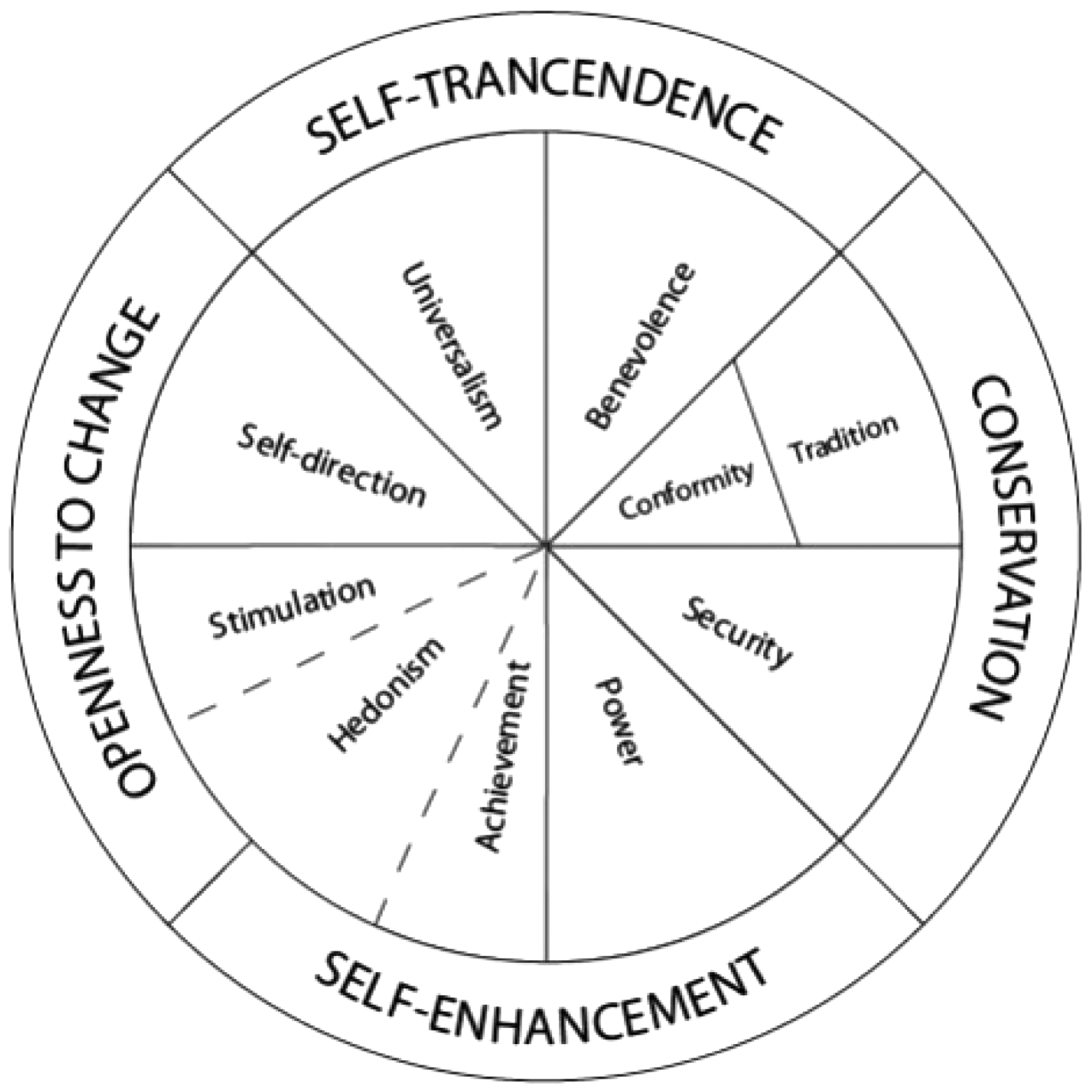
Taiwan has an enormous potential to provide concrete examples in exploring the significant topics of the day – flexible identities, globalization, localization, all coming together in fascinating ways that could be linked to Taiwan’s unique history under Chinese imperial claims, Japanese colonial modernization, the Kuomintang of China’s (KMT) arrival, and US Cold War funding (Moskowitz, 2011). Taiwan’s contemporary popular culture, which includes celebrities and amateurs showing their performances on TV channels and digital environments (e.g. YouTube, Facebook, etc.), especially reflects these colonial and imperialist histories in terms of the norms of identity and gender construction (Castells, 2000). Interestingly, Taiwan’s popular culture is born from its Japanese roots. For example, the Taiwanese’s love for all things ‘cute’ is arguably a direct import from Japan (kawai’i 可爱い(かわいい). In turn Taiwan’s cute (kawai’i) culture links to a widespread fetishization of girlishness, which influences the self-presentations of females (Moskowitz, 2011). In Taiwan, we can frequently see women in their twenties and thirties engaging in cute girlish behavior ranging from giggling to exaggeratedly high-pitch, childlike speech to their clothing choices. Mandopop diva star Jolin Tsai (蔡依林) has become the contemporary diva of this image and has been rewarded with extremely lucrative advertising campaigns as well as movie roles. Taiwanese society creates and sustains this cute perspective on women’s appropriate manner of presenting themselves, as well as men’s expectations from women or their expected actions when imitating women in the digital environments. We argue that gender values continue to be at the center of digital-self construction online. As mentioned above, YouTube is seen as a fantasy-driven space that gives Taiwanese people the freedom to create whatever or whoever they want (Lange, 2007). Men may play different gender roles in order to experience things that they have never been able to experience in the past. Each person’s sense of his/her identity “is an inextricable fusion or melding of personally created (emotionally and through unconscious fantasy) and cultural meaning” (Chodorow, 1996: 217).
Methods
YouTube is an important field of this research conducted to understand how consumers, as amateur performers, construct their digital self, what strategies they devise to achieve digital-self presentation objectives, and how social relations may be created and interacted with online viewers. As such, data collection and subsequent analysis of this data set are strategically diverse. Three types of data are examined in this inquiry: amateur individuals’ YouTube videos; face-to-face, semi-structures long interviews with YouTube amateur performers; and electronic exchanges with participants. The purpose of the content analysis of YouTube videos was to identify ways in which consumers use YouTube to self-construct and self-present. The interviews provided an understanding of how and why participants chose materials, talents, or abilities to display on YouTube videos. Electronic exchanges with participants enabled us to clarify questions arising during data analysis. The sum total of the data is where online and offline data were accumulated, analysed, and presented to form a cohesive story of consumers’ participation on YouTube videos.
YouTube was used to generate a sample of amateur performers’ videos. Researchers’ judgment resulted in a set of 3752 Taiwanese amateur performers’ videos from October 2007 to December 2010. Visual analysis of amateur individuals’ YouTube videos was carried out in accordance with watching consumer presentations and treated as consumer-generated contents.
Participant selection began with amateur individuals’ YouTube videos. First, every tenth individual’s video on YouTube was called up; when possible, researchers left research invitation messages on his/her YouTube comments board. This process generated nine participants who agreed to take part in face-to-face interviews; a second iteration resulted in 11 more participants. The process moved quite slowly because of confidentiality norms, which were being challenged by new digital environments in qualitative inquiry. Traditionally, researchers have been advised to disguise the locations of their fieldwork and change the names of participants by giving them pseudonyms as a way of protecting their identities. However, some participants in this research who insisted on “owning their own stories” and refused to be interviewed (if their ownership was not secured) and challenged it. To resolve this problem, the initial set of identified personal videos was shown to the participants, asking them if they knew any of the performers who are willing to be interviewed in this research. A snowballing technique emerged and 25 more participants were included. In total, 11 female participants and 34 male participants between 16 and 35 years of age were involved in this study. All participants reside in Taiwan. For reasons of confidentiality, all participants are referred to by pseudonyms in the paper.
When participants were successfully identified and interviews scheduled, we downloaded their YouTube videos, coded the contents such as audio, images, icons, gestures, and so forth, and made initial interpretations of these data. The downloading and content coding videos were repeated monthly on the participants’ performances of YouTube videos. Two research assistants, who were trained for a period of two weeks, were responsible for coding the videos. The videos were coded for certain variables. The first stage involved a content analysis of the participants’ performances on YouTube videos. Previous studies that compared and analysed the content of the relevant issues were reviewed (Cheung, 2000; Jin and Park, 2009; Schau and Gilly, 2003) to develop a code sheet for digital self and parasocial interactions. The contents of digital self and parasocial interactions appearing on the participants’ performances on YouTube videos were then analysed to identify new features. After discussions with each other, the two coders resolved any disagreements upon the subset of videos. Next, the different strategies of digital-self presentation were coded. Finally, parasocial interactions and relationship developments were identified. Code-sheet development procedures from previous studies that analysed digital self and parasocial interactions were reviewed (Lindner, 2004) and used as interview references.
Interviews regarding self-construction, self-presentation strategies, and communications with others on YouTube were conducted in person by the author. Initial interviews were done between 2010 and early 2012, which lasted between one and three hours, using online resources. Participants were asked questions about the purpose of their performances on YouTube videos, what they communicate, how they chose materials and stories, and so forth, from a predetermined question set used for all interviews. Follow-up questions and discussions varied by participant and analysis iterations (McCracken, 1988). During the interviews, a computer displayed the participants’ YouTube videos. The researcher also offered preliminary interpretations of YouTube videos to the participant. Participants were encouraged to correct, augment, or otherwise interact with this interpretation of their YouTube videos.
Participants were encouraged to update the researcher(s) on the performances of their YouTube videos. Our interpretation of their YouTube performances was updated and emailed to each participant annually. In most cases, this communication resulted in an exchange between researcher(s) and participants about their YouTube performances. The electronic messages were added to the data set for interpretation and as member checks. Follow-up interviews in 2010, 2011, and 2012 were conducted in person when possible. These participant-researcher encounters clarified issues remaining from the initial interviews, addressed emergent themes through multiple revision efforts, explored digital-self construction and self presentation strategies over time, and furthered our understanding of individuals’ parasocial relations.
The methodology employed was guided by the systematic approach to qualitative research in Strauss and Corbin’s (1998) grounded theory. In this paper, it is better characterized by consumer researchers as the constant comparative method of analysis. The interviews were coded, and themes were distilled. The initial interview was analysed separately and then reinterpreted in a comparative manner. Subsequent interviews were analysed in light of prior interviews and performed in an interview, sometimes labeled the hermeneutic circle of understanding. The hermeneutic endeavor represents an analytical technique emphasizing part-to-whole relationships. These relationships exist on many different levels. Specifically, a single story is interpreted within the context of the text as a whole. The text is analysed and interpreted from the perspective of our conceptual framework of dialectical digital self, parasocial interaction theory, and Taiwanese culture. By going back and forth from single meanings to broader perspective, we were able to form interpretations in context. This iterative movement or dialectical tacking continued until themes useful for constructing a processual theory of digital self and parasocial relationships on YouTube were discovered. Furthermore, triangulation of the different data resources enriches the data set and increases the emic potential of this inquiry. Using amateur individuals’ YouTube videos as consumer-created digital self to augment the interviews allowed participants to influence researcher interpretations. This triangulation brings the researcher a step closer to perceiving the symbols that consumers offer in the manner in which consumers themselves do. By interacting with and observing participants across online and offline situations, we hope to interpret their digital-self construction and self presentation strategies, as well as parasocial relationships on YouTube videos more fully.
Results
In the following discussion, we describe some participants’ stories as they unfolded during the inter-case analysis. We also offer a process of forming digital self and parasocial relationships on YouTube, including the three stages: digital self construction, digital-self presentation strategies, and parasocial relationships that emerged from the inter-case analysis.
Constructing digital self
In the process of constructing digital selves on YouTube, consumption plays a central role. Theoretically, we create a sense of who we are through our consumption. We are through the symbolism that is attached to our consumption choices and activities (Elliott and Percy, 2007). Our data reflect that this embraces our participants, who actively look for symbolic meanings of what an ideal woman or man is like from both lived and mediated experiences. More importantly, our participants possess the skills to draw selectively on mediated experience and interlace it with lived experience in order to appropriate symbolism for constructing a digital self on YouTube videos. For example, ‘Howie’ (21 years old, male, college student) has been a fan of magic shows on TV. Constructing digital self as a magician on YouTube means that his ability surpasses others. As he stated,
Watching TV magic shows has been one of my important hobbies since I was a kid. I want to become a magician due to my adoration of magical powers. I love to imagine and make something come true. I have a dream … My ex-girlfriend’s father is a magician who taught me how to perform well at the magic show. I chose to become a magician to show my special abilities on YouTube.
In my opinion, femininity always matches with long black hair since I am Taiwanese and have watched a lot of movies or TV series that pretty women are like this style. When I wanted to form a female role on YouTube, I though first I needed a wig to highlight my female identity. So I borrowed it from my auntie. Second, cosmetics are important, especially when I wore lipstick. I really felt I am a lady. Finally, wearing my sister’s mini skirt … Everything is done. Perfect!
I wanted to create a Taiwanese version of America’s Next Top Model show. When I tried to construct myself on YouTube and my friends shot me, I was worried whether my appearance looks not oriental beauty, my body is not slim to attract males in our society, and my gestures are not lady-oriented. Not only do I evaluate myself, but also viewers would evaluate me by all of these criterions, right?
I have encountered a lot of bad things in the world … My partner passed away … I only want to present my real (female) identity to memorialize him … A huge pressure pushed down on me when I chose to come out of the closet …
In the beginning, my mother knew I acted a female role on YouTube. She could not accept my female identity. She asked me “Why did you do this? Are you alright? Do you know what you’re doing?” I explained myself to her … Gradually, she tried to understand me and my love affairs … My mother tried to communicate with me … she decided to let me go … All of things seem to pass away.
Strategies of digital-self presentation
The findings reveal that YouTube is inherently conducive to strategic digital-self presentation at a distance. Based on the previous literature and interviews (Bolino and Turnley, 2003; Bolino et al., 2008; Jones and Pittman, 1982), this study further constructs a taxonomy of digital-self presentation strategies on YouTube videos, including: basking, mystification, self-promotion, and gender-switching. The following are the main strategies our participants devised to achieve digital-self presentation objectives.
Basking strategy
Basking strategy is defined as how actors/performers enhance their image by claiming association with prestige figures (Bolino et al., 2008). In our data, basking is one of the most popular strategies for our participants to adopt in presenting their digital self on YouTube. Some participants initially draw attention to themselves through connections with popular or successful celebrities (Moskowitz, 2011). They imitate their performances and impression management activities by association. Image by association refers to the behaviors (i.e. actions, tone, or sense of style) the participants show in their original videos in order to manage their associations with celebrities and to create more favorable images for themselves. For example, ‘Rene’ (19 years old, female college student) stated, “I love to have my hair cut like 7-11 commercial model Ms. Kua’s short hair. My hair style was totally copied from hers. She is adorable …”. ‘Mark’ (28 years old, male, an assistant at work) is another typical example in explaining the way he learned from celebrities how to manage his positive impressions. As expressed by him,
The most important thing is to copy the original concept from celebrities’ works, and then input my own factors or ideas to revise them. It might look like celebrities’ works but I only borrow from high-profile celebrities to enhance my ideas.
I admire his good shape (Alexander Wang) … He is very handsome and professional … I have always wanted to be like him so I copied his recent Ad concept and uploaded that to YouTube. Ha ha ha … some online viewers left messages saying I look a lot like him and that my performance is as good as his. I am so happy to hear that.
Mystification strategy
YouTube also allows for a greater mystification, that is, for a greater distance between how performers manage themselves and their audiences. The audience’s lack of access to the offline backstage of the performance creates much greater potential for mystification. Our participants on YouTube videos can therefore easily hide aspects of their offline persona that they do not want known by others, while emphasizing other aspects they deem presentable. Such presentation of new or possible digital selves is apparently freed from the constraints of the offline world (Schau and Gilly, 2003). For example, ‘Hank’ (32 years old, working man; mixing mystification with gender-switching strategies) only showed his soft and beautiful woman-like voice along with images from the famous Japanese female singer Utada Hikaru. To his surprise, a great number of online viewers offered him praise and encouraged him to sing more of her songs,
I felt so happy when my voice, imitating Utada Hikaru, was accepted by a lot of online viewers on YouTube. They left messages to me saying ”You are so great!!” These messages really touched my heart.
Self-promotion strategy
Self-promotion is defined as the act of seeking to be viewed as competent by touting an individual’s abilities and accomplishments (Bolino and Turnley, 2003). Systematically analysing our data, these abilities and accomplishments include singing, dancing, playing in a band, playing an instrument, or being good at sports as well as executing values or beliefs on our participants’ original YouTube videos. For example, ‘Gary’ (23 years old, male, college student) was happy that YouTube provided a great platform for him and his band to digitally present their specialties and find his potential self (Belk, 1988). As Gary said, “Through YouTube performances, I seem to take on another personality. It breaks me out of the cocoon. In this way, I gain more confidence to promote my band and myself.” Self-promotion strategy goes beyond claims of competence and requires framing of performances. While maintaining a good impression, our findings are similar to previous studies showing that individuals selected ideal or perfect gestures as well as behaviors to be shot (Bortree, 2005). Some participants like ‘Jack’ (27 years old, salesman) use technical skills to revise their appearances on original YouTube videos in order to match their personal expectation. As Jack stated,
I shot an advertisement, showing on YouTube … . You know I need to promote myself so I have revised my appearances and posted certain gestures learned through the mirror to show “ideal me” on my YouTube videos …
Gender-switching strategy
As stated earlier, digital environments (e.g. YouTube) are seen to be filled with tales of masks for age, gender, race, and class; as well as masks for almost every aspect of identity (Turkle, 1995). The development of whimsical identity is encouraged. Different strategies of digital-self presentation are often adopted to disclose or hide personal information, and further supplant it with modified details more congruent with a desirable image (Schau and Gilly, 2003). The findings somewhat echo that digital environments (e.g. YouTube) free our participants from their corporeal selves, allowing for new designations of gender, physical form, and unlimited symbolic materials to digitally self-present (O’Brien, 1999). Our data also found that gender-switching strategy is viewed as playfulness, which is viewed as unserious, untrue, pretense, make-believe, unreal, and so forth. In the views of some participants, adopting a gender-switching strategy to present digital self is seen as non-threatening to the social orders. One of typical cases is ‘Albert’ (20 years old, male, college student; combining gender-switching strategy with basking strategy), who claimed, “No pressure to me! I feel I am ‘Jolin’ Tsai [a famous pop idol in Taiwan].” Although the majority of his classmates questioned him that, “You are obviously handsome! Why did you play a female? What’s wrong with you?” and some classmates even felt sorry to say, “It’s a pity that you don’t want to be a man,” Albert does not think so. The reason is simple, he explained that “I am happy to be ‘Queen Jolin’”. The findings further show that adopting gender-switching strategy allows individuals projecting them to experience a greater diversity of themselves (Lange, 2007). ‘Robin’ (22 years old, male, college student; also combining gender-switching strategy with basking strategy) freed himself to experience the performances of ‘her’ idols. He emphasized,
Like other gender-switching performers, our favorite idols seem to be Jolin Tsai [a Taiwanese pop singer and dancer], Beyoncé Giselle Knowles-Carter [an American singer, dancer, and actress], and Ayumi Hamasaki [a Japanese recording artist, lyricist, model, and actress]. I copied their gestures and manners which make me feel good. I enjoyed being versatile.
When I uploaded my appearance as a man with the same voice, all of the YouTube viewers became crazed and angry … . Some replied “That’s outrageous, when I saw your face.” Others said, “It’s disgusting, when I knew you’re a man.” I felt frustrated and depressed …
Parasocial relationships on YouTube
The data also confirm that our participants in YouTube videos are like traditional TV characters who can arouse viewers to parasocially make more friends and socialize with them (Kanazawa, 2002). Profoundly, most participants who try to present digital selves on YouTube are heavily involved in eliciting desirable digital-self images. For example, Nicole (17 years old, female, high school student) and ‘Charles’ (24 years old, male, graduate student) claimed they are so picky that presenting digital-self images on YouTube should first satisfy themselves. Otherwise, it would not be shown. As Nicole said, “Sometimes I review my films several times. If I thought they are not good enough, I deleted them and replayed my performances.” To parasocially interact with online viewers, the click rating of their videos becomes an essential metric that illustrates direct viewer feedback. In this context, our participants imagine that the click rating is how many viewers watch their performances, and also reflects upon how parasocial relationships are becoming established. ‘Margaret’ (21 years old, female, college student) identified the cause and effect of parasocial relationship developments, “The higher click rating is … , the more people are watching my film. Especially, the more people left messages to me, the more famous I am.” Based on parasocial interaction theory (Horton and Wohl, 1956; Jin and Park, 2009), our data supports that click rates are seen as a parasocial response that contributes to social relationships (Rubin and Rubin, 2001). For online amateur performers, the click rating sounds like watching viewers. When viewers form positive attitudes towards them, they gain confidence to develop parasocial relationships with viewers. As ‘George’ (35 years old, salesman) further elaborated the symbolic meaning of the rating, “It means my efforts have been seen or my abilities attract someone’s attention. It gained my confidence to keep presenting my ideas. I wish I can do better.” Furthermore, the findings indicate that, from the strong feelings of viewers repeatedly and parasocially interacting with the participants, they would gain increased attributional confidence about their digital personality (Giles, 2002). For instance, ‘Adam’ (22, male, college student) impressed his online viewers with his special magic skills and ‘Clare’ (27 years old, female, specialist) triggered her viewers by showing her dancing skills. As a result, Adam happily reported that “Some viewers asked me to teach them, while others suggested that I publish a magic book.” Clare nicely described how joyful she was when people in the world watched her dancing performances on YouTube,
One day, a Mexican guy contacted me and said he really liked my dance. He had kept contacting with me for several months. We enjoyed discussing about how to dance and exchange some ideas … I am so happy. You know this is absolutely heavenly. I have fans from all over the world.
More importantly, our participants know that some fan communities have been formed online to support their ideas, abilities, skills, talents, or performances. For example, Eric (16 years old, male, high school student; combining gender-switching with basking strategies) really enjoyed this kind of atmosphere,
Once I went to a temple for worship, someone recognized me and asked “Are you a dancing girl on YouTube? May I shake hands with you? May I take a photo with you?” I admitted that it was weird at first and gradually I felt “It is so good to become somebody’s idol”. Now, the more people want to join my fans online, the happier I feel.
No matter what strategies we use, the final goal is to extend our social influence. After all, we want to be famous … Today, when I upload my personal performances or images onto YouTube, there are at least one million people in the world who can see me. The impact is more than any TV show in Taiwan could ever produce.
My online fans are not limited within Taiwan … You know YouTube is worldwide so some are foreigners … They sent messages saying, “Your magic show some day will be better than the magic of David Blaine …” Who knows? Maybe someday I will actually become the best in the world.
Conclusions
Our data demonstrate that YouTube is a consumer narrative where multiple digital selves and parasocial relationships are made comprehensible. In the process of constructing digital selves on YouTube videos, consumption comes to play a central role. Gender is a fundamental social category that marketers use in marketing to distinguish between people. Inevitably, we find that the construction of digital gender identity is an essential component of a self-completion project on a YouTube video. The digital selves produced by our participants are certainly not inconsistent with the self of their real lives. Previous studies claim that consumers see digital environments as fantasy-driven spaces (e.g. YouTube) where anything goes. However, our findings are that YouTube is in someway liberating, enabling men and women to freely construct or reconstruct multiple digital selves by lived and mediated experiences. These experiences involve symbolic meanings either from Taiwanese cultural values (e.g. honoring parents and elders, obedience, reciprocation of favors, or sense of belonging) (Schwartz, 1992; Solomon, 2009) or jumping out from traditional gender values (e.g. cute girlishness) to freely express emotions (Moskowitz, 2011) and parasocially interact with the desired impression (Goldberg and Allen, 2008).
Furthermore, our participants thoughtfully considered which performances of their multiple digital selves to disclose. Consistent with Moon (2000), the findings highlight that YouTube is inherently conducive to strategic self-presentation at a distance. The findings highlight that the participants via YouTube videos are like traditional TV characters who can arouse viewers to parasocially make more friends and socialize with them (Kanazawa, 2002). Strong feelings from viewers repeatedly and parasocially interacting with the participants would gain them increased attributional confidence about their digital personality (Giles, 2002). This paper further constructs a taxonomy of digital-self presentation strategies on YouTube videos, including basking, mystification, self-promotion, and gender-switching. Prior studies state that cyber theory about behavior online has tended to over-rely on specific fantasies in digital environments, separating online experiences from offline (real) lives (Wilbur, 1997). For long-term observations and interviews, we find that our participants on YouTube are keen to adopt mystification strategy or combining mystification with gender-switching strategies. The results also present that digital-self presentation success on YouTube videos is associated with important physical associations. These patterns suggest that both idealization and selective digital-self presentation are occurring when a mystification strategy or strategies in combination are successfully adopted. When successfully adopted, self-images depend on the success of one’s digital-self presentation. When appearances or important parts of physical associations were shown, however, digital-self presentation was positively correlated with cultural gender values or stereotypes (Castells, 2000).
Conceptually, this study unfolds the complex process of forming digital self and parasocial relationships on YouTube including three main phases (See Figure 2): digital-self construction, digital-self presentation strategies, and parasocial relationship developments that emerged from the inter-case analysis. Each phase symbolizes evolving positions of the digital self on YouTube. Initially, the digital self embraces a prescribed existence of having been filled with routinized patterns of life formed by mediated experiences and pre-determined ways of leading life (Elliott and Percy, 2007). At times, the digital self is reflexive on normative constraints, questions its existence and meanings of the self, and seeks for a potential style of being (Belk, 1988). Further, consumers continuously adopt one or more strategies to achieve self-presentation objectives. It is through the tension between freedom and constraints, and more significantly between having and being that consumer digital selves are created, transformed, and appropriated on YouTube videos. These parasocial interactions are lived, challenging, and difficult; operating through all digital social practices. Eventually, parasocial relationships emerge and develop through consumers’ digital-self impression management. More importantly, the findings suggest that offline experiences are woven into the fabric of online behaviors and echo O’Brien’s (1999: 95) view that “when persons enter cyberspace they bring with them preformulated cultural scripts that they use to map the new territory.” Regarding managerial implications, marketers must acknowledge that YouTube is the tool that consumers use to digitally self-construct, self-present, and parasocially develop social relations. We suggest that YouTube is a set of cultural values in terms of symbolic meanings in everyday life which are vital for consumers to construct and present multiple digital selves and develop parasocial relationships with others everywhere.
The process of forming digital self and parasocial relationships on YouTube.
Footnotes
Declaration of Conflicting Interests
The author(s) declared no potential conflicts of interest with respect to the research, authorship, and/or publication of this article.
Funding
The author(s) received no financial support for the research, authorship, and/or publication of this article.