



Abstract
Despite the presumed national economic benefits that result from high levels of discretionary spending, past studies suggest that material consumption decreases individual economic and subjective well-being. However, most research on the development of materialistic values has examined how persuasive materialistic messages cause materialism. We recruited 2702 participants to test our prediction that living in wealthy neighborhoods should increase material desires and maladaptive consumption in much the same way it decreases happiness. Interestingly, our regression models revealed that individual socioeconomic status (SES) and neighborhood SES have unique, and opposite, predictive patterns of material consumption. Specifically, after controlling for age, gender, and population size, greater neighborhood SES predicted greater desires for material consumption, more impulsive buying, and fewer savings behaviors while individual SES showed the reverse pattern. Our path model suggests that greater neighborhood SES leads to increased material desires, which then predicts more frequent impulsive buying, and fewer savings behaviors. We discuss why neighborhood SES might change values and consumer behaviors.
Introduction
Happiness is a state that facilitates many positive outcomes (Fredrickson, 2001; Lyubomirsky et al., 2005) and its pursuit is widespread (Myers, 2000). Among the strategies commonly assumed to bring happiness is the acquisition of material possessions (Kasser et al., 2007). This emphasis on possessions is often referred to as materialism, “the importance a consumer attaches to worldly possessions” (Belk, 1984: 291) or “a set of centrally held beliefs about the importance of possessions in one’s life” (Richins and Dawson, 1992: 308). The US Department of Labor (2012) reported that the average annual household expenditure for 2011 was $50,486, or roughly 80% of mean annual household income ($63,563). Of this, basic necessities (e.g. housing, food, and shelter) accounted for 47% of total expenditures, while 26% of expenditures related to discretionary items (e.g. durable goods, alcoholic beverages, apparel and services, transportation, entertainment, etc.). Also, materialistic values are almost universally predictive of one’s frequency of purchase of luxury products (including apparel, electronics, appliances, and automobiles (see Cleveland et al., 2009)).
However, while many consumers believe that material consumption will lead to greater happiness, there is considerable evidence that materialistic individuals have lower self-esteem, less happiness and life satisfaction, poorer interpersonal relationships, higher levels of anxiety and depression, a higher tendency for antisocial behavior, and a higher incidence of health-related problems (Belk, 1984; Burroughs and Rindfleisch, 2002; Dean et al., 2007; Howell and Hill, 2009; Kashdan and Breen, 2007; Kasser, 2003; Kasser and Ryan, 1993; Kasser and Sheldon, 2000; Richins and Dawson, 1992; Wright and Larsen, 1993). Moreover, materialists have a higher prevalence of maladaptive consumption behaviors such as compulsive buying, overspending, and over-borrowing (Dittmar, 2005; Roberts et al., 2008; Yurchisin and Johnson, 2004). Materialistic values fully mediated the link between age and compulsive buying for very materialistic individuals (Dittmar, 2005), and those with high materialistic values are more likely to have a favorable attitude toward borrowing money, more likely to use installment credits, more likely to buy luxury items, and are more likely to possess loans above $1000 (Watson, 2003).
Given the significance of the negative implications of materialism, there is a considerable interest in understanding why some individuals are more materialistic than others (Chang and Arkin, 2002). We suggest, because neighborhood and residential characteristics are known to influence, well-being, values, and behaviors (Luttmer, 2005; Park and Peterson, 2010) and people evaluate their economic circumstances in comparison with other people who have more, (Jencks and Mayer, 1990) that neighborhood socioeconomic status (SES) – as indexed as the number of financial institutions, per capita income, and poverty rate (Dubowitz et al., 2008; Estabrooks et al., 2003; Wen et al., 2006) – predicts material values and its financial consumptions. Specifically, we hypothesize that increased neighborhood SES predicts increased material desires and maladaptive consumption (i.e. increased compulsive and impulsive buying as well as decreased savings behaviors) independent of an individual’s SES.
The antecedents of materialism
Over the past few decades, numerous antecedents of material consumption have been examined (e.g. economic deprivation, parental materialism, disrupted familial structure, and non-nurturing familial environment). Specifically, many studies have focused on the life circumstances of an individual (e.g. gender, education, age); however, the links from demographic characteristics to material values have been inconsistent. For example, in China, males are more materialistic than females, but there is no gender difference in Mexico or the US (Eastman et al., 1997, also see Christopher and Schlenker, 2004; Christopher et al., 2009). There also appears to be no consistent relation between education and materialism (Promislo et al., 2010; Richins and Dawson, 1992). Interestingly, as far as life circumstances are concerned, only one’s age appears to predict material values—materialism, consistently, though weakly, decreases with age (see Belk, 1985; Christopher et al., 2009; Promislo et al., 2010; Roberts and Clement; 2007). However, while current life circumstances do not strongly affect material values, insecurity and interpersonal persuasion are both associated with increased material desires.
Importantly, there is robust evidence that materialistic values are associated with lower levels of self-esteem (Chaplin and John, 2007), higher social anxiety (Schroeder and Dugal, 1995), higher self-doubt (Chang and Arkin, 2002), and higher childhood insecurity, in terms of family disruption or having non-nurturing caregivers (Kasser et al., 1995; Rindfleisch et al., 1997). For example, Chang and Arkin (2002) found that people who are primed with self-doubt-related words are more likely to endorse materialistic values than people who are primed with neutral words. Also, materialists purchase with the motivation to attain interpersonal goals and increase their self-esteem (O’Guinn and Faber, 1989). Finally, existential insecurity is shown to be a predictor of materialism (Rindfleisch et al., 2009)—specifically, materialistic individuals form strong connections to their brands as a response to existential insecurity.
Further, according to the model of materialistic value orientation (see Kasser et al., 2004), material values develop, in part, as a result of exposure to materialistic modeling and persuasive messages, made by family members, peers, television programs, celebrities, and advertisements. Specifically, children and adolescents consumer socialization is guided by both direct parental and peer influences (via explicit brand or product consumption, decision-making, family communication structure, and peer communication about consumption) as well as passive influences such as supervision of media exposure (see Benmoyal-Bouzaglo and Moschis, 2010; Chan and McNeal, 2003; Moore and Moschis, 1981; Nguyen et al., 2009). In the US, China, and Japan, positive attitudes towards advertising are correlated with materialistic values (Osmonbekov et al., 2009). Also, increases in adolescents’ exposure to consumer messages leads to more conspicuous consumption and materialistic attitudes as young adults (Benmoyal-Bouzaglo and Moschis, 2010; Moschis and Churchill, 1978; Sirgy, 1998), especially when adolescents do not communicate with their family about consumption (Moschis and Moore, 1982).
Can neighborhood socioeconomic status increase material consumption?
While past research demonstrates a robust link from insecurity and materialistic messaging to material values and material consumption, one important question remains unanswered: how does insecurity develop and why does exposure to materialistic messaging encourage material consumption? We suggest that relative deprivation (i.e. deprivation in comparison with other people) could lead to feelings of relational insecurity, which would make a person more susceptible to materialistic messages, many of which promise social acceptance, popularity, and belongingness. For instance, Bauman (1998) theorizes that, compared to past industrial societies where individuals’ senses of fulfillment and self-esteem came from their work, individuals living in modern-day societies rely on material consumption as the main determinant of their self-worth.
This is especially true for the poor. According to Bauman, the ‘normal life’ in a consumer society is marked by both the desire to consume and the ability to consume, choosing from “among the panoply of publicly displayed opportunities for pleasurable sensations and lively experiences” (Bauman, 1998: 38). On a daily basis, this ‘normal life’ is marketed to everyone through every possible method (e.g. advertisements, promotions, etc.). The dazzling, lavish objects are the epitome of success and fame, a necessary condition for normality and happiness. These messages, however, do not discriminate on the basis of status, and are seen by both the rich and the poor. Yet, the poor, while having material aspirations, often lack the resources to realize those aspirations. The inability to acquire what is necessary to be considered ‘normal’ in society creates feelings of inadequacy, humiliation, and relative deprivation. Unavoidably, it is these exact feelings of needing to belong and be ‘normal’ that drive the poor to be susceptible to consumer messages, and to consume beyond their means. ‘Flawed consumers’, as Bauman describes them, lack sufficient income to achieve ‘normality’, which ultimately reinforces their socio-economic disparity.
This assertion that the poor are motivated to consume is based on the strong link between lower economic status and material desires. For example, Kasser et al. (1995) found that teenagers from families with low SES placed a higher value on future attainment of material success relative to attainment of prosocial and growth-oriented goals. Chang and Arkin (2002) found that low familial SES positively predicted acquisition centrality or the importance of acquiring material possessions (Richins and Dawson, 1992). In a sample of Indian college students, Singhal and Misra (1992) found that participants from lower castes expressed more distress about not being able to attain materialistic goals than students from higher castes. Finally, recent studies have demonstrated, across various cultures, that lower socioeconomic standing leads to increased materialistic aspirations (Benmoyal-Bouzaglo and Moschis, 2010; Moschis et al., 2009; Nguyen et al., 2009). Thus, these studies provide evidence that smaller financial resources may lead to stronger desires for material consumption.
Although one’s individual SES is associated with material desires, we expect that one’s neighborhood wealth could impact feelings of deprivation (which would then impact material desires and consumption). First, neighborhood and residential characteristics influence well-being, values, and behaviors. For instance, higher neighborhood SES (e.g. per capita income) is associated with greater physical activity resources (e.g. parks, sports facilities (Estabrooks et al., 2003)) and greater fruit and vegetable consumption (Dubowitz et al., 2008). Also, lower neighborhood SES is associated with lower self-efficacy (Boardman and Robert, 2000) as well as increased drug use, social stress (e.g. less family contact), and psychological distress (Boardman et al., 2001). Further, teenagers from low SES neighborhoods display greater impulsivity, as measured by a variety of impulsivity tasks (Lynam et al., 2000).
Thus, it would appear that unhappy people and individuals with materialistic values should either be poor or live in poverty. However, Luttmer (2005) demonstrated that, even after controlling for individual income, living among wealthier neighbors was associated with decreased happiness. How can we explain this? We believe this is because when individuals live in wealthy neighborhoods they experience relative deprivation. As people tend to evaluate their economic circumstances, not in terms of whether they have enough to live in comfort, but in comparison with other people who have more, especially when resources are unevenly distributed (Jencks and Mayer, 1990), even relatively affluent people can feel poor when they compare themselves with the very rich (Csikszentmihalyi, 1999). Thorbecke (2006) suggests that children can feel relative deprivation when their families cannot afford the same material possessions as families of other children in their school or neighborhoods. This explains how people can live in affluent neighborhoods and be less happy and satisfied with their lives. Therefore, given that relative deprivation has stronger negative implications for physical and psychological health than absolute deprivation (Lhila and Simon, 2010; Wilkinson, 1997), we believe that relative deprivation can result from living in wealthier neighborhoods and, thus, increased neighborhood wealth should increase material desires and maladaptive consumption in much the same way it decreases happiness.
Current research
In this study we examine if neighborhood SES is associated with material values and maladaptive consumption in a large cross-sectional sample. This hypothesis extends prior work by investigating whether living in a wealthy environment increases materialism. Further, if neighborhood SES is an important predictor of individuals’ materialism, then we expect that it will predict materialism independent of individual socioeconomic standing in much the same way that Luttmer (2005) demonstrated that, even after controlling for individual income, living among wealthier neighbors is associated with decreased happiness. For this reason, we controlled for age, gender, and individual SES (Donnelly et al., 2013; Howell et al., 2012) in order to determine the unique relation between neighborhood SES and materialism.
Method
Procedure and participants
We recruited 2702 participants combined from popular social media websites (e.g. Craigslist, Facebook, emails) and student samples (n = 1379, 51%) between the summer and fall of 2009. The validity of web-based surveys has been confirmed by Gosling et al. (2004) as well as Chang and Krosnick (2003). However, we note that our sample, like many web-based studies, is not nationally representative as most participants lived on the West and East Coasts. Participants included 1991 females (73.7%) and 689 males (22 individuals did not report gender), who completed one of two surveys. The mean age of the sample was 30.45 (SD = 12.98), and the sample was ethnically diverse (53.6% Caucasian, 17.4% Asian American, 10.3% Hispanic, 8.1% multi-racial, 5.5% African American, 3.1% South Asian/Indian, 1.2% Native American, and 0.9% other). In all, the sample represented 1258 unique residential ZIP codes in the US. 1 This research was approved by the Institutional Review Board at San Francisco State University.
Measures
Individual socioeconomic status
Because the most widely employed measures of individual socioeconomic standing (e.g. income, education, and occupational prestige; see Adler et al. (2000) and Oakes and Rossi (2003)) do not utilize many important indicators of financial status that are important to financial security (e.g. savings, investments, debt; see Howell et al. (2012)), we assessed individual SES by asking participants to complete a five-question scale used by both Howell et al. (2012) and Donnelly et al. (2012).
The first three questions asked about assets: (a) “What is your income after taxes are taken out for all members of your household? (1 = $0–$5000, 2 = $5001–$10,000, 3 = $10,001–$20,000, 4 = $20,001–$30,000 5 = $30,001–$75,000, 6 = $75,001–$100,000, and 7 = over $100,001)” (M = 4.04, SD = 1.87); (b) “What is the amount in all your savings and money market accounts? (1 = none or less than $100, 2 = $101–$500, 3 = $501–$1000, 4 = $1,001–$2500, 5 = $2501–$5000, 6 = $5001–$10,000, and 7 = over $10,001) (M = 3.97, SD = 2.17); (c) “What is the amount in all your investments? (1 = none or less than $100, 2 = $101–$500, 3 = $501–$1000, 4 = $1001–$2500, 5 = $2501–$5000, 6 = $5001–$10,000, and 7 = over $10,001)” (M = 3.09, SD = 2.46). The last two questions asked about credit card debt: (a) “During the past year, how many of your credit cards have carried half or more of the maximum balance?” (M = 2.74, SD = 1.98), and (b) “Of those, how many of your credit cards have carried the maximum balance (maxed out) during the past year?” (M = 1.62, SD = 0.93). We reverse-scored items d and e. The standardized mean of the five questions was computed for each participant to form their individual economic standing.
Neighborhood socioeconomic status
We assessed neighborhood SES by examining the number of financial institutions, per capita income, and poverty rate (Boardman and Robert, 2000; Lantz and Pritchard, 2010; Wen et al., 2006) by ZIP code. The number of financial institutions was expected to be an adequate marker of neighborhood SES because it is positively correlated with income growth and reduced poverty (Li et al., 1998; Jalilian and Kirkpatrick, 2002).
The financial institutions variable was computed by summing the total number of banking institutions and financial service businesses within each residential ZIP code (Mdn = 47.00, SD = 70.66). The number of banking institutions in each ZIP code (Mdn = 7) was determined from the Federal Deposit Insurance Corporation (FDIC) website (http://www3.fdic.gov/idasp//main.asp). The number of financial service businesses in each ZIP code (Mdn = 40) was found through the US Census Bureau Database (http://censtats.census.gov/cbpnaic/cbpnaic.shtml). Median per capita income (Mdn = $23,036, SD = $12,123.91) and the percentage of individuals below the poverty level (i.e. poverty rate, 14.8%) per residential ZIP code were obtained from the US Census Bureau Factsheet (http://factfinder.census.gov/servlet/SAFFFacts). These two variables were standardized, the poverty rate was reverse-coded, and they were combined to represent the local income standing of each ZIP code (r = .48).
The neighborhood SES variable was defined as the mean of standardized local income standing and financial institutions indicators. The pattern of correlations between financial institutions, median per capita income, and poverty rate was as predicted (all correlations significant at p < .05): (a) the number of financial institutions was positively correlated with median per capita income (r = .30) and negatively correlated with poverty rate (r = −.09), and (b) median per capita income was negatively correlated with poverty rate (r = −.50).
Materialism
The fifteen-item Materialistic Values Scale (MVS; Richins and Dawson, 1992; Richins et al., 2004) measures the degree to which individuals endorse materialistic values from 0 (strongly disagree) to 4 (strongly agree). The materialism variable (M = 2.77, SD = 0.64, α = .77) was computed by combining the three subscales: define success (“I admire people who own expensive homes, cars, and clothes”; M = 2.55, SD = 0.76), acquisition centrality (“I like a lot of luxury in my life”; M = 2.95, SD = 0.70), and pursuit of happiness (“My life would be better if I owned certain things that I don’t have”; M = 2.89, SD = 0.82).
Money ethics
The twelve-item Money Ethics Scale – Short (MES-S; Tang, (1995)) was administered to assess attitudes toward money. Participants responded on a 7-point scale (1 = strongly disagree, 7 = strongly agree). The MES-S contains three facets that measure (a) success (a cognitive component; e.g. “money is a symbol of success”; M = 4.18, SD = 1.10; α = .81); (b) budget (a behavioral component; e.g. “I budget my money well”; M = 4.59, SD = 1.50; α = .75); and (c) evil (an affective component; e.g. “money is the root of all evil”; M = 3.47, SD = 1.68; α = .83).
Impulsive buying
The twenty-item Impulsive Buying Tendency Scale (IBTS; Verplanken and Herabadi, 2001) measures the degree to which individuals make impulsive purchases. Participants responded on a 5-point scale from 1 (strongly disagree) to 5 (strongly agree) (M = 2.54, SD = 0.64; α = .78).
Money conservation
We administered the 11-item Money Conservation Scale to determine the degree to which individuals save their money (see Troisi et al., 2006). Participants responded on a 7-point scale from 1 (strongly disagree) to 7 (strongly agree) (M = 4.77, SD = 1.20; α = .86).
Results
Predicting materialism, impulsive buying, and money conservation
Partial correlations for financial institutions and local economic standing with materialism, attitudes toward money, impulsive buying tendency, and money conservation, controlling for individual economic standing, gender, age, and ZIP code population.

More participants completed the material values scale, impulsive buying tendency scale, and money conservation scale (n = 2482) than the money ethics scale–short (n = 1359) due to the first three scales being included on two different web-based surveys. *p < .05; **p < .001.
Predicting materialism, impulsive buying tendency, and saving behavior from individual socioeconomic standing and local economy.

In predicting materialism, (F [5, 1270] = 16.15, p < .001; R = .25); in predicting impulsive buying tendency (F [5, 1270] = 28.10, p < .001; R = .32); in predicting savings behavior (F [5, 1279] = 37.64; p < .001; R = .36). *p < .05; **p < .001.
A path model of direct and indirect effects
We investigated whether individual SES and neighborhood SES independently influenced materialism, impulsive buying, and savings behaviors by specifying and testing a series of nested path models (Amos Version 17.0). Guided by past findings that materialism leads to impulsive buying (Otero-Lopez et al., 2011; Roberts et al., 2008) and fewer savings behaviors (Watson, 2003), we employed path analysis to determine the direct and indirect effects (through materialism) of individual SES and neighborhood SES on impulsive buying and savings behaviors. We followed the guidelines of Stage et al. (2004) for reporting results of path models and determined the fit of the path model by examining: (a) the Normed Fit Index (NFI), which demonstrates good fit when the NFI value is above .95; (b) the Tucker Lewis Index (TLI), which has interpretations similar to those of the NFI; and (c) the root-mean-squared error of approximation (RMSEA), which demonstrates good fit when the RMSEA is below .05.
The path coefficients for the most parsimonious model are shown in Figure 1 (all path coefficients are significant at p < .001). In this model, the indices of model fit indicate excellent goodness-of-fit (NFI = .99; TLI = .97; RMSEA = .04). This model demonstrates that, as individual SES increased, individuals were less likely to buy impulsively and were more likely to engage in savings behaviors. Also, these direct effects were much stronger than the indirect effects through materialism. More importantly, the effects of neighborhood SES on impulsive buying tendencies and savings behaviors were fully mediated by materialism, and the signs are in the opposite direction to that which we observed with individual SES. That is, as a neighborhood becomes wealthier, individual materialism increases and, in turn, is associated with increased impulsive buying tendencies and reduced savings behaviors.
Path analysis examined the direct and indirect effects of individual socioeconomic standing and local economy on impulsive buying tendency and savings behavior. In this model, the indices of model fit indicate excellent goodness-of-fit (NFI = .99; TLI = .97; RMSEA = .04; all path coefficients are significant at p < .001). This model demonstrated that the effects of local economy on impulsive buying tendency and savings behavior are fully mediated by materialism. Further, the strength of the effects is in the opposite direction to individual socioeconomic standing. As residential socioeconomic standing increased, so did one’s materialism, and in turn predicted increased impulsive buying tendency and decreased savings behavior.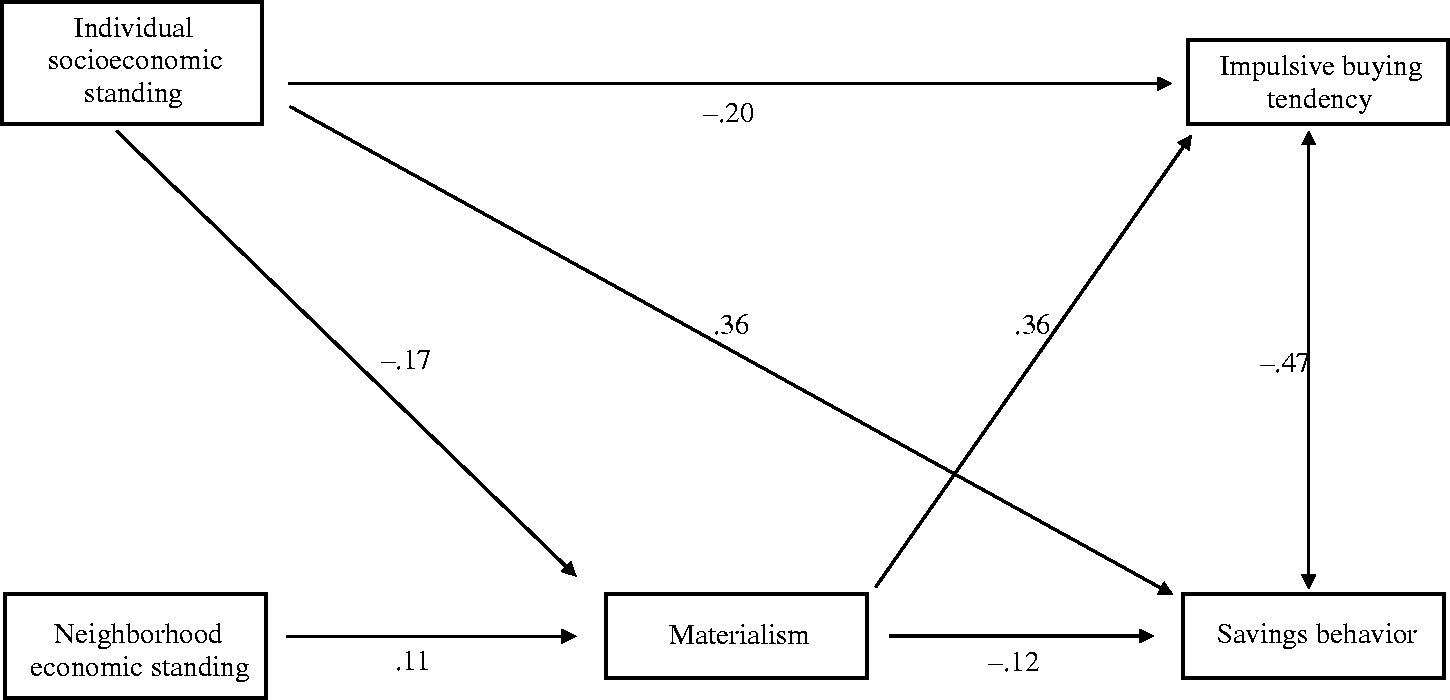
Discussion
Humanistic theorists have long argued that an overemphasis on material comfort and consumption (i.e. material values) prevents individuals from reaching their full human potential, undermines interpersonal relationships, and causes alienation and discontent (Fromm, 1976; Maslow, 1954). Also, numerous studies have demonstrated that insecurity and materialistic messaging increases material desires (see Kasser (2003) for a complete review). However, how insecurity develops and why exposure to materialistic messaging encourages material consumption remains an open question. Further, while most past materialism research focuses on specific demographic (e.g. age, gender) and psychological (e.g. anxiety, distress, insecurity) predictors of material values, few studies have examined the predictive validity of neighborhood characteristics on material desires or consumption. Therefore, because of the strong link between economic status and material desires, as well as the robust evidence that neighborhood and residential characteristics influence well-being, values, and behaviors, the current investigation examined the impact of neighborhood SES on material values and maladaptive consumer behaviors. In sum, greater neighborhood SES predicted greater desires for material consumption, more impulsive buying, and fewer savings behaviors while individual SES showed the opposite pattern.
The unique effect of one’s neighborhood on values and behaviors
Given the growing consensus that socio-demographic variables impact important outcomes (e.g. neighborhood playgrounds, fast food restaurants (Burdette and Whitaker, 2004), and crime rates (Foster and Giles-Corti, 2008) predict obesity in children and physical activity, respectively), the present research extends this research to demonstrate neighborhood SES also predicts material desires and financial consumptions. These past studies, together with the current results, indicated that the financial characteristics of one’s local environment may give rise to materialistic desires. However, most importantly, our results suggest that increases in individuals’ and neighborhood economic status have opposite effects on material desires and consumption patterns.
This is consistent with recent studies that demonstrated one’s individual and neighborhood SES are both independently associated with health and psychological outcomes (Chen and Paterson, 2006; McGrath et al., 2006; Santiago et al., 2011). For instance, Chen and Paterson (2006) found that four indices of neighborhood SES (education, employment, income, and housing value) significantly predicted adolescents’ body mass index (indicator of obesity) and cortisol level (indicator of stress) above and beyond their respective individual SES. Moreover, neighborhood SES predicted greater emotional and behavior problems in low-income families one year later, even after controlling for individual SES (Santiago et al., 2011). Together with the results from the current study, we believe that neighborhood SES is a critical predictor of well-being and consumer behavior. For this reason, we advocate additional work to further determine how and why neighborhood SES influences psychological consequences.
Why do neighborhood characteristic impact material values and consumer behaviors?
Our results support previous research and strengthen the claim that neighborhood and residential characteristics influence well-being, values, and behaviors—however, though these effects are robust, further research is required to determine why neighborhood SES predicts values and consumer behaviors (specifically, material values). We turn to past research to suggest some possible underlying mechanisms.
First, previous researchers have argued that neighborhood SES is intimately associated with the material and psychosocial environments of the community (Kim, 2008). In one study, researchers found that residential and commercial building deterioration mediated the relationships between (a) lower neighborhood social capital, and (b) higher fear of crime with higher individual depressive symptoms (Kruger et al., 2007). Therefore, we believe it is possible that living in a wealthier neighborhood may result in being exposed to a larger number of institutions that highlight, or even explicitly promote, material consumptions (e.g. shopping centers). As recent experimental work has shown that simple reminders of consumption-related concepts can increase materialistic desires (Bauer et al., 2012), we would expect that daily exposure to materialistic messaging as a result of living in wealthy residential areas, in turn, should encourage material desires and consumption. Further, increases in adolescents’ exposure to consumer messages in advertisements can lead teenagers toward more conspicuous consumption and materialistic attitudes as young adults (Benmoyal-Bouzaglo and Moschis, 2010; Moschis and Churchill, 1978; Sirgy, 1998), especially if the adolescents do not communicate with their family about consumption (Moschis and Moore, 1982). Thus, as predicted by the model of materialistic value orientation (see Kasser et al., 2004), if wealthier neighborhoods expose individuals to more materialistic persuasive messages, then we expect that mere exposure to materialistic advertisements can explain our effects.
Also, our results suggest that the wealth conveyed by the local economy may impact self-evaluations in a manner similar to when one is exposed to idealized advertising images—maybe living in a wealthy neighborhood changes an individual’s comparison standards and encourages one to socially compare with respect to their material belongings, style, and consumption patterns. Thus, our results appear to mirror the research on the impact of television and advertising on materialistic values (see Benmoyal-Bouzaglo and Moschis, 2010; Moschis and Churchill, 1978; Sirgy, 1998). That is, we expect that those living in wealthy neighborhoods experience the same dissatisfaction with their body image and depression that individuals experience when they are exposed to the idealized images from the mass media. As there is evidence that well-being (Boyce et al., 2010), physical health (Roberts, 1998), and financial debts (Nelissen et al., 2011) are influenced by comparison with others (Festinger, 1954), we suspect that neighborhood SES increases materialism because it prompts individuals to compare their financial situation with others within their neighborhood; and this social comparison influences individuals to consume impulsively and to spend rather than save as a means of maintaining their social status.
For these reasons, our regression models may then shed light on the work of Hagerty (2000), who found that individuals who live in communities with higher maximum incomes tend to be less happy, and Luttmer (2005), who demonstrated that, even after controlling for individual income, living among wealthier neighbors is associated with decreased happiness. Perhaps exposure to the wealth within a local economy affects one’s self-image. Xu (2008) found that an individual’s public self-consciousness is positively associated with compulsive purchasing behaviors, and this relationship is mediated by materialism. Dittmar (2005) demonstrated that compulsive buyers are motivated by a desire to purchase material items as a means to become their “ideal self”, presumably an ideal shaped, in part, by evaluations of others, and exposure to consumer messages and media images (Richins, 1991). Thus, it may be that social comparison drives individuals toward increased consumption (specifically of certain popular brands, products, and luxury items) because they perceive a need to gain or maintain group acceptance, self-worth, and/or to signal wealth.
Given that relative standing within a group is often based on weighing one’s own possessions against the type, quality, and quantity of items owned and/or displayed by others, especially those deemed important (Saunders, 2001), it is not surprising that ownership of material items can also be instrumental in helping to shape personal identity (Fromm, 1976). Karlsson et al. (2004) demonstrated that the positive correlation between self-reported household SES and consumption of luxury goods is mediated by social comparison. As a household perceives its economic situation to be better than others, individuals become more likely to consider discretionary goods and services to be compulsory (as opposed to optional), and their consumption of luxury items increases. On the other hand, when households perceive themselves to be worse off than others, they purchase fewer non-essential items (Karlsson et al., 2005).
Limitations and future research
Because of the correlational nature of the data, the directionality of our model should be verified by future research. Perhaps, individuals who value material goods, status, and have a tendency to impulsively buy choose to live in places that fall in line with their extrinsically motivated goals. Further, our sample may not be nationally representative and thus may not describe a phenomenon that occurs across the entire US. Given that we collected our data through web-based surveys, we likely omitted people who do not have access to the internet. Nevertheless, this large-scale cross-sectional approach has been consistently used in prior research and has successfully demonstrated the predictive validity of neighborhood SES (Boardman and Robert, 2000; Boardman et al., 2001; Dubowitz et al. 2008; Estabrooks et al. 2003).
Conclusions
While past work has consistently identified the negative consequences associated with increased materialism, the antecedents of material values remain an open question. Consistent with research that has examined the influence of neighborhood characteristics on individual attitudes and behaviors (Fernandez and Kulik, 1981; Knight et al. 2007; Luttmer, 2005), our results suggest that various local economic indicators can affect individuals’ materialistic values, impulsive buying tendency, and savings behavior. Specifically, it appears that individuals who are young, poor, and live around wealth may be most vulnerable to engaging in social comparison with idealized, wealthier individuals, and using their scant resources to accumulate possessions to, presumably, convey wealth they do not have. In contrast, individuals who are older, wealthier, and live in relatively less wealthy neighborhoods may even use downward social comparison strategies, which may explain their lower materialism scores and reduced tendency to buy on impulse. Clearly, more research is needed to fully understand the effects of an individual’s local economy as an antecedent of materialism and why living in wealthy neighborhoods might lead to increased material consumption. However, these findings suggest that the financial cues within one’s community may, indeed, signal one’s need to “keep up with the Joneses”.
Footnotes
Declaration of Conflicting Interests
The author(s) declared no potential conflicts of interest with respect to the research, authorship, and/or publication of this article.
Funding
The author(s) received no financial support for the research, authorship, and/or publication of this article.