



Abstract
Bourdieu’s concept of habitus describes a set of tastes and dispositions operating according to a class homology – for example, a working-class preference for utility, or a bourgeois orientation toward luxury. In the United States, Holt found that high cultural capital consumers were characterized by their cosmopolitanism, idealism, connoisseurship, and affinity for the exotic and authentic. In this article, we use Holt’s analysis as a comparative case, finding an altered high cultural capital habitus incorporating environmental awareness and sustainability principles, in a configuration that has been called ethical or “conscious consumption.” Using both quantitative survey data of self-described conscious consumers as well as four qualitative case studies, we argue that ethical consumers are overwhelmingly high cultural capital consumers, and that high cultural capital consumption strategies have shifted since Holt’s study in the mid-1990s. We show that on a number of dimensions – cosmopolitanism, idealism, and relation to manual labor – a new high cultural capital consumer repertoire privileges the local, material, and manual, while maintaining a strategy of distinction. While the critical literature on conscious consumers has suggested that such practices reflect neo-liberal tendencies that individualize environmental responsibility, our findings suggest that such practices are hardly individual. Rather, they are collective strategies of consumption – what we have termed an emerging high cultural capital “eco-habitus.”
Introduction
In the era of neo-liberalism and the retreat from Social Democracy, consumer action has become a popular strategy for individuals and frustrated social movement organizations hoping to improve working conditions, reduce ecological impact, or secure fair prices for peasant producers. The hegemonic nature of consumer culture means that “voting with your dollars,” or “changing a light bulb to change the world” is a commonsense form of action. However, it is by no means obvious that consumer action can achieve social and ecological goals in a straightforward way.
Scholars are challenging early uncritical accounts (Micheletti, 2003) by questioning the efficacy of ethical or conscious consumption as a strategy for social change (Thompson, 2011). Szasz (2007) argues that private consumption is an “inverted quarantine” in which consumers cordon themselves off from dangers, Carrier (2008: 46) considers consumer action an “anti-politics machine” and Josée Johnston (2008) sees it as definitionally self-interested and therefore anti-collective. Guthman (2008b) believes the logic of consumption leads inexorably to the cooptation of political movements. Despite a lack of empirical evidence for the main claim in many of these accounts, this hypothesis has been influential in North America. By contrast, empirical studies have found that ethical consumption is typically part of a larger repertoire of strategic actions and that participants understand their behavior as both political and collective. Ethical consumption is regarded as an extension of lifestyle, social networks, and civic and political action (Connolly and Prothero, 2008; Forno and Ceccarini, 2006; Shaw, 2007; Willis and Schor, 2012). Another critique of ethical consumers characterizes them as elite, White, and privileged. Alternative food is “yuppie chow,” in the memorable words of Julie Guthman (2003). Johnston et al. (2011) argue that ethical eating is typically defined in terms of high-cost practices, which in itself is exclusionary.
In this article, we explore the class dimension of ethical consumption in the United States, using findings from two national surveys and qualitative data that allow us to explore how status is manifest in the cultural values and orientations of ethical consumers. We are interested in the class practices of ethical consumers, as a basis for addressing claims in the literature about neo-liberal subjectivities, political orientation, and ultimately efficacy. We draw from four interview studies conducted in a large urban area in the Northeastern United States. Because the samples were constructed in somewhat different ways, we have chosen to present the results as four cases, which include both general population interviews and participant observation in alternative practices (time banking and food swapping). We have selected approximately 100 high cultural capital (HCC) consumers from these samples to explore how environmental orientations, or eco-habituses, organize their tastes, practices and dispositions.
We find a distinct HCC consumer who has not yet been described in the literature. Our respondents bear strong affinities to the subjects described by Pierre Bourdieu (1984) in Distinction and to Douglas Holt’s HCC consumers (Holt, 1998). However, in contrast to those studies, ours express a strong ecological orientation, or ecological habitus. We argue that this eco-habitus represents more than an affinity for the environment. It involves a reconfiguration of high-status tastes that is part of a re-articulation of the field of high-class consumption, fostered by a more general social valorization of environmental consciousness.
Our data help to situate HCC environmental practice and dispositions within an
emergent field of ecological practice that increasingly spans the class map. We
find, although we do not have space to argue the point here, that ecological
practices, particularly in food, energy, and goods consumption, have expanded beyond
HCC groups, with the growth of farmers’ markets in inner cities, suburban solar
installations, apparel swaps. and the appearance of organic foods and eco-products
in big-box stores such as Walmart and Home Depot (Erhardt-Martinez and Schor, in
press; Schor, 2010).
Haluza-Delay (2008)
describes eco-habitus as practices of living socially and ecologically well in place. Since habitus
provides a sens pratique or “feel for the game” by being
embodied in a particular place, we can understand an ecological habitus as
an expertise developed from a “sense of place” (Bourdieu, 2002) – a practical logic
of how to live well in this place. (p. 213)
Prior work has theorized pro-environmental attitudes as conditional on economic status, consistent with a hierarchy of needs psychological approach (Inglehart, 1995). We find something different. Our HCC respondents are not mechanistically affirming the importance of environmental issues because their income is sufficient to afford green product and lifestyle options. Indeed, many of them have limited incomes, in contrast to the hierarchy of needs approach. Rather, our subjects enact a set of ecologically oriented high-status tastes that are central to their identity projects and strategies for claiming status and distinction.
In arguing that our respondents possess an eco-habitus, we are not claiming that they are minimizing their ecological footprints or that they have a smaller footprint than those with less cultural capital. They may not, especially in comparison to those who also have low economic capital (LEC) and spend far less (Gatersleben et al., 2002). Rather, the claim is that they employ an ecological consciousness. They think about, if sometimes in the form of myth, how their actions affect the environment and attempt to reduce their footprints. They make judgments using ecological criteria and use discourses of ecological impact.
The emergence of an eco-habitus has inverted a number of binaries used by Bourdieu to describe what is valued by those of HCC. We find a reconfiguration of these binaries on three dimensions: the local and the global, the material and the ideal, and the manual and the mental. The poles of local, material, and manual are traditionally theorized to be occupied by those with low cultural capital (LCC). Therefore, as our HCC respondents enact these values, they do so in typically HCC ways. For example, their localism is not parochial, but quite cosmopolitan. They are not adapting LCC habits and tastes but are creatively reconfiguring them.
Critics of Bourdieu have persuasively argued for the importance of other social divisions in the current historical moment (Bennett et al., 2009), or against a stable homology of consumption with the advent of cultural omnivorousness (Peterson and Kern, 1996). While we affirm the importance of a wider socio-cultural analysis, we also agree with Holt (1997) and Grenfell (2012) that Bourdieu’s theory is neither determinist or ahistorical. It is flexible in its engagement with the fields that characterize discursive social contexts, while also recognizing the importance of practice. While we focus on class for reasons of practicality, further research should investigate how class interacts with other social divisions in forming cultural proclivities.
Describing ethical consumers: Results from two national surveys
Scholars have criticized ethical consumers for being White, middle class, and economically privileged. They are thought to express disdain for fast food and embrace organic and local items that are unaffordable for people of ordinary means (Alkon and Agyeman, 2011; Johnston et al., 2011). They are accused of being color blind and instantiating Whiteness, thereby excluding people of color from alternative food institutions (Guthman, 2008a). Most of the critical literature has identified class and racial biases of the movement, rather than studying whether these origins have limited its expansion. Conscious consumers could be early adopters of practices and behaviors that will diffuse widely. Indeed, many consumer practices and products that are now part of mass consumer culture started among elites – indoor plumbing, vehicle ownership, and frozen food, to name a few. The alternative food movement, which also began as elite, now has a vibrant food justice component (Alkon and Agyeman, 2011). Big box stores offer organic food and eco-options. How far will the shift to “green consumption” go? Will LCC consumers aspire to high-status food practices and products, as they become more accessible and affordable? Or are exclusionary practices too off-putting to them? And if these practices do continue to diffuse, will elites abandon them?
It is beyond the scope of this article to answer these questions, but a cultural analysis of ethical consumption at this moment can help illuminate them, by identifying opportunities and obstacles to the growth of socio-economic diversity in the emergent field of sustainable and ethical consumption. To do that analysis, one must look more closely at its class, race, and gender dimensions.
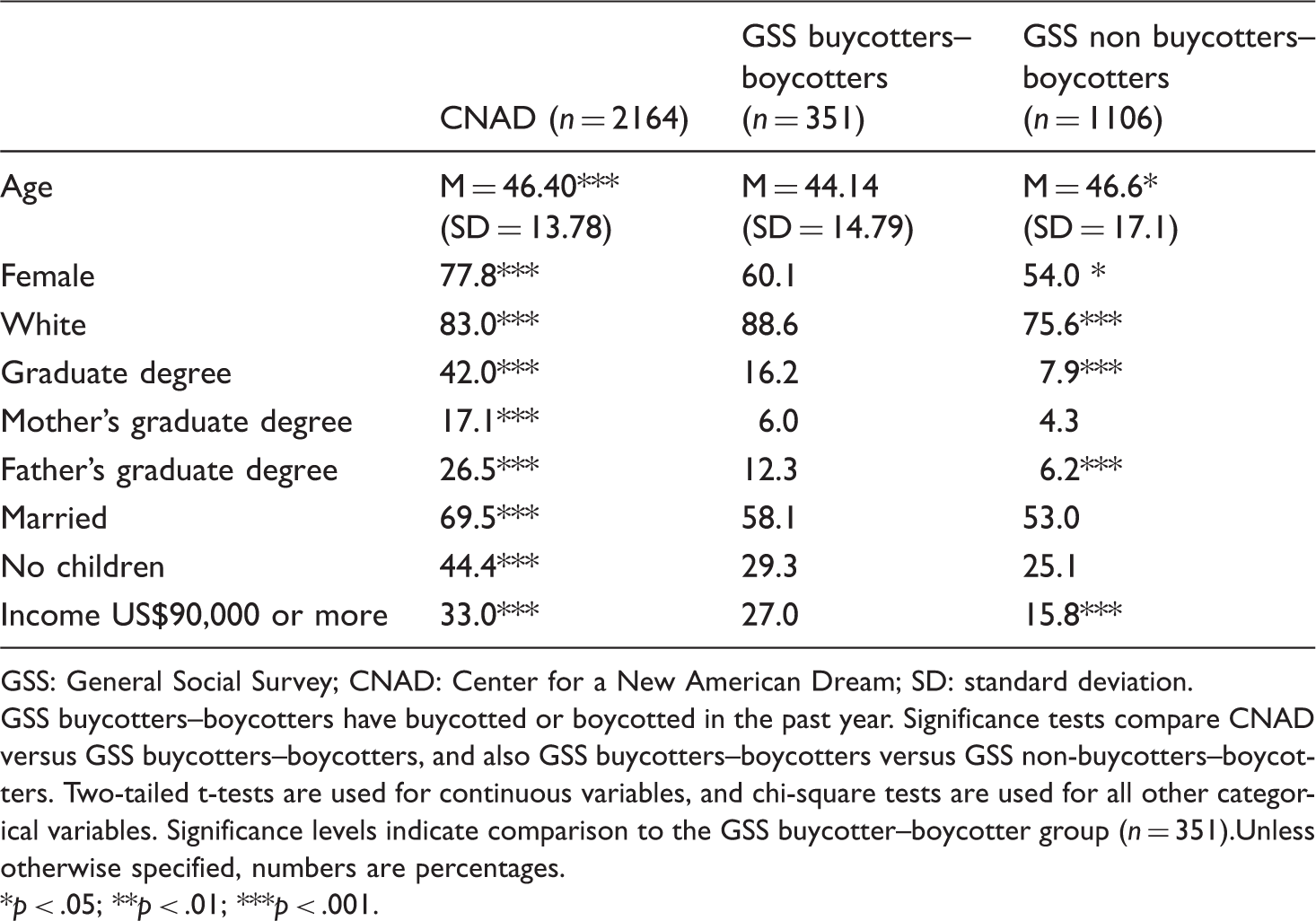
We characterize ethical consumers using two surveys (for detailed discussion, see Willis and Schor, 2012). The first is the Citizenship Module from the nationally representative General Social Survey (GSS), which asks whether respondents have “boycotted, or deliberately bought, certain products for political, ethical or environmental reasons.” About 24% of GSS respondents have done so. The second is our own survey of 2271 self-identified conscious consumers, recruited from the email list of a national organization that has been a leader in the area of conscious consumption (The Center for a New American Dream (CNAD), or newdream.org).
Comparisons of CNAD and GSS Samples.
GSS: General Social Survey; CNAD: Center for a New American Dream; SD: standard deviation.
GSS buycotters–boycotters have buycotted or boycotted in the past year. Significance tests compare CNAD versus GSS buycotters–boycotters, and also GSS buycotters–boycotters versus GSS non-buycotters–boycotters. Two-tailed t-tests are used for continuous variables, and chi-square tests are used for all other categorical variables. Significance levels indicate comparison to the GSS buycotter–boycotter group (n = 351).Unless otherwise specified, numbers are percentages.
p < .05; **p < .01; ***p < .001.
These characteristics of the buycotters–boycotters in the GSS sample are exaggerated in the CNAD sample, where we find 42% reporting that they have a graduate degree, 17% with mothers who have a graduate degree, and almost 27% with fathers who have a graduate degree. A third (33%) have total household income of US$90,000 or more.
Our findings suggest that characterizations of ethical consumers made by critics have validity. They are more female, Whiter, richer, and much more educated than the general population. Because the GSS question captures people with weak ties to ethical consumption, our CNAD sample, which skews even more White, educated, female, high-income and HCC may be more representative of this population.
Reconfiguring HCC dispositions
Distinction, Bourdieu’s expansive study of the dispositions and practices of mid-20th century France, reveals stark differences in tastes across the population. In contrast to some accounts which interpret Bourdieu as mainly being about high art and culture (for a critique, see Holt, 1997), readers of Distinction will remember that Bourdieu investigated everyday practices such as eating, furnishing one’s home, shopping, dress and sport. In the mid-1990s, Douglas Holt published a pioneering study exploring these domains among a group of Central Pennsylvanian consumers. Arguing that both supporters and critics of Bourdieu now agree that the operation of cultural capital differs across “socio-historical settings,” Holt reformulated Bourdieu’s method for the US context. Holt’s influential work forms the benchmark against which we analyze our data. In particular, we are interested in how HCC dispositions and practices may have changed in the 15 years since his research was conducted.
High and low cultural capital traits from Douglas Holt.
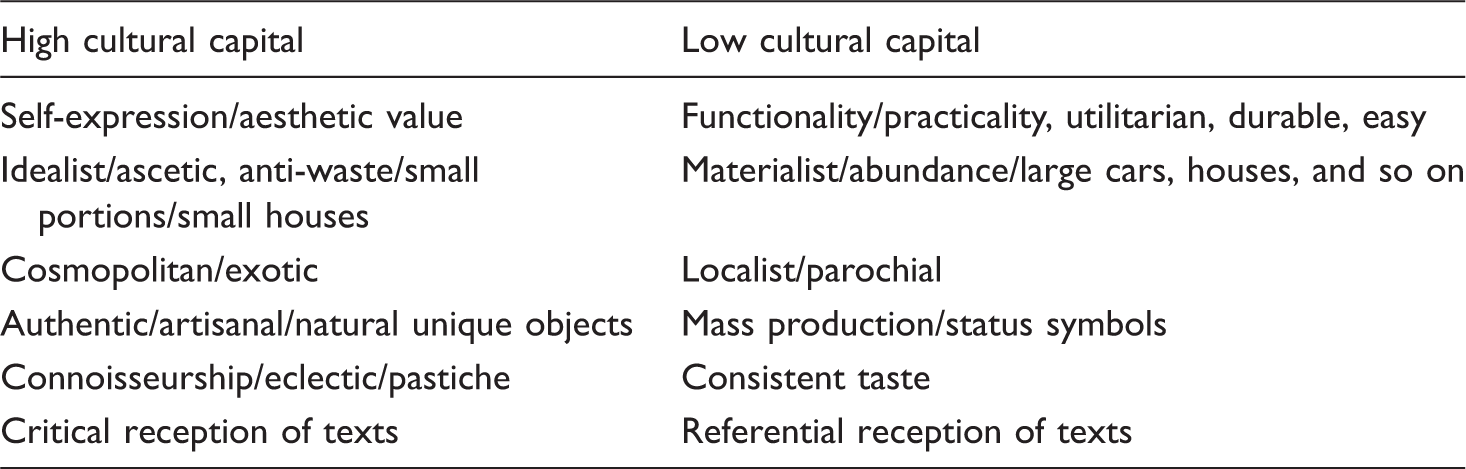
The second area of divergence is the local/cosmopolitan spectrum. Holt’s HCC informants have lived in a variety of places, have a national and international orientation, read national newspapers, and travel frequently. They differentiate themselves from parochial locals, who have few reference points outside Central Pennsylvania. By contrast, our ethical consumers express a strong affinity to the local. They prefer local food, local businesses, and local economies. This is in keeping with the valorization of the local in the food and sustainability movements. Indeed, this valorization has been a touchstone of the alternative food movement, with its discourse of food miles, scale, and anti-industrialization. While it is true that within the larger alternative food discourse health concerns have been found to predominate, research has not found health concerns to be distinct from environmental concerns (Lockie et al., 2002). Rather, popular and academic discourse has sought to link health issues such as the obesity epidemic to ecological concerns like global warming (Guthman, 2011: 7). As a result, we contend that health concerns articulated in support of the local are part of a constellation of ecologically aware consumption practices. We also find that the HCC local is to a large extent an imagined or constructed one and only incorporates certain aspects of the actually existing local (Thompson and Coskuner-Balli, 2007). It references a cosmopolitan and often upscale local, selectively rejecting and accepting aspects of the parochial, often-LCC local that respondents experience in real life.
The third reconfiguration concerns the value of manual labor. A key dimension of HCC disposition and practice, found by Holt and others, is that HCC consumers take great pains to distance themselves from mass production, expressing strong affinities for artisanal products, natural materials, and handmade items (Schor, 1998; Schneider, 1994). We find a number of twists on this theme. Our respondents are strong devotees of the Do-It-Yourself (DIY) ethic, expressing appreciation for the manual labor involved in making and doing for themselves, and taking joy in the process. In this sense, they have moved away from the traditional devaluation of the manual and elevation of the mental discussed by Bourdieu and before him, Veblen. Among our highly educated sample, manual labor is not associated with the lower classes, nor is it juxtaposed with education or intellectual achievements. In contrast to the connoisseurship ethic found by Spooner (1986) in his study of “Oriental” carpets, our respondents are less concerned about “quality” and outcome and more oriented to the process of using their hands and bodies.
To be clear, we are not arguing that our HCC respondents have merely adopted the dispositions or practices of those with lower cultural capital. While we do sometimes detect whiffs of class voyeurism, we are observing distinguishing practices. We find that the dispositions of the LCC pole are being incorporated into an HCC habitus through a new articulation. The valorization of the local is as a cosmopolitan local. The embrace of materiality is not in the traditional form of luxury and excess, but as an earthy, sensual, ecologically infused materialism, and the appeal of the manual is situated within a low-impact, close to nature, local context. Taken together, these findings suggest that at its core, the field of high-culture consumption has increasingly absorbed an ecological consciousness and structure of value.
Case studies methodology
All four case studies relied on semi-structured interviews of 1–2 hours with participants sampled from a large urban area in the Northeastern United States. The cases were conducted independently; however, each case asked similar research questions about how cultural and economic capital affected ecological consumption practices and ideology. Because there was a common core of findings among the four cases, we have combined them in this article. Each case study collected slightly different data and operationalized cultural capital somewhat differently. However, all cases measure education levels, in line with standard practice in the literature. In order to standardize the measurement of cultural capital across the cases, we set the minimum level of education necessary to be categorized as HCC as a college degree. In addition, researchers from the first three cases collected data on parental education; in the fourth case (cleaning practices), spousal education was collected. In all cases, we used education as the criterion for deciding who among the sample were HCC. (In the time bank case, all participants were HCC).
The climate change case (Laidley, 2013) reports findings from eight HCC participants from a sample of 40 interviews with individuals who responded to a call to discuss climate change. Unlike the other cases, we report on both cultural and economic capital for this case. The time bank case (Dubois et al., 2014) reports findings from 30 interviews with individuals aged 18–34 years who are members of the local time bank. Respondents either answered a call for interviews or were asked to participate in an interview after engaging in a time-trade with researchers. The researchers found that the sample comprised, exclusively, HCC participants; all held at least a BA degree and had at least one parent with a graduate degree, more than half held an MA, and four had doctoral degrees.
The food swap case reports findings from participant observation and four interviews with HCC individuals aged 18–34 years who participated in the food swap (Fitzmaurice and Schor, 2013). All respondents and their parents are at least college educated, and their occupations range from traditional careers as young professionals to HCC creative professions such as freelance writers. We found that participants’ extensive knowledge of food practices and their ability to effortlessly incorporate this knowledge into food swap activities acts as a method of HCC distinction. The cleaning practices case consisted of 28 snowball-sampled interviews and reports findings from 12 HCC married mothers aged 25–50 years (Ouimette, 2011). Respondents were stratified by their use of either conventional or eco-cleaning products. The 12 HCC participants and their spouses have at least a college degree and either use eco-products exclusively or use a mix of conventional and eco-products.
Culture, class, and climate change
In this study, HCC respondents often invoked the local when discussing their
individual behaviors, usually referencing consumption choices and transportation.
Brook—low economic and high cultural capital (LEC/HCC, respectively)—a 25 year-old
trained in finance and living in a gentrified area of the city, describes the scene
around her neighborhood: Like, we love going to the farmer’s market, we love buying local produce … We
definitely ride our bikes. I just got a bike, so I’m excited to ride. And,
yeah, I mean we take the train everywhere, so we’re not doing, you know,
jumping in our cars. I think that my friends and family in many areas do make, you know, a
reasonably good contribution in keeping down consumption of non-essentials
and doing more local purchasing, and traveling not as much. So he’s basically spent fifteen years there doing that, going back and forth
(between the U.S., Europe, and Africa) – he spent so much of his life
polluting the world, as far as I’m concerned. Now he’s so green … And he’s
been talking about climate change ever since his return, which was ten years
ago. He’s talking about his passion for climate change – it’s really
strange.
In this study, LCC respondents also mentioned localized practices. Yet, their overriding justification was cost and the vagaries of globalization, reflecting a more economically utilitarian understanding of these issues. The monetary cost of shipping and transporting goods, fair wages, fiscal austerity, and the downsides of deindustrialization were common themes in LCC’s discussions of local practices. Yet, these respondents also were likely to describe their efforts to purchase local goods as provisional, contingent on cost and attainability. Thus, the economic benefits they describe chiefly reside in the realm of production (i.e. better wages, fairer trade) than consumption (where they noted that costs were sometimes prohibitive).
Among some of the HCC respondents, localized practices were inscribed within a
general framework of self-sufficiency and a DIY ethic, reflecting not only an
aversion to globalized consumption habits, but a more utilitarian, materialist
orientation as well. Jane (High Economic Capital—HEC/HCC), a semi-retired
58-year-old freelancer and long-time vegetarian, explains that she does not need to
seek out local or organic produce because she grows her own: J: So I don’t go out and purchase a bunch of organic anything in the produce
departments, because I have my own garden. So … I: Why bother? J: Yeah. I don’t need to buy their tomatoes, whether they’re pesticides or
not. I’ve got my own.
Sarah (HEC/HCC), a 28-year-old financial analyst living near downtown, sees consumer
incentives and inducement to buy green goods as a sound structural approach to
mitigating climate change: If you give people tax credits if they buy a hybrid – I think people care way
more about money than about the environment … So if you basically have to
bribe people to treat the environment well, then that’s the way you get them
to do it and that’s what you gotta do. But those products I’d say, that label – that sells with green and
eco-friendly – I think it’s sort of hypocritical, because I think one of the
problems that’s leading to global warming is a lot of consumerism (and)
materialism. So … you might be better off not buying anything. I’m sure science will help, but people have to start now by consuming less,
not letting the problem get worse.
Time banking among the cultural elites
Our second study draws from a large urban time bank where members trade services in exchange for access to services from other members (Dubois et al., 2014). The trading is multi-lateral (people accrue credits or debits for past trades) and valuation is strictly based on time expended. The market value of the service or skill being offered or taken is not factored into the exchange, a practice that creates considerable complexity in a world where the market values skills so differently. Dog sitters and plumbers receive the same remuneration for each hour spent. In this case, we found new configurations of HCC practices across three dimensions. Informants articulated a critical stance to standard market valuation and a preference for direct, informal connection to service providers. They valorized manual labor, and they expressed an affinity for materiality.
A strong anti-market ethos theme emerged, but respondents enthusiastically embraced
local markets where connections between the producers and consumers of goods and
services are the norm. Rebecca, a middle school science teacher, exemplified this
preference as she discussed farmers’ markets: You can meet the people who made it. I guess when you go to a farmers’ market
and you get some cheese and you meet the farmer who made it, versus just
going to Trader Joe’s and picking up whatever is cheapest. The thing that I’ve gotten the most successful trades with is canning. And
that was … At the time that I started offering it, no one was doing that,
because I’ve been doing that a long time. It’s gotten kind of hip, so there
are more people out there and I have more competition, now. So, that was
clearly a niche that I had at the beginning.
Time-bankers engage in a range of earthy practices, from gardening to composting.
They buy shares of farm harvests, build and fix bikes, design backyard compost bins,
and debate the merits of urban homesteading. At times, affinity for the material
world takes the form of embracing practices that are considered gross or strictly
out-of-bounds for traditional HCC consumers, such as dumpster diving. Temple
recounted her haul from a recent expedition: We got a whole bunch of flowers and bouquets from Trader Joe’s – a lot of
food from Trader Joe’s. And then we’d go to [the] Odwalla distribution
center … they throw like the bottles of juices … they’ll throw them out even
though the date is two weeks later when they expire. It’s just so
wasteful.
Swapping food in an urban warehouse
Our third case is an urban food swap. Swaps take place on Sunday afternoons in a neighborhood full of revitalized wharfs and warehouses and are attended by about 20 people, almost all White women, ranging from their early 20s to late middle age. Homemade food circulates via barter exchanges facilitated by samples and a silent auction format. This food swap has operated for more than a year. Although the concept began in Brooklyn, New York, in March of 2010, it spread quickly: there are now at least 78 food swaps in the United States.
Food has become a central focus for the expression of environmental concern. As a social space where individuals exchange foods they produced themselves, the food swap is an ideal case for examining the expansion of an eco-habitus among HCC consumers. In fact, the desire to “use up” a Community Supported Agriculture (CSA) share motivated the founding of this group. Lyn, a 34-year-old lawyer at the state Department of Energy who helped found the food swap, described struggling to use her CSA share as a single, urban professional before hearing about food swapping. She felt starting a swap would allow her to use her share and keep supporting a local farm.
Talking about food and swapping as environmentally motivated activities, participants
discussed the idea of the “local” in fairly typical ways – as environmentally
friendly and good for the local economy. However, many swappers valorized the local
in novel ways. Susan, another swap founder and a 28-year-old freelance writer,
integrated the idea of local food into broader interests in DIY practices: Part of that is because I’m an entrepreneur, myself, so I kind of feel a
kinship to those people that are, you know, making iPhone cozies and selling
them on Etsy (an online peer-to-peer craft marketplace), or are, you know,
making their own tea blends and selling them at a farmers market.
The concepts of the local expressed by the participants reflect more than the
subscription to local food as a green consumer choice. Rather, these individuals
drew extensively upon the broader classificatory schemes that contribute to the
eco-habitus we describe. For example, discourses that sought to reinvent materialism
for HCC consumers were inextricable from these individuals’ conceptualizations of
the local through the search for “real food.” Lyn believed swaps should be “creating
a culture where people understand that it’s kind of manageable to create real food.”
The “realness” of food was central to Susan’s framing of food consumption.
Describing why she cared about where her food came from, Susan explained, I mean, it’s nice to have food that has that real, authentic, you know,
prepared-from-scratch taste to it … I mean … it’s real food and tastes like
real food, and comes from, you know, comes from a farm as opposed to a box
or a can.
Leah, a 32-year-old librarian working as a university administrative assistant who recently began participating, had a similar idea about “real” food. Describing why buying strawberries in January was “the most ridiculous thing on earth,” Leah explained, “you’re shipping not very tasty strawberries a very long way. And then I get them and, yes, it’s technically a strawberry but it doesn’t taste like one, so what’s the point?” Lidia expressed similar incredulity; while she believed mass-produced foods could be acceptable to consume, she refused to buy products that were not honest. “Why would anyone ever even think to put animal bones [i.e. gelatin] in yogurt?” she said in an utterly bewildered tone.
The quest for “real food” often involved a revalorization of manual labor. By making food themselves, the swappers described an ability to feel productive and gain control. The ethos of the swap is one in which people are encouraged to “take back their pantries,” and Lyn described the swap as “empowering people to be self-sufficient.” Among the food swap participants, the process of manual labor was revalorized as a valuable consumer practice in its own right. Susan, for example, described making her own pesto: “There’s sort of a satisfaction to, like, me actually, literally making the basil [pesto] instead of, like, scooping it out of a can.” Here, the process of doing rather than the item itself becomes the center of Susan’s concern.
This was by no means a limited perspective. At one swap, a young recently married couple – both PhD candidates – generated considerable excitement when they brought pear butter they had made for their wedding favors. Lidia described how she participated in the food swap not for the products she could receive, which she confessed she often disliked, but because she needed an outlet for all of the food she produces. After beginning graduate school, Lidia explained she felt a need to be “productive” and actually make something with her hands with a tangible end result.
Finally, food swappers expressed practicality as a valid standard for HCC
consumption. Lyn described, “this is about people cooking in their house and, like,
feeding themselves.” Likewise, Lidia was very uncomfortable with the idea that what
she was doing when she made jam was artisanal: There are people who believe that food is something that they cannot possibly
make themselves. That food is something that you buy, and other people make.
But then there are people who actually can make food but keep thinking like
that.
Within the food swap case, the valorization of the local, reinvention of materialism, revalorization of manual labor, and appropriation of practicality as criteria for HCC consumption are nearly inseparable. Far from being merely tacked on to existing HCC consumption practices, the ways food swappers talk about their food consumption lend support to the contention that habitus of HCC consumers has been fundamentally transformed by an ecological perspective.
Cleaning green
In our final case, participants choose ecological cleaning products and practices out of consideration for the health of family members and the environment. Since the widespread availability of eco-cleaning products is a relatively new phenomenon, participants described evolving attitudes toward such products as part of emerging preferences in the development of an ecological habitus. Their consumption of eco-cleaning products fits into larger identity and lifestyle projects that connect material choices and their consequences for the earth into the context of everyday consumption. As Amy, a doctoral-level non-profit manager, explained, “I want us to be living as sustainable a lifestyle as possible in every way.”
Pamela, an academic, described how there is a heightened environmental consciousness
in her community and peer group, contributing to a “nagging” feeling to consciously
consider the ecological consequences of her lifestyle decisions and to work toward
more sustainable choices. Her choice of a mix of conventional and eco-cleaning
products is not indicative of the relative strength of her eco-habitus: I’m probably least environmentally friendly when it comes to cleaning
products as opposed to things like recycling, reducing waste and reusing
things, buying things second hand, trying to consume less, especially in
terms of not using the car and riding or walking or using public
transportation … For hand drying, we just use cloth towels and I always buy the paper towels
that come smaller, because I hate the big sheets of paper towels … I would
rather use less paper for the environment. Why waste all that paper when we
don’t need to? In general, if I’m going to buy a new product, I feel like I want to support
the transition of our culture as a whole toward more natural products. So
for ideological reasons, I would prefer to support a company that sold
something that was more environmentally sensitive. But for my own personal
and family’s benefit I’d prefer to just have simpler ingredients. To disinfect I use – I have vinegar in one spray bottle and hydrogen peroxide
in another and I spray one followed by the other. I actually found some
studies on that, that said it was pretty much as effective as bleach but it
doesn’t sit on the surfaces … I like it cause it’s cheap and cause it’s
chemically understandable. [My husband] likes chemicals that you just spray and you splash and you’re
done. There’s no manual labor involved. If you use baking soda or something
else, you gotta rub. That’s not easy, so I think that’s why we have this
discussion. I don’t mind a little physical labor.
Conclusion
Our research has found that an eco-habitus is expressed through the preferences of young mothers “voting with their dollars,” foodie swappers, time traders, and climate-concerned consumers. The conversational contours of these four research cases are especially provocative when considered in the context of two national surveys showing the HCC of ethical consumers. The preferences expressed here suggest the reconfiguration of a number of Bourdieu’s class-bounded taste dichotomies, particularly as they have been explored by Holt in the US context. Holt’s HCC respondents work to distance themselves from what they characterize as crass materialism. They conceptualize culture globally, with a distinctively cosmopolitan ethos. Our collection of studies updates Holt’s analysis and reveals how the severity and scale of global environmental crisis has pervaded the American consciousness since the mid-1990s. Our participants’ expressions of eco-habitus are related to this crisis.
HCC consumers are often early adopters, which is a characteristic of our ethical consumers (Holt, 1998). Our data show strong signs of altered preferences within this group across three main dimensions. First, participants infuse new meaning into the term “materialism.” They focus on the physicality of goods and their connection to the earth. Second, they articulate a preference for the local though local consumption patterns which are marked by cosmopolitan taste patterns. Third, they express reverence for manual labor and a strong desire to gain competences traditionally marked as “unskilled.”
It is too soon to know how the emerging eco-habitus we have described will translate outside the bounds of the HCC urbanites who form our sample. However, our findings challenge and advance the critical discussions of ethical consumption, which tend to see such practices as merely the neo-liberal depoliticizing of environmental concerns (Guthman, 2003, 2008b, 2011; Johnston et al., 2011). In our reading, such practices are hardly individualized solutions to collective problems. They are collective, albeit relatively elite strategies of consumption – what we have termed an “eco-habitus.” Moreover, despite critiques of the “citizen-consumer” who “votes with their dollars,” these new HCC consumption strategies may function either as a strategy for pursuing distinction, or a potentially less exclusive locus of cultural authority (Johnston, 2008; Johnston and Baumann, 2007, 2009) which can promote awareness of and responses to environmental challenges.
In this sense, our respondents are helping to meet the challenge raised by Haluza-DeLay (2008), who argues that environmental social movements should be working to create an ecological habitus, so that sustainable ways of living will become part of an ingrained and habitual praxis that organizations can use to become more effective. Many of the people we studied consider themselves part of such a social movement and we find that such a practical, discursive, and everyday lifestyle shift is indeed taking place. Our research suggests that scholars of culture should be increasingly aware of the ways in which consumers incorporate ecological considerations and concerns into their practices, outlooks and behaviors.
Footnotes
Funding
This research was funded in part by the MacArthur Foundation.