



Abstract
New grassroots organizations that target ethical consumer choices and behavior represent a departure from traditional social movement organizations. In this article, we study the activists of one of these organizations and show that social network ties formed mainly online greatly reinforce commitment toward the goals of the movement. We suggest that online ties, that is, digital ties, are important for political consumerism movements because they create audiences for private actions. It is because of the presence of these audiences that the individual participants can reinterpret their actions into public ones. We used an online survey to collect data on the users of the Transition US social website on Ning.com. Over half of the respondents have experiences with political activism. However, their responses indicate that they are dissatisfied with traditional means of political participation (e.g. rallies) and prefer non-contentious collective actions (e.g. local gardening). Respondents perceive community organizing to be the most effective way to bring about social change, deprioritizing connections to local government. Furthermore, respondents who formed digital ties with other activists were significantly more likely than respondents who had no ties with other activists to adopt consumer changes consistent with the goals of the movement. We interpreted this finding as an indicator that digital ties share some of the characteristics of strong ties, and we explored this similarity in this article.
Political consumerism, that is, the expression of political beliefs and ethical values via the purchasing of goods, is not a new phenomenon, dating back at least to the early 19th century (Micheletti, 2003; Micheletti and McFarland, 2010). However, it is only in recent years that it has begun to attract the attention of social movement scholars (Forno and Ceccarini, 2006; Schurman and Munro, 2009). Indeed, the dominant theoretical paradigm among scholars of collective actions – with its focuses on the political sphere (McAdam et al., 2001) and on the use of contentious tactics (Tarrow, 1996) – allows little room for forms of mobilization that consider the market as their main locus for action (Bennett, 2012). By contrast, political consumerism involves hybrid private–public forms of (mostly) noncontentious actions (Burns et al., 2001) such as writing e-mails to the public office of corporations whose labor practices are contested or planting a garden in order to reduce the carbon footprint of one’s life. As Michele Micheletti (2003) argues, it is because of these unusual characteristics that political consumerism has received less theoretical attention among scholars of social movements.
This is now starting to change as social movement scholars on both sides of the Atlantic appear to be giving greater attention to forms of mobilization centered on the market (Bray et al., 2011; Cook, 2008; Weber et al., 2008). At the same time, audiences in many industrialized countries have increasingly resorted to political consumerism in order to promote desired changes not only within national boundaries but also globally (Keck and Sikkink, 1998). In this article, we intend to extend the theoretical frame of contemporary political consumerism by incorporating into it the role of online networks (Scammell, 2000). We think that the Internet, and the tools of social media networks in particular, play a crucial rule in transforming private actions, such as the ones described above, into collective public actions. That is, we see social media networks as capable of creating shared identities and relationships among activists – digital ties – that reinforce individual commitment toward pursuing change via market-based actions.
Our evidence comes from a volunteer-based online survey conducted on an organization named Transition US, a community of activists scattered throughout the country and mainly concerned with issues of environmental protection and minimizing energy dependence on oil (Mooallem, 2009). Because of the nonrandom nature of our data and the limited generalization that comes from a case study, our conclusions about the role of the Internet in creating networks capable of transforming private actions into public ones are necessarily tentative. Nevertheless, we think that what we have found is of sufficient interest to call the attention of other scholars of political consumerism to the possibilities offered by merging the literature on the role of networks in social movements with the growing empirical evidence on the role that the Internet plays in contemporary forms of mobilization.
This article is organized in the following way: we first survey the main literature linking the Internet to collective action. As we will show, scholars tend to be divided into two camps – those who think that the Internet is nothing more than a coordinating mechanism not useful in promoting deep changes, and those convinced of the opposite. We then consider the role of social networks in mobilization and stress the important distinction between strong ties (thought to promote participation) and weak ties, more likely to promote diffusion of rumors than develop a shared sense of identity (Centola and Macy, 2007). We argue that online interactions have made possible the emergence of a new type of tie, which we aptly call digital ties. Digital ties are for us a hybrid type, promoting engagement but only within the domain of the given online platform (see Small, 2009, for a similar argument on how institutions promote hybrid ties). We use these two sections to build our argument about political consumerism and online social networks. This section concludes the more theoretical part of the article. A description of the case study and of the analysis follows. We use the conclusion to summarize our results and to expand on our theoretical contribution.
The role of the Internet in collective action: A divided view
When we talk about the Internet, our focus lies in the large-scale communication and interaction made possible by social media, rather than the information distribution capabilities of the whole electronic network. Scholarly work on the Internet has shown that the new media technologies have ambivalent results on collective action. On the one hand, they appear to produce only marginal effects. For example, Evgeny Morozov (2011) argues that, in general, the majority of Internet users do not use the Internet for political or civic activism, but to satisfy their own individual curiosities. Therefore, instead of facilitating the kind of solidarity that inspires meaningful collective action, the Internet serves as a divisive tool, pushing users into increasingly isolated networks concerned with trivialities, not matters of civic importance. On the other hand, scholars have suggested that the Internet has had a large impact on how social movements share information and recruit new members (e.g. Howard, 2010), how they attract publicity (e.g. Perlmutter, 2008), how they organize offline action and events (e.g. Shirky, 2008), and how they take direct online action (e.g. Earl and Kimport, 2011). Indeed, there is evidence that the Internet appears to have dramatically altered how social movements operate (Joyce, 2010).
A main exception to the Manichean vision of the role of the Internet among social movement scholars comes from the case of collective action in repressive regimes. Even before the events of the “Arab Spring,” Philip Howard (2010) argued that digital technologies played a crucial role in promoting and developing democracy in several Muslim countries. In such countries where an authoritarian state represses formal political opposition, the Internet functions as a setting for open civic discourse that leads to political activism. Additionally, other scholars writing about the uprising in Egypt have also recognized the role of the Internet, particularly social media, in connecting people and promoting community, and the effect that has on widespread mobilization (e.g. Zorn et al., 2011). We agree with Diani (2011) that the Internet makes “a substantial contribution to what appear largely as ‘communitarian’ forms of collective action: it facilitate[s] the creation of boundaries between people that shared a similar condition, the emergence of common grievances, and the coordination of protest activity” (p. 473). We believe that this role extends beyond political revolutions in repressive regimes into the kind of individual collective action that we examine in this article.
The strength of offline and online ties
When considering this sort of political collective action, scholars have long recognized the importance of strong ties 1 in motivating actors to accept the high costs and high risks of contentious action. McAdam (1988, see also McAdam and Paulsen, 1993) explains how close relationships with other activists and like-minded individuals can both encourage and pressure someone into engaging in contentious political action. Strong ties of this sort act as a mechanism for social reward and social punishment while weak ties, such as relationships with acquaintances or “a friend of a friend,” are more useful for disseminating information (Granovetter, 1973).
Weak ties have been well established as a means for widespread information distribution, since weak ties connect a larger network than strong ties. The weakness of such ties also means that they hold less persuasive power over an individual. Thus, while they may be useful for learning about new job opportunities, they are less helpful in terms of mobilizing collective action, where the risks associated with participation are often quite high (Centola and Macy, 2007).
The distinction between the role of strong and weak ties in facilitating mobilization predates the invention of the Internet and of social networking technology. The contemporary social world is dense with opportunities for connecting with others, and the Internet has become a new vehicle for the formation of relationships. Castells (1996) and Bimber et al. (2012) argue that the proliferation of Internet connectivity promotes networked ties in place of membership in hierarchical, bureaucratic organizations. These networked ties decentralize the locus of organization in collective action and facilitate grassroots community building.
Websites and forums that began as sources of information become communities where members engage in conversations about everyday life and support one another. Websites and forums become places where people interact and form relationships. Scholars studying nonpolitical online communities, for example, observed that topical discussions often evolve into more general interactions (e.g. Baumle, 2009; Gatson and Zweerink, 2000). From a social movement perspective, a key question is whether relationships formed online are strong, in the sense that they encourage and support participation, or weak, in the sense that they mainly facilitate the diffusion of information.
In order to make further progress on the behavior of online relationships with respect to mobilization, we first define digital ties as the relationships formed between activists who are interacting regularly online. These interactions may supplement offline interactions or they may replace offline interactions (especially for people who are geographically distant). As individuals interact online, as, for example, members of Transition US do on the movement’s social networking website, a sense of community and shared identity and purpose can develop among users. In this way, what started out as weak ties – knowing which products to boycott, for instance, or the right way to install solar panels – can develop into closer ties that, while perhaps not as persuasive as strong ties, can reinforce individual’s commitment toward change.
We are not suggesting that all online ties have the qualities that create and reinforce commitment. Most of the time online ties operate purely as coordination mechanisms. Nevertheless, when online ties create a shared identity around which activists can frame their private behavior, they become digital in the sense that they sustain commitment to a movement. In this way, these digital ties play a role similar to that of group memberships, except that they are far more fluid. Rainie and Wellman (2012) explain that “networked individuals have partial membership in multiple networks and rely less on permanent memberships in settled groups” (p. 12). They attribute the effectiveness of such networks to the way in which people use technology.
In light of all of this, we hypothesize that digital ties are strong within the boundaries of the website that generated them, but weak outside of it. What differentiates digital ties from strong ties formed in primarily face-to-face interactions is that digital ties remain constrained within the context and the content of the website that originated them, while the influence of strong ties extends beyond the context of the social movement that brought the two activists together. That is, digital ties are strong but in a specialized sense. Before testing this hypothesis, we explore why the mixed quality of digital ties is particularly significant for political consumerism.
From grassroots to digital ties
Making political statements using purchasing power questions the traditional view that sees politics as separated from the market. Hilton (2007) and Alexander and Ussher (2012) show how consumerist movements can have political and social consequences. Cohen (2004) argues that a gradual but increasing emphasis on consumer authority now extends from products to politics, allowing consumerism to have political value. Politics has escaped the state and has entered the market to the extent that the studying of this form of mobilization requires concepts like globalization, governance, corporations and ethics, and a multidisciplinary approach (Peters and Savoie, 1995).
From this perspective, the state appears to be in a deep crisis, challenged externally by global problems and by a sort of paralysis of its institutions, increasingly incapable of mediating the conflicting interests of its citizens. Such a paralysis has led activists in many countries to engage with actors outside of the traditional political sphere and, since the mid-1980s, to conceptualize corporations as sovereign entities (Vogel, 1975, 1996). Against this background, political consumerism developed by emphasizing the role of consumer choices in creating change. The focus on the political consequences of individual’s choices is the key difference between political consumerism and other forms of mobilization directed against the state or corporations. 2
The adoption and diffusion of political consumerism among vast segments of the population in industrialized countries is directly connected with the emergence of the Internet. While traditional political protest and identity movements continue to exist, the proliferation of the Internet and amorphous online networks allow for more personalized politics (Bennett, 2012). In tandem with consumer culture, online interactions shape how people understand and express their political values as individual consumers and citizens. As group affiliations give way to value- and cause-driven networks (Rainie and Wellman, 2012), a diverse constituency can be mobilized for collective action against a variety of targets, from business corporations to the state.
At the center of political consumerism is the assumption that consumers are not just passive recipients of corporation messages but rather that they have agency. This agency is best expressed through individuals’ decisions to buy things. Yet, most scholars of political consumerism see these decisions as occurring in a vacuum; they become public because (in theory) the single individual has an internalized audience in the privacy of his mind for which the consequences of his action matter. This internalized audience constitutes a sort of imagined community. The self-referential nature of this perspective (Luhman, 1993) is not completely satisfactory because it imagines individuals as atoms, each expressing his purchasing decisions independently of the other.
A more satisfactory approach, and one closer to the empirical observations of how contemporary consumers make political choices in the market, starts by considering the role of networks (Scammell, 2000). As for the case of more traditional forms of collective action, being an activist means enmeshing oneself into networks of other activists (Lim, 2008; Ray et al., 2003). In contrast to traditional forms of activism, political consumerism is based on actions that are prevalently private (and often noncontentious). The Internet has given visibility to these type of actions in the form of blogs, pictures, music, and so on. Furthermore, these websites have become the basis for the formation of online relationships, that is, digital ties whose function is a public reinterpretation of a myriad of private consumer actions into a single collective action aimed at producing societal change. Our argument is that digital ties make possible the generation of a shared identity and culture (Melucci, 1985). This generative process in turn facilitates the creation of new frames into which private actions can be reinterpreted as public and collective (Rheingold, 1993).
Our broad hypothesis about digital ties suggests that social media technologies are of key importance for market-based movements because they create public shared spaces and audiences for activists who use mobilization tactics that are not immediately visible. As the next section documents in further detail, Transition US, like many other political consumer movements, challenges individuals to begin social change by changing their own behaviors rather than by campaigning for policy changes. Its intention is that enough individual changes in knowledge, values, and behavior will lead to the formation of local collectives with organized action plans, which will then lead to structural changes further up the chain, finally resulting in a complete reorganization of governance and policy.
Methods
Case selection
Transition US is the American arm of an environmental movement that began in the United Kingdom in the mid-2000s. Founded by Rob Hopkins, an ecological design scholar, the movement addresses three issues: climate change, the unraveling of the global economy, and peak oil, the last of these being the theory that the world’s production of oil has -- or will soon have -- peaked, leaving a very oil-dependent world in disarray as alternative technologies cannot meet demand (Mooallem, 2009). Hopkins’ solution is a 12-step Energy Descent Action Plan designed to build resiliency and self-sufficiency by employing a “post-consumerist ethos of voluntary simplicity” (Alexander and Ussher, 2012: 70). Local activists draw up and implement lower energy programs to suit their community, including the planting and tending of local gardens, the teaching of skills such as sewing, and the use of alternative transportation ranging from cycling to skiing. The movement in the United States represents an excellent case study for our research interests in individualized collective action and the role of the Internet and digital ties in organizing and community building.
Data collection
We used an online survey to collect data on users of the following website: transitionus.ning.com (now transitioninaction.com). This website is a social networking website whose members have joined voluntarily and expressed interest in the Transition US movement, regardless of their actual level of involvement in Transition US activities.
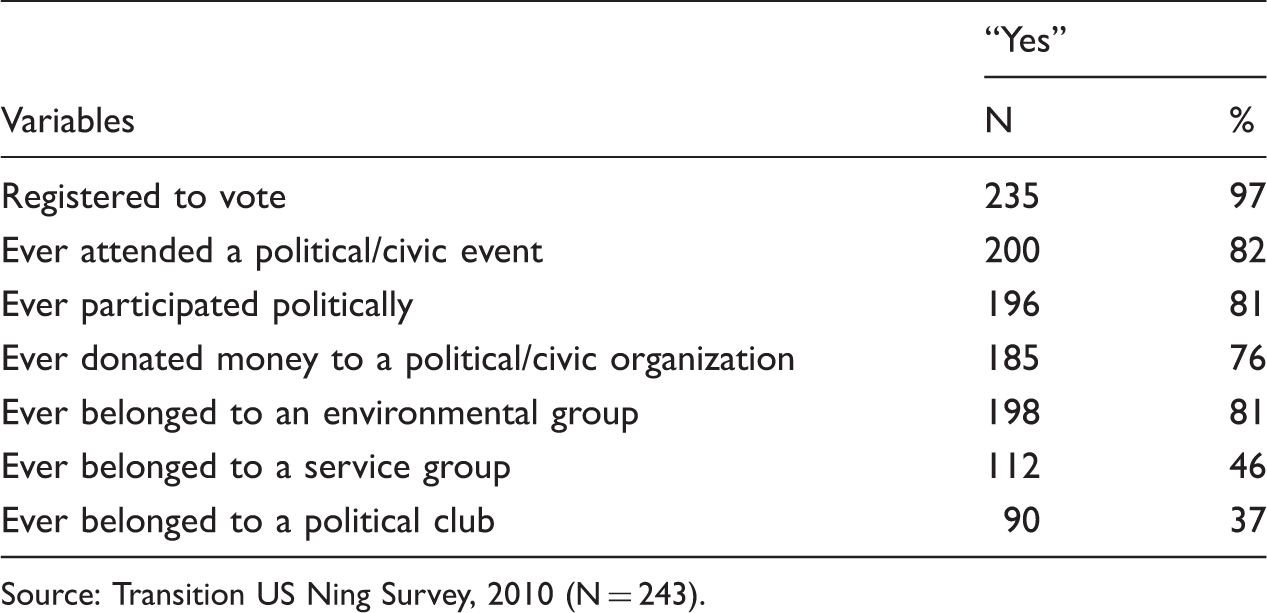
Respondents’ political profile.
Source: Transition US Ning Survey, 2010 (N = 243).
Survey questions were divided into four categories. The first and largest category of questions pertained to respondent’s activities within the Transition US movement. This included what role they occupied within their local group (organizer or joiner), and what activities they participated in both as individuals (e.g. grow their own food or use their car less) and as members of the group (e.g. raised funds for group activities or organized a group event). These activities included how they used the Internet, for example, to stay informed about group activities, for personal communication, or for social networking. The second category of questions was related to respondents’ political attitudes and previous experiences. Respondents were asked what other political or voluntary activities they had participated in prior to joining the Transition US movement and were asked to explain their interest in or motivation for joining the Transition US movement. The third category of questions described respondents’ social networks. Respondents were asked to name five close friends 3 and describe their means and frequency of interaction with those friends. Finally, the fourth category of questions consisted of demographic controls, such as gender, age, education, and income. Although data on race were also collected, the homogeneity of the sample with respect to race limited the usefulness of this variable.
Descriptive statistics
Survey data show respondents to be homogenous with respect to race (91% are White), education (87% have at least a bachelor’s degree), and political preferences (74% describe themselves as politically liberal), with women making up 58% of the sample. As a whole, respondents are web-savvy, using the Internet for e-mail, work, reading the news, social networking, online discussions, and blogging.
All but eight people (97%) are registered voters, and more than half have ever belonged to an environmental group or political/civic organization, with over 80% having attended a political/civic event. However, their responses to survey questions also indicate that they are dissatisfied with traditional means of political participation, such as street rallies and letter writing. Instead, they perceive community organizing as the most effective way to bring about social change, deprioritizing connections to local government. They generally distrust business corporations and political parties, and explain their withdrawal from political/civic organizations as the result of the failure of institutional organizations and means.
Logit model variables
We used maximum likelihood estimates of logistic regression models to predict the likelihood that a respondent undertook some sort of consumerist action, which included any one or more of the following: growing one’s own food, using one’s car less, belonging to a local food group, and installing solar panels in one's house. The dependent variable took a binary value, where taking action = 1 and not taking action = 0. The basic model, Model 1, considered the predictive value of the spread of a respondent’s social network, namely, the average distance from his or her five closest friends. This distance variable was constructed from an original variable measuring how far away a respondent lived from each of his or her five closest friends. This variable took four categorical values that were then assigned point values with 1 being the closest and 4 the furthest and averaged over the five friends to yield a continuous distance variable that was used in the model.
Model 2 further considers the effects of variation in Internet use. An index measuring Internet use was constructed as the sum of use of the Internet for e-mail, work, news, discussion forums, and social networking; thus, its value ranged from 1 to 5. The final model, Model 3, tests for the effects of digital ties in conjunction with ties to Transition US. To do this, we used the count of online friends (i.e. the number of friends with whom the respondent interacted with mainly online, as opposed to in person or via telephone) and the count of close friends involved in Transition US to construct a categorical variable that indicates the extent of a respondent’s online ties to Transition US. Both count variables ranged from 0 to 5. There are three categories of network ties: a group of respondents who have no close friends, online or offline, in Transition US (N = 54); a group of people who have only offline ties to Transition US (N = 66); and a group of people who have mainly online ties to Transition US (N = 65).
All the models controlled for the influence of demographic variables of age, gender, and a college degree. 4 We also included as a control a binary variable measuring whether or not a respondent was an organizer of a local Transition US group (yes = 1) to take into account the effects of leadership on the likelihood of taking consumer action.
Individual level change
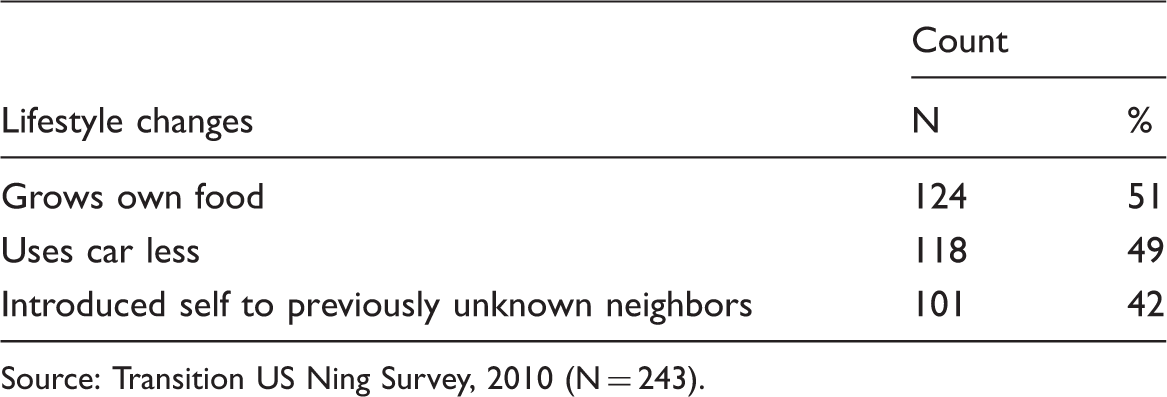
Top three Transition US activists’ lifestyle changes.
Source: Transition US Ning Survey, 2010 (N = 243).
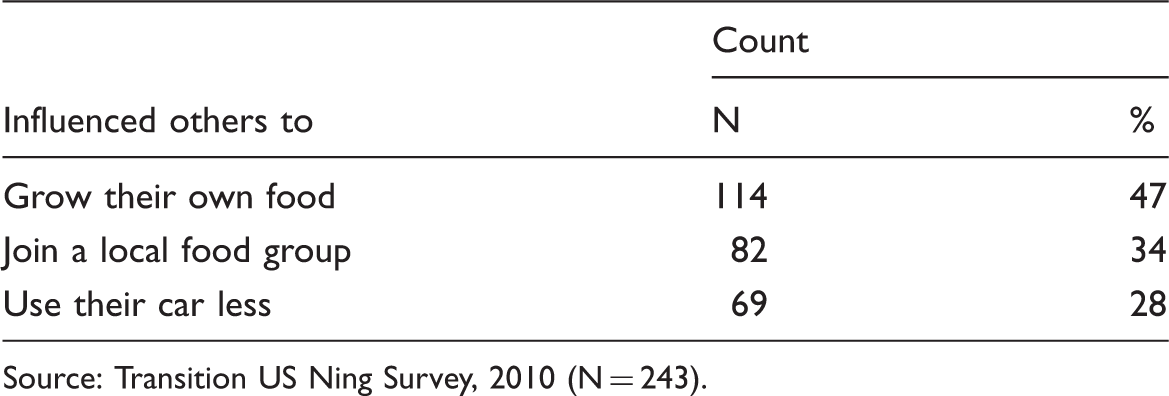
Top three Transition US activists’ influence on others.
Source: Transition US Ning Survey, 2010 (N = 243).
Respondents appeared very consistent in the ranking of their choices – both growing their own food and driving less were among the most popular changes that activists adopted and promoted. Furthermore, 42% of the respondents also listed introducing themselves to unknown neighbors as a relevant change that membership in Transition US catalyzed. Externally, none of these actions has a political dimension per se. Yet, this type of action, intensely focused on the individual, was the bread and butter of Transition US mobilization. For these activists, at least, humble activities such as gardening shifted from being a quintessentially private action to the pinnacle of political activism.
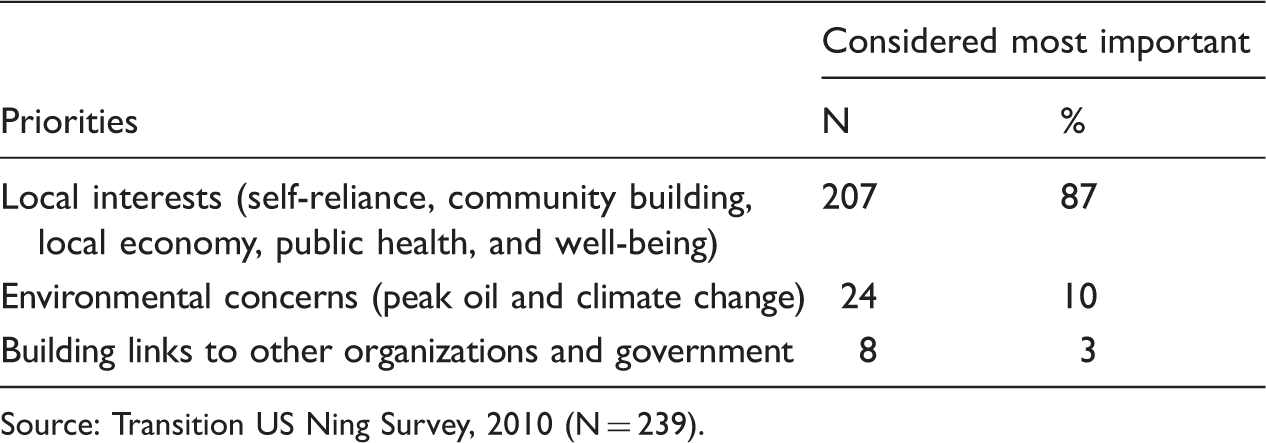
Respondents were also aware that their type of activism was different from that of other movements. Members of Transition US attributed little importance to the more traditional ways of pursuing change. When asked to list the priorities of their local Transition US chapter and their current activities, respondents reported that engaging with other organizations and with the government were among the least of their relevant priorities.
Priorities of local transition groups.
Source: Transition US Ning Survey, 2010 (N = 239).
Activities of local transition groups.

Source: Transition US Ning Survey, 2010 (N = 211).
The irrelevance given to more typically contentious activism was not due to political apathy: 97% of the respondents in our sample reported being registered to vote; 82% said that they have participated in a political or civic event and, even more telling, 76% reported having donated money to a political or civic organization. A politically disenfranchised sample, this was not!
Consistent with some of the themes previously highlighted about motivations for engaging in political consumerism, Transition US members chose to engage in certain actions because they shared a deep sense of frustration with traditional activism. This is what a 57-year-old male said: “I’ve left organizations that attempted to make the government change, or were more about protesting what they didn’t want. I prefer to co-create what we DO want” (emphasis in the original). A middle-aged female respondent said, “I have to focus my resources and energy on things that are effective and local. Most political efforts are a waste of time at this point.” Because of their dislike of traditional activism, members of Transition US chose the type of tactics that they thought were more effective for promoting change.
Tilly (1978) showed the importance of the connection between the goals of the movement and the type of tactics activists use to pursue these goals. However, he focused exclusively on contentious tactics. The two quotes above emphasize how turning the focus away from government and toward the market made Transition US activists adopt noncontentious tactics to promote change. As a 26-year-old male respondent reported, “Adversarial activism is out, social process activism is in …” Noncontentious tactics represent a significant way in which redemptive movements differ from other types of movements. Indeed, 64% of our respondents reported that the most effective tactic to promote change was “community organizing”. More traditional forms of activism, such as street railing, campaigning for politicians, and writing letters to Congressmen, were selected between 1% and 4% of the time.
Although their actions were noncontentious, Tables 4 and 5 show clearly that members of Transition US saw themselves as activists whose goal was to promote societal change by changing the lifestyle of one individual at a time. Their lifestyle changes are not directly political in nature; rather, they take on economic and cultural significance, for example, growing one’s own food or using one’s car less. These individual actions are given meaning within the movement because they occur as part of a collective effort within a local community. Now we turn our attention toward the role that the Internet played in shaping and mediating commitment to the goals of the movement.
Digital ties as a vehicle for commitment
Previous research has shown that social movement organizers formed strong ties with other activists within the movement and that these ties function to reinforce the sense of commitment that organizers feel toward the goals of the movement (McAdam and Paulsen, 1993). Our argument suggests that digital ties operate in a similar fashion to strong ties in the context of political consumerism, everything else equal. Au contraire, if the coordination of individual activities is all that is needed for political consumerism, social media tools can generate coordination without the pressures and incentives associated with strong ties and without necessarily impacting the level of commitment that organizers feel toward the goals of the movement.
Cross tabulations comparing local transition group organizers and joiners.
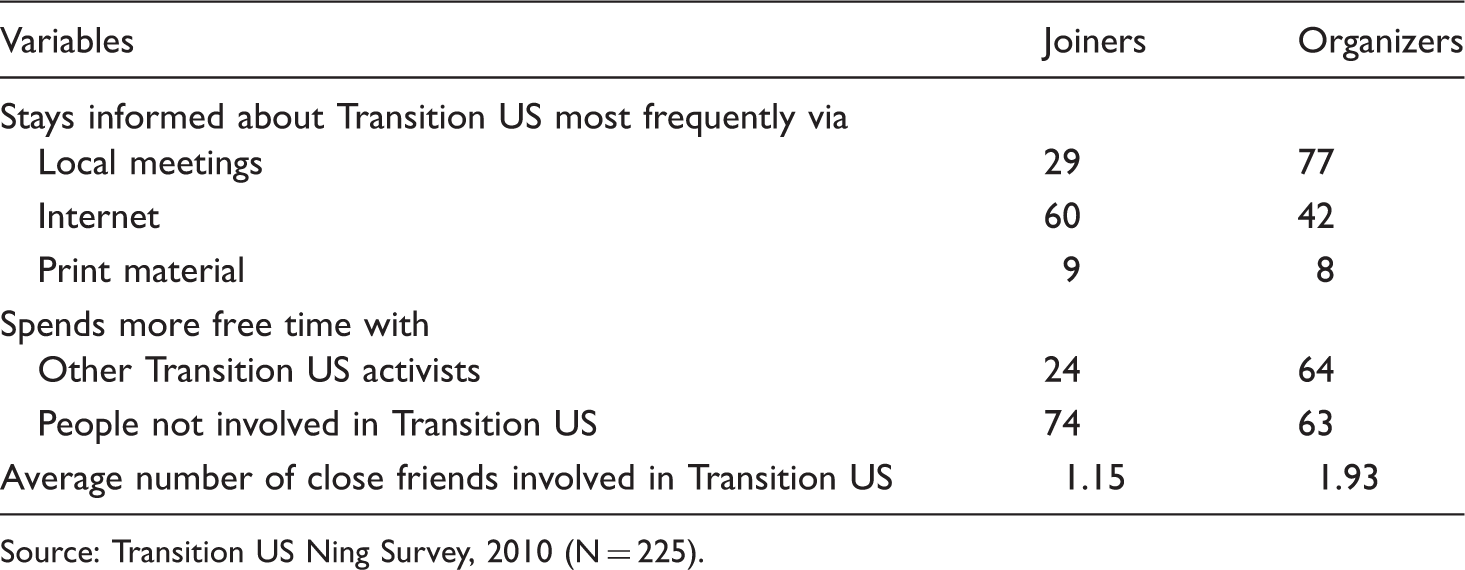
Source: Transition US Ning Survey, 2010 (N = 225).
This suggests that despite the low risk involved in starting a new chapter of Transition US, organizers of this movement operated in a fashion very similar to organizers in more traditional movements. For example, face-to-face interactions played a role in how future organizers were recruited for the movement. In fact, while 36% of the respondents who joined an existing chapter of Transition US reported having first heard of it via the Internet, the same proportion for organizers was 21%.
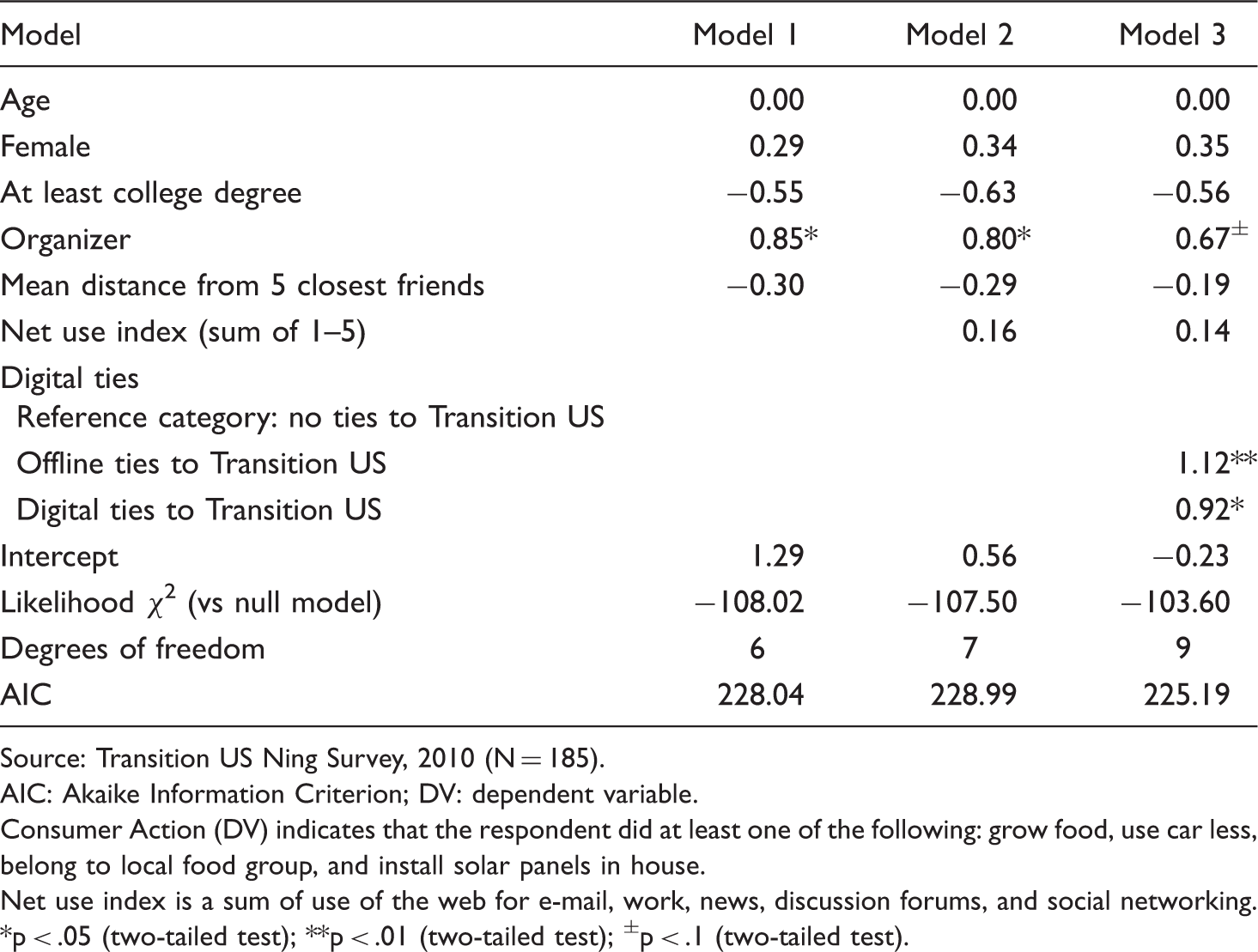
To test more comprehensively the role of the Internet in generating commitment among activists, we used a logit model to predict the likelihood of undertaking consumer action on the basis of the respondent’s use of the Internet and controlling for a host of other factors. If respondents integrated their online interactions with their offline connections to Transition US, they would be more likely to take action compared to those who did not have any online interactions.
Coefficients (log odds ratios) from models predicting effects of network and web variables on consumer action.
Source: Transition US Ning Survey, 2010 (N = 185).
AIC: Akaike Information Criterion; DV: dependent variable.
Consumer Action (DV) indicates that the respondent did at least one of the following: grow food, use car less, belong to local food group, and install solar panels in house.
Net use index is a sum of use of the web for e-mail, work, news, discussion forums, and social networking.
*p < .05 (two-tailed test); **p < .01 (two-tailed test); ±p < .1 (two-tailed test).
Model 2 tests directly activists’ familiarity with the Internet. We employed an additive index to capture the salience of the Internet for respondents, ranging between 1, a respondent who used the Internet only for one task, such as e-mail, and 5, somebody who used the Internet for e-mail, work, news, discussion forums, and social networking. The effects of this variable turn out to be nonsignificant, which tells us that respondents, despite being recruited online from a social networking website directly affiliated with the movement, are not motivated to action simply by their Internet use. In other words, it is not the quantity of Internet usage that predicts consumer action. We would suggest instead that it is the quality of Internet usage, namely, digital ties that are formed and reinforced, that affect the likelihood of consumer action.
When we include digital ties in Model 3, we see that having digital ties with friends in Transition US has a significant positive effect on the likelihood of consumer action, compared to not interacting with any friends in Transition US, whether digital or not. We can compare this effect with the effect of having close friends in Transition US with whom there is no online interaction, that is, the “standard” effect of strong ties on recruitment (McAdam and Paulsen, 1993). As expected, an increase in the number of close friends in Transition US with whom one typically interacts offline makes the odds of consumer action three times (e1.12) as likely than if one had no close ties to Transition US. When we take into account the effect of having friends in Transition US with whom one interacts mainly online, we find that the odds of consumer action are 2.5 times larger than if one had no close ties to Transition US. Here, we see that digital ties operate similarly to the strong ties explanation in that they reinforce commitment toward the goals of the movement. Nevertheless, their impact is somewhat weaker than the impact of strong ties.
There are several potential reasons for the lower effect of digital ties compared to strong face-to-face ties. On the one hand, it could be the byproduct of the small number of cases on which the analysis rests. On the other, Model 3 could be capturing a peculiarity of digital ties, that is, what we previously highlighted as their specialization. Digital ties promote commitment in a fashion similar to strong ties within the content and context of the social networking website that created them. Considering that the website from which we collected information allows the formation of many separate blogs, discussion boards, and communities within the larger umbrella of the Transition US platform, it could be the case that the weaker effect is the byproduct of measuring digital ties across these communities.
Notwithstanding all of this, digital ties appear to greatly reinforce commitment toward the movement after controlling for respondent’s use of the Internet. This latter variable captures how organizers used the Internet mainly as a coordination mechanism rather than as a platform for activism. Our analysis suggests that the Internet can become a platform for consumer activism and that digital ties are key for transforming private actions into public ones.
Conclusion
The analysis of a sample of activists from Transition US found significant support for our argument that participants in political consumerism movements do not act in a vacuum. Instead, they form networks that reinforce their commitment to the goals of these movements. In particular, we examined the role of the Internet and digital ties and compared them with the role of strong face-to-face ties. We discovered that at least among respondents in our sample, digital ties operate identically to strong ties in more traditional social movements, that is, they reinforce participation and commitment toward the movement.
Of great relevance is the fact that the significant impact of digital ties does not wash away after controlling for the respondent’s use of the Internet. We think that this effect reveals the distinction between using social media tools mainly as coordination mechanisms and using them in order to promote changes in values, commitment, or behavior that eventually lead to social change.
Digital ties reinforce commitment toward change in a market-oriented social movement like Transition US because they create an audience for private actions. That is, we think that digital ties transform private actions, such as driving less, into public actions. This transformation is of key importance for understanding contemporary political consumerism movements, where activists could be scattered across different geographic areas with small chances of face-to-face contact with each other.
Our findings reveal that political consumerism movements are not simply driven by individual consumers aware of social issues, but that such movements are rooted in intentional organizational efforts to give actions purpose and meaning. Furthermore, global access to technologies facilitating digital ties increases such grassroots organizing and helps spread cultural attitudes among political consumers, including environmental protection, sustainability, and local production. Ironically, infrastructure and technologies usually associated with globalization are being used to mobilize political consumers at a local level, which is a paradox worthy of further attention and research.
Despite these relevant findings, our analysis suffers from the obvious limitations of a case study. To what extent can we generalize the role of digital ties to other political consumerism movements? While a full answer to this question needs to be grounded in further comparison to other movements, we would like to suggest that our argument about online networks creating an audience for activists is more satisfactory than imagining activists reinterpreting the meaning of their actions in the isolation of their minds. We are therefore cautiously optimistic that our findings offer the basis for a theoretical integration between social network analysis and the burgeoning field of political consumerism.
Footnotes
Acknowledgements
We benefitted from presenting earlier versions of this work to the Political Sociology, Social Movements, and Collective Action workshop at Stanford University. We thank Susan Olzak and the participants of the “Mobilization of Identity” workshop for their comments and suggestions. Les Squires offered his help to make the online survey available to respondents.
Funding
This research has been supported by a generous grant from the UPS Fund of Stanford University.