



Abstract
Digital convergence and Web 2.0 have led to the emergence of new forms of involvement and participation of consumers in the game industry. Prosumers are now participating in productive and decision-making structures at the highest level using collective financing model or crowdfunding. In this system, the traditional business relations based on hierarchy have undergone a major change repositioning the creative focus on the player. The top-down culture of game business becomes bottom-up participatory culture intervening mainly in game genres, topics, and mechanics. This research frames crowdfunding in the participatory culture and the conversion from consumer to prosumer-investor to later analyze the 10 most funded games on Kickstarter. A qualitative analysis focused on the ideology of crowdfunding discourses concludes that positive arguments for video games collective financing model develop an emancipatory-utopian framework, which is critical with publishers, libertarian with users, and melancholic-postmodern with the content developed in the past.
Introduction
The game industry situation: Hegemony of play and the mainstream versus indies debate
The video games business is one of the most successful entertainment markets worldwide, with a US$75 billion revenue in 2015 and an expected US$100 billion in 2019 (DFC Intelligence, 2015). Moreover, mobile market, the next-gen digital contents, and the emergent markets (for instance, Brazil and India) can boost these results (PwC, 2014).
However, these commercial results cannot avoid the fact that the industry is still an oligopolistic business (Ip, 2008: 215; Johns, 2006) determined by the asymmetry of the different actors in the value chain: creators of consoles, publishers, and developers, among others (Parker et al., 2014). In this sense, the few creators of “hardware” (Nintendo, Sony, and Microsoft) receive royalties for development in their own systems, whereas publishers are the key system that provide both funding and distribution of video games to small design studios (Laramee, 2005: 15–30). Therefore, developers are faced with a complex picture. On one hand, access to the most popular gaming platforms is controlled by publishers. On the other hand, the vertical integration that has allowed the industry to bring together publishers and distributors has an impact on the small development studios provoking a lack of funding and denying the efficient and capable promotion of their games to different markets, unless these small video game development studios accept contractual relations in unfavorable situations (Gil and Warzynski, 2014; Kerr and Flynn, 2003: 108–109). Therefore, the game industry provides a double filter when developing a game: the approval of gaming platforms in relation to the typical contents and the conditions set by the publisher to financially support the creation of the product. In this sense, this negatively affects the developers not only in their contribution to the value chain (authorship and intellectual property, autonomy, submission deadlines) but also in the creative perspective when these games are designed to homogenize genres into a mercantilist conformity and make the creation of more risky products difficult. In this sense, Tschang (2007) has showed that video games business, as a creative industry, is suffering a negative influence based on the constant tension between creativity and rationalization. This tension has a decisive impact on the game production because it establishes an asymmetry between companies that have the power to decide whether games can be published on certain platforms or gaming systems and those without it. Thus, the controllability of a minority group on most industrial gaming process was conceived by Fron et al. (2007) as the “Hegemony of Play”: The way in which the digital game industry has influenced the global culture of play in much the same way that hegemonic nations […] have, in their times of influence, dominated global culture. Today’s hegemonic game industry has infused both individuals’ and societies’ experiences of games with values and norms that reinforce that industry’s technological, commercial, and cultural investments in a particular definition of games and play, creating a cyclical system of supply and demand in which alternate products of play are marginalized and devalued. (p. 1)
This cultural conception of the hegemony in the global video game industry is also outlined by the constitution of a hegemonic elite of White men leaders of large corporations that determine both the technologies used and what games should be designed as the entire process of promotion and distribution of titles (Fron et al. 2007: 1, 2). But how is this Hegemony of Play configured and maintained? Robert Cassar (2013) has seen in Gramsci and Althusser a suitable framework for further defining the characteristics of the genesis and reproduction of the concept of hegemony in the video game industry. Cassar (2013), following Gramsci, believes that ideology (the set of ideas or beliefs that represent a reflection of social reality) is not neutral, but its influence is determined by the power structures of a ruling class that is capable, in turn, of controlling the means of production (pp. 333–335). Once ideological control has been achieved by controlling the means of production, the system needs to be maintained and reproduced. In this sense, and considering the contributions of Althusser (Cassar, 2013: 336), hegemony in the gaming industry would be determined by a dominant group that holds both the means of production as the systemic ability to maintain and reproduce an ideological framework that defines what to play or how to play (i.e. the Hegemony of Play).
However, Gramsci’s theory of hegemony does not provide an immobile and unchanging dominant group but considers that its survival goes necessarily through the integration of elements and values that are outside the hegemonic ideological framework (Cassar, 2013: 345). The necessary co-opting of ideas is given by a discourse of resistance that can have an impact on how the hegemonic works as “ideas generated and divulged through media can and will be scrutinized and (if necessary) rejected by an audience who is capable of thinking on its own. This also implies that there is no absolute control over the masses” (Cassar, 2013: 346).
The duality between the dominant class and the discourse of resistance in game development has been traditionally conceptualized by the ambiguous concepts of “mainstream” versus “indie” (De Jong, 2013; Lipkin, 2013). It is very difficult to define both concepts, but considering that in our research it is essential to frame the ideology of crowdfunding in the video game industry, we will establish a set of operational definitions. Thus, and according to Lipkin (2013), we believe that “mainstream” is corporate in nature and capitalist in ethos. While not fairly universal, the mainstream is characterized as emphasizing profit and popularity over creativity and artistry. AAA games are developed by large teams in numerous different companies with multimillion-dollar budgets. Games are published by large corporate publishers […] often as both physical disks in retail stores and digital downloads through platforms. (p. 9)
Instead, the notion of “indie” is conceived, in its simplest reading, as the discursive opposition to the Hegemony of Play, similar to what happened with the American indie cinema (Newman, 2011 in Lipkin, 2013: 10) or independent artistic movements of the 1950s and 1960s (Oakes, 2009, in Lipkin, 2013: 10). But in a broader reading, indie is identified with an ideological framework based on the aesthetic and creative nostalgia and the fan phenomenon (Lipkin, 2013: 10) along with the notions of genre, authenticity, innovation, and creativity (De Jong, 2013: 16–23).
The rise of “indie” game reflects the establishment of a digital culture that has reduced technological costs of major game engines (Unreal and Unity are free today in their use), and it has also allowed greater dissemination of content through the democratization of online distribution (Ruffino, 2013: 106). However, some authors disagree. According to Dovey and Kennedy (2006), “as we have seen in the film and music industries, the ‘indie’ tag may not signify much more than ‘wannabe’” (Ruffino, 2013: 108), an idea also supported by Dyer-Witheford and de Peuter (2009) when they considered that the release of development tools for “wannabe” game developers is ultimately the weapon of game corporations to agglomerate and control potential forms of subversion (Ruffino, 2013: 108). Thus, the logic of survival of the gramscian ruling class (“mainstream”) would be to co-opt part of the discourse of resistance (in this case, the technological revolution for indies).
Along with the supposed democratization by the reduction in technology costs, indie developers have seen that their public access is facilitated by digital distribution platforms. This is particularly notable in the case of the console market, a sector in which access costs (development kits and control over content) were too high, and now, owing to digital distribution, they are more affordable (for instance, the disappearance or reduction in the costs of development kits). However, this view also seems to be questionable. According to De Jong (2013), “the emergence of these distribution platforms is part of a larger development wherein corporate ownership structures are shifting from a control of content to a control of infrastructure” (p. 2), a central strategy in which the publisher no longer intends to exercise direct control over traditional means of production (somehow the hard core of the indie claims) but hegemony co-optation passes through the tutelage of the digital distribution (Martin and Deuze, 2009: 284). In this sense, “because the platform owners effectively market them as indie games on these platforms, they draw in the large segment of consumers eager for products that do not follow ‘mainstream’ conventions.” Thus, rather than indicating subversion, indie has become a highly marketable genre. As an alternative movement, it fails to oppose dominant capitalist structures because it has become such an integral part of those structures (De Jong, 2013: 2).
Research focus: The crowdfunding ideology in the game industry traditional value chain
In the context of mainstream versus indie conflict, Tim Schafer, a former Lucas Arts game designer and current owner of the video games studio Double Fine, repeatedly tried to obtain funding from a publisher for a classic point-and-click graphic adventure. After several failures, Schafer opted to go to the crowdfunding model in Kickstarter, estimating that it would need about US$400,000 for the entire project. The surprise came when, after a month of the release of the request for funding, the game of Double Fine had obtained more than 87,000 backers, with a total of US$3,336,371. In this context, the undisputed success of Schafer has questioned the traditional production model of the industry. In this case, the developer would be able to pass over the publisher (the traditional game investor) to ask directly to the final step of the classic value chain: the player. The novelty and the strong emergence of crowdfunding in the video game market have been seen as an authentic form of opposition, a “windfall to successful developers with a huge potential […] to compete with existing power structures” (De Jong, 2013: 35; Lipkin, 2013: 20, 21). This is particularly relevant, as we have seen before, in the case of the game consoles market, as crowdfunding may allow investors to request for a type of titles based on innovation that could raise potential restrictions on access (and control) on “mainstream” digital platforms. However, there are also voices that believe that crowdfunding is another trick, another trap, based on the exaltation of new technologies and platforms and in their ability to subvert the hegemonic model (De Jong, 2013: 35). In fact, some recent circumstances question the idyllic emancipatory and democratizing virtues of the crowdfunding model in video games. Paradoxically, the project “Double Fine Adventure,” a leading advocate of the virtues of crowdfunding model in the video game industry, has become, in recent times, a clear reference of its faults and main problems. In this sense, Double Fine, after the success of the initial campaign, decided to ask for more capital, an idea that has generated much discomfort among the investors who believed in the project. Similarly, the crowdfunding model has been challenged in some notable failures as the unborn project “Day One” of Pendulo Studios or the disappearance of capital in the video game “Haunts: The Manse Macabre” after 3 months of having procured the funds. Furthermore, together with the lack of confidence of many potential investors and the legal uncertainty of these kinds of projects that are ultimately defined from the business logic, recent academic research has detected a slowdown in the crowdfunding model platforms that could result, in a short time, in a true speculative bubble (Mollick, 2013: 21, 22; Wolf, 2013). In this sense, the discourse around crowdfunding usually fits into the logic of utopian exaltation of new technologies (Bogost, 2012; Buckingham and Rodríguez, 2013: 50) and does not take into consideration, for example, the Hegemony of Play framework and the potential co-option of “mainstream.” Thus, the recent purchase of Minecraft, an “indie” game created in a crowdfunding platform by Microsoft Game Studios, is a good example of how a “crowfunded” project can be co-opted into a “top-down” enterprise.
Considering the rise of this funding model in the Hegemony of Play framework, this research will answer the following questions:
Q1. What is the impact of the active role of the player in the digital crowdfunding model? Q2. What are the main arguments that set a certain crowdfunding discourse in the context of the Hegemony of Play?
Consequently, this research answers both questions in two stages. First, it defines and sets the crowdfunding model in the context of digital participatory culture and the transformation of the passive consumer to a new prosumer-investor. Second, it analyzes the crowdfunding discursive elements in 10 historical Kickstarter-funded games from three perspectives: the role of the editor, the influence of the prosumer-investor, and the impact of this the new model in relation to the contents and genres of video games.
The digital crowdfunding situation: Participatory culture and the rise of the prosumer-investor
Digital participatory culture is, currently, one of the most relevant frameworks of social activism and civic engagement (Rheingold, 2008). Social networks and new technologies have allowed users to express their ideas outside (or even against) the boundaries of the corporatist model (Jenkins, 2006), thus creating new social practices and critical discourses (Ferrés and Piscitelli, 2012: 77).
In this context, one of the most popular social practices has been funding projects in digital platforms using the crowdfunding model. According to the latest report from Crowdsourcing.org (2015), 1250 digital crowdfunding platforms had a funding increase of 167% between 2013 and 2015. In an international perspective, the biggest crowdfunding platforms that host video game projects are Kickstarter (the largest one in 2014: 22,252 projects, 1980 of which were video games), Indiegogo, RocketHub, and Ulule. In recent times, GameLaunched or Gambitious are trying to establish small sites that exclusively focus on video game proposals.
However, it is important to note that this funding model has not just appeared in the digital era. The logic of microfinance (Morduch, 1999: 1609, 1610) is a constant in the history of mankind for projects of social or philanthropic nature (Ordanini et al., 2011), mainly to boost the artistic and literary creation, to appeal to the solidarity of society in catastrophic situations, or to fund particularly popular political campaigns such as that of President Obama in 2008 (Hemer, 2011).
In any case, the crowdfunding model, either in the past or in the current digital frame, can be defined as a funding source that stands for (1) the external support of a large mass of individuals; (2) with a particular goal (Mollick, 2013: 5); (3) with a mixed motivation, although usually associated with social, artistic, and humanistic responsibilities (Wojciechowski, 2009); and, finally, (4) oriented to a trustful project based on a strong initiator identity (successful previous experience, awards or attracting media coverage, among others) (Huili and Yaodong, 2014: 28).
Thus, and according to these characteristics, crowdfunding differs from (1) a traditional inverter model defined by certain business groups, (2) a donation without a definite aim (e.g. alms) or based on chance (lotteries, raffles, and drawings), or (3) financial projects designed exclusively to generate economic returns for investors.
This definition of the funding model does not imply that all crowdfunding proposals use the same kind of relationships between backers and project managers. Crowdfunding, as a concept, allows crowdfunders to choose between different ways to manage the funding of a project. In this sense, the most common classes of crowdfunding are crowd donations, crowd lending, and crowd investment (Hemer, 2011: 9–14).
Crowd donation
Crowd donation is the most basic and, at present, the most popular on the Internet and in the digital crowdfunding platforms, which grew by 85% in 2014 (Crowdsourcing.org, 2015). It is also known as micropatronage that also contains the traditional sponsorship or patronage (p. 6). In this case, participants (backers) make a financial contribution without any expectation of economic return. Thus, the funding model is governed by a philanthropic spirit, even when there might be different rewards (rewards or perks) associated with different contributions. Kickstarter is the most popular platform that uses this crowdfunding system.
Crowd lending
In this case, backers make payments with the expectation of further return, either using absolute guarantees (a traditional loan), conditions (capital is recovered if the project generates income and/or benefits), or tangible goods (for instance, the delivery of the final product). This latter mode, the presale way, tends to hybridize with the previous model (crowd donation) by assuming a donation with possible rewards. In any case, the crowd lending model is the second most successful method, reaching US$11.08 billion worldwide in 2014 (Crowdsourcing.org, 2015).
Crowd investment or equity funding
This kind of crowdfunding is most similar to the traditional system of investment. Far from a mere philanthropic perspective, crowd investment pretends to help small entrepreneurs or start-ups that have difficulties attending traditional financing and have some kind of creative relationship with the crowdfunding investor group.
In this sense, equity funding is not a donation or a loan but a real investment of capital that must be held for legal reasons, control of securities, and national financial regulation. Therefore, the current capacity to promote such projects must be viewed from a national perspective, as some countries are not allowed to make investment offers directly to the public but must necessarily pass through a set of requirements established by a central authority. Thus, although some countries either do not support this mode or are pending adaptation, the two major markets for Kickstarter (the United Kingdom and the United States) allowed this modality since 2012. The most relevant equity funding platforms are Crowdcube, OurCrowd, or Seedrs, among others.
The scientific literature has highlighted the role of crowdfunding in the field of business economics, but it is difficult to find research that focuses on their impact on game production. The closest literature can be found, for example, in the field of Web 2.0 and their potential for crowdsourcing (Brabham, 2008), for research and development (O’Neil, 2010), or for entrepreneurship (Belleflamme et al., 2010). Similarly, motivation and social awareness on the Internet have been recently investigated from a psychological perspective (Martin, 2009; Surowiecki, 2004; Wiepking, 2010).
Thus, considering the relevance of crowdfunding as a new social practice in the digital context, what is the impact of this model on Internet? The crowdfunding in the digital age has greatly benefited from the emergence of social networks and the virality of information (Shane and Cable, 2002) to become integrated into contemporary digital practices, especially in the production in the film industry (Roig et al., 2012; Sorensen, 2012). In this sense, Sorensen (2015) analyzed the impact of crowdfunding in the production of documentaries in the United Kingdom with surprising results: “Rather than providing an alternative to existing production and distribution structures, crowdfunding more often than not feeds into, supports, and enforces traditional production and distribution paradigms and hierarchies” (p. 271). Thus, although the filmmaker may hold the control of the documentary content, the filmmaker cannot avoid the necessary distribution channels (TV, festivals, awards, reviews) that are still controlled by the existing funding models, and only through new and “sustainable peer-to-peer distribution routes and exhibition networks” this situation may change (Sorensen, 2015: 278, 279).
At present, the traditional consumer has been transformed into a new active investor called “prosumer,” a consumer who, in turn, has the potential to create and circulate their own content and thus become a producer, distributor, and user (Sánchez and Contreras, 2012: 103; Scolari, 2012: 222–225; Toffler, 1980). The term coined by Alvin Toffler in 1980 merges the role of producer and consumer in a framework of mass production and standardized products. In this context, homogeneous products would be redefined by particular tastes and consumer opinions: a world of mass products but, at the same time, highly customized (Toffler, 1980: 262, 263). Some years later, the transformation of a passive consumer into an active user and creator became a fact with the emergence of the Web 2.0 (Ritzer and Jurgenson, 2010; Tapscott et al., 2000). In the case of the video industry, an important part of gaming content is based on prosumer activity.
However, the crowdfunding model, in contrast with the prosumer, substantially amended digital activism by adding a new property that complicates its performance. Inside the concept of participatory culture, the prosumer is able to create, for example, new narratives based on a particular canon to contribute to the global imaginary. In the crowdfunding framework, the prosumer also supports a project from the perspective of content generation and viral information. However, the main intention of this support is to materialize the capital investment into a concrete project. In this sense, the crowdfunding prosumer is actually a symbolic prosumer-investor, and his actions, regardless of the specific objective and motivation, involve an intangible expectation of return on the project or a specific and/or future reward. Therefore, the prosumer-investor participates in a triple status: as a consumer, expects to enjoy the outcome of the project; as a producer, aims to determine, through the financial contribution, part of the content and structure of the project; and, finally, as an investor, hopes that the support will materialize in the success of the proposal with the expected return.
The emergence of the prosumer-investor implies, according to some authors, the redefinition of actors in the value chain of game industry, and it represents, to some extent, the creation of a utopian discourse. In this sense, and given the Hegemony of Play, the crowdfunding model, based on prosumers, would break the dependence on game development studios and would promote the democratizing logic of the new relationship between the player and creator. Thus, these new forms of game production deregulate intellectual property, allow risk with less standardized content, enable the direct control of project budgets, and streamline product promotion with new “brand evangelists” (Steinberg and Demaria, 2012: 3–5).
Methodology: Crowdfunding values and discourse analysis in Kickstarter
In the present investigation, the discourse is conceived as the main ideological mechanism that sets a certain rhetorical framework. This framework is called “possible world” and has been conceived and defined by Umberto Eco (1993) as “the set of individuals with properties,” understood as predicates of the actions or merely possible development of events (p. 81). From a particular “real world,” the persuasive possible world selects part of it to generate a new and autonomous reality where facts are combined with different values and ideological perspectives (Bruner, 1987; Eco, 1993; Goodman, 1978; Ryan, 1991). According to the philosopher Chaïm Perelman (1977), facts are noncontroversial realities in the possible world, whereas values are widespread and solid opinions that involve specific attitudes toward the real world (Goméz and Capdevila, 2012: 71, 72). The combination and relationship between facts and values constitute the argumentative core, the center of the persuasive device and the basis of the possible world. From this point, the possible world creator will use different elements (sound, image, video, words) to generate the discursive level.
The analysis of possible worlds as persuasive devices (from a specific discourse that evokes a possible world to the argumentative core based on facts and values) has been particularly useful when analyzing how political discourses articulate rhetorical elements to build their media message (Capdevila and Gómez, 2011; Pericot and Capdevila, 1999). In our research, we will analyze the discursive elements that lead to a possible world where crowdfunding is a positive funding model. In this sense, we will focus our methodology on:
The discursive construction (images, sounds, dialogues, …) of the main roles in the game industry value chain, particularly traditional funders and developers. This analysis includes not only the visual characterization of them but also their actions and ideology. The prosumer-investor main discursive arguments. This category frames the relationship between the developer and the potential backer: what the future player can do for the project and what he will get in return. Discourses about the fictional content. Connected to the previous category, this analysis aims to disclose what the main topics are and key genres proposed by the developer and why.
Using these discursive elements as categories to analyze, the research followed different steps.
First, we have defined a sample of projects for its popularity, success, and significant media outreach to apply a qualitative and textual methodology. Projects have been selected from Kickstarter, the platform that gave birth to the crowdfunding model in video games and is currently the most important worldwide in visibility on the Internet and according to the number of projects registered and successfully funded (Kuppuswamy and Bayus, 2013: 3). The platform itself has a tag system that allows us to filter by various categories, including funded and more successful games (the so-called most funded projects). In turn, it has been necessary to remove subcategories that could not be part of this research such as board games, card games, miniatures, and hardware. Once we achieved the final results (i.e. most funded and successful games were exclusively video games), the first 10 projects were selected for analysis: “Torment: Tides of Numenera,” “Project Eternity,” “Double Fine Adventure,” “Wasteland 2,” “Homestruck Adventure Game,” “Planetary Annihilation,” “Star Citizen,” “Shroud of the Avatar,” “Shadowrun Returns,” and “Elite Dangerous.”
Second, we have analyzed the sample visual elements to extract the main arguments that are favorable. In particular, we have focused our analysis on project presentation videos because they concentrate the main persuasive discourses. This is because these videos are not just mere descriptions of the game proposal: in the context of a Kickstarter web page proposal, video pitches are the most appealing media device. Thus, texts, sounds, and images have been framed, compared, and rated according to three broad categories described before: (1) discourses on publishers or related to the traditional funding model on video games – how the figure of the editor is built, (2) what are the main tensions with traditional investors and why developers decide to go to a new model such as crowdfunding – discourses on the role of the prosumer-investor, and (3) discourses about the fictional content.
Research results
Publishers as the creative brake
Almost all of the projects analyzed highlight the inability of publishers to support innovative games. In this sense, wit and sarcasm make an appearance when customizing publishers in the possible world of the crowdfunding model (Figure 1).
Tim Schafer of “Double Fine Adventure” negotiates with an editor the rights of his new game.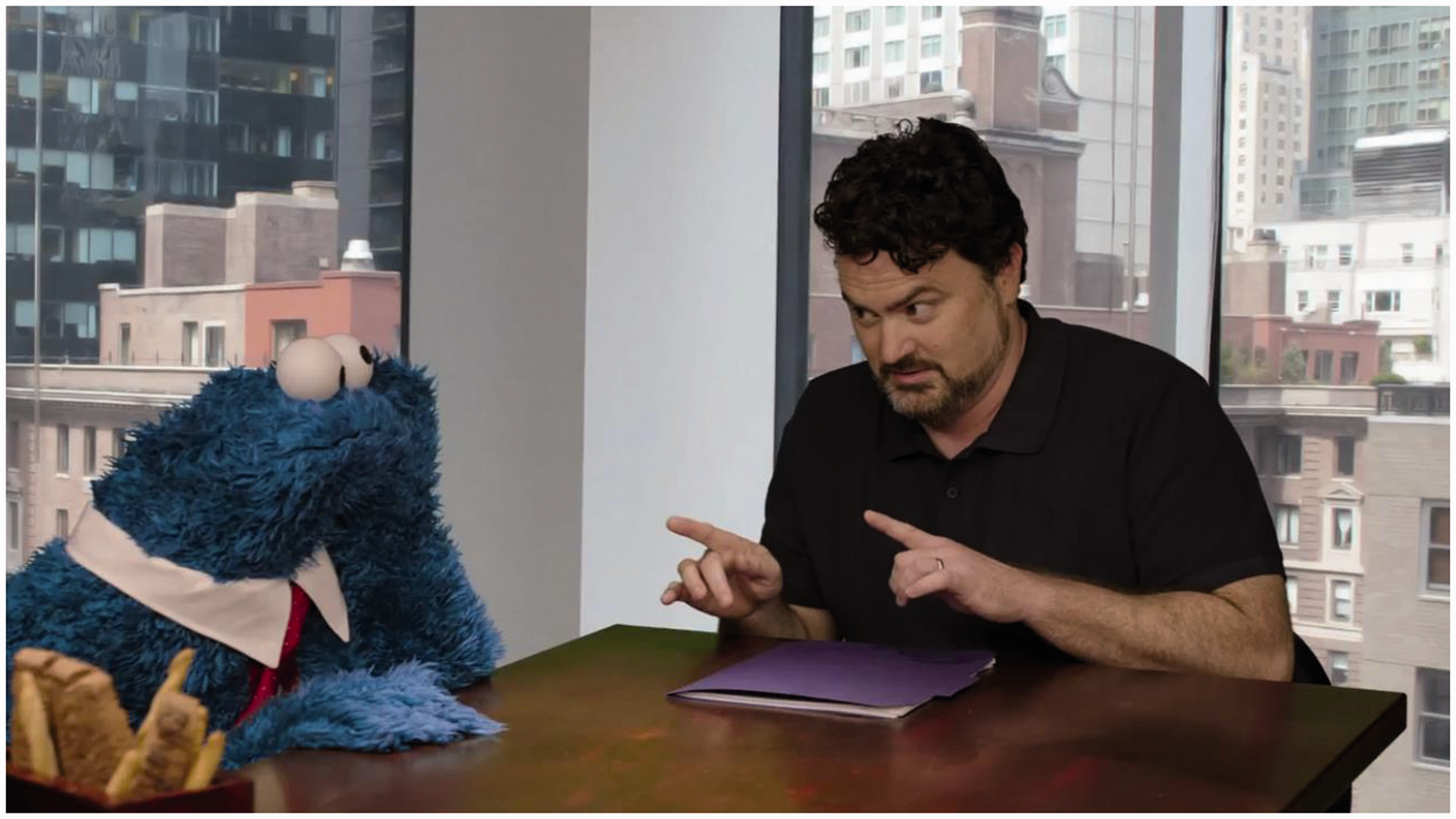
The designer Brian Fargo, through his projects “Wasteland 2” and “Torment: Tides of Numenera,” is possibly the most critical game designer against the current role of publishers. In the presentation “Wasteland 2” video, Fargo deals with three publishers dressed in expensive suits and ties. All of them represent, in their own way and according to Fargo’s discursive perspective, the greatest vices of the video game industry. The first editor is a spoiled and ignorant child who knows nothing about the past work of Fargo as a game developer. His unique motivation is funding billionaire games such as “Angry Birds” or highly popular multiplatform franchises. The second publisher, equally ignorant of the work of Fargo, agrees to finance the game and promises to call the next day. Fargo, of course, receives the call after 2 weeks to discover that the project cannot continue because publisher business has taken “another direction.” The last editor, much less caricatured than the previous ones, proposes “minor changes” which only preserves the title and some graphics peculiarities. Fargo, ironically, proposes to introduce the launch of birds as a weapon, causing joy to the editor.
Regardless of Fargo’s videos and his incisive tone against publishers’ policy in the video game industry, other projects do not visually construct the figure of the publisher but appeal to the difficulties of the industrial model sponsored by them. In this sense, Kickstarter-selected projects introduce some arguments, such as “it’s been almost impossible to get funding through traditional methods for a game like this” (“Project Eternity”), “The traditional publishers don’t believe in PC or Space Sims. Venture Capitalists only want to back mobile or social gaming start ups” (“Star Citizen”), or “let’s face it, game publishers today want sequels in very restrictive genres. In many cases game publisher overhead makes small projects not interesting to them” (“Planetary Annihilation”). In the case of “Shadowrun Returns,” Microsoft appears as one of the most restrictive publishers when designing and publishing games: The game we want to make is very humble by modern blockbuster game standards but it is still way beyond the ability of a small start-up to fund by itself. The restraints on the license from Microsoft made it impossible to get established publishers interested in Shadowrun and so it remained just a dream for a long time until Jordan saw the recent successes of some other veteran designers on Kickstarter. Crowd sourcing to fund creative content represents truly profound change to the status quo. While we watch financial models for the creation and distribution of creative content continue to erode, Kickstarter charts a direction for how fans can directly impact development of creative content they want by funding its creation. We hope that Shadowrun Returns is a creative concept you want to help make into a reality and we thank your consideration and support.
The emancipatory role of the prosumer-investor
Following creative misunderstanding and mistreatment of video game publishers, designers attending the crowdfunding model on Kickstarter try to seek confidence and complicity with a prosumer eager for new play experiences. To do this, it is common to directly appeal to the future game user and prosumer or to highlight the relevance of the role of the prosumer-investor in the configuration and future success of the proposal. In the discursive arguments, the crowdfunding model is conceived not only as a unique opportunity but also as a true revolution. In the case of “Double Fine Adventure,” Big games cost big money. Even something as “simple” as an Xbox LIVE Arcade title can cost upwards of two or three million dollars. For disc-based games, it can be over ten times that amount. To finance the production, promotion, and distribution of these massive undertakings, companies like Double Fine have to rely on external sources like publishers, investment firms, or loans. And while they fulfill an important role in the process, their involvement also comes with significant strings attached that can pull the game in the wrong directions or even cancel its production altogether. Thankfully, viable alternatives have emerged and gained momentum in recent years. Crowd-sourced fundraising sites like Kickstarter have been an incredible boon to the independent development community. They democratize the process by allowing consumers to support the games they want to see developed and give the developers the freedom to experiment, take risks, and design without anyone else compromising their vision. It’s the kind of creative luxury that most major, established studios simply can’t afford. At least, not until now.
Thus, based on the new crowdfunding model, developers’ freedom of action is the key to understanding the connection between video game studios and prosumer-investors and, with it, creativity’s protection in the context of the video game production and design.
However, and in the ideological framework of the possible world, the role of the new prosumer is not limited to “liberate” video game developers from the utilitarian and ignorant editor. His conversion to a prosumer-investor also adds a new dimension. In this case, changes in the status quo (“Shadowrun Returns”) means that now “Instead of taking this prototype to a publisher for a green light, we are cutting out the middleman and taking it to you” (“Star Citizen”). “We are in a new era where you get to decide what we spend our time on […] the better we do the more resources we’ll have to bring you a great game” (“Planetary Annihilation”). Thus, “Ask not what your [video game] genre can do for you, but what you can do for your favorite genre” (“Star Citizen”). In this new logic of investment, game designer’s freedom is in direct connection with the conversion of a consumer into a prosumer-investor according to the idea that “your dollars are now your votes” (“Planetary Annihilation”). In this discursive framework, the bottom-up logic (from the backer and now prosumer-investor to the game designer) becomes more relevant than the traditional top-down system established between the classic publisher and a small developer.
Genres and fictional themes as nostalgic appeals
The analyzed projects are limited to a type of very specific genres and themes. In particular, games that seek financing through Kickstarter’s crowdfunding platform are divided into adventure games (“Double Fine Adventure”), space simulators (“Star Citizen” and “Elite Dangerous”), strategy (“Planetary Annihilation”), and role (all other titles), in which the most popular themes are fantasy and science fiction. In this sense, the analysis highlights the lack of current hegemonic genres such as the first person shooter (called “FPS”) or online games with persistent worlds (called “MMO”). In fact, there is a notable contrast because of the constant appeal to the nostalgia of the most popular genres of the 1980s and 1990s as in the case of “Project Eternity”: Project Eternity aims to recapture the magic, imagination, depth, and nostalgia of classic RPG’s that we enjoyed making – and playing. At Obsidian, we have the people responsible for many of those classic games and we want to bring those games back … and that’s why we’re here – we need your help to make it a reality! […] We have wanted to go back to our roots and create an epic PC role-playing game adventure for years. But, it’s been almost impossible to get funding through traditional methods for a game like this. The great thing about Kickstarter is that we can go directly to the people who love to play RPGs as much as we love to make them. Plus, we don’t have to make compromises with a publisher. We make the development decisions, we market the game, and we don’t have to answer to anyone but you – our fans.
In this sense, persuasive discourse emphasizes that corporate culture and capitalist approach are attempting to end some of the most popular genres of the past (“Double Fine Adventure”) by the homogenization of production and the lack of investment in innovation and creativity. More explicit is the presentation video of “Star Citizen”: They said I was dead. They said console was the future. Now they say mobile and tablets are the future. I say to you, the reports of my death have been greatly exaggerated. I am a PC game. And I’m a space sim.
After the video statements, the proposal again highlights this idea when it defends that We say they’re wrong. We say that there is a large audience of PC gamers that want sophisticated games built for their platform. And inside this audience, a significant group of people that have always loved space games, and if given a quality one again will be happy to play it.
Thus, the recovery of old genres and the reevaluation of classic gaming platforms involve the recovery of some ancient creative values linked to an era where video game design was more an art than a business under the capitalist (“Double Fine Adventure,” “Project Eternity”).
Along with this perception, designers also highlight the growing fan interest in the recovery of certain fictional worlds that marked the recent past. This is the case of “Wasteland 2” when they state that not a month goes by when an email doesn’t come in asking if we’ve ever considered doing a sequel. Emails from gamers who remember Wasteland fondly and want, just as badly as we do, to return to that gritty world where burning through clips might be the only thing that keeps you alive; and where running out of ammo will certainly get you killed. The fact that you, the folks who know and love and play games, keep asking for Wasteland 2 told us that there is a demand for it.
Finally, all projects highlight the contrast between a successful trajectory of certain video game designers and the current status of some depressed genres with little or no industrial support. Therefore, almost all successful games that have gone to Kickstarter looking for funding respond to a system of celebrities or star system that generate a decisive confidence in the prosumer-investor and in his financial support capacity.
Conclusion
According to the results, the possible world constructed from the analyzed discursive elements sets the crowdfunding model as a revolution that is opposed to the current hegemonic production model based on strict and traditional publisher policy. In this particularly hegemonic world, publishers appear as unable to perceive the creative, artistic, or even entertainment value of game industry because its unique objective, consistent with the logic of capitalism, goes through constant profit maximization. These business dynamics explain the standardization of certain games and genres that tend to be cloned from one platform to another, leaving little room for new, more risky ideas. Considering this possible world, we can now answer both research questions:
Q1. What is the impact of the active role of the player in the digital crowdfunding model?
Because of the hegemony of traditional investors, the transformation from a passive consumer to a new prosumer-investor frees the game designer with respect to his creativity, providing new opportunities for innovation and progress. The main merit of this transformation is that it directly connects the creator with video game consumers and, in particular, it empowers the user with new producer and investor properties. Thus, video games would no longer be analyzed by publishers through economic balances, profits, risk limits, and market research: new digital channels would drive participatory culture and players would choose products according to their tastes and desires.
Q2. What are the main arguments that set a certain crowdfunding discourse in the context of the Hegemony of Play?
From the traditional model to the emancipatory crowdfunding ideology.
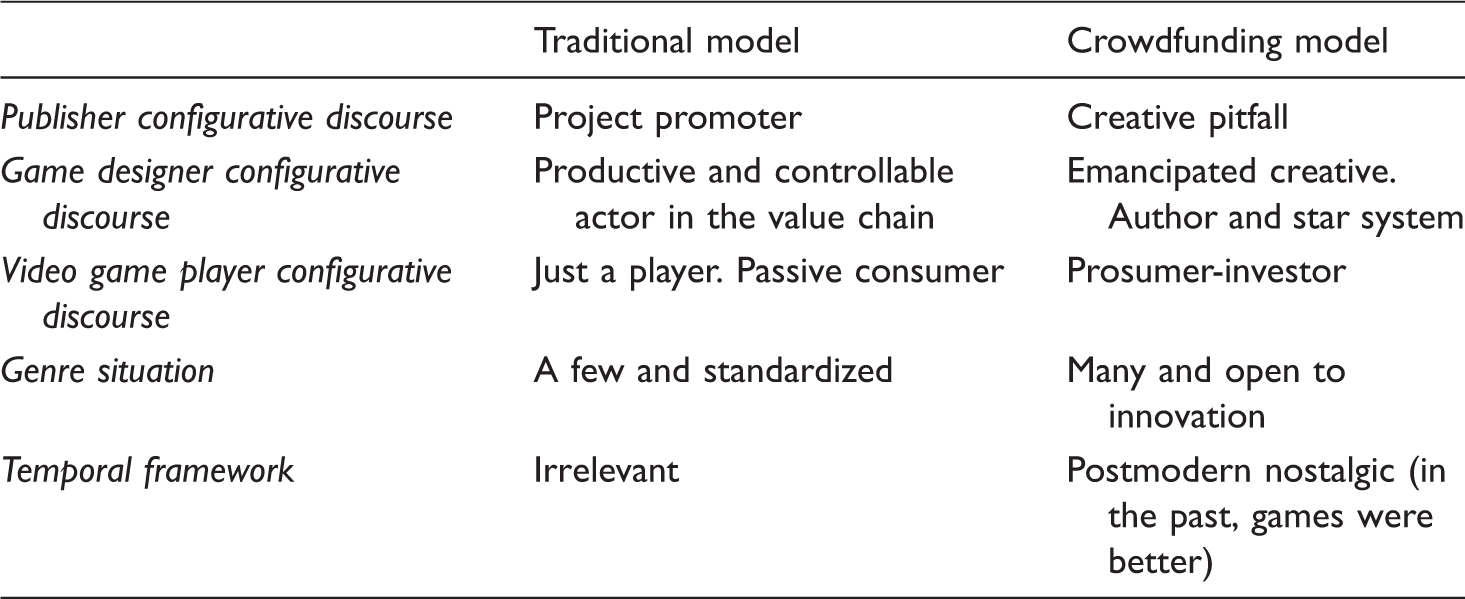
Therefore, it is not surprising that the explosion of the crowdfunding model in a digital platform such as Kickstarter symbolizes, for many developers, a messianic crusade that would allow the return of adventure games, flight simulators, and more complex role-playing games (RPGs), among other genres, and thus relegate economic and financial issues to a second and irrelevant level (Luckerson, 2013).
In any case, and assuming the necessary caution against the excessive optimism established in the roots of this new discursive framework, the crowdfunding model in the video game industry not only poses alternatives to a production model that suffers several problems but also puts on the table the issue of the real scope of the prosumer-investor. In this sense, this article also wants to propose new research topics such as the relationship between successful projects and rewards, the emergence of indie games in crowdfunding platforms (for instance, Faster Than Light (FTL) or Gods Will Be Watching), the crowdfunder’s role as producer as opposed to investor or consumer and, finally, the use of nostalgia and antiestablishment discursive elements in crowdfunding campaigns. In any case, we believe that crowdfunding, as a fashion, as a revolution, or as an alternative model of production, deserves a much deeper and extensive research in these and other areas of knowledge.
Footnotes
Declaration of Conflicting Interests
The author(s) declared no potential conflicts of interest with respect to the research, authorship, and/or publication of this article.
Funding
The author(s) received no financial support for the research, authorship, and/or publication of this article.