



Abstract
This article applies social practice theory to study the emergence of sustainable consumption practices like bicycling among the new middle classes of Bangalore, India. I argue that expansions of bicycling practices are dependent on the construction of defensive distinctions, which I define as distinctions that draw equally on lifestyle-based and ethics-based discourses to normalize bicycling among Bangalore’s middle classes. With their environmental discourses and signage, middle-class cyclists make claims to being ethical actors and ecological citizens concerned about global environments. Their high-end bicycles and special gear enable them to maintain their social status in personal and professional circles, despite adopting what is an essentialized and stigmatized mobility practice in a social context where personal automobiles are a dominant symbol of respectability and propertied citizenship. These defensive distinctions are anchored in communities that facilitate social learning, skill-building, and the creation of collective identities. I highlight the importance of considering the role of ethical discourses in consolidating “low-status” social practices among “high-status” class fractions and discuss the implications of promoting sustainable consumption through the othering of the poor. By applying a social practice analytic to study middle-class bicycling practices, this article makes a significant contribution to the growing literature that investigates the applicability of practice-based approaches to environmental behaviors and sustainable consumption in a novel context.
Introduction
On a Saturday morning in 2012, the neighborhood of Jayanagar woke up to witness the inauguration of Bangalore’s first network of bicycle lanes. The Ride-a-Cycle Foundation (RACF), a small non-profit that works to promote cycle-friendly infrastructure had lobbied municipal authorities to build these lanes, arguing this was an important step in making Bangalore bicycle-friendly. White lines and bicycle symbols were painted on a network of streets in Jayanagar, delineating 3 ft of space for bicycles. 1 That morning, government representatives, RACF volunteers, and schoolchildren, along with some of Bangalore’s cyclists gathered to inaugurate these lanes. Around the celebrations, Bangalore moved as it had the day before. An older man rode past the event on a rickety bicycle. He looked very different from the other cyclists attending this event. Dressed in a dhoti 2 and riding a rusty, Indian-made bicycle, he stopped briefly, looked at the gathering, and rode on. Perhaps he dismissed it as a political gathering or an event for schoolchildren. Either way, the man bicycled away. With the crowd spilling onto the road, passing cars and motorbikes weaved their ways past the gathering. Some honked loudly, while others looked on briefly. But like the man in the dhoti, most drove by, barely glancing at the festivity. As the speeches finished, the assembled cyclists took a ceremonial ride around the block. Leading the pack were members of the Go-Green Cycling Group. Dressed in their signature “Go-Green” T-shirts, atop high-end bicycles, wearing helmets, and in some cases, bicycle shorts, gloves, and other gear, these riders represented a new brand of cyclist. Not poor – cycling out of choice – these cyclists belonged to the new middle classes of India. 3 Many owned cars, worked jobs in the hi-tech sector, and earned incomes that would place them firmly in the middle- and upper-income brackets of Indian society. Their message was clear: they were going green by going cycling.
In this article, I apply social practice theory (Reckwitz, 2002; Shove et al., 2012; Warde, 2005) as an analytical tool to show how the new middle classes of India are legitimizing and adopting practices like bicycling that are typically associated with the poor and working classes. I argue that expansions of a shared community of cyclists are based on defensive distinctions that draw on both ethics and lifestyle-based discourses. With their environmental discourses and signage, middle-class cyclists make claims to being ethical actors and ecological citizens concerned about global environments. Their high-end bicycles and gear enable them to maintain their social status in personal and professional circles. I highlight the importance of considering the role of ethical discourses in consolidating “low-status” social practices among “high-status” class fractions and discuss the implications of promoting sustainable consumption through the othering of the poor.
India’s new middle classes, along with their counterparts in countries like Brazil, China, and South Africa, herald the spread of consumer lifestyles to the developing world (Lange and Meier, 2009). This rising consumption is often bemoaned as a blow to the environment (Myers and Kent, 2004). The concern over the environmental impacts of intensifying consumerism in India necessitates an examination of the environmental politics of India’s middle classes, especially in relation to their consumption practices. While contemporary scholarship on this topic suggests that there is limited scope for India’s middle classes to reduce or redirect their consumption (Baviskar, 2003, 2011; Ghertner, 2012; Mawdsley, 2009), the literature largely lacks studies that examine the everyday practices and behaviors of the middle classes. By studying bicycling, an everyday commute and recreational practice that can have positive environmental benefits, my work bridges a gap in contemporary scholarship and contributes to a growing literature on middle-class (sustainable) consumption and citizenship in India.
The bicycling practices I describe in this article are particularly interesting to sociologists as they allow one to interrogate the class dimensions of sustainable consumption. In modernizing urban India, bicycling is an activity relegated to those who have few other transportation options. As one of my interviewees remarked, “No respectable middle-class adult would be caught on a bicycle.” 4 Studying bicycling in Bangalore tells us something not just about how eco-practices like bicycling are instituted and performed among the middle classes but also about the strategies that middle-class actors use to legitimize and adopt practices predominantly associated with the poor. 5 In other words, if certain lifestyle practices are key to middle-class distinction, identity, and power (Fernandes and Heller, 2006, following Bourdieu, 1984), then how does the adoption of practices associated with deprivation and thrift occur? 6 Why are these practices promoted as acts of ecological citizenship and sustainable consumption? Asking these questions helps explicitly identify the relationship between pro-environmental practices and class politics in urban India. It also illuminates the role of changing social practices in discussions of environmental politics in Bangalore. 7
Social practice theory and class identities
Social practice theory sees social order as rooted in everyday practices (Hargreaves, 2011; Reckwitz, 2002). By situating their analysis at the level of the practice and focusing on the interactions between agency and structure, practice theorists like Bourdieu (1984), Giddens (1984) and more recently Reckwitz (2002), Warde (2005), and Spaargen (2011) provide a distinctive framework to analyze social behaviors. Decentering the individual in its formulations, practice theory moves beyond approaches anchored in behavioral economics and social psychology (Shove, 2010; Shove and Walker, 2010) to explore how multiple factors such as the mind, body, agents, objects, knowledge, norms, structures, and discourses are integrated into a set of internally differentiated practices that are executed by skilled practitioners (Warde, 2005).
Social practice theory has been used to analyze both how “normal” and “everyday” practices come to be (Shove, 2003) and how practices can be changed (Halkier et al., 2011; Shove et al., 2012). This second theme is particularly relevant to sustainable consumption research as practice-based analyses can illuminate the pathways to transforming resource-intensive consumption patterns (Watson, 2012). By highlighting the co-shaping of individual agency and social structures, social practice theory can help devise policy options that address both individual attributes and structural variables (Røpke, 2009; Spaargen, 2011). Practice-based analyses have also highlighted the importance of considering the material and infrastructural elements of practices (Magaudda, 2011; Watson, 2012), the role of elite leadership in popularizing and normalizing new practices (Birtchnell, 2012), and how communities of practice can serve as sites of experimentation and social learning, supporting the transformation of resource-intense consumption (Sahakian and Wilhite, 2014).
Social practice theorists also recognize that individuals and groups, through various social formations, affect the performance, stability, and transformation of practices. Relating this to consumption practices, Warde (2005) observes, Sociological applications of the (practice) concept may deal equally with persistence and change in the form of practices and their adherents, with manifest differences in the ways in which individuals and groups engage in the same practice, and with the social conflicts and political alliances involved in the performance and reorganization of practices. (p. 6)
Recognizing variations in how different groups of people perform and change a practice lays the foundation for looking at the relationship between collective identities and class politics, as expressed through everyday practices.
This mutually constitutive relationship between practice and class identity is key to contemporary formulations of India’s middle classes as a “class-in-practice.” As Fernandes and Heller (2006) write, “the contours of the (new) middle classes can be grasped as a class-in-practice, that is, as a class defined by its politics and the everyday practices through which it reproduces its privileged position” (p. 497). This practice-based analysis is largely drawn from Bourdieu’s concepts of habitus and field that theorize how class structures are reproduced by social groups (Bourdieu, 1984). Bourdieu (1984) defines the habitus as a “systems of dispositions, characteristic of the different classes and class fractions” (p. 541). Habitus is first shaped in the intimate context of the home, where individuals are socialized into certain ways of being and interacting with the world and acquire skills and cultural competencies. The field is the setting where these skills and dispositions are deployed and strengthened through everyday practices. Individuals thus acquire cultural capital, which along with economic and social capital becomes the structural basis of class power. Cultural, economic, and social capital together become the means for creating and maintaining social distinction. For India’s new middle classes, cultural capital, which is accumulated over multiple generations of caste endogamy and reinforced through educational experiences in elite English-medium schools and colleges, becomes the primary means of consolidating an identity as the vanguards of modernization in India (Fernandes and Heller, 2006; Mawdsley, 2004).
Distinction is a key to middle-class identity: Because the definition of “middle-class” is so ambiguous, those who want to claim this identity need to actively distinguish themselves from the lower orders, both on the street and within the home (Baviskar and Ray, 2011). These practices of distinction are dependent both on long-standing forms of caste, religion, and linguistic differences and on new forms of consumption (Fernandes and Heller, 2006; Upadhya, 2009; Wilhite, 2008). Consumption practices that maintain middle-class distinction are particularly visible in Bangalore, where sprawling malls, gated communities, and car-clogged roads embody the new middle-class lifestyle. Middle-class practices of distinction include shopping in malls, wearing branded clothing (Mathur, 2010; Upadhya, 2009), employing domestic workers within homes (Ray and Qayuum, 2011), and of particular relevance to this study, travel by car or motorcycles on city roads (Baviskar, 2011).
(Auto)mobility in the Indian city
The personal automobile is undoubtedly a potent symbol communicating social status. “The dominant culture that sustains major discourses of what constitutes the good life” (Sheller and Urry, 2000: 738), automobility is not just a means of transportation but a “sign of adulthood, a marker of citizenship, and the basis of sociability and networking” (Urry, 2007: 116). In an automobilized culture, both physical road space and social identity formation are dominated by cars, while other road users such as cyclists and pedestrians are reduced to essentialized and stigmatized identities (Aldred, 2013). With economic liberalization, Indian roads have become increasingly ruled by the personal automobile, and the needs of cyclists and pedestrians have become further subordinated to those of the car-driving middle classes. 8
Car ownership is a critical symbol of having achieved middle-class respectability. As scholars writing about the urban middle classes in India observe, car advertisements play on themes of inclusion and exclusion, framing the car as the most convenient, safe, efficient, and stylish mode of transport that every Indian must aspire for (Baviskar, 2011; Wilhite, 2008). Baviskar (2011) recaps how cars perpetuate middle-class distinction saying, “Cars are necessary and desirable. Those who have the wherewithal to own, drive, and ride them are, by definition, respectable citizens by virtue of their demonstrated property-owning power” (p. 414). The car-riding classes are also inured from the risks, noise, and pollution of city streets (Urry, 2004) and are able to enjoy the fruits of car consumption, without having to face its externalities. Automobiles consequently enable a distancing and displacement of responsibility for the public commons (Mitchell, 2005) and for environmental harm onto other classes (Baviskar, 2011; Mawdsley, 2004).
If the car is an integral component of middle-class lifestyles, then the bicycle is an important vehicle supporting working-class livelihoods. The majority of urban cyclists in India today are described as “utility” or “livelihood” cyclists (Tiwari and Jain, 2009). These terms refer to individuals who cycle more out of necessity and for utility, in contrast to those who cycle voluntarily or for recreation. India’s utility cyclists are members of the urban poor and the working classes who use bicycles to commute to work, transport goods, and access education, health care, and other services. (Srinivasan and Rogers, 2005; Tiwari, 2002). Livelihood cyclists comprise anywhere from 8% to 27% of the urban road share (Ministry of Urban Development GoI, 2008; Tiwari and Jain, 2013).
In stark contrast to riding a car, bicycling requires an individual to intimately interface with city streets. In Bangalore and other Indian cities today, a cycle ride is rarely a pleasant activity. Forced to jostle for room with aggressive automobiles, harassed by cops, breathing polluted air, sweating in the unforgiving Indian sun, riding barely roadworthy bicycles while transporting goods as diverse as gas cylinders or dying chickens, this is no recreational ride (Gupta, 2013). Worsening air quality and traffic congestion only exacerbates this situation (The Hindu, 2012). Non-motorized transit users often must fear for their lives. 9 It is no surprise that bicycling rates in Indian cities have declined steadily with livelihood riders upgrading to motorcycles and other automobiles when possible (Nair, 2005; Tiwari and Jain, 2013). 10
If the car is the symbol of modernization and “having made it,” the bicycle is its modern antithesis. Even if the bicycle in India started off as an identifiably foreign import and served as a vehicle to acquire social status and upward mobility (Arnold and DeWald, 2011; Rao, 1999), the rising automobilization of Indian cities has marginalized the bicycle. 11 India’s livelihood cyclists are increasingly viewed as physical impediments to the juggernaut of India’s development aspirations, and a recent ban on bicycles in Kolkata is testament to how the government discriminates against this class of road users (Bera, 2013; The Economist, 2013). In Bangalore, the government has invested significant resources in enhancing automobile infrastructure by widening roads and constructing flyovers, often at the cost of pedestrian and cyclist safety (Nair, 2005). As automobility gains ground in Indian cities, dominant depictions of the middle-class lifestyle as an automobilized lifestyle leave no room for the bicycle. How then are stigmatized bicycling practices being accommodated within the constellation of social practices that constitute a middle-class lifestyle? 12
Data and methodology
In this article, I draw on interviews, participant observation, and online ethnography to analyze the processes by which middle-class bicycling practices emerge and spread. The data presented here were collected during 14 months of ethnographic fieldwork in Bangalore. I conducted 20 semi-structured interviews with individuals who practice and/or promote bicycling in Bangalore. 13 Interviewees were identified and recruited through a number of channels: through a mailing list of a bicycling community in Bangalore, Facebook posts, and through snowball sampling. My sample consisted of 15 men and 5 women. 14 Most interviews took place on a one-on-one basis either in the homes of respondents or in public settings like coffee shops. 15
Nine of my respondents were employed in the Information Technology (IT) industry either as engineers or as managers, all of whom bicycled to work at least four times a week. Five others had previously worked in IT companies, but had quit their jobs in the past year or two to pursue interests around bicycling and other environmental issues. One of them, Nikhil, had started a bicycle store. Another, Karthik had left his IT job to work with the RACF. One of my female informants was, when I first met her in 2011, employed in an Indian software company. By 2013, she had quit and started working for RACF full-time, while also pursuing interests in organic farming. Another female informant had also quit her IT job and was planning to start working at a bicycle store. 16 About half of my respondents identified as being “native” to Bangalore, while the rest moved to the city for education or work opportunities from various parts of India. Two of my informants were “expats,” who were born and raised in Europe.
Interview questions included asking respondents about how and why they began to bicycle as adults, what kinds of trips they make (e.g. for commute, recreation, exercise, shopping), barriers they face while performing the practice, what the practice means for other aspects of their daily life, and how their families and friends have responded to these changes. In addition to interviews, I attended bicycling community events. I also carried out an online ethnography, which involved tracking conversations on forums, Facebook, blog posts, media articles, and other sources. 17 I integrate these multiple sources below and use the social practice analytic to decipher the different dimensions of the middle-class bicycling practice.
Findings: The elite and ethical dimensions of middle-class bicycling
Since the mid-2000s, many middle-class individuals in Bangalore, most of them men in their 20s and 30s, have taken to weekend bicycle rides, rallies, and races as a popular form of recreation, and some have adopted bicycles as their main mode of commute. This renewed patronage of bicycles is evidenced by the thousands of members who post on mailing lists, Facebook groups, and blogs and use these fora to coordinate weekend rides to outdoor destinations, discuss fitness tips, and share stories about successes and failures on two wheels. 18
While I received a couple of different “origin” stories for this reinvigoration of recreational and commute bicycling in Bangalore, many pointed to transnational influences. For some individuals employed in the IT industry, work trips to California and Europe provided a glimpse into bicycling lifestyles and opportunities to ride “hi-tech” bicycles. Some of these individuals came back to Bangalore, bought mountain bikes, and started taking day-trips outside the city, charting bicycle-friendly routes and finding challenging peaks to surmount. Others started riding in their neighborhoods, using bicycles for quick trips to shops and cafes.
Eventually, the bicycling scene diversified to include racing, bicycle tours, and rides within the city for beginners and casual riders. For example, the Bangalore Bicycling Championship hosts races throughout the year for both men and women. There are several organizations that coordinate multi-day bicycle trips such as the popular Tour of Nilgiris, a week-long trip that traverses parts of the Western Ghats mountain range. Many groups organize short rides within the city for beginners, usually early in the morning when there are fewer automobiles on roads. Some recreational riders have also begun to use bicycles as their main mode of commute, often riding 40–50 km on Bangalore’s traffic-choked roads every day. 19
These diverse cycling practices are supported by a number of high-end bicycle stores. These stores sell many types of bicycles, ranging from road bikes and hybrids to “fixies” and mountain bikes, most of them imported, along with specialized clothing, bags, and other accessories. Bangalore is also home to a number of bicycling communities like the Go-Green cycling group. Advocacy organizations like the RACF work with municipal authorities to improve cycling infrastructure in the city. RACF has also helped launch bicycle-share systems with the goal of getting more people to use bicycles for short trips.
My analysis proceeds as follows: In line with Hargreaves (2011), I use “Shove and Pantzar’s (2005) empirically helpful understanding of practices as assemblages of images (meanings, symbols), stuff (materials, technology), and skills (forms of competence, procedures) that are dynamically integrated by skilled practitioners through regular and repeated performance” (p. 83) to identify the various elements of cycling practices. I highlight the role of communities in supporting bicycling practices and in recruiting new practitioners. Developing the term defensive distinctions, I demonstrate how cycling becomes a “classed practice” (Aldred and Jungnickel, 2014) in Bangalore, that is, a practice implicated in class identities and relationships.
Images and stuff: The materiality and discourses of bicycling
Practices have social meanings. In asking my interviewees why they became cyclists, I began to glean some of the images, that is, meanings and symbols associated with cycling practices. I found that middle-class cyclists drew on diverse images to associate their cycling practices with discourses of “cool,” fitness, and health. All my interviewees pointed to health benefits as a motivating factor, saying that bicycling increased their sense of well-being. For a sizeable majority, bicycling also represented a great way to escape Bangalore’s legendary traffic jams. Over half my respondents explicitly mentioned saving money on fuel as an added bonus, while some said they enjoyed getting ahead of cars on the road. Many interviewees pointed to an interest in environmental issues as a motivating factor. Some of these individuals had also adopted other “pro-environmental” practices such as recycling and composting waste, buying organic food, and downsizing. 20 This suggested that health, efficiency, speed, and environmental conservation were some of the important social meanings associated with bicycling.
Images and stuff work together to recruit more practitioners into a practice. As one example of the interplay between stuff and images, the middle-class cyclist presents a visual contrast to the livelihood cyclist of Bangalore. Dressed in spandex shorts, wearing special gloves, and bike helmets, many middle-class cyclists look modern and sleek, much like the cyclists of the United States or Europe. Some use imported bicycles that are advertised as “hi-tech” and powerful. These imported bicycles are also much more expensive than the local bicycles that working-class cyclists invariably use. 21
The following two interview quotes substantiate how gear and imported bicycles are used to frame cycling as cool, hip, and appropriate: It helps that these bicycles are expensive … people can think of them as an upgrade and not as beneath them … there are some people who are buying their first bicycle now, instead of their first car but they will do that only if it is expensive and if people around them know that they can buy a car if they want to. (Nikhil, 29) … if you want them to step out of their air-conditioned car, you need to give them a cool solution. Not just status. A cool solution as in it should be fast, efficient, light-weight. Cool sexy bikes. People are busy flaunting them. (Rahul, 31)
Imported bicycles, clothing, and gear also serve practical purposes. Imported bicycles are faster, easier to ride, and help individuals travel longer distances. Cycling gear provide an added dimension of safety when bicycling in traffic or on poorly lit roads. Bicycling tights and T-shirts are more comfortable to ride in as they wick sweat away from the skin. These utilities, which are provided by expensive and often imported stuff, help stabilize the practice as they make the act of bicycling safer and more pleasant and appear more akin to the cycling practices of the West than to livelihood riders in India.
In addition to signaling this discourse of cool, fitness, and health, cyclists also draw on images and stuff to showcase the ethical motivations behind their decisions to bicycle. A telling sign of this is the following text taken from the website of the Go-Green group: It’s a general notion in our country, when someone who spots a cyclist they feel He/She is cycling either for fun or they cannot afford to buy motor cycle/car but the same cyclist cycling with a Go-Green – Tee can pass on a clear message that He/She is cycling for a cause. The print on the Tee is self-explanatory and doesn’t require any briefing on the cause. YOU GET BACK U’R RESPECT WHILE U WEAR THIS GO-GREEN TEE & RIDE CYCLE.
23
Skills, support, and shared learning: Community in bicycling
Bicycling in Bangalore is a risky proposition. It involves physical risks that are encountered while navigating traffic and pot-holed roads. It also comes with social risks, in the form of the disapproval that cyclists face from family members, friends, and professional colleagues who are often skeptical and unsupportive. Coping with these risks requires that novice cyclists develop specific skills, that is, the forms of competence and procedures that eventually enable them become full-fledged practitioners. The online and in-person cycling groups of Bangalore function as communities of practice as they consist of individuals who have come together out of a mutual interest in cycling for commute and recreation. As Sahakian and Wilhite (2014) discuss, communities of practice play a critical role in changing practices, as they can expose people to new practices, allowing experimentation and shared learning.
Bangalore’s cycling communities are critical spaces for social learning and skill-building, providing members with support and resources. Online communities like the Bangalore Bicycling Club (BBC) serve as repositories of shared knowledge on bicycling gear, routes within and outside the city, and technical knowledge on how to repair bicycles. Members often share personal stories of riding different routes on forums. These accounts in turn serve as a resource for people who are beginning to bicycle on Bangalore’s often daunting roads. Online communities extend to offline activities too. BBC members conduct bicycling workshops in workplaces and university campuses, where experienced cyclists make presentations that list the various benefits of bicycling, in terms of health, fuel costs, and recreation, while also providing other useful information on bicycling gear and riding routes.
24
Members of other communities like the Go-Green cycling group help novice cyclists learn how to ride on Bangalore roads by going on bicycle rides with them, helping them buy the right type of bicycle, and troubleshooting problems. An interviewee summarizes how bicycling communities have helped her develop the skills she needed to become a regular cyclist: I always wanted to bicycle because I am concerned about the environment … I tried it by myself for 2 years, but it was very hard to keep it up. Finding a community like the Bangalore Bicycling Club helped because I got a lot of practical advice and also saw that there were others doing 20 km commutes everyday … I was also able to join many people on rides, which was fun … I realized it was possible to do this … I was facing opposition from my family as they thought cycling was not safe for women in Bangalore … by meeting other women cyclists in these groups, I was able to reassure them. (Lakshmi, 34)
Communities of practice also help off-set the social risks that come with adopting a stigmatized and essentialized practice (Aldred, 2013). Communities work to collectively change the images associated with bicycling practices, refashioning them as green, hip, cool, and safe. For example, in the Go-Green community, members adopt and display shared symbols like Go-Green T-shirts and promulgate specific environmental discourses, thereby strengthening the identity of a cyclist as an ethical actor and ecological citizen. Similar to what Stehlin (2014) demonstrates in San Francisco, Internet-based bicycling groups develop collective norms and concepts of “proper cycling practice,” including notions of what types of cycles and gear are necessary for traversing Bangalore’s roads.
For many cyclists, their immediate families are not supportive of their decisions to cycle. Access to a community of like-minded practitioners helps offset censure from family and can also help recruit family members to the practice. This supportive function of cycling community was well illustrated during an interview with a couple: In this family, the husband was a cycling evangelist, while his wife was initially resistant to cycling and especially nervous about her husband’s safety on a bicycle. She eventually started bicycling herself after she went on a few rides organized by the Go-Green cycling group. The fact that children, older people, and women went on these rides helped convince her that cycling was not an unsafe activity reserved for young men. She now cycles regularly in her neighborhood and often goes on rides with her family. She identified community as a critical factor in changing her mind. Bicycling communities thus become integral to the socialization of commute and recreational cycling as a practice appropriate and safe for middle-class individuals.
Defensive distinctions and the cultural politics of cycling practices
Q: “How did your family and friends react to your decision to start bicycling to work?” Actually initially some of them were surprised. Some were dismayed, since the perception is that if you can afford a car, why would you cycle? But some were quite impressed and happy that I cycle regularly. (Ganapathy, 37)
The defensive distinctions of middle-class bicycling.
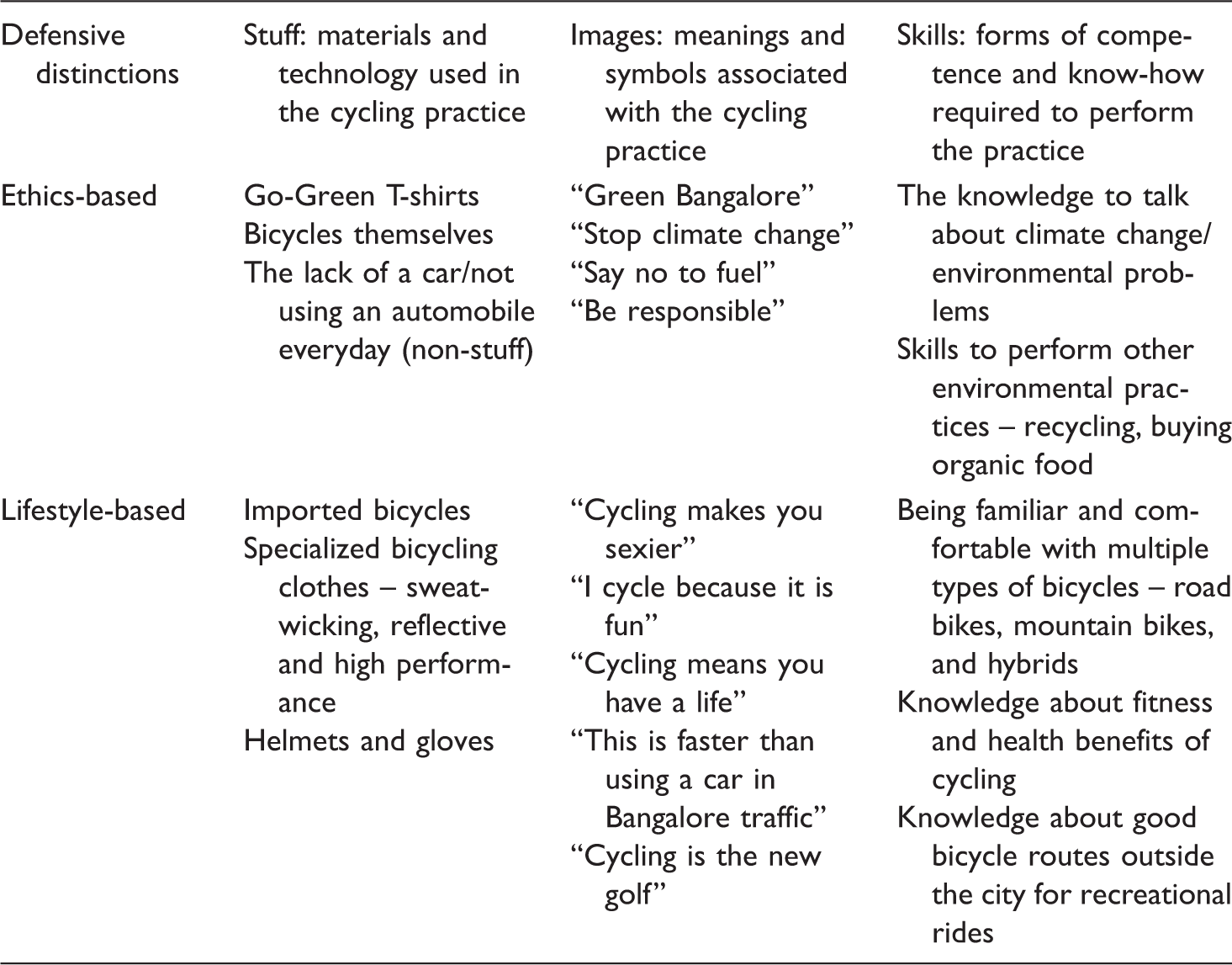
As Table 1 shows, ethics-based distinctions were made through the explicit framing of bicycling as an eco-friendly practice. By emphasizing that bicycling for the middle classes is a voluntary act adopted not just for personal benefit but also for planetary stewardship, the practice is elevated to a status of ethical import. By talking about “going green by going cycling,” cyclists also seek to distinguish themselves from car drivers, whose apparent apathy to environmental problems is evidenced by their continued patronage of automobiles. 26 Practitioners linked cycling practices with images of local and global environmental problems, developing the skills to talk about complex environmental issues and their solutions in depth. Cycling practices were anchored in stuff that conveyed environmental engagement (like Go-Green T-shirts or the bicycles themselves) and also in non-stuff, that is, in the conspicuous non-use of cars.
For my interviewees who identified as environmentalists, riding a bicycle was a way of communicating “green distinction,” that is, a means by which they communicated their identity as eco-activists and planetary stewards (Horton, 2003, 2006). I also met individuals who had developed an awareness of and interest in environmental issues through their engagement in bicycling communities. For example, one of my interviewees, when asked about what motivates him to cycle, responded: Initially I was motivated by fitness and health concerns, so I used to cycle 75% of the time. Now environment has become a bigger factor, so its’ about 100%. (Gopi, 35)
However, while bicycling was a gateway practice to environmental engagement for some, it is important to note that environmental concern was by no means universal in Bangalore’s bicycling communities. For many cyclists, the environment was peripheral to their practice (7/20 of my interviewees did not think this was an important motivating factor to their bicycling practice). Instead, the lifestyle benefits of cycling were more important. 27 Nevertheless, the environment was constantly invoked by all interviewees as a justification for their bicycling practice, that is, even if it did not motivate their actions in the first place, it was often used to rationalize their bicycling choices later to friends and family. This idea that “going green” can buffer social status has been documented in other contexts (Griskevicius et al., 2010) and, when combined with other discourses around health and lifestyle, undoubtedly plays a role in driving individuals to take up sustainable consumption activities (Barendregt and Jaffe, 2014).
Lifestyle-based distinctions, constructed through the use of images and stuff that highlight the conveniences, efficiencies, and pleasures of bicycling, work alongside environmental ideas to popularize bicycling. These distinctions have clear transnational connections as evidenced by the fact that practitioners ride imported bicycles, and their outfits look much more similar to what cyclists in the United States and Europe wear than to the attire of livelihood riders. Cycling’s resurgence as a practice associated with the cultural elite and with urbanist lifestyles is being witnessed in San Francisco, Chicago, and other American cities. In these spaces, municipal governments have begun to invest heavily in bicycle infrastructure, viewing this as means to creating more “livable” downtown areas (Sagaris, 2015) that are attractive to the so-called creative class (Stehlin, 2014; Vivanco, 2013). This link between cycling identities and “entrepreneurial” cities is becoming evident in Bangalore too, where some advocates call “cycling the new golf,” linking it to ideas of innovation and entrepreneurship. Perhaps recognizing that cycling is becoming mainstream among Bangalore’s much-vaunted IT community, the government is becoming more receptive to the infrastructure demands of bicycling activists, viewing them as legitimate voices in urban planning. Government support for middle-class-led urban renewal projects is not new in Bangalore, where the state has had a long record of privileging middle-class voices in urban governance through elite participatory-governance schemes (Ghertner, 2011; Nair, 2013). However, the fact that a municipal government that has to date prioritized car infrastructure is now willing to invest time and resources in improving bicycling infrastructure is clear evidence of the success of middle-class bicycling’s defensive distinctions.
Conclusion: Cycling spaces and city futures
This article has used social practice theory as an analytic frame to show that middle-class communities in Bangalore adopt and promote bicycling through the creation of defensive distinctions, which I define as distinctions that draw equally on lifestyle-based and ethics-based discourses to destigmatize and normalize cycling practices. In doing so, it demonstrates how ethical discourses are key to consolidating environmental practices that have “low-status” connotations among groups that seek “high-status.” Analyzing the ethical dimensions of social practices is critical especially when it comes to eco-friendly practices that carry both implicit and explicit normative connotations. Considering the conditions under which social practices are actively framed as ethical acts helps understand how groups can deploy claims to the greater good to overcome social and cultural barriers, and adopt stigmatized but environmentally sustainable practices.
The new middle classes of India are beginning to access lifestyles that are increasingly similar to the Western model and come with similar environmental impacts (Myers and Kent, 2003). Although the middle classes currently represent a small fraction of the Indian population, ranging from 50 to 150 million (Baviskar and Ray, 2011), their numbers are expected to increase in the coming years, if the forecasts on India’s economic growth hold true. As previously described, car ownership has emerged as one of the cornerstones of a middle-class existence and also contributes significantly to their environmental footprints. Devising alternatives to automobile use has emerged as an important priority for actors interested in reducing the environmental impacts of the middle-class lifestyle. This article shows how, in the space of a few years, bicycling in Bangalore has gone from an essentialized and stigmatized practice reserved for the poor to a practice that is cool, hip, efficient and eco-friendly, and increasingly popular. It demonstrates how social practices are changed through collective action and has important insights for practitioners and advocates interested in reimagining mobility in the Indian city.
This article also demonstrates how the practices of class distinctions in urban India are fluid and constantly negotiated through individual and collective actions. As the middle classes begin to identify as cyclists, they collectively change what it means to ride a bicycle in urban India, modifying its social meaning from a practice of deprivation to an act of self-improvement, enjoyment, and environmentalism. In doing so, they defend their class status and retain for themselves the privilege that their class identities afford, despite rejecting that ever-present signifier of middle-class status in India – the personal automobile. However, promoting eco-friendly practices of bicycling through the creation of distinctions is ethically problematic as it depends on the othering of the poor. This othering is especially problematic in a political context where the government is highly receptive to the needs of middle-class communities, but has a record of marginalizing the urban poor. Furthermore, it deepens the stigma associated with poor cycling identities.
As some discussion on bicycling forums demonstrates, middle-class cyclists are becoming increasingly cognizant of the limits of defensive distinctions. Some bicycling advocates who want better cycling infrastructure in the city are coming to the conclusion that for this to happen, they may need to build support and solidarity with working-class cyclists, who far outnumber middle-class cyclists. Other bicyclists speak of their admiration for the tenacity and physical capacity of working-class cyclists, who often traverse long distances on old, rickety bicycles carrying heavy loads. However, for a majority of Bangalore’s cyclists, bicycling in and of itself is not a political act of resistance to automobiles or of solidarity with the working classes. Rather it is symbolized by an “economy of enjoyment” (Stehlin, 2014: 22). This significantly limits the potential of bicycling communities to usher in more egalitarian roads and public spaces, especially as bicycling in Bangalore, like in other cities like San Francisco, is evolving into a distinctive and depoliticized middle-class sub-culture. Resuscitating the bicycle’s role as a vehicle of social transformation (or engendering “biketivism” in Furness’ (2005) words) would require bicycling movements to move beyond exclusively elite leadership, which has been demonstrably successful in changing the social practices (Birtchnell, 2012), but has hitherto failed to include diverse perspectives.
The story of bicycling is reflective of and linked to broader transformations in Bangalore. Since the liberalization of the Indian economy in 1990, Bangalore has transformed from a mid-size city filled with public sector enterprises, small-scale industries, and educational institutions to a large metropolis enmeshed in the circuits of global commerce. The city has grown four-fold, and the networks of roads and highways that crisscross its terrains are signs of this expansion. Contestation over public spaces has erupted at multiple times, especially over decisions to widen roads to reduce city traffic. Bangalore’s middle-class cyclists are interestingly positioned in relation to these conflicts. On the one hand, being middle class and invested in particular visions of modernity, they could presumably be in favor of a more “world-class” city with highways and smooth traffic. This is indeed what numerous scholars studying the middle classes of urban India have documented; that is, the middle classes are invested in the creation of “world-class” cities that leave no room for the poor. On the other hand, they are also cyclists who appreciate pleasant, tree-lined avenues for their bicycling practice. As Bangalore contemplates its future, the story of bicycling could serve as an interesting counter-narrative to automobile-focused urban planning. However, the potential for bicycling practices and movements to bring about a more sustainable city will depend on the ability of middle-class practitioners to make connections to other constituencies in the city, including pedestrians, public transit users, and most importantly cyclists like the old man in the dhoti who rode past the rally.
Footnotes
Declaration of Conflicting Interests
The author(s) declared no potential conflicts of interest with respect to the research, authorship, and/or publication of this article.
Funding
The author(s) received no financial support for the research, authorship, and/or publication of this article.