




Abstract
This article connects existing mobility biographies research with social practice inquiries into the dynamics of consumption and examines the potential of a biographic, practice-centred approach for researching everyday practices. Following a critical review of the benefits and limitations of existing research on mobility biographies, the article explores some key ways in which a practice theory approach can be employed to reframe and extend how dynamics of mobility over the life course can be conceptualised and analysed. A key feature of the discussion is a consideration of the ways in which the concepts of practice and career can broaden investigations of practice biographies to include various perspectives and scales. The article then outlines the development and application of a biographic, practice-centred methodology which was employed in an ongoing mobility biographies study based in Ireland. In demonstrating the potential of this approach for researching practice careers across the life course, empirical data relating to an individual’s career-in-car-driving are presented and discussed. The article concludes that, despite some limitations, practice-centred biographic approaches offer potential for addressing some unanswered questions regarding mobility practices.
Introduction
Understanding the dynamics of everyday consumption practices and their transformation across the life course is central to comprehending and potentially encouraging more sustainable practices (Rau et al., 2014; Schäfer et al., 2012). Everyday mobility practices that revolve around the ‘consumption of distance’ (Heisserer and Rau, 2015) represent a key focus for scientists, policy makers and practitioners in the sustainability arena. In this context, the rapidly expanding field of mobility biographies research has produced insightful work on the dynamics of individuals’ everyday mobility practices over the life course, including changes around major life events such as arrival of first child, or residential relocation (e.g. Lanzendorf, 2003; Müggenburg et al., 2015; Rau and Manton, 2015; Scheiner and Holz-Rau, 2013b; Schoenduwe et al., 2015). Recent efforts to reconceptualise and study everyday mobility as a dynamic practice have thrown up interesting theoretical and methodological questions regarding, for example, the appropriate focus and scale of inquiry, the nature of human behaviour and its transformation over time, as well as practical issues specific to longitudinal work such as time constraints or gaps in people’s recollection of past practice (Heisserer and Rau, 2015; Jaeger-Erben, 2013).
Nevertheless, the question how and why people develop, maintain or change routine mobility practices has only been partially answered. Considerable gaps in knowledge remain that reflect the continued dominance in consumption research of conceptual and methodological approaches that rest upon misconstrued static conceptualisations of human behaviour (cf. Blue et al., 2014; Hards, 2012; Rau et al., 2014). Within mobility research more broadly, a general lack of attention to temporality has been reflected in the persistent popularity of cross-sectional research designs that link people’s present attitudes and behaviours to current contextual conditions in an effort to understand and predict their behaviour (Jones et al., 2014; cf. Rau and Edmondson, 2013 for a more detailed discussion of cross-sectional work and its implications for understanding behaviour). In addition, mainstream approaches that focus on individuals’ travel behaviour continue to outnumber studies that adopt a more sociological, relational perspective, most notably those that draw on theories of social practice (hereafter referred to as SPT (Social Practice Theory)). 1 This last distinction is particularly important as the two approaches rest on divergent understandings of human behaviour, sociality and change.
This article falls firmly into the latter category by reconceptualising everyday travel behaviour as mobility practice. In doing so, it aims to contribute to current debates on appropriate concepts and methods for exploring dynamics in everyday consumption practice more generally, and mobility in particular, by linking the field of mobility biographies with SPT approaches. To complement this, we discuss the development and application of an innovative retrospective qualitative methodology for analysing dynamics in car driving across the life course, drawing on empirical data from a mobility biographies study in Ireland. Here, the article ties in with recent innovative work on biographical dynamics in practice (cf. Butler et al., 2014; Groves et al., 2016; Hards, 2012; Henwood et al. 2015; Spurling, 2010), with a view to raising additional theoretical and methodological questions for further exploration. Although the article’s primary aim is not to present data but to illustrate the utility of a biographic, practice-centred methodology in representing and exploring life-course dynamics, it refers to illustrative empirical examples throughout.
The article commences with a brief overview of recent mobility biographies research, identifying some considerable gaps in the field. Building on this, the potential of an SPT approach is discussed. Thereafter, the practice-centred, biographic methodology is introduced and its application in the research context is traced. The article then demonstrates the potential of the methodology for researching practices across the life course using an illustrative case of an individual’s career-in-car-driving. The article concludes that, despite some limitations, practice-centred biographic approaches open up a fruitful avenue for addressing some unanswered questions regarding mobility practices.
Dynamic approaches to mobility practice
Investigating mobility biographies: Everyday travel practices across the life course
Recognising the limitations of cross-sectional designs, social-scientific mobility research has moved towards more dynamic, longitudinal approaches, broadly termed the mobility biographies paradigm (Scheiner, 2007; Scheiner and Holz-Rau, 2015). This has led to a rapidly expanding body of work adopting a life-course approach to study changes in individual travel behaviours. A review of the field reveals significant variation in terms of the analytical focus, methodological approaches and temporal focus (Jones et al., 2014; Müggenburg et al., 2015; Rau and Manton, 2015). A significant volume of work focuses on the effects of significant, clearly identifiable life events, such as relocation or the birth of the first child, on individuals’ travel behaviour (e.g. Clark et al., 2014; Lanzendorf, 2010; Rau and Manton, 2015; Scheiner and Holz-Rau, 2013b). These event focused mobility biography studies have shown that changes in routine travel behaviour occur rather unevenly across the life course. Some life events, such as the transition from education to employment or starting a family, appear to initiate radical shifts in the organisation of everyday mobility while others coincide with phases of relative stability.
Methodologically, this field has been dominated by quantitative methodologies employing large-scale data to model different trajectories and identify life events and domains that impact individuals’ travel behaviour. Methods employed have ranged from longitudinal analyses of existing panel data to retrospective studies based on self-completion surveys (Müggenburg et al., 2015; Rau and Manton, 2015). However, while this work has been important in capturing large-scale trends in travel behaviour across the life course and revealing the significance of major life events, many of the processes and mechanisms by which change occurs remain unclear (Jones et al., 2014; Müggenburg et al., 2015).
Recent efforts have broadened the scope of analysis to capture the influence of contextual factors that shape both life events and travel behaviour. Here, context is loosely defined as a set of factors that influence the cognitive and behavioural dimensions of travel behaviour. These have included gender (Scheiner, 2014), social networks (Axhausen, 2008), the built environment (Chatterjee et al., 2013), spatial contexts (Clark et al., 2014; Scheiner and Holz-Rau, 2013a), and cohort effects (Hjorthol et al., 2010; Scheiner and Holz-Rau, 2013a). Moreover, it is possible to observe interaction effects between contextual variables, life events and travel behaviour. For example, Clark et al. (2014) used UK panel data to show the effect of spatial context on travel behaviour around key life events. Similarly, Lanzendorf’s (2010) work captures interactions between key events (e.g. relocation, new job, arrival of first child) and behaviour changes across the three domains of lifestyle, accessibility and mobility. Cohort and period studies provide further insights into contextual effects. For example, a quantitative analysis of panel survey data by Hjorthol et al. (2010) found that while car ownership tends to increase up until retirement and then declines thereafter, in general car ownership has increased over successive generations, pointing towards the importance of historical location and cohort membership on travel behaviour.
However, these attempts to direct attention towards context, while welcome, remain at best incomplete, mainly because they treat context quantitatively, as a set of external variables that influence individuals’ decision-making. This ignores the role of individuals as active and socially connected change agents whose practices both shape and reflect the structure, composition and logics of the social settings they inhabit. Moreover, individualist–rationalist conceptions of everyday decisions and habits have dominated, leading to a ‘portfolio model of human action’ (cf. Warde and Southerton, 2012). Here, life-course transitions constitute ‘moments of change’ when automated habits become subject to reflection, shifting the unconscious into consciousness, and thus offering opportunities to reset habits (cf. Verplanken et al., 2008). However, the onus is essentially on individuals to alter their decisions, with the overall aim of putting rational sovereign consumers back in charge of their conduct. 2 Perhaps as a consequence of the continued centrality of individualist–rationalist approaches, there has been little consideration of socio-symbolic, material and institutional dynamics and how these intersect with dynamics in performance over time (Cairns et al., 2014; Heisserer and Rau, 2015). As such, questions remain regarding how wider structural processes, including changes in value orientation, legislation or policy, intersect with individuals’ mobility biographies (cf. Müggenburg et al., 2015; Rau and Manton, 2015).
Furthermore, in terms of temporal orientation, much existing research has focused on particularly dynamic life stages characterised by frequent transitions rather than dealing with the life course in its entirety, including phases of relative stability (Jones et al., 2014). In addition, much quantitative work to date has adopted a rather homogeneous, over-simplified picture that fails to recognise and represent diversity in life-course circumstances and experience (Cairns et al., 2014; Schoenduwe et al., 2015). This raises the question, what might a less individualised and more sociological approach offer to this field of inquiry, especially if it is combined with innovative empirical approaches to studying dynamics across the life course?
To summarise, existing mobility biographies work has significantly advanced understanding by moving beyond static approaches to capture the influence of major life events on travel behaviour. However, conceptual and methodological tools, most notably the actor-centric perspective, strong focus on quantification and aggregation of individual-level data, have been less suitable for exploring processes at the level of situated social practices. Some critical gaps in understanding remain, with SPT approaches offering promising ways to address these. Approaches that move beyond the individual to re-contextualise the study of mobility as a social practice represent an alternative to prevailing individualist views of change. The following section outlines SPT as an innovative conceptual approach through which these some limitations of mainstream approaches can be addressed.
Reconceptualising travel behaviour as mobility practice – The potential of a social practice approach
Within consumption research, a paradigmatic shift has occurred towards SPT as a means to conceptualise and study dynamics of practices (cf. Røpke, 2009; Shove et al., 2012; Warde, 2005). However, travel and mobility research has not yet shown the same uptake of SPT, despite some recent noteworthy exceptions (cf. Barr and Prillwitz, 2014; Heisserer and Rau, 2015; Shove et al., 2015; Watson, 2012). This emerging work is clearly demonstrating the significant potential of practice approaches for advancing understanding of everyday mobility. However, to date, mobility biographies research has been largely unaffected by these recent trends towards SPT. Using the exemplar of car driving, this section outlines different ways in which SPT can advance the study of everyday mobility. In considering the specific implications of SPT for mobility biographies research, it asks how the concept of ‘career’ could broaden the investigation of practice biographies to include various scales and temporalities.
What then can SPT add to the study of mobility biographies? At the most basic level, it implies reconceptualising travel behaviour as a situated social practice (Barr and Prillwitz, 2014) that undergoes various transformations over time. The key proposition underlying SPT is that individuals’ performance of distinct sets of everyday practices reproduces social structures (Bourdieu, 1977; Giddens, 1984; Schatzki, 1996). In addition, SPT proffers to connect micro and macro approaches to social analysis by highlighting the interconnections between routinised everyday conduct and larger-scale institutional development (Reckwitz, 2002). In this sense, structure and agency are taken to be mutually constitutive, recursive and simultaneously determined through time and space. Thus, rejecting analyses that draw exclusively on either of the juxtaposed models of homo economicus or homo sociologicus, practices are presented as the constitutive social elements through which we can understand actions, institutions and structures (Shove et al. 2012; Warde, 2005).
Applying SPT to the study of everyday mobility practices across the life course thus brings about a fundamental shift in how agency, context and change processes are approached (Warde, 2005; Watson, 2012). While existing work has highlighted the ways in which attitudinal and contextual variables interrelate with life events in shaping individuals’ mobility biographies, an SPT perspective reframes this discussion away from individual behaviour towards the dynamics of practices. Barr and Prillwitz (2014) argue that such a shift in perspective is crucial as social practices are more broadly conceived than habits in that they place current individual routinised behaviours into both a social and a historical context, thus recognising how apparently individual choices are framed by contemporary trends and the development of such trends over time and space. (p. 7)
In considering the embeddedness of mobility in everyday life, SPT directs attention to the ways in which forms and modes of mobility such as car driving allow socially valued practices to be accomplished, including getting to work and school, shopping, visiting friends and so on (Cass and Faulconbridge, 2016; Shove et al., 2015). In this sense, habits and routines can be conceptualised as the reproduction of stable social practices, thus drawing attention to the recursive interaction between collective and social temporalities and the structure and allocation of practices in daily life (Southerton, 2013). Furthermore, reframing research questions to conceptualise ‘car dependence as a feature or characteristic not of people or of places but of practices’, Shove et al. (2015: 275) highlight ways in which complexes of social practices (e.g. shopping, mobility and work) and the infrastructures that underpin them have evolved together as they have been reconfigured in time and space via an overall process of spatial distancing between sites and services.
Reconceptualising car driving as a distinct, integrated
3
social practice makes it necessary to explore how practices and their transformation have been understood in the literature. Focusing on practice directs attention to the embodied, material, temporal and spatial organisation of human action, but it also implies a recognition that practices are made up of a unique set of elements (cf. Shove et al., 2012). For example, Reckwitz (2002) views practices as distinct entities composed of a unique set of elements and highlights processes of routinisation in their (re)production: A ‘practice’ … is a routinized type of behaviour which consists of several elements, interconnected to one another: forms of bodily activities, forms of mental activities, ‘things’ and their use, a background knowledge in the form of understanding, know-how, states of emotion and motivational knowledge. (pp. 249–250)
A key focal point of research on consumption practices has been to explore the careers of practices-as-entities. Here, Shove et al.’s (2012) dynamic model which treats materials, meanings and competences as key constitutive elements of a practice has been instrumental (see Figure 1).
Dynamic elements of social practice (adapted from Shove et al., 2012).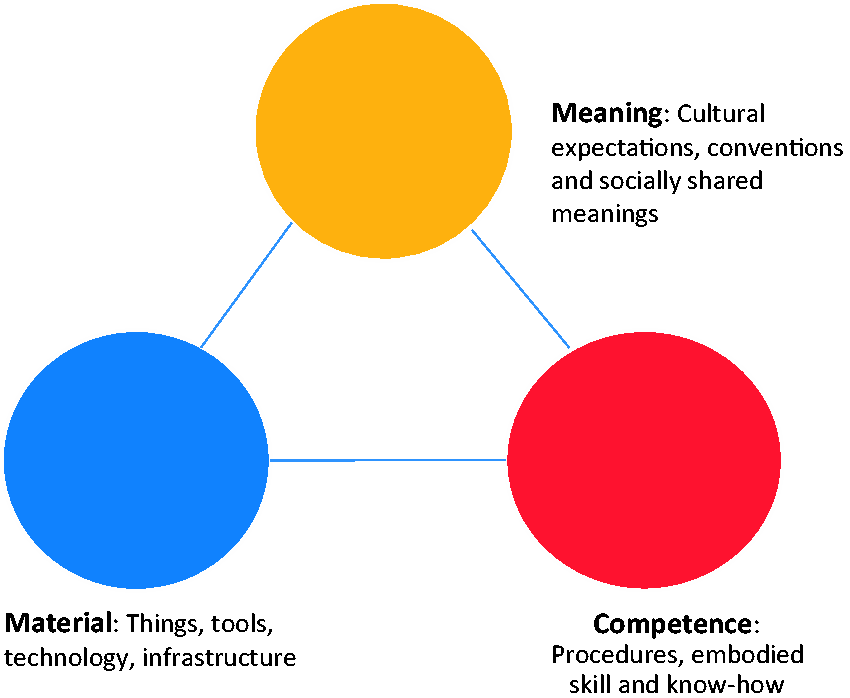
According to this view, the reproduction and transformation of practices can be studied by examining changes in the specific configurations of the elements that constitute them. These configurations are historically and geographically grounded in specific normative and material contexts and thus vary across time and space. Practices develop specific trajectories or ‘careers’ as routines and habits continually evolve through the emergence and dissolution of linkages between elements. The practice of driving a car, for example, came into being and diffused over time and space during the past two centuries, during which period its key elements – cars, infrastructure, skills required to drive as well as rules and norms about driving in society – have continuously evolved in different ways around the world (Cairns et al., 2014). Significantly, SPT challenges commonly held views of change as exceptional or ‘out of the ordinary’, instead emphasising the highly dynamic nature of everyday practices and their role in social reproduction, thus shifting attention towards biographies of practices (Shove et al., 2012).
In positing practices as the unit of analysis, practice theory offers a very different approach to understanding the relations between individuals and their actions than that of dominant mobility biography approaches. In decentring the individual and instead ‘placing the practices which constitute individual lives at the centre of analysis’ (Watson, 2012: 490), SPT offers a radical and distinctive perspective on human agency and subjectivity. Instead of practices and actions being seen as reducible to individuals, individuals are conceptualised as ‘practitioners’, ‘carriers’ or ‘hosts’ of practices. In other words, SPT does not attribute meanings, knowledge or competencies to be the property of individuals, but rather see these as constituent elements of practices. The processes by which an individual becomes ‘enrolled’ or ‘recruited’ to a practice, that is, how they become practitioners, emerge as a central focal point for analysis (Warde, 2005).
However, this explicit emphasis on practices as the unit of analysis should not imply that we lose sight of the importance of individual lives (Hui and Spurling, 2013; Spaargaren, 2013). Practices, of course, depend upon individual performances for their continued survival and it is individuals who carry and integrate the necessary skills and knowledge that make each performance possible (Reckwitz, 2002). Indeed, practice theorists are careful not to overemphasise the structuring effect of practices on individuals. Rather, individuals, as ‘carriers’ of practices, are active, knowledgeable and capable bodily and mental ‘agents who make use of the possibilities offered to them in the context of specific systems of provision’ (Spaargaren, 2003: 688) and whose skilful engagement with and performance of practices is crucial to their reproduction and transformation (Giddens, 1984).
With respect to understanding change more broadly, and the evolution of mobility biographies in particular, the question of individuals’ ‘careers’ of engagement with a practice across the life course arises as an important area for analysis. In this respect, Shove et al. (2012) stress the importance of individual and collective ‘careers’ of engagement with practice for patterning of energy demand over time, reminding us that ‘the lives of practitioners and practices interact’ in the dynamics of practice as it plays out over time and space (p. 39). Thus, as Warde (2005: 149) recognises, the question of how a practitioner’s career takes off, develops and changes over time is crucial for understanding dynamics in practice.
To date, however, the relationship between individuals and practices has not been explored in a systematic way (Hui and Spurling, 2013). 4 Indeed, most existing longitudinal practice research focuses on larger-scale processes to trace shifts in prevailing norms, technologies and at an aggregate societal level (e.g. Anderson, 2014; Southerton, 2009). In contrast, there has been a paucity of work exploring practitioners’ biographies or careers-in-a-practice (Hui and Spurling, 2013), despite the significance of an individual’s lifelong experience for their engagement with practices (cf. Shove and Pantzar, 2007; Spurling, 2010). 5 Instead, many practice-theoretical studies have, to date, endorsed a rather static framing of individuals as carriers of requisite elements needed for the enactment of practices. 6 However, individuals, too, have a history and future of performances that are ‘woven together within a life’ (Hui and Spurling, 2013: 2). This implies that at least two temporal scales of analysis, as well as their interactions, are important for understanding emergent mobility dynamics: that of the career of the practice-as-entity in question and that of the individuals’ career-in-a-practice over biographical time.
Extending the concept of ‘career’ to include individuals’ lifelong engagement in a practice can help to shed light on the complex and dynamic linkages between individuals’ lives and the developmental trajectory of practices. To this end, an individual’s career-in-a-practice can be conceptualised as a biographic repository in which elements such as embodied skills, knowledge, meanings and changing technologies are accumulated, rearranged, replaced or removed over time. This implies recognising that processes of accumulation, rearrangement and integration of elements are shaped by prior biographic experience as well as wider social, spatial, temporal and structural contexts (Hui and Spurling, 2013). Here, the ways in which shifting cultural conventions and institutional norms and standards at the macro scale intersect and interrelate with the trajectories of individuals’ career-in-a-practice at the micro scale become a key question. Furthermore, in investigating practice dynamics through the lens of life-course transitions, analytical attention is directed towards crucial turning points in individuals’ career-in-a-practice and their potential connections with major life events. Moreover, it necessitates recognising that practitioners may be engaged in multiple, concurrent practice careers throughout their lives. For example, work, family, mobility and food careers can evolve and intersect in different ways as commitments and roles shift and change throughout biographical time. In other words, while studying a career-in-a-practice foregrounds the practice under investigation, it must be recognised that the practice in question only gains coherence when set against the backdrop of ‘the integration of many practices and many careers within an individual’s life’ (Hui and Spurling, 2013: 7). Such investigations can thus explore how patterns, flexibilities and tensions emerge between concurrent careers in individual practitioners’ lives as they move through particular life-course transitions.
A final application of a career-centred practice approach relates to the investigation of historical changes in the social differentiation of practices across generations. In this respect, explicit recognition of the changing demographic picture of multiple careers-in-a-practice (Hui and Spurling, 2013) emerges as important for thinking about how practices take hold and develop in society. 7 For example, in considering the development of car travel as an ‘initially exclusive activity, becoming increasing popular and plural’ (Warde, 2005: 139), the recruitment of new socio-demographic groups, including women and lower classes, to the practice of car driving has been crucial to its expansion (cf. O’Connell, 1998 for a class and gender focused historical analysis of access to the car in Britain). In this respect, an individual’s career-in-a-practice must be situated within the context of the broader socio-historical context in which it develops.
In summary, applying SPT to the study of everyday mobility offers a highly contextualised and dynamic approach that can help advance understandings of the relationship between individuals’ lives and practices over time. A biographic, career-centred approach implies asking novel questions about how mobility biographies might be analysed. Importantly, both practice and life-course approaches offer concepts and methodological tools that can be fruitfully employed to design and implement dynamic approaches to empirical practice research. The remainder of the article discusses the empirical approach developed for an investigation into the biographies of mobility practices and their practitioners in an Irish context.
Methodology
Efforts to empirically connect individuals’ careers-in-a-practice and wider historical changes offer exciting opportunities for multi-scalar, practice-centred lines of inquiry. However, they also involve considerable methodological challenges, many of which relate to choosing practices as main units of analysis. Often, traditional research methods fall short in their ability to capture the dynamic nature of practices as well as their contextual elements (Blue et al., 2014). This partly relates to the continued dominance in social research of ontological and epistemological standpoints that focus on either the activities of individuals or the influence of wider structural conditions (e.g. policy landscape) but rarely on their interactions (Spurling, 2010). Innovative, context- and time-sensitive methods are thus needed to capture individuals’ careers against the backdrop of wider changes in the ‘systems of provision’ that underpin them (cf. Rau et al., 2014). Biographic methods provide ‘a sophisticated stock of interpretive procedures for relating the personal and the social’ (Chamberlayne et al. 2000: 2), thus offering fruitful pathways for structurationist empirical investigations. In cross-fertilising life-course approaches and SPT, the methodological design for this study combined various biographical, practice-oriented tools to collect and analyse data on individuals’ career-in-a-practice over the life course and against the backdrop of the wider history of mobility practices in Ireland.
Developing a biographic, practice-based methodology
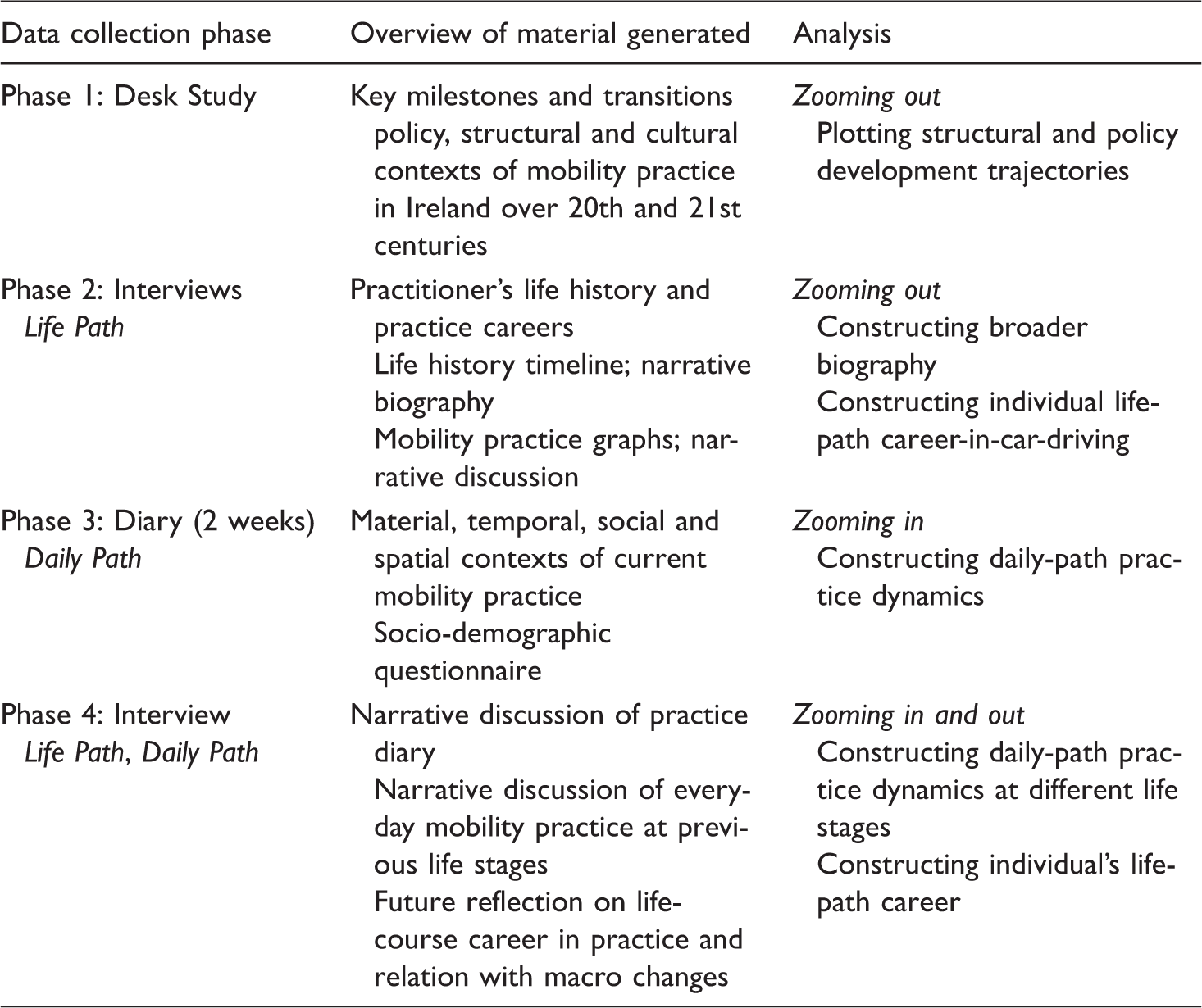
Overview of methodology.
Sample
Participants by gender and cohort.

Analysing practice careers
Adopting the two-pronged strategy outlined by Witzel and Reiter (2012: 102), analysis of primary data relating to individuals’ biographies (Phases 2, 3 and 4) combined detailed examinations of stability and change within each individual case (vertical analysis) with an exploration of themes across cases (horizontal analysis). To explore changes in practices, a retrospective picture of the evolution of individual’s practice careers (in this case driving a car) was established. Triangulation of practice career graphs and interview and diary data helped to construct a life path of how practice careers developed over individuals’ lives.10 The visual-graphic methods proved particularly useful for capturing when, how and at what rate change occurred. By embedding practice dynamics in their biographic and socio-historical contexts, it was also possible to demonstrate the role of time and space in creating or foreclosing the circumstances for the development of practice careers (cf. Hards, 2011).
Using biographical interviews supported by life-course tools (Phases 2 and 4), individuals’ careers were constructed to identify periods of relative stability and change. Life graph drawing techniques (Hards, 2012; Howell, 2013) stimulated and supported interview discussion and helped to create a holistic picture of the development of individuals’ careers-in-car-driving in the context of life-course transitions and phases identified as salient by them. Retrospectively, respondents reflected on their entire life course to consider the timing and order of phases and to identify critical milestones, turning points and transitions in their practice careers.
Following Hards’ (2011) analytical approach, the direction, tempo and contexts of change received particular attention. Phased practice trajectories represented the direction of change in terms of levels of car use (driving) as increasing (positive slope), decreasing (negative slope) or stable (flat line). Furthermore, the gradient of the graph reflected the rate of change, with participants drawing sharp inclines or decreases to represent periods of rapid and sudden change and more gradual slopes to represent periods of slower transition.
Below, an illustrative case of a participant’s career-in-car-driving shows how the methodology was used to record and visualise dynamics. Claire is a 56-year-old secondary school teacher, divorcee and mother to four adult children who have recently left home. Living in Ireland all her life, she always resided in urban areas until her recent decision to relocate to the countryside to live with her new partner. Figure 2 is a visual representation of Claire’s career-in-car-driving over time.
Claire’s career-in-car-driving.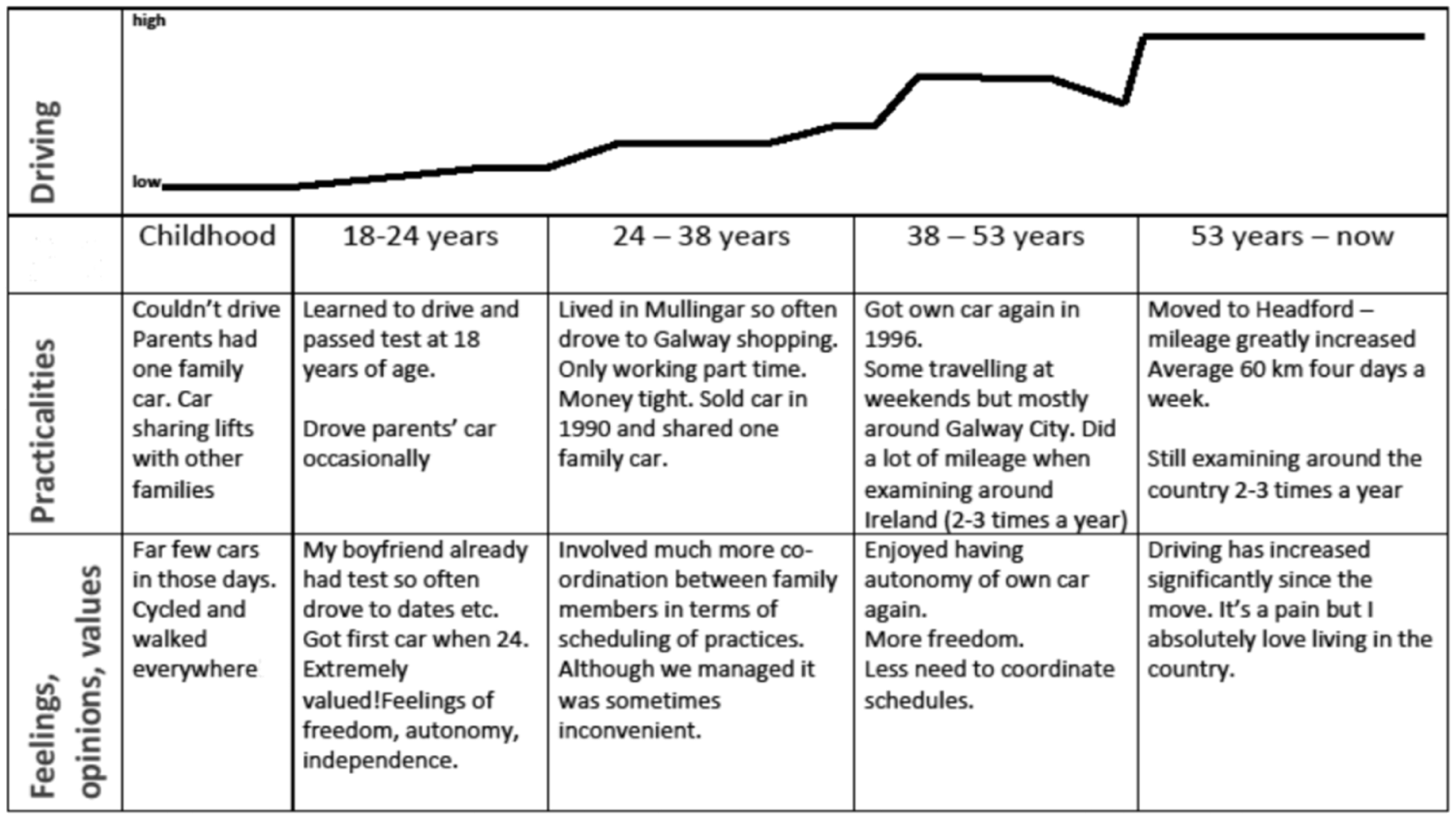
Claire’s graph displays a mixture of sudden and sharp changes alongside more gradual transitions, interspersed with periods of apparent stability (Figure 2). The resulting pattern reflects a biography of alternating flat and upward trajectories of varying degree, representing an overall increase in car use over time. Such a positive car use trajectory (upward curve/line) was very common across the entire sample while a downward curve/line proved much rarer.
Contextualising practice careers
The methodological approach pursued also facilitated an investigation into the ways in which individual lives, everyday practices and wider institutional developments interact to create particular practice dynamics over time (cf. Spurling, 2010). Linking primary data to existing evidence of (infra)structural and institutional developments regarding mobility (Phase 1), it was possible to explore the ways in which socio-historical developments shape individual careers. For example, the contextualised account of Claire’s career-in-car-driving in Figure 3 plots individual-level changes against wider mobility-related transformations in society.
Contextualised version of Claire’s career-in-car-driving.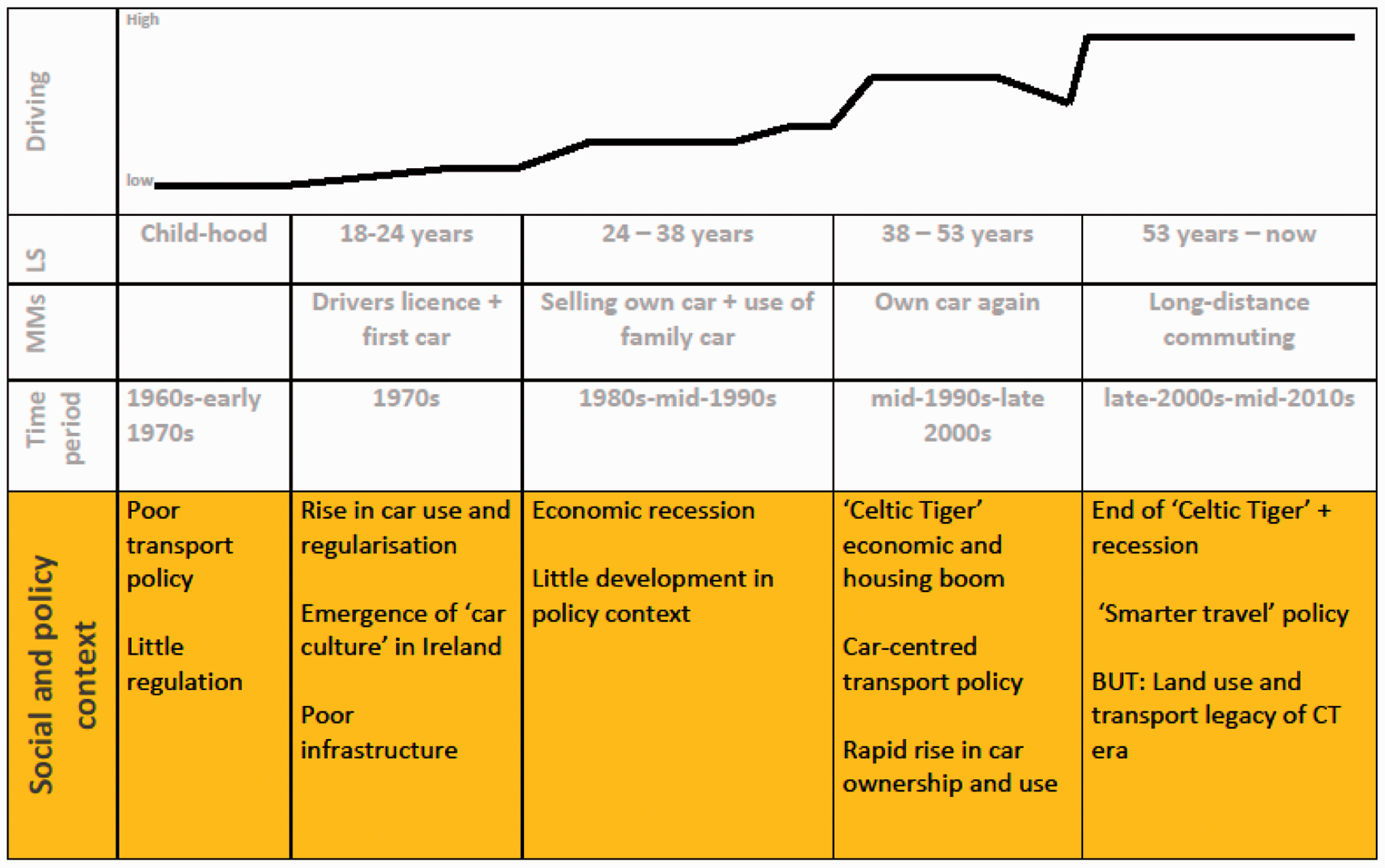
While it is not possible to draw definitive conclusions based on a single case like Claire’s (or indeed on the small number of cases in this study), the predominance of positive car use trajectories within the sample nevertheless pointed towards the centrality of structure in the formation of individuals’ career-in-a-practice. It furthermore emerged during interview discussion that developments in transport infrastructure, the standardisation of rules and regulation regarding transport and mobility, the introduction of new policies (e.g. carbon taxing, National Car Test) as well as sudden economic shifts (e.g. banking crisis in 2008) all played a role in shaping Claire’s practice. For example, her decision in her early 50s to move into the countryside and commute considerable distances reflects society-wide trends towards urban sprawl and long-distance commuting in Ireland during the Celtic Tiger economic boom (1995–2007). According to McDonald and Nix (2005), large commuter belts emerged during that period, especially but not exclusively around Ireland’s capital Dublin, due to rapid, credit-fuelled increases in house prices that forced many low- and medium-income households out of the cities. A large-scale road construction programme as well as relatively low motoring costs further exacerbated this trend towards commuting (cf. Rau et al., 2015). The research design introduced in this article is clearly capable of capturing such intersections between individuals’ careers and medium- and long-term processes of social change, at least to some degree.
Zooming in and out
Upon establishing a broad picture of change, interviews and diaries (Phases 2, 3 and 4) shed light on the conditions and practices associated with specific periods of stability and change (daily path). This method of ‘zooming in and zooming out of’ a practice (cf. Nicolini, 2009) made it possible to alternate between different temporal contexts and aspects of change (see Table 1). A commitment to representing multiple temporalities complemented efforts to capture different scales of context. Overall, the research process involved regular, deliberate movement between different theoretical lenses (life course and social practice), temporalities (daily and life paths) and scales (micro, meso, macro).
Applying an SPT frame that focused on individuals and contexts during the analysis of interviews offered an effective means for exploring how routines are constructed, maintained and deconstructed over time. Zooming in to critical turning points and transitions, narratives were explored for sequences of causally related events that shaped people’s interaction with the key elements of a practice. The diaries were a useful tool for stimulating discussion with participants on the workings of their routines at different life stages. For example, Claire’s account of how she learned to drive at the age of 18 years revealed a complex mesh of meanings, motives and contexts that shaped her recruitment to driving: It was fantastic! It really opened up a whole lot of things … the independence and freedom and being able to take a crowd in the car and be popular (laughs) and all that kind of stuff. Yeah it just opened up a lot of new avenues that you couldn’t do on a bike. (Interview 1, January 2014)
Furthermore, Claire’s coming of age coincided with the emergence of a car-based mobility culture in Ireland (see Figure 3). Her biographical narrative clearly reflects this, with episodic accounts situating her discussion in the context of broader changes in mobility norms and practice in Ireland. In other words, the development of Claire’s personal meanings about car driving cannot be separated from society-wide shifts in mobility-related norms. The importance of socio-historical timing and location was brought into relief by Claire when she compared her driving career to that of her mother’s. Reflecting on her experience of learning to drive, she compared this to her mother’s lack of opportunity to become a driver: My mother never learned to drive. So she would walk us to school in the morning. Dad would be gone with the car and she didn’t drive … It was always Dad’s car. You know it was that very old fashioned ‘it’s Dad’s car’. It was just very standard at the time. It was just the way it was … I ensured I got driving lessons because I saw how disadvantaged my mother was by not being a driver, dya know what I mean? … But by then it was just kind of run of the mill. It was kind of just what everyone was doing. Everyone had a car, or had a boyfriend who had a car, you know. It was just kind of routine. (ibid)
Overall, this snapshot into Claire’s case highlights the potential of a biographic, practice-centred approach to understanding life-course dynamics in relation to the practice of driving a car. In exploring intersections between temporalities of individuals’ lives and practices, a contextually sensitive and dynamic approach to mobility biographies emerges. This said, the adopted methodological design is not without its limitations. While the emphasis on a life-path view is useful for studying continuity and change, there is a risk that capturing major events eclipses evidence of variability in daily patterns during various life stages. The ‘subjective and shifting nature of people’s representations of their practices’ (Hards, 2012: 768) and the related tendency for people to sometimes overplay the significance of turning points and transitions when viewed retrospectively, can pose particular challenges in this respect (cf. Rau and Manton, 2016 for a related discussion regarding retrospective approaches to quantitative mobility biographies research). However, the analytical tool of zooming in and out between life-path and daily-path perspectives proved useful for honing in on dynamics occurring during key life stages (detailed analysis of which is forthcoming). Indeed, when prompted with a range of tools, the amount of detail participants could describe in relation to the workings of their routines many decades ago has been surprisingly articulate and reflective (cf. Browne, 2015; Hitchings, 2011). Furthermore, connecting individual experiential accounts with social policy and structural contexts can help to mediate some of these concerns in relation to validity and verifiability.
Conclusion
This article set out to demonstrate the potential of a biographic, practice-centred perspective for researching mobility biographies and addressing some unanswered issues in the field. While extant mobility biography approaches have drawn attention to the changing dynamics in individuals’ lives and how these shape action, they have tended to treat context and practice as static and unchanging. Conversely, existing practice investigations, while emphasising the dynamic nature of practices, have paid less attention to individuals’ lives and in doing so have often implicitly posited the individual as a static carrier of elements. In this respect, a combined biographic, practice perspective methodology offers a temporal, contextual and experiential approach that has the potential to advance understandings of how the lives of individuals and practices interact.
Adopting a social practice perspective reframes how life-course dynamics in mobility practices can be conceptualised and approached. In this article, a discussion of the different applications of the concept of practice and career to the study of mobility biographies offers interesting possibilities for broadening the scope of conceptual and empirical inquiries into practice biographies. In considering the key challenges of representing multiple scales and temporalities that characterise a practice career, this article revealed how approaches which combine and build upon insights from both SPT and biographical and life-course studies offer a largely untapped body of conceptual and methodological tools. These could be fruitfully deployed in future research to capture, represent and understand mobility biographies in ways that complement other recent theoretical and practical innovations in this rapidly evolving research field.
Footnotes
Acknowledgements
The authors wish to express their thanks to all participants who were involved in this research, which was conducted as part of the CONSENSUS#2 Project: a cross border household analysis of consumption, environment and sustainability ( ), funded by the Environmental Protection Agency (EPA) Science, Technology, Research and Innovation for the Environment (STRIVE) Programme 2007–2013.
Declaration of Conflicting Interests
The author(s) declared no potential conflicts of interest with respect to the research, authorship, and/or publication of this article.
Funding
The author(s) disclosed receipt of the following financial support for the research, authorship, and/or publication of this article: The authors wish to acknowledge research funding from the Irish Research Council for the Humanities and Social Sciences.