



Abstract
Several authors have described contemporary purchasing and consumption behavior as part of a “throwaway society.” Broader movements around environmental and consumer issues try to offset this process. Among these movements, Repair Cafés—places where volunteers help people repair their household items for free—are an interesting vantage point to study how a different relationship to objects can be transmitted by practicing repair. By conducting qualitative field observations, semi-structured interviews and quantitative questionnaires in three French Repair Cafés, I show that these organizations, which are intended to be places of learning, aimed at empowering individuals to deal with their household goods by teaching them repair techniques, cannot help but drift toward a logic of service, where audiences play the role of consumers rather than learners. But I argue that this service relationship has the advantage of attracting many individuals who are not familiar with the issue of product durability, and of socializing them, through concrete practice, to a new reflex of repair.
Introduction
In today’s societies, domestic repair practices are reshaping themselves. Historical research shows how the consumer society, which emerged in the 18th century in Europe (McKendrick et al., 1982), triggered a change in attitude toward objects: people throw away more easily than before; the time has passed for daily mending of old clothes (Trentmann, 2016). In our “throwaway societies” (Cox et al., 2013; McCollough et al., 2018; Packard, 1960), repair is rare: only 26% of consumers commonly repair, while 38% never do so (Cooper, 2004). Theoretically, it is even rarer among the upper classes who have no economic interest in repairing because spending time fixing constitutes a loss of income, all the more so as they earn a good living (McCollough, 2007). Market logic discourages repair (Diddi and Yan, 2019): it takes time and efforts (Campbell, 2005; Hand and Shove, 2007; McCollough, 2007, 2009; Watson and Shove, 2008); it is difficult to access, with expensive or nonexistent professional repairers (Cox et al., 2013; Hennies and Stamminger, 2016; McCollough, 2019); and it requires personal skills or an entourage of do-it-yourselfers (Adriaenssens and Hendrickx, 2009; Scott and Weaver, 2014). Advertising, industrial innovation (Spinney et al., 2012), or the will of demonstrating social success (McCollough, 2019) attenuate the value placed in the objects (Okada, 2001; Page, 2014). Based on these findings, throwing away seems the simplest and most common solution. However, some authors qualify this, that is, arguing that consumers have an aversion to waste (Bolton and Alba, 2012; Brough and Isaac, 2010; Gregson et al., 2007, 2009; McCollough, 2009; Okada, 2001). Furthermore, some emerging organizations seek to fight against this “throwaway society.” These, combining social innovation and civic engagement (Pesch et al., 2019), have been referred to as the “repair movement” (Graziano and Trogal, 2017). They promote repair, either by fighting at the legislative level to make products repairable or by offering new services. The latter category includes websites accompanying self-repair, such as iFixit (Raihanian Mashhadi et al., 2016), or voluntary repair workshops, such as Repair Cafés.
The Repair Café concept was created in 2007 by a Dutch journalist. The idea is simple: anyone can bring their broken item and a volunteer helps to repair it for free. For the fluidity of the story, I will call those who come to repair their object “the bringers”. All kinds of objects, if transportable, can be brought: small household appliances, electronics, bicycles, clothes, and other various objects (chair, children’s toy…). The repairs offered depend on the volunteer repairers’ specialization and the tools available: for instance, shoes are not very popular as a machine is needed for leather. The events are held at regular times in public places (sociocultural centers, community hall...). The central rule is that the repair must be done in the presence of the bringer. Most research on other Repair Cafés in Europe and America (Ames and Rosner, 2014; Charter and Keiller, 2016a; Cole et al., 2018; Gnanapragasam et al., 2017; Graziano and Trogal, 2017; Kannengießer, 2018; Pit, 2020) highlights similar modes of operation. To measure the weight of Repair Cafés around the world, let us consider their geography. The Repair Café Foundation, a nonprofit organization which, since 2011, federates Repair Café projects, provides a map1 showing around 2,100 Repair Cafés, mostly in the northwestern countries: nearly 1,900 in Europe and 150 in North America. Figures are smaller in other continents: 50 in Oceania, 10 in Asia, 5 in South America, and 5 in Africa. France has around 300 Repair Cafés, about 50 of which are located in the Paris region, others being evenly distributed across the country. The number of Repair Cafés is growing every year: there were only 900 in 2016 (Charter and Keiller, 2016b). Repair Cafés host 10 to 100 bringers per session, depending on their size.
The rationale behind these initiatives is threefold: the organizers see repair as a necessity that is social (enabling the less well-off to save money), environmental (avoiding production of waste), and educational (gaining autonomy over objects) (Pit, 2020; Rosner, 2013). According to them, these events are a means of reducing, through concrete action, the number of objects thrown away. But beyond this, they have a desire to convey to their audiences a new relationship with repair (Cole and Gnanapragasam, 2017). They want to have an impact on individual representations in order to reestablish reparation as a common practice. One may then wonder if they succeed in doing so. It leads us to ask the following question: what does the Repair Café do to the relationship between individuals and their objects?
In this article I will defend the following argument: Repair Cafés are perceived as free services by the bringers more than as militant organizations, and the fact that they play this service role allows them to socialize various populations to repair. Indeed, it is because they resemble a commercial device that they manage to attract so many people to this new, less consumerist practice, and beyond that, to make them question the consumer society. The first part of this development will allow us to put Repair Cafés in the context of social movements and see what the literature tells us about the effects of these Sustainable Community Movement Organizations (SCMO) (Forno and Graziano, 2014). I will then develop my argument in three points, in chronological order: we will consider which actors are involved in Repair Cafés and what are their expectations, first showing that the volunteer organizers have an educational project for the Repair Café that is not necessarily shared by the volunteer repairers, and then, looking at the profiles and motivations of the bringers, which are also different. Second, we will focus on the actual course of the event, seeing that the organizers’ educational project is implemented in a variable way, in practice: it depends on the repairer–bringer interactions, as well as organizational constraints, which in both cases can assimilate the event to a free service. Finally, we will assess what is really shared in Repair Café: this shift toward a service logic does not prevent bringers from learning from the experience. They are brought, not through a militant discourse but through shared activity, to (re)acquire a reflex of repair.
The article is based on qualitative and quantitative materials from three Repair Cafés in the Paris area: “OldTown” in the old center of Paris, “Intramuros” in a more outlying and mixed neighborhood, “Suburb” in the southern suburbs2. I varied them according to their location and size. They enabled me to reach a diversity of populations; however, if we wanted to further enrich the collection of materials, it would be interesting to go to more popular or more rural areas: I only sounded out what happens at these other events, which looks similar to what I found in my three main fields. Observations were conducted during the Repair Café sessions, which took place on Wednesday evening or Saturday morning. I observed 25 of them, from March to November 2019. They lasted 4 hours and I sometimes attended volunteer meetings before or after. My objective was threefold: to pass questionnaires on the bringers’ profiles, observe, and gather written sources. Sometimes, I passed questionnaires face-to-face, focusing on one respondent at a time; other times, I distributed them while volunteering at the reception desk; or I delegated the distribution to the reception desk, observing different points of the event (waiting rooms, repair tables…) and holding informal discussions. Although I presented myself as an interviewer, most bringers saw me as a volunteer. Based on the 277 questionnaires completed, I contacted some respondents to offer them semi-directive interviews, varying the profiles to reflect the diversity of the sample. I interviewed 27 bringers, to which I added 8 interviews with volunteers and 6 interviews with individuals who had attended Repair Cafés elsewhere in France. The questionnaires were subjected to flat sorting, cross-sorting, and a multiple correspondence analysis. The field notes and the transcripts of the 41 interviews were read over, with extracts selected, commented on, entered into a spreadsheet, and sorted by theme. I also constructed another table with one line for each respondent, bringing together some characteristics (profile data, visited Repair Café, and motivations) and their experiences of the events.
Repairing in an affluent society: stakes and impacts
What is at stake: ecology, alternative to capitalism, and popular education
The Repair Café is linked to three issues: it seeks to play the role of an environmental organization, an alternative to the capitalist economy, and a place for mass education. First, it is strongly linked to the rise of ecological challenges. It plays a role in the transition to the circular economy encouraged by the European Union (Pit, 2020) and can be supported financially by local authorities; it is also often linked to a network of environmental associations. For example, Repair Café Paris took part in its early days in an event organized by the Paris municipality, next to Disco Soup3 and Zero Waste4 stands. Second, Repair Cafés are seen by many authors as a modality of political participation aimed at exiting the capitalist system (Kannengießer, 2018), in the continuity of the American counterculture of the 1960s (Rosner and Turner, 2015). Voluntary repair attempts to break out of the market, by offering the consumer to maintain the object rather than buying. In doing so, it challenges an entire economic system. The third trend to which Repair Cafés can be linked is the maker and hacker movement where individuals make their own tools to address the problems posed by manufacturers (Coleman, 2012), but also, the popular education movement (Delp et al., 2002), which in both cases seek individual autonomy and empowerment through the acquisition of skills. Repair Cafés can thus be analyzed as a SCMO, along with community-sustained agriculture and slow food movements. These specific social movement organizations are community-led initiatives for sustainability that go through political consumption; they emphasize “solidarity and the use of ‘alternative’ forms of consumption as means to re-embed the economic system within social relations, starting from the local level” (Forno and Graziano, 2014, p 2). They gather the idea of the ecological transition with the questioning of the capitalist system. The authors underline that these initiatives have the power to socialize their members: by attending them, many nonmilitant consumers may become more aware of political matters. Indeed, other research shows that these movements often attract people with motivations other than ethics—for example, joining an organic cooperative to have healthy and tasty products—and use the concrete practice of collective consumption to sensitize them to broader issues—for example, the working conditions of small producers (Dubuisson-Quellier et al., 2011).
The impact of Repair Cafés on individuals’ relationship to consumption, a research gap
Sustainable Community Movement Organizations can socialize to new practices and representations: what about Repair Cafés? Research has given a lot of details about bringers’ motivations (fight against waste, meeting the local community, and attachment to the broken object (Charter and Keiller, 2016a; Guldenbrein, 2019; Kannengießer, 2018; Pit, 2020)) but few have looked at the impact the event has on its audience. The aim of Repair Cafés is to bring individuals to new repair habits. But while this objective is met in some community sewing workshops in New Zealand (Durrani, 2018), lots of Repair Cafés have a more moderate impact on bringers, mostly because volunteer repairers rarely use a pedagogical discourse to democratize repair: they often limit themselves to taking reparation in hand, without providing explanations (Graziano and Trogal, 2017); the object is repaired for the bringer, rather than with him (Ames and Rosner, 2014; Kannengießer, 2018). However, a large proportion of the participants at least gain the idea that repair is possible, and plan to return to the Repair Café if necessary (Charter and Keiller, 2016a; Kannengießer, 2018; Pit, 2020). The bringers, if not acquiring technical skills, at least gain the courage to dare to open the machine (Goyon, 2016). A survey shows that they can also acquire some knowledge about maintenance or routine repairs; but this study involved only 25 participants, and the authors themselves recognize its limitation (Cole et al., 2018). For now, only partial research exists on the subject. This invites us to dig deeper into the question of what the Repair Café does to consumers and to the practice of home repair in general.
Coming to Repair Cafés: different visions depending on volunteers and bringers
An educational project for the founders, out of step with the desires of repairers
At the origin of Repair Cafés, there is a project from the organizers. They hope the activity will be a source of change for its audience. This can be seen in the communication materials, created by the organizers. The presentation page of the Repair Café Foundation shares a willingness to bring repair back into the core of communities, by revalorizing technical skills. The idea is to empower individuals through a double learning process: giving them practical knowledge and making them aware of their possessions’ value. “Knowing how to make repairs is a skill quickly lost. Society doesn’t always show much appreciation for the people who still have this practical knowledge, and against their will they are often left standing on the sidelines. Their experience is never used, or hardly ever. The Repair Café changes all that! People who might otherwise be sidelined are getting involved again. Valuable practical knowledge is getting passed on. […] The Repair Café teaches people to see their possessions in a new light. And, once again, to appreciate their value.” -
These terms are also found on the sites of our three Repair Cafés under study, which emphasize the importance of exchanges between repairers and bringers, and in the way organizers talk about their Repair Cafés. Out of the six organizers interviewed, five shared that they should serve to make individuals autonomous vis-à-vis their domestic goods. This is the case of Frédéric, who draws a causal link between the lack of knowledge that an individual may have of the technical functioning of his object and his dependence on manufacturers. Repair Cafés’ mission is to empower individuals so that they are not just passive consumers. “If you are helpless when faced with an object you cannot repair, somewhere, you depend on the choice of the manufacturer who made it impossible to repair, who does not want it to be repaired, and who wants us to buy a brand new one [laughs], and throw it in the trash, who cares, so there are political stakes on a simple thing like fixing it” -
However, this educational project maybe out of step with the repairers’ desires. Most of repairers’ motivations are less focused on the empowerment of the bringers than on the taste for repair and the desire to help. Several interviews and informal discussions with volunteers bear witness to this point. Among them, the observation of an altercation between a founder and a repairman is interesting to note, as it shows the two opposing visions at work. At “Suburb” Repair Café, during a volunteer meeting before the event started, the organizer made a quick speech. She invited the repairers to involve the bringers in the repair, by handing them the tools. She reminded they should explain how to fix, quoting the proverb: “Give a hungry man a fish and he will eat for a day; teach him to fish and he will eat all his life.” But a repairer did not see it this way. He replied that he would do as he pleased, and that she could not give him orders. The educational goal was not shared by the repairer. By asking him to entrust his tools to the bringer, the organizer took away an interest that was essential for him: she asked him to reduce the manual aspect of his activity, to move toward a more intellectual aspect—a way of doing things that suits the organizers more than the repairers. Indeed, one way of explaining this variation is a difference of background: repairers have more of a technical profile (computer scientists, electronics engineers...) than the organizers, who have more literary occupations (journalism, cinema, law...), which would explain they are more driven by a general discourse of mass education rather than the technical interest of a repair.
A place which attracts a variety of people who are not regular repairers
The bringers’ expectations when they arrive at the Repair Café are also different. The events attract a large population, in two ways: they attract a variety of profiles, not necessarily familiar with repair. The audience is more feminine (66% women), slightly older (average age 55 years, compared with 42 years for the French population5), and more qualified (48% with 5 years of higher education compared to 20% in the Parisian area6) than the average population. These results are similar to those found in surveys on the profiles of British bringers (Charter and Keiller, 2016a; Cole and Gnanapragasam, 2017), except that they found more popular profiles.
Although this audience is specific, it is also interestingly diverse. As showed by Figure 1, the motivations for going to Repair Cafés are varied and linked to social belonging. An important result is that only 15% came to learn how to repair, a rate that is higher among the middle classes than the other categories. Indeed, a lot of bringers are not regular repairers when they come to Repair Café: half of my 33 interviewees never tinker at home, and 62% of the 271 respondents7 had not tried to repair or get their item repaired before coming. The most mentioned motivations link repair to the environmental impact (58%) but also to more utilitarian reasons: throwing away a broken item is a form of loss of profit that can be met by repair (31%). Cross-sorting shows that environmental motivation increases with social class, while economic motivation, the desire to discover the Repair Café community, and attachment to the object are more the domain of the working classes. Repair Cafés can speak to different populations because there are many different reasons for going there. They can be compared to secondhand shops, whose meanings depend on the audience (Bardhi and Arnould, 2005), gathering the less well-off “thrift seekers,” and the wealthy “creativists” who make secondhand purchases a form of cultural capital (Steward, 2017). However, we will see that this distinction between subjugated and voluntary sobriety does not have a strong explanatory potential to demonstrate the variety of Repair Cafés’ impacts on audiences. Motivations to come and repair one’s object in Repair Café according to socio-professional category.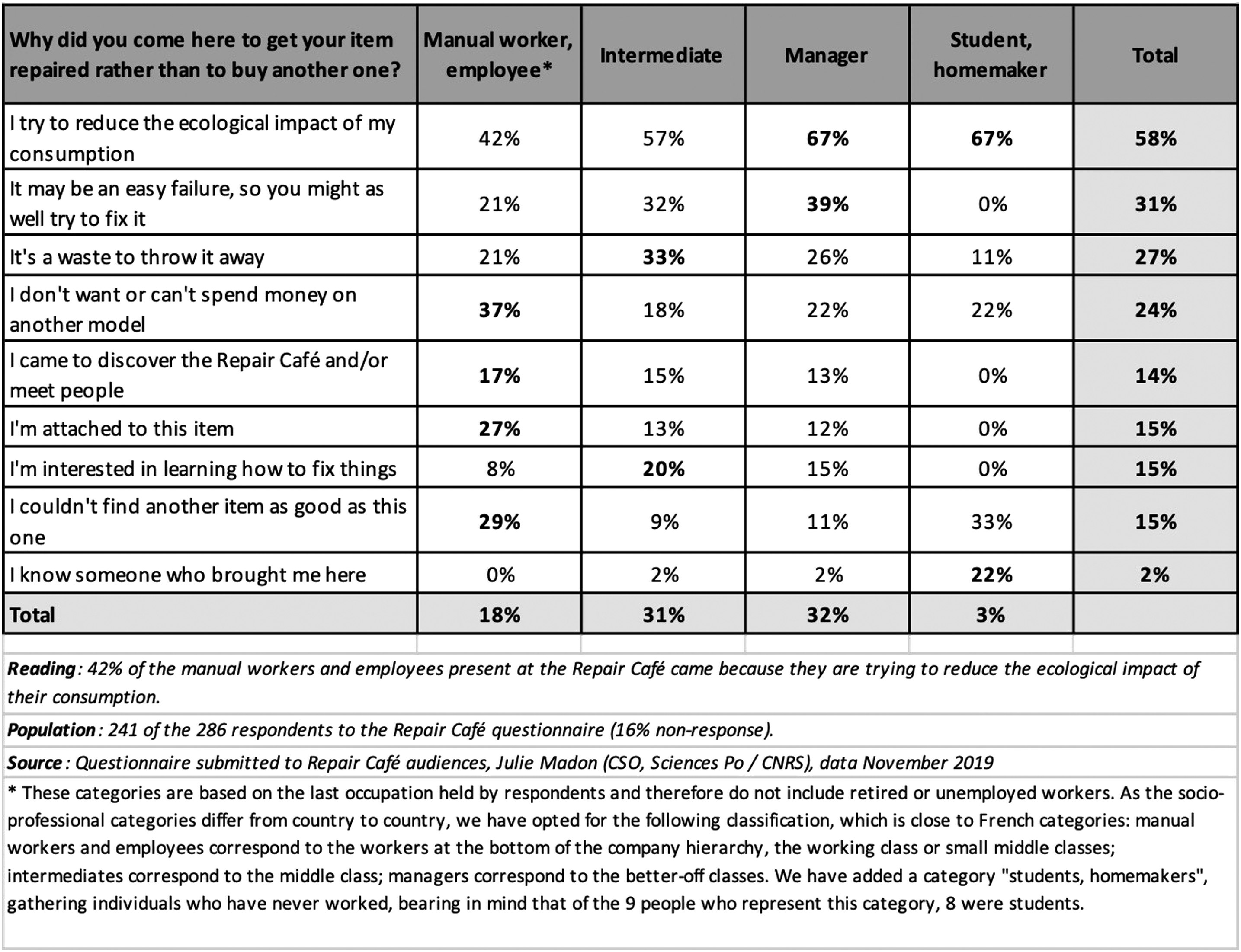
During the event: a variable transmission according to the interlocutors and the attendance
A variable transmission, depending on repairers and bringers
Repair Cafés introduce a wide range of people to the world of repair. But once the bringers are there, what do they discover? To measure the socializing power of the Repair Café, we will now look at the interactions between the repairers and the bringers. As we anticipated at the beginning of this development, the educational project of the organizers is not systematically followed up at the time of the event. The repairer–bringer dialog depends on repairers. I noted this in the stories I heard from bringers in interviews and observed it on the field. Some repairers are very quiet, while others are more demonstrative. To show this variation, I will compare the progress of two repairs observed at the same event, at “Intramuros”. I observed them in their totality; I only spoke if I was asked, without imposing a theme for discussion. The two repairs were carried out by different repairers. In the first one, there were few exchanges and the repairers (a team of two) did not involve the bringer a lot. The bringer talked a little to me about the fact that he was careful with waste. When he was speaking, the repairers did not react: they were busy understanding the cause of the breakdown. They did not encourage the bringer to participate, although he might have some skills as he had himself tried to dismantle the reader—nor did they ask the object’s age or comment on its brand. During the second repair, I observed, the repairer got the bringer involved and exchanged a few tips with him. The bringer had a baffle with an on/off button that did not work anymore. The repairer had the bringer open the object and then explained about the breakdown and what could be done. This example shows that the volunteer can share more or less information when faced with the bringer.
The repairer–bringer dialog also depends on bringers. Based on the interviews conducted, I searched a link between the bringers’ characteristics (age, gender, diploma…) and their exchanges with repairers. No link was significant, except one: the more interested the bringer was in repair techniques, the more he participated. Among the interviewees, at least 6 were involved in the repair, making small manipulations on their object, with or without tools. Five of them were also tinkering at home. These six also include the three only persons in my group of interviewees who had come to learn how to repair. This variation in attitudes is clearly visible in the observations. In Repair Cafés, it ranges from the bringer who repairs on her own, to the one who watches her mobile phone and plays games while the repairer repairs. The fact that the latter dares to look at her phone during the whole repair shows that not only is she not solicited by the repairer but also she did not come with an interest in the repair as such. In this attitude, the bringers are more in a logic of service which consists in letting the professional do the work, rather than in a learning position.
Audience attendance management: the richness of interactions threatened by the change in scale
The transmission of know-how also depends on the size and attendance of the Repair Café. When it grows, it must be able to quickly cater for a large number of people. In this way, it tends to become efficient and service-oriented, rather than a place where people take the time to explain and dialog. Figure 2 shows that attendance is much higher at “Intramuros” and “Suburb” than “OldTown”. There is often one volunteer for every two to three bringers at “Intramuros”, “Suburb”, and the “OldTown” Saturday events. But almost all “OldTown” events held on Wednesdays are on the opposite pattern, with two volunteers for one bringer. Attendance at Repair Cafés.
Thus, the way in which repair sessions are organized varies. In “Intramuros” and “Suburb”, bringers line up to register at the reception table. Volunteers fill in a label with the bringer’s name and the type of item brought. They arrange the label on a board, by category (electronics, sewing...) and return the bringer to the waiting room. When a repairer is available, he goes to the board, selects an object, and calls the bringer; then, they take a place in the repair room. This does not happen at “OldTown”, where the fewer bringers sit directly and talk with one of the volunteers to explain their problem. In “Intramuros” and “Suburb”, the high attendance induces an unpredictable waiting time, ranging from a few minutes to several hours. Some bringers may express their impatience. Of the 25 observations of Repair Café, I noted seven such episodes, exclusively in one “Suburb” and two “Intramuros” sessions. Let us take as an example of one of these interactions, which is not different from the others observed, but clearly shows the mechanisms by which a bringer can increase a volunteer’s stress, by monitoring his actions and making him take responsibility for his waiting. A bringer I observed during a “Suburb” session, who had brought a metronome, stayed next to the label board where her object was registered, to watch who would choose it. A repairer looked at the section where the metronome was, hesitated, and then chose another object. The bringer came up and said: “You! Why didn’t you pick me up when you looked at it?” With this kind of reproach, the bringer plays the role of a dissatisfied client. As Le Velly has identified in fair-trade shops, what used to be a nonmarket community space is then confused with a place of service (Le Velly, 2007). The mechanism is similar for the Repair Café, which is perceived more as a free service than as an alternative to the market fighting against overproduction and for individual learning. Queuing up in “Intramuros” and “Suburb” encourages passivity and annoyance, while at “OldTown”, the bringer is quickly integrated into a communal atmosphere. Tina, a neighbor of the coworking space where “OldTown” is located, comes frequently and sees a big difference between the big Repair Cafés and “OldTown”. In the formers, she criticizes the high number of visitors, which forces the repairers to work in a line, making them hurried and uncommunicative (“come one, bye bye”); in “OldTown”, she appreciates the family-like atmosphere (she knows the volunteers, as we can see she gives the repairers' first names in her story), the tranquility of the repair process (“they really take their time”), and the freedom she has to ask them to let her handle the tools. Tina is used to repair at home as well, which may explain her taste for hands-on learning. “My ex-boyfriend and I had gone to a Repair Café before for a razor he had, but I didn’t get it. There were a lot of people, we were queuing up, the guy looked quickly... [...] Then he told us: ‘Here, you have to buy this part and come back. Come on, bye bye’. Compared to [OldTown] where they really take their time... Here it’s a bit magical [...] What I want is for someone to explain to me, to tell me what’s wrong... I brought my Kobo last time and I let Nicolas open it [laughs]... He told me: ‘It’s complicated, sometimes it can break’. I said, ‘Listen, I won’t be mad at you, I’ll buy another one if you break it, but I’d rather you do it because youʼre more used to it’. But once he opened it I went: ‘Ah no no, leave me alone, it’s me who unscrews it!” -
The turnout at Repair Cafés transforms the atmosphere of the events, and thus, on the margins, the richness of the exchanges that can take place between volunteers and bringers.
Repair Café effects: a logic of service that allows a socialization of consumers towards repair practice
A socialization on a case-by-case basis, through action and practical advice
In this part, my point is to show that, although the repairers do not take the role of formal educators, they socialize bringers in a diffuse way by transmitting gestures and practical advice on a case-by-case basis. Authors have already shown, about open-air markets, how a commercial structure can socialize individuals: through practice, rather than through an awareness-raising discourse, these organizations make customers discover issues that lead them to become more involved in their consumption (Chiffoleau et al., 2017). Repair Cafés operate in a similar way. The elements we are going to give come from observation notes and three interviews with repairers, two of whom being founders of Repair Café, the third having a particularly militant background (involved in numerous degrowth movements). These examples are, therefore, not generalities from my field but are linked to specific repairers: the ones who are interested in transmission. First, some explain the stages of repair and involve the bringer. Some may also try to go further, teaching what are the right gestures to take care of objects. They can raise awareness or place technical devices to help consumers make objects last. Gilles, the militant repairer mentioned above, puts a mark on the vacuum cleaner cable one meter from the end of the rewind, so that the user stops it at this point and avoids pulling on the cable. This intervention is one of the many creative practices (De Certeau, 1990) used by repairers to adapt objects to users and preserve them. Gilles hopes that, in addition to the oral explanation, the technical device will encourage a change in the user’s habits. “On new vacuum cleaners there’s a mark on the cables when there’s still a meter of reserve; when it comes out, normally, you stop pulling. [...] Except that people don’t read the instructions; and when they see that it’s marked, they say: “We don’t know what it’s for”, and they’ll keep pulling! [laughs] So, once I fix it, I put the mark myself or I make them put it.” -
Repairers can also promote repair in general, whether it takes place in Repair Cafés or elsewhere. Delphine, one of “OldTown”'s founders, encouraged a bringer to have an object repaired by a professional. The bringer had come to ask if her leather basket handle could be repaired, but Delphine did not have the right equipment to fix it. She advised the bringer to go to a shoemaker. The bringer explained she was afraid of being swindled because she might pay 5€ for 2 minutes of work. The founder replied she was ready to give her 5€ to repair because it was avoided production and pollution; plus, the 5€ given to the cobbler was perhaps his 5€ per hour because he had only one customer. We see that the bringer evaluated professional repair as too high a cost, and that she considered the price overestimated by the professional. The fact that the founder insisted on the honesty of the repairer, and even offered to pay for the repair, undermined the bringer in her initial assessment. Thus, the way in which volunteers can demystify professional repair, presenting it as an honest and inexpensive solution, has the power to disrupt the representations that bringers have of it. We can, therefore, see that some repairers spread information, promoting good gestures or professional repairers, for example.
The Repair Café experience, source of a new repair reflex among bringers
Bringers will get more or less out of their Repair Café experience. But most share the idea of thinking more about repair in the future. Of the 33 interviewees, 19 reported on the impacts Repair Cafés had on them. They are of two types: Repair Cafés can encourage bringers to do more repairs themselves or to have more repairs done. Seeing the repair process is not enough to acquire new skills: only 6 interviewees said they have gained technical know-how. All of them also tinker at home. Some might get a general impression: that you can at least try. Three interviewees have gained the power to carry out other repairs or maintenance activities on their objects themselves. This is the case of Gaëtan. Years before, he had been afraid to intervene on the breakdown of his oven, out of apprehension of the complexity of the repair. He then went to his first Repair Café with a broken toaster. The day after this experience, another of his objects, a dehumidifier, malfunctioned: he tried to repair it alone. He himself speaks of “self-confidence.” This example shows that coming to Repair Cafés can encourage to undertake other interventions. Again, let us note that Gaëtan has a strong DIY potential: when he came to the Repair Café, the repairers offered him to be a volunteer. “Interviewer: You repaired the dehumidifier [in 2019] but not the oven [in 2013], because you couldn’t find that model in the oven? Gaëtan: At the time I was apprehensive and I hadnʼt even looked for it. Interviewer: Ah, that was another time too. Gaëtan: Yes; the dehumidifier is very recent, itʼs the day after I fixed the toaster, I had the dehumidifier error again and so I said to myself: ‘Iʼm really going to try to fix the thing and I'll find a solution’, I had more self-confidence.”
In this case, the original objectives of the Repair Café on individual empowerment through the gain of technical skills worked. Gaëtan’s story is a perfect example of this. However, it is a marginal instance of what the Repair Café can do. Generally speaking, not all bringers acquire the DIY spirit, but a new relationship to repair: they will look at their next breakdowns differently and think more about getting things fixed. First, bringers return to Repair Café. Among 113 respondents who came to Repair Cafés8, 28% had been to an event of this type before, once or several times. Repair Cafés, therefore, recruit some repair enthusiasts, who will have the reflex to come back. They bring a free resource that can be called upon; but beyond that, the fact they make repair more visible plays a role on mentalities. At least 6 interviewees mention this, and what is interesting is that, unlike the acquisition of technical skills, this impact acts on people with little DIY experience. This is well demonstrated by Colette, who explains how knowing that volunteers give their energy to repair objects encourages her to throw less. Colette explains in other sections of the interview that several decades ago, it was less well seen to keep a defective object for a very long time. Thanks to the Repair Cafés, she says it is more “allowed,” impliedly facilitated but also socially accepted, to repair her objects. “[Repair Café] was really something that allowed me to say: ‘Ah, I could bring this so I donʼt have to change it, etc.’. […] That’s what I would have said to myself 10 years ago. ‘Maybe it was repairable, well yes, but there’s no one there, so anyway...ʼ. [...] But maybe itʼs also out of a concern for... I think it’s so nice for volunteers to spend time, maybe out of respect for these people. [...] Why throw something away if by chance that day they could do something? It’s a tribute to their volunteer work, I don’t know!”
To sum up, bringers do not acquire repair skills, but begin to look at their objects differently by catching a repair reflex. The simple fact of knowing that it is practiced develops many things: daring to open, coming back to the Repair Café, and legitimizing the practice.
Conclusion
This article echoes research on environmental movements on how they can bring new populations into practice. Because of their dual identity, both their activist objectives and their function as a free resource, Repair Cafés are of interest to a large population of individuals. By positioning themselves in relation to overproduction, waste, and environmental impacts, they bring a whole new population to repair practices: high-income individuals, who theoretically would not be interested in fixing their objects (McCollough, 2007). This shows how environmental issues can revive practices that were previously reserved for people with limited resources, as we noted in the introduction, by generalizing them to other social classes. Moreover, Repair Cafés are not only environmental associations but they are above all a place for sustainable consumption. Offering a concrete service makes them possible to attract a large population. They thus share, with other SCMOs (Forno and Graziano, 2014), an ambiguous relationship with the commercial world. In short-circuit cooperatives, for example, many members are present on the basis of personal motivations such as their health, rather than the preservation of the planet (Hughner et al., 2007). But we defend in this article that the gathering of these populations who do not necessarily have the same motivations as the militant founders is in fact the strength of the project.
This article also brings knowledge on how some organizations can change people’s relationship to consumption. The Repair Café story told here is neither a success story nor a failure story: there are informations and representations that pass from volunteers to bringers, and others that are not communicated. What Repair Cafés bring is above all a resource: having a structure to turn to in order to bring one’s object back to life. This “resource” role has the impact of attracting many people who are not DIY enthusiasts and making them think more about repairing before throwing away. In line with the work on fair-trade shops (Le Velly, 2007) or open-air markets (Chiffoleau et al., 2017), we see how a resource can attract a large number of individuals to a new practice, simply by doing it together. This article thus argues that shared activity does not need awareness-raising discourse to be effective. In particular, the simple fact of making repair visible in the public space helps to transform the social norms around this practice, gradually making it acceptable and standardized. In other words, the Repair Café is gradually helping to transform the relationship to objects for a good number of consumers, by making the practice of extending the life of their objects both accessible and mainstream.
Sustainable Community Movement Organizations encourage a form of “prosumption,” which is not an exploitation of consumers, forced to carry out tasks delegated by the market (Ritzer et al., 2012), but rather allows their emancipation, as shown by subsequent research (Dubuisson-Quellier, 2011): the consumer’s work on his objects (carrying them, queuing at Repair Cafés, and attending repairs) enables him to gain autonomy from the script proposed by the manufacturers. Indeed, the simple fact of not accepting the end of the object’s life is a sign of creativity and resistance (De Certeau, 1990). These findings also invite future research on the impacts of these SCMOs on a larger scale but also on the populations they do not reach. Who are the individuals who do not visit these structures? We see that the working classes are underrepresented in Repair Cafés: for what reasons? Maybe they are not aware of their existence or maybe they do know about them but some obstacles prevent them from getting there. What other populations could the initiative serve, and at what cost? The study of the limits of this type of alternative to consumption could allow a better assessment of its scope and potential for future development.
Footnotes
Acknowledgements
Many thanks to Philipp Brandt, Brianne Dubois, Alexandra Hondermarck, Marion Michel, and Sophie Dubuisson-Quellier for their very useful comments on previous versions of this article. Special mention should also be made of the reviewers, whose advice was a great help in maturing this paper.
Declaration of Conflicting Interests
The author(s) declared no potential conflicts of interest with respect to the research, authorship, and/or publication of this article.
Funding
The author(s) received no financial support for the research, authorship, and/or publication of this article.
