



Abstract
An iconic characteristic of Hong Kong’s social unrest in 2019 was the establishment of the so-called “yellow economic circle”—a networked system of retailers and consumers linked by shared political values. Movement sympathizers chose to consume products from retailers perceived as supporting movement aims and boycotted retailers thought to be in favor of closer ties with China. This research focuses on the challenges of the yellow economic circle through the lenses of class and consumer nationalism. Drawing on social media posts and interviews with pro-democracy individuals from different socio-economic backgrounds, we highlight challenges to the sustainability of the “yellow economic circle.” Class-based purchasing power represented an obstacle to the success of the yellow economic circle; however, it was not the biggest challenge. Instead, an inherent incompatibility between the movement’s aims and the means for achieving these aims posed the biggest hurdle. Navigating this incompatibility represented an opportunity for movement participants to develop innovations in thinking about consumer nationalism and the role purchasing power may play in participation. We conclude that the way participants defined consumer nationalism determined whether the yellow economic circle could be understood to engender a shared “Hong Kong identity” and eliminate existing class differences.
Keywords
Introduction
The 2019 Hong Kong Anti-Extradition Law Amendment Bill Movement (Anti-ELAB Movement) generated large-scale protests and suppression from the state. It also generated affective polarization which split the society into two groups with distinctive political identities—movement sympathizers who supported the preservation of democratic freedoms and those who supported the government and strengthening Hong Kong’s ties with China. The former symbolized their values and identity through the color yellow and the latter through the color blue. Protestors routinized this struggle over political and cultural identity into their everyday lives through deliberate choices on consumption (Cheng and Yuen, 2020; Poon and Tse, 2022). A “yellow economic circle” emerged—a network of retailers and consumers connected by shared political and ideological values. Citizens were encouraged to consume (“buycott”) products from “yellow retailers” supportive of movement aims and avoid consuming (boycott) products from “blue retailers” who opposed the movement (Chan and Pun, 2020; Lee and Fong, 2021; Wong et al., 2021). Such a political consumption became a daily routine shared by young, middle-aged and elderly people (Cheng and Yuen, 2020).
The perceived purpose of the yellow economic circle was to promote domestic political change and particular values such as democracy and certain civic freedoms (Chan, 2022). With the passage of the National Security Law 2020, the costs of participating in protest has significantly increased (see Fong, 2021) so too has the power asymmetry between the state and public (Chan, 2022; Cheng, 2016). The Yellow economic circle represents an opportunity for the “politically powerless” to use a synthesis of political boycott and buycott to express political demands in their daily lives (Poon and Tse, 2022).
Studies of political consumerism have addressed the likelihood it will achieve movement aims, its relation to political identity, how political consumerism itself becomes a commodity and loses its original meaning, what counts as political consumption, and the peer pressure of “shopping correctly” (Heldman, 2017; Stillerman, 2004a; Zorell, 2018). The relationship between class, socio-economic background, education, and partisanship of consumers and engagement in political consumerism has also been explored (Endres and Panagopoulos, 2017; Ferrer-Fons and Fraile, 2013; Stolle et al., 2005). Studies on yellow economic circle have implied that it could transcend class disparity (Chan and Pun, 2020; Tang and Cheng, 2022). However, fewer studies have explored how to theorize political consumerism that is built on an inherent contradiction because it occurs at the intersection between identity politics and the forces of the global market economy.
The yellow economic circle represents a situation where a politico-cultural entity—China—was simultaneously the target of consumer nationalism and a center of mass production that supplies the globe with 28.7% of products used in daily life. Further, the Anti-ELAB’s status as a leaderless movement (Lai and Sing, 2020) makes it difficult to define the boundaries of political consumerism in Hong Kong as “yellowness” as a commodity has not been officially defined. This context causes us to ask whether the “yellow economic circle” can be considered “consumer nationalism” as defined by Castelló and Mihelj (2018) or should be seen only as an expression of “Hong Kong nationalism” (Ho, 2022). To this end, this article investigates three questions: (1) How does political consumerism in Hong Kong reflect and influence Hong Kongers’ identity? (2) What are the challenges to the “success” and “sustainability” of the yellow economic circle? (3) How did the emergence of the yellow economic circle cause “consumer nationalism” to be redefined?
Drawing on social media posts and interviews with pro-democracy individuals from different socio-economic backgrounds, we found a class disparity of consumption habits was present. Real and perceived challenges to the success of the yellow economic circle mostly mirrored existing literature, that is, purchasing power difference, quality and ethical concerns. However, one aspect stood out—the China factor. Respondents were alive to the incompatibility of their aims (carving out a Hong Kong identity through and the reality of the global market). This caused them to look for ways to redefine yellowness and thus the definition of consumer nationalism.
The findings contribute to the study of consumer culture, class-based consumption patterns, identity, and consumer nationalism, in highlighting the challenges associated with political consumerism as a way of forming an identity that can transcend class disparity the powers of the market. To sustain the yellow economic circle as a form of political participation, it may be more realistic to see consumer nationalism in Hong Kong as belonging primarily to the realm of culture (even though they have political implications) or a lifestyle politics (Gotlieb and Cheema, 2017; Stolle et al., 2005).
Literature review
Political consumerism and class politics
Political consumerism is a daily form of political participation for the powerless to conglomerate political resources and eventually influence government or business decisions (Stolle et al., 2005). In other words, such an action is often revealed through consumer choice of producers and products based on political or ethical consideration (Micheletti et al., 2003), partly because they see the government as an ineffective institution (Stolle et al., 2005). Key tools in this critical consumption repertoire include refraining from consumption of a particular product (boycotts) and intentionally, sometimes explosively, buying another product (buycott) for socio-political reasons (Endres and Panagopoulos, 2017; Stolle and Micheletti, 2013). Political consumerism increases the sensitivity and awareness of consumers (Stolle and Micheletti 2013). Thus, it can be as effective as electoral or other forms of participation in bringing about political and social change.
Consumption is deliberately used to reflect one’s political identity vis-à-vis others (Carvalho et al., 2019; Wong et al., 2021), and to literally and figuratively buy into certain discourses and not others. Through “role mobilization” individuals have the potential to transform their private consumption choices into a collective political identity at the moment of purchase (Holzer, 2006). In the yellow economic circle, everyday consumption reveals and provides social and cultural identities (Chan, 2022; Wong et al., 2021; Carvalho et al., 2019).
The significance of the intersection between class politics and political consumerism has been debated. Social class, socio-economic background, education, and partisanship have been used to explain the likelihood of engaging in political consumerism, and whether political consumerism could lead to the decline of social class disparity (Endres and Panagopoulos, 2017; Stolle et al., 2005). It has been suggested that aspects of globalization including increasingly integrated economies, and communication systems have reduced the participation gap between different social groups, regardless of their ethnic, religious, or class affiliations (Hudson et al., 2013; Micheletti and Stolle, 2008). For example, participation in buycotts during the Progressive Era to promote fair labor conditions for working-class women transcended class (Haydu, 2021). Yet, it has also been found that the chances of engaging in political consumerism are higher for individuals with the highest level of socio-economic capital, especially for buycotting which is more resource-dependent and individualistic (Ferrer-Fons and Fraile, 2013; Yates, 2011). Furthermore, political consumerism such as buying organic, fair trade or eco-friendly products has been associated with the “lifestyle choices” or “tastes” of certain class groups (Gotlieb and Cheema, 2017; Copeland and Boulianne, 2022; Nonomura, 2017; Wahlen and Laamanen, 2015). The conflation of political consumerism with class taste raises the question of whether the consumption choices are motivated out of a desire to change a politically objectional situation or a desire to demonstrate ones belonging to a particular socio-economic class (Adams and Raisborough, 2008; Stolle et al., 2005).
Consumer nationalism and identity politics in Hong Kong
A sub-type of political consumerism is “consumer nationalism.” Consumer nationalism has been conceptualized as consumption behaviors at the intersection of consumer culture, nationalism, and globalization (Gerth, 2011; Wang, 2006). Here consumer choices are motivated by perceptions of national collective identities and discourses of nationalism (Dong and Tian, 2009; Carvalho et al., 2019). Consumer nationalism is not just limited to the realm of influencing domestic or international politics (Castelló and Mihelj, 2018; Wang, 2006). It is equally important in the reproduction of cultural and symbolic identities through daily consumption habits, such as “the routine, unremarkable buying of domestically produced goods in a local supermarket, which occur without any specific political agenda” (Castelló and Mihelj, 2018: 562).
Castelló and Mihelj (2018) distinguish between political consumer nationalism and symbolic consumer nationalism: the former involves fostering or obstructing the consumption of particular national products with the aim of affecting a nation’s economy and thereby promoting or attacking a particular nation politically. The latter draws attention to discourses and practices oriented to “cultural” rather than political ends and, more specifically, to the reproduction of nationalism by means of daily consuming, using, buying, or wearing products or services that are either produced nationally or otherwise recognized as having a national identity. Wang (2006) points out that a premise of consumer nationalism is to fulfill one’s self-definition or social identity. Yet, consumers may not always be supportive of their nation (Carvalho et al., 2019: 317). Symbolic consumer nationalism, in this sense, reflects a relational perspective (in-group vs out-group) and the construction of collective identity, ethnocentrism, and belonging (Chan, 2022).
Turning to the construction of a collective identity in Hong Kong, in recent years, fears of China’s political and cultural assimilation of Hong Kong have fostered the emergence of “anti-China” sentiment. Political consumer nationalism in Hong Kong can be seen as a form of identity politics that mobilizes a Hong Kong local identity to push back against Beijing’s promotion of cultural and national pride in being Chinese (Tang and Cheng, 2022; Wong et al., 2021). This has been conceptualized as a form of “peripheral nationalism” whereby the periphery counter-mobilizes against the assimilation of the center (Fong, 2017). Observing Hong Kong and PRC luxury consumers, for example, Joy and her colleagues (2020) highlight the fears of being occupied by the PRC, of their hybrid identity being subsumed by their Chinese ethnicity, and of losing their democratic freedom among Hong Kongers.
Political consumerism in Hong Kong arguably first emerged during the Umbrella Movement in 2014 but the alignment of identity politics and political consumerism in Hong Kong became a defining feature of the Anti-ELAB movement of 2019. For example, a conference was organized for academics and intellectuals to discuss the possibility of using cryptocurrency to segregate the circle from the rest of the economy, enhancing solidarity and reducing transaction costs. There has also been discussion of establishing a label similar to the fairtrade label to better identify the affiliation of businesses (Wong et al., 2021).
To help consumers quickly and easily identify shops that aligned with their political and cultural identity a campaign to classify shops as being pro-movement, neutral, or pro-Beijing ensued. Crowd sourced information was used to label shops with yellow or blue tags respectively on built apps such as Telegram Bot or WhatsApp Business API (Poon and Tse, 2022). This networked system of tagging defined the boundaries of the “yellow economic circle.” Even if the real impact might not be substantial (Lai and Sing, 2020: 53–54), what is important about the yellow economic circle is the “symbolic” meaning of the protest in people’s everyday life, as it has integrated discursive and symbolic resources relating to the movement, local identity and values into acts of consumption (Lee and Fong, 2021).
Methodology
Content analysis of social media posts
We adopted a mixed methods approach and included both social media posts and in-depth interviews as our data, to cover opinions from online discussion and subjective thoughts of different classes. For the social media posts, our research assistant scraped relevant posts from (1) Facebook pages which share information about the location and details of yellow/blue retailers; and (2) discussion on yellow/blue retailers on LIHKG, a Reddit-like platform which is widely regarded as a central communication platform for Anti-ELAB movement supporters (Lee, 2020), and six major Telegram channels listing where the “yellow/blue” retailers are. We focused on the frequently mentioned keywords of the posts such as “Hong Kong(er),” “class,” “made in China/Hong Kong,” “Chinese,” “Mainlander,” “Taobao” (a major e-commerce platform in China), “quality,” “identity,” “ideology,” “protest,” “democracy,” “autonomy,” and “reliance.” After collecting all related posts (250 posts on yellow retailers and 100 on blue retailers), we coded the contexts, themes, subjects’ evaluations, sentiments, relations between different themes, and meanings conveyed in the posts.
Respondent recruitment and interview questions
To better understand individuals’ thoughts on whether to consume products from particular retailers, we further conducted twenty in-depth interviews. Most informants were recruited through snowball sampling, beginning with personal contacts we had. We diversified respondents through a range of channels including personal connections, respondent referral, and invitations sent to suitable potential respondents through social media platforms and Facebook pages. We acknowledge snowball sampling contains self-selection bias, yet the passage of the 2020 National Security Law enhanced the chilling effects and the difficulty of finding respondents as we would otherwise wish to have. In this regard, snowball sampling could be an appropriate method as respondents would have more trust through personal connections and their friends’ referrals.
To address the issue of representativeness, we tried our best to diversify respondents covering a reasonable variation of age, gender, education, occupation, and socio-economic status. We categorized respondents into two groups; one is working class and the other is middle class. The criteria for class classification are based on personal and household income, purchasing power by Hong Kong standards, as well as self-identification. We also considered other factors such as education, occupation, job position, type of housing (which is an important division in Hong Kong’s context; for example, most working-class people live in public rental housing estates, whereas private housing represents a more comfortable economic condition and is associated with the middle- or upper-class families), etc. In the end, we recruited nine respondents whom we considered working class and eleven we thought of as middle class.
The interview guidelines contained questions that tease out respondents’ reasons for buycotting or boycotting particular retailers, experiences of and perceptions of the yellow economic circle, and thoughts on the consumption behaviors of their own and the counterpart class. To be specific, there are five major dimensions involved: (a) patterns and frequencies of shopping yellow/blue—how often did they shop in yellow/blue retailers? (b) experiences of shopping yellow—how satisfied did they feel shopping yellow? How did they react if the quality and services of yellow retailers are declining? (c) ways to define “yellow”—which criteria did they use to evaluate a “yellow” retailer? (d) identity—did they feel the yellow economic circle represent a certain kind of Hong Kong identity? And (e) challenges of the yellow economic circle—how did they evaluate the yellow economic circle as an everyday resistance strategy? All the interviews were conducted in Cantonese. We use pseudonyms to maintain respondent anonymity.
Interview data analysis
After collecting interview data, we analyzed the transcripts with the aid of NVivo software. We translated interview data from Cantonese into English. We used both inductive and thematic coding to create codes based on a theoretical framework (Charmaz, 2006) that focuses on participants’ reasons for participation (or not) in the yellow economic circle, anticipated consequences, concerns, perceptions of the other class group’s consumption patterns, and the intersection of consumption patterns and Hong Kong identity. We coded keywords such as class, income, price, expensive, affordability, support, democracy, freedom, autonomy, reliance, value, quality, service, future, identity or identification, ideology, meaning, China, Mainlander [Dalu ren], Hong Kong(er), and protest.
Findings
Social media posts
The most frequent keywords when mentioning yellow/blue retailers.
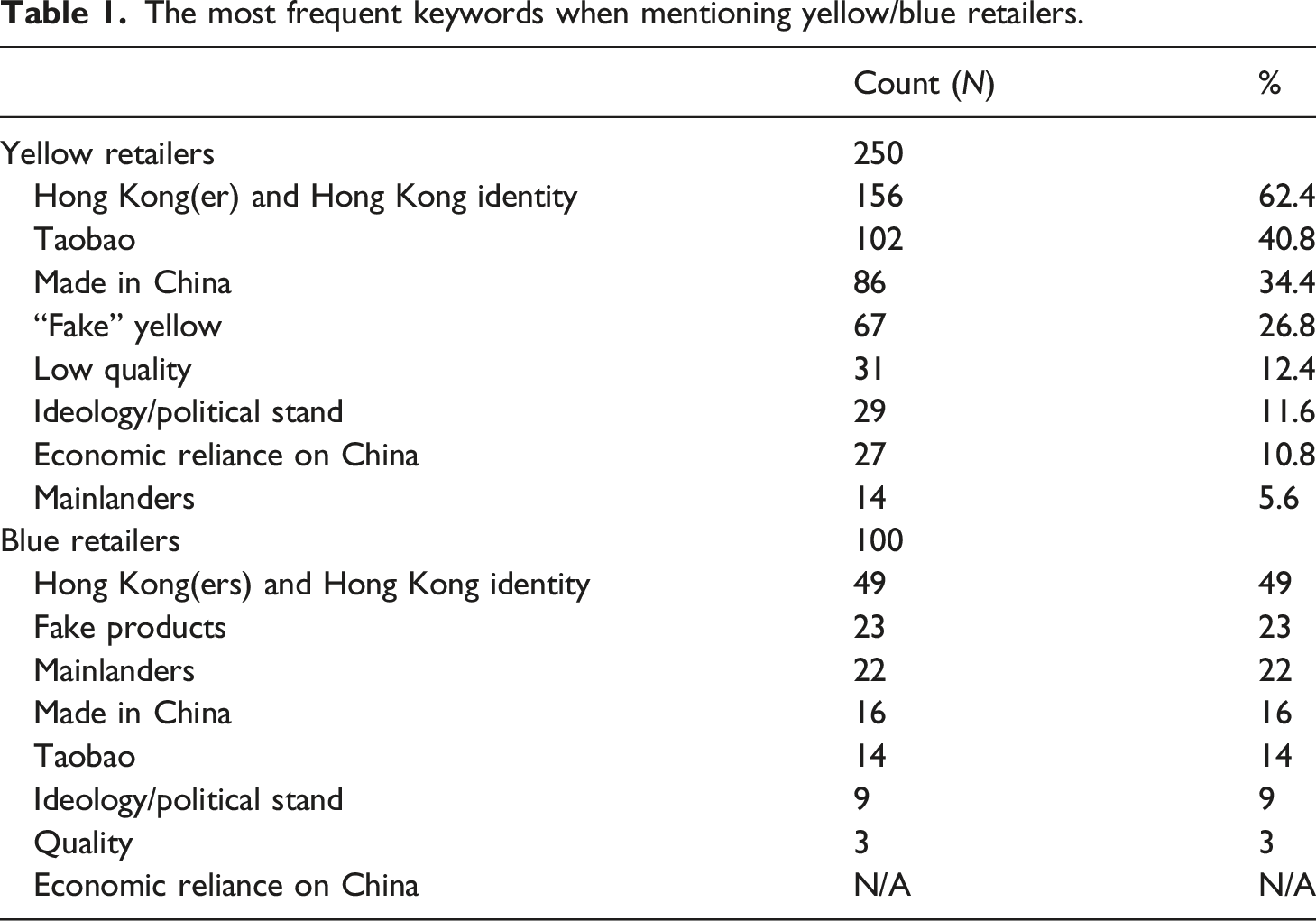
On the other hand, we found that among discussion of the blue retailers, the most frequent keyword appeared is still “Hong Kong(ers).” When we further examined the posts, we found that the posts containing Hong Kongers are correlated with boycotting blue retailers. The narratives are consistent with those discussing the yellow retailers. This may not be surprising as we know that one major goal of the yellow economic circle is to “buycott yellow and boycott blue.” Other posts on the blue retailers discussed whether the products are fake (23%), and whether those who consume blue might be Mainlanders (22%); yet fewer posts focus on whether the products are made in China (16%), from Taobao (14%), the retailer’s ideology (9%), and quality issues (3%).
Overall, there is a high correlation of products made in China (vis-à-vis Hong Kong) with perceived (low vs high) quality, price (cheap vs expensive), economic reliance on China versus economic autonomy, and political identity (pro-establishment vs pro-democracy). Other concerns such as cultivating a localized Hong Kong identity by consuming “Hong Hong-only” products, “betraying” Hong Kong if buying things from Taobao, and whether the retailers are “real yellow” or “yellow enough” also occasionally appeared on LIHKG and relevant Telegram channels. The results show that online discussion centers on socio-cultural identity as a Hong Konger vis-à-vis a Chinese (Chan, 2022; Wong et al., 2021). They also raise concerns about whether using products made in China, considering price affordability, would hinder the foundation of the yellow economic circle and Hong Kong nationalism (Ho, 2022; Tang and Cheng, 2022).
The perceived purposes of the yellow economic circle can be broadly divided into four categories: protest, a resource base, punishment, and economic independence. For example, 14% of the total posts perceived participation in the yellow economic circle as a means to send a signal to the state and demonstrate that there is a form of everyday resistance, pushing for regime change and the democratization of the political system (Tang and Cheng, 2022). Example posts include “Let the government know the people’s voice!” and “When the government uses guns, we the people use money to resist!” 12% of posts framed participation in the yellow economic circle also aimed to build up a political resource base for sustaining the movement dynamic—transforming economic power to political resources and expand political opportunities (Chan, 2022; Chan and Pun, 2020). Example posts include “Without resources we can’t achieve any goals, so we have to fight this economic war!” “Accumulate local funds to develop local businesses!” Others felt shopping yellow was a means to punish Chinese capital or those retailers believed to support the Hong Kong government and Hong Kong’s further assimilation into China (Poon and Tse, 2022). For example, 9% of posts online mentioned punishment, such as “punish red capital and limit their influence.”
Sustainability of the “yellow economic circle”: Supporting yellow but shopping blue
Perceived threats to the sustainability and effectiveness of the yellow economic circle could be grouped into several categories: purchasing power of individuals from different class backgrounds, social-psychological pressures of revealing one’s political identity, poor or declining quality of goods and services provided at “yellow stores,” the commodification of yellowness, and ethical concerns such as exploitation.
The cost threshold of engaging in buycotting is higher than for boycotting (Kam and Deichert, 2020). In a rational choice paradigm, price and purchasing power become the dominant factors determining whether people can continue to shop yellow. Thus, the working class who do not have the same level of capital as their middle- and upper-class counterparts may have to take price into account when making political consumption decisions (Zorell and Yang, 2019). One respondent, Sean, used shopping on Taobao, a major e-commerce platform in China, as an example: I am from a working-class family, so I have been told to be economical since I was a kid. It is nothing wrong to buy things with cheaper prices. Although I support the yellow economic circle and the protest, I have to say that buying products made in China is unavoidable. Look at all the products in our everyday life…from raw materials, food, and necessities, they are all made in China! You just cannot pay for something unaffordable in the long run, otherwise why isn’t McDonald’s or Starbucks [with Chinese-capital] closing down? Because their prices are more affordable!
Sean’s remarks reflect the issue of purchasing power and the compromise of movement identity due to price concerns. When evaluating the potentials of political consumerism, class-based patterns and differential purchasing power cannot be ignored (Hudson et al., 2013; Micheletti and Stolle, 2008). Civic engagement could be differentiated and more likely to happen among the socially well-integrated (Stolle and Hooghe, 2011). The class disparity of participation also contrasts with the claim that the yellow economic circle became a daily routine shared by different groups of people (Cheng and Yuen, 2020). Several respondents mentioned that they could buy expensive things from yellow retailers occasionally, but it would be hard for them to regularly shop there. For example, Sonya commented: Some popular yellow restaurants and shops are expensive; I don’t know if it’s the blue shops’ strategies of making prices cheaper to attract more consumers, but the strategies did work in Hong Kong. Consumers are realistic, and we have to be realistic. We can support the yellow shops once in a while, but it would be hard for us to go there every day.
Online posts also revealed Hong Kong consumer culture—perceptions of others’ purchasing power and the obligation associated with it. Example posts include “Only rich people can be the real yellow.” “The yellow and poor seek equality, whereas the blue and rich seek profits.” The middle-class group is seen to have more leverage (capital) not to consume in blue retailers and is more capable of shopping yellow. In other words, the “moral threshold” assigned to the middle class is higher, given their capital difference. On the other hand, however, some respondents connected buying products made in China to Hong Kongers’ dignity. For example, James, said: I understand the price is cheaper on Taobao and people want to save as much money as possible, it’s appealing…but I cannot stop feeling something is wrong there. I feel they [those who shop on Taobao] lost their self-dignity as a Hong Konger, they are too easily manipulated by money. Today, Hong Kongers want to do something together and make it successful, like this yellow economic circle; it would be impossible if some easily compromise and buy cheaper stuff made in China.
James’ response shows his concern about the “dignity” of Hong Kongers and the “success” of consumer nationalism if people easily compromise with buying products made in China (Chung, 2020; Wong et al., 2021). The yellow economic circle aims to create an everyday form of resistance and establish a Hong Kong identity which can transcend class disparity. Yet, when taking class-based consumption patterns and different purchasing power into consideration, the scale and sustainability of consumer nationalism becomes questionable.
Scholars have mentioned that political consumerism sometimes involves the active attempt to influence other consumers by resorting to moral pressure (Jacobsen and Dulsrud, 2007). Similarly, social-psychological pressures of “shopping yellow” were often deeply intertwined with perceptions of economic rationality, and also served to undermine the sustainability of the yellow economic circle. Some respondents reported feeling forced to consume yellow retailers or burdened when they didn’t. For example, Wing said: I remember once my friends and I were deciding where to eat. I mentioned restaurant X did good dim sum, then one of my friends said it’s a blue restaurant. She even asked me how dare I proposed the idea of going there. I feel like I was accused of being a “Hong Kong pig” [politically indifferent]. In the end we had to go to another yellow one serving less tasty food with more expensive prices. I really don’t understand…
Wing’s view demonstrates the symbolic importance of political consumerism, which reflects that sometimes, the decision of shopping yellow might be economically “irrational” but politically “correct.” Yet, economic irrationality creates psychological pressure about how often, and for how long, can one continue such a shopping pattern, especially for those who have more limited purchasing power (Aung et al., 2021). This peer pressure can generate a “forced” identity: people are now expected to publicly “display” their political identity in a certain way to avoid being ostracized. Peer pressure is more complex when it intersects with class. One working-class respondent, Jason, expressed his sense of guilt when he could not shop yellow as frequent as his friends: I think the psychological pressure is more significant among the working class, because shopping yellow has been a dominant slogan and practice…to the degree that if you don’t follow it [shopping yellow] then you are the outgroup and no one wants to be your friend.
Deteriorating quality in yellow retailers was another concern. When retailers perceive consumption is driven by demand for political ideology, quality and service may become secondary elements of the product and thus decline. Different from boycott companies for deteriorating quality and service, here movement sympathizers face the challenge of whether to stay loyal when the quality or service of the yellow retailers they regularly consume deteriorates. On social media, respondents constantly shared negative experiences they had in yellow retailers, for example: “…I intentionally support yellow restaurants but can’t tolerate the poor quality and service.” The posts and respondents also revealed consumers’ normative expectations of retailers who claimed to be part of the yellow economic circle. Apple, for example, complained about one restaurant that she used to go regularly: Let’s be frank, many restaurants were not that famous before. Now, with the assertion as a yellow restaurant, customers have to make reservations and wait in long queues. There is a restaurant near my workplace where I used to go regularly, but with more customers their service and food quality surprisingly became poorer. I was so disappointed and decided not to go there any longer.
Related to perceptions of quality and continuing to shop blue were existing consumption habits. Jeannie, for example, shared the reasons why she could not resist buying products from MUJI, even though it is categorized as a blue shop: I know MUJI is a blue shop, but the quality, color, and style there could hardly be replaced by other brands. I know that the clothes there are made by Xinjiang cotton, which is controversial, but I have been shopping there for many years…it’s like a habit. I guess what I could possibly do is decrease the frequency of buying things from there.
Another challenge, closely related to the normative expectations placed on “yellow retailers” that undermined the trust base of the yellow economic circle, was the perceived commodification of yellowness (Li and Whitworth, 2022). Concerning about whether the yellow retailers align with the movement’s goals, 26.8% of posts named certain retailers and questioned whether they are “real” or “fake” yellow retailers—that is, whether they only advertised yellowness to make money. The doubt is apparent from Sandra’s narrative: I was very disappointed to find out that some yellow shops do not post the political leaflets anymore, maybe they no longer care much about political affairs. Joining the yellow economic circle, for them, is just to attract more customers.
Labor exploitation is another factor that posed challenges to the “conscious” consumers of the yellow economic circle. Again, the challenge here differs from the intention of boycotting companies which exploited labor (Micheletti and Stolle, 2008); instead, the dilemma is between political correctness and ethical concerns (whether to keep supporting the yellow retailers even there are labor exploitations). One yellow restaurant C, for example, was reported to exploit its employees. The news caught people’s attention and generated a lot of debates on social media. On LIHKG, several former employees also made complaints about the management, such as underpayment and poor working conditions. The issue here is whether political consumerism and “ethical” consumption are mutually exclusive, or whether ethical concern can be secondary to a broader political identity (shopping yellow). Consumer activism usually emphasizes moral principles and calls for social change, such as fair trade and buying environmentally friendly products (Jacobsen E and Dulsrud; Skotnicki, 2021). Although expressing political stance (political consumerism) and undertaking ethical practice (ethical consumerism) might be two different issues, unfair labor practices have undermined the trust base of the yellow economic circle.
Sustainability of the yellow economic circle: The “China factor”
One of the claims made by the yellow economic circle is to respond to China’s economic intervention and Hong Kongers can decrease economic reliance on Chinese products and the influence of Chinese capital (Wong et al., 2021; Chung, 2020). One respondent, Sam, for example, explained why Hong Kong-based consumer nationalism is important: Red [Chinese] capital is so strong and is everywhere in Hong Kong. If we want to get rid of economic colonization from the Chinese government, the first thing to do is decrease their influence in Hong Kong. Now, almost everything is made in China, but what we could get started is to decrease its influence bit by bit and cultivate citizens’ awareness of supporting the local industrial chain and products made in Hong Kong. If we can’t cut off our reliance on China, there won’t be any autonomy, and they [the Chinese government] can easily control us.
Sam’s narrative ties shopping yellow not only to the success of consumer nationalism, but also to the future of Hong Kong and the maintenance of Hong Kong’s social and cultural identity (Joy et al., 2020). When everyone shares the same political beliefs and takes action in buycotting yellow and boycotting blue, it gives a sense of belonging to Hong Kongers and could create an “imagined community” (Anderson, 1983) with other customers.
Most movement participants were sympathetic with the idea of “shopping yellow,” but questioned the attainability of goals such as Hong Kong’s economic independence from China. 6% of online posts noted Hong Kong’s reliance on crucial imports from China, including water, electricity, and food. One post thread entitled: “A yellow shop selling products made in China and thinks it is normal” generated 30 pages of discussion with 731 replies. A significant proportion (35%) of these replies debated whether Hong Kong can decrease its reliance on crucial imports from China as 47% of products in Hong Kong are made in China. These replies pointed to the market’s saturation with products made in China and that it was nearly impossible to avoid buying products made in China. One respondent, Fiona, also commented: …many people buy things and support the yellow retailers, but what they don’t know is that these yellow retailers may actually import ingredients made in China or products from Taobao, like some toy shops in Sham Shui Po. The world we are living now…almost everything is made in China…boycotting China-related products is like a mission impossible.
Posts online and interview respondents alike employed different frames to reconcile the decision to participate in the yellow economic circle and perceptions they themselves held, or that they perceived others may hold, about the utility of participating in the yellow economic circle because of “the China factor.” Some looked to academic research for evidence that Hong Kong could be entirely self-sufficient in its power supply and that it could import food and goods from countries other than China (Moss and Francesch-Huidobrob, 2016; Kaynak and Kucukemiroglu, 2001). Example posts include “Big mistake! Hong Kong doesn’t need to rely on China!” “Hong Kong can develop our own electricity and water system and avoid paying expensive prices to China!” Others emphasized the symbolic importance of their actions in creating spaces for a shared Hong Kong identity, and maintaining the movement’s momentum. These posts resonate the fears that growing political control of the Chinese government will dissipate Hong Kong’s economic autonomy (Chan et al., 2021). Example post includes “Even after Beijing’s enactment of the national security law in mid-2020, there are still shops claiming yellow and using local ingredients, and people with similar ideology still go there to show support.”
In other circumstances, however, selling products made in China could be tolerated if the retailers are “yellow enough.” The issue here is the extent to which one can tolerate products made in China—whether selling products made in China is just a “tool” and would thereby not influence the major goal of the yellow economy: supporting democracy and localism. For example, one respondent, Louis, said: The effect of shopping yellow, as you know, is rather symbolic. It is a kind of civil disobedience…to voice our demands, or to encourage more people to blacklist certain blue or red shops. That’s about it.
Louis’ comments were echoed by other respondents who felt shopping yellow is an action that is “better than doing nothing.” Particularly under the National Security Law, everyday consumption has become one of the very few ways to legally express support of the movement and (political) identity (Poon and Tse, 2022). Scholars (Wong et al., 2021) have pointed out that since sentiments of supporting movement and political consumerism are distinctive (even with shared origins), and the latter targets not only the government but also the ideology-opposite group (the “blue” camp). Therefore, political consumerism will continue to be one of the few forms of political participation and battlefield even the movement has been diminishing. It has also become a low-risk protest repertoire that has helped pro-democracy citizens express their political identity and solidarity (Chan, 2022).
Defining yellowness in the face of the China factor
Arising out of the debate that it is nearly impossible to avoid buying products made in China, was discussion on where to draw the boundaries of the yellow economic circle and how to define the “yellowness” of a retailer and the products they sell. Following the attempts to “define” political consumerism and its sources (Micheletti et al., 2003; Newman and Bartels, 2011), opinions on how to define “yellowness” could be divided into four broad groups. First, among the 15 post threads with 1000 replies discussing the definition of yellowness, 38% view that for a retailer to be considered part of the yellow economic circle, they could not use any products or materials sourced from China. Example posts include “Yellow shops using products made in China would lead to division among the yellow camp”; “Today, Hong Kongers want to do something together and make it successful; it would be impossible if some easily compromise and buy cheaper stuff made in China.” The second group (23%) suggested that a retailer could be included within the boundaries of the yellow economic circle even if they sold Chinese made products as long as there was local value added to the product. Examples include “Adding value to the products from Taobao is ok, directly selling them is not ok.”
Third, 19% thought that the origin of the product a retailer sold was irrelevant: “…as long as it can help the yellow economic circle grow and bring benefits to the pro-democracy businesses, it is still better than giving money to the blue retailers.” Instead, to be part of the yellow economic circle, retailers needed to contribute to the movement. Replies to the post thread suggested that it could be done in multiple ways including making donations to pro-democracy funds such as 612, hiring active members of the movement; providing food, shelter or supplies to protesters, and providing shopfront space to advertise protest events and mobilize participants. A fourth group (12%) defined yellowness in the opposite way as what would indicate the store was owned or staffed by government supporters (“the blue”). In a post thread entitled: “Teach you how to distinguish between yellow and blue in one second,” common indicators of blue retailers included TVB playing on the TV or national security propaganda being distributed in the store or restaurant.
Discussion and conclusion
The yellow economic circle aimed to create an everyday form of resistance and establish a Hong Kong identity in opposition to notions of Chineseness promoted by Chinese central government. Numerous challenges to the sustainability and effectiveness of the yellow economic circle exist. Class-based purchasing power represented an obstacle to the success of the yellow economic circle, however it was not the biggest challenge. Instead, an inherent incompatibility between the movement aims, and the means for achieving these aims posed the biggest hurdle. Navigating this incompatibility represented an opportunity for movement participants to develop innovations in thinking about consumer nationalism and the role purchasing power may play in participation.
Defining “yellowness” and redefining “consumer nationalism”
The traditional paradigm of consumer nationalism would require Anti-ELAB movement participants to boycott any products made in China. However, the majority of movement participants agreed that such an approach to consumer nationalism was not feasible as the majority of products used in daily life are from China. Thus, movement participants set out to define the boundaries of the yellow economic circle, by reaching a collective compromise on the respective roles of local value add and goods manufactured in China.
In the process of defining what could reasonably be defined as a “yellow product,” movement participants thus also redefined what would acceptably constitute “consumer nationalism.” The consumer nationalism witnessed in Hong Kong could not be neatly categorized by either political or symbolic consumer nationalism as defined by Castelló and Mihelj (2018). Instead, we saw a pragmatic fusion of the two. On the one hand, a key element of political consumer nationalism was present. Participants sought to economically punish their target—China—by inflicting financial and physical damage on “blue” or “red” retailers. On the other hand, however, the consumption practices were symbolic in both the tangible and metaphoric senses of the word. Consumers deemed buying products that were made in China as acceptable forms of participation in the yellow economic zone so long as the retailer added some form of local value. Thus, consumers were not only buying tangible symbols of Hong Kong identity that had been added later, they were also buying into an ideologically aligned identity.
We speculate that when one of the world’s manufacturing hubs (e.g. Vietnam, Pakistan, Bangladesh) is the target of consumer nationalism, the consumer nationalism will likely take the form of a hybrid between Castelló and Mihelj’s (2018) political and symbolic consumer nationalism. This notion warrants future research.
Transcending traditional boundaries: Was it the market or the China factor?
The degree to which the equalizing effects of the global economy were harnessed by the yellow economic circle depends on two things: First, the perceived affordability of products locally produced in Hong Kong compared to those mass produced in China. Second, how one chooses to define “yellowness” and thus “consumer nationalism.”
Our study suggests that, at this point in time, most participants perceived products locally produced in Hong Kong to be more expensive than products sourced from China. Thus, if one ascribes to a more traditional conceptualization of consumer nationalism—that participation is only derived from the consumption of items locally produced in Hong Kong—then our findings largely align with what is already discussed in the literature. Similar to Stillerman’s (2004b) finding that class shapes individuals’ consumption choices, we found that in Hong Kong, purchasing power influenced consumption patterns and decisions. Class and perceptions of affordability served as a barrier to participation in the yellow economic circle and in turn prevented the transmission of the yellow economic circle into a shared class base.
However, if one adopts the broader construction of consumer nationalism developed by participants in the yellow economic circle—that participation is derived from the consumption of symbolic value added by local retailers—then class-based purchasing power may become irrelevant. Here, the acceptance of consumption of products perceived as being cheaper by virtue of the fact they were produced in China may broaden the market base to include those with lower purchasing power.
This reveals an ultimate irony, without products from China perceived as being financially accessible to a broader market base, the yellow economic circle may not have been able to transcend class-based identities to create an all-inclusive Hong Kong identity. In this case, the target of contention—China—through its role in mass production and the global supply chain, facilitated the participation of a wider cross-section of the Hong Kong population in the contentious performance. It would be fruitful to further test this idea, such as exploring attitudes toward China’s role in the global supply chain, perceptions of affordability, and Hong Kong’s identity politics.
Footnotes
Acknowledgments
We would like to thank Wai Yee SZE for her help with collecting and coding social media posts on LIHKG and Telegram, and Kin Yu CHAN for conducting interviews. We also thank Matthew Chew for his valuable suggestions. An earlier version of this article was presented in “Becoming and Unbecoming Hong Kong: A Hong Kong Studies Symposium” in July 2021. We appreciate the constructive feedback from the audience.
Declaration of conflicting interests
The author(s) declared no potential conflicts of interest with respect to the research, authorship, and/or publication of this article.
Funding
The author(s) disclosed receipt of the following financial support for the research, authorship, and/or publication of this article: This work was supported by the HKBU Externships 100 Scheme.
