



Abstract
Global car, fashion, and media brands invite enthusiasts to participate in corporate values through brand museums, visitor centers, and factory tours. Those guided tours offer a means to engage their fanbase with the product/service in a more interactive and immersive manner. This study has in its focus the LEGO Inside Tour as a branded assembled spatial story of experiential consumption. Rather than focusing on theme parks as a historically proven place-based engagements with the industry, this study embarks on a journey into a consumer experience via architectural, material and performative inside tour created by the LEGO Group as a corporate engagement strategy filled with commodified meanings of fandom and nostalgia. Drawing from ethnographic fieldwork as a participant observer during the 3-day LEGO Inside Tour in Denmark, the author will discuss the externalization of LEGO brand values into meaningful spaces with symbols of LEGO corporate culture and nostalgia. Finally, the study offers a contextualization of a monumental experience in brand-related places and its role in the contemporary fandom.
Introduction: The exclusivity of an experience
In 2023, the Middle East Film and Comic Con, a popular culture festival in the region, brought the all-new exclusive VIP experience which included fast track access with autograph and photograph vouchers. On top of that, the Ultimate VIP pass, for US$1.460, gave visitors and fans access through priority VIP queues, and a 30-min-encounter with one’s favorite celebrity (Middle East Film & Comic Con, 2023). Another such example from Mercedes-AMG, a high-performance subsidiary of Mercedes-Benz AG, promises unforgettable and unique experiences on a factory tour through AMG headquarters in Affalterbach. Moreover, these guided tours are exclusively reserved for owners of Mercedes-AMG models (Mercedes-AMG, 2023). Lastly, Disney offers the ultimate in fan luxury, where one can embark on a 24-days adventure in world-class accommodations and travel in extravagance aboard a VIP-configured airplane, visiting 12 Disney theme parks. This indulgent experience comes with a starting price of US$114.995 (Disney Parks Around the World - A Private Jet Adventure, 2023).
The fans involved in each of the abovementioned “behind-the-scenes” experiences, VIP pass opportunities, and exclusive themed tours and adventures have their own way of experiencing and making sense of the places involved, utilizing their history with the text, their own interests, and their relationship with the community (Waysdorf, 2021). Miles (2021) finds experiences as the new ideological terrain of consumer society, and they have increasingly become the focus of marketing communication, consumer engagement, and experience design with the goal of creating memorable experiences across industries. This clearly indicates a transition from the consumption of products to the consumption of experiences. (Miles, 2021: p. 245). Thus, experiences specific to a VIP status may include sophisticated, privileged, or elements of special importance that are expected in luxury and status-seeking environments (Barksy and Nash, 2002). As a result, VIP experiences are key revenue generators for many cultural, sports and corporate venues due to limited perishable capacity, competition from alternative entertainment options, and ticket price sensitivity (i.e., Barnes, 2000). Yet, profitable experiences are those that fans find unique, unforgettable, and sustainable over time, that consumers would want to repeat (Pine and Gilmore, 1998, 1999). The present study rather takes as its point of departure an inside tour that is primarily promoted as an ultimate and adventure of a lifetime fan experience.
The study’s specific context is constructed around the LEGO Inside Tour as an authentic branded assembled spatial story in Billund, Denmark. LEGO House, the “Home of the Brick,” will take the LEGO fan collective narrative on a 3-days tour that ritually orients participants through the LEGO Group history, culture, and values from the inside, while eliminating boundaries to several places that are normally inaccessible. In this scenario, participants of the tour are offered a unique opportunity to observe the manufacturing process of LEGO bricks firsthand through an exclusive guided experience of the Billund factory and the internal museum of the LEGO Group. This tour not only serves as a type of immersive fantasy experience (Brooker, 2005; Hills, 2002; Roesch, 2009) and a means of escape for tourists into an imagined world, potentially heightening their satisfaction and sense of fulfillment. Furthermore, a building event with LEGO designers will reinforce the fantasy of a real design process within the LEGO Group. Finally, participants will get a special shopping experience and a unique exclusive LEGO set. All this will contribute to our refined understanding of how consumption of experiences is evolving and how the dynamics between the fans and brands navigates in the increasingly symbolic realm.
Pullman and Gross (2004) examined how perceptions and emotions are shaped within environments intentionally crafted to enrich experiences and foster customer loyalty. In contrast, this study does not aim to evaluate customer satisfaction or quantify brand loyalty behaviors. Instead, it seeks to provide a fresh perspective on fans’ multisensory and embodied experiences, underscoring the significance of physical locations visited, which contribute to creating a profound sense of monumental fan experiences. Therefore, the focus of the study is on the fans’ experience of the location as a connector of fans’ individual, collective, and LEGO brand representations, embodied in corporate spaces, practices and material objects. Taking on the LEGO Inside Tour as a spatial representation of collective LEGO brand culture and LEGO fandom, negotiated through discourse between the realm of physical places of LEGO (Campus, House, Factory) and abstract realms of LEGO fandom with the individually distinct encoded fan experiences, this study opens a new perspective on experiential consumption and how consumers relate to the physical immersive experiences within the brand community and engagement strategy.
Theoretical building blocks
“The world is my representation,” one of the most famous opening lines in philosophy, in which Schopenhauer ([1818] 1966) finds this a priori truth valid with reference to every living and knowing being, where one can bring it into reflective and abstract consciousness. Bachelard (1969) further argues that representation is dominated by imagination (p. 150). Representation thus becomes nothing but a body of expressions with which to communicate our own images to others. The image is no longer descriptive, but resolutely inspirational. The space we love is unwilling to remain permanently enclosed. It deploys and appears to move elsewhere without difficulty; into other times, and on different planes of dream and memory (p. 53). Space that has been seized upon by the imagination cannot remain as an indifferent space subject to the measures and estimates of the surveyor. It has been lived in, not in its positivity, but with all the partiality of the imagination (xxxvi).
It has been firmly established in literature the impact that fans’ engagement has on the growth and in sustaining a brand (Carroll and Ahuvia, 2006; Vernuccio et al., 2015; Wallace and De Chernatony, 2014). Fans are individuals who passionately experience certain brands and whose members consciously declare them as committed and loyal to a larger community (Jenkins et al., 2013). They often display intense interest, affection, and attachment and are distinguished from non-fans through their respect, admiration, and commitment to the object of their fandom (Fiske, 1989). Fans, however, are not a homogeneous group and encompass various types who differ in levels of participation and engagement (Hills, 2002, 2013, 2015, 2017; Jenkins, 2006; Sandvoss, 2005, 2011, 2017).
In general, experiences are essentially emotional and personal, Pullman and Gross (2004) argued. Drawing from previous canonical research, same authors argued that experiences were interpreted based on one’s cultural background, prior experience, mood, sensation seeking personality traits, and many other factors (Belk, 1975; Gardner, 1985; Hirschman and Holbrook, 1982; Zuckerman, 1971). Thus, some fans are seeking extraordinary or optimal fandom experiences. In this regard, Csikszentmihalyi (1991, 1997) refers to optimal experiences as “flow.” Flow experiences offer absorption, personal control, joy, values, spontaneity, and newness of perception and process. In addition, Arnould and Price (1993) defined extraordinary experiences as those characterized by high levels of emotional intensity (p. 553). Also, Pine and Gilmore (1998) argue that the richest experiences have a “sweet spot” or elements of customer participation and immersive and absorptive connection in the context, engaging all senses. Similarly, the LEGO Inside Tour is the activity that completely absorbs one’s attention, and triggers satisfaction-related emotions and VIP-specific emotions related to the need to enhance fan’s self-concept or the feeling of importance through behind-the-scenes status and privileged parts of it. And so, to what extent can brands innovate experiential consumption by enhancing symbols interpreted by fans within the physical environment, empirical reality, and the realm of fandom fantasy?
Lefebvre (1991) in his production of space was concerned with physical, mental, and social fields. In other words, logico-epistemological space, the space of social practice, the space occupied by sensory phenomena, including products of imagination, such as symbols. He also noticed that it had been established that the physical space had no reality without the energy that is deployed within it (p. 13).” With reference to this, the LEGO Group, as the producer of space, constitutes the manifestation of experience society’s physical form (Miles, 2021: p. 159), while fans-participants of the LEGO Inside Tour experience what is inserted into their representational space. Therefore, if the space is produced, if there is a productive process, we are dealing with history (p. 46). The spatial code is not simply a means of reading or interpreting space; rather it is a means of living in the space, of understanding it, with all the verbal and non-verbal signs. The history of the LEGO Group in Billund in Denmark periodizes the development of the brand, combining the town’s reality with its ideality, embracing the physical location and the founding family symbolic and corporate imaginary. Social space is then re-produced in connection with forces from the fanbase, where objects are fetishized becoming more real.
So, this spatial practice (Lefebvre, 1991: p. 38), can be seen as a dialectical interaction between fans-participants, the LEGO brand culture, and the physical location of Billund in Denmark, a place of “felt” value, how the eminent geographer Tuan (1977, p. 4) referred to physical spaces where perceived, occupied, and lived meanings are attached to them. The LEGO Inside Tour thus embodies a close association within the perceived space, within the specific spatial performance where objects hide importance for fans – illusory or real. And how is all this monumental?
A monument is constructed as a culturally emic place, a permanent space upon the physical landscape that mediates human experience and memory (Kolb, 2020: p. 3). With this in mind, we may argue that fans’ place-making process can be seen as a social and cognitive process that is cumulative and culturally specific that, over time and space, becomes associated with a vast network of experiences and memories as people reoccupy, reuse, and recreate places of interest.
Previously, Johnson (2019) positioned the LEGO Inside Tour as a tourist experience, as a part of media industries. He also argued about this tour as a matrix of interaction between the social identities of childhood and adulthood, as well as the industrial relations of producer and consumer. He added that the experience served as a ritual interface between industry and audience that transmitted a corporate production culture to adult consumers (p. 124). In the present contextualization of the LEGO Inside Tour as a monumental fan experience, the study follows Lefebvre (1991, p. 221) who describes monumentality as a “singular spatial representation of collective identity.” With reference to Lefebvre’s notion of monumentality, the study negotiates the LEGO Inside Tour through a discourse between the absolute realm of physical places in Billund and abstract, nostalgic realms of LEGO fandom culture. Drawing from ethnographic fieldwork as a participant observer during the 3-day LEGO Inside Tour in Billund, from August 30 to September 1, 2023, the author will examine how LEGO brand values are projected into significant spaces through symbols of LEGO corporate culture and fandom nostalgia, thus crafting a compelling setting for memorable events driven by experiential consumption.
LEGO inside tour within its adult fandom context
LEGO is a colored interlocking plastic toy brick manufactured by The LEGO Group. However, LEGO is not just a construction toy, it is also “a medium through which ideas can be expressed and with which art can be created” (Wolf, 2014: xxi). The LEGO brand’s aesthetics and technology have evolved over time, and its global growth, brand offerings, and connection to bigger trends are reflected in its dynamic social media ecosystem and digital experience (Botorić, 2022: p. 892). LEGO is a transgenerational and multimedia empire (c.f. Johnson, 2019; Wolf, 2014) that attracts children and adults of all ages and professions. There are 358 recognized LEGO User Groups and online communities worldwide (LEGO, 2024). Besides child fans, adult fans of LEGO (AFOLs) are also recognized and celebrated by the LEGO Group.
LEGO’s strategic move to welcome adults into a “zone of zen,” offering premium sets designed specifically for them such as the Batcave Shadow Box or the Gringotts Wizarding Bank Collectors’ Edition set, taps into a nostalgic appeal while recognizing this demographic’s potential for growth (LEGO, 2022). Moreover, LEGO has introduced the large LEGO Titanic set, costing US$679, the LEGO Eiffel tower, valued at US$629, and the LEGO Millennium Falcon and AT-AT, both priced at US$849 – all of which are aimed to target the 18+ age group. This is hardly pocket-money pricing for a LEGO set, compared to the LEGO City sets ranging from US$10 for a small vehicle or plane to US$199 for a freight train or downtown building set, the most expensive sets of the LEGO City theme (https://LEGO.com, 2023). Whether this phenomenon is about nostalgia or hands-on creative and cognitive skill-building, both adult fans and the LEGO Group recognize the value of LEGO. This leisure-based consumption may counteract the stress of modern adult life (Botorić, 2023: p. 7), and it is characterized by the illusion of self-realization brought to life through partial moments of self-satisfaction (Miles, 2021: p. 34).
LEGO Inside Tour offers a narrative that is increasingly captivating, immersive, and perceived as more authentic than ever before — where participants identity and experiences intertwine seamlessly with the destination, contingent upon their financial means to travel. Like most of the VIP and behind-the-scenes experiences, the LEGO Inside Tour also depends on the economic privileges to be able to participate in such an event. The price per person for taking part in the LEGO Inside Tour in 2023 was 20,000 DKK, approximately US$2600. This includes three overnight stays at the LEGOLAND hotel including breakfasts and all meals, beverages, and snacks while visiting. A full-year free pass to LEGO House and access to LEGOLAND Billund during the tour is also included. However, travel costs to and from Billund and additional overnight stays are not included, and the participants are responsible for travel arrangements that are not part of the LEGO Inside Tour. Consumption now profoundly shapes how we utilize our leisure time, transforming it from a simple relief from work into a proactive propagation of self (Miles, 2021: p. 65). LEGO Inside Tour serves as a paradigmatic example of this shift, offering tangible benefits of exclusive experience to individuals of substantial means or those with a strong LEGO fan identity that justify the premium cost. Even so, attending the tour depends on subcultural capital to a certain extent, as having funds to cover the fee and additional expenses does not guarantee one’s participation. Participants of the LEGO Inside Tour are generally fans who passionately experience the LEGO brand, belong to the adult community, and show affection and attachment to the brand.
Regardless, those who would like to sign in for the tour should have an eye on the LEGO House website. This means that future participants should fill out a form with the general information, including some descriptions on the reasons why they would attend the tour, and some personal fan experiences, such as membership in fan community. Since there are no transparent selection criteria, the process remains confident, leaving possibilities for interpretation of the interests of respected brand management departments and fan engagement strategies. The author of the present study was selected after his first attempt. On the contrary, from informal discussions with other participants, one could find out that many of them had applied several times – even 10 at the most extreme cases. The reason might be in whether you are a single applicant or applying as a family, and/or other selection criteria that are linked to various demographic, geographic or benefit segmentation variables.
Also, one cannot register for the tour at any point. Only at a certain date, the information about the tours for the following year will be announced. In recent years, it is usually in late October, when the link for signing up on the LEGO House website is active for 3 days only. Within four or five 1 tours annually, there is a limit access to less than 200 participants. Overall, less than 10% of the applicants get the chance to participate. This limited access makes this tour far more exclusive than other touristic experiences linked to theme parks, such as LEGOLAND, with millions of visitors annually. Finally, all of this confirms that the LEGO Inside Tour is an exclusive experience, enjoyed by those with the sufficient financial means to afford it, and those who generated subcultural capital to some extent, that is successfully recognized by the department in charge.
All communication on the LEGO Inside Tour is in English since the tour participants are from all over the world. The fourth and last tour of 2023 confirmed that as 35 participants were from 15 different counties, ranging from Australia, Asia, and Europe to North America. The tour is dominantly aimed at adult fans, since children under 12 are not eligible to attend the tour, and guests between 12 and 17 years old must be accompanied by an adult participant. The tour that Johnson participated in 2014, consisted of 30 adults and seven minors, whereas the smaller children made up a distinct group, offered a worksheet for special activities by presenters, to keep them distracted while discussions could continue as adult conversations (2019, p. 143). In conclusion, the attention gap during the sessions over the years between the adult participants and children was obvious, and the age limit has been lowering and increasing, limiting attendance to those of 12 years of age if accompanied by an adult, and 17 for individual participation.
LEGO history collection: A spatial-cognitive metaphor of performative movement
LEGO fan culture, like any culture, is represented as a cumulative set of shared representations, a set of shared meanings and experiences that is greater than any one individual. Our first address as a point of meeting is the LEGOLAND hotel in Billund. “Billund was where our roots are – and where we should stay. […] I have always felt the same strong sense of veneration for the town and the area, which is why Billund remains our headquarters.” (Andersen, 2022: pp. 57-59). This is how Kjeld Kirk Kristiansen, the grandson of the founder of LEGO, Ole Kirk Christiansen, reported on how the generations of family owners agreed on the decision where to locate the main operations of LEGO (See Figure 1). This study sees LEGO Inside Tour as an assembled spatial story that creates collective fandom and brand narrative through the process of movement. Therefore, this pilgrimage to Billund, to the LEGO Inside Tour, orients and demarks real and imagined boundaries that enable fans-participants to “make sense” of corporate imaginary. LEGO Lion House, the LEGO family house, Billund, Sept. 2, 2023.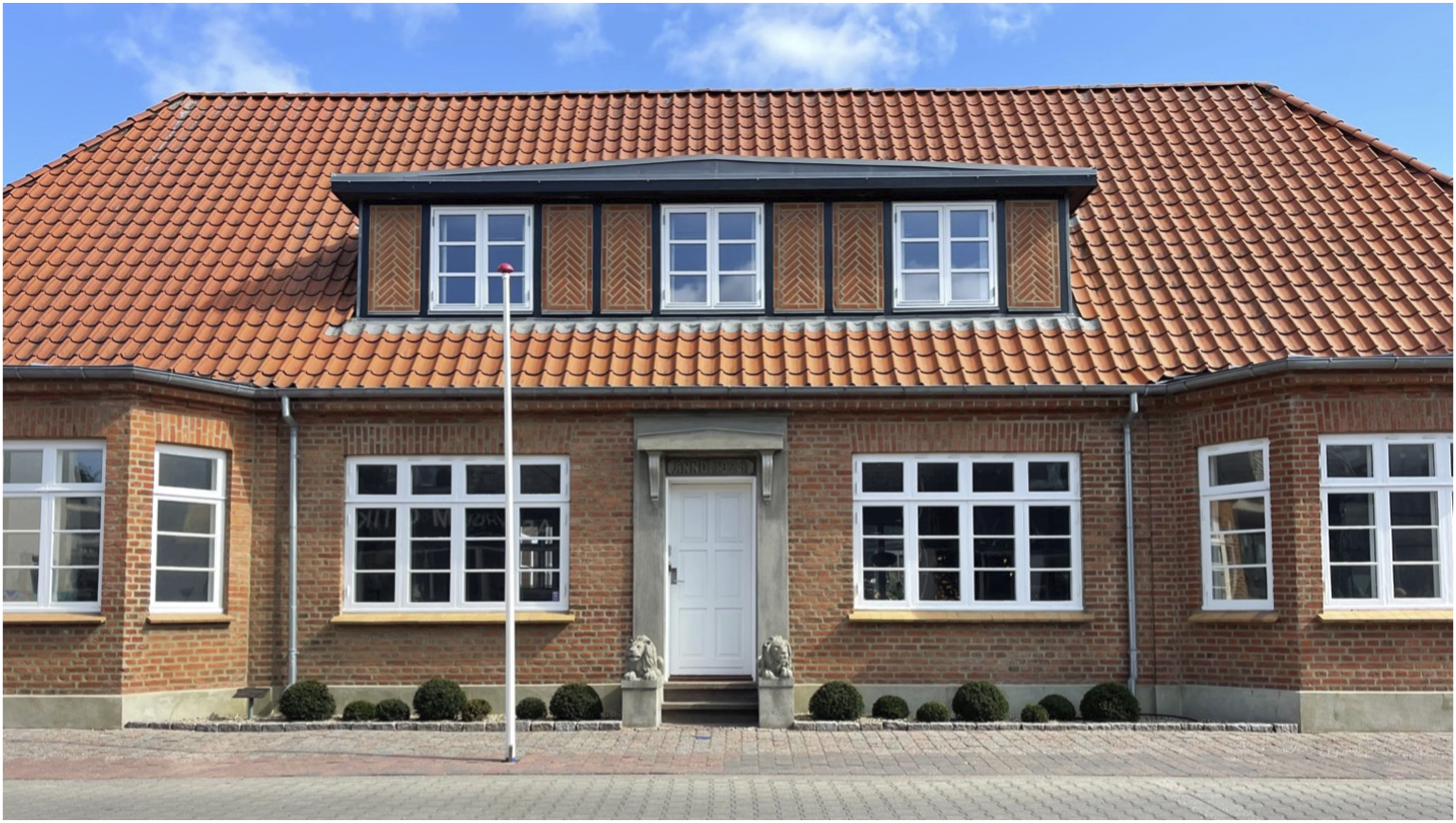
During the check-in process into the LEGOLAND hotel in Billund, the participants were given the orientation kit. The following morning, after the orientation at the LEGO House, one of the central locations for the 3-day tour, we were escorted to the LEGO Idea House. The complex is comprised of several buildings: Lego founder Ole Kirk Kristiansen’s old family home, the old woodworking factory, and a building which served as the first administration building, none of which is open to public. In other words, the Lego Idea House is placed right at the cradle of the Lego Group where it all began. The Idea House was built within the structure of the old Christiansen family home where the oldest family and brand artefacts are displayed, design sketches, wooden toys and the molding machines that produced LEGO bricks. In this metaphorization process (Lefebvre, 1991: p. 98), participants were caught up in the web of images from corporate history, signs, and symbols, as an influx of information and messages. A multiroom exhibit of the LEGO Idea House serves as a chronicle of the LEGO brand and product development throughout the company’s history (See Figure 2). The performative movement filled with spatial-cognitive metaphors (Kolb, 2020: p. 135) intensified with generated collective meaning and interaction between corporate historians and the fans-participants. History overview of the LEGO brand and product development, LEGO Idea House, History Collection, Aug. 30, 2023.
Afterwards, participants moved to one of the climatic spaces – the vault, where the LEGO history collection is displayed. The space preserves almost all LEGO sets ever produced (See Figure 3). The nature of historical corporate time is focused on periodization, the categorizing of the past into decadic blocks of time, facilitating stable and convenient insight of the LEGO production past. During the visit, this space directly lives through its associated images and symbols. Participants make this physical space alive, or how Lefebvre would say (1991, p. 42): it speaks. For this tour, the vault acts as one of the affective centers, since it embraces elements of fandom passion, nostalgia, and personal histories. In this still physical yet “mixed space,” participants experience the re-embodiment of their fandom, in a localized nostalgia, personal experiences and present interpretations. The history collection shows powerful and unique quality in documenting encapsulated meanings of the brand production mixed with fans’ contemplation and reflection. The 90’s section of the vault featuring LEGO System Pirates, Space and Castle, all discontinued themes, LEGO Idea House, the Vault, Aug. 30, 2023.
The direct encounter with the LEGO production history underscores the fundamental relationship that exists between monuments, space, and time. No matter what personal fandom memories participants possess, any direct physical encounter with a retired, old LEGO set, through direct bodily experience, create new meanings. It might be only to reinforce memory or strengthen a nostalgic meaning, seeking to create a transcendent vision of the past, known only through such re-embodiment. In other words, participants are allowed to touch and inspect LEGO boxes, and that makes this experience both dynamic and participatory (See Figure 4). Aura of nostalgia surrounds each of those sets, as objects of potential direct connection to childhood, no matter if one owns the set and played with it, or it is a LEGO set that one never managed to get when younger. Feeling an old box, seeing its content, and reading its inscription and design enhances personal memory and a sense of fandom nostalgia. A participant inspects an old LEGO box in the LEGO Idea House, History Collection, Billund, Aug. 30, 2023.
That being so, the vault becomes a lived space, distinct from perceived spaces, because it is an affective bodily practice. While walking through the multiroom space filled with LEGO sets organized by themes and production years, the participants are immersed into experiencing the space, where individual experiences are expropriated into this space and then appropriated back into individual fandom experience. The movement of the group through the vault enacted shared social practices that unified participant relationships and fandom values among participants.
Finally, the history collection preserved and displayed in the vault emphasizes an intense emotional response from participants who were offered an exclusive opportunity to observe and hold and inspect old LEGO sets. This power of the moment ultimately derives its potency through a monumental experience itself reflected in the orchestrated tour movement, individual concentrated observance, community relational perspective, and physical representation.
LEGO house: The home of the brick
Representations of space must therefore have a substantial role and a specific influence in the production of space (Lefebvre, 1991: p. 42). The corporate intervention occurs by way of construction, in other words, by way of architecture, conceived of not as the building, or a particular structure, but rather as a project embedded in a spatial context which call for representations that will not vanish into the symbolic or imaginary realms.
Concretely, for more than 90 years now, Billund has been home to LEGO, and in 2017, the LEGO House was opened, as a large, vibrant, modern “brand house” that pays tribute to the brand though architecture (p. 374). The LEGO House is a highly expressive space of brand significance. Even though it is a monumental collection of brand symbols, the affective level is emphasized, the level of the bodily lived experiences of the participants of the tour, transformed into symbols which are intrinsic, becoming metaphorical, mixed with the corporate imaginary. The LEGO House in Billund, in its dramatic beauty and grandeur, strikes a high symbolic cord while communicating on the LEGO brand values in a very personalized experience. The architectural and symbolic perfection of the LEGO House architecture offers an unprecedented level of continuity for the LEGO brand values, while exemplifying a mutuality of physical space associated with them. The building itself is structured from imagined 21 oversized LEGO bricks that is most obvious from a drone photo (See Figure 5). Bird’s-eye view of the LEGO House in Billund, Source: https://legohouse.com.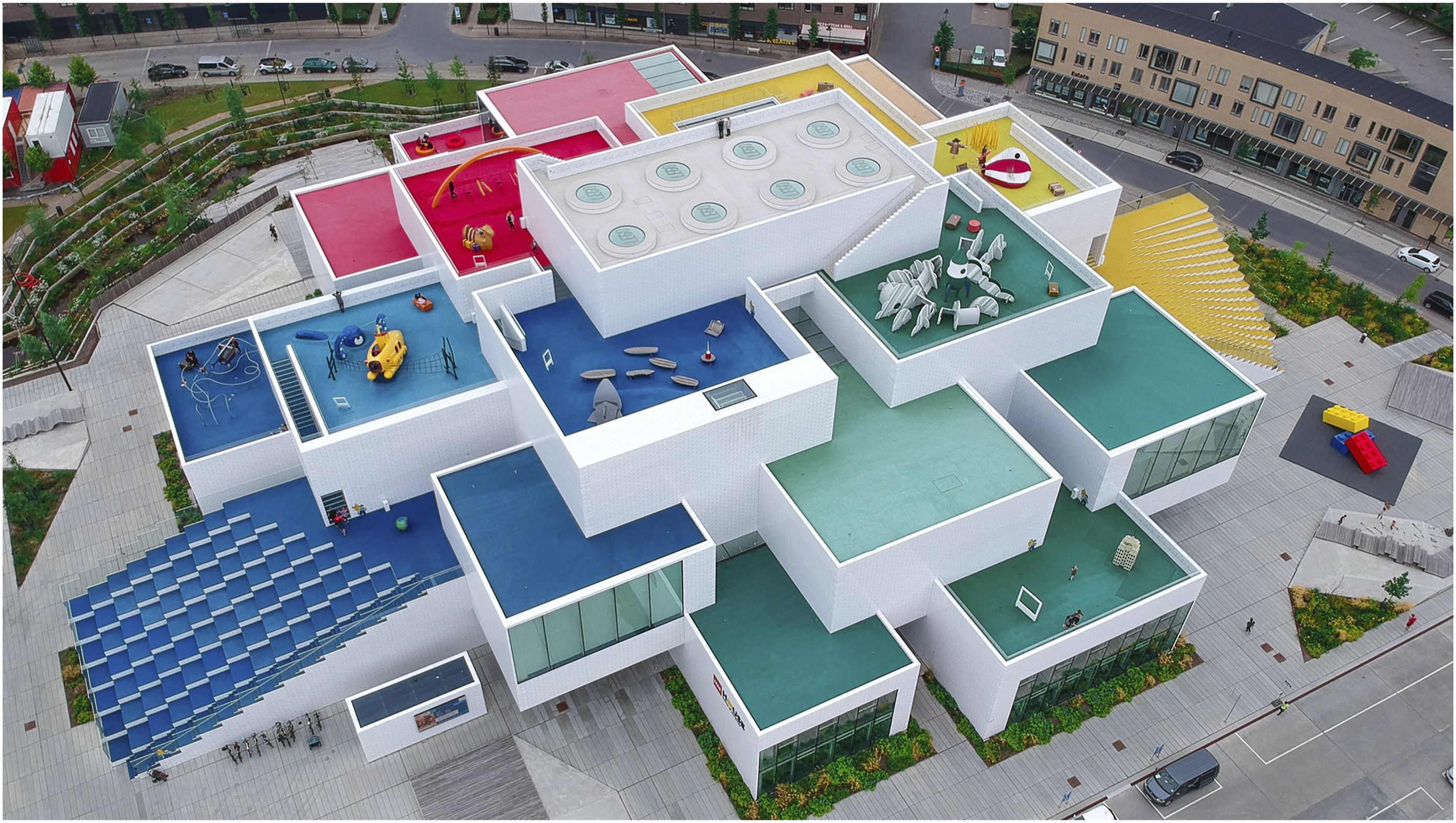
Immediately upon entry, visitors are found in a central plaza space. All the performatively structured spaces become focal points of action while the space itself communicates and influences movement. Namely, visitors are inevitably drawn towards the upper levels, featuring four experience zones. The Red zone, also called creative, is free for playful activities; Blue is cognitive and the problem-solving zone. The social zone, Green, is devoted to storytelling and character development, and finally, Yellow, the emotional zone is where bricks are used to express feelings. In the middle of all four experience zones, a gigantic 15-m tree made of more than six million standard LEGO bricks, stands from floor to ceiling, as a centerpiece of the LEGO House. Called the “Tree of Creativity,” it holds small play scenarios on the branches, based on the classic as well as the newer LEGO play themes (See Figure 6). In fact, the tree is a metaphor for the entire LEGO Group, containing references to both wooden toys and a company in growth. At the top of the building is the Masterpiece gallery, that features fan-made creations, as a celebration of fan-builders (Botorić, 2023). Tree of creativity, LEGO house, Billund, Sept. 1, 2023.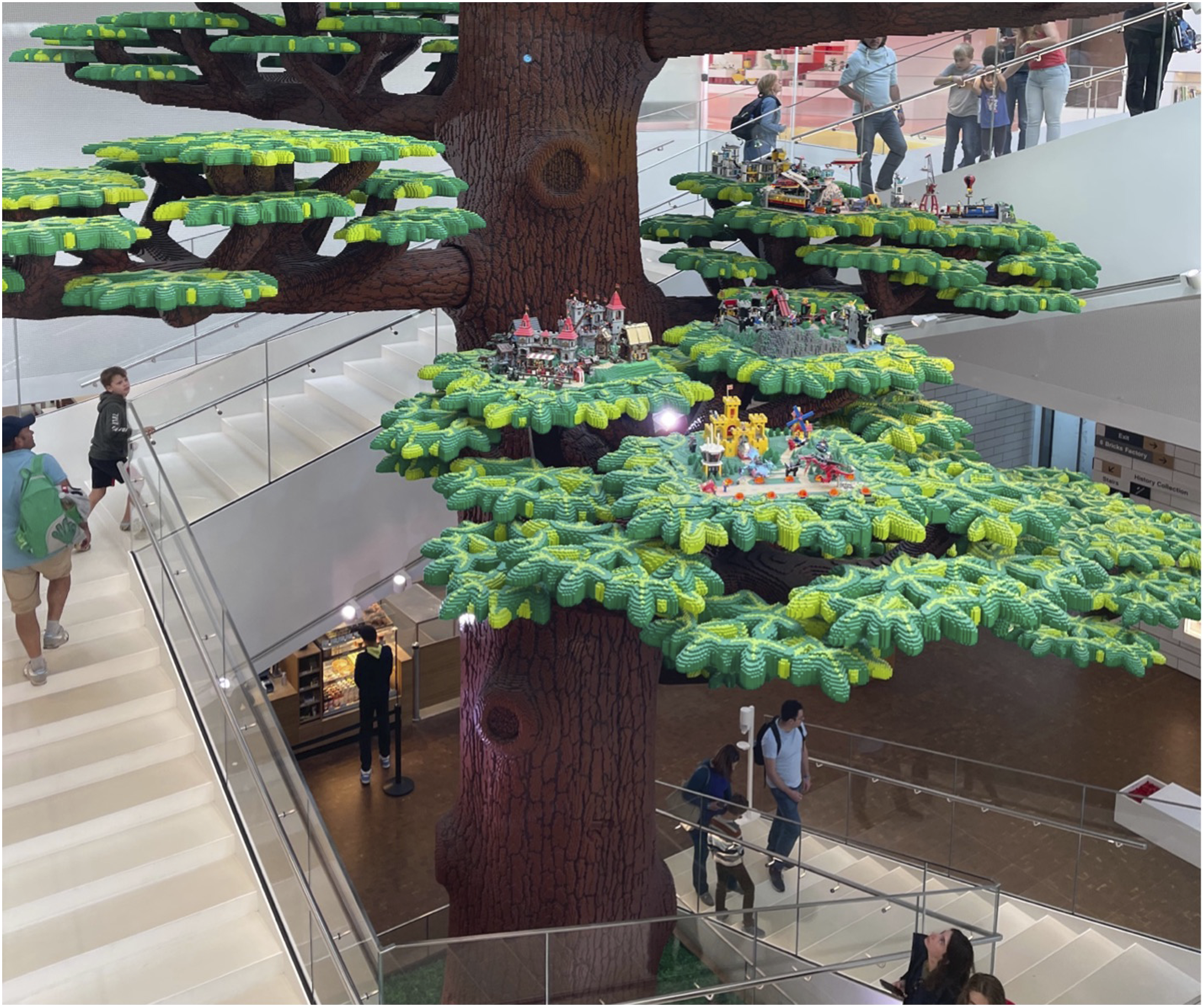
Overall, the LEGO House stands in contrast to the exclusive LEGO Inside Tour experience, as it is open to the public. This openness demonstrates a broader accessibility and engagement strategy, wherein the architectural representation (Lefebvre, 1991) of the LEGO brand becomes a shared experience rather than a privileged encounter. Therefore, through its public accessibility the LEGO House not only serves as a physical manifestation of corporate identity but also democratizes access to the brand’s cultural narrative, linking spatial representation directly with public engagement and cultural influence.
Design challenge: Everyone gets a trophy!
The LEGO Inside Tour was designed to orchestrate distinct metaphors of previously restrictive interactions between the producer and consumers. For the LEGO Group, adult fans have represented an important avenue for value creation (Botorić, 2022). Bringing AFOLs into official LEGO design processes marked a wide shift in its producer-consumer relationship. In addition, the shift emphasized a democratizing potential of the participatory culture reflected in LEGO’s empowerment of AFOLs. This change occurred more than 60 years after LEGO had first created and marketed its bricks and elements within its corporate walls and far from customers’ eyes. Originally, the LEGO Group’s practice had been that it did not look for ideas or welcome suggestions from its quickly growing innovative army of customers and fans. The company’s attitude was that it did not need to communicate with customers beyond its advertising and marketing. However, with the emergence of the Internet and social media, AFOL discussion groups emerged in which they could share their photos and discuss LEGO themes, newly introduced sets, and general LEGO news. AFOLs also launched online marketplaces to buy and sell old LEGO sets that have been discontinued. The LEGO Group realized it had a stake in empowering AFOLs’ creativity and capturing the value they generated in an appropriate manner (Zwick et al., 2008) and began building personal relationships, thus involving AFOLs in corporate research and development programs (O’Neill, 2010).
As a result, the LEGO Group established the LEGO Community Engagement program to engage adult fans in a dialogue with the company. According to Gyrd-Jones and Kornum (2013), this program enabled the company to move successfully into the newly created dynamic platform consisting of groups of customers and generate creative ideas outside its corporate walls. With reference to this, Botoric (2015) identified a source of new competitive advantage and a fertile ground for LEGO’s profitable growth, laying in the strategic capital built by a continuous interaction with its fan base. Such collaboration involved enabling co-creative interactions so that fans could have meaningful and compelling engagement experiences (p. 168). Instead of having LEGO designers work in secrecy behind closed doors on new LEGO sets, the LEGO Company would invite fans and users to “sit at the table” with the designers and work together on future LEGO sets. To date, more than 56 sets have been produced and marketed as LEGO Ideas, from the collaborative work between fans and LEGO designers. For example, LEGO Ideas 21,336 The Office set, based on the US sitcom, won the 2022 Toy Association’s Grown-Up Toy of the Year award.
The most time-consuming event during the tour was a role-pay design challenge in which participants were demonstrating their building abilities. Participants were given 3 hours at the end of the first tour day to create a LEGO model using approximately 200 LEGO elements. In an especially re-arranged room in the LEGO House, where presentations and thematic sessions took place, builders were offered seemingly countless LEGO bricks and elements of all the colors and shapes, all put in six long rows (See Figure 7). If someone needed a piece that was not in the trays, LEGO designers would bring it to the table. With a highly engaging and playful atmosphere, the event reinforced the fantasy of a real design process within the LEGO Group. The creative context where participants could discuss their ideas among themselves and more importantly and freely with professional designers, getting feedback to improve their models. This transformed the design challenge from a competitive one to a fun community bonding session. Even when the clock suggested that participants ran out of time, one was able to continue with the building in the hotel room. This challenge became powerful and memorable due to the active involvement of its participants fully immersed in the event. Design challenge LEGO elements display, LEGO House, Billund, Aug. 30, 2023.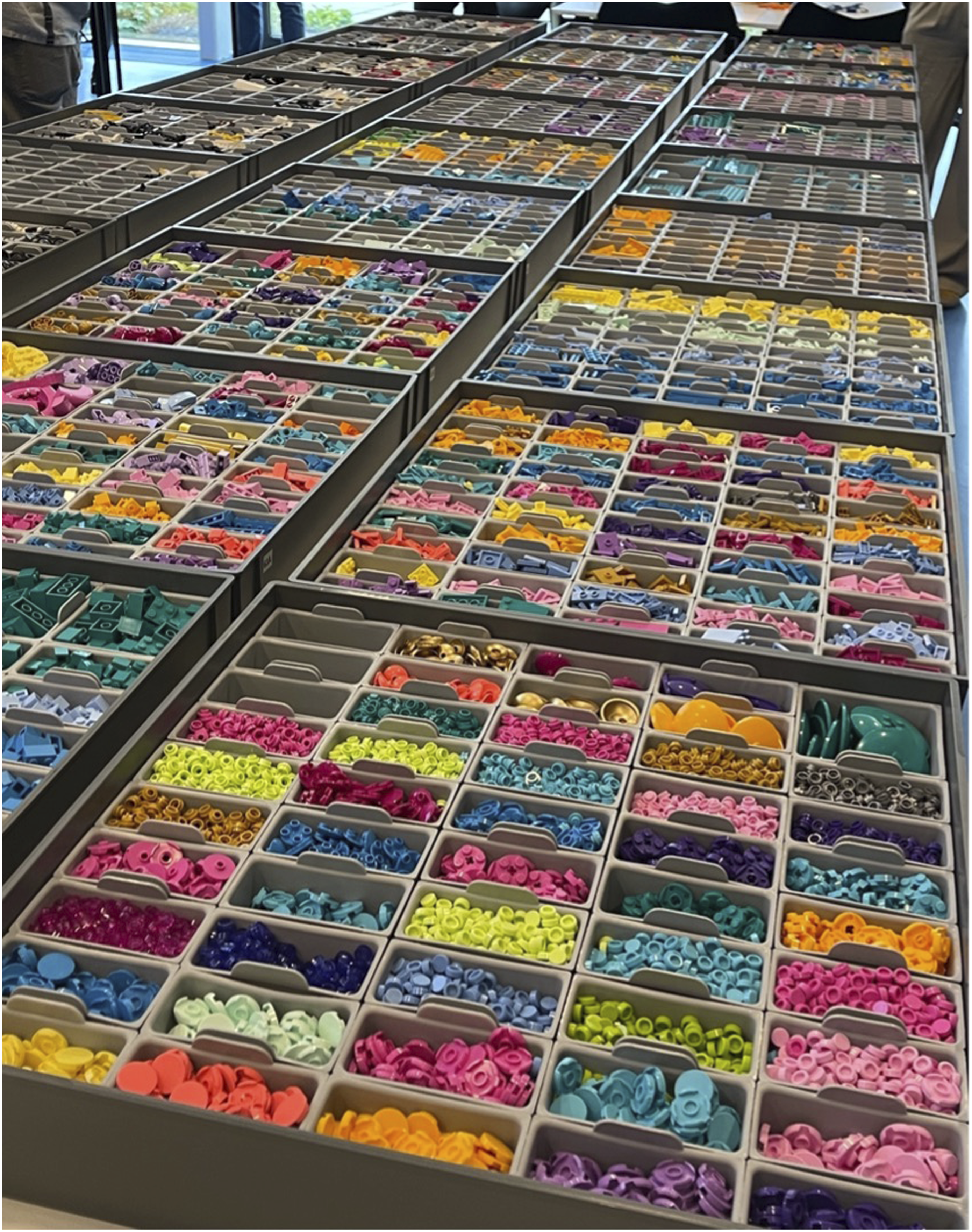
The following morning, all the models were collected at the hotel reception, and they would undergo a designer’s review. Another theatricality sophisticated and spectacularizing event with designers happened during the LEGO designers review and dinner, where the designers were awarded best models in some categories. Unlike the experience that Derek Johnson experienced in 2014, the design challenge was not related by any means with the simulation of the hiring process, or as a part of aspirational professionalism. Even though, some of the winners demonstrated skill in their design to some extent, it seems that others were awarded more for the purpose of affirming the playful atmosphere and stimulating the LEGO Inside Tour community spirit. The event was held during dinner in one of the LEGOLAND hotel’s event rooms, with elegantly set tables. Overall, the design challenge was conceived of an organic space (Lefebvre, 1991: p. 229) due to its immediacy of the links between participants, LEGO designers, and the tour organizers, while creating a strong expression of community. Echoing Pine and Gilmore’s (1999) perspective on the experience economy as a form of self-illusory validation, Miles (2021) underscores that this phenomenon is less about the production of experience and more about how such experience encourages us to feel that we have more control. According to Pine and Gilmore (1999), the vitality of the economy will rely on effective orchestration of memorable events. For participants immersed in the LEGO Inside Tour design challenge, the quality of the experience was dynamic and entertaining thus fostered active engagement. Miles’s exploration (2021, p. 21) resonates with this view, emphasizing that contemporary consumption trend prioritizes experiences that enhance perceptions of control, in this case, of the design process, rather than merely production of experience.
Insider’s viewpoint: Manufacturing, sustainability and consumerism
What makes this tour distinct is the in-person nature in which the bodily presence of the participants is directly linked to the LEGO community engagement strategy. This tour offered access to exclusive corporate and production spaces, thus making this branded tourist experience monumental. In contrast to a theme park experience that is usually staged, the LEGO Inside Tour participants experienced the industrial manufacturing side in real time in a LEGO factory near Billund. These LEGO elements for the European market are still being molded in this factory. In fact, the participants were able to touch the raw material, the color palettes from which LEGO bricks are made of, to see the process of how the molding machines make and eject final LEGO elements of different colors, shapes, and sizes. One of the most interesting encounters was to the factory’s famous AGV (Automated Guided Vehicles). They retrieve bins full of LEGO parts from the molding machines and replace them with empty bins. The full bins are transferred to another automated system which places them into the fully automated warehouse.
In a series of events during the second day, the LEGO Group’s Chief Marketing Officer welcoming speech inside the new LEGO Headquarters in Billund made the tour participants literally cross the producer and consumer boundary in its fullest potency. The LEGO Campus (See Figure 8), a new central corporate facility, is now home to a playful, inclusive, and collaborative environment for more than 2000 employees in a high quality, low-energy office building, partly powered by solar panels installed on the roof of the nearby parking area. While the focus on biodiversity of indigenous plants, trees and natural environments planted to support wildlife is clearly visible, the LEGO Group’s values of ‘Imagination, Fun, Creativity, Caring, Learning, and Quality’, are all integrated into the LEGO Campus. LEGO Campus, new LEGO Headquarters opened in 2022, Billund, Sept. 2, 2023.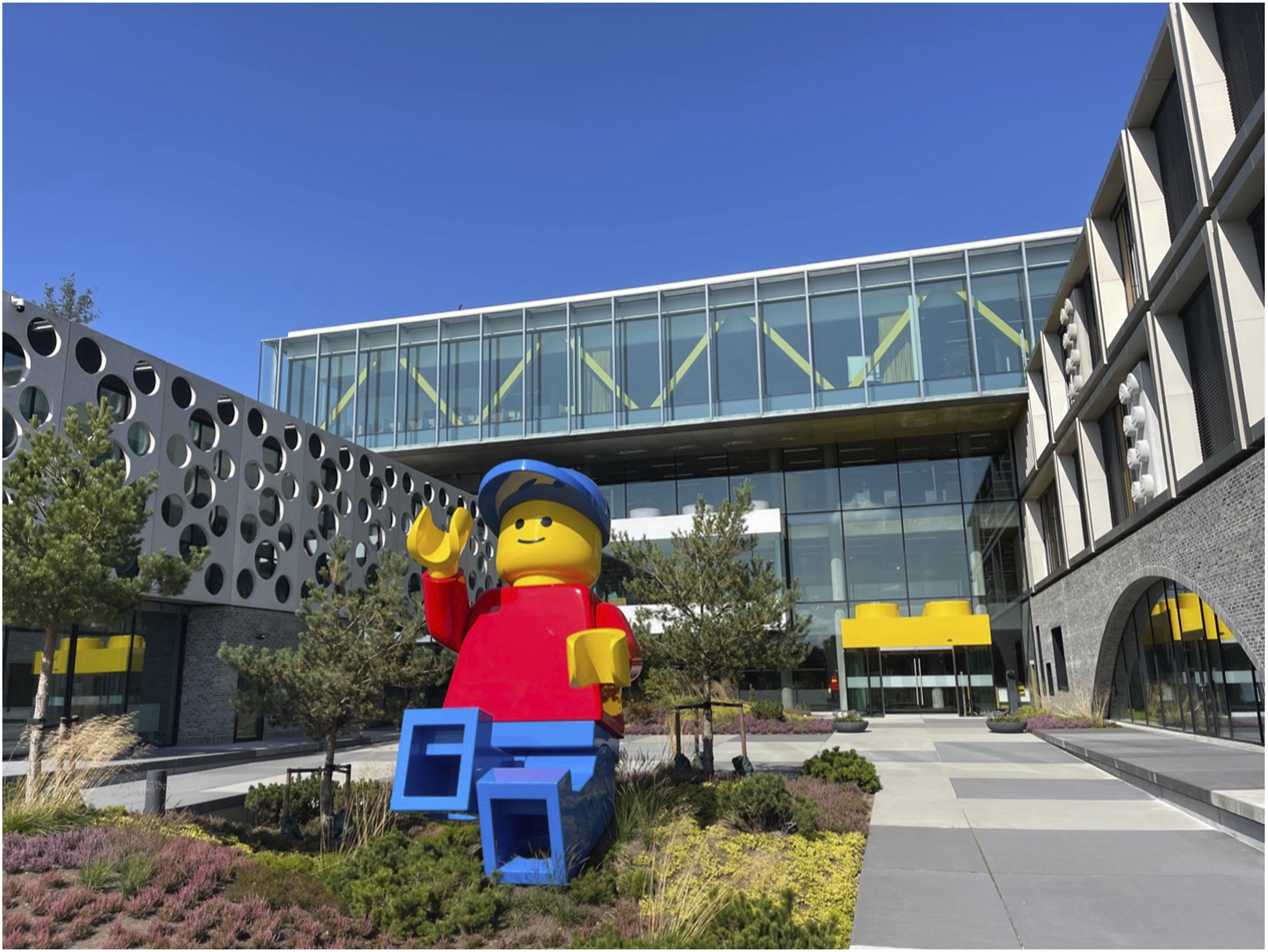
The intensified sense of exclusivity in the real corporate setting occurred when the participants were invited to have lunch in the employee canteen, after which a presentation took place. During this session, another representative from senior LEGO management, a Vice President of Environmental Responsibility and the Sustainable Materials Center, informed us about the most challenging mission in making all core LEGO products from more sustainable materials. At the end, all participants were given the first LEGO 40,320 set with trees, bushes, and leave elements – all of which were produced from plant-based plastic sourced from sugar cane.
Finally, the overall LEGO Inside Tour ritualized performance did not omit the emphasis on consumerism. Another exclusive and fantastic performance of being an employee happened during 2 hours at the new LEGO Employee Store in the LEGO Campus. The store has almost all current sets that are available on the market, including some discontinued ones. Each participant was given one big box to be filled with other LEGO boxes – all to be shipped for free to the participants’ home address. Since the experience at the store was enriched by the fact that all shopping comes with the employee discount, once again the simulated fantasy of professional belonging to the brand within the tour was reinforced. While some participants bought just enough sets to fit the box, others used carts to transfer huge boxes with the idea to fill their cars and campers. Others purchased so many sets, so they had to ship another big box to their home country. Interestingly, the shipping cost was as much as the amount saved on those sets, but they were happy enough to get those sets, regardless of the cost/benefit ratio. The shopping experience at the LEGO Employee Store, with the employee discount reoriented participants entirely towards the fantasy of being an employee, with the revitalization of the ideological potential of consumer capitalism through the illusory realm facilitated by excessive consumption. Such situation merely amplified participants’ passivity (Miles, 2021: pp. 22-3) —all participants pursued the experience actively, and focused on living intensely in the present moment, fully maximizing its potential of the employee discount to achieve personal objectives. Only afterwards, participants were back to reality when trying to pack all the boxes and calculate the overweight luggage fees.
On the final day of the tour, the LEGO House meeting room was re-arranged once again, this time with dimmed lights and an aura of mystery. As a definite climax of the tour in which the participants were immersed into a magical moment when the LEGO exclusive set, especially designed for them, was about to be revealed. The sets specifically designed for LEGO Inside Tour are among the rarest produced by the LEGO Group. These sets are not available anywhere in the market and are produced in extremely limited number. The 2023 LEGO Inside Tour set was a brick-built replica of a 1940s wooden fire truck (See Figure 9). The participants could see the original toy on display in the previously visited LEGO Idea House Museum, which inspired its recreation for an Inside Tour set. While the packaging offers a historical overview of a long history of fire engines within LEGO production, it was highly personalized. The group photo of all the tour participants was printed on the back of the box, making this LEGO set a unique and memorable confirmation of the LEGO Inside Tour experience in the heart of LEGO in Billund, Denmark. LEGO Inside Tour 2023 set, author’s copy of the designer signed box, Oct. 2023.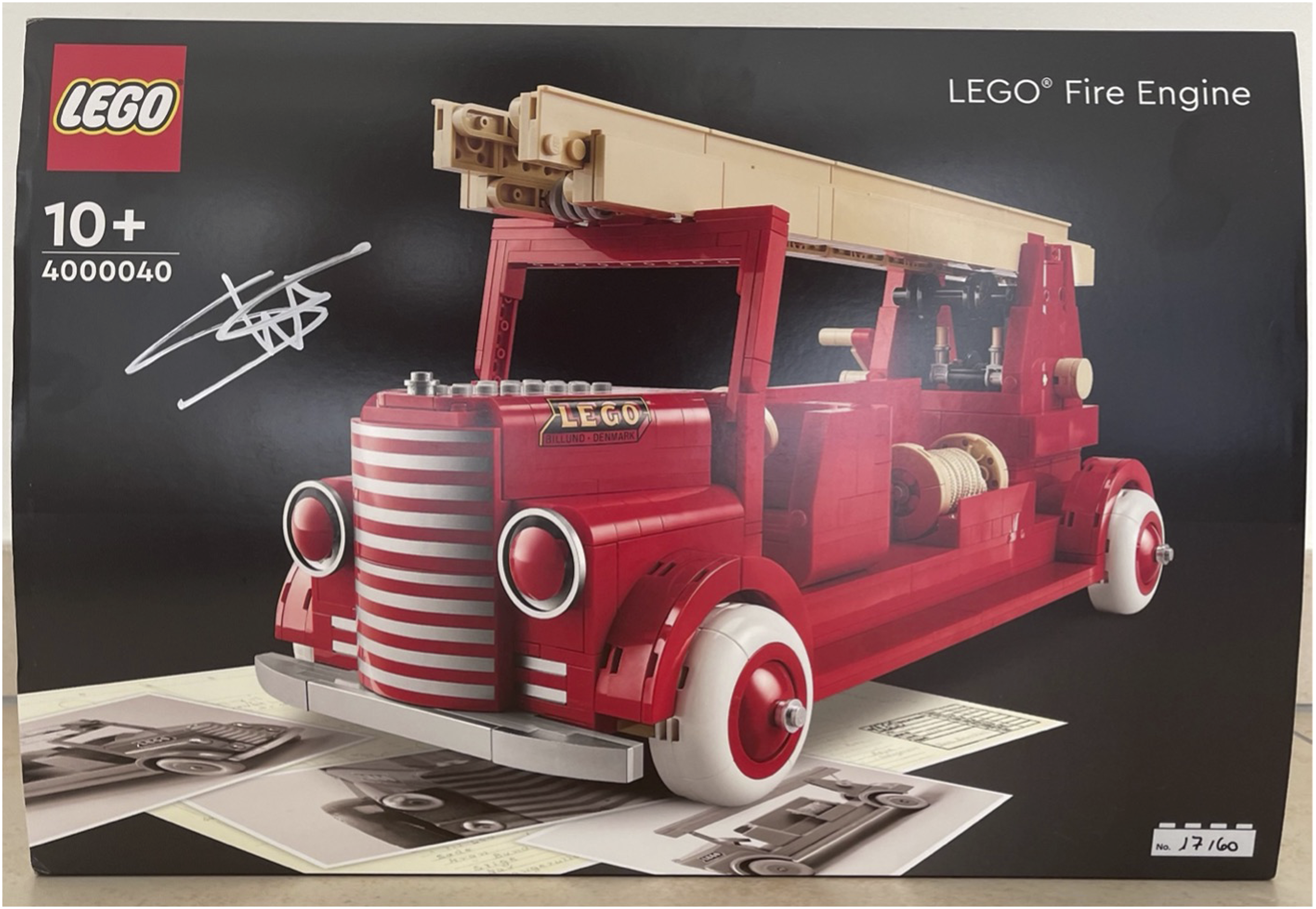
Conclusion
In the contemporary experience-driven society, time assumes heightened value, influencing our perception of reality through moments of profound significance (Miles, 2021: p. 16). Hankiss (2006: p. 214) characterizes this era as one dominated by experiences, emphasizing the role of imagination. Consumption thus becomes a gateway to escape into imaginatively enriched realms. The rise of digital consumption and the increasing deterritorialization of consumption practices suggest the emergence of an altered consumption paradigm. In this paradigm, experience plays a central role in shaping the motivations and modes of consumption. Concretely, to diversify the in-store experience by giving shoppers access to catwalk shows and exclusive backstage footage that they would not have access to otherwise, luxury fashion designers create mobile apps and headsets that make it possible for customers to be immersed into the narrative from the intimacy of their own homes (Prada, 2020). The headset acts as a personal VIP pass, welcoming customers into the backstage of a luxury fashion show while enabling to experience the pre-show atmosphere with all its elements (LVMH, 2015). Using virtual technology to enable the customers to experience events or spaces that were traditionally exclusive only to celebrities or media representatives, we can see how technology has another key role now. It brings a brand closer to its customers, while establishing a stronger connection in a more personalized experience (Harba, 2019).
In contrast to virtual or augmented reality consumer experiences, LEGO fandom is heavily dependent on a tactile, rather than textual engagement, making this fandom different from other forms of popular culture and media fandoms (Botorić, 2022: p. 899). Contrasted to the VR technology that transports users into completely virtual worlds and AR that superimposes digital information, images, or animations onto the user’s view of the real world, encountering a retired LEGO set firsthand through physical interaction, regardless of personal memories associated with fandom, adds a new significance. This History Collection experience can serve to reinforce memories, deepen nostalgic sentiments, and evoke a transcendent connection to the past that is uniquely enabled through such tangible re-encounters. As it is a bodily experience, utilizing all the senses as well as the feeling of being in a place, it is intensely personal, Waysdorf (2021) argues, as nothing is more personal than one’s own body. Each box from the collection carries an aura of nostalgia, representing a potential direct link to childhood, whether one previously owned and played with the set or merely desired it. In essence, the ability for participants to touch and examine LEGO boxes, observe its contents, and read its labels and design elements enriched personal recollections and enhanced the sense of nostalgia associated with fandom. Opposed to the introduction of virtual technology into consumer experience, this experience re-affirmed a necessity of bodily presence at places and spaces of interest.
Experience assumes a pivotal role in blurring boundaries, notably those between the routine of daily life and the realm of escapism. LEGO Inside Tour stands out as a feature of the fan tour experience, characterized by its capacity to fully immerse participants through architectural, material, and performative (Lukas, 2016) experiences. In the context of the LEGO Inside Tour, this multisensory and embodied experience exemplifies how consumers validate the reality of a place. By participating in such tours, fans engage in a form of commodified brand interaction that goes beyond mere consumption; it becomes a means of confirming their connection to the brand and its associated narratives. It also represents a quality of uniqueness, a set of signifying fandom practices that interplay between the corporate imaginary and the fandom symbolic, actualizing the consumer self (Miles, 2021: pp. 176-177). The tour derived its value from its ability to direct the participants’ attention to brand culture and values and fandom collective representations. This interaction was enriched by the infusion of symbolic and subcultural meanings embedded within the LEGO fandom universe, conveyed through distinctive motifs and narratives that resonate deeply with LEGO fans.
Properly executed consumer experiences will encourage loyalty not only through a functional design, but also by creating an emotional connection through engaging, compelling, and consistent context (Pullman and Gross, 2004: p. 553). The concept of the LEGO Inside Tour illustrates the influence of experiences and brands’ capacity to reinterpret them using the trope of movement emphasized with a poetic walk over LEGO topography in Billund. This movement contoured the intimate LEGO fandom sentiment into a materiality of monumental scale through the branded architectural layouts of the LEGO House, LEGO founder Ole Kirk’s Lion House, LEGO Idea House, LEGO Campus, and the LEGOLAND hotel. Through a ritualized performance, the monumentality of the LEGO Inside Tour was successfully articulated within corporate spaces of the brand history and values and validated the importance of adult fans in the LEGO Group’s ecosystem.
As Riegl (1982) observed, “a monument in its oldest and most original sense is a human creation, erected for the specific purpose of keeping single human deeds or events (or a combination thereof) alive in the minds of future generations.” In this way, the monumentality of the LEGO Inside Tour is more than an experience of an architectural form or object because of its spectacle-like character that evokes collective fandom identities and corporate values that set a monument apart from other places. A monument simultaneously belongs to the present and the past, as Kolb (2020) noted, effectively blending time with space, sequencing and segmenting an experience that is similarly cross mapped so that temporal perception is likewise segmented (p. 220). The LEGO Inside Tour established a setting that provided cognitive stimuli, extending, and enhancing emotionally stimulating spatial experiences within LEGO locations in Billund. Consequently, these physical spaces encapsulated brand essence, fostering collective corporate and fandom memories, and facilitating the development of diverse narratives intertwining both fandom and brand identities across generations.
The convergence of physical visitation to branded sites and immersive experiences underscores a broader phenomenon where individuals actively negotiate the boundaries between fantasy and reality. Imagination and reality are not completely distinct; rather, they continually influence and interact with each other, as Reijnders (2011, pp. 15-20) pointed out. During the LEGO Inside Tour, when fandom imagination intersected with the brand reality, fantasy enhanced its vividness, while reality gained significance when it was resonating with significant imaginative elements. Precisely this intertwining of fantasy and reality inspire fans to explore these connections, to push these boundaries by integrating their fictional worlds into everyday life by seeking out places where fictional and real worlds intersect. In the search of the “reality” within what is otherwise purely imagined, this process not only enhances fans engagement with brand but also contributes to the construction of personal and collective identities within the context of consumer culture.
Footnotes
Declaration of conflicting interests
The author(s) declared no potential conflicts of interest with respect to the research, authorship, and/or publication of this article.
Funding
The author(s) received no financial support for the research, authorship, and/or publication of this article.
