



Abstract
This study explores the development of Thailand’s craft beer community through a sociological lens, focusing on social capital and power dynamics. Despite originating much later than Western craft beer movements, Thailand’s scene has evolved rapidly since 2012, shaped by unique socio-economic and regulatory contexts. The research reveals how the community transitioned from homebrewers to a complex network seeking cultural legitimacy. Using Putnam’s and Bourdieu’s theories, the study highlights social capital’s role in fostering both cooperation and competition. Privileged groups use networks for economic and symbolic gains, while intermediaries shape the movement. Gender dynamics affect women moderately compared to other contexts. The COVID-19 pandemic spurred geographically close clusters and affinity groups, showcasing resilience amid regulatory challenges. These findings offer insights into craft beer consumption in non-Western contexts, stressing the importance of understanding social capital in emerging cultural industries.
Keywords
Introduction
Craft beer consumption in the Global South has experienced significant growth over the past decade, driven by Western trends advocating for alternative, locally brewed options (Collins et al., 2022). This expansion has led to neo-artisanal brewers, lifestyle consumers, and craft beer intermediaries who prefer authentic, personalized, varied, local, and innovative beers from small players over monopolized producers (Gerosa, 2020; Ocejo, 2017; Simoes Ferreira et al., 2022; Thurnell-Read, 2018). Despite the surge, there remains a notable scarcity of understanding regarding social change, cultural dynamics and consumer practices within nascent craft beer scenes in developing countries, which present vastly different settings compared to the mature craft beer landscapes of Europe, the United Kingdom (UK), and the United States (US). This knowledge gap highlights the need for a context-specific analysis that moves beyond the often overgeneralized view of craft beer culture as unilateral and universal (Alonso et al., 2018; Nanney et al., 2020; Thurnell-Read, 2017).
Building on this foundation, this qualitative case study explores the emergence of Thailand’s craft beer consumption community, referred to as ‘the Community,’ which emerged in 2012. It aims to understand evolving motives, relationships, and social structures that underpin the Community and influence the broader dynamics of the craft beer culture in Thailand (Gerosa, 2020; Jansson, 2019; Nanney et al., 2020). Using social capital as the conceptual framework, the study examines how networks, norms, and trust within the Community facilitate cooperation for mutual benefit (Putnam, 1993, 1995), while also leading to power struggles and inequalities among members (Bourdieu, 1984). It acknowledges producers, intermediaries, and consumers as key actors driving consumption practices (Thurnell-Read, 2018). This exploration is critical for understanding the relational mechanisms that facilitate market function and community resilience, as well as identifying systemic challenges to sustainability and growth within this unique cultural ecosystem (Scott, 2017; Wallace, 2019). The pivotal question the study addresses is: ‘How does social capital contribute to the formation and development of the Thai craft beer consumption community?’
Advancing the field, the study offers two significant contributions. Firstly, it enriches our understanding of social capital dynamics within consumption communities by delivering fresh, context-specific empirical insights (Claridge, 2020; Tzanakis, 2013). A major contribution is the innovative juxtaposition of the contrasting social capital perspectives of Putnam (1993, 1995) and Bourdieu (1984). Integrating these frameworks provides a nuanced depiction of how social capital develops through the interplay of collective and individual interests, influencing evolution and development within the craft beer community and broader consumption culture. This approach not only deepens our theoretical knowledge but also sets a precedent for future studies exploring complex social dynamics in other evolving consumption fields.
Secondly, the study provides new insights into understanding craft beer as a cultural industry (Cunningham and Fraser, 2021) contextualized within local institutions and shaped by global trends (Drakopoulou Dodd et al., 2018). It reveals how, within just over a decade, the Community transformed from a close-knit group of enthusiastic homebrewers with low cultural capital into a dynamic web of knowledgeable actors competing within various craft beer spaces. These now include homebrews, small breweries, craft beer bars, festivals, underground events, social media apps, and online communities (Nanney et al., 2020; Wallace, 2019). This evolution occurs amid a growing consumer base increasingly informed and influenced by curated information from various intermediaries (Jansson, 2019). The findings offer valuable insights for other developing countries looking to understand and cultivate their craft beer industries.
Literature review
Social capital and craft beer consumption communities
Social capital is crucial in the evolution of consumption communities, navigating socio-cultural, spatial, and economic landscapes (Drakopoulou Dodd et al., 2018; Närvänen et al., 2019). This dynamic is particularly pronounced in the craft beer domain, where an ethos of ‘honesty,’ ‘craftsmanship,’ and ‘collaboration’ shapes community interactions and consumer relationships (Gerosa, 2020; Thurnell-Read, 2022). Unlike mainstream economic sectors characterized by fierce competition, the craft beer industry thrives on robust networks and intimate dynamics between producers and consumers, fostering vibrant communities grounded in shared norms and reciprocal trust (Cunningham and Fraser, 2021; Drakopoulou Dodd et al., 2018; Flanagan et al., 2018).
Entrepreneurial literature describes these relationships as ‘collaborative resistance’ and ‘coopetition,’ highlighting the interplay between collaboration and competition (Cunningham and Fraser, 2021; Flanagan et al., 2018). Despite this, mutual benefit, trust, commitment, and sympathy remain fundamental, especially for smaller craft beer entities (Alonso et al., 2018). For these players, a strategic blend of resource sharing, innovation, and marketing support through coopetition is crucial for collective sustainability and advancement (Flanagan et al., 2018; Kraus et al., 2018).
Critics argue that craft beer communities, once seen as inclusive, actually reveal power imbalances and identity constructions that favor certain demographics over others Chapman and Brunsma (2020a, 2020b); Thurnell-Read, 2022). Consumption patterns, they argue, mirror societal structures, highlighting both inclusivity and exclusion based on gender, race, and class. Scholars like Darwin (2018) and Thurnell-Read (2022) emphasize entrenched gender biases where women navigate barriers to gain acceptance while men control cultural influence. This gendered dynamic, often intersecting with class, portrays brewing as a middle-class, male-dominated pursuit. Craft beer environments, frequently criticized as male-centric, present significant challenges for women, particularly in contrasting public versus elite spaces (Nanney et al., 2020). Chapman and Brunsma (2020a, 2020b) further explore craft beer as ‘white spaces’ that cater to and perpetuate whiteness and exclude minorities and women, revealing underlying issues of white supremacy.
The ascension of craft beer consumption as a middle-class phenomenon has also been propelled by scholars as a symbol of upward social mobility and refined taste, illustrating a shift towards sophisticated beer appreciation practices interlinked with gentrification and socio-spatial dynamics (Chapman and Brunsma, 2020a; Thurnell-Read, 2018; Wallace, 2019). This transformation not only reinforces class distinctions within consumption patterns but also perpetuates ongoing struggles for status and power among established and emerging community members (Thurnell-Read, 2018).
Theoretical perspectives on social capital
In light of the contentious role of social capital in both integrating and segregating consumer communities, understanding its dual capacities is imperative. Ronald D. Putnam’s sociology of integration emphasizes collective values and solidarity (Putnam, 1993, 1995), while Pierre Bourdieu’s sociology of conflict highlights the strife of interests and power dynamics (Bourdieu, 1984, 1986). These perspectives dissect social capital dynamics within emerging craft beer communities, illustrating how ‘networks, norms, and trust foster coordination and cooperation for mutual benefit' (Putnam, 1995: 67), while also revealing and how interpersonal connections accumulate “potential resources” (Bourdieu, 1986: 248) across different spaces over time.
Putnam’s framework (1993, 1995) emphasizes horizontal interactions and reciprocity in voluntary associations, echoing dynamics observed in emerging craft beer communities. Trust-based relationships establish norms and strengthening bonds, driving civic engagement, economic growth, and democratic participation (Tzanakis, 2013). Putnam (2000) distinguishes two forms of social capital – bridging and bonding. Bridging connects diverse groups, enhancing network variety, while bonding strengthens ties within homogeneous groups, crucial for economic and political cooperation. For example, in North Carolina’s craft beverage tourism, bridging and bonding social capital have bolstered community capacity, entrepreneurial initiatives, and infrastructure, transforming the region into a vibrant craft beverage hub (Knollenberg et al., 2021).
Despite its influence, Putnam’s theory is criticized for its overly optimistic view that community engagement always yields positive outcomes (Siisiainen, 2003). Critics argue it neglects vertical social network dimensions like resource diversity and openness to new members, impacting local and national levels (Tzanakis, 2013). Moreover, it oversimplifies the dynamic nature of social networks, missing complexities and inequalities (Siisiainen, 2003), leading to varied outcomes in wealth, success, and democratic participation across contexts.
Transitioning from Putnam’s optimism, Bourdieu (1984, 1986) offers a critical view of social capital, highlighting self-interests and inequalities within networks that perpetuate social hierarchies. Bourdieu argues social capital enables individuals to secure economic, cultural, and symbolic advantages, reinforcing their positions in social structures (Siisiainen, 2003). This perspective is evident in the craft beer sector, as demonstrated in Thurnell-Read’s (2018) analysis of the embourgeoisement of craft beer practices and Wallace’s (2019) examination of urban inequalities exacerbated by craft beer spaces. Drakopoulou Dodd et al. (2018) study on the Irish craft beer community further exemplifies this critical perspective, showing how networking enhances entrepreneurs’ resource mobilization for economic and social gains, legitimizing the field in broader contexts.
While the theoretical insights from Putnam and Bourdieu are invaluable, empirical research extending these concepts to non-Western craft beer markets is scarce. Most studies focus on social capital within Western contexts, leaving a gap in understanding its impact in regions with different cultural and market dynamics. The following section provides a backdrop of Thailand’s craft beer context as a foreground to the empirical findings of the study.
Thailand’s craft beer context
Craft beer consumption in Thailand began around 2012, initially targeting urban consumers who could afford imported beers from the US, UK, and Belgium (Chirakranont and Sunanta, 2021). As appreciation for craft beer’s distinct flavors grew, the community expanded to include diverse stakeholders. Thai craft beer occupies the premium beer market, comprising 5% of a largely oligopolistic sector dominated by mainstream lagers. Despite challenges in a saturated market with slow economic growth and stringent legal and tax structures affecting pricing, consumer preferences and a wider beer selection have fueled consistent 4% growth, with craft beer accounting for 40–50% of this segment (Flanders Investment and Trade, 2020).
Craft brewers and intermediaries play pivotal roles in shaping the community. Brewers typically fall into two categories: self-taught or graduates of brewing courses. Currently, Thailand boasts around 500 underground homebrew brands and 100 legal craft beer brands, with many brewers transitioning from passionate consumers to specialists (Koch and Sauerbronn, 2019). Reflecting trends in other craft beer scenes (Thurnell-Read, 2022; Wallace, 2019), the majority are men aged 20 to 50, often from middle-income professions. Many have expanded operations over time, establishing pubs, organizing events, and hosting festivals. Meanwhile, an increasing number of women and other new entrants serve as craft beer intermediaries—knowledge providers, bloggers, distributors, and bar owners—who facilitate distribution, connect brewers with consumers, and enrich craft beer culture with expertise and insights (Jansson, 2019).
Craft beer consumers, spanning novices to brewers, are integral to the community. Recent studies indicate a majority are sophisticated urbanites in Thailand, aged 28 to 35, earning between 35,000 and 85,000 baht monthly, and embracing Western lifestyles (Flanders and Investment and Trade, 2020). Although foreigners make up 30% of the clientele, predominantly expats, craft tourism and visits to craft beer bars remain niche (Foster, 2021). Despite premium prices—often 10 times higher than mass-market beers—consumers are price-sensitive. Males dominate the market, comprising about 70%, yet the number of female and LGBTQ + consumers is rising (Chirakranont and Sunanta, 2021; Techa, 2022).
Methodology
This qualitative case study examines the social capital elements shaping Thailand’s craft beer community. Adopting an interpretivist epistemology, it explores subjective experiences, meanings, and interpretations of community members’ relationships and actions. Researchers maintained reflexivity, acknowledging their positionality, assumptions, and biases (Holmes, 2020). As management academics and craft beer enthusiasts, they navigated dual roles, enhancing information access and community integration (Koch and Sauerbronn, 2019). Trustworthiness was ensured by addressing assumptions and biases, maintaining credibility, transferability, confirmability, and dependability (Soulard et al., 2019).
Data collection
Participants’ profiles.
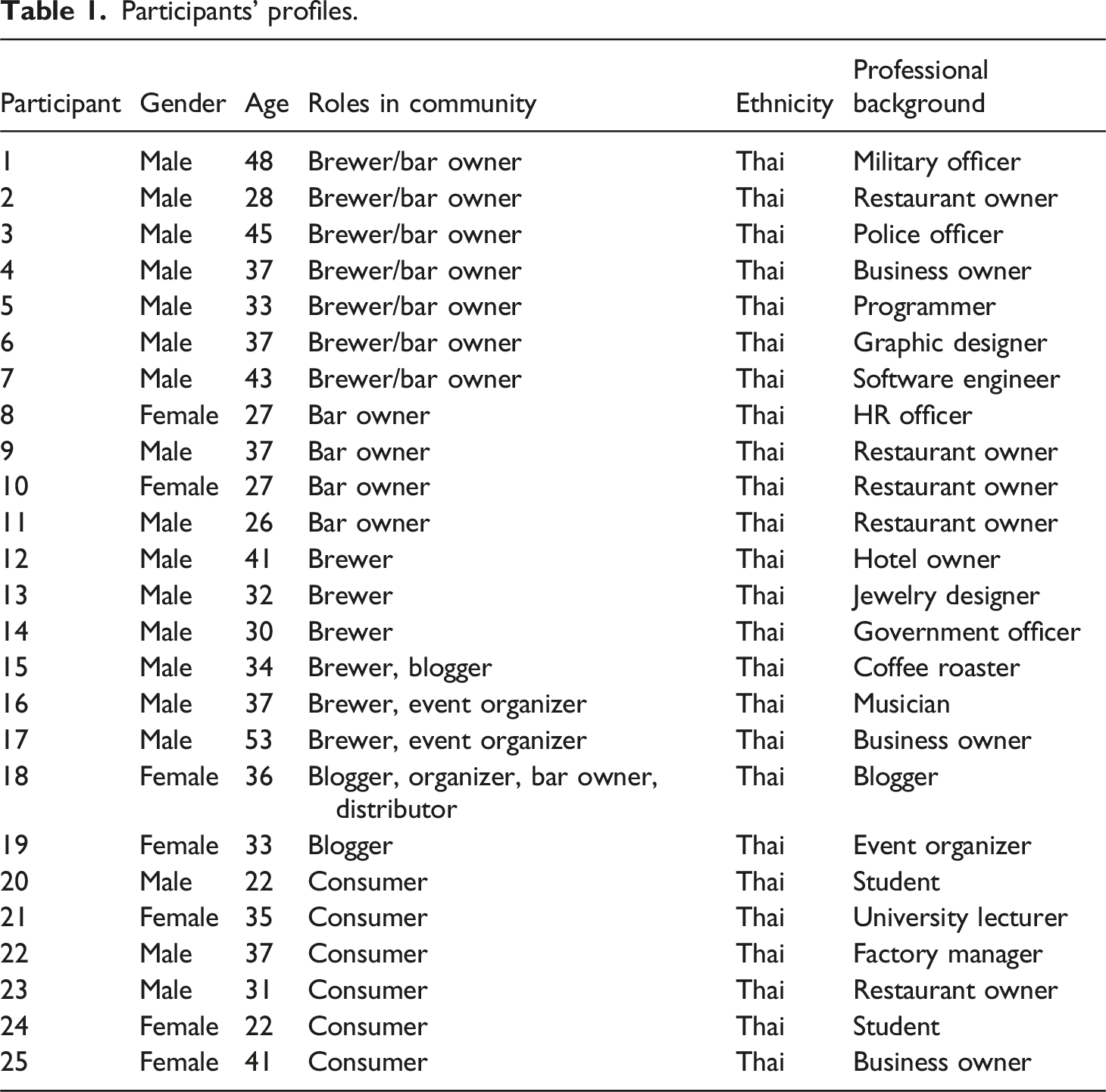
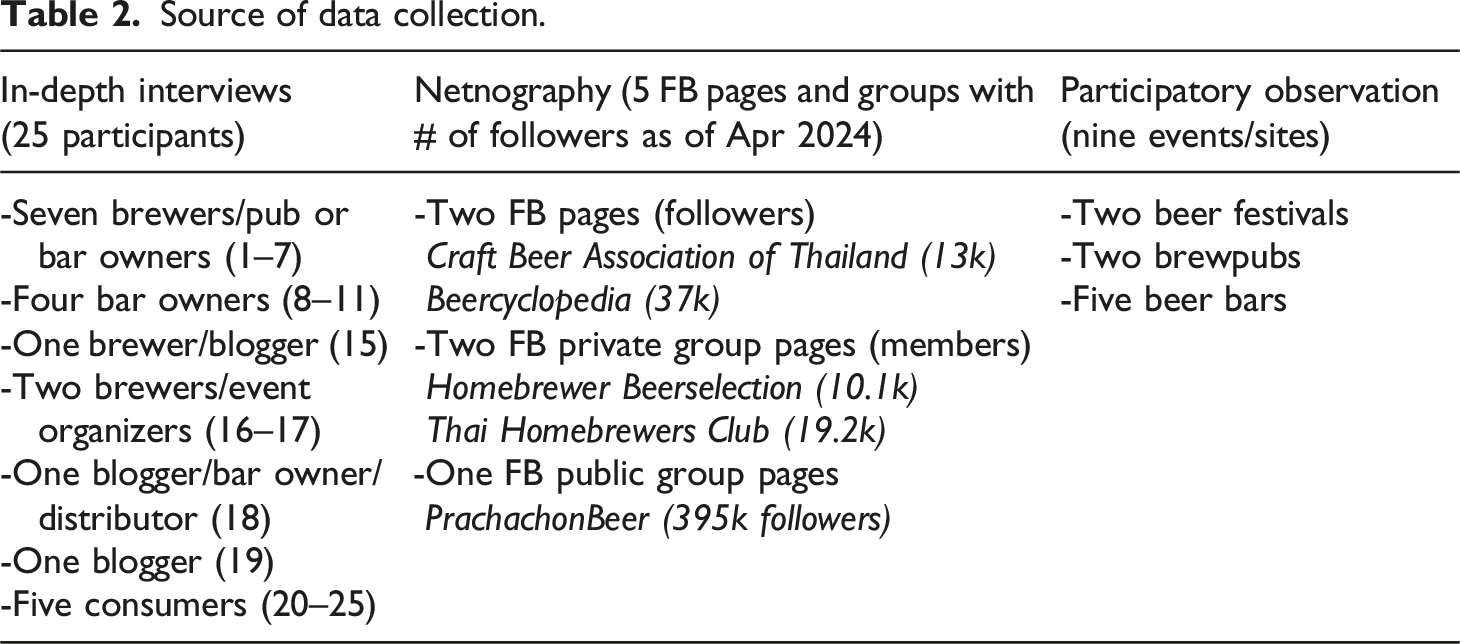
Secondly, netnography was employed to examine the broader Thai craft beer community’s associations and interactions via Facebook (FB) pages. With around 70% of the Thai population using social media (Social Media Stats Thailand, 2021), FB provided a naturalistic, unobtrusive source for information on community symbols, meanings, and actions (Kozinets, 2002). Out of 30 FB pages and groups, five were chosen based on follower count and activity level (Table 1). These included FB pages with founders as key content providers, private groups accessible to approved members, and public groups open for posts and shares by founders and followers. Additionally, community viewpoints were gathered from YouTube videos and interviews. Researchers reviewed posts and comments from the selected FB pages and groups from January 2020 to May 2023, uncovering community interactions and movements.
Source of data collection.
Data analysis
Data analysis included processing interview transcripts, observation notes, and FB content. Interviews were recorded and transcribed verbatim for confirmability. Open coding was used to extract codes from the original passages, and similar codes were grouped to develop themes reflecting social capital dynamics shaping community development over time. Qualitative content analysis was employed to identify salient themes from textual and visual data, involving a thorough review of FB pages to validate interview notes and participatory observations (Guest et al., 2012).
Dependability was ensured through independent and rigorous coding by both researchers, followed by consensus on findings (Soulard et al., 2019). Combining analysis from three data sources enhanced data credibility. Methodological triangulation enriched data thickness and richness, boosting findings’ transferability. After comprehensive analysis, four broad themes emerged inductively.
As part of the Institutional Review Board (IRB) process, an ethical consent form was presented to all interviewees before conducting interviews. Furthermore, to secure Chit’s final consent regarding the use of his name and identity in the findings, a manuscript draft was shared with him.
Findings
In this findings section, we explore the dynamics of social capital within the Thai craft beer community through three key themes that trace its evolution. These themes span distinct temporal epochs: the formative years, characterized by seeding unity (2012−2015); the growth and fragmentation period (2016–2019); and the ongoing resurgence phase (2020–present), marked by diverse alliances advancing toward market liberalization. Together, the themes encapsulate the community’s journey from inception to its current state, illustrating integrative and segregative mechanisms of social capital shaping Thailand’s craft beer culture and practices.
Seeds of unity (2012–2015)
The early years of the Community embody Putnam’s (1995) ideal features of social capital, characterized by resources from networks of mutual acquaintance, social trust, and collective interaction – crucial for shared norms, understanding, and cooperation. Participant 18 called this the ‘romantic period,’ echoing Cunningham and Fraser’s (2021) ‘artisanal scene,’ where craft beer cultural growth prioritized community over commerce. While Western craft beer brands were already present in Thailand, a nascent group of urban middle-class consumers, influenced by international travel, education, and exposure, sparked the movement for local brews.
As pioneers of the Community, most participants reminisced about their first encounters with craft beer and home brewing, emphasizing the appealing aromas and simplicity they learned from foreign exposure. Participant seven recalled a trip to France, where he bought a pack of Brewdog – unavailable in Thailand – and fell in love with the ‘strong and complex taste.’ Participant 18, a key figure in Thai craft beer distribution, noted how a US roommate introduced her to home brewing and ‘bitter aromatic beer.’ Similarly, Participant 1, known as Chit, learned from an American friend that “any ordinary person with the knowhow and equipment was capable of making their own beer.” Many participants also cited YouTube as their main source of homebrewing knowledge. Echoing Ireland’s craft beer scene (Drakopoulou Dodd et al., 2018), the ‘importation' of foreign cultural capital to Thailand was facilitated by technological advancements and a global network of craft beer enthusiasts.
A pioneering community leader emerges
Prominently, it was Chit, widely acknowledged as Thailand’s craft beer brewing godfather, who spearheaded the community’s initial development, leading a homebrewing rebellion in a country with significant barriers to selling homebrew. In 2012, despite legal challenges, Chit founded his first homebrew pub, Chit Beer, in an old wooden house on an island in Nonthaburi Province, just outside Bangkok – soon known as Thailand’s homebrewing red zone. Chit’s initial goal was to share the joy of quality homebrewed beer with friends and family. However, news spread about a Thai military officer brewing beer from a homebrew kit purchased on Amazon.com. “More people started coming, partially out of curiosity, and I wasn’t selling my beer – it was free. They could donate, but I didn’t care. My job was to make it taste good. Their job was to enjoy it!” Chit shared.
Despite his rank, Chit strongly opposed the privileges of the rich and powerful, particularly the dominance of three major beer distributors—Singha, Leo, Chang, and Heineken (Flanders and Investment and Trade, 2020). He soon saw a broader mission beyond brewing for friends: challenging the status quo and advocating for beer market liberalization. Over the next few years, several performative acts provided access to resources through network ties and trust, promoting norms of consensus and solidarity to drive this change (Siisiainen, 2003). The clear ‘problem domain’ of exploring an unknown craft context, where early members shared interests, stimulated collaboration (Alonso et al., 2018: 206).
In 2014, Chit opened a brewing academy to offer lessons to a broader audience. Many participants referred to Chit’s academy as the origin of the closely-knit network that evolved into various relationships. Participant 13 admitted that, although initially attracted to the academy by his interest in beer, he ultimately fell in love with the community. The group included professionals in their 20 s–40 s from various fields – doctors, architects, engineers, pharmacists, and programmers – who had the financial capital to explore this new lifestyle. While some saw brewing as a hobby, others considered turning craft beer into a business.
Chit’s ability to intellectually stimulate and motivate others has cemented his reputation as a transformative leader (Chirakranont and Sakdiyakorn, 2022). Former students highlight his role in fostering community among home brewers by offering free showcases at Chit Beer, assisting in establishing a brewery abroad, and co-founding a collaborative brewpub (Participants 13, 12, and 7). Participant 9, a female beer blogger and event organizer who later led another faction of the Community, credits Chit with pivotal support in helping her organize a beer event, gathering an unprecedented number of Thai homebrews. She remarks, “I always make a point to visit Chit, enjoy a few beers, and hang out with others in the Community. It's always a fun time.”
The ‘tight-knit’ community
The Community from 2012 to 2015 was considered small and beautiful. “We all knew one another!” noted Participant 10. Participants described the Community as “warm,” “supportive,” “fun,” “like-minded,” “charming,” “full of potential,” “filled with good people,” and “a family.” On the production side, the number of homebrewers was limited, with only 10 active brewers in 2012, increasing to around 30−40 by 2015. “By law, we were all considered illegal as our production capacity and financial capital did not meet the national requirement,” shared Participant 6. Consumers at the time were brewers themselves or enthusiastic drinkers, referred to by several participants as “beer geeks” or by Participant 2 as “the few strange ones,” who were ready to support the initiative.
Nevertheless, the majority of Thai beer consumers remained largely unengaged, deterred by higher prices and unfamiliar flavors that deviated significantly from traditional beer experiences. Many were unaccustomed to paying a premium for beer, questioned the prohibition against ice in glass, and found the taste overly bitter. Participant 2 noted, “Thai consumers have been implanted with the wrong drinking culture for more than 70 years.” Participant 7 explained, “We’ve been drinking lager for nearly a century, it’s the light beer equivalent to German and Belgian styles they prefer…they don’t see the need to switch to IPA, Pale Ale, or Weizen.” “The jump from lager to craft beer is an extreme one, and we need to give people some time to understand,” emphasized Participant 17.
Given the limited cultural capital regarding craft beer production and consumption among Community members, high-trust relations as defined by Cook (2005) naturally emerged due to the low risks involved in learning and progressing together. The increase in trust within this horizontal network can be attributed to how members bonded and bridged through various craft beer spaces and collaborations.
Early craft beer spaces and collaborations
Collaboration is crucial for global craft beer community growth, aiding members in managing challenges, enhancing capitals, and creating value (Drakopoulou Dodd et al., 2018; Knollenberg et al., 2021; Slocum, 2018). The early Community days saw the emergence of craft beer spaces – homebrew pubs, beer bars, and events – as hubs for social networking and collaboration. Operating under legal constraints that discouraged craft beer production, consumption, and promotion, these spaces often carried an ‘illegal’ status.
On the production side, the collective need to acquire and share brewing knowledge, techniques, and product development drove brewer gatherings within the Community. This contrasts with Flanagan et al.’s (2018) finding of minimal knowledge sharing among nascent brewers in the Midwestern US, possibly due to their higher cultural capital in beer production. In Thailand, the lack of formalized training, as noted by Cunningham and Fraser (2012), further fosters these mutual relationships. Homebrew pubs served as weekly hubs where members bonded through idea exchange and learning. Chit aimed to build a nationwide network of brewers, cultivating a welcoming culture for both seasoned brewers and novices. This ethos extended to events like the soft opening of a new homebrew bar, where 15 brewers and bar owners shared a large table, engaging in spirited discussions. Having previously interviewed some attendees, the researchers were warmly invited to join the group.
Echoing Flanagan et al.’s (2018) findings, collaborative efforts in technology, procurement, and operations bridged gaps among members, including hops farmers, bar owners, craft beer distributors, and event organizers, supporting their mutual success. For instance, Participant 7, a brewer turned hops farmer, provided his hops for free to brew masters who later shared the beers they created. Bar owners also offered technical support during service interruptions, managing CO2 shortages or keg coupler issues, and optimized costs by sharing and rotating beer inventories to meet customer demand for new products. Participant 25, a regular beer bar customer, highlighted the unique camaraderie within the Community, describing it as “a fraternal relationship not found in other communities.”
Due to the high investment needed for legal brewpubs or breweries, homebrew pubs and beer bars became key spots for consumers. While expats and tourists frequented beer bars in tourist areas, the majority of patrons were Thai males, with female drinkers also welcomed. These venues facilitated social engagement and learning between producers and consumers. For instance, Participant 21, a middle-aged female craft beer enthusiast, often visited beer bars alone or with friends to try new beers and learn from owners. Many female drinkers entered these spaces with family or male friends, a cultural practice noted by scholars (Nanney et al., 2020; Thurnell-Read, 2022). Despite stereotypes of male-dominated drinking spaces, most participants saw few barriers for women. However, venue design and atmosphere could affect this perception. Participant 8, who manages a bar with all-female staff, highlighted their bar’s minimal decor, soft music, and welcoming environment for female patrons.
Knowledgeable brewers or bar owners, regardless of gender, were crucial to many bars and taprooms’ success. While studies suggest men often serve as gatekeepers of craft beer knowledge (Chapman et al., 2018; Thurnell-Read, 2022), many participants disagreed. Participant 8 highlighted how women’s empathetic and detail-oriented nature provided an advantage in catering to diverse consumers with varying cultural capital. “Women can be more sensitive and delicate in handling customers, observing their body language and meeting their needs.” Participant 10 remarked, “I can gauge whether to introduce a lighter beer style or something more sophisticated as soon as customers approach the counter.” Others described women in the industry as ‘normal,’ ‘competent,’ ‘special,’ and ‘influential’ (Participants 10, 11, 13, 18). Many women in the community were familiar faces from the beginning, having developed their expertise alongside male counterparts, often their partners. Mutual trust, respect, and community bonding have supported their roles. Participant 18 confirmed that the camaraderie and welcoming nature of the community made it easier for women to find their place in the sector.
The early years also witnessed the rise of self-organized craft beer events by brewers, primarily in Bangkok. Despite production constraints limiting beer variety, these events strengthened community ties, allowing brewers to showcase innovations, bar owners to offer feedback, distributors to find new clients, and consumers to enjoy diverse brewing experiences. Chirakranont and Sunanta (2021) noted how the small scale and entrepreneurial spirit of these brewers fostered close interactions between consumers and producers, a point also highlighted by Flanagan et al. (2018) and emphasized by Participant 12. ‘It’s unlike other beverage businesses where consumers may know the product but not the producers or their origins. In craft beer, consumers know both the products and the people who make them. Beer events unite this community.’
Adding vibrancy were secret beer events organized through underground networks based on trust (Cook, 2005). Participant 3 shared how members learned about these events through private inbox groups, with the venue announced only 1 day prior to avoid police raids.
Growth and fragmentation (2016−2018)
Following the formative years, the Community transitioned from an artisanal ethos to more entrepreneurial-driven objectives. Social capital became crucial as members leveraged their connections and positions to access different forms of capital, as outlined by Bourdieu (1986). Participant 18, a prominent distributor of Thai craft beers, observed that despite joining the Community during the beginning of 2016, she still attained the status of pioneer and influential figure within the Community. This privilege enabled her and other early members to drive forward both the collective goals of the Community and their individual interests.
The rise of entrepreneurial brewers
During 2016–2017, a significant milestone was the pursuit of legal recognition among brewers, prompting two forms of collaboration requiring higher financial investment: partnerships to launch brewpubs and exploration of foreign contract brewing ventures. These strategies aimed to meet legal prerequisites – a minimum registration capital of 10 million baht (approximately 300,000 USD) and an annual production capacity of 100,000 L mandated by law. Establishing brewpubs proved more challenging compared to collaborative contract brewing ventures, possibly due to higher investment costs and calculated risks. Apart from Chit’s Mitr Sampan co-brewing space and brewpub, co-founded with six trusted brewers who were his initial students, Wizard Brew Pub stood as the only other brewpub at the time, established solely by one owner with sufficient financial resources.
Utilizing foreign contract brewing, on the other hand, was more prominent. Having perfected homebrewing, many brewers were now aspired to have legal brands to which they can expand their distribution. Participant 3 recalled how members would invite each other to travel to visit various contract brewers, mainly in Cambodia, Vietnam, and Taiwan, due to limited domestic services. “Traveling together reduced transportation costs and sped up delivery times, as bringing beer back required purchasing entire containers,” he explained.
By 2017, numerous brewing academies and craft beer training centers had emerged, offering rigorous lessons aimed at cultivating professional Thai brewers. Participant 15 highlighted how the Independent Thai Craft Brewery training center he co-founded, along with the Issara Academy in collaboration with Boon Rawd Brewery, Thailand’s largest beer player, served as pivotal hubs for training brewers not only in production but also in commercialization. These initiatives facilitated the expansion of approximately 100 homebrew and legal craft beer brands, fostering a dynamic network of brewers and stakeholders. Drawing from Burt’s (1992) concept of brokerage, these academies expanded as nodes within the Community, enhancing multiple network ties and transforming the once tightly knit clan into a more interconnected and dynamic ecosystem.
The influential role of craft beer intermediaries
The boom in craft beer production brought in individuals with cultural capital in beer production and consumption, allowing them to spread cultural values, practices, and knowledge within the community and broader society. This period saw the rise of intermediaries – brewers, beer critics, bloggers, event organizers, and distributors – acting as gatekeepers, tastemakers, co-producers or co-promoters, shaping the discourse, aesthetics, and identity of craft beer culture (Jansson, 2019; Shultz, 2015). Participant 18, a blogger, event organizer, and distributor, remarked, “It became easier to communicate with consumers, collaborate with the government, expand distribution channels, and implement marketing campaigns as more craft beer products gained legal status.”
Reflective of other craft business (Shultz, 2015), FB became the primary social media platform for brewers to network, driving engagement, promotion, and sales. Chit actively engages with his 70k followers, using humor and entertainment to connect with audience. The synergy between physical and virtual spaces as hybrid forms was highlighted by Participant 6, owner of a pioneering beer brand, who benefited from online sales because of trusts built through physical connections (Jansson, 2019): “We use FB to inform customers about upcoming products. It allows distributors and bars who know me to message directly for new orders.”
In addition, various FB pages and craft beer blogs such as Wanderlust, Orangesky and Hellobeerja, have emerged as pivotal cultural mediators within the craft beer community. Popular pages, referenced in Table 2, function as public and private curatorial spaces, where individuals or groups act as custodians of craft beer knowledge and culture. They provide a ‘quality stamp’ by assembling, framing, contextualizing, legitimizing, collecting, organizing, preserving, promoting, and recommending craft beer products within the community (Jansson, 2019: 123). For instance, the Beercyclopedia FB page, managed by a ‘professional curator,’ offers in-depth insights into beer brewing techniques, industry challenges, and craft beer scene developments (Jansson, 2019: 117).
Similarly, the Homebrewer Beerselection and Thai Homebrewers Club pages, offering similar content, foster a more collaborative environment. Here, members act as ‘amateur curators,’ co-creating knowledge and sharing personal experiences to enhance collective understanding and appreciation of craft beer (Jansson, 2019: 117). From 2019 to 2021, user engagement on these platforms surged as members actively participated in discussions and exchanged information. However, engagement later declined, likely due to a cultural capital shift among members; as their knowledge deepened, they sought more sophisticated content, reflecting evolving intellectual demands within the community.
Changing nature of collaboration as members struggle to survive
By 2018, it became clear that supply outpaced demand, with consumption unable to keep pace with producer-driven expansion. Participant 19 noted that despite growing interest in local products, many consumers still preferred foreign craft beer. “Bars were offering the same products,” added Participant 3, diminishing the appeal for beer enthusiasts constantly seeking novelty. Participant 18 described this situation as a ‘craft beer bubble,’ prompting departures from both new and established Community members. While collaboration persisted, it became more transactional and business-focused, reflecting Alonso et al.’s (2018) observation of change-oriented relationships driven by perceived broadened or intensified benefits within the craft beer community. Participant 13 fondly recalled a time when every batch sold out quickly due to strong brewer support. However, in the current landscape, distributors struggled to reimburse brewers because retailers couldn’t sell the beer, as Participant 18 explained.
The period also saw a rise in craft beer events and festivals nationwide, especially during the cooler season from September to January. While this reflects the Community’s ethos of inclusivity, where every newcomer finds a place, some participants became increasingly critical. Participant 6, for instance, noted the commercialization and diminishing significance of festivals. “We’re looking at about 10 events annually, each showcasing around 200−300 products. How many could one person possibly try? More importantly, many events were dominated by brewers themselves!” Participant 19 echoed similar sentiments, describing the events as becoming overly numerous and unappealing to both seasoned and novice participants.
Advancing toward market liberalization (2019−2024)
From 2019 to 2024, the Community navigated a transformative third wave, marked by complex power dynamics and evolved social structures that catalyzed growth and consumption. This period saw the rise of two distinct sub-communities – each advocating for market liberalization aligned with the political climate of the time. In addition, the COVID-19 pandemic served as a catalyst for expansion, enhancing social cohesion within geographically proximate clusters and solidifying affinity groups based on shared interests.
Amid these broader changes, Chit’s vision of nurturing a robust network of brewers came to fruition as members independently sought new opportunities, reflecting his metaphor, “they all flew out of the bee’s nest to find their own nectars… their own way!” However, the laissez-faire approach sparked debate about the need for a unified direction, highlighting a desire for consensus on future strategies. In light of Chit’s dream, several participants criticized his lack of effort to drive further institutional changes. “We cannot say he is the leading force of the community anymore,” stated Participant 15. Participant 6 further reiterated, “His focus is simply on helping others to realize that they can brew, but this change is not enough.”
Chit’s credentials as the godfather of Thailand’s craft beer brewing have, however, gained him a global reputation and, in turn, expanded his network and access to resources (Bourdieu, 1984). While Chit Beer has become a ‘must visit’ tourism spot (Chirakranont and Sakdiyakorn, 2022) for locals and foreigners, several new ventures owned by Chit have been founded.
Emergence of politically-tied sub-communities
During this period, the Thai Craft Brewers Association and PrachachonBeer, also known as ‘Beer People,’ emerged as influential sub-communities, actively engaging pro-liberalization community members. Both entities, however, operate through distinct norms and strategies. The Thai Craft Brewers Association, as an established entity, collaborates closely with public agencies and likeminded political parties, notably the Excise Department and the Move Forward Party. Their focus is on legislative changes, such as easing brewery requirements and improving quality control, facilitating growth of legal craft beer players. In contrast, PrachachonBeer mobilizes social support through festivals supporting both legal and homebrew players, and street protests to raise public awareness and advocate legislative reforms. This strategy aligns with the current political climate, fostering widespread community backing.
To champion reforms, both sub-communities skillfully utilized online spaces, fostering active engagement among followers eager to debate and support proposed changes (Jansson, 2019). Posts on alcohol law reform consistently generate high likes and comments, particularly from young adult craft beer enthusiasts. Despite PrachachonBeer scaling back its focus on alcohol law reform recently, its robust following of 395K remains engaged, participating actively in regulatory discussions and lighter topics such as pairing snacks with IPA beer. Meanwhile, the Association’s private Facebook page, with 13K followers, serves as a central hub, offering detailed updates on legislative changes, insightful seminars, and curated recommendations for craft beer aficionados.
Participant 18 noted the era’s charged enthusiasm, especially among the younger generation advocating for socio-political and cultural shifts. “Business has been thriving. Every day, I greet new faces at my brewpub, eager to discuss beer techniques, brewing politics, and the potential for starting their own businesses,” shared Participant 6, capturing the spirited atmosphere and community engagement.
In February 2022, the Move Forward Party introduced the Progressive Liquor Bill to support small players in the alcoholic beverage industry (The Nation, 2022a). Despite the Bill being rejected in November 2022 during House of Representatives readings, a ministerial announcement relaxed alcohol production controls (The Nation, 2022b). This governmental action partly reflects growing public pressure and efforts from the two sub-communities. “Though not as extensive as we hoped, we can expect to see more legal craft beer players and brewpubs across the country,” stated Participant 6.
The COVID-19 effect: strengthening of geographical clusters and affinity groups
The COVID-19 pandemic brought significant disruptions to the craft beer industry, echoing impacts felt across the service and tourism sectors. Government measures such as social distancing, curfews, and restrictions on bar operations and alcohol sales severely curtailed production and sales, significantly reducing essential physical interactions within the craft beer community. The owner of Spacecraft microbrewery underscored the diminished social capital, noting, “Craft beer is an art that relies on communication. When consumers cannot visit the taproom and beertenders cannot share the story of each beer, the connection with the beer is lost” (A Day Magazine, 2020).
In response, brewers, bar owners, and distributors adapted by boosting their online presence and implementing aggressive marketing strategies, including promotions, discount codes, combo packages, and free samples. They also expanded home delivery services and fostered online community gatherings to maintain connections with existing and new customers. However, these efforts were often hindered by geographical limitations, which paradoxically facilitated the growth of dispersed networks at regional and provincial levels. “With more free time, more people started homebrewing and connecting within their provinces,” noted Participant 18. Facing challenges in large gatherings, producers and consumers began forming clusters based on geography and shared interests. “We now have clusters like the Northeastern cluster focusing on hops, the Eastern cluster in Chantaburi specializing in cider due to its fruit-rich location, and the Samutprakarn cluster just outside Bangkok,” explained Participant 6.
While regional clusters have strengthened, persistent challenges hinder Thailand’s potential as a craft beer tourism destination that could support locavorism and neolocalism, akin to trends observed in the Western context (Simoes Ferreira, 2022). Despite community adaptations and resilience, existing regulations and lack of developmental support constrain this vision. However, there is optimism for future changes. Participants agree that current laws restrict this vision but envision a future where tourists explore diverse breweries across Thailand. Bar owner 10 remains skeptical about the feasibility of this idea in the near term, while Participant 6, actively advocating for institutional changes, remains hopeful. This mix of skepticism and optimism marks a critical stage in Thailand’s journey toward becoming a recognized craft beer tourism destination.
Closure
This study explores the unique context of Thailand’s craft beer community, offering a critical examination that contrasts with the established craft beer cultures of the West. Whereas Western craft beer movements began in the early 1970s and have since matured (Simoes et al., 2022; Thurnell-Read, 2018), Thailand’s craft beer scene is relatively nascent, having only started to develop around 2012. This temporal and spatial divergence has resulted in distinctive features of craft beer consumption and culture in Thailand, shaped by its unique socio-cultural, political and regulatory landscape. These differences are not merely chronological but also reflect deeper sociological dynamics that influence how craft beer is produced, marketed, and consumed in Thailand.
In seeking to understand the culture and consumption practices within Thailand’s craft beer community, this study critically examines the roles of producers, intermediaries, and consumers (Jansson, 2019; Thurnell-Read, 2018). By focusing on the community’s evolution through the lens of social capital, there is deeper insights into the relational mechanisms that drive consumer culture. Social capital, encompassing networks, norms, and trust, has been instrumental in the development of the Thai craft beer community (Putnam, 1993, 1995). This sociological approach illuminates how the interplay of social relations and cultural practices has shaped the community’s growth. However, this reliance on social capital also reveals inherent vulnerabilities, such as the risk of exclusionary practices and the perpetuation of existing power imbalances (Bourdieu, 1984, 1986).
During its formative years, Thailand’s craft beer community exhibited characteristics aligned with Putnam’s (1993, 1995) ideal of social capital, where trust-based relationships and shared norms fostered a cohesive and supportive network. This period was marked by strong communal bonds and mutual support among brewers, bar owners, and consumers. However, as the community evolved, Bourdieu’s (1984, 1986) critique of social capital became increasingly relevant. Hierarchical structures and competitive dynamics emerged, with social capital being leveraged for economic, cultural, and symbolic gains. These developments exposed the limitations of Putnam’s optimistic view, revealing how social capital can also serve as a mechanism for reinforcing social hierarchies (Bourdieu, 1986), particularly among pioneer members or those with stronger networks, while excluding marginalized groups (Wallace, 2019). Notably, these exclusions were less based on gender compared to other contexts (Darwin, 2018; Nanney et al., 2020; Thurnell-Read, 2022), but relatively similar in terms of class and race (Chapman and Brunsma, 2020a; Thurnell-Read, 2018; Wallace, 2019). While there are spaces for women to enter and excel within the community, especially as intermediaries, the production and consumption of craft beer remain largely dominated by urbanized, middle-class Thai males.
The COVID-19 pandemic further accentuated these dynamics, highlighting both the resilience and fragmentation within the community as it adapted through changing forms of collaborative efforts and dispersed networks of sub-groups pursuing diverse interests (Alonso et al., 2018). These adaptations demonstrated the community’s continuous capacity for innovation and growth (Knollenberg et al., 2022; Slocum et al., 2018). The entry of new members on the production and intermediary sides with relatively higher cultural capital compared to earlier members, the easing of craft beer regulations, and an increasing consumer base capable of connecting, collaborating, and co-creating through both varied forms of offline and online craft beer spaces (Jansson, 2019) all show promise for future development.
Looking ahead, understanding these dynamics presents opportunities to foster more inclusive practices within global cultural industries. The interplay of social capital’s dual capacity – to integrate and segregate – within non-Western contexts like Thailand’s craft beer scene, suggests avenues for enhancing community sustainability and equity. Further exploration of these themes could uncover approaches to address exclusionary practices and amplify the transformative potential of social capital in emerging cultural landscapes. Embracing these insights enables researchers and practitioners to deepen their understanding of community dynamics and leverage social capital for equitable and resilient cultural development.
Footnotes
Declaration of conflicting interests
The author(s) declared no potential conflicts of interest with respect to the research, authorship, and/or publication of this article.
Funding
The author(s) received no financial support for the research, authorship, and/or publication of this article.
