




Abstract
This essay draws on archival and archaeological sources to examine historical matters of power in the Siin province (Senegal) and their inscription in village landscapes. It focuses specifically on the entanglements of the longue durée binding Siin’s Serer peasantry and the ‘colonial state’. Building on the work of Michel Foucault, the article suggests that historical archaeology is in a prime position to study the construction of colonial rule in African settings, and to shed light on the workings, logics, and ambiguities of state power on imperial margins. Going beyond arguments of domination and resistance, it seeks to examine the intended and unexpected effects of colonial government, how it transformed the lifeworlds of rural Africans while creating conditions for the emergence of new modes of social action.
Introduction: Towards an archaeology of colonial rule in Africa
In this essay, I would like to make a fairly simple point: that historical archaeologists working in colonial settings have the ability to elucidate the mechanics of colonial states. This we cannot always do through purely archaeological means, but in staging a dialogue between documents and material evidence, we can explore the workings of colonial statecraft and begin to theorize about its materialization. We can also shed important light on some of the tensions arising from the attempt to govern the conduct of subject populations. By studying the sites where common people and ‘the state’ intersected, we can reintroduce much needed ambiguity in our thinking about colonial power. Instead of treating western rule and indigenous agency as separate realities, we must examine how they became inextricably bound in the unfolding of imperial projects and how they partook – unevenly, both unconsciously and by design – in each other’s making. We need to study the specificities of their entwinement to understand how colonial governance remade the worlds of colonized people, how these new milieus informed the construction of native subjectivities and agency, and the limits of imperial sovereignty.
To address these questions, I analyze the dynamics of state–peasant interactions in the Siin province (Senegal) between the late 1850s and 1960, a period that corresponds to France’s colonial occupation in the region, and laid pivotal foundations for African peasant experiences today (Figure 1). The account I propose draws on historical research, as well as the evolving results of long-term archaeological work conducted in the Siin since 2003. I lend special attention to the province’s majority population, the Serer, and their wranglings with various configurations of ‘state power’ from the Atlantic period to the postcolony. As an ethnic designation, ‘Serer’ is an umbrella term that comprises several ethnolinguistic subgroups (Richard, 2012). To avoid ambiguities, I use the term as shorthand for ‘Serer Singandum’, the subgroup conventionally associated with the Siin. While the region today is more cosmopolitan than ever, and probably was home to many cultural communities in the past, and while substantial numbers of Serer lived in neighboring areas, they have historically been Siin’s dominant ethnicity. Long portrayed as typical African farmers and held to embody a sort of unrepentant peasant condition, the Serer have often been assigned to the passive margins of Senegal’s history and modernity.
Political boundaries of the pre-colonial Siin Kingdom, c.1850.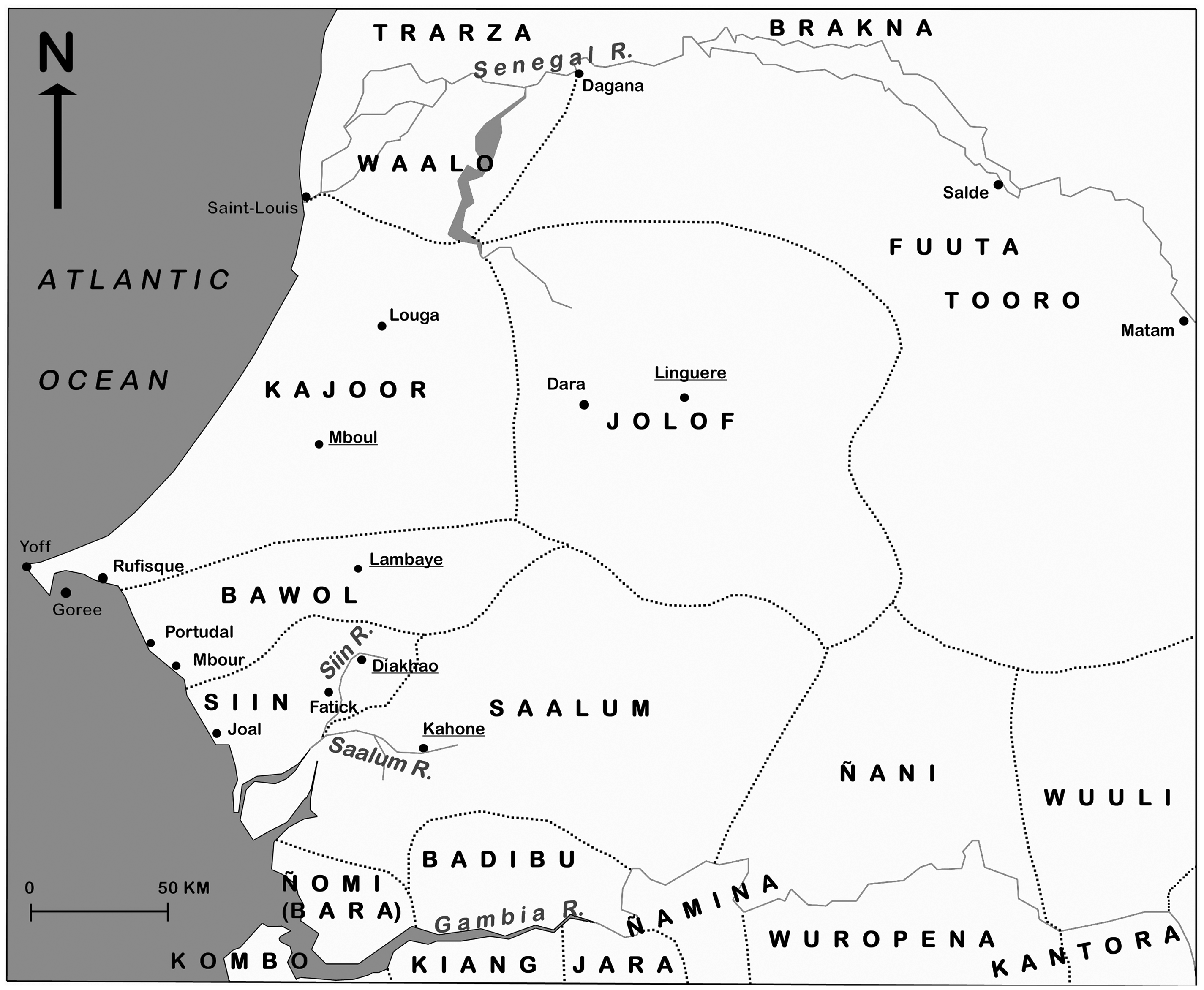
While I hope to paint a subtler picture of Serer historical experience, my goal here is not to piece together a ‘recuperative history’ (Smith, 2004) of marginalized people, but to use Serer entanglements with imperialism as a critical entrée into the conditions of power that infused colonial life in Senegal. Echoing contemporary anthropological scholarship (Comaroff, 1998; Cooper, 2005; Mbembe, 2001), materials from the Siin reveal that, for most of the colonial era, local landscapes were not hermetically controlled, but formed ‘twilight zone[s] of multiple indeterminate configurations of power and authority’ (Hansen and Stepputat, 2006: 302). French colonial administration was neither impotent nor Leviathan-like, yet it was limited in its capacity to govern, variably effective in enforcing its rule, and subject to challenges on the ground. Part of this instability stemmed from the fact that the various institutions, projects, and ideologies making up ‘the colonial state’ were not always wholly in harmony with each other or with the reality they purported to manage. Further uncertainty derived from the coexistence of colonial administrations with other spheres of power, which sometimes had more legitimacy in the eyes of Africans. A last source of ambivalence flowed from the fact that colonial policies did not always elicit anticipated responses from subject populations or meet their consent; indeed, they were often ignored, contested, or creatively reinterpreted. In Siin, colonial claims over people and land were not absolute, but dissolved into a messy tangle of hybrid practices, incomplete patterns of rule, and ill-contoured subjects. Force, discipline, and exploitation were indisputable features of colonialism, yet they were often supplanted by softer technologies of power designed to create serviceable African subjects through the cultivation of proper habits. What resulted were hesitant geographies of power: at once robust and volatile, deliberate and accidental, colonial rule redefined the horizon of ‘the possible’ for African peasants, while braiding with local worlds to enable new ways of making history.
Colonial ‘power’, in theory: Government, materiality, and subjectivity
Historical archaeologists, over recent decades, have done an admirable job of rewriting the histories of indigenous communities caught in the updraft of colonial violence. Invoking the need to take material culture as seriously as language-based archives, researchers have documented with great success the practical strategies deployed by native peoples in their entanglements with the twin forces of colonial modernity and global capitalism (e.g. Croucher and Weiss, 2011; Stahl, 2002; Voss, 2008). Challenging the discourses informing various colonial projects and the subsequent production of indigenous pasts, this scholarship has exhumed a realm of native experiences once silenced in conventional histories of colonialism, while showing that colonial worlds were in fact vastly more heterogeneous than earlier scholarship allowed.
Historical archaeology, however, has often been less attentive to the dialectical underside of these ‘tensions of empire’ (Cooper and Stoler, 1997) – namely, the historical and material constitution of colonial states and practices of government. To be fair, this disciplinary tendency appears to have developed in large part as a response to the top-down emphasis placed on state power and colonizers in an earlier literature on colonialism, as well as the abundance of documentary archives detailing the templates, intentions, and rationalities underwriting the application of colonial rule (e.g. Mitchell, 1988; Wright, 1991). Nor do I mean to suggest that archaeologists have been insensitive to the work of power in colonial settings. Clearly they have been quite concerned with the latter (e.g. Silliman, 2005), but their efforts have frequently been directed to a general level of power relations forged out of uneven and unequal cultural encounters, or more specific manifestations of power nested in disciplinary institutions (e.g. Casella, 2007; De Cunzo, 2006).
Investigations of colonial life have been less consistent in situating native experiences within the evolving matrices of political practices, institutions, and programs put in place by different imperial regimes. By extension, material expressions recoverable through archaeology have not been extensively used to explore how the colonial management of indigenous communities shaped the subjectivities of colonized peoples.
This trend, broad as it is, has its exceptions, and a number of valuable studies have used archaeological thinking to chart formations of state power and the ambivalence of their workings. In his analysis of coffee plantations in British Jamaica’s Blue Mountains, Delle (1997) has shown that spatial surveillance and the management of bodies were critical conduits for establishing authority and subjugating enslaved populations to colonial law. Others have preferred to explore the precarious underside of colonial rule, and train attention to the contradictions inherent in its structures of power. For instance, in her fascinating study of ‘rogue colonialism’ in eighteenth-century Louisiana, Dawdy (2008) points out that order and disorder were both intrinsic to the functioning of colonial empires, and chronicles how the interplay of law and its subversion (in the form of smuggling, banditry, and other extra-legal practices) were critical to the making of New Orleans’ urban society. Likewise, recent studies, from the Cape of Good Hope to the Chesapeake, via the Caribbean, are increasingly unveiling the experimental quality of colonial order (Hall, 2000), and the hesitations that arose as imperial proscriptions met the slippery terrain of cultural practice. These unpredictable outcomes are nicely illustrated in Hauser’s (2008) examination of ‘black markets’ in eighteenth-century Jamaica. The study uses locally produced ceramics distribution networks to show how lawmakers’ attempt to police island market activities not only failed, but ironically assisted the development of an informal economic underground operated by enslaved Africans.
Perhaps closest to the purposes of this essay, recent syntheses associated with the archaeology in Annapolis program have made a persuasive plea for the archaeological study of the modern state and its murky histories of ‘inscription’ into the daily lives of political actors. Revisiting a classic debate, Matthews et al. (2002) suggest that the cultural transition to the ‘Georgian order’ was not an atmospheric change in mental structure, but the result of a ‘logic of empire’ actively promoted by the state. In materializing ideas of order, symmetry, and property in space, they argue, colonial elites succeeded in infiltrating the everyday existence of Annapolis residents and naturalizing a set of cultural dispositions congenial to the growth of state government. Leone (2005: Ch. 3) makes a related point about the role of urban planning in diffusing ideologies of individual liberty and citizenship in eighteenth- and nineteenth-century Annapolis. He shows, for instance, that ideas of personal freedom and possessive individualism trickled down to all echelons of society, including enslaved African Americans. While some slaves chose to engage in alternative forms of community-making, others elected to pursue these aspirations through manumission. By embracing these values as part of their self-understanding, they challenged the core mythologies of slave-owning society, but at the same time absorbed certain orientations friendly to the reproduction of capitalist exploitation.
What I find enticing about this research is its willingness to consider the ‘middle-ground’ of colonialism, that grey horizon of power that operates beyond coercion and resistance, and diffuses across the realm of social practice to enter the construction of subjects. In turning to these issues, these authors open a conversation with Michel Foucault, whose analysis of power’s cloudy ‘middle-ground’, of its simultaneously ‘productive’ and repressive dimensions (Scott, 1999), is profoundly relevant to the problem of governance in Senegal and colonial settings more generally.
Rather than viewing state rule as coherent and monolithic (e.g. Scott, 1998), Foucault (2007: 87–114, 115–134) parsed its operations into three interdependent realms of power. Sovereignty refers to the exercise of rule over a territory through law, force, and policy. Discipline aims to reform of bodies within particular institutions. Government (or ‘governmentality’) is a mode of power concerned with ‘the population’ and its optimization. It seeks to shape popular conduct by drawing on a wide array of techniques and forms of knowledge that mobilize desires, habits, and interests with the purpose of enlisting people in the project of their own rule (Moore, 2005: 3). Foucault (1994: 122–123), then, locates the work of rule in the engagement between different technologies of government, political institutions, and social actors (Rose and Miller, 1992). Waged in discursive and material milieus (Comaroff and Comaroff, 1997; Moore, 2005), the exercise of colonial power is best apprehended obliquely, through the ‘effects’ that it left on indigenous lives and their social landscapes (Foucault, 1994: 323–364). Since the lived worlds of native communities were the ‘targets’ of colonial governance (Scott, 1999: 25; cf. Ferguson and Gupta, 2002; Trouillot, 2003: Ch. 4), then the very contexts which archaeologists study contain prima facie traces of the making of regimes of power, rule, and law in colonial settings.
Another critical move made by Foucault is to draw our attention to the co-constitution of states and subjects. Part of this process is captured in Foucault’s (1994: 331) definition of ‘subjectivity’ (which I share in this essay), which denotes 1) the process of subjugation (to be made amenable to control and governance), and 2) the forms of consciousness and self-knowledge that orient people’s courses of action. In becoming subjects to particular regimes of authority or social institutions, individuals interiorize certain sensibilities that influence their deeds and decisions.
Such considerations help to sidestep the tendency sometimes found in archaeological writings to vilify power and counterpose it to ‘subaltern resistance’. I do not suggest we ignore the many instances of overt aversion or confrontation of colonial force by colonized peoples. Nor do I mean to skirt the very real effects of colonial domination, or argue that colonial subjects were the hapless victims of imperial sovereignty’s iron grid. My suggestion is that there is a nuanced spectrum of power situations between hegemony and resistance, which complicates how we employ these terms: not all projects of hegemony follow the same routes or find equal success in crafting consent, and the category of ‘resistance’ comprises a diverse blend of motivations, media, and messages that at times drew from the very well of colonial institutions to fight state oppression or simply act in the world. The point, then, is that power and possibility are the conditions of each other’s making. Any configuration of power is both enabling and alienating, and our goal should be to determine the precise ways and moments in which colonial authority was one or the other, or simply neutral to the unfolding of indigenous lives. In Senegal, and I would suspect other contexts, colonial institutions may have ignored, enticed, restrained, or coerced, but in doing so they also offered a certain freedom to act, which was internalized into Africans’ changing social practices.
Let me close this theoretical parenthesis with two points of clarification about materiality and subjectivity. First, when I talk of materiality, I refer primarily to the material lining of the social: the fact that social and political relations are objectified in the material world, that they impart use and significance to it, and that physical things in turn become critical constituents of social imaginations. The types of materiality I invoke here encompass but are not limited to ‘artifacts’ and ‘archaeological sites’. Doing so would hopelessly impoverish archaeological engagements with colonialism. Rather, they involve the broader stretches of landscape in which these archaeological manifestations are found. This focus on landscape is mandated in part by the fact that the bulk of my archaeological material consists of surveyed sites and assemblages; in other words, here archaeological data are dictating a unit of analysis that can be used to integrate other sources of evidence. By choosing this framing, I also wish to deliberately blur the line between past and present, because this line simply does not exist. Present-day landscapes are no less archaeological than past ones: the elements that make them up accreted at different points in time; they were shaped, used, and redefined by different communities over the course of history; and consequently, like a watermark, colonialism and its residues cohabit, in various gradations of silence, with today’s terrains of practices. Many of the remains of colonialism in Siin have amalgamated with elements of the modern milieu, and can only be inferred derivatively from the latter. For instance, colonial infrastructure has long been rebuilt and updated, but its footprints linger in today’s transportation network (roads and railway), which was primarily laid down during the colonial era, or in urban locations established by the French, even as few ‘colonial era’ buildings remain in existence.
Secondly, I am keenly aware that the idea of subjectivity raises thorny issues for the archaeologist, in that subject positions often presuppose ‘inner states’ (conscience, psyche, self-perception) (Biehl et al., 2007; Butler, 1997), which are often intractable in the material record alone (but see Tarlow, 2000). Still, I would nevertheless suggest, following other authors (Meskell, 1999; Smith, 2004), that subject positions also have material dimensions in the form of practical dispositions that may have promoted self-understanding. Of course, evidence imposes certain restrictions about what can be studied, and my reliance on a landscape scale of analysis structures my account accordingly. Thus, the ‘material subjectivities’ I refer to in this essay capture a broad ‘peasant’ social location: a sense of what Siin villagers in the colonial period would have collectively perceived as meaningful and legitimate modes of being, the social possibilities they might have envisioned, and the stakes around which they would have forged their lives. As such, inevitably perhaps, the ‘subjects’ I conjure gesture to a rather normative ‘peasant community’, made up of ‘peasant actors’ (adult male stakeholders, generally), at the expense of a more complex patchwork of positions structured along the lines of gender, age, occupation, wealth, kinship, lineage, ethnicity, or religion. Despite its coarseness, the broad category of peasant subject has corrective usefulness, foregrounding the lifeworld of rural commoners when Senegal’s past has often been written from the standpoint of elites.
Anatomies and paradoxes of colonial statecraft in Siin
If formal colonization in Senegal debuted in the 1850s, its foundations were laid down 40 years earlier, when the French began to experiment with agricultural commodities – gum, then peanuts – to create new revenue streams in the aftermath of the slave trade. Commercial interests gradually consolidated over the next decades to culminate in 1856 with a series of military expeditions aimed to suppress coastal kingdoms and craft a space of economic control under the jurisdiction of Pax Gallica. By the late 1870s, stability had been restored over most of northern Senegal, and local polities were by and large operating in the orbit of France’s dominion. Military surrender, however, did not mean formal incorporation into the colony. Indeed, many provinces under France’s mandate were administered as ‘protectorates’, where traditional elites often retained considerable clout. The Siin, after being invaded twice in 1859 and 1861, became a protectorate in 1887, and it was not until 1898 that its monarchy was dissolved, and after 1920 that the region was officially absorbed into the colony. One outcome of this political bricolage was the preservation of registers of power that could not be fully assimilated into colonial law. During the years of colonial expansion (1850–1880), for instance, state authority met considerable challenges, as it competed with other political actors – Catholic missionaries, trading houses, the remnants of African aristocracies, and grassroots authorities – for influence over territories and populations (Klein, 1968).
The partial graft of the colonial state onto indigenous political structures was a byproduct of the policy of financial austerity driving France’s colonial enterprises in West Africa. The primary tenet of French rule was that its African empire was to be realized on the cheap, built on local labor and raw materials rather than investments in infrastructure and production. Colonies were largely expected to ‘pay for themselves’. Unsurprisingly, this platform of budgetary parsimony occasioned frequent disagreements between the interests of colonial and metropolitan governments (Marseille, 1984), but, more importantly, it fundamentally structured the political economy of rule in colonial Senegal by rooting it in agriculture.
While Senegal had few natural riches, it had no shortage of agricultural savoir-faire, which could be co-opted in the pursuit of colonial interest (Richard, 2011). The deceptive peanut fitted ideally into this schema. Peanuts were already cultivated for domestic and commercial needs in Senegal, and were well adapted to the region’s sandy soils and tenuous rainfall. They could be readily plugged into existing systems of cultivation, exchange, and social relations, at minimal costs of ‘development’. Agricultural outputs could be increased relatively cheaply, not by improving the productivity of indigenous farming technologies, but by expanding cash crop acreages. In turn, the revenues generated by peanut sales and taxes would help to defray the costs of administration. Finally, the demand for soap and industrial lubricants in France created a market for peanuts at home, such that peanut oil literally ‘greased the wheels’ of industrialization.
The Siin proved exceptionally attractive to French imperial designs. Home to the Serer, one of Senegal’s most accomplished peasantries, the province boasted a sophisticated system of rain-fed farming and animal husbandry that sustained human densities and cereal yields surpassing those of surrounding regions (Pélissier, 1966). Yet, if French administrators soon recognized the potential of the Serer agro-pastoral economy, Siin’s integration into the colony’s economic machinery proved slower in the making. In effect, France’s frugal moods notwithstanding, the realities of export agriculture did demand a modicum of material investment to assist the operations of commerce. Colonial ‘development’ programs thus involved the construction of roads, bridges, port facilities, and towns that functioned primarily as centers for the administration of trade and headquarters for commercial houses. Consequently, it took the establishment of port facilities in Kaolack in 1896 for peanut tonnage in Siin to take off. From a modest 8000 tons shipped out of the Saalum River in 1884, exports (out of Kaolack) peaked at 310,419 tons 50 years later (Fouquet, 1958: 55, 112; Klein, 1979: 77–78), turning the Siin into one of the premiere agricultural producers in French West Africa, which at its zenith accounted for over 50 percent of Senegalese peanut exports.
Siin’s slow transition to peanut cash cropping also exemplifies the ambiguities of France’s budgetary restrictions. Part of the difficulty encountered by colonial policy-makers was a chronic shortage of funds and personnel, which resulted in enormous asymmetries in the reach of the colonial state. This unevenness was first and foremost geographical. France’s effective political control was restricted to the quatre communes, the four towns of Saint-Louis, Gorée, Dakar, and Rufisque, and their immediate periphery. These coastal centers developed around the dictates of colonial urban planning, civil administration, and legal institutions, and their white and mixed-race residents were accorded the same rights as French citizens (Diouf, 1998). Beyond littoral enclaves, however, France’s attenuated presence made things more uncertain. For example, in the 1890s, the Siin-Saalum region, by no means a small area, was under the supervision of one French administrator assisted by a handful of African clerks. Given these conditions, how was such a small phalanx of colonial employees expected to govern the vast territories under its control?
Colonial law played an important role in specifying what Africans could and could not do. Through the creation of ‘protectorates’, colonial countrysides were constructed as distinctive legal spaces defined by their own special system of laws, ‘rights’, and obligations. One of such impositions was, after 1891, the expectation that rural dwellers in Siin would pay a head tax, which would finance the projects of the colonial state (Klein, 1979). Another peculiarity was the legal status of its residents, who, unlike the ‘citizens’ of the quatre communes, were considered to be ‘French subjects’ (sujets). The sujets occupied a complex legal terrain organized by different regimes of law. On the one hand, under the observances of indigenous justice, and depending on the confessions of plaintiffs and defendants, Muslim or ‘customary’ law would inform the settlement of civil matters. On the other hand, native justice was generally subordinated to another framework, the Indigénat regime (Mann, 2009). The latter was an ensemble of provisions derived from the French criminal code that authorized the summary use of force and penalty without recourse to judicial courts, to ensure obeisance to the law. Under the system of the Native Code, imprisonment, deportation, random fines, and forced labor were legitimate tools of rule, which were frequently mobilized by European administrators (and African chiefs at times) to suppress resistance, discipline the masses, and coerce African participation in colonial projects. In the Indigénat, we find one particular facet of colonial sovereignty, namely, the instrumental deployment of power, in all of its repressive and erratic quality. Such inconsistency was more generally symptomatic of colonial governance, which, as it sought to reconcile rule of law and necessity, inevitably promoted order and its subversion, to the point that they became mutually constitutive.
These dynamics were particularly acute in the day-to-day of the state’s operations, where thinness of personnel imposed a certain amount of rule by proxy, alongside the official bureaucracy staffed by French administrators. Much of the business of colonial power was administered through precolonial African institutions and offices, and exercised through a network of former ruling elites – kings and nobilities – recycled as functionaries of the state. Their main activities were tightly integrated to the cash crop economy, and revolved principally around tax collection, labor recruitment, overseeing peanut cultivation, military conscription, levying fines, and adjudicating simple matters of justice (Aujas, 1931: 308; Guy, 1908: 308). This system of indirect administration engendered considerable headaches. If African intermediaries sometimes executed their duties with integrity, more often than not they used their prerogatives for political gain and the maintenance of social privileges. Thus, the machinery of rule in the countryside tended to veer towards a sort of entropy, characterized by chronic dissipations and diversions of power, as self-serving abuses were committed at every link in the chain of authority (e.g. ANS 13G52). 1
These ambivalences place in stark light the paradoxes of France’s quest for ‘hegemony on a shoestring’ (Berry, 1992): while the success of colonial governance was in part predicated on the development of new forms of African civility, clamored in the moral discourse of mission civilisatrice (‘civilizing mission’), the colony’s economy largely rested on the maintenance of traditional social relations, thus implying minimal direct political involvement in reforming local lifeworlds (also Conklin, 1997). These limitations did not, however, mean an abdication of the idea of ‘native improvement’, but that this project should take place through less interventionist channels (cf. Cooper, 2005: 142–148). There again, as the cornerstone of the colonial economy, peanuts would also be the instruments of its politics. Working in concert with techniques of government, cash crops would penetrate the social worlds of peasants and engineer transformations from within. Pivotal here is the belief, held by the architects of colonialism in Senegal, that economic liberalism was a critical mechanism for the work of governmentality and the cultivation of good subjects (see Foucault, 2010). To French bureaucrats, ‘commerce’ was a de facto civilizing force, which would eventually bring ‘natives’ within the fold of colonial modernity. The goal was to combine law, taxation, and monetization to create a structure of incentive for the production of agricultural commodities and participation in colonial markets (Galvan, 2004: 111–112): peasants would adopt cash cropping so they could obtain the money necessary to cover the dreaded head tax; cash cropping would force peasants to abandon subsistence agriculture and become consumers of French goods; consumption would interpolate African peasants into circuits of debt and credit, while deepening their dependence on cash and imported commodities for the requirements of social reproduction. In other words, peanuts, commodities, and money would regulate the collective conduct of African rural masses, and in time, gradually sensitize habits and hearts to the virtues of industry, property, and individual responsibility (Richard, 2011).
Having delineated the broad ‘structural’ logics of colonial statecraft in Senegal, let us now delve into how colonial government manifested itself in Siin and articulated with Serer communities. While these entanglements took place in more ways than can be reviewed here, I specifically examine colonial attempts to manage Serer social geography and ways in which colonial governance was staged in space. Siin’s rural landscapes are imperfect mementos, but they do preserve partial imprints of these histories of power, which can be summoned through the combined play of archaeological and ethnohistorical archives. The archaeological evidence mobilized here derives from a campaign of large-scale survey conducted in 2003 (Richard, 2007) (Figure 2). This work identified 180 occupations, over 90 of which fell into the eighteenth to twentieth century range (based on ceramic assemblages). Chronic problems of surface admixture make it difficult to ascribe occupations to more definitive time ranges. To partially offset these difficulties, I have included additional materials from recent survey work carried out in 2011, which targeted previously unexamined areas. While preliminary, these settlement data show greater chronological resolution. In effect, of the 215 occupational contexts retrieved during the survey, 78 were conclusively ascribed to Phase Vb (eighteenth to nineteenth century) and 77 fell squarely into Phase Vc (late nineteenth to mid-twentieth century) of our ceramic sequence. In tandem with historic evidence, the 2003 and 2011 surveys provide a panoramic look at changes in village landscapes before and during the colonial era.
Siin Landscape Archaeology Project 2003 and 2011: The empty polygons and small light gray rectangles represent the 2002–2003 survey regions and quadrats, respectively. The large, darker gray polygons indicate the 2011 survey regions.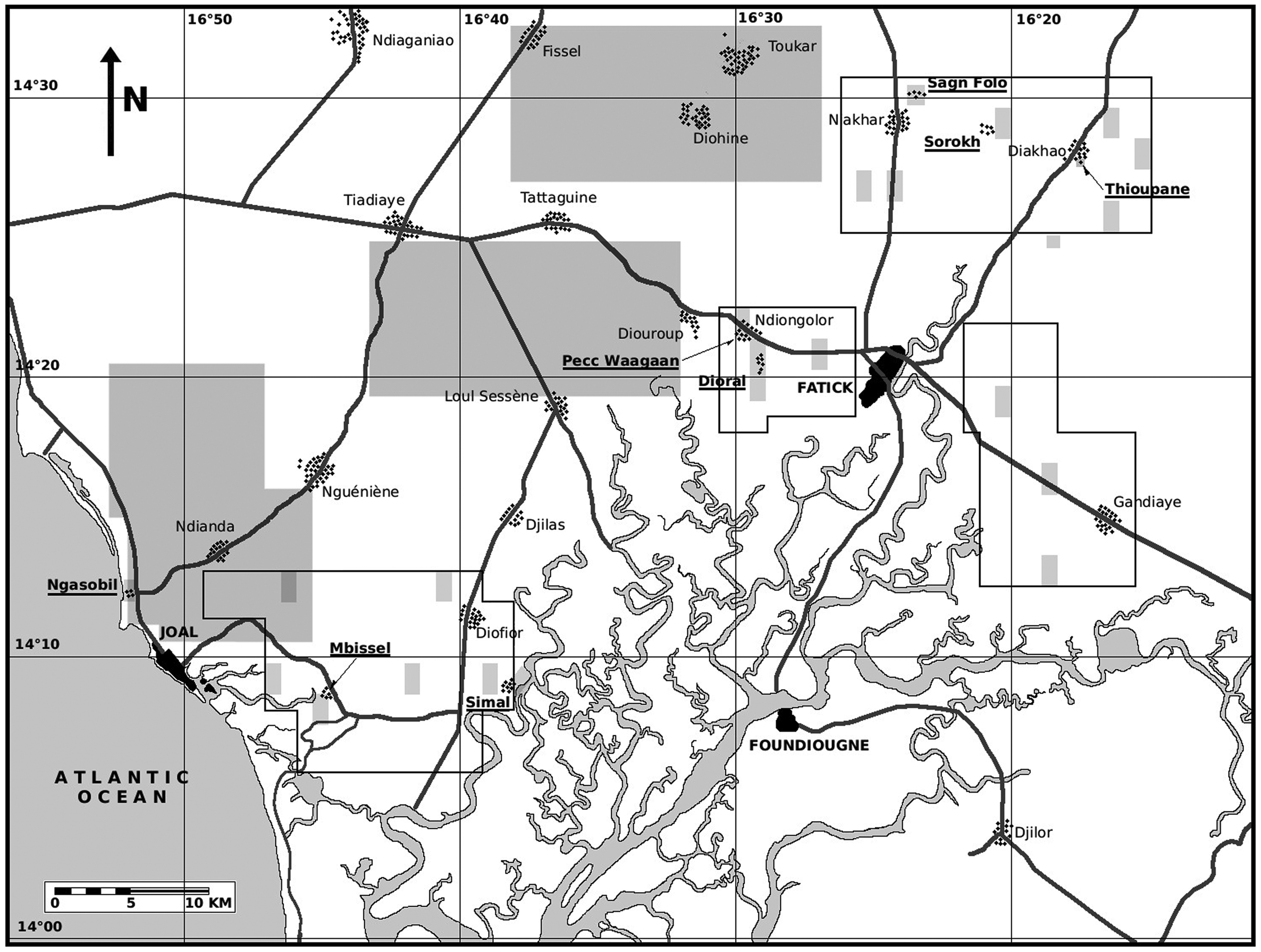
(Im)materialities of rule: Governing rural landscapes and the challenges of milieu
For colonial observers, one of the chief difficulties facing the implementation of French rule was the seeming intractability of Siin’s landscape, which appeared to them as an anarchistic chaos of dispersed settlements, communal fields, and timeless traditions (e.g. ANS 1G26/104, 2G33/70; Bérenger-Féraud, 1879; Boilat, 1853; Bourgeau, 1933; Pinet-Laprade, 1865). Archaeology permits us to clarify and qualify these ethnographic visions of the Serer physical milieu.
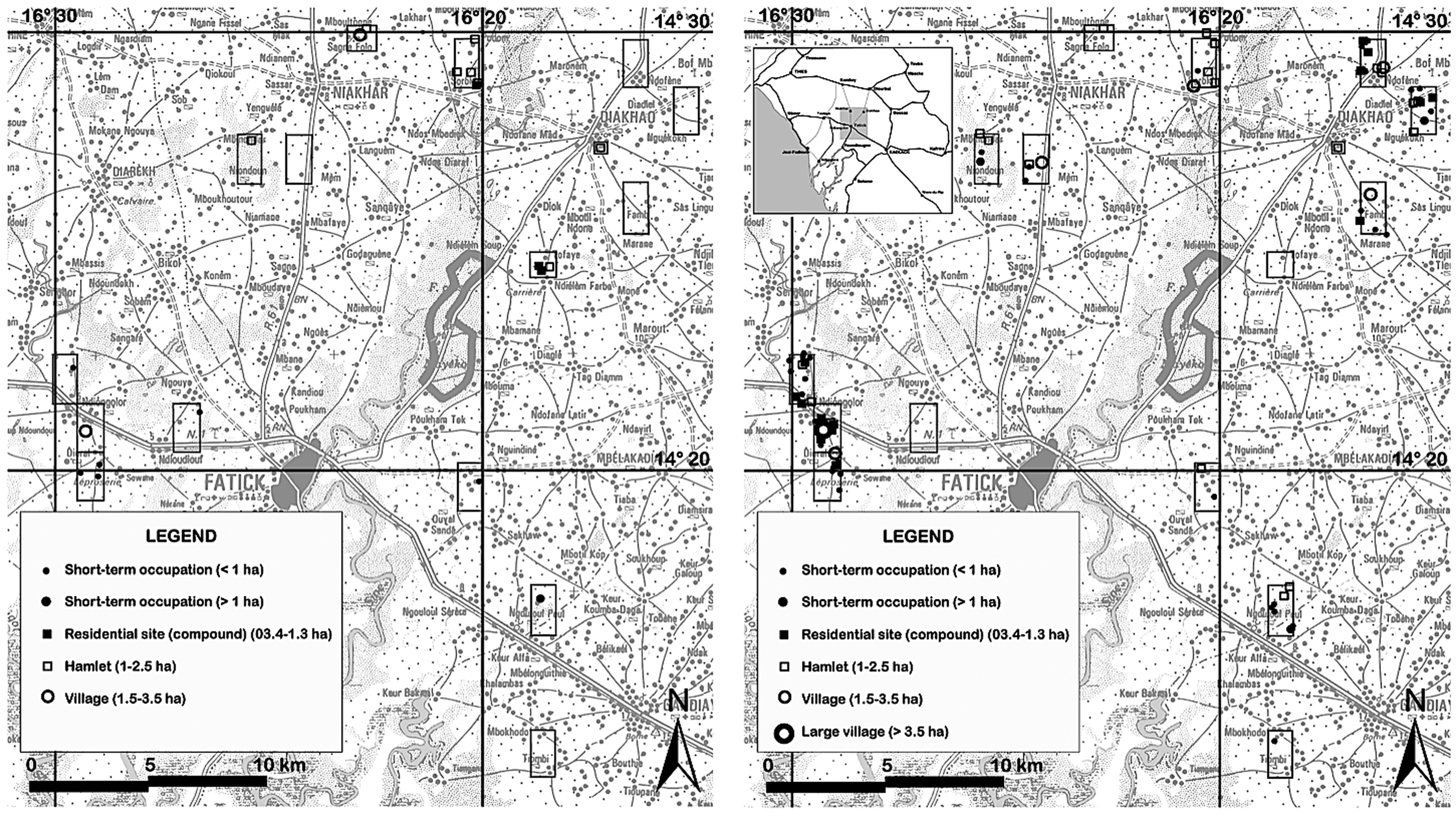
As the 2003 survey data reveal, Siin’s residential landscape was ostensibly quite scattered and mosaic at the time of colonial writing (Figures 3b, 4b): more than 80 percent of the Phase Vb–Vc sites were less than 2 hectares in size; 62 percent consisted of sparse deposits corresponding to individual concessions, while 30 percent contained three to eight trash/habitation mounds suggesting the vestiges of small hamlets. A few larger villages, made up of extensive mound networks clustered around open ‘plazas’ (Figure 5), do stand out from the site inventory, though they appear to have emerged largely during the nineteenth century. Regardless of their sizes, sites were consistently short-lived – inhabited for 150–200 years at most – and constellate widely across the landscape, rather than forming compact agglomerations. What survey evidence suggests here is an interesting logic of long-term mobility: after being inhabited for several generations, archaeological sites in Siin break off and relocate within the perimeter of an original founding place, contemporary settlements representing the latest stage in this trajectory of movement. It is also worth noting that, by and large, the geography of eighteenth to twentieth century deposits maps quite well with the present-day distribution of spirit and ancestral shrines (pangool). This pattern of village (re)settlement around founding and sacred sites seems to bespeak a historical attachment to ‘place’ and lineage-managed land. What archaeological portraits also indicate, in stark contrast with ethnographic sketches, is that Serer landscapes were not immemorial arrangements (Richard, 2012). Siin’s constellated habitat actually took shape during the eighteenth and nineteenth centuries in response to the political turbulences generated by the Atlantic commerce and transition to the post-abolition era (Figure 3a, 4a). Archaeological formations also signal considerable variability in Serer rural materialities. Most notably, the dispersed environment that so puzzled French observers was characteristic of Siin’s interior; closer to the coast, settlements were historically much more nucleated than those in the hinterland.
Settlement map, coastal region of Siin: (a) (left) Phase Va (c.1400s–1700); (b) (right) PhaseVb–c (eighteenth to twentieth century). Rectangles indicate survey quadrats. Settlement map, interior region of Siin: (a) (left) Phase Va (c.1400s–1700); (b) (right) PhaseVb–c (eighteenth to twentieth century). Site exemplars: (a) (left) S11: Remains of nineteenth-century ‘hamlet’ abutting village of Dioral. The latter settlement seems to have gradually accreted around this original occupation; (b) (right) S82: nineteenth-century village deposits. Material culture concentrates densely around mound clusters, while thinning in open ‘plaza’ areas. Occupation seems to have relocated north to present village of Languèm in the first half of the twentieth century.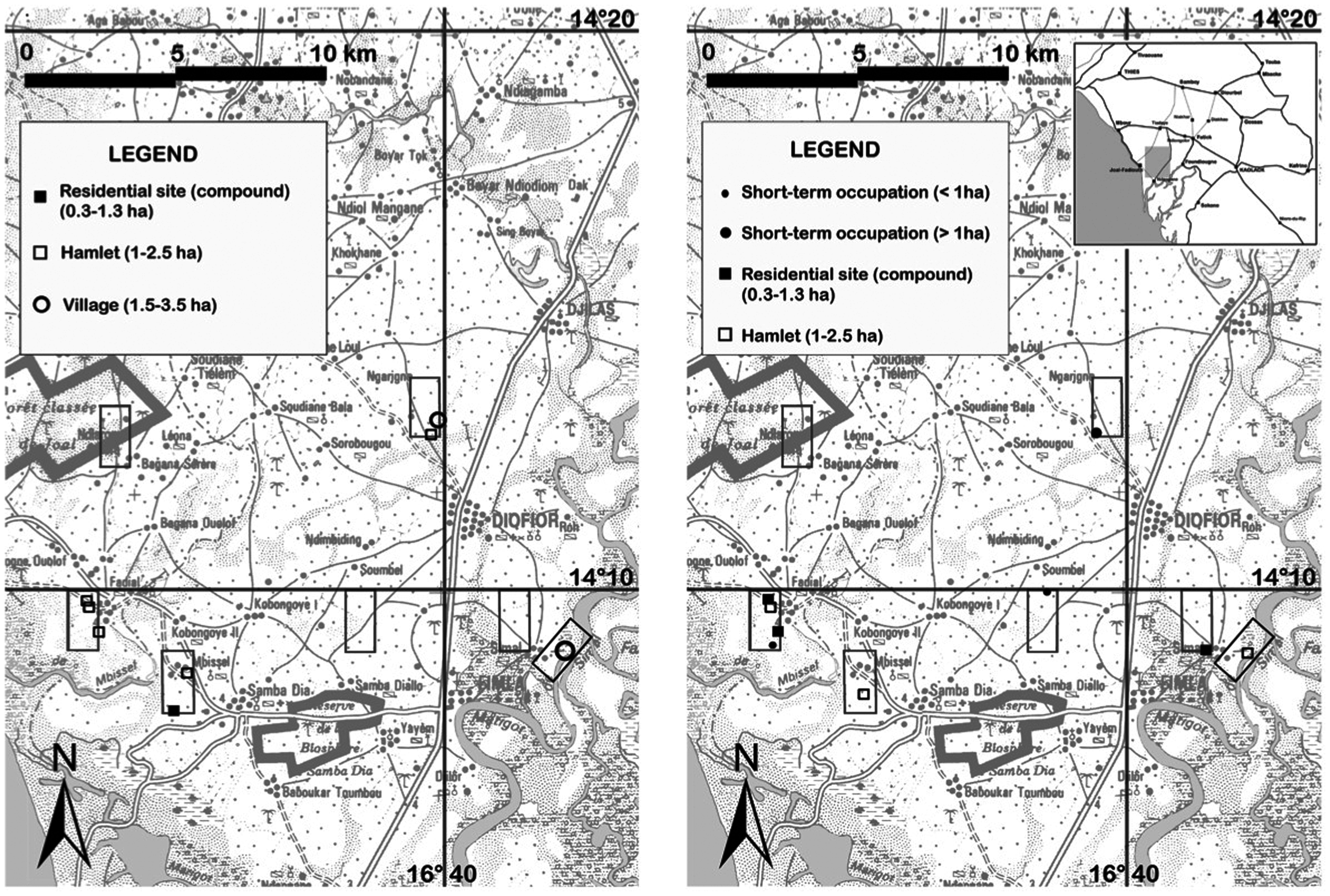
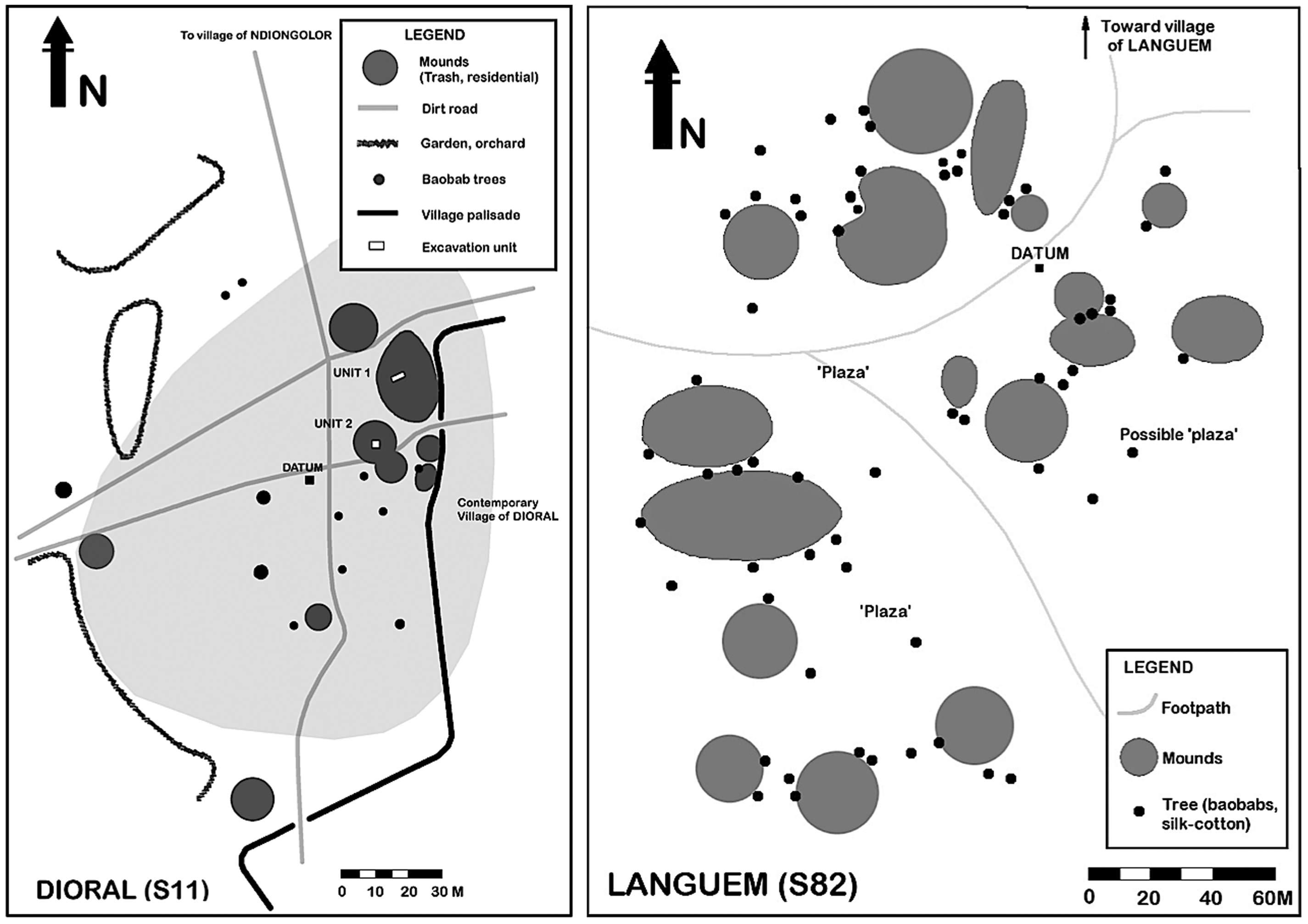
Regardless, the perception of a homogeneous, conservative peasant milieu, combined with the state’s logistical shortcomings, made frontal intervention in native cultural affairs appear quixotic. The indirect magic of commerce – working through the channels of money, commodities, and debt/credit – seemed better-suited to the task of governance and production of docile subjects (Mwangi, 2001; Roitman, 2005). Unsurprisingly, the Serer proved far less susceptible to the seductions of capitalist modernity than expected. Such misfirings were inherent in the institutionalization of colonial power and its truth regimes, which was never an affair of simple inducement; rather, it was an unstable process that generated both acquiescence and disputes over the legitimacy of regulatory authority (Roitman, 2005: 6–9ff). In the early days of the protectorate, it was often a reluctant Serer peasant body which French officials encountered, one less likely to comply with peanut production than rise up in protest against taxation, as residents from the village of Diohine reportedly did in 1891 (ANS 13G322). In subsequent decades, as the viability of open rebellions diminished, villagers gradually resigned themselves to the bitter inevitability of the impôt (head tax), though not without tweaking the terms of financial imposition by the colonial state. Thus, we learn from colonial correspondence that Siin farmers chronically under-reported household members and heads of cattle in their herds, which were the bases on which personal wealth was determined. Likewise, if between 1900 and 1930 the Serer were left little choice but to gradually give in to cash cropping, they often produced just enough peanuts to meet tax requirements and afford basic necessities (store and consumption goods, tools, weapons, etc.). Indeed, until the early 1930s, most Serer villages remained economically self-sufficient. Families continued to produce enough millet to feed themselves, while remaining largely debt-free (Reinwald, 1997).
As noted earlier, France’s program of rule through economic life was mandated both by the need to conciliate with local institutions and to rationalize this cohabitation with indigenous spheres of power. For the first 50 years or so of rule, colonial domination was not very assertive in rural areas, and remained constrained in its ability to impose order. Until the late nineteenth century, for example, French merchants commonly complained about security in the countryside, and were told that colonial protection did not extend beyond the walls of military posts and the immediate perimeter of their cannons’ firing range (ANS 13G318).
A look at historical landscape seems to confirm the patchy presence of the colonial state in rural areas. In the Siin, one of the most curious aspects of colonialism rests in its ‘relative’ invisibility archaeologically speaking. For the nineteenth and early twentieth century, the overwhelming majority of material remains consist of African settlements, spirit shrines, and cemeteries, in a pattern of clear historical continuity with eighteenth-century landscapes. By contrast, the material expressions of colonial authority are confined to a restricted number of places intermittently sighted in the countryside: the occasional vestiges of military outposts, a handful of school buildings, a few ruined dispensaries which old timers remember being in use in the 1920s and 1930s. The trappings of colonial regimes grew more visible in large villages like Joal, or centers like Fatick, Kaolack, and Foundiougne, which hosted basic institutions of colonial sovereignty (forts, courthouses, post offices, prisons, and other official buildings), and where commercial and administrative operations took place. But these sites were few in number, and often stood quite distant from the everyday of most Serer villagers. As a matter of design and necessity, material landscapes show no ostensible sign of spatial reordering, routinized intrusion, or organized grid of control. In effect, it seems that, for most rural residents, ‘the colonial state’ would have been glimpsed less in the existence of enduring material markers than in the moving bodies or events associated with it: military expeditions, administrative delegations, medical campaigns, the inauguration of new infrastructure, or the occasional school creation. And these occurrences would have been episodic in the first 60 years of rule. Their limited phenomenal presence notwithstanding, state institutions were perhaps felt more routinely through ‘effects of rule’ that left a trail of symbolic and material violence in landscapes. For instance, the tarred roads and bridges carrying the contemporary traffic of people and goods between villages were built during the colonial era; likewise with some of the borehole wells that continue to service many rural homes today. This infrastructural network, whose legacies continue to organize the circulation of persons and things in the present, showcased the arbitrary face of colonial power, built as it was on brutal corvée labor requirements (Gellar, 1976).
Echoing Cooper (1994: 1533), it seems that, prior to the Second World War, the colonial state in Siin was not an omnipresent, all-radiating ‘capillary’ system of power; rather, it asserted its presence in resolutely linear, pulse-like fashion. At their most manifest, its expressions could flare into explicit spectacles of sovereignty: military processions, native tribunals, imprisonment, policing, and armed reprisals. More generally, colonial rule followed an ‘arterial’ network of disciplinary techniques – taxation, fining, censuses, labor recruitment – themselves mediated by a circuit of native administrators and collaborators often hand-picked from precolonial elites. The multiplication of intermediary nodes of power provided so many opportunities for illicit personal accumulation. Colonial correspondence is littered with the testimonies of simple villagers lamenting the rapacity and brutality of village and district chiefs, and condemning the exactions of aristocratic elites, over whom colonial authorities had the most nominal of influence (e.g. Searing, 2002). In fact, through the 1860s and 1870s, colonial archives report that entire villages relocated to areas under French colonial jurisdiction in order to escape the arbitrary whims of traditional elites, only to return to monarchical rule when the French failed to deliver appropriate protection (ANS 4B51, 13G314a).
By and large, however, sites of colonial spatiality – administrative towns, commercial centers, ports, urban aggregations – were poorly frequented by Serer villagers. Prior to the 1930s, the relative isolation of indigenous villages from zones of direct French influence suggest the mesh-like character of colonial sovereignty, which accommodated vast horizons of autonomy in its capacious margins, where the Serer could continue to practice old and new spatial forms, while colonial power increasingly redefined the conditions of local subjectivities. The institution of pawnship (taile) nicely captures these dynamics. Taile emerged as a local response to the attempted replacement of indigenous principles of collective landholding with freehold property regimes. It functioned to preserve land loans between maternal relatives (sanctioned by customary arrangements) by masquerading them as terminal, cash-mediated transfers of property between two individuals (Galvan, 2004: Ch. 4). In actuality, these were temporary transfers of use-rights, and though they gave the appearance of changes in titles, land never really left the lineage domain. What taile accomplished was to enable the Serer to stretch notions of inalienable land to make it cash-convertible – which helped those needing quick money to pay the head tax in times of duress – while reaffirming traditional principles of landholding. Rather than securing the privatization of land, contracts became mimetic performances that gave the collective custodianship of lineage resources an extended lease on life. In other words, Serer subjects internalized, if not always willingly, the referents of a changing world within familiar repertoires of practice, as the material conditions of colonialism pressed ever more heavily on the contours of local action. Perhaps, scrambling the lines between continuity and change, they purposely incorporated new practical knowledge so that the changing world, as they knew and understood it, could remain more of the same for a little longer (e.g. Silliman, 2009). Regardless, the chief consequence is that the ‘traditional Africa’ that the Serer came to personify in French eyes was the very product of colonial modernity – or, otherwise refracted, maybe their modernity was resolutely traditional (cf. Piot, 1999).
After the world economic crisis of 1929, the materiality of colonial power no longer lay in its seeming distance, but in its present absence, which, working through the channels of political economy, refashioned the field of local possibilities. Indeed, the movements of goods, rigors of peanut cultivation, and circulation of money gradually altered the texture of space and forms of sociality it had supported. Initial archaeological clues derived from the 2011 survey gesture to some of the processes entailed by these reconfigurations.
If one of the defining trends of eighteenth- and nineteenth-century settlements was a general splintering of Siin’s habitat, sites occupied after the late nineteenth century suggest that such spatial fragmentation intensified during the colonial period. Phase Vc contexts documented in 2011 show much higher proportions of small, transient sites than in earlier eras. Occupations are on average smaller, materially scarcer, and more ephemeral than eighteenth- to nineteenth-century sites, indexing a heightened degree of residential mobility. Most of these sites, especially the ones that were founded after the 1920s to 1930s, are located in the vicinity of isolated hamlets or in areas that appear to have been unsettled before the twentieth century. What these patterns indicate is that the massive conversion to cash crops in the first decades of the 1900s corresponded with a partial dissolution of the sociospatial order, marked by the multiplication of loose agricultural concessions orbiting in the far periphery of villages (Pélissier, 1966). This process of fragmentation and dispersion on the fringes of larger settlements implies transformation in Serer practices of landuse and landholding, which doubtlessly reflects the growing individualization of property and economic relations.
These mobile landscapes also speak to the new labor requirements accompanying the passage of Siin’s agricultural economy from subsistence farming to commercial cultivation. While agricultural workers came from all over southern Senegal for the growing season, some non-Serer migrants stayed and established hamlets in the vicinity of existing villages (David, 1980). In time, this led to confrontations over land, resources, identity, and legitimacy – histories of social drama that abound in village traditions (Becker et al., 1991). Facing the pressures of drought and demography, Serer residents themselves were not immune to small-scale population movements in search for cultivable soil, food, or new opportunities. Oral memory collected near surveyed settlements corroborates such scenarios. Many of the Phase Vc sites surveyed in 2003 and 2011 were associated with stories of recent migrations dating back several decades, some stretching to the colonial era. Some of these settlements, we were told, were founded by migrants originating from the Wolof heartland, others by people from the Gambia. In other areas, like those recorded around the large village of Nguéniène, near the coast, most of the isolated concessions referenced Serer migrants originating from deep in the Siin interior. In explaining what motivated these movements, descendants from the original settlers underscored problems of land saturation, overpopulation, and drought in the heartland, and the quest for empty territory to set up their fields, find pasture for their herds, and secure reliable access to potable water (also Guigou, 1992: 77–78). These displacements afforded new economic opportunities and forms of social advancement that had been proscribed under customary arrangements. Still, for rural peasants whose sense of self adhered to soil, place, and spiritual forces rooted in ancestral estates, these dislocations must have disrupted horizons of consciousness, and slowly redrawn subjectivities away from earlier solidarities, forms of labor, experiences of land, and collective memory (Dubois, 1975; Trincaz, 1979: 24–25). Perhaps peasants developed hybrid strategies similar to those recorded in the 1960s and 1970s, when Serer agricultural migrants erected altars in their new villages, using dirt brought from ancestral shrines to maintain a spiritual connection to the homeland (Trincaz, 1979: 34).
Archaeological archives also document significant village growth during the colonial era. In fact, the largest settlements inventoried in Siin all developed in the second half of the nineteenth century, likely in relation to the French bureaucratic and commercial presence (Aujas, 1929; Klein, 1968). In addition, settlement distributions for the late nineteenth- to twentieth-century period point to a convergence of the village habitat towards new administrative and economic centers, like Fatick. These movements were partly encouraged by logistical considerations. Towns boasted weighing stations and points of collection for peanut harvests, more advantageous selling prices than those practiced by merchants servicing the countryside (ANS 13G314b, 13G314c), and regional markets where surplus food and crafts could be exchanged for increasingly valued commodities (Mbodj, 1978: 336; Reinwald, 1997: 150–151). The latter phenomenon is evidenced by the marked increase in quantity and diversity of imported artifacts across post-1850s archaeological settlements, speaking both to the opening of village life to a wider world of consumption, and the gradual incorporation into, and after the 1930s, dependence upon, circuits of commoditization and cash exchange. Imported objects, of course, had long been creatively appropriated in everyday social strategies (Richard, 2010). However, the sheer numbers of foreign manufactures increase exponentially after the mid-1800s, and Dutch gin bottles, perfume and pharmaceutical containers, molded beads, and, to a much lesser, extent glazed ceramics become fixtures of late nineteenth- and early twentieth-century surface assemblages. Because of their increasing centrality to forms of social reproduction (marriage payments, inheritance, loans, barter, debt repayment), commodities (and money) came to gradually redefine Serer social values and sense of world-being – though not unilaterally. For instance, the dominating presence of beverage containers on post-1850 sites is strong evidence of how the liquor trade served as a tool of empire, bringing the Serer countryside into the fold of colonial commerce; but imported alcohol also acquired new social significance as it was routinely incorporated into events like labor parties, agricultural rituals, and the propitiation of ancestors. By contrast, imported ceramics never quite found a place in Serer practices of cooking and communal eating, pointing to the limits of commercial colonialism. More generally, material clues also suggest the development of new avenues of accumulation associated with rising rural elites, as intimated by the rare recovery of mineral water bottle fragments – an expensive luxury (ANS 13G325) – at the early twentieth-century residence of an indigenous administrator in the village of Ndianda.
Settlement layouts were also influenced by the development of commercial axes; today’s villages, for instance, tend to gravitate towards secondary roads or routes nationales (‘primary roads’), as residences agglutinate in ribbons along each side of the axis. This is a departure from the constellated habitat favored in the Siin interior or more compact settlements found along the coast (Martin et al., 1980) (Figure 6). In this process of community merging, fissuring, and expansion, residential spaces have grown progressively dislocated from matrilineal landholdings, to the point that little congruence is left today between original lineage estates and the boundaries of contemporary villages (Lericollais, 1999). These disjunctures were spatial symptoms of broader transformations in kinship, property relations, and land tenure towards atomization, individual ownership, free-holding, and a gradual dissolution of matrilineal allegiances – features which grew increasingly pronounced with the land reforms, economic austerity, and turn to liberalism and Islamic modernity that accompanied Senegal’s passage into political independence (Gellar, 2005).
Postcard, ‘The Village of Fadiouth’, early 1900s (ANS, Iconographie, #0078). Available at: http://www.archivesdusenegal.gouv.sn/cartes/0078.JPG. Coastal villages were often characterized by a more congested habitat and higher residential densities.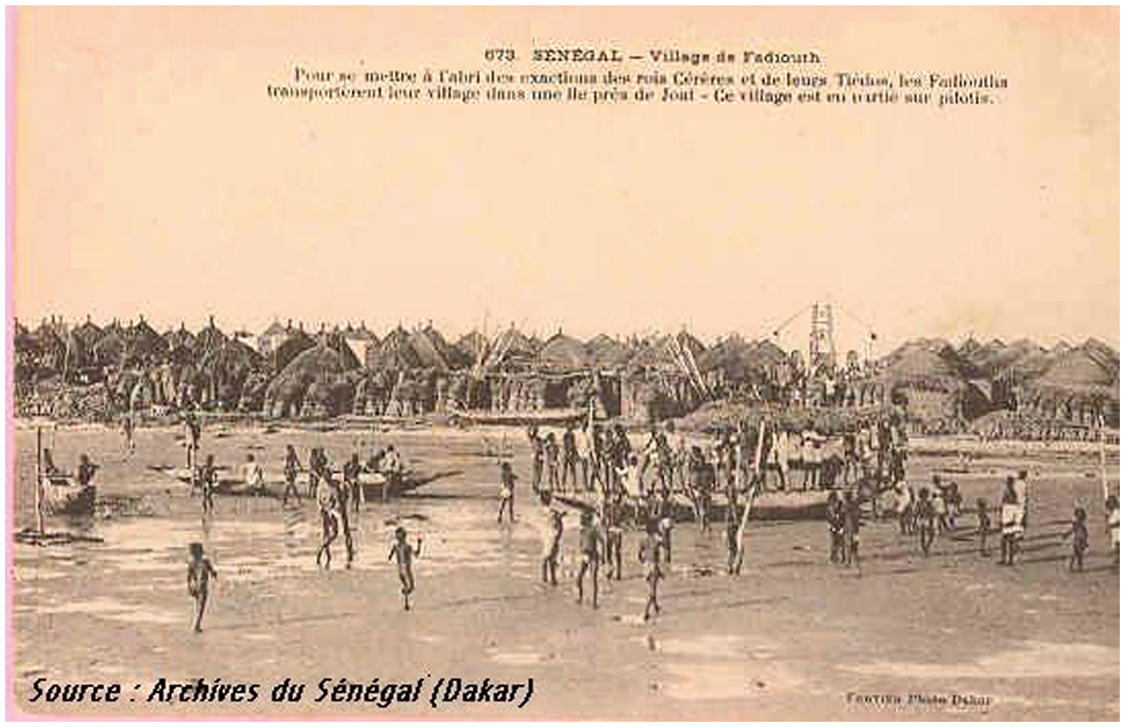

Equally importantly, Serer experiences with the colonial and postcolonial state, particularly over questions of land and landscape, have fundamentally shaped rural political imaginations in the present (Galvan, 2004: Ch. 3). Colonial land reforms and extractive rule, and postcolonial policies such as the nationalization of agricultural land in the 1960s (Abelin, 1979) and gradual withdrawal of the state from rural life, continue to loom large in peasant memories and imaginaries. These add to a long list of historical misgivings toward sovereign authority, which, in turn, animate the contemporary discourse towards the state and Serer understandings of political possibilities in postcolonial Senegal.
Conclusion: Colonial uncertainties and postcolonial futures
While these fragmentary histories stop short of exhausting the motley nuances of colonial world-making, they do capture something of the tensions and unresolved ambiguities that shaped imperial projects in Senegal. Siin’s rural worlds document the emergence of materialities aligned with the compass of social tradition, yet rearticulated around new experiences of movement, rootedness, and estrangement, which infused the landscape with new values and meanings. These worlds were not fully of the Serer’s own making; rather, they emerged in or through colonial laws, discipline, and governance. While hesitant and indeterminate, France’s politique indigène shaped both the fields of actions of rural communities and their capacity to reframe the terms of power.
Archaeological narratives shed useful light on indigenous communities’ relationship to the colonial past and how all those drawn into its orbit were changed in the process (Liebmann, 2008), but they need not stop there. Material milieus, and their palimpsestic jumble of ruins, schemas, and infrastructure, evoke other stories of power scribbled in the margins of colonial history. Rural landscapes, for instance, permit preliminary reflections on the nature of the colonial state and logics of government. Spatial assemblages remind us that colonial designs often resolved to alloy themselves with existing organizing structures and did not always entail the production of new materialities. This point is important, given the usual archaeological expectations we hold about state power and its efficacy in visibility – the fact that sovereignty is made operational and materialized through architecture, monuments, or vast programs of spatial engineering (e.g. Smith, 2003). Colonial landscapes in Senegal show us instead that France’s program of statecraft did not involve the active stamping or remolding of African physical environments, but worked instead through ‘absences’ (Bilke et al., 2010). Often invisible, yet no less material, ‘the state’ outsourced part of the process of subjectivation to commercial penetration and the civilizing seductions of commodities. Absence of evidence here does not necessarily imply evidence of absence. Rather, it raises critical questions about our assumptions of how states ‘should’ inscribe themselves in the world.
These alternative pasts also give us a chance to situate African rural experiences in longer durées of the state that connect colonial and postcolonial regimes of rule. I alluded above to how struggles over land and space initiated by colonial rule and taken up by the post-independence state structured Serer modes of action over the past 150 years. The intrusive tactics of postcolonial law, however, have also cohabited with other modes of intervention (or lack thereof) that preserve uncanny continuities with colonial-style governance. In Siin, the contemporary state has continued to move through a dialectics of presence and absence, alternating heavy-handed regulation (focusing largely around the management of peanut crop yields, sales, and commercialization) with a relatively hands-off investment in local affairs, development, and politics (Galvan, 2007). Against this background of stately aloofness, Serer villagers have continued to enjoy a quiet autonomy in their everyday matters. More generally, if, in the nineteenth century, cultivating millet and working the fields to ensure the subsistence needs of the household were central elements of Serer self-identification, during the next century, these principles were complemented by export cropping and modern forms of consumption as key constituents of what it meant to be a Serer peasant; today, these activities continue to form the ground on which rural subjectivities are built, and from which villagers meaningfully (if unevenly) articulate with state, market, and society, in Senegal and beyond.
Archaeological examination of the production of power and its configurations over time enables us not only to reincorporate the Siin as an active participant in the making of the nation’s past and present, but also to reframe today’s politics of difference in Senegal in a deeper arc of relations between states and subjects. Understanding the Serer engagement with multiple registers of authority in the past 200 years can unearth local narratives of experience that have been lost to posterity. Correlatively, analyses of the (im)materialities of government also stand to clarify the conditions of power that have informed political actions at different points in time, dynamics which are often obscured by the analytical breaks we make between colonialism and its befores or afters, between state and society, or between domination and resistance. Beyond their historical relevance, such explorations have the capacity to sketch more robust maps of the present, by illuminating the solidarities and subjectivities that local entwinements with modern power have made possible, and perhaps the kinds of futures that may arise from them (Weiss, 2004).