



Abstract
The term ‘sexual metaphor’ consists of two elements: sexuality and metaphor. Both individually and together provide a perspective on material culture, and particularly on the current discussions on the relations between humans, things and materiality. Using such relatively common objects as cock taps, bollock daggers and redware pipkins as examples, the article examines sexual metaphors in material culture from the 15th to the 17th centuries. Sexual metaphors – such as touching a barrel tap, or thrusting a bollock dagger – did not have hidden meanings. Instead, as situations they express the entanglement of two domains of practice, connecting everyday objects and repetitive practices with conceptions of sexuality and, for example, humoral theories about the human body.
Keywords
Introduction
In the post-Freudian world, talk of sexual metaphors has become such common currency that any or all things might not be simply what they appear. Objects can become conscious or unconscious vehicles for sexual acts, organs and desires hidden from open view. The ubiquity of sexual metaphors is not, however, unique to our age. In Renaissance paintings, a depiction of a gourd might actually be a sophisticated reference to a male organ (Varriano, 2005). Moreover, sexual metaphors were not limited only to such visual sources as paintings, and consequently they form a powerful tool in approaching pre- and early modern expressions of sexualities in material culture in general (Bevan, 2001; Gilchrist, 2012: 101; Simons, 2011).
The term ‘sexual metaphor’ consists of two elements: sexuality and metaphor. Both individually and together they provide a perspective on material culture, and particularly on the current discussions on relations between humans, things and materiality. In the following, I will start by analysing the relationship between metaphor and materiality, which come together in Tilley’s (1999) concept of the ‘solid metaphor’. After that, I will pick up the theme of sexuality and its connection with material culture. I will then examine the ‘sexual metaphor’ as a material phenomenon through such relatively common late medieval and early modern objects as cock taps, bollock daggers and redware pipkins. These are archaeological finds also known from Finland on the fringes of Europe. I will use Finnish material as the basis of my examples, since the remote location of the country provides a less-studied setting for the well-known groups of objects. Both the conceptual analysis and the archaeological material suggest revising the concept of the solid metaphor by emphasising its performative quality.
Solid metaphors and their critique
The importance of metaphors in the creation of new meanings in speech and text is well acknowledged (Lakoff and Johnson, 1980). By virtue of its prevalence in everyday life, the concept also has significance for the study of genders and sexualities. Examining the power and structure of metaphors, feminist philosopher Kittay (1987: 327) argues that each historical period has its own outlook on metaphoric expression which reflects and communicates the values, ideas and attitudes of a linguistic community. To take the point further, psychologist Haste (1994) asserts that the use of sexual metaphors presses categories of sex and gender into a plethora of discursive domains, thus maintaining and extending the contemporary systems of gender.
The validity of metaphors for archaeological investigation remains a more debated issue. Postprocessual archaeology introduced metaphors to encourage the study of relations between the trope and material culture. The concept of the ‘material metaphor’ was devised by Ray (1987: 67) as ‘a representation or group of representations that encapsulates in material form certain kinds of moral or social or ritual relationships, or certain kinds of interaction, by means of either a simple metaphorical or complex proverbial portrayal of objects or creatures’.
Tilley (1999) developed the theme and considered the trope pivotal for any understanding of material culture. He singles out two main aspects in metaphoric expression for archaeology. The first is its combinatory logic. Any metaphor requires overcoming fragments and examining links between different domains, such as between vegetables and sexual organs, or the concrete and the abstract. In this manner, metaphors provide interpretative accounts of the world based on shared assumptions, usually in the form of bodily understanding of the everyday life. The second aspect of metaphoric expression is its working as a form of movement. Metaphors are processes of integration ‘that result from the subsumption of several meanings under the same material symbol’ linked together in performative contexts (Tilley, 1999: 30).
Tilley distinguishes linguistic metaphors from ‘solid metaphors’. The former resolve temporally in a sequence, whereas the latter are spatial and thus cannot be grasped like a text. Solid metaphors create meanings dissimilarly to language, which is characterised by arbitrary elements, and consequently they are not simple material substitutes for linguistic ones. What the two modalities of the trope share, however, is the process in which a structure of one domain is mapped onto another. In material culture, the connection between domains is based on material qualities, such as shape or texture, or sequences of practices, such as preparing food, which resemble in one way or another qualities of other objects and practices. Tilley concludes that solid metaphors need to be understood as emerging in a historical process depending on the biographies of bodies and things.
Tilley exemplifies solid metaphors with the construction of canoes on Wala Island, Vanuatu. Due to the techniques and materials of construction, the vessel is a ‘floating forest’ that unites people and their life experiences. The community conceptualises the canoe as a gendered human body with its different parts and organs, but there are even broader metaphorical transformations in operation. Tilley detects an elementary relationship that exists between the canoe, the clubhouse, and the society of men, while another metaphor associates canoes and slit drums used in dancing. Both groups of objects are made of the same substance and express a set of similarly gendered features. The canoe has in effect become paramount for the social regeneration of the Wala society.
Although the concept of the solid metaphor has found its uses in the study of material culture (e.g. Brück, 2004), it has not been met with a universal acceptance. Firstly, it has been criticised for its defective use of metaphor as a term. On the basis of semiotics, Knappett (2005: 100–102) points out that Tilley does not properly distinguish metaphor from metonym or synecdoche, or clearly relate the notion of solid metaphors to signs, icons and symbols. Such conceptual vagueness allows seeing metaphoricity as the fundament of all human–object relations. This leads to the second point of criticism which questions the validity of Tilley’s work due to its all-encompassing linguistic premise. For instance, Thomas (1995: 211) argues that instead of a semantic understanding of things, more fundamental is the co-presence of material culture and humans, and the persistence of things as a trace or tradition.
The critical stance towards solid metaphors has been emphasised by the recent introduction of neomaterialism and the subsequent material turn in archaeology. According to its proponents, postprocessualism lost its way in the search for social meanings. In this quest, objects and materials have become secondary as the primary focus has shifted to the cultural factors lurking behind the actuality of things (Olsen, 2010). Although predating the material turn, Hunt’s (1993: 297–298) words epitomise the critique when he writes that objects are essentially dissimilar to the trope. In a metaphor, vehicle and tenor modify each other, whereas objects retain their irredeemably object-like being. In a similar vein, Olsen (2012: 23) argues that objects may act as metaphoric devices, but such qualities are ‘often connotative residues triggered by the primary significance of their own material being’. In other words, when Tilley analyses the Wala canoe, he is not, in fact, seeing the object as a material entity, but some abstract form of the society that it expresses. Such criticism seems to pull the rug from under the application of metaphors in archaeology, requiring the reconfiguration of the relationship between metaphor and materiality. Before addressing the issue of solid metaphors, however, I need to discuss the second element constituting sexual metaphors, namely sexuality.
Genders, sexualities and the material turn
Laqueur’s (1990) Making Sex has had a lasting effect on the study of pre- and early modern systems of gender. His core insight, based mainly on the medical texts of Aristotle and Galen, is that the conception of two sexes as biologically and culturally distinct entities emerged only in the 18th and 19th centuries. Prior to this two-sex model, the development of sexual anatomy was not conceived in terms of fundamentally differentiated sexes, but as a bodily similarity in which the male body represented the basic form and the female body its variant or anatomically reversed version.
Despite its lasting influence, Laqueur’s theory of the one-sex model has been criticised, firstly, due to the one-sidedness of the medical texts he analyses, since the pre- and early modern systems of gender emerged in the intersections of several modes of bodily being (McCarthy, 2009). The bulk of the surviving literature repeats the views of Christian theology on the human body as a battleground between matter and spirit. Other kinds of discourses also gave expression to sexualities (Bynum, 1995: 7). One body discourse was constituted by the humoral theory of medicine which saw the body as well as the universe to be composed of four basic elements. The elements were the essence of the self, and their ratio defined the form that sex took in each individual’s body. Besides humoral medicine, lay conceptions of the body considered it as a site of vitality, enjoyment and expression, as something whose abundance was experienced in dining, drinking, making love and labour. Bodily vitality was cherished, however, also in activities of the nobility such as falconry, jousting and romance literature.
The second point of the criticism against Laqueur is aimed at the way his theory separates lived sexuality from gender. In fact, when the anatomical literature is analysed in parallel with what we know of actual sexual practices, the one-sex model of gender becomes questionable and appears more sharply as only one discourse expressing gender. For pre- and early modern people, according to Karras (2012: 3–5) sex was an activity which one did onto another – man being the actor and woman the object of the activity. The distinction between active and passive parties defined the understanding of sexual acts to such an extent that in contrast to the one-sex model, more important on the level of practices was the difference between men and women (Simons, 2011). The two sexes belonged to different categories forming a hierarchical pair.
In addition to the narrow selection of texts, and to the disregard of sexual practices, the theory of the one-sex model can be further criticised of focusing on texts in general. Simons (2011) suggests that scholars utilising only the written record omit the material characteristics of gender from their view, including gendered and sexualised everyday practices along with the associated artefacts. Simons calls the early modern understanding of gender the ‘unequal two-seed theory’. It is based on the hierarchically organised bodily differences between men and women. The male body is characterised by the abundance of semen, the testes as the origin of semen, and by the heat generated by the masculine humoral constitution. Simons further argues that the penis was only one part in the mechanism by which semen was conveyed. It was not detached from the testes and elevated into the modern-day symbol of the phallus. The priority of the male body derived from the view that he is a spermatic creature (Foucault, 1990: 112). As a reverse to man’s disposition, the female body was cool, moist and meagre in semen.
An expression of the unequal two-seed theory is the secular pewter badges produced in the 15th and 16th centuries and known mainly from England and the Netherlands (Figure 1) (Koldeweij, 2006: 114–116; Kühne et al., 2012). Their use as dress accessories was similar to pilgrim badges, and even the distribution patterns are alike. The imagery on the secular badges, however, is drastically different, depicting male and female genitalia as anthropomorphic creatures appearing as individuals or in groups. For instance, in one badge a vulva is made into a creature with hands and feet, wearing a pilgrim’s hat and holding a staff, while in another, the male organ is furnished with legs and wings, and a small bell around its neck. The bell could be a reference to the testes, but more likely to the bell of a falcon used in hunting. It connects also with the humoral theory in which birds were classified as hot, also the constitution of the male body and desire (Grieco, 2010).
Two 15th-century secular badges of pewter. The height of the one on the left is 24 mm, and on the right 50 mm (Museum of Decorative Arts in Prague, inv. nos 5773, 5774). Image © Museum of Decorative Arts in Prague. Printed with permission.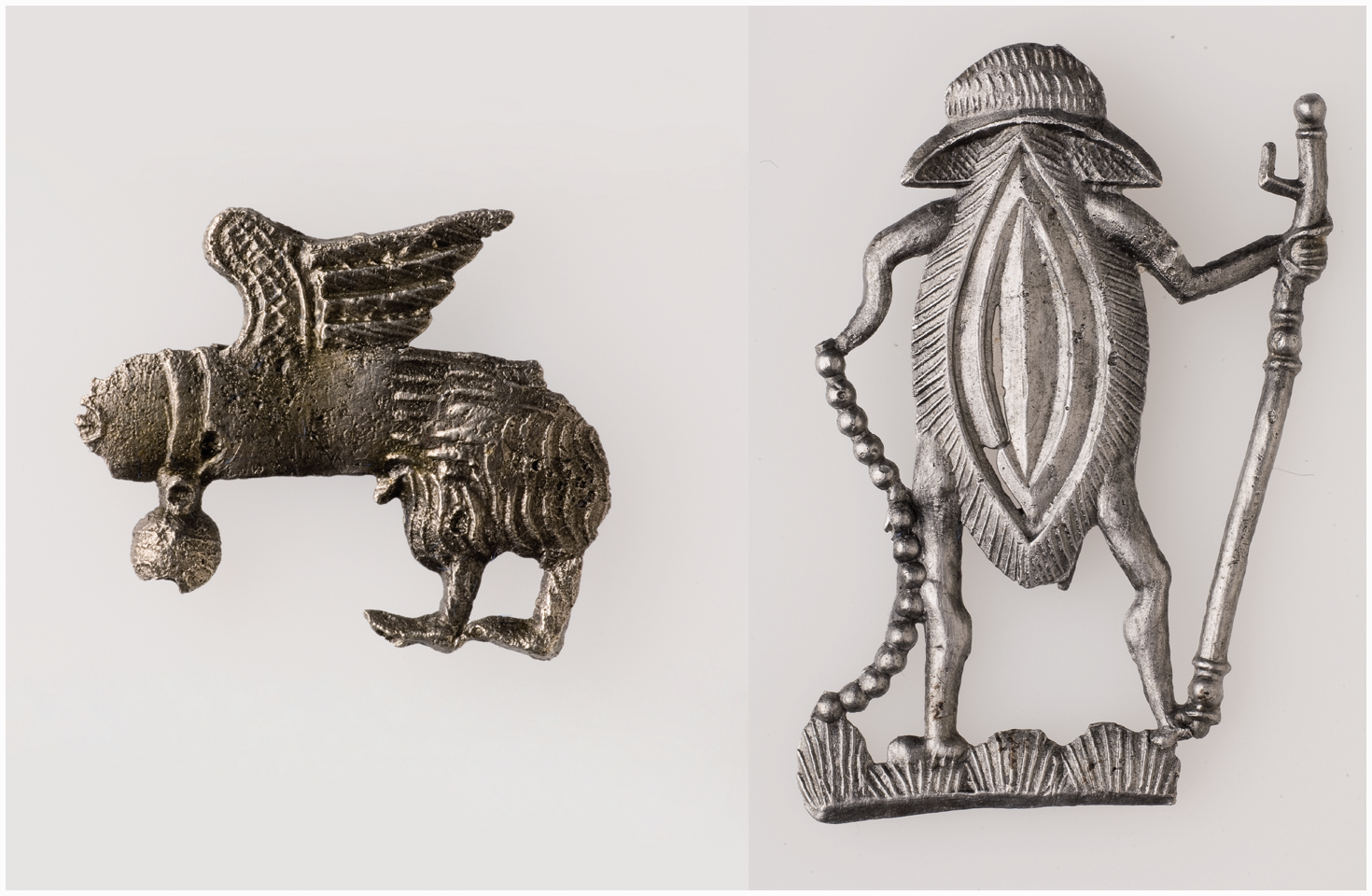
Secular badges might have been transgressive visual jokes. The badge depicting a vulva as a pilgrim could illustrate a sceptical late medieval attitude towards the piety of actual pilgrims. In a similar vein, in the badges depicting groups with both vulvae and penises, it is usually the female organs that have taken the dominant role (Jones, 2004: 29, 253–257). Simons (2011: 86–97) points out that the humoristic role reversal and norm breaking might nonetheless have reinforced the contemporary gender normativity by showing the absurdity of its inverted version. The secular badges thus offer an understanding of gender and sexuality that differs from medical literature, while their numbers testify to the circulation and popularity of such notions in premodern society. Moreover, the grotesque depiction of organs as well as the very existence of the badges themselves emphasise the corporeal and material context of sexuality.
Barrel taps as sexualised objects
No explicitly sexual objects such as secular badges are known from Finland, but the late medieval and early modern barrel taps form a humorous group of masculine artefacts even here. Although called a barrel tap and indeed often placed on wooden barrels for beer and wine, such devices could also be used to run water from a tub or a similar container. The tap cast in brass or bronze consisted of a tube with a hole through the top. A plug of the same metal was placed through the hole, and by turning the key the flow of liquid through the tube was controlled. The tap key could be ornamented in different ways, but the most popular one was a cockerel with its comb and wattle (Figure 2). Cock taps are known widely across late medieval and early modern Europe. In Finland, such taps have been found in urban areas of the country, and rural sites such as castles, manors and vicarages (Heinonen and Koivisto, 2012: 269; Mikkola, 2005: 31; Taavitsainen, 2010: 266). The distribution pattern appears to favour places of higher social status than ordinary rural settlements.
Cock tap of bronze discovered in Turku, Finland. The object is 14.0 × 7.4 cm in size (National Museum of Finland, inv. no 95032:79). Photo: Visa Immonen.
The connection between the cock tap and gender is established by the figure of the cockerel, semantics and the practice of using the tap. The German Hahn, the English cock and equivalent Slavonic terms all have three meanings: bird, tap and penis (Cooper, 2008). The linguistic association between the cock tap and genitalia is substantiated by the shape of the object. The barrel or tub appears as testes, the metal tube as a penis and the liquid running from the former through the latter as urine or semen. The entity establishes a metaphor which expresses the enjoyment of drinking, and pre- and early modern sexuality and the centrality of discharging semen.
The metaphor linking various bodily actions might have come forward and become articulated in certain situations when beverage was drawn. It is also expressed pictorially in an engraving by Albrecht Dürer from 1496 to 1497 (Figure 3). It depicts male bathers with one half-naked man leaning against an upright wooden post on the left. A cock tap is attached to the post, just in front of the man’s groin. The complexity of the image has eluded any definite interpretations (Hinz, 2003), although it has been connected with themes such as the five senses and humoral theory. Following the latter cue, Wood (1939) argues that the man represents the melancholic temperament, and his misfortune is having a dry body. Hence his organs are not energetic enough to match his sexual desire, which leads to glumness – it is of no use running water from a tap attached to a wooden post.
Albrecht Dürer’s engraving of 1496–1497 depicts men in a bath (The Albertina, inv. DG1934/496). Image © The Albertina. Printed with permission.
Dürer’s print has a similar streak of light-hearted but normative sexual humour as the secular pewter badges. In contrast to the secular badges, however, the sexual metaphor suggested by the cock taps is dependent on iconographical reasoning and linguistic evidence. The latter dimension suggests that the sexual metaphor probably did not function outside certain communities. In Finland, this most likely involved social distinctions between rural and urban or more cosmopolitan populations, which, in turn, emphasises the potentially wide differences in how the sexual metaphor unfolded in particular material and social settings.
Daggers and male violence
Another unambiguous connection between objects and male organs was established by daggers. Particularly pertinent is the type of weapon now called kidney or bollock dagger, but which contemporaries knew as a bollok-knyf or bollok-hefted dagger in English, and Testikeldolk in German (Jones, 2004: 258). The dagger’s hilt comprises a grip, and a guard formed by two plum-shaped protrusions. The hilt and the straight blade constitute a weapon resembling the shape of male genitalia. To emphasise this visual similarity, the bollock dagger was fastened to one’s belt and carried in front of the groin (Figure 4).
Woodcut depicting a farmer with a bollock dagger fastened to his belt. It is part of the illustration in the book Des Dodes Danz published in Lübeck in 1489 and 1496 (Meyer, 1896: 75).
Daggers came into use as a war and civilian weapon in Europe in the 13th century, and their distribution covers the continent. Bollock daggers were especially popular in the Nordic countries, where their heyday was from the 14th to the end of the 16th century. In Scandinavia, dozens of bollock daggers are known, whereas in Finland only six survive. The number might appear low, but altogether only 15 medieval and early modern daggers are known from the country, and of them, bollock daggers are the most common type (Harjula and Taavitsainen, 2008: 41–45). In Finland, their pattern of distribution is similar to the distribution of cock taps as daggers are from contexts of higher social classes (Figure 5).
Bollock dagger found at Turku Castle with a handle and guard made of beech (Turku Museum Centre, inv. no 16390:1). The blade is missing. Image © The National Board of Antiquities in Finland. Printed with permission.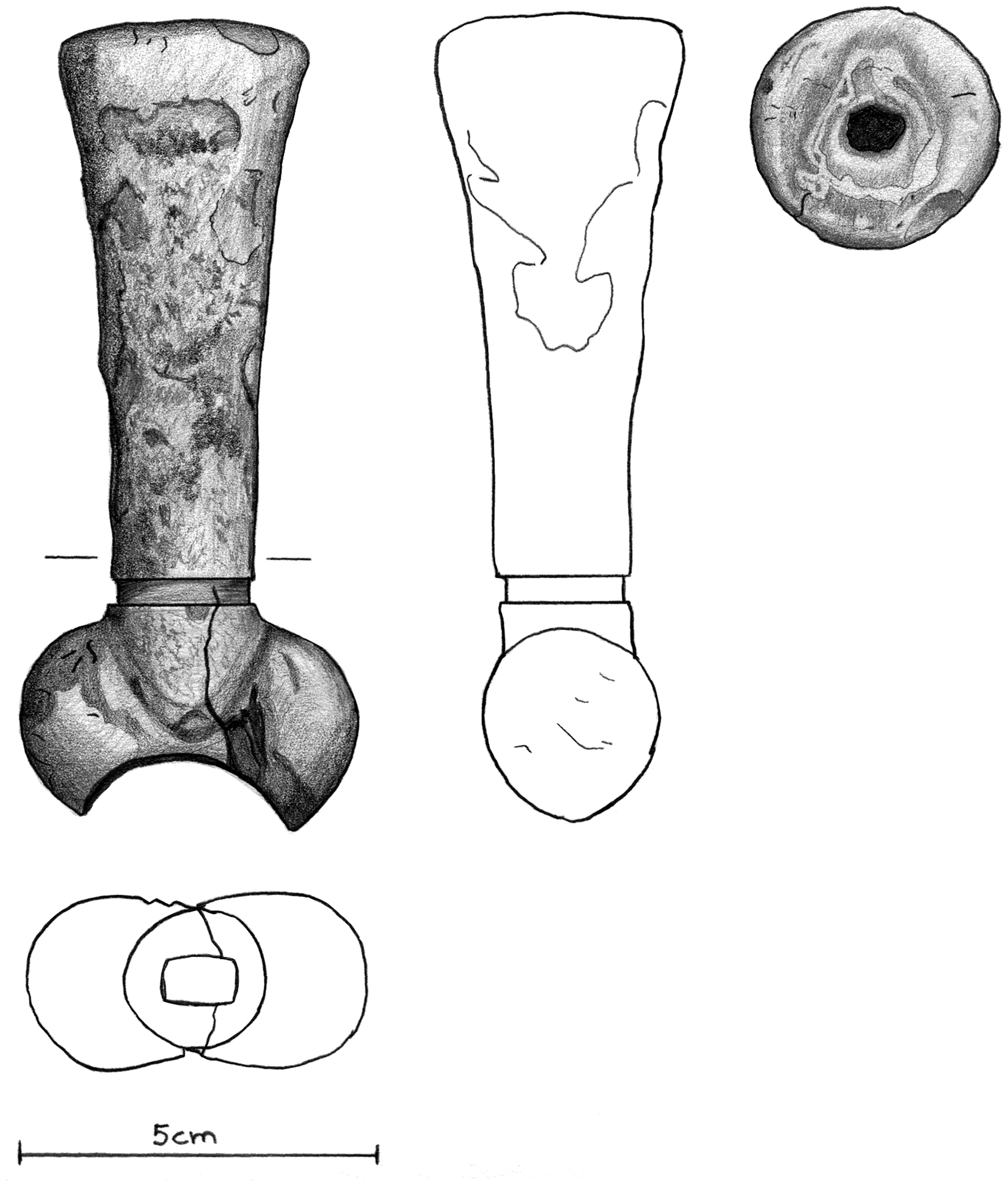
Nøttveit (2006) approaches the peculiar popularity of the weapons in the Nordic countries through medieval laws and sagas. He argues that the Viking Age conception of honour based on manhood and its maintenance continued well into the Middle Ages. Manhood was a characteristic that could be threatened by a joke or insult directed against the person. Mockery called for counteractions and could be neutralised only by retribution. In such a framework carrying a bollock dagger was a declaration of manhood, and stabbing with it an action of penetration, assuming a dominant role in the interaction. In bollock daggers, a cutting blade, public honour and holding the active position in intercourse are assembled into one practical, penis-like weapon.
Fertility symbolism and pipkins
In his work on bollock daggers, Nøttveit (2006: 143–145) criticises previous studies of doing away with the overt penis-like qualities of the object. They are either simply ignored, or dissolved into less provocative fertility symbolism and seen as an allusion to good fortune. A similar interpretation emphasising fertility symbolism is detectable also in connection with redware pipkins and their role in the constitution of sexual metaphors (Figure 6).
Pipkin of the German type dating to the 16th century (Tartu City Museum, inv. no A-169: A554). Image © Tartu City Museum and Aboa Vetus & Ars Nova Museum. Printed with permission.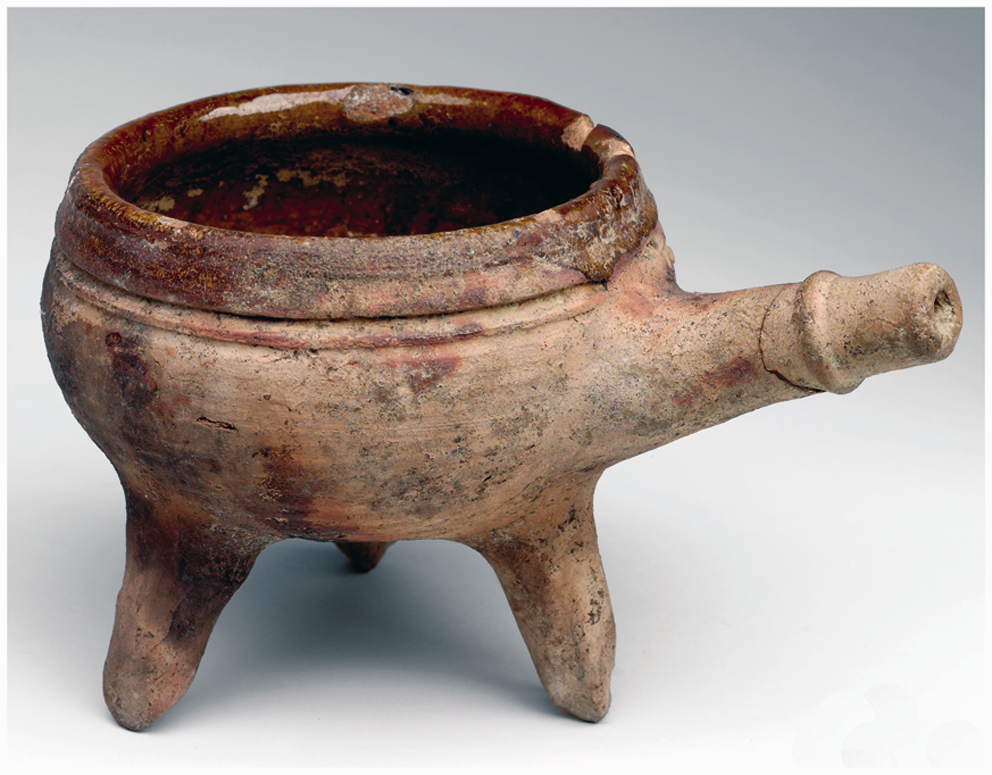
A pipkin consists of a round bowl which stands on three feet. The side of the bowl is furnished with a handle positioned at a slightly upward angle to facilitate wielding the vessel. Due to the production technique, the handle was a hollow, tube-like piece. Pipkins were everyday cooking and storing pots in which the content was heated up by placing the object on hot coals. This type of vessel emerged in the 13th century and continued to be valued and rare pieces through the 14th century, but during the 15th century pipkins became common among all social groups (Niukkanen, 2007). The type remained in use up to the 20th century (Tulkki, 2003). In Finland, pipkins, particularly their intact handles, which are less prone to breakage, are typical finds from early modern sites (Haggrén, 2009: 78–79).
Pipkins were mundane objects, often without any decorations besides the glazing on their inner surface, though some pieces were painted with simple geometric motifs. The potential gendered aspect of pipkins is suggested, firstly, by their primary site of use, that is the kitchen, which in many households was the sphere of women. Secondly, some other types of redware vessels, such as moneyboxes and flagons, could be given the shape of female breasts. Thirdly, the shape of the handle can be seen as suggestive, leading a group of Nordic archaeologists to propose that pipkins were overtly gendered objects. They combined the penis-like stout handle with a bowl representing the womb or vagina (Bergold et al., 2004). The phallic element, it is suggested, protected the female activity of cooking and the women engaged in the activity. Such an interpretation, however, is problematic in a similar fashion as seeing bollock daggers as emblems of fertility and good fortune – explicit sexuality is narrowed into symbolism instead of springing from actual sexual and cooking practices.
The 15th-century glazed redware container discovered in Bruges, Belgium, shows that the sexual associations of ceramics could be open and conspicuous: an erect penis and accompanying testes of clay have been attached to the pot’s side (Koldeweij, 2006: 117), suggesting a visual parallel to pipkins’ non-figurative handles. Moreover, in 16th- and 17th-century illustrations redware ceramics frequently appear as a prominent element in sexually imbued scenes (Garthoff-Zwaan and Ruempol, 1988: 57). Further support for pipkins being sexualised objects is provided by English and Italian literature and linguistic puns which associate, for instance, the English word handle with a penis, while pipkin is used as a reference to vagina (Ajmar-Wollheim, 2010: 143). The latter word is particularly common in expressions referring to losing one’s virginity, such as ‘she has broken her pipkin’ (Williams, 1994: 643, 1040). The parallel between losing virginity and a pot is a reminder that situations in which objects break down and become inoperable often attract attention to the objects’ material qualities (Tilley, 1999: 264). This in turn allows connections between the two domains, for example, sexuality and ceramics or cooking, to emerge.
Simons’s (2011: 193–194) interpretation of the vessel from Bruges differs from the one presented by the group of Nordic scholars (Bergold et al., 2004). She does not make a distinction between two sets of genitalia – penis and vagina – in one vessel but argues that the vessel in its entirety represents the testes and the penis. As in the unequal two-seed model, the heat of the fire boils the water inside the bowl or the testes, while the handle is like a penis through which the semen bursts out. In pipkins, however, the liquid in the actual bowl has no access to the handle. The body of the vessel separates them and makes the neat metaphoric overlap between the two domains incomplete. Objects do not necessarily conform to the requirements of designated metaphors but maintain a degree of independence, causing fuzziness and ambiguities in the ways in which the metaphors occur.
Changes in artefacts and sexualities c. 1400–1600
Two conflicting interpretations have been presented on the sexuality of redware pipkins, and this reveals the simultaneous openness and stubbornness of material culture. Objects are often inconsistent, not yielding to distinct semantics or social purposes (Hicks and Beaudry, 2006). Thus it may not be appropriate to seek clear sexual identities for the pipkins, but consider them rather as objects that allowed certain kinds of situations, some of them sexual, to take shape (Thomas, 1999: 6, 16). In other words, pipkins and other such objects are not entities merely waiting for contextualisation through human action. They also set up contexts. Turning a cock tap or breaking a pipkin were potentially humoristic simulations of touching a penis or of intercourse, whereas taking a bollock dagger into one’s hand might have been an expression of male aggression. For the emergence of these situations, the object itself was vital.
Situational entangling of objects and sexuality is typical of late medieval and early modern material culture of the domestic sphere, or at least so it appears on the basis of contemporary written and visual sources, and the wide spectrum of objects with sexual associations. In addition to the three types of objects discussed here, also purses, knifes and spoons as well as glass beakers in the form of penises and actual dildos were potentially sexual pieces of material culture (Simons, 2011). The list of potentially sexualised objects is specific to the late medieval and early modern period, which serves as a reminder of the historicity of metaphors.
The objects that I have used as examples – cock taps, bollock daggers and redware pipkins – belong to the period known as the ‘age of transition’ which altered and redefined relations between humans and things. In Central Europe, this period of change stretched roughly from 1400 to 1600 (Gaimster and Stamper, 1997), while the archaeological material in Finland shows that it occurred here somewhat later (Haggrén, 2009). In the urban areas of Southern Finland, the first traces of the change appear in the late 15th century, growing in the 16th and 17th centuries, but in Northern and Eastern Finland the premodern human–object relations are visible as late as the 18th and 19th centuries (Nurmi, 2011).
During the age of transition, consumption began to take the shape of modern commercialism, secularism and individualism. In parallel, production increased substantially, and trade relations became more efficient and global in scale. The amount and diversity of domestic artefacts grew, and, for instance, dining as a performance became ever more differentiated with specialised implements and vessels. In the same vein, the number of private objects increased and the demand for privacy and comfortable environments developed. The cultural and technological change altered the lives of ever-wider social strata and their relations with objects. The differentiating function of artefacts grew stronger.
These fundamental transformations were not, however, a straightforward disappearance and replacement of the Middle Ages in the face of the modern, but rather comprised a heterogeneous and asynchronous set of shifts and rearrangements in the relations of humans and objects, affecting the situations from which sexual metaphors sprang. A case in point is the differing chronologies of the age of transition in Central Europe and Finland. Moreover, Howell (2010) emphasises that the age was governed by its own logic not reducible to the object–human arrangements of the preceding or succeeding periods.
Sociologist Sombart (1967) examines the emergence of consumerism in Europe in 1300–1800. He argues that the explosion of trade, production and financial economy was based on the demand for luxuries at court and among the nobility, women holding the key position in consumption. Affluence, courtly culture and capitalist production formed a catalytic combination in which the demand was fuelled by the courtly ideals of love, desire for sensual refinement and ritualised courtship. Sexual practices were entangled with patterns of consumption.
Sombart has been severely criticised both for his shortcomings in collecting and analysing written sources as well as for his methodological flaws (Appadurai, 1986: 37; Mukerji, 1993). Moreover, his style of restricting sexual and consumptive motivations to the nobility is untenable in the light of later scholarship (e.g. Hibbert, 1953). Sombart’s view can also be criticised for giving precedence to discursive elements – ideals and attitudes – in explaining the transformations taking place in material culture and in the material context of sexuality. One could argue to the contrary that the driving force was the change in object–human relations which then resulted in the new models of consumption and sensuality. In the end, however, one is left with the core idea of sexuality and materiality being interwoven during the age of transition (cf. Voss, 2008).
When analysing sexual metaphors as solid metaphors through artefacts, pictures and texts, changing patterns of material culture and subsequent human–object arrangements constitute a vital dimension. The relations between humans and objects also affected the structure of solid metaphors and shaped connections between the domains they brought together. During the Late Middle Ages and early modern period, the presence of sexuality appears to have become more prominent across material culture, whether considering the dress accessories and domestic objects or depictions of these artefacts in other media. The unprecedented abundance of artefacts, and the transformation they brought in human–object relations, offered new ways for sexuality to take shape.
The gendered materiality of metaphors
Tilley in his examination of metaphors evokes the concept of performativity. It parallels his approach and the subsequent material turn in archaeology with developments in feminist theory, where similar concerns regarding materiality and non-discursivity have been voiced. In Butler’s (1993) Bodies That Matter, when she discusses how bodies materialise as sex, the performativity of gender is conceptualised as a constant discursive constitution of material embodiment. Describing how bodily norms sediment over time, Butler argues that matter is a process of materialisation in which reiteration establishes and constructs the limits, stability and surfaces of the substance we recognise as matter. In other words, the sex of bodies is not given as nature, but created as an epiphenomenon of culture, and ultimately structured by productive power (cf. Kirby, 2011).
Butler’s notions of performativity and materialisation have been met with a plethora of reactions. Some neomaterialists reject performativity altogether, while, for instance, Barad (2007) rearranges and redefines its conceptual basis. For her, materialisation is not a question of discursive constitution of matter, but a material-discursive phenomenon in which the limits of both the human and nonhuman, and matter and meaning, are entangled and brought forth. They emerge simultaneously without the possibility of glossing over the presence of objects. The unfolding of matter and meaning is thus a historical process, emphasising the importance of the historical trajectories of its various elements, objects and bodies.
The weight of the neomaterialist stance, particularly its critique of Butler, has equally been questioned (Sullivan, 2012). Ahmed (2008: 35) argues that the critique is built on a caricature of the poststructuralist conception of culture. The claims of matter being missing from poststructuralist theories are actually embodying matter as if it could be an object and thus absent or present. Subsequently, neomaterialism, to all intents and purposes, reinstates the dualism between culture and matter, a dualism which it tries to dismantle, and fetishises materiality as something that one is for or against.
A detailed analysis of poststructuralist and neomaterialist arguments is beyond the scope of this article, but the debate, as it stands, has undeniably changed the focus of theoretical discussion. Materiality, the status of material culture, and the need for theoretical reorientation have become central concerns. In the study of past systems of gender, this kind of shift has launched two lines of development. On the one hand, scholars have become more interested in the possibilities of combining and contrasting artefact and visual collections and architectural remains with the written record, as I have done in my three examples. The objects and associated sexual metaphors reveal traces of sexualities which differ from those articulated in medical texts. On the other hand, the material turn is not limited to new sources becoming topical, but involves the creation of new ways of conceptualising gender as well as objects and connecting texts, pictures and objects to each other (Joyce, 2009).
As a consequence of the materiality debate, I prefer the concept of the ‘performative metaphor’ over ‘solid metaphor’ when addressing sexual metaphors. Performative metaphor is among the repetitive practices through which texts, pictures, bodies and objects give expression to the systems of gender. In contrast to solid metaphors, the performative metaphor encapsulates the simultaneously solid and liquid nature of the situations in which the metaphor operates. Indeed the notion of the performativity does not imply that objects are metaphorical ‘as such’ or in their ‘solidness’, although things are fundamental in setting up the situations in which the metaphors occur. However, in their basic structure, performative metaphors are not merely linguistic, metonymic or symbolic either. They do not hide or reveal some hidden meaning, but express the entanglement of two domains of practice – such as violence and manly honour – and configure their relationship. Recognising this redefines the status of the sexual metaphor as a material phenomenon. Now the distinction between objects as symbolic devices and material beings, advocated by Olsen, seems unwarranted, particularly as it seems to echo the linguistic division between denotation and connotation. Such a division does not precede performative metaphors but is founded by the metaphorical situations: sometimes the bollock dagger was only a secondary reference to a penis, but in other situations the connotation was transformed into a denotation. The cock tap example and the dependence on linguistic evidence, in turn, accentuate how the occurrence of a sexual metaphor reiterated social distinctions.
Objects and bodies form continuous performative situations which are both ontological and epistemological. In these situations, things impose certain limitations, paths of movement and trajectories of actions. Sometimes objects do not conform to a clear-cut metaphor, such as pipkins to human organs, but such frictions are part of the metaphor’s unfolding. As situations, performative metaphors bring forth meaning along with the movements of matter, and in this process the material qualities of things and bodies have a prime impact (Bekaert, 1998). Correspondingly, performative metaphors do not have a more abstract underlying idea as seems to be the case with Tilley’s conception of the canoe and its relationship to the Wala society. They instead structure actions and thoughts by bringing together different, sometimes quite mundane, material domains of life.
The age of transition, like any historical period, had its unique understanding of metaphoric expression and the ways in which it was structured by sexual difference. Particularly, activities related to agriculture, dress and the preparation and enjoyment of food were central for the metaphors of gender and sexuality. In this way, sexual metaphors connected everyday objects and repetitive practices with conceptions of sexuality and, for instance, the humoral theory about the human body. The understanding of sexuality became entangled with and supported by other fields of experience. As situations, performative metaphors sketched out the lines of matter and meaning, and set up such distinctions as between denotation and connotation in gatherings of bodies and objects. Sexual metaphors – touching a tap or thrusting a dagger – did not have a concealed content, but operated as assemblages of humans and objects and created actions and reactions by connecting a variety of domains of life.
Footnotes
Funding
This research received no specific grant from any funding agency in the public, commercial, or not-for-profit sectors.