



Abstract
This paper examines a collection of iron artifacts from the Sarah Burnee/Sarah Boston Site, a late 18th- and early 19th-century Nipmuc home site in Grafton, Massachusetts. While the objects represented have a broad spectrum of purposes, the assemblage is assessed for its utility in the practice of woodsplint basketmaking, an emerging Native trade in 19th-century New England. Native woodsplint baskets were desired and prized by Anglo-American consumers for their authenticity and tradition, yet many of their forms, decorations and the associated toolkit were all developed in the specific economic conditions of post-revolutionary New England and are thus entangled with Euro-American materialities. DeLanda’s (2006) “assemblage theory” is examined as an appropriate concept with which to reconcile the apparent tension of innovation and tradition apparent in this collection, and in Indigenous historical archaeology at large.
In this article, I use the results from archaeological investigations at the Sarah Burnee/Sarah Boston Site to question the idea of “residence” at the material level (Silliman, 2001: 195). What can objects tell us about the negotiation of new Native livelihoods in a landscape increasingly bounded and controlled by the clash of agricultural and industrial economies (Prude, 1999)? I call into question some of the standards of cultural stasis that govern ideas about indigeneity by discussing the tensions of innovation and tradition in the development of the Native basketry industry and its associated toolkit, evident in the iron assemblage at the Sarah Burnee/Sarah Boston Site. Rather than treat modernity as a threat to Native identity, I illustrate ways that Native people fashioned new things, practices, and livelihoods in support of Native identities built by the histories, traditions, and experiences of the past, oriented toward an explicitly Native future. This study contributes to an ongoing discussion of materiality in colonial contexts. As some recent engagements with hybrid materiality (Bhabha, 1994; Harrison, 2006; Silliman, 2010; Turgeon, 1997) have suggested: “individuals can use both novel and ‘traditional’ daily practices as a forum for reworking identity, often through the appropriation of material culture” (Silliman, 2001: 195). While European-made goods had prescribed uses and meanings, they were also subjected to interpretation, improvisation and appropriation by Native consumers (Silliman, 2010; Turgeon, 1997).
I examine the iron assemblage from the Sarah Burnee/Sarah Boston Site, a late 18th- and early 19th-century Native homestead in Grafton, Massachusetts, owned and occupied by Hassanamesit Nipmuc woman Sarah Burnee and her daughter, a locally well-known basketmaker named Sarah Boston. Excavations at the home site were carried out by the Fiske Center for Archaeological Research at the University of Massachusetts, Boston, between 2006 and 2013 with the full support of the Nipmuc Nation (see Law et al., 2007, 2008). The collection was chosen because iron artifacts from the Sarah Burnee/Sarah Boston Site are both abundant (n = 890 to date) and well preserved, and many known basketmaking tools of the early to mid-19th century were partially or entirely made of iron. While I take the intended uses of objects into consideration, my analysis of conserved iron artifacts is designed specifically to recognize deliberate re-purposing and/or modification. In this case, there are reasons why this possibility should be prioritized. First, analyses of other materials in the assemblage have established a precedent for material improvisation at the Sarah Burnee/Boston homestead (Law, 2008). Secondly, in the 18th and 19th centuries, the practice of basketmaking did not have a devoted arsenal of ready-made, job-specific tools. Anthropologist Frank Speck noted that basketmakers in the late 18th and 19th century were constantly developing new tools to hasten or improve basket production as a response to the growth of the Native basket industry (Speck and Butler, 1947: 5). Lester (1987: 47) points out that the full spectrum of known basketmaking tools, including blocks, gauges, molds, and planes, were not fully integrated into the practice of basketmaking until the mid-19th century, and even then were still mostly homemade. Even the basketmaker’s premier tool, the “crooked knife”, was rarely ready-made and available for purchase (Sellens, 2002). I review the Sarah Boston assemblage with the intent of recognizing the potential range of mechanical utility in basketmaking of any object, regardless of its intended purpose. I argue that Native basketmakers in the early 19th century participated in the maintenance of Native community by developing new techniques and tools to hasten the production of baskets and further grow the Native woodsplint basket industry.
Historical background
Sarah Boston came of age in a difficult time for the Nipmuc community. Her mother and father, Sarah Burnee and Boston Phillips, and her uncle, Joseph Aaron, had labored through the latter half of the 18th century, eking out an agricultural existence from the families’ land on Keith Hill. Because the paternalistic court-appointed Trustees kept detailed economic records on Native communities in Massachusetts in the 18th century, we know that Sarah Burnee and her brother were growing rye and wheat on their 154 acre farm as early as 1768 (Earle, 1862: 1:5). The colonial market of the late 18th century had quite a demand for both grains: wheat and rye for breadmaking, while rye also had value for local distilleries that produced both gin and cider brandy (Kelsey, 1980).
Several factors contributed to the slow but certain decline of the Burnee/Boston Farm and the family’s agricultural livelihood in the late 18th century. The greatest obstacle was their limited landholdings, which rapidly dwindled as their agricultural efforts intensified. In May 1771, Sarah Burnee and her brother Joseph Aaron petitioned the Massachusetts General Court to split the family landholdings between them (Earle, 1862: 1:4), as the law required state approval for sale of all “Indian” lands. The division was granted. In addition to the loss of land resulting from this conflict and division, Joseph and Sarah were forced to sell significant portions of their parcels to survive the uncertain economic climate surrounding the American Revolution and the events that led up to it. Within a few decades of the split, Joseph Aaron had signed over his entire portion of the family land to neighbor Silas Fay in exchange for the care he and his wife received in their old age, and Sarah Burnee was the sole proprietor of the much diminished family property (Earle, 1862: 1:5).
During the Revolution, the Nipmuc community and the Burnee/Boston family fell on even harder times. Many of the men, including Sarah’s father, Fortune Burnee, her brother, Joseph Aaron, and her husband were called away to fight. At home, the mostly female community tried to hold things together, shouldering most of the hard labor associated with farming. Meanwhile, the Trustees of the Native community, three court-appointed Anglo-American men entrusted with paternalistic oversight of the Hassanamesit community, their money, and their land sales, became negligent in their duties (Earle, 1862: 1:1). They failed to provide families at Hassanamesit with access to their own money and failed to respond to the community’s complaints. Records imply that even when men returned from the war, the community continued to struggle through the last few decades of the 18th century.
The problems that the Burnee/Boston family faced are an extreme example of economic difficulties that many in the Blackstone Valley faced in the late 18th and early 19th century. After the Revolution, the vast land grants and sprawling tracts of land staked out by New England’s Puritanical forefathers were divided and subdivided to accommodate each successive generation of an ever expanding family tree to the point where no further divisions could be made without compromising the self-sufficiency of the existing farms (Prude, 1999). That meant that for many families, the eldest son would inherit land and other siblings of the generation (which oftentimes approached or exceeded 10 children) would have to find other livelihoods away from the family farm. Many chose to head west, where land was more abundant. For those who stayed, this meant finding a mode of subsistence other than agriculture. Prude (1999: 56) marks a rapid rise in the number and diversity of local businesses in rural Massachusetts from 1810 to 1830 – mostly established by newcomers from nearby towns and even some immigrants – as people scrambled to find other trades. “The categories of shops … embraced not only the familiar ventures like stores, taverns, blacksmithies, and nail-making works, but also unprecedented projects: … shoemaking shops, a bakery, a stove factory, chaise and bobbin making manufacturers, and textile machine works” (Prude, 1999: 58). This increasing number of tradesmen meant that more and more families needed to buy household goods that they no longer had the time or means to produce for themselves, including food and clothing. As early as the 1790s, even farming families began relying more on purchased goods (Prude, 1999: 9), buying cloth, yarn, ribbon, tobacco, molasses, salt, rum, nails, snuff, books, shoes, and mirrors. As demand increased for an ever expanding aggregate of things, more and more niche businesses began popping up in rural New England.
Sarah Boston and many of her Native contemporaries at Hassanamesit became intimately entangled in this trend toward more diverse and specialized modes of subsistence, but they did so in a uniquely Native way. As part of this shared economic predicament, the Native community began to develop a trade in basketmaking, chair-caning, and broom-binding that they mobilized by selling their wares throughout New England’s rural countryside. This trade was not common, or universal; rather these particular kinds of decorated baskets and other closely affiliated tasks and goods were widely accepted as distinctly Native things that emerged from distinctly Native abilities and knowledges. These were things that appealed to their buyers partly because of their indigeneity. The handmade baskets fit the trope of the “Vanishing Indian” that was becoming part of the new American historical narrative, and consumers were eager to own a tangible connection to people they understood to be disappearing. Of course, basketmaking was a known ancient practice in New England, but ironically the designs and materials brought forth to produce baskets for sale to American settlers made for new, emergent objects that sprung from the entanglement of Native and Euro-American materialities after the American Revolution. Iron, the main material used in the development of basketmaking industry tools, was of course a European material; however, the toolkit, and the specific uses and combinations of tools, were Native and new.
Baskets were made from wooden splints of various widths and thicknesses, acquired by removing a year’s worth of growth from the outer layer of what was usually an ash or oak tree, and cutting the thin layers into uniformly sized strips that could be woven together into anything from a small “berry” basket to a large storage basket. The splints were woven into a distinctive checker-plaited pattern and often decorated with paint or ink in designs and configurations that tended to vary according to the region and particular Native community that made them (McMullen, 1987; Turnbaugh and Turnbaugh, 1987). Some had handles, some lids; some were round and others square or oblong. Many of these baskets are still in circulation today, either in the possession of families that bought them almost two centuries ago, or passed on to antiques dealers and museums and sold as “Indian baskets”.
Archaeological study
Several studies dealing with the Sarah Burnee/Sarah Boston Site have been completed (Allard, 2010; Bagley, 2013; Law, 2008; Law Pezzarossi, in press; Mrozowski, 2012, 2013; Mrozowski et al., n.d.; Pezzarossi, 2014; Pezzarossi et al., 2012). But researchers are yet to identify archaeological evidence supporting the claim, made by local historians (Earle, 1900; Forbes, 1889; Speck and Butler, 1947), that Sarah Boston was a basketmaker. The recovery of remains of basketry or basketmaking materials in archaeological contexts is rare in New England. While some basketry and other textiles have been unearthed under very specialized circumstances (Ordoñez and Welters, 2004), the conditions for the preservation of materials like wood or twine are extremely poor in the Northeast United States, and the Sarah Boston Site is no exception. Yet there are other ways to evaluate the potential for basketmaking activities at the Sarah Boston Homestead. I now turn to an analysis of the iron tools found on site, using them as proxies in my inquiry into Sarah’s role in the development of the Native basketmaking industry.
As my research questions relied on determining the use of iron in the Sarah Boston household, I initially designed my catalog to reflect the intended uses for common household objects. All metal artifacts excepting nails were cataloged. I created separate fields to record the specific name, style and portion of the object in the hopes of further narrowing the object’s associated activity, its possible date range, and information about its use life. These are standard practices in the cataloguing of 18th- and 19th-century archaeological materials, and I was relatively successful in my identifications given the level of corrosive damage usually associated with iron objects of this age in the New England area. The total assemblage consisted of 890 artifacts. I was able to identify 45% to specific object (kettle, ox shoe, hook, etc.) and object category (housewares, agricultural hardware, etc.). However, I found the standard object categories restricting in identifying the actual items that might be of use in the development of a basketmaker’s toolkit. The practice of basketmaking for sale to local settlers was a new trade, and the development of the tools associated with the industry likely came about gradually, as needs arose and solutions were developed. These needs are best understood through a review of the basketmaking process as outlined in anthropological accounts and by basketmakers themselves.
Various anthropologists have studied 19th- and 20th-century woodsplint basketmaking. Willoughby (1905) explained the process of constructing woodsplint baskets, which involved the cutting, soaking and pounding of ash, hickory, and elm to separate the annual growth rings. These were then peeled apart and split into uniform size widths, then coiled or bound together in bunches (Willoughby, 1905: 87). Noted early 20th-century anthropologist Frank Speck (1915) described in detail some of the basketmaking designs, tools, and procedures of the Niantic and Mohegan Tribes of Southern Connecticut. Speck lists the tools used including a spoke-shave to smooth the splints; a hand gauge, often made with clock spring teeth to cut the splints into strips; a hand planer, used to thin the splints; a bone pointed tool, possibly used in the construction of the rims; and of course, the crooked knife that Speck mentions was handled with wooden or antler handles. Gladys Tantaquidgeon was one of Speck’s students and informants, and a well-known Mohegan anthropologist in her own right. She notes common tools used in the construction of woodsplint baskets at Mohegan, including the wooden mallet to pound the logs, a knife or a spoke-shave to shave off the layers, a hand gauge to make the splints a uniform width, a splint planer to finish the splints, and a brush (often “made by fraying the end of a small piece of witch hazel [Hamamelis virginiana, Linnaeus]”) or potato stamp for decorating the basket (Tantaquidgeon, 1935: 44). She lists red, blue and black, derived from cranberries, pokeberries, and huckleberries, as the predominant colors used to dye or paint the splints. Lismer and Beatty (1941) provide very detailed information about the tools and tasks involved in the preparation of the woodsplints and the weaving of the baskets based on a study area in west of New England. Lismer and Beatty point out that while there are stylistic variations in the order in which splints are prepared; there are a few universals.
Contemporary Native basketmakers have helped me to understand more about the actual logistics of basketmaking, the reasoning behind many of the techniques, and the kinds of common variations that exist from artisan to artisan in the practice of the skill. Observing basketmakers at work, mostly in video tutorials, has also taught me that there is a great deal of variability in the actual practice of each basketmaking step. I’ve learned and seen demonstrated that any number of tools can be used to complete a job, for example, a drawshave can be effective in removing the tree bark, but a small axe works just as well, as long as the bark is pounded first. These variations and accommodations provide a window into the process of basketmaking both as the production of a basket, but also the consumption of what might be considered “Anglo-American” tools in a distinctly indigenous practice.
Tasks and tools associated with woodsplint basketmaking.

When I cross-referenced this list with the master catalog of iron objects from the Sarah Burnee/Sarah Boston assemblage looking for possible objects used in basketmaking, I found that reducing the entire iron catalog down to a smaller sample based on certain assigned “object categories” significantly limited the sub-assemblage of artifacts that might suggest basketmaking. Other scholars have encountered similar problems. In her work on Roman households from Pompeii, Penelope Allison (1999) acknowledged the potential pitfalls of classifying artifacts according to their assumed function. She makes the point that the functions assigned by early experts often reveal a late 19th-century bias with no real evidence that Roman people thought of or used things in that way. She argues for a more contextual approach, recommending reexamination of the production and intended use of objects, but also a careful consideration of their consumption within the household (Allison, 1999: 59). I found my own study guilty of some of the same kinds of assumptions. Where my categories represented an array of household activities, they rested on an implicit assumption that the assemblage would consist of a corresponding set of task-specific objects. As I have explained above, the diverse 19th-century assemblage of task-specific things was only being developed in the wake of the American Revolution by the same hard-up farmers-turned-tradesmen.
Traditional scholarship in political economy has tended to concentrate its efforts on the active, identity producing properties of production, while under-theorizing and making passive the act of consumption. Miller (1987) and Baudrillard (1995) have worked to blur the problematic split between the technological and social functions of objects, their commercialization and their personalization, their production and their consumption (Baudrillard, 1995: 6). Miller insists that the act of consumption is equally transformative for both the consumer and the object. He claims that only through their consumption, that is their mental and/or physical “appropriation”, can consumers transform goods into “potentially inalienable culture” (Miller, 1987: 215). Baudrillard qualifies that “to become an object of consumption (an object with value), an object must first become a sign”, for it is the idea of the thing (and its relationship to other things) that is consumed, along with its physical manifestation (1995: 218). Here, in the constant semiotic process of meaning creation, the apparent boundary between production and consumption is compromised and an object assumes the ability to carry out a far broader set of tasks than that for which it was intended.
With this in mind, I recognize that what I seek from this assemblage is the emergent, rather than the extant. I am looking for evidence of material innovation. With the possibility of repurposing in mind, I adjusted my analysis to recognize the potential spectrum of mechanical utility for any given object, regardless of its intended purpose. This analysis of an object’s range of feasible mechanical utility employed multiple lines of evidence, with a careful consideration of the historical context. I inspected the assemblage looking for either direct matches or similar forms to those listed in the basketmaker’s toolkit. Ultimately there were several objects in the Sarah Boston Homestead assemblage that could have been used in the practice of basketmaking, but few specifically constructed for just that task.
Data
Harvesting
Tantaquidgeon (1935: 43) notes that Brown or Black Ash, alternatively called, “hoop, swamp, or basket ash”, was the most popular choice of raw material for basketmakers (Tantaquidgeon, 1935: 43). She also mentions White Oak (Quercus alba Linnaeus) and Swamp Maple (Acer rubrum Linnaeus) as alternative, less desirable options among Mohegan basketmakers. Two axe heads were found in the Sarah Boston assemblage. The first is a well-preserved New England style felling axe head. An axe of this kind would have come in handy on any New England farmstead, and been crucial to a basketmaker, who would need it to harvest trees. Archaeobotanical analysis has confirmed the presence of ash and oak in the assemblage of charred macrobotanical remains (Trigg, 2014), and both ash and oak trees do indeed grow on the Sarah Boston Parcel today. It is unclear whether these varieties existed on Sarah Boston’s property while she resided there. McFeat (1987: 66) claims that Maliseet basketmakers in New Brunswick knew the precise locations of nearby stands of ash and would often harvest these resources regardless of the property owner’s wishes.
Stripping
Any number of tools might be used to remove the bark from the tree once it was harvested. An axe (or hatchet) like that described above would have worked well for ash as long as the bark was pounded beforehand. A peeling iron and a drawshave are also common choices. In the Sarah Boston collection I identified one object that could have served well as a peeling iron. This object may or may not have been purpose made for basketmaking; it resembles an oven peel, meant for use in the hearth. While we found no evidence of a traditional drawshave, we did recover an altered scythe blade that might have been repurposed as a drawshave (Figure 1). Scythes are some of the most definitive agricultural artifacts found in the iron collection (along with ox shoes), but the alterations apparent on the blade suggest that they continued to serve a purpose within the household even after the family gave up their agricultural enterprises. Specifically, the scythe in Figure 1 seems to have undergone some kind of post-production alteration in which the tang and the blade have both been bent inward to form a “C” shaped curve. These alterations, especially those to the tang, are too dramatic and seamless to have been accomplished without having reheated the iron (Kelleher, personal communication, 2014), which means that Sarah likely would have brought this blade to her neighbor, blacksmith Amos Ellis, for reshaping. This blade, in its altered state, could have been used as a drawknife-type tool, with the reshaped tang and the bent over end forming the handles. Scythes were often re-made into other tools like hooks, corn knives, and even hinges (Kelleher, personal communication, 2014), so it wouldn’t have been especially unusual for Sarah to repurpose her old scythe blade when she sought to shift her occupation toward basketmaking in the early years of the 19th century.
A scythe blade from the Sarah Burnee/Boston assemblage with evidence of deliberate alterations possibly used as a drawknife. Photo by Heather Law Pezzarossi with permission from the Fiske Center for Archaeological Research at UMASS Boston.
Prepping
Once the bark is removed, the basketmaker must prepare the log in order to get the splints a uniform width, which is accomplished in a few different ways, depending on the kind of wood being prepared. With ash, some basketmakers prefer to split their log into manageable and uniform sized “billets” before pounding (McKee and Follansbee, 2012); others prep the log in its entirety, using a hatchet and mallet to drive short, deep cuts perpendicular to the annual growth rings on one end of the log, at uniform distances. Once the rings are pounded loose, the strips can be peeled the distance of the log at this predetermined width. While no hatchets or mallets were found, Sarah could easily have used her axe to score the log, if she was preparing Black Ash. If Sarah was preparing oak she would have required a mallet or sledgehammer and a pair of splitting wedges which were used to split the log lengthwise in half, and in half again, until the sections were a manageable size for the drawshave, as oak does not naturally come apart in rings when pounded as ash does. In fact, we were able to identify a pair of splitting wedges in the Sarah Boston assemblage, one large (12 cm) and one small (7 cm). Splitting wedges would undoubtedly have had many uses around the homestead, but their presence means that Sarah was equipped to prepare both ash and oak splints in her basketmaking practice.
Pounding
At this stage, the basketmaker pounds every inch of the surface of an ash log in order to release the summer growth rings. Some basketmakers use a sledgehammer, but evidence suggests Sarah Boston used the butt end of an axe. The second axe found at the Sarah Boston Farmstead Site (see Figure 2) was barely recognizable as an axe, as it was just the butt portion and it was quite drastically warped, exhibiting a concave dip in the butt, running the full length of the back surface, and a concomitant slumping of the outer side body. After some research, I recognized that this posterior warping and use wear is highly consistent with the repeated pounding of the butt end against the cylindrical surface of a log. Lismer and Beatty (1941) report that Seneca men use the butt end of an axe in pounding ash logs in preparation for separating the growth rings, and I also found a video clip of a contemporary Maliseet basketmaker (Bear, 2011) that showed not only the pounding activity, but strikingly similar use wear on the butt of his axe (see Figure 2). Sarah Boston was apparently harvesting her own ash and preparing her own splints. Based on the curvature of the warping, Sarah pounded her splints straight from the log (the cylindrical shape of which contributed to the concave deformation of the iron), rather than carving her ash into billets first, which would likely have initiated a different warping pattern (as demonstrated by McKee and Follansbee, 2012).
Left: an axe butt with severe warping to the back and sides found on the Sarah Burnee/Boston Site; right: similar warping demonstrated by Bear (2011) from pounding black ash logs for splints. Photo by Heather Law Pezzarossi with permission from the Fiske Center for Archaeological Research at UMASS Boston.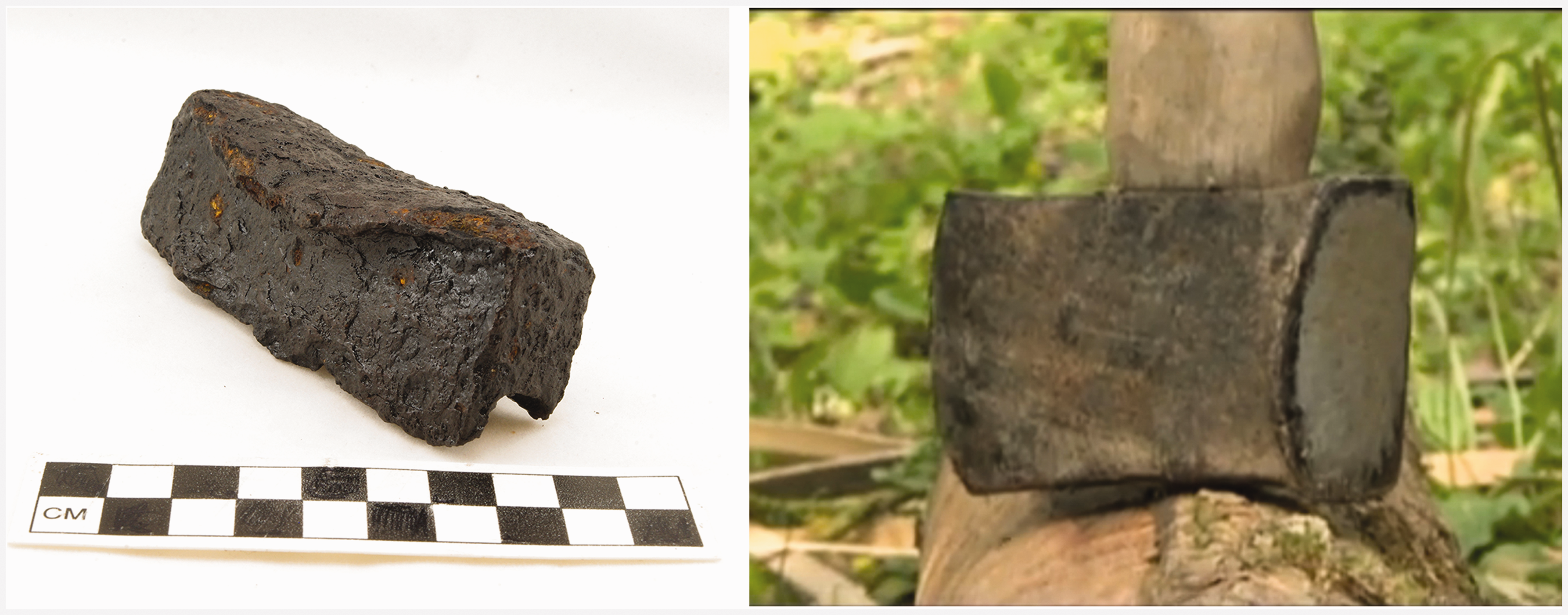
Planing
Once the splints have been removed from the log, both the back and the front of the splints are shaved to create a smooth and even surface. Some basketmakers use a tool known as a hand plane, while others rely simply on a utility knife, pulling each side of the splint swiftly between their knife and a piece of leather strapped to their leg to shave off irregularities in the surface. Lismer and Beatty (1941) note that many Seneca basketmakers preferred a straight-bladed jackknife to a crooked knife, specifying that the blade not be very sharp in the event that it slips and nicks the preparer or the splint itself. Handsman and McMullen (1987: 18) also note that mostly straight-bladed knives and folding knives were used for this step, excepting the case of heavy oak splints, where the drawshave was sometimes employed. There are two folding knives in the Sarah Boston Collection, both of which would have been suitable for planing splints. Including the two folding knives, I identified 35 full or partial knives in the assemblage, with 24 exhibiting the joining of the tang to the blade and 11 of the knives only represented by blades. This confirmed that, at minimum, the assemblage represents at least 24 knives. Further inspection of the condition of the knives revealed that 11 of 35 knives were noticeably bent either at the tang or the blade or both. The repeated pressure of pushing the side of the blade down against one’s leg (as done in the planing action) could cause the blade to eventually bend close to the tang, depending on the force and quality of the iron. Six knives in total showed bending at the blade/tang intersection in varying degrees; interestingly, all six bent to the right, indicating a right-handed user.
Riving
The riving step is performed after the splint has been planed on both sides: the basketmaker scores the end of the splint, cutting the flesh of the wood across the grain about halfway through the thickness of the splint. They then fold back the tab they have created and peel the splint in half lengthwise along the grain, creating a thinner, more flexible splint and exposing a uniformly smooth satiny interior that becomes the desired exterior “finished” side of the basket. Riving would only have required the use of any small utility knife, and possibly that of a splitter, a wooden guide composed of two pieces of wood, meant to squeeze together with the knees, that would have facilitated the even separation of the splint and spared the basketmaker many splinters when preparing large numbers of splints at once (McMullen, 1987: 171; Pelletier, 2009). Pelletier (2009) claims that the splitter was only adopted after 1850, when the tourism industry began demanding baskets in wholesale quantities.
Cutting
The next step involves trimming the splints into various widths. Splints in the main bodies of the baskets, at least in Southeastern New England, were often of one uniform width; however, splints of narrower widths were often used in reinforcing base corners and the rims, and occasionally incorporated into the body as an aesthetic choice (McMullen, 1987). To trim the splints into various smaller sizes, a basketmaker might use a knife, scissors, or a hand gauge. Three pairs of scissors in the Sarah Boston assemblage – a small pair of embroidery scissors, an un-identifiable medium pair, and a larger pair of shears, possibly meant for cutting animal hair (Sellens, 2002: 429) – could probably have handled all of Sarah Boston’s cutting needs, including activities such as sewing, knitting, basketweaving, and grooming. Could she have cut wooden splints with the larger shears? Lismer and Beatty (1941) maintain that some basketmakers separate their narrow splints using shears rather than a knife or a gauge, claiming they make less waste and also result in a more finished, smoother edge to the splints. Alternatively, the hand gauge was composed of a set of small blades, often made from clock spring teeth, mounted onto a wooden handle and capped with an iron fitting. The basketmaker would draw the wide splint through the gauge, which would quickly and easily slice the splint into several smaller ones. Speck (1915: 7) points out that the hand gauge was “highly prized” by the artisan, and in some cases the handles were carefully carved for both aesthetic and ergonomic effect. Most evidence points to the introduction of the hand gauge to the basketmaking industry relatively late, around the same time as the splitter (1850), when the industry called for more wholesale production of baskets. While the wooden handle would not have survived in the archaeological record, we have in the Sarah Boston collection a set of four small iron “teeth” less than 1 cm long that were found delicately clinging to a section of corroded sheet metal. This could represent an improvised precursor to the hand gauge developed after the death of Sarah Boston in 1837.
Weaving
While weaving itself doesn’t require many tools, basketmakers often employed knives in trimming splints as they were woven into the body of the basket. Lismer and Beatty (1941: 9) also mention that a screwdriver or some similarly “blunt tool is used to separate the warps in order to draw the binding with through to the other side”. In the parallel practice of chair-caning, a table knife is often used to aid in feeding splints through the already established warp. At least eight of the 35 total knives in the Sarah Boston collection were identified as “table” knives, which could have been used at the table or in the practice of chair-caning or both.
Carving
After the body of the basket was woven, the basketmaker needed to carve the rims and handles. These were often made of ash or oak, probably carved through use of the crooked knife, or the drawshave. “Crooked knives” were usually home-made (Sellens, 2002), and would have been fashioned from more readily available tools or other knives. While they varied in shape and size according to the preferences and limitations of their makers, Handsman and McMullen (1987: 18) note that most basketmakers preferred their crooked knives to bend at the handle rather than the blade. The angle of the handle facilitates holding the knife so the blade points inward and downward, allowing the user to draw the knife toward the body, which was especially desirable for increased control in carving. For carving purposes, a right-handed user would have preferred a tang bent toward the left, facilitating a shallower, more comfortable wrist angle (see Figure 3). Seven tangs in the Sarah Boston knife collection bent to the left, and just two bent to the right. This suggests the bending could be the result of preferential preparation.
A top-down view of a knife showing a tang bent to the left. Photo by Heather Law Pezzarossi with permission from the Fiske Center for Archaeological Research at UMASS Boston.
In addition to knives and a drawshave, I also identified not one but two very specialized drill bits, one large and one small (see Figure 4). These “Spoon” or “Chairmaker’s” bits were “especially suited for boring the holes for cane-seat chairs” (Salaman, 1997: 79; Sellens, 2002: 66). They were traditionally used with a brace, and were valued in the chairmaking industry because they allowed the artisan to adjust the angle of the bore at any time in the drilling process. Native basketmakers in New England in the early 19th century also sought work re-caning chairs, or making brooms and brushes, because their skills as basketmakers made them uniquely suited to these other tasks as well. These bits represent some of the most definitive material evidence we have to connect Sarah Boston to the broader industry of Native fiber arts in the late 18th and early 19th century. The bits appear to be identical, but for a difference of about 5 cm in length and .5 cm in width.
Two “Chairmaker's”, or “Spoon” bits, often used in restoring cane-seated chairs. Photo by Heather Law Pezzarossi with permission from the Fiske Center for Archaeological Research at UMASS Boston.
Selling
Basketmakers like Sarah Boston made a living from their art by travelling regionally, selling their wares from farm to farm. In this endeavor, artisans would have needed many things including warm clothing and good shoes. A trustworthy network of customers and family would harbor them along the way. Some of the most telling iron artifacts in the collection were two mismatched iron shoe fittings, called “ice creepers” or “ice cleats” (see Figure 5). These speak not directly to the practice of basketmaking but more to the continued practice of mobility required for basketselling. Ice creepers attached to the bottom of the shoe, just in front of the heel, and provided the traction needed for the wearer to walk stably on ice. One ice creeper dates roughly to the Revolutionary War period, when soldiers (like Sarah Boston’s uncle Joseph Aaron) were issued ice creepers so they could walk long distances on New England’s frozen waterways and icy roads. The other is similarly constructed, but obviously not a match to the Revolutionary War pair. While there is no documentary evidence that basketmakers preferred selling their wares in the winter-time, owning a pair of ice creepers would have provided Sarah Boston with an advantage for winter-time mobility in both heightened safety and efficiency, if her circumstances demanded it.
One of the two ice creepers found on the Sarah Burnee/Boston Site. Photo by Heather Law Pezzarossi with permission from the Fiske Center for Archaeological Research at UMASS Boston.
Discussion
This grouping of things is a unique “assemblage” in two different ways. First, it represents an “assemblage” in a traditional archaeological sense, that is, it is a collection of artifacts found in association with one another that represent the activities of another time and place (Harrison, 2011: 10). But the above collection is also an “assemblage” in the sense recently employed by DeLanda (2006: 5) in his outline of “assemblage theory”. In his estimation, an assemblage is a “whole whose properties emerge from the interaction between parts”. Not unlike Latour’s (2005) “networks”, assemblage theory relishes the interdependence and entanglement of heterogeneous human and non-human elements into an emergent entity. This kind of assemblage is composed of more than just the iron implements described above. It implicates the necessary involvement of many other forces and their capacities as well, including material properties of wood, whether ash or oak; indigenous knowledges of basketmaking (both passed down from earlier generations and developing); and, not inconsequentially, the unique economic circumstances of the late 18th century in New England. One of the key aspects of assemblage, as outlined by DeLanda, consists of the capacities and tendencies that the combinations of elements afford (i.e. knives have the capacity to cut, whereas ash or oak has the capacity to be cut; an axe has a capacity for pounding, and ash has a tendency to split when pounded). These aren’t certainties or assurances, but avenues of possibility that emerge and recede as circumstances change. That potential is something that I embrace in the analysis of this archaeological assemblage because there are no sure-things in this collection that guarantee that Sarah Boston was making baskets, or that she was engaged in the development of a new toolkit for a new industry. But by speaking in terms of capacities and tendencies I am not insisting that Sarah used these objects to make baskets and cane chairs. When we view the assemblage as a whole, the combined potential for the expression of agency through the practice of basketmaking is strong. The assemblage communicates a combined sense of “making do” and innovation that you might expect from someone starting out in basketmaking and helping to develop it as a trade (DeCerteau, 1984: 29–42).
Another of the defining properties of this kind of assemblage is their emergent nature, their uniqueness, newness, and even ephemerality as a result of an ever changing set of surroundings and circumstances (Marcus and Saka, 2006: 103). None of the tools described are necessarily new, in fact many of them have been essential woodworking tools for people around the world for millennia. Their combination, matched with the set of physical properties, past experiences, surrounding circumstances and motivations, is new, and unique to this particular time and place. This dynamic or emergent quality of DeLanda’s assemblages often lends itself well to commentary on the modern condition in light of the ever-changing horizons of technology and globalization that we associate with our own era (Marcus and Saka, 2006: 103). However, in this idea of emergence we can begin to see the potential assemblages have in addressing the tension of continuity and change, innovation and tradition in any practice, at any time.
This struggle to reconcile the co-existence of tradition and innovation, authenticity and modernity, haunts indigenous historical archaeology in the United States (O’Brien, 2010). Working within the parameters of the antiquated US Federal acknowledgement process, where cultural change for Native groups signals acculturation, illegitimacy, and the loss of tribal identity, American historical archaeologists have learned to fixate on the elements of Native life that have remained the same over the course of the Colonial project in order to support the survival of Native identity and community during that period. Notions of Native authenticity were developed as a result of 19th-century scientific discourse that attempted to evaluate Native identity based on concepts of genetic and cultural “purity”, and bolstered by ideas about cultural authenticity that only legitimated Native identity based on strict adherence to static, unchanging tradition (Churchill, 1998; Garroutte, 2003; O’Brien, 2010). These ideas were the foundation of the American idea of essential “Indianess”; they permeated the early field of anthropology and have a visible legacy in the modern discipline of historical archaeology. By privileging elements of sustained and uncompromised Native tradition, historical archaeologists have reinforced an environment in which any other practices are seen as a “loss”, or corruption of a previously pure Native identity (Silliman, 2009), inadvertently contributing to the larger problem at hand: the marginalization and erasure of Native people in New England.
This struggle between innovation and tradition, similarity and difference, is not by any means new. Everything we make and do is both referential of the past and preparatory for the future (Gell, 1998: 234). The recognition of similarity also involves the perception of difference, that which is “other” or outside of one’s own experience (Baudrillard, 1995: 218). Michael Taussig (1993) juxtaposes the terms “mimesis” and “alterity” to encompass the concept of mimicry, through which he proposes that even the most meticulous attempts at repetition or recreation of meaning will result in the creation of something historically cumulative and, as a result, new (see also Bhabha, 1994). This constant tension between similarity and difference empowers objects to conduct meaning and also agency across time and space while allowing for inevitable change, whether they are seen as “traditional” or “innovative”.
In archaeology, Pauketat has discussed a practice theory-based approach to understanding tradition, which he defines as “a practice brought from the past into the present” (Pauketat, 2001: 2). Rather than conceptualize tradition as a conservative, or static, element within a culture, he sees it as a dynamic practice that changes, or drifts, with its routine performance, allowing for local variation and regional unity simultaneously. Essentially, the enactment of tradition requires the articulation of agency to reiterate; the act of innovation requires memory and reference to tradition. In this way, tradition brings the past into the future, not by being rigid but by providing a bundle of constraints within which a spectrum of practices and possible innovations can take place (Pauketat, 2001: 3). In time and through countless reiterations of tradition, even the constraints that define it can change. This allows us to identify traditions without demanding literal homogeneity either across space or through time. In fact, Pauketat suggests that the “deepest” traditions are those that lend themselves best to negotiation in practice.
Conclusion
Archaeological and documentary evidence from the Sarah Boston Farmstead shows how and why late 18th-century Native basketmakers found a niche for themselves amongst the waning agrarian and emerging industrial economies of post-revolutionary New England. The study of this developing industry is unique and important in the indigenous historical archaeology of New England because it represents a practice valued for its authenticity and indigeneity, yet only made possible through the involvement of Euro-American tools and consumers. I isolated a range of practical steps and synchronously useful implements with which to analyze the Sarah Boston iron collection. I found that the assemblage of iron tools from the site speaks to a developing practice of basketmaking bound not by task-specific tools, but instead emerging from materials with many and varied uses and re-uses, and representing the spectrum of technological needs fundamental to the practice. These findings resonate with the innovative and practical spirit of the late 18th-century trend toward craft specialization (Prude, 1999). I suggest using DeLanda’s ideas of “assemblage theory” to help identify the potential for agency and the emergent qualities of not only this collection of iron implements but the combined potential of it and the other forces implicated in the assemblage. The assemblage exhibits elements of both change and continuity, but rather than cast the practice of Native basketry as essentially traditional, or essentially innovative, I suggest that the assemblage can help reveal fundamental flaws in the perceived dichotomy of tradition and innovation and its problematic employment in indigenous historical archaeology. As Bruno Latour (1993: 76) said: “one is not born traditional; one chooses to become traditional by constant innovation”. The emergent assemblage of tools, materials, people, and social/material contexts of early 19th-century basketmaking were neither progressive nor regressive. They illustrate an indigenous “brewing of time” (Latour 1993: 75) cognizant of the past and receptive of the future, but not essentially better or worse, just different.