




Abstract
The entanglement of identity and personal attire in colonial settings is explored through consideration of a tattered set of clothes from late sixteenth-early seventeenth-century Ireland incorporating elements of Irish, English, and Scots fashion. Reconsideration of the clothing, recovered from a bog, provides a rare opportunity to explore the physical manifestations of processes of hybridity and mimesis, as well as the pragmatic accommodations of impoverishment and displacement in colonial settings. In addition to considering the role of material culture in colonial identity formation and negotiation, examination of what has become known as the Dungiven costume also speaks to the ongoing legacy of early modern colonial encounters, as the cultural associations of the garments, and by extension their past wearer(s), continue to be subjected to the politically charged nature of identity politics in contemporary Northern Ireland.
Introduction
…without his clothes a man would be nothing at all; that the clothes do not merely make the man, the clothes are the man; that without them he is a cipher, a vacancy, a nobody, a nothing…’ (Mark Twain [1917], The Czar’s Soliloquy)
Identity is expressed, hidden, subsumed, assumed, created and embodied through clothing. Clothing conveys powerful messages of belonging and difference, of safety and danger, and, in early modern colonial settings in particular, of ambiguity and alteration. Yet archaeologists, especially those working in temperate locales, are seldom fortunate enough to uncover extensive elements of attire, making do instead with the traces of non-biodegradable fasteners and accessories such as brooches, buckles, buttons, and the occasional metallic threads which hint at, but do not wholly reveal, how past individuals dressed themselves for their engagements with the world (White, 2008). We instead more often seek evidence for processes of identity formation and maintenance such as hybridity or mimesis in elements of more durable material culture, often ceramics. As symbolically and functionally significant as pottery may be, people don’t don clay pots as they do skirts, shirts, and shoes as part of a daily routine in constructing personal identities. Following Gell (1998), clothing must be understood as active in shaping, constraining, exhibiting and enhancing personhood. The notion of clothing as a consciously constructed and employed ‘social skin’ (Turner, 1980) is particularly apt for investigating early modern identity, presentation, and perception, especially in colonial contexts where sartorial expression (and its suppression) was subject to considerable contestation. As expressed by Hansen (2004: 372), ‘dress readily becomes a flashpoint of conflicting values.’
Exploring those contestations in the past is complicated by the reality that our own contemporary need to delineate adornment and appearance as proxies of selfhood is rooted in attitudes themselves codified in the early modern period, when sumptuary laws set out in detail what colours, cloth, and adornments could be employed by individuals according to their class, status, and ethnicity (Vincent, 2003). These regulations for attire have been extensively exploited by textile and costume historians whose work has fed an industry of theatrical and museum reproductions which employ clothing as representational of cultural and national identities. In so doing, evidence for subversion and deviation, as well as the emergence of hybrid dressing practices in colonial contexts, can be easily obscured or overlooked. Archaeological evidence provides a necessary corrective. The case study that follows capitalizes upon a rare opportunity to explore the early modern entanglement of clothing and colonial identities through reconsideration of an old and underappreciated discovery in a bog in Northern Ireland.
The find, past and present
In 1956, a scattered set of late sixteenth- or early seventeenth-century items of heavily worn woollen clothes and leather accessories were accidentally unearthed on the outskirts of the village of Dungiven in County Londonderry. The articles recovered include an extensively patched woollen mantle, well-worn woollen jacket, heavily repaired trews made from a woollen tartan weave, leather shoe pieces, and a fragment of a leather belt (Henshall et al., 1961–1962). The find spot lay within the former territory of the Gaelic O’Cahan Lordship; lands that in the early seventeenth century were granted to the London Companies (wealthy merchant guilds of the City of London) for their Londonderry Plantation, part of the Ulster Plantation scheme (discussed further below). First unearthed by a mechanical digger, the individual items of clothing were recovered over several days, having been scattered by the machine. Although no traces of human remains were reported, it is likely that the outfit was being worn at the time of its deposition. While unusual, other bog finds exhibit similar good preservation of wool and leather but poor preservation of human remains – for example, a late seventeenth-century interment in the Shetland Islands consisted of a set of woollen clothes accompanied only by some strands of hair, finger and toe nails, and scattered small bone fragments (Henshall and Maxwell, 1951–1952: 30). In the half century since its recovery, what has become known as the Dungiven costume has been subjected to multiple readings embedded in the contemporary identity politics of Northern Ireland; themselves rooted in the cultural upheavals associated with the imposition and implementation of the Ulster Plantation under King James I (VI).
Launched in 1609, the Ulster Plantation was informed by colonial ideology and was intended to subdue Ireland through ‘planting’ loyal (mainly Protestant) British settlers on confiscated Irish lands and imposing English notions of civil society and settlement (Robinson, 1984). This scheme was the latest in a series of post-Reformation attempts by the English crown to exert control over Catholic Ireland. Extended warfare in the latter half of the sixteenth century culminated in the defeat of Irish and Spanish forces at Kinsale, County Cork in 1601. The last stronghold of Gaelic political power, the northerly province of Ulster, yielded to English control following the 1607 departure of the northern Gaelic elite to the Continent. Led by the Earl of Tyrone, Hugh O’Neill, this ‘Flight of the Earls’ paved the way for the Ulster Plantation. Despite considerable investment from the City of London, the aims of the scheme were never fully achieved (Canny, 2001; Horning, 2013; Loeber, 1991). Native Irish were not entirely displaced, and the ambitious plans for landholding, urban development, and cultural change, only partially met. British dominance was not assured until after the Williamite Wars of 1688–1690, with the defeat of James II and the accession of William of Orange (Barnard, 2004; Ohlmeyer, 1998). While the Williamite conflict was a complicated affair in which religion only played a partial role, the accession of William III is traditionally viewed as having cemented Protestant hegemony on the island (Connolly, 2008: 198–207).
Notwithstanding historical realities, the continuing divisions within contemporary Irish society are credited as originating in the warfare and plantations of the late sixteenth and early seventeenth century, events which themselves are traditionally, if not un-problematically (see discussions in Horning, 2006 and Howe, 2000), interpreted as colonial in intent and expression. Unlike other lands impacted by early modern British expansion, Ireland was not administered as a colony, rather it remained a separate (if subordinate) kingdom within the United Kingdom, maintaining a parliament until the 1800 Act of Union. At the same time, the plantation process itself was informed by colonial ideologies and as such insights from postcolonial scholarship can be of value in addressing the nature of cultural entanglements in early modern Ireland.
Given the unresolved legacies of plantation, readings of the Dungiven costume inevitably reference contemporary identity. For some, the Dungiven costume is quintessentially Gaelic Irish. For others, the tartan cloth implies a Scottish origin. Both dichotomous interpretations derive, respectively, from the current divide between Catholic and Protestant community identities, one framed as rooted in Gaelic Ireland and the other in the seventeenth-century settlement of Scottish and English planters. This divide gave rise to the thirty years of violence known as the Troubles in the latter half of the twentieth century, and continues to shape everyday experience even as Northern Ireland endeavours to build a peaceful future.
Acquired by the Belfast (later Ulster) Museum not long after discovery, a replica (Figure 1) of the Dungiven costume was swiftly made so that the outfit could feature in the 1958 ‘Elizabethan Ulster’ exhibit marking the four hundredth anniversary of the accession of Elizabeth I. The exhibit proffered a particular view of Ireland’s relationship with England, as expressed by the exhibit’s curator, Wilfred Seaby: ‘Elizabethan Ulster was a barbarous country to which the English brought the first taste of civilisation’ (Jackson, 2002: 122). In the Ulster Museum today, the clothing is interpreted as ‘the sort that would have been worn by a male member of a Gaelic Irish family in the first half of the seventeenth century.’ However, this interpretation has been challenged by those who see the tartan trews as more significant and relevant to a Protestant Ulster Scots identity. As expressed by the former chairman of the Ulster Scots Agency Mark Thompson (2011): ‘[with] such an obvious, non-contentious, credible and already thoroughly researched Ulster-Scots story to tell, the Ulster Museum has chosen to apply cultural exclusion, and you might argue cultural displacement, asserting a “Gaelic Irish” cultural connection and removing the solidly Ulster Scots’ (my emphasis). As a counter to this identification with Protestant Scotland, an Irish-language medium primary school in the village of Dungiven subsequently adopted the tartan for their school uniform, firmly asserting a Gaelic Irish (read Catholic) origin for the pattern (Gaelscoil Neachtain to greet first pupils, 2012).
Replica costume. National Museums Northern Ireland.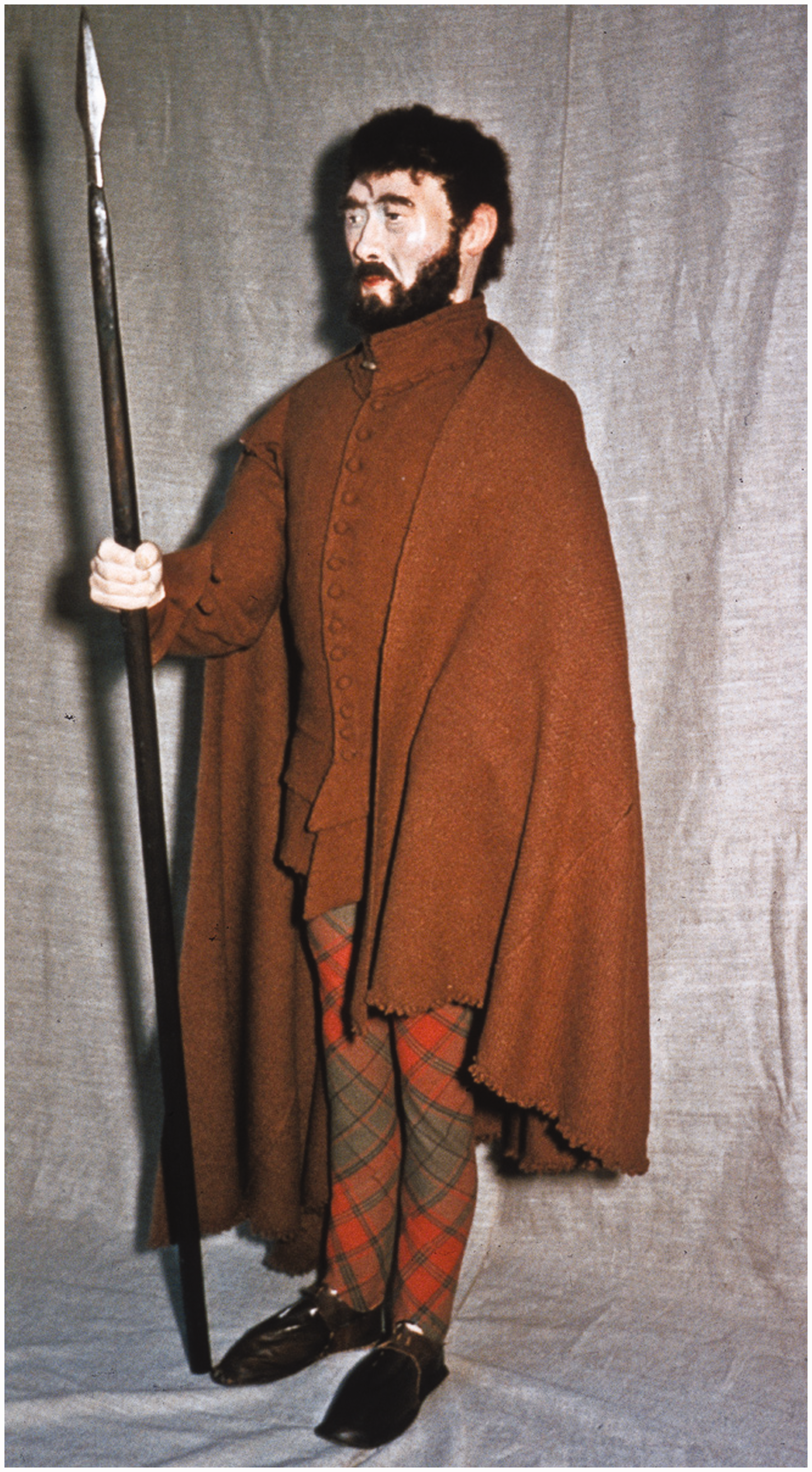
In post-conflict Northern Ireland, this debate between the cultural associations of the clothing must be understood as reflecting broader social divisions. The provisions of the 1998 Good Friday agreement and the 2006 St Andrews Agreement aimed to eliminate discrimination through ensuring parity between Northern Ireland’s two communities. In emphasising parity, however, the very boundaries separating communities in conflict become reinforced, rather than rethought. Government financial support for cultural activities of one community must be matched by funding for activities by the other community, thus funding for Irish language, associated with the Catholic, nationalist community, must be matched by equivalent funding to the cultural activities of a broadly drawn Protestant, unionist community. As such, the Department of Culture, Arts and Leisure now provides funding to the Ulster Scots Agency, or Boord O Ulstèr Scotch, to promote an Ulster Scots language in parity with support for the Irish language body, Foras na Gaeilge. But prior to the 1990s Ulster Scots was known only as a spoken dialect. The cultural politics of the peace process have elevated this dialect, derived from Lowland speech and associated with Presbyterian communities, to the status of a language, further reinforcing difference (Dowling, 2007).
The embodied character of the costume seemingly collapses the past into this present, but it has served more to reflect the desires of the observer rather than to divulge the experiences of its past wearer(s). Further complication is provided by the reproduction of the clothing as an exhibit, but one that is missing the physical traces of wear and repair so evident on the artefacts themselves. Rather than an ad hoc collection of mismatched hand-me-downs, the outfit has been transformed into an exemplar of early seventeenth-century fashion pertaining to one or the other community – but not to both. It has become a ‘costume,’ implying an intentionality and design at odds with the physical remains. In short, the biographies of the items, and the identity of their last wearer remain as much of a cypher as Twain’s essentialised naked subject. Reconsideration of the clothing provides an opportunity to explore the physical manifestations of hybridisation, mimetic practice, and at a more prosaic if no less critical level, the pragmatic accommodations of impoverishment and displacement in colonial settings. Looking more closely at the individual items of clothing via a biographical approach suggests a more interesting story and set of possibilities for the present and the future; also intersecting with considerations of the role of material culture in colonial identity formation and negotiation in other lands.
Clothing and early modern identity
In the sixteenth century, clothing was central to perceptions and projections of identity throughout the British Isles. Sumptuary laws restricted the wearing of certain fabrics and styles to recognised classes of people, objectifying status and normalising hierarchy (Entwhistle, 2000: 88–89). One quite literally could be defined by what one wore, with regional, ethnic, and national clothing styles featuring prominently in political discourse, with the assumption that clothing illuminated deeper cultural characteristics. Such a perspective is echoed by Ferdnand Braudel’s consideration of early modern fashion as not ‘trifling,’ but indicative of ‘deeper phenomena—of the energies, possibilities, demands and joie de vivre of a given society, economy, and civilisation’ (Braudel, 1981: 323). According such significance to sartorial expression increases the potential for and the power of subversion through strategically donned disguises. Code switching was easily facilitated by a change of clothes, while, following Bhabha (1985), the ready appropriation of clothing could serve as a potent means of challenging and undermining hierarchies.
Appropriation was facilitated by a vibrant secondhand trade which, alongside outright theft, provided access to forbidden garments (Lemire, 1988, 1990). Hand-me-down clothing also served as a form of payment, or accounted support, in many households (Jones and Stallybrass, 2000a: 19; Woodward, 1985). The increasingly rapid turnover of high status fashion, particularly in early modern England but also Anglo-dominated parts of Ireland such as Dublin, ensured that clothing items, or recycled fabrics, made their way down the social hierarchy. A late sixteenth-century assemblage of costly fabric swatches unearthed in Dublin attests to recycling. The material included ten fragments of Italian velvet, 24 pieces of silk, woollen cloths, and silken thread, with most scraps exhibiting evidence for reworking (Heckett, 2007: 457–459; Heckett, 2010). Clothing and cloth were costly, and the lifespan of garments, either as fashioned or deconstructed, could be considerable (Spufford, 2000; Woodward, 1985: 177).
The increasing desire for luxury clothing amongst London’s mercantile elite also helped to fill the coffers of the Livery Companies such as the Mercers’, Merchant Taylors, Clothworkers, and Haberdashers, all of whom were compelled by James I (VI) to fund his Londonderry Plantation scheme (Curl, 1986; Jones and Stallybrass, 2000a: 22). The Dungiven costume itself was found within the boundaries of lands granted to the Worshipful Company of Skinners. The Skinners’ Company were associated with the leather trade, a key component in the burgeoning fashion industry and one dependent upon a prime Irish commodity: cattle hides. Planters were also eager consumers of fashion, as underscored by extant port books for the Plantation settlements of Londonderry and Coleraine. Taking just the month of May 1615 as an example, six of the 28 ships reaching the two new ports carried fabrics and garments. The bulk of the cargo unloaded from the Hilbre-based Saray in Coleraine on 16–18 May consisted of cloth and clothing, including silk cloth and ribbons, ‘fine hats,’ girdles, bodices and an extensive selection of Italian, Dutch, Flemish and Spanish cloth; while the Mary of Neston, which docked in Londonderry on May 9th brought more basic items including unlined hats, woollen stockings, and lengths of fustian, kersey, flannel, and frieze (Hunter, 2012: 76–77, 36–37). Londonderry residents did not shun more luxury goods, as the Daniell of Leith brought Iberian commodities on the 19 May, including ‘Spanish silk’ alongside wine, raisins, salt and tobacco (Hunter, 2012: 36–37).
The mantle
For English observers in Ireland, the most Gaelic of all clothing was the mantle, a large woollen cloak that enveloped the body. By contrast to the strict differentiation of English sumptuary habits, the mantle was worn by all classes of Irish society, including both Gaels and the Old English (descendants of the twelfth-century Anglo-Norman invaders) and notwithstanding differences in quality, muted rather than proclaimed social differentiation. A late (if hardly unbiased) description by the poet Edmund Spenser (1596) in his allegorical poem The Faerie Queene encapsulates English anxieties about the mantle: ‘A fit house for an outlaw, a meet bed for a rebel, and an apt cloke for a thief… when it raineth it is his pent-house; when it blowth it is his tent; when it freezeth it is his tabernacle. In summer he can wear it loose; in winter he can wrap it close; at all times he can use it; never heavy; never cumbersome… it is light to bear, light to throw away, and being (as they commonly are) naked, it is to them all in all… besides all this he or any man else who is disposed to mischief or villainy may, under his mantle, go privily, armed without suspicion of any.’ Worse yet, mantles were worn by women as well as men, challenging English notions of gender appropriate apparel. Like many things Irish, English commentators were concomitantly fascinated and repelled by the mantle, its all-encompassing nature feared as a veil masking base savagery, yet alluring in its warmth and cover. The mantle, like the Irish, was cast as capable of deceit, and thus highly dangerous.
The Dungiven mantle (Figure 2) stands as an exemplar, being made of two lengths of coarse woven woollen cloth in a semi-circular shape which originally may have been over eight feet in circumference, with a length at the back of at least four feet. The use of narrow cloth rather than broadcloth suggests continuity from early medieval Irish weaving practices (Hodkinson, 1987: 48). The interior of the mantle is extensively, if haphazardly, patched with at least five different fabrics, some of which were cut down from other garments as evidenced by traces of original seams and stitches. The patches do not cover areas of wear and may have served as extra insulation. One large patch was left open, suggesting that it may have been stuffed with scraps of fabric or bundles of wool. This alteration of the garment to enhance warmth lends support to descriptions of the mantle as an all-purpose shelter, while also personalising and humanising this example. Hidden on the inside, only the wearer would be familiar with these enhancements.
The mantle.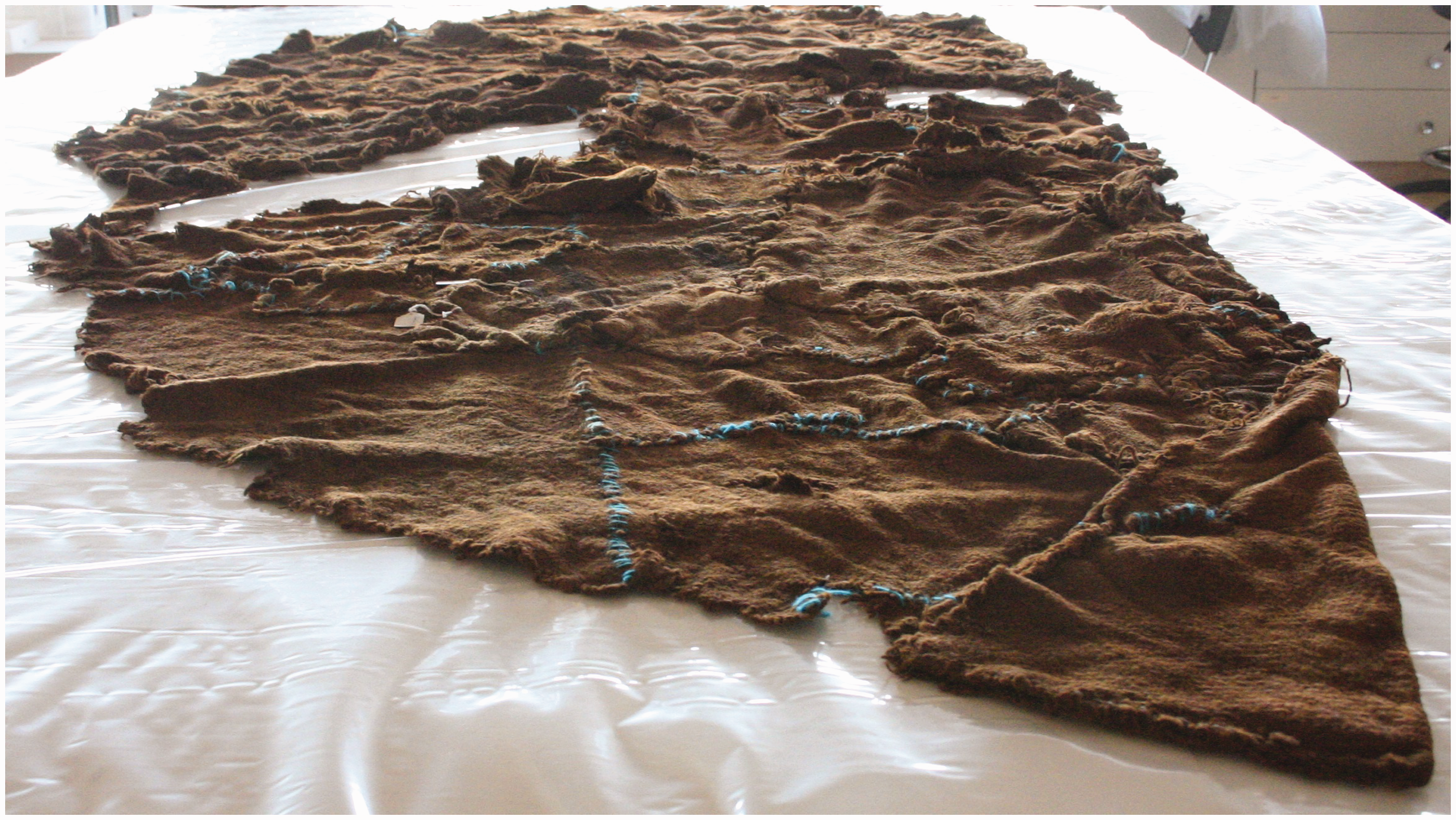
While viewed as a peculiarly Irish form of dress, the practical advantages of the mantle did not pass by the English. In 1597, Sir Henry Wallop recommended that English forces in Ireland adopt the Irish mantle, noting that ‘the soldier must here of necessity use a mantle at all times for his lodging at night, and to keep him dry in the day’ (Calendar of State Papers [CSPI], 1596–1597: 359). Wallop’s suggestion was not well received by William Cecil, Lord Burghley, who considered that ‘English apparel will do best for English men’ (12 August, CSPI, 1596–1597: 381) and that ‘mantles made of Irish frieze [were] an apparel far unfit for a soldier that shall use his weapon in the field’ (Burghley to Wallop 4 October, CSPI, 1596–1597: 413). Wallop’s suggestion was echoed two years later by Captain Thomas Lee (1599, in Maxwell 1923: 215) ‘for protection in all weathers and makeshift lodging at night,’ but was again rejected on cultural grounds: ‘Our difficulty in this article is that by this means the English shall become in apparel barbarous, which hath hitherto been avoided.’ In other words, by merely putting on an unfamiliar article of clothing, an Englishman could become Irish.
Cecil was far from the first to betray anxiety about English adoption of Irish clothing. Consider the 1537 Act for the English Order, Habit, and Language: Wherefore it be enacted…that no person or persons… shall use or wear any mantles, coat or hood after the Irish fashion… every the said person or persons having or keeping any house or household, shall, to their power, knowledge, and ability, use and keep their house and households, as near as ever they can, according to the English order, condition, and manner. (Maxwell, 1923: 112)
By this we can safely assume that some English servitors were wearing Irish mantles and running their households in distinctly non-English ways. Furthermore, the 1537 Act clearly did not work, as underscored by ordinances passed in 1571, stating that ‘the inhabitants of cities and corporate towns shall wear no mantles… but to wear clerk’s gowns, jackets, jerkins, and some civil garments’ (Perrot 1571, Cal. Carew MSS I: 409–411). In fact, the Irish mantle was readily appropriated by Londoners as an article of fashion. As early as 1505, mantles appear as recorded exports, with 2320 mantles shipped to Bristol (Jones and Stallybrass, 2000b: 136; Longfield, 1920: 84). Even Elizabeth I was portrayed resplendent in a brightly coloured cloak trimmed as an Irish mantle, illustrative of the appeal of Irish clothing as well as her desire for sovereignty over Ireland (Jones and Stallybrass, 2000b: 137; Neill, 1994: 29–31). The Queen also tactically employed the dress of other nations, sporting Spanish, French, and Dutch fashion according to political expediencies (Ashelford, 1996: 36). The Queen’s mantle is an illustration of mimesis: a million miles away from the Dungiven example in its appearance, its construction, its cloth and its intent. It is an imperfect copy, but one designed to imitate and to exemplify a power relation that is nonetheless undermined by its very existence; an existence that belies a fascination for the other (Taussig, 1993).
The doublet
The Dungiven doublet (Figure 3) is a more complicated item of clothing than the mantle, again made from woollen cloth but consisting of several discrete elements sewn together to produce a close-fitting doublet fastened with cloth buttons and buttonholes, and decorated with woollen piping, a double skirt, and a stiffened stand-up collar. A far more architectural piece of clothing than the mantle, the tailored nature of the doublet, and of Elizabethan fashion more generally, exemplifies the increasing desire for control over nature (after Keane, 2005; see Schneider, 2006: 208). The height and straight style of the collar suggests an original fabrication date in the period 1560–1570, while the double skirt, with a shorter skirt on the top, is more typical of the period 1550–1560 (Cunnington and Cunnington, 1970: 90–91). Use of herringbone slashing mimics the appearance of a more expensive leather jerkin (Dunlevy, 1989: 76). The jacket evokes the ‘civil garment’ recommended for urban inhabitants in the 1571 ordinance cited above. But the Dungiven doublet likely had multiple lives. Akin to the mantle, the jacket is extensively patched, with cloth added to line the interior and repair work to the sleeves and underarm area. Reinforced buttonholes suggest an ill fit for one of the wearers of the doublet (Henshall, 1961–1962; Dunlevy, 1989: 76–77).
The doublet.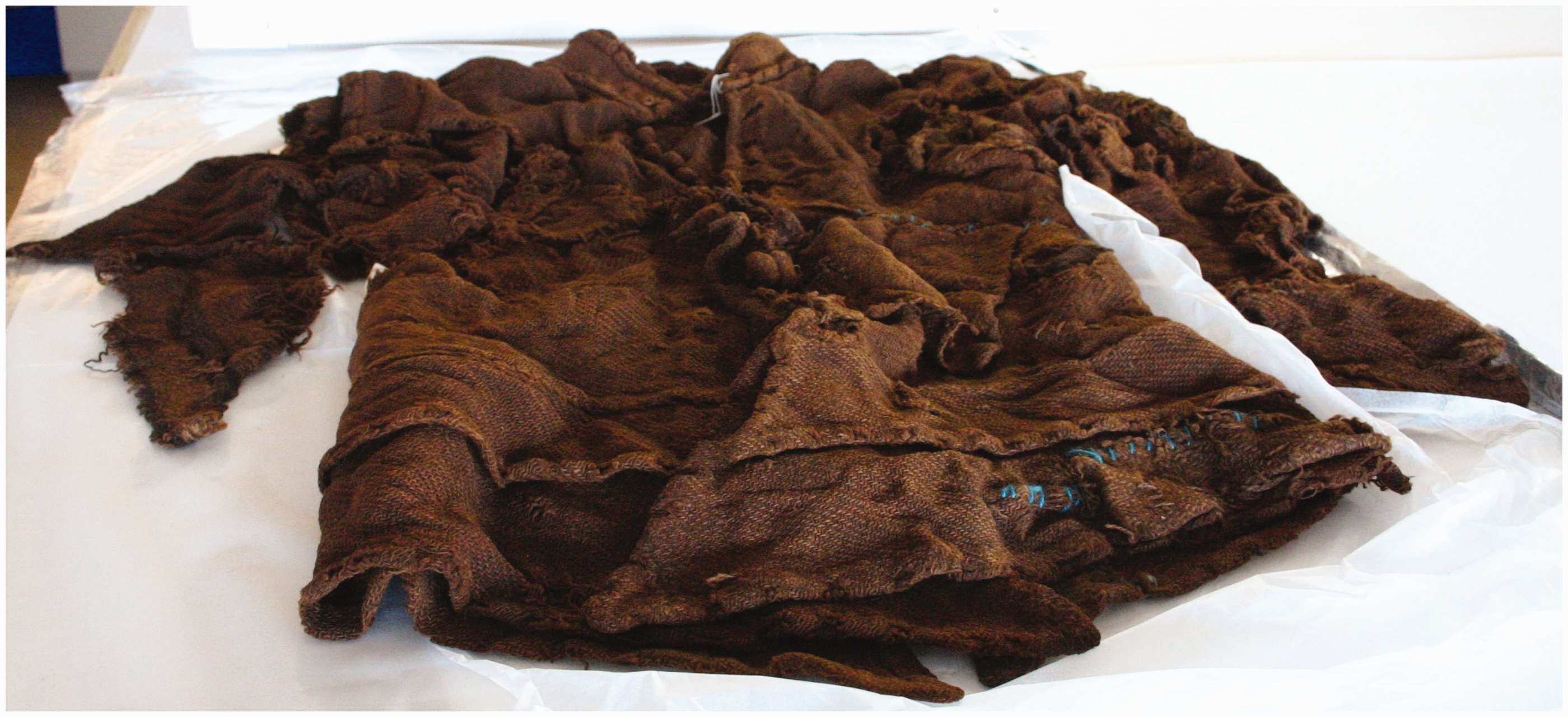
There are few comparable extant examples to assist in contextualising the Dungiven doublet. Doublets incorporated in museum collections (see Arnold, 1971) tend to be associated with the elite rather than the class of individual likely to have worn the Dungiven doublet. Somewhat analogous is a Scottish bog find. In 1975, turf cutters in Caithness unearthed the partially preserved body of a young man accompanied by a single article of clothing, a doublet of a mid-seventeenth century style made from a checked cream, red and green woollen fabric (Tarrant, 2001). While not patched, the Caithness doublet exhibits wear and fraying along the bottom edges. Of note is its construction, which relied upon careful piecing to ensure that as much of the original length of fabric was used (Tarrant, 2001: 325). In both cases, we have rare insight into the judicious use of costly fabric and the careful maintenance of clothing, indicative of the value to the now nameless, non-elite wearers.
So what is the meaning of a fashionable ‘English’ doublet worn in association with an ‘Irish’ mantle? The Irish, of course, were no more immune to English fashion than the English were to that of the Irish, despite the assertion of Viscount Edward Cecil Wimbledon (1626) that the Irish ‘disdain to sort themselves in fashion unto us, which in their opinion would more plainly manifest our conquest over them’ (see also Jaster, 2006: 55). Pictorial evidence for the selective adoption of English fashions can be found in the well-known woodcut by John Derricke (Figure 4) depicting an outdoor feast of the MacSweeneys of Donegal. While Derricke’s caustic portrayal was politically motivated (Morgan, 2007: 6), it is nevertheless notable that the MacSweeney chief sports a sleeveless leather jerkin. Such wearing of English fashions by Gaelic lords did not pass without comment, as in this bardic poem: ‘O man who follow English ways, who cut your thick-clustering hair… Pity that you have not seen your fault, O man who follows English ways’ (Mac an Bhaird, trans. Bergen, 1913).
MacSweeney feast, John Derricke 1585.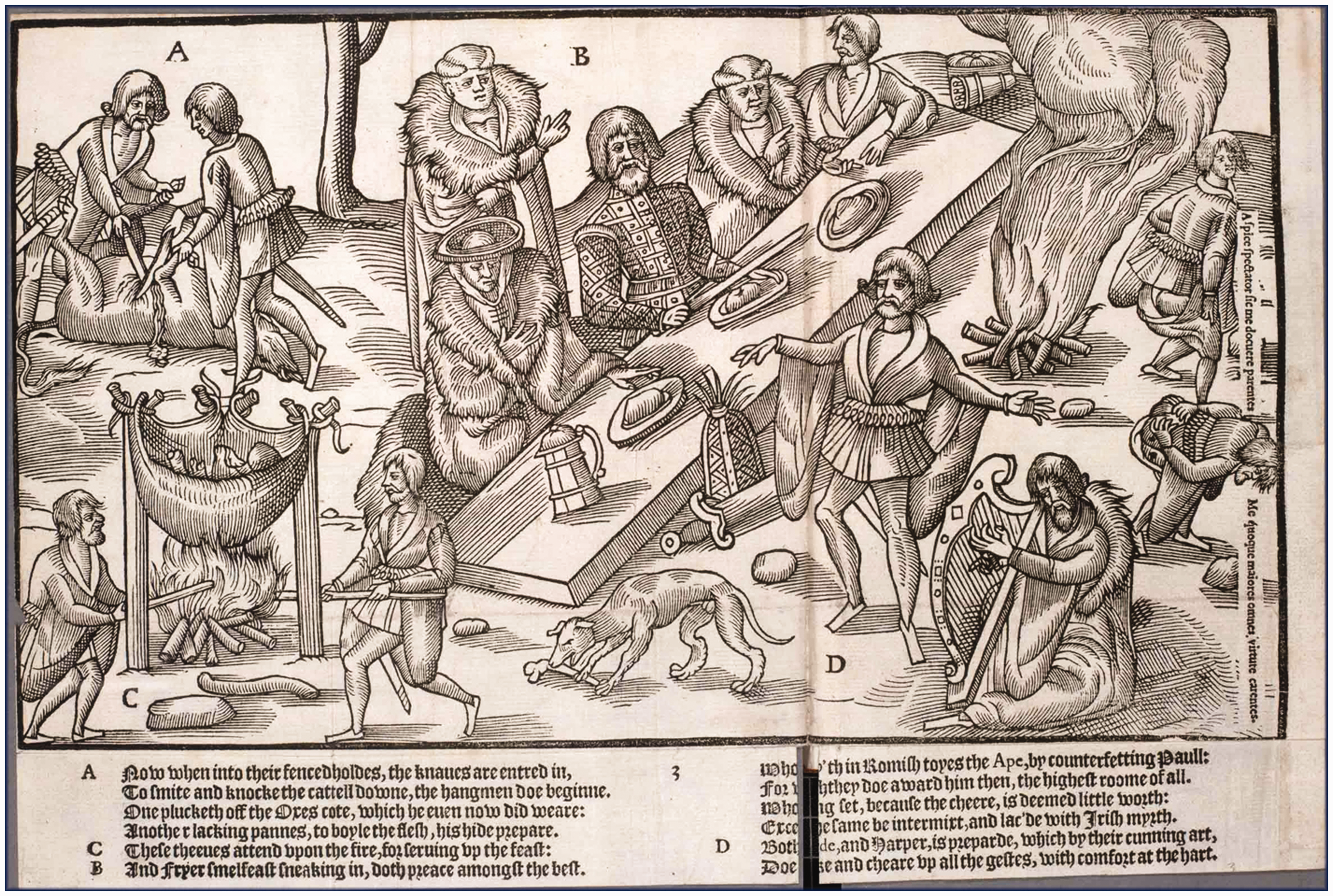
Such concerns about elite Irishmen adopting foreign frippery, and by extension endangering their cultural identity, appear to have been justified. While rare, luxury textiles such as continental silks and velvets have been found in Irish archaeological contexts (Wincott Heckett, 2007), while evidence from the Bristol port books underscores the increasing importation of cloth and clothing to Ireland (Flavin, 2011). It should thus come as little surprise that the Irish elite, both Gaelic and Old English, employed clothing as part of a strategy of code switching. When the powerful Old English Earl of Desmond and his wife Eleanor were under house arrest in London from 1567–1573, they dressed in English clothes. However, upon returning to their lands and tenants in Munster, the Earl consciously ‘put on Irish rayment’ – actively deploying clothing as a marker of identity (S.P., 63/43/6 i, Justice Walsh to Lord Deputie, 24 November 1573; Flavin, 2011: 106). In another example, a 1613 portrait of the Gaelic Lord Domhnaill Cam O’Sullivan Beare, then exiled in Spain, in the full dress of a Spanish knight reflects O’Sullivan Beare’s understanding of the intrinsic relationship between the clothing one wears and the identity one wishes to project (Morgan, 2010: 28–31).
The Trews
In the mantle and the doublet we have, respectively, Irish- and English-derived fashion. But what about the tartan trews (Figure 5)? Trews were a traditional Irish male garment featuring tightly fitted legs cut on the bias, but with a loose and full seat that facilitated activities like horse-riding. Two other examples have been recovered from Irish bogs. An extremely patched pair of plain woollen trews of probable late sixteenth-century date was found as part of a set of clothes in a bog near Thurles in County Tipperary in 1946, while an early seventeenth-century example was recovered from a bog at Killery in County Sligo; this pair features a checked pattern (McClintock, 1950: 64–65). The Dungiven trews exhibit much finer tailoring than these two pairs. Rather than being constructed of lengths of cloth folded around the legs and then stitched, as in the Sligo and Tipperary examples, the Dungiven trews are made up of individually cut pieces of cloth carefully seamed together (Dunlevy, 1989: 77). The other principal difference is in the fabric itself. Cloth used in Irish trews was often multi-coloured, but the Dungiven fabric, of checked design with red, green, brown, and yellow-orange, is much more suggestive of a Scottish origin. The tartan weave and the tailored construction may support the confident assertion of Wilfred Seaby (in Henshall et al., 1961–1962: 132) that the trews were originally ‘associated with a Highlander of rank.’ But here we move into the contentious territory that is research into Scottish tartans.
The trews.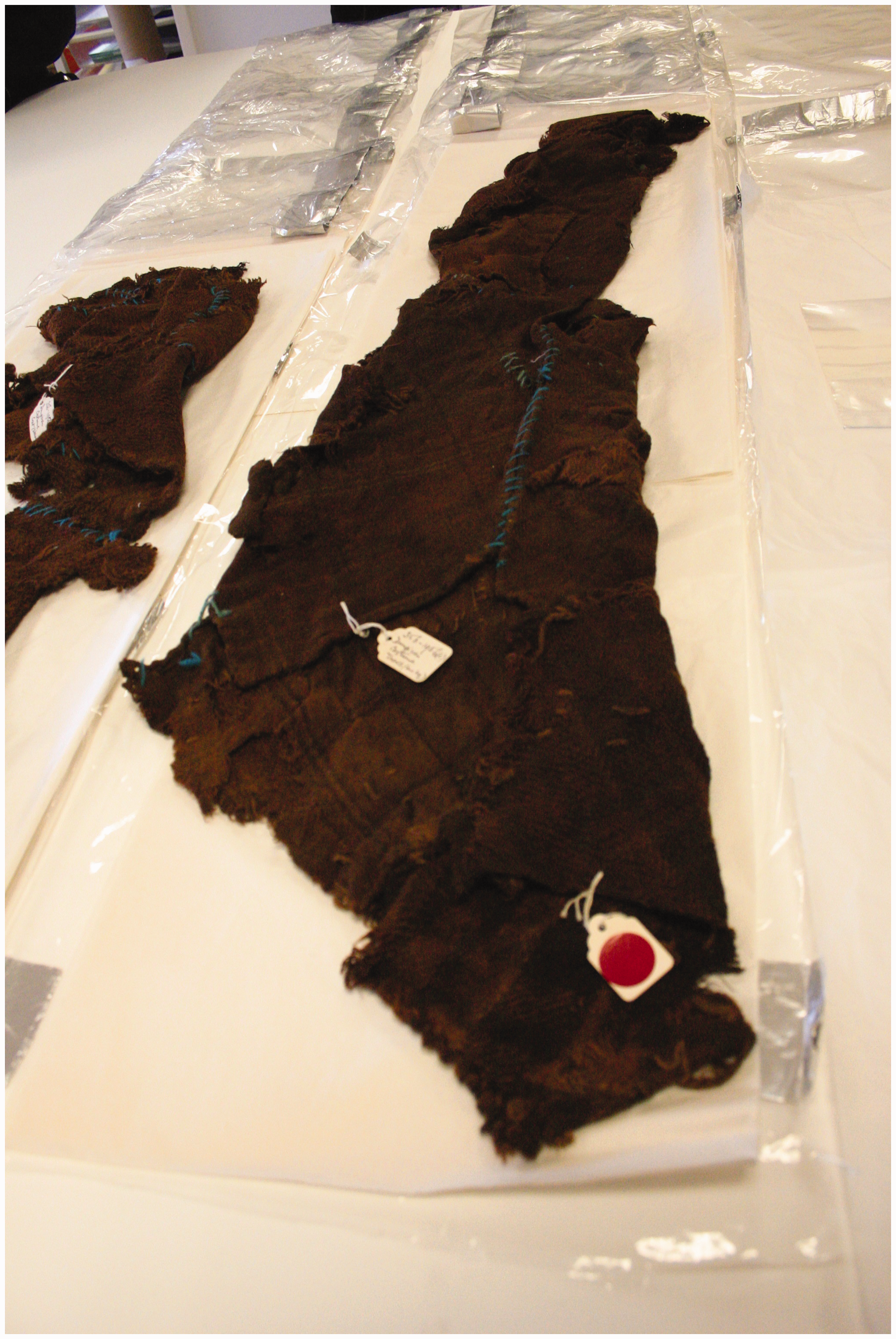
Tartan is a central theme in the emergence of an imagined Scottish national identity in the early nineteenth century (Brown, 2010; Nicholson, 2005). Tartan was and is employed to project an authentic Scottish identity, with patterns assigned to individual clans, both Highland and Lowland, in the nineteenth century (Trevor-Roper, 1983). But understanding tartan as an invented tradition brings us no closer to understanding the uses and meanings of the multi-coloured textile in earlier centuries. While striking and therefore memorable in appearance, the actual techniques for producing a tartan or plaid cloth from multi-colored yarns are straightforward, not the province of any particular region, and likely to have prehistoric origins (Cheape, 2010: 16). The earliest Scottish example is of Iron Age date, but it is the sixteenth and seventeenth centuries that are most pertinent here. Reference to tartan as an exclusively Highland phenomenon are generally attributed to the eighteenth century, yet the researches of Hugh Cheape (1993, 2010), building on that of Dunbar (1979, 1981), associate a plaid cloth with the late medieval Gaelic dress of the Highlands and Isles, and as an element of attire increasingly used during the seventeenth century to signify a Highland identity.
The complexities extend beyond the pedigree of tartan weaves, given the close linkages between society in Ulster and in the Scottish Isles which were formalised in the medieval period through the Kingdom of the Isles (MacDonald, 1997). In the sixteenth century, the MacDonnells of Islay furthered tightened their grasp on the territories of north Ulster, alternatively fighting with and against both Irish and English forces. Culturally, the Gaelic society of the Isles and that of Ulster were intimately connected through a mutually intelligible Gaelic language, a history of political unity and fragmentation, and shared cultural practices (Ohlmeyer, 1998, 2006). One shared tradition was the wearing of mantles. As described by John Major (1892 [1521]) ‘From the middle of the thigh to the foot they [Highland men] have no covering for the leg, clothing themselves with a mantle instead of an upper garment and a shirt dyed with saffron …’ A description from 1573 echoes the Irish association: ‘the Reidschankis, or wyld Scottis’ were ‘cloathed with ane mantle, with ane schirt saffroned after the Irisch maner, going bair legged to the knie’ (Dunbar, 1979: 27). References to the wearing of plaid trews instead of bare legs become more common in the seventeenth century (Gordon, 1841 [1641]; Dunbar, 1979: 35): ‘In the sharp Winter weather the Highland men wear close trowzes which cover the Thighs, Legs, and Feet….The trowzes are for Winter use; at other Times they content themselves with short Hose, which scarce reach the knees.’
A Highland association is plausible given the close linkages between the north of Ireland and the Isles, but those same linkages render it pointless to delineate a Scottish versus Irish identity. What is certain, however, is that the present day attempt to view the trews as a distinctly Ulster Scots garment is untenable, given that Ulster Scots identity today has been consciously styled as emerging solely from Lowland Protestant origins.
The shoes
Moving on from the ‘Irish’ mantle, the ‘English’ doublet, and the ‘Highland Scottish’ trews, what about the leather shoes? The surviving fragments of uppers and soles (Figure 6) are of a brogue type, typical for Ireland in this period, and similar to those depicted in an early seventeenth-century map of the O’Neill inauguration ceremony during which a shoe is cast over the head of the new clan chief (National Maritime Museum map catalogue P49[25]; Andrews, 2008; Horning, 2013: 79–82; FitzPatrick, 2004: 143). Like the mantle, the Irish brogue attracted negative English commentary. In his rebuke of Wallop’s request to use mantles, Burghley derided ‘Irish brogues of calf skins or sheep skins’ by comparison with ‘ good shoes of neat’s leather out of England’ (CSPI, 1596–1597: 413), although he may have been more concerned about protecting the English leather goods industry than protecting soldiers from culturally inferior footwear. By contrast, English commentator Luke Gernon (1904 [1620]) noted that Irish brogues were more ‘rudely sewed’ than shoes, ‘but more strong.’
The shoes.
Aspects of the Dungiven shoe construction hint at multiple lives as well as the creativity that characterises material adaptations in colonial settings. Late medieval/ early post-medieval Irish shoemaking techniques relied upon leather thongs to join together the component parts (Lucas, 1956). The Dungiven example exhibits thong holes on the upper and on the soles, but the soles are joined to the upper by use of woollen thread—a method employed more commonly by English cobblers (Grew and den Neergaard, 1988; Swann, 1973; Thomson, 1981). The woollen stitching appears to be original, while the traces of flat thong stitching on the sole are suggestive of a later repair (Henshall et al., 1961–1962: 135). The shoes thus appear to have begun their life having been fashioned by an English-trained cobbler, but later were reconditioned and repaired by a craftsperson more familiar with Irish thong construction.
We can view the Dungiven shoes as hybrid artefacts, paralleled decades later by shoes found in a well in the Londonderry plantation village of Salterstown, which similarly exhibit Irish thong and English stitch construction and speak to the creative amalgamation of craft practices (Miller, 1991: 601–609). On another level, and regardless of any material associations with cultural identity, it is clear that the shoes were repaired numerous times in a bid to extend their life. To what extent considerations of ‘foreign’ cobbling techniques were at the forefront of the mind of the wearer, who sought to cushion and protect their feet, remains an open question. Scraps of leather that could be refashioned into thongs may have been more readily available than spun woollen thread, while thong work required less specialist skill than stitching. However pragmatic the repair work, the shoes still embody the entanglement of cultural practices (and the attendant imperative for creativity) that constituted early modern social relations in Ulster.
The wearer
In the Dungiven costume we have elements drawn from three different cultural traditions, reflecting the conflicting allegiances on the ground in early modern Ulster. At some stage in the life histories of these articles of clothing, they came together and were worn by an unknown individual who perished unremarked and unremembered in a bog in the territory of the O’Cahans, lands refigured as the Londonderry Plantation. We can fairly safely assume that the wearer was male, given the gender-specific elements of the clothing. Perhaps he was a soldier in the English, Scots, or Irish forces, or a displaced Irish labourer or O’Cahan kern, or even an impoverished English worker brought to Ireland to transform the land into the idealised order promised by Plantation. The extensive patching and repairs suggest that our wearer did not have the economic means to replace what were already second-hand clothes. The tantalising threads of his clothes provoke some key questions. How significant was it for the wearer that his clothing reflected multiple cultural origins? Would he have stood out for his mix and match approach to attire, or was the material blending, and the creativity it implies, the norm rather than the exception?
Given the dearth of routine supplies for Elizabeth’s forces in Ireland, ordinary soldiers in the English forces (which included Irish as well as English conscripts) were likely clad in hybrid outfits. Those not in the military service of the Irish, English, or Scots would nonetheless have also directly felt the effects of conflict and violence. The reports of Fynes Moryson (1617), secretary to Lord Mountjoy who commanded English forces in Ireland during the Nine Years’ War, are explicit in describing widespread starvation and disease resultant from the scorched earth policy employed by the English. While subject to propagandist hyperbole, it is clear from his account that Ulster’s population suffered considerable hardship. Those seeking to keep their bodies clothed may have taken whatever was available.
Ultimately, unfamiliar items gain new meanings in juxtaposition with the familiar. The Dungiven costume is clearly ambiguous in its cultural associations – but perhaps deliberately so. It occupies Homi Bhabha’s ‘third space’ (1994: 50–56): a zone of contestation and negotiation transcending the boundaries that Fredrik Barth (1969) viewed as designed to ensure and reify differences. Aspects of the outfit would have been familiar to any observer, serving as a standpoint from which to understand the wearer, and a means upon which to base communication. Taking this analysis one step further, and following Bhabha’s (1994: 54) rejection of hybridity as the product of a combination of static cultural identities, the outfit also speaks to hybridisation as a process rather than as an outcome through highlighting the intersection of material biographies driven as much by accident as by intention. Such an understanding intersects with broader archaeological considerations of hybridity (e.g. Silliman, 2013).
A final significant question relates to how the individual was changed by association with his hybrid outfit. Given its personal nature, many societies view clothing as imbued with the wearer’s presence, an essence retained by the article of clothing even after the wearer relinquishes ownership (as Norris, 2004 discusses for India). Whether purchased, bequeathed, bartered, stolen, or even removed from a body on a battlefield, the final wearer would have been cognisant of the past lives not only of the his garments, but of the multiple lives of the ancillary elements – for example, the five different squares of tartan cloth that were cut and expediently sewn onto the interior of the mantle, in some cases fixed atop other patches. The materiality of the clothing, and the visceral experience of wearing, demanded awareness of past embodiment. The irregular patches on the trews would have abraded the skin; just as whomever was compelled to reinforce the buttonholes and repair the sleeves of the doublet was acutely aware through its uncomfortably tight fit that the jacket was originally sewn for someone smaller.
Comparative colonial context
Notwithstanding Ireland’s ambiguous colonial identity, the complicated biographies of the Dungiven costume demand comparisons with the centrality of clothing in the construction and contestation of colonial identities across space and time (e.g. Loren, 2010). Examinations of the indigenous adoption of selected elements of European costume in the Americas have often focused upon the manner in which colonisers employed clothing as an active agent in programmes of Christianisation, wherein the metaphorical nakedness of Native people was countered through Christian conversion and the imposition of European-style clothing (Loren, 2001). Materialising her Christianisation, English fashions were famously adopted by the daughter of the leader of the Powhatan paramount chiefdom in the Chesapeake region. Variously known as Pocahontas, Matoaka, and on conversion, Rebecca, her new identity as an English woman, clad in tightly tailored bodice with close ruffed neck, was captured in a portrait by Simon Van de Passe and popularised through a 1616 engraving by Compton Holland (Vaughn, 2006: 83–86). In nineteenth-century southern Africa (Comaroff and Comaroff, 1997), Christian missionaries also employed apparel in an attempt to convert and control the local population in an analogous effort to combat perceived physical and spiritual nakedness. These efforts were confounded by the ready willingness of local people to consume clothing but not necessarily Christianity. But such discourses of nakedness are not directly translatable to the Irish case, given the (Catholic) Christianity of the Irish as well as the readiness of at least some of the English to adopt Irish fashions such as the mantle.
Closer parallels can be seen with the changeability and mobility of fashion in early modern Ireland, and the manner in which dress could both impose and confound new identities. Aspects of Spanish dress were selectively employed by Native elites in colonial Mexico as a means of asserting status (Rodríguez-Allegría, 2010); much as the aforementioned MacSweeney chief may have employed his leather jerkin to materially proclaim his knowledge of English attire appropriate for an elite leader. Elsewhere, European meanings were ignored or subverted. In colonial Delaware, Lenape elites adopted Swedish-made frieze coats that had originally been produced to clothe orphans. Rather than accepting or acknowledging their original social meaning, through a process of inversion the Lenape transformed the coats into a potent material indicator of significant social and political status (De Cunzo, 2013: 201).
Even when European clothing became the dominant form worn by indigenous and African and African-descendant labourers in colonial America, individuals altered dress and distinguished themselves via personal adornments. Manhanset labourers on the seventeenth-century Sylvester Manor plantation on Shelter Island, New York, may have employed the rolled copper pieces found in excavations to augment their clothing (Hayes, 2013a: 113). The Manhanset at Sylvester Manor were part of a pluralistic community incorporating Native Americans, Europeans, and Africans in which the negotiation of identity was mediated through material culture, exemplified by hybridised ceramic vessels exhibiting European style handles but employing Native- and African-derived technology (Mrozowski, 2010; Hayes, 2013b). And just as the English in Ireland appropriated local fashions, so too did colonisers in other lands. Anxieties over the sartorial habits of French fur traders and soldiers, which included the adoption of Native deerskin clothing, permeate many official and unofficial reports from eighteenth-century Canada (Mann, 2007: 38).
Conclusion
The Dungiven costume speaks eloquently to the active role of sartorial expression in processes of identity negotiation in colonial settings, while also reflecting the lasting legacy of early modern encounters in the contestation of contemporary identities. Whether or not the wearer of the Dungiven costume was an impoverished Irish O’Cahan kern, or nameless, disappeared English plantation labourer, or lost Scottish MacDonnell mercenary, he constructed his life below the level of political manoeuvering documented for more elite members of society. Yet far from being untouched by encounter, now nameless individuals like our wearer were often the first brokers of cultural change, thrown together to fight the battles or to provide the labour for what may have been seen as an ever interchangeable procession of overlords. Their engagements with the visceral materials of the everyday reveal the creative accommodations and adaptations necessitated, constrained, yet also facilitated through encounter. The wearer may or may not have been consciously concerned about the multiple pedigrees of his clothing and the ambiguities of its idiosyncratic appearance but he most certainly would be bemused by its changeable significance and varying portrayals in the twentieth and twenty-first centuries. Regardless of how self-aware he was of his appearance and all that was implied by his hybrid outfit, our nameless protagonist was ultimately central to the transformation of cultures in early modern Ulster.
Finally, the remarkable survival of his tattered yet storied clothing provides a rare window into the material character and complexities of identity formation, with real relevance to the ongoing negotiation of identity in contemporary, post-conflict Northern Ireland. Demonstrating that relevance, the costume and its multiple meanings are slated to feature in the refurbished history gallery of the Ulster Museum. An updated, multimedia presentation highlighting the cultural ambiguity of its components and the potential stories associated with the wearer is explicitly designed to challenge visitors to reconsider traditional understandings of the stark character of the plantation process and, by extension, to reconsider the fixed nature of identities in contemporary Northern Ireland. The social value of this new formulation in a land where only eight percent of schoolchildren are educated in an integrated (Catholic and Protestant) environment cannot be overstated.
Footnotes
Acknowledgments
This research received no specific grant from any funding agency in the public, commercial or not-for-profit sectors. I thank William Blair, Siobhan Stevenson, and Fiona Byrne of the National Museums Northern Ireland for access to the costume and for embracing its interpretive potential, and the Dixon family for the opportunity to see the tartan cloth in their possession. Nick Brannon helpfully wielded his red pen, while Liz Thomas provided research assistance. I benefited from discussions with Stephen Mrozowski, who generously commented on a draft. Elizabeth Wincott Heckett kindly shared her knowledge of Irish cloth and clothing, and Susan Flavin provided a copy of her excellent PhD thesis. I am grateful to the three anonymous reviewers for their valuable comments.