



Abstract
Today, monuments and archaeological sites are often specific targets for violence. But rather than casting this as either collateral damage or the result of ignorance and incivility, it can be argued that the material world, in all its widely varied forms, is enmeshed in conflict and violence. This can be better understood in terms of the haptic significance of objects caught up in extreme and traumatic circumstances.
The point of departure for this paper is W.J.T. Mitchell’s concept of the “traumatic gap” that emerges as “the unrepresentable space between words and images”. I show that where the normative breaks down, the haptic qualities of media can assume far greater significance. Books and pictures become objects as well as semiotic registers and graphic representations. Understanding this – the “X” that Mitchell uses to designate the emptiness between the normal meanings of words and images – requires and enables an archaeology of violence. Taking a cue from Mitchell’s formulation, I show how the particular qualities of this space can be expressed in a new algorithm, “image ←→ object ←→ text”.
This space – Mitchell’s “presence of an absence” – can only be filled by things that are neither images nor texts in their conventional sense. This is demonstrated by the extreme of the torture cell, where the most mundane of everyday objects become both normalized in the careful, systematic records of the military operative, and terrifying in the experience of the prisoner. Here, the figure of the Hooded Man, leaked from the clandestine archive of Abu Ghraib, serves as an emblem for the horror of contemporary violence; both executioner and victim, torturer and prisoner, both the Christ-like posture of the saviour and the horror of beheading.
Object, image, text
The central argument in this paper is that, in order to better understand violence, the ways in which objects, images and texts are intertwined also need to be better understood. Objects, from the monumental to the mundane, constitute the material world. Images and texts are also objects: photographic prints and digital projections; books, scrolls and inscriptions. As archaeological assemblages, objects, images and texts are caught up in the representation and instrumentality of violence. To reveal this dimension of violence is to better understand violence itself.
Since its earliest years, the practice of archaeology has been close to violence, given the association between fieldwork, the collection and appropriation of antiquities and colonial expansion. Archaeologists have been drawn into concerns about the destruction of cultural property and the restoration of heritage after conflicts and wars. Today, monuments and archaeological sites are widely known as specific targets for violence: a consequence of widening spheres of seemingly intractable conflicts and ubiquitous digital media. Here, a signal event was the destruction of the Bamiyan Buddhas in Afghanistan by the Taliban regime in 2001. In 2013, Islamist rebels in Mali systematically destroyed libraries and manuscripts in Timbuktu. In late 2014 and through 2015, Islamic State (IS) insurgents in Iraq and Syria began to destroy monuments, museums and libraries in areas over which they had taken control, including Nimrud, Mosul and Palmyra. This is Gonzalez Ruibal’s (2008) “archaeology of supermodernity”; the “landscapes of destruction” characteristic of our times.
A prevalent response to these circumstances has been to insist that there is a level of heritage, defined by aesthetics, uniqueness or monumental association, which should be kept outside fields of conflict, respected by all sides. This belief led to the framing of international conventions for the preservation and protection of cultural property after Second World War and the devastation of cities across Europe from aerial bombardment. It remains the reference point today (UNESCO, 2015). This is evident in UNESCO’s response to the attacks on world heritage. In the face of the possibility of the imminent destruction of the Syrian site, UNESCO Secretary-General Irina Bokova appealed “to all parties concerned to protect Palmyra and leave it outside their military activity”. This is to assume that the IS, which has made its mark by filming the beheading of civilian hostages and circulating these videos across the Internet, is amenable to the conventions of warfare that applied in the last century.
This stance has been mirrored in media reactions. Here, for example, is the response by a leading British newspaper to the first threats to Palmyra: “the loss of Palmyra would be a cultural atrocity greater than the destruction of the Buddhas in Bamiyan. It is hard to think of deliberate vandalism to equal it, despite the grim examples offered by the last hundred years”. In order to defend Palmyra, the writer advocates an alliance between the United States and the Assad regime in Syria, widely condemned for war crimes that had included the use of chemical weapons: “the protection of something this exceptional and precious overrides almost any other consideration” (Moore, 2015).
There is, though, a different way of approaching the difficult and complex relationship between cultural heritage and violence. Rather than casting damage and destruction as either collateral or the result of ignorance and incivility, it can be argued that the material world, in all its widely varied forms, is enmeshed in conflict and violence. These entanglements may be inadvertent, the consequence of significances that are outside familiar verbal and optical registers. They may be tactical; deliberate provocations, or attempts to erase all physical traces of an enemy from the landscape. They may also be grounded in belief, following particular interpretations of religious imperatives. While each circumstance demands its own careful analysis, the more general point here is that violence can best be countered by careful, theoretically informed analysis rather than by an a priori and outraged defence of civilization (Holtorf and Kristensen, 2015).
This point was made by Meskell in the immediate double aftershock of the destruction of the Bamiyan Buddhas in Afghanistan and of the World Trade Center in New York: There has been an almost deafening cry over the ‘antiquities’ toll in the devastated and war-ravaged Afghanistan. While many of these reported incidents are not new, they have suddenly been foregrounded as a result of Operation Enduring Freedom, American politics, and more cynically, by the U.S.-backed desire for the UNICAL pipeline that would potentially traverse the country. (Meskell, 2002: 563)
Then, as now, the relationship between cultural heritage, archaeological practice and political trade-offs was complex. Media representations are partial and selective. Deeper probing reveals how moral certainties are compromised by two centuries of excavation and export to museums in Western capitals. While vigorously protesting the danger to world heritage sites, neither the United States nor the United Kingdom has ratified the 1954 Hague Convention against the destruction of cultural property (Meskell, 2002).
My argument here is that the object world has particular, and significant, ways of conveying meaning through time. This has been a rich and productive strand in understanding the relationship between the material world, memory and identity, founded in the work of Bergson, Benjamin and Yates (Benjamin, 1968; Bergson, 2004; Yates, 1966; see also Gonzalez-Ruibal, 2013; Hall, 2013; Olivier, 2011; Olsen, 2010). I develop this approach further by looking for the haptic significance of objects in those circumstances where our normal understanding of the world is overwhelmed by the imminence of violence.
In its narrower meaning, haptic is the sense of touch, the ability to grasp. Haptic facilities are also central to proprioception – the position of the body in the world. In addition to touch, proprioception is enabled by shape, smell, sound and taste, and by the sense of time in things around us; their stillness, motion and impressions of transience or durability. Haptics, in this broader sense, enable proprioception – our conscious and subconscious understanding of who, and where, we are and our sense of our imminent relationship to the people and things around us.
These properties of the material world are well expressed in Pallasmaa’s “haptic architecture”: materials and surfaces have a language of their own. Stone speaks of its distant geological origins, its durability and inherent symbolism of permanence; brick makes one think of earth and fire, gravity and the ageless traditions of construction; bronze evokes the extreme heat of its manufacture, the ancient processes of casting and the passage of time as measured in its patina. Wood speaks of its two existences and time scales; its first life as a growing tree and the second as a human artefact made by the caring hand of a carpenter or cabinetmaker. These are all materials and surfaces that speak pleasurably of time. (Pallasmaa, 2000)
Pallasmaa is interested in the positive qualities of the haptic – in ways of countering the superficiality of architectural obsession with the visual. My concern is with the opposite – with negative qualities, exposed in circumstances where violence or the fear of violence is pervasive. My working proposition is that, in the face of the extreme and traumatic disruption of violence, haptics assume a particular importance.
My point of departure is two thoughtful and productive studies by W.J.T. Mitchell. In his essay “Image X Text”, Mitchell shows how, in the face of violence, a “traumatic gap” emerges as “the unrepresentable space between words and images”, “blank spaces in which something unpredictable and monstrous might emerge”, where “something rushes in to fill the emptiness” (Mitchell, 2012). This concept augments his study of the representations of direct violations to the body that have become the signature of the “war on terror” and its aftermath; the widely circulated images of desert beheadings and of torture in US detention centres such as Abu Ghraib and Guantánamo Bay (Mitchell, 2011).
Because images and texts are also objects, the haptic properties of the ways in which they are carried and conveyed – their media – may assume a disproportionate significance. A photographic print may be an object of horror. A book may cause revulsion. This is because a text is both the conventional symbol of a semiotic register as well as the medium that carries it: a scroll, tablet, page in a book, words on a computer screen. An image is both conceptual form – metaphors and graphic symbols such as pictures, drawings and representations of objects. It is also its medium: a negative, a print on paper, a liquid crystal display. Under normative conditions the object properties of images and texts are subservient to graphic representation and to the semiotic register. We watch and read, and take secondary notice – often negligible – of the haptic properties of the media that carry the images and words. But where the normative breaks down, the haptic qualities of the media can assume far greater significance. Now the text and the image become as much – and sometimes much more – than just semiotic registers and graphic representations.
This attenuation of meaning in circumstances of traumatic violence may confer particular, and powerful, properties on the photograph (Barthes, 1980; Marks, 2000; Olin, 2012; Sontag, 1977). For both Barthes and Sontag, the photograph is a harbinger of death; “a trace, something directly stencilled off the real, like a footprint or a death mask” (Sontag, 1977: 69). Marks uses the concept of “haptic visuality” to understand the power of images for people caught between national identities, and Olin develops the idea of “tactile looking” in the ways that photographs were deployed in the traumatic aftermath of the attack on New York on 11 September 2001. Taken to these extremes, the haptic qualities of the image (or text) as an object become as significant as the information content of the visual or semiotic registers that were formerly their primary purpose.
One instance can stand for the general propensity for the haptic qualities of the medium to be conflated with, and potentially overwhelm, the registers of the image and the text. In 1992, the Serbian army attacked Sarajevo. Here is a report from the front line, an account of a Serb raid on a Croat artist’s studio: Serbian soldiers broke into his studio looking to steal money and equipment. They were incensed to discover an Islamic levha – a calligraphic inscription from the Koran – which the painter had mounted as a wall hanging. They took it down and, cursing, butchered it. According to witnesses, they then took all the artist’s paintings, drawings and sketches, lined them up against the front wall of the house and executed them with machine-gun fire until they were in shreds. (Lovrenovic, 1994; see Hall, 2002)
I argue that this space between words and images is where objects assume particular significance. Understanding this – the “X” that Mitchell uses to designate the emptiness between the normal meanings of words and images – requires and enables an archaeology of violence. Taking a cue from Mitchell’s formulation, I show how the particular qualities of this space can be expressed in a new algorithm, image ←→ object ←→ text. In turn, this algorithm helps understand the power and complexity of contemporary attacks on “untouchable” heritage such as Nimrud, Mosul and Palmyra.
Understanding violence
While there have been innumerable attacks on cultural heritage since the Hague Convention of 1954, the contemporary faming of these issues is inseparable from the rapid and unexpected ascendancy of the IS and the threat to a range of states across the Middle East and North Africa that centres on Syria and Iraq.
Following their capture of the city of Mosul in mid-2014, IS militia were reported to have destroyed libraries and archives: the Sunni Muslim library, the library of the Latin Church and Monastery of the Dominican Fathers, and the Mosul Museum Library (Hall, 2015). In February 2015, the IS released a video of militants destroying artefacts in the Mosul Museum with sledgehammers and drills. The video also showed the destruction of Mosul’s Winged Bull, an Assyrian protective deity from the seventh century BC (Shaheen, 2015). In April, the IS distributed a further video of their destruction of the 13th century BC city of Nimrud (Guardian, 2015). The following month, IS insurgents captured Palmyra. The motivation for this strategy is a combination of religious belief, the financial opportunities in the illicit antiquities trade and the ability to command global media attention (Barnard and Saad, 2015).
More generally, however, violence saturates our contemporary world, resulting in a taken-for-granted quality that is part of its efficacy. Mignolo (2011), sees the monocentric colonial matrix of these last five hundred years as defined by “the expendability of human lives”; for Maldonado-Torres (2008), violence is the definitive condition of Western modernity. This tendency towards naturalization was addressed by Arendt (1969). Writing at a time when the prevalence of violence was particularly attenuated – from police responses to anti-war protests to the prevalent fear of nuclear Armageddon – Arendt observed the general assumption that violence is “simply” an aberrant outcome of the use of power. She explored this relationship further in her well-known, and still contentious, study of the Eichmann trial in Jerusalem, giving us the concept of the “banality of evil” (Arendt, 1994). Fanon – Arendt’s contemporary – was also centrally concerned with the problem of violence, which he saw as inherent in both colonization and decolonization (Fanon, 1963, see also Mbembe, 2001).
It is this naturalization of violence that is important here. Naturalization can come from denial, from the refusal to see. But it can also come from saturation; from the banality of evil, from the physical violence inherent in every interaction between the colonizer and the colonized. Here, Zizek (2008) makes a useful distinction between what he terms “subjective violence” and “objective violence”. Objective violence is inherent in the normal state of things and therefore invisible because it is the standard against which normality is defined. Objective violence may be embedded in language and behaviour, or systemic, “the often catastrophic consequences of the smooth functioning of our economic and political systems”. In contrast, subjective violence is the experience of individual actors, set in terms of what is perceived to be normal. Zizek argues that this distinction between subjective and objective forms of violence establishes a deceptive circularity in which the combination of symbolic codes and systemic violence are assumed to be the “non-violent zero level” and personally experienced – subjective – violence becomes an aberration (Zizek, 2008). For Zizek, this iterative relationship ensures that violence saturates everyday life.
In the terms of my argument here, it is this invisibility of objective violence that is important. Because such objective violence is everywhere but nowhere, it is managed within the everyday interpretations of images and texts. This, though, makes the subjective violence of personal experience all the more effective – terrifying – because it cannot be anticipated through these normative codes of everyday life.
This invisibility defines the epistemological area for an archaeology of violence. This space – the “presence of an absence”, a deficit of meaning – can only be filled by things that are neither images or texts in their conventional sense. A set of appropriate concepts is required in order to understand how these “things” work.
The opportunities here are evident from recent work in Latin America; in the landscapes of destruction left by the violently repressive regimes of Latin America. Between 1920 and 1990, fifteen Latin American countries were controlled by military juntas usurped civil systems of government with the discrete support of the United States (Dinges, 2004; Feitlowitz, 1998; Klein, 2007; McSherry, 2005). Repressive measures included detention, torture and murder (Funari et al., 2010). At the core of these regimes was the erasure of the body, establishing a new and large category of persons known only in memory; los desaparecidos, “the disappeared”. The numbers of the disappeared are estimated at 1500 in Brazil, 3000 in Chile, 5800 in Peru and 30,000 in Argentina. The majority of the disappeared remain unaccounted for. Bodies were usually disposed of in common, unmarked, graves or dropped into the ocean from helicopters (Funari et al., 2010). This is the space – the “traumatic gap” – where the conventions of everyday images and words fail.
One of Buenos Aires detention centres was the Club Atlético, located in the Federal Police warehouse’s basement on Paseo Colón Avenue. As with most such facilities, there is no surviving documentation and there are no bodies. The building has since been razed. For the families of the Club Atlético’s victims, there is no closure. Given this context, archaeological work at the Club Atlético site has been a powerful intervention in this landscape of destruction. Floor plans have been reconstructed from the accounts of survivors and then tested through excavation. In turn, this research has established the mechanisms of repression and de-humanization: the central torture chamber and the surrounding holding cells where prisoners were kept hooded, and in handcuffs and leg-irons (Hall, 2010; Zarankin and Niro, 2010).
Zarankin and Niro’s work at Club Atlético is exemplary as both an archaeology of violence and for offering some degree of closure for the relatives of los desaparecidos who need ways of organizing memory. In addition, and of particular relevance here, their text breaks down the mechanisms of separation between subjective and objective violence and, in so doing, interferes with the ways in which extremes such as torture and state murder – disappearance – become assumed as a new level of normality (Zizek, 2008). This is because Claudio Niro is both the co-author of the archaeological report and also a survivor of detention and torture – one of those who did not disappear.
Niro was held at Vesubio, a clandestine detention centre in the Mantanza district of Buenos Aires: I was hooded and my hands were tied at my back. Meanwhile, the individuals insulted me and hit me, forcing me into a room. Once inside, they made me stand against a wall with my legs wide open. Several torturers kicked my testicles once and again.
He was then held in a “cucha”, “dog house”, a small room where four or five people were hooded, handcuffed and leg-ironed to walls and to each other; “once in the ‘cuchas’, kidnappers forced us to take off our clothes and wear brown uniforms they had previously handed us in. This procedure made us lose – along with our clothes – all traces of an exterior life”.
Returning to the ruins of Vesubio, Niro recognizes some red tiles, the material traces of the bathroom floor: I closed my eyes and thought: camp remains and horror. I remembered the time they made us wait in front of the operation theater, while we heard screams of pain, chamamé music, and the executioners’ voices. At that moment, I asked myself how the torture would be like, and if I was going to stand it. It was impossible to know the answer. My body and my partners’ bodies shook. Fear. I was forced into the operation theater. They took my hood off and I was blinded by the light. A loud voice asked me to collaborate. I recognized it: it was Vasco’s voice. Four guys held me tightly, undressed me, soaked me up, and tied a wire to my big toe. They started electrocuting me with another wire. Emptiness. I did not actually know for how long they tortured me. I felt they took my soul out of me. They finally took me completely hurt to the ‘doghouses’ with my partners. (Zarankin and Niro, 2010)
There is a strong undercurrent of continuity between clandestine US support for the Latin American dictatorships of the 1970s and 1980s – Operation Condor (McSherry, 2005) – and the devices and strategies of the “War on Terror” that was declared in September 2001. Here understanding the methodology of violence can be augmented by an appreciation of the haptic qualities of the objects that become dense with meaning when the conventional references of images and texts become inadequate.
This is particularly apparent in the evidence of state-sanctioned torture that began to leak into the Internet in 2004. Images made in the genre of family snapshots or holiday mementos horrify through their extraordinary ordinariness; Arendt’s banality of evil. Torture logs terrify because they document the routine procedures of officials doing their jobs.
Together, they evoke a world – the United States of America – in which every aspect of life is saturated by violence. This set of circumstances was anticipated by Arendt: the greater the bureaucratization of public life, the greater will be the attraction of violence. In a fully developed bureaucracy there is nobody left with whom one can argue, to whom one can present grievances, on whom the pressures of power can be exerted. Bureaucracy is the form of government in which everybody is deprived of political freedom, of the power to act; for the rule by Nobody is not no-rule, and where all are equally powerless we have a tyranny without a tyrant.
In the face of such deficit of meaning – the comprehensive inadequacy of the conventional image and record – the haptic qualities of hitherto ordinary objects become apparent. Here, for example, is what we know of the fifty-four days over which Detainee 063 was interrogated at Guantánamo Bay.
1
The state’s methodology included prolonged sleep deprivation, 48 20-hour interrogations and forced nudity; prolonged stress positions and unremitting noise; forced nakedness and wearing of women’s underwear; wearing a leash, barking and performing dog tricks; undergoing forced enemas and intravenous drips (Danner, 2014). The interrogation log shows how everyday technologies and objects are mustered. Here are some extracts, with emphases added: “Day 1: 0225: The detainee arrives at the interrogation booth at Camp X-Ray. His hood is removed and he is Day 6: 0635: Detainee Day 10: 1030: Control began “birthday party” and Day 19: 0001:Detainee Day 24: 0400: Showed detainee
In their careful and systematic deployment of violence, the US Army interrogators’ objective is to deprive 063 with any sense of his position in time or in space; to deny him any coherent sense of proprioception. Within the traumatic gap of the interrogation cell – a landscape of violence – sparse and decrepit furnishings and found objects assume haptic qualities that, for the victim, are terrifying: swivel chair, party hat, birthday cake, flag, national anthem, banana rats, pig, wooden booth, trash.
The torture cell – whether in Argentina, Guantánamo Bay or elsewhere – utilizes at the extreme the saturation of everyday objects with meaning. This where Zizek’s objective and subjective violence come together; where violence is both normalized through the careful, systematic records of the military operative, while experienced as terrifying, subjective, by the victim. The prisoner’s sense of physical self – proprioception – is disabled by elevating the ordinary into the terrifying through the haptic properties of objects, images and texts. At this form of “zero point” the epistemic violence of forms of representation converge with the corporeal destruction of the human body – of life itself.
Archaeology and violence
Just as Meskell, writing at the beginning of the trajectory of violence that would follow in the “war on terror”, paired the destruction of the World Trade Center with the Taliban’s dynamiting of the Bamiyan Buddahs, so the atrocities of the IS can be paired with the revelations of US state-sanctioned torture. In the same way that the US legacy of complicity in the violence of Latin America’s dictatorships compromised claims to ethical principles in responding to the Taliban insurgency, so the legacy of Abu Ghraib compromises the idea of a “higher”, apolitical commitment to cultural heritage.
Mitchell has captured this pairing in what he calls the “synthetic icon” of the “Hooded Man” from the Abu Ghraib archive. This image, now circulating continuously across the Internet and downloaded innumerable times, evokes both the crucifixion of Christ and the beheading of the victims of contemporary terrorism (Figure 1): it reminds us of Jesus. A new kind of Jesus, admittedly, one whose tormented face is concealed from us, and whose poise at this moment of stress is transformed by still photography into an indelible icon of what a Christian nation accomplished in its crusade to liberate the Middle East. (Mitchell, 2011).
Photograph by US military personnel, Abu Ghraib Prison, Iraq, 2003. Public Domain.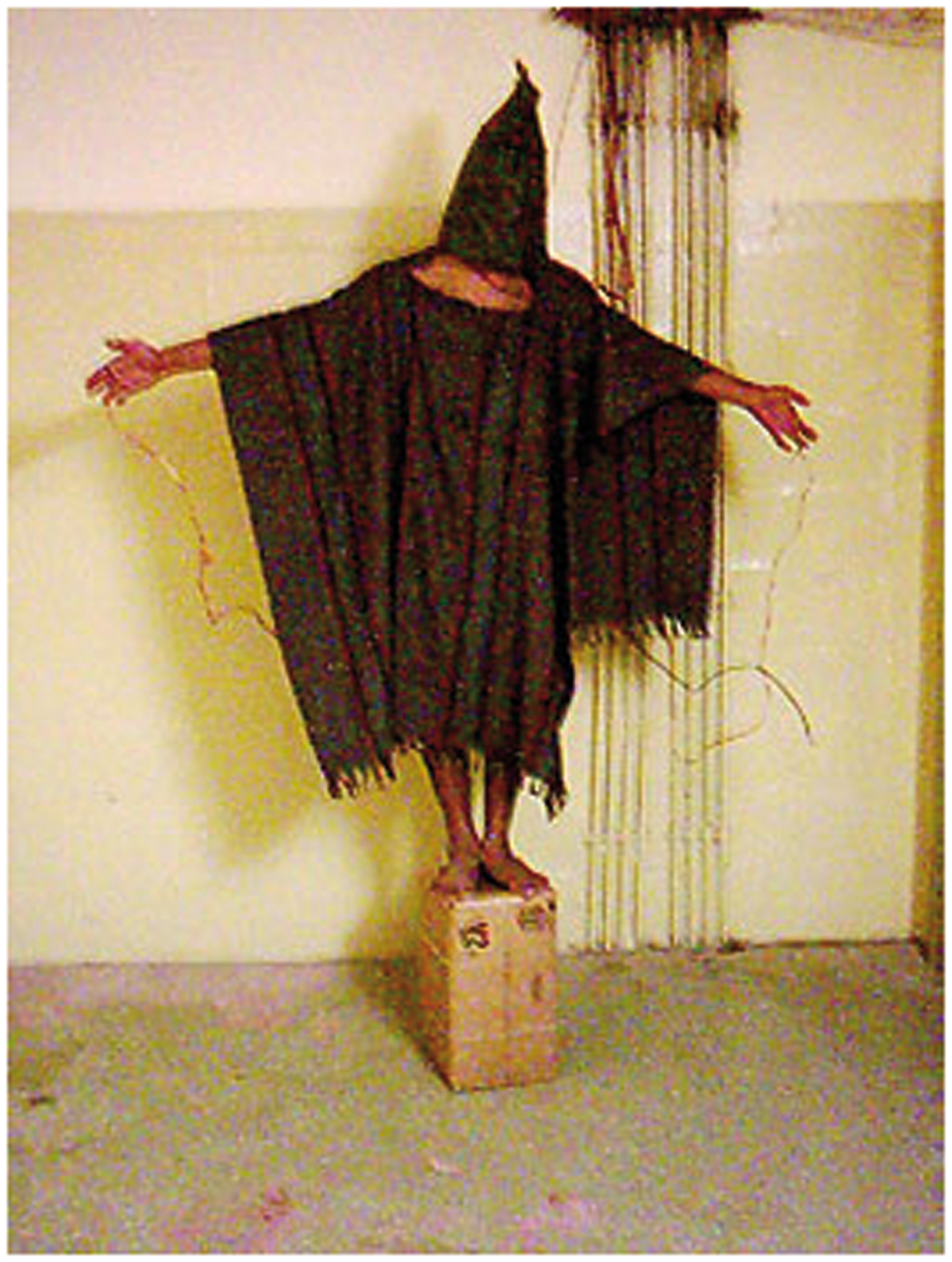
Seen from a different angle, the synthetic icon of the Hooded Man stands for the significance that the haptic properties of objects can assume in circumstances of extreme violence. When the web of objective normality is ripped apart, these sets of haptic meanings occupy and characterize the resulting space. These senses of violence conveyed by the object world do not, and cannot, replace the conventional image or text; an alternative language of things is a logical impossibility. What rather happens is that haptic properties that are usually taken for granted – tacit – assume attenuated significance in the face of the inadequacy and impotence of everyday images and texts.
A characteristic of this space that opens between images and texts in circumstances of extreme violence is, then, that the haptic attributes of the object can interact with the ways in which the image is seen and the text is read. In these kinds of circumstances the book and the photograph become something different. Rather than being unknown and unknowable, as Mitchell (2012) suggests, a new algorithm is required, one that expresses the transformative power of the object world through an archaeology of violence, whether in the context of the Latin American regimes, America’s torture camps or desert beheadings in Iraq and Syria: “image ←→ object ←→ text”
In conclusion
Olin’s work on “tactile looking” in response to the destruction of the World Trade Center complements Meskell’s observations just after the September 2001 attack: we are witnessing the desire for grounded materiality at a staggering rapidity, to apprehend the objects and physical signs of a newfound heritage in real and tangible ways. This familiar desire for material commemoration and the physical marking of the event, is juxtaposed against the realization that the attacks (and the subsequent war on Afghanistan) have been experienced through virtual means. The events of September 11 have inaugurated a resurgence of the real, and of the violence of the real, supplanted within a supposedly virtual universe. (Meskell, 2002: 559)
The increasingly difficult years that have followed, bracketed by the destruction of the Bamiyan Buddhas by the Taliban in 2001 and the capture of Palmyra by the IS in 2015, have demonstrated the inadequacies of established conventions and protocols for the recognition and protection of cultural property. These inadequacies were clearly demonstrated at the point of Palmyra’s capture by the IS in May 2015. While invariably represented in the media as a desert city of dramatic ruins, Palmyra has a population of some 50,000 and hosts the notorious Tadmur Prison where Syrian dissidents have long been held. Famous for Queen Zenobia, who stood against the Roman Empire, Palmyra had been a stronghold of opposition to President Bashar al-Assad’s regime. Endorsement for the UNESCO position on world heritage would have required a military alliance between the United States and al-Assad’s government, which has been widely accused of genocide (Barnard and Saad, 2015). In situations such as these, the argument that heritage, and archaeology, should be outside politics is itself a political impossibility.
The prospectus for an archaeology of such violence, outlined here, addresses the inevitable implication of archaeology in modern-day conflicts by arguing for the theorization of the role of the world of objects in these extreme and attenuated circumstances. This requires the work of imagination. To imagine is to organize the bricolage of experience and impressions around a purpose or an inspiration – memory work. Imagination is the opposite of what Mignolo (2011) calls the “hubris of the zero point”; the knowing assumptions of the rules of the world. By starting from memory, experience and imagination – from the subjective – such an archaeology of violence is positioned against the relentlessness of reincorporation into objective normality; against the nonchalant acceptance of the violence of colonization (Fanon, 1963; Mbembe, 2001); against the banality of evil (Arendt, 1994); and against the inevitability that the subjective experience of violence will be calibrated into a systematic ontology and taken as expected for the future (Zizek, 2008).
Here the ordinary – the banal – is as revealing as the spectacular and monumental. The paraphernalia of the prison cell and torture chamber – everyday things and found objects – can become terrifying both in their immediate use and in recalling memories that are widely shared. As Mitchell anticipated, the experience of violence has taken a significant new turn through the revelations of state-sanctioned torture by the US and the saturating effects of digital information. Things that are, under usual circumstances, taken for granted become terrifying as the usual and anticipated meanings of texts and images become redundant and overwhelmed (Mitchell, 2011, 2012).
I have proposed a methodology for understanding this absence by adopting the concepts of the haptic and of proprioception to understand how the meanings of the object world can overcome the conventions of text and image; of their objective normality. Through working with allied methodologies such as semiotics and cultural and visual studies, that which goes on in the “X” can be mapped and understood. This expanded understanding is expressed in the algorithm “image ←→ object ←→ text”. In the void of extreme violence, the haptic properties of the object can overwhelm the usual registers of the image and the text; photographs become momenta mori, books are burned.
The figure of the Hooded Man, leaked from the clandestine archive of Abu Ghraib, serves as an emblem for the horror of conventional violence; both executioner and victim, torturer and the victim of torture, both the Christ-like posture of the saviour and the crusader. The price of Abu Ghraib and Guantánamo Bay has been this linkage. The inevitable entanglement of archaeological practice with the instrumentality and politics of violence is all the more evident today. The danger in not addressing this through the intellectual work of theorization and the application of knowledge is that the traumatic gap that Mitchell identifies remains a vacuum of meaning and becomes the new normality that Zizek sees as inevitable. This, and the possibility of ameliorating the social injustice and violation of rights that are the inevitable consequences of violence, is why an archaeology of violence will prove to be of growing importance.
Footnotes
Acknowledgements
I am grateful to the Pitt Rivers Museum Research Seminar in Visual, Material and Museum Anthropology, Oxford University, and the Centre for Humanities Research, University of the Western Cape, for discussion, debate and valuable comments on earlier versions of this paper.
Declaration of conflicting interests
The author(s) declared no potential conflicts of interest with respect to the research, authorship, and/or publication of this article.
Funding
The author(s) received no financial support for the research, authorship, and/or publication of this article.
