



Abstract
In 2015, Pope Francis elevated Franciscan missionary Junípero Serra to sainthood, reinforcing the association between the California missions and the founding of Euroamerican colonies in western North America. Yet the canonization also leaves this discourse, and its associated narrative of indigenous decline, open to critique. Here, I examine two developments that effectively recast the California missions as distinctly indigenous places that embody both struggle and perseverance. First, Serra’s canonization offers a platform for Native Californians to raise concerns about the historical and continuing impacts of the mission system. Second, the canonization coincides with new archaeological and ethnohistorical investigations of indigenous life in colonial California that illuminate how native people persisted despite the challenges of missionization. Taken together, these developments intersect ongoing efforts to reorient public interpretive programs at California mission sites to show their complex indigenous histories and the enduring consequences missionization has had for indigenous communities today.
Introduction
On September 23, 2015, Pope Francis canonized the 18th-century Franciscan missionary Junípero Serra, an event that exemplifies the deeply entrenched association between the California mission system (ca. 1769–1840s) and the origins of Euroamerican settlement in western North America. Despite the intense focus on Serra as an historical individual, his elevation to sainthood may mark a lasting break from Eurocentric interpretations of the mission system by exposing the fragility of California’s founding narrative and its reciprocal narrative of indigenous decline. Here, I examine two converging critiques that effectively recast the California missions, hitherto seen by many as romantic European establishments, as fundamentally indigenous places that represent complex histories of Native Californian persistence. First, the decades-long canonization process has provided a platform for Native Californians, whose ancestors experienced missionization firsthand, to highlight the negative and continuing impacts of the mission system for the region’s indigenous people. Second, the increased attention on the missions, within the context of Serra’s canonization, coincides with advances in archaeological and ethnohistorical research on colonial California that have illuminated the complex ways that indigenous people negotiated the constraints of missionary colonialism. These two developments—indigenous activism and recent scholarship—in turn intersect ongoing efforts to restructure the interpretive apparatus at California mission sites in fundamental and meaningful ways.
Like the Columbian quincentenary of 1992, Serra’s canonization calls into question deeply entrenched colonial narratives. In California, the region’s 21 Franciscan missions serve to anchor the European history of the region while simultaneously marking the passing of local indigenous groups into a mythical past (Dartt-Newton, 2011; Panich, 2013; Rawls, 1992). These intertwined stories can be seen, respectively, as founding narratives and terminal narratives–tropes that are common in colonial histories elsewhere in North America (e.g. Cipolla, 2013; King, 2012; O’Brian, 2010; Wilcox, 2009; and see Lydon, 2009: 252–253). Even though a typical California mission housed more than 1000 native individuals during the peak years of the mission system (and was home to only one or two European missionaries and a handful of colonial soldiers from New Spain), demographic realities are turned upside down at contemporary mission sites. There, the heritage landscape features restored mission churches, imposing adobe quadrangles, and fancifully reconstructed gardens. This pattern is consistent with other foundational sites from colonial North America where the physicality of the Euroamerican built environment anachronistically eclipses indigenous presence within or beyond particular colonial outposts (Handsman, 2008; Hantman, 2008). Given such exclusions, there is often a disconnection between how the general public perceives the heritage of colonial places and the indigenous histories that such places necessarily intersect (Gallivan and Moretti-Langholtz, 2007; Ireland, 2015; Rubertone, 2008; Smith, 2006). As in the celebrations honoring Columbus discussed by Trouillot (1995: 118), the public interpretations of missions and other colonial establishments frequently “impose a silence upon the events that they ignore, and they fill that silence with narratives of power about the event they celebrate.”
Yet dominant discourses also open space for dissent (Graham et al., 2000: 258), and despite their silences, historical narratives are continually made and remade in multiple ways ranging from academic histories to heritage sites to popular media (Trouillot, 1995). As descendant communities and scholars seize on this inherent malleability to create native-centered interpretations of colonialism, a crucial tension emerges over whether the focus should be on persistence—often summarized by the phrase, “We are still here”—or the struggles that native communities endured to survive successive waves of colonialism (Cipolla and Hayes, 2015). As exemplified by the inaugural exhibitions at the National Museum of the American Indian, many question whether it is sufficient to highlight the continued presence of native people without explicitly naming and interrogating the obstacles that such communities have overcome (Atalay, 2006; Lonetree, 2006). In the academic realm, these issues intersect a renewed focus on indigenous agency under colonialism. In particular, archaeologists are considering the complex ways that the interested action of native groups and individuals structured the developments of the colonial period (Ferris, 2009; Jordan, 2008; Scheiber and Mitchell, 2010; Silliman, 2009).
In light of these insights, the recent canonization offers an opportunity to change the discourse surrounding the contested histories of the California missions. Junípero Serra has been the subject a long scholarly tradition, culminating in a recent spate of research timed to coincide with the 300th anniversary of his birth, but also serendipitously with his canonization (Beebe and Senkewicz, 2015; Hackel, 2013; Thomas, 2014). Native Californians, whose histories comprise the crux of the current debate, remain in the background in much of the scholarship on Serra and the public interpretation of the Alta California mission system. This pattern mirrors the broader understandings of Spanish missions, like similar colonial outposts worldwide, as distinctly European places despite the demographic and material realities that structured the incorporation of colonial places into indigenous worlds (Schneider and Panich, 2014). These issues of contextualization extend forward into the present as indigenous people, archaeologists, and other scholars grapple with how heritage sites are used to mobilize particular narratives and identities, as well as how to balance the violence of colonialism with indigenous persistence in both academic and public interpretation (e.g. Atalay, 2006; Smith, 2006). In California, a key understanding stressed by indigenous activists and scholars alike is that the missions were, quite literally, indigenous places. This convergence offers an opportunity to build native-centered narratives that recast the California missions as sites of both struggle and perseverance.
Saint Serra and the legacies of the California missions
In 1749, Junípero Serra left his home in Mallorca to work as a missionary in New Spain. He spent nearly two decades in central Mexico, both at the Colegio de San Fernando in Mexico City and in the existing Franciscan missions of the Sierra Gorda, before sailing to Baja California in 1768 eager to preach among unconverted indigenous groups. After overseeing the founding of one mission on the Baja California peninsula, Serra advanced northward in 1769 to establish the Alta California mission chain. There, Serra helped found nine missions before his death in 1784, after which another 12 were eventually established (Figure 1). These missions, as part of a time-tested tripartite colonial strategy that also included military presidios and civilian pueblos, were intended to secure Spanish claim to the far western periphery of its North American colony. In California, Serra and his contemporaries drew on centuries of Franciscan missionary experience throughout the Americas as they sought to transform the region’s indigenous hunter-gatherers into an agrarian peasantry. To do so, they resettled individuals and families from multiple autonomous polities at head mission establishments where missionaries and a contingent of colonial soldiers maintained a stringent schedule of prayer and labor. Although Serra and other Franciscans struggled with military officials for political control of the colony, they largely retained oversight of California’s vast indigenous population, whom they viewed as children in need of strict spiritual and practical guidance (Hackel, 2005, 2013; Lightfoot, 2005). The missions were officially secularized in the 1830s, with many continuing to operate in various capacities until the American annexation of California in the late 1840s.
The Franciscan missions of Alta California.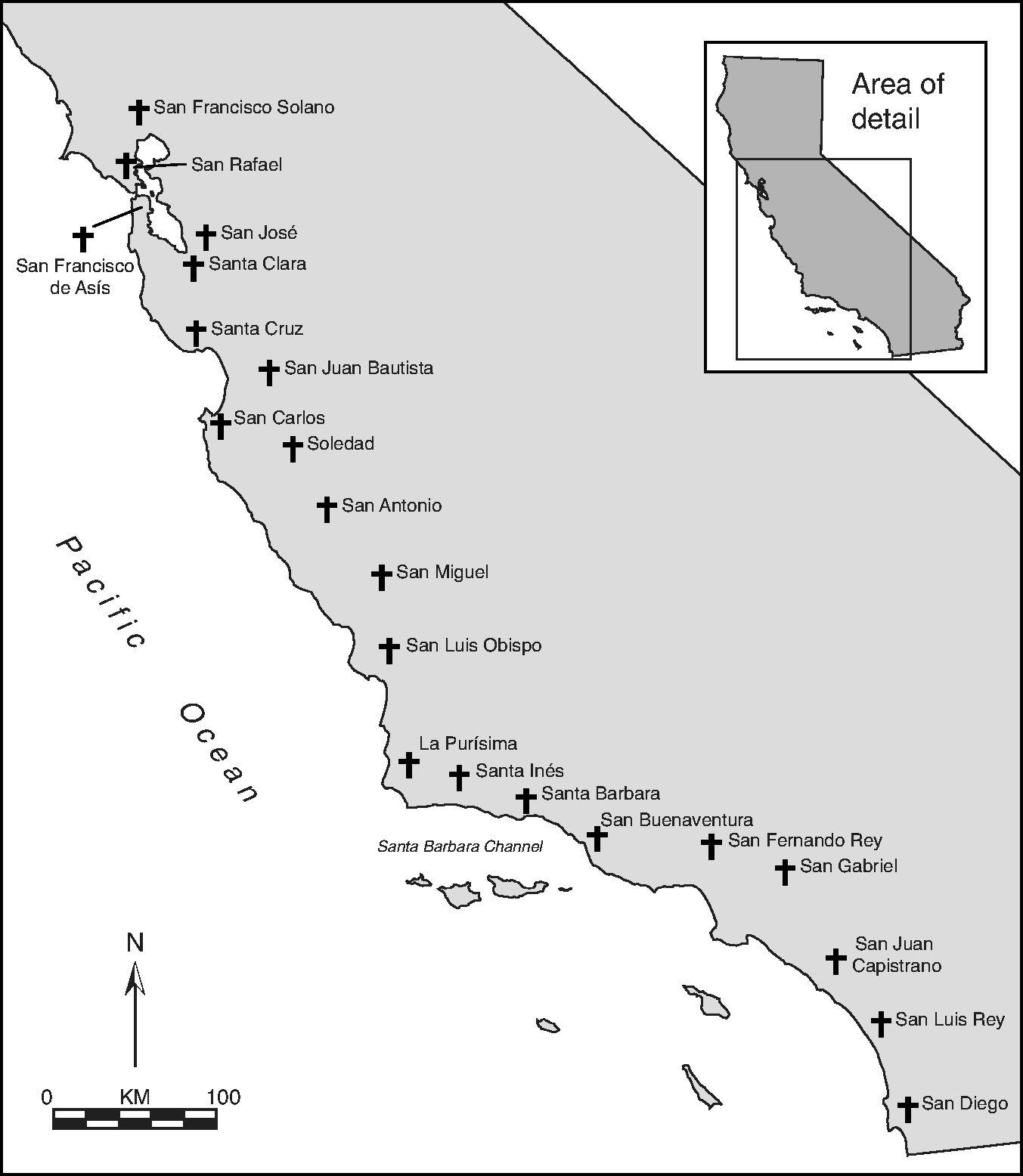
For his role in establishing the Alta California mission system, Serra has been heralded as “California’s founding father” (Hackel, 2013). The public understanding of the mission system he established, however, has undergone several major transitions (Rawls, 1992). Even during their operation, European and American observers were censorious of the way Franciscan padres treated Native Californians, likening the situation to that of enslaved Africans in the Caribbean and American South. Although such accounts may have been colored by anti-Spanish sentiments, the early American-era settlers of the mid-19th century were satisfied to leave the aging adobe missions to crumble into ruin. It was not until the waning decades of the century that the missions were resurrected, both physically and in popular imagination. Spurred in part by the publication of Helen Hunt Jackson’s novel Ramona in 1884, the missions became symbols of an idyllic past that offered a selling point for real estate developers and rootedness for Anglo-Americans who migrated to the region (Rawls, 1992; Thomas, 1991). Less than a century after the last missionaries left their posts, mission-based tourism, mission-style architecture, and even mission pageants all reinforced a direct link between modern California and a romantic, European foundation. Serra was similarly touted, and his likeness was recreated in public monuments and his name came to adorn city streets, schools, and businesses (Figure 2). It was within the context of the Spanish Revival of the early to mid-20th century that the efforts to canonize Serra were launched. The next phases occurred in the mid-1980s, as the historical work on Serra’s life was concluded, the pope initiated the pathway to sainthood, and Serra was officially deemed Venerable and then Beatific (Sandos, 1988).
Statue of Junípero Serra overlooking Interstate 280 near San Francisco. Photo by the author.
Despite the central role of the state’s Franciscan missions in the founding narrative of modern California, many questioned whether Serra’s sainthood could be reconciled with the brutal realities of missionization. Native Californians were at the forefront of this critique, which also drew on the work of several California anthropologists and archaeologists (e.g. Costo and Costo, 1987). The debates of the 1980s simmered over into broader discussions about the significance of the Columbian quincentenary, but questions regarding Serra and the legacies of the California mission system again came to the fore in early 2015 when Pope Francis announced his intention to complete the canonization process. Immediately, Native Californians and others spoke out on the issue. Some tribes passed resolutions of condemnation and others penned open letters to Pope Francis to express their views. For example, Valentin Lopez, the Chairman of the Amah Mutsun Tribal Band, wrote that Serra’s canonization would reinforce the message that the Church “does not care about our true history or our historic trauma” (Lopez, 2015). As the canonization drew closer, the opposition became more vocal in traditional and social media outlets, including an anti-canonization Facebook page. Protests were held at several missions (Figure 3), and the “Walk for the Ancestors,” led by a mother and son team, brought Native Californian people together at mission sites across the region (http://walkfortheancestors.org). By late September, an online petition opposing Serra’s sainthood had garnered more than 10,000 signatures (Carac, 2015).
A protest at Mission San Francisco de Asís on May 2, 2015. Photo by Alex Darocy.
Some Native Californian individuals supported—and even participated in—Serra’s canonization, and the debate revealed the complex relationships that indigenous people hold with the Catholic Church and with particular mission sites (Chilcote, 2015; Medina, 2016; Miranda, 2015). Regardless of their view of Serra, a common refrain was that the descendants of the missionized groups of California are still here, that “the missions did not succeed” (Castro, 2014/2015; and see entire Winter 2014/2015 issue of News from Native California with the theme of “Surviving the Missions”). Such statements get to the heart of the matter: despite the hardships of colonization, Native Californians have persisted in various ways. This message, moreover, is of critical importance given that many Native Californian groups whose ancestors bore the brunt of the Franciscan missionary project are today unacknowledged by the federal government (Field, 1999; Lightfoot, 2005; Panich, 2013). Indeed, the essentialist underpinnings of the federal acknowledgment process put many Native Californian groups in a double bind, demanding unbroken continuities even though native people were only able to survive the mission period and its aftermath by reconfiguring precontact polities and cultural practices (Field, 1999). These flexible, yet historically-situated, strategies of persistence often had consequences for how individual and group identities were understood by others. As Ohlone/Costanoan-Esselen scholar Deborah Miranda (2013: xiv) eloquently puts it, “Those who will not change do not survive; but who are we, when we have survived?”
The fact that Junípero Serra is now a saint of the Roman Catholic Church may paradoxically offer a point of departure in the enduring debate about the legacies of missionization in California. The continued vitality and strength of Native Californian communities, as demonstrated by their responses to Serra’s canonization, has effectively punctured not just the “mission myth” described by Rawls (1992) but also the myth of Indian extinction in California. Now, more than any time in the past 150 years, Native Californians are taking a central role in the public conversation about the California mission system. This is as it should be. I argue here that archaeologists and other scholars of colonial California can support the efforts of Native Californians by providing intimate details about how indigenous people negotiated the challenges of missionary colonialism. Through collaborative efforts and broader dissemination, archaeologists are well positioned to show “that the past was not what it has been made to be” (Hall, 1994: 182).
New insights from archaeology and ethnohistory
Since the mid-1990s, the pace of archaeological investigation into indigenous life in colonial California has accelerated, both through cultural resource management (CRM) mitigation projects and academic research. In the past decade, archaeologists have conducted significant excavations within native habitation areas at Missions San Gabriel, San Luis Obispo, San Miguel, Santa Clara, Soledad, and others (Allen et al., 2010; Dietler and Gibson, 2015; Foster, 2015; Mendoza, 2014; Nettles, 2006; and see Lightfoot, 2005, for an overview of earlier work). Archaeologists have also investigated places outside of the mission walls, offering new insights into the broader relationships that connected indigenous neophytes, as baptized native people were termed, to their ancestral homelands and other places in the colonial landscape. These include autonomous native village sites (Gamble, 2008; Reddy, 2015), less visible places of refuge (Bernard et al., 2014; Schneider, 2015b), as well as important locales in the post-mission landscape (Silliman, 2004). This archaeological work is complemented by a similar spate of ethnohistorical research into the lives of native people in colonial California (e.g. Cordero, 2015; Goerke, 2007; Haas, 2014; Hackel, 2005; Newell, 2009; Phillips, 2010).
While Native Californians’ critiques of the mission system are wide ranging, I explicitly focus on how archaeologists are shedding new light on three major impacts of Serra’s mission system—loss of territory, loss of culture, and loss of life. Taken together, the results of this research further expose the fragility of traditional mission narratives.
Spatial autonomy
When Junípero Serra first arrived in Alta California in 1769, he encountered a diverse cultural landscape composed of hundreds of autonomous hunting and gathering groups, each with their own territory and political leaders. These groups were typically centered on a principal village, around which native people maintained outlying hamlets, collecting areas, and sacred sites (Lightfoot and Parrish, 2009). In contrast to earlier Franciscan efforts in La Florida and New Mexico where missions were placed in or near existing native settlements, Serra and his contemporaries in California instituted a policy of reducción that established a handful of head missions into which native people from multiple surrounding polities were resettled (Thomas, 2014). Once those individuals were baptized they were no longer free to leave the mission compound without official permission; fugitives were forcibly returned. As the mission system expanded after Serra’s death, its reach extended farther from the missions themselves, eventually drawing indigenous people from California’s interior westward into the coastally oriented mission chain. This system, which was intended to disassociate native people from their home villages, relocated thousands of indigenous people into new colonial centers. The success of the Franciscan program of reducción has largely been assumed, particularly on the central coast where it is thought that the mission system all but eliminated autonomous native landholdings. Milliken (1995: 220), for example, suggests that by the 1830s, “all tribal lands within 40 miles to the north of San Francisco Bay and 80 miles to the east were empty of villages.”
Recent research, however, suggests we have much to learn about the varying levels of indigenous spatial autonomy under missionary colonialism (Panich and Schneider, 2015; Schneider and Panich, 2014). Evidence from across California indicates that native people continued to maintain complex connections to the broader landscape that were often structured by enduring economic networks, hunting and gathering practices, colonial labor tasks, and refuge from missionization. Archaeological research at mission sites demonstrates that native communities maintained links to people and resources outside of the missions. Obsidian at central California missions, for example, was obtained from distant sources in the North Coast Ranges and eastern Sierra Nevada, with important inter- and intra-site variations that speak to differential access to external sources of material (Allen, 1998; Panich, 2016; Thompson, 2003). Similarly, Olivella and clamshell beads found at the San Francisco Bay missions illustrate the connections between mission communities and two distinct regional exchange networks: one centered on the Pacific Coast north of San Francisco Bay that brought clamshell disk beads south to various missions, while the other sent Olivella beads manufactured along the coast as far south as the Santa Barbara Channel to particular mission establishments (Allen, 1998; Panich, 2014). The exact mechanisms by which obsidian and shell beads were conveyed in colonial California warrant further research, but their presence in large numbers at mission sites suggests that indigenous neophytes maintained an array of relationships beyond the mission walls (Arkush, 2011).
Scholars are also reconsidering the broader dimensions of the colonial landscape, including indigenous residents of military presidios, secular pueblos and ranches, and outlying establishments tied to particular missions. The Native Californian presence at some of these places has been verified archaeologically, but few full datasets are available (e.g. Farris, 2014; Voss, 2008: 82). Ethnohistorical documents offer interesting detail, particularly about the native people who labored in the colony’s presidios (Hackel, 2005: 296–320). Among those who worked for the military were unbaptized individuals, native convicts, and mission laborers contracted to the military. Native people often worked at the presidios for months at a time, engaging in a range of skilled and unskilled labor tasks. As detailed by Phillips (2010), the region’s pueblos and ranches also offered opportunities for native people who sought to avoid or escape the missions. The role of secular settlements as an alternative to life under the bell was not lost on the Franciscans, who lamented the corrupting influence of the pueblos. As described by José Señán (1796, quoted in Phillips, 2010: 116), the “pagan Indians” living in the Pueblo of Los Angeles “still remain in the darkness of heathendom.”
Lastly, we can look farther afield to the range of autonomous villages and unobtrusive sites of refuge that existed at the margins of Spanish California, as well as in more distant homelands. In south-central California, a range of studies document how native people lived outside of the Spanish mission system. In the Santa Barbara Channel region, archaeologists have documented autonomous Chumash villages that appear to have been more closely tied to secular ranches than to nearby missions (Gamble, 2008). Evidence from further inland suggests that some Chumash people sought refuge within inaccessible areas and regularly crossed over into the San Joaquin Valley where Yokuts and others enjoyed relative autonomy during the mission period (Bernard et al., 2014; Haas, 2014). In Tongva/Gabrielino territory, recent work has revealed a large coastal site where native people maintained traditional feasts and mourning ceremonies during the colonial era (Reddy, 2015). To the north, in the greater San Francisco Bay region, archaeologists are reconsidering shellmounds previously thought to have predated the mission period but which may have served as sites of refuge or culturally meaningful landmarks for people fleeing Spanish missions (Schneider, 2015a, 2015b).
Cultural traditions
Native people faced numerous challenges while at the head mission establishments. Key among them was the enculturation program deployed by the Franciscans, who relied heavily on the routinized practices of daily life in the missions to convert Native Californians not just to Catholicism, but also to a European way of life (Jackson and Castillo, 1995: 80–86; Lightfoot, 2005: 59–68). A strict labor regime, for example, served simultaneously to provision the fledgling California colony while instilling the principles of agrarian production among California’s coastal hunter-gatherers. As critics of the mission system have pointed out, physical punishment met those who could not or chose not to perform their religious or temporal obligations. Many Native Californians, particularly those who entered the missions as adults, chafed against such restrictions, but the policy of reducción ensured that entire generations were born and raised in the missions. This situation, combined with the multi-ethnic mission populations that included native people from diverse backgrounds, undermined the ability of particular native polities to transmit cultural knowledge across generations. The subsequent violence of the American annexation of California exacerbated these patterns, and by the early 20th century, anthropological observers felt that many formerly missionized groups had become culturally extinct. For example, Kelly (1978: 414–415) remarked of her ethnographic research north of San Francisco Bay, “A number of persons today have some Coast Miwok blood but apparently no knowledge of native culture and no interest in it.”
There is no doubt that the Franciscan enculturation program in California actively sought to disrupt indigenous cultural traditions, but recent research calls its success into question. All across the region, archaeologists have documented the persistence and evolution of indigenous cultural traditions at mission sites, particularly within the neophyte villages, or rancherías. Items such as stone tools, shell beads, and ceremonial objects have been documented within or near mission residential features at several California missions. In synthesizing the evidence for the continuation of indigenous practices in the neophyte villages, Lightfoot (2005: 96–99) suggests that such neighborhoods offered Native Californians the opportunity for cultural expression and the maintenance of tradition despite the pressures of missionization. In the realm of hunting and gathering practices, archaeological and ethnohistorical evidence reveals that native people at certain missions continued to obtain wild species for food and raw materials (Allen, 1998; Geiger and Meighan, 1976: 85–88; Hackel, 2005: 85–87; Nettles, 2006; Thompson, 2003). This evidence offers new insight into the often clandestine activities that took place in the mission rancherías and belies the cultural conversion that is too frequently assumed to have occurred at Spanish mission establishments.
Indigenous mortuary practices at mission sites offer a particularly intimate view into how native people negotiated the Catholic belief system imposed by the Franciscans. Ethnohistorical data, for example, suggest that no small number of indigenous neophytes resisted Catholic doctrine regarding the end of life by avoiding the final sacraments (Hackel, 2005: 170–181). Other native people appear to have left mission establishments once their death—or that of a loved one—was imminent. Burial records at Missions San Francisco and Santa Clara include significant numbers of neophytes who died, and in many instances were laid to rest, in their natal villages or territories (Newell, 2009; Panich, 2015). While archaeological evidence varies across the region, quantities of shell and glass beads were deposited in mission cemeteries, a practice closely related to Native Californian mortuary traditions and in conflict with Catholic teachings (Howard, 1972; Panich, 2014; Skowronek, 1998; but see Humphrey, 1965). The apparent remnants of native mourning ceremonies have also been uncovered at Missions San Gabriel (Dietler et al., 2015) and Santa Clara – in the case of the latter, at least three pits have been identified in the native ranchería that contain concentrations of thousands of burned shell beads and other culturally important artifacts and ecofacts (Panich, 2015).
Even in areas of daily life that were highly divergent from pre-contact lifeways, it is possible to see aspects of indigenous agency. Take the native vaqueros, or cowboys, of colonial California, who oversaw the large herds of cattle that built up across the region. Indigenous vaqueros were marked by a distinct set of material culture, including horse handling equipment and clothing (Lacson, 2015; Lightfoot, 2005: 70–71). Such items have been recovered archaeologically from colonial-era native mortuary contexts in different areas of the state, suggesting that vaquero labor signaled individual status within particular native communities (Panich, 2015; Gamble, 2008: 201–206; and see Haas, 2014: 113–115). Native vaqueros also enjoyed enhanced spatial autonomy, offering the opportunity to follow earlier patterns of labor that took indigenous hunter-gathers across their territories at different times of year. And as the missions gradually closed during the 1830s and 1840s, vaqueros were uniquely positioned to transfer the skills they developed in the missions into the new ranching economy of Mexican California (Phillips, 2010). These emerging traditions surrounding horse handling and vaquero identity—rooted in labor, mobility, and associated material culture—remain important to many Native Californian communities today (Hogeland and Hogeland, 2007: 36–41).
Persistence of indigenous social groups
The first wave of critical scholarship focusing on missionary colonialism in California sought to document the tragic demographic effects of the mission system. Early demographic research by Cook (1943), for example, demonstrated that the near-constant influx of new converts masked fundamental instabilities among mission populations. His analysis revealed that death rates were high from the very onset of missionization, birth rates remained low throughout the colonial era, life expectancy was generally short, and men tended to outnumber women among native people at mission establishments. In sum, mission populations were not reproductively viable, leading to a dramatic reduction among California’s native inhabitants (and see Kroeber, 1925: 880–891). Later scholars refined the numbers and extended the approach to neighboring regions, finding notable variation between specific mission populations. These investigations similarly built upon Cook’s work to assess whether disease, labor demands, social controls, malnutrition, psychological deterioration, or some combination thereof was the ultimate cause of the demographic collapse that claimed tens of thousands of indigenous lives (e.g. Jackson, 1994; Jackson and Castillo, 1995; Milliken, 1995). In his oft-cited Handbook of the Indians of California, Kroeber (1925: 888) summarized the demographic catastrophe that befell Native Californians during the mission era. “The tribes that were completely devoted to mission life are gone,” he wrote. “The brute upshot of missionization was only one thing: death.”
Given the intersection between scholarly focus on demographic decline and the terminal narratives associated with missionization, it is not surprising that the transformation of native identities in Spanish California has been a major topic of recent research (Panich, 2010; Hackel, 2005; Lightfoot, 2005; Peelo, 2010, 2011). A key consideration in this vein has been the shift from social identities associated with natal village communities to broader constellations centered on particular mission establishments. In his synthesis of Native Californian experiences under Spanish and Russian colonialism, Lightfoot (2005) suggests two broad trends in the state’s missionized regions. In far southern California, indigenous people associated with Missions San Diego and San Luis Rey maintained many aspects of precontact political and social organization due in part to the fact that they were not required to live year-round at the missions. Further north, more favorable climatic conditions enabled the Franciscans to implement a stricter version of reducción in which native people from multiple village communities were resettled at head missions where they eventually formed new and larger social groups.
These processes are illuminated by detailed ethnohistorical case studies. At Mission San Carlos, for example, Peelo (2010) found that during the early years of colonization, local Rumsen people maintained traditional endogamous marriage patterns at the mission, perpetuating individual identities tied to ancestral villages. Over time, however, native people adjusted their practices as additional ethnolinguistic groups joined the mission. The result was the gradual formation of a collective identity centered on the mission community. A similar trend is evident at the Dominican mission of Santa Catalina in northern Baja California. There, members of at least a dozen discrete indigenous groups drew on traditional exogamous marriage patterns as they underwent a slow process of transformation of group identity from one based on localized lineages to a more tribal form of social organization centered on the site of the ex-mission (Panich, 2010). These transformations of native identities in the California missions unfolded against the backdrop of the racialized casta system, in which native people were cast collectively as Indios, but was also mediated through localized practices such as dress, bodily adornment, and dance (Haas, 2014).
Mission archaeology may also help illuminate how native identities were negotiated under missionization. At Mission San Antonio, for example, a detailed analysis of ceramic artifacts suggests how the practice of ceramic production may have facilitated the creation of shared identities centered on the mission while perhaps simultaneously marking divisions within that community along gender lines (Peelo, 2011). At Mission Santa Clara, the comparison of archaeological assemblages from different areas of the neophyte ranchería suggests that the process of coalescence seen in the ethnohistorical record proceeded unevenly (Panich et al., 2014). Residents of particular dwellings appear to have had differential access to numerous items such as obsidian, shell beads, and implements related to vaquero labor. Some items relate directly to discrete regional interaction spheres, discussed above, indicating that certain social groups at Mission Santa Clara may have maintained separate residential spaces within the ranchería. While further research is needed, these patterns suggest that enduring connections to precontact polities complicated the formation of a unified Clareño identity.
Questions about how Native Californian identities were maintained or transformed in the California missions are not simply academic, and it is here that the convergence between native and academic perspectives is most visible. Several groups whose ancestors experienced missionization are today working toward federal acknowledgment or its restoration (Chilcote, 2015; Freeman and Castro, 2014; Leventhal et al., 1994). As noted above, uncritical assumptions about colonial-era culture change, bolstered in part by early anthropological studies, led government officials to largely ignore formerly missionized groups during periods of federal allotment in the late 19th and early 20th centuries. By the mid-20th century, the acknowledged status of a number of coastal Native Californian groups had been terminated by the federal government, which has been slow to consider these groups’ recent petitions for restoration (Field, 1999; Leventhal et al., 1994; Lightfoot, 2005; Lightfoot et al., 2013; Panich, 2013). Given the role of anthropology in perpetuating narratives of indigenous decline in colonial California, this is an area where recent archaeological and ethnohistorical studies may be of particular use for descendant communities working to challenge long-standing misunderstandings regarding the impacts of colonialism.
The future of the California missions
Today, the physical remnants of the California missions are visited each year by numerous tourists, schoolchildren, and others. It is at these sites that mission histories are propagated and consumed. Three missions, including two mission churches, are interpreted by the California Department of Parks and Recreation, but most remain in the Catholic Church and are typically maintained by local dioceses. Consequently, public interpretive programs vary widely in how they present the experiences of the Native Californians (Dartt-Newton, 2011; Kryder-Reid, 2014; Lorimer, 2013). Some important exceptions exist (discussed below), but until recently most contemporary mission sites and accompanying museums have downplayed the Native Californian experience of missionization in favor of a sanitized and Eurocentric view of the colonial past. Only at a few mission museums—particularly those operated as state parks—was any appreciable sense given for the daily life of native people who lived at the mission or the toll that colonization took on the region’s indigenous population. As analyzed by Dartt-Newton (2011), the interpretive strategies of the pre-canonization California mission museums clearly supported the interconnected narratives of colonial founding and indigenous decline.
What are the opportunities and challenges for descendant communities and scholars to work together to uproot such pernicious histories? Other heritage sites and museums that present the complex histories of indigenous groups that have persisted despite the struggles of colonialism may offer guidance. As the debates surrounding the National Museum of the American Indian demonstrate, it is critical that public interpretations do not gloss over the most negative aspects of colonial histories (Atalay, 2006; Lonetree, 2006). In New England, the Mashantucket Pequot Museum and Research Center has situated community narratives of hard-won persistence despite very real losses within the community’s active strategies of “living and working in and against the modern world” (Kasper and Handsman, 2015). The missions, though, are more than simply museums, and their physical placement on the landscape also offers potential to unpack their contested histories. Elsewhere in North America, monuments to colonial histories represent long and complex relationships between indigenous groups and particular places, evoking family and faith alongside trauma and resistance (Rubertone, 2008). In reckoning with potentially painful pasts, the concept of “sites of conscience” has attracted considerable attention from museum professionals and archaeologists hoping to help the public engage with difficult histories (Little and Shackel, 2014; Praetzellis and Praetzellis, 2011). The International Coalition of Sites of Conscience (ICSC, 2015) represents a network of museums and historic sites that foster dialogue about the implications that particular places have for social issues in the present, and this basic framework could serve as a useful template for the public interpretation of California mission sites (Dartt-Newton, 2011).
Local examples may also provide critical context for how mission museums and associated sites can more accurately portray the complex history of colonial California. Since well before the Serra Canonization, Native Californians have been challenging traditional mission histories. At Mission Dolores (San Francisco), for example, indigenous curators are engaged in a pioneering reorientation of public interpretive programs (Galvan, 2013), while a host of indigenous scholars and activists are working to update California’s fourth-grade curriculum, which includes a unit on the missions (e.g. Medina, 2014/2015; Miranda, 2015; and see http://californiamissionsnativehistory.org). Other efforts, including those at Mission Santa Barbara and the Presidio of San Francisco, were launched in collaboration with descendant communities. Given the controversy surrounding the Serra canonization, site administrators and others are redoubling their efforts to involve descendant communities in designing public interpretive materials. For example, the Diocese of Monterey, which subsumes a full third of California’s 21 missions, has established a California Missions Coordinator position to engage various descendant communities in changes to public interpretation. At the regional level, the California Catholic Conference recently announced a formal review, led by Ohlone scholar Andy Galvan, of the interpretive programs at California mission sites under its jurisdiction as well as the relevant curriculum units in the state’s Catholic elementary schools. The California Missions Foundation, for its part, is adding a day of workshops for docents and other interpreters to its annual conference.
These steps—many of them spurred by Native Californian activism—are important, and scholars too must look for better ways to communicate the results of our research to a broader public. The remnants of the everyday lives of native people living under colonialism, literally unearthed in the course of construction projects and academic research, support indigenous concerns by painting a complex picture of persistence under missionization. In the realm of CRM, creative mitigation measures, including public outreach at specific mission sites, may help keep important findings from being reburied in gray literature reports. Academic researchers might redirect energy to work with museum docents or others on the frontlines of public interpretation. In all cases, it will be important not only to replace Eurocentric narratives with new native-centered histories but also to expose the political nature of older, romanticized interpretations (Kryder-Reid, 2010). While many are already engaged in this important work, the unearthing of indigenous histories at California mission sites requires sustained relationships across many constituencies, including descendant communities, museum professionals, and scholars of colonial California. Like museums elsewhere, mission sites offer the opportunity to bring native histories out of the shadows imposed by colonial master narratives, acknowledging the hardships faced by native people in the mission period but also contextualizing the role of missionization within the broader scope of Native California.
Conclusion
The canonization of Junípero Serra has once again thrust the California mission system into the public spotlight, with the ensuing debate echoing moments of reflection at earlier stages on Serra’s pathway to sainthood as well as the Columbian quincentenary of 1992. While the enduring legacies of Spanish colonialism in California and elsewhere have been considered at length in the previous three decades, Serra’s canonization may be the tipping point in forging a new understanding of role of the California missions as fundamentally native places that still resonate in Native Californian communities today. These palimpsests of colonialism, suffering, and faith are built upon a complex historical foundation, but like heritage sites worldwide are ultimately open to continual reinterpretation. This reframing is of critical importance as Native Californian groups continue to challenge deeply entrenched narratives of extinction and, in many cases, lack of popular and governmental recognition. To do so, it is necessary to look beyond the actions of Serra as a historical figure and instead bring to light the largely hidden histories of the thousands of Native Californians who lived, worked, and died at the missions.
In an letter to Pope Francis, the Tribal Chairman of the Pechanga Band of Luiseño Indians wrote, Today, we refuse to be silent and invisible. The only benefit of Serra’s sainthood will be the platform it creates for us to tell the real, whole and true story of Fr. Serra and to do so in our voice. (Macarro, 2015)
As evidenced through protest, publications, and social media statements, this sentiment is shared by many Native Californians. The ground-up reclamation of indigenous heritage is already achieving results in the realm of public discourse, as well as in changes to public interpretive programs at mission sites across the region. Given the accelerating scale and pace of archaeological and ethnohistorical studies of colonial California, I argue that scholars too have an opportunity to support Native Californian communities as they seek to change the framing of the Californian missions at this critical juncture. Efforts to update the histories presented at California mission sites are moving forward, but must be sustained by continued involvement of descendant communities in the creation of interpretive materials. These efforts can be enhanced by the broader dissemination of recent archaeological and ethnohistorical scholarship that provide detail into the complex strategies Native Californians employed to survive missionization and later forms of settler colonialism. The time is ripe to ensure that the indigenous histories of the California missions are not reburied in the age of Saint Serra.
Footnotes
Acknowledgments
I acknowledge the efforts of all the tribal members, archaeologists, historians, and museum professionals working on these issues in California. This article has benefited from conversations with many of them. I appreciate the constructive comments of Tsim Schneider and the anonymous reviewers for the Journal of Social Archaeology.
Declaration of Conflicting Interests
The author(s) declared no potential conflicts of interest with respect to the research, authorship, and/or publication of this article.
Funding
The author(s) received no financial support for the research, authorship, and/or publication of this article.