




Abstract
Contemporary understandings of Apache history and culture have largely resulted from anthropological work by non-Apache researchers. Most of this work has exhibited a limited appreciation of Apache ontologies that provide better understandings of Apache past and present. The goal of this article is to utilize the Apache concept of Ni and Apache interpretations of the Chiricahua mountainscape to demonstrate how Apache communities retain significant and powerful links to the Chiricahua Mountains. It also provides a discussion of the dilemma of utilizing Western theory in collaborative projects with Apache communities and the need to focus more on tribally derived knowledge. Such knowledge can provide unique glimpses into the Apache past and associations to their former homelands that are crucial for contemporary collaborative archaeological–anthropological research projects involving Apache cultural experts and their ancestral homelands.
Keywords
Introduction
My paper is an investigation of the deep and ongoing interconnections between Southern Apache communities and their traditional homelands in Southeastern Arizona. Despite many years of forced U.S. governmental removal, relocation, and marginalization as a result of U.S. Federal Indian policies, Apache tribal entities and individuals retain lasting and powerful connections to these traditional homelands. These connections are established through language (place names, stories, ceremonies) and visitation (cultural maintenance, site preservation, modification, travel, resource collecting) and demonstrate lasting associations to the landscape. However, attempting to understand these connections through archaeological research has been problematic. The high mobility of historical-period Apache groups has resulted in low visibility sites, making the identification challenging. Yet, better understandings of the Apache past can be enhanced by incorporating Indigenous landscape concepts and recognizing the ongoing importance of place. Of special significance is the application of the concept of “Ni”—the inseparable relationship between the land and mind (Lupe circa 1998, Personal communication with John Welch, as quoted in Welch and Riley (2001)).
The following discussion is an attempt to rethink my research experiences as an Apache tribal member trained in Western archaeological approaches and my experiences and interviews with Apache colleagues in the Chiricahua Mountains. As an Indigenous researcher, I am wary of Western science-based approaches that don’t acknowledge my experiences. Rather, my methodology relies on tribal tenets and values systems that define my Apache identity. As Indigenous researcher Manulani Aluli-Meyer (2008: 220) points out “Your relationship to your research topic is your own. It springs from a lifetime of distinctiveness and uniqueness only you have history with.” The goals of my article are (1) to briefly explain the history and archaeology of various Apache groups having ancestral associations to the research area as well as Apache conceptions of place and worldviews; (2) to discuss my own ethnographic work and questions of theory, which suggest the need to utilize Apache tribally based tenets including the concept of Ni; (3) to provide various examples of how simple visitation to places can enhance understandings beyond archaeology in reference to resource management and cultural maintenance through traditional knowledge and inseparability; and (4) to conclude with remarks concerning the collaborative process and what can be learned and is important to Apache communities in their traditional homelands that archaeology alone cannot reach.
Research area
My study area is the traditional homeland of several different Apache nations, the Chiricahua Mountain range located in southeastern Arizona (Laluk 2015). The first recorded use of the name “Chiricahua” in reference to the mountain range occurred in 1684, “when a group of rebellious natives reportedly took refuge in the sierra de Cuchicagua” (Wilson, 1995: 10). The research area lies in the heart of the Chiricahua, Fort Sill and Mescalero Apache homeland, but other Apache groups including the San Carlos and White Mountain Apache tribes have affiliation as well. The area is thus an ideal setting to investigate issues of late historical-period Apache connections to the mountainscape, the history of U.S military/Apache interactions, and the presence of archaeological material remains suggesting Apache presence (Basehart, 1959; Basso, 1971; Gillespie and Farrell, 1994; Sechrist, 2008; Sweeney, 1991, 1992, 1998, 2010; Thrapp, 1967).
Brief background and historical review: Apache groups
There are seven recognized Southern Athabaskan or Apachean speaking tribes, including the Chiricahua, Jicarilla, Kiowa-Apache, Lipan, Mescalero, Navajo, and Western Apache (Buskirk, 1986; Opler, 1983a). Of these tribes the Chiricahua, Mescalero, and Western Apache former homelands include a good deal of eastern Arizona and much of western and southern New Mexico, which are the primary areas of this research (Figure 1). Despite continuous deception, mistreatment, dehumanization, and eventual exile of various Apache groups from southeastern Arizona, Apache communities retain strong social ties through kinship and clan obligations and retain significant associations to their former homelands.
Location of Chiricahua Mountains in southeastern Arizona.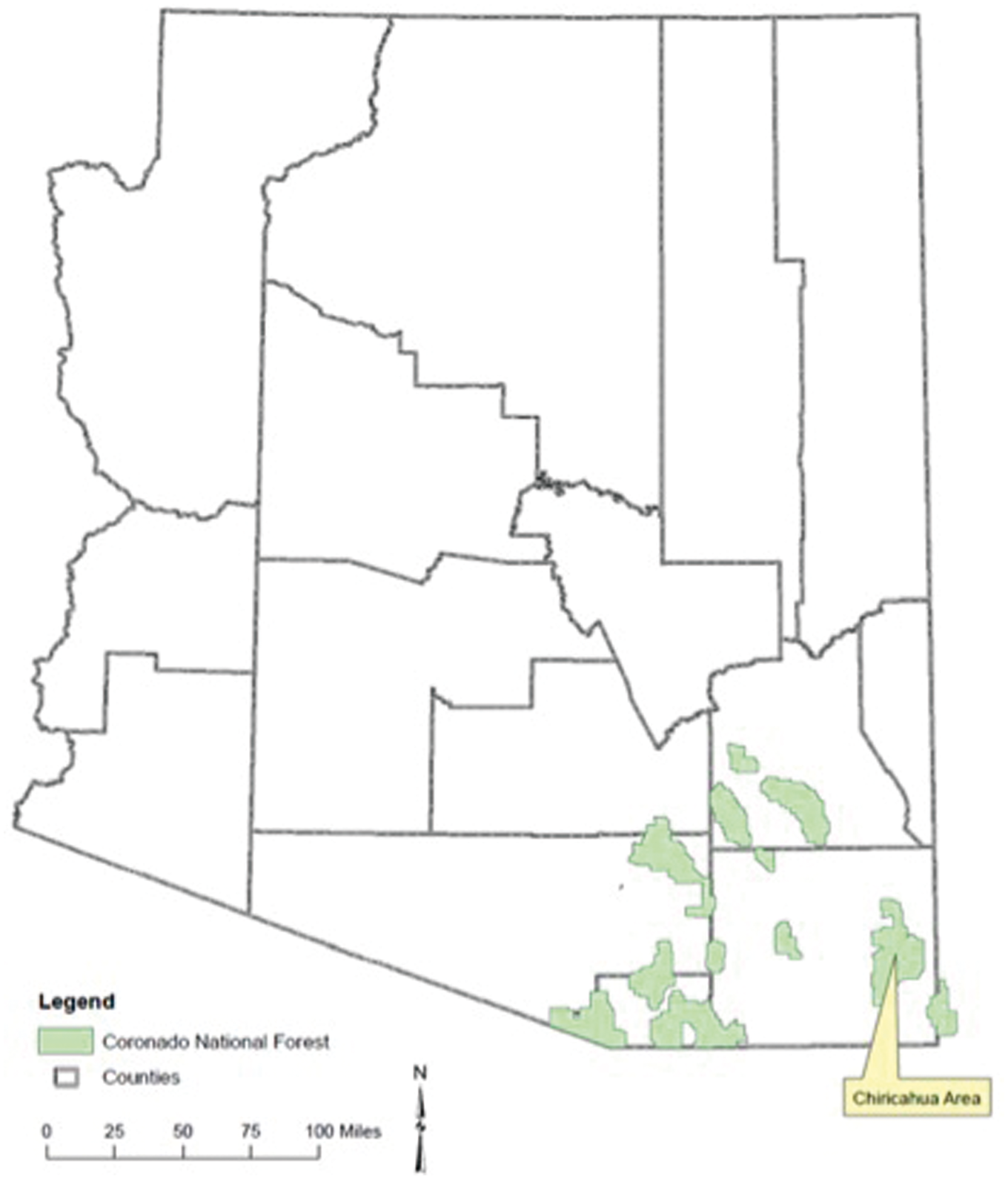
Western Apache
Goodwin (1942) separated Western Apache tribes into five geographic groups: San Carlos, White Mountain, Cibecue, Southern, and Northern Tonto. They “are divided into a series of territorial units of differing size and organization” (Goodwin, 1942: 6). In 1871, a reservation was established in order to protect and preserve links between Western Apaches and areas of their homeland. As Welch and Ferguson suggests (2005: 12), “The Cibecue and White Mountain bands never participated in or declared organized hostilities against the United States;” therefore, they retained exclusive ownership of the 1.67 million acre reservation. In 1897, White Mountain Apache trust lands would be divided from trust lands of the San Carlos Apache Tribe by a Congressional act, “passed to facilitate the federal management of land and people” (Welch and Ferguson, 2005: 12). However, despite United States government divisions of the Western Apache people into different federally recognized tribes with separate reservations, Apache band and clan relations bind them together as a cultural group (Welch and Ferguson, 2005: 77). Furthermore, as Welch and Ferguson (2007: 184) point out, “Most adult Apaches recognize kinship with members of at least one other Apache tribe. Bonds to land and family cut across Apache reservation borders.” This statement underscores the unique and dynamic bonds all Apache people retain to lands and each other, despite present-day geographical constraints and tribal affiliation.
Chiricahua Apache
Opler (1983b: 416) suggests the Chiricahua Apaches are named after the Chiricahua Mountains in southeastern Arizona. The Chiricahua Apache tribe consists of three named bands based upon geographical variations in the southwest U.S. including: (1) the “red paint people,” or (číhéne) who belonged to almost all Chiricahua territory west of the Rio Grande in New Mexico; (2) the (čókánéń) who belong to territories around present-day Duncan, Wilcox, Benson, and Elgin, Arizona, with mountain strongholds within the Dos Cabezas, Chiricahua, Dragoon, Mule, and Huachuca Mountains; and (3) the (nédn í) whose territories include mainly Mexico and a small section of southwestern New Mexico (Opler, 1983b: 401).
Goodwin (1942: 6) points out that the bands of the Chiricahua division seem mostly nearly akin to the Western Apache group, with the difference being the Chiricahua band had local groups within it, each having a regional name of its own, whereas the Western Apache contained loosely bound units usually bearing distinctive names, which in turn were divided into local groups. (Goodwin, 1942: 6)
Although these groups were divided historically, Federal Indian Policy and Executive Orders displaced many Apache tribes from their ancestral homelands through diminished access and reservation confinement.
Mescalero Apache
The Mescalero Apache were first identified by the Spanish as a separate group in the mid-17th century. Opler (1983c: 419) suggests the region inhabited by the Mescalero differed little from where they lived when Americans first arrived in large numbers in 1846. Their southern boundary extended into Mexico including the states of Chihuahua and Coahuila. Their western territories culminated at the Rio Grande, with the eastern boundary extending into Texas. Opler (1983c) also indicates that the Mescalero exploited resources into Lipan Apache territory (northern New Mexico into Colorado and Texas) aggravating hostilities between the groups. Hostilities with Mexicans, Euro-Americans, Lipans, and Comanches continued throughout the 1800s, and culminated in 1873, with the creation of a reservation on the eastern slopes of the White and Sacramento Mountains. However, the population dynamics on the reservation shifted in 1903, when a band of Lipan Apaches was assigned to the Mescalero Reservation, and then again in 1913 when Chiricahua individuals being held at Fort Sill, Oklahoma as prisoners of war were given their choice of taking up residence on the Mescalero Indian Reservation in south-central New Mexico or to accept plots of land near Fort Sill (Opler, 1965: 4; Young, 1983: 400). Most of the Chiricahua chose to go to New Mexico, however, and take up residence on the Mescalero Reservation (Opler, 1965: 4). Due to the assimilation, most of the remaining Chiricahua Apaches were incorporated into the Mescalero Reservation and because of intermarriage with Lipan Apaches it is difficult to distinguish cultural variations, but the Fort Sill Apache in Oklahoma and Mescalero Apache in New Mexico are basically descended from the same group of Chiricahua that were removed from Arizona as prisoners of war in 1886. More recently, during the 21st century the “Mescalero reservation was occupied by members of three Apachean tribes—Mescalero, Lipan and Chiricahua—who have intermarried and have become increasingly amalgamated” over time (Opler, 1983b: 424).
Apache archaeology in southwest U.S.
The theory and method of Apache archaeology has advanced slowly. The highly mobile lifeways of Apache groups and minimal material traces have made it difficult to move beyond labeling areas of possible occupation, let alone forming overarching archaeological methodologies and models to interpret the Apache past. Here, rather than an in-depth review of the literature concerning Apache archaeology, which has been outlined more thoroughly elsewhere, I briefly describe select studies as they pertain to the goals of this research and assist in moving away from solely archaeological issues and focusing more on Apache perceptions of their past.
Archaeological studies of Western and Chiricahua Apache groups have addressed the identification and discussion of material culture and sites (Beidl, 1990; Ciolek-Torrello, 1981a; Donaldson and Welch, 1991; Ferg, 1977, 1987, 1992, 2003, 2004; Ferg and Tessman, 1997; Gifford, 1980; Gregory, 1981; Seymour and Harlan, 1996; Welch, 1994; Welch and Bostwick, 1998; Whittlesey et al., 1997); the identification and analysis of material culture, and application of archaeological dating techniques (Baugh and Sechrist, 2001; Ferg, 1995a, 1995b; Haecker, 2012; Herr, North and Wood 2009; Herr et al., 2011; Sechrist, 2008; Seymour, 2002a, 2002b, 2004, 2008, 2009a, 2009b, 2010, 2013; Whittlesey and Benaron, 1997); and more social, politically driven research focused on collaboration and Apache interpretations of their own history (Ferguson and Colwell-Chanthaphonh, 2006; Herr, 2011, 2013; Krall and Randall, 2009; Welch, 1997, 2001; Welch and Ferguson, 2007).
Although more recent work continues to build on the humanistic and ethnographic component of Apache history and culture, more collaborative work is needed to not only address the Apache past but the unique social dynamics and intricate connections to the landscape that are highlighted during in-field visitations to traditional homelands.
Apache worldview and conception of place
To better understand the Apache world, it is necessary to examine how Apache groups conceptualize “place” and how it defines and is intricately tied to Indigenous notions of past, present, and future. Basso’s book (1996) Wisdom Sits in Places is a compelling account of the importance of place to Western Apache people and how social behavior is strongly tied to the natural topography. As Basso suggests, “when places are actively sensed, the physical landscape becomes wedded to the landscape of the mind” (Basso, 1996: 55). As Welch and Riley (2001: 5) suggest, the inseparability of land and thought, geography and memory, and of place and wisdom has long been recognized by non-Indians. For a much longer period – since time immemorial, in fact – this unity has been put to work by Ndee, Dineh and other people who possess spirits embedded in their place of living.
One of the most important words in the Western Apache language is “Ni.” It means both land and mind (Lupe circa 1998, Personal communication with John Welch, as quoted in Welch and Riley (2001)). This complex concept echoes the main tenets of Apache social life and is a window into Indigenous ontology. The word Ni is commonly combined with other words to serve as a spatial anchor. For example, the Apache word for place names, ni’bizhi’, literally translates as “land names” (Basso, 1990: 154). Apache people regard these place names as having been created long ago by their ancestors (nohwizá’yé) (Basso, 1990: 154).
“Place-based thoughts” or “biké’ goz’ᾴᾴ” (footprints) (Basso, 1996: 31) represented by stories, traditions, ceremonies, prayers, and songs transcend time. These thought processes exist throughout ancestral Apache homeland and defy standard Western categories of knowledge boundaries. “The investment of particular locations with meaning (place-making) is a ubiquitous social and cognitive process” (Whitridge, 2004: 241) that is not only a socially symbolic way of knowing but an inherent, experienced, lived reality that transcends the space, the time, the objective, and the tangible, exhibiting Apache-land relations that are very much alive and innately inseparable.
Moreover, these “footprints” are embedded in the land and mind and underscore the importance of “where events” occurred through time, as opposed to “when events” took place in Apache worldviews and belief systems (Colwell-Chanthaphonh and Ferguson 2010). As Basso (1996: 11) points out, “what matters is what these events serve to reveal about the development and character of Apache social life … and temporal considerations … are accorded secondary importance.” Furthermore, as Herr and her colleagues indicate, “Apache do not trace their history primarily through artifacts like the Hopi and Zuni,” rather they rely on traditions embedded in natural geographies (Herr, 2011: 110). This place-based way of knowing has been put to work by the Apache and continues to define contemporary Apache society, contributes to Apache well-being, and demonstrates the intricate relationship Apache people have with the land through all time.
Recognizing the inseparability of land and mind can highlight American Indian social processes in relation to the land in a way that archaeology alone cannot. For example, most archaeologists interpret a feature such as an agave-roasting pit as an above ground thermal feature consisting of fire cracked rock. The roasting pit might be less than 10 m in diameter, but it implies use of many acres of land for agave harvesting. Yet it can also illuminate information about Apache mobility practices within mountainous landscapes. When I visited such a site in the Chiricahua Mountains with Apache Tribal representatives, they pointed out to me what the location represented: wide views of the surrounding landscape to be able to see approaching enemies, and multiple escape routes in case they needed to flee (Comanche, 2009, personal communication). As Basso notes, “Place-based thoughts about the self, lead commonly to thoughts of other things—other places, other people, other times whole networks of associations that ramify unaccountably within the expanding spheres of awareness that they themselves engender” (Basso, 1996: 55).
Collaboration and interviews
My collaborative research involved working with the Coronado National Forest and its Cultural Heritage Program as well as working with the White Mountain Apache and Chiricahua Apache tribes, both of which claim the Chiricahua Mountains as their ancestral homeland. I conducted in-field interviews and organized site visits with members of each affiliated group able to join collectively. All Apache tribes involved in the project submitted letters of support and authorization for the research. Each tribe’s Heritage Program Manager acted as the main point of contact with the tribes. Tribal consultants were referred to me as cultural experts possessing extensive knowledge of historical-period Apache lifeways and history by each tribe’s respective heritage preservation program. Some Apache representatives involved in the research were direct descendants of prominent historical-period leaders and warriors such as Cochise, Naiche, and Kanseah (Sweeney, 1991, 2012; Thrapp, 1967), who were known to have intensely occupied the Chiricahua Mountain range and much of southeastern Arizona during the late 1800s.
On-site interviews were typically conducted with a brief site description, including initial site interpretation, and where the site was located and recorded by the researcher and/or Coronado Heritage Program staff. Tribal representatives then walked the area with heritage personnel and interpretations or comments were chronicled during the site visits. Bringing Apache representatives out to the field proved to be a crucial component to the oral collaboration component of the project. As Basso (1996) demonstrated in his place names studies, stories come alive during these times due to the powerful associations elders have to the natural environment and topography.
More formal interviews included either roundtable discussions as a group or individual interviews at residencies, tribal historic preservation offices, the Coronado National Forest Supervisor’s Office, and the Rucker Administrative site (staging building normally used as wildland firefighter basecamp). They typically began with me explaining the purpose of the research and the importance and necessity of Apache involvement in the multivocal project. An interview form was used to facilitate question sessions focusing on Apache history and culture within the study area and the southwest U.S. more generally.
I found the formal structured interview questionnaire to be less useful than more informal discussion and listening sessions. My experience was similar to that of Kovach (2009: 123) who observed that “highly structured interviews are not congruent with accessing knowledges that imbue both the fluidity and regulation of the storyteller’s role within oral tradition, or that respond to the relational nature of Indigenous research.” Focusing on structured responses to research questions makes it difficult to appreciate that which is said extemporaneously and is necessary and beneficial for contemporary Apache communities. Moreover, I struggled trying to identify and apply suitable theoretical frameworks to the interpretation of Apache oral testimony and landscape associations.
The question of theory
Initially, my research involved fairly standard questions about “Apache archaeology,” such as the identification of Apache material signatures on the landscape and establishing accurate temporal contexts for Apache arrival and occupation in the southwest U.S. By asking questions concerning Apache material culture and taking Apache collaborators to areas of probable late historical-period Apache sites, I hoped to generate a list of material traits conducive to recognizing Apache surface occupations (Laluk 2015). I also was interested in understanding how these items were utilized and even modified during periods of increased Euro-American interaction. However, two things stuck in the back of my mind. First, I have been inspired by the movement known as Indigenous archaeology that is foregrounding Indigenous concepts and ideas in archaeological interpretation (Watkins, 2000). Second, I am inspired by Apache history—the social decisions made by Apache men and women during the late 1800s that are not adequately addressed in most archaeological studies. These thoughts caused me to reach out to Apache elders and colleagues, to learn how the landscape becomes mind through observing and doing. These thoughts ultimately led me to consider broader questions about transforming the practice of archaeology.
For example, there is a gap between the questions archaeologists ask and the issues that concern descendant communities. How can we archaeologists (or others having land management duties) develop the strategies necessary to address descendants’ concerns? What are the ethical responsibilities of archaeologists to the communities whose histories they study? These questions are of particular interest to my own research given my role as an American Indian archaeologist formerly employed by a Federal land managing entity.
As an American Indian archaeologist performing tribal relations duties, I often became frustrated with the limited concern the Federal administrators have for tribal concerns and lived realities. Tribal communities would inform me of the continued sociocultural and socioeconomic problems resulting from various ongoing Forest Service projects that continued to harm contemporary tribal well-being. Various in-field and roundtable discussions would occur, but end products would often leave out the primary concerns and heartfelt issues of tribal communities. As Stapp and Burney (2002) suggest nearly 16 years ago, “There needs to be more pressure on agencies to comply with Federal regulations.” However, Federal compliance is still far from adequate for many tribal communities.
In my mind, the use of Western theory to explain tribal history and culture is similar to the current practice and approaches of Federal entities conducting mandated “consultation” efforts with tribal communities. What I mean by this statement is that because consultation often is treated as a “checked box” and a reasonable “good-faith effort” rather than being honest, meaningful, respectful, and responsible, then end results will continue to be the same with most benefits or positive outcomes being in line with the researchers' or general public’s needs and concerns. In this sense, externally imposed theory and methodology function in the same way as poor consultation. If Western theoretical approaches continue to be applied that do not usefully engage with tribal cultural heritage resource practices, then the end results will be nothing more than a “checked-box,” not truly fulfilling or addressing the needs and concerns of tribes involved.
Due to these experiences, my research questions and interests evolved. Various models have been applied to study late historical-period American Indian–Euro-American interactions in the U.S. such as acculturation, adaptation, creolization, and ethnogenesis (Laluk, 2007) but I felt these models did not usefully highlight how Apache people define themselves and their own history. During this time of self-searching, I found myself recalling discussions with Mescalero tribal cultural experts. I often spoke of my troubles with finding appropriate theory that could usefully articulate with Apache understandings of the past, wondering even if applying certain types of theory was appropriate. In response to my predicament, tribal cultural experts questioned why there is a need for theory and why couldn't I just write about what people told me? After a great deal of thought I began to question how I could make my research more practical and supportive of tribal concerns and began to ask: “what is theory?” and, perhaps more importantly, “why is it necessary for my own research?”
If a simple definition of theory for archaeologists is the framework of explanation used to account for the facts at hand (Johnson, 2011), then what better way to arrive at this than through lived experience and practical and rational ways of knowing and interpretation. Is it appropriate for us as archaeologists to take these meanings, values, memories, and practices and turn them into our own speculative versions of the past and other peoples’ heritage? This might be of particular use in the case where tribal communities embrace Western archaeological practices or have found utility in integrating archaeological theory and methods into their own cultural and historic preservation programs. But I think that these meanings, values, and memories which serve as the foundations of tribal history, existence, and contemporary well-being are often told “as is” by Indigenous peoples because this is where meaning resides for tribes. It does not need to be speculated on further by nontribal researchers or put into a research design or writing context that makes sense to them, but may lose meaning for Indigenous people because it is put in this foreign context. This recognition follows what Warner and Grant (2015: 181) suggest that “Western education paradigms teach skill sets in isolated academic subject matters, while Indigenous paradigms place emphasis on natural processes of holistic learning at deep intellectual and spiritual levels.”
These paradigms focusing on natural processes, place, and interconnections can be used as powerful cultural precepts to address Apache history and contemporary associations to such places as the Chiricahua Mountains. But the question remains—what are these precepts, tenets, and concepts? At this point, I thought of a statement suggested to me by fellow White Mountain Apache tribal and clan member statement that that “you have to be Apache to know” (Riley, 2010, personal communication). This statement continues to echo in my mind because it is from this statement where experience, knowledge, and meaning collectively reside. It is where my heart, mind, and blood live and function empowering my Apache identity. Because this statement provides cultural power and enhances sovereignty through experience and tribally derived ways of knowing, then perhaps through an on-the-ground, place-based framework focusing on such concepts as Ni can this knowingness through being Apache by birth be achieved. By observing, absorbing, learning, feeling, and experiencing how Apache individuals express their Apache-ness by simply being Apache while visiting such areas–places of ongoing significance and power as the Chiricahua Mountains, this brings to light Apache interpretations and perceptions that cannot always be achieved through material remains.
Storytelling as a way of knowing
I have discussed the Apache concept of Ni and its fundamental and inherent link to Apache connections to place and the problems of applying Western theoretical assumptions to Apache ways of knowing. Here, because Apache views of place are based on the inseparable land–mind bond, better understandings of the past in reference to Apache concerns and values can be addressed through storytelling. This involves a pragmatic orientation including site visitation with elders and the sharing of Apache landscape knowledge. Here, I will discuss how simple site visitation can teach us much about Apache social processes and intergenerational connections, and assist with contemporary resource management practices.
Apache visits to the land create connections, as places are remembered and their meanings reinvigorated. The Apache commitment to resource management and site visitation brings to life ways in which a researcher or land manager might better address how to manage the land base. For example, while visiting a fortified dry-stacked masonry site overlooking the San Simon Valley, a Mescalero representative asked what kind of artifacts were located within the compound. A few crude chipped-stone flakes were located but most material was located outside the walls on a small saddle. She then indicated that at most wickiup sites she has visited on the Mescalero reservation all artifacts were found outside the wickiup structure. Although there are several explanations for the absence of artifacts (buried over time, reuse, collecting, trampling), the statement suggests cultural resource management strategies and resource management commitment in reference to space and landscape modification. The on-the-ground Apache understanding of site placement and absence of artifacts suggest Apache understandings of past practices that can be used to interpret, locate, and manage potential Apache sites in the southwest U.S. Even at higher elevations, including at fortified sites, which require much more labor to construct than wickiup sites, most activities occurred outside the structure walls.
Practical maintenance of the area in the form of activities occurring outside the wickiup area suggests the need for land managers to reinvestigate potential Apache site areas that may exhibit only subtle, if any, remains. These “places” not only provide glimpses into the Apache past and contemporary Apache cultural heritage resource management strategies, but shed light on how cultural practices and the social investments in reference to practical reasoning underscoring these practices are maintained over time and are very much alive. For example, when asked about historical-period site placement strategies and what are better ways to identify Apache sites on the landscape, Mescalero representatives indicated that because past Apache groups were so “neat” and “cleaned up” in reference to leaving no trace on the landscape, their sites are often misinterpreted.
This brings to mind the contradictions between site management and cultural persistence in reference to changes over time, the supposed loss of Apache ability to manage their traditional homelands due to land restrictions, and notions of archaeological site management being best performed by archaeologists or heritage preservation specialists managing the current land base. However, as Mescalero representatives suggest, intentional Apache cleanup shows cultural persistence through time and caring for the land base by descendants that allow Apache interpretations to be used to assist with site management and preservation activities.
Yellow Ground
Indigenous knowledge is central to going beyond material remains to identify Apache landscapes. Further discussions with Mescalero representatives substantiate how important developing preservation protocols with Apache community members is to taking care of traditional homelands. For example, in an interview session Mescalero cultural experts discussed an area off the reservation called “Yellow Ground.” Western scholars sought out this location, but to no avail. The site could not be relocated because the researchers were searching for “yellow soil.” Tribal experts explained that when you visit the area in the spring, yellow flowers bloom and make the ground appear yellow. In the past, Mescalero tribal members used to travel over the “yellow ground.” Cultural maintenance apparent in the “Yellow Ground” story is indicative of unbroken connections through time and space and how places are ultimately tied to the past. These permanent place-based connections suggest Apache seasonal movements, resource procurement strategies, and continuity of the past through place-based and practical knowledge. Here social strategies and links to the land are not only materialized on the landscape through archaeological traces but through memory and practice. Apache ties to the land base are not solely defined by material remains but are manifest in the fact that the land ethic, cultural values, power, knowledge of traditional food and plant areas, and religion are retained.
Traditional knowledge and site visitation
The practical, inherent Apache association and inseparability of traditional knowledge with the landscape comes to life during simple site–place visitation leading to a more complete view of various environments and ecosystems. For many American Indian groups, local-level ecological knowledge is “rooted in an intimate and long-term involvement in local ecosystems” (Menzies and Butler, 2006: 1) that can be utilized as a “crucial tool and source of knowledge for long-term sustainability and immediate resource conservation” (Menzies and Butler, 2006: 1).
For the Apache, the integration of traditional knowledge (Ni) manifests itself in ways of looking at the landscape that can contribute to the definition of “site” boundaries and archaeological pedestrian surveys. For example, on a field visit to the previously mentioned fortified dry-stacked masonry site, Mescalero Apache cultural expert Arden Comanche observed a roasting pit and said, “I’m going up to that saddle, because if I were hanging out at this site, I’d also be hanging out up there” (Comanche, 2009, personal communication). In reference to landscape knowledge, Mr Comanche surveyed the area when arriving at the roasting pit and saw the bigger picture in terms of site placement and preference and headed up to the area near the fortified site. Furthermore, during a visit to a roasting pit site further up the canyon, while some Forest Service representatives were examining the ground for other material evidence associated with the pit, Mr Comanche was drawn to a nearby oak tree. Mr Comanche suggested the tree was modified. Apache individuals cut off the lower branches and used the higher branches of the tree as shelter (Figure 2). Mr Comanche had previously indicated a similar practice during visits to a possible Apache scout camp in the Rucker Canyon area. Similarly, Mr Comanche also suggested that there is an oak tree with branches purposefully bent-growing over to make a house near Fort Bliss New Mexico (Comanche, 2009, personal communication).
William Gillespie and Arden Comanche examining an oak tree and roasting pit site. Photo by Nicholas Laluk.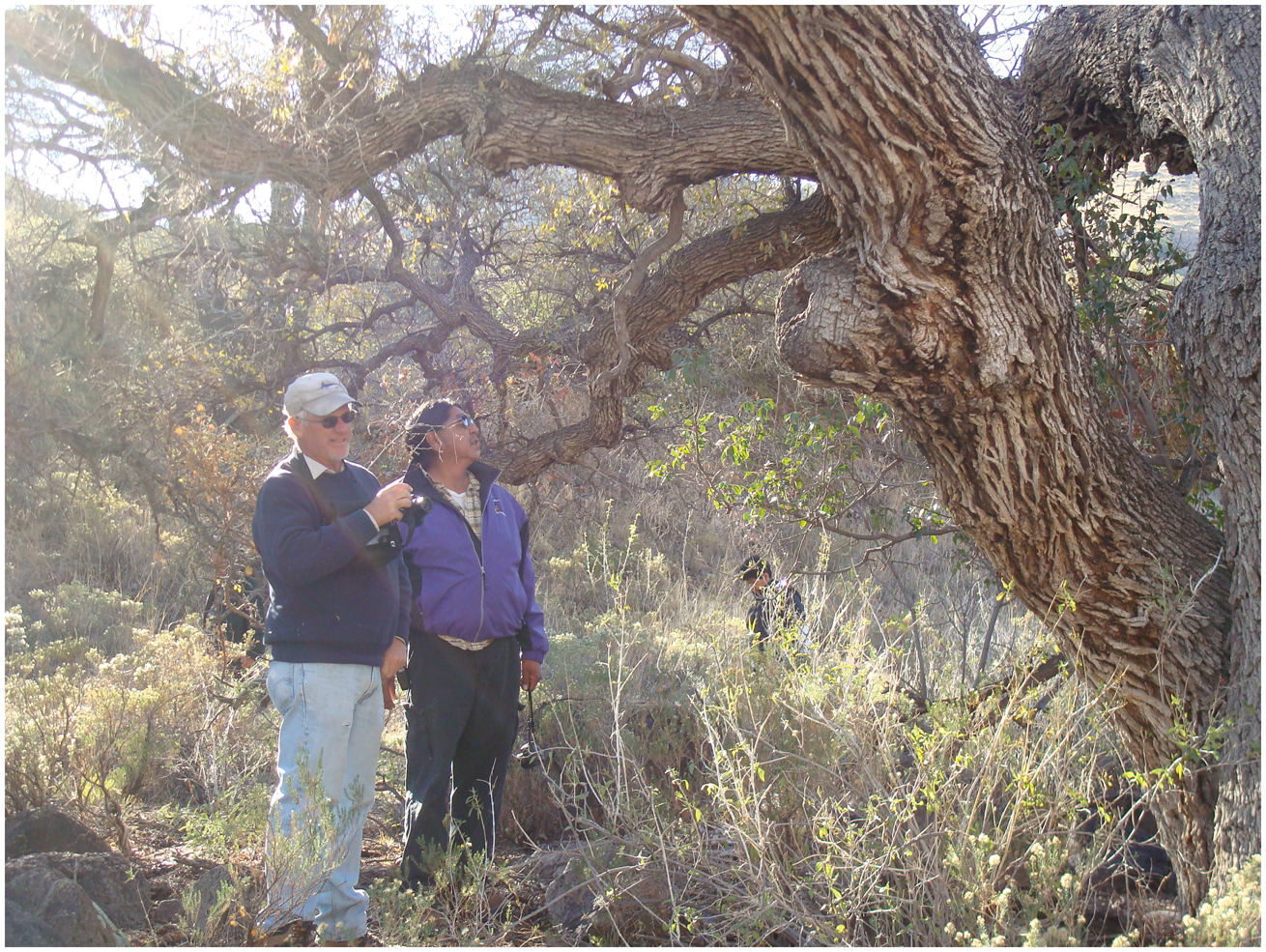
These observations challenge standard “archaeological site” definitions based on material culture evidence. In this case, the site is indicated by the modified tree and is readily visible to Apache elders. Simple visitation and the inherent ability to recognize distinct and important landscape alterations illuminate patterns and clues that most archaeologists would miss. Furthermore, Mr Comanche’s identification of the practice of utilizing low-lying branches for expedient shelter demonstrates an Apache cultural strategy extending from the Chiricahua mountainscape to the Fort Bliss area in New Mexico. This recognition demonstrates an unbroken link of association to the Chiricahua Mountains even after years of forced separation. The natural landscape suggests Apache presence even in the absence of standard archaeologically defined material remains.
Place and associated power relations are manifest in the mountain land base, overshadowing the material remains of the past that can be emphasized through visits to certain areas. As Silliman (2009: 217) suggests in his own research in reference to sites, “Materialized on this landscape are cultural sites that accentuate that materiality, memory, and practice can better reveal colonial processes and Indigenous survivals.” These “Indigenous survivals” are present throughout the Chiricahua mountainscape in the form of power, songs, and stories and are either directly or indirectly remembered, unlocked, or called upon by simple visitation and not bound by archaeological interpretation alone. During my research project Silas Cochise—the great grandson of Chiricahua Chokonen band Chief Cochise—indicated that ceremonies, songs, and power are related to distinct mountain areas and that “the powers that come with different ceremonies don’t understand English.” (Cochise, 2009, personal communication) This statement alone reaches the foundation of Apache social processes and the concepts of memory and place and how they are intricately tied together. As Basso suggests, these “expressive elements”—ceremonies, songs, and stories and their associations—continue to give Apache places their meanings and “are continually woven into the fabric of social life” (Basso, 1996: 57). Moreover, Kovach’s (2009: 61) suggestion that “linguistic structures associated with tribal languages and the deep interconnection between thought and language cannot be extrapolated from other attributes” supports the notion of inseparability of land and mind, and the overall difficulty of integrating tribal perspectives into westernized ways of knowing and nonnative research goals and interests. Moreover, the words of Mr Cochise suggest a continued connection to the land base that can only be felt, experienced, and identified through the Chiricahua Apache language itself. This deep connection between language and the land is still apparent in the words and thought processes of Mr Cochise even after long periods of physical exile, forced removal, and imposed restrictions to reservation lands.
Here, as archaeologists, we can begin to understand, and access, how Apache people view the landscape. What archaeologists see as a feature, such as an agave-roasting pit, with distinct functional characteristics—cooking agave, fire-cracked rock, formation processes of roasting pit, associated material remains—Apache representatives place within a broader dynamic functioning world including seasonality, site placement, and mobility strategies. We emphasize the material nature of Apache sites and create diagnostic checklists to suggest their presence, but while we focus on metal projectile points or wickiup remains, Apache cultural experts emphasize their ancestors’ social responses to increased Euro-American presence in their territory, as well as the landscape-wide social processes signaled by material remains including fortified sites and wickiup locations. Therefore, to reach a more complete understanding of the past, we need to comprehend how Apache tribes utilize contemporary tribal place-based reasoning strategies. We also need to meaningfully address Apache concerns and perspectives regarding these strategies, as well as the natural and modified landscape. These strategies involve a plethora of everyday practices, from food processing, to tool making, to campsite selection. The absence of material remains can tell us just as much about continued connections and Apache relationships to place as the presence of material remains. Because some areas, such as the Chiricahua Mountains, embody such power and significance, this provides meaning and glimpses into past and contemporary social processes even when such areas are devoid of material traces.
Furthermore, the Apache social processes embedded in the landscape and that come to life through traditions and stories present the need for collaborative projects that stress mutually beneficial, respectful, and responsible research frameworks. From this, better understanding of past and present social interactions, landscape associations, and past theoretical models can be built or expanded upon. This approach can demonstrate not only how Indigenous people rationalize and legitimize their life, but also how these intricate rationalizations and social identities can be used to co-manage ancestral lands and expand upon colonial models of Indigenous peoples and Euro-American interactions.
Conclusions
Indigenous archaeology needs to engage more deeply with native ways of knowing. It needs to consider storytelling as a means of challenging the dominant archaeological emphasis on linear time scales focusing on “when” as opposed to “where” events took place in the past. Not only do Apache ways of viewing the past challenge Western assumptions of time and space, but they also clearly provide understandings of ways in which Apache individuals–communities dwell (cultural maintenance, site interpretation, lived experience) in their homelands despite forced removal and exile.
Moreover, because in Apache worldviews theory can literally come from the ground up, as demonstrated by the concept of Ni and the enduring links to the land overtime, this demonstrates how the land and Apache are one and that thinking about the Apache past or present requires researchers to always consider this. Apache landscapes are alive and imbued with such power that they are never disconnected from the mind. The ongoing significance of the Chiricahua Mountains in reference to Apache “use” is still evident and very clear even after more than 130 years of physical exile. Apache cultural maintenance, continued connections, and intergenerational commitments are maintained by the existence of place and its association to memories, stories, and ceremonies that define the social and behavioral existence of Apache people. Simple site visitation not only illuminates and contributes to understanding the past but ensures commitment to the maintenance and preservation of Apache culture. Material remains and features composing Apache sites provide signs and signatures of various social activities of the past and where they occurred on the land base, but additional lines of evidence are needed to understand how Apache people define the landscape and, more importantly, how the landscape defines them. Within the Chiricahua mountainscape the material elements composing Apache sites are dwarfed by the importance of the land base or “place” where they were produced and utilized. Beyond material remains of these Apache groups there exist other explanations still very much alive in Apache landscape associations, stories, and continued power relations.
In sum, archaeological research on Apache occupation of southeastern Arizona has to be conducted involving Apache cultural experts. In-field collaboration proved to be beneficial in recognizing not only past use of the Chiricahua Mountain land base but also various social processes embedded in the overall Chiricahua Mountain range. Moreover, visitation to these mountainscapes and places leads to fuller and more fruitful discussions regarding issues of critical importance to contemporary Apache communities.
Footnotes
Acknowledgements
First, I would like to thank various colleagues representing Apache tribes involved in this research for their assistance in reference to conversations, edits, and recommendations including Mark Altaha, Mae Burnette, Silas Cochise, Arden Comanche, Holly Houghten, James Kunestsis, Ramon Riley, Clarice Rocha, and Jayro Traes. I would also like to thank other colleagues including Chip Colwell, T.J. Ferguson, William Gillespie, Sarah Herr, Barbara Mills, Seth Pilsk, Robert Preucel, and John Welch for providing comments and editorial assistance to various drafts of the manuscript.
Declaration of Conflicting Interests
The author(s) declared no potential conflicts of interest with respect to the research, authorship, and/or publication of this article.
Funding
The author(s) disclosed receipt of the following financial support for the research, authorship, and/or publication of this article: I would like to acknowledge previous funding I received relating to the publication of this article from the American Philosophical Society, the Community and Forestry Environmental Restoration Program, the Society for American Archaeology, the Students to Academic Professoriate for American Indians Program, and the United States Forest Service.