




Abstract
This article explores the perception and practice of everyday life at transhumant settlements in western Ireland during the period, c.1750–1920 AD. Small-scale summer transhumance to upland pastures was once widespread in Ireland. Dairy cows would be sent by families to hill and mountain commonages, with herders milking the cows and making butter. Recent archaeological and oral historical research has shown that these people dwelled in small structures known as booley houses, which have a high degree of variability in construction, distribution, and use. Unlike Continental European pastoralism, but similar to Scandinavia, it seems to have been mostly young people who occupied booley sites. With oral tradition and field evidence, this article addresses the social implications of seasonal re-location to liminal landscapes, and how it functioned as a didactic rite of passage. Furthermore, it demonstrates the flexibility of pastoral communities as work routines changed over time at both home and booley.
Introduction: Seasonality and transhumance in communities of practice
This article explores seasonal settlement as a factor in maintaining and reproducing social practice in non-elite farming communities. Seasonality is a constant in farmers’ interactions with their ecological environment - people timing their decisions to sow crops, breed animals, wean animals, and harvest crops based on variations in soil temperature and vegetation growth. Social practice in farming communities is therefore bound up in a seasonal cycle. In some cases, that cycle involves the movement of people and livestock between different environmental zones, usually lowlands in the winter and uplands in the summer. Such practices are generally known as transhumance and have long been used by agro-pastoralists to overcome geographic restrictions around home settlements while also taking advantage of seasonally available pastures some distance away. Focusing on small-scale transhumance of the recent past in western Ireland, the present article aims to find out how meaningful groups of practice are formed and viewed within farming communities as a result of the seasonal relocation of herders of a certain age and/or gender.
After initial skepticism about the archaeological record of pastoralists, who were supposed to “live in tents instead of excavated shelters or huts” (Childe, 1936: 81), there is now much more optimism among landscape archaeologists that pastoral movements may be traced (e.g. Barnard and Wendrich, 2008). For semi-mobile transhumant groups in medieval and modern Europe, two recent volumes have shown that many marginal landscapes contain plentiful remains of summer dwellings used by herders, as well as other buildings and enclosures associated with dairying and livestock control (Collis et al., 2016; Costello and Svensson, in press). However, in-depth analysis of the socio-cultural functions of past transhumant systems has yet to take place in a European context. Most contributions to the aforementioned pair of volumes have sought out chronological and functional interpretations of seasonal sites, and a long line of historical and geographical studies have focused on the economic/ecological justifications for seasonal pastoralism (Braudel, 1972: 85–87; Brochier, 2005; Davies, 1941; Gomez-Ibanez, 1977).
Yet transhumance only takes place because people are involved, so archaeologists are bound to study its social meaning. And to situate that meaning in a broader anthropological context, it greatly helps to experiment with existing theoretical frameworks—in this case, practice theory (e.g. Bourdieu, 1990; Giddens, 1984). All variants of this school hold that “social practices are routines: routines of moving the body, of understanding and wanting, of using things, interconnected in a practice” (Reckwitz, 2002: 255). In a further modification by Wenger (1998: 73), people in “communities of practice” who work on a joint project are said to engage “in actions whose meanings they negotiate with one another.” This idea allows for a more powerful interpretation of transhumant societies. In an Irish context, communities had to engage in a joint enterprise because hill and mountain pastures were usually shared (see Costello, 2016b), and they also had to maintain cohesion given that some family members re-located seasonally as herders. During the 19th and early 20th centuries, it is clear from recorded oral history that it was primarily young people, and young unmarried females especially, who looked after and milked dairy cows at “booley” sites (from the Irish buaile) in marginal summer pastures; adults, especially men, were employed at home, laboring to improve fields, tending to crops and, in coastal areas, fishing (Gibbons, 1991: 45; Graham, 1954: 23–24; Mac Giollarnáth, 1941: 280; McDonald, 2016: 59; Morris, 1939: 289; Ó Cathasaigh, 1943: 159; Ó Danachair, 1945: 250; Ó Duilearga, 1939; Ó hEochaidh, 1943: 133; Ó Héalaí and Ó Tuairisg, 2007: 21; Ó Moghráin, 1944; NFC 62: 218–226; 155: 54; 156: 54; 157: 434; 625: 466–467; 694: 599; 991: 145; 992: 400; 1453: 111). A gender/age divide is also encountered in Hebridean Scotland, where summer shielings in the 19th and 20th centuries were frequently the preserve of young women (Skene, 1880: 385–388; Thomas, 1857: 130–132), in Sweden, where they looked after cattle at summer säter in the outlands from at least the 17th century (Larsson, 2012), and in Iceland, where sel sites were strongly associated with females in historical writings and oral tradition from the 13th century onwards (Kupiec and Milek, 2014).
The age- and gender-specific nature of summer settlement throws up many questions about transhumant communities and their organization. To what extent did young people inhabit a different cultural space while at summer upland pastures? How did re-location to booley sites form a rite of passage, offering freedom and at the same time preparing them for adulthood? What broader demographic and social factors contributed to the division of labor in these agro-pastoral societies? Through archaeological and oral historical analysis of summer transhumant settlements between about 1750 and 1920, when the last of them were abandoned, this study hopes to offer a new model of social practice within semi-mobile communities.
Seasonal landscapes as liminal cultural space
It is worth stating at the outset that the children and teenagers who re-located to summer settlements in Ireland remained a vital part of their families and wider community. Baile and buaile—home and booley—were rarely separated by more than 6 or 7 km in those parts of the west where small-scale transhumance survived into the 18th and 19th centuries; contact would have been made at least every few days as milk and butter were transferred down to the farmsteads (Costello, 2015: 56–58, 2016a, 2016b: 70–71). Moreover, a couple of oral accounts say that men and older adolescent males used to go up each year in April or May to repair and re-construct booley houses for young female herders (Gibbons, 1991: 45; Ó hEochaidh, 1943: 133–134, 136). The community’s two most important resources—young people and the dairy cows they were in charge of—were not forgotten about after they left the confines of home.
Nonetheless, in oral history, booley sites and the hills, bogs, and mountains to which cattle were typically brought during summer (see Costello, 2015; Gardiner, 2012; McDonald, 2014) are often portrayed as strange and even slightly dangerous cultural spaces. This “liminality” was rooted in the uncertainty which many people felt towards such landscapes. At the same time that uplands offered valuable pastures for the summer, their open expanses and highly varied terrain rendered them somewhat unpredictable. Anyone who walked the hills—be they herder or visitor—would have known to respect a space that was not as familiar as their homestead. Having spoken to Jack Cunningham and Patsy King during fieldwork, two hill farmers who now keep sheep on the Galtee Mountains, it is clear that when fog or darkness descends these upland slopes become far more difficult to navigate. Indeed, during fieldwalking, the present writer found that man-made waypoints occur much less frequently than in lowlands, where field boundaries, roads, and farmhouses are all present at a relatively high density. In stonier marginal land like south Connemara or the MacGillycuddy’s Reeks in Kerry, one also has to be watchful of foot injuries. Before motorized transport and social welfare arrived in the 20th century, the loss of labor resulting from a broken ankle or leg could spell disaster for a family. Con Moriarty, a native to the Reeks, related to this writer that the mountains were feared in previous generations. Keeping to a known path when watching livestock was expected—diverting from it (and risking injury) to be admonished.
These fears arguably manifest themselves in the most detailed oral accounts of booleying. For example, a number of stories taken down from elderly people in west Mayo and south Connemara during the 1930s and 1940s relate attempted abductions or bride-stealing of adolescent girls. Groups of strange men are said to have arrived at booley houses by night, when usually only a teenage girl and her younger brother were present (NFC 62: 218–219; 625: 465–467; 1230: 151–154; 1242: 313–316). Other stories contain supernatural occurrences. For example, the common European trope of an old woman taking a hare’s form to steal cows’ milk is related in a story about an east Connemara booley (see Jenkins, 1997: 310–312; Mac Giollarnáth, 1934: 105; Nildin-Wall and Wall, 1993: 67). Three other accounts from south Connemara involve either a young or teenage girl being left on her own at the booley for a night, resulting in visitations by witches, strange but benign men, and, in another Scottish example, the approach of a sinister each-uisge or water-horse (NFC 156: 56–57; 62: 220–226; 157: 434–442; Thomas, 1857: 130–132). In one of the Connemara versions, the lone girl hides in a dark part of the booley house as three men enter for shelter and fall asleep by the fire; three old women then arrive in and, by taking their blood to bake a cake, curse the men to remain frozen still. Wolves appear too. In one story, a young dairymaid walking through hill pastures is chased by three wolves, one of whom turns out to be a young man (NFC 155: 56–57), while a travelling man who rests in a vacant booley house is attacked by a wolf during the night (NFC 155: 54–55). Many of these themes are found in other folkloric contexts; however, the likelihood of strange encounters seems to have increased in places regarded as somewhat risky or liminal, like summer pastures. In oral tradition collected in the Irish midlands, Lysaght (1997: 31) points out that “fairies are the ancient dead who live on in the mounds and hills”; while in Donegal, people were said to be “afraid of [the fairies] in bygone times, especially people who were out on the hills late in the evening” (Ó hEochaidh et al., 1977: 37).
The very construction of booley dwellings suggests that, to some extent, people accepted the unpredictability of upland landscapes. The morphology of booley houses likely to have been occupied in post-medieval times varies much more than the permanent houses of transhumant farmers in 18th- and 19th-century Ireland, which were almost universally of a long rectangular or roughly rectangular form (e.g. Aalen, 1997; Orser, 2010). Summer dwellings identified through recent field surveys are usually rectangular, square or sub-rectangular, but oval, circular, and irregular forms are also common (Costello, 2016a; in press; Gardiner, 2012; McDonald, 2016). Most of those found in western Ireland are stone-built but some are constructed mainly of sods with stone intermixed or as a wall footing (e.g. in the Mourne Mountains; Gardiner, 2012). They range in size from house-like structures with internal dimensions of 5.5 m by 3 m (in the Galtee Mountains) to relatively small huts measuring only 2 m by 1 m internally (the latter being most common in south Connemara). While Gardiner (2012) and Costello (2015) have both tentatively argued that square and rectangular high-walled structures post-date low-walled structures with curved walls, it is clear that the physical environment in which they were built is an equally if not more important factor in their appearance. As we have seen, the terrain of summer pastures is usually much rougher than that of improved farmland around home settlements. In the Galtee Mountains, where transhumant people had to contend with steep topography, there are several examples of rectangular stone booley houses being built on flat earthen surfaces that had been cut out from the slope, with up-cast material used to create a wind-break on one or more sides of the dwelling (Figure 1; Costello, 2016a: Table 1). People also used their agency to manipulate the design of booley dwellings when upland landscapes were not as pliable. In the low inland hills of south Connemara, boulders and outcrops of granite and metagabbro are extremely common and at many sites people actively employed these natural features during construction and re-construction. This is especially clear at Beitheach Chatha 1, a hut (internal: 2.2 m × 1.8 m) consisting of a curvilinear wall built up against a large boulder, at Cnoc Buí 4, a D-shaped structure (2.05 m × 2.25 m) with its straight northern side formed by two boulders, and at Gleannán 3, a roughly rectangular hut (2.2 m × 1.5 m) built against a hillock, with a boulder forming one corner (Figures 2 and 3). These designs were innovative adaptations to an unpredictable landscape and speak to a reflexive relationship with the topography. In pastures that were not as steep or elevated as the Galtees or as unpredictably rocky as south Connemara’s, there was less need to alter the ground or build around it. All the same, the present writer’s survey of Mín na Saileach in south-west Donegal (a 19th-century hill pasture which contains 15 probable pastoral sites) did encounter one case of a hut and adjoining triangular enclosure built up against a quartzite cliff (and the structures—Mín na Saileach 8 and 9—are themselves roughly formed of quartzite blocks). Indeed, even at the Bunowna booley settlement in Achill—a relatively smooth and grassy pocket of pasture—a minority of structures are nestled by the bank of Bunowna stream, the construction of their walls taking advantage of that feature for shelter (Figure 4).
Plan of Coolagarranroe 1, probable 18th-/19th-century booley house; Galtee mountains. Beitheach Chatha 1 booley hut, Carna, south Connemara. Gleannán 3 booley house, Carna, south Connemara. Sub-rectangular and rectangular booley houses by Bunowna stream, Achill island.
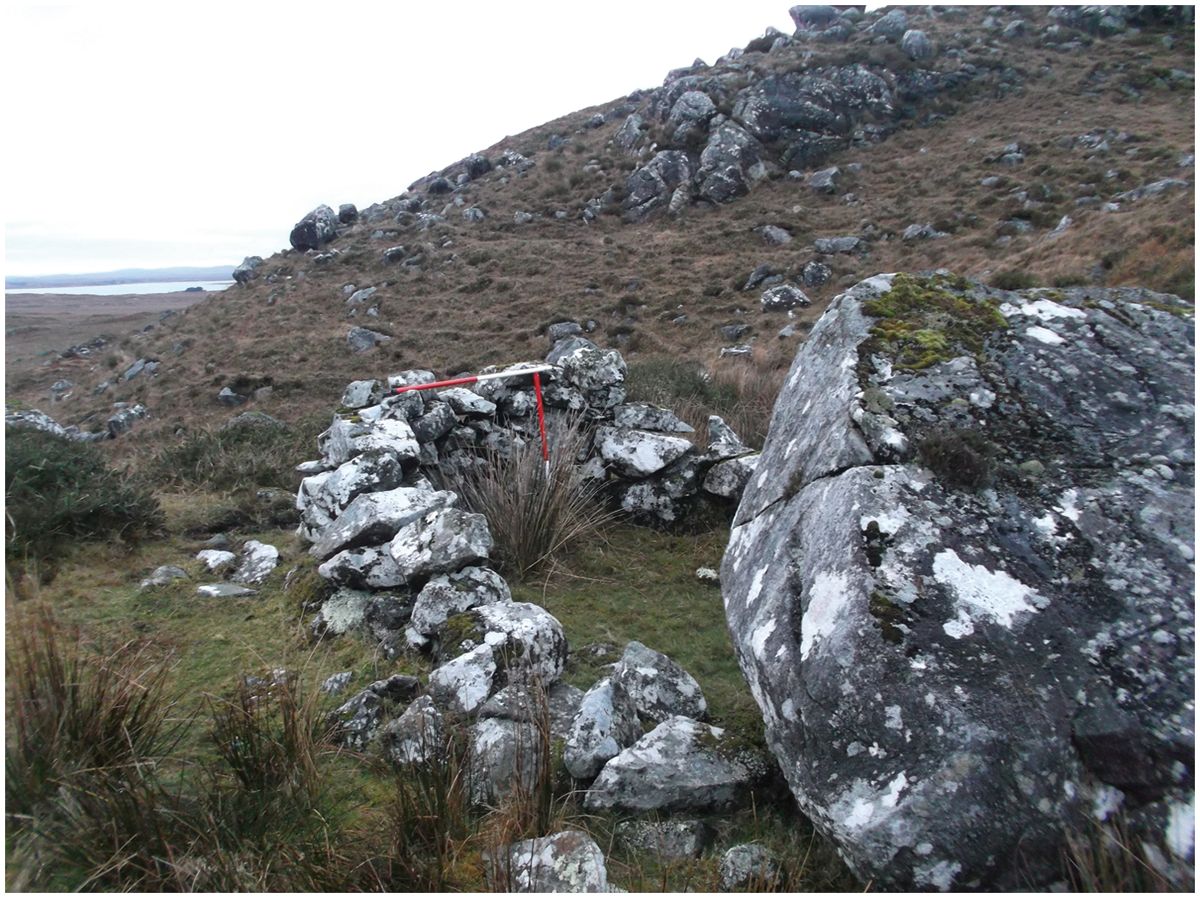
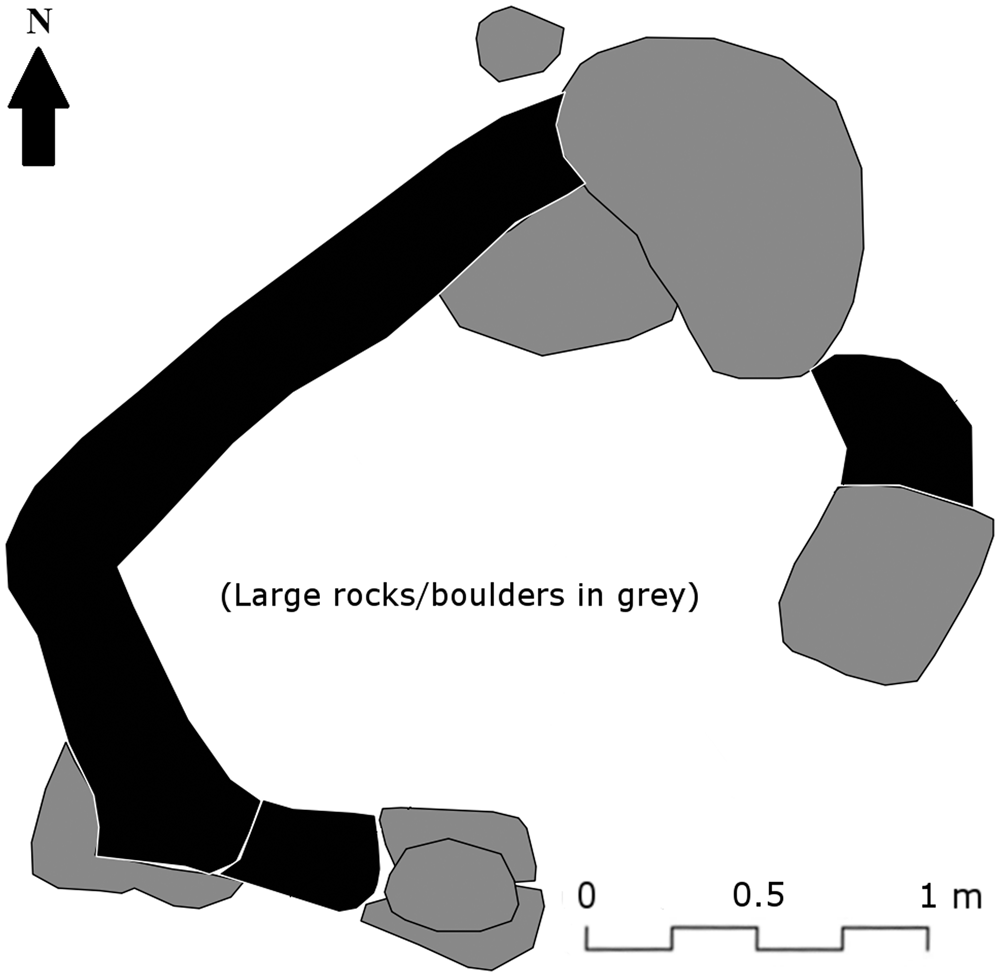
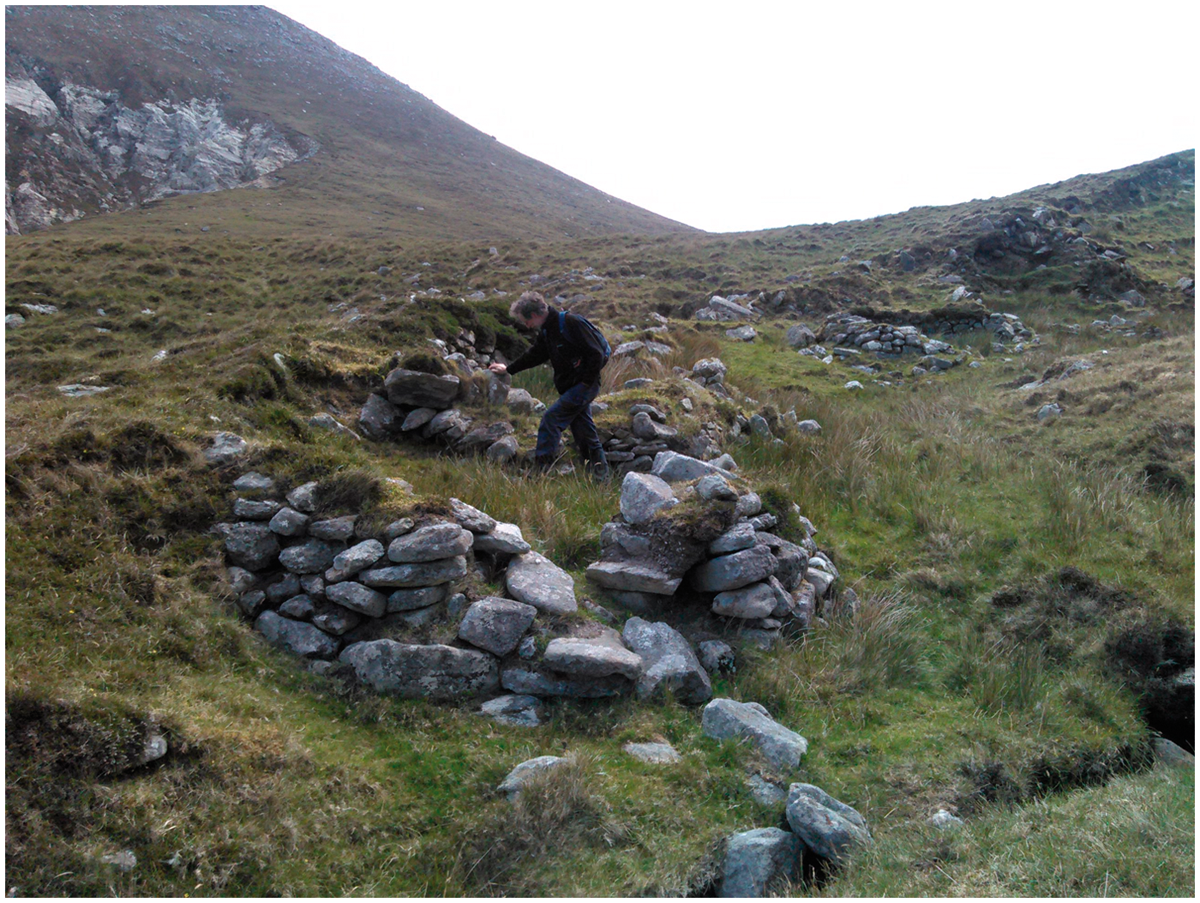
The seasonal occupation of these sites clearly had a bearing on their construction as well. Given that booley houses would only be occupied for part of the year, and the more clement part of the year at that, it is unlikely that the fathers and older brothers of dairymaids were prepared to invest as much time in building and standardizing them. For instance, regional variation in the length of time people stayed at booley sites may partly explain the differing amounts of labor that were put into booley house construction. In the Carna peninsula, where oral histories suggest that the summer grazing season for dairy cows only consisted, in its last incarnation, of two 4- to 6-week periods (one in May or June; the second in August or September), the average size of structures is 10 m2 externally and 4 m2 internally. Compare this to the Galtee Mountains, where booley sites are said to have been in use from April to late October: here, the construction style is sturdier and summer houses have an average area of 23.8 m2 externally and 10.9 m2 internally. To offer a distant parallel, modern herders involved in dairying in the Italian Alps tend to occupy more substantial summer dwellings, at fixed points in the mountain landscape, than sheep herders who have to keep on moving (Carrer, 2015). Moreover, booley sites were situated in peripheral parts of the community. Costello (in press) has suggested that this facilitated the proliferation of more adaptive forms of building in the summer pastures of south Connemara because booley sites were less open to scrutiny on a day-to-day basis than houses in permanent coastal settlements.
Learning and living in summer pastures: A rite of passage
The perception of uplands as a liminal cultural space is important to understanding how young people grew into full adult members of these communities. Beyond the most obvious functional explanation of why they were sent to booley sites—that adults had to stay at home—the responsibilities handed to young people speak to a process of learning through temporary independence. Although the oral histories above are narrated mainly by elderly men—two even stating that their fathers had passed the folklore down to them (NFC 155: 57; 157: 434)—they contain a tacit recognition of the abilities of young people, and of girls especially. In averting abduction by a group of strange men, the adolescent girl at the booley uses her skill and presence of mind to delay them with music, playing a tune which only her young brother recognizes; slipping out, he runs home to find help, which soon arrives, leading to a violent beating for the bride-stealers. One narrator even remarks that some women have “a way about them” (“bíonn rian mór ag na mná – cuid acab”; NFC 62: 219). Female stealth and patience are to the fore when a booley dwelling is intruded upon by the three men sheltering from bad weather, who are then cursed by witches while asleep. The small girl who lay hidden throughout the night overhears the cure and eventually rises with the power to free the three otherwise benign men, a situation that she exploits in order to take the best and wealthiest one for a husband (NFC 157: 440–441). Thanks to her calmness and pragmatism, she emerges from the horrible trap not only unscathed but well-married too.
These folk stories drew on the realities of daily life at summer settlements, insofar as young people and adolescent girls particularly exercised an unusual degree of freedom. When recalling their own experiences, as opposed to relating local lore, elderly interviewees frequently speak of the enjoyment that was had at summer pastures. Accounts from Donegal and south Connemara agree that the young herders would come together in the evenings and nights to socialize, play music, dance, and sing, with young men sometimes coming up from the home settlements to listen or join in (Morris, 1939: 289; Ó hEochaidh, 1943: 148; NFC 156: 55). Even in the Galtee Mountains, where booley sites were more dispersed, it is remembered that the young people would sometimes “come together and have a dance or some other fun like that” on the upland commons (Ó Danachair, 1945: 250). These social gatherings were crucial learning experiences, eventually helping to reproduce the cultural structure of the core settlement or baile. One elderly Donegal man recounts that his mother learned many of her songs at the buaile (Ó hEochaidh, 1943: 148), while the Irish saying, “Thug sí an damhsa ó bhuaile léi/She was well-schooled in dancing” translates directly as “she brought the dance from the booley” (Ó Dónaill, 1977: 152–153). Moreover, summer pastures provided an opportunity for unsupervised mingling. For instance, in Donegal, one man maintained that marriages were made between communities in the north and south of one parish as a result of meetings that took place at booley sites (NFC 1453: 110–111). At the very least, the hills and mountains formed an arena for young people of like status, i.e. cow-owning tenant families, to test out relationships and form bonds. This socialization process was vital to the reproduction of communal ties, which held the whole system of customary grazing together.
The obvious risks that went along with social autonomy were part of the rite of passage. Notwithstanding one folklore collector’s claim that there “was never a hint of any impropriety” during social activities (Morris, 1939: 289), and the fact that help was not very far away, young people were undoubtedly beyond the immediate protection and judgment of their families. In medieval Icelandic sagas, the secluded, ambiguous nature of summer sel sites provides the setting for several illicit encounters between lovers whose parents disapprove, and for the birth of children out of wedlock (Kupiec and Milek, 2014: 109). If booley sites were occasionally used for similar purposes in Ireland, it would hardly have been related or recorded in the 1930s and 1940s. That said, the possibility that illicit or damaging relations might take place did serve a didactic purpose in stories told to would-be herders and dairymaids at home, presumably by elders on long winter evenings. References to the wolf are a case-in-point. This predator had been extinct in Ireland since the mid- to late-18th century, and had probably not been common in Connemara since the late 1600s (see Hardiman, 1846: 9; Hickey, 2011). Nevertheless, storytellers continued to include wolves in their narratives because of their symbolic power. The idea that young men could take the form of a wolf was an implicit moral warning to young girls: during summertime, they would be responsible for looking after cows in the hills, so it was well to be a little wary of the opposite sex—mostly strangers, but also young men from their own community. At the same time, there was a warning for boys, who presumably listened to the same stories in wintertime. Accordingly, the young man who chased a young woman as a wolf is ultimately found out, and told by an elderly man to look after a flock of sheep as punishment (NFC 155: 56–57).
Learning continued within summer settlements thanks to the different ages of those present. A close reading of the longer folk tales suggests that younger siblings re-located to the booley along with older and more responsible adolescents. For example, the young girl who emerged from her night of hiding to win a husband had actually been left behind by older girls (they, having gone home with milk, were unable to return before nightfall due to rain and fog; NFC 157: 435). Readers will also remember that the young woman who was nearly abducted had her small brother with her until the strange men arrived. The presence of younger children is highly significant as it suggests that summer settlement involved a kind of apprenticeship (see Lave, 2011; Lave and Wenger, 1991). Not only did they learn songs and music at night-time, they would also have observed and eventually practiced many aspects of daily life that they needed for the rest of their lives. Boys may have seen to the rounding up of cattle in the hills, but milking the cows, churning, spinning, and knitting were all tasks carried out by females—whether at summer pastures or at home (Arensberg and Kimball, 1961: 33–43, 46–48; Evans, 1957: 95; NFC 694, 601; 991: 145; 992: 401; O’Dowd, 2005: 140–141). The idea of an informal apprenticeship is supported by the fact that, in south Connemara, a bródach or “favorite” would be in charge of each bráca (or “hut”) at summer pasture (Mac Giollarnáth, 1941: 278). By allowing youngsters to watch and partake in their daily routine, these “favorites” may well have played a key role in passing on cultural knowledge and technical expertise.
The liminal perception of summer pastures in male-narrated folk tales helped justify their lack of involvement in the vital activities that took place there, namely dairying and the care of livestock. At the same time, it gave young people an appropriate space to act out a transitional time of life in a way that benefitted the community beyond basic labor considerations. Sending them to summer settlements to form temporary groups of practice was a rite of passage. Girls acquired cultural knowledge through music and they bolstered dairying, knitting, and spinning skills that sustained not only the booley settlements but eventually, as well, the social structure of home. The fact that their apprenticeship and socialization took place in landscapes that tenant families had to share, as commonage, is important too. Dwelling and working on common land would have instilled in people from an early age the value of mutual understanding and negotiation.
Given that seasonal movements of people and livestock died out in most of Ireland before the 20th century, and earlier still in many parts of the south and east, it is difficult to gauge exactly how communities marked the beginning and end of this rite of passage each year. There is good historical and ethnographic evidence from countries like Spain, Greece, and Romania that rituals and feast days marked the movement and return of livestock from summer pastures, albeit with men usually acting as herders (Chang, 1993: 692; Juler, 2014: 14; Klein, 1920: 24). In Ireland, there appears to be an association with Bealtaine or May Day, an auspicious time of year for all farmers at the start of summer (see Danaher, 1972: 86–127). As early as the 8th-century AD, law text glosses suggest it was common to go to summer pastures around May 1st and return home about November Day (Neilson Hancock, 1865: 132). Much later oral tradition in south-west Donegal records it as the day for bringing cattle together and having them counted by one man, prior to summer pasturing (Morris, 1939: 289). May gatherings also happened at the start of summer pasturage in Ballycroy, Co. Mayo, but for the purpose of ritually draining blood from cattle to keep them free of murrain (Otway, 1841: 333). In the Outer Hebrides, entire families would accompany young female herders to summer pastures in early June, helping to repair the shieling huts and holding a special feast where cheese was shared and dedications sung (Skene, 1880: 385–388). Similarly detailed contemporary accounts are sadly not available for Ireland, although it is recalled in two sources from Donegal and Connemara that older brothers and fathers would travel up to the hills in April or so in order to ready and re-build the booley dwellings of their daughters and sisters (Gibbons, 1991: 45; Ó hEochaidh 1943: 133–134, 136). These rituals vouched protection and perhaps a degree of control over herders and cows at the outset of the grazing. Beyond the obvious personal attachments that existed between kin, unmarried young people represented a very important social resource that could not be forgotten, no matter how liminal their temporary home was perceived to be. Although having sons was advantageous given their potential to carry out hard labor and acquire further land through marriage, daughters were highly valuable to the wider community as future brides who would provide dowries. As these girls approached late teenagehood, marriage was the ultimate closing ceremony on their years of apprenticeship and autonomy at the booley. While there is evidence to suggest that some married adult women continued to carry out dairying tasks at booley sites in the final stages of the practice, they were ultimately now under the control of one man - their husband (O’Dowd, 2005: 256–257). The fairly widespread Irish folk song, “Aililiú na Gamhna,” encapsulates the feeling of loss that may have accompanied marriage. Reminiscing about her days milking cows and looking after calves from a small cabin in an upland valley, the singer admits it is with them that she would rather be … na gamhna b’iad a b’fhearr liom (ITMA: 996-LP, Mary O'Hara). The use of poetry and song to express opinions about their own situation and the men who held power over them is also found amongst Somali and Maasai pastoralist women (Hodgson, 2000: 15).
Remembering and preparing for a domestic environment: The materiality of summer settlements
With young women expected to return home, and regular contact forming the essence of the baile-buaile system, it is unsurprising that some elements of a domestic environment are recreated in the otherwise liminal environment of summer pasture. While booley houses are not as uniform as permanent houses between 1750 and 1920, there are signs of activity around them, that recall the domestic taskscape of home. First, potato cultivation took place on a small-scale. Oral history from both the Galtees and north-west Donegal mentions the growing of potatoes at booley sites (Ó Danachair, 1945: 250; Ó hEochaidh, 1943: 139). Archaeological field survey confirms the presence of cultivation ridges at a minority of sites. In the Galtees, Knocknascrow 3, Coolagarranroe 1 and 2, and Drumleagh 4 have patches approximately 300–400 m2 in size, while in south Connemara, the south-western slopes of Gleannán and Seanadh Bhuire towlands contain several smaller patches of ridges in association with summer settlement, in this case measuring between 100 m2 and 200 m2. McDonald (2016: 60) in Achill has found at least one instance of likely potato ridges at the aforementioned booley settlement of Annagh. Given that the last potatoes may not have been harvested until November each year, Costello (2016a: 92) makes the point that many of them would have been brought home for consumption over the winter. The sowing, earthing up, and picking of potatoes are a routine that would also have taken place at permanent settlements, albeit on a much greater scale. In that sense, booley sites were an extension of the home, not just because they were a means of procuring food for the winter (for that was their purpose as summer dairies), but as places where some aspects of people’s daily practice were the same.
The general layout of booley settlements is also arguably linked to notions of space derived from home settlements. Field survey in south Connemara bears this out especially. Two loose groups of stone houses and huts, in Gleannán and Cnoc Buí, respectively, are associated with large enclosed areas of irregular shape (Figure 5). Medium- to large-sized stones picked from the soil surface have been arranged in linear cairns or walls, linking up natural boundaries like rocky ridges and sharp breaks in topography. At first glance, their purpose would appear to have been livestock control, i.e. they could either have been constructed to make paddocks in which to milk cows morning and evening, or they could have acted as deterrents to livestock entering and trampling potato plants and/or grass (that might have been saved as hay and brought home). Closer inspection, however, shows that there may have been a large degree of multi-functionality to the walls. Both the Gleannán and Cnoc Buí groups are divided into roughly two main areas. The former group contains one large enclosure on a rise, which is relatively quiet in archaeological terms (only Gleannán 12, its nearby ridges and a few clearance cairns being present). Below it to the north-west is a more complicated zone of activity, focused on a meandering stretch of flat, waterlogged ground. On the rocky slopes leading down to this wet patch are the remains of several booley houses, patches of ridging, and large clearance cairns. Obviously, the latter would not have served very well as a milking paddock. At the same time, it is not clear that the higher enclosure was suitable for the purpose, since it too contained some cultivation and offers no convenient line of approach for stock. The Cnoc Buí group is roughly divided between a small northern enclosure, containing booley huts Cnoc Buí 3, 4, and 5, and a larger, grassier southern area with the poorly preserved hut-like structures, 6 and 7. In this case, 3, 4, and 5 appear somewhat segregated from 6 and 7. But why enclose them? At Cnoc Buí, there is no visible evidence of cultivation, while the crowded, uneven and rocky nature of the northern area is unlikely to have been conducive to the corralling of cows. Indeed, as they survive, the “walls” themselves are hardly stockproof, rarely reaching above 0.4 m in height, and along some stretches amounting simply to lines of stones.
Plan of part of Gleannán booley settlement. Contours generated by writer using imagery provided by Western Aerial Survey and Photography Services, Oughterard, Co. Galway.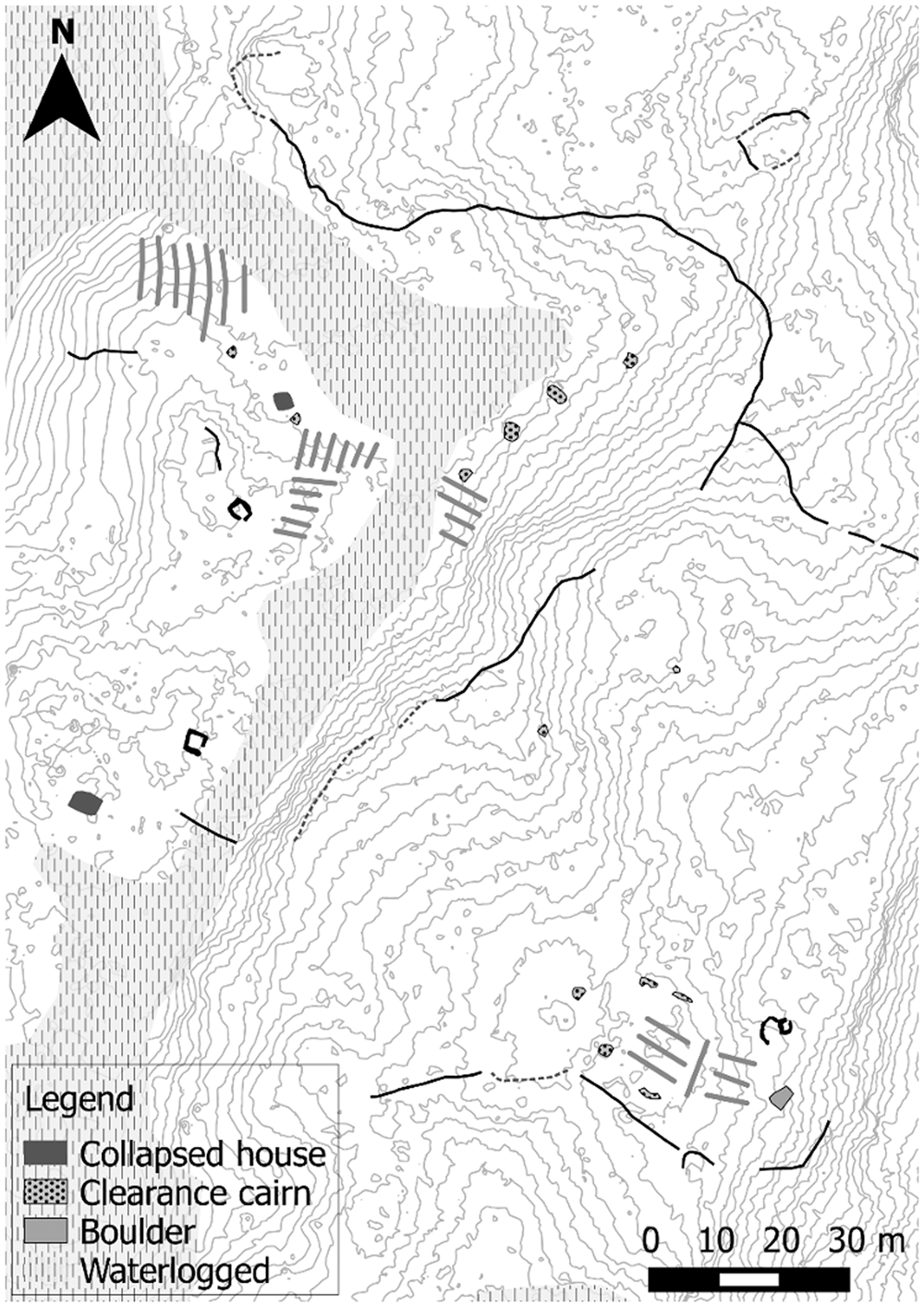
Oral history from north-west Donegal and two other parts of County Galway—Joyce Country and the Slieve Aughties—does mention that cows were kept next to booley sites overnight, so that they could be milked evening and morning (Ó hEochaidh, 1943: 145–146; NFC 525: 83; 707: 394). However, the account from Donegal—the most detailed—fails to mention any sort of physical enclosure; rather, it says that cows were tethered to posts for the night (Ó hEochaidh, 1943: 146). Field surveys of known or probable summer settlements elsewhere in Ireland have also failed to reveal the kind of division visible at Cnoc Buí and Gleannán (other than much smaller and discrete pens). It would not be surprising if the larger enclosed areas within these settlements helped to enclose cows at night, especially prior to the 18th century when wolves were common. Nevertheless, their peculiarity within Irish transhumance and likely ineffectiveness as barriers strongly suggest that another function was to demarcate ground and create spaces that held significance in the social context of the local farming community. As a result of these spaces’ creation, by adult males presumably, herders had to dwell and work in a more ordered space. Granted, the walls are laid out with reference to certain topographical features, but the overall sense is one of a place that was subject to pragmatic cultural control.
The roots of this mindset lie in the home farms. On Ordnance Survey maps from 1838 (Figure 6), the houses of tenant farmers are also located in loose groups within individual townlands and between them are curvilinear field walls. Their unplanned appearance probably indicates evolution over several decades in pre-Famine times, but the outcome is nonetheless a control over space. The partial communities of young people and girls who went to summer pastures stayed in what might be termed satellites of home, where the replication of certain features allowed them to relate to their neighbors and the landscape in a similar way. So while oral histories depict life at summer pastures as a somewhat alien world of risk and joy—elements it may well have contained—the field remains remind us that the social structure of home was still present in some form. In other upland pastures, the layout of booley settlements used in post-medieval times also appears to be partly derived from contemporary permanent settlements. The booley houses of Achill are far more clustered than those in south Connemara and yet have no demarcation of space between them, a pattern arguably derived from nucleated villages in which tenant families were based (Costello, in press); while in the Galtee Mountains, most booley houses are isolated on the mountain, echoing the individual farmhouses that dominated the surrounding lowlands and foothills by the 19th century (Costello, 2016b: 270–271).
Plan of coastal home settlements in Carna, south Connemara, in 1838 (after Ordnance Survey First Edition 6″ map).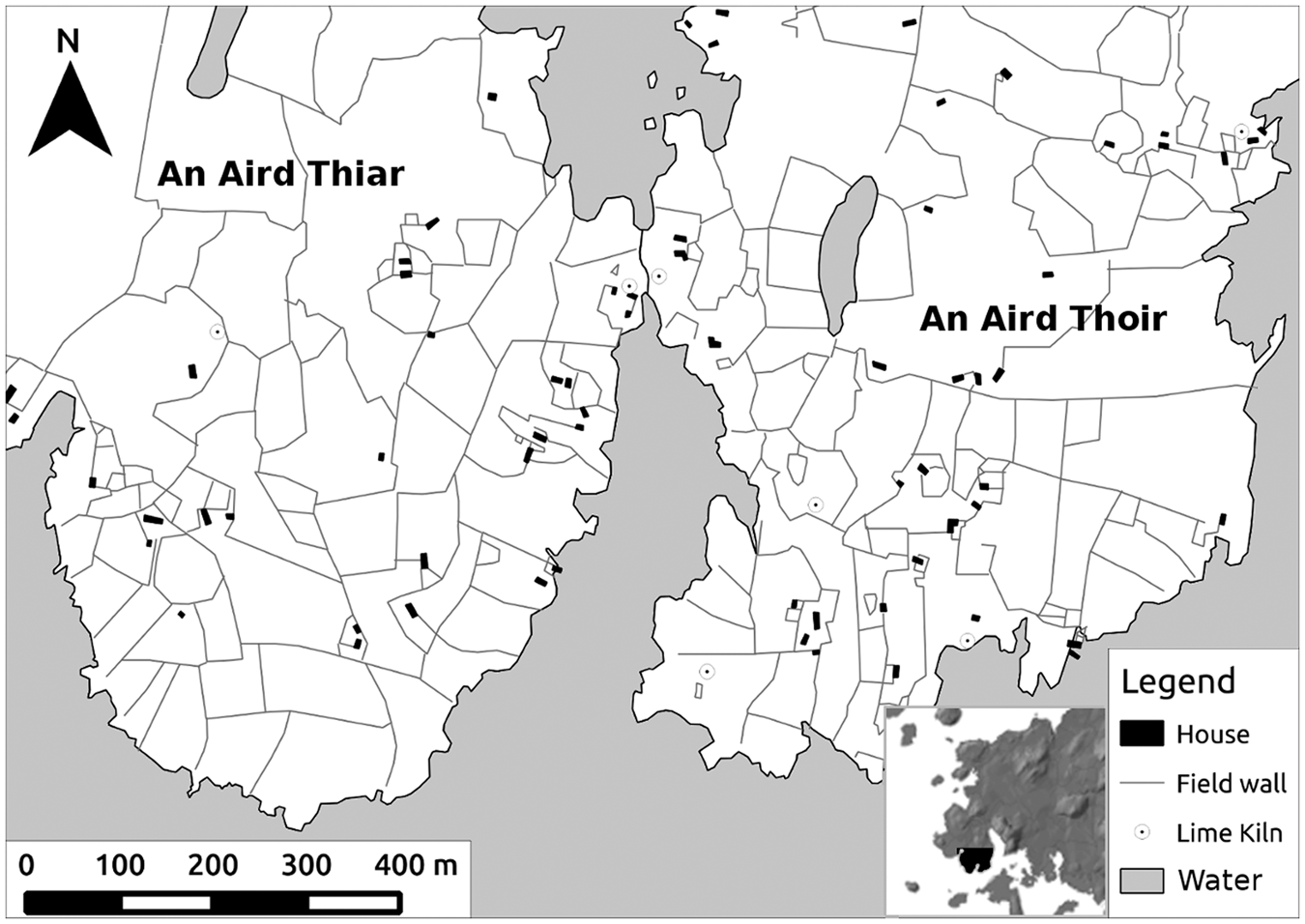
Thus, it is not possible to draw a sharp boundary between buaile and baile during the period in question. If anything, with transfers of butter taking place regularly and permanent settlement expanding rapidly in western Ireland during the 18th and 19th centuries (see next section), it was an extremely porous border. Albeit working in significantly different environments, scholars of Viking and medieval Iceland have now also turned away from the idea of a strong dichotomy between infield and outfield, that is, the binary opposition of a safe and socialized infield (innangarðs) and an unknown and dangerous outfield (útangarðs) where summer grazing took place (Kupiec and Milek, 2014: 103). Indeed, artifacts and animal bones from one of the few sel sites to be excavated, at Pálstóftir, has revealed that a range of activities, like fowling, crafting, and gaming all took place alongside the management of livestock (Lucas, 2008). Targeted research-led excavations have not taken place at any known booley sites in Ireland yet, though in the future they might provide another line of evidence on the daily lives of their occupants.
Seasonal social practice in historical landscapes
The complexities, indeed, the apparent contradictions of seasonal social practice are linked to the rapid historical change that took hold of Irish landscapes during the post-medieval period. Between 1732 and 1821, the population of Bannagh barony in south-west Donegal is estimated to have grown by a staggering 600%, while that of Ballynahinch barony (inclusive of Connemara) in County Galway grew by between 301 and 400% (Smyth, 2012: fig.2). In the 20 year period before the Great Famine (1845–1850), the population of both areas grew by a further 40–50% (Smyth, 2012: fig.4). Although replicated across the whole of Ireland, this trend was most extreme along the western seaboard in areas which previously had very low population densities (as estimated by 17th-century English surveys; Smyth, 2002). And it had very significant impacts on contemporary land-use and settlement. In the Galtee Mountains, up to 4000 ha of what had been common pasture was encroached upon by tenant farmers and enclosed with landlord encouragement (Costello, 2015). Similar, albeit more organic expansion into uplands took place in Connemara and Donegal. For example, even though the Gleannán booley settlement was used by tenants who were based 7 km away in the coastal townland of An Aird Thiar (see Martin Estate, Co. Galway, Particulars etc. 1837–1852), there are three single farmsteads located much closer to it, at a distance of only 1.5 km. Distinguishable from booley sites due to their larger houses and surrounding improved land, these farmsteads were established on summer pastures during the early 19th century when population pressure was at its greatest by the coast. Pioneering farmsteads are even more common in the hill pastures of south-west Donegal (Costello, 2016b: 245–246), and although excavation has yet to test their origins, placenames and oral history suggest that many of them replaced older booley settlements (Costello, 2015: 62; McDonald, 2016: 62–63).
This was not the first time that Ireland’s uplands had seen year-round settlement and agriculture—episodes of Neolithic and especially Bronze/Iron Age activity have been detected in north Mayo and west Cork (O’Brien, 2009; Verrill and Tipping, 2010). However, the rate of post-medieval population growth was unprecedented. In as little as one or two generations, land-hungry tenant farmers made hundreds of thousands of small inroads into commons. It is the present writer’s contention that the swiftness and scale of these incursions created a degree of uncertainty around the idea of the buaile. Piecemeal and planned encroachment onto commons weakened the notion of summer pastures as a communal resource, since encroachment was usually undertaken by individual families. In other transhumance-practising regions of northern Europe, such as Iceland, Highland Scotland, Norway, and central Sweden, the assarting of forest or moorland did not have as noticeable an overall effect on landscape since there were far greater expanses of marginal land and less rural population growth to affect it during the 18th and 19th centuries. In Ireland, the areas used as summer pasture were comparatively small and fragmented, and so, in a few decades, farming populations were forced to become more flexible in their use of seasonal sites.
The uptake of potato cultivation was both a cause and expression of their changing mindset. Common as a garden crop from the second half of the 17th century, the potato gradually became the chief field crop of tenantry during the 18th century as grain prices rose (Clarkson and Crawford, 2001: 61–62). Oral tradition from south Connemara maintains that people in the area initially thought potatoes would only grow on the better soils of inshore islands, but this soon changed, and potatoes—feeding more people per hectare—contributed greatly to population growth. However, increasing the extent of their cultivation in places like Connemara required laborious improvement of peaty soil, first through stone clearance and continually thereafter by collecting and digging in various manures (sand, seaweed, seashells, dung, etc.). Haymaking also became more widespread in Ireland during the 18th and 19th centuries (replacing the labor-free but less efficient practice of winterage, i.e. standing fodder). The adoption of these work routines at home settlements had an effect on the overall labor structure of transhumant communities in a relatively short period of time. During the 17th century and early- to mid-18th century, entire families are said to have moved seasonally with cattle in some parts of Ireland and Highland Scotland (albeit with females actually milking the cows; Bil, 1990: 196–205; O’Sullivan, 1971: 46; Smith and Harris, 1744: 125). From c.1750 onwards, more intensive and sedentary labor in the fields diverted adult males away from livestock husbandry, leaving children with a greater role in booleying than before. In Sweden, too, people were adaptable in terms of labor, with women emerging as the dominant presence at säter sites in the 17th century partly due to Sweden’s heavy involvement in warfare (Larsson, 2012: 16). But the effects of modernization on age and gender roles have not been uniform. In Tanganyika, for example, commodification of livestock in the early 20th century contributed to the erosion of Maasai women’s sense of being pastoralists—men’s control of the cash economy giving them more power than previously over their wives and daughters (Hodgson, 1999).
When thinking of social structure spatially, booley sites were now arguably more integrated into the home or baile as opposed to more detached from it. The beginning of small-scale potato cultivation and the conversion of some sites into farmsteads are material expressions of booley sites’ changing status. Patches of ground within the wider summer commonage landscape entered a process of “domestication” due to increasing contacts with and even replication of the baile. This process was both facilitated by and facilitative of delegation to young people. Moreover, it speaks to the temporality of upland landscapes, and reminds us that they were not immutable (see Horning, 2007). Comparisons between social space at booley sites and the layout of their parent farms during the 19th century hint at a connectedness too; however, extensive excavation is required to test whether these patterns in seasonal and permanent settlement emerged at the same time in the post-medieval period, or earlier. Boys and girls may not themselves have laid out summer settlements or constructed summer dwellings, but they were active participants in creating stronger links with home settlements by milking and minding their families’ cows, producing butter, tending to potato ridges, bringing these foodstuffs home, and reproducing the all-important communal ties that kept booleying working. If the context of potatoes’ introduction and the expansion of population help to understand conflicting representations of seasonal sites in material and oral culture, the death of transhumant pastoralism in these communities not long after was a consequence of some of the changes. The practice of booleying during the 18th and 19th centuries represented a transitional phase toward fully sedentary agro-pastoralism in many parts of Ireland. Seasonal movements of stock still take place in some areas (notably of dry cattle to the Burren during winter), but there has been no seasonal movement of herders with dairy cows to booley sites since the last of them were abandoned in south Connemara and Achill island in the early 20th century.
Changes to work routines increased after the Great Famine, leading to even greater agency for young people and young women in their communities, albeit outside of farming and outside of Ireland. Young people were drained out of Achill Island in the early 20th century to work seasonally in the potato fields of Scotland (O’Dowd, 1990), while it is remarked of south Connemara that “all the girls of these large families who are not married at eighteen … are despatched to America” (Finlay, 1898: 73). The cash which they brought or sent back to their families replaced or exceeded what might have accrued from sales of mountain butter, but the social implications for these communities were now very different. For all the temporary freedoms that young people could exercise at booley settlements, they were still ultimately kept within the community as a future source of intermarriage between families. Emigration to foreign labor markets therefore represented more than a changing mode of production; it was a socio-cultural loss, which contributed to the cessation of Ireland’s last transhumant systems. As such, it underlines the full extent of interdependency between seasonal settlements and their permanent counterparts. In an economic sense, the links between them were of almost immediate benefit—extra grazing, sale of butter, and potatoes—but their socio-cultural role only became apparent over years and lifetimes. Young people exercised responsibilities and acquired local geographical and cultural knowledge that served them as adults, passing it on to their own children in oral narratives tempered with cautionary tales and in occasional material interventions that were as much meaningful as well-meaning. That cycle was itself a transformation of earlier social practices in booleying, foreshadowing an internal break-up of the whole structure of seasonal settlement by its participants, who, many of them, now sought to exploit faster-appearing economic opportunities.
Final thoughts
Through ethnohistory and archaeological field survey, this article has discussed the embodied social role of summer settlement. Apprenticeship and learning were important aspects of daily life at pastoral booley sites in the west of Ireland during the recent past. Because of their location in hills and mountains, summer pastures were often perceived as liminal, a trait which added justification to the autonomy of young people at summer settlements. Notwithstanding their re-location to booley sites several kilometers away from home, young people were still very much part of their community since they depended on adults for protection and the latter depended on them to look after and milk cows—their economic lifeblood as tenant farmers. The archaeological evidence reflects this conundrum. While the actual booley houses were built clearly with the immediate physical structure of the landscape in mind, there are signs around some of them of domestication, i.e. potato cultivation, stone clearance, demarcation of space. These arguably served as reminders for young people, and young women especially, that a domestic, married life lay ahead of them.
It is hoped that the article will alert archaeologists to the added complexities of using practice theory on communities that are—at least in part—seasonally mobile. At the same time, it shows that research questions which are informed by social theories can help make archaeological studies of transhumant people more powerful—emphasizing pastoralists’ role in giving meaning to gender and age divides in labor, and in helping to create and transform different cultural arenas in a landscape. Through seasonal movement and settlement, transhumant farmers were able to create separate task groups that, economically, could exploit different parts of the landscape and, socially, could reinforce the community as a whole in the long term. Hence a key message is that communities of practice manifest themselves not just in households and villages but across broader landscapes too. In the transhumant societies discussed here, seasonal spatial fragmentation was in fact central to keeping together and reproducing the community.
Footnotes
Acknowledgements
I would like to thank my doctoral supervisor at NUI Galway, Dr. Kieran O’Conor, and Prof.’s Ian Kuijt, Meredith Chesson, and Diarmuid Ó Giolláin at University of Notre Dame for all their encouragement and advice.
Declaration of Conflicting Interests
The author(s) declared no potential conflicts of interest with respect to the research, authorship, and/or publication of this article.
Funding
The author(s) disclosed receipt of the following financial support for the research, authorship, and/or publication of this article: This research was supported by a National Endowment for the Humanities Fellowship (2016–17) at the Keough-Naughton Institute for Irish Studies, University of Notre Dame.