



Abstract
Collaborative and Indigenous archaeologies call on researchers to recenter theory and practice on descendant peoples' lives and ways of knowing. Extending this project, this article takes story and dance as a site of theory, foregrounding Indigenous modes of embodiment in which bodily and sensory perspectives are cultivated through participation in more-than-human beings. Drawing on research with members of a small, Muskogee-identified community in the US South, it frames the large-scale earthworks at the Poverty Point site in Louisiana as representing a horned owl. This evokes stories about a people who lived in an owl-shaped village and who could move in particularly owlish ways. Critiquing ontological frameworks in which the sensory is universal and mind is removed from body and land, I argue that ancient peoples may have cultivated perspectival embodiments through the everyday activity of living together in the collective form of an owl. Moreover, as contemporary descendants return to Poverty Point, the land animates shared, multispecies sensory fields that enroll descendants into a longue durée of owlish encounters and entanglements, or what my hosts simply call “Owl's teachings.” Here, I call for an archaeology reimagined in the context of Native American and Indigenous studies, asking how mounds might animate resurgent possibilities rooted in (and routed through) deep Indigenous histories of return.
Keywords
Late at night, a small fire flickers in a clearing in the woods, half-illuminating the handful of people sitting nearby. Standing up, they quietly move their canvas and plastic chairs beyond the shell ring that marks the edge of the sandy area. I follow suit.
We form a line facing the fire, shadowy figures against the warm glow, and begin. We take slow, half steps forward, singing a slow, haunting melody of descending notes. As the verse ends, we circle quarter-way around the fire and begin again, singing and stepping towards the light once more. We circle the fire this way, then sing a final verse stepping slowly back to the darkness.
This dance was for Opv, or Owl, and was brought forth by a small community in the US South whose members identify as of Muskogee (Creek) ancestry. At ceremonial gatherings, called busks, families come together to fast, feast, sing, and dance their prayers. Elders say that these dances are ways of acknowledging, honoring, renewing, and “giving breath” to the beings of creation, and in this case, Owl. There are also particular reasons for this dance. Often, just before it begins, an elderly woman, Linda, asks, “Why do we do the Owl Dance?” Someone answers, “Because owls see into the darkest of places, and the darkest place of all is the human heart.”
Although many Southeastern Native American peoples hold that certain species of owls are bad omens related to death (Swanton 2000[1928]: 549), elders within this particular community say that they are merely messengers. 1 Owls are considered especially important because they see within the unseen and fly in silence. As an elder and Heles-Hayv (Maker of Medicine), called Hakope, explained excitedly: “Haven't you seen the PBS documentary [Nature 2015] where they have an owl fly over a series of microphones? The microphones pick up nothing.” Silence, as elders often say, is the voice of Creator. Humans, however, are not always as good at moving in perfect silence. The dancers compensate by moving slowly—translating the auditory into the proprioceptive (the internal sense of bodily movement)—swooping towards the fire before returning to darkness. In moving through space in this owlish way, dancers both give breath to Owl and hope to share in its sensory perspective: vision into the darkest places.
Introduction
The Owl Dance enacts a mingling of bodies through stylized movement: a mutual enfleshment and sensory borrowing. In this article, I draw upon such visceral teachings to interpret Poverty Point (c. 1750–970 BCE), an Archaic Period earthwork and UNESCO World Heritage Site in what is currently Louisiana, as a landscape of multispecies encounters and transformations (Birch, 2018; Hamilakis and Overton, 2013; Haraway, 2008; Kirksey and Helmreich, 2010). Extending critiques that recenter archaeological theory and practice on Indigenous ways of knowing and being in place (Atalay, 2006; Smith and Wobst, 2005), I look to interpretations of the landscape and oral traditions that an elder and heles-hayv (Maker of Medicine) of this community, Hakope, shared with me. This account constitutes what Davis and Todd (2017) call “fleshy” knowledges in which mind, body, multispecies relations, and land are inseparable (see also Laluk, 2017; Watts, 2013). As such, I take oral traditions as both descriptions of the past and sites of place-based, embodied theory in which the land enrolls peoples into multispecies embodiments and entanglements (Cipolla et al., 2018; Cruikshank, 2005; Ferguson and Colwell-Chanthaphonh, 2006; Laluk, 2017; Million, 2005; Patton, 2014; Watts, 2013). In the context of Poverty Point, these transformations occurred through the everyday movement of dwelling together in the collective form of Owl and as descendants return to ancestral landscapes and are drawn into encounters with these nocturnal birds (see also McNiven, 2016).
These insights come out of research on ancestral places with Hakope's community, whose members claim Muskogee (Creek) identity, undertaken since 2010 (Bloch, 2018). I refer to this community using a pseudonym, Talwa, because my agreement with the leadership is to protect the community's privacy as best as I am able. 2 This name is derived from a generic Mvskoke-language word for a type of spiritual community that historically exercised significant political autonomy. Talwa people are descended from families that avoided Removal in the 19th century or returned shortly thereafter, and as such are distinct from the Muscogee (Creek) Nation in Oklahoma. Talwa people's historical experiences are specific and I do not assume that the interpretations discussed here are necessarily held by all Mvskoke or Indigenous peoples (see also Ferguson and Colwell-Chanthaphonh, 2006: 6; Howe, 2014). In adopting an archaeological ethnographic approach (Hamilakis, 2011; Hamilakis and Anagnostopoulos, 2009; see also Cipolla et al., 2018; Ferguson and Colwell-Chanthaphonh, 2006), I argue that Indigenous peoples already practice alternative archaeologies or ways of attending to deep histories, but that these remain illegible within dominant disciplinary discourses (see also Laluk, 2017). As such, my role as a non-Native researcher has been to learn from these practices. This shaped a hybrid practice that moves beyond conventional dichotomies of history/prehistory, sacred/mundane, human/animal, and knowing/being (Dowdall and Parrish, 2003; Silliman, 2009). Adapting a place-based oral history methodology (Basso, 1996; Ferguson and Colwell-Chanthaphonh, 2006), we visited about three dozen ancestral sites representing a wide range of cultural eras. I learned from the stories my teachers told along the way, including oral traditions and personal memories. While my Talwa teachers often pushed me to focus on symbolic and cosmological frameworks (in keeping with their own cultural revitalization projects), Hakope often refused to discuss any site with me until I had visited it myself—even if it meant visiting it alone. This speaks to the importance of situating these knowledges within embodied relationships with place.
Poverty Point is one among thousands of earthen mound sites that Indigenous peoples built across eastern North America over the last 6000 years. It is also among the oldest, with its main component dating to the Late Archaic Period (Gibson, 2001; Ortmann, 2010) (Figure 1). There is also a later Late Woodland/Mississippian component and there are important relationships to earlier Middle Archaic earthworks nearby. As such, intermittent periods in which visitors leave less materially dense and durable traces have been a part of Poverty Point's life cycle for a long time (Clark, 2004; Ortmann, 2010; Sassaman, 2005). Hakope interprets the planned, geometric layout of the site as representing a horned owl, estekene. This landscape evokes stories about a people who once lived in an owl-shaped town. Indeed, researchers have found a number of miniature jasper owl figurines at the site. By living in the collective form of an owl, Poverty Point peoples may have cultivated particularly owlish embodiments and sensory perspectives—similar to the Owl Dance. Yet Talwa ways of knowing are not limited to descriptions of ancient peoples' lives, but include the ways in which the land continues to weave humans and birds together within a deep history of owlish encounters as descendants continue to return to Poverty Point. These “returns” (Clifford, 2013; Howe, 2014) demand rethinking narratives of site “abandonment,” which teleologically presume the completed nature of mound sites. Abandonment accounts are premised upon the erasure of Native American peoples' continued presence within ancestral landscapes, or what Mojica (2012) describes as a scientific realism that obscures lived Indigenous realities. Colwell-Chanthaphonh and Ferguson (2006) likewise point to how such narratives obscure historically shifting patterns of land use in ways that may interrupt contemporary peoples' claims to ancestral places. In contrast, they note that Indigenous peoples in the Southwestern US may perceive ancestral sites as powerful places that go through their own cycles of death and renewal and which may remain important for spiritual practices, pilgrimages, and historical instruction. Indeed, as the land draws descendants into Owl's teachings, Talwa people renew connections to ancestral landscapes in the face of hundreds of years of settler colonialism and the silencing of their histories.
Poverty Point in chronological context.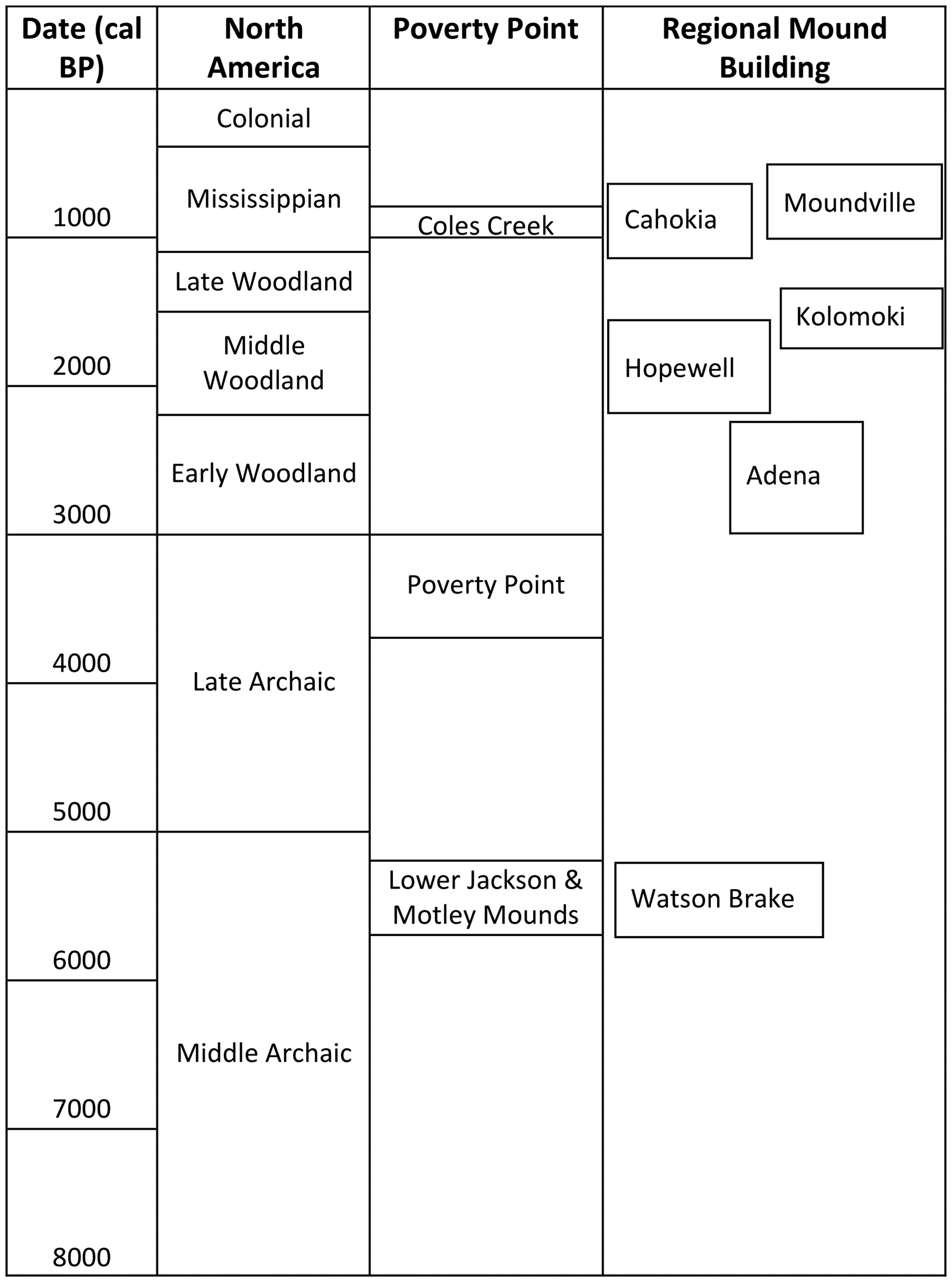
The following treatment situates Indigenous knowledges at the intersections of land, story, dance, and everyday movement, rendering Poverty Point as a living place and a site of return as an alternative to abandonment narratives. It also points to the limits of framing mounds in terms of monumentality, foregrounding instead the everyday labor of dwelling with and caring for human and nonhuman others (see also Moore and Thompson, 2012; Thompson and Pluckhahn, 2018). Likewise, Talwa oral traditions call attention to Indigenous modes of embodiment and transformation—of giving breath to and participating in more-than-human bodies—that may be applicable to other sites, such as Serpent Mound in Ohio and Rock Eagle in Georgia (the latter of which Talwa people interpret as a turkey). However, I argue that the point is not to “scale up” Talwa theory, but rather to ground (fleshy) archaeological knowledge in the sensory fields and encounters that emerge as descendants return to place (Ferguson and Colwell-Chanthaphonh, 2006; Howe, 2014; Laluk, 2017). 3 That owls offer in-sight into the darkness within should not be lost here. Owls embody a negative poetics that reminds us to reflect on the silent and the unseen. They evoke a transformative alterity that resists capture within fixed representations (Alberti, 2016), calling attention to that which is invisible from one's own vantage (hooks, 1989: 145–154). Such uncertainty is humbling: it invites rethinking and reflection upon one's own positioning. Indeed, Poverty Point remains what Chadwick Allen (2012: xiv–xv, 2015a: 441) calls trans-Indigenous space, as a site of creative interaction and exchange among many peoples (see also Gibson, 1994a, 1994b; Sassaman, 2005). 4
I argue that the land animates multispecies sensory fields that both evoke the deep memory of oral traditions and draw descendants into an ongoing longue durée of owlish entanglements. While others critique the privileging of autonomous sight within modernist archaeology (Hamilakis, 2013), Talwa oral traditions call attention to how peoples cultivate distinct bodily and sensory perspectives through multispecies encounters (see also Viveiros de Castro, 1998; Weismantel, 2015). Yet whereas perspectivism often centers on relations of predation, Talwa oral traditions foreground the labor of living well together and returning to place (Howe, 2014; Overing and Passes, 2000) and tune into not only the visual but proprioceptive (feeling of movement) sense. Such an orientation problematizes not just modernist but colonial sensory regimes, calling into question the individualized and displaced body (in which the sensory amounts to a nature inscribed upon by culture) as enacted through relations of dispossession that sever Indigenous peoples' multispecies relations and knowledges (Davis and Todd, 2017; Whyte, 2017). As such, future research might re-situate archaeology more deeply within Native American and Indigenous studies (see Battle-Baptiste, 2011 for a parallel argument about black feminism). An archaeology reimagined as both located within descendant communities and as a subfield of NAIS might turn not only to theories of animate landscapes and multispecies relations, but also resurgence and sovereignty beyond the nation-state. These discourses call for alternative futures rooted in (and routed through) deep Indigenous histories, demanding decolonial temporalities. Indeed, the sensory fields of Poverty Point continue to draw Talwa people into Owl's teaching as a sovereign mode of life that quietly exists within the fractures of settler governance.
The archaeological context of Poverty Point
Archaeological models of Poverty Point are multiple and contested, but the site was massive in scale and a center within regional exchange and travel networks (Gibson, 2001; Kidder, 2011). In 2015, I visited Poverty Point with Quinn, a Talwa elder, along a longer trip to visit mound sites that took us through Alabama, Illinois, Kentucky, Louisiana, Mississippi, and Tennessee. I was surprised how difficult it was to gain a sense of the land from only a few feet off the ground. The overall site layout becomes much clearer with a high vantage (see Figure 2). Adjacent to the Macon Bayou, the Late Archaic component of the site consists of five mounds and six concentric, semi-circular earthen ridges, dating from 1750 BCE to potentially as late as 970 BCE (Connolly, 2006; Ortmann, 2010). In addition, the layout incorporates two nearby earlier Middle Archaic mounds (built after 3900 BCE) and a sixth, Coles Creek mound (c. 1100–1050 CE) (Saunders et al., 2001). The six ridges span the length of a kilometer, cradling a plaza. Just to the west sits Mound A, flanked by Mounds B and E. Mound A measures 22 meters in height and about 200 meters along its axes. Sometimes called the Bird Mound due to its form, it is irregularly shaped with two “bulbs” on the north and south sides. In spite of the amount of labor and planning that went into its construction (Sherwood and Kidder, 2011), Mound A was constructed within about 90 days c. 1450 BCE by foraging peoples with a situational leadership (Ortmann and Kidder, 2013).
LiDAR map of Poverty Point. Image courtesy of the Poverty Point Station Archaeology Program, University of Louisiana at Monroe; data courtesy of FEMA and the state of Louisiana; data distribution courtesy of “ATLAS: The Louisiana Statewide GIS,” LSU CADGIS Research Laboratory, Baton Rouge, Louisiana.
Unlike the quick construction of Mound A, the earthen ridges were probably built over several centuries (Ortmann, 2010: 674–5; cf. Gibson, 2001: 96). Domestic debris and dark, organic soils suggest that Poverty Point peoples may have built their homes atop these ridges, although this is contested and little direct evidence is available due to centuries of plowing (Gibson, 2006; Ford and Webb, 1956: 32, 128; Webb, 1982: 16–19; see Connolly, 2002; Hargrave et al., 2007 for suggestive but inconclusive support, but cf. Jackson, 1991; Sassaman, 2005: 263). While some suggest that the site supported a large, sedentary town, others advocate vacant ceremonial or economic center models (Gibson, 1987; Jackson, 1991; see Carr and Stewart, 2004 for discussion and limited testing). Poverty Point may also have been a pilgrimage site for peoples across the region (Spivey et al., 2015). The people who built this site imported materials such as copper, galena, hematite, magnetite, soapstone, greenstone, and quartz (Gibson, 1994a, 1994b). Archaeologists have also found miniature owl figurines made from jasper at Poverty Point as far away as central Florida (Lien et al., 1974). Gibson (1998: 26–29) notes the importance of owl iconography may have extended into shamanistic masking practices.
The builders of Poverty Point incorporated two Middle Archaic mounds into the planned site layout (Clark, 2004; Sassaman, 2005). Mounds A, B, and E create an axis that intersects with Lower Jackson Mound, which sits 2.4 kilometers to the south and was built during the Middle Archaic after 3900 to 3600 BCE (Saunders et al., 2001). A parallel line running north from Mound C intersects with Motley Mound, a second Middle Archaic earthwork 1.7 kilometers to the north. Later peoples returned to Poverty Point again another 2000 years later: Ceramic evidence from the final construction event of Mound D dates to c. 1100–1150 CE. As such, the site was a place where peoples renewed relationships with ancestors across multiple millennia both before and after the Late Archaic component. In fact, Poverty Point remains a living place to this day, drawing Indigenous peoples from distant places and times together (see also Howe, 2014). Rather than teleologically proclaiming that the site belongs to a terminal Indigenous past, a deep historical perspective identifies Poverty Point as a place of cyclical return (Howe, 2014; see also Clark, 2004; Ortmann, 2010; Sassaman, 2005). This process is characterized by intervals of archaeologically visible activity (such as mound building and deposition of trade objects) and less materially intensive presence leaving less durable traces (perhaps such as short-term visitation).
Although Hakope interprets the landscape of Poverty Point as representing an owl, Choctaw novelist Howe (2014) interprets Mound A as a hawk. She draws a connection between Mound A's rapid, 90-day construction and the life cycle of hawks from gestation to leaving the nest (82–83): The ceremonial cycles are not the only functions of Bird Mound, but again, if we connect the gestation of an actual bird, a red-tailed hawk, with the building of a bird's mound, a performance of natural and cosmic events begin to unfold at the site. We can see the ceremonial event; the mound rises above the horizon and spreads its wings, a story to be read over and over again for all who visit. (83)
Owl landscapes
Hakope interprets the earthworks at Poverty Point as representing an owl: particularly estekene, the horned owl that announces deaths and other events. Mound A forms the head; the concentric ridges, the wings. With great excitement, Hakope noted the roughly 30 miniature owl beads fashioned from red jasper stone at the site (Figure 3). He also mentioned hearing stories in his youth about a community who lived in an owl-shaped village, which he called “Owl People” or “People of the Owl.”
5
Of course, I wanted to know more. Sure, I could see how the earthworks might represent a bird, but an owl specifically? “Well,” Hakope replied flatly, “It just looks like an owl.” Weeks passed, then months. More used to the pressures and tempos of the academy, I tried to be patient.
Jasper owl figurines from Poverty Point. Photograph by Jenny Ellerbe, courtesy of the Poverty Point Station Archaeology Program, University of Louisiana at Monroe.
Then one day, Hakope said to me, “I'm going to show you the owl in the shed.” With no other context given, I followed him outside. We walked toward an old wooden shed on his property, originally built to store medicinal items. Today, it was used for more general storage. As we rounded the corner of the building, Hakope pointed to the window (Figures 4 and 5). “Do you see the owl? The two eyes? And the ears, the wingtips, and the feet?” I blinked, confused. I searched for what I had wrongly assumed to be an owl perched in the window. “No, no,” Hakope chided, directing me to the window trim. He explained that the window is meant to look like an owl, as is the door. The trim extends out at the top, like ear tufts, and at the bottom, like legs and wing tips. The windows themselves form the eyes. Talwa people place these kinds of images on things that hold items of medicinal power, since owls are watchful guardians of the unseen. “Hakope continued: Owls are guardians...”
The owl in the shed. Note the window trim, which extends out into points that are iconic of ear tufts, wing tips, and legs. Photograph by author. are guardians of the dark, they rule the darkness. They can negotiate the dark better than anyone. They have a voice, which belongs to the Middle World, but they move in complete silence. That silent movement belongs to the Upper World. See these kinds of subtle traditions? “You can't open somebody's book and get this crap. It's stuff that you just go with and grow with.”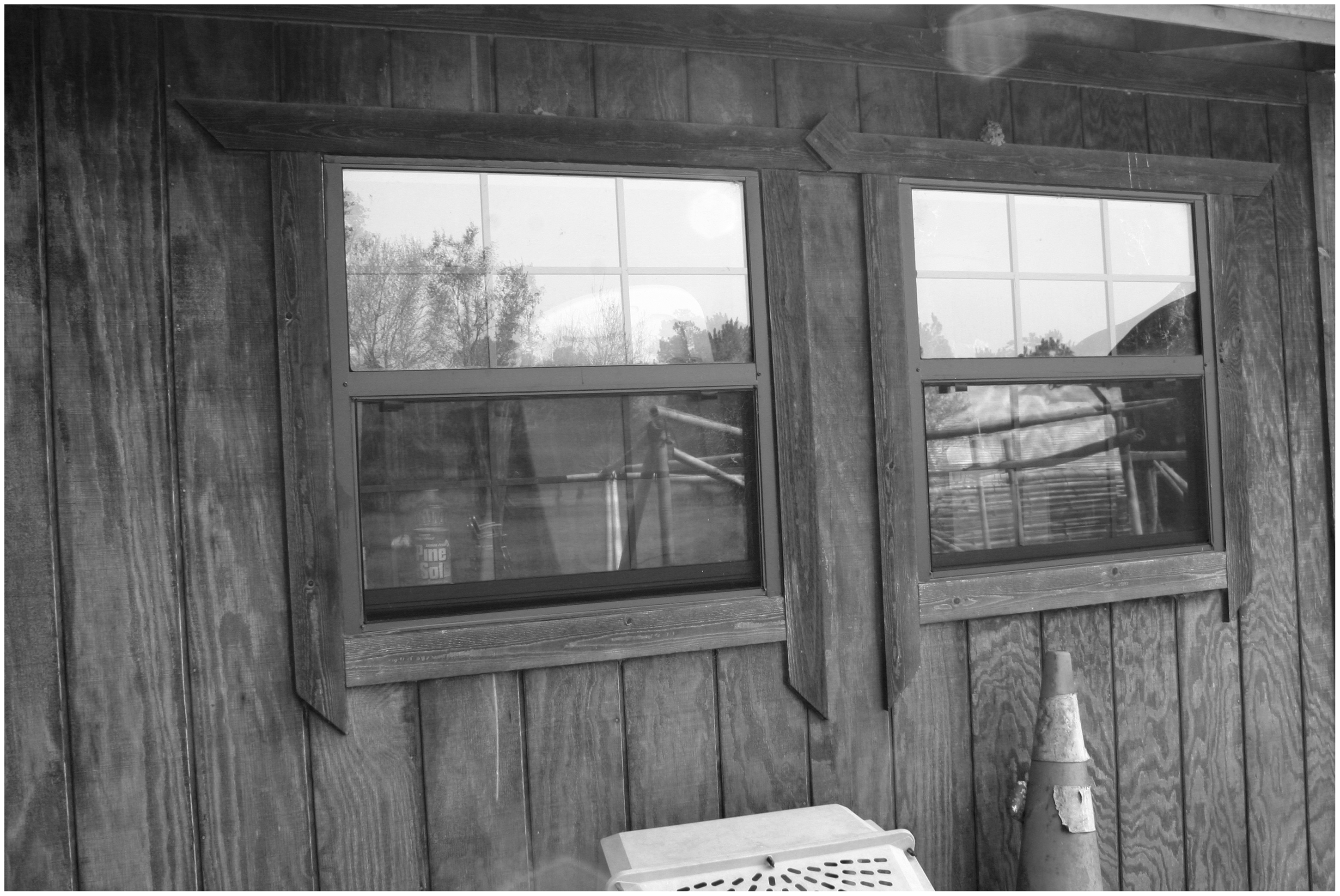
The reference to the Upper and Middle Worlds points to the importance of beings that cross boundaries between the sky, earth's surface, and underground/underwater (Justice, 2010).
6
At a later date, Hakope added: “Some owls even live in ground burrows; they truly belong to all three Worlds.” Looking back at Poverty Point after learning to see the owl in the shed, the “bulbs” at the western end of Mound A could represent ear tufts. This small, identifying detail would mark the particular species of bird: the horned owl. Hakope's final comment also invites us to ask whose perspectives are centered and whose are marginalized in dominant accounts of the past—and what remains unseen—as a matter of embodied history and memory (Bloch, 2014; Laluk, 2017). I had to learn to see the owl in the shed and in Poverty Point, attending to the subtle permutations of different multispecies histories and knowledges stored in the body. And I had to do it on Hakope's time.
The owl in the shed. Note the window trim, which extends into points above the door that are iconic of ear tufts. Photograph by author.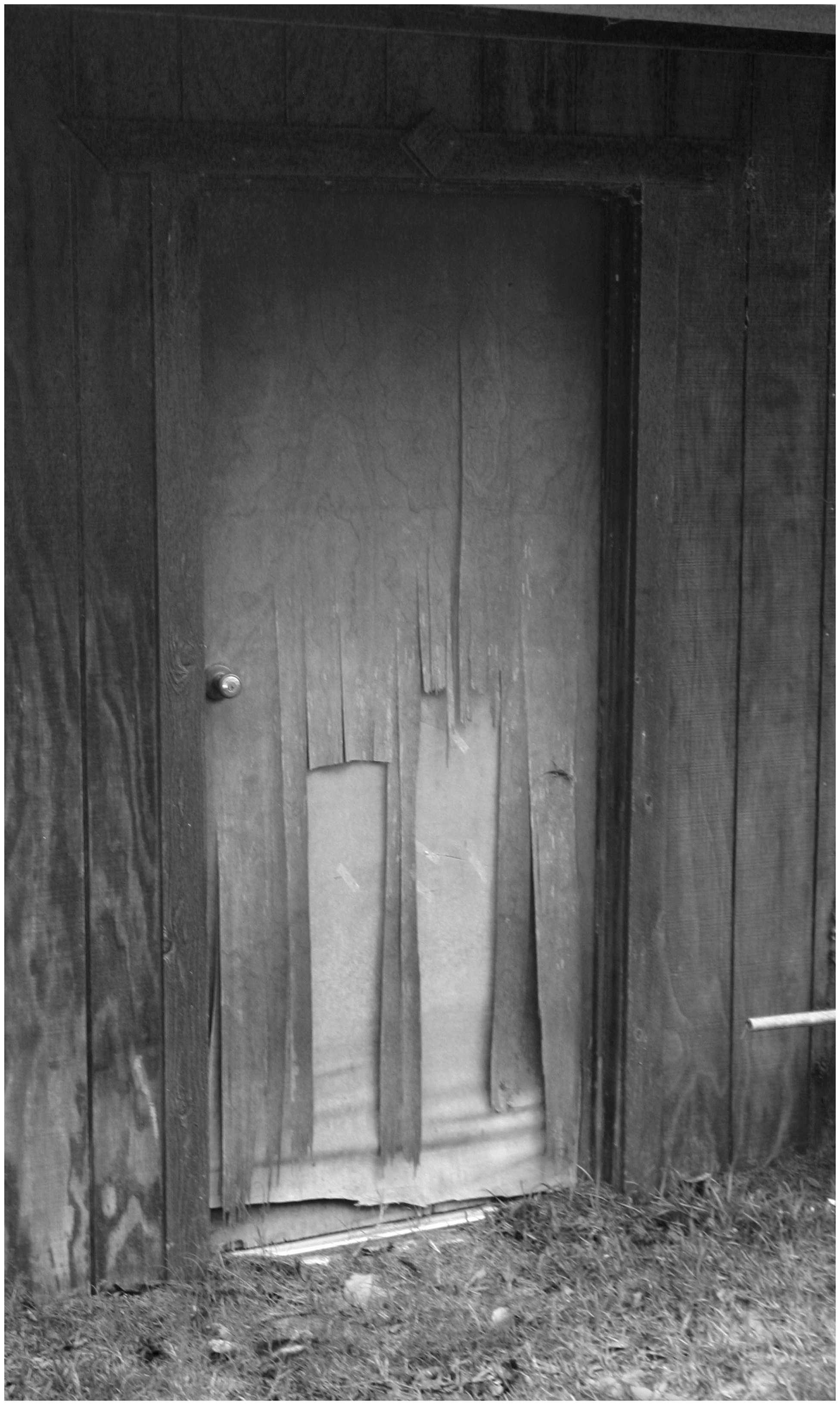
But for whom was Poverty Point meant to appear as a bird? As stated earlier, the overall layout of the site only becomes clear from a high vantage point. Hakope suggested that Makers of Medicine might have been able to see the site from above, perhaps helping to coordinate its construction. Others could have caught a glimpse of it by climbing trees. Oral traditions discussed below suggest that Poverty Point's inhabitants may have been able to fly, although Talwa people debate if such statements should be taken literally. And what might the site look like to the flying creatures and ethereal beings of the sky? Alternatively, it is generative to attend not only to sight but also proprioception and bodily movement. If the people of Poverty Point did build their homes upon the earthen ridges—a position that supports large town over vacant ceremonial or trade center models—they may have lived out their lives in the collective form of an owl. Households extended the ceremonial movements of mound building (Kidder and Sherwood 2017; Howe, 2014) into the everyday activity of living together in an owlish way. This collective shape unfolded slowly, over generations, drawing past and future together into the slow rhythms of mounded temporalities. Perhaps like contemporary Talwa dances, these practices could have allowed Owl People to share in the being of Owl, cultivating particular bodily and sensory perspectives as they did so.
Owl stories
Shortly after World War II, a very young Hakope traveled hundreds of miles to visit Poverty Point with his family. At that time, a tall observation tower built by the Civilian Conservation Corps stood over the site. Visitors could climb to the top to get a better view of the earthworks. Upon reaching the top, Hakope remarked, “It looks like an owl to me.” That was when Hakope's dad told him a story about Owl People, which always began: “Ae, oketv hvmken…” or “Well, some people say…” 7
One evening at a weekly community dinner at a local southern buffet, Hakope began to tell Owl People stories. Once everyone had filled their plate with food, he explained that although human, Owl People are said to have been able to move in complete silence. Although they never purposefully made war with others, there were times when they needed to defend themselves. In such situations, they would silently slip through the woods and surround their enemy. Owl People could fly, although Hakope was not certain exactly what this meant. He imagined that some elders believed that Owl People could physically fly. Others told him that they took flight in their sleep: that they could see and know things through dream flight. Owl People could also become invisible. They never seemed to die; they just disappeared.
Hakope said that traders used to visit Poverty Point on their regular routes through the South and Midwest. The site is not far from the Mississippi River, which was an important avenue of travel. However, these stories say that there was not much to trade at the site beyond feathers, other animal parts, dried berries, knowledges, and songs. Regardless, traders would visit and camp before heading on to other places, such as Cahokia further north. Indeed, there appears to be more archaeological evidence of import than export at Poverty Point (Carr and Stewart, 2004: 143–144; Gibson, 1994a, 1994b; although cf. Hayes et al., 2015, 2016). On the other hand, other Talwa people were surprised because Cahokia was built several thousand years after the Late Archaic component of Poverty Point. Hakope suggested that the traders may have visited sometime afterwards. “Maybe,” he continued, That's why some elders said Owl People could become invisible and why there wasn't much to trade. Maybe the traders said they couldn't see the people, but the people here must be Owl People because there are these owl figurines lying around. And I said, “What do you mean, a ballet dancer?” That made no sense to me. He said, “Have you watched the dancers spin?” I said, “Well, yeah… They keep their heads still! The whole body goes around, and then the head spins again, just like an owl.” And he said, “That's it. So when you go through the swamps, you cannot depend on the sky. You cannot depend on the water or the ground in order to find your way. You have to fix your gaze upon a certain tree or a group of trees… and when you get there, you have your back to those trees and you select another one and you go straight toward it. But when you get to the other one, you turn around and look back at how the trees look from the other side and you keep that picture in your mind. And you can successfully go through any swamp on foot, swimming, or on a boat. But you do it from not moving your head, you keep your gaze fixed.”
Later, as a young man, Hakope visited Poverty Point again. He parked his car just off the road near some of the mounds. That evening, the park rangers did not see him and accidentally locked him inside the park. He spent the night in his car, listening to owls. “There seemed to be about three or four choruses,” he said: Each chorus [of about four owls] would get on its hooting bend and hoot away for a while, and they'd die down, and then you'd hear another chorus of owls a few hundred yards [away] in an entirely different direction. And then pretty soon a third or fourth group would take over. Then, after a while, all four or five of them would start in at one time… and I've often wondered if our Owl Dance has a relationship to that place. And I would hesitate to make that an assumption or make that a definite statement. But it's worth worrying about to a limited extent. The Owl Dance seems to be so disassociated with the normal pace of things Muskogee: In the format of the dance, in the music that accompanies it, and how the dance moves. It's very angular. So those are some idle thoughts about Poverty Point.
The storied land
Like the Owl Dance, Talwa oral traditions evoke the transformative potential of living together in the collective form of an owl: everyday practices that reshaped ancient peoples' bodies and sensory perspectives. Moreover, the land continues to draw descendants into owlish encounters and entanglements, animating the multispecies sensory fields of Indigenous memory. Here, I follow Todd's (2015) call to listen to stories told in more-than-human bodies that “we, collectively, have forgotten to listen to” (105): whether these are owls, hawks, or other beings. These stories are not simply representations, but a “reciprocal embodiment between people and land” that may be told not only in words but bodily movements, multispecies relationships, and returns to place (Howe, 2014: 76; Todd, 2015; see also Basso, 1996; Ferguson and Colwell-Chanthaphonh, 2006). This is to say that stories, like land, are ontologically primary relata that animate life.
The above account extends Indigenous and collaborative methodologies (Atalay, 2006, 2012; Colwell-Chanthaphonh and Ferguson, 2008; Silliman, 2008; Smith and Wobst, 2005; Swiddler et al., 1997; Watkins, 2000), demonstrating the theoretical potential of ethnographic, multispecies, and ontological approaches to landscapes (Cipolla et al., 2018; Dowdall and Parrish, 2003; Ferguson and Colwell-Chanthaphonh, 2006; Laluk, 2017; McNiven, 2016; see also Alberti, 2016). Recalling Mojica's (2012) point that dominant modes of scientific realism in colonial contexts may erase Indigenous realities, as archaeology professionalized in the early 20th century, Lowie (1913, 1917) defined the discipline in direct opposition to Indigenous oral traditions, which he claimed were in excess of “real” and “universal” history (see also Thomas, 2000; Trigger, 1980). Yet in recent years, the discipline has seen a resurgence of interest in methods for re-integrating oral traditions and the archaeological record (Echo-Hawk, 2000; Ferguson and Colwell-Chanthaphonh, 2006; Schmidt, 2006; Whiteley, 2002). Talwa oral traditions can be taken as both descriptions of past peoples and as sites of (fleshy) theory in which mind, body, and land are inseparable (Cruikshank, 2005; Howe, 2014; Laluk, 2017; Watts, 2013).
Critical interventions in Native American and Indigenous studies argue that mounds are sites of historically deep and unfinished dramaturgies, foregrounding the importance of movement and vitality as an alternative to clinical descriptions of “dead” materialities and “abandoned” sites (Allen, 2015a, 2015b; Knowles, 2014; Mojica, 2012). In her discussion of Mound A as a hawk, Howe (2014) speaks of returning to place as an “embodied lifeway” in which one makes connection and continuity with ancestors, renewing teachings embedded within the land as a living matrix of multispecies relations. This demands rethinking continuity not in terms of cultural change/stasis, but the cultivation of (multitemporal) relationships with ancestors. For Talwa people as well, the landscape of Poverty Point grounds visceral and unfinished Indigenous knowledges: oral histories elicited by ancient earthworks when seen from an aerial vantage (a perspective achieved through observation towers, LiDAR, aerial photography, climbing trees, or perhaps spiritual flight), the feeling of movement through space (whether in carrying and mounding up baskets of earth, living together in the collective shape of an owl, or traversing woods near old sites with family), and even the sound of owls hooting when accidently locked in the park for the night.
This is not only a matter of representation, but becoming (Koons, 2019; following Haraway, 2008). In attending to Poverty Point as a multispecies and multitemporal sensory field, I follow Hamilakis's (2013) critique of the autonomous vision-based practices privileged in modernist archaeologies. As an alternative, he attends to memory as a sensory practice that unfolds from particular locations and relations, in which the material world acts upon human bodies and activates mnemonics—much like Hakope's own insistence that “it's stuff that you just go with and grow with” or the ways in which earthworks and owl choruses call upon his attention. Yet Talwa oral traditions—like the Owl Dance—call on researchers to go beyond the common assumption that the sensory body is universal, foregrounding instead embodiments and transformations achieved by participating in more-than-human beings. This is a kind of perspectivism, in Viveiros de Castro's (1998) sense. As he explains: what to us [humans] is blood, is maize beer to the jaguar; what to the souls of the dead is a rotting corpse, to us is soaking manioc; what we see as a muddy waterhole, the tapirs see as a great ceremonial house. (478)
However, Indigenous critics note that the ontological turn often reproduces colonial value hierarchies, citational relations, and anxieties about the natural/supernatural and material/immaterial (TallBear, 2017; Todd, 2016). As such, I call for archaeologies that are more deeply grounded in Native American and Indigenous Studies (NAIS). Watts (2013) writes of “Place-Thought,” or the “non-distinctive space where place and thought were never separated because they never could or can be separated” (21). For Watts, the land is alive, thinking, and intentional. Its thoughts give agency to human and nonhuman beings that live upon, sustain themselves from, and return to the soil. Indeed, she argues that oral traditions are not (mistaken) mythologies but expressions of land. Similarly, Todd (2015; 2018) argues that some stories are told in animals' bodies, constituting Indigenous legal frameworks for living well in more-than-human worlds and animating Indigenous sovereignties that exceed settler orders of law-as-rule. These frameworks eschew any divide between the ontological and the epistemological, but rather treat land, knowledge, and multispecies relationships as inextricable (Watts 2013; see also Ferguson and Colwell-Chanthaphonh, 2006; Laluk, 2017). They not only locate politics within more-than-human relations, but center expansive visions of self-determination that weave past, present, and future within one another (Rifkin, 2017). Indeed, Koons (2019) argues that practices like the Owl Dance constitute sovereign modes of embodiment: a refusal of the colonial politics of recognition (Simpson, 2014) that insists upon Indigenous ways of being and becoming with more-than-human others. So, too, do Talwa people renew such sovereign embodiments as they return to Poverty Point and are drawn into deep Indigenous histories of owlish entanglements.
This perspective foregrounds resurgence in which living landscapes enroll descendants into multispecies embodiments and sensory fields, as a kind of flourishing and cultivating of Indigenous modes of life beyond the logics of settler governance. NAIS theories of resurgence call for movements that turn “inward” and away from a colonial “outside,” as a refusal of settler modes of interpolation under the assumption that ancestral ways of life hold important teachings for the future (Alfred, 1999; Simpson, 2011; see also Coulthard, 2014; Kauanui, 2018; Rifkin, 2012, 2017). What would archaeology look like if it were a subfield of NAIS, committed to the resurgent modes of life beyond settler nation-states that emerge within deep Indigenous histories? I leave this as an open question, but such frames require multitemporal and multispecies ways of rethinking archaeological concerns in politics and everyday life, as well as the cultivation of decolonial futures in the context of the longue durée of return.
The Poverty Point earthworks tell stories sedimented over millennia, told in the everyday movements of living together accumulated over generations. As unfinished histories, these landscapes call descendants into presence, enrolling them into ancestral, multispecies relationalities and political orders. These stories—these acts of return to ancestral lives—constitute a practice of mutual enfleshment and giving breath to others: past and present, human and otherwise. As a modest kind of land reclamation that sidesteps federal courts, such practices animate relational temporalities and Indigenous possibilities that emerge in moments of being drawn into Owl's teachings.
Owl teachings
Poverty Point is the creative expression of millennia of generations of lives—stories and movements and kinships—sedimented within the earth. As a multispecies and multitemporal landscape, Poverty Point embodies an unfinished longue durée in which owls and owl landscapes call on descendants to breathe new life into ancestral knowledges and relationalities. Moving about in owlish ways becomes a kind of bodily mingling, a mode of life within landscapes that draw peoples together across chronological and species boundaries. Perhaps in dwelling in the collective form of an owl, Poverty Point peoples learned to move silently and invisibly in the same way that contemporary Talwa people borrow Owl's sensory perspective (i.e. Owl's embodied teachings) through dance. Today, Poverty Point remains a place of return for Talwa people, as for those of other Native American nations. It is a place to remember stories and even get caught listening to owls for the night. Maybe Owl People continue to live there, as well, watching silently. Thousands of years later, Poverty Point remains a vital subject of story and contemplation, drawing Talwa people into an unfinished history of owlish entanglements. For a non-Native archaeologist such as myself, this means listening to and learning from ongoing conversations and open-ended reflections as descendant peoples return to ancestral landscapes and their teachings.
Such owlish landscapes animate Indigenous resurgence via fleshy knowledges. The Poverty Point landscape can be understood as a practice of multispecies embodiment, in which ancient peoples cultivated bodily dispositions by literally dwelling in the form of their more-than-human relations. This reframes mounds as not only sites of specialized ceremonial events but also everyday transformations (see also Gibson, 1998; as well as Moore and Thompson, 2012; Pluckhahn, 2010; Wilson, 2008). Moreover, the story of Poverty Point demands alternative, relational temporal frames. These earthly and bodily movements exceed Eurocentric ruptures between history and prehistory, constituting Indigenous knowledges that are coextensive with visceral and emplaced multispecies relationships (Lightfoot, 1995; Mojica, 2012; Schmidt and Mrozowski, 2013). This is not to say that owls and Owl People exhaust the history of Poverty Point: but rather to locate knowledge (and life) in encounters with others and sensory fields animated by living earth. In Talwa teachings, owls are particularly interesting because they see into the darkest places; they move silently and invisibly. As such, perhaps owl stories can invite their listeners to forego definitional certainty and foreclosure: to leave things open for unseen perspectives and worlds. Such beings might call on us to attend to other bodily and sensory perspectives, reminding us that the whole only becomes visible from the vantage of margins (see also hooks, 1989: 145–154): whether these are the margins of colonial institutions, human/animal, or life/death.
Attending to these dynamics requires centering on Indigenous knowledges and interpretations, which may themselves be emergent within embodied and historical relationships between humans, more-than-human beings, and land. These stories raise questions about how the land manifests differently to/within different bodies: who sees Poverty Point as an owl, who moves through the landscape in an owlish manner, and who returns to the site to hear oral traditions or spend the night listening to owls. Poverty Point becomes a site for renewing ancestral teachings told in land and bodily movement—animating Indigenous knowledges and lifeways that emerge in the mingling of fleshy bodies and multispecies landscapes across timescales of millennia, breathing life into ancestors and descendants alike.
Footnotes
Acknowledgements
I thank Hakope and the members of his community for their patience, teachings, and companionship over the years, for reviewing the manuscript, and for their guidance and support during the often-painful process of looking inward. Thanks to Martha Caldwell, Julia Haines, Ryan Koons, LeAnne Howe, Jeffrey Hantman, George Mentore, Kath Weston, Lise Dobrin, Jalane Schmidt, and Jim Igoe, as well as JSA editor Lynn Meskell and the three anonymous reviewers, who greatly helped sharpen the argument. Dr Diana Greenlee provided the LiDAR map of Poverty Point and the image of the owl figurines.
Declaration of conflicting interests
The author(s) declared no potential conflicts of interest with respect to the research, authorship, and/or publication of this article.
Funding
The author(s) disclosed receipt of the following financial support for the research, authorship, and/or publication of this article: Funding was provided by the National Science Foundation Cultural Anthropology Program, Wenner-Gren Foundation, American Philosophical Society, UVA Institute for the Humanities and Global Cultures, and Explorers Club Washington Group.