



Abstract
Environmental relationships were critical to most early colonial encounters, especially for those involving permanent settlements. The ability to successfully establish a colony required developing relationships with plants, animals, and the land because they were central to providing for the colonists’ basic subsistence needs. The ways European colonizers developed these new relationships rested on their moral ecologies, a mix of beliefs and practices which give a sense of right and wrong to actions that are informed by ontologies. In this paper we use the concept of moral ecologies to explore the relationships that two empires—the British in New England and the Spanish in New Mexico—created as they established colonies that also entangled Indigenous peoples. The differences in moral ecologies between these empires and the peoples they invaded help explain tensions in the past that remain powerful today.
Introduction
Early colonial encounters have often been portrayed as a clash of cultures—in North America colonizers from Europe, driven by Western philosophies, versus the colonized Indigenous folk with more nature-centered, animistic ontologies. These clashes became violent in both the American Southwest with the Pueblo Revolt of 1680 and New England with King Philip’s War of 1675-1676. At the core of these conflicts were moral ecologies that are the primary focus of this paper. Western philosophies were part and parcel of what Mignolo (2005: 111) has called the “logic of coloniality (domination, oppression, exploitation) hidden under the rhetoric of modernity (salvation, civilization, progress, development, freedom and democracy)”—concepts to which we can add the notion of patriarchy. These beliefs influenced not only colonists’ behavior towards Indigenous people but how they engaged the land as the logics of domination, exploitation, patriarchy, development, and civilization were reproduced through daily practices involving direct interaction with the environment.
Environmental relationships were critical to most early colonial encounters, even in extractive colonies, but they were especially important to those involving permanent colonial settlements. Because most early colonizing societies were agrarian, the ability to successfully establish a colony required developing relationships with plants, animals, and the land because they were central to providing for the colonists’ most basic subsistence needs (Rockman, 2010). The creation of these relationships involved not only new environments, but also the interplay between colonists’ needs, desires, and agency—and the cultural values that guided that agency. A society’s values articulate between its ontologies and individuals’ actions, so the concept of moral ecology affords a way of examining the cultural ethics that guided relationships between colonists and the environment, and the ways these human-environment relationships were dynamically created and modified.
Archaeological and historical records provide abundant examples of the challenges 17th-century colonists faced in establishing successful strategies in colonies in Massachusetts, New Mexico, Florida, and Virginia (Blanton, 2000; Dawson and Trigg, 2022; Mrozowski, 2006; Scarry and Reitz, 1990). For most early settler colonists, the provinces were unknown, unexperienced lands, which complicated their efforts to establish some of the most basic cultural practices such as producing sufficient food. Colonists did, however, arrive with expectations for what were considered the just rewards those new lands afforded, as well as their own ecological practices.
These relationships are also important because most early colonies where settler colonialism was the goal rapidly became entangled with Indigenous communities. Spanish colonialism explicitly incorporated Indigenous people into Spanish society (Rothschild, 2003; Weber, 1992). English colonialism, especially in New England, was less open about its reliance on Indigenous peoples, but research (Pawlicki, 2022) has shown that Indigenous practices and labor were also critical to English colonial society. Often these impacts related to the appropriation of Indigenous lands for crops or livestock, the theft or appropriation of Indigenous subsistence goods such as food, or demands on Indigenous people for labor to support these enterprises (Den Ouden, 2005; Rothschild, 2003). Understanding how early settler colonists created ecological relationships provides a window into the ways they colonized new spaces and imbued the land with colonial practices, ideals, and meaning in what Snead (2008) has called culturalizing the landscape.
The different conceptualizations of the way the world works—their ontologies—were fundamental to the ways colonists and Indigenous peoples engaged each other and created cultural places out of contested space. Cultural conceptions of the environment were central to both Western and Indigenous ontologies, but the nature of those relationships and people’s place in them differed. It would be a mistake to portray all Indigenous North American cosmologies as the same, but Watts (2013) suggests that there are commonalities to many, which give agency to inanimate and non-human entities, and where people and space are intrinsically linked. “Habitats and ecosystems are better understood as societies from an Indigenous point of view; meaning that they have ethical structures, inter-species treaties and agreements, and further their ability to interpret, understand and implement” (Watts, 2013: 23). The Indigenous ontologies which situate people as dwelling within a living, agentive world (place-thought) contrast with Western ontologies which present nature as something over which God has given people dominion. Such positioning no doubt contributed to colonists’ attitudes toward taking Indigenous lands and altering Indigenous lives. Western colonizers’ ontologies were based on very linear notions of history and were characterized by abstract notions of space. In contrast, Deloria (1994: 122) notes how Indigenous religions, like Indigenous histories, are often place-based, with landscapes characterized by a “sacred geography,” developed through long-term engagement with the local environment. For example, in the American Southwest, environmental features such as mountain peaks and lakes are sacred. They define Indigenous homelands and figure prominently as homes to powerful other-than-human beings, who bring rain for crops in this challenging environment. For many Indigenous peoples these ontological features braid space, environment, and religious meaning as part of epistemologies and ontologies very different than those brought by European colonists (Atalay, 2020).
While place-based Indigenous ontologies were not easily transferrable to new lands, Western ontologies were reproducible in space, and in fact new lands were seen as environments of opportunity—for upward social mobility, escape from problems in the homeland, and especially wealth. For the Spanish in New Mexico, not only did colonization afford the possibility of generating wealth through agricultural pursuits, but those early colonists who stayed on the land for a period of five years could gain the status of nobility (Weber, 1992). Movement to colonial areas also allowed for re-inventing identities or flexible treatment for those of lower standing. For the English, the Massachusetts Bay and Rhode Island colonies were places of relative refuge from religious persecution that also afforded ample opportunities for financial rewards. Similarly, the Virginia and Caribbean colonies were highly successful opportunities for extracting wealth from the land that brought with them moral ecologies which revolved around economic gain. Archaeologists working in these regions have focused on the economic strategies early colonists employed (Bell, 2005; Fox, 2020; Frank and Ryzewski, 2013; Maniketti, 2015; Snow, 1992; Trigg, 2005) and how they differed from those of the Indigenous populations of these areas (Gallivan, 2011; Rubertone, 2000).
While broad distinctions between 17th-century Indigenous and Western ontologies have been criticized as simplistic, Indigenous scholars point out significant differences between both ontologies and epistemologies (Atalay, 2020; Gilio-Whitaker, 2019; Kimmerer, 2013), which can profitably be explored in more detail. The notion of moral ecology provides an analytical framework to do so. In this paper, we consider the ways two groups of colonists, the Spanish in New Mexico and the English in New England, developed ecological relationships that entangled themselves, the environment, and Indigenous people (Figure 1). We focus on the colonizers and the impact of their actions on colonized communities; however, the role of moral ecologies in these encounters is more evident when contrasted with Indigenous moral ecologies in those places, and these are also discussed. Environmental relationships and their ontological and, more specifically, moral underpinnings provide an important reference point from which to view the ways these colonizing efforts unfolded. Extent of the British and Spanish territories in the mid-17th century, and sites noted in the text (C. Torrini).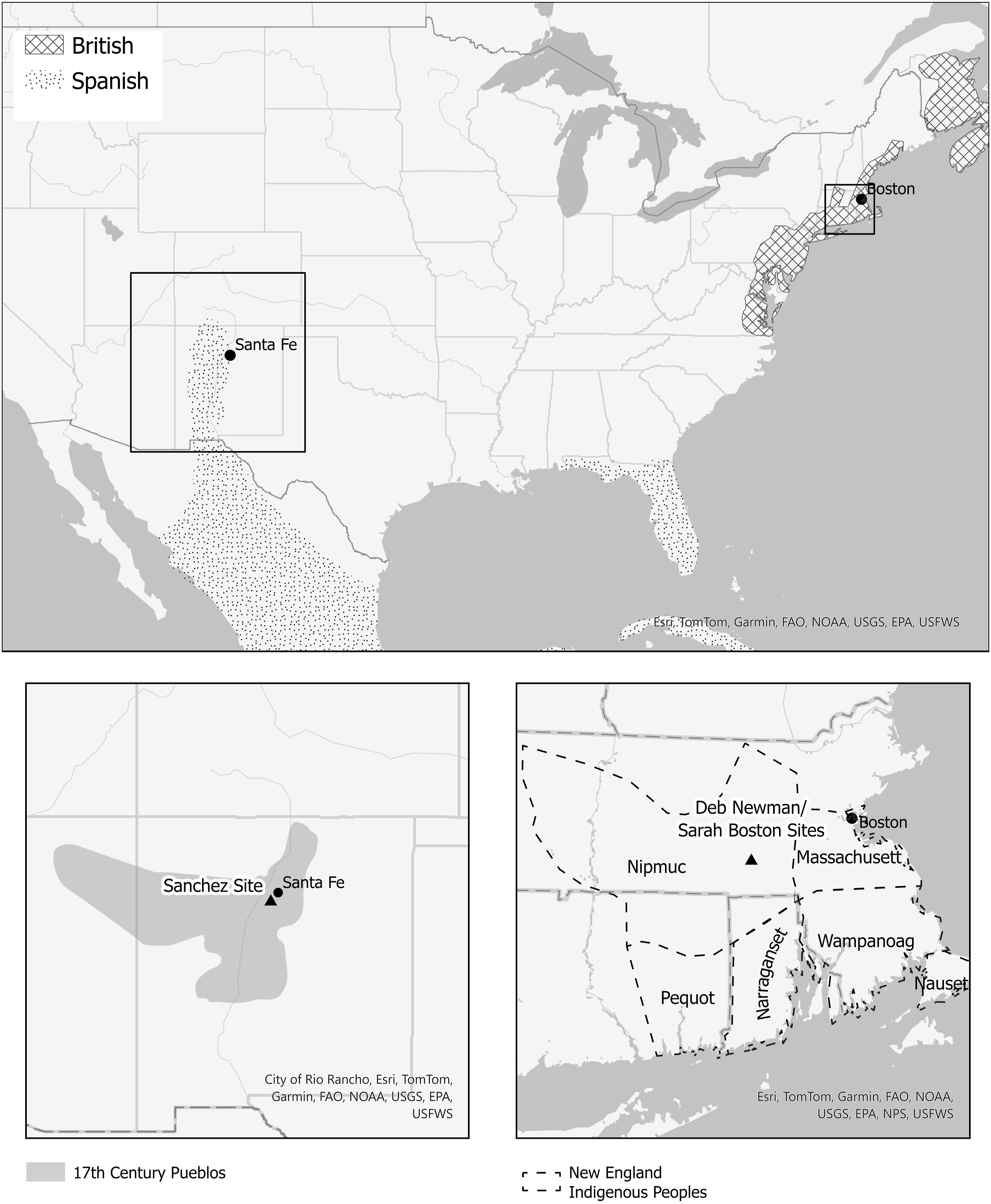
Moral ecologies
Moral ecologies are social structures that provide the moral underpinnings for people’s ecological relationships (Martínez-Reyes 2016). These social structures hold special sway in guiding human/human and human/environment/place interactions because they reference a community’s internal principles of right and wrong. If structures of quotidian practice, such as cooking or harvesting wood, can be conceived of as “this is what we do,” we can think of moral structures as reflecting “this is what is right.” Moral ecologies, therefore, carry a weightier sense of justice and ethical behavior in peoples' interactions with their surroundings.
The concept of moral ecology has been variously defined and used by psychologists, ethicists, environmental historians, and anthropologists (Brinkmann, 2004; Hertzke, 1998). Here, we follow Martínez-Reyes (2016), Scaramelli (2019), and others in using the term to refer to the moral foundations of ecological relationships between people and the world around them, in particular the rationales people use to create and maintain relationships with features of the landscape, ancestors, and non-human living things, as well as inanimate objects (Escobar, 2016, 2018; Rizvi, 2017; Scaramelli, 2019). Martínez-Reyes (2016: 23) sees moral ecologies as “the essence of the body of knowledge about the environment … and the ethos of peoples’ relationships with their environment.”
Like other social structures, moral ecologies are fundamentally dynamic relationships, created through people’s interaction with the world around them. They are also internally referenced systems, so different communities have different moral ecologies, even within the same physical environment. Moral action is relational and occurs in interactions between people and between people and non-human entities, which have their own ecologies (Martínez-Reyes, 2016). In her analysis of Turkish fishermen and their interactions with infrastructure and the environment, Scaramelli (2019: 339) uses the term moral ecologies to signify “people’s notions of just relations between people, land, water and nonhuman animals, plants, buildings, technologies, and infrastructures. Moral ecologies also constitute assessments of justice and motivations for action, which concern relations between humans and nonhumans.” These moral imperatives are deeply embedded in the ways societies view ecological relationships, such as the use and allocation of resources and the proper behavior toward culturally defined entities inhabiting the world, which develop from long-standing interactions with the environment, resulting in the creation of traditional ecological knowledge.
An analytical focus on moral ecologies is similar to, but contrasts with, political, historical, and cultural ecologies in its emphasis on the moral drivers of action. This complements approaches such as political ecology, where the focus is on the wielding of power and access to resources, or historical ecology, which emphasizes the developmental trajectory of environmental relationships. While the concept of moral ecology can be used for investigations of cultures in deep time, it offers a particularly useful perspective that helps in framing archaeological investigations of colonial encounters where ontologies may have differed. Colonization required flexibility in the creation of ecological relationships as colonizers adapted to novel environmental conditions. The concept of moral ecology allows us to understand the cultural values underpinning these actions, and because moral ecologies are dynamically created relationships, this concept allows us to explore the ways new relationships are developed pragmatically as colonists interacted with new lands and new peoples. Much of the recent research using a practice theory framework, especially that relating to colonialism, has focused on agency—the role of individual action, individual choice, and individual power. A discussion of moral ecologies places emphasis on the other side of that framing—on the social structures or guiding principles.
The 17th-century Spanish colonization of New Mexico and the contemporaneous English colonization of New England provide examples of human-environment relationships that illustrate the role that systems of right and wrong play in colonists’ actions. These empires were alike in their Western ontologies and emphasis on agrarian production, but different in the ways they chose to engage Indigenous people and religious traditions. The imperial goals for both colonies were similar in that they were to establish a settled presence in the new territory rather than simply extract resources such as furs, precious metals, or fish.
Moral ecologies can be seen in the expectations expressed by colonists, figurative language regarding relationships to the land that stress dominion, patriarchy, and religion. However, the instantiation of moral ecologies also leaves tangible traces as practices important to colonists generated culturalized landscapes. The impact of the introduction of new plants and animals and ways of husbanding, utilizing, and conceptualizing resources altered ecologies in ways that are visible archaeologically and had long-term impacts on the environment. Our analysis relies in part on documentary accounts, but we also explore the ways these ideas are reflected in the archaeological record, in particular the relationships with land, plants, and animals. Not all behavior seen archaeologically would have been guided by moral ecologies, but a general regularity in practice would suggest the impact of moral structures especially if it articulated with religious ideas.
Colonial New Mexico
The moral ecologies of colonial New Mexican Spaniards were evident from the moment colonists claimed the region for Spain. In 1598, when Juan de Oñate, New Mexico’s first Spanish governor, crossed the Rio Grande at present day El Paso, he proclaimed: I take and seize tenancy and possession, real and actual, civil and natural, ... without excepting anything and without limitations including the mountains, rivers, valleys, meadows, pastures, and waters. ... I also take possession of all the other lands, pueblos, cities, towns, castles ... with civil and criminal jurisdiction, power of life and death, over high and low, from the leaves of the trees in the forests to the stones and sands of the river, and from the stones and sands of the river to the leaves in the forests ... (Hammond and Rey, 1953: 335)
La toma, the political act of defining the colony of New Mexico, specifically referenced elements of the land—mountains, rivers, and valleys—and people and their built environment—pueblos, cities, towns. Figurative language was used to enact dominion over not only the environment, but also people and their creations, and using landscape and botanical imagery (leaves, stones, and sand), Oñate conveyed the sweeping powers he claimed on behalf of the Spanish empire as control over these objects was equated with just power.
By 1598, the Spanish government had over 100 years of experience in colonizing new lands in the western hemisphere. These experiences generated policies and practices for engaging Indigenous people and developing relationships with the land. Documents describe how colonized land was conceptualized, appropriated, and used (Barrett, 2015). When authorizing the colonization of New Mexico, the viceroy referenced ordinances for the amounts and types of land to be given to colonists and the types of environmental resources necessary to sustain colonies. New Mexican governors were explicitly told to allot to each colonist specific amounts of land for specific agricultural purposes: defined space for houses with kitchen gardens (jardin), additional amounts for olive groves and vineyards, acreage for irrigated crops such as wheat (huertas), and general agricultural areas (caballarias) for livestock. Designating common lands (ejidos) was also specified. These notions are idealized, but they referenced the sort of environmental accommodations the empire deemed necessary for colonists and gave name to the different types of productive spaces (Kessell, 2003; Weber, 1992). Moreover, these templates informed the ways colonists would produce landscapes. While these ordinances were not necessarily moral, in the sense of good and evil, the programmatic aspects speak to a sense of a correct way of engaging the land.
Policies also existed for parceling out homesteads to the colonizers, allowing colonists to collect tribute from Indigenous people, controlling access to Indigenous peoples’ labor, and setting aside land for Indigenous villagers’ agriculture. Landownership in 17th-century Spanish New Mexico had feudal characteristics that were internally consistent with Spanish Catholic values of engagement and incorporation of Indigenous peoples into colonial life (Kessell, 2003). Colonists who provided military protection to Pueblo villages, and the colony in general, could be granted an encomienda—the right to collect tribute from Pueblos, which took the form of food and cloth (Weber, 1992). Access to these sources of subsistence goods buffered risk in this challenging environment (Dawson and Trigg, 2022) and as a result encomenderos tended to be wealthy and powerful. Moreover, under Spanish law, colonists could compel Pueblos to provide labor for agricultural purposes. During the 17th century, coins did not circulate, so ecological relationships that generated basic subsistence items were at the heart of the colony’s social, economic, and political functioning (Trigg, 2005).
For most of New Mexico’s Spanish colonizers, the province was an unexperienced land. Colonizers arrived with notions of what they might achieve in New Mexico, knowledge of the rewards they would receive from the Spanish government, and hope that there would be opportunities for financial gains. While colonists had imagined finding precious metals as the Spanish had in northern Mexico, there was very little mining in the colony during the 17th century, so agricultural production, land ownership, and tribute payments from the local Pueblo tribes were anticipated sources of wealth and status.
As with any aspect of practice, we cannot describe all the structures acting in moral ecologies, but we highlight several relationships. Religion played an obvious role in moral ecologies, and Catholic practice required the production of certain crops, such as wheat for the communion host. We see this archaeologically in the presence of wheat kernels, pollen, rachis fragments, and phytoliths at the small number of sites for which we have data (Dawson, 2024; Gruber, 2023; Trigg, 2005). To produce a successful crop, wheat had to be irrigated—requiring the construction and maintenance of acequias (irrigation canals), which called for land that could be irrigated, typically the most productive near watercourses and Pueblo villages. Wheat crops also required labor and technologies such as plowing and threshing which typically involved domestic livestock. Religious practice, therefore, necessitated the occupation of the most productive, well-watered land, the presence of livestock to assist in the production of wheat, and the labor to not only to grow and harvest the crop, but also to create and maintain irrigation systems and care for the livestock. In Spanish colonial practice, often this fell to Pueblo and enslaved Plains people, whose presence and labor can be inferred from their lithic material culture at Spanish ranches (Lindsay, 2021).
Cuisine was another, related set of practices that had moral undertones. New Mexico’s colonists complained to authorities when famines forced them to eat foods that did not fit their notions of propriety, using descriptors such as wild greens and “injurious herbs.” Documents also recount colonists’ complaints that bakers became unduly wealthy, suggesting that wheat bread was a critical part of Spanish cuisine, for which colonists were willing to pay (Hackett and Shelby, 1942: 173).
Archaeobotanical evidence indicates wheat and other Eurasian crops (such as cantaloupe, lentils, and peaches) were grown along with American domesticates (maize and chilis). Zooarchaeological data from 17th-century Spanish ranches in the Cochiti and Galisteo regions of New Mexico also demonstrate a profound preference for domestic meat and the ability to produce it, with more than 85%–95% of fauna by NISP and 94%–99% of the biomass coming from domestic animals (cattle, horse, sheep, goat, pigs, and chickens) at most sites (Snow, 1973a, 1973b; Trigg et al., 2022). Wild fowl and fish were consistently present in small numbers, but there were few wild animals such as deer and rabbits, which were the mainstay of the meat component of Puebloan diets. Thus, both the zooarchaeological and archaeobotanical data point to an economic emphasis centered on the farm and indexing the named land types—jardin, huertas, and caballerias.
The notions of agricultural production and general aspects of cuisine rather than specific plants and animals may have guided colonists’ ecological relationships. Spanish colonists entered New Mexico with maize already a part of their diet, so it was not an entirely new plant, but the way colonists conceived of and used maize was different from how Pueblo societies did. For most Pueblos, maize was an integral part of their cosmologies: it was sacred, a part of ritual, and a good crop was an object of their prayers (Duwe, 2011; Ortiz, 1969). Colonists, on the other hand, in addition to consuming it themselves, likely fed maize or parts of maize plants to their livestock (Dawson, 2024; Gruber, 2023). Scholars have suggested that this difference in attitude toward the plant may have contributed to tensions between colonists and Pueblos, especially if the maize was appropriated from the Pueblos and fed to animals. Both the religious imperative for wheat and a cuisine in which wheat bread constituted an important staple drove the production of this crop. Wheat was a necessary part of Spanish culture, but colonists were clearly pragmatic, as maize was much better suited to the New Mexican environment, so colonists grew both (Trigg et al., 2023).
While cuisine and productive activities focused on agricultural lands, the ejidos provided critical resources, such as fuel wood for cooking and heating, timber for construction, summer pasturage for sheep, and water for irrigation. These areas also provided habitats for wild fowl and fish, which were critical for the fasting required by Catholic practices. Colonists’ relationships with two taxa of large trees also illustrate the importance of the ejidos for daily life. Most 17th-century colonists established their farms along watercourses in valleys located in environmental zones below 7000 ft. Often the vegetation around these sites was a bosque (riverine forest), or pinyon-juniper woodlands, or grasslands. Such locations were good for crops and livestock and afforded access to a domestic water supply and Indigenous labor, but lacked large trees appropriate for construction purposes. Riverine trees like willow and cottonwood were not straight or strong enough to be used for heavy construction, and pinyon and juniper trees were small with branching trunks. Large straight trees, such as Douglas fir and ponderosa pine, were necessary for roofs on Spanish structures, and were primarily found at high elevations, in areas considered common lands or ejidos. Roofs were constructed of large timbers called vigas that rested across the tops of walls, with smaller branches (called latillas) laid across them. On top of these were reeds and grasses and finally a thick layer of mud which waterproofed the structure. Superficially, domestic structures at colonists’ ranches might have looked like small Pueblo roomblocks—walls were plastered and roofs were flat and mud-covered—but Spanish rooms were much larger.
An example from one excavated 17th-century Spanish ranch, the Sanchez site, illustrates some of the relationships the colonists needed for their structures (Trigg et al., 2023). The site was located immediately adjacent to a marsh at the juncture of grasslands and pinyon-juniper woodland. The ranch was home to an extended family of Spanish colonists who had the wealth to construct not only a house, but also a large barn (unusual for the 17th century) to shelter livestock and store crops. Archaeobotanical analysis indicates smaller cottonwood and juniper branches were used for latillas, and large ponderosa pine and Douglas fir trunks were the vigas. The location of the site near wetlands, woodlands, and grasslands would have made cattails, cottonwood, juniper, grasses, and mud easily accessible on land near the ranch. However, the important ponderosa pine and Douglas fir vigas would only have been available in mountainous areas, the nearest of which would have been at least 30 km away (Albert, 2023). The size of the structures at this site suggests at least 130 ponderosa pine and Douglas fir tree trunks were needed. Metal tools would have helped with felling the timbers and draft animals would have assisted with transport, but there were no roads into the mountains. The labor required to collect and transport the vigas and construct the buildings likely exceeded the labor of the family of colonists, so Indigenous people would have been called on to help construct these sizable edifices. While Pueblo peoples would have been accustomed to building large structures such as roomblocks and kivas, the buildings at the Sanchez site were not for a community—they were for a single family who controlled large, domesticated animals, planted acequia-fed fields, accessed distant forest resources, and were able to force Indigenous people into laboring for them. Consequently, this ranch would have engaged Indigenous labor in building structures that presented an image of colonial power (Albert, 2023). While Spanish homes in the Cochiti and Galisteo regions varied in size (Snow, 1992), they were similar in their construction and use for single families. Creating buildings of this size and manner did not have the religious imperative that producing wheat did, but the consistency of the architectural style among the archaeologically known ranches, the effort that went into the construction of the buildings, and architecture’s ability to signal identity, wealth, and power to other colonists and Indigenous people speak to the importance of colonists’ relationship with common lands.
The intertwined moral systems supporting religion, cuisine, conceptions of land, and a largely feudal approach to conquered people were integral to colonists’ ecological practice. The examples afforded by crops, livestock, and montane trees illustrate relationships with the environment that were consistent and meaningful, and likely reflect moral ecologies. Moreover, Indigenous labor was critical to the ecological relationships underpinning the colony’s activities and culturalization of the landscape, as the introduction of new plants, animals, and agricultural techniques transformed Southwestern landscapes (Edwards and Trigg, 2016).
Colonial New England
In colonial New England, the effects of moral ecologies are seen in the ways colonists utilized resources, constructed homes and settlements, and described their perceptions and use of landscapes, often contrasting their values with those of Indigenous peoples to justify their actions. The combination of written sources from this period and archaeological data, especially regarding the creation of landscape, provides particularly powerful evidence of the role of moral structures regarding ecological relationships.
In his chronicle of Plymouth Colony, William Bradford describes his new home as part of “those vast & unpeopled countries of America, which was fruitful & fit for habitation, being dvoyd of all civill inhabitants” (Bradford, 1898: 32–33). A similar sentiment was offered by John Winthrop—the leader of the Massachusetts Bay Colony—when in 1629 he described the inhabitants of the area in this manner: “As for the Natives of New England, they inclose noe land, neither have any settled habitation, nor any tame Cattle to improve the Land by, and sow have noe other by a Natural Right to those Countries” (Winthrop, cited in Cronon, 1983: 56). Both quotes capture the tenor of the unfolding religious and political discourse of the 17th century surrounding notions of improvement. Bradford (1898: 162–163) and later John Locke also evoke the spirit of improvement when distinguishing private property from common lands. Locke (1988[1689]: 287-288) writes, “Though the earth and all inferior creatures be common to all men, yet every man has a property in his own person: this no body has any right to but himself. The labour of his body, and the work of his hands, we may say, are properly his.” In the English colonial context, improvement and private property meant specific things—clearing the land, remaining on the land, the bounding of the land—fenced or walled—and the construction of a proper house on the property. The result was often-bounded, enclosed landscapes that incorporated new ways of conceptualizing the land in precise, abstract terms that reflected a new appreciation for “calculation and measurement as instruments of understanding and control” (Slack, 2015: 1–2; Johnson, 2006; Mrozowski, 1999). These abstract notions helped create a landscape where the individual farmstead was the central element of the English agrarian economy of the 17th century, which revolved around livestock, including cattle, sheep, and pigs. Not only did the English of New England rely upon these animals for their own daily foodways, but they were also the center of their exchange economy, which centered around the extraction of resources and the commodification of living creatures, including their raising, slaughtering, salting, and packaging for shipment to the Caribbean.
Sylvester Manor, a 17th-century provisioning plantation located on Shelter Island, New York, provides an example (Hayes and Mrozowski, 2007). Archaeological investigations on the island and, in particular, of the 17th-century plantation illustrate how the Sylvesters, who were Dutch-English colonists, engaged Indigenous people and enslaved Africans in European-style economic production and transformed the island’s landscape. Prior to the arrival of the Sylvesters, Indigenous people used the island for gathering wild resources such as hickory nuts, fruits, and shellfish (Lightfoot et al., 1987). Documentary, zooarchaeological, and paleoethnobotanical research show that cattle and sheep were raised and pigs were produced in sufficient quantities to salt and export to Barbados along with barrel staves. These activities, along with the production of wheat, maize, and cider, were accomplished with the assistance of Indigenous people and enslaved Africans (Trigg and Landon, 2010). To support the household and its economic goals in the Caribbean trade, the Sylvesters’ agricultural activities transformed the island and created a more European-style landscape as apple orchards were established, fields of wheat, maize, and hay were grown, and cattle, sheep, and pigs foraged (Trigg and Landon, 2010).
English livestock, critical to colonists’ moral ecologies, were a category of animal for which there was no counterpart in Indigenous New England. The first documented case of Indigenous hunters coming upon a cow in the woods of what is today Connecticut in 1636 (Anderson, 2003) is an illustration of contrasting moral ecologies. Where the English viewed cattle as a commodity to be exploited, Indigenous people engaged the animal according to their moral ecologies. Even though the Indigenous hunters had never seen a cow before, they assumed that it was to be approached cautiously because it was likely protected by a guardian spirit. They also assumed that, like many creatures, if the cow was mistreated or killed, such action would be viewed as being disrespectful of other members of a shared spiritual world that could result in retribution.
There is archaeological evidence that these beliefs were part of a deeper set of moral ecologies. Vasta’s (2007: 79, 181-186) examination of faunal remains from Indigenous sites in Connecticut before and after English and Dutch colonization suggests a marked difference in the percentages of calcined animal remains among Indigenous households when compared to English households. Archaeological work on the Eastern Pequot reservation (Cipolla et al., 2007:53) and the Mashantucket Pequot reservation in what is today Connecticut (Harper, 1999; McBride, 1993) both document high percentages of calcined bone that they and others (Vasta, 2007) have interpreted as possible ritual burning. In his analysis of the faunal remains from the Deb Newman site—a Hassanamsico Nipmuc dwelling dating to the late 18th-early 19th century in Grafton, Massachusetts—Ellis (2021: 69–71) found that 94% of the faunal assemblage was comprised of calcined bone. McBride (1993: 72–73) archaeological work on the Mashantucket Pequot Reservation found high percentages of calcined bone carried forward from the deeper past into the 18th and 19th centuries and almost always involving wild species. Although Vasta’s research found primarily wild species being heavily burned, there were instances of domesticated animals—in particular pigs—that may have also been ceremonially burned (Vasta, 2007: 181–186). These animals may have been captured by Indigenous landowners who found the pigs wandering into their own gardens—a common complaint by the Pequot of Connecticut as well as the Nipmuc of Massachusetts and Connecticut.
The idea of bounded space was a major source of tension between the English of southern New England and the Indigenous peoples of the region during the 17th century (Frank and Ryzewski, 2013; Gould et al., 2020). English attempts to Christianize the Indigenous populations at this time revolved around the notion that Indigenous communities had to learn English ways. The descriptions of these communities—what were referred to as Praying Indian communities by English missionary John Eliot and “Indian Agent” Daniel Gookin—make note of their streets and English-style houses. Archaeological investigations of two of these communities—Magunkaquog and Hassanamisco—revealed that the portraits painted by these English commentators was an imagined landscape whose description served as propaganda for Eliot’s financial supporters in England. The real picture looks much more like some English-style houses—especially the meeting houses—set in landscapes that did not have streets, very likely included more traditional Indigenous house forms, and maintained a more dispersed settlement pattern in keeping with long-standing Indigenous practices that included land inheritance through the female line (Gould et al., 2020).
The idea of improvement would be quoted time and time again by English colonial leaders in their dealings with the Indigenous populations of the region (Silverman, 2003). These notions of improvement remained an omnipresent measure by which Indigenous use of their own lands and their very existence would be questioned. A good, if not ironic, example comes from the writings of Henry David Thoreau, who seems to have factored an appreciation for the Indigenous peoples of New England into his many writings. In a journal entry in 1858, he notes the following: Who can doubt this essential and innate difference between man and man, when he considers a whole race, like the Indian, inevitably and resignedly passing away in spite of our efforts to Christianize and educate them? Individuals accept their fate and live according to it, as the Indian does. Everybody notices that the Indian retains his habits wonderfully,—is still the same man that the discoverers found. The fact is, the history of the white man is a history of improvement, that of the [Indigenous] man a history of fixed habits of stagnation (Torrey and Allen, 1906: 251–252).
Thoreau’s expressed view of the inevitable fate of the local Indigenous peoples restates the underlying moral ecology of improvement, the same justification for the slow, but unending, avarice for native land (Mrozowski, 2019). The irony we allude to comes from an archaeological example involving Thoreau’s description of the “wild” landscape of the Estabrook Woods in what is today Concord, Massachusetts (Garman et al., 1997; Torrey and Allen, 1906: 175-176). In his journal for November 1857, Thoreau notes the presence of “Indian corn-hills” in the Estabrook Woods of Concord, which he describes as being composed of “regular round grassy hillocks, extending in straight rows” (Torrey and Allen, 1906: 176). Remains of this field were rediscovered in 1996 on the grounds of what is now Middlesex School (Garman et al., 1997). When the configuration of the Estabrook field was compared to the only documented example of an Indigenous corn field to have been investigated archaeologically—the site of Sandy’s Point in Yarmouth on Cape Cod, Massachusetts (Mrozowski, 1994)—the differences were noteworthy. First and foremost, the Estabrook field was three times the size of the field on Cape Cod and was noticeably more symmetrical. You could stand on any of the hills in the Estabrook field, look 90°, and see a straight line of hills, just as Thoreau described. The Indigenous field on the Cape was smaller and noticeably not symmetrical, with hills seemingly separated by enough space to walk among the them and to allow for their being hilled up. The size of the hills was also different, with the Indigenous hills being smaller than the hills in the Estabrook forest (Garman et al., 1997: 68–72; Mrozowski, 1994). Ultimately, it was decided that the Estabrook field was not Indigenous, but more than likely the 18th-century field of English farmer Paul Adams, whose land was once part of the “wild” Estabrook Woods that Thoreau often frequented a century later (Garman et al., 1997).
While Thoreau was writing in his journal, the Hassanamisco Nipmuc still resided where they had for hundreds if not thousands of years. His characterization of Indigenous history as “inevitably and resignedly passing away in spite of our efforts to Christianize and educate” perpetuated the settler colonial myth of the disappearing Indian. The survivance of the Hassanamisco Nipmuc stands in sharp contrast to the inevitable “passing” referred to by Thoreau. Thoreau’s 1858 depiction of Indigenous peoples as having retained their “habits wonderfully,” remaining “still the same man that the discoverers found” (Torrey and Allen, 1906: 175), is countered by a combination of archaeology, documentary, and oral history research, which paints a picture of female-headed households that were able to maintain political continuity during the 19th century while playing an active part in the local and regional economies. Archaeological evidence of large-scale community gatherings at the Sarah Boston/Sarah Burnee site, joined with archival sources of continuing Hassanamisco political activities—petitions to the colonial and United States courts during the 18th and 20th centuries—are offered as testimony of continuing political, economic, and cultural vibrancy (Gould, 2013; Gould et al., 2020). Despite bounding their land as the English did, they continued to use a parcel of their land called swago specifically for gathering medicinal herbs and appear to have maintained some traditional architectural forms into the 19th century. While the Nipmuc women, such as Sarah Boston, lived in houses built in the English tradition, they continued Nipmuc land tenure practices well into the 19th century as ownership was passed from mother, Sarah Burnee, to daughter, Sarah Boston. They did so despite American law and patriarchy, which prioritized male rights.
Conclusion
Ontologies frame how we conceive of our place in the world, while moral ecologies guide our interactions with that world. The ways colonists created culturalized landscapes and, in doing so, transformed the environment and engaged Indigenous people are instantiations of their moral ecologies. While many Indigenous peoples the colonists encountered were agriculturalists whose environmental relationships included cultivating or managing plants and modifying the land, the colonists’ environmental relationships, involving large animal husbandry and commodity production, would have been a strikingly new way of interacting with entities that were believed to have souls. Livestock husbandry was a common practice, which also provided a rationale for enclosing land, and a moral ecology that also encouraged clear-cutting forests for field agriculture. The examples of the Massachusetts field systems, which physically looked different from Indigenous field systems, and Spanish New Mexican homes, which superficially looked like Pueblo roomblocks but were significantly more massive and required more natural resources and labor to construct for a single family, illustrate the differences in the ways abstract notions of right and wrong were made real on the land. The moral ecologies underlying these actions contributed to tensions between colonists and Indigenous people which reached a flashpoint in both Spanish and English regions at roughly the same time. In New England, the aftermath of King Philip’s War (1675–1676), or Metacom’s Rebellion, resulted in further dispossession of Indigenous lands, the oversight of most Indigenous communities by English overseers, and increased pressure for Indigenous communities to adapt English ways (Gould et al., 2020: 36–41; Mrozowski, 2019). In New Mexico, the ways colonial ecological relationships were put in place resulted in the appropriation of Pueblo foodstuffs and land and a strain on Indigenous labor, which contributed to the Pueblo Revolt (Preucel, 2002) and ultimately the destruction of the original colony.
We might imagine that both English and Spanish colonists had similar moral ecologies. After all, both English and Spanish moral ecologies derive from Western philosophical traditions and, combined with a Christian religious tradition that emphasized people’s dominion over the land, these ideologies facilitated the exploitation of environmental resources. Both Spanish and English colonization incorporated a heavy dose of patriarchy, especially concerning land ownership and political authority. Notions of salvation and progress impacted Indigenous people as both empires forced Indigenous people onto reserved lands; both seized Indigenous lands and products of those lands; and both sought to alter Indigenous lifeways, emphasizing settled village life with Christian values.
The clash of cultures and the accompanying differences in engagement with the environment, however, are not reducible to the difference between Western and Indigenous ontologies. Moral ecologies provided more specific guidance about practices that colonists brought and the ways practices were created dynamically in new lands. The moral ecologies of these two colonizing empires were different and led to different social and ecological engagements. New Mexico’s Spanish colonists, with their state-sponsored emphasis on salvation through engagement, actively incorporated Pueblo tribes into agricultural activities and economic systems. English colonists, on the other hand, portrayed themselves as infrequently engaging Indigenous communities, ultimately leading to the movement, often forced, of Indigenous peoples from their homelands and the narrative of the vanishing Indian. Spanish incorporation of Indigenous people, rather than their wholesale removal, has led, in New Mexico, to a Hispano population in which many individuals recognize and celebrate their Indigenous as well as Spanish ancestry.
Perhaps one of the more obvious differences in moral ecologies between these two empires rests in their approaches to land, in particular common lands. English land practice emphasized private property, improvement, and enclosure; Spanish New Mexican moral ecology emphasized continued access to common lands. The importance of ejidos to Hispanos and the primacy of private property for Anglo Americans in New Mexico was evident well into the last century (Gomez, 1985). In the 1980s, for example, armed conflicts erupted between centuries-old Hispano communities and new Anglo Americans, as Hispanos’ deeply held belief in access to common lands clashed with newer Anglo American landowners’ insistence on exclusive rights to private property.
The notion of improvement remains a fundamental feature of American law concerning landownership. Under the principle of adverse possession, a trespasser may claim legal ownership of land if they occupy it for a period, and improvement is an important aspect of the claim. For example, in a 2018 US Supreme court case, Upper Skagit Indian Tribe v. Lundgren, the Lundgrens claimed that they owned 10 acres of Upper Skagit land through adverse possession, listing the facts that the land was fenced and, for decades, the “Lundgren family exclusively ha[d] harvested timber, cleared brush, kept the fence clear of fallen trees, and treated the disputed property … as their own.” While the Supreme Court dismissed the claim on a different aspect of the case, lower courts and two dissenting Supreme Court justices upheld the claim based on adverse possession. These legal principles rest on a sense that the specific actions of fencing and clearing land of brush demonstrate caretaking and ultimately an investment of labor—which overrides prior legal title.
Similarly, continuing efforts by the Hassanamisco and other Nipmuc groups to gain federal recognition have been stymied by the Bureau of Indian Affairs’ insistence that political power was a male-only quality, holding up the death of Joseph Aaron in 1808—the brother of Sarah Boston—as a break in political continuity (Gould et al., 2020: 122). Ignoring a wealth of documentary evidence of female inheritance of land, the long-standing political power of women in Nipmuc society, and petitions to the General Court of the Massachusetts Bay by Nipmuc female heads of households, the BIA chose to privilege one set of moral ecologies over another, thereby perpetuating colonial practice.
We argue that moral ecologies structured the practices that shaped colonial landscapes and that those landscapes stand as the material expression of those moral ecologies. These inquiries show that moral ecologies not only influenced colonists’ behavior toward the environment but also how implicit understandings of right to access, right to possession, and values regarding environmental dominion had a cascading impact on Indigenous communities. These “age-old” moral principles remain in force today and can be seen in the recent conflicts over landownership, federal recognition, and adverse possession; conflicts over access to or protection of sacred sites; and tensions between Indigenous peoples’ traditional practices—such as whaling and fire management—and environmentalists’ concerns for species’ protection and “natural” landscapes (Gilio-Whitaker, 2019). The traces of these early creations of moral ecologies continue, and they remain powerful.
Footnotes
Declaration of conflicting interests
The author(s) declared no potential conflicts of interest with respect to the research, authorship, and/or publication of this article.
Funding
The author(s) received no financial support for the research, authorship, and/or publication of this article.
