




Abstract
This article reports the findings of a small-scale investigation into the Internet user behaviour of generation Y (Gen Y) students, with particular reference to social networking sites. The study adds to the literature on cross-cultural Internet user behaviour with specific reference to Gen Y and social networking. It compares how a cohort of international students makes use of SNS for academic work and for recreational purposes. The study also explores the notion of ‘second-level digital divide’ which holds that urban dwellers will use the Internet in a different way from suburban and rural dwellers. The findings point to broad areas of commonality among students and some disparity in their Internet user behaviour, indicating the importance of proceeding with caution when using technology-enhanced learning, to avoid over-generalizing the needs of the so-called Gen Y students.
The global forces of change
This enquiry explores the Internet user behaviour of today’s students, a cohort commonly referred to as ‘generation Y’. The globalization of the Internet has transformed many aspects of everyday life by providing access to information that was previously withheld or unavailable. It has accelerated the flows of information and communication. Accessible to all age groups, the Internet can be considered an intergenerational piece of technology. New developments in Internet technology often bring about new user behaviour, as in the case of social networking sites (SNS), which have changed the way individuals build relationships and maintain contact with others. It is generally acknowledged that the Internet is a cost-effective channel of communication that crosses national borders, generations and social classes. These notions are widely found in academic literature and common discourse, and often lead to the assumption that generation Y students worldwide tend to share similar Internet user behaviour.
Academics have shown a keen interest in the ‘generation gap’ since the 1960s when the term was introduced to describe the difference between the Second World War population (the silent generation) and its offspring (the baby boomers). Although dates vary somewhat, a sizeable body of literature acknowledges that four dominant generations co-exist today (Clare, 2009): the silent generation (or traditionalists, born 1922–45), whose core values are conformity and sacrifice; the baby boomers (born 1946–64), who are distinguished by their optimism and personal growth; generation X (born 1965–75), recognized for being techno-literate and informal; and lastly generation Y, the Facebook generation or Y-Geners (born 1976–94) – hereafter Gen Y – who are described as multi-taskers, confident and team players. Boyd (2010) believes that one of the main differences between generations X and Y lies in their motivation; generation X are thought to be ‘astute pragmatists whose focus is on self rather than society’ (p. 465) whereas Gen Y ‘evince a myopic tendency toward self-gratification, while in other situations they trumpet the supremacy of social betterment’ (p. 469). The youngest generation (born since 1995) are often referred to as the ‘Net Gen’ or generation Z (Dorizas, 2009) – the generation who have totally integrated the Internet into their daily lives. However, literature seems to draw attention to the differences between generations rather than within generations.
The notion of the generation gap can be used to illustrate how different age groups use ICT (information and communication technologies) to learn, communicate and build relationships. It follows that the rapid rise of ICT, especially the Internet, is creating a new form of generation gap, arising from differing perceptions and uses of Internet-based technology. According to Herbison and Boseman (2009: 34), Gen Y frequently use ‘YouTube, MySpace, LinkedIn, and Craigslist’ – sites that the older generations may rarely use (or even know). As Internet-based social networks play an increasingly large role in our daily lives,
It is thought that the popularity of SNS can be linked to the belief that these sites satisfy the higher levels of needs in Maslow’s hierarchy by responding to an individual’s emotional yearning (Purkert and Parsons, 2010). Critics have raised the question of the real value of such sites in terms of a tool for meaningful communication. Xiang and Qing (2010: 53) highlight the limitations of SNS: ‘a lack of useful real world relationships, a lack of serious consideration for user privacy, and a tenuous business model’. One of the biggest concerns is that social networking will lead to social notworking, with people using the sites to chat to friends instead of working or learning. Moreover, not everyone is comfortable with the idea of sharing information online, worrying that sensitive or compromising data could be inadvertently published. But the immediate challenge for today’s teachers, many of whom lack the experience of online social networking, is whether to integrate SNS into the classroom and, more importantly, how to channel their resourcefulness. This challenge raises the question of how students actually use SNS.
Literature available in the public domain, such as the Pew Internet Study (2010) and KPMG International Consumers and Convergence (KPMG, 2007), supports the view that the Internet is an intergenerational piece of technology. There are many different user groups but one group stands out from the others: Gen Y, the children and grandchildren of the baby boomers, many of whom are today’s students in higher education; they grew up ‘surrounded by technologies and digital tools that enable a wider range of communication possibilities and greater connectivity than ever before in the developed world’ (Barzilai-Nahon and Mason, 2010: 396). They are often described as ‘savvy computer users’ (McMahan et al., 2009: 61) who use technology to get information from each other, rather than from traditional institutions like corporations (Li and Bernoff, 2008: 9). For this reason, it is thought that new methods of teaching may be needed to educate Gen Y students (Pelton and True, 2004; Sojka and Fish, 2008) such as virtual user groups, social networks, forums, blogs and wikis (Viot, 2010).
It is generally acknowledged in the literature that the younger generation is driving technological change and that this is bringing about an evolution in Internet user behaviour (Livingstone, 2008). However, while young people and students are more likely to explore and use new ICT, older people and educators tend to become interested in the new ICT when they see the younger generation using it (Bailey and Ngwenyama, 2010; Paz, 2004). In other words, technology diffusion is happening as younger users pass on skills to older users, encouraging participation in ICT despite the generational divide. The younger generation have become accustomed to ‘actively, instantly and autonomously mastering information digitally’ (Haste, 2009: 4). Members of Gen Y grew up with the Internet and personal computing. They are the first entirely electronic generation.
This affinity to technology has been connected with the concept of the digital native (Prensky, 2001), that is, Gen Y students expect digital technologies to be a component of their life (Moos and Honkomp, 2011), and they approach learning and work in fundamentally different ways from other generations (Palfrey and Gasser, 2008: 6). They are comfortable using blogs, instant-messaging (IM) and social networking during their free time and it seems logical that they will want to use the same networking tools at work (Morgan, 2008). The popularity of networking websites such as Facebook is thought to indicate that students seek network ties as ends in themselves (Stevens et al., 2008). Facebook has even been likened to a nation-state by David Post, evoking the definition of Benedict Anderson’s imagined communities (Fisher, 2010). Given the popularity of Facebook, there is perhaps an argument for integrating academic materials and e-learning platforms into social networks, although this would be problematic in areas where Internet access is restricted or censored.
For the time being, however, there is little evidence to support the idea that students want to use these new ICTs in an academic context. It may be that many teachers do not know how to integrate SNS into the learning environment or do not want to use them – or that students prefer to separate socializing from studying. Nevertheless, studies of Gen Y show that some ‘96% of them belong to social networks’ (Childs et al., 2009: 22), especially Facebook (Ducourtieux and Girard, 2009). It follows that that new methods may need to be developed for teaching this generation in order to ‘increase interaction with students, and provide for rich conversation while minimizing efforts and optimizing the limited attention span of many undergraduates’ (Short and Reeves, 2009: 416). This notion is based on the belief that students learn best through experience and collaboration with others.
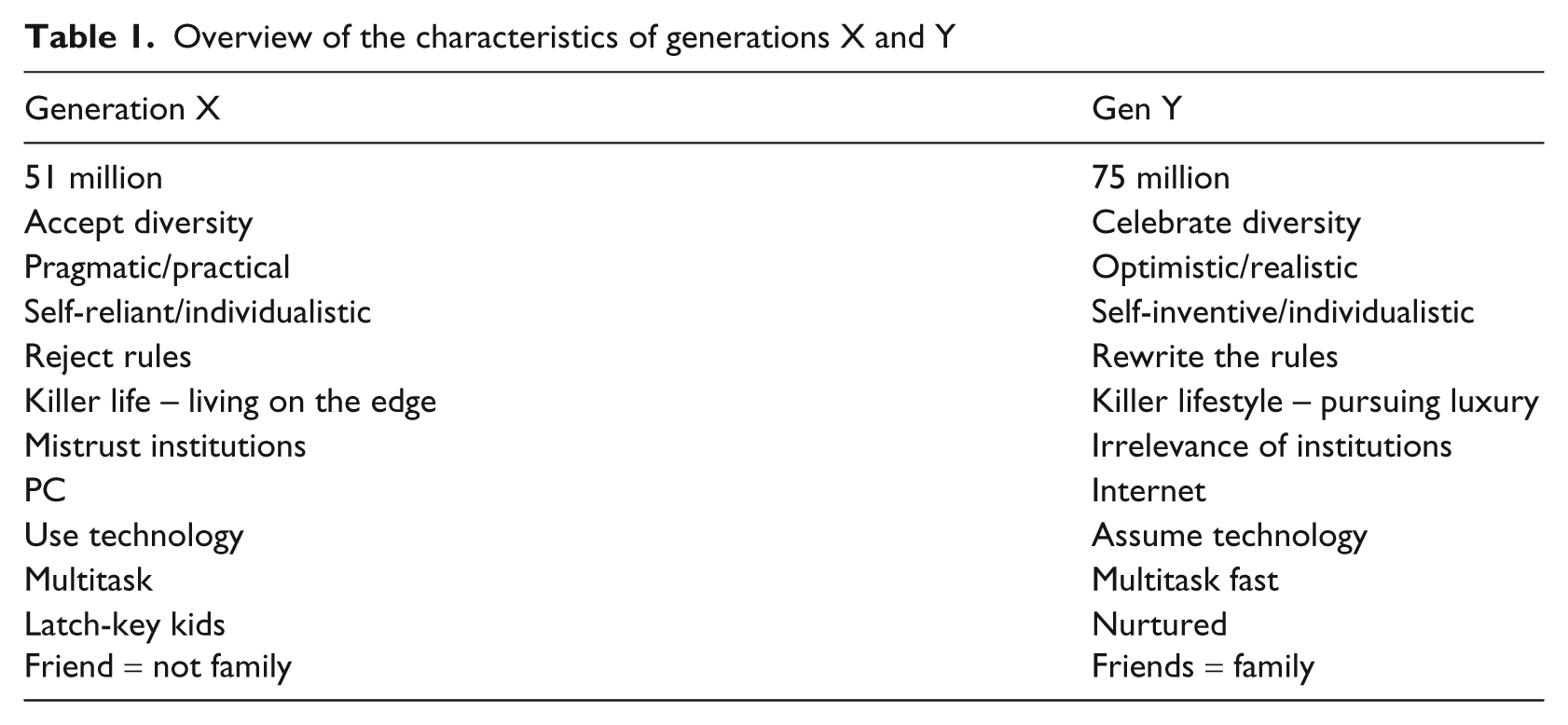
Members of Gen Y (and generation X to a lesser but still significant extent) grew up with ICT in the classroom; their understanding and level of comfort with technology seems to distinguish them from other generations. They were raised in an era of ‘on demand’ technology and the instant feedback it provides. Gen Y expect change and willingly embrace it (Baggott, 2009). They are heavy users of digital technologies, especially social media and web 2.0 tools – and are adept at using several web tools simultaneously to share detailed information across their extended networks of professional and personal contacts. Simons (2010) summarizes the attributes, ideas and values that characterize generations X and Y (see Table 1), reflecting the different era in which each generation was raised. These traits support the view of Tulgan (2009), a member of generation X, that Gen Y need to be guided with the same ‘helicopter parenting’ style practised by the parents of Gen Y. In other words, they are in need of mentoring or ‘educational hand-holding’ (Quinn, 2010: 10) because they lack skills in how to manage themselves (Burt, 2009). It seems that Y-Geners are motivated by reward and recognition so they will excel in a challenge where they can demonstrate ‘above and beyond’ performance (Tulgan, 2009). Josiam et al. (2009: 25) put forward that ‘Gen Y understands the importance of continuing education when entering the workforce’; this is an important point because it has implications for HE providers.
Overview of the characteristics of generations X and Y
Today’s students seem to attach great importance to the technological devices that they use. It follows that the greater interactivity between students can be channelled into a richer learning experience, connecting students with students, rather than connecting students with static content (as in the case of an e-campus for example). Online networks can be used to develop collaborative learning, virtual project work and virtual learning environments. The widespread adoption of ICT by Gen Y has drawn attention to other changes taking place which seem to reflect an evolution in the way students absorb and use information. These points are discussed below.
Over a decade ago, Wolf (1996) and Paul (2001) observed shortened attention spans and chronic boredom among students, and even increased numbers of students with attention deficit disorder. This behaviour has been attributed to constant stimulation, quick communication and the emphasis students place on multi-tasking. For this reason, certain commentators such as Proserpio and Gioia (2007) put forward that educators face a unique challenge in effectively reaching the Internet-dependent Gen Y students. Lin (2008) suggests that the exposure to digital technologies such as laptops, cell phones, text messaging and twittering can enhance brain circuitry – and some journalists believe that this has produced a generation of students who see the world in a different way (Economist Technology Quarterly, 2010), operating through networks – namely Facebook, Twitter, LinkedIn, etc. (Lafay, 2010). For researchers, understanding what students do online is an increasingly complex and challenging task, since greater interactivity generates a greater diversity of ideas and content (Hamilton and Hewer, 2010: 274).
The Internet-dependent behaviour of Gen Y students is a topical theme. Studies can be divided into three main themes: the growing reliance on technology-led learning, the implications of recruiting Gen Y graduates, and the emergence of an online lifestyle marked by the popularity of social networking. Many of these studies are based on research undertaken in a national or monolingual context, particularly in urban areas and often in the USA, of how young individuals cause change. The studies often overlook the experiences of students from different cultures and linguistic communities. They also fail to take into account the notion that socio-spatial factors can cause digital inequality (Crang et al., 2006; Zhao, 2009), the belief that there is disparity between urban and suburban Internet users – as opposed to urban versus rural (Hargittai, 2010; Stern et al., 2009; van Winden and Woets, 2004). This lack of information highlights a specific difficulty (gap) in gathering data beyond borders and across different socio-spatial groups. Few publications available in the public domain have addressed the issue of Gen Y Internet users from an international perspective within the context of higher education. To this end, it would be constructive to explore how a cohort of international Gen Y students makes use of social networking for academic work and for recreational purposes.
Before discussing Gen Y Internet users, it is worth noting that opinions are divided over the legitimacy of simplifying the behaviour of a whole generation in the way that Prensky did when he coined the term digital native in 2001 to refer to the ‘new’ students of that era. Many sweeping statements have been made about age and digital competence based on the premise that constant exposure to technology since birth will enable young people to be able to use it effectively (Coombes, 2009). Such claims exaggerate the need for educational reform to cope with the generational change. More importantly, there is a general lack of empirical evidence to back up many of these across-the-board assumptions. According to Vaidhyanathan (2008), generalizing about youth and technology ignores the needs and perspectives of those young people who are not socially or financially privileged. Cross-generational understanding can be fraught by an insistence on identifying all young people as digital natives. It may be more accurate to define Internet users by how they use the technology rather than by age. For Boyd (2007), the term digital native refers more to a state of experience than a generation.
Segmenting individuals into generations overlooks the reality that individuals of a particular age cannot be categorized into a homogeneous group. It is wrong to assume that everyone has the same access to technology and digital software. From an educational perspective, if the skills of Gen Y are overestimated then there is a risk of underestimating the support that some students may need (Livingstone, 2010). There is no doubt that in today’s society the population as a whole is more dependent on digital technology than previous generations; but more research is needed on intra-generational disparity among Gen Y students rather than inter-generational differences. This is another dimension of the gap in the literature.
Furthermore, it is important to bear in mind that research into Internet user behaviour faces the challenge of constant evolution. As soon as research is published, the findings are often out of date, owing to the dynamic speed of change in technology and the way in which people use the technology. It took, for example, only a few months for millions of Internet users to abandon blogging in preference for social networks such as Facebook (Leloup, 2010).
The body of literature presents today’s students as a cohort of Gen Y individuals. It is thought this group stands out from previous generations in their heavy reliance on digital technology. Today’s students are often described as heavy Internet users, with a tendency to use similar sites and services for communicating, information retrieval and social networking. Socio-spatial factors are believed to influence Internet user behaviour: the notion that a divide exists between urban, suburban, semi-rural and rural dwellers. However, critics call into question the validity of describing this cohort as homogeneous, drawing our attention to the dangers of oversimplifying a whole generation. Furthermore, given that much literature in this domain is written from a monolingual or national perspective, it calls into question the validity of such claims when applied in an international context.
To further our understanding of this ‘networked’ and ‘connected’ generation, this enquiry sets out to explore Gen Y Internet user behaviour in two different national contexts, and thus answer the following research questions. To what extent do students from different cultures and linguistic backgrounds use the Internet and social networking? How apparent are geo-demographic variables that are typically used for classifying individuals into ‘homogenous’ segments of consumers (national difference, age, gender and socio-spatial disparity) in the online environment? Might it be the case that early adopters of SNS use online networks in a similar way to the late majority? Is there a relationship between gender and the way in which respondents use SNS? Is there a relationship between socio-spatial setting and the use of SNS? In brief, what influence (if any) do gender, age, geographic location (that is, urban/rural) and experience have on the sites and services used by this particular student population? To what degree is the widespread adoption of ICT by students leading to converging Internet user behaviour across national borders?
Methodology
Face-to-face written surveys (questionnaires) were used to obtain information about the thoughts, experiences and behaviours of Gen Y Internet users in order to explain them. The survey questions were purposely broad in order to explore the extent to which Internet user behaviour may be influenced by generation and socio-spatial factors (urban versus suburban location). The survey was carried out with a convenience sample of over 229 undergraduate exchange students at two different locations; IDRAC Lyon (France) and St Petersburg State Polytechnic University (Russia), a partner university of IDRAC.
The survey was designed with open and closed questions to gather information from the students concerning their routine Internet behaviour, that is, sites and services regularly used for studying and for leisure, time spent updating profile, time spent communicating on SNS, and related sites. Space was provided at the bottom of the survey for the respondents (that is, the students) to add any further comments if they wished (for example, their personal views about using the Internet). In order to explore the existence of a relationship between certain variables, personal information was also requested – namely gender, age group, type of residential neighbourhood (urban, suburban, rural or semi-rural) and permanent country of residence. Respondents were also required to give the date when they first began using the Internet.
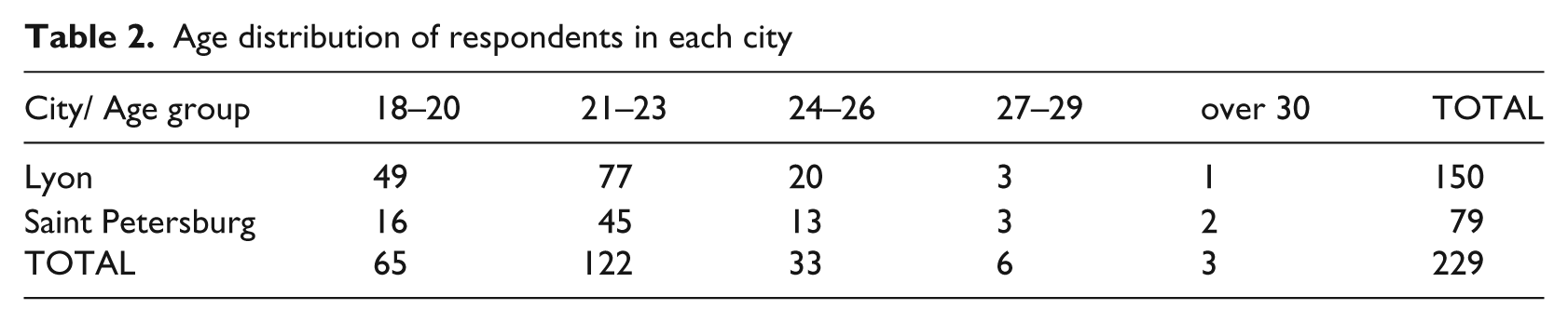
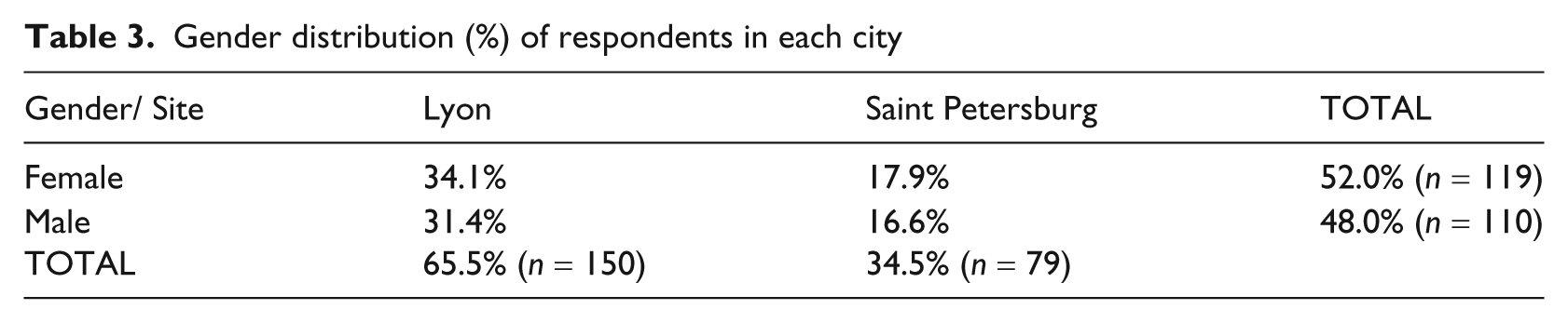
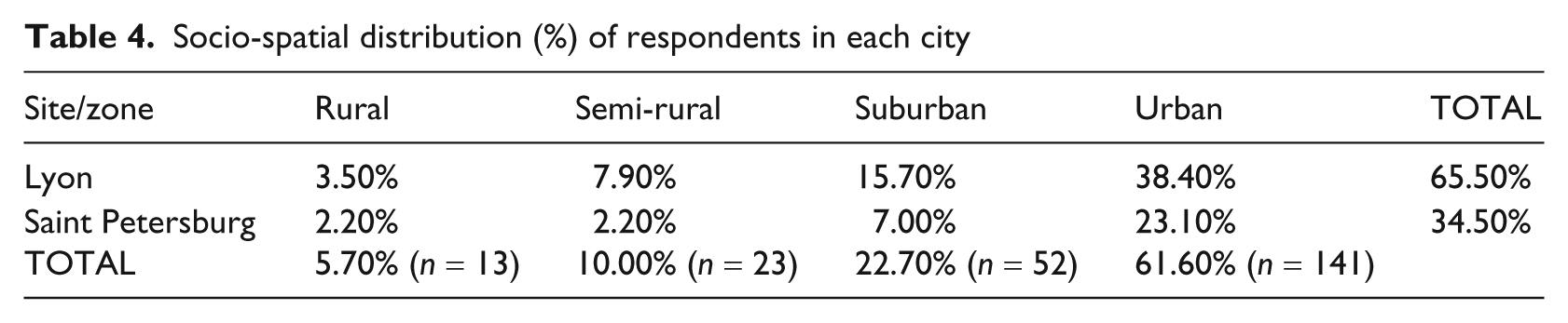
During March 2010, the surveys were distributed face-to-face to the international cohort of third-year undergraduates at IDRAC Lyon and St Petersburg State Polytechnic University. The sample yielded 229 surveys from male and female respondents aged 18 to over 30 (see Tables 2–4): 150 from Lyon and 79 from St Petersburg. Over 60% of the respondents (male and female) used the Internet prior to 2000. The results therefore reflect the behaviour of experienced Internet users.
Age distribution of respondents in each city
Gender distribution (%) of respondents in each city
Socio-spatial distribution (%) of respondents in each city
The raw data were entered into Sphinx for analysis, and then sorted thematically to highlight the most frequently cited activities undertaken via the Internet. This enabled the responses from the open-ended questions to be grouped together in order to produce graphs that represent the activities most frequently undertaken on the Internet.
Results
The results suggest that there was no strong relationship between the way in which respondents use SNS and the date when they first used the Internet. In other words, the early adopters of SNS were using online networks in a similar way to the late majority. Neither was there any perceptible relationship between gender and the way in which respondents used SNS. Lastly, no visible relationship was found between socio-spatial setting and the use of SNS. It can therefore be said that gender, age, geographic location (that is, urban/rural) and experience seem to have little influence on the sites and services used by this particular student population.
What can be said is that, based on the responses given by the students, a number of common activities (or themes) were frequently cited. These dominant themes include: communicating (85.6% of respondents use email), information retrieval (95.2% of the sample use Google) and social networking (used by 90.8%, of which 88.6% use Facebook). A large proportion of students (44.1%) used SNS for over an hour a day, and the majority (76.4%) used SNS for communicating through chat or IM. Internet telephony was used by a greater proportion of respondents (20.5%) than academic resources (19.7%) or school materials online (18.3%). This would suggest that students rely heavily on Google and Wikipedia for information retrieval. The sites and services that respondents claim to avoid using include dating sites (42.8%), online betting (39.7%) and adult content (36.2%).
To enable comparisons to be made between the graphs, the vertical axes were set to 100 (for Figures 1 to 5). The graphs show strong signs of commonality across the sample in the services used by the students for undertaking academic work, particularly Google, Wikipedia and translation sites (see Figures 1 and 2). These services were cited by respondents from different socio-spatial settings (that is, residential neighbourhoods) in Lyon and St Petersburg. In other words, the results show that students who live in different neighbourhoods in each national context (France and Russia) used similar sites and services for their course work.
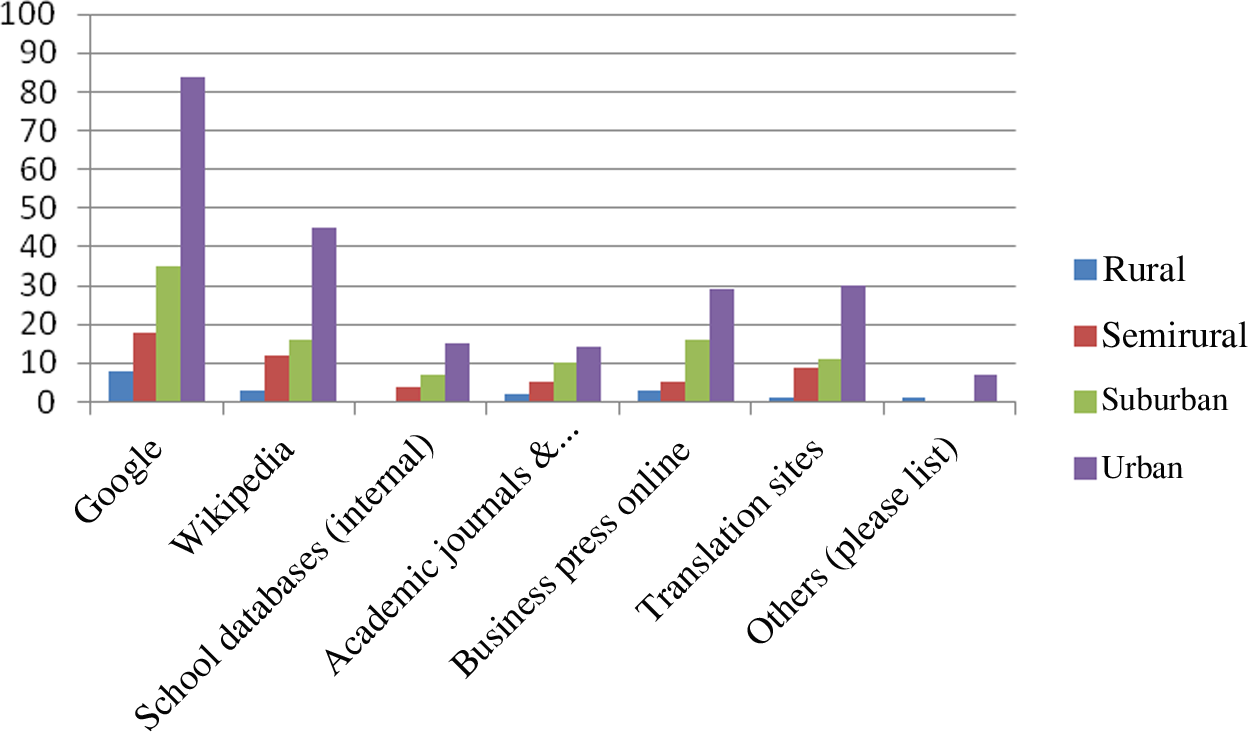
Sites used most often for course work by students in Lyon neighbourhoods
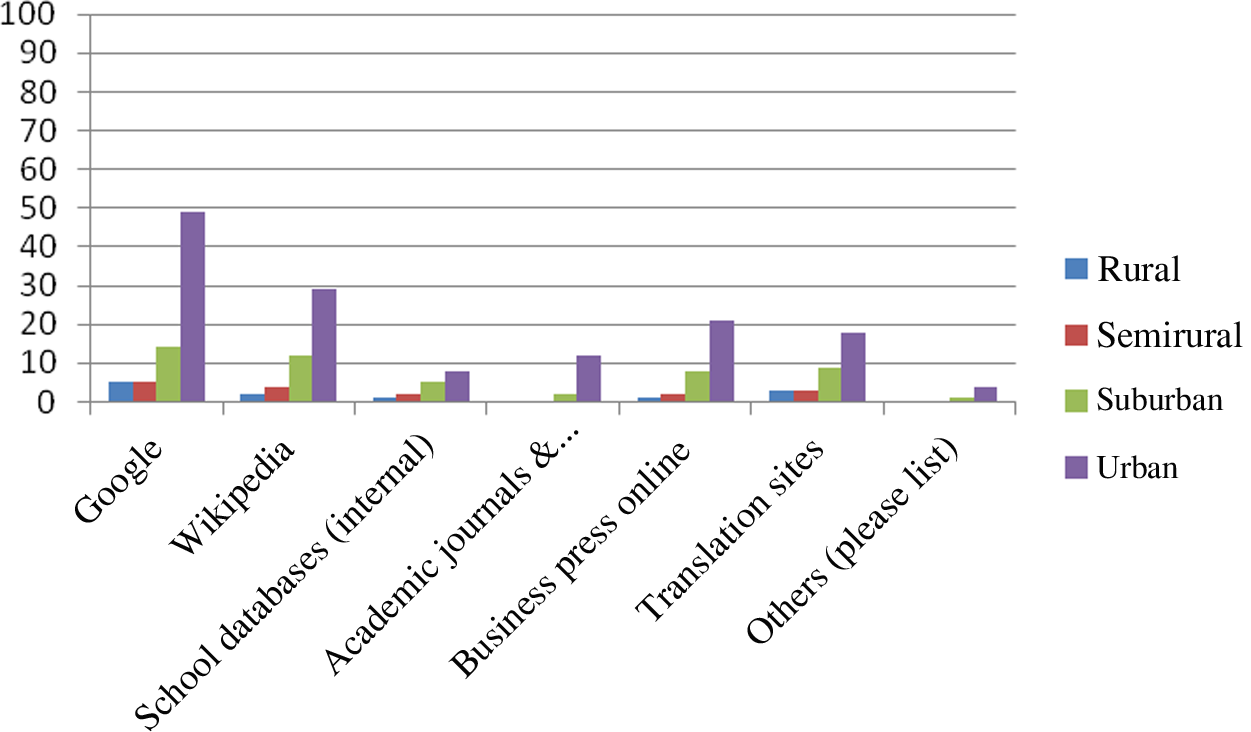
Sites used most often for course work by students in St Petersburg neighbourhoods
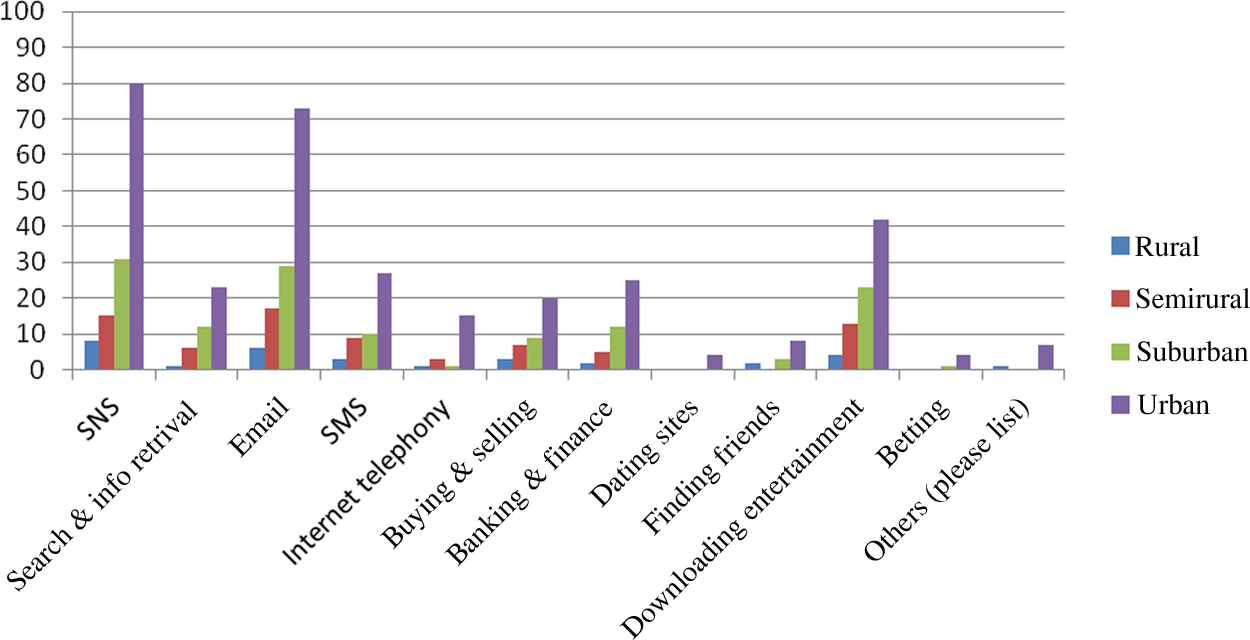
Sites used most often in leisure time by students in Lyon neighbourhoods

Sites used most often in leisure time by students in St Petersburg neighbourhoods

Sites generally avoided by respondents in Lyon and St Petersburg
Concerning a more recreational use of the Internet, a large proportion of respondents cited SNS, email and downloading entertainment (in decreasing order of popularity) as activities pursued during leisure time (see Figures 3 and 4). Responses given suggested that there was also considerable divergence for using other online activities such as buying and selling online, financial transactions and dating sites, many of which require divulging a certain amount of personal and/or financial information. Disparity was also noticed in the sites that respondents preferred to avoid using (see Figure 5).
While there were overwhelmingly more urban respondents than any other category in the sample, the results suggest that a wide variety of sites are used across the different neighbourhoods (rural, semi-rural, suburban and urban) in Lyon and St Petersburg. In other words, the notion of socio-spatial disparity is not apparent.
There was also commonality in the sites and services that respondents claimed not to use. In other words, respondents tended to avoid similar sites, in particular adult (18+) content (36.2%), dating services (42.8%) and online betting (39.7%).
With reference to the gender split, the responses indicated that there was no great difference in the way that male and female students used SNS. The findings indicate that male and female students use SNS in roughly equal proportions across the sample (see Figure 6). Moreover, irrespective of age, the use of Facebook and MSN remained popular across all age groups (see Figure 7). In the responses given, ‘other’ refers principally to ВКонтакте, a popular Russian site which looks remarkably similar to Facebook. The survey responses indicated that female students claimed to use several SNS, while male students claimed to use only one or two sites. The only activity that male students undertook more intensely than female students was online gaming (see Figure 8).
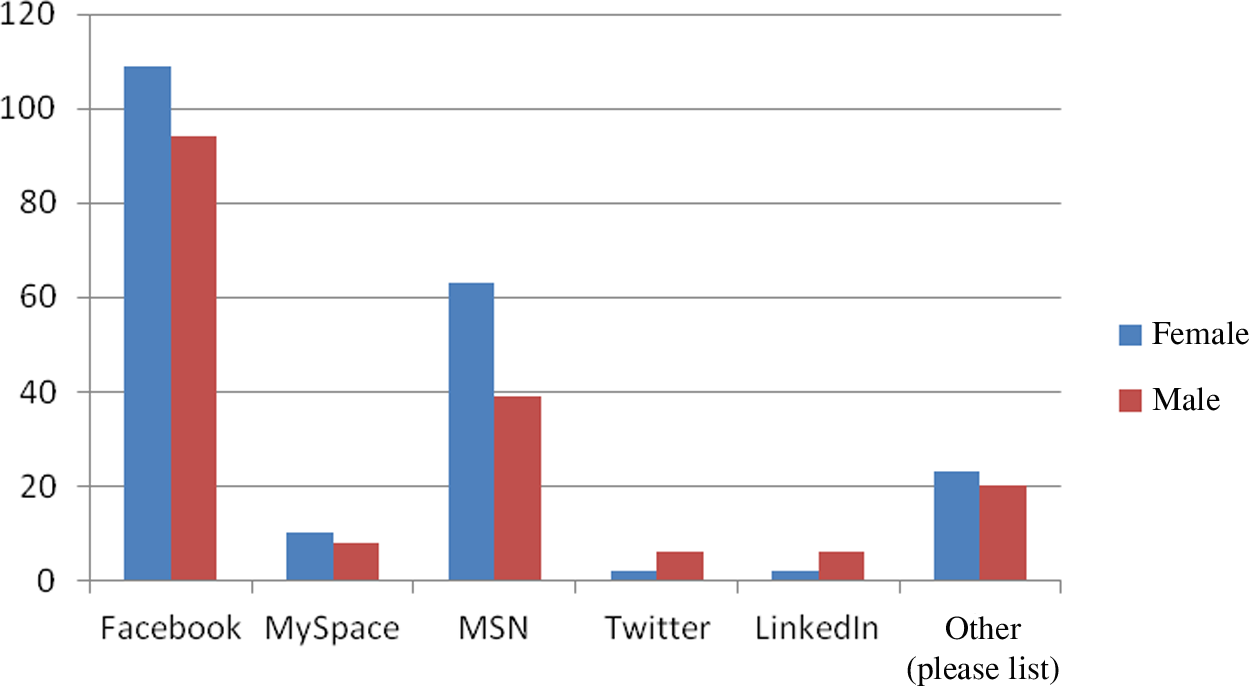
Gender distribution in the use of SNS
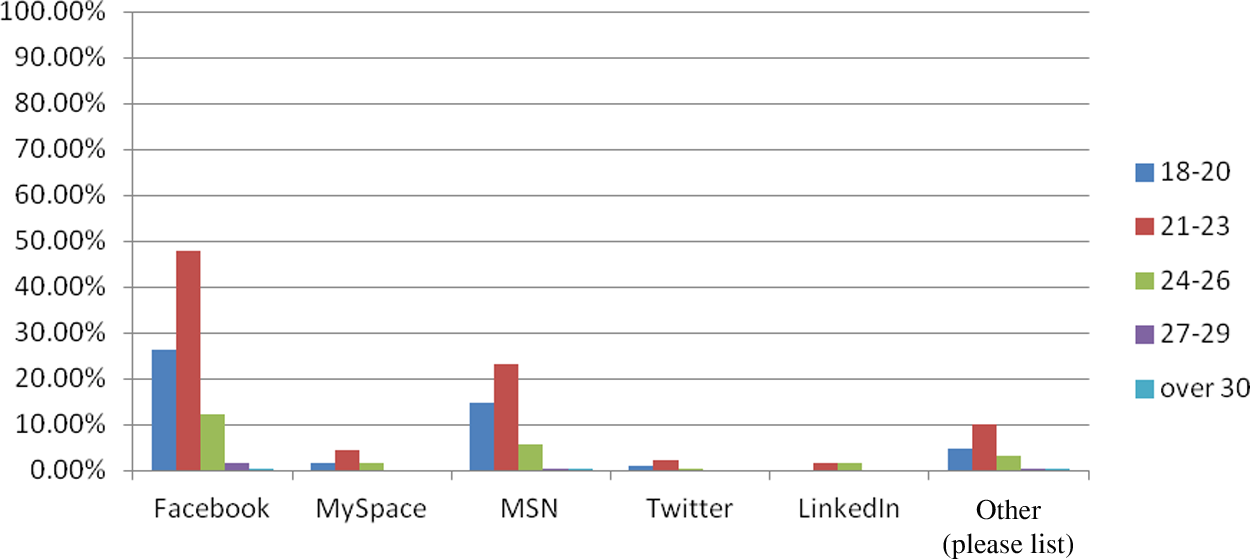
Age distribution in the use of SNS

Gender distribution for activities undertaken on SNS
On the whole, the survey data showed relatively few major differences in Internet usage across different residential neighbourhoods or between respondents in different national contexts (France and Russia). The students in this sample showed clear signs of commonality particularly for using the Internet for communicating, information retrieval and social networking. In other words, the way in which the students claimed to use the Internet suggested that converging Internet user behaviour is taking place, and that this convergence seems not to be influenced by either gender or national/residential context. The similar use of ICT across the different socio-spatial distribution suggests that the designation ‘Gen Y’ for this generation may be appropriate. The impact of this apparent convergence is discussed in the following section in the light of the literature.
Conclusions and implications
The analysis of the data provides a snapshot of how Gen Y students from different cultures and linguistic backgrounds use the Internet and social networking. It shows the extent to which the geo-demographic variables that are typically used for classifying individuals into ‘homogenous’ segments of consumers (national difference, age, gender and socio-spatial disparity) are not as apparent in the online environment as the literature seems to suggest. There are in fact strong signs of converging Internet usage among Gen Y students (irrespective of the widespread claims of cultural difference), particularly for communication, information retrieval and social networking. This finding challenges the body of ‘essentialist’ literature that ascribes difference in an individual’s behaviour to the national context. Indeed, it confirms the growing body of literature that points to converging Internet use, and the emergence of an international subculture, in other words the findings substantiate the literature which can be described as belonging to the ‘post-national’ era.
A certain degree of intra-generational disparity was expected in the investigation, since the sample was taken from an international group of students. However, the data show strong signs that students who live in different neighbourhoods in each national context (France and Russia) did in fact use similar sites and services for their course work. This finding highlights the extent of the globalization (or convergence) of Internet user behaviour. The literature also suggested that there could be disparity in Internet user behaviour across urban and suburban, rural and semi-rural neighbourhoods. This was not the case across any of the socio-spatial locations and it lends support to the notion of converging Internet user behaviour among Gen Y students, irrespective of the socio-spatial disparity. Given the speed at which Internet technology evolves (for example, becoming easier to use and more multi-lingual) it is not surprising that the results reflect a widespread adoption of popular sites and services. The findings of this study confirm the popularity of Facebook over other SNS, supporting the studies which claim that Internet users are attracted to the numerous applications that Facebook offers.
Bearing in mind the research method used, it is not possible to generalize from the findings; the data do not apply to the whole population. The investigation provides a snapshot of Gen Y students online, all of whom are experienced Internet users. Less experienced Internet users may have given different data. By using a short survey, only a brief insight into Gen Y online behaviour can be gained; for a more detailed understanding, in-depth interviews need to be undertaken with a larger sample size. The enquiry used a convenience sample of third-year undergraduates from only two partner institutions – located in France and Russia – and thus the findings cannot be generalized beyond this relatively small, homogeneous group. Other age groups (first, second and fourth years) and destinations might have given different answers. Lyon and St Petersburg are both ‘second cities’ and they may not reflect cities of a different type, size or geographical location. Only a restricted number of popular sites and services were considered. Surveying the users of a wider variety of sites would most likely provide different results. The findings therefore do not represent the whole online population of Gen Y students.
Given the apparent attraction of Facebook, it would seem logical that educators could take advantage of this mode of communication by integrating certain applications (for example, closed group discussions) into the learning experience. In an informal post-survey discussion with the respondents, this point was raised with the students. They responded with mixed feelings about privacy and security issues. The general consensus was that Facebook would be preferable to using email. The students appreciated the ease of communication with teachers via SNS but acknowledged that it could be problematic to separate the social side from the academic materials. It can be deduced that Facebook is perceived by students as more of a channel for social communication than for learning. The obvious conclusion would be to encourage the use of an independent pedagogical platform (such as Moodle) rather than Facebook but it is unlikely that students would embrace a new platform with the same enthusiasm. In addition, commenting on the current online provision, students resent the fact that they need to log on to the school intranet and then log on again to access their academic email. Incorporating Facebook into the school platform would further complicate the signing on process, it seems. More research is needed into the various platforms, security issues and Internet technologies that can be adapted for learning purposes and social networks.
In this investigation, there was very little difference in the activities undertaken by students in the online environment. The results point to the growing reliance on information seeking, and particularly the popularity of social networking, email and instant messaging, in addition to online entertainment activities. This trend draws attention to the problem facing today’s students of knowing how to use the vast amount of information available online, for furthering understanding or simply for enjoying themselves. This is another area that merits further research.
An equally interesting field to explore would be teachers’ attitudes to integrating SNS into the curriculum, looking at how teachers choose (or choose not) to develop technology-led learning. Indeed, restricting the research to simply students is a major weakness of this enquiry. In addition to teachers, other key user groups need to be taken into consideration – including administrative staff, school managers and technical support services. It would be constructive to investigate how these groups use the Internet across a wider number of sites and networks, especially corporate sites, professional bodies, research portals, academic resources and so on. Given the rapid evolution of technological developments and the use of technology in higher education, this topic is of great interest to academics and it is hoped will encourage additional research.
Footnotes
Biographical note
Jessica Lichy has a PhD in the field of online consumer behaviour in a cross-cultural context, from CEISR (Centre for European & International Studies Research, University of Portsmouth, UK). She is currently employed as enseignant chercheur (research professor) at ICAR (Idrac Centre for Applied Research) and Erasmus visiting professor at St Petersburg State Polytechnic University (Russia), UCLan (UK) and Chester Business School (UK). Based within ICAR, her present focus of research concerns technology-enhanced learning and Internet user behaviour. She is a member of AFM; her other disciplines of interest include cross-cultural management, social media and research methodology. Jessica teaches e-business, international marketing and research methods. Address: ICAR (Idrac Research), 47 rue Sergent Michel Berthet, CP 607, 69258 Lyon Cedex 09, France. [email: