




Abstract
Nowadays, teaching and learning have been shifted from traditional classrooms to technology-supported learning environment. By offering a convenient, efficient and financially affordable information technology learning environment, mobile learning is a topic that is of considerable interest for education audiences owing to the pervasive nature of text messaging. This study investigated tertiary students’ use of text messaging in mobile learning and related areas such as their literacy levels and years of using text messages. Given the use of such technology in classrooms today, this study is timely and makes its contribution to what is naturally scant literature in this area. Data were gathered by way of a questionnaire and text message exercises. Fifty-three students participated in this study. The results shed light on whether or not text messaging is positively or negatively related to students’ self-rated reading and writing attainment. Also revealed is whether or not there are differences between students at different levels, that is, whether first-year undergraduate students use text messaging differently, and if so in what ways, than undergraduate students who are nearer the end of their studies and postgraduate students. This article offers insight into the implications of successful mobile learning upon a contemporary account of practices and how we educators might use text messaging in mobile learning.
The use of text messaging in mobile learning (m-learning)
With the popularity of Information and Communication Technologies (ICTs), many people can communicate with each other by using different technologies, including mobile phones. According to Prensky (2004), there are more than 1.5 billion mobile phones in the world, which is over three times the number of computers. Owing to the computer function in modern mobile phones, Stone (2004) predicted that people will use mobiles phones instead of computers in the near future. Although it is still arguable whether or not this will be the case, it nonetheless indicates how powerful and sophisticated mobile phones are becoming (Attewell, 2005). The use of mobile learning (m-learning) by educators has also increased significantly since the introduction and popularity of mobile phones, and has shifted a greater emphasis on teaching and learning (Motiwalla, 2007). M-learning is based upon a contemporary account of practices that can enable successful technology-supported learning (Sharples et al., 2005) and a theory of learning that is underpinned by the view that learning occurs outside classrooms and lecture halls as people initiate and structure their activities to enable educational processes and outcomes (Sharples et al., 2005). It is based upon the notion that learning cannot easily be separated from other everyday activities, and these activities can be resources and contexts for learning. Instead, it is combined with personal purpose and entertainment needs in every day activity (Vavoula, 2004).
M-learning can be undertaken in a traditional classroom, where students can not only access the traditional printed materials but also use Internet and wireless technologies to visit course websites and access web-based learning materials (Homan and Wood, 2003; Virvou and Alepis, 2005). M-learning has been adopted in tertiary educational settings as well (Duncan-Howell and Lee, 2007). However, despite the tremendous growth and potential of wireless devices and networks, m-learning is still in its early stage (Motiwalla, 2007) and there is evidence that m-learning can complement and conflict with formal traditional education (Sharples et al., 2005). The context of m-learning is constructed by learners through interaction between learners and environment (Leadbetter, 2004; Sharples, 2002), and this includes traditional learning environments and m-learning environments.
Text messaging is one of the fastest growing types of information communication technologies (Plester et al., 2008; Reid and Reid, 2005), and it is also a very important form of m-learning. Text messaging provides “anywhere, anytime” (Geddes, 2004: 1) access to learners and a channel for communication with which they are generally familiar. Text messaging–related applications have to date covered a number of areas (e.g. Cavus and Ibrahim, 2009; Cornelius and Marston, 2009; DuVall et al., 2007). However, it does not always follow the standard rules of English grammar, nor usual word spellings. For example, students may use ‘LOL’ to represent “Laugh out Loud” and ‘ASAP’ to represent “As Soon As Possible”. Text messaging is also a beginning to redefine the social networks of today’s students (Bryant et al., 2006), from primary school to tertiary level. By offering fast-paced, inexpensive, online communication, text messaging allows for students’ learning communities to form and evolve. Thus, given the increasing popularity of m-learning and popular usage of text messaging in m-learning, many (e.g. Bryant et al., 2006; Thurlow, 2003) have emphasised the importance of text messaging in the use of m-learning.
As a group of users of text messages, tertiary students discuss their studying or personal issues by using mobile phones given that so doing is convenient, efficient and financially affordable. Nowadays, tertiary students have enormous access to digital technology such as m-learning devices (Prensky, 2001), and given how many of our students have such technology, it is not surprising that these students are speakers of ‘digital languages’ (Zhang, 2011), such as using text messages, owing to the fact that they have grown up in a world dominated by mobile phones (Duncan-Howell and Lee, 2007). With the growth in the use of mobile phones and other m-learning devices, there has been a similar growth in research into this important field. Research projects worldwide have been conducted on the use of text messaging in m-learning in tertiary educational settings in Europe (e.g. Corlett et al., 2005; Pettit and Kukulska-Hulme, 2006; Seppala and Alamaki, 2002), in Asia (e.g. Cheung, 2004; Thornton and Houser, 2004) and in North America (e.g. Cao et al., 2006; Motiwalla, 2007). Making its contribution to the growing literature in this area, in a study carried out at Griffith University in Australia, text messaging has been used to create channels of communication between lecturers with first-year undergraduate students (Horstmanshof, 2004). Results indicated that text messaging provided students with connection and community between themselves and their lecturers and this had a positive influence on persistence. At the University of Sydney in Australia, text messaging was used as a response mechanism for problem-solving experiments, and Cheung (2004) found that text messaging helped to overcome logistical problems. In common with these universities, many of us are adopting m-learning in our teaching programs or courses, but given that there is still little published literature on the use of text messaging, it is clear that we still have much to learn about this important aspect of m-learning and how best, and in what ways, we might better support our learners in their learning, whether inside or outside the classroom.
However, although there is some research in tertiary educational settings, most of the research describes the use of text messaging by school-aged students (e.g. Plester et al., 2008, 2009). Such research that exists continues to debate whether or not the use of text messaging has positively or negatively affected students’ learning in m-learning. In general, texting has provoked a very strong, negative response from teachers, parents and language experts (Bell, 2003; Humphrys, 2007; Lee, 2002) although this reaction must be viewed with some caution as these groups are, unlike our learners, not often those who can be described as ‘digital natives’. In addition, research into the perceptions that various groups hold about such technology and how it may or may not assist our learners in their learning more generally, there is evidence to suggest that, in one way at least, it might be beneficial, namely, in improving students’ levels of literacy. Research conducted into mobile usage and high-school students’ literacy levels found that the use of text messaging may be positively, instead of negatively, related to reading and writing attainments (Plester et al., 2008). Moreover, it was found that school students’ knowledge was not related with their literacy outcomes such as reading and writing abilities (Plester et al., 2008, 2009). There is evidence to suggest that during text messaging, students perform text messaging adeptly and creatively (Thurlow, 2003). Given that this evidence comes from studies on school-age children, it is clear that there is a need to investigate whether these arguments also apply in the tertiary educational setting.
To sum up, there are concerns from researchers and educators about the challenges and issues involved in the use of text messaging in m-learning. For example, although research has looked at the use of text messaging by teenage users such as school-aged students, little research has been conducted on the interaction of text literacy and standard English literacy among tertiary students, who are assumed to have already achieved a certain level of academic literacy. Therefore, there is a need to find out whether or not the use of text messaging in m-learning might positively or negatively influence the level of literacy of tertiary students, especially in terms of their reading and writing abilities.
Specifically, do the years of using text messaging influence the learning outcomes of tertiary-level students? Do traditional learners, that is, those learners who have not used text messages at all or those who have not used text messages for as long as other learners, benefit from using text messages in m-learning? Does m-learning increase students’ motivation and engagement in learning? These questions are addressed in the study described, which also aims to investigate whether the use of text messaging influences m-learning outcomes with a view to further understanding the advantages and disadvantages of mobile learning within tertiary educational settings. This study aims to understand the use of text messaging among tertiary students and to investigate whether the use of text messaging in m-learning could assist students in their daily learning process.
Methods
This study adopted the research methodology and research instruments used by Plester et al. (2009). Quantitative data were collected through closed questions via a questionnaire and text message exercises, and qualitative data were collected by using open-ended questions in the questionnaire. Survey research refers to almost any form of descriptive or qualitative and quantitative research (Gay and Airasian, 2003; Leedy and Ormrod, 2005). Surveys can be used to acquire information from the participant(s) about their opinion, characteristics, attitudes or prior experience (Johnson, 2001). Open-ended questions in the survey also “allows for the informants to answer from their own frame of reference rather than being confined by the structure of pre-arranged questions” (Bogdan and Biklen, 1982). In the text message exercises, a survey was used to test the participants’ abilities of ‘translating’ between the language used in text messages and that used in Standard English.
Participants
Participants were invited and consisted of 53 on-campus university students (4 males and 49 females), including undergraduate and postgraduate students from the School of Education in Charles Darwin University, Australia.
Questionnaire procedure
The questionnaire was administered with the assistance of the unit coordinators in Charles Darwin University. The questionnaire was conducted during Semester 2, 2011. It was carried out in the internal tutorial classes within the normal teaching period and required 30 min of time. Questionnaire instruments, in hard copy, were handed out to the students with the consent forms by the researcher, who also transcribed, entered and analysed the data gathered. The questions consisted of five closed questions, such as the participants’ demographic background, their self-rated level in reading and writing, and the year they started to use text messages and number of text messages they sent and received every day. The questionnaire questions also consisted of four open-ended questions, namely, whether they feel comfortable translating and using text messaging and the importance of using text messaging in their daily life.
Text message exercises procedure
When the participants had completed the questionnaire, they were invited to participate in the text message exercises. The text message exercises were also administered with the assistance of the unit coordinators as in the questionnaire procedure. During the text message exercises procedure, the participants were not allowed to talk to each other. The text message exercises had two sections: (a) translating 64 of the most popular, well-used text abbreviations to Standard English and (b) creating two text messages based upon two pre-made scenarios. The participants were given 5 min in each section (10 min in total). The researcher entered all the written answers into the Statistical Package for Social Science (SPSS), which were then checked to confirm accuracy of the data.
Results
Gender, mode of studying and age
Of the 53 participants, 49 (92.5%) were female and 4 (7.5%) were male. The predominance of females is due to the fact that in the discipline of Education, there are more females than male students. Out of the 51 students who answered the questions about their mode of studying, 46 (86.8%) students were studying full time and 5 (9.4%) were studying part-time. This research was conducted in a classroom environment and only fulltime internal students were required to attend internal workshops, lectures or seminars; thus, most of this study’s participants were studying full time. Their age range was from 18 to over 51 years old, with 75.5% being 18–30 and 26.5% being over 30 years. Of the 53 participants, there were 22 (41%) first-year students, 25 (47.2%) second- to fourth-year students, and 6 (11.3%) postgraduate students.
Year of using text abbreviations
Of the 53 participants, the range in the number of years of using text abbreviations was from 1995 or earlier up to 2011, with 18.9% having used text abbreviations before 1999 and 81.1% having used text abbreviations from 2000 onwards. This finding shows that all the participants had used text abbreviations and that the majority of them had started to use text abbreviations on their mobile phones from 2000 onwards.
Number using text messages between lecturers and other students every day
Of the 53 participants, the range of using text abbreviations was from under 1–5 messages per day to over 51 messages per day. Twenty-seven students (45.3%) used 1–10 messages per day, 10 students (18.8%) used 11–20 messages, 9 students (17.0%) used 21–30 messages, and 10 students (18.9%) used over 51 messages per day.
Success in reading and writing
The participants were asked to self-rate their level in English reading and writing by choosing a number from a 6-point scale (1 = not very successful at all and 6 = very successful). In total, 48 students answered this question. According to their self-report, 3 students (5.7%) rated themselves as “3” in the 6-point scale, 15 students (28.3%) rated themselves as “4”, 20 students (37.7%) rated themselves as “5”, and 10 students (18.9%) rated themselves as “6”. The mean of the participants was 4.77, and the standard deviation was 0.875.
The mean of the participants (M = 4.77) emphasised that their English reading and writing levels were well above the average level. None of the students rated themselves as 1 or 2 in the 6-point scale. However, this might be expected given the level of reading and writing ability demanded by the university’s entry requirements.
Text messages
The participants were invited to translate 64 messages from text abbreviations to Standard English. Table 1 presents the mean and standard deviation of correct translation, incorrect translation and blank answers among the 53 participants. It can be seen that the average translation was 36.13 (56.45%) out of the 64 messages, the average incorrect translation was 2.66 (4.16%), and the blank answer was 24.25 (37.89%).
Correct translation, incorrect translation and blank answers from text abbreviations to Standard English
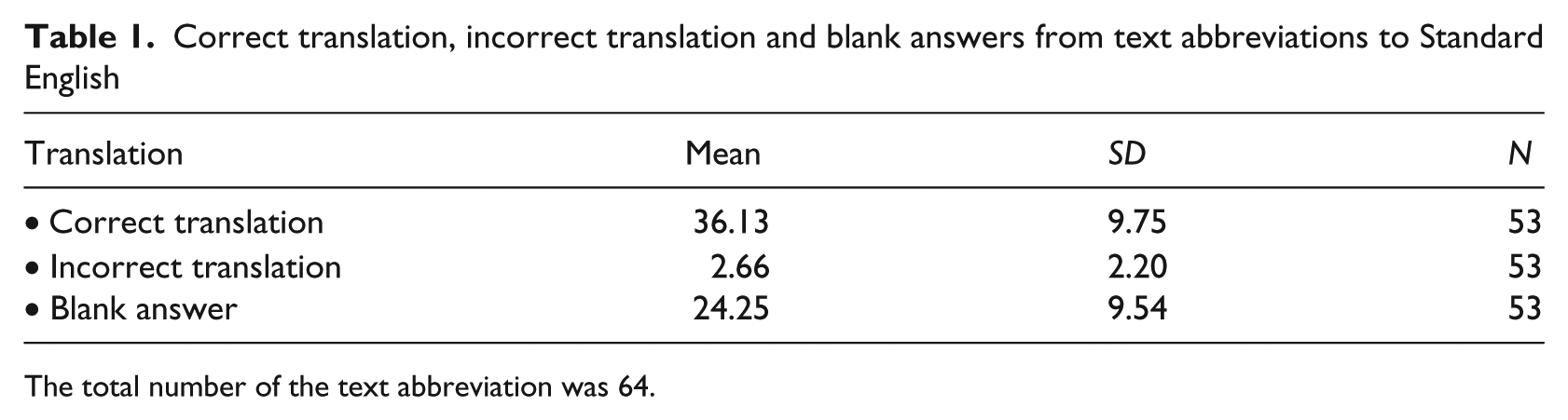
The total number of the text abbreviation was 64.
A correlation was used to measure the correlation among the correct translation, incorrect translation and blank answer. As can be seen from Table 2, the translation was significantly negatively correlated with blank answer. The students who had more correct translations had fewer blank answers.
Intercorrelations of text messages translation
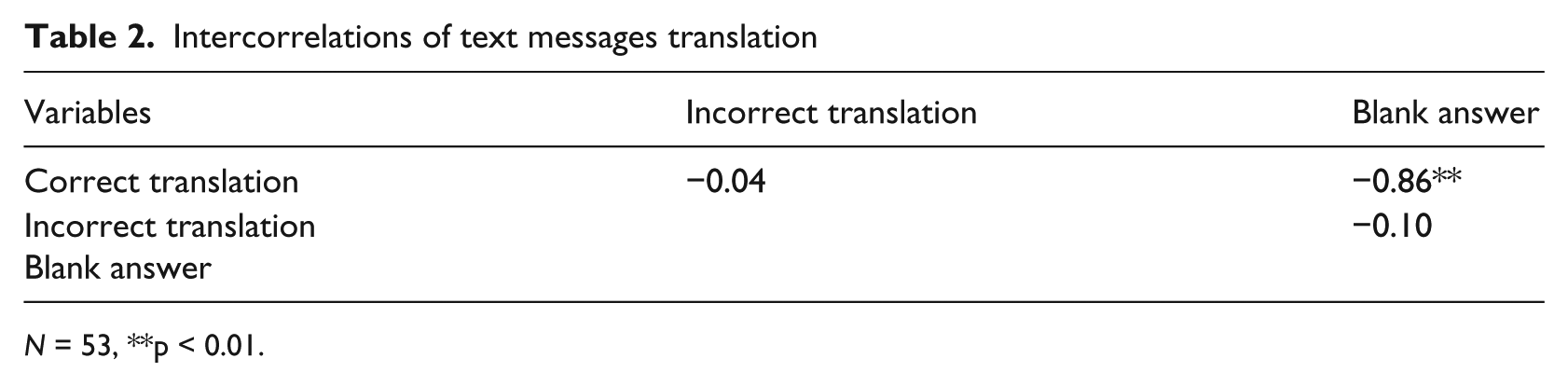
N = 53, **p < 0.01.
In terms of the text message exercises, the mean of participants’ correct translation of the text abbreviations was higher than the mean of blank answer. It was also found that the students who had more correct translations had fewer blank answers. It suggests that tertiary-level students choose to do one of two things, either do a correct translation or leave it blank. There was limited incorrect trying or guessing meanings of the text messages.
Text messages and reading and writing
A one-way analysis of variance (ANOVA) was used to find the relationship between the text messages (correct translation, incorrect translation, and blank answer) and the students’ self-rated success in terms of reading and writing levels. As can be seen from Table 3, the students’ correct translation of the text abbreviations was significantly related with the students’ success in terms of their reading and writing levels, F(3, 44) = 5.18 and p < 0.01. The students who rated themselves more highly in terms of their reading and writing levels had more correct translations of the text abbreviations. This finding shows that text messaging was positively, not negatively, related to the students’ reading and writing attainment.
Self-reported reading and writing successful level and means of translation of text abbreviations

Values represent means of translation of text abbreviations, N = 53.
Text messages and the year level of their university studying
A one-way ANOVA was used to find the relationship between the text messages (correct translation, incorrect translation, and blank answer) and the period they had been studying (their level/year). Results demonstrate that the students’ incorrect translation of the text abbreviations was significantly correlated with how long the students had been studying (their level/year), F(2, 50) = 5.30 and p < 0.01. As can be seen from Table 4, first-year undergraduate students and postgraduate students made more mistakes in the translations than the second- to fourth-year undergraduate students. This finding shows that the first-year undergraduate students and the postgraduate students made more mistakes in the translations than the second to fourth year undergraduate students, although the first-year undergraduate students had the highest number of text messages per day. It suggests that the first-year students chose to guess the meaning of the text messages more than was the case in the other year groups.
Year level of the participants and means of translation of text abbreviations
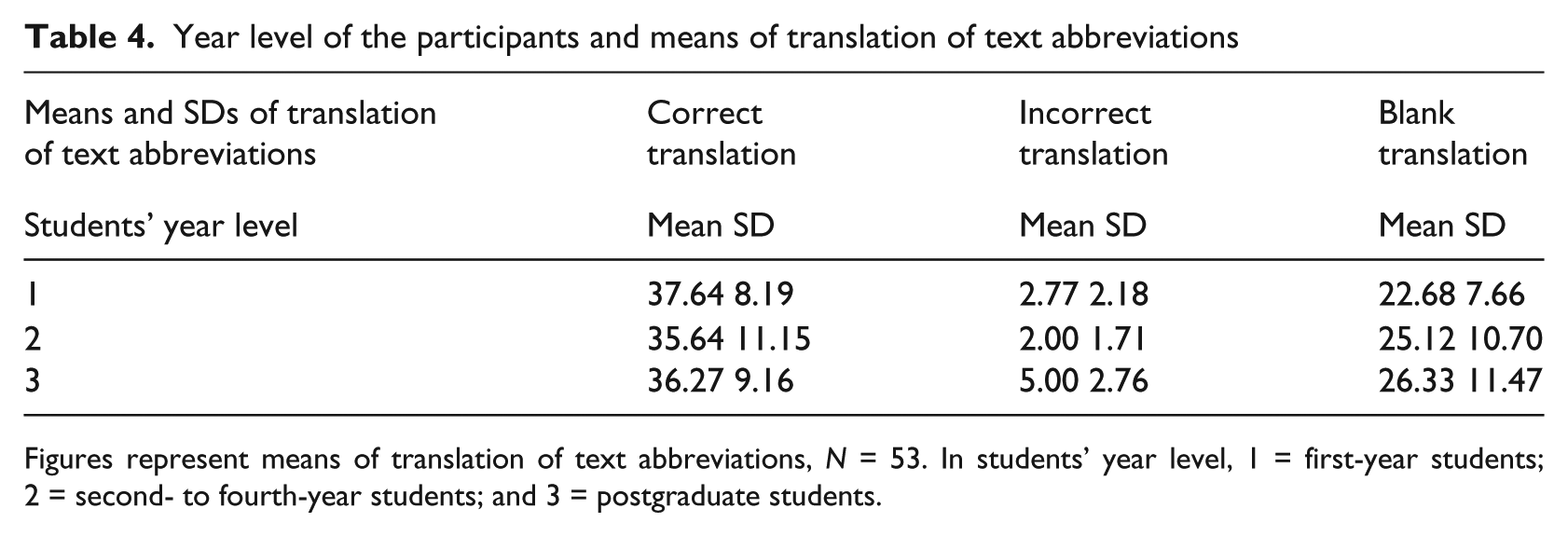
Figures represent means of translation of text abbreviations, N = 53. In students’ year level, 1 = first-year students; 2 = second- to fourth-year students; and 3 = postgraduate students.
Text messages and the year of starting to use text messages
A one-way ANOVA was used to find the relationship between the text messages (correct translation, incorrect translation, and blank answer) and the year/time when students started to use text messages. As can be seen from Table 5, the students’ incorrect translation of the text abbreviations was significantly related to when students started to use text messages, F(3, 44) = 4.33 and p < 0.01. This finding indicates that the more the user uses text messages, the greater the chance of them making correct translations of text messages.
Students’ year of starting to use text messages and means of translation of text abbreviations
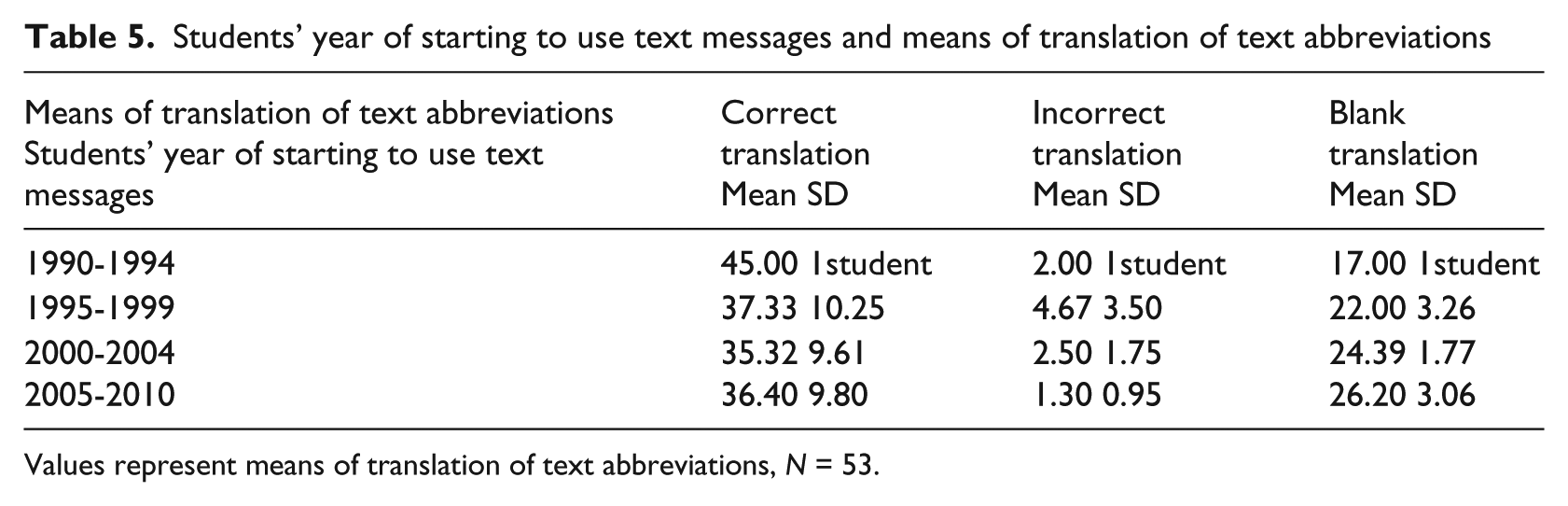
Values represent means of translation of text abbreviations, N = 53.
Number of messages per day and the level/year of their university study
Crosstabs were used to find the relationship between the number of messages the participants used per day and the students’ level/year of their university study. It was found that there was no significant relation between different groups of students and text messages per day, χ2 = 19.43 and p = ns. This finding indicates that whatever the reason why students use text messages, it is not because of their level/year level of their study.
Age group and correct translation of text messages and numbers of messages used per day
A one-way ANOVA was used to find the relationship between the text messages (correct translation, incorrect translation, and blank answer) and the age of students. It was found that there was no significant relation between different age groups of students and text messages (correct translation, incorrect translation, and blank answer), p = ns. Crosstabs was used to find the relationship between the number of text messages per day and the age of the students. It was found that there was no significant relation between age and the number of text messages per day, p = ns.
Conclusion
Text messaging can provide students with a flexible learning environment and access to create a communication channel to successful learning as long as they have a contemporary account of practices. As the vast majority of students in this study had used text abbreviations on their mobile phones from 2000 onwards, it is clear that today’s generation of ‘digital natives’ both use this technology and, it can be argued, expect to use it in their studies too. That students use mobile phones supports that of Prensky (2001) in that tertiary students have easy access to m-learning devices and they are fully able to use digital language such as text messages. This finding also demonstrates that text messaging can be used anywhere, any time by users and that it provides a communication channel for students for their learning (Geddes, 2004) and also for social networking purposes (Bryant et al., 2006).
This study makes five important contributions to our knowledge on the use of text messaging. One, it is one of the first studies to provide data that show how many text messages are sent between lecturers and students, and between students and their fellow students per day. Nearly half of the students used 1–10 messages per day, which is what might have been predicted. Nearly a fifth used 11–20 messages per day and nearly a fifth used 21–30 messages per day. Of some surprise, perhaps, is that nearly a fifth used over 51 messages per day.
Two, text messaging is positively, not negatively related to the students’ reading and writing ability. Results show that the students’ correct translation of the text abbreviations were significantly correlated with those who had higher ratings of their reading and writing levels and that the students who rated themselves higher in reading and writing levels had more correct translations of the text abbreviations. This finding is consistent with Plester et al. (2008) statement that students’ spelling ability and the translation exercises are strongly correlated and that good writing attainment is also associated with successful use of the text messages. However, there is clearly a need for further studies in this area as these findings contradict those of Bell (2003) and Lee (2002), whose findings showed that the effect of text messaging had very strong negative effects on students’ literacy levels.
Three, on the issue of text messages, how well or otherwise students deal with translation of messages. It was found that the translation was significantly negatively correlated with a blank answer. Students who had more correct translations had fewer blank answers. Students either did the correct translation or just left them blank. There was limited trying and getting them wrong or guessing meanings of the text messages. This finding does not accord with that of Zhang (2011) or the statement of Duncan-Howell and Lee (2007) who assert that tertiary students can use text messages properly because they have grown up in a digital world and who argue that there is a need to assist tertiary students to develop a better skill of translating text messages.
Four, in terms of the relationship between text messages and the year/level of their university studying, it was found that the students’ incorrect translation of the text abbreviations was significantly correlated with the students’ year/level of studying in university. First-year undergraduate students and the postgraduate students made more mistakes in the translations than the second- to fourth-year undergraduate students, although the first-year undergraduate students had the highest number of text messages per day. However, this finding might be because the first-year students may have chosen to guess the meaning of the text messages more than the other year groups given how much more frequently they used text messaging.
Five, as to the relationship between the text messages and the year/time of when they started to use text messages, the students’ incorrect translation of the text abbreviations were significantly related with the students’ year of starting to use text messages. This finding indicates that the more the user uses text messages, the more experience they will have and that this increases the likelihood of producing correct text messages.
When looking at the number of messages per day in relation to the year/level of studying, results show that there was no significant relation between different groups of students and text messages per day, which indicates that the reason that students use text messages is not because of their year/level of their study but instead because the use of texting has become so widespread as to be considered standard, normal in the student population as a whole. Linked to the year/level of study is age, and, again, results show that there was no significant relation between different age groups of students and text messages (correct translation, incorrect translation, and blank answer) nor any significant relationship between different age groups of students and the number of text messages per day. These findings indicate that age plays no important role in students’ correct use of text messages and numbers using text messages.
There are naturally limitations. The data were based exclusively on the students’ self-reports. There was no objective index against which to measure their actual achievement in terms of their reading and writing ability. Instead, the present definition of ‘successful’ represented the students’ perception of their own abilities rather than their actual attainment. This study confounds the skills of reading and writing and asked students to rate/rank their own abilities in both. They have, however, separate skills, and ratings/rankings might vary within a single individual. The data were based solely upon 53 internal students, who are from School of Education in one Australian university and with more female than male participants. These factors limit generalisation to the student population as a whole.
Therefore, a number of research directions can be identified. Some possible recommendations include obtaining an actual measure of the level of reading and writing ability and to have data on these as separate skills. Data need to be gathered from students from other disciplines and from other geographical regions. Further research will need to be conducted about tertiary students’ translation abilities from Standard English to text abbreviations and the reasons for choosing to use or choosing not to use these. Future research will also need to be undertaken to further explore students’ attitudes about using text messages in m-learning and whether these attitudes may influence their practices. Future research will also need to focus on what kind of practices and how they can improve tertiary students’ m-learning outcomes. In further study, reading and writing will need to be analysed separately as well. Last but not least, further study will be needed to investigate how teaching professionals could be empowered with the skills that they need in order to use these new mobile technologies both within and outside the classroom to better support their students’ learning.
Footnotes
Funding
This research received no specific grant from any funding agency in the public, commercial, or not for profit sectors.