




Abstract
Educators have integrated instructor-produced audio files in a variety of settings and environments for purposes such as content presentation, lecture reviews, student feedback, and so forth. Few instructors, however, require students to produce audio files and share them with peers. The purpose of this study was to obtain empirical data on graduate students’ perceptions of the integration of student-generated audio files within the context of online, asynchronous course delivery and to gain an understanding of how this approach impacted their perceived satisfaction, engagement, connectedness, learning, and utilization. Results indicate students were satisfied with this instructional approach. The integration of student-generated audio files fostered their engagement and involvement, assisted them in effectively connecting and communicating with peers, and increased their learning. Some drawbacks to this approach are detailed.
Active learning in the online environment
Active learning is an instructional approach that has become popular in higher education in recent years. McKeachie and Svinicki (2011) believe that active learning is a catch phrase that is widely being used. Active learning is a “learning by doing” approach that encourages students to actively engage with course content. When students are presented with information, there is value in them actively processing that information—learning by doing can motivate and engage students (Machemer and Crawford, 2007). With the continued focus of making learning active and integrating active learning into course design, educators may consider requiring students to generate and share their rich media files in learning environments. Online instructors may use this active learning approach in their “classrooms” in order to increase levels of student satisfaction, engagement, connectedness, and learning. Active learning approaches can provide meaningful learning experiences for students as they perform hands-on activities that allow them to process course materials and communicate newly acquired knowledge they obtain in class (Covill, 2011). Dengler (2008) agrees that active learning is an important instructional technique because it engages students, and they can apply what they are learning.
Student satisfaction is defined as an individual’s perception regarding the educational experience and its value (Astin, 1993). When students enjoy and are pleased with their learning experiences, they tend to be satisfied. Student engagement is here defined as students’ commitment to learning and their involvement in course material and activities (individually and collaboratively). Connectedness has been defined as the learner’s perception of belonging and having personal or professional relationships with other participants in the same learning environment and setting (Lee and Robbins, 1998; Shin, 2003).
Ormiston (2011) believes that technology is an “integral” part of active learning and that the focus in the learning process needs to be on student engagement. Media and technologies need to be selected and integrated into the learning environment carefully. The selection of media should be based on sound instructional design theories and decisions because the focus needs to be on the instructional methods not the media or technologies. Different media and technologies have different attributes and can either increase or decrease engagement, communication, or community building (Haythornthwaite et al., 2000), and support different levels of social presence (Carlson and Davis, 1998). These elements have the potential to either enrich or diminish students’ learning experiences; therefore, they can influence student satisfaction (Bolliger and Martindale, 2004).
Rich media such as digital audio or video files “bring the sensations of sight and sound to the online classroom. This not only helps those who profess visual or auditory learning styles but also enriches the overall learning environment for all students” (Rovai et al., 2008: 66). Learning styles refer to students’ personal preferences on how they learn—how they prefer to organize, receive, process, and recall information. Fleming’s (1995, 2005) model includes four modes: visual, aural, read/write, and kinesthetic. Many online courses consist of primarily text-based content because our society has historically used the written word to pass information and knowledge from one generation to the next. Traditionally, formal learning environments have included printed information (e.g. textbooks and assessment). Including as many presentation modes to accommodate a variety of different learning styles is a more inclusive way of teaching.
Caladine (2008) argues that there is a need to integrate appropriate media-rich content in online courses, and predicts that media-rich content will increasingly play a bigger role in online education and effective and efficient online teaching and learning: “In this age of online-rich media it seems archaic and not always appropriate to have educational content predominantly delivered as text” (Caladine, 2008: 5).
Podcasts (or other types of downloadable digital audio files) can be distributed via the Web, and their use is considered a mobile learning approach that provides flexibility to learners. Dale and Pymm (2009) identified five learning experience themes that emerged from students using iPods and podcasts in performing arts courses: flexibility, creativity, sensory, personalization, and collaboration. It is important to consider these five attributes and functions of social networks when integrating mobile technologies. “Portable, personal and situated technologies have the potential to offer students and educators flexibility in how content is delivered and how communication occurs” (Sutton-Brady et al., 2009: 221). The utilization of audio files provides an alternative communication channel in the online classroom as the teacher can record a lecture or provide class updates. Students can communicate with one another through the generation of audio files they post and share in the online course. As a result, students can engage and interact with one another in a way that may provide more connectedness in the online environment (Harris and Park, 2008), therefore transforming learning into a more personal and social learning experience (Dale and Pymm, 2009). However, the act of listening to audio files is considered primarily a “solitary affair” (Taylor et al., 2012: 81).
Instructor-generated audio files
The use of podcasts and audio files in college courses can provide higher education institutions with a competitive technological advantage as students may recognize the educational value of audio files in their coursework. The use of podcasting allows teachers to experiment with audio files that may provide innovative instructional strategies to enhance student performance (Heilesen, 2010). Many educators have integrated instructor-produced audio files in a variety of settings and environments for purposes such as content presentation, lecture reviews, student feedback, and so forth (Flanagan and Calandra, 2005; King and Gura, 2007; Lunt and Curran, 2010). Hew (2009) indicates the most common use of instructor-generated podcasts is to provide recordings of instructional or supplementary course materials to enhance student learning; this has been the primary focus of “podcasting research in higher education” (Taylor et al., 2012: 81).
Podcasts or audio files help students with the retention of course material by listening to recorded lectures. In addition, students may listen to the files repeatedly in order to increase levels of comprehension and knowledge retention. Students who are unable to attend class sessions due to personal issues such as illness may be able to listen to recorded lectures on their mobile devices (Hew, 2009). Researchers have found students were either moderately motivated by the use of podcasts or it increased their motivation. This approach assisted students in learning or enhanced learning (Bolliger et al., 2010; Fernandez et al., 2009; Heilesen, 2010).
One concern educators have is that students may not attend class session when recorded lectures are available (Hew, 2009). Students may need training to access sites and download the files; user support must be available (Flanagan and Calandra, 2005). Students may not necessarily be as eager or prepared to utilize podcasts as educators think they are. Walls et al. (2010) conducted a study to investigate student attitudes toward podcasting and whether students were equipped to use podcasts in their college courses. They found many students were not prepared to utilize podcasts and suggested to provide end-user training so learners may operate the podcast effectively.
Student-generated audio files
One innovative integration strategy of digital audio files is to create assignments across the curriculum for which students engage in media production. Sprague and Pixley (2008) believe that “the real power of podcasts, as with any technology, is when it is placed in the hands of students” (p. 231). Students at all ages can create audio files for performances, reflections, reports, and so forth. Projects may include individual or collaborative activities (Dale and Pymm, 2009; King and Gura, 2007; Shamburg, 2009). The process of generating a podcast is relatively simple, and some say that students need minimal technical skills to create and distribute audio files (Moss et al., 2010); however, there are some challenges with the use of audio files. For example, equipment issues must be considered when students create audio files for class, such as computer storage space, soundcards, headsets, microphones, and Internet access with proper bandwidth. In addition, the institution should have adequate technical support to assist students with the creation of audio files (Flanagan and Calandra, 2005).
There are few documented cases of instructors who have required students to produce audio files and share them with peers or of researchers who have evaluated the integration of student-produced files. Among these were studies conducted by Lazzari (2009), Lee et al. (2008), McLean and White (2009), Middleton (2009) and Petrovic et al. (2008). For example, Middleton (2009) conducted a study to evaluate instructors’ utilization of student-generated podcasting to encourage students to use their creativity and found that their use can enhance academic creativity. Petrovic et al. (2008) conducted a study with 85 medical students who had an option to create podcasts to support informal learning; however, very few students created podcasts. Lazzari (2009) conducted a study on students’ academic experience of generating podcasts. Results revealed students were able to comprehend course materials more effectively.
Lee et al. (2008) who investigated the use of student-generated audio files found students were able to grasp concepts effectively and file sharing promoted a collaborative learning environment. McLean and White (2009) experimented with two instructional approaches to the integration of audio files. The first instructor employed teacher-driven podcasting to complement lectures, whereas the second instructor had students develop their own podcasts. All students agreed that the use of podcasts helped them in their academic studies.
Some students, however, reported the process as time consuming, and some experienced anxiety over the use of technology-driven assignments (McLean and White, 2009). Another drawback of integrating student-generated audio files found was the lack of student technology training in the development of podcasts (Middleton, 2009), which is consistent with experts’ opinions (Flanagan and Calandra, 2005; Walls et al., 2010).
The literature has addressed the integration of instructor-generated podcasts in a variety of learning environments and settings. However, literature pertaining to the integration of student-generated audio files in online courses is limited. The inclusion of audio files, particularly student-generated files, may accommodate learners’ learning styles; yet the current literature does not address this matter. With more and more instructors being tasked to teach online and student enrolment in online courses in higher education rapidly growing, this topic is an important issue.
The purpose of this case study was to investigate learners’ perceptions of producing and sharing their audio files. The overarching research questions were: What are student perceptions of student-generated audio files integration in an online course? How does the integration of this active learning approach in the online learning environment where course material is primarily text based impact students’ perceptions of satisfaction, engagement, connectedness, learning, and utilization?
Research methodology
Setting
The study took place at a research-intensive university in the western United States with an enrolment of approximately 13,000 students. Approximately 6000 students were enrolled in online courses in spring 2011. Students enrolled in an advanced graduate-level instructional technology course delivered online in spring 2010, 2011, and 2012 were invited to participate. The instructor of this course was the only person on campus who required students to generate and share audio files.
The course was delivered asynchronously and primarily text based, and the course utilized both instructor- and student-generated audio files. The instructor posted podcasts in each of the 11 units for the purpose of providing a summary of required textbook readings and sharing personal perspectives pertaining to activities and topics. Students were required to develop audio files about their use of Web 2.0 tools and other resources (e.g. Wiki, podcasts, social networking, readings, and Web resources) and post them in a threaded discussion forum housed in either an external social networking site or a course management system.
Instrument
Researchers developed a survey instrument in order to investigate student perceptions of the integration of audio files in online courses. The instrument included a total of 32 questions: 15 Likert-scale items (ranging from 1—strongly disagree to 5—strongly agree), 10 open-ended questions, and 7 demographic questions. Questions were derived from the literature and included a variety of constructs: satisfaction, engagement, connectedness, utilization, student learning, and general issues (Bolliger and Martindale, 2004; Fernandez et al., 2009; Harris and Park, 2008). Demographic questions referred to learners’ prior experiences with instructional technologies (e.g. computers, multimedia, and online courses), age, gender, degree, and academic major. The survey was reviewed by a panel consisting of three expert instructors with experience in the production and integration of media files and teaching experience in the online environment, whose feedback resulted in the minor revision of 16 items. After the survey was administered, the internal reliability coefficient was calculated; it was acceptable (a = .82).
Data collection and analysis
Students were invited via email to complete an online survey; one reminder was sent after 12 days. Participation was voluntary, and all responses were anonymous. The response rate was 66.7% (N = 22). One case was deleted because two-thirds of the data were missing. Researchers calculated frequencies before recoding four negative items, and descriptive statistics were generated. Open-ended questions were analyzed using open coding in order to find emerging themes and categorize the data (Flick, 2006).
Results
Demographics
Most students (81.0%) who participated had been admitted to the graduate program in instructional technology. Students majoring in educational leadership (14.3%) were also represented. The majority sought master’s degrees (76.2%); other students were in doctoral programs—EdD (14.3%) or PhD (9.5%). Most participants were female (76.2%), and respondents’ ages ranged from 26 to 57 years (M = 37.4). The number of online courses completed by participants ranged from 0 to 30 (M = 9.9); only three individuals were new to online learning. Most respondents rated their computer skills as either very good (71.4%) or good (19.0%); only two students perceived them as moderate.
Student perceptions
General perceptions
Participants posted positive and negative thoughts about general perceptions of student-generated audio file integration in response to an open-ended question. Most positive comments addressed the actual task of creating audio files. Of the total participants, 16 respondents indicated they “enjoyed” or even “loved” the process, or that it was a “great experience”; others wrote that it was “simple” and “a good idea.” Respondents also spoke of the variety of assignments. Comments included that it was “a nice way to vary the instructional approach” and a “good alternative to written projects.” It “breaks up the monotony of all text-based assignments and communication” and provides a “great opportunity for more auditory learners.”
Of the total participants, four individuals liked hearing their peers’ voices and inflections because it “made them come alive for me” and “served to personalize the other students.” When students spoke of identified community elements, two of them mentioned this approach contributed to an increased feeling of community and connectedness. One respondent directly addressed learning and communication by writing, “I can definitely see how adding podcasts can benefit learning and communication.” Students also identified drawbacks. These related to a preference of reading and writing over using audio, struggling “to actively listen to classmate’s files,” and not having the “time to listen to everyone’s audio files.”
Descriptive statistics for scale items
Mean scores and standard deviations for all scale items are presented in Table 1. Items with a mean score at or above 4.00 pertained to satisfaction (1 and 2) and engagement (5 and 6). Three items had a mean score at or above 3.50: these items addressed perceived feelings of connectedness (items 10 and 11) and learning (item 13). Item 12 yielded the lowest mean score.
Means and standard deviations for scale items.
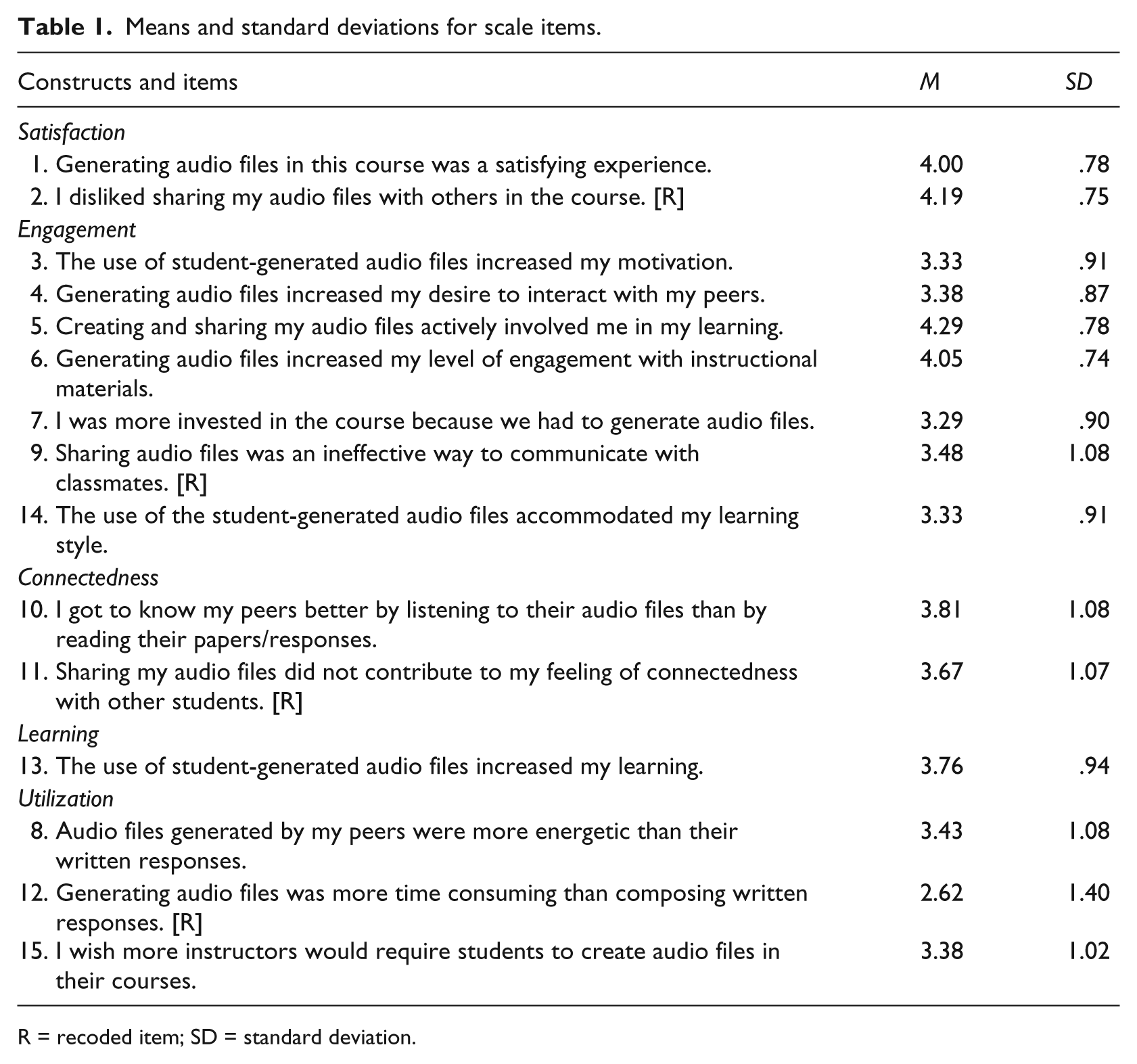
R = recoded item; SD = standard deviation.
Satisfaction
Items 1 and 2 had a mean score above 4.00; most respondents (80.9% and 90.4% respectively) agreed or strongly agreed with these questions. These respondents were satisfied with creating and sharing their audio files in the course. When responses to the open-ended question about the most satisfying aspects of creating and sharing audio files in the online course were analyzed, most comments pertained to the development process of the audio files and community. Individuals “thought it was fun!” or they “enjoyed the production process.” Reading their scripts out loud enabled them to catch some grammatical errors and make corrections.
Comments that were coded as community issues were responses such as “I learned the voices of others […] I knew them just a little bit better” or “it gave me a new sense of community towards my classmates” that lead to the “desire to contribute effectively to the course.” Feedback received by classmates gave students the feeling that others “had actually taken the time to listen” to them and provided them with “more confidence” in their abilities. Others commented on the fact that the production of audio files introduced variety to a heavily text-based delivery format and, therefore, broke “up the monotony”. Students indicated, “I didn’t have to type up a paper” or felt “it wasn’t just typing in a discussion board using Word.” Other respondents were satisfied with learning a new skill or a new tool.
Most identified dissatisfying comments addressed time issues: time required to “figure out how to make it work,” “create a podcast in comparison to just doing a written response,” or “listen to others’ audio files.” Three participants experienced technical difficulties (e.g. with posting audio files). Others felt their files exceeded the required length because of the amount of information they shared or that files became repetitive. One person felt that listening to classmates who, in this person’s opinion, only completed the assignments to simply earn points was a dissatisfying experience.
Engagement
Of seven items, two items pertaining to student engagement also had mean scores above 4.00. The majority agreed or strongly agreed with two engagement items, items 5 (90.5%) and 6 (85.7%), that pertained to involvement in their learning and engagement with instructional materials. Most respondents (61.9%) also agreed or strongly agreed with the statement that sharing the files was an effective way to communicate with classmates.
Only 52.4% of students felt that the assignment accommodated their learning styles. When individuals responded to an open-ended question about whether the use of student-generated audio files met or failed to accommodate their learning style, opinions were also split. Some (n = 8) reported it accommodated their learning style, whereas for others (n = 4), it did not. Those who expressed it met their learning style indicated they had a preference for hands-on approaches, auditory delivery of content or oral expression. Others who preferred reading and writing in the online environment or identified themselves as visual learners reported it did not meet their learning style. Those individuals “struggled to actively listen to and mentally process the podcasts of my peers” or thought “there were times where it was slightly difficult to pay attention.” One student who critically reflected on the experience wrote, “But it was good experience to do so and highlighted my need for being a better listener.”
Connectedness
Almost two-thirds of respondents indicated the assignment of creating, sharing, and listening to audio files added to the feeling of connectedness (66.6%) and helped them to get to know their peers better (61.9%). Of the 18 participants who answered the question about whether the integration of student-generated audio files was an effective approach, 17 expressed that it was effective. They gave reasons such as “it was a way to hear and have more personal connection with others” and “… because it helped me retain the information, and allowed me to feel that I knew my classmates better.” One individual was not sure.
Learning
The majority of respondents (76.2%) indicated the integration of student-generated audio files increased their learning. All 13 respondents who answered the open-ended question (n = 15) pertaining to whether the development of audio files contributed to or hindered their learning shared that this approach contributed to their learning. These participants explained that developing audio files “solidified concepts” or “increased [their] understanding of the materials.” Several students mentioned they wrote scripts for the audio files and were able to correct errors while listening and rerecording files. One student wrote, … the process did require […] that I write out the assignment, figure out how best to present [it] in an audio format, script the speech, and then record. It was a multi-step process of continually refining what I wanted to say in order to be concise.
Another person wrote, “I was able to hear what didn’t make sense, or what didn’t flow […] it contributed to making me a better writer.” Others replied they “had to interact in a new way” or learned a new skill or use of a new tool. One student who was not sure whether it enhanced learning indicated, “there is the likelihood that I remember more of the subject due to greater engagement.”
Utilization
Over half of participants (61.9%) agreed or strongly agreed that the creation of audio files was more time consuming than formulating written responses. Several students reported they recorded their podcasts after scripting; hence, they spent more time designing and developing the podcasts than compared to typing papers or discussion responses.
Participants offered suggestions on how the use of student-generated audio files could be improved. One person indicated they would appreciate the option of creating more podcasts, whereas another learner mentioned that they should not be overused. Respondents suggested requiring additional but shorter files in order to break up the information or rotate students who share files, instead of requiring all students to share them at the same time. Individuals thought assignments should be expanded to include “a combination of audio and video” or at least static photos and embedded music. Other comments addressed specific instructional uses such as instructors using audio files to present assignments, discussion points, or “as a way to liven up a presentation.” Others thought students could use audio files to introduce themselves at the beginning of the semester.
All but one respondent who completed one of the open-ended questions indicated they would recommend that other educators integrate student-generated audio files in their courses. Some of them placed conditions for its use such as: instructors need to be “properly trained in both the technical and pedagogical aspects,” “if it fit the curriculum,” or “it would depend on the outcomes.” One person would neither endorse nor oppose this instructional approach.
Discussion and conclusion
The purpose of the study was to investigate perceptions of graduate students enrolled in an online course who were required to produce and share audio files with other course participants. Results indicated students were overall satisfied with this approach. Many respondents felt the development and distribution of student-generated audio files fostered their engagement with instructional materials, involved them in their learning, assisted them in effectively communicating with peers, and increased their learning. Students who shared their audio files in an online learning environment were expected to perceive this process an effective way to communicate. Not all students, however, felt the integration of student-generated audio files in the online course was an effective way to communicate. One possible explanation is that the development and distribution of files was too time consuming in addition to completing other required course activities and assignments. Students may not have utilized the audio files of peers to the fullest extent. However, most students felt that the use of audio files contributed to their perceived feeling of connectedness and learning in the course.
Students reported that the generation and sharing of audio files was more time consuming than written assignments. This result is not surprising, and other researchers have found similar results (McLean and White, 2009). In this study, several students scripted their audio files or had to rerecord some of them. However, this process assisted some learners in their self-assessment—when they listened to their recorded files and refined them. These results support what others who investigated students who used capturing software for recording their presentations have found (Smith and Sodano, 2011).
In retrospect, it was not surprising that most respondents rated their computer skills as very good or good given the fact that most participants were experienced online learners and enrolled in an area of study where technology is integrated heavily. Interestingly, however, 76.2% of respondents had not created audio files in a previous course as students; this reaffirmed the perception that the practice of integrating student-generated audio in courses is not a common approach. Results pertaining to satisfaction and engagement with audio files are encouraging because the premise was that students’ experiences would be satisfying. Researchers have pointed out that the integration of an active learning approach engages learners (Harris and Park, 2008; Haythornthwaite et al., 2000; Machemer and Crawford, 2007), and some of the results of this study support that notion.
Some limitations need to be pointed out. First, all data were self reported. Second, only students in online courses who were required to create audio files as integral major assignments were surveyed; therefore, the sample consisted of only education majors enrolled in one course offered by one institution and was small. Therefore, the results are not generalizable to other settings and audiences, and they need to be interpreted with caution. It can be determined that the integration of student-generated audio files has potential in active learning in the online environment, but the topic warrants further investigation. There is a need for other researchers to investigate similar research questions in other settings where participants can be drawn from a larger pool.
Results of the statistical analysis did not yield high mean scores for items representing utilization and some items in the engagement category. Qualitative results, however, show that the integration of student podcasts impacted some students’ perceptions positively. Perhaps to some learners, the feelings of community and connectedness are more important than to others. This is an important consideration when building and sustaining effective online communities. The results beg the question as to what online learners are willing to do in order to build, foster, and sustain community. In which community-building activities are they willing to participate? How much are they willing to share? Adult learners tend to have many responsibilities outside of the academic environment. How much time are they able and willing to invest in these activities?
Participants in this study reported they felt engaged while creating the student-generated podcasts. However, when some of them listened to podcasts of their peers, they felt disengaged because this approach did not meet their learning styles. Clearly, there is a gap in our understanding of how students utilize audio files developed by others. How do students organize and process the information presented in audio files? What actions do they perform while listening?
It is important to note that many respondents were experienced online learners and familiar with online delivery and integrated course management tools. It could be assumed that all participants were fairly technology savvy; however, that was not the case. Therefore, students were asked to rate their technology skills, and most participants rated their skills at either good or above. Yet, the majority had not created audio files in courses before. Instructional designers or online instructors need to be cautious about the integration of student-generated audio files, particularly when the audience consists of learners whose technology skills are limited; it has the potential to create major challenges for both instructors and students. Students who are new to the online environment or newly admitted students who are not familiar with the interface of commonly used course management systems may simply be overwhelmed and experience cognitive overload when grasping functionalities of numerous systems at the same time.
Footnotes
Funding
This research received no specific grant from any funding agency in the public, commercial, or not-for-profit sectors.