




Abstract
Educators and researchers are increasingly calling for the processes of writing and knowledge construction to be an integral part of disciplinary learning. This article contributes to the literature by presenting an empirical analysis of a programme that was designed to expose students to the complexities of academic practices in conjunction with disciplinary concepts. The impact of the programme was evaluated through analysis of student grades before and after its implementation and student and tutor perception of its effect. Data collected included surveys, interviews and focus groups. The data showed that the programme generated student engagement with the processes of knowledge construction and reflected better thinking in the subject. This was evidenced by effective utilisation of feedback and improved grades in written assignments. The findings suggest that similar programmes are of value potentially to any discipline.
Keywords
Academic writing
Many students begin university studies with little or no knowledge of the principles underpinning academic discourse. These principles are rarely explicitly documented by subject lecturers and are ‘usually only implicit in course outlines, assessment instructions and the assumptions about the structuring of work’ (Haggis, 2006: 524), yet subject lecturers often assume students understand what is required of them. For students with little experience in academic communities, ‘the struggle to develop an effective voice with which to speak the discourse, whether in writing or in class, can be long and difficult’ (Northedge, 2003b: 250). Haggis (2006) cites Ivanic (2001) as arguing that ‘working with new text genres, possible vagueness about what “analysis” of an essay question might mean and a likely fear of exposure through the written medium’ means students are ‘likely to be hampered in their struggle to make sense of academic practices by their own misconceptions about purpose’ (p. 525).
Subject lecturers are not intentionally keeping their expectations hidden, nor are they unwilling to articulate what they are looking for. Indeed, approaches to clarifying expectations regarding assessment have burgeoned in recent years. One widely advocated strategy has been the criterion-referenced approach to assessment tasks where academics signal their expectations of students’ work via clearly formulated and transmitted criteria. However, the assumption that students will extract and act upon the desired criteria is optimistic in that unless explicitly explicated, modelled and discussed, language used in such criteria may not be interpreted in the way academics intend (Hunter and Docherty, 2011; O’Donovan et al., 2004).
Another strategy to enable students to make sense of academic practices has been the steady growth of learning development units often providing what Lea and Street (1998) called a study skills approach which focuses on writing with no connection to knowledge, thinking or activity within the discipline. The study skills approach has also attracted criticism from Northedge (2003a) and others, as representing a medical model, locating the cause of the problem in the students themselves, thus pathologising them. Added to this, the optional nature of study skills instruction may lead students themselves to perceive it as marginal to the curriculum. Such perceptions contribute to the ‘residual stigma attached to writing development’ (Murray, 2006: 133).
Embedded approaches
Despite the residual stigma, the role writing plays in the construction of knowledge in the tertiary setting is well documented. The concept that writing is a process that generates ideas and enables new knowledge through interpreting and acting on those ideas is agreed upon (Anderson and Hounsell, 2007; Greenlaw, 2003; Hansen, 1998; Knoblaunch and Brannon, 1983; Mitchell and Evison, 2006; Wingate and Tribble, 2012). Common references to the inseparability of ‘learning and articulating’ (Knoblaunch and Brannon, 1983: 467) and ‘indivisibility of the learning of content and the discursive practices associated with that content’ (Anderson and Hounsell, 2007: 472) underline the importance of writing in knowledge development.
Support for developing writing within disciplinary concepts has led to approaches that embed writing in the curriculum. Yet if such embedding does take place, it is often left to input from writing specialists (guest lectures or tutorials on writing) working collaboratively with the discipline academic (e.g. Hunter, 2006 and Morley, 2008). This partly integrated approach demonstrates the common belief that writing specialists who rarely have a ‘matching disciplinary background’ (Mitchell and Evison, 2006: 69) should be responsible for developing writing within a subject. Efforts to build partnerships to embed writing development within a discipline often lead to ad hoc arrangements where a space for writing ‘is filled with input from the writing and study skills specialist, the role and responsibility of the subject teacher remaining largely unchanged’ (Mitchell and Evison, 2006: 69). This approach moves responsibility for inducting students into academic writing from subject tutors who design and manage assessment regimes, to ‘agents’ outside the discipline (Wingate, 2006).
An alternative way of thinking about the teaching of writing in relation to disciplinary learning has emerged in recent literature based on the US notion that effective writing is ‘central to the work of higher education’ so the ‘responsibility for writing should be vested in the disciplines where this work takes place’ (Monroe, 2003: 4). Gee (1996), Haggis (2006), Jacobs (2005), Mitchell and Evison (2006), Murray (2006) and Wingate (2006), among others, argue it is the ‘tutor’s role as expert speaker of a specialised discourse’ (Northedge, 2003a: 70) to give students access to that discourse and that writing needs to be taught specifically within subject content by subject tutors as an ‘integral part of academic content teaching’ (Haggis, 2006: 530). Thus, writing is integrated to a greater extent than the previous approach.
Haggis (2006) further argues it is ‘the teacher’s responsibility to create pedagogical situations … exploring aspects of process in conjunction with specific concepts’ (p. 532). Yet she believes that this idea challenges many conventional assumptions about university teaching. One assumption may be the perception that providing students with guidance on processes is ‘spoon feeding’. She argues exploration of the high-level processes required of assessment tasks ‘cannot be spoon feeding – only content can be delivered by the spoonful’ and that writing processes of, for example, structuring, synthesising and formulating an argument cannot be delivered; they can only be ‘described, discussed, compared, modelled and practised’ (p. 530).
A more common assumption is that teaching of content itself takes time and emphasis on the processes or ways of thinking and practising would be at the expense of epistemological knowledge. To address this, Wingate et al. (2011) suggest that links to the processes can be made explicit in teaching disciplinary knowledge. For example, her study found analysis of extracts from suitably chosen texts does not reduce content teaching time as ‘the chosen extracts served to demonstrate a debate over the topic that was taught in the session’ (p. 6).
Another challenge to the explicit teaching of contextualised writing is that although university teachers ‘are likely to have spent many years developing acceptable ways of constructing their own knowledge through their own writing practices’ (Lea and Street, 1998: 163), their knowledge of writing construction is usually tacit and unarticulated and they may not be able to make writing practices visible for students (Jacobs, 2005; Murray, 2006; Wingate, 2006). Jacobs (2005) identifies two challenges disciplinary specialists face: first, the need to scaffold the teaching of content, and second, the need to bring their tacit knowledge and understandings of their specific discourse into overt and explicit teaching (from Gee, 1996). Her findings support the argument that these challenges are well met through collaboration with writing specialists in that they can ‘facilitate in unlocking the tacit knowledge’ that disciplinary experts have (Jacobs, 2005: 479).
Pedagogical applications
Insights and practical applications have emerged in the literature as to how subject teachers might begin to embed the processes and practices of their disciplinary discourse. These recommendations range from the overarching,
Opening up conversations and coaching students in speaking the academic discourse (Northedge, 2003a);
Demonstrating how knowledge is constructed in the discipline, the rhetorical processes, and how students can integrate their voice with existing knowledge (Wingate, 2006);
Aiding students to reflect on the nature of the knowledge with which they are interacting and adopt a reflective, questioning stance towards that knowledge (Anderson and Hounsell, 2007);
to the more specific in,
Designing teaching, learning and assessment activities carefully and coherently crafted to draw students into performing specific ways of thinking and acting, understanding the reasoning behind the structuring of content, organisation of activities and assessment (Anderson and Hounsell, 2007);
and that this can be done by,
Staging and explicit exploration of processes (Haggis, 2006), providing explanations, scaffolding, modelling and feedback (Wingate, 2006).
There is little empirical research investigating programmes that have applied this pedagogy. Some initiatives, for example, the Queen Mary College Thinking Writing project (see Mitchell and Evison, 2006), and a project that aimed to encourage disciplinary experts collaborating with writing specialists to take responsibility for students’ disciplinary writing (O’Neil and Harrington, London Metropolitan University) have been put in place. Reports of individual case studies of fully embedded writing instruction have been published in the United Kingdom by Wingate et al. (2011) and in Australia by Thies (2012). However, these programmes have usually been implemented at grass-roots level by teams of writing specialists through collaboration and partnership with subject teachers and are largely dependent on funding or committed disciplinary experts to continue.
The themes emerging from the literature are echoed in Wingate’s (2006) table of academic writing and levels of learning (p. 462) that ‘illustrate the complexity of academic writing for a novice writer’ (Wingate, 2006: 462). In her discussion that the learning of academic writing as ‘study skills’ is inadequate, Wingate (2006) suggests that one level of learning academic writing consists of techniques while a deeper, more complex level involves ‘understanding the nature of knowledge and how it is constructed’. She used a format of outlining three stages in academic writing development: (1) selecting, evaluating information sources; (2) synthesising arguments from sources with one’s own arguments; and (3) writing arguments into a structured coherent text. Techniques or writing skills align with each stage as the first level of learning, while reference to deeper learning and understanding of the ways of thinking in the discourse represent the second level. Wingate (2006) uses referencing as an example in that the stage of synthesising requires knowledge of the technique of referencing which is relatively simple as most students can use it successfully when taught. However, to develop an understanding of referencing, students need to understand that knowledge is constructed, debated and contested and this understanding requires an ‘epistemological shift’ as students need to understand they are expected to question existing knowledge and use evidence from previous contributors to that knowledge to formulate arguments. Embedding such an approach can be seen as a contextualised process of looking at and/or applying the theory of a particular discipline and that ‘the teaching imperative shifts from the transmission of subject expertise to encouragement and crafting of students’ active response to the subject: their construction of knowledge’ (Mitchell and Evison, 2006: 81).
In sum, the literature suggests that ‘learning and articulating are inseparable activities’ (Knoblaunch and Brannon, 1983: 467) and making disciplinary writing and thinking practices visible is the responsibility of subject lecturers. Suggestions for pedagogical applications of such practices are put forward. However, programmes that embed thinking and writing practices into academic content teaching taught by disciplinary specialists remain largely under-researched. The study described in this article increases the scholarly output by reporting a case study of a programme that implemented this approach.
Research methodology
Programme design
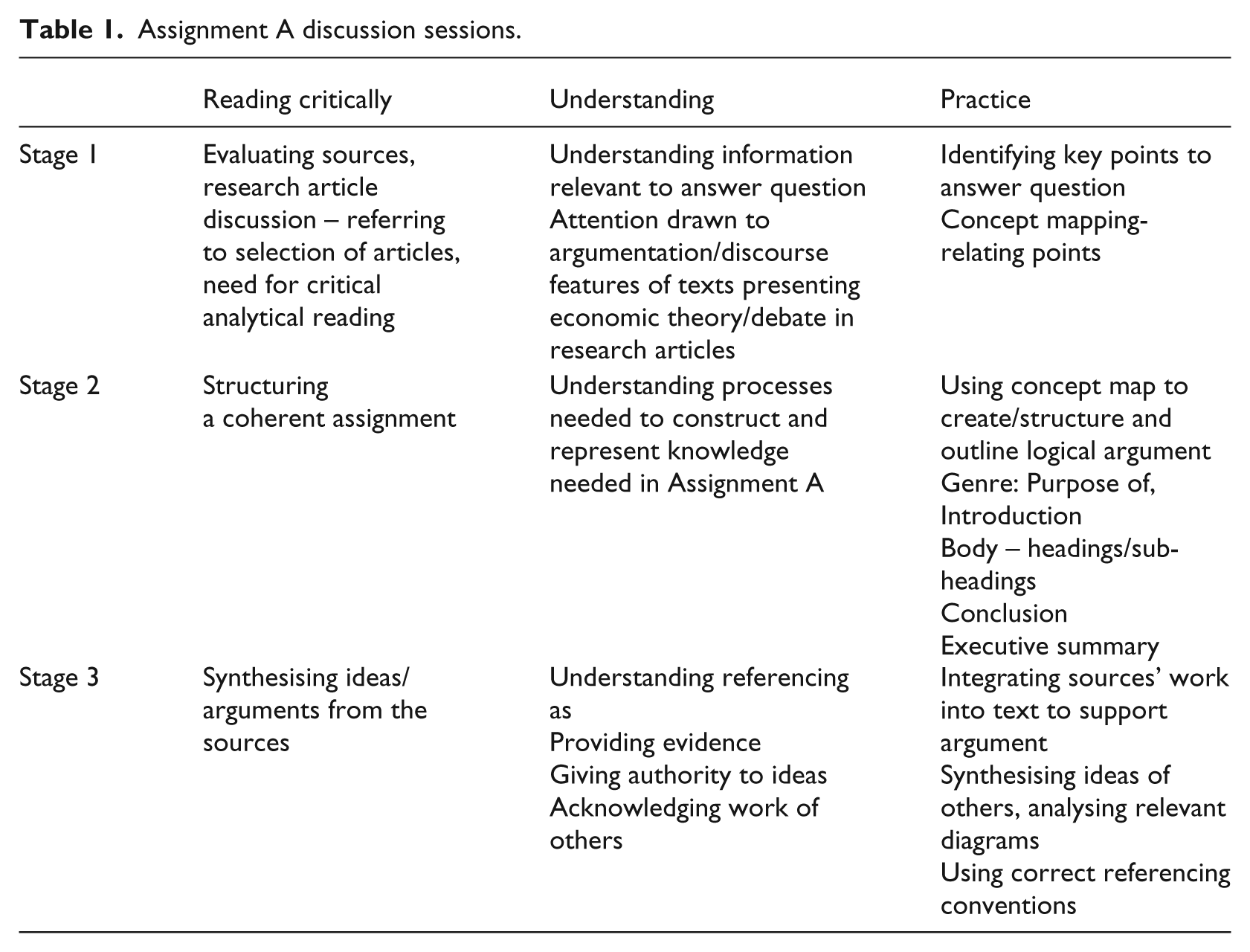
Wingate’s (2006) table of academic writing and levels of learning (p. 462) was adapted to design a programme to embed the stages required to complete two related assignments in a macroeconomics subject. Two sets of assignment discussion sessions were created, one for each assignment, each containing three stages, to be presented in a 20-minute slot within the weekly 2-hour lecture as represented in Tables 1 and 2.
Assignment A discussion sessions.
Assignment B discussion sessions.

Wingate’s (2006) two levels were turned around in that the deeper learning (understanding) was explained first within content delivery (scaffolded) and the technique level of learning was explained second as practice or activity to express the understanding. The set was presented for 3 consecutive weeks, concluding a week before each assessment task was due, six sessions in all. The first set addressed the processes of (1) reading critically, (2) structuring a coherent text, and (3) synthesising/appropriate language required. The second addressed the processes of (1) applying feedback/feedforward, (2) thought processes for more analytical question, and (3) structure and language for assessment B. The programme explained the stage, for example, critical thinking, then provided modelling (exemplars) in conjunction with subject concepts to first develop the more complex level of understanding. Then the practice stage involved introducing techniques to express that understanding. For example, in the first stage of reading critically for Assignment A, understanding involved evaluation of an article relevant to the concepts required to answer the essay question. Attention was then drawn to the textual features in how economic concepts, theory and debate are presented, and from this, students were guided towards judging information relevant to the question. Then the technique of drawing up concept maps was introduced as a way of interpreting and acting on that understanding.
Thus, all students were shown a contextualised process of applying macroeconomic theory. The sessions were formatted as animated slides combined with online exemplars. In addition, the coordinator spent more teaching time opening up conversations that aided students to reflect on the nature of knowledge in the subject, consider how writers in economics make points and arguments and how they could integrate their own voices in the argument.
Assessment
Two related essays on an economic issue formed the assessment tasks 2007/2008/2009, the second requiring more analytical thought. Students were asked to outline and describe current economic conditions (Assignment A) and use appropriate macroeconomic framework/theory to analyse the economic conditions and appraise government policies relating to them (Assignment B after 4 weeks). Thus, the tasks used current issues to develop students’ analytical thinking. In 2007/2008, voluntary assignment writing workshops (taught by the writing specialist) had been provided; yet only 10%–15% of students attended. The 2009 project moved from the self-selecting workshops to a programme that would reach the entire cohort by way of the series of assignment discussion sessions taught in a large class (300+) environment.
The same assessment criteria, 50% content and 50% writing, was used for all 3 years (see Table 3).
Assessment criteria.
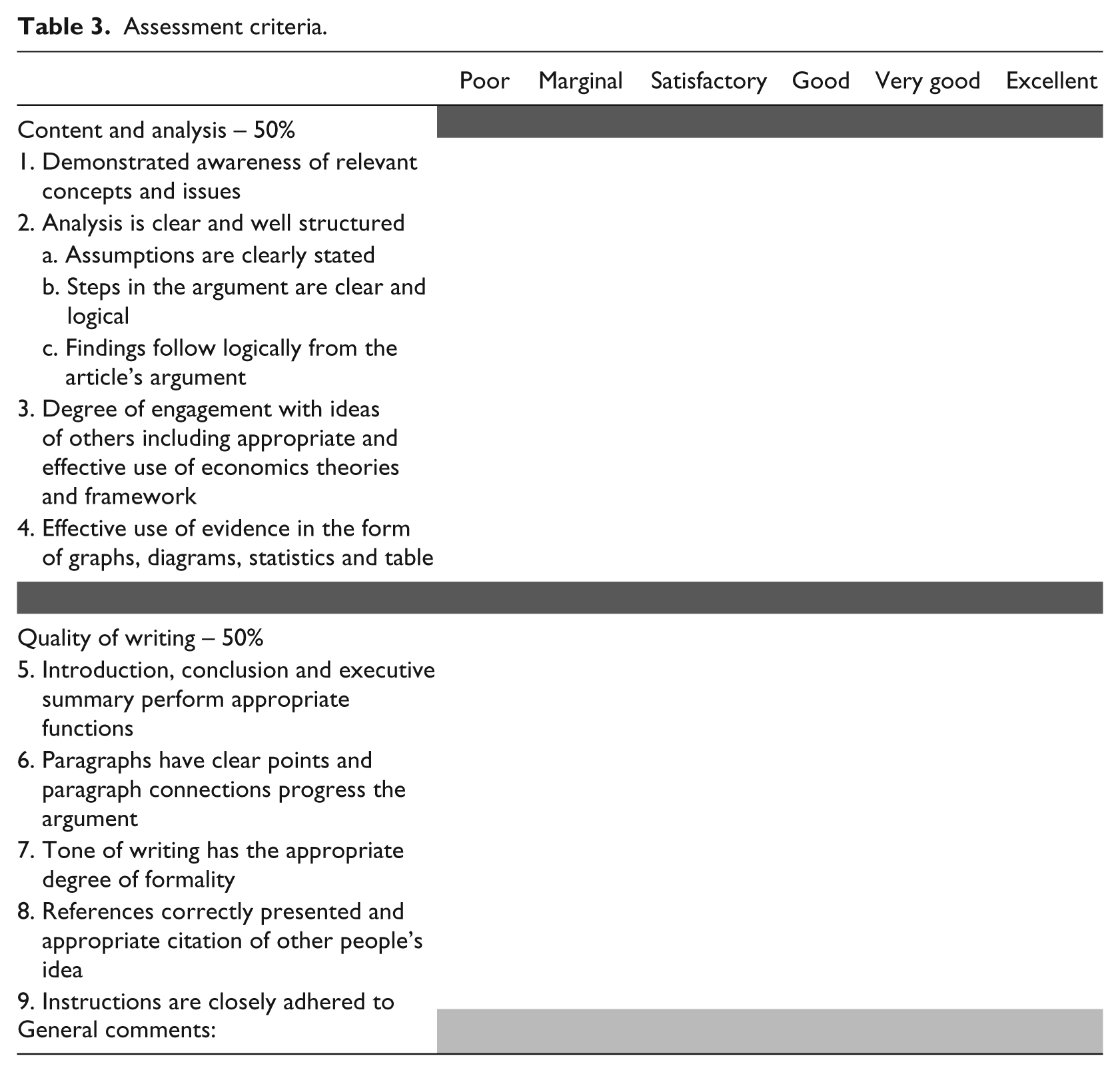
In 2009, all students were helped to interpret the criteria and relate each criterion to the assignment discussion sessions. Tutors (graders) were inducted into the programme through a series of briefings. Grader moderation sessions were held with particular focus on the need for feedback relating to specific aspects of the assignment discussion sessions. Thus, detailed feedback could be given on, for example, structure, synthesis, argumentation and use of appropriate language by referring to specific slides. Feedback was an element of the embedding, Assignment discussion session 1 for Assignment B.
Data collection
Data collection was undertaken within the framework of mixed methods research. Quantitative data included a paired sample t-test of essay grades in assignment A and B for 2009 and a grade comparison including all essay grades from 2007/2008/2009.
For the 2009 t-test, the data set, grades from both Assignment A and Assignment B, are from the same group of 309 students. Therefore, the two samples of grades are from related, not independent, groups. In hypothesis testing, a paired sample t-test should be applied to related samples (Burns, 1997). The hypothesis was that although students had some preparation for Assignment A, Assignment B would have a higher grade average due to the follow-up feedback and further assignment discussion sessions.
Further, a comparison was made of the difference between Assignments A and B grades for the entire cohort in all 3 years 2007/2008/2009. Although in 2007/2008, 10%–15% of students attended voluntary assignment writing classes, the grades from this group were not tracked. As the majority of students (90%) in those years had no inclusive embedded sessions, a grade comparison was considered to be a valid measure of the effect of the assignment discussion sessions.
To allow students a voice to put forward their experience of the assignment discussion sessions, an in-class questionnaire and series of focus groups were conducted. The questionnaire included a Likert scale evaluating usefulness of elements of the assignment discussion sessions and open-ended questions inviting comments. The focus groups were semi-structured with a core set of questions asked of all groups, although the facilitator, unknown to the students, was free to explore student responses through spontaneous questions. While the phrasing and type of questions varied to suit both the focus groups and in-class questionnaire, both were designed to elicit student perception of the assignment writing discussions. The questions were open ended and divergent in nature allowing for detailed responses and elaborations (Gay et al., 2006). All focus groups were recorded and transcribed.
A frequency-based approach was used to identify themes emerging from the open-ended questions in the in-class questionnaire. Responses were independently coded by frequency of occurrence and responses and categories viewed iteratively until a stable analysis was reached. A similar approach was undertaken to identify key themes that emerged from the focus groups. While it is doubtful whether separate focus groups can be compared in terms of relative strength of opinion, a comparison can be made of issues being aired (Sim, 1998). Responses to the Likert Scale questions were tabulated and cross-referenced with the emergent themes from the questionnaire comments and focus groups.
A facilitator unknown to the tutors conducted unstructured face-to-face interviews with tutors. This was considered to be the most effective way of allowing individual tutors an opportunity to express their thoughts, and not be distracted by a group dialogue (Sim, 1998). Interviews were recorded and transcribed, and a similar frequency-based analysis was used to identify common issues that arose.
Findings and discussion
Table 4 provides the descriptive statistics of the grades from Assignment A and B in 2009.
Grades from assignments A and B: 2009. Paired sample statistics.
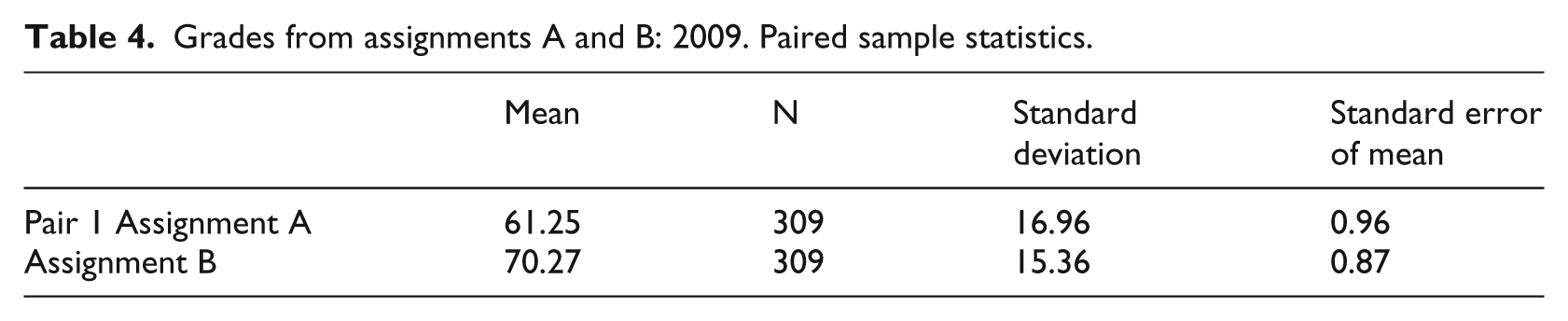
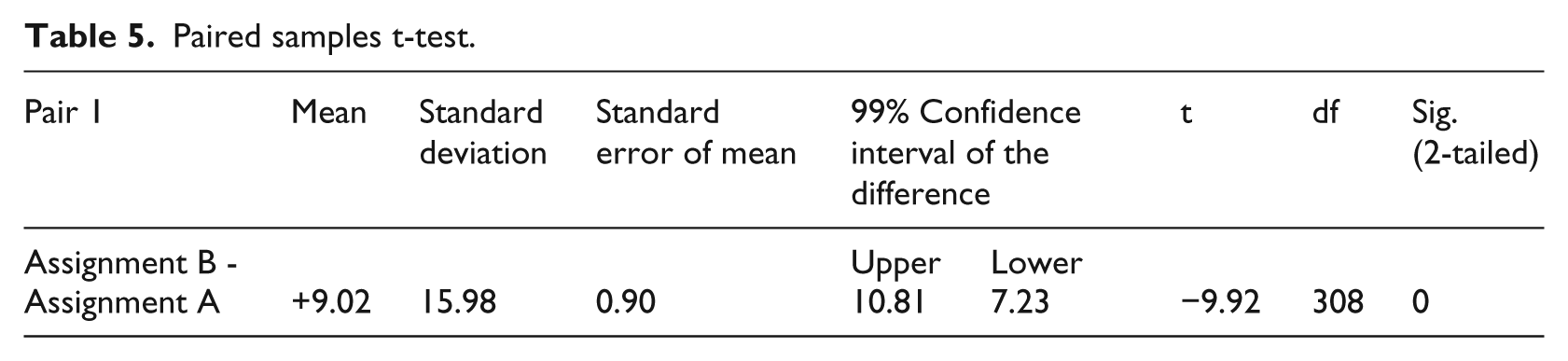
In addition to the descriptive statistics, a formal statistical test of the difference in grades in Assignments A and B was performed. The average grade in Assignment B is 9.02 higher than for Assignment A (means for Assignments A and B are 61.25 and 70.27, respectively), as can be seen from Table 6.
Table 5 demonstrates that the difference in the average grades for Assignments A and B (+9.02) is statistically significant. The t-statistic for the test is 9.9, resulting in a p-value close to zero.
Paired samples t-test.
Noticeably, in 2007 and 2008, students performed worse in the second assignment in comparison with 2009 where the grade increased. As Table 6 shows, a grade decrease of 6.86 in 2007 and 3.28 in 2008 reflected student difficulty completing Assignment B, the more analytical of the two assignments. A 9.02 or 15% grade increase shows the inclusive embedded programme in the large lecture delivery appears to have been more effective in enhancing the communicative product of the students.
Assignments A and B grades 2007/2008/2009.

Significant at 5% level.
Student perception of the writing programme
A thematic analysis of the in-class questionnaire comments and Likert scale results was cross-referenced with the salient themes that emerged from the focus groups. Four broad key themes of overall programme value, framework, feedback and expectations gap emerged. The student comments shown here were selected as being representative of the entire group.
Overall value
The majority of the students found the sessions valuable, commenting that they would apply the techniques (e.g. mindmapping) in future assignments: The assignment discussion sessions were great and very insightful!! Keep it up, I wish all subjects provided this! In future writing I will be able to approach the question for what it is asking, keeping the criteria in mind and yeah mind mapping ideas so that it is a fluent argument.
Framework
The students indicated the most useful session was acquiring the necessary framing for knowledge construction, through being provided with explicit guidance in understanding the reasoning behind the structure of content (Northedge, 2003a): The framework session helped the most because I found it hard with my article – having that, explaining it, definitely helped
Feedback
Feedback played an important role in this project. Assignment feedback, or feedforward as is recommended in the literature (Hounsell et al., 2008), was given in two ways. First, feedback on Assignment A was written on the hard copy aligned with the assignment discussion session discussion slides. This method did not require the time usually taken to write comments, thus avoiding the resource load that has been commented on extensively (recently Wingate et al., 2011). This way of providing feedback directed students’ focus to specific areas of the writing and was timely and formative as it was relevant to the following essay, thus avoiding the common student comment that feedback is too late to be applied (Carless, 2006) or that students do not understand what is meant (Higgins et al., 2002). Second, an overall feedback discussion session, aligned to the previous sessions, became session 1 of the Assignment B discussion sessions (see Table 2): I think the best session for me was the discussion of feedback from assignment 1, because it was only then that I realized what I had done wrong. I guess with the assignment feedback he put emphasis on what was really good and what was not good and not acceptable so yeah, it kind of cleared the water for us.
Interestingly, although 92% of students applied feedback from Assignments A and B (Likert scale), not all comments about the feedback were positive: Feedback from assignment A was limited.
Although graders had been inducted into the programme where a particular emphasis was placed on the importance of feedback aligned to the assignment discussion sessions, the variation in student comments indicated that the provision of feedback had not been uniform.
Expectations gap
The final emergent theme was expectations gap or misconceptions about purpose (Haggis, 2006). Probing students’ perceptions of whether the sessions helped them realise what lecturers expected of their written assignments met with a dichotomy of responses: Were helpful to clarify exactly what the markers wanted.
It was noted that the negative comments about lecturers’ expectations reinforce the premise that each discipline has specific practices that need to be explored with students: What they expect in economics might be different to other subjects…actually is different…
It appears that the emerging themes are consistent with the literature in that students feel they have learned the techniques or practice of what they need to do in this subject through staging and explicit exploration of processes (Haggis, 2006). However, comments about subject content, reflections on their understanding of knowledge required or even how they integrated their voice with that knowledge were infrequent: Helpful in how to write the assumptions and characteristics, which is to do with understanding the topic. Like if you chose monopoly, we had to talk about the assumptions about it – how is it a monopoly, therefore having the buyers and sellers; how the product, you know, product characteristics – it was simply done, so then I was able to write my justification of the model, I was able to draw on that.
Although the majority commented on the value of the sessions ‘I wish all subjects provided this’, none of the students commented that the teaching approach outside the sessions differed from that of other subjects.
Tutors’ perceptions
Content knowledge, writing and applying feedback were identified as key themes emerging from the face-to-face interviews with tutors.
Although tutors had been inducted into the programme and attended moderation sessions, there had been no mention of epistemological understanding as an outcome. It was notable that all tutors commented on the students’ increased epistemological understanding that had been brought about by the focus on ways of thinking and writing in the subject. They commented that the students seemed to better understand the reasoning behind the assessment requirements and how it aligned with subject content and from this understanding were able to better demonstrate their thinking.
Tutors who had taught the previous 2 years commented on the enhanced analytical writing in Assignment B compared to previous years. Numbers of students who articulated competent analysis had increased (as seen in Table 6). All current tutors thought the grade allocation of 50% to writing underpinned the importance of the sessions. Tutors also indicated that the system of grading and feedback had been made easier and less onerous for them, in aligning comments with the session slides, and more useful for the students in becoming feedforward due to the related assignments. They also commented that the majority of students applied the feedback.
Conclusion
This study adds to the ‘as yet under-researched initiatives’ (Wingate and Tribble, 2012: 12) investigating a model of discipline-specific, integrated writing instruction taught as an integral part of content teaching by a discipline expert. The findings generally accord with the literature that calls for the processes of writing and knowledge construction to be integrated within the discipline and taught by the disciplinary specialist (Gee, 1996; Northedge, 2003a; Haggis, 2006; Mitchell and Evison, 2006; Murray, 2006; Wingate, 2006) as the data from the intervention suggest it had an effect on analytical writing proficiency as indicated by grade improvement. Tutors suggested the grade improvement was the result of a communicative product that reflected better thinking in the subject, and an increased ability to think like an economist (Greenlaw, 2003). This outcome attests to the claim that exploration of the complexities of writing practices can help develop content knowledge.
Although tutors observed the programme had an effect on deeper learning as evidenced by more competent assignments, one aspect of the research design limited exploration of students’ perceptions of this fact. Questions in the in-class questionnaire and focus groups targeted the usefulness of the assignment discussion sessions and neglected to probe student perception of whether the sessions, embedded within subject content, deepened their thinking and understanding of economics. The infrequency of comments on the sessions helping develop content knowledge may have been caused by the research methodology as the questionnaire Likert scale and questions for the focus groups focused on the elements of the programme that assisted writing of the assignment. It could have been that students did not actively associate the sessions with subject content but saw them as aids to writing.
The study does offer evidence to show that subject lecturers paying attention to writing in their discipline at both presentation and knowledge construction level can benefit students in terms of improving their grades. It would be reasonable to assume further investigation into this approach in other disciplines would contribute to this under-researched practice and substantiate claims made in this article. Publication of this study, it is hoped, will raise awareness of the inseparability of learning and articulating in the tertiary setting.
Footnotes
Funding
This research was funded by a University of Technology, Sydney Faculty of Business Teaching and Learning Grant 2009.
Author biographies
Both