



Abstract
This article reports the results of research concerned with students’ statistical anxiety and confidence to both complete and learn to complete statistical tasks. Data were collected at the beginning and end of a quantitative method statistics module. Students recognised the value of numeracy skills but felt they were not necessarily relevant for graduate employability and preferred to study with words rather than numbers. A significant reduction in anxiety and increase in confidence to complete statistical tasks were found. Students seemed to feel more confident about doing and learning less complex procedures. Results reinforce the need to provide students with additional mathematical and statistical support outside of quantitative method courses as well as that numeric learning materials and study tasks need to be embedded across the curriculum within substantive disciplinary modules. The design of numeric study tasks needs to be carefully considered to ease the transition for students from simple to more complex statistical procedures while simultaneously reinforcing the importance of numeracy skills for examining substantive disciplinary topics and promoting graduate employability.
Quantitative method teaching: key issues
The current global economic climate has reinforced the necessity for higher education institutions worldwide to produce more numerate and critically informed graduates (Nuffield Foundation, 2012a, 2012b). However, students the world over often seem to view numeracy skills such as being able to conduct a statistical analysis as being less important for their graduate employability than the subject content knowledge of their degree and other key transferable skills that they develop during their studies. Added to this is that students often encounter negative signals and messages during their studies about the role and importance of numeric data and ‘number analysis’ in their subject and for pursuing a graduate career. There is, then, an important need to better understand how to support them in their learning.
Rüdiger and Hans-Dieter (2013) discuss how internationally some disciplines, such as economics and psychology, tend to be more successful in producing statistically numerate graduates than other disciplines, such as politics and sociology, while international reviews of statistics teaching provision by Parker et al. (2010), MacInnes (2010) and Linden (2012) all similarly highlight how some countries, such as the Netherlands, tend to be more successful in this regard than others, such as the United Kingdom. These variations can be attributed to the tendency for disciplines such as psychology as well as universities in countries such as the Netherlands to allocate quantitative method teaching a greater role within the curriculum (British Academy, 2012). For example, in his review of pan-European and Anglo-American statistics teaching provision, MacInnes (2010) discusses how unlike countries such as the United States and Germany, sociology students in the United Kingdom tend to not be progressively taught a broad range of statistical techniques as they move through their studies and often are not expected to complete independent study projects utilising quantitative methods during the final year of their studies.
Importantly, despite variations internationally in teaching provision, the research that does exist highlights a common tendency for students to possess a high level of statistical anxiety and a low level of confidence to conduct statistical tasks (see, for example, Finney and Schraw, 2003; Garfield and Ben-Zvi, 2007; MacInnes, 2012; Murtonen et al., 2008; Onwuegbuzie, 2003; Rüdiger and Hans-Dieter, 2013). A key factor often said to underpin student anxiety and lack of confidence about completing a quantitative method and statistics course is their mathematics background (Hodgen, 2010). For example, in the United Kingdom it has been noted that ‘mathematical illiteracy’ is sometimes worn like a badge of honour among students who tend to study the social sciences and humanities and that they can as a result become anxious when faced with numeric study tasks (Higher Education Funding Council for England (HEFCE), 2005). Students may well avoid such tasks and associated learning materials, as well as be anxious about learning statistical skills, precisely because they feel they possess poor mathematical skills as a result of their pre-university maths education (Advisory Council on Mathematics Education (ACME), 2011).
Quantitative method teachers are acutely aware of such concerns and do recognise the need to pitch pedagogic material to students in such a way that presumes little prior knowledge, particularly at the beginning of their studies. Yet, research in this regard seems to indicate that, as Williams et al. (2008) note, the problem ‘is perhaps less to do with numeric deficit and more to do with lack of student interest in the use of quantitative methods’ (p. 1003) – a conclusion which bears some credence given that statistical anxiety exists even in countries such as the United States where mathematics, quantitative method and statistics teaching provision is generally regarded as being of high quality (Linden, 2012).
Social science students internationally certainly often seem to view numeracy skills, such as being able to conduct a statistical analysis, as being less important for their graduate employability than the subject content knowledge of their degree and other key transferable skills they develop during their studies, that is, communication and critical analysis skills (see, for example, Carey and Adeney, 2009; Linden, 2012; Murtonen and Lehtinen, 2003; Williams et al., 2008). Such findings reinforce that even as quantitative method tutors make the case to students that numbers are important, they must also recognise that some, perhaps even the majority, will remain uninterested even when they can see the relevance. Furthermore, it has been highlighted that students often encounter (albeit sometimes unintentionally) negative signals and messages during their studies about the role and importance of numeric data and ‘number analysis’ in their subject and for pursuing a graduate career relevant to the social science (Murtonen et al., 2008; Rüdiger and Hans-Dieter, 2013). Quantitative method teaching and the analysis of numeric data are certainly not seen as an immediate priority in all social science disciplines and for all higher education tutors (Byrne, 2012). Falkingham and McGowan (2012: 114) found as much when they tried to persuade colleagues to integrate quantitative methods and numeric data within substantive modules by providing them with both relevant materials and support. Although most teaching staff reported they could see the benefit for students in including this material, there nevertheless was some ‘resistance with a few lecturers refusing to modify their lectures to incorporate the exemplars’.
While at a broader level although some disciplines, such as sociology, may rhetorically embrace methodological pluralism anti-positivist epistemological tendencies, a concurrent preference for qualitative methodologies remains noticeably prevalent in the curriculum (Payne and Williams, 2012; Skvoretz, 2000). This state of affairs could minimise or even negatively affect the impact even best-practice quantitative method and statistical teaching can have on students (Garfield and Ben-Zvi, 2007). As MacInnes (2010) notes, it can generate a situation whereby students can successfully complete even good quality compulsory courses and still lack confidence in their quantitative method skills and ability to use them independently, because quantitative method training is not regularly underpinned by the appropriate use of quantitative material elsewhere in their curriculum. (p. 21)
As a result of such considerations, the literature reinforces that quantitative method teachers should design teaching and learning experiences which seek to overcome students’ statistical anxiety by engaging them with real-world problems relevant to the discipline they are studying (Carey and Adeney, 2009). Study materials must be organised in a progressive fashion so they start simply before introducing complexity over time at a pace best suited to student ability and mathematical background (MacInnes, 2012). Tutors are also advised to use familiar and engaging presentational devices, such as graphical displays of national crime rate figures often found in national newspapers. This helps to develop student understanding of complex analytical concepts and technical procedures by pitching learning material in a simpler more immediately graspable form while simultaneously reminding them of the importance and relevance of statistical analysis skills for graduate employability (Falkingham and McGowan, 2012).
Expanding quantitative teaching provision and embedding numeric data and study tasks throughout the curriculum are recommended to address any explicit or implicit negative signals and messages students can encounter during their studies about the role and importance of ‘number analysis’, both in their degree subject and for pursuing graduate careers (Linden, 2012). Here, it is noted that the active support of colleagues not teaching quantitative methods is needed in order to positively challenge students’ misconceptions concerning the value and role of ‘numbers analysis’ within their degree subject and for graduate employment. This would also serve to decrease their anxiety and increase their confidence in their ability to complete numeric study tasks, including conducting a statistical analysis (Murtonen et al., 2008). Finally, existing work recommends that universities provide additional mathematical and statistical skills support services for students who struggle to grasp key statistical concepts and procedures relevant to undertaking quantitative research (Matthews et al., 2012).
Higher education systems in some countries lag behind others in embedding this guidance in social science curricula. For example, in its recent position statement Society Counts (2012), the United Kingdom’s national body for the humanities and social sciences – the British Academy (BA) – strongly voiced its concern about the impact of what it argued is the historically weak provision of quantitative method teaching on the quality of the teaching and learning experience, graduate employability, as well as the international competitiveness of the UK economy. A key problem here may well be that the evidential base for the recommendations made in the literature is relatively sparse and perhaps therefore is not as persuasive as it could be. It tends to be drawn from survey or interview-based research concerned with identifying what particular statistical methods and techniques students report they have studied during their degree (e.g. Rüdiger and Hans-Dieter, 2013; Williams et al., 2007), what student attitudes are towards having to learn quantitative methods and associated statistical techniques (e.g. Falkingham and McGowan, 2012; Linden, 2012; Murtonen and Lehtinen, 2003) as well as what the student response is to attempts to broaden quantitative method teaching provision and introduce numbers and numeric study tasks more generally within the curriculum (e.g. Carey and Adeney, 2009; Murtonen et al., 2008).
Collecting the student experience and viewpoint in this manner is certainly of value for enhancing the teaching and learning experience through refining pedagogic approaches and materials (Payne and Williams, 2012). It also provides tutors tasked with teaching quantitative methods with some evidence from which to seek to persuade their colleagues about the need to enhance the role of quantitative method teaching more broadly within social science curricula (MacInnes, 2010). Here, it is of note that given students’ preferences and anxieties, it seems reasonable to assume that they will tend to retain somewhat ambivalent feelings about having to complete numeric study tasks and use learning materials even when they complete a course in quantitative method as part of their studies.
The literature, however, arguably fails to get to grips with the extent to which students more generally during their studies avoid materials which have numbers in them. Such material could be statistical reports providing evidence in support of a new government policy, and students could avoid using numbers of their own volition in assessed study tasks. Such numbers, perhaps from graphs or tables, may be highly relevant to their discussion and critical appraisal of a substantive disciplinary concept like social deprivation. So, information regarding student engagement with numeric data across the curriculum is vital if tutors wish to pursue evidence-based change in teaching provision, enhance learning outcomes, as well as persuade their more reluctant colleagues of the need to reinforce to students the importance of promoting numeracy skills throughout the curriculum. The shared goal for quantitative method tutors and their non-quantitative method teaching colleagues alike is after all to constantly seek to enhance the teaching and learning experience as well as promote graduate employability (Byrne, 2012).
But most importantly, the literature arguably fails to rigorously ascertain over time the impact of quantitative method teaching on a student’s educational development and in particular their confidence to complete core statistical tasks essential to the conduct of quantitative research, such as appropriately applying a measure of central tendency or their confidence to continue to learn about such core tasks in the future (Finney and Schraw, 2003). Such a focus on ascertaining measurable change in student confidence over time is essential if quantitative method tutors are to identify ways to alleviate students’ statistical anxiety (Onwuegbuzie and Wilson, 2003). Self-efficacy, or student perception of personal competence, heavily impacts their actual performance and future study behaviour as their interpretation of their previous experience will inform current decisions and so shape their behaviour (Bandura, 1997; Unrau and Beck, 2004). Indeed a meta-analysis of published research by Robbins et al. (2004) shows that students with higher academic self-efficacy generally possess better academic performance. While a meta-analysis by Zieffler (2008) notes that where personal self-efficacy is high student-reported anxiety to do statistics is low or non-existent.
It has been noted that the teaching they receive can have some positive impact on student confidence and academic performance (Chamberlain, 2012; Halpenn, 2007). There might well indeed be a link between student confidence and the quantitative method teaching they receive, but due to omissions within the literature it is not possible to state with certainty that student confidence in completing statistical study tasks will increase and their statistical anxiety lessen as a result of being taught how to complete such tasks. Thus, there is a need to concretely identify which statistical tasks students find particularly challenging so that tutors can better tailor teaching and learning episodes and study materials to help address statistical anxiety through increasing student confidence.
Research methodology
A pre-test/post-test research design was used to test five interrelated hypotheses drawn from the literature. First, students will recognise that employers value numeracy skills but nevertheless express a preference for a non-numeric graduate career. Second, students will view numeracy skills as being less important in their studies than other key transferable skills such as communication skills. Third, students will be anxious about having to learn statistics. Fourth, students will acknowledge that study tasks and learning materials incorporating numbers are a necessary part of their studies but nevertheless will express a preference for nonmathematical-based study and will tend to avoid numeric tasks and materials. Fifth, participation in a quantitative method statistics course will increase student confidence and lesson their statistical anxiety. A pre-test/post-test research design was used (Bryman and Cramer, 2011). Ethical approval to conduct the research study was obtained from the university research ethics committee, and informed consent and confidential data collection and storage procedures were adhered to. Collected data were analysed using the statistical analysis package SPSS.
At Loughborough University, first-year students must complete a 12-week introductory quantitative method statistics course as part of their BSc (Hons) Sociology or BSc (Hons) Criminology and Social Policy degree studies. It is delivered in semester 2 via 11 weekly didactic lectures and 5 bi-weekly 2-hour practical sessions where students learn to use SPSS to analyse numeric data. Assuming little or no prior knowledge, the module introduces students to descriptive and inferential statistics in the form of univariate analysis and bivariate correlation statistics, so they can develop the knowledge, understanding and practical skills necessary to produce by the end of the module a statistical report which examines and discusses the key features of a secondary data-set. Within this, hypothesis formulation and testing are emphasised. As an introductory module, it does not cover more advanced forms of statistical analysis, such as factor analysis, multivariate regression and multi-level modelling. The content and delivery of the module are similar to much of the current quantitative method teaching provision in the United Kingdom (see, for example, MacInnes, 2010, 2012).
Students completing the module were asked to complete a project questionnaire at the beginning of the module (Week 1) and the end of the module (Week 11). Students were fully briefed about questionnaire items, so they understood what was meant by key terms such as self-efficacy. Data collected were on the Likert-type scale of ranked ordinal level of measurement, so a paired sample t-test can be used to measure the difference (if any) in respondents’ mean responses at the beginning and end of the introductory statistics module (Brace et al., 2012). Some would rather employ a Wilcoxon test as it uses the median (Chamberlain, 2013), but the t-test is well suited to the attitudinal data being examined. As a precaution, however, results for the median and mode were considered and found to behave as the mean, and t-test analyses were replicated using the Wilcoxon test.
Research questionnaires
To measure change in student confidence, questionnaires were used. A copy of the questionnaire used is available by contacting the authors. The design of its items pertaining to students’ perceptions of statistics and the role of numbers, numeracy skills and numeric study tasks within their degree studies and for promoting graduate employability were all informed by research such as Williams et al. (2004a), Williams (2007) and MacInnes (2010). Question items from the well-validated statistical self-efficacy questionnaire items developed by Finney and Schraw (2003) were used to measure change in student confidence to complete statistical tasks. Finney and Schraw (2003) sought to ascertain US college-level students’ self-rating of their current ability to perform 14 core statistical tasks (called the Current Statistical Self-efficacy (CSSE) questionnaire) as well as their self-rating of their ability to learn how to perform these 14 tasks (called the Self-Efficacy to Learn Statistics (SELS)). Both instruments measure confidence on a 6-point Likert-type scale from 1 indicating ‘No confidence’ to 6 meaning ‘Complete confidence’.
The CSSE and SELS cover core statistical skills which arguably should form part of any introductory statistics module and indeed are essential if students are to be properly introduced to the manner by which quantitative research operates, that is, through formulating and testing a null hypothesis (Bryman and Cramer, 2011). In addition to their appropriateness to the local teaching and learning context, the CSSE and the SELS were chosen as they are robust reliable tools which have been rigorously validated and used internationally to identify students’ self-confidence ratings (Zieffler et al., 2008). The CSSE and SELS questionnaire items were completed by students at the beginning and the end of the course in 2013.
Questionnaire items 1–18 sought to capture the student point-of-view concerning the importance of numeracy, quantitative method teaching and their confidence in completing numeric study tasks. Question 1 captures students’ rating of the relative importance ‘numeracy skills’ (i.e. being able to understand how a study using numbers came to its conclusions) on a scale from 1 to 6 with respect to five other key transferable skills they will develop during their degree studies. Namely, ‘comprehension skills’ (i.e. reading and understanding texts), ‘analytical skills’ (i.e. thinking about how what one text says compares to what another text says), ‘time management skills’ (i.e. managing your study time effectively to meet deadlines), ‘communication skills’ (i.e. making a presentation on a topic) and finally, ‘team working skills’ (i.e. working with others as part of a group to achieve a goal. Respondents who ranked numeracy first to third were categorised as rating it relatively more important than the other five skills, with those ranking it fourth or lower thinking of it as relatively less important.
Questions 2–8 and 11–18 captured students’ attitudinal responses to various questions about the role of statistics in their course and for employment, as well as their anxiety and confidence in completing numeric study tasks. These used a 5-point Likert-type scale from 1 = Strongly agree to 5 = Strongly Disagree. Given the relatively small sample size, this scale was compressed into three categories for some analyses – S/Agree, Neutral and S/Disagree. Question 9 asks students if they have ever had work experience involving numbers, requiring a yes or no response. Question 10 asked them to note their current career intentions. Finally, Question 21 offered students the opportunity to provide any additional comments they wished to make.
Sampling matters
A total of 66 first-year undergraduate students completed the introductory statistics module. Of these, 55 completed the initial questionnaire (83%) and 44 (67%) fully participated by completing a questionnaire at the beginning of the module and at the end. They are 51 females and 15 males (77% female and 23% male). Of these, 33 females and 11 males fully participated in the project (75% female and 25% male), similar to those partly participating (78% female and 22% male). The highest maths qualification is only known for participating students; however, 91% (n = 50 of 55) of the students who partially participated and 94% of those who fully participated (n = 41 of 44) recorded General Certificate in Secondary Education (GCSE) maths as their highest maths qualification (exact grade unknown). Of the remaining three, one did not possess a maths qualification, one had A-Level maths and the other a Baccalaureate. GCSEs are the United Kingdom’s compulsory educational qualification in mathematics which all schoolchildren take when they reach 16 years, while A-Levels are higher mathematical qualifications typically taken between the ages of 16 and 18 years. In conclusion, the majority of study participants had not completed compulsory assessed study tasks involving the use of mathematics since the age of 16 years.
Research findings
Student perception of the importance and role of statistics in their course and for graduate employability
The results of Questions 1–9 are related to students’ perceptions of statistics, the role of ‘number analysis’ skills in their course and their value for employability, in addition to whether they have work experience involving the use of numbers. These questions were asked at the beginning of the module (n = 55). Figure 1 visually summarises the mean, median and modal responses to these questions in a Likert-type format. A full copy of questionnaire results for these items in a table format which details the responses is available on request from the authors.
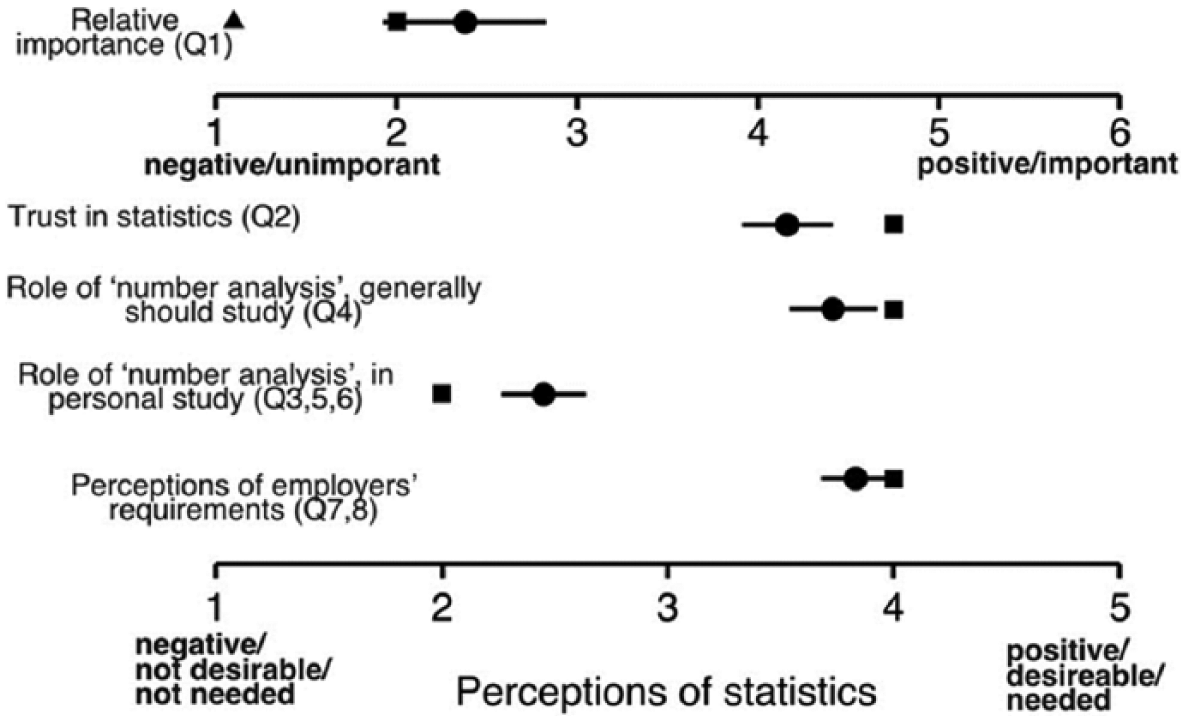
Student perceptions of statistics. Perceptions of statistics and number analysis, including for employability (Questions 1–8). Responses reflecting a low opinion of statistics are on the left, with high opinions on the right, with the scale inverted for items where necessary to achieve this. Mean (circle) ± 2 standard errors, median (square) and mode (triangle) for fully participating students (n = 44). The mode is not shown where it is superimposed on the median. Where multiple items are aggregated, descriptive statistics take all individual response (e.g. median of 88 responses for 2 items).
Of the respondents, 61% thought that you can trust statistics, while 29% responded neutrally. In all, 71% did not think they should not have to study topics which involve statistics, 60% did not expect to have to do much studying that involves maths as part of their course, 49% chose the course as they do not like studying topics which involve using maths a lot and finally, 65% would rather write an essay than analyse numbers.
The responses to Question 1 demonstrated that the students appeared to not value numeric subject skills (e.g. conducting a statistical analysis) in relation to their own education giving it a mean rank of 4.6 (inverted to 2.4 on Figure 1), with most rating it least important (i.e. sixth). A total of 80% rated numeracy skills as relatively less important as other transferable skills. This, paradoxically, is despite their responses, with identical percentages, to Questions 7 and 8. These showed that many more (52%) think employers value numeracy skills and think that knowing how to conduct a statistical analysis will help them find a job than otherwise (8%).
Of the students, 65% possessed work experience which has involved them working with numbers in some capacity, for example, as a cashier in a supermarket such as Tesco. Finally, the most commonly reported current career intention of students reported in Question 10 was on the surface ‘non-numerate’ careers – for example, in the criminal justice system, that is, law, probation officer, police officer, prison officer; or in social work; or in youth work; or in government; or in marketing and advertising and finally, in teaching.
Self-confidence in completing study tasks which involve using numbers
The results to Questions 11–14 are concerned with student’s self-confidence in using numbers to complete study tasks. Again, a full copy of questionnaire results for these items in a table format which details the responses in percentages is available on request from the authors. The responses reinforce that a number of students seem to actively prefer to study with words rather than numbers. Nearly half (48%) reported that they do not avoid using numbers in their coursework assignments in case they get it wrong, while 23% agreed that they do. Similarly, nearly half of respondents (48%) do not avoid study materials which have numbers in them, while 27% agreed that they do. Yet, just over a third of respondents feel confident about interpreting number tables (34%) or graphs (34%). Between a quarter (25%) and nearly a half (48%) of students responded neutrally to these four questions.
Anxiety to learn statistics
Question 15 (see Figure 2) directly assessed student anxiety about the idea of having to learn statistics. Respondents agreeing that they were anxious decreased from 55% to 43%, while, reciprocally, those disagreeing increased from 21% to 35%, a statistically significant if small change in mean and median anxiety (T-test result: T(43) = −1.730, p = 0.05; Wilcoxon result: Z = −1.731, N – Ties = 30, p = 0.04; Table 1). Slightly more than a third of respondents reported they do not feel anxious about the idea of learning statistics (i.e. 35%), and two thirds (66%) remain neutral (23%) or anxious (43%). Furthermore, at the end of the module, questionnaire items 16–18 revealed that far from all (48%–59%) students felt confident in their ability to communicate using numbers after the course. A full copy of questionnaire results for these items in a table format which details the responses in percentages is available on request from the authors.
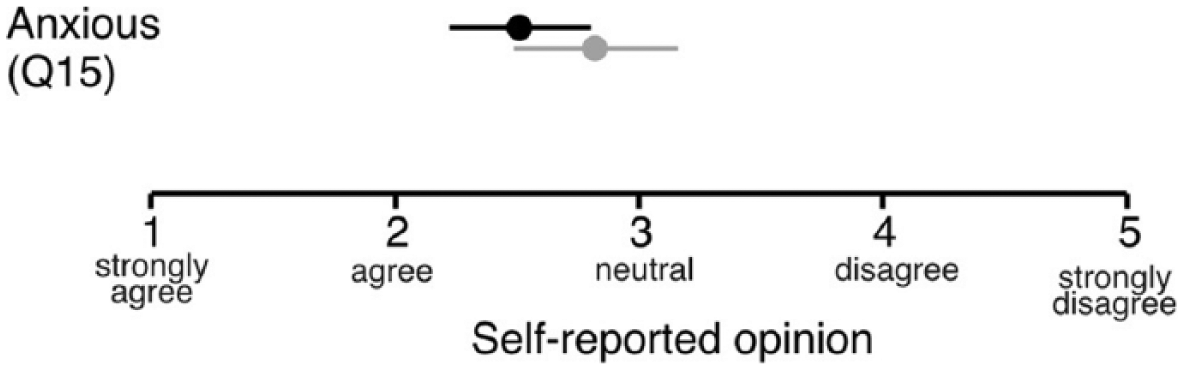
Student before-and-after anxiety to learn statistics. Student anxiety about learning statistics (Question 15) before (black) and after (grey) the course. Mean (circle) of the 44 responses for this question and uncertainty (±2 standard errors) are shown.
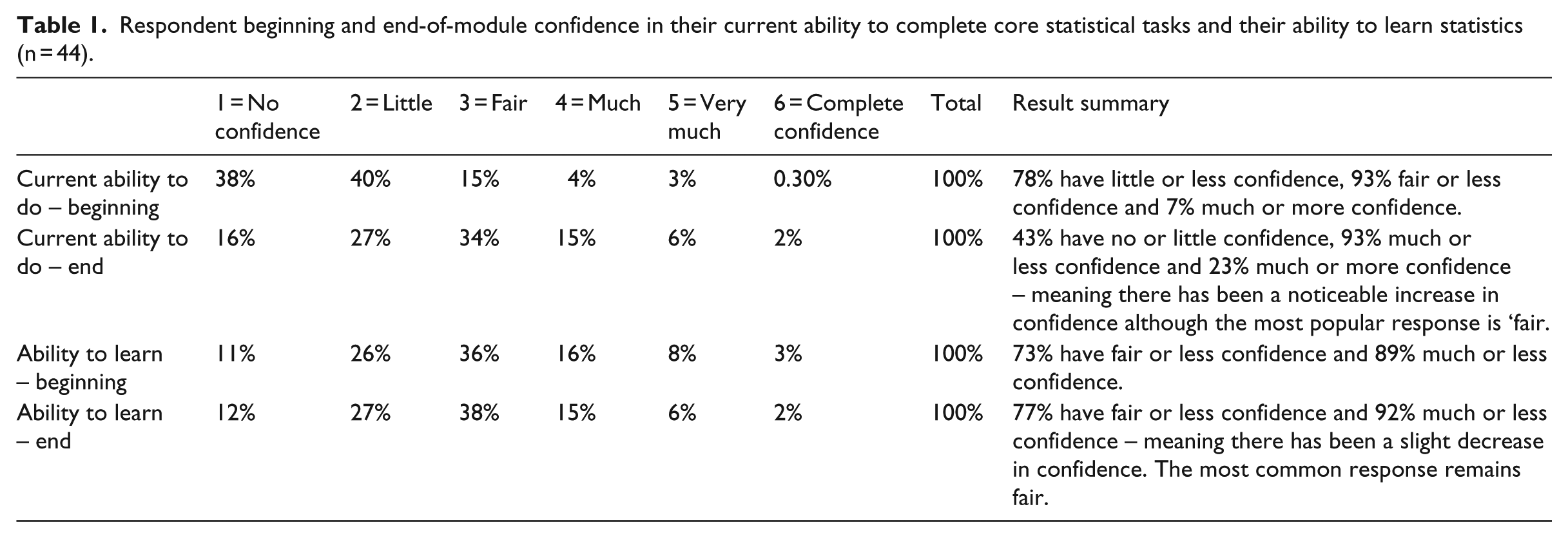
Respondent beginning and end-of-module confidence in their current ability to complete core statistical tasks and their ability to learn statistics (n = 44).
CSSE and SELS results
The results of the Finney and Schraw (2003) self-efficacy questionnaire items (Table 1 and Figure 3) reinforce that students remain anxious about studying with numeric data and completing statistical tasks. Overall, there is a small, but significant (T-test result: T(43) = −3.988, p = 0.00; Wilcoxon result: Z = −4.652, N – Ties = 44, p = 0.00) increase in confidence to do statistical tasks and no increase in confidence to learn (T-test result: T(43) = 0.332, p = 0.34; Wilcoxon Z = −0.202, N – Ties = 39, p = 0.21), while confidence overall remains relatively low. CSSE and SELS results converge after the course when students have been taught to do the tasks.
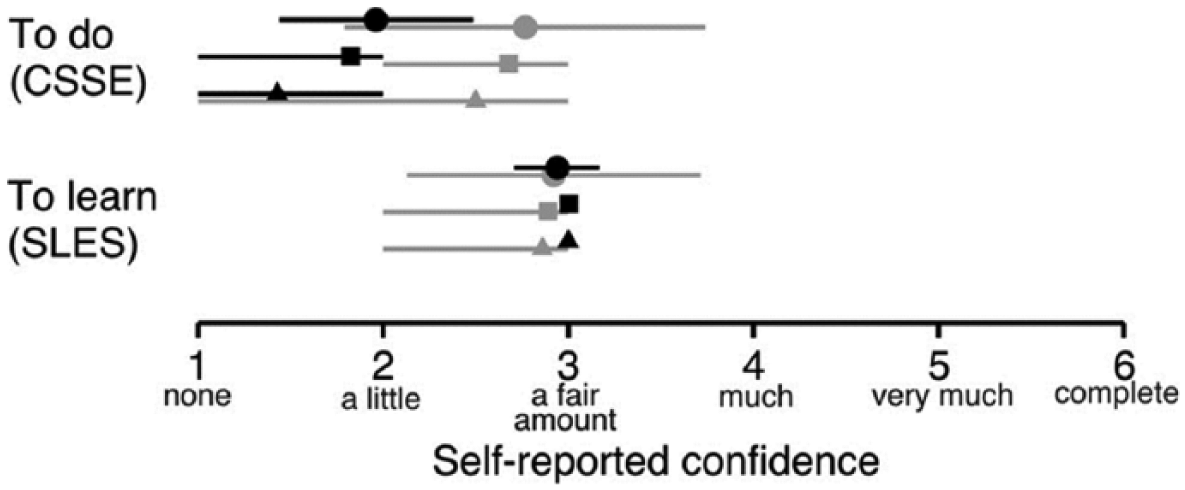
CSSE and SELS results. Results of the CSSE and SELS questionnaire, before (black symbols) and after (grey symbols) the introductory course. Figures for central tendency are calculated for each question and then a mean of these taken to produce an overall number for the 14 questions: mean (circle), median (square), mode (triangle). Error bars are ranges of the 14 questions for the median and mode, and standard deviation (±2σ) for the mean.
Table 1 is an alternative view of the data in Figure 3. It shows that at the beginning of the module, 78% of research participants (n = 44) have little or less confidence in their current ability to perform core statistical tasks (CSSE). A total of 93% have fair or less confidence, leaving only 7% with much or more confidence. The mean response category was 2 or ‘little confidence’ (it also being the median response category). The table also shows that at the end of the module, 43% of participants have no or little confidence and 93% much or less confidence. It means that there has been a noticeable increase in confidence, which is statistically significant for the mean and median (T-test and Wilcoxon p both <0.05), while 23% of students now report they have much confidence or more (i.e. ≥4) in their current ability. Figure 3 reinforces this by showing that the mean response category is now 3 or ‘fair confidence’ (it also being the median category). The increased confidence to do is consistent with the reduced anxiety, but students remain cautious about completing statistical tasks.
In relation to participants’ ability to learn how to do the core statistical tasks, Table 1 shows that at the beginning of the module 73% of participants have fair or less (≤3) confidence in their ability to learn how to do the core statistical tasks listed, and 27% reported they had much or higher confidence in their ability to learn. The mean response category was 3 or ‘fair confidence’ (it also being the median response category). Table 1 shows that at the end of the module, 77% of participants have fair or less (i.e. ≤3) confidence, and 23% reported they had much or more confidence. That is, there has been, if anything, a very slight decrease in students’ confidence while the mean response category has remained at 3 or ‘fair confidence’ (it also being the median category).
That students’ mean, modal and median confidence remain in the middle at ‘fair confidence’ or point 3 of the 6-point Likert-type scale arguably reinforces that although they feel they can now complete certain core statistical tasks, they nevertheless remain cautious about their ability to do so and remain similarly cautious about their ability to learn to complete a statistical analysis of numeric data. As Figure 4 shows, when CSSE and SELS questionnaire items are combined but divided into ‘less complex’ tasks, for example, ‘Q1 Identify scale of measurement’ and ‘more complex’ tasks, for example, ‘Q2 Interpret probability value’, there is a difference in perception. Confidence to do and to learn the more complex tasks is, as might be expected, lower than less complex ones. Confidence in doing less complex tasks has increased significantly, while confidence to learn them has changed least, perhaps indicating that they were able to judge this from previous contact with these activities. Confidence in performing more complex tasks has increased significantly, but by less. Furthermore, confidence to learn more complex tasks has if anything decreased.
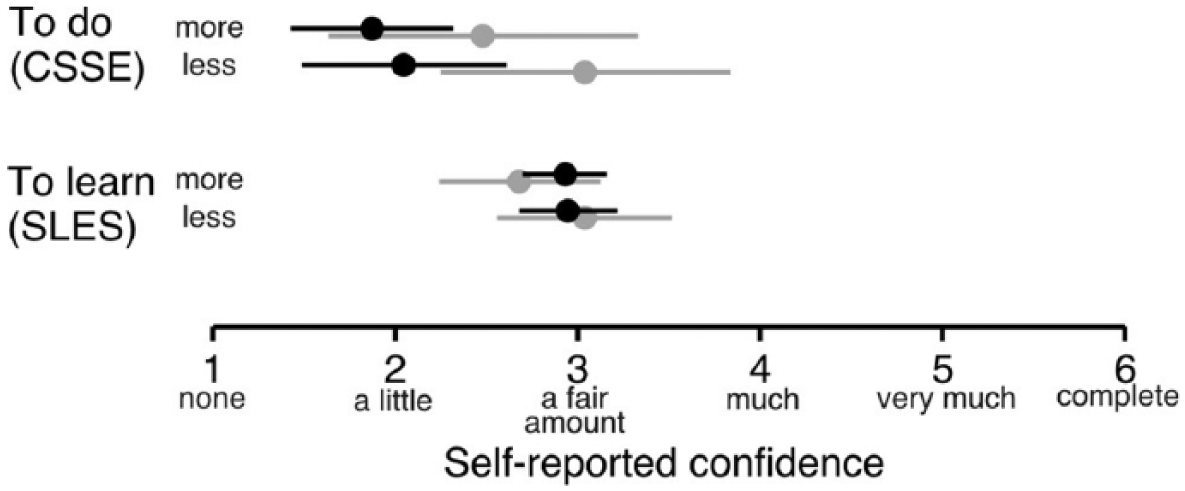
CSSE and SELS results comparing ‘simple’ and ‘complex’ statistical tasks. Comparison of responses CSSE and SELS questionnaire items (see Figure 1) disaggregated into less complex ‘descriptive’ and more complex ‘inferential’ statistical categories. Only the mean results for the questions and their spread (±2σ) are reported. Note the greater increase in confidence to do less complex items and potential opposing responses in confidence to learn for more and less complex items.
In summary, as Figures 3 and 4 reinforce, it appears that the teaching they have received has had some positive effect on students’ statistical anxiety and confidence to complete numeric study tasks which require they conduct a statistical analysis. However, this effect has been relatively small and seems to be larger for less complex tasks.
While some students feel more positive about completing a statistics course and their ability to complete study tasks which involve using statistics, overall as a group they appear to possess mixed feelings about their ability to complete statistical tasks and to learn statistics, particularly in their more complex forms. The following contrasting narrative comments made by two students in their questionnaires illustrate this state of affairs succinctly: I feel like something’s clicked, I’m not as scared as I was and I actually enjoyed producing the graphs and looking at what the cross tabs told us. (First-year social science student) I did not understand what to do even once it had been personally explained, we have never dealt with statistics before and it felt too complex and it has worried me constantly throughout … [the] … semester. (First-year social science student)
Discussion and conclusion
Findings confirmed that students acknowledged that employers value numeracy skills, but they tended to express a preference for non-numeric graduate careers and that numeracy skills were held to possess less importance than other transferable skills. There was a tendency to feel anxious about the idea of learning statistics, and participation in a quantitative method course did reduce this anxiety and increase self-confidence to complete core statistical tasks. Yet, although this reduction in anxiety and increase in confidence may have been statistically significant, it nevertheless is relatively small and seems to be centred on the completion of less complex statistical tasks – with the presence of statistical anxiety and low-confidence arguably remaining a key characteristic of students as a group.
In relation to studying with numeric data across the curriculum, there indeed was a tendency for students to express a preference for non-mathematical courses and for studying with words rather than numbers. However, in contrast to the hypothesis, only a minority reported that they tended to avoid numeric study tasks and learning materials. Most participants seemed to accept that such tasks are a necessary part of their studies. As a result, this hypothesis is partly upheld and requires some further empirical investigation.
These students are not confident about completing numeric tasks and interpreting numeric study materials. They also have mixed feelings about their ability to communicate with others using numbers, both as readers and as writers. Roughly between a quarter and a half responded neutrally to questions concerned with their avoidance (or not) of numeric study tasks and learning materials, their confidence (or not) interpreting numeric learning materials such as graphs and number tables, as well as their confidence (or not) communicating with others using numbers, for example, by writing a statistical report.
It seems to be the case that only a minority of students reject the need for numeric study tasks and learning materials and tend to use avoidance strategies to disengage with them as far as possible. The majority may well prefer to not study using numbers, but they nevertheless seem to be amenable to the idea that they may need to use numbers as part of their studies. A lack of mathematical and statistical confidence is arguably the driving force behind the nature of student engagement with numeric tasks and materials as well as their perception of their ability to study with and communicate effectively with others using numbers (Garfield and Ben-Zvi, 2007). Therefore, adjusting the placement, presentation, content and purpose of numeric tasks and study materials may help quantitative method tutors to increase their impact on the meeting of the learning outcomes required by students, although it may well be the case that such adjustments need to be made throughout the curriculum and involve quantitative and non-quantitative tutors working together to achieve a common goal if they are to have a significant positive impact on student learning and engagement with numbers.
When considering such matters, it is important here to consider the empirical findings pertaining to the impact of quantitative method teaching on student confidence. Although student anxiety did significantly reduce and their confidence to do core statistical tasks increased, only a third reported they were not anxious about learning statistics at the end of the module. Furthermore, this increase in confidence to do and learn statistics appears to be centred on the completion of less complex statistical tasks. There was no significant change in student confidence to learn statistics, and confidence to do and learn statistics by and large remains at the mid-point of the confidence rating scale.
These findings add to and indeed extend those found in the literature (e.g. Finney and Schraw, 2003; Onwuegbuzie and Wilson, 2003). They provide statistically rigorous evidence to suggest that the presence of statistical anxiety and a low level of self-confidence to complete statistical tasks among students continues to persist after they have completed a course designed to teach them how to complete core statistical tasks. This conclusion, if the case, highlights the inherent limitations of using quantitative method teaching alone to address statistical anxiety and increase student confidence in studying with numbers.
At the end of module, a standard student course rating was conducted confidentially at a central administrative level without tutor input. Students rate their satisfaction with a module on a 1–5 Likert-type scale, from highly dissatisfied at 1 to highly satisfied at 5. Module tutors receive the final module rating score only. Students reported via this process that they were highly satisfied with the quality of teaching they had received: the teaching being rated at 4.7 out of 5. In short, the persistence of a lack of confidence and continued presence of statistical anxiety does not seem to be directly attributable to a poor quality teaching and learning experience. Even excellent quantitative methods’ teaching in isolated courses is unlikely to be sufficient to ease student anxiety.
The limitations of the research need to be acknowledged. These include the focus on the United Kingdom, the focus on sociology and criminology and social policy students, the relatively small sample size causing an inability to explore study findings in relation to key participant characteristics such as mathematics qualification and gender as well as the fact that it is not possible to conclusively prove that the changes in anxiety and confidence noted are indeed a result of the teaching students have received. The change detected could be the result of students’ broader exposure to the higher education learning environment, or due to their age, given that the general maturation process is still underway for participants. There is a need for further comparative work to be undertaken across social science disciplines in other higher education institutions, so a degree of caution is called for before the findings from this study are generalised to other settings.
Study findings presented do, however, possess a considerable degree of numeric and statistical persuasiveness. There is a robust narrative consistency with existing international literature from which to draw some key conclusions regarding their implications which are relevant for quantitative method tutors who teach in other universities, disciplines and countries. Certainly findings pertaining to the presence of a lack of confidence among students about their ability to complete study tasks which involve using numbers, in addition to their general preference for studying with words rather than numbers and for pursuing non-numerate graduate careers, are all congruent with the quantitative method teaching literature internationally (see, for example, Linden, 2012; MacInnes, 2012; Murtonen et al., 2008; Rüdiger and Hans-Dieter, 2013).
The findings discussed in this article act as a useful and robust baseline of data from which other tutors in other educational institutions worldwide can compare the progress of their own students over time using the questionnaire. Additionally, they provide further evidence for the view that no matter how quantitative method teaching is packaged and delivered, some social science students will always prefer non-numeric courses and study tasks (Byrne, 2012). Yet, this does not mean that quantitative method tutors should shirk from challenging students’ preconceptions concerning what disciplinary topics and transferable skills are important. The fact of the matter is that students’ preconceptions can be incorrect just as much as their career preferences can change over time as they complete their studies (British Academy, 2012). Tutors should therefore continue to use engaging real-world examples when planning learning, teaching and assessment episodes and activities so that these reinforce the importance of numeric data and numeracy skills, both as part of their current studies and for future graduate employability.
Importantly, the persistence of statistical anxiety and low levels of self-confidence to complete statistical tasks adds to current debate surrounding how best to deliver quantitative method teaching by suggesting that what tutors do in the classroom has a beneficial but nevertheless limited impact on students’ perceptions of their confidence to complete statistical tasks (Carey and Adeney, 2009). It is of note that roughly a quarter of students in this study said they possessed a tendency to avoid study materials which contain numbers and also tend to seek to avoid including numeric data in their assessed coursework in case they get their analysis of it wrong. Nearly half do not feel confident about their ability to communicate using numbers. Student’s overall academic performance and general educational progress across the curriculum could perhaps be hampered by a fear of numbers and the presence of statistical anxiety with the result that they may not fulfil their true potential despite their and their quantitative method tutor’s best intentions (Payne and Williams, 2012). Such a state of affairs is far from satisfactory and serves to reinforce that students may benefit from the targeted provision of additional mathematical support before they complete an introductory statistics course as well as during it (Matthews et al., 2012).
Study findings in relation to students remaining less confident about their ability to do and learn more complex core statistical tasks reinforce that additional intervention and support may be of most use in the first year of their studies. It should be concerned with addressing statistical anxiety as part of a broader concern with developing students’ numeracy skills. Furthermore, the surrounding curriculum needs to be ‘on-message’ and stress the importance and relevance of quantitative method statistics teaching, numeracy skills and numeric data, and key to this is embedding statistical teaching and learning material and numeric study tasks in a developmental and progressive manner across the curriculum (Parker et al., 2010). This will increase the impact of such teaching on student confidence.
In conclusion, study findings concur with existing international research which has found that students who report a low level of self-efficacy to complete and learn statistical tasks generally report high levels of statistical anxiety (Unrau and Beck, 2004; Zieffler et al., 2008). This study adds to what is known by demonstrating that good quality teaching of quantitative methods alone may not change students’ confidence or anxiety. If this is indeed the case, then arguably a key priority for quantitative method tutors is not to just make their teaching more relevant and interesting but to also seek the active support of their non-quantitative method teaching colleagues if they are to positively challenge students’ preconceptions while also building their self-confidence and reducing their statistical anxiety. Yet, some colleagues may well be ambivalent or resistant to such overtures. Perhaps the key message of the findings presented here is that they act as a reminder that the most pressing task for quantitative method tutors is not so much persuading students that numbers are important but rather persuading the wider teaching community that this is so.
Footnotes
Funding
Project activity was in part funded by an ESRC grant to examine the impact (if any) of QM teaching on UG social science students (ES/J011452/1).