




Abstract
This article explores students’ extracurricular activities and, uniquely, their short- and long-term effects on employability. Drawing on the literature, six research questions are identified. A questionnaire and interviews with alumni provide the quantitative and qualitative information needed. The effects of different extracurricular activities and the skills and qualities they promote are demonstrated for early- and later-career jobs, as are the complementary effects for employability of degree schemes and extracurricular activities. Alumni who are now recruiters of staff use their double perspective to explain the role extracurricular activities have played in their lives and now as professional recruiters. This article shows how the alumni of any university could share these insights with undergraduates.
Employability and extracurricular activities
The transition from undergraduate to employee is often difficult. It is competitive, particularly when unemployment is high and especially for the best ‘graduate’ jobs where applicants need to stand out, and it is full of uncertainties (Hinchliffe and Jolly, 2011). A recent theme in UK higher education has been the need to improve the employability of graduates to equip them better for the labour market, for their sake and for their employers’ international competitiveness (Confederation of British Industry (CBI), 2009; Leitch Report, 2006). Of course, the differences in meaning that can be attached to the word ‘skill’ – skill as generic or situational, and in what sense a skill can be transferred to another situation – can confuse the discussion (Hinchliffe, 2002). Yet in practice, these complexities are traditionally removed by compiling lists of skills that employers say they are seeking in new employees. The results in Archer and Davison (2008) focus on communication, team-working and confidence. The CBI (2013) has identified key gaps (pp. 54–8), notably in self-management and problem solving. The Institute of Directors (2010: 3) has added leadership skills to those widely lacking. The Association of Graduate Recruiters (2012) has welcomed the new Higher Education Achievement Reports because they could help recruiters differentiate among the increasing proportion of students with the ‘good’ degrees that large employers require. Other lists are more nuanced, stressing differences in terms of the balance of technical, job-specific skills and more behavioural qualities and skills, and among different occupational sectors (Bennett, 2002; Hinchliffe and Jolly, 2009; Lowden et al., 2011). However, the links – their strength and durability – between extracurricular activities and employability are still unclear in places.
If students do not already possess the required employability skills, how are they to acquire them – from their degree schemes or their extracurricular activities? Much work on enhancing the employability effects of undergraduate degree schemes is currently under way (Higher Education Academy (HEA), 2012), arising from a perceived mismatch between the skills employers say they require and those usually inculcated by degree schemes. Clark and Higgitt (1997) and Hennemann and Liefner (2010) describe the mismatch in one subject area and Arrowsmith et al. (2011) explore the complex curricular consequences of trying to remove the mismatch. One problem which has been highlighted is the extent to which students realise they are acquiring employability skills and developing the ability to transfer these skills to work after university (Burke et al., 2005). Another issue is how the staff perceive employability skills acquisition in terms of the curricular and extracurricular spheres (Clegg et al., 2010). So, the relative effects of degree schemes and extracurricular activities in helping students acquire employability skills and qualities are unclear. Do they reinforce or complement each others’ effects and in what ways?
The potential role of extracurricular activities in developing employability skills has been less studied than the effects of the curriculum. In their longitudinal study of entrants to higher education, Purcell et al. (2012) noted how key employer skills tend to be less well developed by academic study yet are widely sought by employers. They reported that participation in extracurricular activities, particularly office holding, led to less unemployment and more graduate-level jobs – Stuart et al. (2011) concurred. Purcell et al. (2012) also noted that students from more advantaged backgrounds were a little more likely to pursue extracurricular activities and be office holders in them, and Stevenson and Clegg (2011) noted this too. They focused on motive – whether extracurricular activities were about reinforcing one’s current student self or about preparing for one’s future employment. They too noted that those who needed paid employment while at university were less able to participate in extracurricular activities and so gain from these experiences. Several universities now have ‘Awards’ schemes that encourage extracurricular activities and reflection on them (Quality Assurance Agency (QAA), 2012), and Jackson (2011) has described the system at the University of Surrey that merges students’ personal development within and outside the curriculum. Nonetheless, the literature is still unclear as to which extracurricular activities develop which skills and to what extent. There is also the durability of the effects – do they help only with initial job search or have career-long effects?
Howcan one communicate to current students the potential value of extracurricular activities and the employability skills they may enhance, and do so accessibly and credibly? Both Purcell et al. (2012) and Stevenson and Clegg (2011) have developed the idea of students having differing endowments of social and cultural capital while at university and when entering the labour market (Bourdieu, 1984; Putnam, 1995, 2000). Some students will be part of social networks that will enhance their access to pertinent career advice from parents (Kintrea et al., 2011), work, fellow students, career services, books or websites; others will be less advantaged (Connor et al., 2004; Purcell et al., 2012; Richardson, 2008; Scott, 2000; Stuart et al., 2011). Could this be counteracted at university using extracurricular activities? The bridging function of social capital is the most relevant here: ‘… more distant connections between people and is characterised by weaker, but more cross-cutting ties …’ (Office for National Statistics, 2013: 2). Granovetter (1973) stressed the general importance of multiple ‘weak ties’ for careers. A bridging function is usually limited to a defined topic for a limited time. The key point is that most students, outside vocational subjects, are unclear about their career, just hoping their extracurricular activities will reinforce their employability (Thompson et al., 2013). At this stage, guidance on extracurricular activities – which to choose and how to benefit from them – that comes from many ‘advisors’ and for many job markets will be more useful than advice from a single mentor.
For a social network to be effective, particularly one with ‘weak ties’ where people listen to those previously strangers, trust needs to be constructed quickly. This might come from the advice-givers’ credentials, such as their career experience or qualifications, similar to Bourdieu’s (1984) ‘institutionalised cultural capital’. Or it might come from the language in which the advice is given, similar to Polanyi’s (1967) ‘tacit knowledge’ where credibility is related to the shared experiences of the parties and their common ‘language’, such as graduating in the same subject, similar extracurricular activities pursued, attendance at the same university or working in the students’ targeted career area. Students differ in the scale and pertinence of the social networks of family and friends from which they can draw guidance on job seeking (Villar et al., 2000). Those interviewed in Thompson et al. (2013) favoured hearing the views of past graduates from their university as a source of reliable and pertinent advice for job hunting. Because extracurricular activities are not structured or assessed as degrees are, students might benefit from the discussion about extracurricular activities being more explicit. Some students will not previously have analysed their extracurricular activities in career terms, whereas graduates will often know if and how their extracurricular activities were helpful and whether and how they should be planned. So the voices of alumni from different decades will give current students, particularly those from narrower social networks, the trustworthy relevant advice for a range of careers and extracurricular activities which they have said they want.
Finally, the employability agenda presupposes that recruiters give consideration to extracurricular activities and that graduates believe their extracurricular activities to have been useful in job searching. Studies such as Cole et al. (2007) and Tchibozo (2007) are unclear on this, hence the need for clarification. Clearly there are three groups involved in extracurricular activities and employability – students, graduates and recruiters. While work has been done in looking at this from the student perspective (Thompson et al., 2013), there is also the need to gather the views of graduates and recruiters if we are to better understand extracurricular activities and employability. It is clear from the literature that the effects of extracurricular activities on employability and subsequent careers still lack detail in some areas. These have been crystallised into six research questions designed to extend our understanding of extracurricular activities.
Are all the standard employability skills and qualities developed equally by all extracurricular activities?
How exactly do extracurricular activities influence obtaining and doing one’s first job and subsequent jobs?
Should undergraduates plan their extracurricular activities and, if so, in what ways?
How do the employability effects from extracurricular activities interact with the employability effects from degree schemes?
Do all graduates report the same effects from, and views about their extracurricular activities?
How exactly do extracurricular activities help in the job-search process for alumni and for recruiters selecting from applicants?
Methods
Quantitative and qualitative information was needed, so a mixed-methods approach was used. A questionnaire provided numerical information and interviews, and the free-text section of the questionnaire allowed for elaboration on the quantitative aspects.
Surveys were carried out of alumni, that is, of those graduates still registered with and so contactable by a university. Using alumni from a single university allows a partial control over some of the academic, demographic and geographical variables as student leave for their careers. The alumni provide the potentially trustworthy voices current students have said they want to hear. Alumni records also let us contact students who graduated several decades ago, so the research is no longer confined to the relatively easier-to-reach group of very recent graduates. This gives this study a much-enhanced longitudinal element compared with previous research.
The sampling frame comprised only those alumni with undergraduate degrees from Lancaster University itself. The use of one university’s graduates provides a common ground within which there is some control over the many variables that affect the relationship between extracurricular activity and employability – the range of degrees, the opportunities for extracurricular activities, styles of teaching and the regional labour market’s characteristics, for example. The use of Lancaster University in particular allows for more valid comparisons between its undergraduates (in Thompson et al., 2013) and its graduates in this article.
For reliable recollection and given the increasing comprehensiveness of the alumni database, sampling was confined to the 14,538 alumni (out of 16,800) who had graduated between 1990 and 2010, had supplied a current email address and were willing to be contacted. Factual information was collected about extracurricular activities at university, about first and subsequent jobs and also their opinions about the effects of their extracurricular activities. A questionnaire survey was followed by interviews. Quotations and references to respondents have been fully anonymised.
In July 2012, the Alumni Office emailed 14,538 alumni about this research. A total of 323 emails could not be delivered, so the population of respondents was 14,215 people. The Alumni Office encouraged participation and explained the aims. Recipients had to click on a link in the email to access an online-survey website containing the questionnaire and then complete the questionnaire and return it to the researchers online. The email was opened by 5095 of the 14,215 recipients (35.8%). The other emails either went unnoticed, or were sent to a junk mailbox or were deleted unopened. A total of 988 alumni then went to the website with the questionnaire and 620 completed and returned the questionnaire. This comprises 4.4% of the delivered emails, 12.2% of those who opened the email and 62.8% of those who went to the survey website. The technology used made the non-response multi-staged.
The gender profile of the 620 respondents was similar to the 14,538 to whom the email was sent (56.7% female in the sample and 54.7% female in the alumni population). The earlier graduates (1990–2000) provided 38.1% of the respondents but comprised only 26.9% of the university’s alumni since 1990. The respondents and all the alumni had a similar balance of degree classes.
The questionnaire enquired into the alumni’s experiences of extracurricular activities while at Lancaster University and the influences (if any) of their extracurricular activities on their first jobs and subsequent careers. As there is no universal definition of an extracurricular activity, the questionnaire explained that this meant any activities, hobbies and work outside their academic studies, such as sports, college activities, hobbies, social groups and clubs on campus and elsewhere, paid or voluntary jobs, internships and travel. For comparability, the questions and categories were derived from Thompson et al. (2013). The questionnaire was analysed using SPSS for the quantitative data and NVivo for the free text.
All the respondents were invited to participate in a telephone interview and 320 of the 620 agreed. The telephone interviews were restricted to UK residents. Two researchers (G.C. and J.D.W.) worked independently to select a short-list of 25 potential interviewees, balanced to represent the diversity of the 320 volunteers in terms of their gender, year of graduation and occupation, and who held a variety of views on their diverse extracurricular activities. The interviews, held between September and November 2012, stopped after 18 had been completed by when no new information was emerging. Of the 18 alumni interviewed, half were women and half men, and half from each decade. Two interviewees were from the Management School, seven from Arts and Social Sciences and nine from Science and Technology. Of the 18, 11 were also now recruiters of graduates, which gave them a unique double perspective on the roles of extracurricular activities. The interview schedule was developed in stages starting with the gaps in the literature which guided the research questions. The questionnaire and its results guided the themes included in the interview schedule. Those analysing the interviews looked for material that answered the research questions, which included ideas not envisaged at the start of the study. The open structure and implementation of the interview themes allowed an emic element as ideas emerged from the respondents that reflected their perceptions, experiences and priorities about their extracurricular activities and careers, so expanding on the results from the questionnaire.
Results
Are all the standard employability skills and qualities developed equally by all extracurricular activities?
The alumni had pursued many extracurricular activities – sport (27% of them had had sport as their main one), social groups and clubs on campus (19%), paid employment (14%), college activities (9%), arts and music (8%) and many others. Only 3% had no extracurricular activities, while 48% had had two or three.
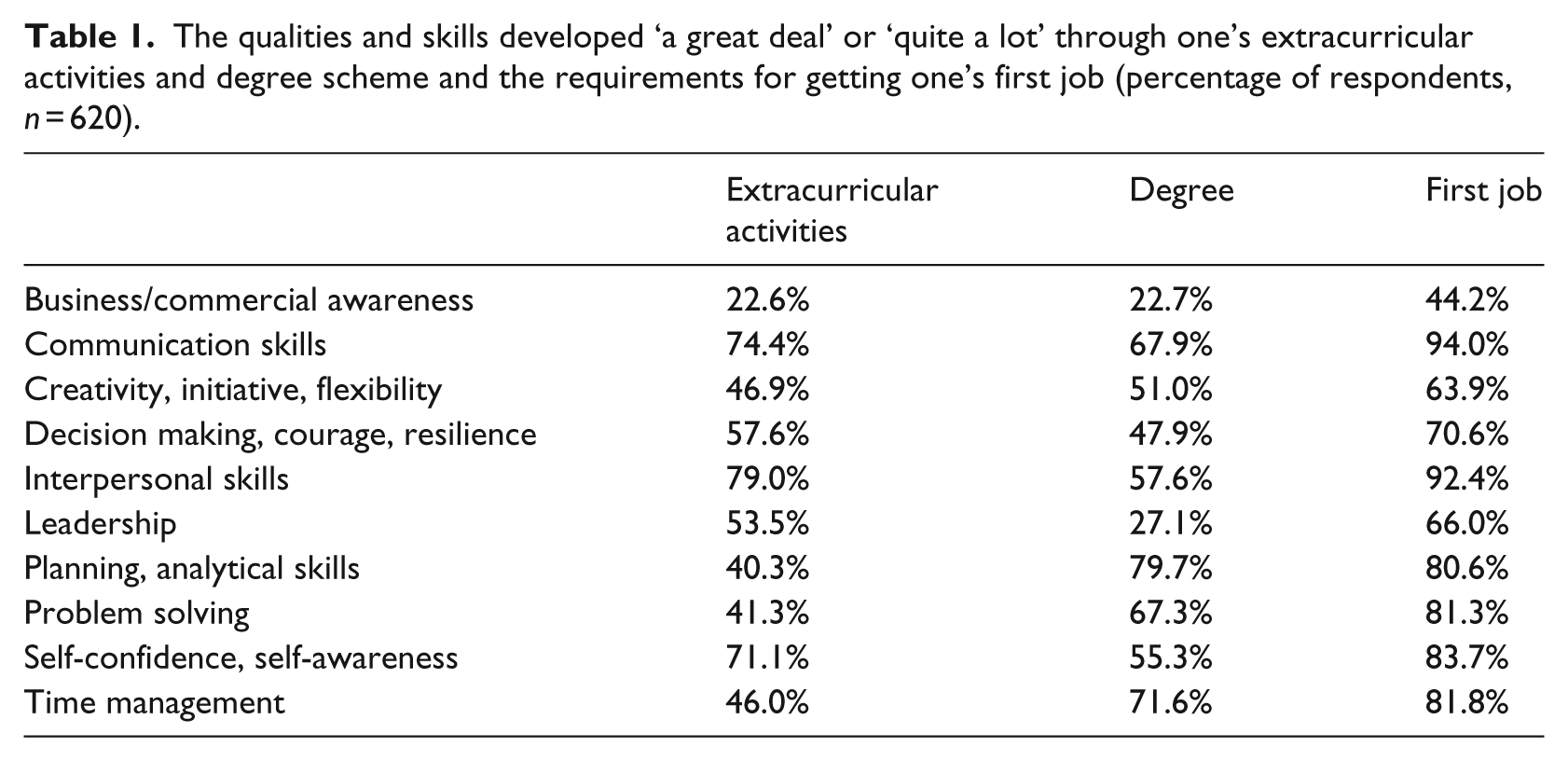
They reported that many qualities and skills had been developed through their extracurricular activities, principally interpersonal and communication skills, self-confidence and self-awareness (Table 1, ‘Extracurricular activities’ column). When asked what qualities and skills their degree scheme had given them, the main ones were mostly different from those from their extracurricular activities – planning and analytical skills, time management, communication skills and problem solving (Table 1, ‘Degree’ column). The complementarity of the gains from the extracurricular activities and degrees is notable, helping create the well-rounded graduate. As the ‘First job’ column of Table 1 shows, the top three qualities and skills the respondents identified as most important in getting their first job (Table 1, ‘First job’ column) were enhanced more often by their extracurricular activities than by their degrees – communication skills, interpersonal skills, and self-confidence and self-awareness.
The qualities and skills developed ‘a great deal’ or ‘quite a lot’ through one’s extracurricular activities and degree scheme and the requirements for getting one’s first job (percentage of respondents, n = 620).
The respondents were asked which skills and qualities had been developed by each of their extracurricular activities. Not all the extracurricular activities had developed each quality and skill equally, as Table 2 shows.
The three most commonly reported main effects of each extracurricular activity (percentage of the extracurricular activity’s participants in rank order who reported this effect).
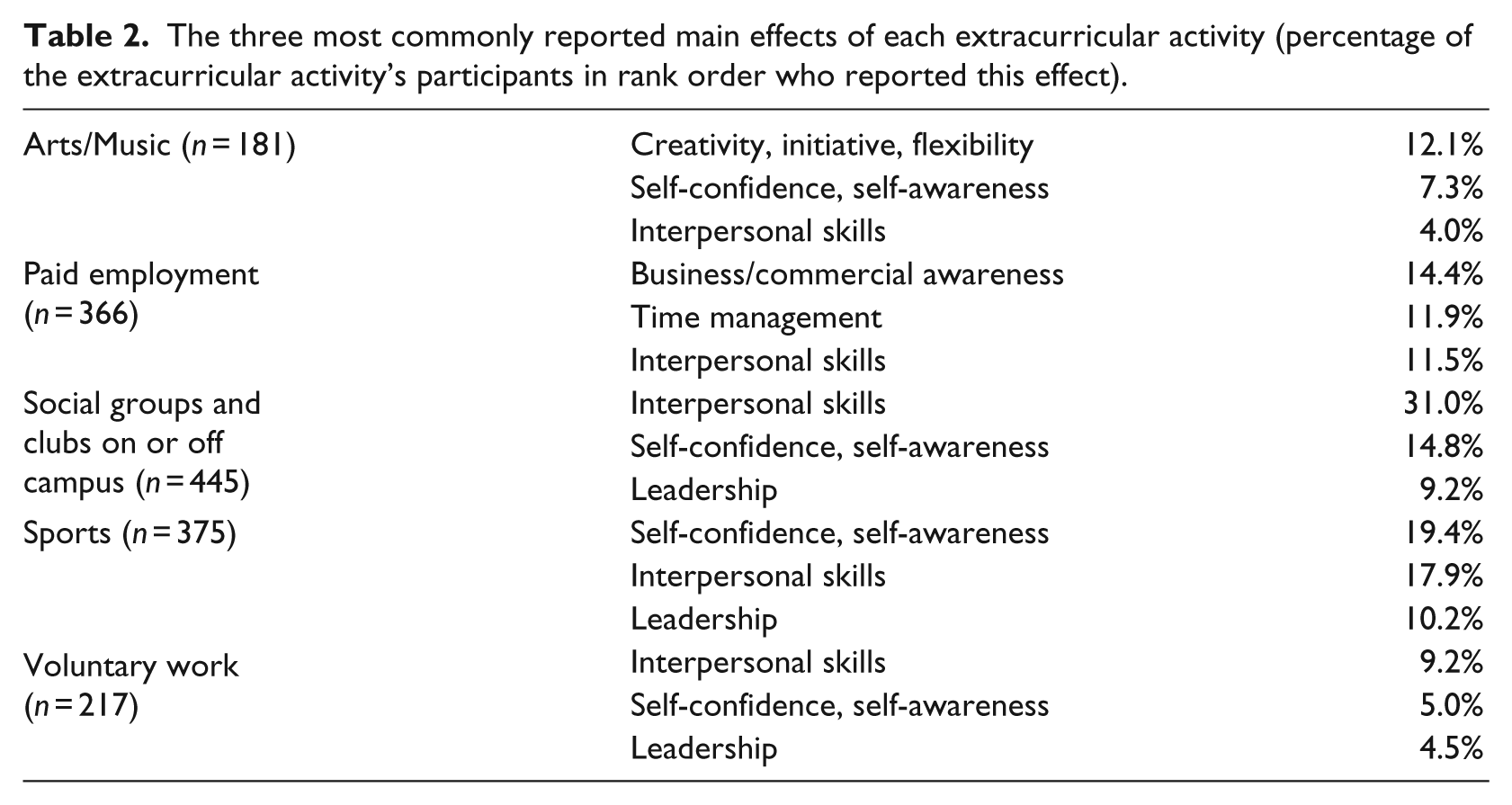
Paid employment was the only extracurricular activity to enhance business and commercial awareness to any great extent, while sport was best for self-confidence and self-awareness, and social groups for interpersonal skills. All five extracurricular-activity groups enhanced interpersonal skills to a major extent, four improved self-confidence and self-awareness and three leadership and responsibility. So, which extracurricular activity one chooses may not be critical except for business and commercial awareness, which requires experience of paid work, and creativity, which is enhanced only by work in the arts.
The key points here are the complementarity of the skills developed by extracurricular activities and degree schemes and the ability of different extracurricular activities to develop different skills albeit with substantial overlaps of outcomes.
How exactly do extracurricular activities affect obtaining and doing one’s first job and subsequently?
A free-text question in the questionnaire asked how exactly these extracurricular-activity effects had helped in their careers, and 512 of the 620 respondents responded. Not all linked the key qualities and skills for employment to particular extracurricular activities but, where they did, the most frequently mentioned were (in descending order) committee work, sport, paid work and volunteering (including work experience). The most frequently cited key qualities and skills from committee work were responsibility (including leadership), organisational skills, communication skills and interpersonal skills. A biology graduate commented that ‘speaking and meeting people is critical in my workplace [and] having the confidence and ability to do this comes from extracurricular activities’. For one marketing graduate, involvement with the Student Union and College Junior Common Room (JCR) meant ‘[I could] take responsibility for an end to end project’. This showed ‘you have to learn to deal with people you don’t particularly gel with but you need to make it work’. The most frequently cited key qualities and skills from sport were team-working, interpersonal skills and communication skills. A management graduate noted, ‘… it was something that showed I had a more rounded character, was a team player and good with the social interaction which is crucial in my career’. From paid work, the gains were work-related knowledge, time management and confidence. The main benefits from volunteering were work-related knowledge, interpersonal skills and communication skills. The extracurricular activities were clearly developing the respondents in preparation for their careers.
A majority of the respondents saw direct links between extracurricular activities and work; 64% said that their extracurricular activities had helped them get their first job and 57% said their extracurricular activities had helped them do their first job better – extracurricular activities’ effects endure. Cross-tabulating the two responses, 47% of the respondents said that their extracurricular activities had helped in both ways and only 14% said they had helped in neither. Among these ‘extracurricular-activity sceptics’, some stated that they had not participated in extracurricular activities at university, and one reason was because they lacked self-confidence. Another theme was that extracurricular activities, including sport, were undertaken for purely social reasons and were therefore not relevant when seeking employment. However, some recognised that even if their extracurricular activities had been only social and not forward-looking to a career, they were beneficial for developing confidence and maturing, which could be useful at job interviews. For some respondents who believed that their extracurricular activities had not helped them get their first job, there was still a recognition that their ‘soft skills’ had developed through extracurricular activities. An engineering graduate commented that the extracurricular activities had provided much needed help to improve self-confidence but ‘didn’t relate in any way to the technical skills I need for my employment’. It is debatable whether these extracurricular benefits are being explicitly discounted or are simply unappreciated.
The questionnaire also invited the respondents to describe how the personal qualities gained through extracurricular activities had helped them to do their first job more effectively. The three most frequently mentioned personal qualities (over 100 mentions for each) were (in descending order) confidence, interpersonal skills and communication skills. An ‘ability to stand in front of strangers and present myself and my ideas with confidence and in a strong voice’ was an example given by a software trainer. One respondent said, ‘my time in student radio, debating political topics, helped develop my persuasiveness which was invaluable in having to defuse aggressive and angry customers’.
In summary, the respondents identified how exactly different extracurricular activities had helped in their initial job search and the extent to which these gains had continued through their first jobs and subsequently in their careers. Even those sceptical of a link between extracurricular activities and careers acknowledged their personal-development value.
Should undergraduates plan their extracurricular activities and, if so, in what ways?
Since most alumni see their extracurricular activities as in some way beneficial, should undergraduates plan them, to get maximum benefit? Surprisingly 49% of those who felt their extracurricular activities had helped them get their first job thought they should not be planned strategically. Four reasons were given.
Extracurricular activities are just for fun.
Any extracurricular activity will benefit you, so there is no need to plan.
Students lacking a clear career path cannot plan extracurricular activities.
Extracurricular activities pursued to bolster a career will lack conviction and quality, and recruiters will spot such shams.
Therefore, the question of whether extracurricular activity should be planned divides sharply even those alumni whose personalities and/or careers have benefitted from extracurricular activity. There are those looking ahead to future benefits and those focused more on the present and hoping for the best. The case against planning extracurricular activities prioritises one’s present-day self over what one could become (Stevenson and Clegg, 2011) and is based on either planning as unnecessary (extracurricular-activity benefits are unavoidable) or planning as harmful in job-seeking.
How do the employability effects from extracurricular activities interact with the employability effects from degree schemes?
Table 1 has shown that the employability effects from degree schemes and extracurricular activities are usually complementary. Of the 10 qualities or skills, 8 were much more strongly developed by either the degree or the extracurricular activity than by the other, with just two exceptions (business/commercial awareness and creativity, initiative and flexibility). The respondents were asked to reflect more deeply on the relationships between their degrees and extracurricular activities; five options were suggested (Table 3).
Direct relationships between extracurricular activities and degrees.
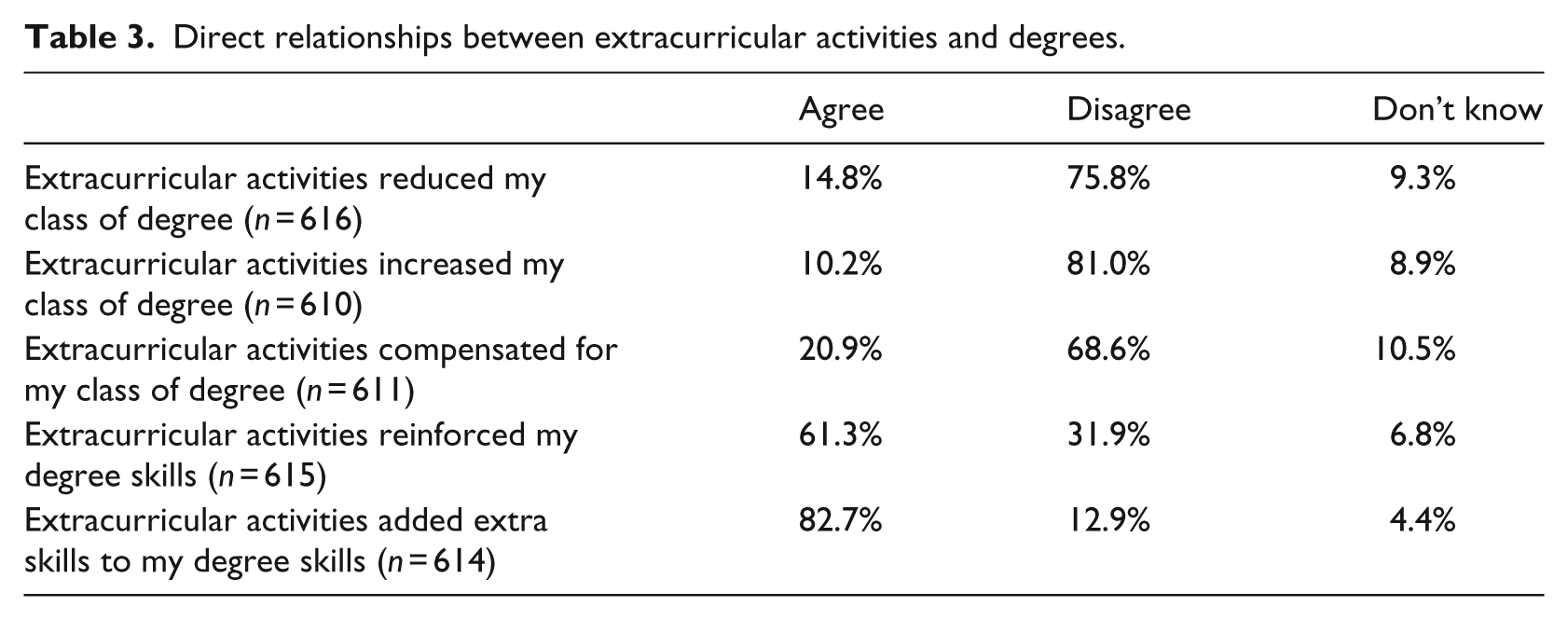
The respondents were happiest seeing the relationship between extracurricular activities and degrees as complementary, the extracurricular activities adding new skills or reinforcing those also provided by their degrees.
A few felt the relationship was more direct. A fifth said their extracurricular activities had compensated for their class of degree. The 92 respondents (14.8% of the total) who said their class of degree had been reduced by their extracurricular activities deserve attention. Of these 92 alumni, 65 felt that their extracurricular activities had compensated for their reduced class of degree, 49 said their extracurricular activities had reinforced the skills developed in their degree and 83 saw their extracurricular activities adding additional skills. Only 6 of the 92 alumni (6.5%) felt that they had gained none of these from their extracurricular activities. Of the 92 respondents, 14 said that they had gained one of these benefits from their extracurricular activities, 33 had gained two and 39 all three. So, even in the few cases where the extracurricular activities were claimed to have harmed academic achievement, there were nearly always some, and usually several, compensating benefits from their extracurricular activities.
In contrast, 62 respondents (10.0%) said that their class of degree had been increased by their extracurricular activities. Of these 62 alumni, 45 said that their extracurricular activities had reinforced skills also learned in their degree, and 56 said that they had gained additional skills. Only 4 said that they had gained no reinforced or additional skills, 15 said they had gained either reinforced or additional skills and 43 said they had gained both. These graduates had obtained both academic and non-degree benefits from their extracurricular activities.
Many of the interviewees gave examples of how their extracurricular activities had reinforced and/or complemented their degree skills. A politics graduate working in the political sphere said she had acquired skills of ‘innovative, quirky ways of trying to break through to people that are hard to reach’. Two Management School graduates used volunteering (managing JCR finances) and paid work to put into practice the theory learned on their courses. ‘You are taking money off other people, which you’ve got to make sure you don’t lose and you’ve got to spend it in the right way […] actually can you apply those kinds of things in the real world?’ Several interviewees linked participation in extracurricular activities to an increase in self-confidence. For example, an arts graduate, whose voluntary work included talking to prospective students, explained that this ‘help[ed] with my confidence […] because I was shy at university’. A student volunteer (now a community worker) welcomed ‘the discipline of being somewhere on time and having the right attitude about it’. Therefore, there were several distinct ways in which extracurricular activities had reinforced degree skills for career benefit.
Work–life balance was almost universally enhanced by extracurricular activities. Time at university was improved by non-academic interests and new friendships were formed. The epithet ‘well rounded’ was applied to the time at university and one’s character, each expanded beyond one’s discipline, and useful for a career. Typical comments were
‘… make yourself as well-rounded as you can and get as much out of life as you can because you’ll be happier at the time and […] afterwards’; ‘I personally think it’s important to show that you’ve got a life outside work’.
Therefore, the interactions between extracurricular activities and degree work were multiple, some very direct and others less so, but for most alumni the interactions were mostly positive and reinforcing.
Do all graduates report the same effects from and views about their extracurricular activities?
Although women and men had different profiles of extracurricular activities (men played more sport and took less paid work), their views on extracurricular activities and careers were very similar. The only large differences were that fewer women felt that their class of degree had been reduced by their extracurricular activities (11% compared with 20%) and more women saw their time management having been improved (51% compared with 40%).
The respondents (male and female) from the Management School were statistically significantly more likely to believe that students should plan their extracurricular activities for career purposes (p = 0.045) and that their extracurricular activities had increased their degree class (p = 0.021). The biggest difference was that Management School alumni saw their extracurricular activities as having increased their business and commercial awareness (p = 0.001). Arts and Social Science students saw their extracurricular activities as having increased their creativity (60% compared with 41% in Management) and their communication skills (81% compared with 68% in Science and Technology). These differences may reflect the different styles of teaching prevalent in the faculties and the nature of the work in their eventual careers.
The respondents were divided into the earlier graduates (1990–2000) and the more recent (2001–2010). The latter had a more favourable view of extracurricular activities: They were more likely to see their extracurricular activities as having improved their time management, planning and analytic skills and their creativity. They were less likely to see their extracurricular activities as having reduced their class of degree and more likely to believe they had compensated for their degree class. All these differences were statistically significant at the 5% level.
There was no statistically significant relationship between class of degree and whether the alumni thought that their extracurricular activities had helped them obtain or do better in their first job. Nor were those with Firsts and Upper Seconds any keener to advise students to plan their extracurricular activities. Those with lower degrees were much more likely to blame their extracurricular activities for reducing their class of degree – only 18.6% of those with better degrees blamed their extracurricular activities compared with 70.7% of those with lower ones. It is unclear whether the extracurricular activities really had this deleterious effect or were a scapegoat for academic disappointment.
There were some interesting individual differences of views on extracurricular activities by gender, age and faculty, but these are modest in scale compared with the perceptions of alumni as a whole.
How exactly do extracurricular activities help in the job-search process?
Many of the alumni commented on how their extracurricular activities helped them in the process of finding a job; one said, ‘I suspect that you don’t get an interview unless you’ve got something a bit extra’. A respondent in the finance sector had gained management experience through the Students’ Union and Nightline, and this was useful at assessment centres and in interviews. Some interviewees had not undertaken their extracurricular activities with any strategic purpose in mind but, on reflection, they had seen their value at the job-hunting stage. An English literature graduate transferred her extracurricular skills to those required for event management and she noted that ‘when I was writing a CV and then when I was at work I realised how beneficial they had been’. An extracurricular activity included in a job application can provide the basis for a conversation during a job interview. An IT consultant stated that, in an interview, ‘you try to find something you can hold a conversation on and some people can’t do that at all, you know’. One interviewee had used the example of how he had dealt with a difficult member of the executive of a society; another (an industrial manager) valued his time on the committee of a (sometimes rowdy) all-male sports club. A higher education administrator reported that some graduates appreciate the value to prospective employers of leadership positions in extracurricular activities. However, she noted that ‘it’s more about how somebody articulates what they’ve gone through […] rather than the actual activity […] you get students that are running football teams with thousands of pounds worth of budget and they don’t mention it’. Most of the interviewees were able to relate their extracurricular experiences to aspects of their job searches and careers.
In terms of doing one’s job, a banker commented that his extracurricular experience had taught him tenacity: ‘you might be up against it but you’ve just got to get on with it and [the sport] gives you that discipline, which I’ve still got’. Two interviewees mentioned that their extracurricular activities had been arenas in which mistakes could be made and learned from. One commented that ‘I probably made a few mistakes, which I then didn’t repeat when I got a job’. These results show that there are several distinct ways in which their extracurricular activities influenced the alumni as they searched for jobs.
How do recruiters perceive and make decisions based on the extracurricular activities of job applicants?
Some of the respondents to the questionnaire noted that they are now recruiters of graduates. A distinctive point of this article is that 11 of the 18 alumni-interviewees are also recruiters and so they could reflect on both their own extracurricular activities at university and their early careers and also on how they now view the extracurricular activities of job applicants. This gives their comments a particular pertinence. Their comments mostly come from their interviews though a few have been taken from the free-text sections of the questionnaire for recruiters not interviewed. Clearly, their views cannot reflect those of all UK recruiters because our sample started from a database of alumni and not one for recruiters. However, their views help us expand on the processes, motives and perceptions of extracurricular activities from their unique vantage point as both job seekers in the past and job givers today.
Recruiters do use extracurricular activities as selection criteria. As one said, ‘… because I think it’s pretty much one of our criteria for selecting people is that they must have done something on top of the kind of core study programme’. The type of extracurricular activity was irrelevant for some recruiters: ‘So for me I don’t mind if it’s scuba diving or dancing, even if they’re coming for a job that’s got nothing to do with these things […]’. Though a few disagreed: ‘So, I’m sort of biased towards sport. OK, you can get some duffers in there as well, but I do look at what they put their mind to, because it shows a certain determination’.
The alumni-recruiters were clear as to why they thought that extracurricular activities were important during the recruitment process: ‘… actually one of the things I have looked for is if people are showing an interest in doing something in their own time and really committed to it […]’. One interviewee saw extracurricular activities as a sign that someone was a good multi-tasker, a valued skill: ‘[…] when we recruit it’s one of the things we look for because the type of work we do requires that you can kind of do more than one thing at once’. Another saw extracurricular activities as a sign of flexibility: ‘So it just means that there’s more about them; they’ve obviously been able to apply themselves in other fields’. Other qualities that recruiters were inferring from extracurricular activities were that you are ‘an interesting person and engaging’, that you ‘can learn new things quickly’ and could ‘fit into the team’. Therefore, recruiters are inferring job-related qualities in the applicants based on their extracurricular activities.
The high regard for extracurricular activities parallels some downplaying of the degree. As one alumnus/recruiter said,
A degree is a degree in some respect and it’s just showing you’ve got the mental capabilities to pass certain exams and hand coursework in […]. It’s everything else you do that turns you into the character that you’re looking for.
Their ideal appointee should not be
‘… too concentrated on the facts and need[ing] to have everything in front of them before they’ll make a decision. Sometimes you need somebody who’s going to go out on a piece of gut instinct and go and do it, you know. And […] you get that from what they were doing outside their degree, I always find’.
Several respondents stressed the need to be able to communicate your achievements to the interviewer and not just list your extracurricular activities. ‘There’s definitely a skill to it […] so even if you’ve got all these experiences and skills, which you’ve built up through your ECA [extracurricular activity], you need to be able [to] communicate that’. Another said, ‘… you can say, “I had this responsibility,” or “I arranged this,” […] or “I fixed the budgets for our society”’. University ‘Awards’ schemes may help students develop such ability to communicate about extracurricular activities.
The alumni who were recruiters stressed the important role of extracurricular activities in terms of specific skills and imputed personal characteristics, and hence the key role they play in applicant selection beyond the assessment of applicants’ specific technical abilities to do the job.
Discussion and conclusion
These results suggest that most extracurricular activities can develop most employability skills but that not each activity affects each skill equally. This evidence and the testimony of recruiters show that the choice of which extracurricular activity one pursues at university is less important than what one does within that activity and how well one communicates one’s achievements to recruiters. This answers the question posed by the Association of Graduate Recruiters (2012), Tchibozo (2007) and Cole et al. (2007) about the extent to which recruiters do actually use extracurricular activities during the selection process. Most of the effects of extracurricular activities are generic, useful often in unexpected ways when there is no specific technical training available (e.g. in matters of personal motivation and interpersonal interactions). This clarifies the issues of the generic and the technical raised in Hinchliffe (2002) and Hinchliffe and Jolly (2011). That the effects of one’s extracurricular activities are so long-lasting is a new finding.
The alumni were sharply divided on whether one should plan one’s extracurricular activities – both sides had cogent arguments about the present and future (Stevenson and Clegg, 2011). This study specifies in more detail than Purcell et al. (2012) how degrees and extracurricular activities interact. Complementarity was the key novel finding in this study. Few alumni saw their extracurricular activities as having compensated for a poor degree class – the undergraduates in Thompson et al. (2013) were hoping for this – but most respondents strongly acknowledged how their extracurricular activities had added to or had enhanced their degree skills and some said they had improved their degree class. Students hoped extracurricular activities would be useful (Thompson et al., 2013), while the alumni confirmed they were and showed in what ways, both for getting a job and doing it. The alumni-recruiters revealed that they used applicants’ extracurricular activities for selection. For them, the key points were what the students had achieved, how they had reflected on their extracurricular activities and how they communicated this. Some graduate applicants will describe their extracurricular achievements more effectively, and this could help explain Stevenson and Clegg’s (2011) point (p. 243) about students with similar extracurricular experiences having different career outcomes.
The study has some limitations. It is based on the alumni (not all graduates) of one university whose database could be accessed, and therefore, the results cannot be extended automatically to other universities. The comments are based on alumni memories and on their ability to differentiate key factors as they affected past events such as securing a post. Memory effects also limited the study to graduates within the last 20 years. The sample size was not large enough to deal effectively with important sub-sets of graduates such as those working abroad, those with disabilities or those from a non-UK background, all of whose experiences of study and extracurricular activities could be distinctive. More extensive interviewing and deeper analysis of these interviews than were possible here could have yielded further insights. Possible areas for future research include a fuller study of the experiences of the sub-sets mentioned above and a comparison, from the employers’ viewpoint, of those employability skills evidenced by degree results and those by extracurricular activities. Also, the relative impact of simple office holding in an extracurricular activity and actual achievements in post could be studied from the recruiters’ viewpoint. Further recruiters’ viewpoints on how they perceive extracurricular activities would be informative. There could also be a fuller differentiation of types of job and among sectors that would show whether extracurricular effects were equally positive throughout the labour market.
Burke et al. (2005) and the QAA (2012) were concerned about how one could enhance the realisation of what one had in fact gained from one’s time at university. The study described in this article suggests that the formation of a time-limited, single-focus social network between alumni and undergraduates could benefit the latter as they plan their non-academic time at university. This could be carried out by any university and would reflect their balance of degrees and their graduates’ labour markets. Coming from alumni, the advice on extracurricular activity is generic, covers many disciplines and careers, is easily communicable and credible, and it should be long-lasting. It gives students for the first time a balanced view of the complementary effects of academic studies and extracurricular activities. All students could benefit from the richness of the alumni’s advice, but those with more sparse social networks and less advantaged backgrounds (highlighted by Purcell et al. (2012) and Stuart et al. (2011)) should benefit the most from the tacit knowledge about extracurricular activities being made explicit. By this triangulation among alumni, recruiters and students, we have shown the importance of extracurricular activities and how they enhance university and careers. Our respondents expressed only ‘positive regrets’ – not having done more extracurricular activities or not having done them better.
Footnotes
Acknowledgements
We thank the alumni who contributed so insightfully and Frank Wareing who helped administer the questionnaire.
Funding
This work was funded by the Lancaster University Friends Programme.