




Abstract
This article explores the digital technologies that taught postgraduate students engage with during their studies, what these technologies are used for and how useful they are perceived to be. The article draws upon data gathered from a survey of 253 masters and postgraduate diploma/certificate students across two universities in Australia. Analysis of these data contrasts the varied use(fulness) of ‘official’ university technologies such as learning management systems and library resources against ‘unofficial’ technologies such as Wikipedia, Twitter, Facebook and free/open education resources. In particular, the data highlight notable differences between students by subject area, domicile, mode of study and academic performance. The data also highlight the perceived benefits of this technology use – with students primarily finding digital technology useful in terms of supporting the logistics of university study rather than matters of learning per se. The article concludes by considering what is missing from these current forms of technological engagement, particularly in comparison with wider discourses about the educational potential of recent digital technologies.
Digital technology and the student experience
Universities now offer all manner of Masters qualifications, postgraduate diplomas and postgraduate certificate programmes. However, students on taught postgraduate courses are considered rarely in the academic literatures on higher education and/or educational technology. As Masterman and Shuyska (2012: 335) observe, taught postgraduate students remain ‘a comparatively under-represented population’ in ongoing discussions and debates about the future of higher education in the digital age. These authors suggest a number of possible reasons for this oversight. For example, it might reasonably be presumed that taught postgraduates are capable and confident individuals who have already successfully negotiated undergraduate study. There might be less institutional imperative to research the postgraduate student experience due to the relatively modest income streams that result from postgraduate enrolment and/or the diminished status of some courses. Also, from the perspective of investigating ‘cutting-edge’ aspects of technology use, older postgraduates are perhaps less compelling research subjects than late-teen ‘digital natives’ embarking on undergraduate courses.
Yet the digital educational experiences of taught postgraduate students need to be seen as a distinct and important aspect of contemporary digital higher education. In numerical terms, postgraduate taught students make up a sizable proportion of students on (and off) university campuses. In the United Kingdom, for example, there are 427,000 taught postgraduates pursuing a variety of courses – most sizably in business, medicine and education-related subjects (Universities UK, 2014). These headline figures belie a diverse student population. For example, around half of taught postgraduates study on a part-time basis, nearly 60% are female, two-thirds are aged 25 years or more and over one-third are from outside the United Kingdom (Universities UK, 2014). Similar figures can be found in other Anglophone higher education systems, such as the United States, Canada and Australia.
The nature of postgraduate taught courses and the experiences of students enrolled in them clearly need to be considered separately from undergraduate education – particularly when it comes to making sense of the continuing digitization of teaching and learning. Of course, as with undergraduate provision, postgraduate courses are built around engagement with institutional resources such as ‘learning management systems’, e-journals and plagiarism detection tools. Similarly, all postgraduate students are now expected to make extensive individual use of word-processing, email, Google and other popular web applications. Yet perhaps more than undergraduate provision, elements of postgraduate teaching that relied traditionally on part-time and/or distance modes of provision are now making extensive use of online technologies. As such, use of digital technology is both a potentially radical and wholly routine feature of the contemporary taught postgraduate experience.
To date, then, it is unfortunate that only a few studies have explored the everyday digital technology experiences of taught postgraduates. One exception was Masterman and Shuyska’s (2012) small study of 23 Masters students at the University of Oxford. This research found that while not possessing greater functional competence with technology, most students were developing skills throughout their courses in accessing and evaluating online information and communicating via technology. This study also highlighted the conscious choices made by these students not to engage with technology – often reflecting the tension between the time pressure of intensified postgraduate courses with the iterative process of gradually becoming more confident or even expert users of a broad range of tools. Another pertinent investigation was Gourlay and Oliver’s study of 12 postgraduate students at the Institute of Education in the United Kingdom which highlighted a number of characteristics of the contemporary postgraduate experience (Gourlay, 2014; Gourlay and Oliver, 2013). These included students’ ‘constant entanglement’ with digital devices and, if follows, the ever-present option of engaging in digital study. This was leading some postgraduates to develop intimate and personal routines of studying (e.g. in bedrooms, bathrooms and on the move). Crucially, this study uncovered a variety of student engagement with digital technologies – including ‘surfers’, ‘gamblers’ and ‘sceptics’. Clearly, it makes little sense to presume that all postgraduate students are making use of the same digital technologies in the same ways.
This latter point chimes with issues and tensions recurrent within the broader literature on technology and learning within university education. On one hand, there is plenty of evidence for the potential of digital technology to support and sustain forms of active learning. Networked digital technologies have undoubtedly transformed the generation and communication of knowledge and, it follows, the ways in which learning and understanding take place (DeSchryver, 2015). The potential of digital technologies to support or even ‘enhance’ learning has therefore been discussed in terms of every significant development in digital technology over the past 20 years or so. Recently, this has involved discussions over the educational benefits of podcasting (Dale and Pymm, 2009), blogs and micro-blogs (Ebner et al., 2010), social networking sites (Brady et al., 2010) and other forms of online social networks (Veletsianos and Navarrete, 2012). There has been much written about the ways in which digital technology can support collective, creative and connected forms of learning and study (e.g. Buzzetto-More, 2012; Sharpe and Beetham, 2010). New technologies are widely seen to support students in the co-creation of knowledge with peers, engagement in interest-driven informal learning practices, and the personalized engagement with education on an ‘anytime, anyplace, any pace’ basis. This journal has featured a number of such discussions and investigations. Bollinger and Armier’s (2013) study of the integration of student-generated audio files into online courses demonstrated how this technology stimulated student engagement and involvement in learning activities, as well as enhanced peer communication and interaction. Similarly, Prestridge’s (2014) study of Twitter use in university teaching highlighted the learning gains that can be achieved through the paraphrased interactions and dialogue that constitute microblogging. Now similar claims are beginning to feature in emerging discussions surrounding new ‘new’ technologies such as three-dimensional (3D) printing, augmented reality and learning analytics (Bower et al., 2014; Drake and Pawlina, 2014; Siemens, 2013). Digital technology is clearly associated with much ongoing educational enthusiasm.
On the other hand, concerns remain over the less spectacular realities of digital technology use within university teaching and learning (e.g. Losh, 2014). While many commentators may like to imagine collaborative communities of content creators, in reality many undergraduate students’ engagement with technology is often far more passive, solitary, sporadic and unspectacular, be it on or off-campus (Kennedy et al., 2010; Yılmaz et al., 2015). Undergraduates have been found to be surprisingly ineffective in their use of the Internet and other research tools. As Jones’ (2012) ‘Net Generation’ study concluded, students were found to report varying levels of digital confidence and skills, often reporting ‘initial surprise or confusion at the array of technologies that were available’ (n.p.). As an exploratory study of university students’ use of social networking sites concluded, there is a need for educators to ‘proceed[] with caution when using technology-enhanced learning, to avoid over-generalizing the needs of the so-called Gen Y students’ (Lichy, 2012: 101).
Against this background, there is a need to add to the existing (predominantly qualitative) research base on taught postgraduate students and digital technologies and to address the following questions:
How are taught postgraduate students most commonly engaging with digital technologies during their university studies?
In what ways – and to what extent – are different forms of digital engagement seen by taught postgraduates as useful?
Throughout the investigation of these two broad areas of questioning, particular interest will be paid to issues of patterning, specifically to the commonalities and differences between groups of taught postgraduate students (e.g. subject disciplines, different types of course and modes of study, gender, educational attainment, domicile status, cultural and linguistic diversity etc.).
Research methods
These questions are addressed through an analysis of survey data collected as part of research funded by the Australian Government Office of Learning and Teaching. Data were collected during the 2014 academic year from students of two large Australian universities situated in the southeast and northeast of Australia. These universities were of similar size, each with multiple campuses providing a breadth of courses at undergraduate and postgraduate levels with academic and vocational orientations. Taught postgraduate students in both institutions were invited to complete an online questionnaire containing items investigating their engagement with digital technologies. The self-selecting sample of those students who chose to respond consisted of 253 students with an age range of 21–69 (mean age = 33.3, standard deviation (SD) = 10.6) years. As can be seen in Table 1, the sample was within expectation in terms of academic performance, mode of study, domicile status and cultural and linguistic diversity. However, there was an over-representation of female students (72% in our sample, but only 56% of University A’s overall intake and 58% of University B’s overall intake). There was also a slight over-representation of students taking medicine and related subjects (19% of overall taught postgraduate intake in University A and 36% of overall taught postgraduate intake in University B).
Survey respondents by individual characteristics (n=253).
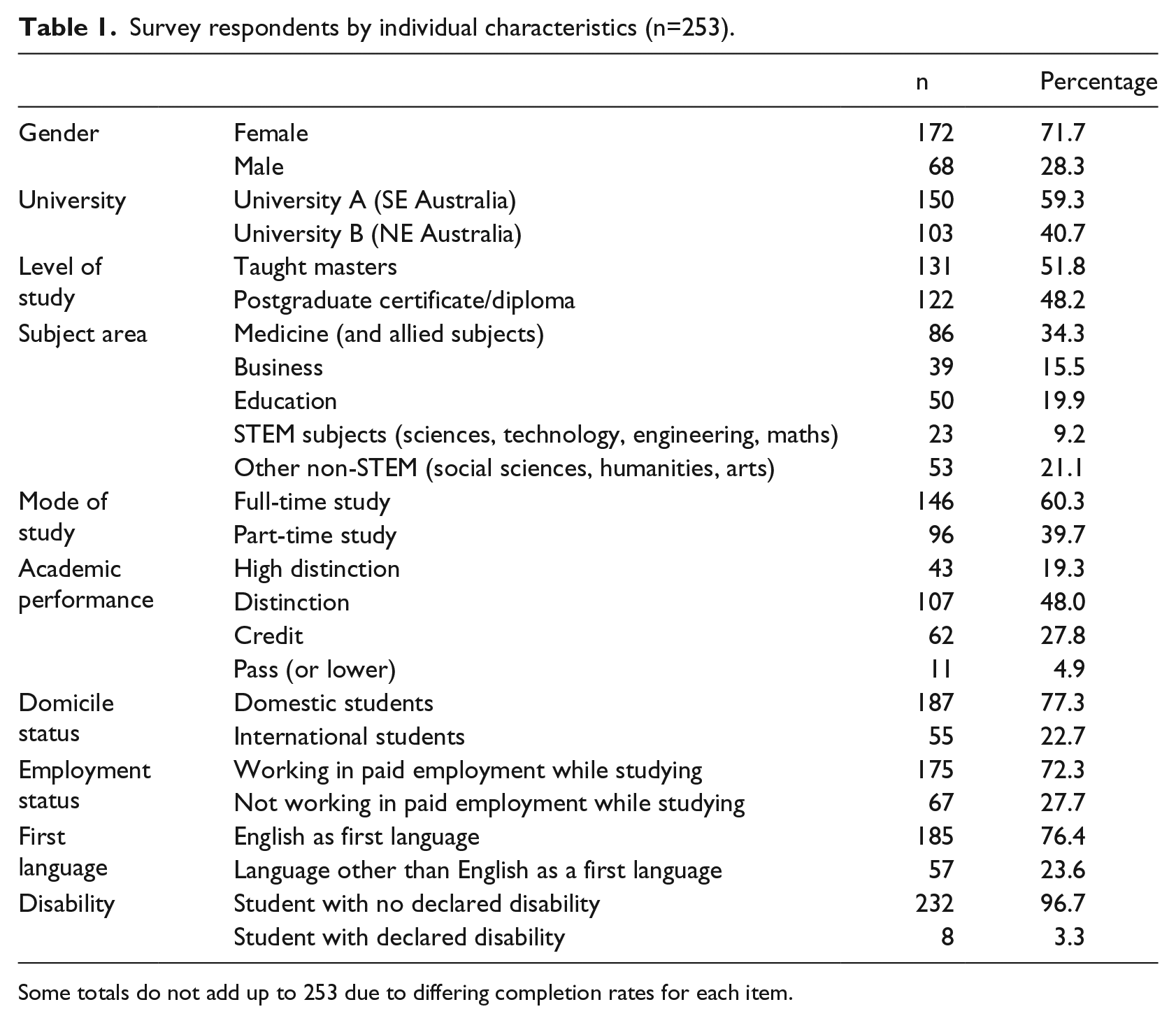
Some totals do not add up to 253 due to differing completion rates for each item.
Data from the survey relating to students’ reported types and levels of digital technology use relating to their studies are examined, as well as perceptions relating to the usefulness of this technology use. Analysis of the survey data was conducted in a relatively straightforward manner, acknowledging the limitations of the self-selecting, non-randomized nature of the sample and the lack of complete measurement of all cases in the selected sample (De Vaus, 2002; Gorard, 2014). Thus, in light of the growing trend for the ‘appropriate use of numbers’ within educational research, the analysis of the data set therefore takes the form of frequencies and cross-tabulations (see also Gorard, 2006). Similarly, analysis of the textual data arising from the open-ended items related to the perceived usefulness of digital technology took the form of relatively straightforward thematic analysis. This involved initial readings of all responses to the open-ended survey items to gain an overall sense of the data. These data were then read again and ‘open-coded’ to produce an initial code list until, in the opinion of the research team, analysis had reached theoretical saturation. Although some codes were adapted which directly used the language of the respondents, the majority were researcher-led and analytic. From this basis, the data were then coded in terms of categories identified with the initial code list directly related to the aims of the study.
Results
Students’ reported uses of digital technologies
As can be seen in Figure 1, survey respondents reported using a variety of digital devices. Nearly every respondent reported using a personally owned laptop/desktop computer, with most (92.6%) making use of a personally owned computer for their university studies. The survey also suggested that smartphones were being used increasingly to support students’ academic studies (68.9% of respondents who used a smartphone had used it in relation to university studies). Conversely, tablets/iPads were used by fewer students (61.7%), although 80.2% of students who owned one reported making use of their tablet/iPad for university work.
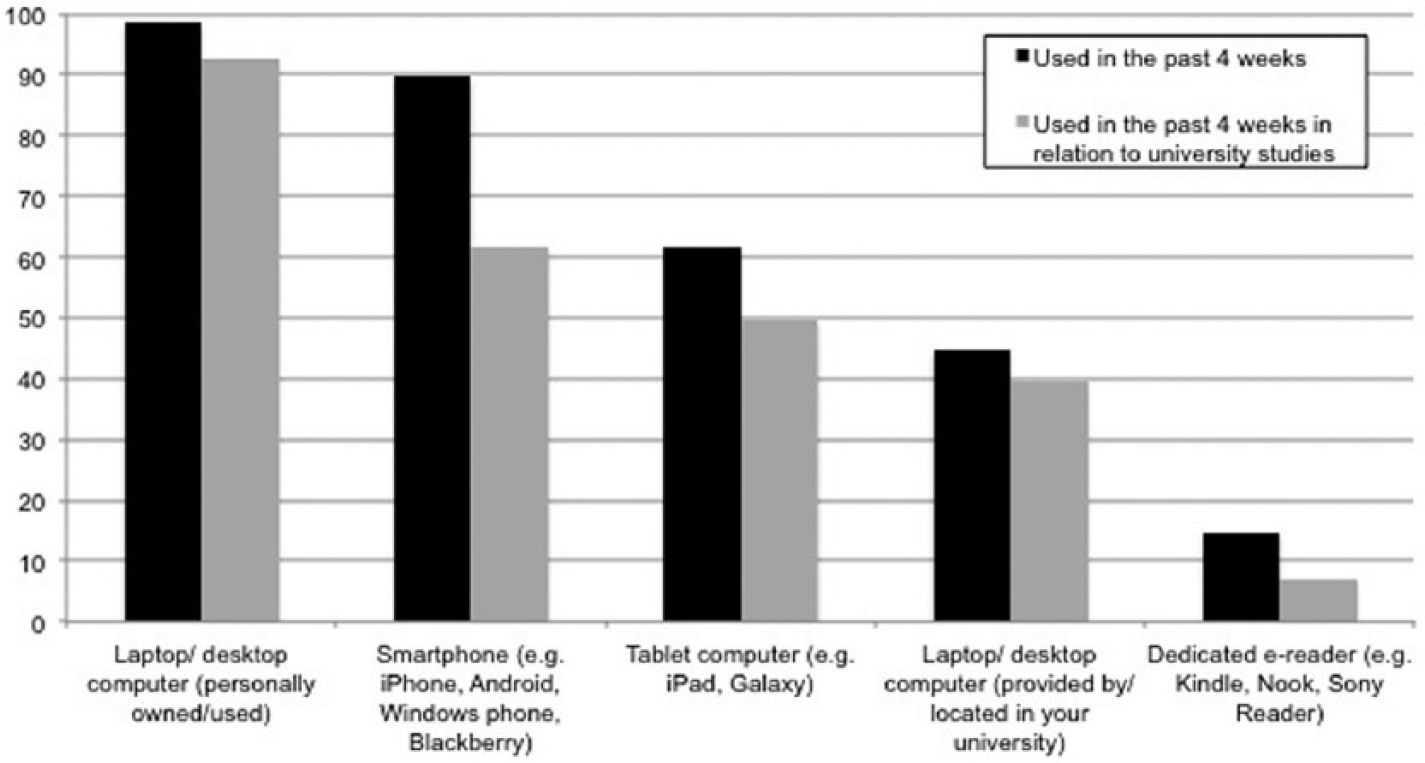
Students’ reported use of digital devices during the previous 4 weeks.
While (non)use of these technologies was generally comparable across the sample, a few specific differences were apparent. For example, use of university-provided computers was most prevalent among students taking science, technology, engineering and mathematics (STEM) subjects (83.3%) as compared, for example, to Medicine (33.3%) or non-STEM subjects (42.9%). Use of university computers was also the preserve of international/overseas students (73.5% as compared to 37.0% of home/domestic students).
Of course, these general levels of digital device use need to be seen in light of what these devices were being used for. Here, the distinction can be made between ‘official’ digital resources and practices (i.e. those provided and/or mandated by universities) and ‘unofficial’ digital resources and practices (i.e. resources that were not part of university-provided systems and services). In terms of ‘official’ digital resources, the survey data confirmed the prominence of online library resources and learning management systems (see Table 2). These data also highlight the growing use of e-books and e-textbooks (reported by 84.3% of respondents). Use of all these ‘official’ resources was remarkably consistent throughout the sample, regardless of subject discipline, mode of study or other individual characteristics measured in the survey.
Students’ use of ‘official’ digital technology resources in relation to their university studies, and the perceived usefulness of these in supporting academic work.
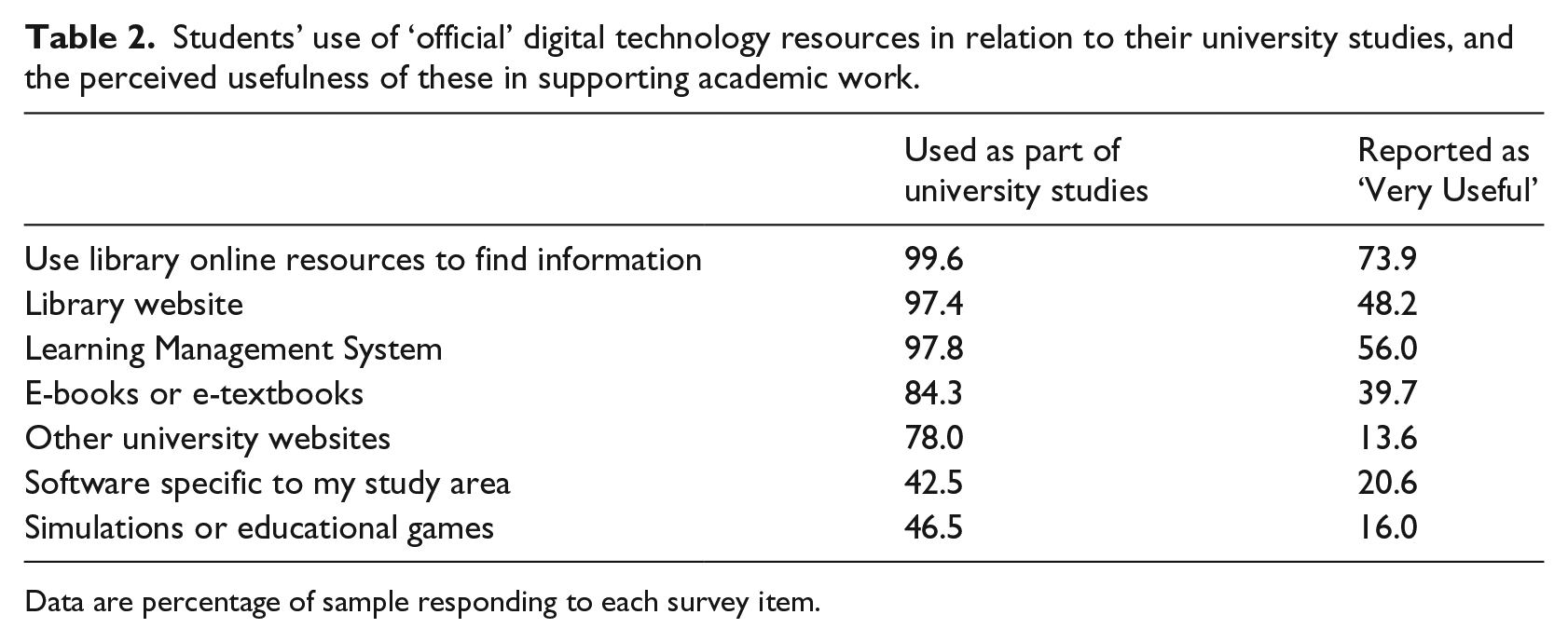
Data are percentage of sample responding to each survey item.
More variation was apparent, however, with regard to use of what could be classed as ‘non-official’ digital resources. As can be seen in Table 3, nearly all respondents reported making use of general Internet search engines (such as Google) and specialized academic search services (such as Google Scholar and Web of Science). Other prevalent practices included viewing subject-related content on video sharing websites such as YouTube and finding information related to their university studies on Wikipedia.
Students’ use of ‘non-official’ digital technology resources in relation to their university studies, and the perceived usefulness of these in enhancing learning.

OERs: Open Educational Resources.
Data are percentage of sample responding to each survey item.
The extent of students’ engagement in these ‘non-official’ practices differed across the sample. For example, in terms of subject-related differences, students studying STEM subjects made notably more use of a range of different technologies. For example, 83.3% of STEM students reported making use of free/open resources and content, as compared to just over half of students in each of the other subject areas. Subject-specific software was used by 77.8% of STEM students (as compared, for example, with 34.0% of Education students). STEM students also reported notably higher levels of social media use related to their academic studies. For example, 64.7% of STEM students reported using Twitter (compared to 31.3% of non-STEM students) and 88.3% using Facebook for collaboration with other students (compared with 57.1% of non-STEM students). The one unofficial technology use not dominated by STEM students was the use of web-based documents to collaborate with other students. Here, Business students were most likely to be collaborating with other students through collaborative Wiki/Google Docs (87.5%) as compared, for example, with students following non-STEM students (46.9%).
Aside from subject areas, other differences across the sample were less consistent. For example, levels of Wikipedia use were highest for students achieving ‘High Distinction’ grades (95.2%), as opposed to Distinction grades (85.0%), Credit grades (81.8%) or Pass grades (77.8%). This pattern was reversed for Facebook and open/free resources, where use was more prevalent among students achieving lower grades. Elsewhere, international/overseas students were more likely to be using social media than domestic/home students, that is, Twitter (used by 62.5% of international and 41.0% of domestic students), Facebook (89.6% as opposed to 63.3%) and collaborative Wiki/Google Docs (79.2% as opposed to 58.7%).
Students’ perceived usefulness of digital technologies
The survey data also explored students’ perceived usefulness of these digital resources and practices. As Tables 2 and 3 show, among the most ‘useful’ digital resources were using general Internet search engines (such as Google), making use of university Learning Management Systems and using library online resources. Also rated highly were academic search services such as Google Scholar and Web of Knowledge and viewing subject-related videos on content sharing websites such as YouTube.
The perceived usefulness of these technologies varied across the survey sample. Again, the most prominent differences were found in terms of respondents’ subject of study. For example, students enrolled on Business courses were most likely to report Wikipedia (34.6%) and collaborative Wiki/Google Docs (53.6%) as ‘very useful’. Facebook was reported as ‘very useful’ by 32.7% of medicine students as compared, for example, to 13.3% of STEM students. Conversely, Twitter was reported as ‘very useful’ by 13.3% of students enrolled on non-STEM courses, in comparison with 2.8% of medicine students and none of the respondents enrolled on STEM courses.
Alongside these subject-related differences, respondents studying on a fulltime basis were more likely to perceive e-books and e-textbooks as ‘very useful’ (47.5% of fulltime students as compared to 27.0% of part-time students). Similar patterning was apparent with Wikipedia (reported as ‘very useful’ by 31.9% of fulltime and 13.2% of part-time respondents) and Facebook (34.5%, 8.9%). Elsewhere, female students were notably more likely to perceive collaboration with peers through Facebook as ‘very useful’ (33.9%) as opposed to male students (9.1%). However, this was the only clear gender-related difference across the data set.
The nature of the use and usefulness of students’ digital practices
In order to further contextualize these data, a concluding open-ended section of the survey asked respondents to nominate and justify the digital resources and practices that they found to be ‘most useful’ during their university studies. From the nominated examples, 10 distinct digital practices were identified and coded. These data provide further insight into what taught postgraduate students were using digital technologies for and the meanings that students attached to these practices. As can be seen in Table 4, the most prominent practices related to the logistics of university study, that is, organizing schedules and fulfilling course requirements, being able to engage with university studies on a ‘remote’ and/or mobile basis and the broad issue of managing time and time-saving.
Cited reasons for digital technology usefulness in relation to students’ university studies.
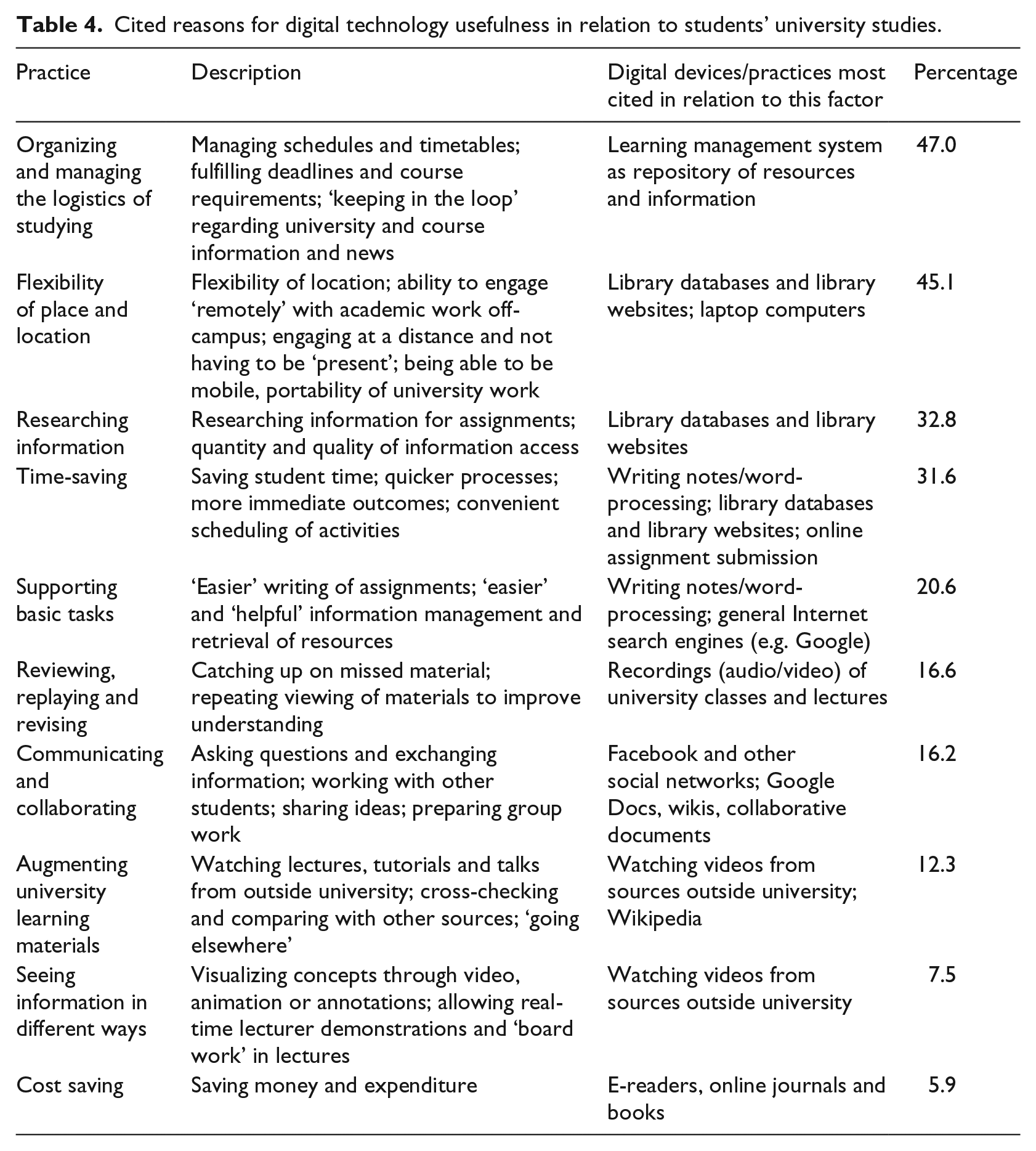
Tellingly, practices explicitly related to learning were reported less frequently. The most prominent learning-related practice was using digital technologies to ‘research information’. While less frequently reported, ‘reviewing, replaying and revising’ digitally recorded learning materials – most notably the viewing and listening of class recordings also featured in the data, as did the practice of ‘looking elsewhere’ for supplementary materials to corroborate or clarify what had been learnt at university. All these logistic and learning ‘benefits’ were cited consistently across the sample, with little recurrent patterning between different groups.
Discussion
These data present a mixed picture of postgraduate students’ engagements with digital technology. On one hand, digital technology is clearly an integral element of the contemporary taught postgraduate experience – particularly mandated ‘official’ digital systems and services such as online library resources and learning management systems. Clearly, digital technologies are an essential element of the core academic practices of researching and retrieving information, preparing and producing assignments, reports and other forms of coursework. It is now difficult to imagine being a university student without these technologies. Beyond these ‘basics’, our data also highlighted the widespread practice of engaging with teaching and learning materials in video form. Alongside recordings of their own university lectures, many students were also turning to video sharing websites such as YouTube to find external video content to supplement their studies. This clearly marks an additional way that digital technologies have found a place in the everyday practices of postgraduate life.
On the other hand, the take-up of other technologies often talked about in terms of the digitization of higher education appears to be more varied and inconsistent. For example, notwithstanding their high public profile, iPads and other tablet computers did not appear to be core academic tools for the majority of students. In addition, while Facebook was clearly a commonly used communication tool, other ‘big name’ social media were less prevalent. For example, Twitter was not reported as a prevalent part of university studies. While nearly half the sample reported trying to use Twitter for academic purposes, only 16.5% of these students found it ‘useful’ or ‘very useful’. Similarly, while the majority of students used social media sites such as YouTube, contrary to popular assumptions in the academic literature, it was for the passive consumption of content rather than creation or participation practices. Also, students’ use of Wikipedia was not the ubiquitous practice that is often assumed, with our data showing variations by subject of study and academic performance in students’ use of Wikipedia as an information source for their academic work.
Indeed, our data suggest that taught postgraduates’ digital technology use was patterned along distinct lines. In particular were differences between subject areas and the basis of students’ candidature, that is, whether they were domestic or international and/or studying on a fulltime or part-time basis. Such differences highlight that digital technology use is not a ubiquitous (or even consistent) presence among what is a diverse and divergent current postgraduate student population.
In making sense of these findings, it is perhaps helpful to view taught postgraduates’ engagement with digital technologies from the two different perspectives that emerged from the open-ended survey data – what was classed as ‘logistics’ and ‘learning’. The logistical aspects of study refer to the day-to-day ‘work’ of being a taught postgraduate student. In this sense, much of the engagement with digital technologies reported here could be seen as related to students’ pragmatic negotiation of their work, that is, the immediate demands of postgraduate study that continue to be centred on issues of assignments, grades and (non)attendance. The digital technologies that were most prominent in our data were those that fit closely with the immediate logistical realities of postgraduate student life, such as the pressures of class attendance and scheduling, participating in mandatory group activities, reserving library materials, conducting ‘research’ in the form of locating and retrieving documents, as well as producing and submitting assignments. Thus, it is these aspects of taught postgraduate courses that come to the fore when students choose (or are compelled) to engage with digital technology.
Alongside this logistical engagement with digital technology comes the use of digital technologies for learning. Here, much of how digital technologies were being used, and perceived as being useful, appeared to be shaped by dominant university models of the passive consumption of learning, rather than any more fluid, networked, connected or creative-driven forms of learning. Regardless of subject specialization, academic achievement or mode of study, technology-based learning appeared to take the primary forms of the passive reception of information and instruction, coupled with the largely individualized practices of researching and producing assignments.
At best, these data suggest that digital technologies are allowing taught postgraduate students to pursue these modes of learning that are more convenient but not necessarily innovative. The ability to watch and re-watch videos from around the world or the ability to search vast online databases of scholarly literature is a clearly valued practice by taught postgraduate students, and therefore presumably of benefit to them. Nevertheless, most of the dominant digital practices in the day-to-day lives of the taught postgraduates appear to be those that conform to (and reinforce) instructivist notions of content, knowledge, pedagogy and learning. If anything, then, these students’ experiences of ‘technology-enhanced learning’ can be described most accurately as involving the passive consumption of knowledge rather than more active, connected and/or creative practices. This is not to say that postgraduate scholarship is being ‘dumbed down’ or devalued through digital technology use, but neither is it being notably transformed or revolutionized.
Clearly, this study provides only an initial glimpse at what is a complex area of higher education. Our data are limited by the self-report nature of the survey method and the self-selecting nature of the sample. In focusing on the differences in students’ levels of engagement and perceptions of usefulness, we have not examined the quality or effectiveness of this engagement. Nor have we questioned how digital resources fit alongside students’ use of non-digital educational resources (e.g. books, face-to-face lectures and meetings). Therefore, it is clear that students’ actual uses and non-uses of the digital technologies during postgraduate studies merit a sustained and far-reaching programme of future research.
One key issue for this future research would be to explore how the restricted forms of digital technology use highlighted here ‘fit’ with students’ non-academic engagements with technology – especially social media applications such as Facebook, Wikipedia and Twitter. The suggestions of differences along subject area and domestic/international basis also merit closer scrutiny. Similarly, research should be conducted along more longitudinal lines than the ‘snap-shot’ nature of the present data set. Repeated collection of data from cohorts of students as they progress through their taught postgraduate studies would provide a rich and detailed picture of the factors underlying the take-up of digital-based resources. It is hoped that the study described here has been able to provide a starting point for such investigation.
Perhaps the key conclusion to be drawn from our data, then, is what is missing from these current forms of technological engagement – particularly in comparison with what is known about the educational potential of digital technologies. In this sense, universities clearly are not brimming with cohorts of taught postgraduate students who are making extensive and imaginative use of digital technology during their studies. While a few of our survey respondents did report participating in Massive Open Online Courses (MOOCs), using Tumblr and generally conforming to the description of ‘power users’, far more appeared to fit the more prosaic categories of what Kennedy et al. (2010) term as ‘ordinary users’ or even ‘basic users’. This is not to say that postgraduate students are incapable of using technologies in expansive ways. However, they clearly do not perceive the need to do so.
This suggests a number of possible implications for educators in postgraduate education to consider – not least how the digital technology practices of these students might be extended and expanded. Our data suggest that the more expansive forms of technology-based learning often celebrated in discussions of educational technology are clearly not occurring spontaneously. Instead, postgraduate students’ academic uses of technologies could be seen to follow the largely restrictive expectations that continue to pervade higher education with regard to knowledge, the development of what constitutes knowledge and understanding, and what counts as postgraduate learning, study and scholarship (see Selwyn, 2014). As such, perhaps the main implication of the data presented in this article is that current discussion of ‘digital higher education’, ‘twenty-first century learning’ and the like needs to be balanced by a renewed attention to the non-digital structures and contexts of higher education. Our findings certainly support arguments for reorienting the content of syllabi, nature of assessment and forms of engagement and learning more forcefully and unambiguously around technology-based practices.
Also, it seems clear that teachers, tutors and other university staff members have key active roles to play in stimulating, supporting and sustaining ‘best practice’ uses of the technologies that do not appear to currently be core elements of the taught postgraduate experience. Although these students are successful, experienced university learners, this does not mean that they will autonomously engage with new learning opportunities. Instead, these are students who could well benefit from increased teacher orchestration and co-ordination of technology-based education. In this sense, university educators need to be reminded that they play an important role in influencing and supporting learners’ ‘self-directed’ digital activities (see Littlejohn et al., 2013). Therefore, educators working on postgraduate courses need to provide an initial impetus for the collaborative activities that underpin much contemporary technology-based learning. As Crook puts it, teachers at all levels of education play a key role in ‘arranging the furniture’ of technology-based learning – providing a ‘good core’ and ‘initial governance and impetus’ to extend student use of digital technology beyond the routine completion of coursework and fulfilling other course requirements. Digital technology is clearly an important element of postgraduate education. However, more work is required from within universities if taught postgraduate provision is to be genuinely enhanced along digital lines.
Footnotes
Acknowledgements
The authors would like to thank the other members of the research team: Rachel Aston, Kevin Larkin and Vicky Smart.
Declaration of Conflicting Interests
The author(s) declared no potential conflicts of interest with respect to the research, authorship, and/or publication of this article.
Funding
The author(s) disclosed receipt of the following financial support for the research, authorship, and/or publication of this article: This paper arises from a research project funded by the Australian Government Office of Learning and Teaching (award number SP13-3243).