




Abstract
Small class size is often used as an indicator of quality in higher education, and some research suggests that instructors in smaller classes more often use activities that are learner-centered and that involve physical and mental activity on the part of learners, such as group work, simulations, and case studies. However, we have little information on how instructors change their pedagogical practice when they teach in large- versus small-class settings. In this study, we examine alignment between intended and enacted teaching strategies, or initial plans and specific ways in which instructors reported altering their teaching in the context of a university policy shift to smaller classes. Furthermore, we examine instructional challenges in this shift to call attention to professional development needs of small-class teaching and to best leverage the benefits of such activities for student performance and retention.
Class size and effects on student learning and experience
What difference does class size make for instructors and for students? Class size and staff-to-student ratios are widely used as indicators of quality at colleges and universities (Bandiera et al., 2010; Martin, 2015). Because these metrics factor into university rankings, and universities face numerous pressures to move up, a better understanding of the benefits and challenges of altering university policy around one factor in this calculus is needed. Studies on the effects of class size at the postsecondary level have examined a wide range of outcomes, including achievement, student engagement, attitude, and student evaluations of teaching. While some studies suggest that increasing class size has a negative effect on direct measures of student learning (Arias and Walker, 2004; Bandiera et al., 2010; Kogl et al., 2016; Kokkelenberg et al., 2006; Westerlund, 2008), many show no or mixed effects (Bellante, 1972; De Paola et al., 2013; Edgell, 1981; Gleason, 2012; Hancock, 1996; Hill, 1998; Jarvis, 2007; Kennedy and Siegfried, 1997; Matta et al., 2015; Olson et al., 2011; Raimondo et al., 1990). However, scholarship consistently supports the idea that students perceive an improved learning experience when class size decreases. For example, students tend to assign higher ratings to instructors and courses when class size is smaller (Bedard and Kuhn, 2008; Benton and Cashin, 2012; Kwan, 1999; Mandel and Süssmuth, 2011; Monks and Schmidt, 2011; Sapelli and Illanes, 2016; Westerlund, 2008). Furthermore, students in smaller classes report learning more (Benton and Pallett, 2013; Monks and Schmidt, 2011), being more engaged (Gleason, 2012), and having a more positive attitude toward the discipline (Benton and Pallett, 2013; Edgell, 1981). Hypothesized reasons for this greater engagement include pedagogy, with instructors in smaller classes using more active learning approaches (Lammers and Murphy, 2002; Monks and Schmidt, 2011), and personalization, with students receiving more individual attention in smaller contexts (Arias and Walker, 2004; Kokkelenberg et al., 2006). A study conducted at a medium-sized polytechnic in the United Kingdom echoes these findings. Investigators found that students in large, introductory first-year courses experienced feelings of anonymity and a reluctance to speak up or ask questions. Similarly, instructors reported difficulty in forming relationships with students in large classes (Ward and Jenkins, 1992).
Active learning is a broad and commonly used term “generally defined as any instructional method that engages students in the learning process” (Prince, 2004: 223). Educators have proposed widely varying examples of active learning pedagogical strategies or techniques including, for instance, case studies, team projects, simulations and role playing, internships, peer tutoring, and challenging discussions (Bonwell and Eison, 1991; Carr et al., 2015; Chi, 2009; Chickering and Gamson, 1987; Meyers and Jones, 1993). What is common across these teaching strategies? The theory behind these techniques is based on a constructivist view of learning. Constructivism posits that people build knowledge by acting on the world around them and reflecting on their experiences. Piaget (1970: 104), a French psychologist who advanced a constructivist view of learning, wrote that rather than learning by passively receiving and interpreting information, in order to learn or “know objects, the subject must act upon them, and therefore transform them: he must displace, connect, combine, take apart, and reassemble them.” The constructivist perspective on learning positions knowledge as inseparable from the people processing it and emphasizes social interaction and cooperation over individual study and practice (Gibbs, 1994). Active learning techniques are designed to require higher-order thinking tasks such as analysis, synthesis, and evaluation (Bonwell and Eison, 1991). Although many studies focus on face-to-face classroom settings, it should be noted that many active learning strategies can be used in the rapidly expanding setting of online course environments (Carr et al., 2015).
Despite evidence suggesting that reducing class sizes can lead to more active and engaged learning, we have little information about how instructors actually change (or do not alter) their pedagogical practice when they move from a large- to a small-class setting. Sometimes faculty teach small courses exactly in the same way as they would teach larger classes (Harfitt, 2012; Hattie, 2006). Perceived barriers to using activities such as case studies, group work, and simulations in large lectures are well-documented, including lack of necessary class time, a high comfort level with traditional lectures, and insufficient time to learn about a new strategy and effectively implement it (Dancy and Henderson, 2010; Froyd et al., 2013; Miller and Metz, 2014). In contrast, there is a gap in our understanding of the challenges of teaching in smaller classes and ways to implement such activities in them. This understanding is needed in order to better leverage the benefits of small courses and promote more extensive course reform. It is important to examine how faculty understand the shift to more student-centered learning practices, as well as what challenges they perceive to making this adjustment. Although there is a good deal of literature about the barriers to implementing such activities in large courses (Carbone, 1998; Heppner, 2007; Lammers and Murphy, 2002; Stanley and Porter, 2001), there is more limited research on perceived challenges to implementation in small-class settings.
The research questions driving the study are these. How do faculty’s intentions to change their teaching as a result of smaller classes align with their reports about what they are able to enact? What are the key barriers to making more extensive use of activities such as group work, case studies and the like?
Methodology
Data collection and analysis
This study is situated in a Winter 2015 policy shift at a large Midwestern public research university in the United States, in which course size decreased from a previous enrollment ceiling of 25 students to 18 in introductory- and intermediate-level World Language and European Language courses. The policy shift was undertaken at strategic locations across the institution both to enhance undergraduate education and to improve university rankings in one key US index. Although this is a modest decrease, it is in line with other course size research that compares effects of small (1–19) versus medium (20–33) classes in UK (Bandiera et al., 2010), US (Bedard and Kuhn, 2008; Kokkelenberg et al., 2006), and German (Mandel and Süssmuth, 2011) universities.
To gather feedback, all academic staff (heretofore called “instructors”) in the two participating departments were invited to attend two meetings. The first took place at the beginning of the term and was designed with a two-fold goal: (a) to promote intentionality about leveraging smaller course sizes and (b) to gather written information about instructors’ plans for teaching with smaller classes. Each instructor wrote a response to the prompt, “At this point in the term, what are your plans for leveraging the decrease in small course size?” In total, 39 responses were collected, representing most (78%) instructors (N = 50). A large-group discussion was followed in which a staff member from the university’s teaching center elicited ideas and recorded them on the board.
Near the end of the term, all instructors were invited to participate in a 60-minute focus group. Eight focus groups or interviews were held, for a total of 28 participants, or over half of all instructors. All courses of interest were represented in the instructor focus groups. Instructors reported a mean of 8.8 years of teaching experience, with a range of only one term to 27 years. All focus groups were recorded and transcribed. In the middle of the discussion, instructors who had participated in the first discussion received their plan back and were asked to write about and discuss (a) what they were able to enact and (b) what they did not enact and why. A total of 20 written reflections were completed. The analysis focused on these 20 written reflections and discussion about them from the full group of 28. This study was approved by the university’s Institutional Review Board.
Analytic approach
The key analytic frame used for this study was understanding alignment between intended versus enacted pedagogical strategies. This approach mirrors discussions of curricula, where the intended curriculum is the aspirational plan, the enacted curriculum is the content actually delivered, and the achieved or assessed curriculum is the content and skills that are truly learned (Cuban, 1992; Kurz et al., 2010). Instead of using this schema for student learning, we apply this to pedagogical change, focusing on planned and enacted teaching strategies.
With this broad lens, we then analyzed the written reflections and verbal transcripts separately using a grounded approach in which themes emerged from the data, rather than coding for a priori themes (Charmaz, 2006; Corbin and Strauss, 2008). Grounded coding involves an iterative, ongoing process of creating categories of data, or codes, then comparing data with existing codes to revise or expand the codes. In the first stage of coding called open coding, codes are “provisional, comparative, and grounded in the data” (Charmaz, 2006: 48). Next, we used axial coding (Strauss, 1987) which involves “relating concepts/categories to each other” (Corbin and Strauss, 2008: 198). Two researchers (Wright and Bergom, 2015) analyzed the data to agree on a set of themes. The researcher who was not present at the focus groups conducted the first round of analysis, and the emerging themes were reviewed and confirmed by the second researcher, who conducted the focus groups. A final set of themes from faculty-written reflections were compared to the set of themes from the focus groups and interview transcripts.
Findings
The subsequent section presents three stages of instructors’ plans to teach in smaller course sizes: initial plans at the start of the term (intended strategies), objectives that were realized (enacted strategies), and challenges faced.
Intended strategies
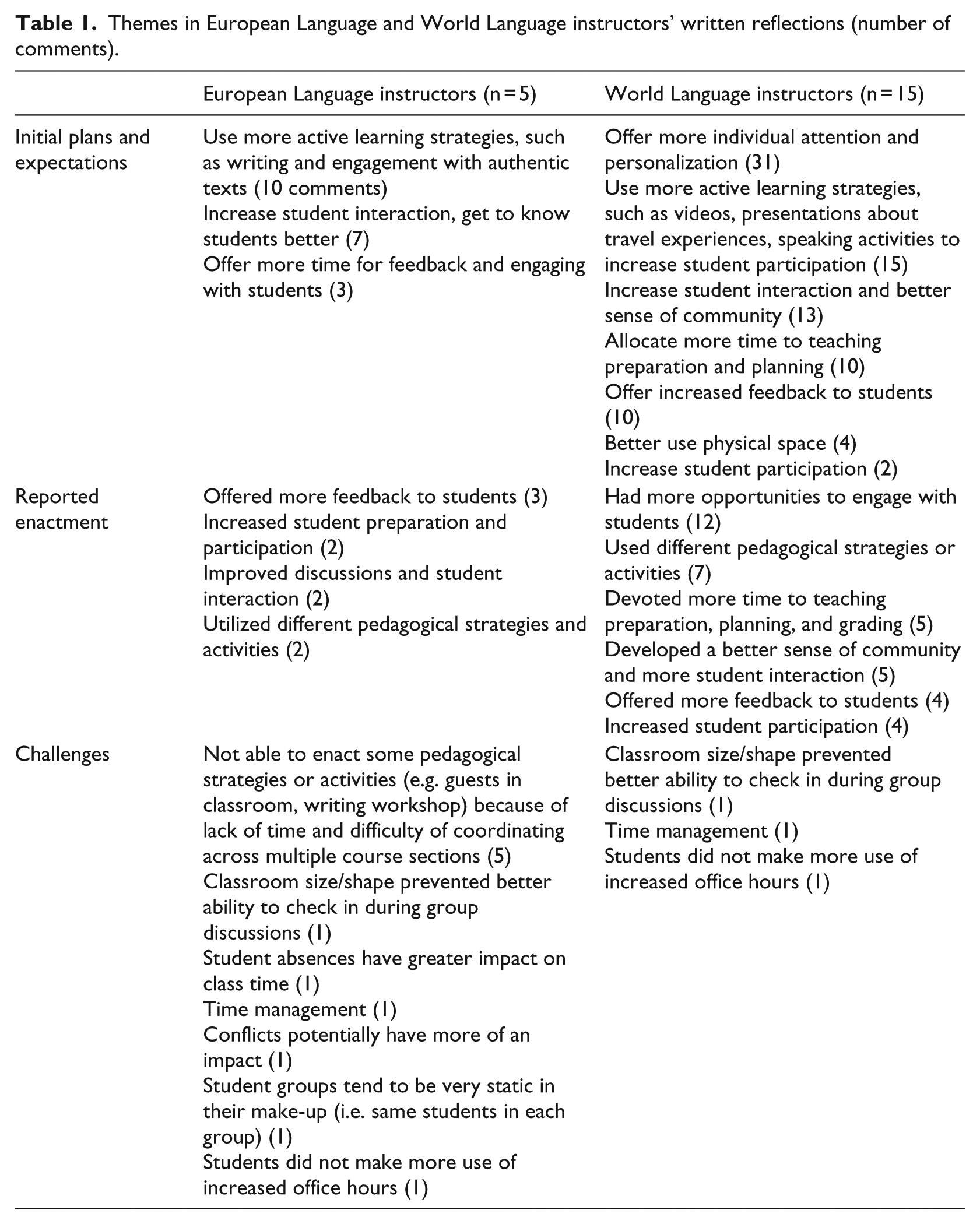
In their initial plans written at the beginning of the term, many instructors planned to utilize new active learning strategies. Such ambitions included more writing, more questioning and discussion in small- and large-group formats, and integration of cultural material (see Table 1). Most frequently, instructors described this change as a plan to offer more opportunities for students to interact with each other and with the instructor. For example, one World Language faculty planned, “I feel like my students will have more opportunities to communicate with me and their classmates in the target language.” A second theme noted by faculty in both units was the intention to offer more written and oral feedback, such as one instructor who thought she “will be able to more frequently provide feedback to more groups of students because there will be fewer groups.”
Themes in European Language and World Language instructors’ written reflections (number of comments).
Finally, a number of comments addressed plans to more closely tailor lessons to individuals. To illustrate, one instructor thought she would
get to know my students better which helps me personalize the classes a bit more. When it comes time for me to evaluate each student’s level of participation, I feel like I can evaluate them more accurately since I am able to spend more time with each of them on a one-on-one basis.
Faculty reports of enacted strategies
Focus group discussions among instructors checked in with faculty near the end of the term to better understand which changes were able to be realized, from the perspective of faculty. Discussants pointed to three key changes in teaching that were attributed to smaller course sizes: greater use of active learning strategies, more feedback, and inclusive teaching (Table 1).
More time to develop active learning strategies and use them in class
Consistent with written plans, a frequently reported change was the opportunity to develop new active learning strategies to promote student interaction and engagement. This activity was evidenced by a World Language coordinator who noted that “there’s been more action this semester” on a common learning management site where activities are shared among instructors. Discussants indicated that they largely utilize the same kinds of activities (e.g. working in pairs), but they are able to utilize more strategies in a classroom because there are fewer students. To illustrate, one introductory-level World Language instructor noted, “I can get through more communicative activities now than I feel like I could before.” Similarly, a European Language instructor wrote about achieving better class discussions because “the smaller class size allowed for better fluidity moving between small groups and whole class discussions.”
More thorough and prompt oral and written feedback
Also in alignment with intended strategies, faculty from both departments indicated that smaller sizes allowed them to give more oral feedback in class and more extensive and prompt responses to students’ written work. For example, an introductory-level European Language instructor noted that in previous terms, “I would never get over to some students. I would do an activity, and I’d get part of the way around.” However, with fewer groups of students, she now has “a chance to get to more people for feedback.” Likewise, multiple instructors described giving more feedback on written work and being able to return it to students more promptly, such as offering “more written feedback on their writing assignments much more quickly.” In addition to offering feedback to students about their learning, instructors indicated that they were better able to collect formative feedback about their teaching (e.g. by traveling between groups to see areas of common difficulty), which enabled them to more flexibly adjust their lessons. Because of this ability to intervene with more facility, some instructors described being able to set higher standards for students.
More inclusive teaching to create a classroom community
Although not documented at the start of the term as an intended strategy, instructors in one department noted that an enacted approach was the ability to create more inclusive classrooms and be attuned to student diversity. One intermediate World Language instructor noted, “Now with 14 students, I can read their journals. I know where they come from, and I can be an ally.” A second instructor commented, “I think the smaller class sizes have brought about very important conversations about how to leverage diversity because we have a smaller group of people.”
Faculty reports of barriers to enacting new strategies
Despite multiple reported changes to instruction, instructors also named several barriers to enacting all of the modifications that they hoped to make at the beginning of the term. Examples of pedagogical approaches faculty hoped to enact but did not included inviting guests to the classroom, increasing office hours, and changing group composition for collaborative learning (Table 1). Although there were common themes of reported challenges, it is also striking that relatively few were named in contrast to the number of enacted strategies.
Limits on personalization
The key disjuncture between intended and enacted strategies was personalization and the ability to offer individualized feedback. Tailoring or customization of learning was named frequently by World Language instructors in their initial plans, and some faculty did report increased opportunities to provide oral and written feedback (see above theme under faculty reports of enacted strategies). However, personalization emerged much less frequently as an enacted strategy, relative to its prominence as an intended approach. In other words, faculty had expected to be able to create more customized learning experiences than they were actually able to implement. In discussion and writing, named challenges in enacting initial plans in this area include time limitations, student buy-in (such as students not attending extra office hours), and highly structured curricula. Furthermore, the physical environment, such as oddly shaped classrooms, was named across groups as a challenge to instructor mobility to offer individualized feedback during group discussions.
Class sizes that were too small
In the focus group discussions, the most frequently named challenge was classroom dynamics resulting from smaller classes. For example, multiple instructors indicated that some classes were too small for ideal student interaction and engagement. Although a size of about 18 was perceived to be ideal in a communicative classroom, for various reasons, courses could drop below that level. Some instructors pointed to the difficulty of teaching with lower initial enrollment or if students dropped the class midway through the term. A World Language coordinator remarked, “Of course, there are drawbacks when you end up with—sometimes with eight or nine students.” In other cases, instructors observed how temporary decreases, or student absences, seemed to more significantly change the classroom dynamic, compared to larger courses. An intermediate-level World Language instructor noted, “You can see it more when someone doesn’t come.” Furthermore, individual students’ personalities seemed magnified in a smaller setting, which was a challenge for instructors who had multiple shy or vociferous students. For example, a World Language instructor noted that with “five or six really timid students in a group of eighteen, it’s hard to pull those students out of their shells.” Conversely, another faculty member described other students’ tensions with a very talkative student. “She could be camouflaged a little better in a bigger group.”
Heightened classroom management challenges
Although it did not emerge frequently in written reflections, in discussion, faculty frequently noted that smaller sizes seem to heighten other classroom management challenges. For example, multiple intermediate World Language instructors suggested that because students know instructors and peers better, this may create an overly permissive atmosphere. To illustrate, in a dialogue, one instructor observed that students “just feel like it’s okay to say something because it’s a small classroom and they have got a strong sense of community.” Another instructor concurred, noting that instructor–student boundaries occasionally seemed too blurred, “I think they feel comfortable enough to demand my attention maybe too much sometimes.” Because smaller classrooms were highly participatory and students had the opportunity to get to know each other better, some instructors had to manage conflicts between students. A World Language coordinator noted that because students’ “personalities shine so much individually” in a smaller course, “more tensions are created.”
Discussion and conclusion
This study followed the arc of faculty’s experiences transitioning to smaller course sizes, documenting intended pedagogical shifts as well as reports later in the term of what was and was not able to be enacted. In summary, instructors’ intended strategies for leveraging smaller classes were largely in alignment with their enacted approaches. Most clearly, intended and enacted strategies across departments include greater use of active learning strategies and increased feedback. Inclusive teaching, although not named as an intended strategy, emerged as an enacted approach in one department. One possible reason for the emergence of this theme may be because the university’s teaching center conducted a workshop for the program on diversity and inclusive teaching. Although the workshop was independent of the course size initiative, instructors noted the linkage between the two topics. In line with previously described research that students perceive smaller class environments more favorably (Bedard and Kuhn, 2008; Benton and Cashin, 2012; Benton and Pallett, 2013; Gleason, 2012; Kwan, 1999; Mandel and Süssmuth, 2011; Monks and Schmidt, 2011; Sapelli and Illanes, 2016; Westerlund, 2008), here, faculty also perceived the move to decreased class size positively. The conjunction of these findings is significant for measurement of the student experience, in surveys such as the UK National Student Survey, and faculty work life, in instruments such as the US Faculty Survey of Student Engagement. This research suggests that class size is a key variable needed to contextualize these results, and it is often overlooked.
However, not all plans were able to be realized, and this study also documents barriers to fully enacting all intended plans. Most prominently, although some research suggests that greater student engagement in smaller courses can be attributed to increased personalization (Arias and Walker, 2004; Kokkelenberg et al., 2006), this intended strategy was the most challenging for faculty to implement. Although there is ample literature about the challenges of implementing activities that are more learner-centered, that involve more physical activity on the part of learners, such as group work, simulations and case studies in large courses (Carbone, 1998; Heppner, 2007; Stanley and Porter, 2001), we also document previously unexamined perceived structural and interactional challenges to changing pedagogy in small courses. Structural challenges that may be difficult for individuals to address include physical space, highly structured curricula, and very small numbers of students. Challenges that appear to be more tractable include interactional factors, such as classroom management and difficulties in facilitating discussion and feedback. Below, we address implications for professional development based on these challenges.
Hattie (2006) notes that the benefits of small classes should be leveraged by adjusting teaching practice. What are the implications for educational development, particularly for colleges and universities who wish to maximize the impact of a course size reduction initiative or who already have small classes and wish to maximize their benefits? First, it is helpful to acknowledge that although much attention has been placed on the difficulties of facilitating active learning in large courses, small classes also present challenges that instructors may not be used to, especially at large institutions. An intentional approach that recognizes the opportunity for educational development in this area can help normalize and mitigate those challenges. Key challenges named by faculty in this study were management of participation in a discussion-oriented classroom and concerns about maintaining authority in a high faculty-to-student contact classroom. For example, in the discussion of blurring of boundaries, instructors may be observing a move to more student-centered pedagogy, which has advantages for student learning but involves negotiation of new roles for all members of a classroom community (Hansen and Stephens, 2000; Weimer, 2002). Faculty may find it productive to establish norms early in the term, either through instructor-led or classroom community generation of guidelines for the class. These processes would also allow students space to reflect on the key differences in the experience of being in a smaller-sized class and to enable staff to set role expectations. Professional development resources addressing these issues include workshops on facilitating discussion (Edwards et al., 2007) and identity and authority in the classroom (Wright, 2007), as well as useful guides on these topics (e.g. Howard, 2015; Sorcinelli, 1994). Furthermore, strategies for personalizing feedback to students, formative and summative, may be another productive area of professional development (see, for example, Howell, 2016; Taylor and daSilva, 2013). In short, faculty and teaching assistant development in this area is a useful approach for colleges and universities wishing to maximize the impact of smaller course sizes.
Second, although some challenges were named by instructors, there were relatively few. This result aligns with other research that finds that smaller classes are better environments for activities that are more learner-centered (Kokkelenberg et al., 2006; Lammers and Murphy, 2002). However, it is also suggestive that the action research approach (Cook et al., 2007; Lewin, 1949/1997) used here may be helpful preparation, specifically for increasing instructor intentionality around small classes. In particular, the low-resource approach involved one gathering at the beginning of the term for instructors to engage in reflective writing, followed by a large-group discussion, about their course plans. A midway meeting (in this case, a focus group) allowed for reflection on enactment of these plans as well as sharing of ideas with a community of instructors (Cox, 2001). In either of these meetings, it may be useful to call attention to perceived barriers to deeper course revision, such as the challenges named here (e.g. curricular flexibility, space constraints, and lack of student buy-in). Some of these constraints, such as student non-compliance, have been named by others (Ellis, 2015), with suggestions that instructors acknowledge reasons behind student resistance and offer ways to mitigate perceived risks of active learning. Similarly, it may be useful for anticipate how to mitigate the challenges faced in their own local context, in order to best leverage small classrooms for active learning benefits.
This study has several limitations. First, because of the large number of courses and faculty, self-reports were used to identify changes in instructional behavior. Although the primary purpose of this study was to document how faculty understand the shift to more student-centered active learning practices, it may be that instructors did not adjust their practice as extensively as they thought they did, a theme echoed in other research about faculty-development interventions (Ebert-May et al., 2011). Second, findings from focus groups and written reflections relied on a sample of faculty in two language departments in one university in the United States. Their reflections may not be representative of all faculty, and a study using a different sample, discipline, or university or cultural context may yield different themes or insights. Finally, this study took an action research approach (Cook et al., 2007; Lewin, 1948/1997), so instructor reflections and interactions with the teaching center may have influenced actions that may not otherwise have occurred. Future research would benefit from observations by an external trained observer, insights from students themselves, and a broader sample of disciplines and university contexts.
Footnotes
Acknowledgements
The authors thank Dr Ronit Ajlen (CRLT, University of Michigan) for literature review assistance and Melinda Thompson (CRLT, University of Michigan) for data entry assistance.
Funding
The author(s) disclosed receipt of the following financial support for the research, authorship, and/or publication of this article: This work was supported by the University of Michigan’s College of Literature, Science, and the Arts.