




Abstract
Increasingly, students engage in multitasking during lecture by shifting their attention between class material and irrelevant information from texts and webpages. It is well established that this divided attention impairs memory and learning. Less is known about how to correct the problem. This study used an educational intervention in the form of a PowerPoint presentation that informed students in the experimental condition about the deleterious effects of multitasking. Students were randomly assigned to the experimental condition, the placebo condition (a slideshow about sleep), or no intervention. Participants self-reported the percentage of the time they multitasked in class and paid attention at two time points, baseline (before the intervention), and in a second lab visit 3 weeks later. The experimental intervention did not reduce student multitasking or increase student attention, relative to the other conditions. Supplementary research questions examined students’ beliefs about multitasking, finding that most thought it decreased their grades. The correlations between grade point average, stress, and boredom proneness, on one hand, and baseline attention and multitasking in class, on the other, were also inspected, revealing that students with higher grade point average pay more attention in class and multitask less. Suggestions for future research to reduce multitasking are made, including having students engage in multitasking to observe the effect on their memory retention.
Student multitasking and inattention in class and effects on student success
Student multitasking and inattention through the use of technology are ubiquitous in today’s classrooms. Research suggests students pay attention to the lecture only 54% of the time (Yair, 2000). Indeed, 69% of students report texting in class, 21% report searching the Internet for class irrelevant material, and 28% report using Facebook (Junco and Cotten, 2012). In addition, students engage in task switching between technology and homework an average of every 6 minutes during a homework session (Rosen et al., 2013).
Multitasking is often conceptualized as completing multiple tasks at one time, but a definition that better captures what occurs in class defines multitasking as divided attention and non-sequential task switching between relevant and irrelevant tasks (Junco and Cotten, 2012). This behavior may not be problematic if students were capable of multitasking with technology while paying attention to the lecture. However, research has demonstrated that this is not the case (Fried, 2008; Junco, 2012; Junco and Cotten, 2012; Wood et al., 2012).
Studies on the effects of multitasking while learning often use a divided attention task in which participants are asked to learn new material while completing a concurrent task. Findings from these studies suggest that focused attention while encoding information is beneficial for learning and memory and that divided attention during encoding results in poorer recall for the material. For example, participants who learned word pairs while they were also attending to a visual tracking task performed significantly worse on the word learning task compared to those who were told to only focus on learning the word pairs (Naveh-Benjamin and Guez, 2000). Furthermore, concurrent multitasking in the form of instant messaging while watching an educational video hindered participants’ retention of the information (Dindar and Akbulut, 2016).
Due to the negative impact of multitasking, researchers have focused on delineating the factors that contribute to this behavior. This research has revealed that multiple factors affect a student’s willingness and ability to pay attention and engage in class more generally (Zepke and Leach, 2010). Situational factors, such as lecture content, and personal factors, such as intrinsic motivation (Calderwood et al., 2014), polychronicity (a preference for multitasking; Kononova et al., 2016), and distractibility (Loh et al., 2016), have all been linked to multitasking in class.
Additional personal factors that relate to student attention and that were examined in the context of this project include students’ stress levels, boredom proneness, and grade point average (GPA). Higher stress is often associated with reduced cognitive function (Schwabe and Wolf, 2010). Higher levels of boredom proneness are negatively correlated with attention in the classroom (Farmer and Sundberg, 1986). Similarly, higher GPAs are negatively correlated with attentional difficulties (Schwanz et al., 2007). These studies, however, focused on varying measures of cognitive function and attention, including memory for words learned under stress as opposed to a nonstress control condition (Schwabe and Wolf, 2010). Thus, it would be beneficial to examine how self-reported stress, boredom proneness, and GPA of students relate to their self-reported attention and multitasking in class.
Another factor that may relate to student multitasking in class could be students’ beliefs about the effects of that multitasking. Possibly, students might believe that multitasking does not impair learning. Anecdotal evidence supports this contention with professors noting students believe they can, indeed, successfully complete two challenging tasks at once (Paul, 2013). For such students, there would be little incentive to cease multitasking. Sparse empirical research has examined students’ beliefs about multitasking. Thus, further inquiry into students’ beliefs about multitasking in class is needed.
Regardless of why students multitask in class, this behavior adversely affects student learning, likely because they miss important information while their attention is absorbed by technology and therefore cannot encode it (Dindar and Akbulut, 2016). Engagement in multitasking in class may result in missing important content, which may reduce students’ comprehension of the rest of the lecture. As such, it is important that researchers attempt to uncover a solution to the problem of student in-class multitasking.
Suggested solutions to the problem of student in-class multitasking include encouraging professors to strive to keep students’ attention through lecture content and delivery (Mann and Robinson, 2009). Indeed, rather than looking for a solution that will reduce multitasking during lecture, some have suggested minimizing the traditional lecture itself and replacing it with active learning, which, in turn, might solve the multitasking issue (Freeman et al., 2014). If a traditional lecture format is maintained, varying the presentation approach (e.g. by including video case studies) can promote student attention (Young et al., 2009).
Another solution to reduce multitasking in class could be to educate students about the detrimental effects of multitasking. Testing this hypothesis, researchers sent text messages with information about the effects of multitasking to students over the course of a week (Terry et al., 2016). Unfortunately, the intervention was unsuccessful in changing student behavior, possibly because students did not actually read the messages (indeed, the authors admit that some participants found the messages intrusive and ignored them) or perhaps because a one-sentence text message received intermittently was not potent enough to be beneficial.
While this intervention did not reduce student multitasking (Terry et al., 2016), using educational interventions to change student behaviors has been successful in other studies. For example, an educational intervention convinced students to increase their hand washing behavior, with educational posters presenting the benefits of hand washing posted around a college dorm. There was a subsequent reduction in respiratory infection in the group exposed to the posters, but not in the control group (White et al., 2005). Clearly, educational interventions can be a simple and effective tool for some forms of behavioral change; thus, it may be a worthwhile extension to the work by Terry et al. (2016) to use a different approach to an educational intervention in an attempt to reduce multitasking in class.
In sum, the overarching message from the literature is that multitasking in class is detrimental to students’ attention, which negatively impacts their learning. There is a need for further study into what might be done about this problem. While most proposed solutions have placed the burden of responsibility for effecting behavioral change upon the educators, research that has attempted to persuade students to change their own multitasking behavior has been unsuccessful. Thus, an educational intervention about the effects of multitasking that ensured that students attended to the educational message could fill an important gap in the literature.
Additional gaps in the literature, yet unexamined, include assessment of whether students exposed to the multitasking intervention differed from those exposed to the placebo intervention in their GPA, boredom proneness, and/or stress levels (Terry et al., 2016). Furthermore, whether students’ beliefs about multitasking relate to improved multitasking after an educational intervention remains unexamined. Possibly, students who believe that they can always multitask in class while paying adequate attention to the lecture will not benefit from an intervention that emphasizes the deleterious effects of multitasking on attention. Thus, it would be important to connect students’ beliefs about multitasking to the effects of the educational intervention on multitasking behavior.
An important research aim would be to examine whether an educational intervention about the deleterious effects of multitasking in class can reduce student multitasking and improve attention. A proper test of this issue would require that students pay attention to the intervention and do not differ in their GPA, boredom proneness, or stress across conditions. An additional important research aim would be to ascertain whether students believe that multitasking affects their performance and whether these beliefs affect students’ response to the intervention. Finally, it would be beneficial to determine the nature of the relationships between self-reported attention in class and students’ self-reported stress levels, boredom proneness, and GPA. In summary, the following questions are posed:
Does self-reported inattention in class at baseline correlate with students’ stress levels, boredom proneness, and GPA at baseline?
Does an educational intervention about the negative impacts of multitasking in class improve attention and reduce multitasking?
What are students’ beliefs about the effects of multitasking in class, and do these beliefs relate to whether students benefit from the educational intervention?
Methods
Participants
Participants were Canadian university students, all of whom were taking an introductory psychology course at an urban university. All students were enrolled in a face-to-face course that featured 3-hour weekly lectures in introductory psychology for 12 weeks. Participants were recruited to complete a two-part study through an online Participant Pool and received two course credits for their participation.
Of the 97 students who came to the first lab visit, 27 were excluded for not completing the study. Of these, 16 did not attend the second lab visit, and 11 either failed to answer the key questions about multitasking or left 20% or more of the questions on the questionnaires (described in Measures) incomplete. These participants were not included in any further analyses. The final sample size, thus, consisted of 70 participants: 26 in the experimental condition, 22 in the placebo condition, and 22 in the no-intervention control condition.
The majority sampled were female (N = 64; 91%) and were ethnically diverse, including 38% White (N = 27), 17% Asian (N = 12), 11% South Asian (N = 8), 10% Black (N = 7), 4% Hispanic (N = 3), 4% Middle Eastern (N = 3), 4% West Indian (N = 3), and 10% (N = 7) did not report their race/ethnicity. Participants had an average age of 20.26 years (standard deviation (SD) = 4.67). Students came from a variety of majors, but were mostly from nursing (N = 13; 19%), early childhood studies (N = 11; 16%), social work (N = 8; 11%), biology (N = 6; 9%), and psychology (N = 5; 7%). This research was approved by the Research Ethics Board (REB) at Ryerson University.
Materials
Students in the experimental condition watched a PowerPoint presentation containing information about the detrimental impacts of multitasking in class on learning, memory, and grades. Participants viewed the slideshow individually and were instructed to read each slide at their own pace until they came to the last slide. No audio was included. The presentation provided an overview of the research regarding the impact of multitasking in class on academic outcomes and an explanation of the impact of multitasking on attention and encoding. The intervention incorporated principles of persuasion such as presenting both possible gains to be earned by reducing multitasking and losses that could be encountered through not reducing multitasking (Dijkstra et al., 2011). The presentation used positive messages, modeled after the positive messages used in an intervention that changed coal miners’ ear protection use (Stephenson et al., 2005). The placebo intervention condition received a similar intervention, but one that included information about healthy sleep rather than multitasking in class. This topic was chosen due to its educational, yet non-emotional, and unrelated nature. Both the intervention and placebo PowerPoint presentations contained 15 slides with identical backgrounds/font and were designed with a comparable amount of information on each slide, ensuring that the only difference between the presentations was the content. The no-intervention control condition received no PowerPoint presentation.
Measures
Classroom time use
The Use of Time in the Classroom Questionnaire (Tassone, 2015) was developed for this study to better understand the behaviors and attitudes of students in regard to multitasking and attention in class. It was pilot tested before this project to ensure all questions were understood. The questionnaire asks participants to provide an estimated percentage of the amount of time they spend multitasking during class and the amount of time they pay attention in class on a scale from 0% to 100%. Participants also self-report their current cumulative GPA (on a 4.0 scale), their beliefs about the effects of multitasking on attention and grades, and demographic information. The questionnaire is available from the authors upon request. Validity information is not yet available. Internal consistency reliability of this measure was not computed, given the diverse nature of questions on it that would not be expected to correlate highly (e.g. gender and class attention). The questions about the percentage of the time spent multitasking and spent paying attention were used to measure participants’ self-reported multitasking and attention in class, respectively, which served as outcome variables. The GPA question on this scale was used to ensure that randomization was successful, such that conditions did not differ in their GPA at baseline. The percentage of the time spent multitasking in class and the percentage of the time spent paying attention in class were negatively correlated, r = −0.24, p = 0.05.
Perceived stress
The Perceived Stress Scale-10 (PSS-10) assesses perceptions of stress, specifically the extent to which respondents have found their life to be unpredictable, uncontrollable, and overloaded in the past month (Cohen et al., 1983; Cohen and Williamson, 1988). It has good internal consistency (coefficient α = 0.82) and convergent validity, as it was highly correlated with other scales assessing stress (Andreou et al., 2011). The internal consistency reliability of the PSS in our study was α = 0.86. The PSS-10 was used in this study to ensure that the three experimental conditions did not differ in their baseline stress levels since this factor is known to impact students’ attention.
Boredom proneness
The Boredom Proneness Scale (BPS) assesses respondents’ tendencies to experience boredom (Farmer and Sundberg, 1986). It has satisfactory internal consistency (coefficient α = 0.79) and good test–retest reliability over a 1-week period (r = 0.83). The scale is also correlated with other measures of boredom, demonstrating convergent validity (Farmer and Sundberg, 1986). The internal consistency reliability of the BPS in our study was α = 0.56. The reason for the lower internal consistency of the BPS in this study compared to that from other studies (Farmer and Sundberg, 1986) is unclear. There were six items that had each a negative corrected item-total correlation. Removing these six items resulted in an internal consistency reliability of 0.74. Speculatively, it may be that the racial/ethnic diversity of our participants played a role in the lower internal consistency reliability of the BPS. For example, among participants who identified as Asian, internal consistency reliability of the BPS (for all 28 items) was 0.703, whereas for participants who identified as Hispanic, Middle Eastern, or West Indian, internal consistency reliability of the BPS was only 0.276. This measure was used to ensure that the three experimental conditions did not differ in baseline boredom proneness, as this trait might make one condition more or less likely to pay attention in class.
Content retention questionnaires
Two content retention questionnaires were developed, one for the experimental condition and one for the placebo condition (Tassone, 2015). Each content retention questionnaire is a quiz with five questions testing the retention of the information from the PowerPoint presentations of the experimental and placebo interventions, as a manipulation check. Validity information is not available for these questionnaires. It was not possible to calculate the internal consistency reliability for each quiz since there was little variance in the items. (Most students answered all items correctly, and all students answered at least four of the five questions correctly.)
Design
We used a quantitative mixed-model design with one between-participants factor and one within-participants factor. For the between-participants factor, participants were in one of the three conditions: the experimental condition that watched an educational presentation on the deleterious effects of multitasking, the placebo group that watched a presentation about the importance of sleep, and the control group that did not watch a presentation. Time (the first or second lab visit) was the within-participant repeated measure. Attention and multitasking scores (on a scale of zero to 100% of the time) were the dependent variables.
Procedure
Participants were recruited to individually attend two 60-minute laboratory visits. During the first visit, participants provided written consent and were then randomly assigned to the experimental condition, placebo condition, or no-intervention control condition. Following that, all participants filled out the Use of Time in the Classroom Questionnaire, the PSS-10, and the BPS. Subsequently, participants assigned to the experimental condition watched the experimental intervention and then took the intervention content retention questionnaire. The participants assigned to the placebo condition received the placebo intervention and took the corresponding content retention questionnaire. The participants assigned to the control condition received no intervention and simply sat in the lab for 10 minutes, the approximate time it took for the intervention and placebo conditions to watch their presentations and respond to the content retention questionnaire.
After 3 weeks, participants returned to the lab for the follow-up visit and again completed the Use of Time in the Classroom Questionnaire, adapted to question participants about their attention and multitasking in class since their first lab visit. They were then debriefed and credited for their participation.
Statistical analysis
Data from 27 students who did not complete the study were excluded. In the remaining participants, missing data on the BPS or PSS were rare and were treated to mean substitution (Tabachnick and Fidell, 2007). Pearson’s correlations examined the relationships between students’ baseline attention in class and their stress levels, boredom proneness, and GPA. Baseline comparison of conditions on GPA, PSS-10, and BPS used a one-way analysis of variance (ANOVA). Levene’s test indicated that homogeneity of variance could be assumed for each ANOVA. The main analyses comparing the extent to which each condition changed over the two lab visits in their self-reported multitasking and attention used a mixed ANOVA, with time as the repeated factor and condition as the between-participants factor. For practically important (but nonsignificant) effect sizes (Ferguson, 2009), we used post hoc pairwise comparisons to examine this effect in each pair of groups. To examine whether students’ beliefs about multitasking related to whether they responded to the educational intervention, mixed ANOVAs on attention and multitasking in class were repeated after excluding students who believed at baseline that they could always multitask and pay attention in class.
Findings
Does self-reported attention in class at baseline correlate with students’ stress levels, boredom proneness, and GPA at baseline?
GPA was significantly negatively correlated with multitasking in class, such that students with higher GPAs reported lower levels of multitasking (Table 1). The correlation between GPA and attention in class was also significant, indicating that students with higher GPAs reported higher levels of attention in class. In contrast, neither attention nor multitasking was significantly associated with boredom proneness. Students’ stress levels were not significantly correlated with attention in class but were significantly negatively correlated with multitasking in class, such that students with higher stress levels reported lower levels of multitasking.
Correlations between baseline BPS scores, PSS scores, and grade point average (GPA) and baseline self-reports of attention and multitasking.
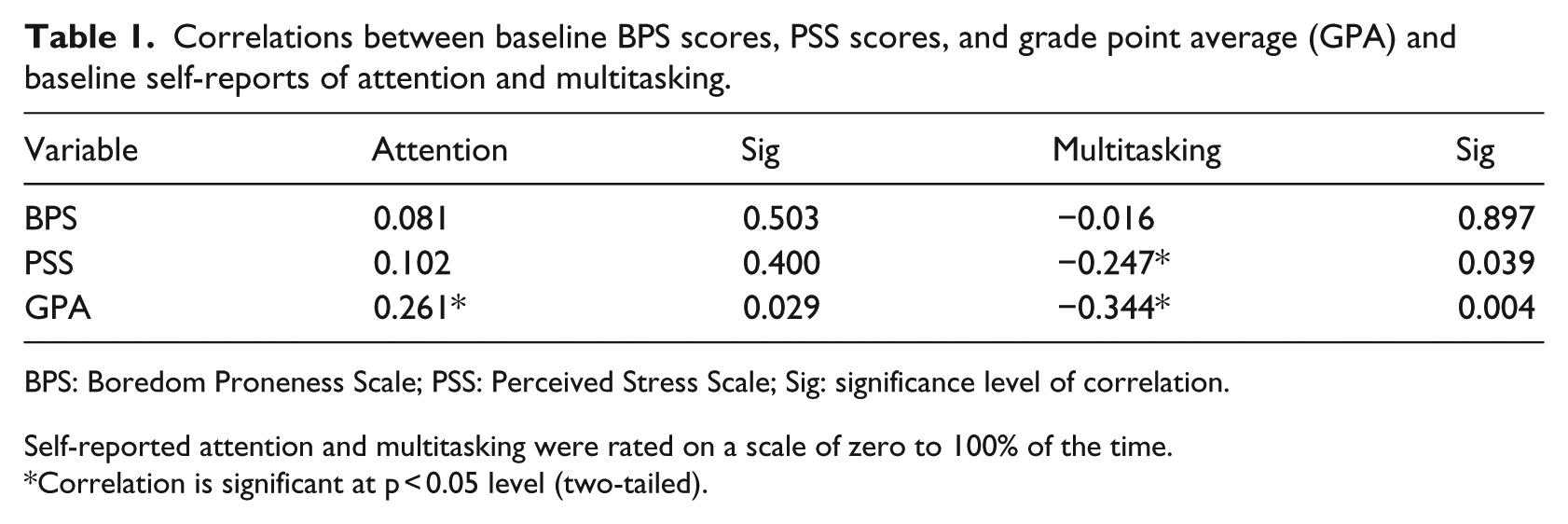
BPS: Boredom Proneness Scale; PSS: Perceived Stress Scale; Sig: significance level of correlation.
Self-reported attention and multitasking were rated on a scale of zero to 100% of the time.
Correlation is significant at p < 0.05 level (two-tailed).
Does an educational intervention about the negative impacts of multitasking in class improve attention and reduce multitasking?
Since GPA and stress were significantly correlated with students’ baseline multitasking and/or attention, conditions (intervention, placebo, control) were examined to ensure they did not differ at baseline (Time 1, before the intervention) on GPA and stress scores. This was the case in both ANOVAs: for GPA, F(2, 67) = 1.50, p = 0.231, η2 = 0.043; for stress (PSS-10), F(2, 67) = 2.15, p = 0.124, η2 = 0.060 (groups also did not vary significantly in boredom proneness (BPS), F(2, 67) = 1.96, p = 0.149, η2 = 0.055). Since conditions did not differ on these variables, we did not control for them in the subsequent main analyses. Table 2 displays each condition’s average GPA, PSS, and BPS score at baseline.
Baseline condition mean values and standard deviations for GPA, PSS-10, and BPS.
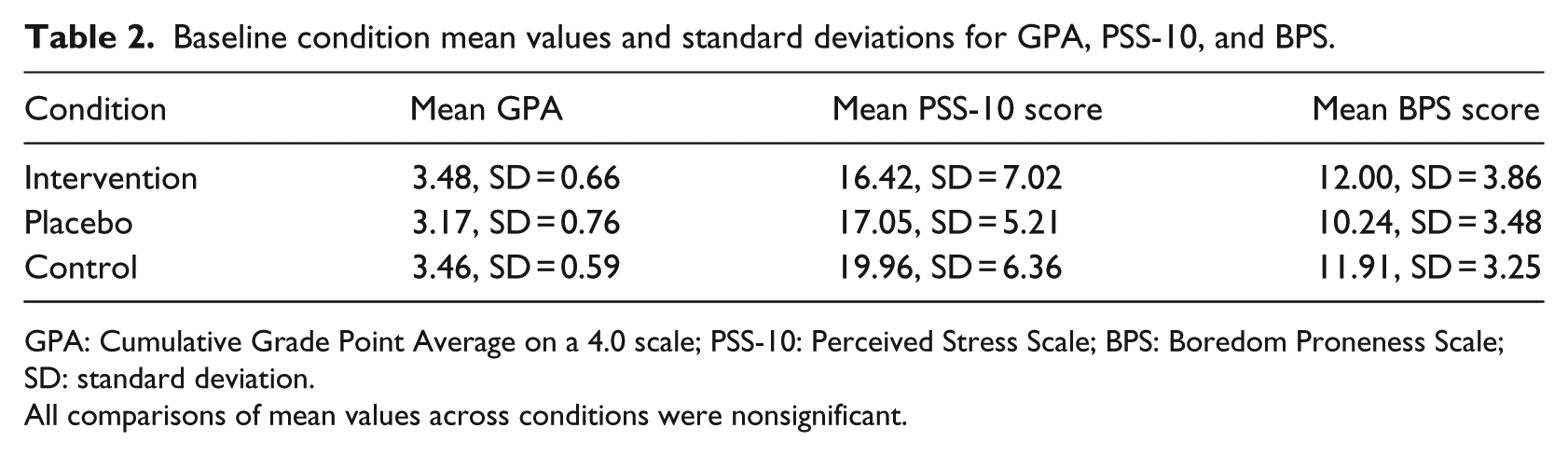
GPA: Cumulative Grade Point Average on a 4.0 scale; PSS-10: Perceived Stress Scale; BPS: Boredom Proneness Scale; SD: standard deviation.
All comparisons of mean values across conditions were nonsignificant.
To ensure that participants absorbed the information in the experimental and placebo interventions, participants’ accuracy on the content retention questionnaire was examined. Successful retention of the presentation material was defined as a minimum of three out of five responses correct. All participants scored at least 4 out of 5 on their content retention questionnaire. All participants were deemed to have retained the information in the presentation shown to their group, and all participants were, thus, used in the subsequent main analyses.
For attention, overall, there was no significant interaction between time (the first and second lab visit) and the experimental condition (intervention, placebo, and control), F(2, 67) = 2.042, p = 0.138, η2 = 0.057, indicating that the intervention did not result in increased attention over visits, relative to other conditions. Nor were there any differences in attention paid in class between experimental conditions (intervention, placebo, and control), F(2, 67) = 0.595, p = 0.555, η2 = 0.017, indicating that no one condition improved attention over others. In addition, no significant difference in the reported amount of attention paid in class was found between the first and second lab visits, F(1, 67) = 0.001, p = 0.972, η2 < 0.01, indicating that time in course did not influence attention.
Although in the above analysis the interaction between time and experimental condition did not significantly predict attention, the effect size (η2 = 0.057) for the time by condition interaction was of a large enough magnitude to be deemed practically important (meaning a magnitude of at least η2 = 0.04; Ferguson, 2009). Post hoc pairwise comparisons on the pre- to post-change scores in attention were, thus, used to elucidate whether a specific group varied from another group in improvement in attention. These post hoc pairwise comparisons (uncorrected for multiple comparisons) were all nonsignificant, indicating that the change in attention over time did not vary in each condition from that in each of the other two conditions. However, the comparison of the change scores in attention between the experimental group and the sleep group approached significance (p = 0.06), and inspection of these change scores revealed that the experimental group showed a trend to increase its attention more than the placebo group. Inconsistent with prediction, the experimental group and the control group had similar change scores in attention (p = 0.771).
For multitasking, the time by condition interaction was also not significant, F(2, 67) = 0.182, p = 0.834, η2 = 0.005, indicating that the intervention did not result in decreased multitasking between lab visits. The between-groups effect of condition for multitasking was not significant F(2, 67) = 1.542, p = 0.221, η2 = 0.044, indicating that no one condition decreased multitasking over others. However, the within-group effect for multitasking of time was significant, F(1, 67) = 7.169, p = 0.009, η2 = 0.097. Most students reported reduced multitasking at time 2 compared to time 1 (63% of respondents), regardless of the experimental condition. The mean values and standard deviations for attention and multitasking at both time points for all conditions are shown in Table 3.
Attention and multitasking percentage scores for each condition at time 1 and time 2.
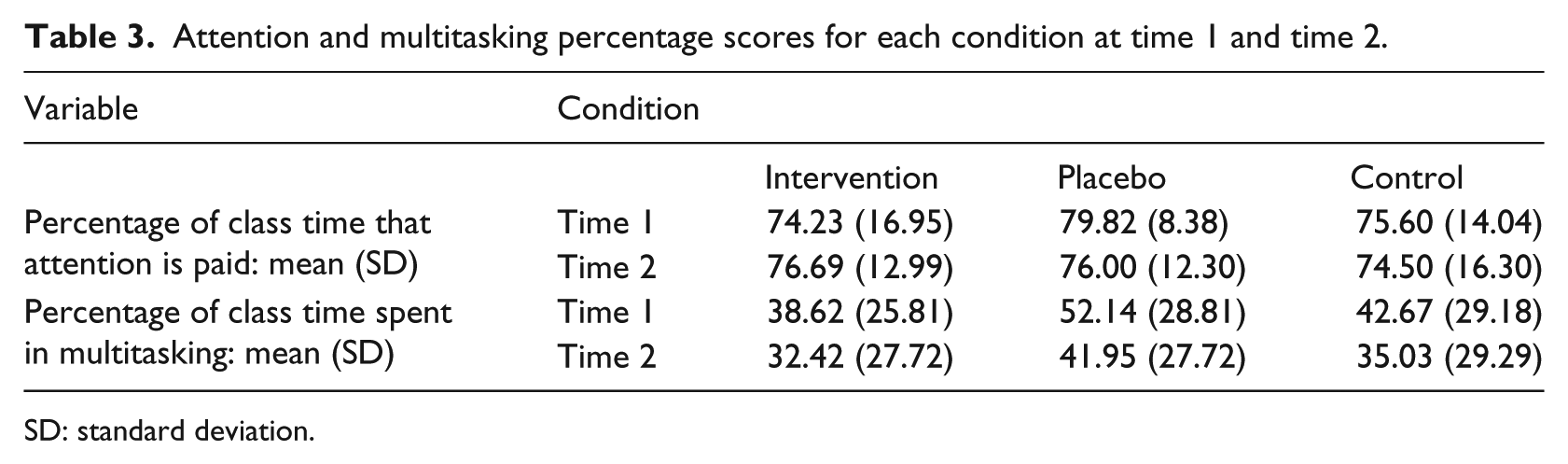
SD: standard deviation.
What are students’ beliefs about the effects of multitasking in class, and do these beliefs relate to whether students benefit from the educational intervention?
Most respondents (66.2%) believed that multitasking while in class reduced the quality of their work at least a little. Indeed, only 33.7% of respondents reported that they do not believe that multitasking reduces their quality of work very much or at all. The vast majority of students (96.6%) reported that they definitely wanted to improve their grades. The majority (69.8%) also indicated that they believe that if they paid more attention in class, they would get better grades.
To analyze whether students’ beliefs about multitasking related to whether they reduced their multitasking behavior in response to the educational intervention, we focused on students’ responses to the following question: “If you multitask in class, do you believe that you can still pay adequate attention to the lecture?” Students were given the response options of “Yes, all the time,” “No,” “Sometimes,” and “I don’t multitask in class.” Five students indicated that they did not multitask in class; however, when asked on another question to indicate the percentage of the time they multitask in class, all five of these students entered a non-zero number (ranging from 3% to 70%, median = 25%, interquartile range (IQR) = 38.5%). Therefore, since these students did indeed multitask in class and yet they did not indicate whether they thought they could pay adequate attention to the lecture during their multitasking, these students were removed from this analysis.
Of the remaining 65 students, 8 (12.3%) indicated that they believed they always could both multitask and pay adequate attention to the lecture, 11 students (16.9%) reported that they could never multitask and pay adequate attention to the lecture, and 46 (70.8%) stated that they could sometimes multitask and pay adequate attention to the lecture. In each condition, the number of students who believed that they could always multitask or could never multitask and pay attention to class was quite small. We therefore used two approaches (descriptive and statistical) to understand whether students’ beliefs about multitasking influenced their response to the intervention.
In the descriptive approach, we focused on the experimental group and asked whether the beliefs students in this group had about multitasking related to whether they improved in their attention/multitasking after the educational intervention. Change scores for each of attention and multitasking were examined in three groups created from students’ beliefs about multitasking (I can always multitask and pay attention; I can never multitask and pay attention; I can sometimes multitask and pay attention). Inspection of the change scores in attention revealed that students who believed they could always multitask (n = 2) did not change in their attention (mean change score = 0, SD = 0). For the four students who believed that they could never multitask, there was a mean increase in attention (mean change score = 10.75, SD = 10.69). Inspection of these four students’ change scores showed that all students increased but with varying degrees of improvement (increases of 1, 2, and 20 for two students). For students in the experimental group who believed they could sometimes multitask (n = 14), there was an overall decrease in their attention (mean change score = –1.64, SD = 12.39), but there was substantial variability, with seven students indicating decreased attention (by 2–25 units) and seven indicating increased attention (by 5–15 units).
Results from classifying the multitasking change scores in the experimental condition into these three groups based on students’ beliefs about multitasking were similar. The two students who had an always multitasking belief changed little (mean change score = −1.00, SD = 1.41; change scores of 0 and −2). Most (three of four) students with a never belief about multitasking decreased their multitasking (mean change score = −14.00, SD = 24.10; change scores of −50, −5, −1, and 0). Within the sometimes group, change in multitasking was quite variable (mean change score = −8.07, SD = 27.05; eight decreased their multitasking from 5 to 55 units, two students did not change, and four students increased their multitasking from 5 to 56 units).
We next used a statistical approach to examine whether students’ beliefs about multitasking related to their response to the intervention. Specifically, we excluded the eight students with always beliefs about multitasking and reran the mixed ANOVA, with time as the repeated factor and condition as the between-participants factor. The results indicated that for attention, there was no significant interaction between time (the first and second lab visit) and the experimental condition (intervention, placebo, and control), F(2, 59) = 1.87, p = 0.163, η2 = 0.060, indicating that the intervention did not result in increased attention over visits, relative to other conditions, when excluding those students who thought they could always multitask successfully. Nor were there any differences in attention paid in class between experimental conditions (intervention, placebo, and control), F(2, 59) = 0.635, p = 0.533, η2 = 0.021, indicating that no one condition improved attention over others. In addition, no significant difference on the reported amount of attention paid in class was found between the first and second lab visit, F(1, 59) = 0.043, p = 0.836, η2 = 0.001, indicating that time in course did not influence attention. In other words, these results are the same as those reported with the inclusion of these students.
As the effect size (η2 = 0.060) for the time by condition interaction was of practically important size (Ferguson, 2009), post hoc pairwise comparisons on the pre- to post-change scores in attention were examined. These post hoc pairwise comparisons were all nonsignificant, but the comparison of the change scores in attention between the experimental group and the sleep group approached significance (p = 0.068) and indicated that the experimental group showed a trend to increase its attention more than the placebo group. However, inconsistent with prediction, the experimental group and the control group had similar change scores in attention (p = 0.695).
For multitasking, the time by condition interaction was also not significant, F(2, 59) = 0.195, p = 0.823, η2 = 0.007, indicating that the intervention did not result in decreased multitasking between lab visits when excluding those students who thought that they could always multitask successfully. The between-groups effect of condition for multitasking was not significant, F(2, 59) = 0.267, p = 0.766, η2 = 0.009, indicating that no one condition decreased multitasking over others. However, the within-groups effect for multitasking of time was significant, F(1, 59) = 5.68, p = 0.020, η2 = 0.088. Most students reported reduced multitasking at time 2 compared to time 1, regardless of the experimental condition.
Discussion
Researchers have suggested that the reason why many people continue to multitask despite evidence of the harm multitasking can cause to performance and cognitive functioning is because they are ignorant of this information (Wang and Tchernev, 2012). Others have suggested that teachers should review the negative impacts of multitasking in class with their students to reduce multitasking (Sana et al., 2013). Contrary to these suggestions, this study found that education is not an effective method of reducing in-class multitasking and improving student self-reported attention. Furthermore, inattention to the educational materials presented, and individual differences in levels of stress, boredom proneness, and GPA, did not account for these findings. Findings from the study described here, thus, bolster and expand upon research that was similarly unsuccessful in reducing in-class multitasking with an educational intervention (Terry et al., 2016). We discuss the findings from each of our three research questions below.
Our correlational findings between baseline attention and multitasking in class, on one hand, and baseline levels of stress and boredom proneness, and current GPA, mirrored trends in research. In line with other studies (Schwanz et al., 2007), we found a strong relationship between GPA and both baseline attention and multitasking, such that students with better GPAs report less multitasking and more attention in class. Thus, in further research on reducing multitasking in class, it will be important to control for student GPA if there are differences in GPA between groups. Inconsistent with research (Farmer and Sundberg, 1986), boredom proneness did not correlate with either baseline attention or multitasking. However, the internal consistency reliability of the BPS was low in this study. Further research into the relationship between multitasking/attention and boredom proneness is needed in a sample in which the BPS has high internal consistency reliability. Our results on the significant negative relationship between stress and multitasking were also inconsistent with some findings (Schwabe and Wolf, 2010). However, not all studies on the relationship between stress and learning indicate that higher stress levels impair learning. To the contrary, under certain circumstances, such as when the stress is experienced near the same time as the material to be remembered, stress may in fact enhance learning (Joëls et al., 2006). Further research is needed to clarify these discrepant findings.
Although some of our correlational findings diverged from other studies, our main finding that the educational intervention did not reduce attention/multitasking is highly consistent with extant research (Terry et al., 2016). Indeed, based on this study and that of Terry et al. (2016), it appears that even when students are fully aware of the possible harms associated with multitasking in class, they will still engage in the behavior. Participants in this study were generally aware of the impact of multitasking on their learning before the study began. The questionnaire responses indicate that most participants believed that multitasking was at least somewhat detrimental to the quality of their work and that they would improve their grades if they paid better attention in class; almost all indicated that they wished to improve their grades. Despite this, many reported that they think that they can pay adequate attention to the lecture while multitasking at least some of the time. Thus, there appears to be a discrepancy between beliefs (multitasking is detrimental to grades), desire to improve grades, and behavior (continuing to multitask). Accordingly, a lack of knowledge about the detrimental effects of in-class multitasking upon performance does not seem a compelling explanation for the multitasking that occurs. Quite to the contrary, it was the students who believed that they could never multitask in class and also pay adequate attention to the lecture who reduced their multitasking the most in response to the educational intervention, according to our descriptive analysis. Possibly, the educational intervention was particularly potent in reducing the multitasking of these students as it reinforced what they already believed to be true. Also descriptively, students who believed they could always multitask and pay attention in class had on average little improvement in their attention or multitasking after the intervention. However, when these students were removed and the groups again compared in their change in attention/multitasking, there was no evidence that the experimental group changed more in attention/multitasking than did the control group.
Thus, although the educational intervention did not significantly improve attention or reduce multitasking, our findings tentatively (with a very small sample size) suggest that an educational intervention about the deleterious effects of multitasking may be effective in certain students—those who already believe that they can never multitask and also pay adequate attention in class. In future research, it would be beneficial to consider other factors known to influence students’ ability to stay focused in class. Indeed, as aforementioned, factors such as motivation, affect, and polychronicity influence student behavior and might explain why interventions focused solely on educating students about the effects of multitasking in class are unsuccessful, since they do not take into account the multiple forces acting on student behavior. Since all these factors influence a student’s decision to multitask in class, a short educational intervention may be insufficient in targeting these factors. As such, it is perhaps not surprising that both the study described here and that of Terry et al. (2016) found that educational interventions were unsuccessful in changing multitasking behavior. While an educational intervention is an appealing option due to its simplicity, it appears that this type of intervention alone may not be effective. Future research should focus on delineating the factors mentioned previously (e.g. negative affect) that cause multitasking. Future research should also consider that the solution to reducing student multitasking in lecture could very well be replacing the traditional lecture with active learning, known to promote student attention and performance (Freeman et al., 2014).
This study has several limitations. It used a small sample and relied on self-reported data. Participants may not have been able to accurately reflect on and report their attention and multitasking. Indeed, one study found only a modest correlation of r = 0.31 between students’ self-reported estimates of their daily multitasking on the computer and objective measures (Moreno et al., 2012). The use of objective measures of multitasking in this study, such as via observation, may have resulted in different findings. Ecological validity was also an issue in this study. Since participants received the intervention in the context of a research study, instead of in one of their classrooms, it is possible that they did not take the information seriously. In addition, this study was conducted on students from only one university, meaning the results may not be applicable to students elsewhere.
In-class multitasking and inattention continue to affect student learning (Junco and Cotten, 2012). It is, thus, a worthwhile endeavor for researchers to search for solutions to this problem. The findings of both the study described here and work by Terry et al. (2016) demonstrate that educational interventions are ineffective. Research emphasis should, instead, be placed on developing other interventions and on identifying root causes of multitasking and inattention. Efforts could be allocated to research student motivation, affect, and polychronicity. As discussed earlier, these factors may influence student multitasking and inattention. Therefore, a better understanding of these factors as well as how to mitigate their effects might be a more profitable approach to reducing in-class multitasking and improving students’ attention in class than educational interventions.
Footnotes
Declaration of Conflicting Interests
The author(s) declared no potential conflicts of interest with respect to the research, authorship, and/or publication of this article
Funding
The author(s) disclosed receipt of the following financial support for the research, authorship, and/or publication of this article: This project was funded by an internal grant from the Learning and Teaching Enhancement Fund, Ryerson University.