




Abstract
Flipped learning is known to be an approach where learners take part in the learning process in a different way than in the non-flipped classroom and that in both they may deepen their knowledge and develop various competencies such as problem-solving and collaboration. Paying attention to the characteristics of flipped learning, the purpose of this study is to propose practical guidelines for the use of the flipped classroom by exploring the teaching and learning processes involved. Through a literature review, the 3 P model of teaching and learning was applied, and grit, professor support for fostering autonomy, learning engagement and perceived achievement were selected as variables for the process involved in learning via the flipped mode. In order to investigate the relationship between these variables, 121 students in a flipped classroom were surveyed. Data were analyzed by path analysis. The results showed that the support provided by the professor in terms of helping students to develop autonomy significantly predicted perceived achievement. Learning engagement mediated the relationship between grit and perceived achievement, and between the support given by the professor in terms of helping students to develop autonomy and perceived achievement. Based on the results, the specific strategies to enhance learners’ grit, their autonomy and learning engagement are discussed for the successful flipped classroom.
The flipped classroom
In recent years, there has been a shift in higher education institutions worldwide, with a call for a need to more fully embrace learner-centered teaching methods. Accordingly, various teaching and learning methods have been attempted, and flipped learning has become the center of attention (Abeysekera and Dawson, 2015; O’Flaherty and Phillips, 2015). Flipped learning is a form in which some learning takes place in advance through video lecture, and in-depth learning activities are done in the classroom. In flipped learning, which centers on collaboration and participation of students within the classroom, there is a wide variety of opportunities for students’ competencies to be cultivated, and this contrasts with general lecture-based classes, that is, the non-flipped ones (Khoo et al., 2015; Lee and Kim, 2017). In general, cooperative learning activities can enhance learners’ interest and engagement in learning, and improve their various competencies such as higher-order thinking (Herrmann, 2013). Cavanagh (2011) reported that cooperative learning activities in class were more effective than traditional lecture-based class in understanding learning contents and increasing learners’ interest and engagement. In this context, cooperative activities are central in flipped learning. It has been reported that it drives positive learning outcomes such as engagement, satisfaction, and achievement (Bates and Galloway, 2012; Bergmann and Sams, 2014; Burke and Fedorek, 2017; Enfield, 2013; Kim and Kim, 2014; Wilson, 2013). Also, the learners who participated in the flipped classroom reported that they developed critical thinking and communication skills through discussion and collaboration (Kong, 2014; Lee and Kim, 2017; Leem and Kim, 2016). The idea of flipped learning has increasingly gained interest as a means of supporting students in their learning in higher education.
Nevertheless, flipped learning does not always guarantee positive learning outcomes (Davies et al., 2013; Kim et al., 2014). For example, Davies et al. (2013) compared the effectiveness of the general classroom, the flipped classroom and simulation in an introductory-level college course on the use of spreadsheets. The results showed that the general class and the flipped class were more efficient than the simulation, but the difference between the general class and the flipped class was not significant. Also, two rounds of experiments were conducted to determine the effectiveness of the flipped classroom compared to the traditional lecture-based class (Foldnes, 2016). The first trial examined the efficacy of lecture and the flipped classroom without promoting cooperative learning and this resulted in no significant differences. On the other hand, in the second experiment, in which collaborative learning activities were carried out, the flipped classroom led to higher academic achievement than via the lecture-based one, that is, the non-flipped classroom.
Therefore, we can learn from these studies that for the learning environment in the flipped classroom to be successfully designed and implemented, several conditions are required. However, these studies focused on the comparison of a flipped classroom with other forms of teaching and learning. Further research is needed to see which learners are performing better within the flipped classroom. Therefore, we need to focus our attention on identifying which presage and process variables predict learning outcomes within the context of the flipped classroom.
Perceived achievement is assumed to be a learning outcome variable within the context of a flipped classroom. Grit, defined as the patience and enthusiasm for long-term goals, is a crucial factor for ensuring that students accomplish positive academic achievement through steady efforts without giving up (Duckworth et al., 2007). Indeed, it is essential for all human beings in any environment, including the workplace. Learners with a high level of grit perform better in learning environments where self-directed learning is required, such as in a flipped classroom (Aparicio et al., 2017; Duckworth et al., 2007; Slick and Lee, 2014). In addition, the nature and amount of support provided by the professor in terms of helping students to develop autonomy, that is, to become more autonomous and not so reliant on faculty is a key variable in fostering motivation as it allows learners to understand their active role in the learning process (Ames, 1992; Black and Deci, 2000). It plays an important role in the flipped classroom environment because autonomy, the need to be more self-reliant and not so dependent on the lecturer, plays a greater role than in the traditional lecture-based learning context (Chen et al., 2014). Finally, learning engagement, which refers to the degree of cognitive, behavioral, emotional and agentic involvement (Reeve, 2013), is a prerequisite for successful learning in a learner-centered learning environment such as a flipped classroom.
Flipped learning
Flipped learning, or the flipped classroom, refers to a way of flipping the traditional way of teaching and learning. While traditional methods of teaching and learning include doing homework after class, flipped learning is a method in which the student first learns through watching a video recording of a lecture (or via some other means) at home in advance and then conducts some kind of activity in the classroom after having done so (Bergmann and Sams, 2014). Individual learning through watching video/recorded lectures allows learners to learn at their own pace by providing flexibility (Chen et al., 2014). In class, more intensive learning activities take place, with dynamic interactions such as exchanging opinions and feedback rather than a one-sided communication from the instructor about content (Baepler et al., 2014).
Although the concept of flipped learning has only recently been introduced, the teaching–learning method of preparation in advance is a method that is not new (Bergmann and Sams, 2014; Hung, 2015). Learner-centered teaching-learning methods based on what is understood by constructivism such as discussion, problem-based learning, and project-based learning are already in use. However, as the use of technology in education becomes more common and the importance of collaboration and community increases, flipped learning has garnered more attention (Lee, 2013). Flipped learning has the advantage of incorporating learner-centered constructivist perspectives as well as teacher-centered traditional teaching-learning methods (Ko, 2015).
Some studies that utilized flipped learning in university classes showed that flipped learning is effective for learners’ cognitive and emotional learning outcomes (Bates and Galloway, 2012; Enfield, 2013; Kim and Kim, 2014; Wilson, 2013). The results, however, were inconsistent, depending on the contexts such as the teaching methods and the characteristics of the learner or the instructor (Davies et al., 2013; Kim et al., 2014). By using flipped learning, satisfaction and academic achievement improved (Bates and Galloway, 2012), and flow and self-efficacy were enhanced (Enfield, 2013). In addition, student performance and opportunities to use knowledge were improved (Wilson, 2013). On the other hand, there was no significant difference in academic achievement and satisfaction in flipped learning of the information system class in a university setting (Davies et al., 2013). Learners’ self-efficacy improved but motivation of learning did not differ (Kim et al., 2014).
3 P model of teaching and learning
The 3 P model serves as the theoretical framework to explain the learning outcomes in a flipped classroom. The 3 P model is a teaching-learning model proposed by Biggs (2003) based on the student approaches to learning (SAL) theory of Marton and Säljö (1976). This model as the learner’s teaching-learning process is divided into presage, process, and product, and represents a dynamic system of interactions between each stage. The presage stage includes student factors and teaching context, the process stage refers to learning activities, and the product stage refers to the quantitative and qualitative learning outcomes. The 3 P model can be used at any level of learning environment and culture (Joo and Kim, 2015), and has been applied in research because of its simplicity, inclusivity, and convenient measurement (Han et al., 2015; Jones, 2002).
The presage stage of the 3 P model consists of existing student factors and teaching context before learning occurs. Factors like prior knowledge and motivation are used as student factors; teaching context is used to explain the elements such as instructional objectives, evaluation method, teaching and learning method (Biggs et al., 2001). The process stage explains the relationship among the learner, the teaching context, and the process of learning activity within the system in which learning occurs. It indicates learner behavior and the intention of the behavior in the complex process of learning (Prosser and Trigwell, 1999). Learning process variables that affect learning outcomes play an important role in explaining what learners do in the learning process. Finally, in the product stage, the desired learning outcome is achieved through learning, and it can include quantitative, qualitative, and emotional outcomes. In the 3 P model of teaching and learning, the components of each stage interact to form a dynamic system, but the basic structure does not change in different learning environments. In the presage stage, the student factors and teaching context interact with each other and show that the factors and learning of the process stage and product stage influence the exchange of knowledge and vice versa. The student factors and teaching context affect the product stage (see the bold lines in Figure 1), and factors of the process stage influence the learning outcome.
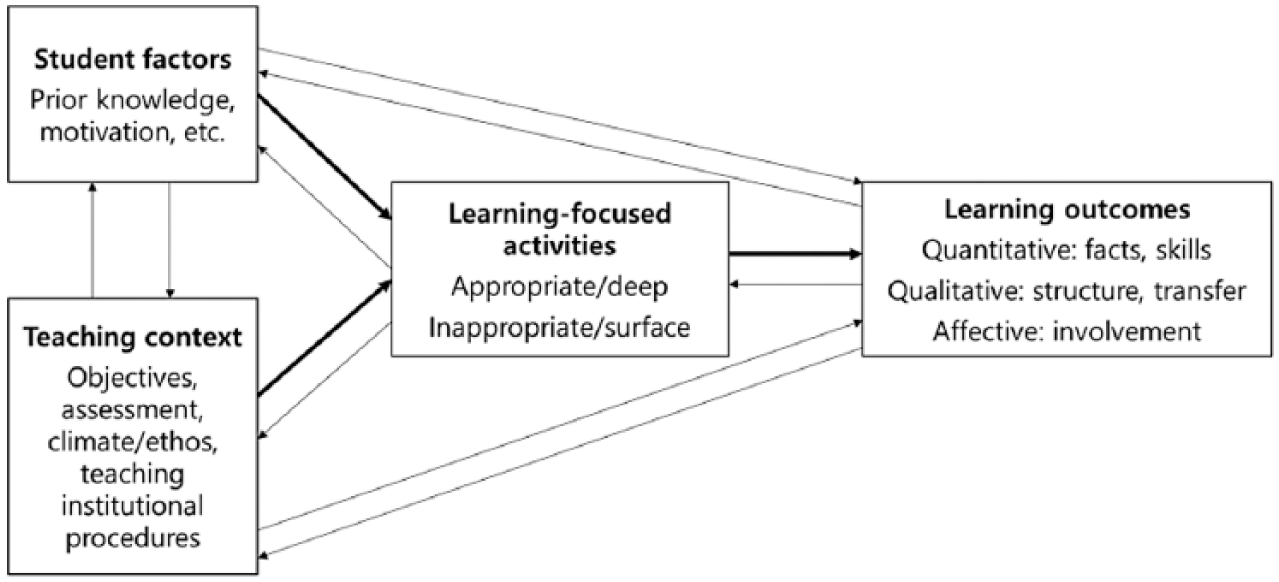
3 P model of teaching and learning (Biggs, 2003).
In particular, in the 3 P model, the student factors and teaching context are core parts of the presage stage which show that the learning environment can play an important role in the learning process. In addition, the 3 P model is considered to be an appropriate model to synthetically examine the relationship between student factor, teaching context, learning process, and learning outcome in flipped learning applied in university classes. Because, in the 3 P model, the mediator effect can be identified through explanatory variables of the learning process stage and the predictive power of the learning process variables can be examined.
There is also a need to examine the perceived achievement of flipped learning in terms of cognitive outcome. Perceived achievement is a learning outcome measured by self-report that allows for simple measurement of a large number of learning outcomes in a cost-effective manner (Ross, 2006). A number of studies have shown that self-assessment is a valid, reliable, and useful way to measure learning outcomes (Ross, 2006). In particular, students who have enough learning experiences as adult learners are known to report reliable results of their perceived achievement (Kang et al., 2012; Lim et al., 2016).
Predicting variables for perceived achievement in a flipped classroom
Grit
Grit refers to patience and enthusiasm for long-term goals and was proposed as a non-cognitive characteristic of people who succeeded in their own field (Duckworth et al., 2007). Grit is a concept that includes two sub-factors: consistency of interest and perseverance of effort. People with high grit levels use continuous effort and do not shift the direction of a goal even when there is no positive feedback (Duckworth and Quinn, 2009; Millward et al., 2016). Grit has been identified as a learner trait variable that positively influences learning outcomes in the context of learning (Wolters and Hussain, 2015). In general, learners with a high level of grit have a higher degree of self-control, are less likely to quit learning, and thus obtain higher academic achievement (Duckworth et al., 2007; Strayhorn, 2014). The US Department of Education reported that grit is required to overcome the challenges and obstacles learners face at school or in life in order to achieve long-term, high-level goals (Shechtman et al., 2013).
Grit is expected to play an important role in learner-centered teaching and learning, in which self-directed learning is required, such as flipped learning. In the online learning environment, learners must perform self-controlled learning, use online teaching-learning resources, and deal with the distant learning environment without declining effort or interest (Aparicio et al., 2017). In a study which surveyed 383 students in the context of e-learning, the grit level had a significant effect on their satisfaction, and satisfaction had a significant impact on the positive perceptions of e-learning (Aparicio et al., 2017).
Research is limited in showing that grit had an influence on learning outcomes in the context of flipped learning. However, the importance of grit can be inferred from the characteristics of flipped learning. Flipped learning requires more autonomy from learners than traditional lectures and when it comes to their abilities re problem-solving through activity-based classroom instruction (Baepler et al., 2014; Chen et al., 2014). Therefore, grit, a persistent effort to achieve long-term goals, can be judged as necessary for successful flipped learning.
Professor support for autonomy
Professor support for autonomy refers to a professor encouraging independent problem solving, actively responding to the learners’ behavior, and exhibiting a supportive attitude. It is the instructor that has an influence on the autonomy felt by the learner. The instructor supports the autonomy of a learner by encouraging and empathizing with the learner’s perspectives. This supportive behavior by the lecturer allows learners to recognize their active role in the learning process (Ames, 1992), experience more interest and enjoyment in learning, and to be more motivated to learn (Black and Deci, 2000). The learning environment in which the learner’s autonomy is supported by an instructor has the effect of enhancing performance related to learning, and significantly predicts achievement (Black and Deci, 2000; Jang et al., 2010; Sohn and Bae, 2014). Support for autonomy was also found to be predictive of learning outcomes, which is indicative that it was a factor strengthening academic performance (Lee et al., 2015). In general, professor support for autonomy leads to positive learning outcomes by increasing motivation and encouraging active participation in learning. This is likely to play a particularly crucial role in a learner-centered learning environment such as flipped learning.
Learning engagement
Learning engagement refers to the degree of behavioral, emotional, cognitive, and agentic involvement in learning activities within a class (Reeve, 2013). Learning engagement involves the learner’s active participation in the class, and includes the cognitive and behavioral intensity and affective quality generated when a learner performs learning activities.
Learning engagement is categorized as behavioral, emotional, cognitive, and agentic participation (Reeve, 2013). Behavioral engagement, defined as the active pursuit of achieving goals through learning activities, is accomplished through effective communication, positive learning attitudes, and opportunities for cooperative learning. Emotional engagement refers to the degree to which positive emotions are experienced during a learning activity. It is enhanced by respect for others and motivation to complete tasks. Cognitive engagement refers to self-regulation by selecting and using learning strategies and implementing the metacognitive plan. This leads to successful learning activities by linking the learned contents with prior learning to understand the content. Finally, agentic engagement refers to the extent to which students contribute to the learning process based on prior learning in the educational environment they experience. Students who participate actively play a role in obtaining learning outcomes through active communication with an instructor (Reeve and Tseng, 2011).
Learning engagement has been focused as the indicator to measure educational effectiveness (Kim, 2014; Reeve et al., 2004). A structural relationship has been demonstrated in which learning engagement has a positive effect on academic achievement (Reeve and Tseng, 2011). Learning engagement has been shown to have a significant effect on academic achievement (Kim, 2014). In addition, there is a positive effect on learning outcomes when the relationship between teacher and student is inclusive (Ahn, 2007).
Prediction of grit and professor support for autonomy for learning engagement
In order to participate positively and steadily in learner-centered teaching and learning methods like flipped learning, individual learners should have high self-control. This is a personal characteristic closely related to grit. There is limited research that verifies the relationship between grit and learning engagement. However, through the role of grit revealed in studies, the predictive power of grit for learning engagement can be inferred. Grit has significant predictive power on self-regulated learning ability as well as educational satisfaction in gifted education (Joo and Kim, 2016). That is, learners with higher grit levels have higher self-regulated learning abilities. The learners with grit have a high level of self-control, engage more in active learning, and control the learning process more effectively. Thus, we can predict a positive relationship between grit and learning engagement in flipped learning.
In addition, the educational environment that supports the autonomy of learners plays an important role in facilitating learning engagement in teaching and learning situations (Kim, 2014). Student engagement was reported to increase when teachers responded to the learner in a way supporting the autonomy of learners (Jang, 2008). Instructors creating a supportive atmosphere in class were significantly predictive of class satisfaction (Reyes et al., 2012). According to these findings, we can observe that as more autonomy is fostered by the instructor, the learners are more actively engaging in the learning process.
Based on the above, flipped learning does not always guarantee successful learning outcomes. That is, there are some conditions that need to be met in order to have successful flipped learning. Therefore, it is necessary to investigate which characteristics should be presumed in order for flipped learning to achieve learning outcomes. There is a need to identify predictors of the learning outcomes of flipped learning, and to explore implications for successful design and implementation of flipped learning. There is a need to understand the teaching-learning process in flipped learning, grit as a student factor, support for autonomy as a teaching context, engagement as a learning process and perceived achievement as the learning outcome. Specific research questions include: Do grit, professor support for fostering autonomy and learning engagement predict perceived achievement in flipped learning? Does learning engagement mediate between grit and perceived achievement in flipped learning? Does learning engagement mediate between professor support for autonomy and perceived achievement in flipped learning? The research model is shown in Figure 2.
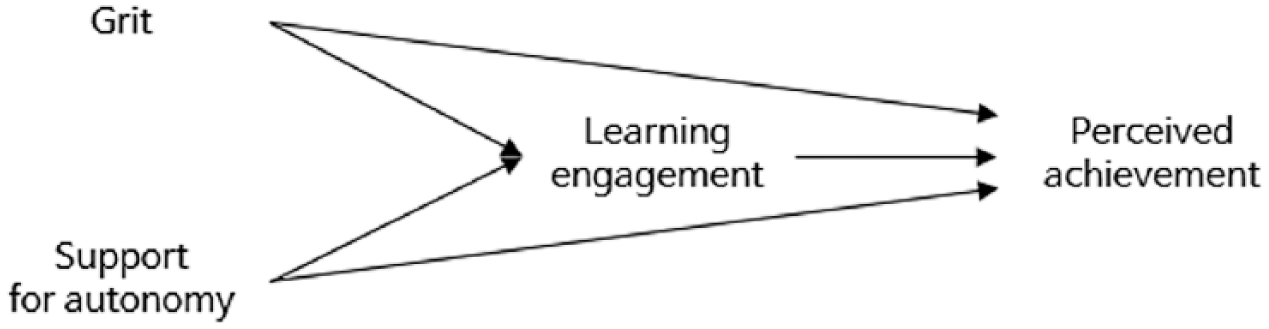
Hypothetical research model.
Methods
Participants
This study involved 128 students who had enrolled in General Physics in the engineering department of Hansung University in Korea in the fall semester of 2016. This course was taught by one instructor in a total of 4 classes, and had implemented flipped learning. Among the 128 respondents who responded to the questionnaire, the final analysis included 121 students, excluding 7 unreliable respondents (response rate: 94.5%). The participants consisted of a majority of freshmen students (113 freshmen (93.4%), 1 sophomore (0.8%), 4 juniors (3.3%), and 3 seniors (2.5%)) 64 students were from the mechanical systems engineering department (52.9%), 23 students were from the electronic and information engineering department (19.0%), 19 students were from the computer engineering division (15.7%), 9 students were from the applied IT engineering department (7.4%), 3 students were from the industrial and management engineering department (2.5%), 2 students were from the management division (1.7%), and 1 student was from the economics department (0.8%).
Research context
The purpose of the lecture conducted in this study was to cultivate students’ ability to solve engineering problems by understanding the concepts and techniques of general physics. The instructor, therefore, planned to apply flipped learning for 13 weeks and gave an orientation on the flipped learning method to students during the first day of class. Each week, the instructor prepared a video of the lecture (about 20–30 minutes) and uploaded it to the Blackboard, which was the university’s learning management system. The learners were asked to prepare for the lesson by watching the online video before class and to then come along to the face-to-face class. The instructor confirmed that students watched the video through quizzes. Face-to-face classes were involved problem-solving, and discussion based on the online video. The students submitted assignments of summaries of the videos, completed exercises, and took a total of four exams. The survey was conducted using the measurement instruments selected for this study during the last class of the flipped learning. In all, 128 students enrolled the class and no one dropped the class during the semester. Therefore, all 128 students responded to the questionnaire.
Instruments
The questionnaire comprised 38 questions. Each variable was measured by the Likert-type 5-point scale.
Grit
Grit is defined as patience and enthusiasm for a long-term goal and comprises two sub-factors: consistency of interest and perseverance of effort. A scale consisting of 12 items was drawn on, including “I have achieved a goal that took years of work” (Duckworth et al., 2007). This scale was used in prior studies of South Korean educational systems (Joo and Kim, 2016; Kang et al., 2016; Yoo et al., 2015). In this study, 10 items were used. Two items were not used as they hindered reliability. The internal consistency reliability of the scales was Cronbach’s α = .89.
Support for autonomy
Support for autonomy is defined as the instructor encouraging the learner to solve a problem independently, responding to behavior and showing a supportive attitude. To measure autonomy support, an instrument developed by Williams et al. (1996) and translated by Jang et al. (2009) was drawn on. This instrument was used in studies conducted in South Korean higher educational systems (Kim and Kim, 2016; You and Kang, 2011). After the reliability analysis, six items were used. Two items were not used as they hindered reliability. An example of an item is: “my professor provides me with choices and options.” and “when I offer suggestions to my professor, he or she listens carefully and considers my suggestions seriously.” The internal consistency reliability of the scale was Cronbach’s α = .93.
Learning engagement
Learning engagement is defined as the degree of cognitive, behavioral, emotional, and agentic engagement in the learning activities of the learner in the classroom. To measure learning engagement, an instrument that is validated for university students in South Korea was utilized (Reeve, 2013). There were a total of 17 items, including “when I’m in this class, I listen very carefully” and “during this class, I express my preferences and opinions.” The internal consistency reliability of the scale was Cronbach’s α = .97.
Perceived achievement
Perceived achievement means the level of achievement that the learners themselves perceived having followed the course. Perceived achievement is an alternative measure of achievement that can be used at contextual limits where researchers cannot be given learners’ actual achievements (Lim et al., 2016). Perceived achievement was measured using a validated instrument developed by Kang et al. (2008), based on Shin (2003). The instrument includes items measuring the diversity and depth of learning, and has been used to measure the performance of flipped learning (Lim et al., 2016). The instrument consisted of 5 items, such as “I have been able to learn a lot from the courses provided.” The internal consistency reliability of the scale was Cronbach’s α = .97.
Data analysis
Collected data were analyzed using SPSS and AMOS. Descriptive statistics analysis and correlation analysis were performed. In addition, path analysis was performed to verify the appropriateness of the set path between variables and to analyze the explanatory power. Path analysis can verify the direct relationship between variables, and indirect effects can be easily analyzed when there are mediators in comparison with regression analysis. To investigate the relationship between variables, path analysis was performed using maximum likelihood estimation. The proposed model was set up to analyze the indirect paths of learning engagement utilizing a saturation model consisting of 10 parameters. For a saturated model (that is, zero degrees of freedom), it is known as a just-identified model. If a model is just-identified, it indicates that it is a perfect fit. The ideal fit for this is the technical representation of the number of uses of information, which correspond to the number of applications of data. It does not mean that the fit is perfectly reasonable. Fully saturated models always produce a perfect fit to the data; therefore, the model fit index is not examined or reported in the fully saturated model.
In addition, in order to verify the indirect mediational paths, bootstrapping method was applied. 5,000 bootstrap samples and 95% bias-corrected confidence intervals were used to examine the significance of indirect mediational paths. The statistical significance level of all analyses was .05.
Results
As can be seen from Table 1, the absolute value of the kurtosis of all variables was < 2 and the absolute value of skewness was < 7. All variables were found to satisfy the assumption of normal distribution (Curran et al., 1996). It shows that perceived achievement used as an endogenous variable had significant correlation with other exogenous variables.
Descriptive statistics and correlation matrices (n = 121).
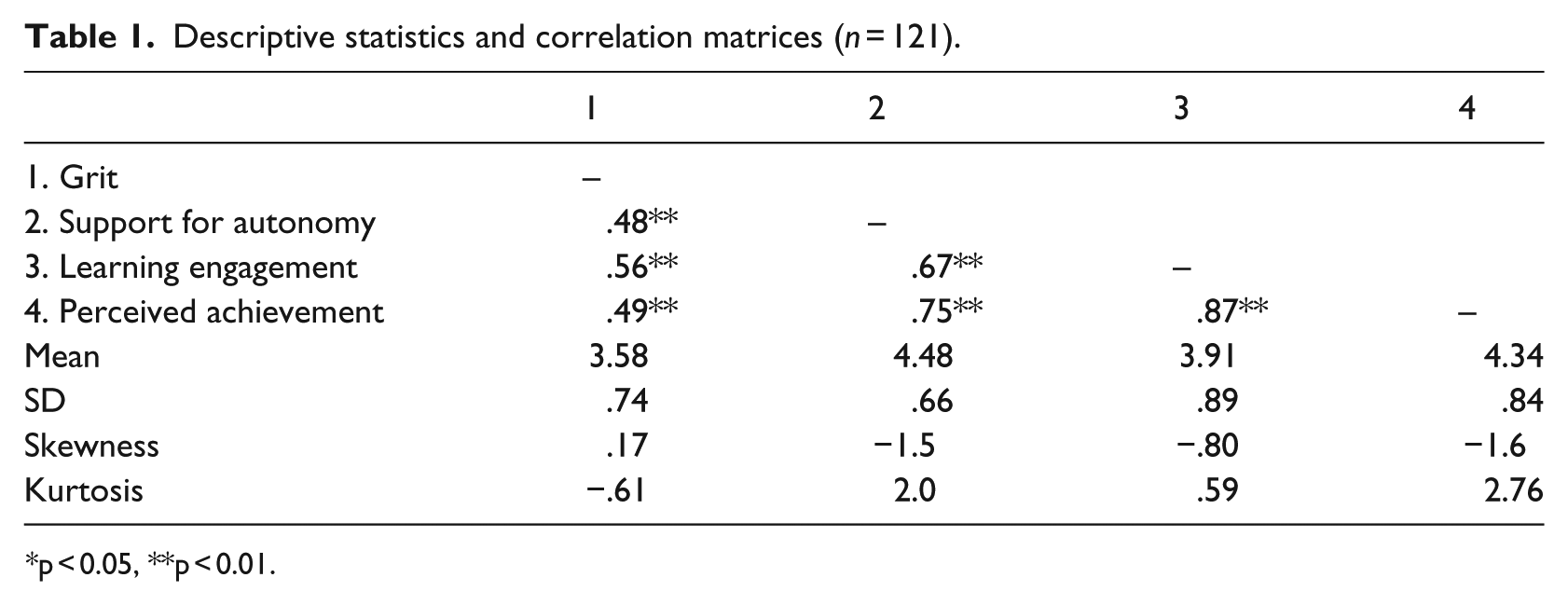
*p < 0.05, **p < 0.01.
As can be seen from Figure 3, the results of the analysis showed that: (a) grit significantly predicted learning engagement (β = .31, t = 4.28, p < 0.05); (b) support for autonomy significantly predicted learning engagement (β = .53, t = 7.32, p < 0.05); (c) learning engagement significantly predicted perceived achievement (β = .68, t = 12.01, p < 0.05); (d) support for autonomy significantly predicted perceived achievement (β = .31, t = 5.47, p < 0.05). However, grit’s path to the perceived achievement was not significant at p < 0.05). The path model explained 52.4% in learning engagement, 80.0% in perceived achievement.
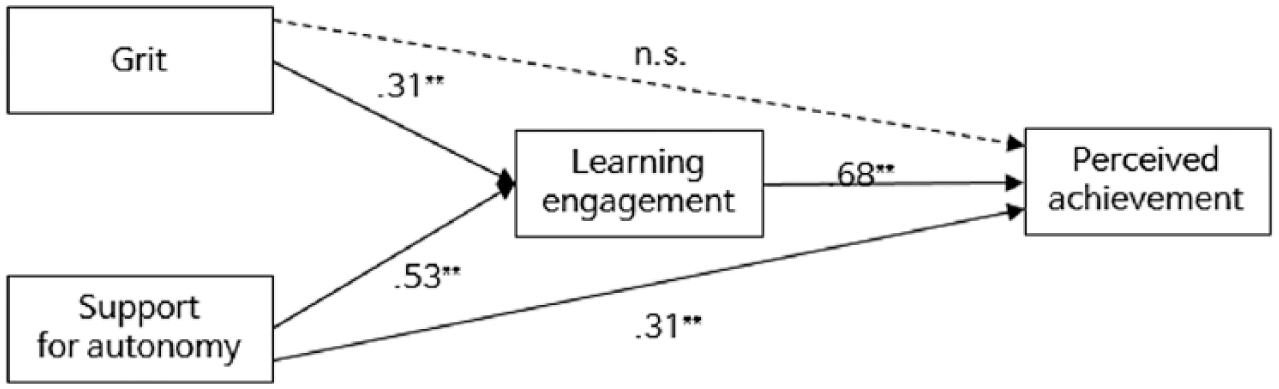
Path analysis result (standardized path coefficient).
Next, Table 2 shows the results of decomposing direct effects, indirect effects, and total effects among variables by performing bootstrapping. Indirect meditational test results suggest that grit predicted perceived achievement through learning engagement (β = .21, 95% confidence interval (CI) = .12 to .35). Support for autonomy also indirectly predicted perceived achievement through learning engagement (β = .36, 95% CI = .31 to .60).
Path model results (n = 121).
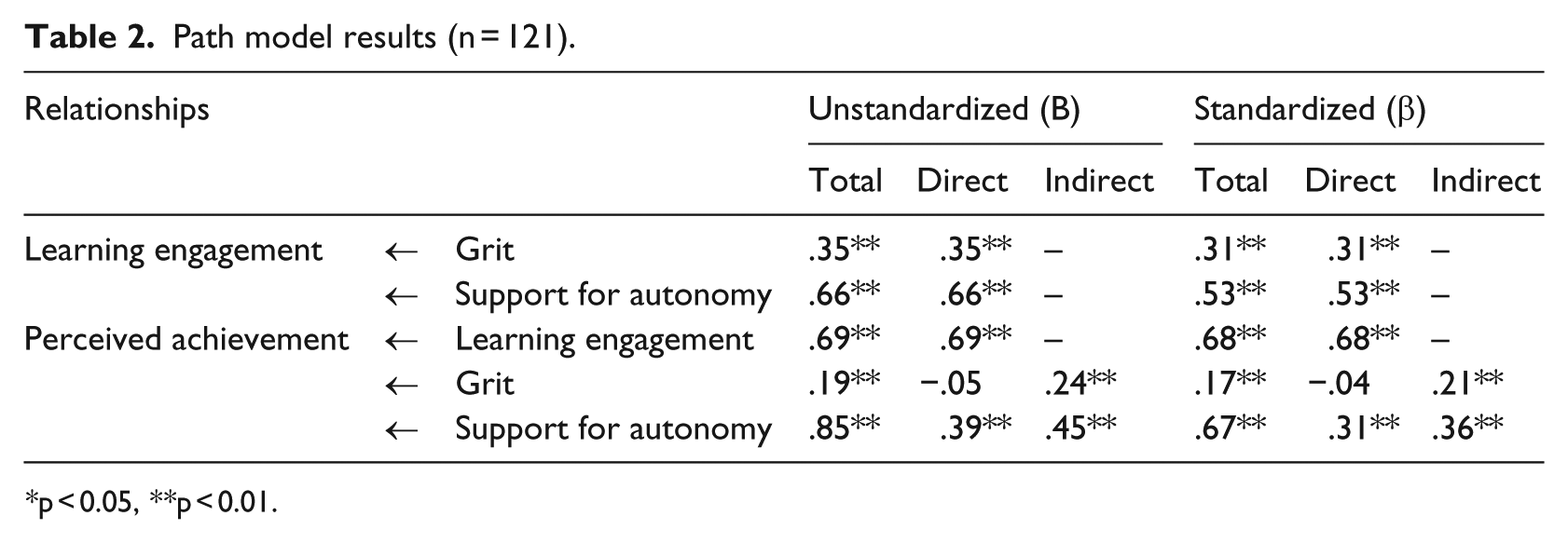
*p < 0.05, **p < 0.01.
Discussion and conclusion
This study sought to shed light on concrete instructional design strategies for successful flipped learning by examining the predictive power of grit, support for autonomy provided by the lecturer/instructor, and learning engagement on perceived achievement within the context of a flipped classroom in the university environment.
First, the study found that professor support for fostering autonomy in students and learning engagement predicted perceived achievement. This finding is supported by the studies (Black and Deci, 2000; Kim, 2014; Lee et al., 2015; Soenens and Vansteenkiste, 2005; Sohn and Bae, 2014).
Second, a significant mediating effect of learning engagement between learners’ grit and perceived achievement was found. This is consistent with the studies (Duckworth et al., 2007; Strayhorn, 2014). The more persistent learners are, the more likely they are to be actively participating in learning, whether in the flipped classroom or the non-flipped one, and this may be part of the reason why they perceive that their achievement is higher, or that it actually is. Learning engagement also had a significant mediating effect on the relationship between the professor’s support for fostering autonomy in their students and perceived achievement. This is a result consistent with studies (Jang et al., 2009; Kim, 2008). As in the non-flipped classroom, it is confirmed that learning engagement can be a powerful learning process variable that mediates between learning context and learning outcome. Studies suggest that cooperative activities have positive effects on learning engagement (Cavanagh, 2011; Herrmann, 2013). This explains why instructors design cooperative activities with various forms in class to enhance student engagement.
Third, the results show that the 3 P model can be applied to the flipped learning environment. The grit as the student factor, the professor’s support for fostering autonomy as the teaching context factor, and learning engagement as the learning process factor were identified as factors that directly or indirectly influenced learning outcomes. It is meaningful since it extends the applicability of the 3 P model, which usually has been studied only in non-flipped classes (Han et al., 2015; Jones, 2002), to flipped learning context by examining the presage, process, and product stages of learning. Also, the results verified that each factor from the model has positive effect on learning outcomes in the context of the flipped classroom.
In this study, as grit seems to predict perceived achievement through learning engagement in flipped learning, a strategy is needed to keep learners interested in long-term goals and maintain the interest. To help to achieve this, instructors should promote students’ intrinsic motivation so that they can motivate achievement in flipped learning. In other words, it will be helpful to give students the opportunity of choice by giving specific learning objectives and providing various learning resources to achieve these learning goals.
In addition, as learning, whether in the flipped or non-flipped classroom, is based on the learners’ self-directed participation (Leem, 2016), it is important that the instructor respects learning methods and activities that are more geared toward fostering autonomy in learners. It is important to provide appropriate guidance and feedback on self-directed learning activities because feedback plays a crucial role in all learning activities, whether in the flipped or non-flipped classroom (Warburton and Volet, 2013). Therefore, when adopting the flipped classroom, instructors could suggest learners submit a summary or a reflection paper after watching the video, or conduct reflection activities on group work.
Furthermore, it is necessary to develop a strategy to increase the learners’ participation in the learning process since learning engagement is proven to be an important learning process variable not only mediating the presage stage and the product stage but also predicting achievement. In flipped learning, just as in the non-flipped one, learner participation can be encouraged by appropriately connecting online learning and offline activities. Providing quizzes on online lectures can be an important strategy to link online and offline learning and to encourage learner participation (Leem, 2016). This is consistent with the Watch-Summary-Question (WSQ) strategy in which students can learn online lectures and gather questions in the classroom to interact and discuss with teachers and other students in class (Bergmann and Sams, 2014).
This study is not without limitations. The study measured perceived achievement using self-reporting. It is necessary in future studies to gather data on actual, not perceived, achievement through marks/grades in order to determine their actual achievement. This study also did not consider the variables related to the attitude and behavior of learners watching the video lecture before attending class. Despite the fact that the instructor tried to check whether students watched the video through quizzes, it does not guarantee that all the students watch the video. As we all know, just because we design activities or materials for students for use outside of the classroom, such as video recordings of lectures, there is no guarantee that they will watch them, or watch the whole lecture from start to finish or, in the case of the flipped classroom, whether they choose to watch them after, not before, the activities carried out in the classroom. The assumption was made in the study described in this article that the students had watched these recordings before, not after, the scheduled class. Viewing behaviors of students in this study were not included. Behaviors of students, whether in the flipped classroom or any other, vary. In terms of viewing lectures, or attending lectures, it is usually the case that viewing/attendance is higher in the early weeks/stages but that it diminishes as the course progresses. Future work is therefore needed to look at behaviors over time, at different stages of a course. What students achieve in terms of marks/grades may or may not be different according to their actual behaviors. Because it is essential to link the video recording of the lecture with the classroom activities, it is necessary to carry out future studies to examine the influence of the attitudes and behaviors of learners when watching lecture videos on in-class activities and learning outcomes. Another limitation is that the various elements/components of the course were not used as measures within the model, so future work needs to look not only at a course as a whole but also to look at it taking into account the various elements/components, such as any differences between performance in coursework or by examination. Another limitation is that it is not known what the levels of grit, engagement and the rest were in the participants before they studied this course in the flipped mode, that is, they may have already had high levels of grit, or motivation. Future work therefore needs to include measures taken before, as well after, the intervention (here, the flipped classroom). The study had a relatively small study sample, that is, only from one discipline, one university and one country. Studies with a larger sample size, from disciplines other than engineering and from different levels, for example, those in their final year or those at postgraduate level, and from different cultures/countries are needed in order to better understand the structural relationship between variables.
Despite these limitations, this study provides further evidence of the success of flipped learning in university education. It is expected that research and active practice of flipped learning will continue to play an important role in supporting learning.
Footnotes
Declaration of Conflicting Interests
The author(s) declared no potential conflicts of interest with respect to the research, authorship, and/or publication of this article.
Funding
The author(s) received no financial support for the research, authorship, and/or publication of this article.