



Abstract
Research has frequently found that students use their information and communication technologies—such as smartphones and laptops—for non-academic uses in the classroom. These uses include sending messages as well as checking email and social media accounts. This study aimed to examine students’ in-class information and communication technology use, their motivations for it, and perceptions of it, as well as their attitudes toward restriction and integration of information and communication technologies in the classroom. It was found that students most frequently engage in non-academic information and communication technology use when they feel that they would not miss any new class content, or when they feel disengaged. Students perceived that their non-academic information and communication technology use had costs, especially distraction. However, students also reported negative attitudes toward policies that would restrict their information and communication technology use in the classroom but had positive perceptions of attempts to integrate information and communication technology use. We propose that information and communication technology integration can be an effective method of increasing student engagement—and therefore decreasing non-academic information and communication technology use.
Keywords
The use of technological devices such as laptops, tablets, and smartphones has become a routine component of modern-day society. Higher education classrooms are no exception, with most students now bringing their laptops or smartphones to class (Ragan et al., 2014). Although these devices—referred to as information and communication technologies (ICTs; Barry et al., 2015)—are used in the classroom for academic activities, such as taking notes, students also use these devices to engage in various non-academic activities. For example, students have reported using their ICTs in the classroom for online shopping, instant messaging, playing virtual games, and browsing their social media accounts (e.g. Aagaard, 2015; Akbulut et al., 2016; Barry et al., 2015; Kuznekoff and Titsworth, 2013). In fact, one study found that when undergraduate students used their ICTs in the classroom, two-thirds of that time was spent on non-academic activities (Ragan et al., 2014), whereas another study found that 42% of students’ time in classrooms was spent on non-academic activities on their laptops (Kraushaar and Novak, 2010).
These non-academic uses of ICTs in the classroom are associated with various negative academic outcomes; students who report more frequent engagement in non-academic ICT use also report decreased levels of sustained attention in class (Wei et al., 2012), lower test scores (Bjornsen and Archer, 2015; Kuznekoff and Titsworth, 2013; Ravizza et al., 2017), and lower overall grade point averages (GPAs; Junco, 2012; Junco and Cotten, 2011; Kirschner and Karpinski, 2010). These detrimental effects can be partially explained by the role of multitasking, or simultaneously attending to two or more tasks at a given time. A great deal of research in psychology (see Pashler and Johnston, 1998, for a review) has demonstrated the limitations of attention, such that performing two tasks simultaneously (simultaneous multitasking), or rapidly alternating between two tasks (interruption multitasking) results in impaired learning or increases in the amount of time it takes to learn material (Pashler et al., 2013). Research has shown that students who multitask in the classroom—such as texting or engaging in non-academic activities on their laptops—experience negative effects on various indicators of academic success, such as exam scores (e.g. Hembrooke and Gay, 2003; Junco and Cotten, 2011; Kraushaar and Novak, 2010; Wood et al., 2012). Given that students who engage in non-academic ICT use report that it has a detrimental effect on their learning, and that students who are in close proximity to those engaged in non-academic ICT use also report that it distracts them (e.g. Fried, 2008; Sana et al., 2013), it is important to try to understand why students engage in these activities in the classroom. If our goal is to discourage non-academic ICT use in the classroom, then it is also important to assess students’ attitudes toward attempts to either restrict or integrate ICT use in the classroom.
Student motivations for non-academic ICT use
Several motivations have been identified as key contributors to student’s non-academic ICT use. For example, Olufadi (2015) found that students often use their mobile phones during lectures to maintain social connections and relieve boredom. Most notably, students who use their devices to relieve boredom perceive this non-academic use as a mental break from prolonged, unengaging lectures (Aagaard, 2015). Aagaard (2015) found that students engage in non-academic ICT use in the classroom when they consider lecture content to be either too difficult or too easy, or if they perceive the lecture to be unengaging. In addition, students report that if they are not encouraged to actively participate in class, they turn to non-academic activities to relieve boredom (Aagaard, 2015; Barry et al., 2015). Unfortunately, boredom in classrooms appears to be a common experience for university students. For example, Mann and Robinson (2009) found that 59% of students reported their lectures as being boring half the time, and 30% reported that most or all of their lectures were boring.
Knowing that boredom might be a major factor in non-academic ICT use might impact the ways in which instructors address this issue. Regarding non-academic use, researchers have generally proposed two potential solutions: (1) to restrict the use of ICTs in the classroom and (2) to integrate the use of ICTs in the classroom to improve student engagement and facilitate learning. Restricting ICT use in the classroom seems likely to be ineffective if student boredom is not also addressed, as students would remain unengaged and disinterested in the lecture material. Integrating ICTs in the classroom, however, may engage students while also reducing negative outcomes associated with boredom and non-academic ICT use.
ICTs in the classroom: restrict or integrate?
Few studies have examined students’ views regarding policies on ICT use in the classroom; however, the results of these studies indicate that students are generally not supportive of restrictive policies regarding their ICT use (e.g. Jackson, 2013; Santos et al., 2018; Tindell and Bohlander, 2012). That is, students are not only opposed to policies completely banning ICT use in the classroom, but they are also opposed to policies aimed at reducing non-academic ICT use in classroom, such as those that prohibit students from sending text messages during a class lecture (McCoy, 2016; Santos et al., 2018). This opposition is perhaps not surprising if a major factor in non-academic ICT use is boredom. Simply taking away the ICTs, or limiting students’ use, would do nothing to make classes more interesting, and instead removes students’ preferred means of coping with a boring class. However, students’ attitudes contrast with those of instructors, who are more likely than students to support restrictive policies related to ICT use, including a complete ban of all electronic devices from classrooms (e.g. Baker et al., 2012). For example, Santos et al. (2018) reported that compared to instructors, students were significantly less likely to agree with policies that would restrict their non-academic ICT uses (such as social media) and significantly more likely to support policies that would allow them to continue to use their ICTs while minimizing disruption (e.g. to use them in silent mode).
Although several studies have assessed participants’ attitudes toward hypothetical restrictive policies, Elliott-Dorans (2018) assessed the impact of an actual laptop ban on students’ performance. Across two semesters, several sections of a course were randomly assigned to a “laptop” or “laptop ban” condition. Elliott-Dorans reported that students who were banned from using their laptops had lower class attendance and lower grades on both papers/coursework and examinations, across both semesters, compared to students who were permitted to use their laptops. In another study by Hutcheon et al. (2019), students in two sections of a course were allowed to use ICTs in the classroom, whereas those in two other sections were banned from using their ICTs. They found no significant differences between the two groups on students’ exam grades, professor–student rapport, or interest in the course. However, students in the technology-ban sections reported significantly lower levels of engagement in the course. Taken together, these results suggest that restricting ICT use may not be the best solution to reducing negative outcomes associated with technology in the classroom. Banning ICTs, in the absence of complementary efforts to increase engagement in class, may simply disengage students, or drive them away from class, resulting in poorer learning outcomes.
Recently, a Canadian University implemented its own laptop ban in an attempt to prevent students from being distracted by using their ICTs for non-academic purposes. It is unknown whether or not this ban resulted in its intended effect, but what is clear, however, is that the ban was met with strong criticism from student groups, with a social media campaign encouraging the use of “#SayNotoLaptopBan.” This suggests that students’ lack of support applies not just to hypothetical but also to actual policies restricting classroom ICT use (University of Toronto Students’ Union, 2019). While restricting ICT use in classrooms may be a popular course of action among instructors (e.g. Baker et al., 2012), the scholarly evidence and salient real-world examples suggest that restricting or banning the use of ICTs elicits negative responses from students. It may even have detrimental effects on students’ learning.
Restriction of ICT use encompasses policies on a spectrum from completely banning ICTs in the classroom (as the example above demonstrates) to allowing the use of ICTs only during break periods. However, these are not the only policy options; ICTs can also be integrated in the classroom. Over the past several years, some instructors have attempted to integrate ICT use in their course curriculum—both inside and outside of the classroom—to increase student engagement and interest. This can include designing course websites to be accessible through mobile devices (Chen et al., 2008), using personal digital assistants (PDAs) to mediate communication in the classroom (Du et al., 2010), taking students on virtual field trips (Turney et al., 2009), as well as asking students to use their own ICTs to complete in-class activities via online platforms (e.g. Remón et al., 2017). Although limited research has examined the effects of integrating ICTs in the classroom, the results of these studies show promise as students generally support instructor-facilitated use of ICTs for activities in the classroom (e.g. Licorish et al., 2018) and have positive perceptions of its use in the classroom (e.g. Hunsu et al., 2016). More specifically, integration of ICTs for course-related activities leads to greater student engagement, and students perceive that it enhances their learning experience in the classroom (e.g. Plump and LaRosa, 2017; Shon and Smith, 2011; Tessier, 2013). So, given that it appears that students hold negative attitudes toward restrictive policies, and that restricting their use might be detrimental to students’ academic performance, it is perhaps worthwhile to instead focus attention on ways to integrate ICT use in the classroom.
Existing literature indicates that—when integrated effectively—ICTs can be an invaluable pedagogical tool for enhancing student learning in the classroom (e.g. Imazeki, 2014; Shon and Smith, 2011). Integration occurs on a continuum. For example, online courses can be considered one end of the spectrum of integration, where students complete all their learning online with no face-to-face interaction in a classroom (Moore et al., 2011). In addition, blended learning consists of a teaching approach in which traditional classroom instruction is combined with online—or computer-mediated—learning (Boelens et al., 2018). These approaches are increasing in popularity due to their ability to increase students’ flexibility and self-regulation in accessing content. In these classrooms, a significant component—or all—of students’ learning occurs through the use of technology. A meta-analysis by Means et al. (2013) compared the effects of experimental studies that involved traditional face-to-face, blended learning, and/or online-learning conditions. Studies involving blended learning models outperformed those in purely online or face-to-face models, a conclusion also reached in a similar meta-analysis by Bernard et al. (2014). Means et al. (2013) noted, however, that this effect could be due to the additional learning time provided to students in blended learning conditions, rather than simply attributing the difference to the integration of technology specifically. Finally, various individual-level factors also affected the instructors’ ability to even use technology for educational purposes, such as existing technology literacy skills (Georgina and Olson, 2008).
Integration, however, does not only encompass learning experiences that are primarily technology-mediated. On the other end of the spectrum, ICT integration can include supplemental methods of content delivery, such as the use of interactive whiteboards and course-related software (Livingstone, 2012). Integration could also include technology-mediated activities in classrooms—such as Kahoot! games—which aim to achieve specific learning outcomes through gamification (e.g. Licorish et al., 2018). More recently, social networking sites—such as Facebook and Twitter—have also been used as methods of enhancing instruction both inside (e.g. Al-Bahrani and Patel, 2015; Hawkins, 2015; Kassens-Noor, 2012; Prestridge, 2014) and outside the classroom (e.g. Blessing et al., 2012; Dyson et al., 2015). However, the literature on using social media as a pedagogical tool is not conclusive regarding its effectiveness on student learning. For example, using a quasi-experimental design, Welch and Bonnan-White (2012) found no significant differences in students’ engagement in the classroom between students who used Twitter and those who did not. In fact, students who were in the control condition—that is, who wrote their responses by hand, rather than posting on Twitter—perceived greater levels of engagement. However, using Twitter in the classroom to obtain instant feedback has been shown to facilitate student–teacher communication and class discussion (e.g. Junco et al., 2011), resulting in a more engaging learning experience. In addition, Buzzetto-More (2012) explored the use of Facebook as an instructional tool and found that students reported positive perceptions toward using the social networking system as a communication tool to build a classroom community, but not to replace course management systems as a whole.
Based on the literature, one productive line of inquiry is to continue to explore the possibilities for the integration of ICTs in the classroom; this includes investigations of students’ attitudes toward the use of instructor-facilitated ICT use, as well as the effects of this use on students’ learning within the classroom. While there is literature that examines these questions broadly (e.g. Aagaard, 2015; Heflin et al., 2017; Lepp et al., 2015; Ravizza et al., 2017; Van der Schuur et al., 2015), there is a need to provide a more nuanced investigation of ICT use in the classroom, specifically in determining students’ perceptions of potential restriction and integration of ICTs, as well as their perceived benefits and detrimental effects. In this study, we explore three sets of issues related to ICT use in the classroom: (1) in what ways do students already use ICTs in the classroom and what are their perceptions of how this use affects their learning? (2) what policies would students be willing to support regarding ICT use in the classroom? and (3) have students experienced integrated ICT use, and if so, what are their perceptions of how this use affected their learning in the classroom?
Method
Participants
A total of 321 Canadian undergraduate students enrolled in several sections of an introductory psychology course at Ryerson University signed up to complete an online survey. At the end of the survey, we asked participants to indicate whether they had taken the study seriously and whether we should use their responses in our analyses. In total, 34 indicated that their results should not be used, resulting in a final sample of 287 participants. Demographic or other identifying information was not obtained from participants.
Procedure
The study was an online one approved by a Canadian Research Ethics Board. Participants were enrolled in introductory psychology courses at Ryerson University in the Fall 2017; these introductory psychology courses followed a weekly, 3-hour lecture schedule, with no accompanying workshops or tutorial sections. After providing consent, we asked participants to answer a series of questions that asked about their ICT use in the classroom. Following completion, participants were asked to read an online debriefing form and were compensated for their participation with half a participation mark toward their overall grade in the course. The study was programmed and administered using Qualtrics (2017) survey software, and took approximately 20 minutes to complete.
Survey
The survey consisted of 19 open- and closed-ended questions; however, questions 2 through 4, and 13 through 19 pertained to a separate study investigating students’ study habits, and so the results from these questions are not reported here. Answers to questions 5 through 12 formed the data for this study. Forced-choice questions asked participants to indicate the types of ICTs they bring into the classroom, the types of activities they use their ICTs for in the classroom, and in what time periods during the lecture they engage in ICT use. In open-ended questions, we asked participants to indicate the (1) perceived benefits and detrimental effects of having an ICT with them in the classroom; (2) perceived benefits and detrimental effects of other students’ ICT use in the classroom; (3) benefits and/or negative effects associated with integrated ICT use in the classroom, for students who had experienced this; and (4) the expected benefits and/or negative effects associated with integrated ICT use in the classroom, for students who had not experienced this. The questions were created by the researchers and informed by several studies (e.g. Aagaard, 2015; Akbulut et al., 2016; Barry et al., 2015). The specific survey questions are presented below:
Which of the following—if any—ICTs do you have with you during class? (please select all that apply): laptop, phone, iPad, tablet, smartwatch, other (specify), I do not have any ICTs with me in class. If you used your laptop to take notes during classes, or if you had your phone or other electronic device with you during class, did you use it to do any of the following during your classes? (please select all that apply): checking email, instant messaging, look up words or definitions or trying to clarify things presented in class via the web, play games, online shopping, read or post on social media websites (Facebook, Instagram, Twitter, etc.), look at other websites not related to the class (give details), complete work for other classes, other (describe). If you used an electronic device (laptop, phone, iPad, etc.) for something that was not related to the class (like sending emails, instant messaging, playing games, online shopping, or social media activity), when did you do those things? (please select all that apply): in the break periods, whenever I felt I would not miss content (e.g. when I felt like I already knew what the lecturer was presenting), whenever a student asked the professor a question, whenever I got bored, all the time, other (describe). If you used an electronic device (laptop, phone, iPad, etc.) for something that was not related to the class (like sending emails, instant messaging, playing games, online shopping, or social media activity), what percentage of the class time do you think you spent doing these things? Have any of your instructors completed in-class activities that involved your use of ICTs (i.e. completing a Kahoot! quiz, taking an online poll, etc.)? If yes, do you think this was beneficial to your learning experience? Why? If no, do you feel that this is a component that would enhance your in-class learning? Why or why not? What are the benefits of using and/or having ICTs with you during lectures? Alternatively, what are some of the negative effects of having ICTs with you? Do you feel that other students having ICTs with them have an impact on your learning experience in the classroom? If yes, please describe why. Which of the following policies regarding ICT use in the classroom would you support? Complete ban on ICTs in the classroom (no laptops, cellphones, etc.); use of ICTs in the classroom allowed, but no Wi-Fi access; half of the classroom designated for ICT users, but other half for handwritten note-takers; I do not support any of these policies; other (describe).
Analytic strategy
In addition to calculating means and proportions from participants’ responses to forced-choice questions, we conducted a thematic analysis of their responses to the open-ended questions to identify emerging themes (Braun and Clarke, 2006). Coding themes for each question were developed independently by the first author, after an initial review of all open-ended responses. These themes were then applied and adjusted following an independent review of responses by the second author. Following a preliminary discussion based on coding the first 15 responses, both the first and second authors then applied the coding scheme to all student responses. Any discrepancies were resolved through further discussion and reliability statistics were calculated for all items to determine interrater reliability.
Results
In what ways do students use ICTs in the classroom?
The majority reported bringing a laptop (85.4%) or smartphone (81.5%) with them to class. A small percentage indicated that they had additional forms of ICTs with them, such as smartwatches (4.9%), iPads (2.4%), and tablets (2.4%). Unsurprisingly, only 1% (n = 3) reported that they did not bring any ICTs with them to class. Participants also reported the non-academic activities they engaged in during class time, as well as when they engaged in these activities. As presented in Table 1, the majority checked their email (70.7%) and sent instant messages (70.7%) during class. Almost half (49.8%) indicated that they browsed or posted on social media websites in class. Although most (86.1%) stated that they engaged in these non-academic activities during the break periods, only 24.7% indicated that they engaged in these activities solely during the break.
Students’ self-reports of the academic and non-academic ICT use they engage in during class, and when they engage in such use.
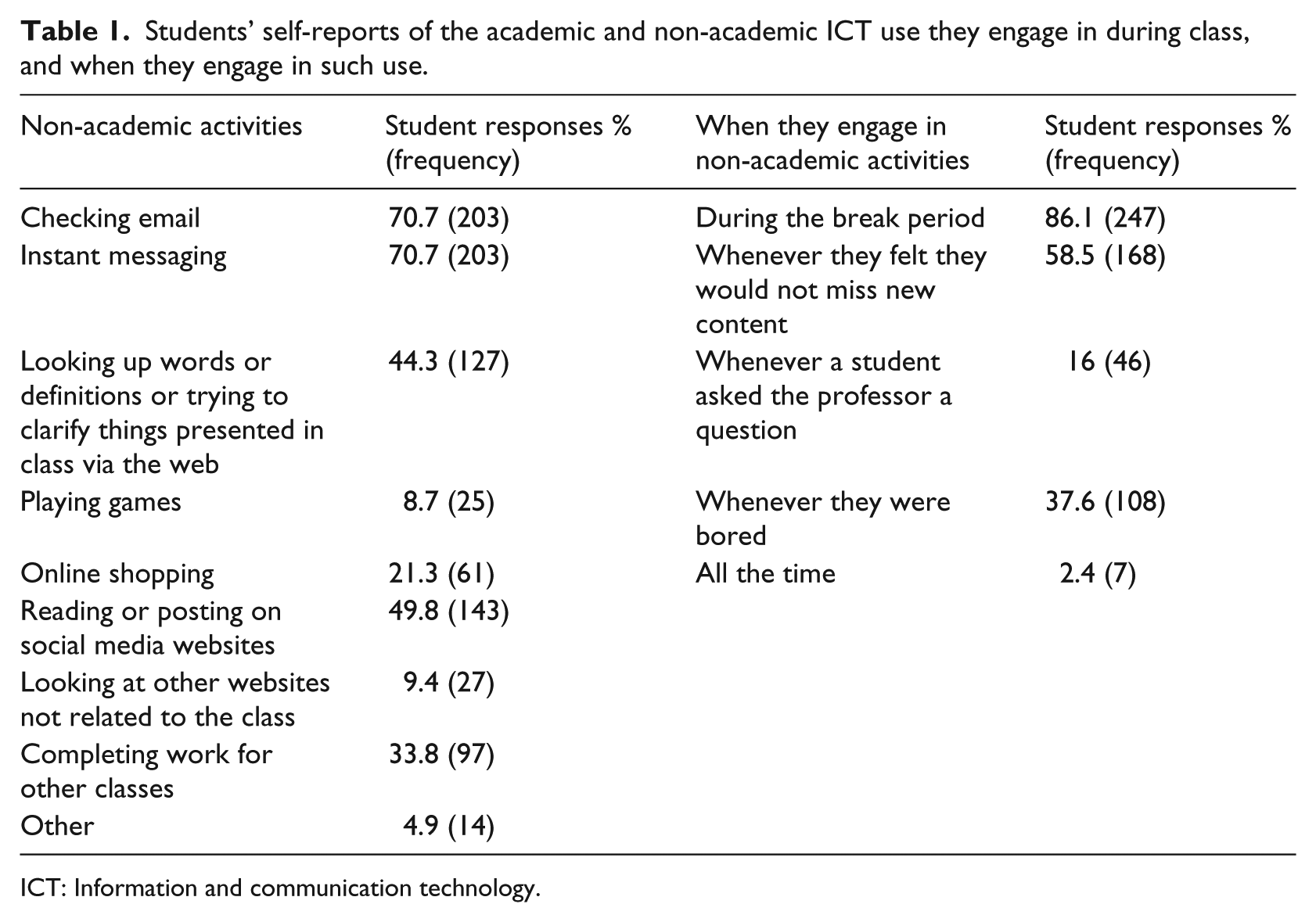
ICT: Information and communication technology.
What are students’ perceptions of the positive and negative effects of their ICT use?
Several themes emerged (Table 2). Specifically, most said they used their ICTs to access information related to the lecture, with common themes of “faster note-taking” and “access to lecture materials.” Additional responses such as “. . . if you are confused you can search up a definition or phrase right away . . .” and “being able to look up things you do not know or understand . . .” indicated that participants were also using their ICTs to obtain supplemental information and clarify content covered in class that they were unsure about. As a result, we identified a third theme of “identifying supplemental information.” Participants also mentioned that ICTs can be used as a method of engaging with the instructor in class, as well as providing a mental “break” from the lecture material.
Themes obtained from student responses to open-ended questions.
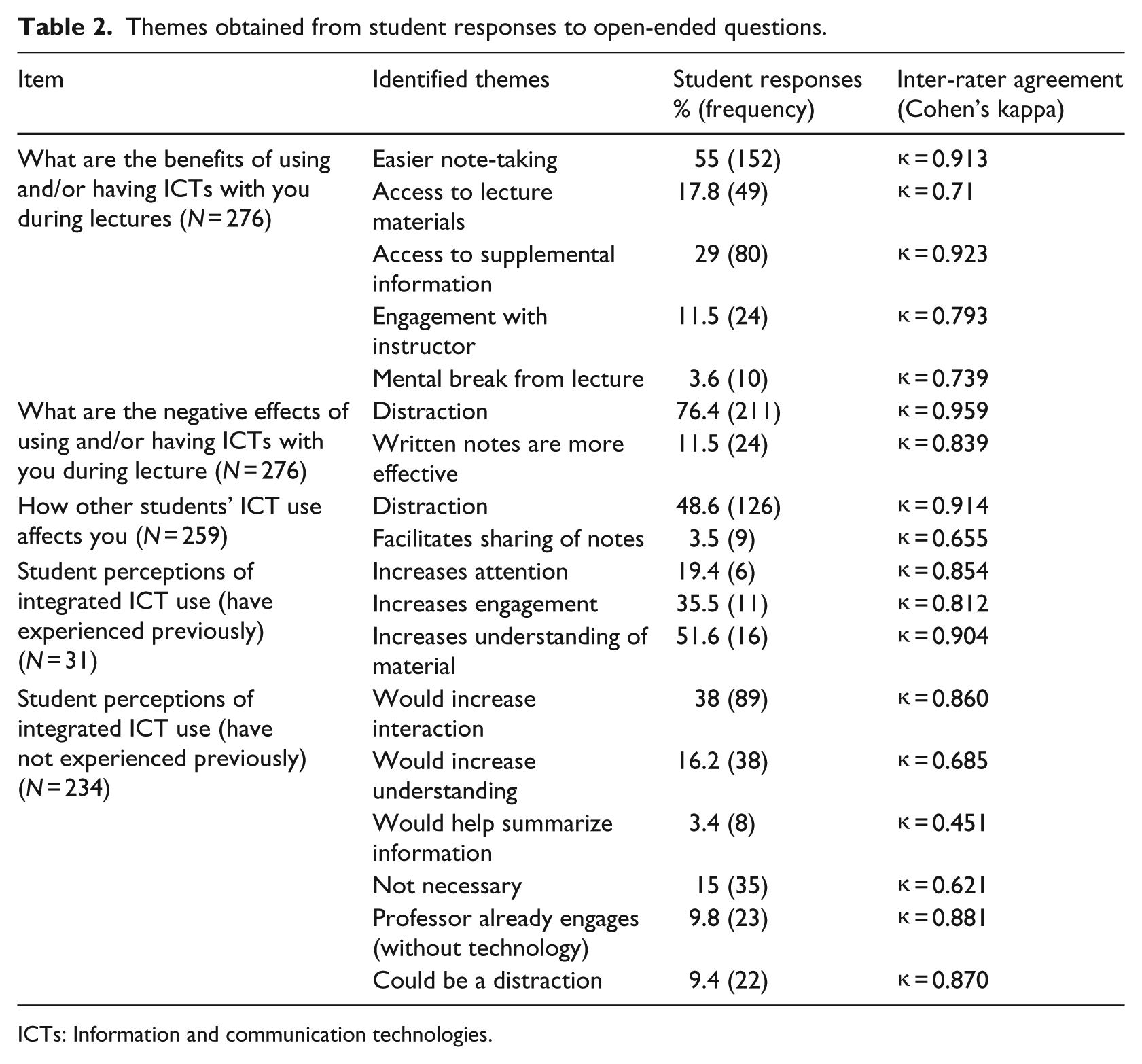
ICTs: Information and communication technologies.
The majority (n = 211), however, also acknowledged that a detrimental effect of having ICTs in the classroom was the tendency for them to be distracted from the class lecture, resulting in a theme of “distraction.” Most notably, participants indicated that access to various other non-academic activities—such as checking one’s email and browsing social media—was the greatest source of distraction, with responses such as “. . . one can easily be distracted due to instant messaging and/or other social media outlets that they have access to” and “. . . they are mainly a distraction because you can look at your email, go on social media, etc.” A small subset (n = 24) believed that an additional negative effect of ICTs is that notes taken on an ICT (as compared to handwritten notes) result in a lower level of understanding of course material.
When considering other students’ ICT use, almost half (n = 141) indicated that other students’ ICT use in the classroom impacted their own learning experience. Of these, the overwhelming majority (n = 126) stated that this impact was negative, specifically, that other students’ ICT use was distracting. For instance, participants wrote that “I am very easily distracted by people who use their laptops for things other than taking down notes (i.e. scrolling through Facebook, watching Netflix or online shopping)” and “a lot of people watch videos on their laptops and it’s a distraction if you can see what they’re watching” As a result, not only did we identify a theme of distraction via own ICT use, but we also identified this theme for other students’ ICT use.
What policies would students be willing to support regarding ICT use in the classroom?
The majority (58.2%) indicated they would not support any policies related to restriction of ICT use in the classroom. A small minority (13.2%) indicated willingness to support a policy that would allow ICTs in the classroom with no Wi-Fi access. Between one-fifth and one-quarter (22%) supported designating half the classroom to students that take notes on their ICTs, with the other half designated to handwritten note-takers. A small percentage (5%) recommended alternative policies. Finally, only 2.1% supported a complete ban on all ICTs from the classroom.
Have students experienced integrated ICT use in their classrooms? What are their perceptions of how this use affected their learning?
Only 11.2% stated that their instructors had completed in-class activities which integrated the use of their ICTs. However, of these, 96.8% stated that they felt this integrated use was beneficial to their learning experience in the classroom. Common themes for why participants overwhelmingly perceived this use to be beneficial were “increased attention,” “increased engagement,” and “increased understanding.” For example, responses such as “It helps us become more focused and it engages us in the course material” and “engaging students during class is a beneficial way to help them understand the content” demonstrate that students experience greater engagement with the course material through integrated ICT use, and that this engagement translates to perceptions of stronger understanding of course material.
Of the 234 who had not experienced integrated ICT, 55.6% stated that they felt the inclusion of integrated ICT use would enhance their in-class learning experience, 6.4% said it might enhance their experience, and 35.5% said it would not improve their learning experience. Of those who stated that integrated ICT use would enhance their learning, 68.5% of them indicated that this would be due to “increased interaction” with the instructor. Other themes that emerged included “would increase understanding” and “would help summarize information” as reasons for the integration of ICTs in the classroom. In contrast, for those who did not believe integrated ICT use would enhance their learning, the themes obtained were “it is not necessary,” “it could be a distraction,” and “professor already engages the class” (see Table 2).
Discussion and conclusion
This study examined three key questions pertaining to undergraduate students’ ownership, usage, and perceptions of ICTs in the classroom. Our results broadly align with research conducted in other geographical locations (e.g. Aagaard, 2015; Heflin et al., 2017; Lepp et al., 2015). In regard to ownership and use, most students have ICTs with them in the classroom and the majority spend at least some class time using them for non-academic purposes, such as checking their email, browsing social media, and sending instant messages. Only a minority confine such non-academic uses strictly to the break periods. In addition, although participants did report various benefits associated with using their ICTs in class, many also recognized the downsides, such as distraction for themselves and others.
Despite acknowledging the downsides to having ICTs in the classroom, not only were the majority of students against banning ICTs from the classroom but they were also against any policies restricting their ICT use. This lack of support echoes previous studies (e.g. McCoy, 2016; Santos et al., 2018) that have examined students’ attitudes toward restricting ICT use. In addition, Elliott-Dorans (2018) reported that an actual laptop ban was associated with various detrimental effects on several indicators of students’ academic experience, such as class attendance and performance on response papers/the writing of a short piece of coursework where students are asked to apply course material such as readings and discussions to critically discuss or evaluate a problem or problems identified within the subject matter. These findings suggest that restrictive policies lack student support and may cause unintended negative consequences for learning outcomes.
Perhaps, rather than restricting or banning ICT use, educators should instead employ strategies related to the effective integration of ICTs in classrooms. In our sample, participants who had previously experienced integrated ICT use stated that it increased their engagement and attention. Furthermore, increased engagement and attention were also seen as plausible benefits by those who had not previously experienced integration. These results raise two points of interest: (1) the evidence suggests that students perceive benefits to integrated ICT use, both students who have—and who have not—previously experienced integration, and (2) if integrated ICT use effectively increases engagement, it might counteract one of the main reasons students engage in non-academic ICT use in class in the first place—boredom. Boredom was identified as a reason for non-academic ICT use in a sizable proportion of our participants, and boring classroom environments have been cited as a main reason for this form of ICT use in previous studies as well (e.g. Aagaard, 2015; Emanuel, 2013; McCoy, 2016).
Thoroughly tackling the issues of boredom and disengagement that seemingly drive students to non-academic ICT use might ultimately mean moving away from traditional lectures (the primary means of instruction for students in our sample) toward more active and engaging participatory classrooms. But perhaps ironically, ICTs could be one of the very means through which to make this shift; ICTs can be used for academic purposes to enhance students’ active participation in classrooms in ways that support the learning goals of the course. For instance, evidence suggests that testing (retrieval practice) is at least as important as studying (encoding) for retention of information (Carrier and Pashler, 1992; Roediger and Karpicke, 2006), and there are now several software options for instructors who wish to use ICTs to conduct in-classes quizzes. Other active participatory in-class activities enabled by ICTs include virtual field trips and experiments. As the data show, students feel very positively about attempts to integrate ICTs into the classroom in these ways. If effectively integrating academic ICT use in classrooms provides increased student engagement, it represents a potential solution to alleviating student boredom and may therefore reduce non-academic ICT use.
The study had a number of methodological limitations that need to be acknowledged. First, the study was conducted with first year, undergraduate students who were enrolled in an introductory psychology course. Future work is required with students of varying levels of study—such as postgraduate students—as well as other years at the undergraduate level. Furthermore, research should also be expanded to students in other disciplines. In addition, no demographic data—such as students’ gender, age, or year of study—were collected, so future work is needed to determine whether there are any differences in attitudes across these variables. Students were provided an incentive to complete the study—that is, half a mark toward their overall grade—which may have influenced or biased the responses that they provided. Future research should determine the potential impact of this incentive by collecting data from students who voluntarily participate in the study. In addition, the study was completed using a questionnaire; while practical, this methodological design may result in a number of limitations, including participants succumbing to social desirability bias or misinterpreting survey questions and consequently responding incorrectly. Finally, the students in this study were in traditional lecture-based classes. It is certainly possible that students’ use of ICTs for non-academic purposes is reduced, or at least different, in classrooms that involve more engaging and student-centered learning. Questions for future research include asking whether integrating ICT into the classroom will reduce its non-academic use and whether or not student engagement levels are the mechanism by which such a reduction would occur. Some literature does show beneficial effects on student engagement and test scores but additional investigations are necessary to determine the causal effects of integration of ICTs in the classroom. This is particularly important considering that the literature has obtained mixed findings.
Our findings indicate that students support the integration of ICTs in the classroom and perceive benefits associated with this use, particularly for engagement. Furthermore, the same perceived benefits were found irrespective of whether students had previously experienced integrated ICT use or not. Students’ perceptions of the effectiveness of ICT integration for creating engagement are encouraging. Currently, however, there is limited research to support the various forms of ICT integration in the classroom, and to determine the different effects they may have on actual student learning outcomes. That is, the evidence is somewhat inconclusive, particularly given the concept “ICT integration” has been used as an umbrella term to encompass a wide-ranging variety of topics, and has yet to be operationalized. The development of a taxonomy of integrated ICT use in the classroom, and subsequent studies of the effect of different types of integrated ICT use, would likely aid us in obtaining a clear-eyed picture of the effects of such use. Given students’ resistance to policies aimed at restricting their ICT use, and their support for attempts to integrate ICTs into the classroom, it seems useful to consider the possibilities for such integration. It seems likely to us that successfully integrating ICTs into the classroom can turn them from a means for distraction into a valuable tool for engaging students in active learning.
Footnotes
Declaration of Conflicting Interests
The author(s) declared no potential conflicts of interest with respect to the research, authorship, and/or publication of this article.
Funding
The author(s) received no financial support for the research, authorship, and/or publication of this article.
