




Abstract
Students’ engagement in extra-curricular activities can play a significant role in their development of a student identity, as well as leading to a greater sense of belonging and wellbeing. However, individual characteristics such as sociability may influence the likelihood of students engaging in extra-curricular activities. We collected mixed mode data from two online surveys to explore students’ perceptions of the impact of engagement in extra-curricular activities on their experience at university, as well as the mediating role of engagement in extra-curricular activities in the relationships between extraversion and wellbeing and sense of belonging to the University. Our data demonstrate that extraversion is positively associated with both belonging and wellbeing, and that engagement in extra-curricular activities also mediates these relationships. Our qualitative data uncover further nuances in engagement with extra-curricular activities; while many perceived outcomes are positive, some students express regret at opportunities missed, and find it challenging to balance extra-curricular activities and their studies. Taken together, these findings indicate that not all students stand to benefit equally from engagement in extra-curricular activities. Providing a range of opportunities that are accessible to a wide range of students may promote equity in participation in extra-curricular activities.
Extra-curricular activities, wellbeing and belonging
The literature exploring the ‘student experience’ has often prioritised those experiences that occur within the boundaries of students’ academic programmes; for example, students’ learning within the classroom and their experiences of assessment and feedback (e.g. Harvey et al., 2006). However, there is a growing body of evidence which is beginning to foreground the importance of those experiences which transcend the academic environment, as part of a wider, holistic, understanding of students’ lives (e.g. Milner et al., 2016; Roulin and Bangerter, 2013; Stevenson and Clegg, 2011). For many students, their wider university experience is characterised by participation in extra-curricular activities which are not part of formal degree programmes, such as participation in clubs, societies, sporting/recreational activities or religious groups. Extra-curricular activities are believed to be of value to students for multiple reasons, conferring academic (e.g. Stuart et al., 2011), social (e.g. Bohnert et al., 2007), wellbeing (e.g. Busseri et al., 2011) and employability benefits (e.g. Clark et al., 2015). These benefits are seen as particularly pertinent to students embarking upon a new programme of study, where activity involvement may provide a structured and supportive context for exploring new interests and identities, building personal competencies, expanding support networks and forging community connections (Busseri et al., 2011). Thus, there is the potential for wide-reaching benefits of engagement in extra-curricular activities.
Belonging represents perceptions of acceptance and connection, and is associated with student wellbeing, academic attainment and retention. Belonging consists of four domains: academic, social, surroundings and personal space (Ahn and Davis, 2019). Stronger feelings of belonging are reported by students who invest a greater number of hours per week in extra-curricular activities (Knifsend, 2018), potentially because involvement in extra-curricular activities plays an important role in determining how students adjust to their learning environment, and therefore potentially contributing to their sense of belonging (Tieu et al., 2010). Engagement in extra-curricular activities also has the potential to foster both physical and psychological wellbeing among students (e.g. Bowman, 2010; Kilgo et al., 2016; Shiah et al., 2013). Participation in campus activities also may be linked to psychosocial wellbeing (Knifsend, 2018). Through supporting the development of friendships (Thompson et al., 2013), time spent engaging in extra-curricular activities can increase positive psychosocial outcomes as well as providing a buffer against loneliness and social dissatisfaction (Bohnert et al., 2007). These findings may be particularly significant given concern in higher education globally regarding increasing rates of mental health difficulties in student populations (see Baik et al., 2019). In fact, students often report that they use extra-curricular activities as a means through which to manage their levels of stress (Bland et al., 2012). If engagement in extra-curricular activities stands to benefit students in terms of belonging and wellbeing, should universities be promoting students’ participation in order to maximise these benefits, or are these associations too simplistic? It is necessary to consider critically the reasons why some students are more likely to engage in these activities than others.
Problematising participation
Given the potentially positive effects of engagement in extra-curricular activities, it is important to consider equality of access to such activities. In the theory of student involvement, Astin (1999) defines involvement as ‘the amount of physical and psychological energy that the student devotes to the academic experience’ (p. 518). This implies active participation, whereby ‘involved’ students are those who embrace campus life. Furthermore, Astin (1999) claims that ‘a typical uninvolved student . . . abstains from extracurricular activities’ (p. 518). There is a potentially dangerous assumption here that ignores the complexity of engagement and participation, and places the blame for a lack of engagement firmly upon the student. In contrast, Gourlay (2015) describes the ‘tyranny of engagement’, where in student engagement work there is often a ‘reification of the notion of “participation” which – although appearing to support a “student-centred” ethos – may serve to underscore restrictive, culturally specific and normative notions of what constitutes “acceptable” student practice’ (p. 403). In what ways, then, may engagement in extra-curricular activities underscore such notions of what constitutes ‘acceptable’ student practice? Indeed, there are a number of reasons for students to not engage with such activities.
Many clubs and societies are inherently social spaces, with engagement in these activities forming a social practice that may be uncomfortable for some students. In his theory of personality, Eysenck conceptualised inter-individual variability in extraversion as emerging from fundamental differences in preferences for sensory stimulation (Eysenck, 1967). Individuals high in extraversion, characterised by sociability and positive emotionality (McCrae and Costa, 2013), have a preference for high levels of sensory stimulation, which they might satisfy by engaging in physical activities, or seeking social spaces and the company of others. In contrast, individuals who are low in extraversion can easily feel overwhelmed by many social situations, preferring lower levels of sensory stimulation, such as smaller groups or solitary activities (Eysenck, 1967). Research has also identified a relationship between low levels of extraversion and sensory processing sensitivity (Aron et al., 2012). Settings that many individuals would find stimulating, such as social gatherings, can be physically and psychologically uncomfortable for those with sensory processing sensitivity; such discomfort is often minimised through avoiding noisy or social situations (Aron et al., 2012).
A body of literature represents extraversion as related to both wellbeing and belonging in educational contexts. In a US sample, DeNeui (2003) explored the relationship between extraversion and first-year college students’ ‘psychological sense of community’, which is akin to the sense of belonging. DeNeui reported a significant positive correlation between extraversion and psychological sense of community, and also showed that greater involvement in campus activities was associated with higher extraversion. Lounsbury and DeNeui (1996) propose that individuals high in extraversion view university in a different way, as ‘more cohesive, close-knit, socially accessible’ (p. 391). Furthermore, Zhang and Renshaw (2019) reported that extraversion was the strongest predictor of subjective wellbeing. These findings replicate those reported by Steel et al. (2008) in a meta-analysis, where extraversion was shown to exhibit strong positive relationships with subjective wellbeing.
Adopting Eysenck’s theory of extraversion in the context of extra-curricular activities leads to the implication that individuals low in extraversion may find many of the social environments characteristic of extra-curricular activities uncomfortable and over-stimulating, whereas such environments provide optimal sensory stimulation for those high in extraversion. Indeed, the level of engagement in extra-curricular activities has been shown to relate positively to extraversion in a Chinese sample (Shiah et al., 2013), mirroring wider literature on the positive relationships between extraversion and general engagement in physical and leisure activities (e.g. Wilkinson and Hansen, 2006; Wilson and Dishman, 2015). Crucially, students lower in extraversion may be less likely to participate in extra-curricular activities, and as a result, experience lower levels of wellbeing and belonging (Lounsbury and DeNeui, 1996). Moreover, with a lack of extra-curricular activities designed to suit more introverted, solitary or quieter students, universities may encourage a ‘performance of interaction’ and the ‘occlusion of individual practices which are either absent from the model or actively discouraged as retrograde and passive’ (Gourlay, 2015: 405).
A further critical consideration when focusing on the potential benefits of extra-curricular activities is the assumption that students freely choose to engage. Importantly, students may engage not through choice but through the implicit or explicit messages that engagement in extra-curricular activities is a requirement for future success beyond university. Extra-curricular activities are significant because regardless of degree subjects or outcomes, graduates who have been involved in extra-curricular activities are significantly advantaged in terms of employability (Tchibozo, 2007). Furthermore, in a study by Clark et al. (2015), alumni retrospectively reported positive effects of engagement with extra-curricular activities in supporting their effectiveness in their first job, particularly in relation to gains in confidence and interpersonal/communication skills. In an increasingly competitive employment market, engaging in extra-curricular activities can offer students the opportunity to develop additional skills. As Thompson et al. (2013) explain: ‘It’s just like an extra string to your bow’. This indicates that students can feel under pressure to engage in extra-curricular activities not for reasons of personal choice, but as a requirement to develop ‘an employable self’ (Stevenson and Clegg, 2012: 41). This pressure can lead students to over-commit to extra-curricular activities (see Marsh and Kleitman, 2002), thus negating many of the benefits to psychological and physical wellbeing.
There are also additional social and cultural factors that inhibit students from engaging with certain extra-curricular activities. For example, older students (those over the age of 25) are less likely to participate in extra-curricular activities, perhaps owing to other commitments they hold, or to the fact that they do not always feel there are activities suited to them (Wyatt, 2011). Indeed, Stevenson and Clegg (2012) explain that extra-curricular activities can be viewed ‘as a site of gendered, raced, and class practices’ (p. 42). Likewise, Gourlay (2015) warns against the prioritisation of Western values within discourses of student engagement. Thus, with certain forms of extra-curricular activities prioritised and valorised, those students who may not feel comfortable engaging with such activities, or who simply are not able to due to time and family commitments, are excluded from the benefits of participation. Given recent calls for a greater spectrum of extra-curricular activities on offer that range from those based around drinking to those involving solitary activities (e.g. Hinsliff, 2018; Nagesh, 2019), there is a need to explore whether positive relationships between extraversion (i.e. sociability and positive emotionality) and positive outcomes such as wellbeing and a sense of belonging to university are mediated by engagement in extra-curricular activities.
As discussed, students higher in extraversion are more likely to report a greater sense of belonging to their university and better subjective wellbeing. Drawing upon Eysenck’s theory as a conceptual framework, we argue that these relationships may, in part, be due to there being a higher likelihood that students with higher levels of extraversion engage in social activities (i.e. extra-curricular activities) that lead to increased belonging and wellbeing. Thus, we assume that there are indirect relationships between extraversion and belonging, and extraversion and wellbeing, through the extent of students’ engagement in extra-curricular activities. To further explore the role of extra-curricular activities for different groups of students in their university experience, the following research questions need to be addressed:
Are there positive relationships between extraversion, engagement in extra-curricular activities, belonging and wellbeing?
Does engagement in extra-curricular activities mediate the relationship between extraversion and belonging?
Does engagement in extra-curricular activities mediate the relationship between extraversion and wellbeing?
What are students’ perceptions of the impact, both positive and negative, of engagement in extra-curricular activities on their experience at university?
Methods
To address the questions regarding whether or not there are relationships between extraversion, engagement in extra-curricular activities, belonging and wellbeing, whether or not engagement in extra-curricular activities mediates the relationship between extraversion and belonging and whether or not engagement in extra-curricular activities mediates the relationship between extraversion and wellbeing, we collected data via an initial survey (Survey 1), involving the following.
Participants
A total of 227 undergraduate (n = 206) and postgraduate (n = 20) students (one respondent did not specify their qualification level) from a university in the south east of England in the United Kingdom provided complete data for Survey 1. The sample consisted of 92 males and 134 females (one respondent did not state their sex), and respondents ranged in age from 17 to 43 (Mage = 19.74, SDage = 3.26). All were in the first year of their programme of study. For 84% of the sample, the University was their firm choice when they applied, and 38% of respondents were the first in their family to go to university. In the UK Higher Education system, students are required to confirm their first choice of University as their ‘firm’ choice. If students do not obtain the required grades, they are unlikely to be accepted by their ‘firm’ choice of University. Respondents were roughly evenly spread across all discipline areas at the University; 33% of the students were from health and medical sciences, 35% from arts and social sciences and 28% from engineering and physical sciences (4% of respondents did not specify a discipline). Prior to coming to university, 79% of respondents had taken part in extra-curricular activities and 76% reported that they had taken part in extra-curricular activities since starting university. Of the students taking part in extra-curricular activities at university, 79% participated in sports teams/clubs, 19% participated in music, dance or theatre groups, 34% participated in other clubs and societies and 2% did not report what extra-curricular activities they took part in (these do not sum to 100% because some students participated in multiple types of extra-curricular activities).
Measures
Respondents completed an online survey, which began by asking them to report on their demographic and background details. The second part included an item to measure engagement in extra-curricular activities, and three scales to measure levels of extraversion, belonging and wellbeing. All three scales had the same Cronbach’s alpha value (α = 0.82), representing excellent levels of internal reliability. As a measure of engagement in extra-curricular activities, respondents completed a single item from the Beyond-Class Engagement subscale of the First Year Experience Questionnaire (FYEQ; Krause and Coates, 2008), which stated, ‘I am actively involved in university extra-curricular activities (e.g. cultural, sporting)’. Item responses are on a scale from 1 (strongly disagree) to 5 (strongly agree).
Respondents were asked to complete the Extraversion subscale from the Mini International Personality Item Pool (Mini-IPIP) scale (Donnellan et al., 2006). The subscale consists of four items and respondents indicate the extent to which each statement represents them on a scale from 1 (very inaccurate) to 5 (very accurate). As a measure of belonging, the University Attachment Scale (France et al., 2010) was used. This scale consists of nine items. Each item is measured on a scale from 1 to 5 (anchors vary for each item). Finally, respondents completed the GP-CORE (General Population-Clinical Outcomes in Routine Evaluation), which is a 14-item measure of wellbeing (Evans et al., 2005). The items cover anxiety, depression, subjective wellbeing, physical health, social functioning and general functioning, and are measured on a scale from 0 (not at all) to 4 (most or all of the time).
Procedure
The study was approved through institutional ethical procedures. A link to the survey was distributed towards the end of the first semester of the academic year, via the Students’ Union newsletter. The link took students directly to an information sheet and consent form, following which they were taken through each set of items. Once all scales had been completed, students were directed to a debrief page reminding them of sources of support they could access if they were finding it difficult to settle into university life.
Analyses
Pearson’s correlation analyses were performed to determine whether there were relationships between all variables. Mediation models were tested to examine extraversion as a predictor of belonging (model 1), and wellbeing (model 2), with engagement in extra-curricular activities as a mediator. First, for all continuous variables apart from age, normality assumptions were met (skewness values = −1.03 to −0.21, kurtosis values = −0.75 to 0.03) and boxplots did not indicate any extreme outliers. Bootstrap confidence intervals (95% CIs) based on 1000 samples were calculated for all analyses with the age variable.
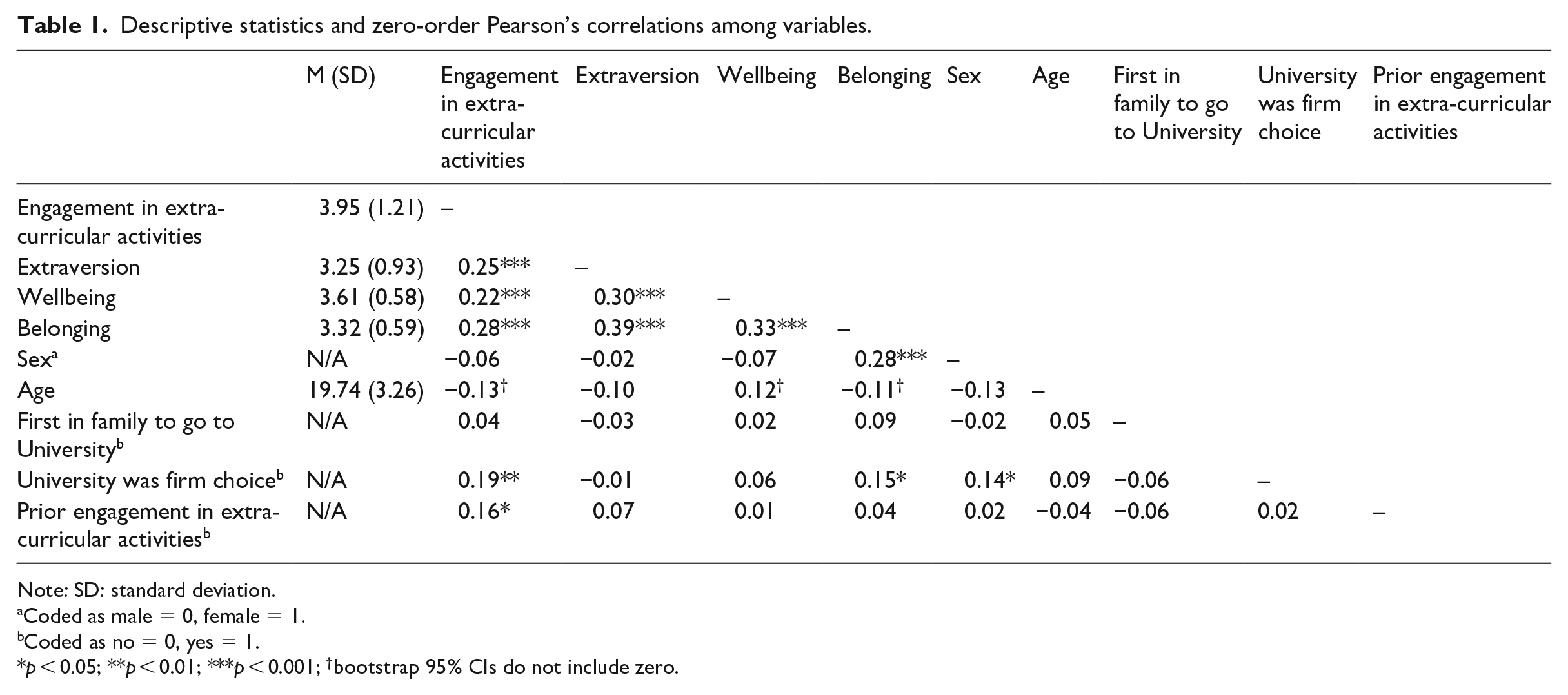
The following demographic and background variables were significantly correlated with mediator and/or outcome variables (see Table 1), so they were entered into each mediation analysis as covariates: age, sex (model 1 only), whether the University was students’ firm choice when they applied and prior engagement in extra-curricular activities. Mediation analyses were performed with the PROCESS macro v3.4 (Hayes, 2017), and bootstrap 95% CIs were calculated for indirect effects based on 5000 samples. Standardised coefficients have been reported as measures of effect size for each association and are denoted by β (effect sizes reported for indirect effects are completely standardised).
Descriptive statistics and zero-order Pearson’s correlations among variables.
Note: SD: standard deviation.
Coded as male = 0, female = 1.
Coded as no = 0, yes = 1.
p < 0.05; **p < 0.01; ***p < 0.001; †bootstrap 95% CIs do not include zero.
To address the question of what the students’ perceptions of the impact, both positive and negative, of engagement in extra-curricular activities on their experience at university were, we collected data via a follow-up survey (Survey 2), involving the following.
Participants
A total of 76 students from the same university participated. Only three respondents had not participated in any extra-curricular activities during the academic year. Of those who had participated in extra-curricular activities, 85% had participated in sports teams/clubs, 23% had participated in music, dance or theatre groups and 44% had participated in other clubs and societies (as with the part addressing the first three research questions, these do not sum to 100% because some students participated in multiple types of extra-curricular activities).
Materials and procedure
A link to a survey was distributed at the end of the second semester of the academic year, via the Students’ Union newsletter. This survey aimed to capture students’ perceptions of the influence of their engagement in extra-curricular activities on their university experience with the following open-ended item: ‘Please describe how you feel participating in extra-curricular activities has shaped your first year experience of university’. Students who had not engaged in extra-curricular activities did not need to respond to this question. The same consent and debrief procedures were followed.
Analysis
Of the 73 respondents who had engaged in extra-curricular activities during the academic year, 71 students provided a response to the open-ended question, and these were analysed thematically (Braun and Clarke, 2006), due to the flexibility this method offers in inductive approaches to data analysis. After reading through all responses to familiarise ourselves fully with the data, we coded these responses using codes such as social benefits, belonging, stress relief and so on. Notably, only four respondents commented that extra-curricular activities had not had any impact. Codes were then developed into five themes representing students’ perceptions of the influence of extra-curricular activities, illustrated with example quotes from students’ responses.
Results
Are there positive relationships between extraversion, engagement in extra-curricular activities, belonging and wellbeing?
Significant positive correlations were found between levels of extraversion, engagement in extra-curricular activities, belonging and wellbeing (see Table 1).
Does engagement in extra-curricular activities mediate the relationship between extraversion and belonging?
Extraversion and the covariates explained 14% of the variance in engagement in extra-curricular activities, R2 = 0.14, F(5, 219) = 7.21, p < 0.001 (see Figure 1). Extraversion significantly positively predicted engagement in extra-curricular activities (see path ‘a’ in Figure 1). Students who chose the University as their firm choice, students who engaged in extra-curricular activities prior to university and younger students were more likely to engage in extra-curricular activities at university: b = 0.73, p < 0.001, β = 0.22; b = 0.40, p = 0.03, β = 0.13; and b = −0.05, 95% CI [−0.10, −0.01], β = −0.13, respectively. Engagement in extra-curricular activities, extraversion and the covariates explained 28% of the variance in belonging, R2 = 0.28, F(6, 218) = 14.04, p < 0.001. Greater engagement in extra-curricular activities significantly positively predicted increased belonging (see path ‘b’ in Figure 1). Females also had a higher sense of belonging, b = 0.34, p < 0.001, β = 0.29, but remaining associations with covariates were non-significant (bs = −0.03 to 0.09, ps = 0.34 to 0.73 and 95% CI [−0.02, 0.01] for age, βs = −0.02 to 0.06). Extraversion significantly positively predicted a sense of belonging (see ‘direct effect’ in Figure 1), but engagement in extra-curricular activities also significantly mediated this association (see ‘indirect effect’ in Figure 1). However, the direct effect did remain larger than the indirect effect (βs = 0.34 vs 0.05).

Model of extraversion as a predictor of belonging, with engagement in extra-curricular activities as a mediator. Sex, age, whether the University was a firm choice and prior engagement in extra-curricular activities, included as covariates.
Does engagement in extra-curricular activities mediate the relationship between extraversion and wellbeing?
Extraversion and covariates explained 13% of the variance in engagement in extra-curricular activities, R2 = 0.13, F(4, 221) = 8.28, p < 0.001 (see Figure 2). Extraversion significantly positively predicted engagement in extra-curricular activities (see path ‘a’ in Figure 1). Significant relationships with covariates, and directions of associations, were the same as in model 1: University as students’ firm choice, b = 0.66, p = 0.002, β = 0.20, prior engagement in extra-curricular activities, b = 0.40, p = 0.04, β = 0.13, and age, b = −0.04, 95% CI [−0.09, −0.003], β = −0.12. Engagement in extra-curricular activities, extraversion and the covariates explained 14% of the variance in wellbeing, R2 = 0.14, F(5, 220) = 7.11, p < 0.001. Greater engagement in extra-curricular activities significantly positively predicted wellbeing (see path ‘b’ in Figure 1). Older students also had greater wellbeing, b = 0.03, 95% CI [0.01, 0.05], β = 0.17, but remaining associations with covariates were non-significant (b = −0.04, p = 0.70, β = −0.02 and b = 0.02, p = 0.84, β = 0.01). Extraversion significantly positively predicted wellbeing (see ‘direct effect’ in Figure 2), but engagement in extra-curricular activities also significantly mediated this association (see ‘indirect effect’ in Figure 2). However, as with model 1, the direct effect remained larger than the indirect effect (βs = 0.27 vs 0.04).
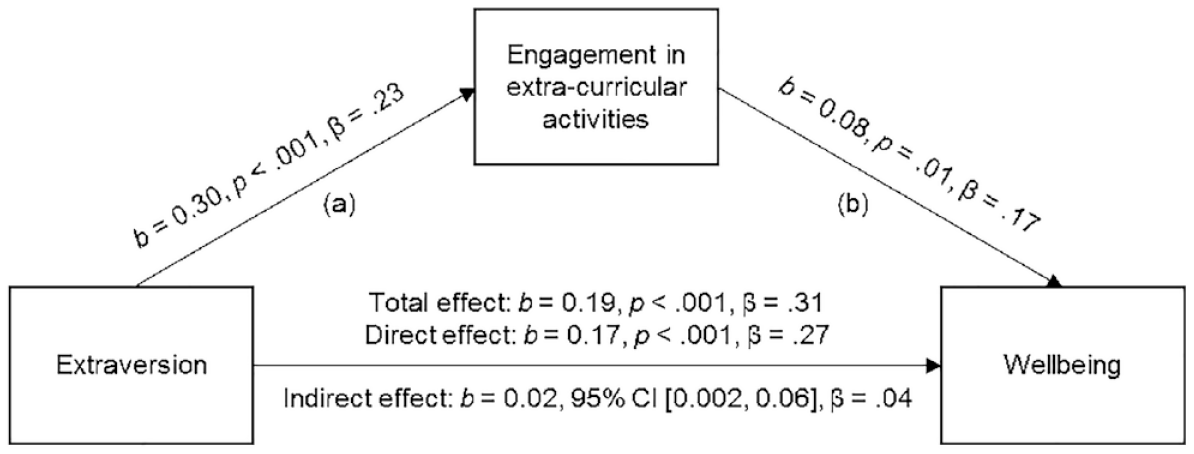
Model of extraversion as a predictor of wellbeing, with engagement in extra-curricular activities as a mediator. Age, whether the University was a firm choice, and prior engagement in extra-curricular activities, included as covariates.
What are students’ perceptions of the impact, both positive and negative, of engagement in extra-curricular activities on their experience at university?
Identity and belonging
The impact of participation on their sense of belonging to the University was mentioned by 26 students. Students explained how their involvement had made them ‘feel more a part of the University’ and ‘part of the University community’. One student described feeling ‘as if I’m playing my part as a student here’, with another describing participation as conferring ‘a sense of spirit and makes me love the University even more’. Students also identified their involvement in these activities as having ‘made the University experience for me’, leading another to ‘enjoy my presence at the University more’. Another described being ‘unable to imagine university without being part of a club’.
Expanding the social circle
Of the 75 respondents, 42 made some reference to how their involvement with a club or society had enabled them to make friends, where their membership ‘helped massively with transitioning in’ and ‘helped me to get more involved and make friends’. Crucially, engagement with clubs and societies enables students to meet and socialise with people beyond the immediate circle of coursemates or flatmates, and many respondents recognised this opportunity to meet ‘a wider variety of people’ as a positive outcome of their engagement with extra-curricular activities. One student described that ‘[extra-curricular activities have] allowed me to make friends from other courses’; similarly, another expressed that their involvement ‘introduced me to a number of new people that aren’t just in my year . . . I got great advice about course and uni life’.
For some students, the opportunity to meet ‘more like-minded people’ through their engagement in teams and societies resulted in the formation of their ‘main friendship group’ containing their ‘closest university friends’. This was clearly described by one student, who explained that ‘I’ve found close friends in the sports club which feels like a community. We have more in common and get along better than my current flatmates’. Aligning interests was also described as a key benefit of their involvement by another student: ‘It helped me to meet some people from outside of my course with similar interests, consequently I found it very easy to talk to and get along with them!’ However, notably one respondent commented that ‘I haven’t enjoyed a society enough to want to continue as the ones which I was interested in were often very clique-y’.
Supporting wellbeing
Engagement in sports teams was discussed by 23 students as having a positive impact on their wellbeing, for example, acting as ‘a significant stress relief’ and helping them to feel ‘more relaxed and happy’, making their ‘time at university more balanced’. This impact extends to general fitness and opportunities to recover from the stress of academic work, providing ‘a relaxing stage for winding down from research’ as further described by this student: ‘[extra-curricular activities] kept me fit and healthy, encouraged me to eat healthily and take care of myself. It also helped me cope with stress and make new friends’.
Beyond these benefits, involvement in extra-curricular activities seems, for some students, to support their adjustment to university, preventing feelings of loneliness and isolation, by avoiding ‘having too much time in my room or not doing anything’, and ‘shaping a “routine” here at university’. For other students, their involvement with clubs and societies appeared to help them to manage their time and get a good work–life balance. One student explained that this had helped them to ‘organise my time better and find time for sports in between studying’; for another, their participation ‘helped me to get my mind off my studies sometimes’.
Finally under this theme, students spoke about the role of extra-curricular activities in providing affective benefits, conferring a ‘sense of pride and accomplishment’, and building confidence. For one student, this led them to feel ‘proud and confident of what I turned out to be capable of’. Another student described the wide-ranging impact of their involvement: ‘I met great people that I am always happy to see and it has given me “punch” and motivation in my everyday life’. The social networks developed through involvement in clubs and societies also create a support network who can provide support during difficult periods, as expressed by this student: ‘I have really enjoyed [extra-curricular activities] and have met loads of amazing people that have helped me throughout this year, without lacrosse I wouldn’t have enjoyed uni this year’.
‘I wish I’d done more’
However, while the majority of students were positive about their involvement in extra-curricular activities, some respondents expressed a sense of regret at having failed to take full advantage of the opportunities available. For example, one student stated, ‘I wish I’d done more’. Another student clearly expressed a sense of an opportunity missed: ‘I really, really wish I had joined the sports team that I was planning on joining. Not participating in sports was a real shame, and I think it could have significantly improved my experience this year’. These ‘missed opportunities’ are described emotively and strategically, evincing the anxieties that may accompany non-participation in extra-curricular activities for those students who feel a personal responsibility to make the most of their opportunities to succeed while at university.
Balancing act
Some students spoke about the difficulties in maintaining a balance as a result of their involvement; for one, this was a social balance, explaining that ‘I have a close group of friends from my sport but I am distant from my course mates as I train so much’. For another, their involvement in a sports team was ‘fun but stressful to find the time with my courseload’. Another respondent commented that extra-curricular activities were ‘enjoyable when I was able to attend’, showing the difficulties that some students face in attempting to find time to engage in additional activities.
Discussion and conclusion
Engagement in extra-curricular activities forms an important part of many students’ university experience. While the literature supports that such engagement confers many positive benefits (e.g. Bohnert et al., 2007; Busseri et al., 2011; Clark et al., 2015; Stuart et al., 2011), there may be barriers to participation, such that some students are more likely to engage in extra-curricular activities than others, which we anticipated to be a problem if participation leads to positive outcomes, such as a greater sense of belonging and higher wellbeing.
The study described in this article first sought to explore whether there were positive relationships between extraversion (i.e. sociability and positive emotionality) and positive outcomes such as wellbeing and a sense of belonging to university, and whether these were mediated by engagement in extra-curricular activities. The data replicate the previously reported positive relationships between extraversion and wellbeing (Steel et al., 2008; Zhang and Renshaw, 2019) and between extraversion and belonging (e.g. DeNeui, 2003). They also replicated positive relationships between extraversion and engagement in extra-curricular activities (e.g. Shiah et al., 2013). We also found positive relationships between engagement in extra-curricular activities and wellbeing (e.g. Busseri et al., 2011) and belonging (e.g. Knifsend, 2018). However, what the data described in this article add to existing research on these relationships is evidence that the positive relationships between extraversion and the beneficial outcomes of wellbeing and belonging are also mediated by engagement in extra-curricular activities. Although the direct effects between extraversion and belonging and extraversion and wellbeing remain larger than these indirect effects, these findings still indicate that the reason why individuals high in extraversion show higher levels of wellbeing and belonging is at least partially because they are more likely than those lower in extraversion to engage in extra-curricular activities. In line with Eysenck’s theory, this may suggest that as many extra-curricular activities involve high levels of social interaction, those higher in extraversion may actively seek the stimulation that such engagement provides. In contrast, individuals scoring more towards the introverted end of the personality dimension may find such social spaces physiologically overwhelming, and thus may be less likely to participate.
The inclusion of covariates in the analyses also sheds light on further inter-individual variability in the likelihood of engagement in extra-curricular activities. First, the analyses demonstrated that students were more likely to engage in extra-curricular activities at university if they had engaged in extra-curricular activities prior to coming to university, and if the university was their firm choice when they applied. The former effect may well represent the influence of social and cultural capital on engagement in extra-curricular activities; the latter likely arises from the fact that opportunities for extra-curricular activities formed part of students’ decision-making processes when choosing a university. Interestingly, the data also indicate that younger students were more likely to engage in extra-curricular activities, supporting the findings of Wyatt (2011), and highlighting that extra-curricular activities may not necessarily be open to all. These findings underscore recent cautions around homogenising the student experience, instead seeking to recognise students’ nuanced and individual experiences (e.g. Balloo, 2018; Gravett, 2019; Lygo-Baker et al., 2019).
The analyses were qualified by students’ perceptions of the impact of engagement in extra-curricular activities. Students’ responses confirm that extra-curricular activities can offer a wealth of benefits, helping students to feel more involved and to make friends, preventing feelings of isolation. Extra-curricular activities were described as offering general fitness opportunities and as a significant stress relief. However, the data also draw attention towards the challenge of ‘non-participation anxiety’, where some students experienced regret at not always making the most of opportunities. It will thus be important for institutions to be mindful of this response and to support students with their participation, and non-participation, in extra-curricular activities. It is also notable that some societies were perceived to be ‘very clique-y’; such environments may be particularly uncomfortable for individuals low in extraversion. Institutions may thus need to carefully examine how and when extra-curricular activities take place, and how accessible these activities are to different groups of students. However, since individuals low in extraversion may not experience the same sense of belonging and have lower wellbeing in general, it would be useful to explore whether any activities designed to target them could have a moderating role, which means they can still reap the same benefits from participation.
It is important to acknowledge the limitations which temper the conclusions we can draw. First, we measured engagement in extra-curricular activities using a single item. Second, the data were collected at a single UK institution; students were predominantly undergraduates rather than postgraduates, and there were more females than males. In addition, this particular university was the firm/first choice for a great majority of students and most were not the first in their family to attend university. A great majority of them had taken part in extra-curricular activities before coming to university. Furthermore, better academic performance may lead to a stronger sense of belonging, but we were not able to ascertain whether this played a role in any of the associations since we did not record students’ grade point average (GPA). The nature of the open-ended question asked limited the opportunity for the voices of students who had not engaged in extra-curricular activities to be surfaced. Finally, the qualitative data analysis was restricted to simple thematic coding, in recognition of cautions about deeper forms of analysis with short-answer survey responses (LaDonna et al., 2018).
In developing this research area, several directions have emerged. First, given growing awareness of providing a range of activities catering for varying student preferences and profiles (e.g. Hinsliff, 2018; Nagesh, 2019), it is important to explore whether certain types of extra-curricular activity also confer wellbeing and belonging benefits for individuals lower in extraversion. Second, research exploring students’ preferences for extra-curricular activity engagement in the context of an increasingly diverse student body is important in understanding how opportunities for participation can be equitable. For example, this is especially important in the context of students with caring responsibilities, commuter students and part-time students. Third, the data have demonstrated how some students can feel under pressure to participate in extra-curricular activities, which may have a detrimental effect on wellbeing, where the pressure to make ‘every minute count’ can be significant. Better understanding how students see the value and importance of extra-curricular activities can help universities to support students to benefit from such engagement. There is also a need to broaden research on extra-curricular activities to include studies with different student populations (e.g. doctoral students, mature students) and across a wider range of contexts and countries.
This research has highlighted the real and significant value of extra-curricular activities in supporting wellbeing, belonging and in enabling students to develop skills that they can take beyond university. However, it is important to ask how we can enable all students to access these opportunities. We have sought to problematise the concept of participation, examining more closely a breadth of psychological, social and cultural reasons why some students cannot or do not engage. We suggest that there is a need for institutions to offer a greater diversity of extra-curricular activities, including opportunities for quieter, introverted, students, and students from diverse cultural backgrounds, to participate.
There may also be a need to recognise and talk more openly about the anxiety that may accompany non-participation, or that may arise from students feeling overwhelmed. While we have shown that extra-curricular activities are beneficial for students in many valuable ways, we must also offer supportive environments where students have opportunities to communicate when the pressure to participate becomes too much. This might include, for example, reiterating to students how and when to access support services, such as wellbeing centres, peer mentors or the pastoral care that can be provided by their course tutors. Ultimately, while we have sought to highlight the significant value of extra-curricular activities in terms of students’ development, we also urge careful consideration of how such activities may be made more suitable and more accessible to a diversity of students, so that the benefits of extra-curricular activities are available to all.
Footnotes
Declaration of Conflicting Interests
The author(s) declared no potential conflicts of interest with respect to the research, authorship, and/or publication of this article.
Funding
The author(s) received no financial support for the research, authorship and/or publication of this article.
