




Abstract
This paper investigates the online news gallery as a site for new genres of multimodal news reporting, and the extent to which such galleries may be used as a method of news storytelling. News media websites are now well established and the relative ease with which multimedia can be incorporated into such websites has led us to question the extent to which galleries exploit the semiotic potential of the web to tell stories in new ways, or even to draw on long established traditions like the photo essay. We draw on two (of three) phases of data collection and analysis in this paper: an exploratory survey of a small number of galleries in established online newspapers; and an international survey of English language online newspapers, investigating the uptake of galleries and other multimedia. To tell a story, or not to tell a story: that is the question, and the answer, as online news gallery authors exploit the potential of galleries to varying degrees.
Now there is a really low category that masquerades as an essay or portfolio but is obviously just thrown together – a parking lot of pictures.
Introduction
Online newspapers have established themselves in the landscape of the mass media of the early 21st century. While some empirical studies question the importance of images in online newspapers (e.g. Arant and Anderson, 2001; Barnhurst, 2002), editors and readers appear to share an affection for the image galleries which can be produced and published in online newspapers in ways and on scales not affordable in print production (cf. Perlmutter, 2003: 10). According to a senior editor at the Sydney Morning Herald:
one of the most popular things on our site when we do them are our photo galleries where we gather together a whole range of pictures you can flick through and look at . . . Those elements are very very popular on our site. (Interview with author, July 2007)
Indeed, galleries may also prove to be the press photographer’s paradise: a place where a number of shots from an event can be worked together to offer further interpretation of the happenings and deeper engagement with the reader, rather than having to submit just one shot for the print edition that could end up being cropped or omitted.
Given the popularity of online galleries among editors, readers, and photographers, a number of obvious questions are raised. What do these galleries do? Is it just that people like to look at images, or do these galleries exploit the semiotic potential of the world wide web to tell stories in a new way?
In this paper, we investigate the online news gallery as a vehicle for multimodal news reporting. We consider the relation between online news galleries, and genres such as photo essays, picture stories, portfolios, verbal news stories, and other verbal texts, and explore the extent to which two specific galleries are instances of storytelling. And in doing so, we question whether one function of online news galleries is to serve as the photographic dumping ground of the online news outlet; or to use the somewhat derogatory words of the founder of the photo essay, W. Eugene Smith, the ‘parking lot of pictures’ (cited in Moran, 1974: 14).
Online news galleries are sequences of images. When authoring galleries, online newspapers employ interfaces, which, in their design, expect the audience to click through a sequence, from the first to the last image. Thus, while a gallery has a sequential beginning, middle and end, we are interested in investigating the extent to which online news galleries may be guided by narrative norms, with a rhetorical beginning, middle and end. The potential narrative appeal of these galleries is of particular interest because news reporting is often defined in terms of its storytelling nature (see e.g. Tuchman, 1973; Schudson, 1978; van Dijk, 1988). Indeed, Bell (1991: 147) states that ‘[J]ournalists do not write articles. They write stories . . . [they are the] professional story-tellers of our age’. Thus, as an instantiation of news reportage, how (and how much) do news galleries draw on existing visual genres, and the storytelling practices of written news genres?
There is a long tradition of studying photographic collections in their various forms and contexts (see below). In addition, news images (e.g. Bicket and Packer, 2004; Caple, 2010; Zelizer, 2005) and online newspapers (e.g. Boczkowski, 2004; Knox, 2007; Paterson and Domingo, 2006) have been widely studied from a range of theoretical perspectives. However, we have only been able to locate a single study which treats online news galleries as texts in their own right. Wojdynski (2008) conducted a framing analysis of the reporting of the Iraq War in multimedia stories (including image galleries) in 100 US online newspapers during 2007. While this study focused on the framing of reporting on a specific war, it found in part that, within the scope of this topic, online news image galleries were:
less likely to present human interest stories, and … more likely to present stories using ‘hard news’ frames. The photos and their captions, whether shot by newspaper staff or from a wire service, tell the story of recently transpired news events by presenting content that is heavy on images and light on words. (Wojdynski, 2008: 47)
In this paper we consider the potential of online news galleries as storytelling devices, and examine the extent to which this potential is realised in two case-studies. After outlining the scope and design of our project, we take an institutional perspective on photographic storytelling. We look at the purposes of collections of photographic images in different institutional contexts, and how such collections are understood both by the storytellers and those studying their practices. Then, we provide an analysis of two online news galleries, one from an Australian tabloid, and one from a UK broadsheet (both collected in September, 2009). Finally, we consider the extent to which the two galleries studied can be considered as texts, and the implications of this for storytelling in online news galleries.
Researching Online News Galleries
We began the project on which this paper draws with the assumption that online news galleries are texts in their own right. While some are related to verbal stories in the same newspaper, others (such as ‘The Week in Pictures’) clearly have no verbal counterpart. Further, online news galleries that are linked to a verbal story can often be accessed by more than one path in a website, so the ‘reader’ of a gallery may not ever see the verbal story to which the gallery is linked (if there is one). In the course of this research, we have come to problematise our original assumption, and now argue that online news galleries have the potential to be texts in their own right (a point we return to in the final sections of this paper).
In this project, three phases of data collection have been conducted. The first of these was an exploratory survey of a small number of image galleries in online newspapers. The second was an international survey of English language online newspapers, investigating the uptake of multimedia, in particular, galleries. The third, in progress at the time of writing, involves a more detailed analysis of a small sample of galleries. Because this paper draws on stages one and two of the research, stage three is not outlined below.
Part One: Small-Scale, Exploratory Survey
The purpose of this phase of the project, conducted in September 2009, was to gather initial data on a small sample of galleries, and to answer the following questions:
What are the general design and discursive features of galleries in a sample of established online newspapers?
What are the commonalities and disparities between them?
What areas suggest themselves for further, in-depth exploration in later stages of the project?
This involved collecting a single gallery from seven established, English-language online newspapers on three continents as detailed in Table 1.
Exploratory survey of online new galleries (September 2009)
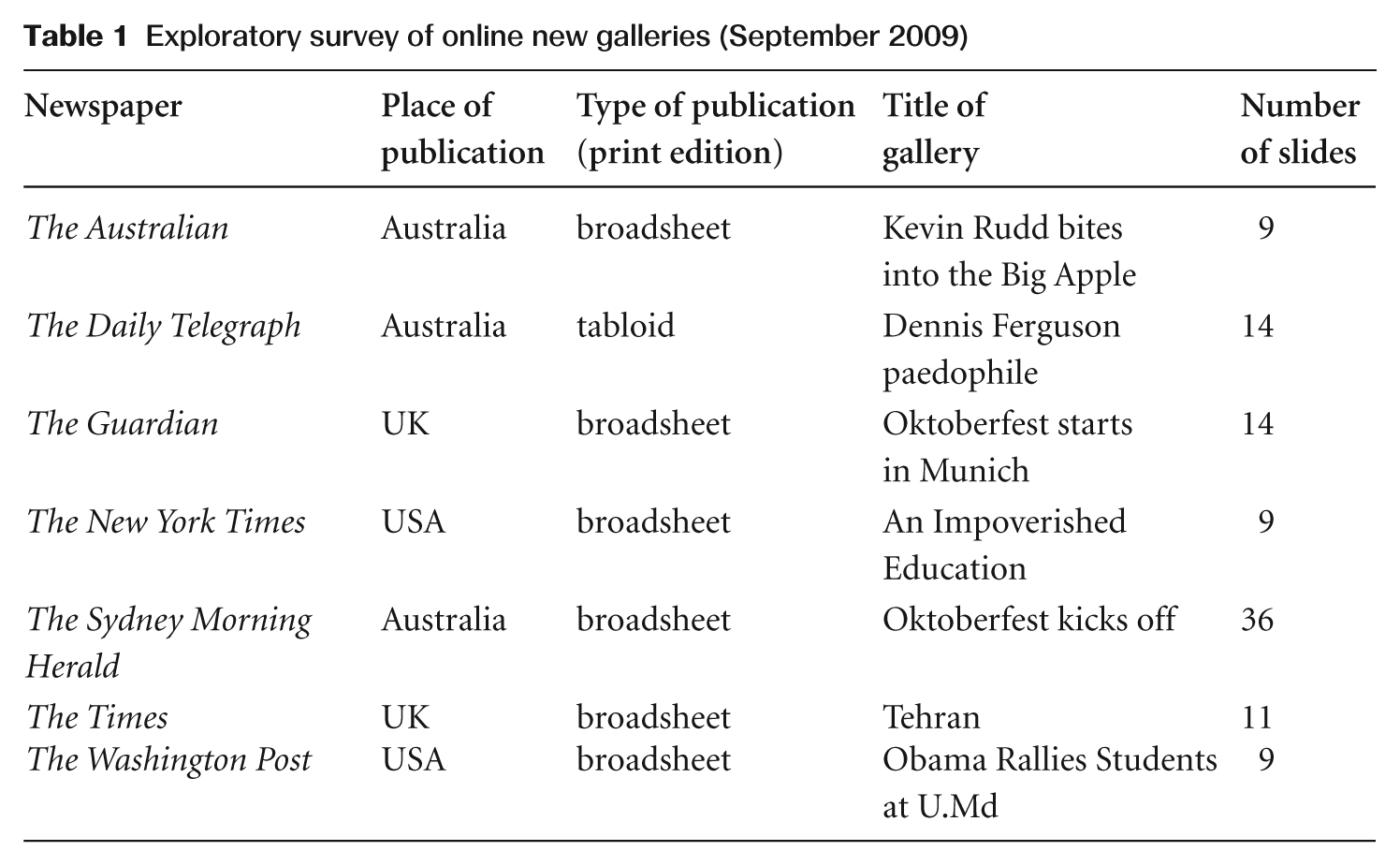
The galleries were chosen on the basis of their relevance to news stories current at the time of publication, their relatively small number of images in comparison with other galleries viewed, and their various topics (though two on the same topic – Oktoberfest – were deliberately chosen for comparison). Further, galleries related to news events, rather than themes (e.g. Weather) or time (e.g. ‘The Week in Pictures’) were chosen.
Part Two: International Survey
The large-scale international survey on the uptake of multimedia was conducted during February 2010. A database was written specifically tailored to this research project, using a widely available commercial database software package, where information gleaned from the websites was recorded and analysed (a snapshot of the database is provided in Appendix 1). The online English language newspaper website searches were conducted via http://www.world-newspapers.com in conjunction with http://www.thebigproject.co.uk/news/. These websites were used to help select major national online newspaper websites from each country and to ensure a range of quality/popular, independent/state-owned news organisations.
A total of 180 newspaper websites were surveyed. Of this total, just under half (84, or 47 per cent) offered links to multimedia sections in their websites. Table 2 summarises these findings by continent/region.
International survey of online news gallery uptake (February 2010)
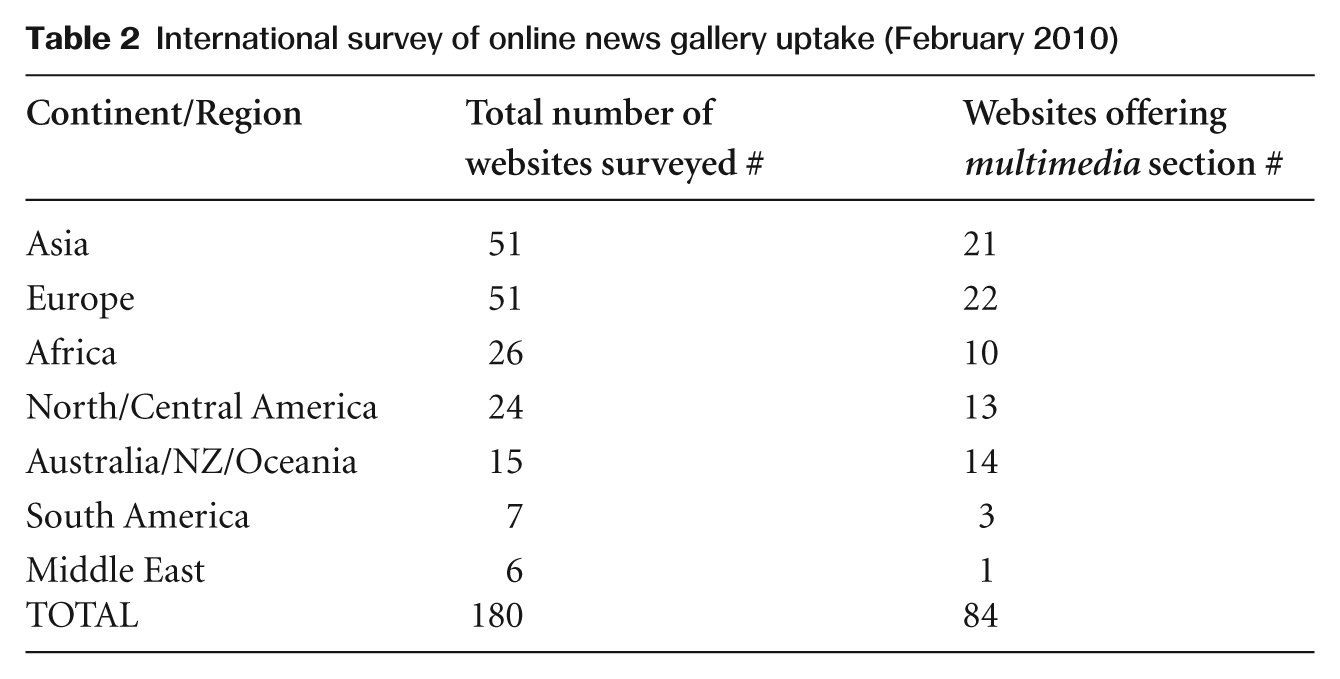
Less than half the sites surveyed offered multimedia, and of the kinds of multimedia story on offer, galleries were more than twice as common as video (the second most common, see Table 3; cf. Wojdynski, 2008: 30). These figures provide a snapshot of the kind of multimedia on offer in a fast-changing environment, and the totals and proportions may already have changed significantly.
Range of multimedia offered (February 2010)
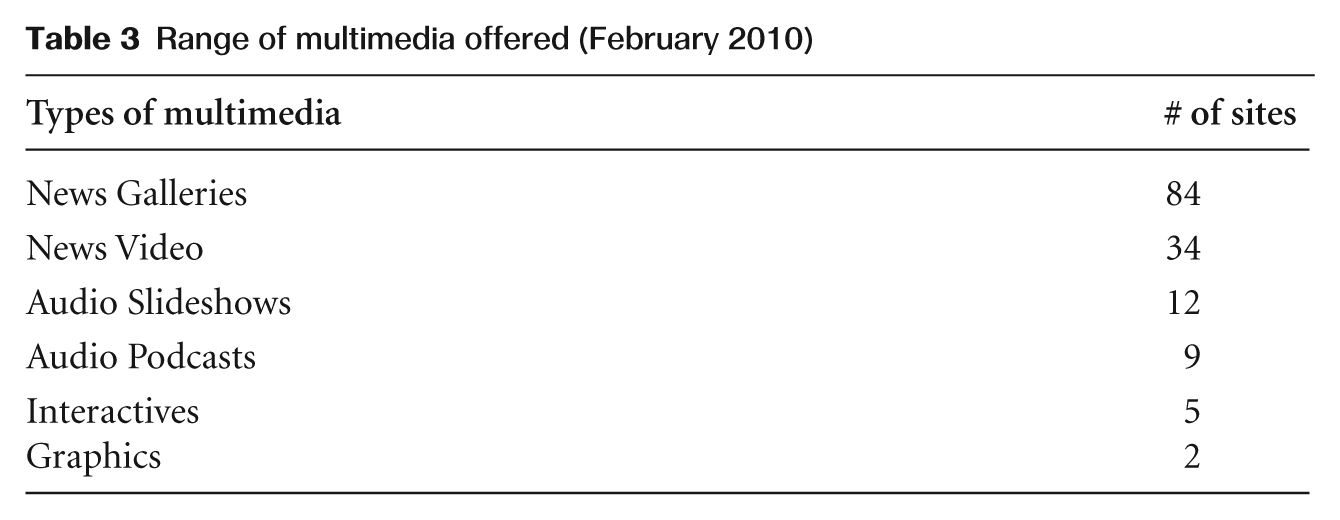
All of the news websites surveyed that offer multimedia at all use news galleries, a significant finding in itself. Approximately 14 per cent of the sites offering multimedia also had slideshows of image stills that included narration (and occasionally music) spoken by journalists who also reported on the events depicted (see Engebretsen, forthcoming-2012). Interactives and graphics were not very common at all. Interactives often consist of maps or images, where readers activate the revelation of information by hovering the cursor over these figures and thus navigate their own pathway through the text; and graphics are usually additional tables and figures that are linked to a news story elsewhere on the website. Some examples include tabulated election results or a historical timeline of past presidents.
One further point that will be made here regarding the large-scale survey concerns navigation and access to the galleries. Of the 84 websites that did offer news galleries, 52 of these included a Multimedia tab in the navigation bar that runs across the top of the homepage or down the left side of the page. Twenty-five of these sites also included Multimedia as its own section embedded in the homepage, just as Opinion, Local News or Sport may have their sections indexed on the homepage, thus providing multiple entry points to the galleries. Of the remaining 32 sites that did not signal the existence of galleries through the navigation bar, 14 had their own section on the homepage, and eight included an icon (typically of a camera) next to a news item that linked to the galleries section. Ten sites included a link in the site index at the bottom of the homepage.
Overall, ease of reader access to online news galleries in our sample varies widely. Some galleries are very difficult to find, and are most likely to be discovered ‘by accident‘ through a story or an image. In general, the newspapers that tend to make the existence of galleries obvious, that give readers easy access to them through a variety of hyperlinks, and that offer the most variety in the types of multimedia (i.e. not only galleries), are established, well-resourced, nationally (and often internationally) recognised newspapers such as The Washington Post, The Guardian, and so on. The two galleries examined in this paper come from two such newspapers: The Daily Telegraph (Australia) and The Guardian (UK). Analyses of these galleries are offered below, but first we turn our attention to the ways in which collections of images have been institutionally conceptualised, and establish the definition of online news galleries deployed in this research.
Portfolios, Essays And Galleries
In this section, we consider different institutional conceptions of image collections. To begin, we consider the portfolio, a common text type in the photographic professions. Then, we look at the practices of art institutions, and the collection of images into galleries. This term has recently been ‘borrowed’ to describe practices on the world wide web, and online news. Finally, we consider news institutions, and institutional perspectives on photo essays and picture stories.
In the professional practice of photography, a portfolio is most commonly defined as a sample of an artist’s (photographer’s) work. A portfolio may be used to demonstrate the skills of the photographer and the range of work/styles they engage in. They are typically organised to highlight the depth of the body of work, rather than according to narrative drive or a desire to ensure cohesion between the pictures presented. Thus, even though the pages in a portfolio are viewed sequentially, each image in a portfolio stands as a discrete example of the photographer’s body of work; it does not rely on the images before or after it to reinforce its meaning potential in relation to a particular event or theme.
Another institutional approach to the display of a collection of images is the gallery. The term gallery is most commonly used to refer to a room or a building where works of art are displayed for the general viewing public. There are innumerable ways of organising the works displayed: according to regions (Asian), styles (watercolours), movements (Cubism), periods in time (late 19th century), artists (Gilbert & George), collectors (Eli and Edythe Broad), and competitions (World Press Photographer of the Year), among them. Thus, viewers in a gallery do assume that there is some underlying principle or purpose in the ways in which works of art are gathered together in a particular space for a particular time period. However, as with portfolios, narrative appeal does not typically rank as one of these.
Another more recent use of the term gallery has been in the online context of software to download and to organise photographs, either for personal use, or for more public viewing and sharing with social networking websites that allow members to upload, organise and share their photographs with others. Further, in the online news environment, the term picture gallery is employed in relation to the collections of press photographs that are grouped together or ‘packaged’ (Layton, 2011: 58) according to news events (e.g. Deep Water Horizon Oil Spill in the Gulf of Mexico) or themes (e.g. Weather) or time (e.g. ‘The Week in Images’).
In the institutional context of print news production, photo essay is one of the oldest terms applied to collections of images, and is attributed to W. Eugene Smith. This form of news storytelling was particularly prevalent in the illustrated press that emerged in the 1930s, such as Picture Post and Life Magazine (Gernsheim and Rosenblum, 2010; see also Caple, 2010 for a brief history of the development of news photography). Smith described the photo essayist as:
a photographer who manages to comprehend a subject – any subject, whether it’s coal miners in Appalachia, or love, or mercury poisoning of human beings in Minamata – and gives a lot of thought to weaving the pictures into a coherent whole in which each picture has an integral relationship with the others. (Cited in Moran, 1974: 14)
What appears to be central to Smith’s understanding of the photo essay here is the fact that the images must relate not only to the subjects or happenings they depict, but must also relate to each other in a way that produces a coherent whole (see also Kobre, 1980: 286–305 for an extended interview with Smith). He goes on to state that:
just having a long story doesn’t make an essay. You can take a group of pictures all in the same place, on the same subject, and lay them out to make a powerful visual statement, but if they don’t reinforce each other – if they don’t show those interrelationships that make the whole more than the sum of its parts – you’ve got what I’d call a portfolio. (Smith, cited in Moran, 1974: 15)
Mary Ellen Mark, also a photo-essayist, shares some of Smith’s concerns regarding the relationship between images in the photo essay, and perceives a considerable difference between the photo essay and the kind of image typically sought by photojournalists: ‘the photo-essayist has to consider layout when working, whereas the documentary photographer or the photojournalist places more emphasis on the strong, individual picture that can stand alone – it doesn’t need other pictures to support it to tell a story’ (Mark, 1990: 5). However, in providing technical directions on how to construct a photo essay, Moran (1974: 74) explains that press photographs can be effectively combined into an essay: ‘individual photographs in an essay must complement each other, each adding to the narrative and emotional impact of the others. Yet each can stand as a dramatic picture, an individual statement, in itself’.
Douglis distinguishes between photo essays and picture stories. For him, the images in photo essays ‘express considerable meaning on their own’ and cumulatively add up ‘to communicate an even stronger point’, with verbal text in place to offer context over meaning (Douglis, 2003: 36). In picture stories, however, ‘the text is written first, and pictures usually show the very things the story talks about’ (Douglis, 2003: 36).
Although Moran (1974: 14), also draws a distinction between the ‘photo essay’ and the ‘picture story’ (on the basis of interpretation of a larger theme, or not), he sees both as having a rhetorical structure with ‘a beginning, middle and end’. Gernsheim and Rosenblum (2010) use the terms photo essay and picture story interchangeably. They suggest that the photo essay/picture story is visually organised to ensure ‘maximum reader impact’, that the opening photograph establishes the situation, and ‘as with written narration there [is] a visual climax and a definite conclusion’.
For us, three clear factors emerge from these discussions of image collections in news practices. The first is the subjective presence of the photographer in the authoring of the essay. Indeed, Moran states that ‘an essay is one of the most personal and powerful forms of narration a photographer can use’ (1974: 8), having what Wade (2009: 5) terms ‘affective resonance’. Our own approach is less concerned with the subjectivity of the individual photographer, and more with the subjectivity of the collective, institutional author of online news galleries (including photographers, photo editors, and potentially other practitioners in various authorship roles, cf. Bell, 1991: 39). The second is the requirement for a rhetorical structure. While some distinguish between ‘photo essays’ and ‘picture stories’, the importance of some kind of rhetorical organisation in the arrangement of the images in such collections is recognised by all. The third is the relation between images and the verbal text that often accompanies such essays. The contribution of verbal text is particularly important to consider, especially when it may in fact be the contribution of a completely different person (or people). In discussing the online news galleries in this study, which are always a combination of both images and words, the role of the verbal text is a crucial element in our analysis of the storytelling qualities of such galleries.
In this study we use the term online news galleries for the following reasons:
online because they are produced exclusively for the web;
news because they are produced by major news organisations;
galleries because they are a collection of photographs that have been organised into collections through some underlying principle or purpose.
And in this paper, we are concerned specifically with two galleries based on specific news events (i.e. not organised by theme or time), which suggests that an impetus for rhetorical organisation (as is common in photo essays and picture stories produced in news institutions) is likely to be ‘in play’.
Combining photographic images into meaningful texts is a social practice which is shared across a number of social institutions. Each of these institutions has their own purposes, and their own histories. Online news galleries may draw on these institutions in various ways: photographers are members of the photographic profession, and are familiar with portfolios. Newspaper institutions have a long (and varied) history of using image collections for different purposes, and recent developments in other genres in online newspapers are clearly related to evolving institutional practices. These different institutional perspectives suggest that there is a range of potential influences on the practices involved in authoring online news galleries, including the two specific galleries to which we now turn.
Gallery One: ‘Ferguson’
The first gallery examined in this paper has as its subject a convicted criminal in Australia, who served his prison sentence and was released. Figure 1 shows the design template of the gallery used by The Daily Telegraph (a Sydney-based metropolitan tabloid newspaper) at the time of publication of this gallery.
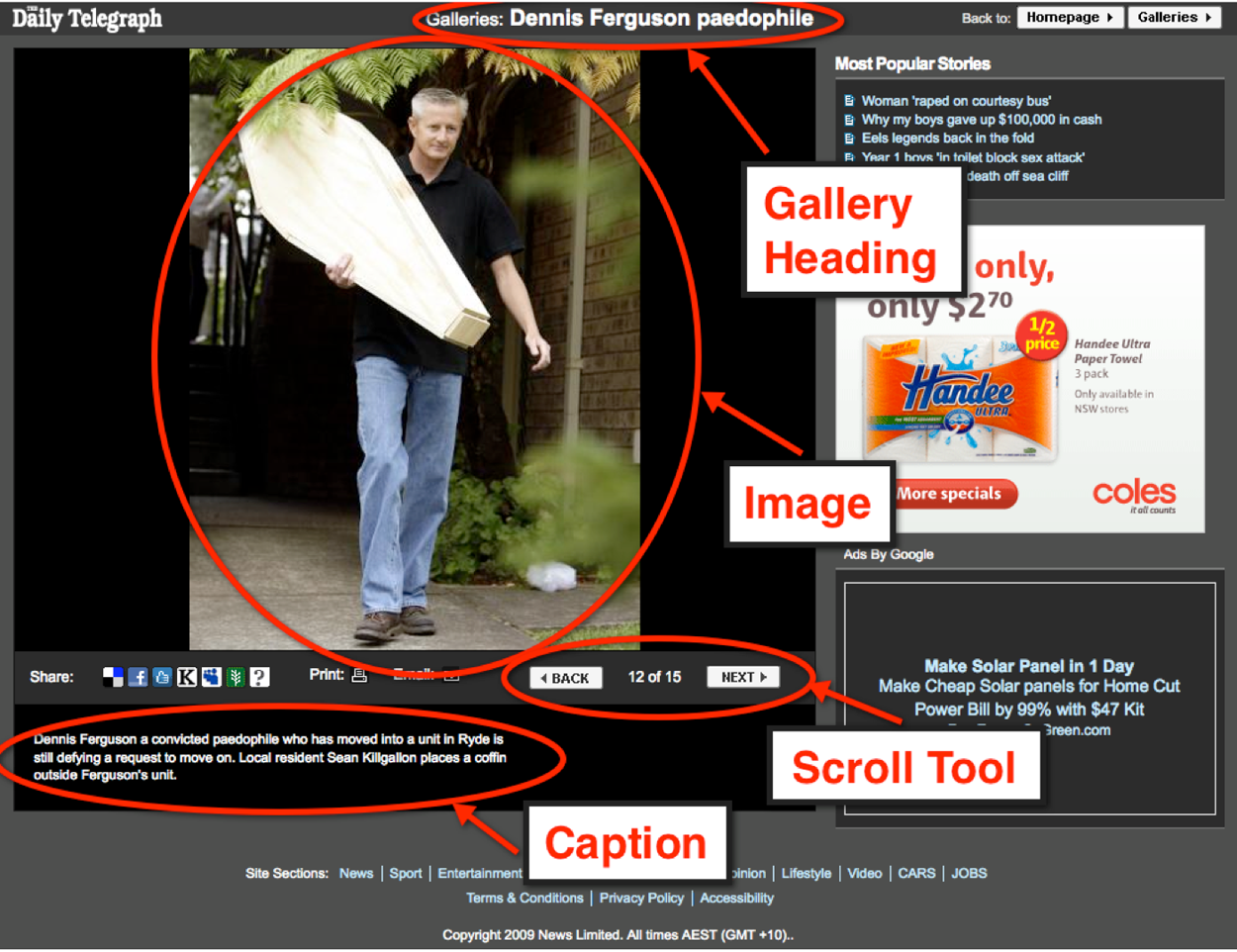
Page template: ‘Ferguson’ gallery, Daily Telegraph
As illustrated in Figure 1, the heading for the story appears at the top of the page, the image dominates the page spatially, and the caption runs across the bottom of the image. 1 The scroll tool allows readers to progress sequentially through the images in the gallery, and to go either forwards or backwards once the sequence is begun. This particular gallery has 14 images, each with a caption. Some images have identical or near-identical captions. Table 4 provides a transcript of the gallery.
Transcript of ’Ferguson’ gallery showing conjunctive relations
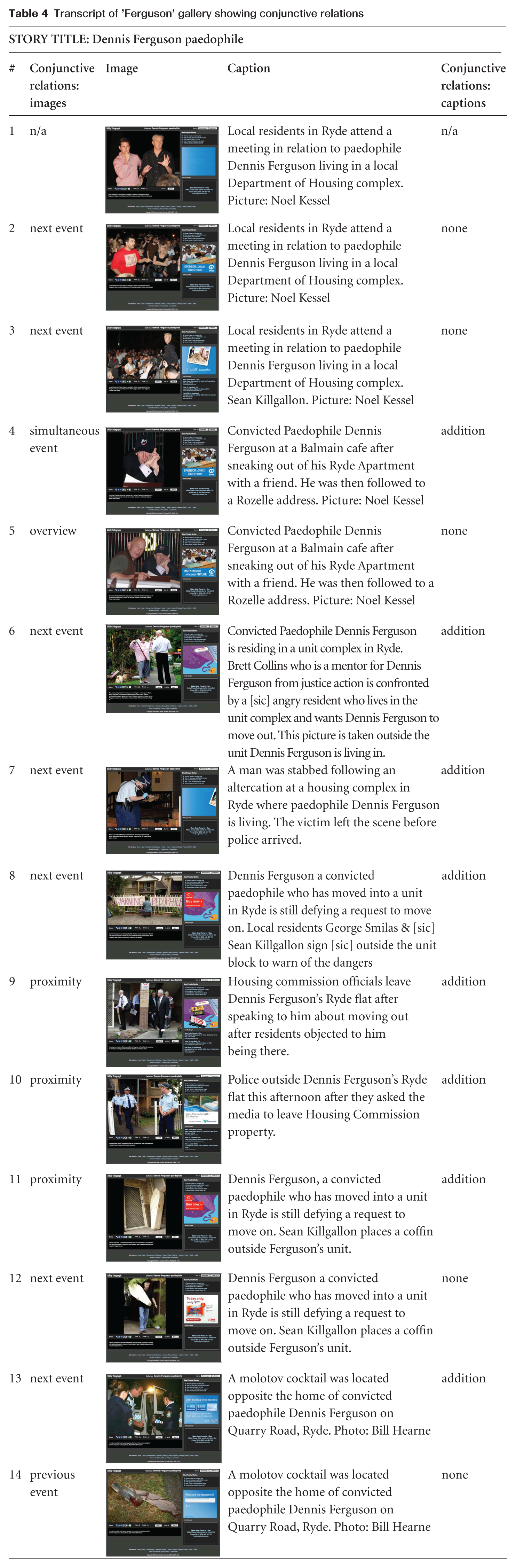
Perhaps the most obvious feature of the transcript is the degree of repetition between captions. There has been little or no effort put into developing a story through the verbal text in this gallery. There are a number of possible reasons for this, including the tight publishing deadlines under which newspapers operate; a relative lack of resources devoted to galleries in this newspaper; and/or the authors’ understanding of the purpose of the gallery in relation to the verbal story to which this gallery was (first) linked.
As noted earlier, the reader of this gallery, if they choose to view all the images, must progress in sequence from first to last. This sets up an expectation of rhetorical relations: readers will read each image and caption in relation to what has preceded them, and attempt to ‘make sense’ of each one in terms of their position in the sequence. This is because such conjunctive relations exist in texts: ‘between the items of information in verbal texts … the frames in a cartoon, the shots in a film, the pages of a website’ (van Leeuwen, 2005: 220).
The medium of the gallery forces the reader through a sequence, so the mechanical relations between each page of the gallery are sequential and fixed: next, next, next, etc. This is in contrast to the ways in which readers may choose to progress through other pages and multimedia in the online newspapers in which these galleries appear (see Djonov, 2008), or even through the elements found on single pages in online newspapers (e.g. Knox, 2007).
Van Leeuwen (2005) explores conjunctive relations in film and websites, and we draw on elements of his framework here to look at (aspects of) the semantic connections between the pages in the galleries. The ‘Ferguson’ gallery can be read as having six phases, marked by the temporal and spatial location of the images (Figure 2). In terms of the conjunctive relations between the captions on each page, they are either relations of simple
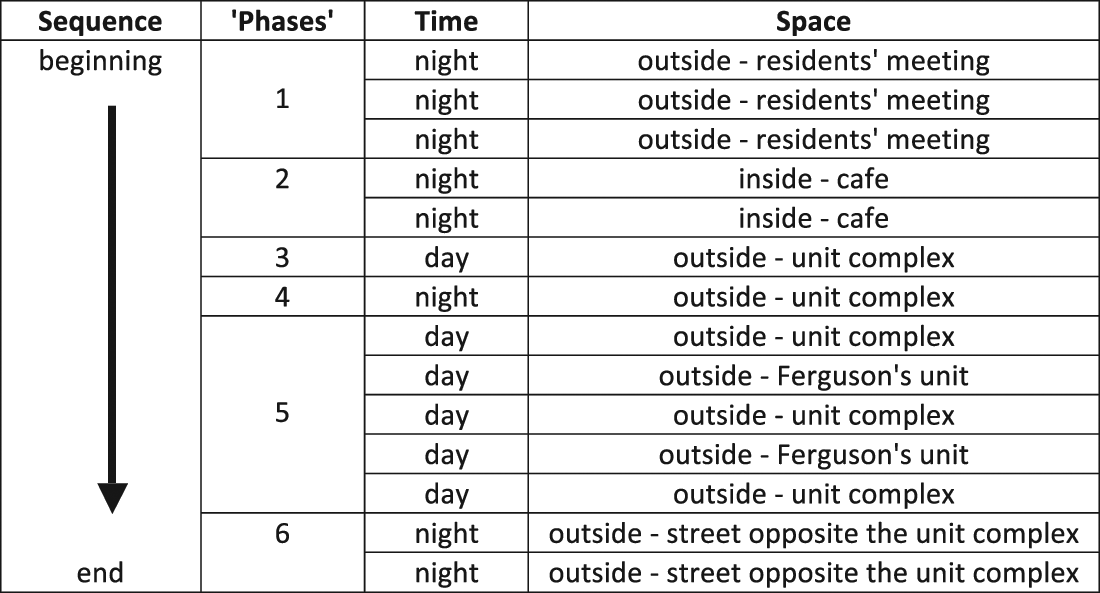
Temporal and spatial development: ‘Ferguson’ gallery
Local residents in Ryde attend a meeting in relation to paedophile Dennis Ferguson living in a local Department of Housing complex. [In addition / Then / Similarly], local residents in Ryde attend a meeting in relation to paedophile Dennis Ferguson living in a local Department of Housing complex. [In addition / Then / Similarly], local residents in Ryde attend a meeting in relation to paedophile Dennis Ferguson living in a local Department of Housing complex.
Regardless of which conjunctive choices a reader makes, the relations do not work because this kind of repetition does not work in texts: it is not coherent or functional. Each of these captions works with its image, on its page, but collectively and sequentially, they do not work with each other.
In addition to the repetition of whole captions, the high degree of repetition of information in captions that are not identical (e.g. the repeated identification of Dennis Ferguson as a paedophile), the lack of reference between the captions (e.g. pronouns), and the single conjunctive relation of
Turning from captions to photographs, the requirement to scroll through the images sequentially is an important factor in ‘reading’ the conjunctive relations between them. The first five images are shot at night, and given their subjects, it is possible to read the first three images as temporally related, and the fourth image as a
In the two longest ‘phases’ of this gallery, there is some pattern of visual conjunctive relations. However, because there are several very short ‘phases’ in this gallery, and because of the limited conjunctive relations between the captions, the gallery overall ‘reads’ as a set of independent images around a related topic, but not as a text.
It is interesting to consider how the gallery might have functioned were the images arranged for rhetorical effect. One possibility (of many) follows:
image 8: hanging the sign: WARNING PEDOPHILE [sic]
image 4: (switch to night) close-up of Ferguson
image 3: residents’ meeting with media
image 1: fronting the meeting
image 2: resident anger at the meeting
image 14: molotov cocktail
image 6: (switch from night to day) angry resident
image 12: carrying the coffin
image 11: the coffin
image 10: police at residence.
While this particular story is not one we would want to tell (or, in fact, see told), the rhetorical effect of ordering the images in this manner would clearly be far more forceful than the gallery as it was authored.
Having considered the relations between the pages of the gallery, we now turn to the ‘interpersonal involvement’ of the author as discussed in relation to photo essays and picture stories above. The language of the captions clearly identifies the interpersonal position of the author (i.e. the newspaper), and this can be illustrated with the use of Appraisal theory. Appraisal theory is a theory of evaluation in language, and:
is concerned with how writers/speakers approve and disapprove, enthuse and abhor, applaud and criticise, and with how they position their readers/listeners to do likewise. It is concerned with the construction by texts of communities of shared feelings and values, and with the linguistic mechanisms for the sharing of emotions, tastes, and normative assessments. (Martin and White, 2005: 1)
Within Appraisal theory, the system of
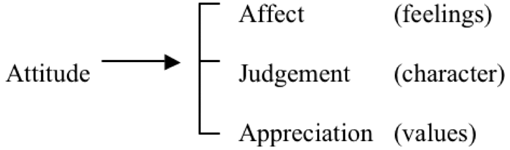
The attitude system in Appraisal theory
Appraisal meanings ‘radiate’ through a text – a particular position towards a person, group, action, or object is typically established, and then this position is maintained prosodically throughout (one or more phases of) a text. In the ‘Ferguson’ gallery, there is an early negative judgement of Dennis Ferguson in the heading of the gallery: Dennis Ferguson paedophile. Paedophile is an explicitly negative term, and in appraisal terms is an instance of
Appraisal in language in the ‘Ferguson’ gallery
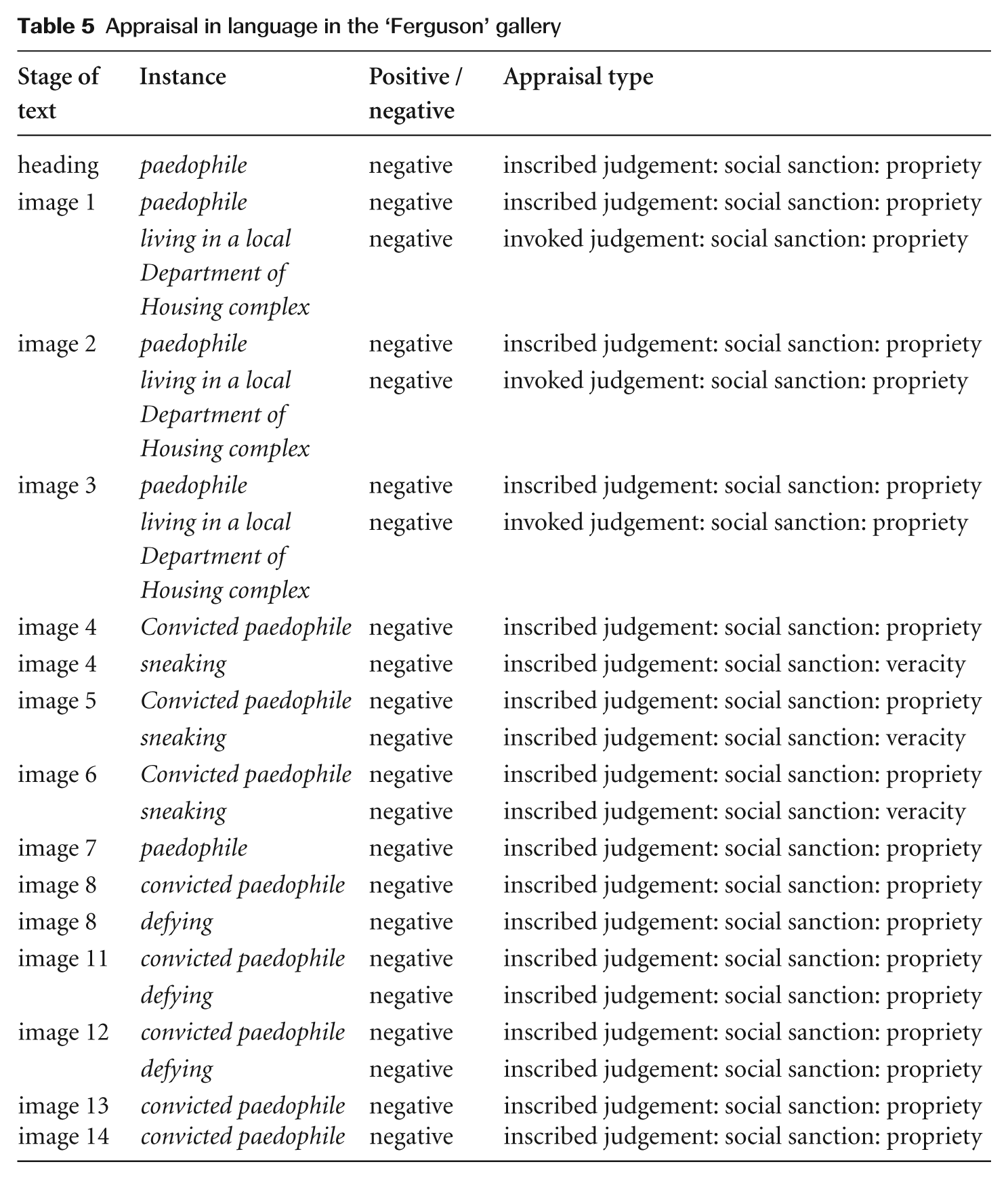
Appraisal theory has been applied to images (Chen, 2010a, 2010b; Economou, 2006, 2008), though such applications are in their relative infancy compared to the extensive work on appraisal in language. In Table 6, we provide an analysis of the appraisal meanings of the images in the ‘Ferguson’ gallery. The emotions (
Appraisal in image in the ‘Ferguson’ gallery
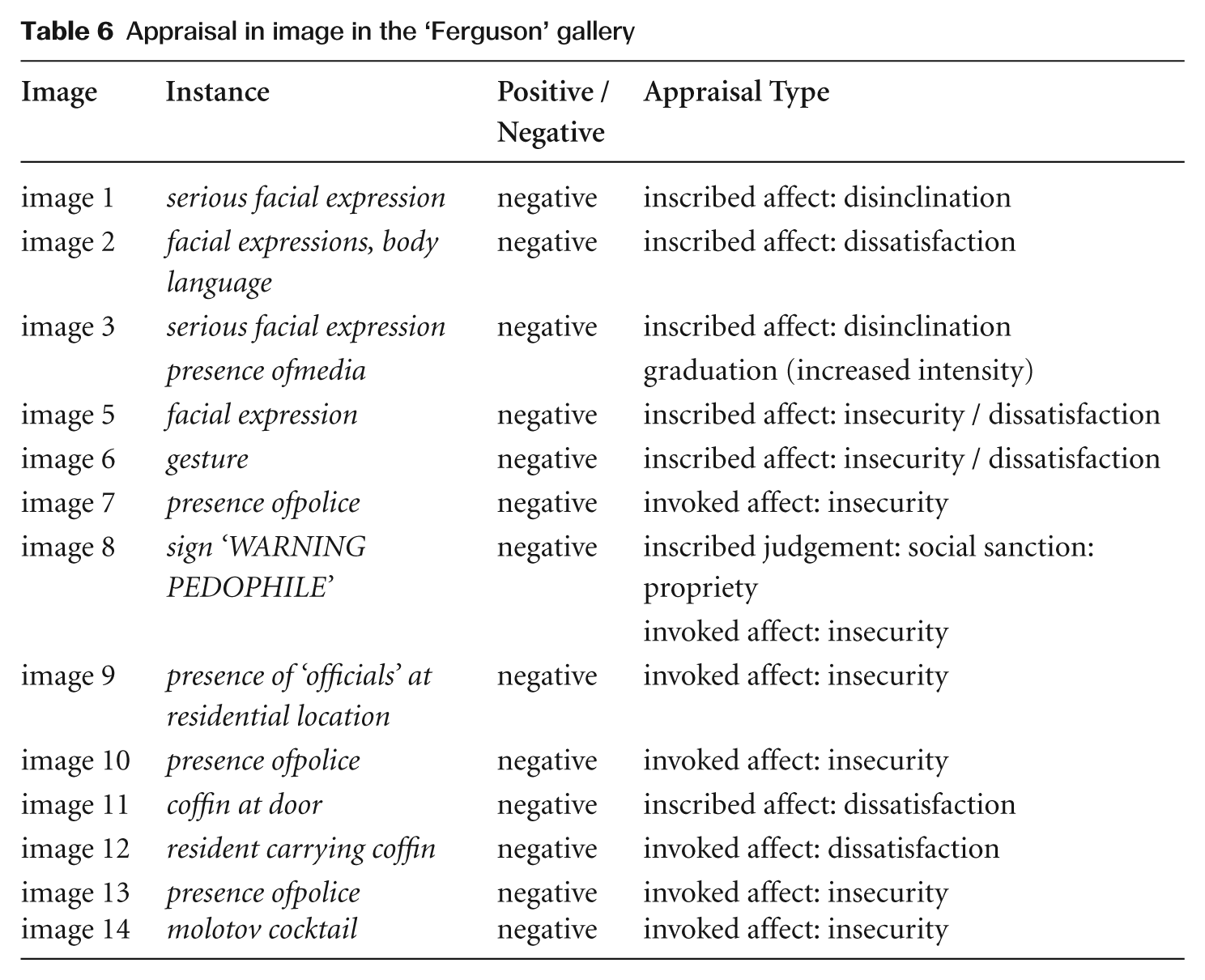
From an interpersonal perspective then, we can say that the author has involvement and a coherent subjective presence in the authoring of the text – one of the key criteria identified for photo essays and picture stories. However, the ‘semiotic burden’ of communicating this ‘affective resonance’ (Wade, 2009: 5) rests almost entirely with language. While the appraisal values are associated with the relevant actors as they are represented visually in the gallery, the images would not carry nearly the same impact in the absence of the verbal text.
Thus, the gallery has a relatively high interpersonal ‘charge’, though this depends largely on language, and there is no rhetorical development – visual, verbal, or multimodal – in this gallery. In light of this, the quote from Mark in the previous section bears repeating here:
the photo-essayist has to consider layout when working, whereas the documentary photographer or the photojournalist places more emphasis on the strong, individual picture that can stand alone – it doesn’t need other pictures to support it to tell a story. (Mark, 1990: 5)
Mark’s characterisation of the practice of photojournalism is consistent with Caple’s (2009: 188) discussion of the photojournalistic mission to ‘capture the critical moment’, and both of these are consistent with the discursive description of verbal hard news stories by White and colleagues (e.g. Iedema et al., 1994; White, 1997). In their work, White and colleagues build on the well-known ‘inverted pyramid‘ model of description to provide a ‘Nucleus-Satellite’ model, in which the ‘Nucleus’ of headline-plus-lead is expanded upon by ‘Satellites’ which relate to the Nucleus rather than to each other. Figure 4, taken from Knox and Patpong (2008), illustrates this rhetorical structure, and shows how the Satellites can be read in any order, a feature which illustrates their relation back to the Nucleus.
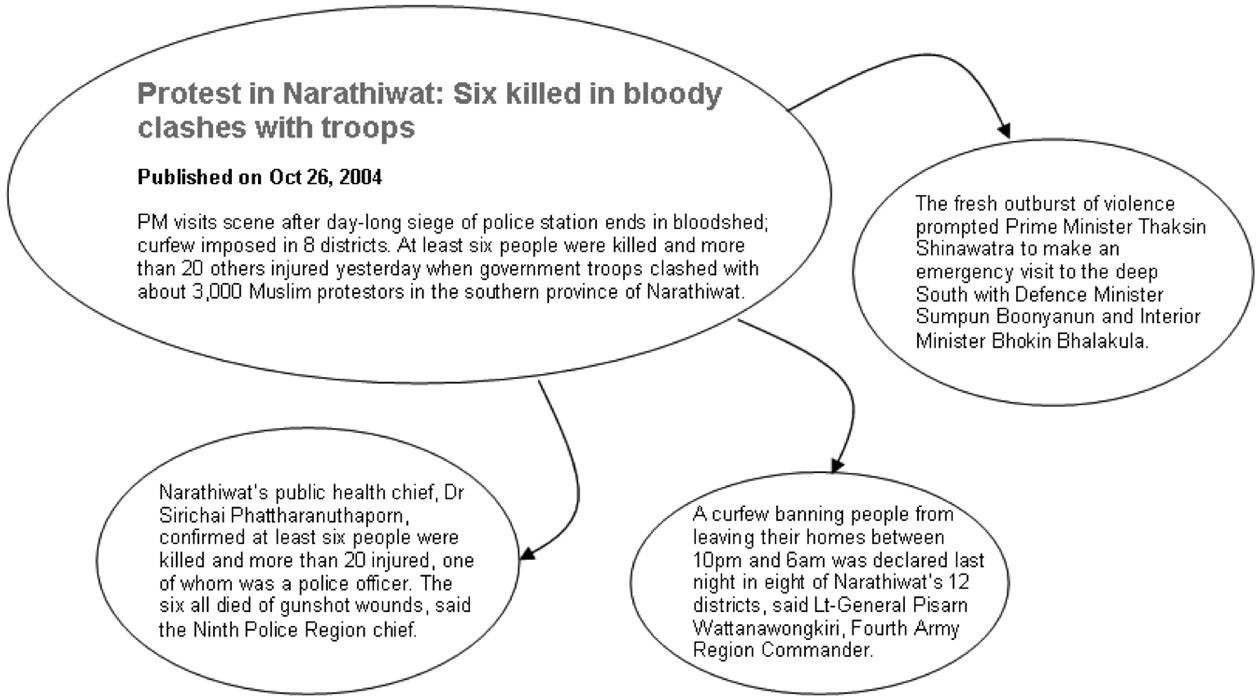
Nucleus-Satellite rhetorical structure (Knox and Patpong, 2008)
This structure has evolved over time, as the social and commercial contexts of news production have led to the ‘crisis point’, or ‘peak’ of interpersonal meaning of a story being moved to the front of the story (see Iedema, 1997; cf. Barnhurst and Nerone, 2001). As photojournalism has evolved into a valued aspect of newspaper discourse in the 20th century (Caple, 2010), journalists and photojournalists alike strive to build their texts around the interpersonal peak of a story, through their respective verbal and visual discursive re- construction of an event.
While the journalist is employed to ‘tell the whole story’, the job of the photojournalist in print newspapers has largely been to capture the ‘critical moment’ visually (typically construed verbally in the nucleus), in a way that will complement the verbal account (though cf. Caple, 2008). The ‘Ferguson’ gallery has been authored in a way that suggests the assignment of the photojournalists in this story was to ‘get’ an image to complement the verbal story, and not, for example, to compile a collection of images that would tell the story visually in their own right.
In summary, this gallery can be described as having the following features: a high degree of discursive repetition in language; a lack of any sense of development in the spatial and temporal unfolding of the text; a lack of conjunctive development; a strong reliance on language in addition to image to signify the ‘subjective involvement’ of the authors. In short, this gallery is a collection of image-caption complexes that work independently of one another, but do not work together to tell a story, though they have the potential to do so. These features problematise our initial assumption that galleries function as texts in their own right, by providing a falsifying instance: a gallery that is not a text.
Gallery Two: ‘Oktoberfest’
The second gallery is sourced from the online site of The Guardian, a national broadsheet newspaper in the UK, and ‘reports’ on Oktoberfest, an internationally well-known festival held in Munich, Germany every September. Figure 5 shows the design template of the gallery, which has minor differences to the Daily Telegraph design template shown in Figure 1, but is overall structurally consistent with it.
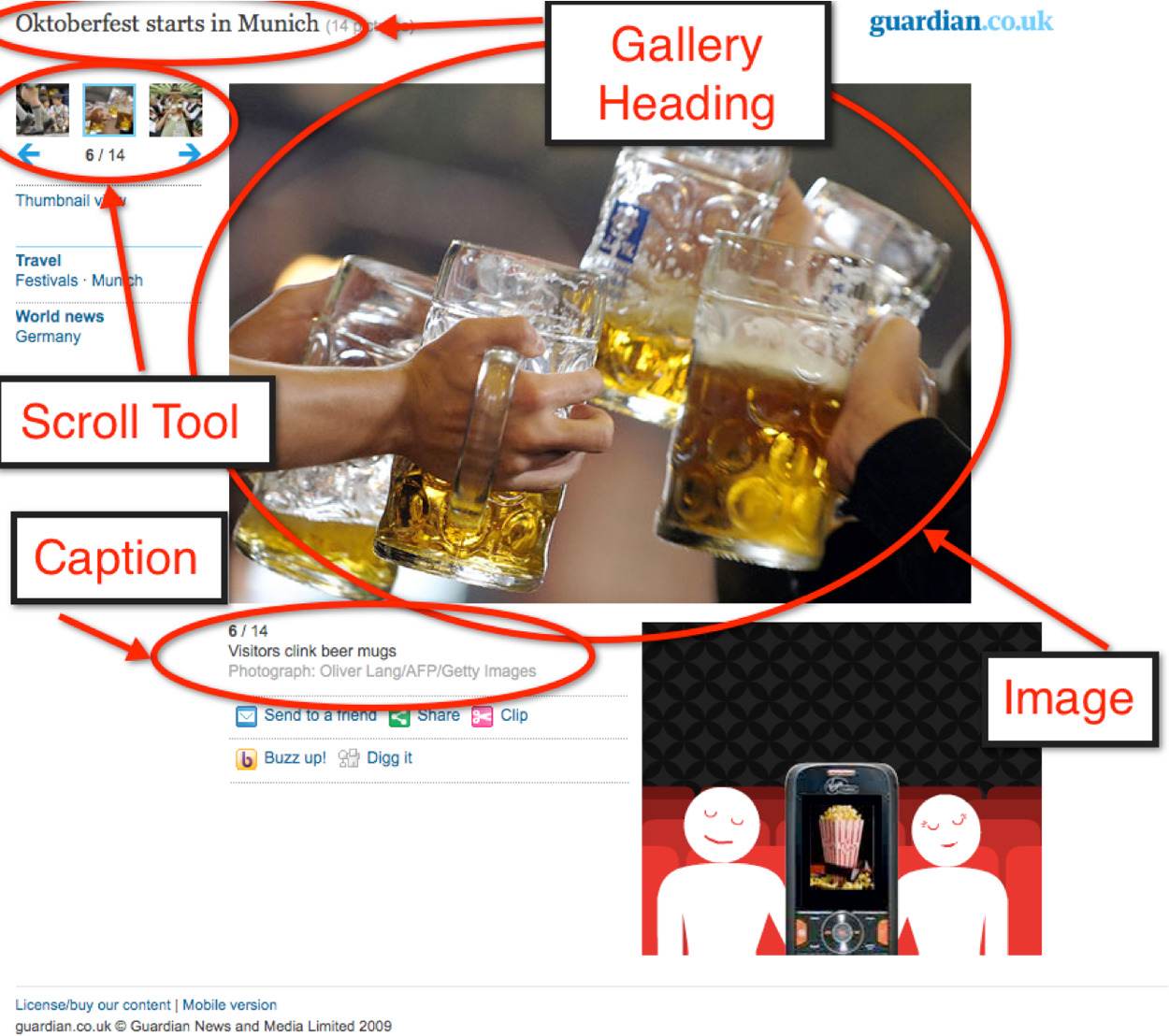
Page template: ‘Oktoberfest’ gallery, The Guardian
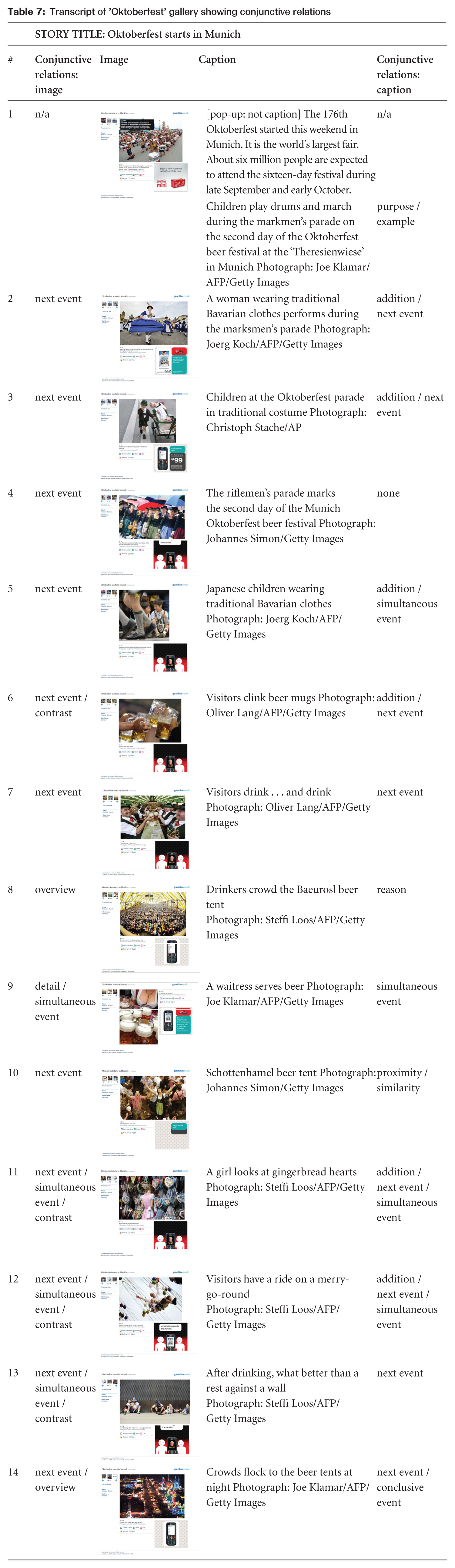
This particular gallery has 14 images, each with a caption. Again, readers can scroll forwards or backwards through the gallery. The ‘Oktoberfest’ gallery moves through a number of related events, all of which appear to take place during the day. The final image is a night shot, and an extreme long-shot taken from a very high angle (in contrast with almost every other image in the gallery). Each image has a different caption. The Oktoberfest gallery has both a sequential beginning, middle and end, and a rhetorical beginning, middle and end. Table 7 provides a transcript of the gallery.
Transcript of ’Oktoberfest’ gallery showing conjunctive relations
Like the ‘Ferguson’ gallery, the ‘Oktoberfest’ gallery can be read as having a number of ‘phases’. As Figure 6 illustrates, the temporal and spatial development of the gallery is far more internally consistent than that of the ‘Ferguson’ gallery.
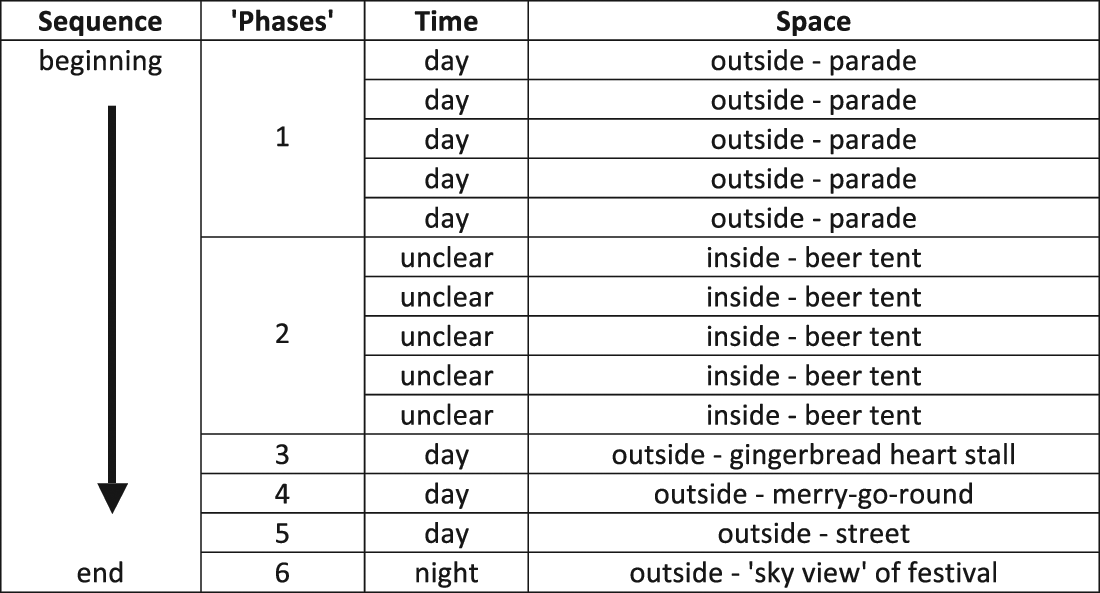
Temporal and spatial development: ‘Oktoberfest’ gallery
Turning to the conjunctive relations, the first written text in the ‘Oktoberfest’ gallery is not a caption. It gives background information about the Oktoberfest, and the relation between this text and the first caption is one of
The 176th Oktoberfest started this weekend in Munich. It is the world’s largest fair. About six million people are expected to attend the sixteen-day festival during late September and early October. [For the purpose of participating in Oktoberfest / For example], children play drums and march during the markmen’s parade on the second day of the Oktoberfest beer festival at the ‘Theresienwiese’ in Munich. [And / Then], a woman wearing traditional Bavarian clothes performs during the marksmen’s parade. [In addition / Next], children at the Oktoberfest parade in traditional costume.
Within the second phase, a range of conjunctive relations exist, as the following reproduction of the relevant five captions (with conjunctive relations and punctuation inserted) illustrates.
Visitors clink beer mugs. [Then] visitors drink … and drink. [For this reason], drinkers crowd the Baeurosl beer tent. [Meanwhile], a waitress serves beer. [Similarly, nearby], Schottenhamel beer tent.
While the last clause is not grammatical, and this ‘compiled extract’ does not ‘flow’ as it would had it been written as a single, stand-alone verbal text, the conjunctive relations that hold between the captions are clear, and they function together.
A final observation on the captions in this gallery: between the captions at the boundaries of phases 1 & 2, 2 & 3, and 3 & 4, the conjunctive relations can be read as operating between the phases of the text, rather than just between individual images (e.g. the parade then drinking).
The conjunctive relations between images in the ‘Oktoberfest’ gallery are, like the ‘Ferguson’ gallery, affected by the mechanical requirement to access each one in sequence: the reader looks for the sequential meaning between the images. This suggests a temporal reading of the images throughout the gallery (i.e. each related to the other as
As with language, there are conjunctive relations between whole ‘phases’ in the images. The change in subjects and locations in the images at the beginning of each new ‘phase’ can be read as a conjunctive relation of
Turning to the subjective involvement of the author, the primary means of appraisal in this gallery is in the images, and there is no inscribed appraisal in the language. In contrast to the ‘Ferguson’ gallery (which – importantly – is very different in its subject matter), the appraisal meanings in this gallery are all of
Appraisal in image in the ‘Oktoberfest’ gallery
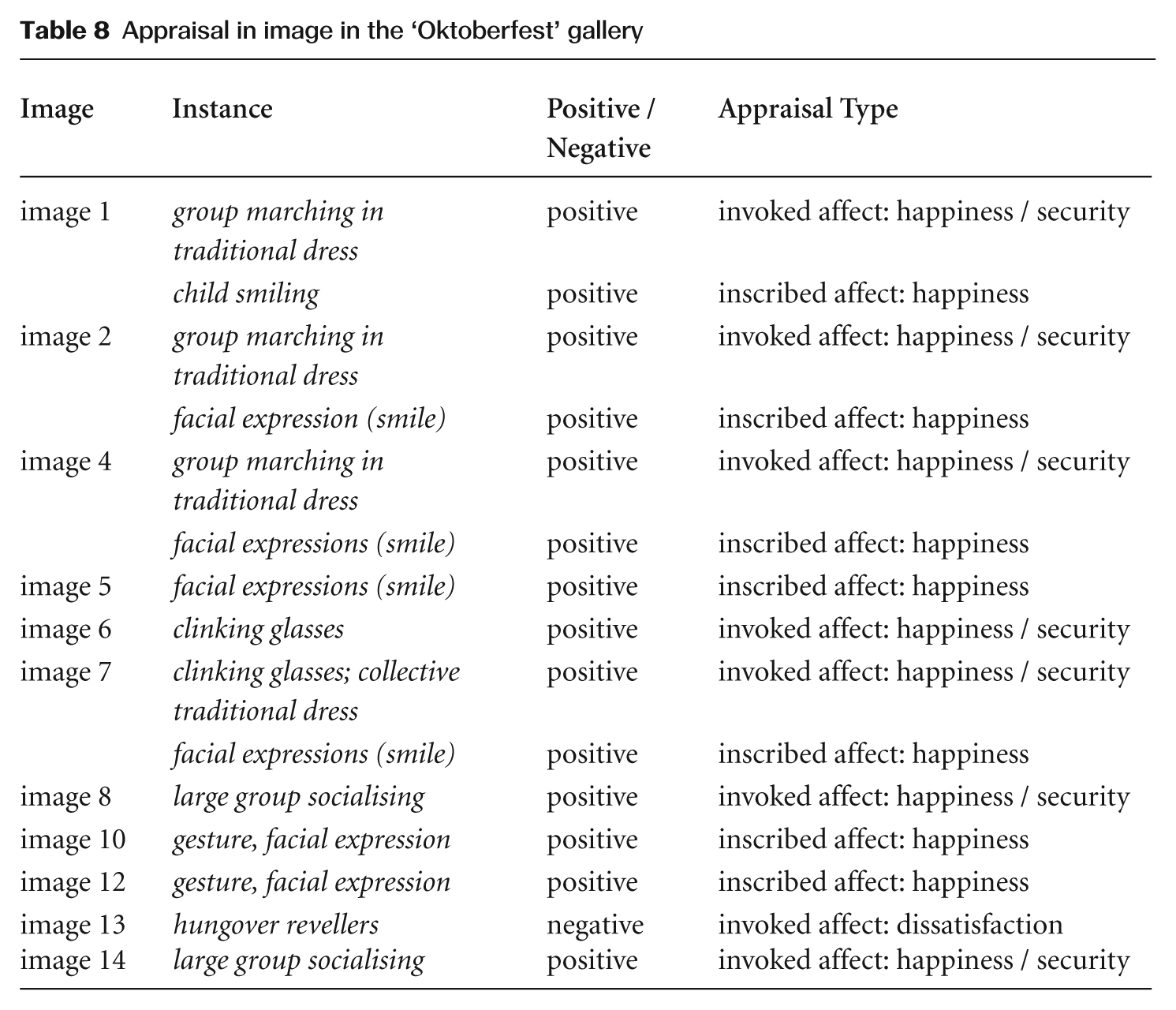
While many of the images in this gallery are ‘important moments’, or important activities associated with Oktoberfest, the overall collection of images appears to reflect a documentation of the event from a range of perspectives (including different aspects of the parade, different beer tents, and different activities such as buying gingerbread hearts and riding merry-go-rounds which fall outside the ‘main’ focus of parades and beer drinking), rather than a search for a single image to ‘capture’ the ‘interpersonal peak’ of the event.
Our argument here is not that photographers covering the two events were necessarily given different assignments, nor that they necessarily went about their work differently, but that the different ways in which the two galleries are authored communicates a different interpersonal relation between the author of the gallery and the subject matter of the collection of images. Notably, both galleries include images from more than one photographer, and all the images in the Oktoberfest gallery are agency images, so authorship of both galleries is collective, and a product of institutional practices.
Just as the ‘Ferguson’ gallery can be considered in relation to the Nucleus-Satellite structure of hard news texts, the structure of the ‘Oktoberfest’ gallery can be considered in relation to a number of verbal genres that have been studied and described by linguists. The first of these is a recount (e.g. Martin and Rose, 2008), in which a speaker/writer orients the listener/reader by giving information about when, where, and who is involved in the text, and then recounts events in sequence. The ‘Oktoberfest’ gallery moves through a parade (with a verbal orientation that is additional to the caption of the first image – see Table 7), then to drinking, then to other activities (gingerbread hearts and merry-go-rounds), then to hangovers, and then into the night.
Another relevant verbal genre is the information report (e.g. Martin and Rose, 2008), which begins with a general statement about the object to be reported on, and then talks about different aspects of the object in turn. The ‘Oktoberfest’ gallery begins with a verbal statement about the festival, and ‘reports’ on the parade, the beer tents, and other aspects of the festival (cf. the earlier discussion of temporal conjunctive relations between phases in this gallery).
However, this gallery is not a recount, and it is not an information report. Our intention is not to ‘shoehorn’ the gallery into a verbal genre, but to demonstrate that the way this gallery unfolds visually is reminiscent of other common patterns used to ‘unfold’ texts in English-language-speaking cultures within which this newspaper is distributed. In short, the ‘Oktoberfest’ gallery is unquestionably a text which tells a story. Yet the hard-news story-telling practices which typically drive journalists and photojournalists, as discussed in relation to the ‘Ferguson’ gallery, do not appear to be the driving force behind the authoring of the ‘Oktoberfest’ gallery.
Discussion
It is clear from these analyses that the two galleries, ‘Ferguson’ and ‘Oktoberfest’, differ considerably. The ‘Ferguson’ gallery was, in fact, published together with a verbal story, and the link to the gallery was embedded in the middle of the story. Bearing this in mind, the gallery can be considered as ‘hanging off’ the verbal story. Together, the two make a kind of ‘illustrated story’, but while the verbal text stands alone effectively, the gallery (as argued above) hardly works without the verbal story (if it works at all); it is more a clustering of ‘privileged moments’ (Sontag, 1977: 18) than a functional text.
This is consistent with Boczkowski’s (2004) identification of newspaper archives, once known as ‘the morgue’, as a money-making opportunity for online newspapers. Photographs which once would have been rejected can now be published in the spaces created by online news galleries, spaces that are at once semiotic and commercial. However, publishing photographs in these spaces, and providing readers access to them collectively in a given sequence, does not make them a text. We argue that this gallery, read alone, is not a portfolio, an illustrated story, or a picture essay. It is a collection of related texts, and is an example of Smith’s ‘parking lot of pictures’. We would argue, further, that those newspapers that publish online news galleries that do exploit the semiotic potential of these spaces (rather than parking lots of pictures) will, ultimately, be the ones that maximise the commercial possibilities they also offer.
In contrast to the ‘Ferguson’ gallery, the ‘Oktoberfest’ gallery was not published with another verbal news story, and was designed to ‘stand alone’. There is little verbiage in the captions, but the captions have conjunctive relations with one another. In addition, they give narrative impetus to the text, propelling the story forward (cf. Martin, 2000) by offering historical background (at the outset), adding factual information about images (the name and significance of the parade, and the various tents), and adding ‘story-like’ commentary (e.g. ‘drink … and drink’; ‘what better after a …’). Even without the captions, though, the images are related and display a clear rhetorical structure. Here, then, we have a picture story - a rhetorically structured sequence of images that tell a story, and that are complemented by language but can stand alone from it, independent from any other text for their collective meaning or purpose.
Conclusion
Online news galleries offer new possibilities for storytelling. They are not a genre, but do allow for the development of new genres. Contrary to Wojdynski’s (2008) findings, our analysis here (a different kind of analysis, of a much smaller sample) suggests that the established practices of newspaper reporting may make it more difficult to tell hard-news stories in galleries than telling ‘human interest’ or soft-news stories. Indeed, this is one of the areas to be further investigated in stage three of our project.
Other areas requiring further investigation include text-image relations; though we have not explored these relations in this paper, our initial findings suggest that captions perform a range of functions in different galleries. We also need to examine galleries that are theme- and time-based as well as those based on events. In addition, as this paper makes clear, it is important to look at the ‘text complexes’ (e.g. ‘verbal’ stories, galleries, videos which are published together) which are becoming more common in online newspapers, and to take into consideration the fact that stories can be (and are) told by multiple means.
Online news galleries are quite a new ‘storytelling space’ for most news organisations (cf. Habermas, 2002: 359); indeed, according to our international survey, the uptake of news galleries has been somewhat limited. However, in some ways they may be understood as a return to practices of many print newspapers of almost a century ago (cf. Caple, 2010). It will be interesting to see what new genres emerge in this online environment, and what impact online news galleries have on photojournalists’ work.
When journalists delete paragraphs from their stories, they do not expect to see them put up on the web just because they can be. But the work of photojournalists is rarely regarded in the same way as that of journalists. As Smith himself lamented: it is often very difficult to get past the preconceived ideas of the editors (cited in Kobre, 1980: 289) and it will be a bold photographer that will be able to decide what gets published and how it gets published. In time, though, we predict (and hope) that more and more newspaper editors will explore the story-telling capacities of galleries (and owners will resource them to do so); not pave the photographers’ paradise, and put up a parking lot of pictures.
Footnotes
Appendix 1: a snapshot of our online news gallery database
Notes
Biographical Notes
DR HELEN CAPLE is a Lecturer in Media, Journalism and Communications at the University of New South Wales. Her research interests include media discourse, press photography and social semiotics. Helen is a former press photographer.
Address: 311Q, Robert Webster Building, School of the Arts and Media, University of New South Wales, NSW 2052 Australia. [email:
JOHN KNOX is a Lecturer in Linguistics, teaching on the Postgraduate Programs in Applied Linguistics at Macquarie University. His research interests include media discourse, language in education, multimodality, and Systemic Functional Linguistics.
Address: Department of Linguistics, Macquarie University, 2109, Australia. [email: