




Abstract
Despite the interest that literacy educators in the United States have expressed in graphic novels as a pedagogical tool, few empirical studies have asked how readers interact with their multimodal design to interpret them. To account for a gap in the literature, this case study asked how six high school students read and talked about four graphic novels in the context of a voluntary after-school reading group. In doing so, it sought to identify semiotic resources the students drew on as readers, and understand how they used them to construct literary meaning. Contrary to arguments that have traditionally characterized works written in the medium of comics as rendering readers passive, the findings indicate that the participants actively drew on an available visual and linguistic design to construct meaning and interpret the graphic novels they read.
Introduction
A growing number of literacy educators acknowledge the importance of creating opportunities for students to think critically about their interactions with multimodal texts—that is, texts that integrate a range of semiotic modes, of which language is but one (e.g. Jewitt, 2002, 2005; New London Group, 1996; Schwarz, 2002, 2006). Drawing attention to the impact that multimodal literacies are expected to have on language arts instruction in the 21st century, the National Council of Teachers of English (a professional organization for literacy educators in the United States, henceforth NCTE) encourages educators to help students understand how multimodal texts ‘make meaning, how they are based on conventions, and how they are created for and respond to specific communities or audiences’ (NCTE Position Statement, 2005: Declarations Concerning the Broadest Section, para. 16).
A number of literacy educators advocate using graphic novels, a form of multimodal text, to address these ends. Like the comic book, its older sibling, the graphic novel—a marketing term understood to refer to a book-length work written in the medium of comics—interweaves word and image to convey a narrative. Yet whereas educators have historically held comic books in low regard (Hajdu, 2008; Nyberg, 1998), a recent spate of books and journal articles indicates that a growing number of them are interested in understanding the pedagogical implications involved in using graphic novels in academic contexts.
In higher education, several university English departments, long considered guardians of high culture, have introduced courses of study designed to theorize graphic novels and comics reading, and, according to Chute (2008), works written in the medium of comics have appeared in Postmodern American Fiction: A Norton Anthology. Outside academe, elementary and secondary educators, as well as public and school librarians, credit graphic novels with motivating so-called ‘reluctant’ readers (e.g. Crawford, 2004; Simmons, 2003; Snowball, 2005) and supporting students who struggle with literacy as it is traditionally conceived (e.g. Bitz, 2004; Frey and Fisher, 2004). Still others conceptualize graphic novels as a complex form of reading material capable of challenging readers of varying ability levels (e.g. Carter, 2007; Connors, 2012; Jacobs, 2007; Versaci, 2001, 2007). In short, a review of the literature could understandably lead one to conclude that graphic novels represent a panacea for literacy education. Nevertheless, in spite of the enthusiasm educators express for graphic novels, few empirical studies have asked how actual readers interact with their multimodal design to construct literary meaning.
This article reports on a case study that asked how six high school students navigated the multimodal design of four graphic novels they read in the context of a voluntary after-school reading group. 1 For organizational purposes, the article is divided into six sections. To begin, I foreground charges that educators have historically levied against comic books as a form of reading material, after which I contrast them with arguments contemporary literacy educators offer for including graphic novels in the school curriculum. Next, I review the work of scholars who conceptualize multimodal meaning making as a process of design, a perspective that informed my analysis of my data. Following this, I outline the methodology I employed in my study, after which I offer a broad overview of the findings that emerged in response to the research question it sought to answer—specifically: ‘What semiotic resources do high school students draw on as they read graphic novels, and in what ways do they work with those resources?’ I then present and examine an excerpt from an interview with one of the participants to more fully illustrate the findings and demonstrate how he wove the meanings that he associated with individual semiotic resources to interpret a sequence of panels he encountered in one graphic novel he read. To conclude, I discuss the study’s limitations, as well as its implications for researchers and educators alike.
The Emergence of the Graphic Novel as a Cultural Artifact
Given their resemblance to comic books, one might anticipate that classroom teachers—and literacy educators in particular—would resist efforts to introduce graphic novels to the school curriculum. Indeed, since the 1895 publication of Richard Felton Outcault’s Hogan’s Alley, a popular American comic strip that depicted a group of brash immigrant children who inhabited a slum on New York City’s Lower East Side, educators have historically held works written in the medium of comics in low regard (Hajdu, 2008; Nyberg, 1998).
Educators in the United States were initially critical of comic strips that depicted immigrant characters and treated their use of the vernacular and derision of authority figures as sources of humor (Nyberg, 1998). Later, when comic books found an audience with adolescents in the late 1930s and early 1940s, a new generation of literacy educators questioned their impact on reading (Hajdu, 2008). Some argued that comic books were detrimental to young people’s aesthetic sensibilities, and undermined their ability to appreciate quality—that is, canonical—literature (e.g. North, 1940). Others drew a correlation between comic books and juvenile delinquency, and argued that reading comics interfered with normal reading development. The latter assertion was prominent in the work of the German-American psychologist Fredric Wertham (1954), who unabashedly proclaimed that comic books were ‘death on reading’ (p. 121), a fact he attributed to their privileging the ‘visual image’ over the ‘proper word’ (p. 125).
Having been made the focus of a congressional investigation that was inspired in part by the notoriety that Wertham’s (1954) accusations achieved, and faced with the threat of external regulation, a number of comic book publishers, under the leadership of Archie Comics’ John L Goldwater, banded together in 1954 and formed the Comics Magazine Association of America (CMAA). In doing so, they adopted a self-regulating code not unlike the one the motion picture industry had adopted some years earlier (Nyberg, 1998). In so far as this newly established Comics Code relegated writers and artists to addressing non-threatening subject matter, it effectively sanitized comic books. As the publishers hoped would be the case, it also silenced their critics, prompting one educator writing for The Elementary School Journal in 1960 to proclaim: ‘The controversy has apparently subsided’ (Emans, 1960: 253).
Comics scholars generally credit a series of events that transpired between 1960 and the late 1980s with having demonstrated that the medium of comics was capable of addressing substantive subject matter, and with having paved the way for the emergence of what is today known as the graphic novel (Harvey, 1996). First, in the years that followed the establishment of the Comics Code, mainstream publishers, searching for a genre that would appeal to members of the baby-boom generation, who were by that time teenagers (Nyberg, 1998), reintroduced the superhero genre. Influenced by the social upheaval of the 1960s, however, this new generation of superheroes questioned the integrity of social institutions their predecessors had taken for granted, and the storylines in which they appeared often explored relevant social issues, not the least of which were drug use, racism, poverty, and the destruction of the environment (Harvey, 1996). By the 1980s, comic books such as Watchmen, by Alan Moore and Dave Gibbons (1987), and Batman: The Dark Knight Returns, by Frank Miller (1986), deconstructed the idea of the superhero itself. In doing so, these texts challenged conventional wisdom that regarded comic books as a simplistic form of reading material intended for a juvenile audience.
Equally important, a generation of readers that grew up reading crime and horror comics only to see them purged by the establishment of the Comics Code began producing and selling comic books that appealed to their own sensibilities when they came of age in the 1960s and 1970s. These ‘underground comics’ (or ‘comix’) confronted social taboos, the most notable being sex, violence, and drug use, and included the work of cartoonists such as R Crumb (Zap Comix), Frank Stack (The Adventures of Jesus), and Art Spiegelman (Arcade). In subsequent years, the creators of underground comics grew more introspective, exploring a wider range of subject matter, much of which was autobiographical in nature (Harvey, 1996).
In the years following the establishment of the Comics Code, the comic book industry underwent a qualitative change in terms of how comic books were distributed to audiences, the result of which made it possible for creators to produce and market stories that would not otherwise have been permissible under the strict regulations the code imposed. In the early days of underground comics, it was not uncommon for cartoonists to sell their work directly to readers. As their fan base expanded, however, businesses associated with the counterculture movement—for example, record stores and head shops—began selling underground comics. This had the effect of setting up a retail network that, over time, led mainstream publishers such as DC and Marvel to recognize a direct market for comics. Although the time-honored practice of selling comic books on news-stands persisted, specialty shops—or comics shops—sold a larger percentage of them in subsequent years. Unfettered by the constraints of the Comics Code, creators and publishers were free to produce and market comic books that addressed more mature subject matter and storylines (Nyberg, 1998).
Perhaps more than any other work before it, Art Spiegelman’s (2003) Maus, which explores the author’s complex relationship with his father, a Holocaust survivor, and which was initially published serially in RAW, a magazine devoted to underground comics, demonstrated the extent to which the medium of comics was capable of presenting complex narratives. The story was subsequently collected and published in two book-length volumes, and in 1992 it became the first work of comics to earn the prestigious Pulitzer Prize. Suddenly, institutions that had previously disparaged comics afforded the medium a newfound sense of cultural prestige. Indeed, as Wolk (2007: 43) observes, in subsequent years ‘books-of-comics became the province of bookstores and libraries—“respectable” places—as much as comic shops.’
Cumulatively, the preceding events paved the way for the emergence of the graphic novel. As opposed to comic books, which are on average 32 pages long and published serially, graphic novels often—though not always—present an entire narrative in a single volume. Today graphic novels address an array of subject matter, and they are written for a range of audiences, including children, adolescents, and adults.
From Schoolyard Scourge to Literacy Panacea
Sociocultural theories of literacy learning (e.g. Gee, 1996[1990]; Heath, 1983; Street, 1984), coupled with a turn to poststructuralism and a proliferation of digital media, have motivated some educators to challenge traditional conceptions of reading and writing and embrace a more comprehensive view of text (Gee, 2003). In turn, researchers have expressed an interest in the multiliteracies (New London Group, 1996) students are said to bring to the classroom. Responding to this ground change, NCTE (2004) issued a guideline statement on adolescent literacy that in part observed:
Adolescents are already reading in multiple ways, using literacy as a social and political endeavor in which they engage to make meaning and act upon their worlds. Their texts range from clothing logos to music to specialty magazines to web sites to popular and classical literature. In the classroom it is important for teachers to recognize and value the multiple literacy resources students bring to the acquisition of school literacy. (What is Unique section, para. 2)
In the same statement, NCTE insisted that ‘text should be broadly viewed to include print, electronic, and visual media’ (What Adolescent Readers Need section, para. 1).
Confronted with a need to rethink their commitment to alphabetic literacy, some scholars have taken heed of Schwarz’s (2002: 262) observation that ‘in an increasingly visual culture, literacy educators can profit from the use of graphic novels in the classroom, especially for young adults.’ According to Wright and Sherman (2006: 168), reading interest research has attested to the appeal comics have held for children and teenagers for over 50 years:
Witty (1949) and Witty and Sizemore (1955) have reported the comic section of the newspapers as the favorite section by 85% of the children respondents and that 90% of children between the ages of 8 and 13 read comics frequently. Norvell’s (1973) longitudinal study on school age children’s reading interest produced results similar to those reported by Witty. Dechant and Smith (1977) found comic strip materials to be popular with intermediate, junior high school, and even primary age children. McKenna (1986) found that comics were the strongest reading interest of 576 junior and senior high school struggling readers.
Recent research suggests that comic books and graphic novels remain popular with many adolescents (e.g. Hughes-Hassell and Rodge, 2007; Worthy et al., 1999).
Sales figures offer another indication of the popularity that graphic novels enjoy with readers. According to Publishers Weekly, the sale of graphic novels in the United States accounted for approximately $210 million in revenue in 2004, a 35 per cent increase over the preceding year (Reid, 2005: 15). By 2007, that number had ballooned to $375 million (‘Graphic novel sales rise’, 2008: 8). Although adults continue to purchase the majority of the graphic novels sold in the United States, Bucher and Manning (2004: 67) characterize them as ‘one of the most popular and fastest-growing types of young adult literature’.
Arguments for the pedagogical value of graphic novels are varied. Graphic novels are alternatively said to motivate so-called ‘reluctant’ readers (e.g. Crawford, 2004; Simmons, 2003; Snowball, 2005), support English language learners (e.g. Chun, 2009), and support students who struggle with literacy as it is traditionally conceived (e.g. Frey and Fisher, 2004). Concerned that such arguments potentially overlook the complexity of multimodal literacies, others argue that graphic novels are capable of challenging readers of varying ability levels (e.g. Carter, 2007; Connors, 2012; Jacobs, 2007; Versaci, 2001, 2007). Still other scholars regard graphic novels as a tool for fostering visual literacy (e.g. Frey and Fisher, 2008; Gillenwater, 2009). It is worth noting, however, that arguments that attest to the pedagogical value of graphic novels are founded primarily on anecdotal evidence provided by teachers who have used them with students. To date, few empirical studies have asked how readers experience graphic novels, or how they draw on their multimodal design to construct literary meaning.
Theoretical Framework: Reading by Design
A central theme that runs throughout a position paper authored by the New London Group (1996), an international group of scholars that met in New London, New Hampshire with the intention of understanding how the field of literacy education ought to respond to an ‘increase in cultural and linguistic diversity’ and a proliferation of ‘text forms associated with information and multimedia technologies’ (p. 61), underscores the many changes that have characterized communicative practices in the 21st century. Whereas schools historically functioned as agents of assimilation, the New London Group argued that a waning credence in the existence of a standard language obliged educators to embrace the concept of ‘multiliteracies’ (p. 63), a term the authors used to acknowledge the diverse linguistic and cultural practices students bring to the classroom.
The term ‘multiliteracies’ took on a second meaning in the report the New London Group subsequently authored, however, and directed attention to the preponderance of multimodal texts that students encounter outside of school. In addition to the written word, these texts incorporate the use of audio, the visual, the spatial, and so forth, which function collaboratively to convey meanings that surpass those any one resource might convey alone. To think critically about how multimodal texts mean, then, the New London Group argued that it was necessary for students and teachers to examine them from the standpoint of design, a process the authors conceptualized as consisting of three interrelated parts: Available Designs, the act of Designing, and the Redesigned (p. 74).
As used by the New London Group, the term ‘Available Designs’ refers in part to the design grammars available to members of different social cultural groups. According to Jewitt and Kress (2003), design grammars constitute recurring patterns or regularities in the way a particular group of people uses a given semiotic resource—for example, word or image—over time, a view that is informed by Halliday’s (1978) observation that ‘the grammar of a language is not a code, not a set of rules for producing correct sentences, but a resource for making meanings’ (quoted in Van Leeuwen, 2005: 3). As conceived by the New London Group, people draw on the grammars their communities make available to them to actively design, or create, meaning. Of particular importance is Kress and Van Leeuwen’s (2001) assertion that interpretation constitutes an act of semiosis, albeit one that results in the inward, rather than outward, production of signs. Seen in this light, it is possible to construe graphic novel reading as a socially and culturally mediated activity wherein readers draw on Available Designs—defined here as resources available for interpretation—to design (that is, create) meaning. In the case of graphic novels, Available Designs potentially include a cartoonist’s use of color, perspective, page layouts, speech balloons, literary conventions, and so on.
Although readers have access to Available Designs, the production of texts is not a matter of mimesis. Rather, the act of Designing—understood here to refer to a process wherein readers and writers actively draw on a text’s Available Designs to create meaning—results in the production of new meanings. In the context of the New London Group’s argument, these new meanings are known as the Redesigned (p. 76). The degree of resemblance between the Redesigned and Available Designs is subject to vary; under no conditions, however, will the former mirror the latter. Rather, the Redesigned is best understood as a marriage of ‘culturally received patterns of meaning’ and the ‘unique product of human agency’ (p. 76), a view that complements theories of aesthetic reading advanced by literary critics such as Wolfgang Iser (1974, 1978) and Louise Rosenblatt (1995[1938], 1978), both of whom regard readers as constructing meaning as they transact with the structures of a literary text. Indeed, in keeping with the design motif, Rosenblatt (1978: 11) characterized a text as a sort of ‘blueprint, a guide for the selecting, rejecting, and ordering of what is being called forth’.
One might ask whether the notion of design grammars applies broadly to all forms of multimodal texts in a culture, or whether certain mediums and genres constrain the range of designs available to readers and writers. I would argue that the answer to this question is, ‘both’. In designing graphic novels, cartoonists draw on Available Designs shared by other mediums and genres. They might, for example, employ perspective, which has its origins in the work of Renaissance painters, or close-ups and long shots, conventions associated with cinematography. In composing a written narrative, cartoonists might employ literary conventions such as theme, foreshadowing, irony, and symbolism. At the same time, McCloud (1993), Eisner (1985) and other comics scholars agree that there are conventions that are unique to the medium of comics—speech balloons, for example, or the use of sequentially arranged panels to parse time. Speaking to this point, Khordoc (2001: 171) argues:
Reading text and looking at pictures are two important ways of appropriating comics, but these two activities are not independent of each other, and furthermore, readers must draw links between words and images, as well as perceive and understand other coded components of comics, such as pictorial symbols, zip ribbons … and the space between panels. Hence, if it is not enough for a creator of comics simply to be a good artist, then it is not enough for a reader of comics simply to know how to read text or to look at pictures. (emphasis added)
In short, graphic novels require readers to draw on their knowledge of Available Designs associated with other mediums and genres, yet the medium of comics invites them to read in a particular way, an assertion that reflects Bateman’s (2008: 178) observation that a decision to assign texts to a particular class leads readers to recognize ‘certain interpretive frames and expectations’ which in turn ‘guide [them] to make sense of what they are seeing’.
Methodology
This study sought to identify the semiotic resources six high school students drew on as they read four graphic novels in the context of a voluntary after-school reading group. To recruit participants for the study I solicited help from members of the English department at Hamilton High School, an affluent suburban school that abuts a large city in the American Midwest. 2 Specifically, I asked the teachers to distribute copies of a recruitment letter to sophomores and juniors (15 to 17 years old) that they identified as proficient readers, and who they thought might be interested in participating in a graphic novel reading group that met after school on a bi-weekly basis over a period of 17 weeks. In working with proficient readers, my intention was to challenge arguments that indirectly forge an association between graphic novels and struggling readers, the result of which casts the former as an unsophisticated form of reading material. 3
Six participants—three sophomores and three juniors—volunteered to participate in the study. All of them were European American; four were male and two female. Although some of the participants expressed a penchant for prose fiction, others found reading traditional novels time-consuming, and they expressed an affinity for other forms of text, including comic books, manga, and graphic novels. 4 In spite of their differences, there were qualities the participants shared in common. In addition to being identified by their English teachers as proficient readers, for example, they shared an affinity for reading, and they enjoyed conversing with others about books.
During the initial reading group meeting I discovered that three of the participants—Hal, Barry, and Saki—had considerable experience reading comic books, graphic novels, and manga, while two—Bill and Hermione—had some experience. Having read one graphic novel, Sarah was the least experienced member of the group so far as her familiarity with comics was concerned. Recognizing that talking about graphic novels in the context of the reading group was likely to influence the manner in which the participants read them, and given Bloome and Egan-Robertson’s (1993: 309) observation that in studying reading the ‘basic analytic unit is not the individual but the interaction of a group of people’, I elected to take the group, rather than individuals, as my case.
Criteria for selecting graphic novels
In selecting four graphic novels to use in my study I adhered to two criteria. First, in order to identify graphic novels that would appeal to adolescent audiences, I selected texts that appeared on the Young Adult Library Service Association’s (2010) list of ‘Great Graphic Novels for Teens’. Second, given my desire to understand how the participants used the multimodal design of graphic novels to interpret the texts they read, I selected books that evinced variation in their use of artistic and comics-specific conventions. The participants read four graphic novels: Persepolis: The Story of a Childhood by Marjane Satrapi (2003); Night Fisher by R Kikuo Johnson (2005); Pride of Baghdad by Brian K Vaughan and Niko Henrichon (2006); and Laika by Nick Abadzis (2007). A brief plot synopsis and description of each graphic novel follows:
Data and data collection procedures
At the initial reading group meeting, the participants completed a reading interest survey that consisted of 31 questions designed to yield information about their attitudes toward reading, their reading preferences, their experiences reading prose fiction, both at home and in school, and their experiences reading comic strips, comic books, manga, and graphic novels. The remainder of the meeting took the form of a whole group interview during which the participants talked about their experiences reading graphic novels and their conceptions of them as a form of reading material. To begin the following meeting, the participants took part in a second whole group interview, after which I introduced them to the response journals I expected them to maintain as they read each of the four graphic novels. In maintaining their journals, the participants were free to represent their responses verbally as well as visually. The following four meetings took the form of book club discussions during which the participants shared their responses to the graphic novels they read.
To create an opportunity for them to share their thoughts free of any pressure the larger group might exert, I interviewed each of the participants on an individual basis approximately halfway through the study. At that time I asked them to engage in an informal think-aloud exercise and lead me through their reading of one scene in a graphic novel they’d read.
The seventh (and final) reading group meeting took the form of a third whole group interview during which I asked the participants to reflect on their experiences in the study. Some of the questions I posed echoed those I’d asked during the initial whole group interview, a result of my desire to determine whether the manner in which the students understood themselves to read graphic novels had undergone any degree of change as a result of their participating in the study.
To identify the semiotic resources the participants drew on as they read the assigned graphic novels, and to understand how they used them to construct literary meaning, I coded the response journals, transcripts of the reading group discussions, and transcripts of the individual interviews.
Data analysis
To identify semiotic resources the participants drew on to interpret the graphic novels they read, and to understand how they used those resources to construct meaning, I found it useful to analyze my data using categories of design established by the New London Group (1996). Thus, I coded the response journals, interview transcripts, and discussion transcripts for references the participants made to a graphic novel’s visual design or linguistic design. To refine my categories, I related emergent codes to one another and searched for recurring patterns that made it possible for me to more clearly define the semiotic resources the participants drew on, and to describe the manner in which they used them to construct meaning. Because I read the data with the intention of identifying recurring patterns that allowed me to describe the way the group read graphic novels, I am unable to provide frequencies for individuals, a limitation that I address at the conclusion of this article.
Discussion of Findings
Readers will recall that the research question that framed this study asked, ‘What semiotic resources do high school students draw on as they read graphic novels, and in what ways do they work with those resources?’ In the section that follows, I present a broad overview of my findings, incorporating the participants’ voices whenever possible to illustrate the manner in which they drew on the visual and linguistic design of the graphic novels they read to construct literary meaning. As will be seen, the participants treated perspective, facial expressions, color, and layout as meaning-making resources available to them in the visual design of the graphic novels they read. In interacting with a graphic novel’s linguistic design they tended to read in a manner that called to mind Rosenblatt’s (1978) theory of transactional reading. To conclude the discussion, I present and examine an excerpt from an interview with one of the participants to more fully illuminate my findings and demonstrate how he drew on an available visual design and linguistic design to interpret a sequence of panels in Night Fisher, one of the graphic novels he read in the study.
Visual Design perspective
Kress and Van Leeuwen (2006[1996]) regard perspective—that is, the position from which an audience is made to view an image—as a resource artists use to establish an imaginary relationship between viewers and the subjects represented in an image. To manipulate perspective, artists may elect to vary the vertical angle from which viewers encounter objects and figures, and the size of the frame they use to establish a sense of distance between them. A recurring theme in my data suggested that, in drawing on an available visual design in the graphic novels they read, the participants interpreted changes in perspective as a rhetorical move designed to establish relationships between characters and the settings they inhabited, and elicit an affective response on the part of readers.
When readers first encounter Loren, the teenage protagonist in Night Fisher, he is revealed from a low vertical angle (see Figure 1). In a sequence of three panels, he walks from his car, which is seen parked in the distance, toward the audience. Because he maintains a low angle throughout the sequence, the cartoonist, R Kikuo Johnson, manages to create the illusion that the character grows larger from one panel to the next, the result of which makes him appear powerful and imposing. Later, however, when Lauren gets involved with drugs and his life gradually spirals out of control, Johnson alters the perspective from which the character is revealed, occasionally using long shots to represent him in relation to objects that tower over him. Far from powerful, Loren appears insignificant, a point Hal noted in his journal, as well as when the reading group met to talk about the graphic novel:
I like, uh, the last three panels of page 12. Where he’s walking from his car, and he starts to look gigantic, but then he steps on this little weed and everything. And later you just, you just look and there are all these things that are larger than him. Like, um, I mean for the rest of the book I don’t think I’ve seen him look that gigantic in perspective.

Night Fisher (Kikuo Johnson, 2005: 12). Reproduced with permission from R Kikuo Johnson.
Eisner (1985: 89) regards perspective as a convention that cartoonists use ‘to manipulate and produce various emotional states’ in readers, and there were indeed occasions when the participants attributed their affective responses to changes in perspective. When she read Laika, for example, a work of historical fiction that traces the story of a dog sent to her death in space aboard a Soviet rocket, Sarah identified a panel in which the cartoonist manipulated the vertical angle from which the audience viewed the caretaker in whose hands the animal’s fate rest. Specifically, she interpreted the use of a low angle as a rhetorical device designed to situate readers in the animal’s subjective position, thereby fostering feelings of empathy for the character (see Figure 2). ‘And it’s kind of from the bottom,’ she explained when the group met to talk about the book, ‘the perspective, so you kind of feel like the dog.’
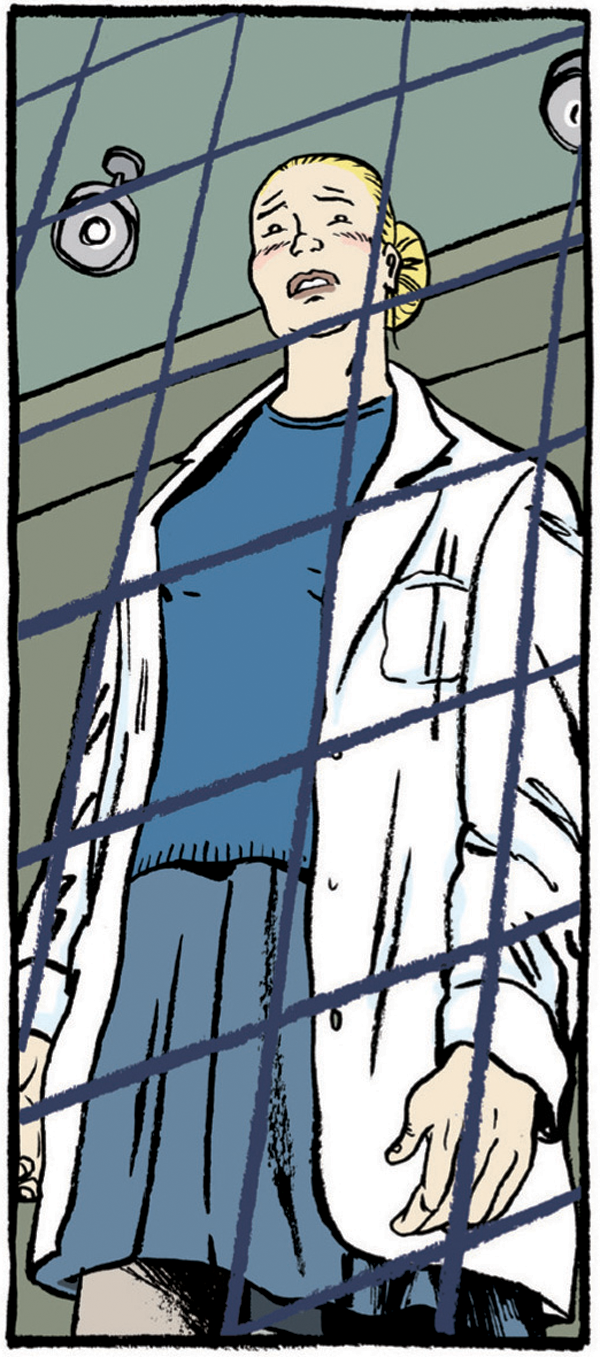
Laika (Abadzis, 2007: 109). Yelena and Laika panels from the book Laika by Nick Abadzis. Copyright © 2007 by Nick Abadzis. Reprinted by arrangement with First Second an imprint of Roaring Brook Press.
When they read Pride of Baghdad, an allegory that interrogates the concept of freedom by examining it against the backdrop of the Second Persian Gulf War, several of the participants commented on the dexterity the cartoonist showed in revealing emotion through facial expressions. Barry, for instance, wrote, ‘It’s incredible how the art is able to convey such animalistic mentalities and human emotions at the same time in the lions’ faces’, while Hermione observed, ‘It’s amazing how expressive the artist made the lions’ faces.’
In drawing on this aspect of a graphic novel’s visual design, the participants used facial expressions to infer information about a character’s inner thoughts. In doing so, they assigned feelings and motives to characters not otherwise stated in the text, a feat that required them to introduce information beyond that available in its linguistic design. This led them to engage in the sort of gap filling that Iser (1978) argues is characteristic of aesthetic reading. For example, when she read Persepolis, Sarah drew on the slightest alteration in a character’s facial expressions to infer information about his motivations. When the narrator’s father recounts how the father of the Shah rose to power in Iran, the images that accompany the written text portray the latter figure engaged in conversation with a representative of the British government, who promises to make him emperor. A slight rise in the character’s eyebrows led Sarah to infer that the Shah’s father was tempted by the offer. ‘I’ve noticed that Reza’s expression and the positioning of his eyebrows changes as the British man tells him he can one day be emporer [sic]’, she wrote in her response journal. ‘His eyebrows start low, then become crookedly raised.’
On other occasions, the participants cited color as a resource that enabled them to ‘feel’ tactile sensations they attributed to characters in a narrative. For example, Hermione credited the use of a primarily blue and gray color palette she encountered at the beginning of Laika with having led her to ‘feel cold’, while others identified the heavy use of orange and red hues in the latter half of the same graphic novel with having led them to experience ‘feelings of intense heat’ (see Figure 3). Finally, the participants treated color as a conventional sign, an additional mode that Eisner (2002) suggests artists use to communicate with an audience. In this way, they acknowledged socially and culturally agreed upon meanings associated with different colors, so that they interpreted black as signaling impending doom, blue as conveying feelings of sorrow, and white as representing purity or wholesomeness.

Laika (Abadzis, 2007: 185). Yelena and Laika panels from the book Laika by Nick Abadzis. Copyright © 2007 by Nick Abadzis. Reprinted by arrangement with First Second an imprint of Roaring Brook Press.
The participants drew on the layout of the graphic novels they read, and in doing so they imbued compositional arrangements with meaning. Characters situated at the opposite ends of a panel, for example, might be construed as separated by emotional distance. Likewise, variations in the size of the panel a cartoonist used to frame an image were regarded as a potential meaning-making resource. Thus one participant interpreted a series of unusually small panels in Laika as a rhetorical strategy designed to impose the feelings of oppression that characters in the narrative experienced on readers, while another construed a panel that occupied an entire page as conveying feelings of ‘openness’, and hence ‘freedom’.
On page 102 of Persepolis, readers encounter a sequence of two panels stacked on top of one another. The upper-most panel depicts the silhouettes of young boys dying on a battlefield, their bodies contorted as explosions erupt around them. In the panel immediately below it, the protagonist is seen attending a party. Situated in the foreground, she raises her arms above her head and dances to music. In the background, her friends are seen dancing as well, their bodies positioned in a manner that is reminiscent of the boys in the panel above.
The arrangement of the two panels creates an interesting juxtaposition, a fact Hermione commented on when she read the graphic novel. Responding to the sequence in her journal she wrote, ‘The juxtaposition of the minefield and the party is eerie.’ When the same sequence was referenced in the subsequent reading group discussion, Hermione again drew on the design of the page to interpret the relationship between the two panels and construct what she identified as a theme in the graphic novel. ‘I mean I guess that’s the point [the author] was making’, she explained, ‘like well these kids are dying but I mean life still was going on and I mean it kept going.’ Recognition of this point led her to conclude that the cartoonist ‘put those two together for sure on purpose’.
Linguistic Design
Though references to it were neither as explicit nor as frequent as were references to the visual design of the graphic novels they read, the participants made use of an available linguistic design. In doing so, they drew on literary conventions such as symbolism and verbal irony, which led them to fill gaps in a narrative and construct meanings that extended beyond the referents to which the words in a panel immediately pointed.
Rosenblatt’s (1978) theory of transactional reading, which regards readers as acknowledging the personal meanings that written language evokes, constitutes a useful heuristic for understanding how the participants interacted with the linguistic design of the graphic novels they read, as does Iser’s (1978) theory of aesthetic reading, which construes readers as filling ‘gaps’ in a narrative, one of which exists between significance and meaning. In a scene that takes place after Loren, the teenage protagonist in Night Fisher, is arrested, readers encounter a panel depicting the exterior of the building in which his father runs his dentistry. On the wall of the building a sign reads ‘Miles of Smiles’, the only written text visible in the panel. Foregrounding this linguistic message in his response journal, Saki interpreted it as commenting on the preceding events, most notably the protagonist’s arrest, writing: ‘Ironic that the sign talks about smiles after all that’s happened.’ Sarah made a similar move when she encountered a panel at the end of Pride of Baghdad in which the four protagonists, all of them lions, climbed a pile of rubble. Referring to the surface on which they walked, one of the characters exclaimed: ‘This earth. It’s uneven’ (Vaughan and Henrichon 2006: np). Documenting the line in her journal, Sarah interpreted the word ‘uneven’ as a sardonic comment on the absence of justice in the world the characters inhabited. ‘This earth. It’s uneven’, she wrote. ‘There’s more to this than the literal fact. The “earth” the lions were thrusted [sic] into is just that, uneven.’
Weaving multimodal meaning
According to Walsh (2006: 34): ‘An important aspect of reading multimodal texts is the ability to integrate information from the different modes.’ In drawing on the aforementioned semiotic resources, as well as the available designs they associated with them, the participants synthesized the meanings individual modes conveyed to construct what was for them the text. Lewis (1996: 108) uses the term ‘polysystemy’ to refer to this ‘piecing together of text out of different kinds of signifying systems’. As the participants wove multimodal meaning, they were active as readers, an observation that belies arguments that have historically characterized works written in the medium of comics as rendering readers passive (Hajdu, 2008).
To more fully illustrate the active stance the participants took relative to the graphic novels they read, and to convey the ease with which they moved between a text’s visual design and linguistic design, synthesizing the meanings each conveyed to interpret a scene, I conclude my discussion by examining an excerpt from an individual interview with Hal. At the time of the study, Hal was a junior in high school. Of the six students who participated in the study he had the most experience reading graphic novels, having grown up in a literacy environment that valued this form of reading material.
As explained, Night Fisher, the second graphic novel the participants read, is a Bildungsroman about a disaffected teenager grappling with feelings of social isolation. As evidenced by the response journal he maintained when he read the graphic novel, Hal responded strongly to one scene in particular, and it served as the basis for a think-aloud exercise when we met for his individual interview. At the onset of the scene, a portion of which is reprinted in Figure 4, the protagonist is seen climbing a dimly lit stairwell after having arrived home from school. Upon reaching a doorway that looks onto a kitchen, he spots his father seated alone at a table. Unbeknownst to the protagonist, his father is financially overextended and struggling to pay the mortgage. The scene makes scant use of written text, relying instead on image to carry a substantial portion of the narrative.
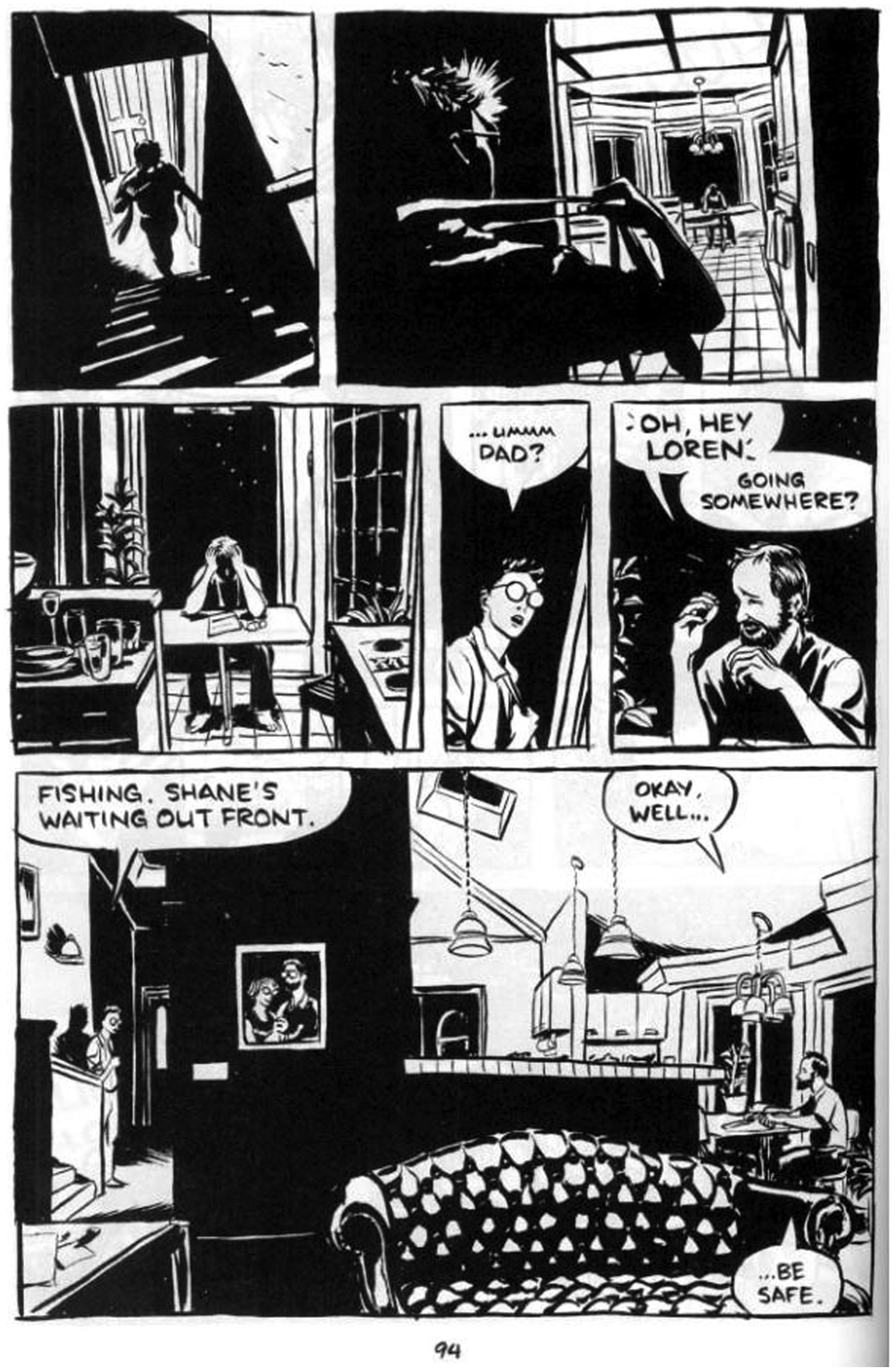
Night Fisher (Johnson, 2005: 94). Reproduced with permission from R Kikuo Johnson.
When he responded to the scene in his response journal, Hal wrote: ‘Something’s really wrong. You can tell in the pictures.’ Intrigued by his comment, I brought a copy of the graphic novel with me to his individual interview, which occurred three weeks later, and I invited him to participate in a think-aloud exercise. Specifically, I asked Hal to lead me through the scene with the intention of helping me understand how he’d reached the conclusion that ‘something’s really wrong’. Having taken a moment to examine the page and gather his thoughts, he explained:
Okay. ((exhales)) He’s walking up this, this
As indicated by the bold text, Hal began his reading by drawing on the mode of color, an aspect of the text’s visual design, to construct a tentative interpretation of the scene. Value—an artistic term that refers to the use of shadow as well as contrasts between light and dark—constituted the initial resource on which he drew, and he used it to construct a sense of atmosphere for the scene, a point evidenced by his use of the descriptor ‘mysterious’.
Acknowledging the visual design of the second panel, Hal observed that the doorway through which the character, and hence the reader, viewed the father was positioned at an angle, a reference to perspective. Continuing, he explained:
And you can, you can see how
In the excerpt above, Hal drew on perspective as a meaning-making resource, observing that the character of the father appeared at a distance from the reader, the result of which caused him to appear ‘small’. He also referenced the mode of gesture, using the character’s ‘slumped’ position to infer that he was ‘upset’. Having done so, he returned to perspective yet again, this time using terminology associated with film to describe the point of view from which the father was revealed. Specifically, he observed that the cartoonist made use of a medium shot, as opposed to a close-up, which he felt emphasized the character’s diminutive stature in relation to his surroundings. Cumulatively, the visual design of the third panel led Hal to infer that the character was ‘alone’, both in terms of his ability to confront his financial problems, and in his relationship with his son, who is emotionally distant throughout much of the graphic novel, and who callously leaves home at the conclusion of the scene to spend time with friends.
Upon reaching the fourth panel in the sequence Hal commented on the role layout played in conjunction with the text’s linguistic design:
And then once again this, this kind of
It’s worth noting that when Hal read the line of dialogue attributed to the protagonist, he altered his voice to make it sound meek, suggesting that in interacting with the text’s linguistic design he simultaneously drew on its visual design—namely, a stylistic change in the lettering the cartoonist used to represent the word—to construct what Schwarcz (1982) calls ‘visual sound’. Equally important, he relied on facial expressions—specifically, an upturned eyebrow and a slight smile—to infer that the father’s response—‘Oh, hey!’—belied other, unarticulated meanings. This led him to introduce a line of dialogue not otherwise stated in the text—‘I’m happy to see you but there’s something else’—which indicates that he engaged in the sort of gap filling Iser (1978) suggests is characteristic of aesthetic reading. In doing so, he filled a gap between the text’s visual design and its linguistic design to construct a meaning that surpassed those either conveyed alone.
Upon reaching the final panel in the sequence Hal returned once again to the text’s visual design, citing the role layout played as a meaning making resource:
And then you go to this. There’s,
In proposing that the father and son were ‘not in the same place’, Hal alluded to the emotional distance that separated them, something that is implied throughout the narrative, but never explicitly stated. To construct this interpretation, he drew on the compositional arrangement of the image, specifically the physical space between the characters on the page. As opposed to the preceding panels, which are small enough to co-exist alongside each other in neatly ordered rows, the final panel occupies the bottom half of the page, making it possible for the cartoonist to emphasize the space between the characters. That they are situated at extreme ends of the panel, and framed (Kress and Van Leeuwen, 2006[1996]) by strong horizontal and perpendicular lines that confine them to opposite corners, further exaggerates the distance—physical as well as emotional—one senses between them.
Lest my analysis of the above exchange appears to suggest that Hal interpreted the scene through a process of accretion, moving from one mode to another in a linear fashion, this was not the case. Rather, his reading was recursive in so far as it led him to shift between the text’s visual and linguistic design to reconcile the meanings they individually conveyed. In weaving together the strands of meaning he associated with Available Designs such as perspective, color, facial expressions, and layout, Hal introduced information not otherwise present in the text, which allowed him to fill gaps between its visual and linguistic design and interpret the larger scene. That he did so is consistent with an observation made by Khordoc (2001: 172) who, citing Saint-Gelais, argued that reading graphic novels ‘is not simply a question of alternating between words and pictures, but rather, a different mode of reading which always calls for readjustment of the reading process’ (emphasis added).
Conclusion
All research is subject to limitations, and this project is no exception. Although I undertook this study to understand how actual readers read graphic novels, the narrowness of my sample population prohibits my ability to draw generalizations. Additionally, while my decision to use response journals made it possible for me to map patterns in the repertoire of semiotic resources the group drew on, it did not allow me to determine whether individual readers drew more heavily on some resources than others, or whether they interacted with them in ways that were qualitatively different. To address these issues, future research should rely more extensively on think-aloud protocols similar to those employed by earlier literary scholars (Earthman, 1992; Langer, 1995), as doing so will offer deeper insight into the activities in which readers engage as they transact with graphic novels.
A further limitation of this study involves the fact that all of the students who volunteered to participate in it were proficient readers. Likewise, they all came from White, middle-class backgrounds, leaving one to wonder whether struggling readers, or students from other sociocultural backgrounds, would interact with the semiotic design of graphic novels in a similar manner. Finally, while the reading group met after school, it did so in the context of the school media center. This, coupled with my involvement in the discussions, almost certainly influenced the way the participants read the graphic novels, leading them to do so in ways they associated with school literacy. Recognizing this, future research might ask how adolescents read graphic novels in out- of-school settings.
According to Siegel (2006: 74): ‘children and youth are not empty vessels waiting to be “filled” with knowledge about multimodality. Rather, their knowledge is considerable.’ My study supports that observation. As seen, the participants drew on a range of semiotic resources to interpret the graphic novels they read. In doing so, they made use of Available Designs (New London Group, 1996) they associated with those resources to interpret the graphic novels in ways that were meaningful for them. If the participants lacked anything, it was a sense of appreciation for the wealth of resources they navigated, and the body of knowledge they drew on as readers to design multimodal meaning. Asked throughout the study what knowledge one needed to read a graphic novel, the participants continually cited a general ability to read, which for them meant decoding print text and adhering to the Western convention of reading from left-to-right, top-to-bottom.
The latter finding is consistent with other research that has asked how readers experience works written in the medium of comics. Having surveyed and interviewed 291 students who attended a small liberal arts college in southwest Japan, Allen and Ingulsrud (2003: 678) concluded that one of the reasons their participants enjoyed reading manga was that they found doing so easy. The researchers attributed this to the format, noting that ‘the limited amount of text combined with many illustrations’ led manga to appear ‘more accessible than the solid text of books’. Nevertheless, citing the plethora of conventions manga employs, they concluded that manga readers ‘underestimate the skills required to access the text’. Recognizing this, educators should endeavor to help students make visible the otherwise considerable knowledge they draw on as readers of graphic novels, as doing so may heighten their awareness of the rhetorical strategies multimodal texts employ to move and persuade them. Indeed, several of the participants in my study were surprised to discover that it was possible to interrogate the visual design of graphic novels, and they cited a need for teachers to create opportunities for students to engage in visual analysis. By helping students construct a medium-specific language that directs their attention to the range of semiotic resources they draw on as readers of multimodal texts, and by encouraging them to reflect on the rhetorical strategies such texts employ, literacy educators may help students become more critical consumers of multimodal texts.
Equally important, this study challenges educators to revisit their definitions of literacy and ask whether they are willing to extend that term to include transactions with sign systems beyond written language. The implications of doing so are profound, not least because it raises the question of whether schools are currently preparing students to read and write in a broad sense. Nearly two decades have passed since Charles Suhor (1984) challenged educators to embrace a ‘semiotics-based curriculum’ that invites students to think critically about the array of signifying systems available to them in the larger culture. Given the frequency with which adolescents interact with texts that blend semiotic resources, perhaps Suhor’s argument warrants renewed attention. Indeed, literacy educators might do well to consider a question that Hal broached toward the end of my study when he asked: ‘Is our idea of literature a tiny bit out of date?’ If, as Moje (2008) observes, adolescents’ preferred texts are in fact multimodal, then his question warrants serious consideration.
Footnotes
Notes
Biographical Note
SEAN P CONNORS is an Assistant Professor of English Education in the College of Education and Health Professions at the University of Arkansas. His scholarly and research interests include multimodal literacy, social semiotics, and the application of diverse critical perspectives to young adult literature. His most recent publication, ‘Toward a shared vocabulary for visual analysis: An analytic toolkit for deconstructing the visual design of graphic novels’, appeared in a 2012 issue of the Journal of Visual Literacy.
Address: University of Arkansas, Peabody Hall 304, Fayetteville, Arkansas 72701, USA. [email: