



Abstract
This article elaborates the dialectical relationship between visual art forms and the social structures in which they are produced, by extending Robert Witkin’s taxonomy first presented in his 1995 book Art and Social Structure. Witkin tracked the history of visual art from pre-modern times, for which he invented the label invocational art, to the advent of Modernism, described in terms of evocational and then provocational art. The article then extrapolates from Witkin’s model to include post-Modernism, for which the author’s term revocational art has been coined, and goes on to discuss Nicolas Bourriaud’s concept of Altermodernism, his term for describing the relationship between contemporary art practices and the social conditions of today, for which the author suggests an alternative – convocational art – a synonym for Bourriaud’s term relational art. The article concludes with a demonstration that social semiotic theory can be a powerful tool for the analysis of relational art.
Types of Social Structures and Related Artforms
In his book Art and Social Structure, Robert Witkin (1995) identified three distinct types of social structure, and proposed three types of art forms which correspond with those structures. These have been elaborated elsewhere (Riley, 2004), and so here I shall adumbrate his argument:
A co-actional structure, Witkin argued, describes social relations in which each member plays a pre-determined role. Each separate role cues the others, rather like orchestral players. Such societies, low on the scale of individualism, with social roles integrated in a collective, are described as co-actional.
An inter-actional structure is characterized by the kind of social relationship found in an urban, industrialized society. Complex division of social labour leads to development of social differentiation and individualism,as well as interdependence with others.
In Witkin’s intra-actional social structure, subjects construct their social being directly in and through the process of relating to others. The disintegration of established social systems and the subsequent fracturing of a sense of identity are symptomatic of a society such as that of 19th-century Western Europe.
Witkin (1995: 55–56) suggested three categories of artform which correspond to his three types of social structure: invocational, evocational and provocational. (Incidentally, this categorisation draws attention to the essentially vocative nature of all images: they address the viewer, and the viewer is positioned. The categories are extendable, as we shall see.)
Invocational art is motivated by a theology of a primitive kind. In a co-actional social structure, typified by the Nascans in southern Peru for example, there is no attempt to portray individuality in their carvings of humans, animals and gods, either on their pottery or on the huge designs marked out upon the Pampa in the Nazca desert from c.400 BC. In such belief systems, a model invokes the real. The aura associated with the image is directly attributable to the referent: sign and referent are one.
In an inter-actional social structure typified by Renaissance Italy, the attributes of individuals, their features and their personalities, were depicted as lifelike as possible because the function of these pictures was to evoke the spirit residing in, and animating, every individual. In evocational art, the image was understood to be separate from the spirituality it evoked; the sign is distinct from its referent.
A third type of artform, provocational art, was motivated not by any religious or spiritual source, but by the humanism that evolved from the Enlightenment and socio-technological revolutions of the 18th and 19th centuries in northern Europe. Such art shifted the emphasis from the relationship between the sign and its referent altogether – and drew attention instead to the process of signification itself. The primary function of art was no longer to do with representing anything, but a means of provoking viewers into a state of awareness of their own responsibilities for making sense of images. Marcel Duchamp was the agent-provocateur par excellence!
In a previous article (Riley, 2004: 298), I could not resist the temptation to extrapolate from Witkin’s model and propose a fourth type of social structure: a multi-actional one: Such a multi-actional structure was typified by a post-Modern period in which has been seen the development of a plurality of approaches to art practice and an eclecticism of styles. This period was one in which the constructions of an individual identity were complicated, not only by the fluctuating states of possibilities of relationships between individuals but also by an expanding range of available social positions made possible through an expanded awareness of the multiplicity of ideological positions. What kind of art form could represent the complexities of such a society? A revocational one, at once motivated and unmotivated by a plethora of influences, including the historical and the contemporary as well as the spiritual and the material. Such art revokes all previous laws and restrictions so that contradictions and contravisuals abound, realities may be virtual, and the virtual becomes a reality. Attention is drawn to the very membranes themselves that separate internal from external, signifier from signified. In a post- modern period, the Saussurean sign itself has been split, and signifiers float free as we that observe float between them.
For example, we floated through Damien Hirst’s cows in his 1996 installation Some Comfort Gained from the Acceptance of the Inherent Lies in Everything, where the boundaries between inside and outside, front and rear were reversed, interpenetrated.
But we were denied entry to Rachel Whiteread’s House constructed in1993, whilst, paradoxically, having access to the interior surfaces of the rooms which formed the exterior of the sculpture (Figure 1).
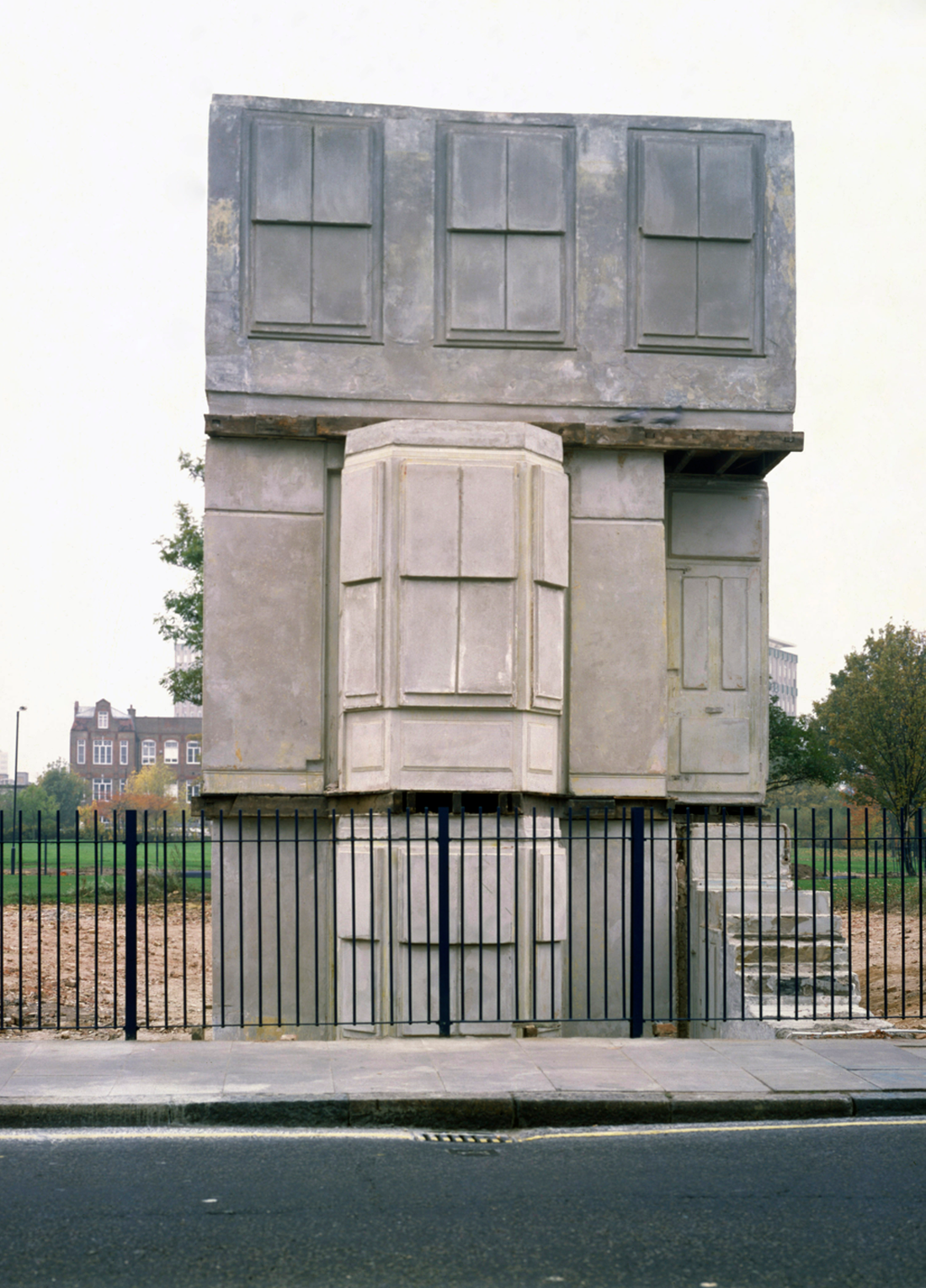
Rachel Whiteread House (1993). © 2012 Rachel Whiteread. Courtesy of Gagosian Gallery.
After Post-Modernism: Altermodernism?
In his recent book Aesthetics and Its Discontents, Jacques Rancière (2009: 49) adapts the Brechtian neologism Verfremdungseffekt, explained as an ‘estrangement effect’, similar, I would argue, to the Russian Formalist theorist Viktor Shklovsky’s earlier (1977[1917]: 35) identification of the social function of art as ostraneniye, or ‘making strange’. Rancière’s (2009: 52) adaptation, distantiation, identifies a period in time when ‘humorous distantiation takes the place of provocative shock’. In other words, the period of what I have described above as revocational art, following on from the Modernist era of provocational art.
Rancière goes on to identify four major ‘figures’ or sub-classes of shift from ‘yesterday’s dialectical provocations to the new figures of … artistic dispositifs’ (p. 53) which he labels Play, Inventory, Encounter and Mystery, and here the recent writing of an influential contemporary curator/theorist to whom Rancière alludes, albeit only in a footnote, becomes relevant: Nicolas Bourriaud was cited by Rancière as the main theoretician of Relational Aesthetics, the title of Bourriaud’s book first published in English in 2002. Relational art corresponds to the third of Rancière’s sub-categories of contemporary art practice, elaborated under his sub-class Encounter as activities to which the artist/curator invites – I shall use the phrase calls together, for a reason clarified below – visitors in order for them to encounter, to participate within, to relate to some sort of event. Rirkrit Tiravanija, for example, arranges camping stoves, water urns and sachets of Thai soup powder which visitors are invited to prepare before sitting down and chatting with the artist (or whoever else might be in attendance).
Such art, championed by Bourriaud’s curatorial practice as a typical example of the contemporary social situation after post-Modernism, one he has labelled Altermodernism, no longer attempts to respond to the excesses of commodity culture and the fragmentary, revocational nature of a post- modern social structure, but rather attempts to address the lack of social coherence in a social structure formed by a post-industrial, service economy. As Rancière (2009: 56–57) puts it: Relational art … aims no longer to create objects, but situations and encounters. In so doing, however, it relies on a simplistic opposition between objects and situations, effecting a short-circuit where the point is to carry out a transformation of those problematic spaces that once contrasted conceptual art with art objects/commodities. The former distance taken with respect to goods is inverted and a proposition made about a new proximity between individuals, about building new forms of social relations. Art no longer tries to respond to an excess of commodities and signs but rather to a lack of bonds.
George Baker (2004: 50), introducing a series of articles on relational art published in the journal October, had earlier related such artforms to the contemporary social structure: Bourriaud’s project amounts to a theory of advanced art in the era of a putatively new service economy, a context within which, it is claimed, art abandons its prior (industrial) object forms and shifts to the immaterial form of services, a proliferation of event-based manipulations directly shaping the sphere of ‘inter-human relations’.
Bourriaud (2002: 36) himself is more succinct, though perhaps a little cruder in translation: ‘Through little services rendered, the artist fills in the cracks in the social bond.’ He takes from Felix Gauttari the idea that a work of art is a process of becoming, so as to articulate an explanation of his term ‘Altermodernism’ as a collectively-produced open-ended flux of social activities and events that resists fixed interpretation or closure, typical of an internet culture, in which the global realm of human interactions becomes the arena for art practice, rather than any notion of private, individually-based response. (I’m grateful here for the comments of one of my referees, who points out the precedents for such practice, citing the Fluxus group, in particular Yoko Ono, as well as the work of Alan Kaprow and the example of Yves Klein, who disposed of his gold art objects, first purchased by a client, in the Seine.)
And so Witkin’s useful taxonomy of social structures and their corresponding artforms can be neatly extended even further, to form a coherent pattern which began with invocational art, moved through evocational art, provocational and revocational art, to include the contemporary situation in which artists and curators call together participants in a co-operational social structure in the attempt to resolve social fissures: a convocational art practice of relational aesthetics, situated in this contemporary context of Altermodernity.
In this extension of Witkin’s taxonomy, convocational art becomes a rather more useful term than Bourriaud’s own relational art since it relates, through its etymology, to the historical development between artforms and social structures adumbrated above. Surprisingly, Bourriaud himself makes no reference to the social semioticians who have been elaborating similar interpretations of the social function of art. Here, then, is proposed a useful connection between relational art and the social semiotics of art.
The Social Semiotics of Relational Art
In the materialist sense, art is produced through the selection and combination of particular materials, processes and contexts. However, semiotically speaking, both producers and viewers of art take up positions, adopt attitudes and points of view which are influenced by their positions within their sets of social relations. Such an ideological positioning involves a specific way of using signs (a semiotic), and a structured sensibility (an aesthetic) both grounded in a particular system of social relations. The way the producer selects and combines the compositional elements of the artwork or event, and how the viewer relates to that artwork or event, are both functions of the social contexts in which the work is (re)produced. This is the essence of what Bourriaud has called relational aesthetics. Note that to say art simply reflects social structure is too passive: art not only expresses the social context, including viewer–participants, but is also part of a more complex dialectic in which specific artworks actively symbolise the social system, thus producing, as well as being produced by, the ideological framework of a society.
Variation in ways of producing and making available artworks is the visual expression of variation in society. Artworks and events are produced within society and work to effect change in the social structure in their turn. This dialectical relationship is what the socio-linguist Michael Halliday (1978: 183), was discussing long before Bourriaud, in the phrase ‘social semiotic’. It might be time to refresh our understanding of Halliday in the light of contemporary thinking about relational art, and to draw attention to the visual social semioticians he has inspired, in particular the work of Michael O’Toole (2005, 2011), which might now be utilised to demonstrate, through visual semiotic analysis, the relations between art and society alluded to in Bourriaud’s phrase relational art.
As a linguist, Halliday proposed that language operates through three functions: firstly, to convey some aspect of our experience of the world; secondly, to express the communicator’s attitude or mood regarding the experience, and also to position the receiver in terms of mood and attitude; and thirdly, to structure these two into a coherent, perceptible form. The first two functions I shall label the experiential and the interpersonal; the third I shall term the compositional function.
The parameters of social context – field, tenor and mode – are systematically related to the functions of the semiotic system (Figure 2). In fact, those meanings that constitute our understanding of any particular social situation are made visible through the selection and combination of elements within the semiotic system.
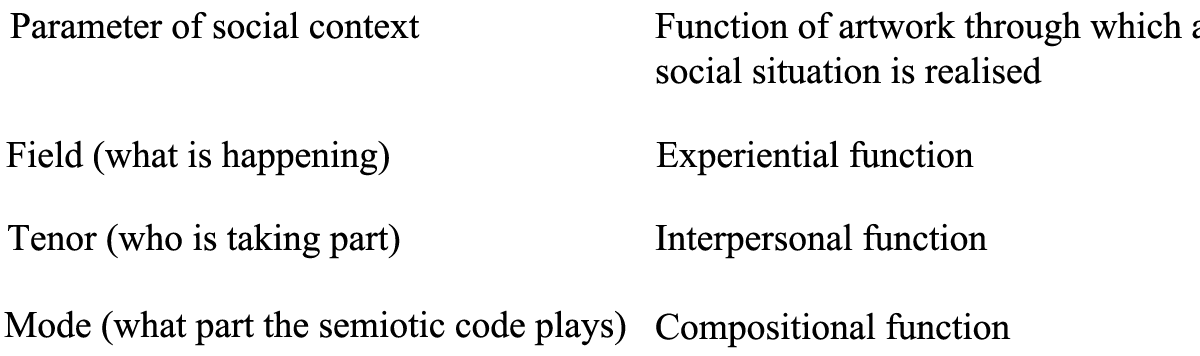
Parameters of social context.
Halliday (1973) elaborated upon this basis to provide a model which identified the systems of choices – the range of available alternatives – from which specific selections may be related to the functions of language in specific social contexts.
Michael O’Toole (1990) was one of the first in print to demonstrate the power of Halliday’s insights when they are applied to the analysis of visual codes of communication. O’Toole (2011) also demonstrates the versatility of Halliday’s model by adapting it to theorise how sculpture and architecture may be understood in relation to their social contexts. Gunther Kress and Theo van Leeuwen (1996) have also used Halliday’s insight to illuminate the study of graphic design and other forms of visual communication. They have argued that visual codes of communication may be construed as rational expressions of cultural meanings, amenable to rational accounts and analysis. The problem, they claimed, has been that cultures which are historically biased towards literacy as the preferred medium of cultural discourse have ‘systematically suppressed means of analysis of the visual forms of representation, so that there is not, at the moment, an established theoretical framework within which visual forms of representation can be discussed’ (pp. 20–21). This article goes on to demonstrate how such a framework might now be applied:
At the 2009 Venice Biennale, Rirkrit Tiravanija installed a range of facilities for visitors to access and browse publications relating to the exhibits on show in the Biennale (Figures 3 and 4):
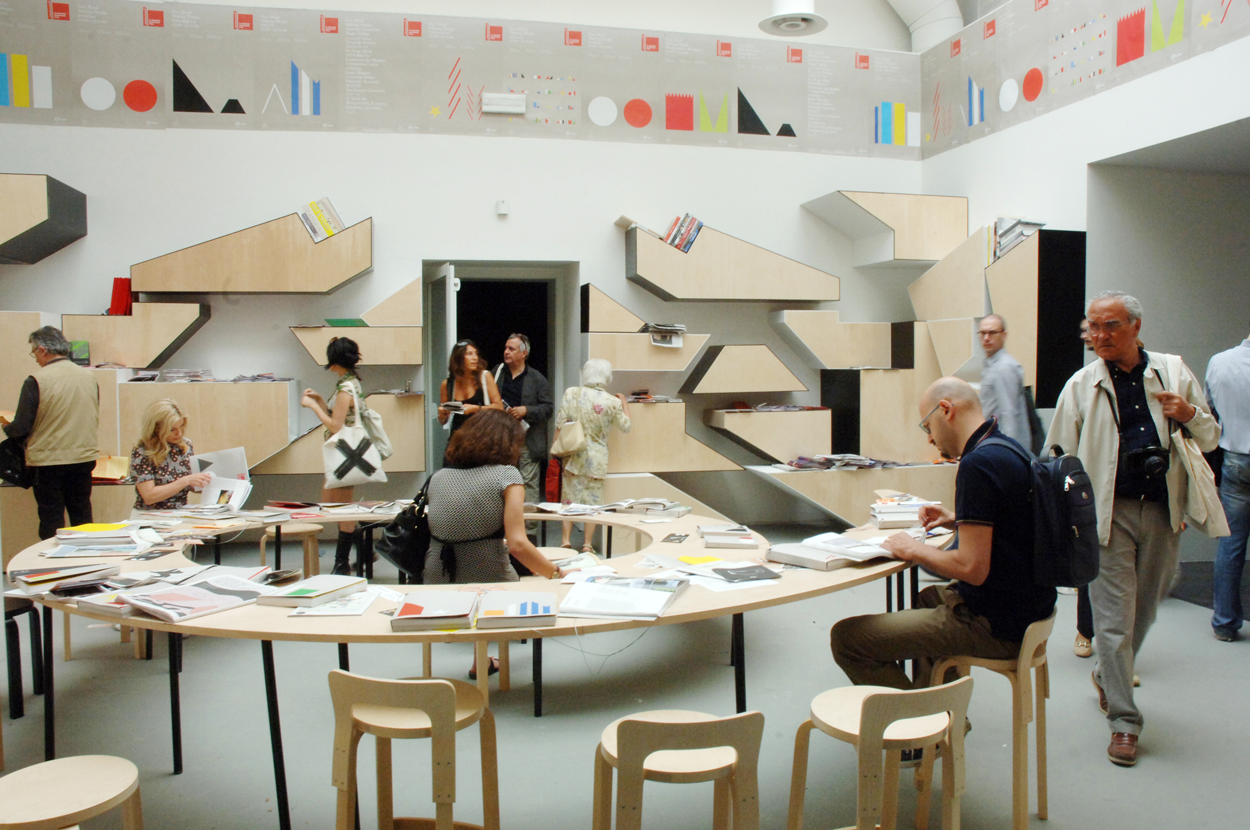
Rirkrit Tiravanija (2009). Courtesy Fondazione La Biennale di Venice.
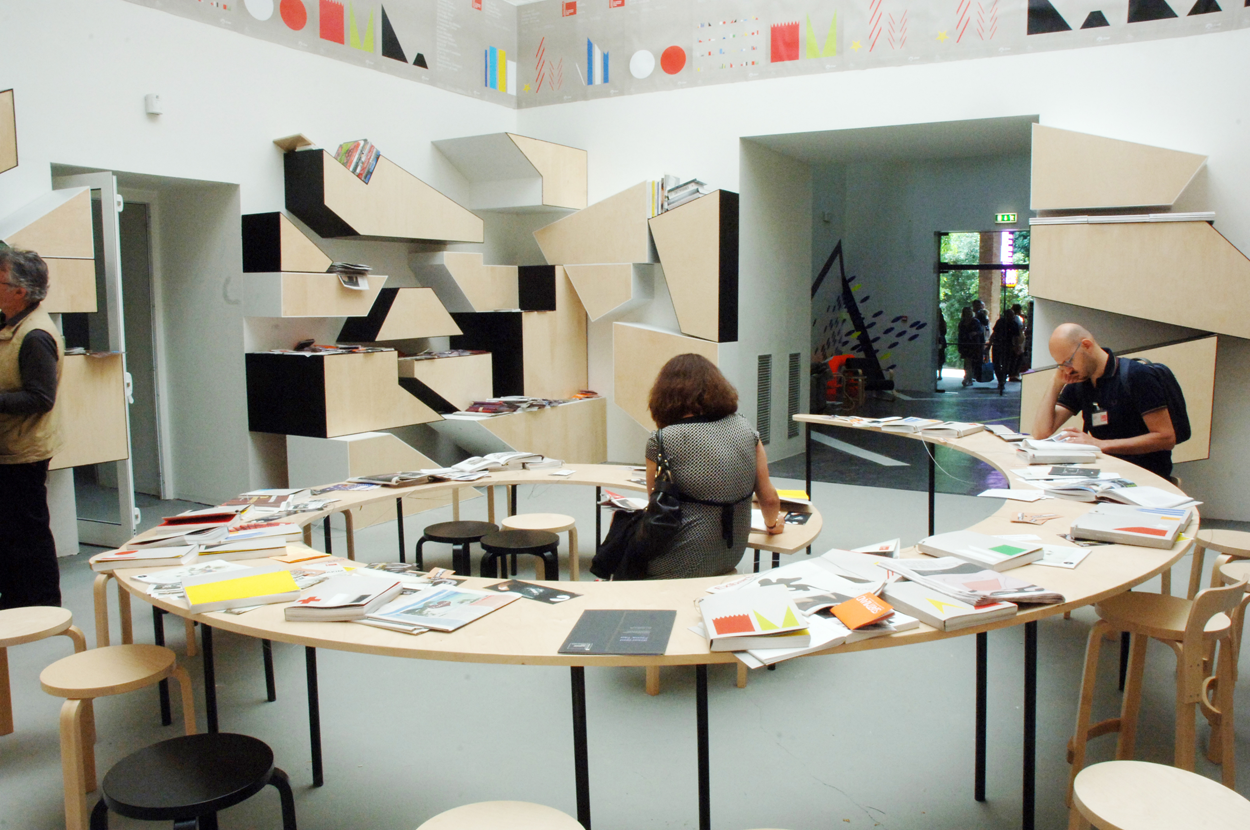
Rirkrit Tiravanija (2009). Courtesy Fondazione La Biennale di Venice.
In order to analyse this installation, I shall employ a systemic-functional semiotic model presented in Figure 5:
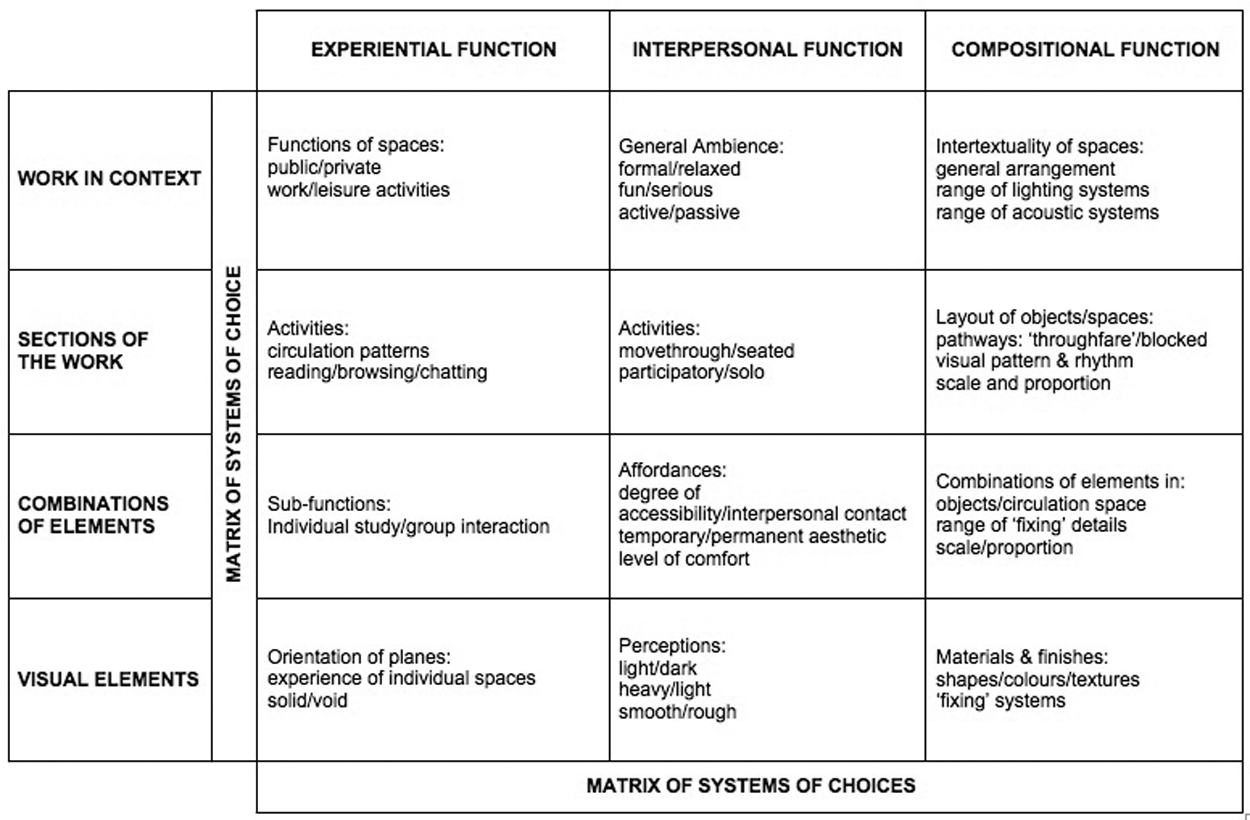
Systemic-functional model for installation works.
In relation to this chart, at the level of engagement The Work in Context, the selected location of this installation, situated between the café and the bookshop in Venice’s Palazzo delle Esposizioni, and therefore outside the recognised exhibition galleries, positioned visitors outside the realm of influence of what Roman Jakobson (1960[1958]) termed the poetic function, one which foregrounds the form of the work under scrutiny (even though those visitors had chosen to immerse themselves in the highly-charged aesthetic crucible that is the Venice Biennale!) so as to relax their attitude of critical alertness normally adopted in visits to exhibitions of art, and to assume instead a mood of what might be termed informal browsing, a receptivity to relational possibilities. This is realised, through the Compositional function, in the spatial connections experienced by visitors as optional circulation patterns: some of these facilitate simple phatic contact with fellow visitors; others invite more engagement with people and the documentary materials on display; others still afford the visitor a direct route through, linking café and bookshop.
At the more detailed level of engagement in the chart labelled Visual Elements, the wall-mounted shelving units, comprised of irregular-shaped coloured planes and the spaces between them arranged with an angular asymmetry, connote a randomness of documentary organisation conducive to casual perusal.
However, at the level of Combination of Elements, the overall visual pattern made by the units, their coloured planes and the negative spaces between them, echo – perhaps a more apt poetic metaphor would be to say they visually rhyme with – the graphic logos of the Biennale displayed around the space above door height, and thus the relation between those dual criteria for assessing the quality of art is articulated: the degree of balance between the perceptual intrigue of pattern formed by the combination of shape, colour and texture, and the conceptual intrigue contained within the documentary sources available for perusal.
At the level of Sections of the Work, the variety of seating arrangements around the spiralling reading desk connoting a rising (or falling?) path of progress, addresses the Interpersonal function, encouraging – as was evident on my visit – visitors’ participation, each reader in visual contact with the others, facilitating the possibilities of group co-operation, the hallmark of relational art events.
To sum up, here is truly a convocational space, fashioned from the careful selection and combination of materials which affords the participants/viewers a variety of means of engagement as they choose to stroll through, pause to browse or fully immerse themselves in the available literature.
Footnotes
Funding
This research received no specific grant from any funding agency in the public, commercial, or not-for-profit sectors.
Biographical note
Address: School of Research & Postgraduate Studies, Dynevor Centre for Arts, Design and Media, Swansea Metropolitan University, De La Beche Street, Swansea SA1 3EU, Wales, UK. [email: