




Abstract
This article uses a multimodal critical discourse analytic approach to analyse how a Chinese women’s magazine has changed visually over 17 years, partly through the gradual adoption of international branding design styles and partly through consumer product influences from Japan that are used to recontextualize core Chinese values and women’s identities. The authors conclude that, like established international magazine brands, this title signifies freedom, but of a very different order to that found in those counterparts.
Introduction
Scholars have pointed to the rapidly changing media environment in China. Some have observed the adoption of international models and how these interact with the existing structures and the representations and values they had more traditionally communicated. Others have pointed to significant regional influences, particularly those from Japan. Such studies form part of broader theoretical concerns across media and cultural studies about the flow of media products, formats and culture around the world. In this article, adopting a multimodal critical discourse analytical approach, we carry out detailed observations on the visual contents and styles of the Chinese women’s magazine Rayli. This magazine is produced by Rayli Publishing in China, which licenses three titles from the Japanese publisher Shufunomoto and one from an Italian publisher. At the time of writing it had become the best-selling women’s lifestyle magazine in China, selling to affluent urban women in their 20s and 30s and advertising mainly Korean and Japanese products alongside the usual global brands of perfume and accessories.
This case study allows us to observe how Rayli has been changing since its launch in 1995, both through an analysis of its contents and through interviews with editors, writers and visual designers. The analysis of Rayli over 17 years reveals how designers have gradually adopted visual design styles and formats from American and European magazines. This has resulted in a shift in the way that images and text are used and has involved a process where formerly distinct genres such as features and advertising become indistinct. It has also seen a shift away from documenting personal, work and social life, to a more symbolic world which carries the magazine brand more effectively across all contents. Importantly we find that Rayli is still clearly mindful of addressing a Chinese audience through an underlying sense of Chinese women’s identity as being ‘good’ and ‘responsible’. But this is shaped through the influence of Japanese branding to represent the ‘cuteness’ and ‘vulnerability’ of a particular form of consumer culture known as ‘Kawaii’. The new design culture, we show, is a process which facilitates this kind of reshaping or recontextualization.
The Chinese Media and Globalization
Since the Deng reforms of the 1990s, and particularly since entry into the World Trade Organization in 2001, the media in China have gone through major changes from a state-run propaganda system to one increasingly engaging with the global media landscape both in terms of looking outwards to international markets for its own media products and internally in terms of media organization and imports of products, styles and formats (Donald and Keane, 2002). Observations cover a number of different media, all pointing to clear international and American influences in formats and practices in areas such as entertainment television (Wu, 2008), journalism (Wu and Ng, 2011) and advertising (Chung, 2006). Feng and Wu (2007) observe that this is a process where Chinese values related to family, tradition and obligation are making way for the promotion of values from America and Europe such as self-fulfilment and hedonism as the ideology of consumerism becomes more established.
The magazine market in China has itself been changing steadily as globally operating media corporations have brought their international titles into China and as local Chinese titles have had to transform in order to meet the changing market and the arrival of advertising-driven content. A handful of studies point to the adoption of western lifestyle journalism and new kinds of topics and contents (Li, 2011). Machin and Van Leeuwen (2007) carried out an analysis of the Chinese and Taiwanese versions of Cosmopolitan magazine as part of a comparison of a range of international versions, highlighting the way contents and styles were being introduced that sought to present, promote and legitimize ideas and identities that were more in accord with consumer capitalism.
Japanese commentators have also pointed to the strong presence and influence of Japanese media, across Asia and especially in China (Liu, 2008; Tsutsui, 2010). Iwabuchi (2002) suggests that while China’s older generation is still haunted by Japan’s wartime brutality, Japanese popular culture – such as Manga, Hello Kitty and Pokemon – has become a central part of the look of youth culture in China, what is known as Kawaii or ‘cute’ culture.
Sociologists have commented on the significance of Kawaii culture, which has emerged in Japan and been hugely successful in China, and this is of central importance to the analysis we carry out here. Kawaii emphasizes immaturity, vulnerability and cuteness. Unlike some western societies, where maturity is associated with freedom and independence, in Japan and China it has been associated with the opposite. Kinsella (1995) argues that Kawaii therefore represents in part a rebellion against a society that has celebrated, partly through the influence of Confucianism, hard work, devotion and conformity: at work, to parents and to husbands. The Japanese Post Office has post boxes designed in Kawaii style. The Japanese Police have Kawaii style mascots and the Japanese Asahi bank carries a cute character on their credit cards. Kawaii has itself become seen at an official level as an important part of Japanese exports as merchandising accounts for billions of dollars a year and is an important part of Japanese popular culture (Borggreen, 2011). Kawaii, in one sense, sociologists argue, represents comfort from some of these realities (Allison, 2006).
The staff at Rayli told us that Kawaii has been used as a marketing tool in a way that pushes traditional Chinese ideas about womanhood to another level. While traditionally Chinese women have been associated with purity, harmlessness and subservience, such qualities were not formerly linked to cuteness and infantilism. Similar to Western media, as commentators have argued, women’s escape from the bounds of domesticity and motherhood, heralded first by feminism, was then hijacked by consumer-led media (Irigaray, 1985), so too the sense of escape for women here has been harnessed and articulated through consumer lifestyle media.
Methodology
This article draws on a number of social semiotic tools from the emerging field of Multimodal Critical Discourse Analysis (Kress and Van Leeuwen, 2006; Machin and Van Leeuwen, 2007). We provide the details of each set of analytical tools at the start of each section. These offer us more detailed ways to observe changes at the level of typeface, colour, composition and in the kinds of images that we find.
In our analysis we also draw on the ideas of Floch (1995) and Thurlow and Aiello (2007). It is useful here to distinguish between representation and design (Aiello, 2012). An example of a representational resource available to a designer would be literal or figurative images. In the case of Rayli this would include the women themselves as seen in photographs and the iconic value of the different clothing, postures and setting. But a different meaning can be given to these through their treatment as part of the design process (Floch, 1995). This is important in understanding Rayli since it is not only the way that women are represented that has changed, but also their treatment as they are placed within and alongside changing design elements and forms. In this context, we begin the analysis by looking at the changing representations of women in the magazine and then go on to look at how changing design plays an important role in this process.
The analysis we present in this article is taken from a broader study where we collected every issue of Rayli magazine between 1995 and 2012. We analysed the magazine for changes at the linguistic (Chen and Machin, 2013) and visual level. After this initial stage of analysis, we carried out face-to-face interviews in Beijing with staff at the magazine over a period of a month in 2012 and then asked further questions via email in 2012 and 2013. We present here four examples, which we use to help us to point to the visual changes that we observed. In this case, we wanted to find out how women were represented at work over time. This was also chosen because it allowed us to make comparisons with the visual analysis of the international versions of Cosmopolitan magazine carried out by Machin and Van Leeuwen (2007). These interviews were to help understand the reasons behind the changes of visual representations in the magazine over time.
The Changing Representations Found in Rayli
To begin with, we attend to the different ways that women are represented in Rayli over time. How we go about this is influenced by Critical Discourse Analysis (Fairclough, 2003; Van Dijk, 1993). This encourages the analyst to think about the way that people in representations are placed in the social world, which parts of their identity are foregrounded, backgrounded or hidden. We also ask to what extent people are represented as individuals or in groups, as unique or generic persons and whether the viewer is encouraged to have interpersonal contact with them or not. Each choice can have the effect of connoting sets of ideas, values and attitudes that are not necessarily overtly stated. What we find in Rayli is a shift from more specific yet more distant persons who are indicated to be a part of a larger work group, to more individualized interpersonally engaging generic types who are seen in smaller groups of friends. Crucially, we find a shift from photographs of actual workers to those which contain models wearing clothing and striking poses, that as Rayli’s editor pointed out, clearly reflect Kawaii culture.
In the 2001 issue of Rayli, seen in Figure 1, we find images accompanying a text about collegial relationships. On the right-hand page at the bottom, we find a group of people seen in the place where they work. One of these people is signalled as salient as she stands apart in the centre of the scene. But she nevertheless remains part of the collective. In this case, we are given the name of the person in the image with a short account of her work in the accompanying text. She is clearly individualized as a specific person through being named in the text, although the social distance created by the medium shot does not bring us into a closer relationship. Nor are there any features in the image to signal that she is unique. It is also of note that the people in this image, shot from a position looking down on them, look up awkwardly. This is very different to the more at ease and confident women seen in later images.
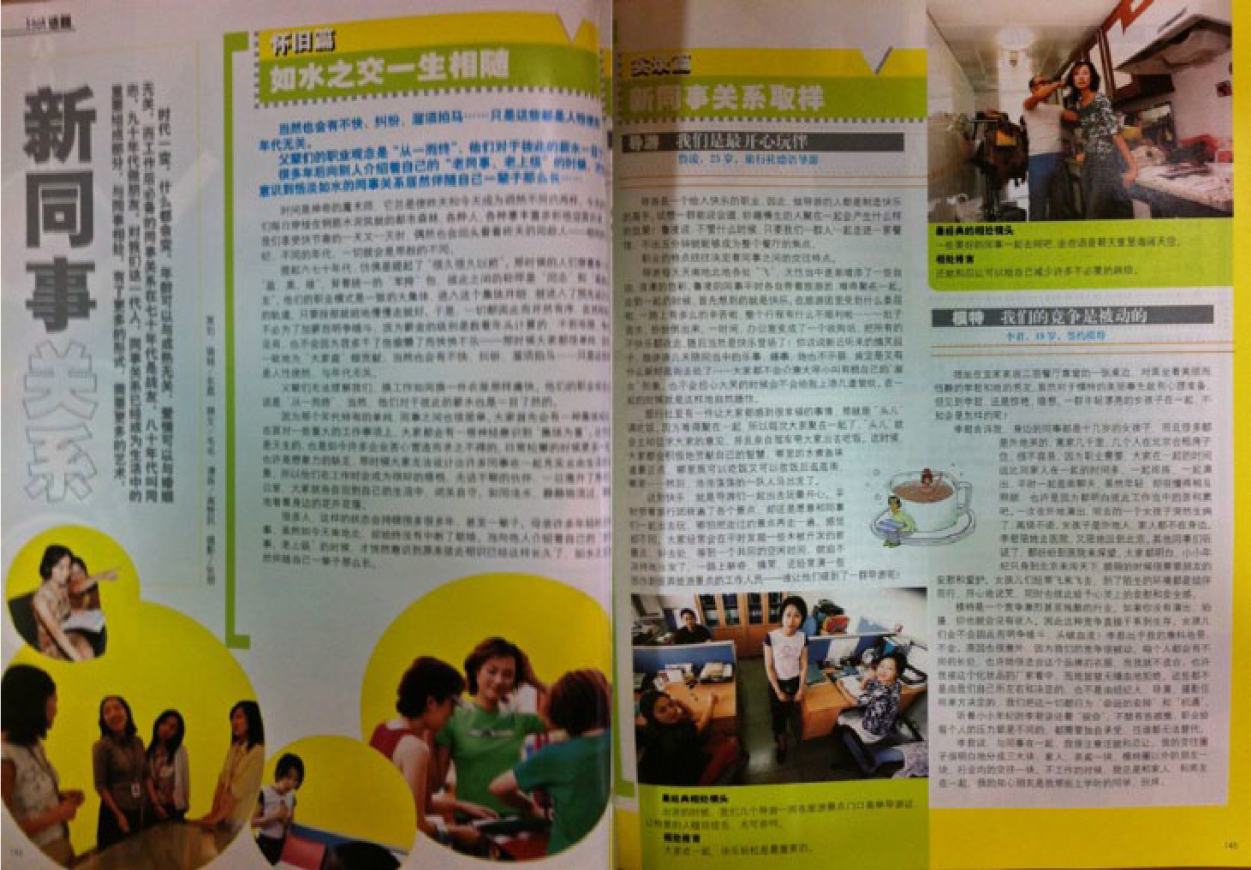
Rayli, September 1999: 144–145.
Both images on this page show real work places. At the top right-hand page, a person appears to be working in make-up. In the lower image, people are seen at work stations where they have stopped to have their photo taken. Here there is a sense of work having been interrupted and the subjects look awkwardly on. All these are important observations in comparison to those that follow.
On the left-hand page we see the importance of collegial relations signalled by people collectivized as colleagues. The images appear to be photographs that have been rather crudely assembled into a collage taken of real workers rather than models. Rayli’s designer said that by more recent standards this was very primitive, reflecting a time when graphic design was very limited in China. These people do not address viewers in the manner of the other images.
Overall, these are typical of images in the magazine at this early period. They show real people in real work settings. In this specific case, they show not so much unique individuals but dedicated workers. In the accompanying text, we hear personal stories which all point to strict devotion to work and Chinese society. And these photographs do not encourage the viewer to enter into a relationship with the people they represent. Kress and Van Leeuwen (2006) explain how we can assess this on the basis of the way that people in images look out at the viewer and the kinds of metaphorical response that this requires.
In 2005, as seen in Figure 2, we begin to see a stark contrast. Here we find posed images of models; these women look out at the viewer, smiling and engaging. The women are also represented in close-up, indicating a closer social proximity to the viewer and also important for displaying their facial expressions, which are here highly positive. While the women in 2001 look outwards, it is more that they look meekly at the camera than look out at the viewer. While in 2005 women appear individually in some of the photographs, they represent not individuals but generic types, through clothing, hair and pose. Identity is represented by a number of specific deliberate features. Here, across our sample we felt there was some difference to the way that Machin and Van Leeuwen (2005) described the representation of women in Cosmopolitan magazine where generic types of women such as ‘office workers’ might also have one clear marker of individuality, usually through pose, clothing and hairstyle.
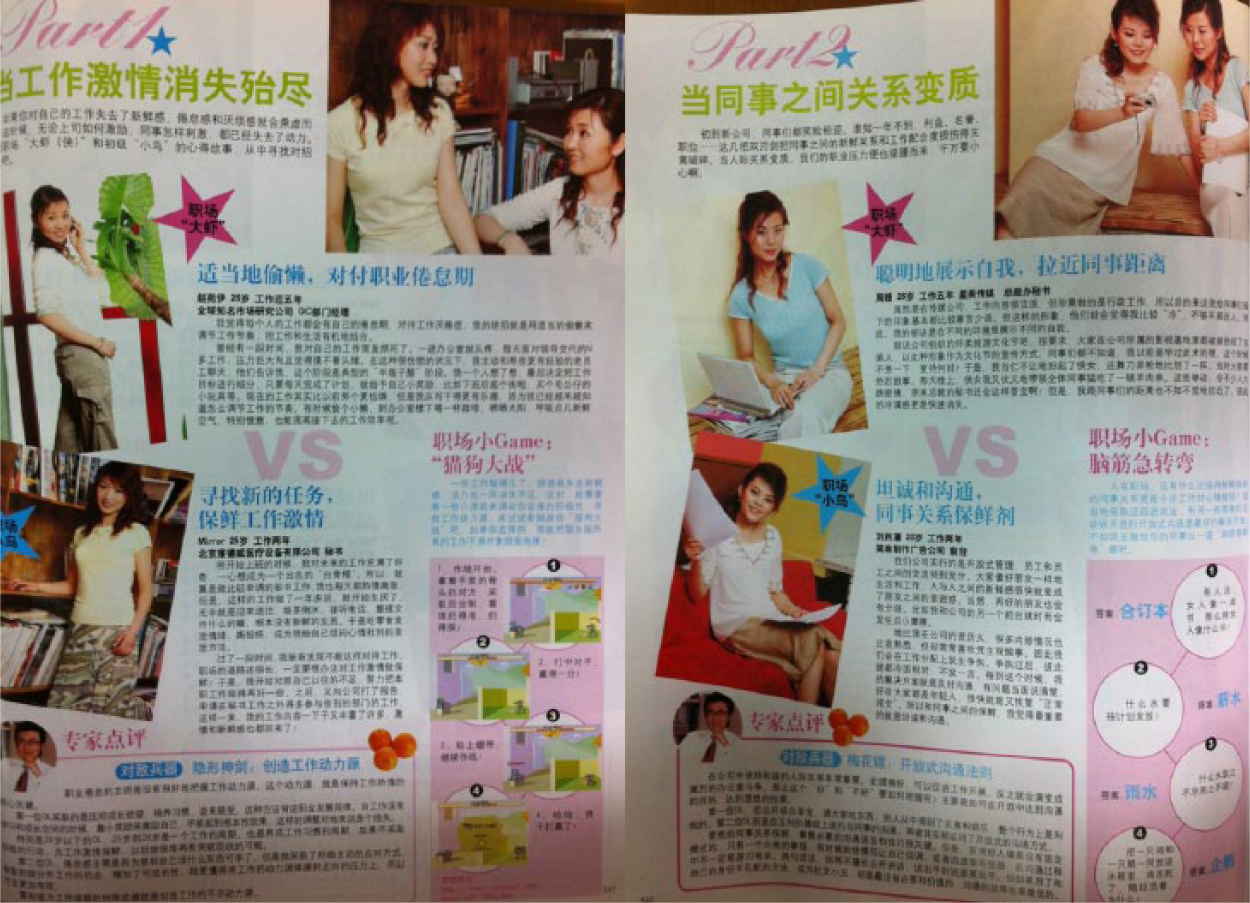
Rayli, June 2005: 347 and 349.
In the 2005 images, we also find women represented as having a relationship with each other as seen in the top photograph on each page in the 2005 edition. Here, collegial relations are signalled visually as agreeable and fundamentally as social in contrast to the image on the right-hand page in the 2001 version. This is part of a process by which such images shift away from concrete social context and specific social ties and activities to signifying broader moods and social interactions. However, while work appears as pleasant and social relations positive and easy, we find the women striking poses that point to a lack of assertiveness such as where one holds her work tightly against her chest.
In the 2011 version, as seen in Figure 3, we find something different again. On the right-hand page, the model is pretty but indistinct. Here she is individualized and seen in close-up, as we see her reactions to particular kinds of problems, to which the solutions are offered in confident go-getting language in the accompanying text. But she remains a generic office worker type. She is not a specific named individual. She is typical of the women described in Cosmopolitan magazine by Machin and Van Leeuwen (2007), who look thoughtfully upwards or downwards off frame pointing to their mental states regarding the problems identified and dealt with by the magazine. On the left-hand page we see the same kind of individualized, yet generic, woman. Also on both these pages the women are not simply meek or subservient, as could be said for the women in 2005, but appear much more ‘cute’. The designer said that here we see the clear influence of Kawaii culture.
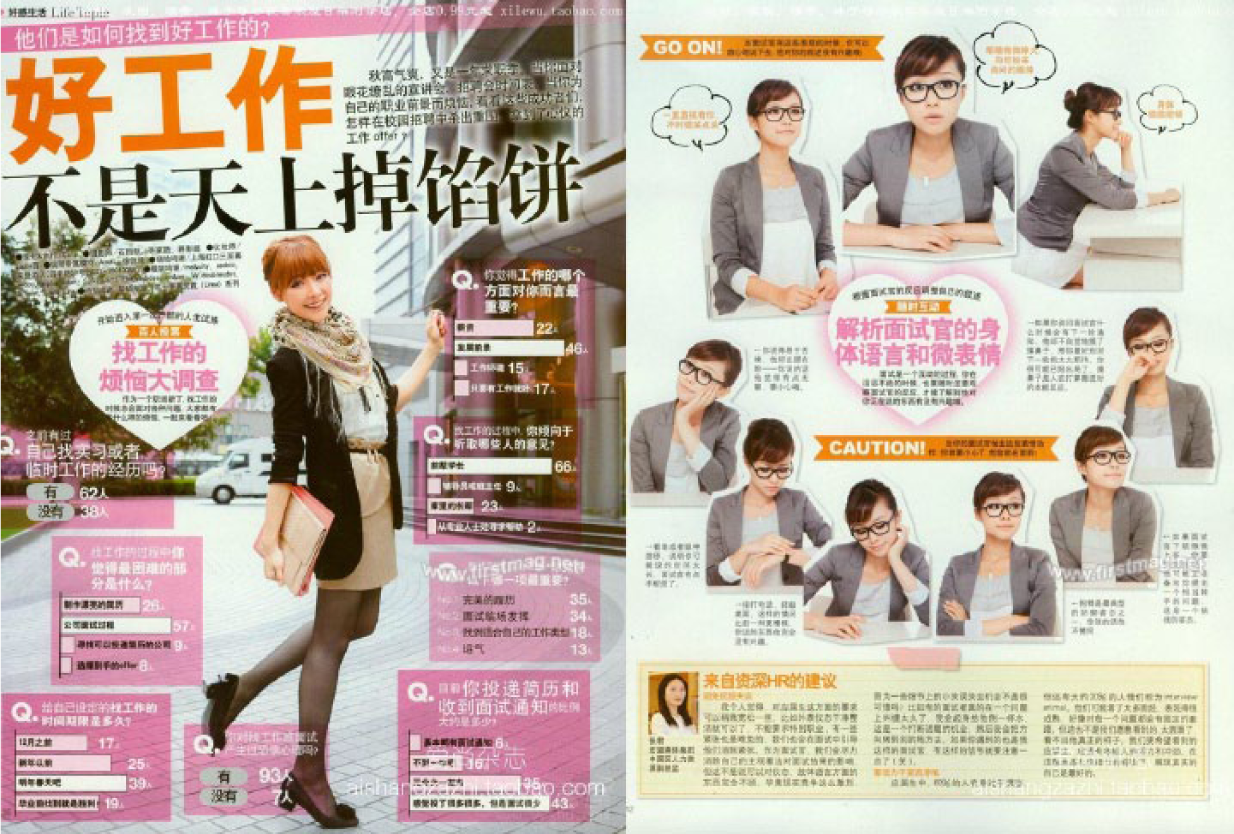
Rayli, December 2011: 436 and 442.
In the 2012 edition, seen in Figure 4, we find an extreme representation of genericity on the right-hand page where three young women wear the same kind of clothing and strike similar poses that are cute and childlike. Their clothing too suggests softness and vulnerability. One important area for Kawaii marketing has been in fashion. One of these, the designer told us, is known as ‘Lolita fashion’ where girls dress in clothing that signifies childhood. Textures are also important here, we were told, in terms of softer fabrics that relate to comfort. So models in Rayli will often wear fur, velvet or soft cotton clothing. The clothing style is likely to be layers of ruffles, lacy fringes and floating skirts or dresses.
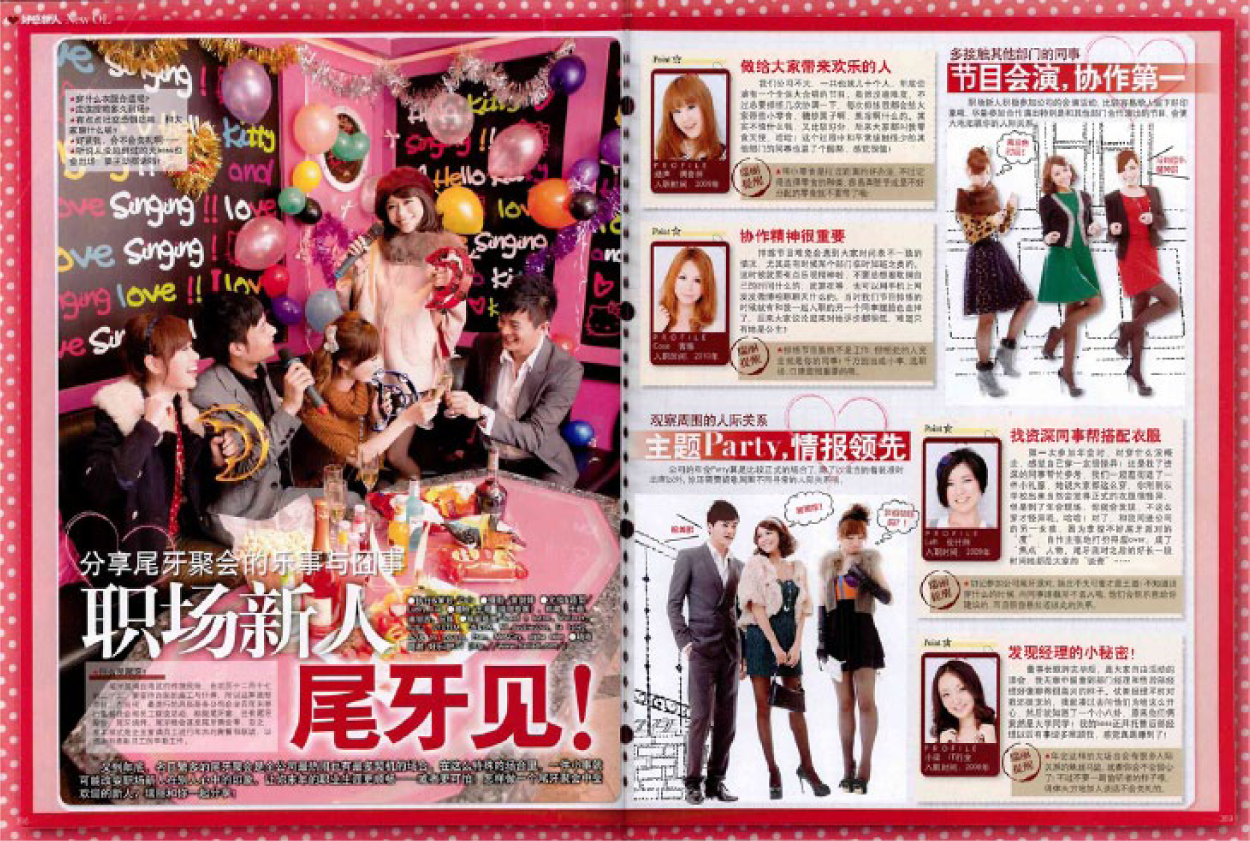
Rayli, January 2012: 366 and 369.
The women in these photographs are also shown in smaller groups as well as being marked individually in the passport-size photographs where they are also named. On the left-hand page we find young women as part of a group of friends. This is again very different to the observations made by Machin and Van Leeuwen (2007) who found a huge emphasis on individuality in the international versions of Cosmopolitan. The Rayli editor commented on this difference. In American and European women’s magazines, the features are mostly about women acting strategically, and social bonds and ties are generally completely missing. Colleagues are present generally as competitors or as a problem. Boyfriends can be present but in order to learn strategies for seduction or aspects of relationship management. In the case of Rayli, the production team are aware that Chinese women are attracted to the independence of the freedom represented by such magazines, yet nevertheless still find themselves in a culture which emphasizes collectivity and the importance of responsibility and belonging. This, they suggested, can still be seen visually even if in the texts women are represented as operating alone.
The Changing Role of the Image in Rayli
We now turn our attention to the design changes in Rayli from 1995 to 2012. It is here that we take Floch’s (1995) point that it is not only figurative or representational aspects that must be taken into account but also their ‘visual treatment’. In doing this, we adopt Aiello’s (2012) analytical distinction between representational and design resources, with the former corresponding to ‘raw’ visual material or content (e.g. the people, objects and places included in an image) and the latter being the abstract principles used to ‘style’ basic blocks of visual content.
Our first observation is that, from 1995 onwards, the use of images, or specifically the relationship between text and image, has changed. Kress and Van Leeuwen (2001) argued that it is not so much that we inhabit an increasingly visual culture, but rather one where the relationship between language and images has changed. They argue that the visual is now used to accomplish kinds of communicative tasks formerly accomplished by language. On the one hand, at a simple level, this meant that text and image became more integrated on the page. Older school books, for example, might have a drawing at the top of the page and then a detailed description of that object in a large body of text below. In contrast, we would later find visual image and linguistic text highly integrated, with images, diagrams and info graphics all playing a key role. On the other hand, at a more subtle level, Kress and Van Leeuwen point to the shift towards an increased use of other semiotic resources such as font shape and colour to take the role formerly occupied by language. We begin with the changing role of the image and move on to more detailed design features afterwards.
In the 2001 version of Rayli, seen in Figure 1, we find a dominance of linguistic text which provides the information, where for the most part images exist as illustrations of this text. This use of images characterises the older form of text–image distinction. On the right-hand page in the same example, we find a slightly different use of visuals comprising a collage of images of real workers talking. These have been assembled to connote the broader issue of collegial relations, which is the topic of the text. This left-hand image is more of an earlier form of the kind of use of image that we find in later versions where they are much more integrated into the page design as a whole.
We can see this more integrated use of images in the 2005 version, shown in Figure 2, where the images of the smiling office workers with bright lighting are not used to allow the viewer to see the actual workers or work places but to help to align work with something pleasurable. We see the same thing later in 2011, in Figure 3, and in 2012, in Figure 4. Here the images do not so much provide ‘illustration’ of the text, but themselves indicate kinds of persons, settings and attitudes appropriate to the magazine brand. But in order to understand more about how exactly images accomplish this, we need to look more closely at the way that the kinds of images have changed over time.
Change in the Kinds of Images Used: The Image as Design Element
One other crucial change in visual style has been in the kinds of images that are used. This can be seen in the difference between the photographs in the 2001 version, seen in Figure 1, of actual office workers in their place of work and the more posed images in 2005 and more abstracted settings in 2011 and 2012. Machin and Van Leeuwen (2007) used the concept of ‘visual modality’ to analyse the images in current editions of Cosmopolitan, comparing these with earlier editions of the magazines and with those in locally produced magazines in different territories. The term ‘modality’ refers to how true or real images are meant to be seen. Simply this means assessing images for the difference in how we would have viewed them if they had been in a scene in a naturalistic setting, or in a scene where we had been there to observe it. For example, are details of the objects and background represented in fine-grained detail and focus or are these reduced? Do aspects of colour such as saturation, modulation and differentiation appear naturalistic or are they in some ways exaggerated? Do light and shadow appear realistic?
One example of photographs that typically have reduced naturalistic modality is advertising images. It is common that in such images details of background are slightly out of focus; the modulation of light on clothing and skin has been reduced to make it appear rounded and softer; the scene is saturated with diffused light; and colours are saturated and coordinate across the image and with fonts, borders and perhaps the product itself. This can be contrasted to the higher naturalistic modality of a documentary photograph. In the advertising image, the world, we can say, is therefore idealized and simplified (Machin, 2004).
What is apparent in Rayli is that in earlier editions we tend to find images that depict actual women in actual settings such as the places where they work and through naturalistic modality. In 2001, in Figure 1, we find actual work settings full of clutter. The people we see in these images are captured as we would have seen had we been there. Lighting is naturalistic and not particularly flattering. In Kress and Van Leeuwen’s (2006) terms these are images of high naturalistic modality.
Later versions of Rayli increasingly depicted women through lower modality in more abstract and idealized settings, typically uncluttered with minimalist props and backgrounds, evoking simplicity and a modernist aesthetic. Lighting is clearly artificial and often overtly bright to create a sense of optimism. The colours found in the images and other objects and fonts within and outside the frame will be coordinated also, creating an impression of stylization and further shift away from naturalistic reality. In the 2005 version, seen in Figure 2, we find such posed images. This is a world that resembles more that of the world of the fashion shoot and the advertisement.
By 2011 and 2012, as seen in Figures 3 and 4, we find pages that contain images that do not document, but rather symbolize women at work. On the right-hand page in the 2011 example, work is symbolized by the desk and perhaps by the spectacles. In 2012, work is signified purely by collegial relations. And, in this case, the setting has become completely abstracted and replaced by sketches.
Such lower modality, decontextualized images, Machin and Thornborrow (2003) argue, fit more comfortably with the trivial actions and go-getting features that are needed to imbue the magazine and its products with positive values. Such articles would fit much less easily next to an image of a tired woman sitting in a cluttered, slightly grubby, office. In addition, these authors argue, this lowered modality is a way in which the kind of solutions and advice offered by these magazines can operate free of social context and individual circumstances.
In part it is this switch in the modality of images that also allows them to shift from their use as mere illustrations to integrated parts of the composition. For example, the text in 2012, Figure 4, which contains trivial hot tips for being successful at an office party, is not just accompanied by these images, but is realized through them. As text alone, such a feature would simply not work.
What is of central importance in this shift in the use of images and the modalities of images is that they are used across distinctive kinds of genre in the magazine. Whereas formerly features carried naturalistic images of real people, they now appear largely undifferentiated from those used for an advertisement or for a fashion shoot, as we see in the 2012 example. This fusing of visual styles across what were formerly distinctive domains has been one key feature of the process of branding in international magazines such as Cosmopolitan (Machin and Van Leeuwen, 2007).
The Changing Use of the Semiotic Resources of Design
We now move on to the way that other design elements have taken over roles formerly performed by writing as observed by Kress and Van Leeuwen (2001). Here we are interested in the changing use of typeface, colour and composition. In particular, we find a clear influence and gradual adopting of the design styles of international women’s magazines.
Kress and Van Leeuwen (2006) have shown how design features can be broken down and analysed in terms of them being a set of choices from which a designer can select in order to communicate specific ideas and attitudes as well as creating coherence and links across a page. In terms of typefaces, colour and layout, these authors show it is possible to identify some of the basic building blocks which dictate these choices. We draw on these in our analysis.
After 1995 we find a gradual shift to more sophisticated uses of typeface to communicate specific ideas and attitudes, and to create page coherence. In the 2001 version we find a hierarchy of font sizes for relative headings. But by 2005, seen in Figure 2, we see more careful attention to using font types to create an easy-to-identify hierarchy and matching across the two pages. And in this case the matching and hierarchy go beyond font size to include font type as well.
The fonts here are also much less heavy than in the 2001 edition. In the terms of Van Leeuwen (2005), we find here a shift from the meaning potential of heavier fonts that tend to signify stability and certainty, to lighter fonts that signify something more subtle and mobile. In the 2005 version, we also find the slim, curved and emotional fonts used for the English words ‘Part 1 and 3’. This helps to load the page with more of a sense of ‘girliness’ and ‘softness’. This is one example of a shift to designers thinking more carefully as to which fonts can be selected to represent the ideas and values that they seek to communicate in any particular article and also for the overall branding of the magazine. This can also clearly be seen in the right-hand page of the 2011 edition seen in Figure 3. We find the bolder fonts used for directives ‘CAUTION’ and more curved gentle fonts placed right in the centre which also match those on the left-hand page. Such visual treatment and design resources, in Floch’s (1995) and Aiello’s (2012) terms, are part of the way that the representations of the women, here found in images which also become designed mainly for symbolic work, are also shaped into the brand.
After 1995, we also find a shift to a more sophisticated use of colours. It was here that the designer expressed to us her strongest opinions on what had formerly been used with much less awareness. In the 2001 edition, in Figure 1, we find that yellow has been used for borders, box-fills and as a background to the images at the bottom left. Red and green are also used to create balance and links. But the designer thought this was crude. In the 2005 issue, in Figure 2, we find much more attention to the use of colour, although the designer told us that this appeared over-designed by more contemporary standards and used too many colours, all in a very symmetrical way. She commented that they were still too inexperienced to really use these ideas well.
In the 2011 version seen in Figure 3, we find a shift towards more subtle and yet effective uses of colour matching and alignment. Here different kinds of elements carry the same colour and in different places over the two pages. The ‘Go on’ and ‘Caution’ banners match the colour of the font on the left-hand page. The font colour right in the middle of the right-hand page matches the box-fill colours in the left-hand page. The neutral grey jacket does not clash or add to the colour scheme, thereby creating a more modern aesthetic.
In the 2012 pages we find a similar kind of linking of elements across the two pages. Red is not a dominant colour but it is used as a cohesive colour in the two pages. On the left-hand page, red is a part of the title, the girl in a red cap is holding a red tambourine and another girl is wearing a red top. On the right-hand page, red can be seen in the titles, subtitles, designed conversations, page borders, and the two girls’ clothing. As Machin and Van Leeuwen (2007) note, such use of colour is in fact more typical of the stylized and idealized world of advertising. But in this case we find such communicative devices in articles about work activities and work relations.
At the level of colour, while it has changed over time as regards the textual function, hue and levels of saturation have also been harnessed more carefully to communicate more regional and local ideas and attitudes. The hues and colour qualities we find in the later versions of Rayli, the editor told us, point clearly to Japanese influences. The colours found in Rayli are mostly pink, followed by baby blue and red. But these are much softer and more diluted colours compared with those we would find in an international magazine such as Cosmopolitan. Here colour itself is part of the way that Kawaii cuteness and childishness are communicated. This would be in contrast to the more saturated colours of the ‘Fun Fearless Female’ brand of Cosmopolitan magazine, described by Machin and Van Leeuwen. These same cute colours cut across the different genres in the magazine: advertisements, editorials, careers. All these genres cease to play distinctive roles but are harmonized through the branding processes.
Conclusion
In this article, we have shown that analysis of visual changes in Rayli requires us to think, first, at the level of changing representations and, second, about how design provides an additional level of meaning. In this sense, it is the case that the adoption of styles and formats from international women’s magazines does not so much stand apart from ‘local’ content, but conveys its meaning. As such, styles and formats are tools which Rayli has used to move from documenting actual Chinese social and work life to becoming a brand which offers a kind of freedom, not from domesticity and motherhood as in the West, but from duty and responsibility. And, as in other places where international consumer-driven women’s magazines are purchased, readers can align themselves alongside these discourses by buying the products sold within its pages.
What this analysis shows is that we need to attend to the way that such changes, that we tend to call ‘globalization’, happen at different paces and in different ways in different national media. It also points to the fact that even content that might appear at first glance as ‘local’ must be interrogated in terms of the way that this too is in itself a recontextualization, something that has been selected and transformed for the purposes of the branding process. What we find in Rayli is clearly, to some extent ‘local’, but, like the kinds of women’s agency found in American women’s magazines, is something that has been hijacked and transformed for the purposes of consumer capitalism.
Footnotes
Funding
This research received no specific grant from any funding agency in the public, commercial, or not-for-profit sectors.
Biographical Notes
ARIEL CHEN is based in the School of Journalism, Media and Cultural Studies at Cardiff University, Wales. Her research interests lie in Multimodal Critical Discourse Analysis especially applied to issues of globalization and Chinese media, on which she has previously published.
Address: Room 1.24, Bute Building, King Edward VII Avenue, Cardiff CF10 3NB, Wales, UK. [email:
DAVID MACHIN works in the Department of Media and Communication at Örebro University, Sweden. He publishes mainly in the field of Critical Discourse Analysis and Multimodality. His books include The Language of Crime and Deviance (Bloomsbury, 2012) and The Language of War Monuments (Bloomsbury, 2013). He is the co-editor of two international peer-reviewed journals: Social Semiotics and Journal of Language and Politics, and sits on the board of a range of related journals in the field. He is associate editor of the online community SemiotiX.
Address: Room F3164, School of Humanities, Education and Social Sciences, Örebro University, SE-701 82 Örebro, Sweden. [email: