




Abstract
This article begins with the assumption that analysing visual discourse is a question of exploring the hermeneutic potentials and epistemological emergence of images as depending on individual perception, ways of seeing and social interaction, strengthening their agency, to ascertain their significance and recognition as aesthetical symbols, as meaning-making processes. The article presents a case study based on two world-renowned Portuguese artists (Helena Almeida and Jorge Molder) in which the authors understand the notion of the agency of image as an original means of interpreting social and cultural experiences, studying how artists transform their visual representations in ambiguous narratives about images. Starting from a critical and phenomenological perspective, the authors developed an image-based analysis, contrasting artists’ visual representations with their textual readings and recognizing the central meanings of self-representation in both cases.
Keywords
Introduction
Our relation to visual discourse becomes a matter of being exposed to certain images, developing an understanding of certain representations, connecting certain habits, behaviours and ideas with the forms of representing the world, which then acquire a status of artistic, aesthetic or educational instruments as they achieve meaning through a spatio-temporal context (see Kara, 2011: 103). This article proposes that we analyse images by exploring their hermeneutic potentials and its epistemological emergence as depending on individual perception, ways of seeing, and social interaction, studying how artists transform their visual representations in ambiguous narratives about images, although evidencing the agency or irreducible identity of the visual objects.
In short, we outlined a strategy of understanding the general notion of image as a distinct aesthetic performative modality, by emphasizing its power beyond its mimetic empirical content (Kara, 2011: 103), through a case-study based on two worldwide renowned Portuguese artists – Jorge Molder (JM) and Helena Almeida (HA) – working with self-representation, mostly in photography. The model of this interpretative analysis of images has consisted of contrasting artists’ visual representations with their textual readings. Our proposal is to join the principles of a critical discourse analysis with a phenomenological reading of images – a reading that goes beyond the interpretation of their content, allowing for the analysis of the social (and power) relations in which they are embedded. It considers the objective and subjective conditions of interpreting and experiencing images, showing how the construction of their meaning, acceptance and artistic status is a process concerning not only certain systems of meaning, ways of seeing, and the agency of the visual object, but also human perception.
Our thesis is that while visual meaning is culturally constructed, the agency of the visual object and individual perception are decisive features in that construction of meaning. In one way, each image is an interpretation of reality, grounded in representations, models, and paradigms structuring particular spatio-temporal periods in the history of art and social world; but in another way, the decoding of images lies in their agency, which is connected with human perception, i.e. with the ways of experiencing them, since all social practices are embodied and images have their punctum(s) 1 (see Barthes, 1981). Hermeneutical potentials of images are thus endless and multidimensional.
General readings of visual images broadly agree that there are three key dimensions to acknowledge the meanings of an image: the image itself, the production, and the audience dimension. According to Rose (2007), each one of them comprehends three different aspects or modalities: technological (any form of apparatus designated either to be looked at or to enhance natural vision, from oil paintings to television and the internet [Mirzoeff, 1998: 1, see Rose, 2007: 13); compositional (referring to the specific material qualities of an image or visual object, namely related to formal strategies like content, colour, elements pictorial organization); and social (the range of economic, political and social relations, institutions and practices surrounding an image and through which it is seen and used).
While the perception of images is more linked to their technological aspects and mediums, and their agency is further associated with their composition and content, their readings stand at the social level. Usually these readings are disclosed through several media and communication mechanisms (reviews, catalogues, online, television shows, etc.). These mechanisms (re)produce and (re)create the various interpretations and perceptions of images, working to give them their aesthetical status and recognition, moreover defining their identity. For artists this is an anticipated objective since without public recognition they would remain unknown. Thus, recognition is a process depending not only on legitimacy, but in acceptance, i.e. in specific social conditions of communication and interaction under particular power–knowledge regimes (Foucault, [1990[1978]). Recognition conditions are important in the analysis of images because they contribute to their intelligibility and visuality (contextualizing them, helping explain the social conditions of their existence and meanings). Besides devising their agency, the reading of images must not be separated from their identity/recognition dialectic construction process.
Presentation of the Cases and Problematic
In the cases of Helena Almeida (HA) and Jorge Molder (JM), the works/images, are usually named as self-representations rather than self-portraits. In both cases, however, the image is usually identified with the artists themselves, with their self or personality, often becoming difficult to make a clear distinction between the images and its referent, resulting in fact in confusing, and sometimes contradictory observations:
2
[They] are not self-portraits because I do not find in them my own ‘subjectivity’, but rather my ‘plurality’ which I make appear in a kind of a stage setting. Would that they were ‘self-portraits’! In any case, I can say that they are stage settings executed within a small or sometimes large format (in the sense painting/theatre) in which I appear as a fictional character. These scenes are made as if they were the narrative of a spark – appearance/disappearance – recounted with the silence of a sign language; projections which I would like to contain the deep sound of the body; images that tell what happens before the image, before movement as thought, before history, and above all, before intentionality. (Helena Almeida, 1994: 84) *** I am the actor of my photographs, so, in theory they should be self-portraits … Sometimes this invented persona is close to what I appear, and others it is quite different, and I do not have the slightest explanation for it. In some pictures I'm quite well, if I may say so, but unfortunately in those pictures I almost never recognize myself, or I would say that sometimes I am forced to acknowledge me in some images, however, the question remains open. It's more exciting when we are dealing with uncertainty. (Jorge Molder et al., 1999: 178)
Both discourses (visual and textual) fall into an ambivalence and/or duplicity between identity and otherness, body–object and body–subject, self-portrait and self-representation. If ichnographically and in a psychoanalytic sense, hiding the face could mean preserving the identity or dislike of the self-image, revealing it suggests good self-esteem and self-confidence. By hiding their faces or portraying different characters, it seems that the artists are avoiding personal revelation; but on the other hand, their works are produced through photographic mechanisms traditionally associated with the discourse of mimesis and immediacy. These ambivalences allow us to question the true nature of the self-portrait/self-representation in Helena Almeida and Jorge Molder, and complicate the conceptual scheme of works.
Although, in these two cases, most of the discourses suggest that none of the characters are similar to the personal self, an embodied vision of social practices may say otherwise. Hence, the cases are often positioned equivocally or in an ambivalent way between the two genres – self-portrait versus self-representation, raising a number of questions: Beyond mimesis, what is there? In what conditions has this ambivalence been originated? In what way are artists, and other agents or observers participating in the creation of such a discourse? What are its main effects? What about contingency, as contexts of creation and correlative relations with other images, texts, and signification structures representing a particular moment in time? How is artistic status created and reproduced? By what means are artists transforming their experiences of seeing and acting in ambiguous and (un)determinate narratives about the works of art?
The linguistic paradigm neglects images in art as symbolic organizations of ideal concepts beyond their representational possibilities, reducing their significance to the precision of their references, thus ignoring the power of image – agency – built in cultural expression and interaction (see Kara, 2011: 103–104). This idea is related to the notion of the composition of its material form (visual presentation and visual effects) and visuality, that is, to the ways in which what is seen and how it is seen are culturally constructed (Rose, 2007: 2). Moreover, it is related to specific ‘ways of seeing’ since we never look at just one thing, we are always looking at the relationship between things and ourselves: images cannot be reduced to a metaphorical, communicative or discursive instrument to the comprehension of reality, rather they have a life of their own, they are empowered with a proper strength; they interact with reality by carrying out different forms and practices as well as different representations of the world (Berger, 1972: 9, see Rose, 2007: 12). 3 However, in addition, different ways of experiencing them (e.g. looking), once the experience of images in art, are increasingly a question of sensation(s), not just of looking, but smelling, hearing, touching, and all forms of bodily interaction (e.g. James Turrell’s work Wedgework V 1975 – Fluorescent Light, or Doug Wheeler’s work, DW 68 VEN MCASD 11 2011 – White UV neon light). 4 This is to conceive the multiplicity of images in the world as an intersection between its proper materiality and embodied social processes of vision and interacting. This kind of phenomenological concern with the power of the image determines that its own reception as well as its production is embodied. This way, our perspective emphasizes the political and aesthetical interactive implications of images enhancing its communicative effects via transmission and perception.
In his first work, Phenomenology of Perception (1962[1945]), Merleau-Ponty revised the concept of sensation, connecting it, intrinsically, with the body, and demonstrating how subjective and objective experiences are inter-related, breaking with the classical theory that saw the senses as passive recipients. According to his theory, ‘sensation’ is not a state or quality, nor the consciousness of a state or quality as proposed by empiricism, for which perception is described through linear causality stimulus-response, but a creative expression of different perspectives on the world. Hence, perception is understood as the act through which the mind uses sensation to capture the object(s) from reality. This is therefore not representation but creation, and opened up new possibilities for interpreting the various existential situations. In this line of thought, the meaning of an object is an emergent property of the interaction between individual selves and objects/image. The meaning of an object lies in what it means to us, in our response to it. Thus, to understand its meaning is not so much a question of discovery of some objective reality, it is a question of creation. In this account the construction of visual meaning is not a process of strictly description and reproduction, but a process of creative transformation (see Mead, 1910). In other words, the conveying of meaning(s) is not a mimetic process, but a creative one in which meaning is constantly made rather than merely reproduced, under a power–knowledge regime involving a certain type of legitimacy (the ways visual discourses circulate, are established and accepted, and eventually contested by other people), within a certain context and interaction relying on the relation established between images and each individual, creating them, seeing them or experiencing them, therefore, between the images and other discursive contexts, and reflecting a ‘system of meanings’ in which they are embedded. Their analysis is a question of establishing a network of causes that takes account of the singularity of the images (identity/recognition) as an effect of those relations. Hence, we need to consider the multiplicity of relationships and interactions, the circularity of actions intersecting and the heterogeneous processes among images. This is not to reduce to a cause a set of derived phenomena, but to confer intelligibility to a singular positivity precisely to its own singularity (Foucault, 1990[1978]: 54–55). Consequently, our perspective assumes that each image is the result of specific ways of seeing, perceptions and embodiments within particular historical discursive moments. Their agency and consequently their identity recognition are discursive constructions depending also on acceptance and immediacy, on the ways images circulate and communicate among artists, other agents and observers in the worlds of art.
Hitherto, our perspective states that it is possible to deconstruct meaning or sense ascribed to images, evaluating the way they are created, disclosure, accepted and (re)produced in the cultural world as discursive and embodied practices. This is to seek for the mechanisms or generative powers of images (agency), and identity/recognition configurations of self-representation as an ‘open system’ whose structural properties (e.g. composition and formal elements of discourse; aesthetic status of an image) are not reducible to the parts that compose them; rather, they emerge from their relationship and interactions with their environment. This perspective assumed these elements as relatively autonomous as they operate through relations of dependence exercising an influence on the structuration process through the practices, actions and relations that recursively generate and transform them (see Archer, 1995). Nonetheless, and as realized earlier considering the ‘external and contingent’ relations in which they are embedded (e.g. relations with other discursive, cultural and social systems or as we named it their ‘immediacy spaces’), this critical assumption makes it possible to identify the social mechanisms operating between the (embodied) individual agency of images and their external (embodied) settings of acceptance and recognition.
Methods: A Critical and Phenomenological Interpretation of Images
As discussed earlier, the conceptual perspective starts from the idea of the power/agency of an image outside the boundaries of linguistic models of representation (see Kara, 2011: 104; Rose, 2007: 2), with the phenomenological assumption stating that all human perception and practices are embodied. This approach also assumes ‘labels’ or meanings as sensory ascribed to images rather than as objective features of them. The assumption is that people act based on what things mean to them: the consciousness of meaning consists mainly of a consciousness of attitude, on the part of the individual, over and against the object to which he or she is about to react (Mead, 1910). While the criteria (or the system of symbolic meaning) that individuals use to evaluate their relations to images are also important: ‘people cannot use a word to describe their experiences or observations unless they have socially acquired it and learned how to properly use it’ (Harris, 2010: 97).
Therefore, we consider the production of visual discourse and the power of images as an interactional process of creation (at the individual level between the embodied structures of thought of the artist, like memory or intellect; and at the external level between perceptions, ways of seeing and discourses involving others), with the emergent proprieties (or causal powers) of images determining their results (identity/recognition) including, in both cases, the circulation and reproduction of specific conceptualizations about the self-representations. In this manner, the action (practice of self-representation) is creative and transformative and exists beyond the instantiation of artists’ actions (see Danermark et al., 2002; Roldão, 2010), with the production of meaning, identity and recognition as a process involving others (e.g. the contexts of exhibition and exposure of images; if exhibitions are individual or collective; relations with other images; places).
In this account, the method for the analysis of these cases has consisted essentially of confronting the internal narrative of images (stressing their substance) with the external narratives about images stressing the social context that produces them (see Banks, 2001: 11). As empirical support, we used the images and other texts (namely from artists and other agents, published either in paper or online and further media).
The analysis comprised visual and textual readings of images, with particular attention to the relation between these two types of discourses. Basically, we confronted what is actually seen in the images with what is actually said, interpreted and reproduced by other discourses, showing how artists and other agents transform their self-representation’s practices and experiences in ambiguous and (un)determined narratives about images, identity and otherness.
Using different tools, the visual dimension of analysis comprised the observation and interpretation of images that were analysed in terms of the singularity of each case, comparing their differences and acknowledging their properties, mechanisms and resources, namely of identification and exposure (according to their technological, compositional and social aspects). Also, images were interpreted according to a number of general categories created and withdrawn from the preliminary observation of the empirical materials and the literature about the domain in investigation: corporeality, identity, expression, technology and aesthetics, plus immediacy spaces (Table 1).
Categories and subcategories of analysis.
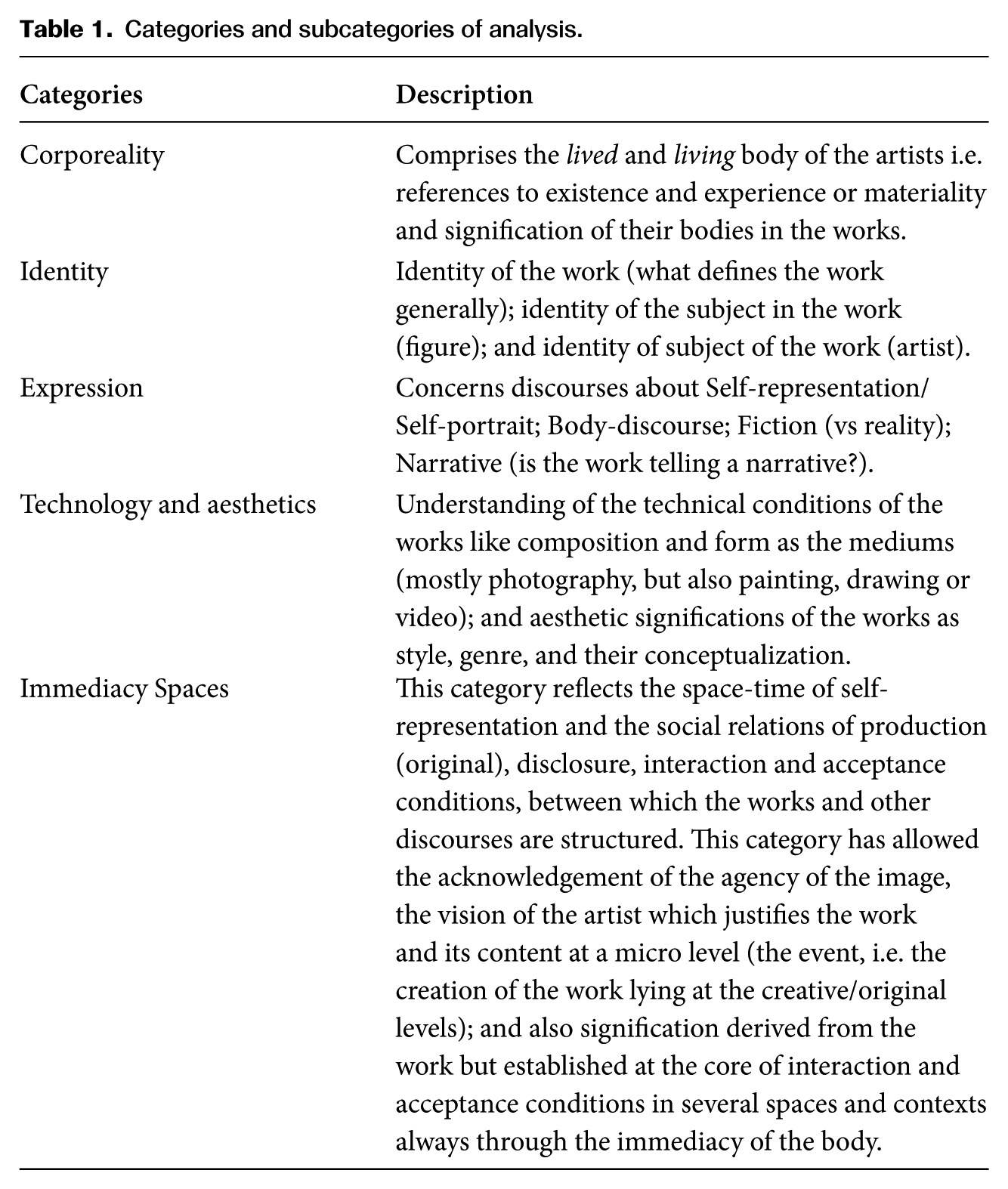
The textual dimension of analysis comprised the collection, observation, identification, classification and categorization of texts available in catalogues, books, magazines, online and in newspapers. Strictly, we decomposed several texts focusing on the differences between ‘artists’ personal discourses’ (22 texts) and ‘others’ discourses’ (44 texts) using MAXQDA categorical and content analysis software. We decomposed the texts in segments according to the five main analytical categories. Then we interpreted their number by document, type of discourse, category, subcategory and the comparisons between them.
Relative to types of texts, ‘personal discourses’ were divided into: interviews; talks; and writings. And ‘other agents’ discourses’ were divided into: articles; essays; texts in catalogues; and texts in books.
Outcomes
Regarding the dimensions and modalities of the images’ interpretation (see Table 2), outcomes revealed the main use of the artists’ proper body (corporeality) in each case; it allowed the recognition of three subcategories of identity: the work, the artist and the representation; as well as the identification of their mediums (already referred to above), the modes of self-expression in each image/work, i.e. the technological and aesthetical instruments applied by the artists like mundane objects, interplay of light and shadow, and of the proportion of scale with images mostly in large frameworks, etc.; it also revealed the immediacy spaces (e.g. the inner space of the work as the atelier in the case of Helena Almeida, and the sorts of other fictionalized settings in the case of Jorge Molder; plus at the external level, different spaces of exposure and observation like galleries, museums, and other institutional spaces such as foundations, banks, biennales, etc.). It also identified the mechanisms of discursive (re)production and networks of relationships such as: the use of digital media discourses, interviews and participations in TV shows, films, radio interviews, etc. and the aesthetical and cultural interactional context of images (e.g. visuality regimes in which they emerged).
Image interpretative analysis in Jorge Molder and Helena Almeida’s cases (based on Rose, 2007: 30–31).

In these cases, the visual project is a reflexive psychosocial narrative production, built on the depersonalized experience of self-representation. The material conditions, discourses and practices interact to shape it and its multiple identities. Being culturally situated, the subjectivity of the artists, expressed in the images, is a place of embodied knowledge, as a textual surface in which the artists’ lives are inscribed (Smith and Watson, 2001: 37). However, each image is a place of simulation and depersonalization – an abstract work, a fiction. Thereby, artists emphasize the differentiation between the self and the figure throughout verbal expressions. This causes uncertainties and contradictions when comparing the discourses because in self-representation the referent/message coincides with their creators/authors. However, the meaning is broader than the referent, the original coming from it, but eventually autonomous and powerful. It is what gives to the image the artistic status, rather than the pure image status, and what makes us talk about self-representation or body-image representation rather than self-image.
The body reality (experience and existence) is being invisibly translated into the images as their main subject is understood as a pure ‘object’. In both cases, the artist’s image continuously depersonalized in the figure is understood not like a projection of the artist’s self, but as duplication, and always as an abstraction. This narrative directs significantly the discourses in both of them. Nonetheless, visually the ‘identity of the work’ continues to be expressively connected with the artist’s image, thus allowing the process of personal identification in the perception of the works, which influence the many references to the artist’s self in their textual readings, mostly in the texts in catalogues (213 coded segments) as Figure 1 shows.
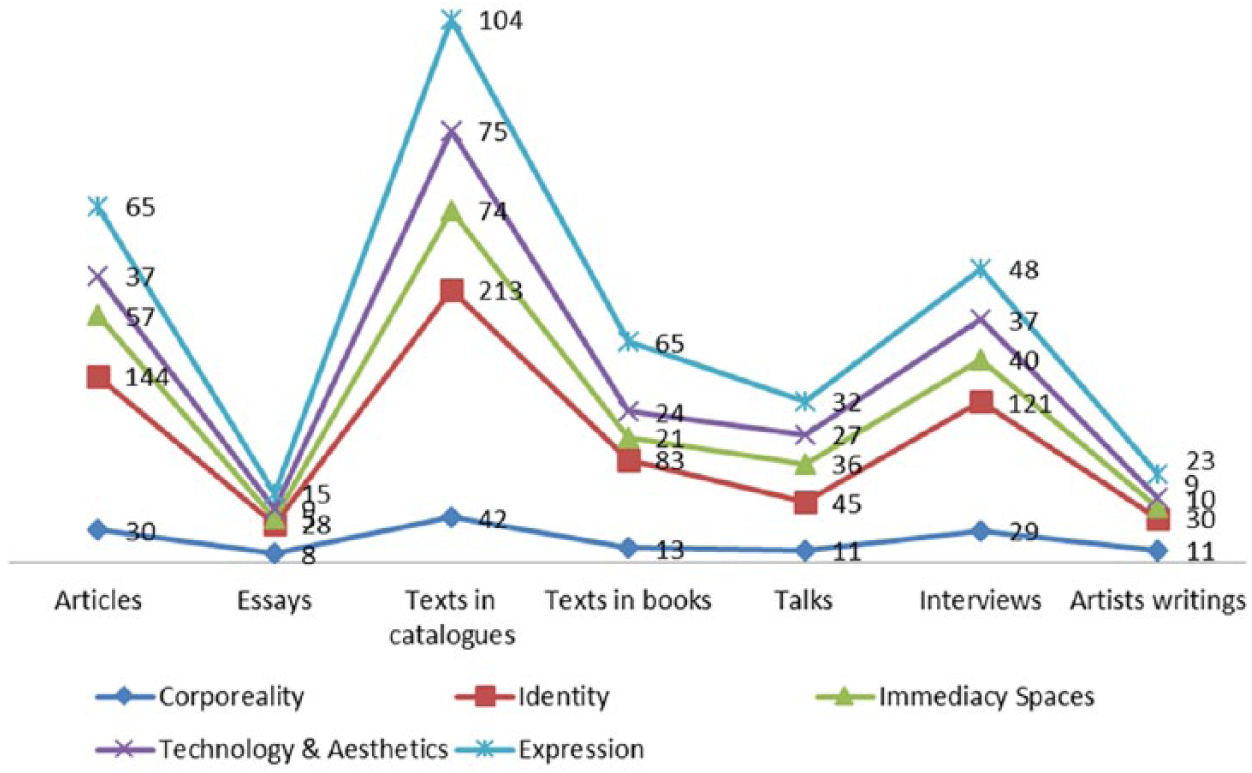
Number of coded segments by category and types of texts.
‘Corporeality’ displayed less weight in the analysis when compared with ‘identity’ in terms of the coded segments for the texts. In fact, this was the most contrasting evidence when both discourses (visual and textual) were compared since it was expected that the ‘body’ of the artists had the major weight in the textual reading, rather than ‘identity’, as it has in the visual reading of the works, once it is their main theme. So why does this happen?
Firstly, the agency of the image (including the non-expected effects on the viewer) influences the reconfiguration of social identities of the artists themselves, producers of these discursive formations (self-representations), as their visuality. Secondly, because it was difficult to separate the experience of the body from its existence, making many segments of the texts redound in the category of ‘identity’, rather than in the category of ‘corporeality’. In texts in catalogues, in fact, it has shown a representativeness of 42 coded segments, less than a half of the coded segments for ‘identity’ in the same category of texts, mostly given the importance of the ‘identity of the work’ in the texts published in catalogues. However, the discrepancies remain when comparing them in the other types of texts.
We also observed a majority of themes related to ‘expression’ and ‘technology and aesthetics’ in this type of texts. Catalogues are in fact the privileged support for using expressive and aesthetical readings of images, for they are directed to a specialized public, when compared with articles or essays more focused on the general public. Catalogues were also the type of document most employed in this analysis, whether for the textual analysis or the visual analysis.
Hitherto, and now comparing the two types of textual discourses (Table 3), we observed that in artists’ personal discourses the ‘identity of the subject in the work’ is less referred to (5%) then it is in other agents’ discourses (10%). While ‘identity of the subject of the work’ has more weight in artists’ personal discourses (14%), then in other agents’ discourses representing only 7 per cent of the coded segments. Interpretation of this outcome shows that while artists (in personal discourses) are encouraged to talk about themselves, other agents’ discourses privilege the idea of defining the ‘character’ in the work, rather than the artist himself. This evidence emphasizes the distance between the person (I, artist or subject) and the category of the other (it, image or object) qualifying the variations in visual discourses definitions as the ambiguity self-portrait/self-representation. This outcome reinforces identification as the core aspect of the discourses undertaken in a wide-ranging sense, while the body-image is apparently the core aspect of the visual understood in a particular sense. In fact, and as we have seen, there is one ambiguity in assuming (or not) personal identification, generating contradictions, uncertainty, and ambivalent positions relative to the character of the figure in the representation. Nevertheless, there is no doubt that artists are the ones performing those actions, showing the significance of embodiment and the role of self-representation as an embodied practice in these cases, besides the inseparable link between identity and the body, as in the same way between the artist and the work.
Comparison between personal and other discourses in textual form.
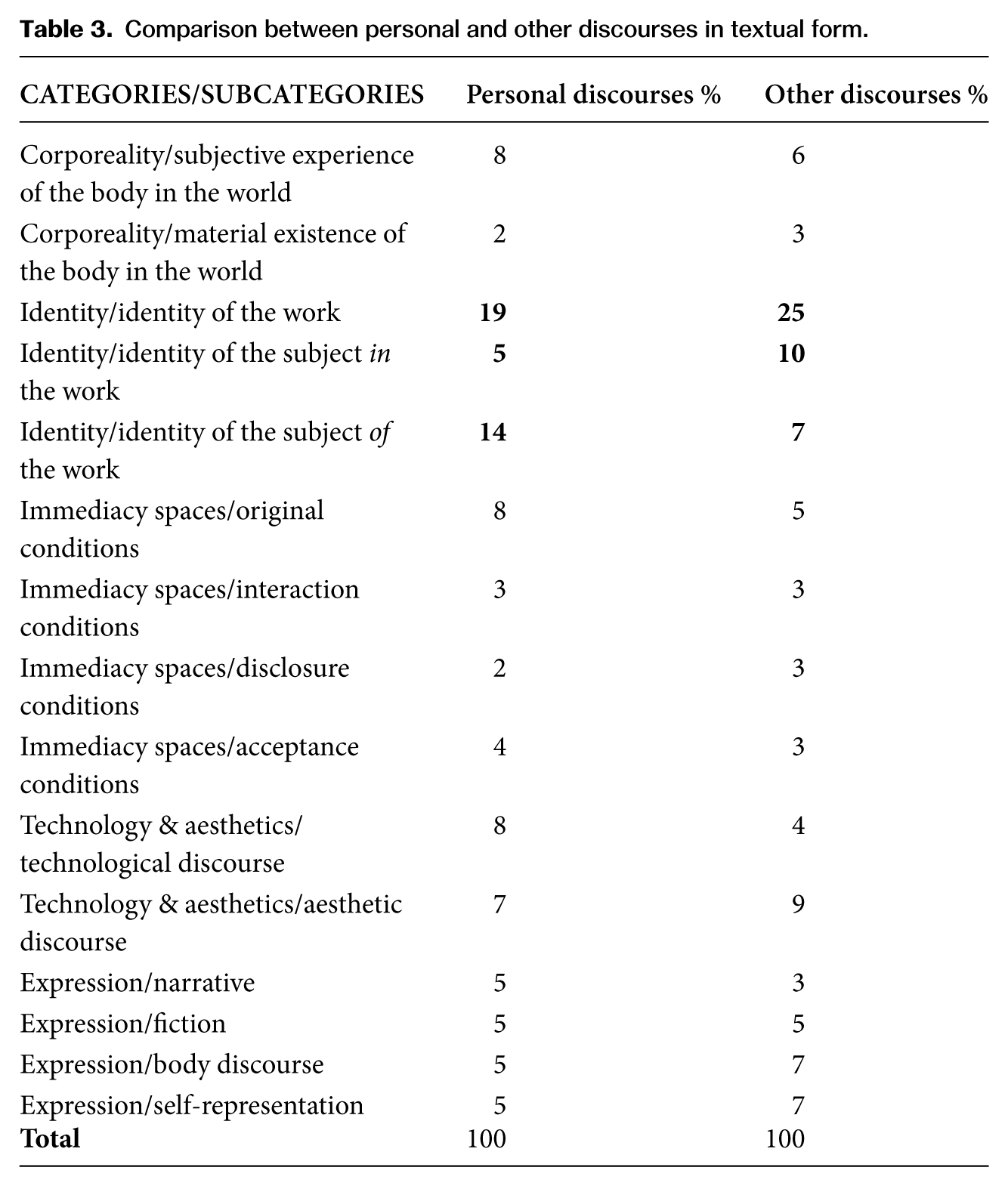
Other evidence deserving note is the weight of the ‘identity of the work’ in others’ discourses (25%). This is relative to the amount of references to compositional elements and definitions of style, methods and techniques in these discourses as they represent the core elements defining the works, nonetheless it is the category mostly used also in personal discourses (with 19% representativeness). In fact, it is the main category present in the overall textual readings of images, enhancing their material components (e.g. black and white photography, Polaroid and digital, etc.) and other properties (e.g. the mediums as drawing, painting, video, and the proper body). The higher presence of these elements in others’ discourses suggests that the (visual) substance of the image has a big weight in defining it, superior to the artists’ personal discourses which are by nature (as creators) the privilege exegetists of images.
Through these experiences, and by working with personal materials, the artists reveal their own relationships with life, and in the particular case of self-representation, with its own image and bodies generating constant thoughts and interpretations about this specific place, where they meet – the works/images. While their agency (the way images produce specific visual effects) is the privileged means by which the image is perceived and communicates with observers, their textual readings represent the means by which their meanings are spread, accepted and recognized by large publics.
Thus, if hypothetically we considered the meaning-making of a work of art as a process with two complementary dimensions – identity/recognition – our outcomes indicate that visual discourse has a major role in defining the first, while the significant purpose of textual discourse is the second.
Accordingly, in the analysis of textual discourses, different working relations and interactions were detectable, such as invitations, requests for representations in biennales and prizes. The acknowledgment of sites of exhibitions and exposure also very noticeable (through the observation of artists’ curricula) revealed long-lasting trajectories when disclosing the works in these two cases, as they are internationally acknowledged artists (the specific analysis of the trajectories is not displayed since it goes beyond the scope of this article).
Discussion
In the visual narratives of Helena Almeida and Jorge Molder, ‘self-representation’ not only symbolizes an inner research. It also signifies the need for the artists to manifest themselves in complex social networks (in recent years increasingly immaterial through digital and technological devices), representing common imagery structures, as well as the sharing of symbolic narratives. Situating these artists in this imaginary field covers the relationships through which discourses and self-representations are created, representing different modes of individualization as social and visual imaginaries.
Helena Almeida experiences the work as a process of making art, from her body interaction with the space. Jorge Molder explores it more from the point of view of existence, through the passage of time by the body, and the inevitability of its finitude, as opposed to the in/finitude of the image. Other issues such as the fiction, narrative, self-representation, reflexivity and memory are common to both discourses and cases, though with some particularities.
In the case of Helena Almeida, ideas are born in drawing and completed in photographs. Some aspects of the photographs are later exploited in other drawings, videos, performances. If, on the one hand, it is possible to state that the work of Helena Almeida presents itself like ‘morphology of continuity’, it is also possible to say that it is a work that repeatedly displays the ‘threat and risk of discontinuity’. In much of her work there is a ‘sense of rupture and possible catastrophe that seems to float beyond the frame’. This feeling gives her art a ‘sense of fragility and violence’. This ‘potential rupture’ is expressed in ‘discontinuities through cuts and connections’ in her photographic series of multiple pieces, motivating the action in the invisible space between each of the images that she shows (Phelan, 2005: 58).
Jorge Molder’s photographs embody the otherness, initially in Self-portraits (1979–1987); 5 afterwards in self-representations, dense, enigmatic, as if they were still images from movies, in series, performing the distance which nullifies the psychological and autobiographical experience of the double as an instance of the inner ‘I’. His work problematizes the feature of the ‘double’ as a suspension of the recognition feature, that is, as a device for thinking the tension of the cleavage between the ‘I’ and the ‘other’ in the figure. This is, par excellence, the metaphor of the modern. His work is therefore an ‘archaeology of the modern’, personifying the symptoms of modernity, often ironically (Molder et al., 1999: 188).
In these artists’ work, each ‘persona’ as depersonalized abstraction is still a creation existing beyond the relationship between self and other. Each image insinuates itself as fiction, as the inter-relationship between the dimension of experience (and memory) and their symbolic articulation in discourse as narrative forms, originated in a social and cultural constructed self, though multiple and/or fragmentary. However, it is not the self that they reflect, but the double, the other. In symbolic or figurative terms, images can refer to many personas: They are not living pictures in the classical sense. They are fictions because it's not me; it's like a double, another person. It is a fiction in the pictorial sense. In my work there is always the plan, the plan of the canvas [screen] when I’m there. It is as if I was inside a canvas, a fiction. When I used the ink it was for people to realize that there is a plan which I do not cross, to remind the canvas surface. The focus of the photograph is the space of this canvas [screen]. (Helena Almeida, 2000; see Mah, 2000: 46)
Although personal identification is being widely rejected, at other times the possibility of images being self-portraits emerges because it is not possible to escape from their evidence/content. This dualism is due to the fact that the artist must admit that the image is his or her own. However, the images represent figurations of artists in different scenarios as a character and a fiction: ‘I recognize myself in most of the pictures. I recognize certain traits which I'm sure they belong to me, but at the same time, I do not recognize myself in the mirror [i.e.] in the images that I produce’ (Jorge Molder et al., 1999: 177–178).
On the other hand, the reason for this ambiguity is the artist’s intention to objectify those represented in the figures, giving them a specific and autonomous sense, that is, to create an identity of the subject in the work as an object while preserving, at the same time, their personal identity as subjects of the work. It represents an investment in the best interests of artists, a practical sense, which was imposed by the sense of the game. As Bourdieu (2001) refers to it, something like a ‘social libido’ similar to the biological libido, demonstrating how there is no disinterested behaviour.
The investment in the idea of ‘figure as an object’ allows reaching larger audiences and greater communication skills of the work itself, as the artists allow the audience to identify with this, in another sense. That is, not only on the identification of their personal image but, autonomously, by the appropriation of the meaning of the work according to each one’s perceptions and contexts.
Thus, we assume identity/recognition of the ‘self-representation’ in Helena Almeida and Jorge Molder, not just as a matter of symbolic attribution of meaning in all the sets and conditions where artists perform their roles, but as well as a matter of agency of the visual object by itself given its particular properties, and their perceptions by others involving the creative transformation of the original structures of the visual object, in future contexts, through the different readings.
And if artists present multiple differences in terms of the narrative of the work and their expressiveness at a singular level, externally at a general level, discourses about the works, and their identities, are instantiated similarly in common networks of relations and through similar discursive practices occurring and legitimized in the course of the ‘social worlds characterized by a relative diversity’ – for example, publications, catalogues, interviews, conversations, and mediations involving critical views in their production, while their ‘inner worlds [and expressiveness often translated into the works] are plural’ (Corcuff, 2001).
Finally, textual discourses have pointed to a practical and operative sense (especially in Helena Almeida’s case, but not exclusively), and to a narrative sense (predominant in Jorge Molder’s case, but also not exclusively) for self-representation showing the discursive and embodied nature of images, while the discourse of the work or visual discourses have demonstrated the expressive and agential sense for self-representation, showing its symbolic power.
The practical and operative senses of self-representation indicate, on the one hand, that these artistic practices provide a logic to artists’ lives, which means the possibility of the action without having to go through the elaboration of a theoretical reason for this action (Bourdieu, 1997, 2009). Namely, they appear as a way of life, a subjective (objectified) need, cause and consequence of actions in the sequence of events that is life; and secondly, that there is an operative property of self-representation as technological and discursive instrument.
The narrative sense is interpreted also in two ways: first, through the inner narrative of the image, it is the result of experiences and reflections of artists and forms of expression. It operates in conjunction with other images (e.g. use of the series) and discourses, or separately (i.e. in the literal sense each image can have a visual sense independent of the series which it is included; within other contexts acquiring new uses and symbolic meanings). As Barthes (1998) states, ‘the image is polysemic’, and thus to fix the meaning of an artistic image, i.e. its identity, we need the words and the speech. It makes sense in the context of a set of floating meanings in the existing culture. Thus, we suggest that the linguistic message is an instrument to counteract the polysemy of the image, its excesses, and its ‘floating chain of meanings’ (Barthes, 2009: 42). The linguistic or textual reading restricts the polysemy of the image setting for its sense. By restricting the denoted senses it guides the identification. At the symbolic level, the linguistic message guides the interpretation, being the sense provided by the context and the proper substance of the image (pp. 32–33).
Secondly, the narrative sense is interpreted in this analysis, as the sense that the experiences of representing the body provide to the artists’ lives and their identities, insofar as these are identified with the images and vice versa, and because the trajectory and recognition of images constitute also its path as artists.
The expressive meaning is translated through the different compositions in the image decoding feelings, thoughts, ideas and knowledge (through various technical, aesthetic, material, and symbolic elements of the image). One expressive act demands a dialogic relation mediated by the object to be known (the self-representation) and the subject of the act of knowing (observer). In this perspective, observers assume the role of creators. And the object of the expressive act, involving a question of language, is the relation of the artists with the world. The analysis of these relations expresses the dialectic movement between the images created by the artists transforming the world and the limits that these images exercise upon them. It clarifies the role of the image in the identification/recognition process and in the critical reflection about the practice.
Lastly, the agential sense of the image as already understood, is the production of specific effects (including the unexpected ones, in the observer) according to each one’s perceptions and ways of seeing, namely building and expanding the visibility of the work. It is therefore one act of creation as the expressive act’s perceptions, embodying a dialectics between image and the reflection about it, showing both their limits and potentialities, and re-thinking the images and their symbolic meanings.
The acknowledgement of these effects and the meanings of the images involve specific discursive mechanisms of legitimation and identification/recognition, embedded in the textual (and verbal media) discourses. Synthetically these mechanisms are: (i) discursive mechanisms of differentiation and individualization, namely identification and definition of the identity of the work; (ii) procedural discursive mechanisms, or the description of ways of doing, experiences and processes of constructing the works; (iii) ambiguous discursive mechanisms, i.e. the use of stylistic linguistic resources as the metaphor, oxymoron and paradox; and (iv) discursive exposure/visibility mechanisms that encompass the ways of showing the images, with their exhibition (in galleries, museums and other institutions) and reproduction (through the writings in catalogues and brochures), besides the strategies for dissemination and acceptance of the works, especially through interviews and other conversations and documentaries in various media sites.
Conclusion
The presence of self-portraits and self-representations in the two cases brought phenomenological and discursive perspectives for their respective readings. They both can be thought of in the context of the postmodern notions of fragmentation and displacement of the self, such as the body-image directly involved in expressiveness. This question requires a look at the postmodern views of subjectivity, agency and subject, pertinent to the artists whose work relates to their ‘lived identities’ and articulated with an artistic expertise. That is, a ‘living identity’ as material for discourses of otherness, fiction and abstraction. On the other hand, for contemporary social theory this discussion is adjusted with the idea that the body in the world is not separated from its physical manifestations: ‘the body and the world are made of the same flesh, the flesh of the body is part of the world, and simultaneously reflects it because they both intersect’ (Merleau-Ponty, 1962[1945]: 225). This is why in the works of Helena Almeida and Jorge Molder the ‘subjectivity’ and ‘materiality’ of the bodies are in a relationship of transgression and connection. Thus the hermeneutics of the images come from the synchronization between the ‘subject of the work’ and the ‘subject in the work’: images, mental in the first instance, are materialized in the form of a document, a photograph, a work of art, a body of events. They embody emotions, experiences and facts of life, subjectivities, expressively through the body, used in the work as a depersonalized symbolic narrative. As Susan Sontag (2004[1961]: 166–167) writes: ‘photography which has so many narcissistic uses, is also a powerful tool for the depersonalization with the world, and the two uses are complementary.’
The phenomenological and interpretive readings of the representation of the body in Helena Almeida and Jorge Molder has shown that the production and reception of the works are embodied. This proposition is not limited to the experience of the observer, but involves also the hermeneutics of self-representation in the two cases. The analysis recognized the visual discourses as carrying social and cultural experiences of its creators, as well as of the contexts in which they are produced. In this sense, the image is a medium of potential meaning, generating particular effects through its agency, as new ways of seeing and indeterminate perceptions of them, not planned from the beginning by its creators.
This analysis has shown that identity of self-representation is a narrative process built dialectically between the internal and embodied dispositions of the subjects, and the external conditions of the field, whether speaking in a textual sense or in a visual sense of this perspective (as the visual is also a textual reading of the world in the postmodern sense of the word ‘text’); but also a project since there is an intention, conceptual ideas, and purposes (e.g. recognition, legitimacy and autonomy of artists’ names and works) while developing the actions or discursive practices (e.g. the representation of the body, the use of the titles, the reflection on individual experience subjectively translated into the scope of the work) in which the image directives the meanings ascribe to it (agential meaning), as their contexts of interaction and the different perceptions (disclosure, acceptance conditions) provide support to legitimate them.
Contrasting the two types of discourses, we observed that whilst constituted under the same logics, they fulfil different roles: we have enhanced the agential and practical sense of self-representation mostly linked to the visual discourse and their respective identities, while the role of other texts is above all the legitimacy in their recognition, enhancing the narrative and expressive senses of self-representation.
Besides seeing images as socially constructed, we remembered they also have causal mechanisms, particular perceptions they generate, and visions they produce. Concerning textual discourses, they ensure essentially the acceptability of images. This critical and phenomenological analysis of images in the cases of Helena Almeida and Jorge Molder has shown the logic guiding the social and cultural production of their discourses, from which the meanings for self-representation are being constructed. It contributes to the specific visualities of the works, and thus for the reconfiguration of their singularities, recognition and identities.
Textual discourses, however, are mostly characterized by ‘ambiguity’ given the propensity of artists employing self-image in their works to be identified with their representations, being at the same time their authors. Artists do not represent something away from themselves; they involve themselves in the work as body-object in a process, making a poetic narrative about the world as a project through their self-representation as metaphor or fiction; a plastic exercise and a discursive production, expression of their creativity and experience of the world, the result of which is the image as an artistic proposition, with their agency and perceptions, product and creator of embodied discourses, meaning(s) and visualities.
Footnotes
Funding
Research support for this project was provided by the Portuguese Science Foundation (grant number SFRH/BD/43455/2008) at Instituto Universitário de Lisboa (ISCTE-IUL), Centro de Investigação e Estudos de Sociologia (CIES-IUL), Lisbon, Portugal in the scope of the Doctoral Program of the School of Sociology and Public Policies, Department of Sociology, at Instituto Universitário de Lisboa (ESPP, ISCTE-IUL), between 2008 and 2013.
Notes
Biographical Note
ANABELA DA CONCEIÇÃO PEREIRA holds a PhD in Sociology from the Instituto Universitário de Lisboa (ISCTE-IUL). She is an associate researcher at the Centro de Investigação e Estudos de Sociologia (CIES-IUL), Lisboa, Portugal of the same institute. She is currently a visiting professor at UNTL (Universidade Nacional Timor Lorosa’e). Her recent publications include: ‘The discursive analysis of body-representation: A critical, realistic and embodied overview’, The Portuguese Journal of Social Sciences 13(1), 2014: DOI: 10.1386/pjss.13.1.75_1). Her main research interests are: sociology of the art, sociology of the body, visual sociology, identity, and discourse.
Address: CIES-IUL, Edifício ISCTE, Av. das Forças Armadas, 1649-026 Lisbon, Portugal. [email: