



Abstract
Framed in theories of social semiotics, this descriptive multiple case study examined the images used by six middle-school teachers during one school year as they each taught two different subject areas: earth science, language arts, mathematics, and/or social studies. Using Kress and Van Leeuwen’s visual grammar to analyze these images, this study identified discipline-specific patterns in how 1,132 images realized assumptions in regards to the ideational and interpersonal metafunctions of communication. A content analysis suggested discipline-specific differences in the presumed social distance between the content of the images and the students, as well as discipline-specific differences in assumptions about the subjectivity of knowledge. Instructional implications are suggested, such as encouraging students to critique the assumptions in images and selecting a wider array of image types in each discipline.
Keywords
As secondary students participate in various academic disciplines, they are introduced to discipline-specific ways of approaching particular goals using particular types of texts, which mediate students’ thinking about discipline-specific content (Wertsch, 1998). These disciplinary texts realize the norms of each discipline, including norms for what counts as legitimate, valued, or focal bodies of knowledge, and norms for how that knowledge is produced and communicated. Oftentimes, these norms are implicit, communicating ideas about a given discipline that are never explicitly acknowledged or critiqued by teachers and students (McDiarmid et al., 1989).
Van Eijck and Roth (2008; cf. She, 1995), for instance, analyzed images of scientists in high school textbooks and found that they depicted scientific activity as being isolated, objective, and removed from the social groups to which scientists belonged. Similarly, O’Halloran (2005) found that images in popular Western mathematical texts evolved over generations to omit depictions of persons-in-activity, such as men shooting cannonballs who were featured in earlier mathematical images. These studies and others (Bazerman, 1988; Fang, 2006) have suggested that a variety of visual and written texts have instantiated mathematics and science as appearing a-social, unbiased, and objective, assumptions that are rarely overtly discussed or challenged in secondary classrooms.
Images in history textbooks likewise may communicate particular disciplinary norms as they invite students to take particular perspectives on the content of the images. Kress and Van Leeuwen (2006), for example, analyzed images in several Australian history textbooks and found that Aboriginals were often depicted as passive objects of Europeans’ actions. Photographers at times depicted their subjects from angles that aligned with the positions of European schoolmasters, rather than with the positions of Aboriginal schoolchildren. Kress and Van Leeuwen argued that, as a whole, the historical images in the textbooks they analyzed were designed to engender an empathetic perspective of Europeans while distancing students from Aboriginals. In this sense, images in history curricula may at times be drawn or photographed to promote the perspective of one social group (Burke, 2006), or to depict that social group as being powerful while concurrently portraying other groups as weaker and less desirable (e.g. Janks, 2010; Wineburg et al., 2011).
Images in language arts have long been valued for their ability to express the emotion and psychology of literary characters (Smagorinsky and O’Donnell-Allen, 1998; Whitin, 2005) or students (Allen et al., 2002; Smagorinsky et al., 2005). In expanding the role of images in language arts beyond aesthetics, Doering et al. (2007) argued that a wider variety of images can be included in language arts curricula, such as student-generated photographs that document activity in their communities; popular media images that students critically analyze; and images that students post on social media websites to indicate affiliation with particular groups. Although these descriptions of images in language arts are diffuse, researchers (Fleckenstein, 2002) tend to emphasize that these images can be selected based on their ability to promote students’ creative expression and reflection about various facets of identity, social contexts, and values.
Informed by previous research on disciplinary images, this descriptive multiple case study (Stake, 2006) sought to answer the following research question in regards to six middle-school teachers, each of whom taught two disciplines: What discipline-specific patterns were realized through images used during earth science, language arts, mathematics, and social studies instruction? This focus differs from many other studies (e.g. Bezemer and Kress, 2009; Lee, 2010; Van Eijck and Roth, 2008), which have analyzed textbook images, many of which may not be viewed by students when their teachers project online images on interactive whiteboards to supplement their instruction. This study also differs from studies that have analyzed images produced by professionals (Lemke, 1998; Pauwels, 2006), and images used in individual lessons or units (Coohill, 2006; Lemke, 2003; Zoss et al., 2010).
Instead, this study sought to identify broader disciplinary norms and assumptions as they were realized across all types of images used as part of middle-school disciplinary instruction, including individual images found in textbook readings assigned to students, informal drawings sketched on whiteboards, images viewed in computer programs, and images displayed on interactive whiteboards. This study also enabled a comparison of how the same individuals used different types of images when teaching different disciplines. By focusing on the images used in the classrooms and by comparing aspects of them across disciplines, we hoped to identify distinctive patterns in how the images realized disciplinary knowledge over time.
A Social Semiotic View of Academic Disciplines in Middle Schools
According to theories of social semiotics (e.g. Hodge and Kress, 1988; Kress, 2010; Wilson, 2011), academic disciplines are produced and maintained through the texts that people create, combine, exchange, and use. These texts may be comprised of any mode, or socially-fashioned resource for communication, such as gestures, images, verbal speech, three-dimensional models, and written words (Kress, 2009). On a moment to moment basis, each text – such as an impromptu sketch on the whiteboard – conveys what it means to ‘do’ a discipline, including the content that is appropriate for the discipline as well as the assumed relationships between that content and the viewers or users of the text (cf. Halliday, 1973, 1978).
This text-by-text production of the disciplines may seemingly lead to instability, as each text is a new instantiation of disciplinary content and practice that may differ from the past. Kress (2003), however, argued that relatively stable social activity leads to the production of relatively stable genres. Geologists, for instance, have long studied layers of soil and rock, leading to stable genres such as cross-sections (Rudwick, 1976), each example of which bears similarities in both content and features to other examples. Tradition, then – in the form of repeated social activity and representational conventions – often causes new instantiations of texts to display comparable characteristics to texts produced in the past by people participating in similar types of social activity. Accordingly, we anticipated that instructional images would also bear traces of social activity that reflected patterns of disciplinary practice.
Images and the Metafunctions of Communication
According to Halliday (1973, 1978), language fulfills several interrelated metafunctions, a concept that was later extended by Kress and colleagues (e.g. Kress and Van Leeuwen, 2006; Kress et al., 2001) to apply to images as well. First, each image fulfills an ideational function whereby the image is related to a referent. This referent may be a physically observable object or event, a conceptual relationship among two or more phenomena, one’s experiences or imaginings, and so forth. Second, each image fulfills an interpersonal function by realizing social relationships, including the presumed social distance between the viewer and the subject of the image, as well as an affective evaluation of that subject.
Much as Halliday (e.g. 1973, 1994) sought to identify how metafunctions are realized through lexico-grammatical patterns in language, Kress and Van Leeuwen (2006) sought to identify how metafunctions are realized through patterns in images. We used aspects of their ‘grammar of images’ to identify how instructional images communicated discipline-specific social practices and assumptions in relation to the ideational and interpersonal metafunctions of images. Below, we describe the aspects of images that they associated with each metafunction.
Interpersonal metafunction
Drawing from Hall’s (1964, 1966) work on proxemics, Kress and Van Leeuwen maintained that images communicate a greater social distance between viewers and the content of the image as the subjects of images appear farther away. For instance, human subjects are framed at an ‘intimate’ distance when the viewer sees only a close-up of their faces and heads, indicating a close social relationship with their viewers; they are framed at a ‘personal’ distance when the viewers can see only their torsos, as would be visible when giving a handshake; and they are framed at a close social distance when their whole body is visible with a little space around it. ‘Intimate’, ‘personal’, and ‘close social’ frames indicate the subject of the image is no more than a few steps away from the position from which the photograph was taken or from which the image was drawn. In contrast, a subject is framed at a ‘public’ distance when viewers can see several objects in one frame with ample space around them, while in this study, we defined images as being ‘distantly’ framed when the subject was at least 500 meters away from the presumed viewer of the image.
Like frames, angles also communicate social relationships. For instance, if the subject of an image is viewed from a high angle – in effect, if the viewer is looking down on the subject – the presumed social relationship is ‘depicted as one in which the [viewer] has power over the represented participant – the represented participant is seen from the point of power’ (Kress and Van Leeuwen, 2006: 140; cf. Martin, 1968). Conversely, looking up at the subject reverses assumptions of power and status. In accordance with the idea that social distance is realized through images’ framing and angles, we sought to identify whether instructional images in each discipline tended to instantiate particular assumptions about the power and authority of depicted content as it related to students who viewed the images.
Ideational metafunction
In addition to realizing assumptions about social relationships, instructional images realize assumptions about the nature and purpose of knowledge. According to Kress and Van Leeuwen, under some traditions, legitimate claims may be made via images that explicitly acknowledge or celebrate the individual style and vision of the image-maker in shaping the subject of the image, such as a painting by Pablo Picasso or Vincent van Gogh. In contrast to these images with artistic orientations, other images are oriented toward naturalism, whose purpose is to mimic everyday visual perception to the greatest extent possible. Images may also realize schematic orientations (cf. Han and Roth, 2006); these images are intended to provide instruction and explanation, often through depicting causes, processes, or principles that are not perceptually visible. We hoped that an identification of images’ orientations (artistic, naturalistic, schematic) would point toward discipline-specific methods of constructing and expressing particular forms of sanctioned knowledge.
Images’ orientations are related to their modality, which can be defined as ‘the truth value or credibility of (linguistically [or visually] realized) statements about the world’ (Kress and Van Leeuwen, 2006: 195; cf. Halliday, 1994). In other words, modality relates to the degree to which the content of an image is presumed to be true and legitimate. Different orientations in images are characterized by different epistemologies, or stances toward what constitutes legitimate knowledge. Schematic images, for instance, communicate a scientific approach to knowledge construction; they favor knowledge that is generalizable, available through rational explanation, and based on empirical observation.
Because schematically-oriented images seek to explain general principles that extend beyond a single instance (e.g. explain the common features of all rectangles), contextualizing details that situate subjects in a specific time and place are often considered ‘gratuitous details’ that draw attention away from scientific or mathematical concepts (Myers, 1990; cf. Baigrie, 1996). An image with a schematic orientation, therefore, is more credible and legitimate in direct proportion to the extent that it avoids particularities in favor of generalities. Because scientific/technological discourses have acquired a position of societal power (Martin, 1998), images with schematic orientations are often considered to be more authoritative than images with other orientations.
However, Kress and Van Leeuwen argued that another important standard for identifying ‘truth value’ is the images’ coherence with everyday perceptual experiences, which forms the basis from which humans understand and experience the world. Despite modern-day photo manipulation programs, for example, a photograph often connotes higher modality than a cartoon because it coheres with humans’ external perceptual reality. To be sure, scholars (e.g. Barthes, 1977; Bourdieu, 1990; Sontag, 1977) have long asserted that photographs are the product of human framing and perspective, just as cartoons and other illustrations are. Nonetheless, through portraying subjects that appear as though they could exist in an external reality, photographs often connote a relative absence of human bias, analogous to the manner in which scientists use ‘objective’ written language to connote the alleged absence of human bias in their writing (Bazerman, 1988; Halliday and Martin, 1993).
Artistic images offer a third basis for what constitutes legitimacy: not what can be objectively explained, proven, or seen, but also what can be felt, imagined, and subjectively perceived. Under this epistemological framework, for instance, a painting may illuminate ‘truths’ about the human experience – not because it objectively portrays a subject as it would appear in the external world, but because it powerfully communicates the painter’s feelings or original vision. In the context of this orientation, modality does not refer to the degree to which one is rationally persuaded by the objective reality of the image, but the degree to which one is emotionally impacted or moved by it.
At least two different features are used to connote high or low modality within each orientation. One feature is contextualization, which refers to the level of background detail in an image. Images with low contextualization often feature subjects placed against solid white backgrounds, whereas images with high contextualization feature subjects placed in specific settings characterized by spatial depth and richness of detail. Minimal contextualization often indicates higher modality in schematic images because their purpose is to strip away all elements of a phenomenon that are not necessary to an explanation (Topper, 1996), whereas naturalistic images with minimal contextualization convey lower modality because humans’ everyday visual experiences of the world occur within textured, nuanced, and spatially-differentiated settings (Kress and Van Leeuwen, 2006).
Color is a second feature that indicates modality within each orientation. Kress and Van Leeuwen divided color along three scales: saturation, which runs from full intensity of color to the absence of color (e.g. black and white illustrations); differentiation, which runs from the maximal diversification of colors to monochromatic color; and modulation, which runs from many different shades of the same color to one shade of that color. As with contextualization, colors can communicate high or low modality based on the orientation of the image. Maximal saturation, for instance, may indicate higher modality in artistic images that communicate intensity of emotion, whereas maximal saturation and minimal differentiation (e.g. a photograph in which all objects are bright orange) can indicate low modality in naturalistic images if the colors do not cohere with people’s familiar and commonplace visual experiences with the world.
In sum, images realize different assumptions about what constitutes legitimate knowledge through their orientation and modality, including through their use of color and contextualization. Instructional images likewise indicate assumptions about the social distance between viewers/students and disciplinary content, through techniques such as framing and angles. We sought to answer our research question – What discipline-specific patterns were realized through the teachers’ instructional images? – by using these aspects of Kress and Van Leeuwen’s (2006) ‘grammar of images' to identify how images exhibited discipline-specific regularities in relation to the interpersonal and ideational metafunctions of communication. We hoped that an answer to this question would highlight assumptions about knowledge and relationships in each discipline, ultimately serving as a springboard for discussion among educators and textbook publishers who seek to be more discerning and critical of the images they show to their students.
Method
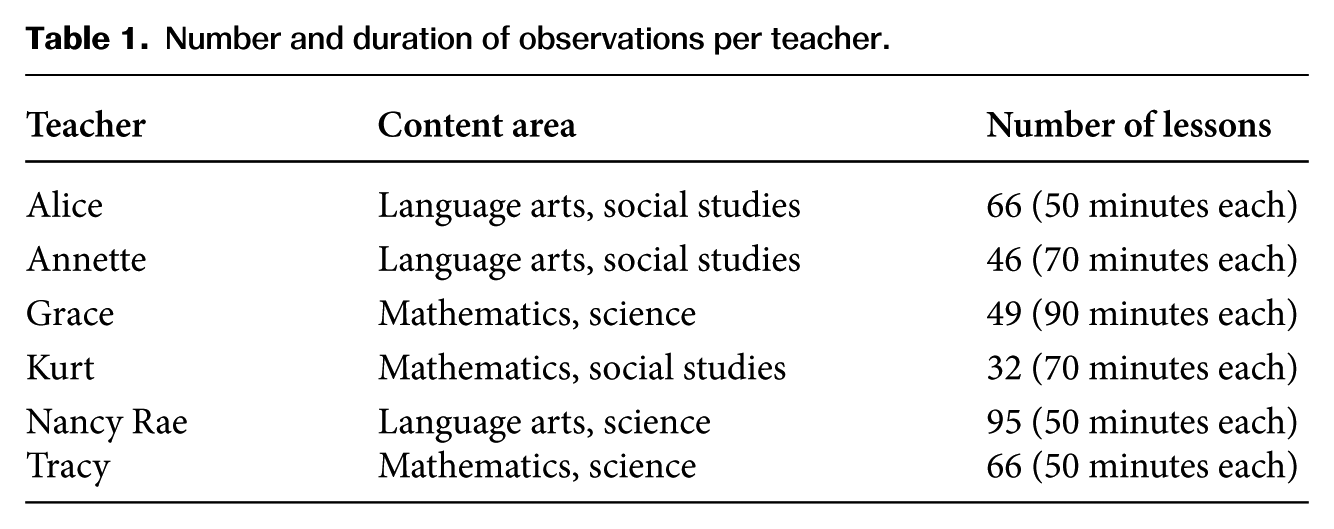
To this end, we conducted a descriptive multiple case study (Stake, 2006) of the instructional images used by six middle-school teachers as they each taught two different disciplines; in all, we studied images used in three earth science, three language arts, three mathematics, and three social studies classrooms (see Table 1). Stake (2006) asserted that multiple case study research is useful for exploring a ‘phenomenon … of which we might seek examples to study’ (p. 6), necessitating a shift from understanding each case as a whole to understanding the phenomenon – in this study, patterns in disciplinary images – as it appears within and across cases.
Number and duration of observations per teacher.
This study is based on a subset of data collected as part of larger studies on disciplinary representations. Six research participants in the southeastern United States were purposefully selected to participate in this study because they had been recommended as highly effective and innovative teachers in their respective districts. We hoped that their use of images would provide insights into ways that effective middle-school teachers used images to communicate disciplinary content.
Data collection
To study discipline-specific patterns in the teachers’ instructional images, we collected four types of data. Field notes, the first source of data, were written during observations of 354 total lessons, ranging between 50 and 90 minutes in length (see Table 1). Second, during these classroom observations, the first author also took photographs of all images viewed by the students, including images in assigned textbook sections and images projected on the Smartboard. Teachers’ moving images, such as video clips they showed to their students, were excluded from the analysis.
The third source of data was artifacts from the teachers’ instruction, including print-outs of their PowerPoint presentations and handouts that were distributed to students. These artifacts were uploaded to NVivo 9, a qualitative analysis software program, along with the photographs. Interviews, the fourth source of data, were conducted between five to nine times with each teacher in order to ascertain why he or she selected particular types of images. In these interviews, the teachers were asked to rank images’ utility and importance as compared to other modes they used during that instructional segment. These interviews were not formally analyzed but instead served as contextualizing information for the study.
Data analysis
We used a modified form of content analysis (Bell, 2001; White and Marsh, 2006) to analyze the images. We first divided the data into units of analysis, which were individual images distinguished by the space between the image and other modes; and/or by captions and other features that identified separate sub-components as being part of a discrete whole. Using concepts from Kress and Van Leeuwen (2006), we developed a set of a priori codes that enabled us to test our supposition that instructional images would exhibit unique patterns according to discipline. We coded a small, randomly-selected subset of the data to ensure that the codes seemed to fit this particular data set, and we modified and expanded these codes based on our observations (see Appendix for a list of final codes). Using the codes we had established, the first author analyzed the entire data set, while the second author analyzed 10 percent of the data. We obtained over 85 percent agreement in our codes as one means of establishing ‘trustworthiness’ (Freeman et al., 2007; Lincoln and Guba, 1985).
This first phase of data analysis enabled us to generate frequency counts that illustrated how particular methods were employed in aggregate across the data set. The second phase of data analysis, by contrast, enabled us to identify how multiple techniques worked together in individual images. In other words, we sought to identify how images’ features worked together to produce an overall effect. To this end, we selected two images from each teacher’s instruction in each discipline to examine in greater detail (see Figure 1 for analysis of one image). We selected these images because they were representative of overall trends in that teacher’s use of images in each discipline, as indicated by the frequency counts. In the findings section, we report our analyses of images that were representative of the larger data set.
Analysis of one image in terms of the interpersonal and ideational metafunctions of communication.
Limitations
All six teachers identified themselves as being middle class and white, but images can vary depending on the cultural practices of the communicator (e.g. Kress, 2010). Although these teachers were considered to be successful at communicating disciplinary concepts to diverse students, this study does not enable a discussion of how people with different cultural, geographic, and linguistic backgrounds might have used images to meet the needs of a particular group of learners. Moreover, because the sampling criteria did not include selecting teachers who held different conceptions of their disciplines, this study does not address how teachers with different sets of beliefs might have enacted their disciplines in different ways. For instance, it does not address how language arts teachers with a media focus might have enacted the discipline differently than those with a literary focus.
Furthermore, like most case study research (Bassey, 1981), this study does not attempt to prove statistical difference, such as the difference between types of images used in each discipline. Rather, it is a descriptive study which highlights patterns in six teachers’ instruction, thereby enabling ‘relatability’ to other instructional contexts wherein other teachers and students engage in similar types of disciplinary activity, resulting in the production of similar types of texts. Finally, this study does not report how disciplinary images realized the textual metafunction, the third function of Halliday’s (1973, 1978) social semiotic theory of communication, by which sub-components of images are connected to each other, to other modes, and to the larger classroom and societal context. For the sake of brevity, we reported the analysis of the textual metafunction in a separate paper.
Findings
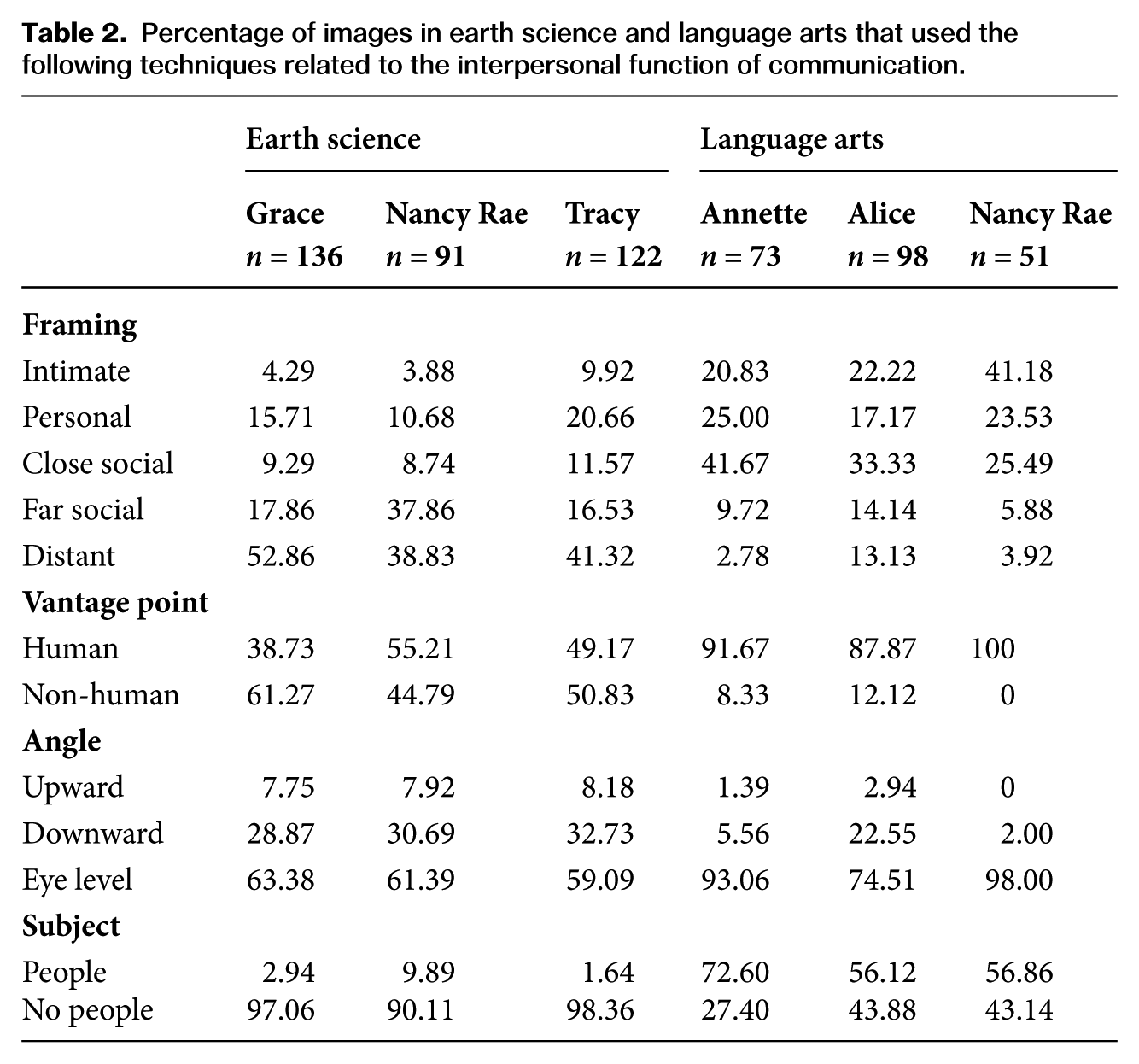
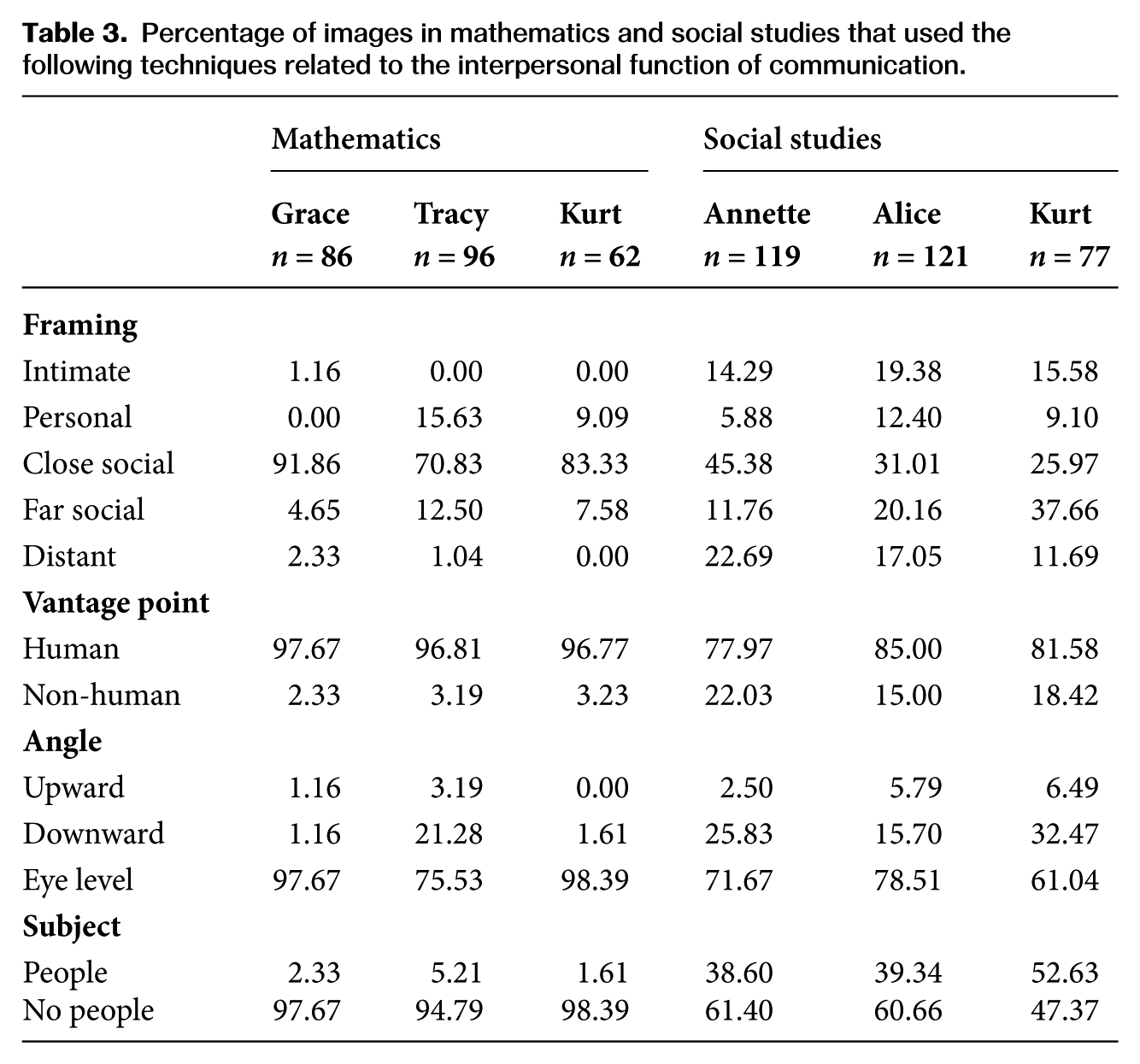
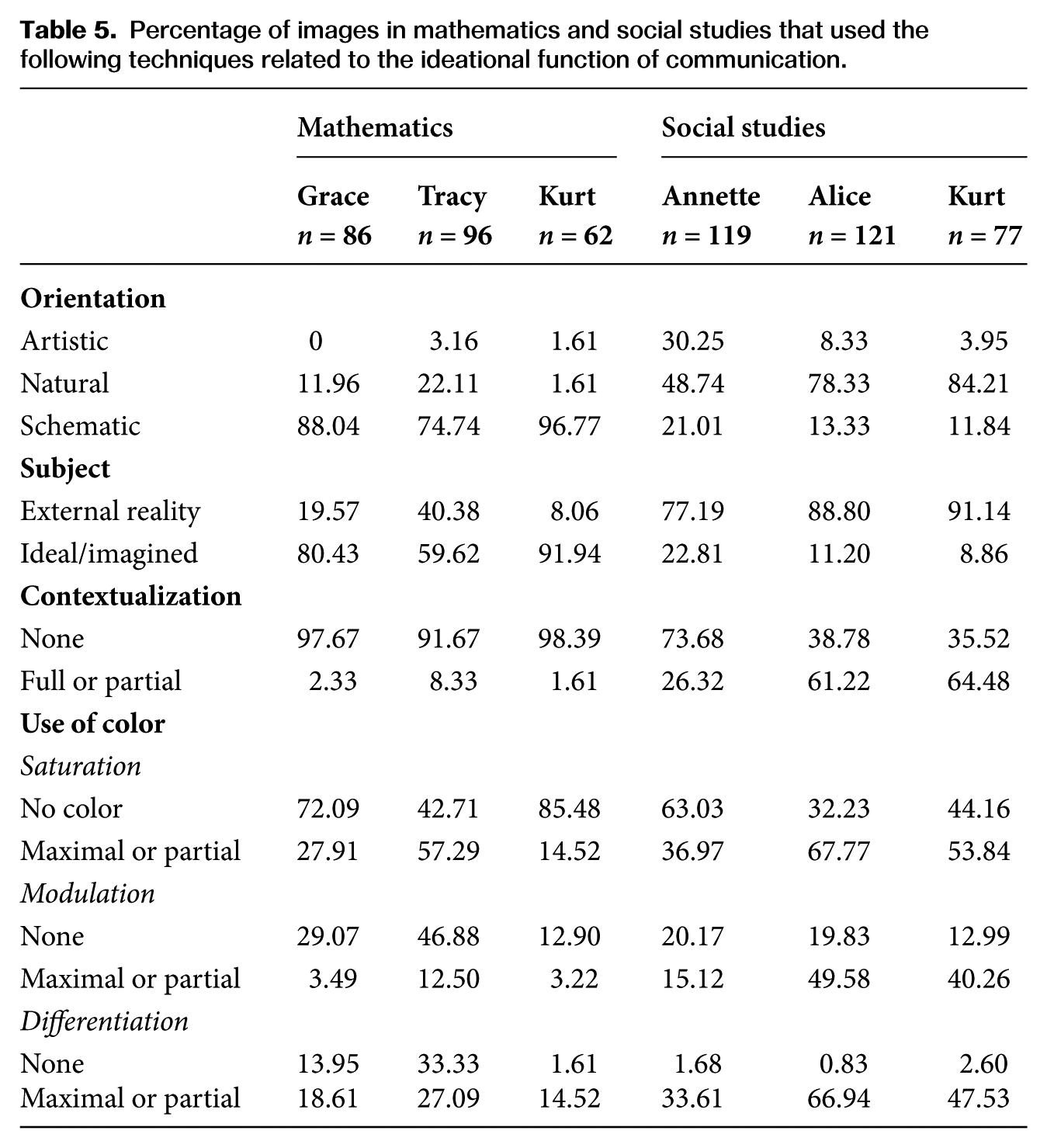
We return to our initial research question: What discipline-specific patterns were realized through images in earth science, language arts, mathematics, and social studies instruction? Tables 2–5 indicate the techniques that were used across images in each discipline. The findings from these tables are explained in greater depth in the following section, which responds to this question by describing how each discipline instantiated distinctive assumptions in regards to the interpersonal and ideational metafunctions of communication.
Percentage of images in earth science and language arts that used the following techniques related to the interpersonal function of communication.
Percentage of images in mathematics and social studies that used the following techniques related to the interpersonal function of communication.
Percentage of images in earth science and language arts that used the following techniques related to the ideational function of communication.

Percentage of images in mathematics and social studies that used the following techniques related to the ideational function of communication.
Disciplinary Images and the Interpersonal Metafunction
Our analyses highlighted discipline-specific patterns in the presumed social positions realized via disciplinary images. The following section highlights disciplinary differences among images in terms of their interpersonal metafunction.
Mathematics
As a whole, mathematical images instantiated disciplinary content as being removed from human presence and activity. Of all disciplines, images in mathematics were least likely to feature people: only 3.05% (n = 244) of total images in mathematics featured a person, most of whom were the subjects of word problems posing for photographs. No images depicted middle-school students or professional mathematicians engaged in mathematical activity, such as collecting data or drawing graphs. We argue that this lack of images with people realized mathematics as a discipline wherein human activity was not overtly acknowledged. Instead, mathematical products (e.g. formulae, definitions) were presented without concurrent representations of people constructing those products.
Of all of the disciplines, images in mathematics also exhibited the least variation in terms of the physical stance that the maker of the image assumed in relation to the subject of the image. A majority of subjects (82.01%) were framed at a close social distance, in which the viewer could see the entire form of the depicted subject (e.g. Figure 2). Moreover, these subjects were typically positioned directly in front of the viewer (98.26%) at his or her eye level (90.53%). As these percentages suggest, mathematical subjects tended to be depicted from a uniform angle and distance. We interpreted this preponderance of direct frontal viewing from a close social distance to indicate the ‘objective eye’ through which mathematical content was viewed. That is, little attention was drawn to the vantage point of the viewer by changing his or her stance (closer or farther away, looking at the object diagonally or ‘straight on’) in relation to the subject(s).
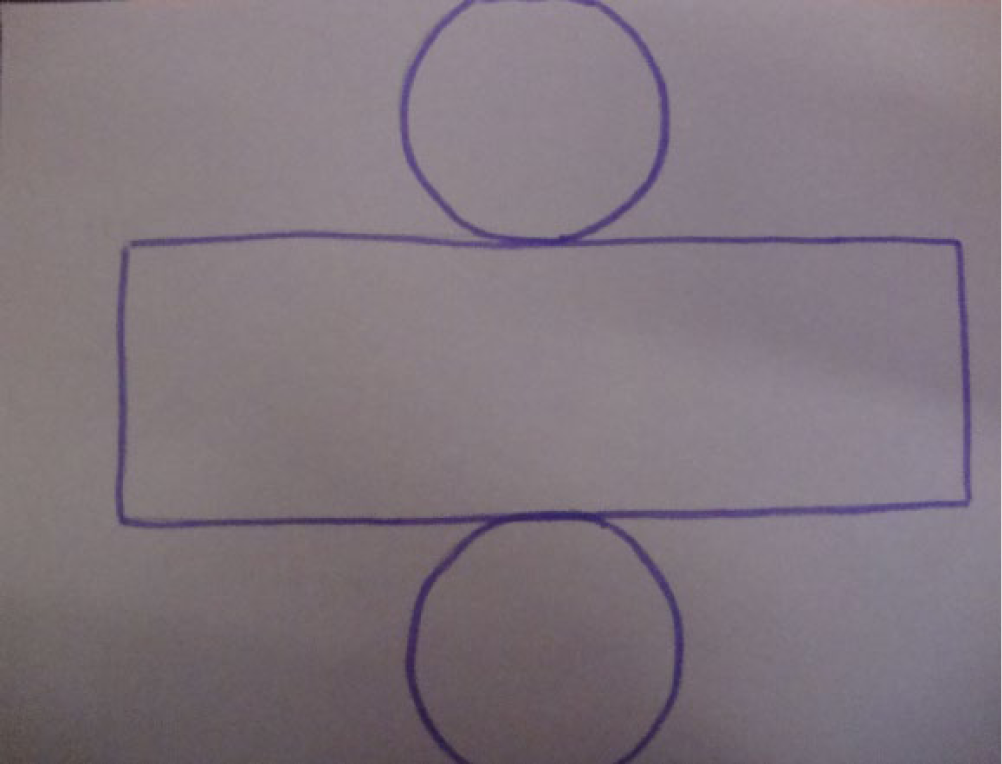
This net of a cylinder is positioned at a close social distance to the viewer at a direct frontal angle.
Language arts
In contrast to images in mathematics, over half of the images in language arts (61.86%; n = 222) featured people. These people were often engaged in disciplinary activity, including images of adolescents as they were reading and writing. Images in this discipline also included photographs of famous authors with their biographical information beneath or beside them. We argue that this depiction of ‘disciplinary practitioners’ – such as professional authors – instantiated language arts as a discipline whose content was explicitly acknowledged as the product of human activity. In addition to featuring readers and writers, images in language arts also commonly depicted culturally diverse characters from literary texts. In this sense, images also indicated that human life and activity (as described by authors) were appropriate objects of study as well.
As compared to images in other disciplines, images in language arts established the least social distance between viewers and the subjects of the images. Over one in five images in language arts were framed at an intimate distance, or the distance at which one would see only the head and shoulders of one person. Greuze’s painting Cupid (Athenaeum, 2012) is an example of a figure framed from this distance. This detailed depiction of a single subject accompanied a retelling of a Greek myth that elaborated on the actions, words, and motivations of the character with the same name. As in this example, most images (81.53%) in language arts portrayed single subjects from relatively close distances (close social, personal, or intimate). This portrayal was consonant with accompanying literary texts’ elaborated descriptions of individual protagonists or characters. The detail of the images – analogous to the detail within written texts – provided students with more nuanced, detailed views of the characters than would have been visible from more distant frames.
Social studies
Numerous images in social studies likewise (43.52%; n = 317) featured people, although not to the same extent as in the discipline of language arts. Annette and Alice, who both taught social studies and language arts, frequently included photographs of authors as they taught language arts, but they rarely showed photographs of historians, geographers, or other disciplinary practitioners as they taught social studies. Across the whole data set, only one exception to this generalization was noted: when Annette and Alice were teaching about various economic systems, they each used a cartoon economist who explained economic principles through speech bubbles. We interpreted this finding to mean that, on the whole, images realized social studies as a discipline wherein human activity was an appropriate object of study, but the methods by which one came to know human activity were not made visible to students. Unlike in language arts, wherein close framing at times encouraged students to feel close to literary authors, close framing in social studies did not encourage students to connect with historians in the same way.
Although images in social studies rarely depicted people engaged in constructing or explaining social studies concepts, they regularly represented historical and contemporary figures. As in language arts, the subjects of these images in social studies (16.42%) were at times framed at an intimate distance, instantiating the content of these images as being physically very close to the viewer. According to the tenets of Kress and Van Leeuwen’s grammar of images, this close distance realized a relatively intimate social relationship between students and the social studies content they viewed. Unlike language arts, however, the discipline of social studies was equally likely to include images whose subjects were positioned several miles away from the viewer (17.14%).
As one example, Alice created a PowerPoint presentation where the first slide depicted a city covered in smog, photographed from miles away, whereas the second slide showed a statue of an angel – framed from the waist up – whose face and torso were marked with gaping holes and gashes where acid rain had worn it away. Whereas the first set of images depicted the large-scale impacts of pollutants on the air quality of an entire city, the second set of images represented a closer view of how the pollution affected an individual object within that city. These images, which we categorized as distant and personal framing, respectively, in effect represented a relatively large- and small-scale view of the same phenomenon.
This example, as well as the variation in frames across the discipline as a whole, suggests that the images in social studies required students to view content from afar while also providing them with more personal views of that content. We interpreted this finding to indicate that social studies encouraged students to intimately connect with individual historical or contemporary subjects, while at the same time taking a more detached stance toward particular events or phenomena as they analyzed their macro-level impacts. In other words, because images in social studies exhibited the most evenly-distributed variation among closer and more distant frames as compared to other disciplines, we assert that multiple interpersonal stances toward content (personally-involved empathetic stances and more removed macro-level stances) were legitimized in this discipline.
Earth science
As in mathematics, images in earth science rarely featured disciplinary practitioners or adolescents. Only 4.67 percent of total images in earth science (n = 349) featured humans. In this sense, images in earth science did not overtly instantiate disciplinary concepts as being the product of human activity, generated by scientists as they conducted experiments or discussed concepts with colleagues. Rare images of people included photographs that illustrated how natural disasters could affect human life, such as when Nancy Rae’s students viewed a photograph of a man surveying the damage that a tornado had caused to his home. This finding suggests that, as in mathematics, this discipline was largely realized as occurring objectively, apart from the influence of human action and interpretation.
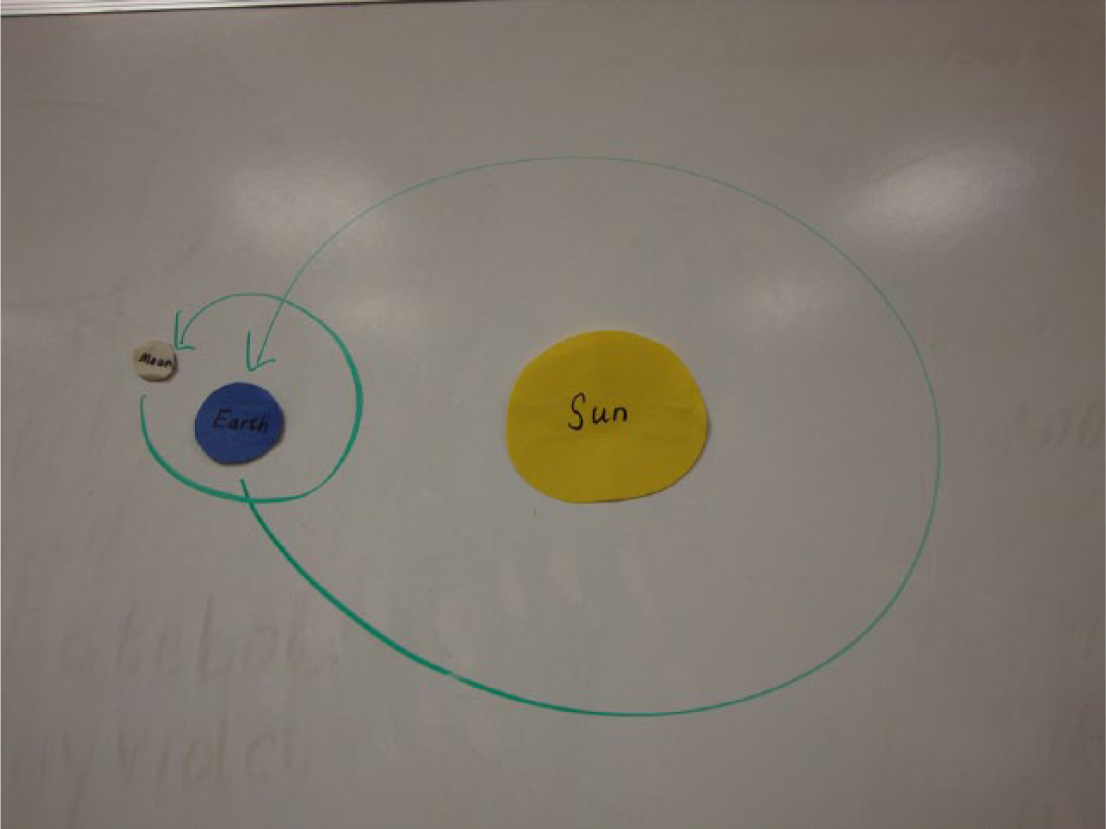
Of images in all the studied disciplines, images in earth science established the most social distance between subjects and viewers, with over one in three images in earth science depicting subjects located more than several miles away from the viewer. Moreover, 52.3 percent of scientific images portrayed subjects from non-human perspectives, or vantage points that would be impossible to achieve without the aid of technology, such as the image in Figure 3 that depicts the sun and the earth from a stance in outer space. This reliance on non-human vantage points contrasted sharply with other disciplines: non-human vantage points were employed in only about 2.92 percent of images in mathematics, 6.82 percent of images in language arts, and 18.48 percent of images in social studies. This frequent use of non-human vantage points in earth science realized it as a discipline whose content was largely inaccessible from familiar locations, instead requiring methods of seeing that relied heavily on technology or on inferential reasoning. Just as Lemke (1990) has argued that scientific language realizes science as being foreign and unfamiliar to students when it does not incorporate their everyday languages, we found that scientific images, too, most commonly realized the discipline as being removed from students’ everyday visual experiences.
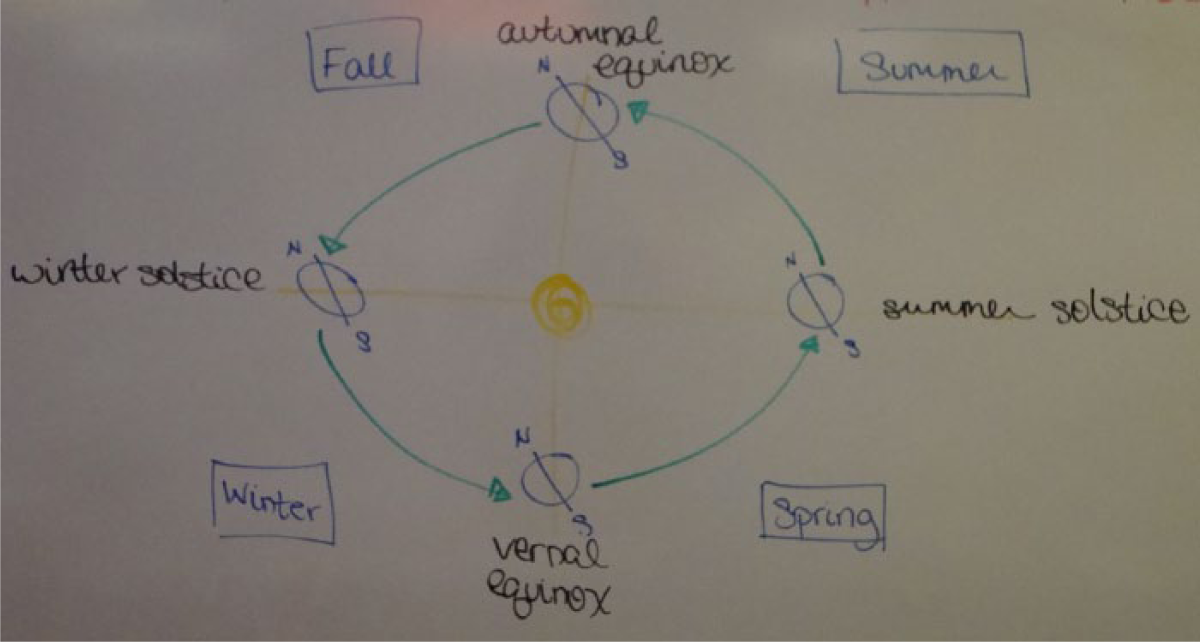
This diagram, used to explain the causes of seasons and day length, frames its content at a far distance from viewers, presumably from a vantage point that would be impossible to occupy without the aid of advanced technology.
Finally, as in all of the other disciplines, a majority of images in earth science (61.29%) featured subjects at students’ eye level. In Kress and Van Leeuwen’s terms, this level view indicates an overall social parity among the students and the viewed subjects across all disciplines. However, of all the disciplines, images in earth science were also most likely to depict the subjects of the images as physically beneath the viewer (30.67%), positioning students as looking down on them. Because previous theorists and researchers (Halliday and Martin, 1993; Haraway, 1991) have argued that science is instantiated as a discipline of power in which practitioners seek to ‘master’ or ‘tame’ nature, we inferred that this consistent use of downward angles in earth science images positioned students as having power over their objects of study.
Disciplinary Images and the Ideational Metafunction
In addition to realizing discipline-specific assumptions about social distance, the images also realized assumptions in terms of what constituted legitimate knowledge in each discipline. The following section describes how the images instantiated tendencies toward particular types of disciplinary knowledge; tendencies toward differing degrees of objectivity; and tendencies toward legitimizing particular methods of knowledge construction and expression.
Language arts
In language arts, most images realized an aesthetic rather than an instructional orientation toward knowledge, as evidenced by the preponderance of artistic images in this discipline (62.73%). These images included techniques that identified them as the overt product of human imagination and craftsmanship rather than as a purportedly objective recording of reality. For instance, Alice’s textbook included a portion of Ramirez’s (2004) painting Three Kids, in which the child to the far right was framed at an intimate distance while the other two children were cropped from the image. In this case, Ramirez used thick lines, shapes, and a limited range of highly-saturated, bold colors to ensure that his painting was not taken as a replica of visible reality, as in naturalistic images.
Instead, Ramirez’s painting was used to express a strong emotion, as corroborated by the accompanying narrative and caption. This painting accompanied ‘Eleven’ (Cisneros, 1991), a short story about a young student who is mortified when her teacher makes her wear a sweater that is not hers. In the blank space between the painting and the written description of the embarrassing scene, the textbook authors ask students to identify how the character is feeling based on the painting. This image would be classified as ‘high modality’ according to Kress and Van Leeuwen’s description of an artistic orientation, but as ‘low modality’ according to schematic and naturalistic orientations, suggesting that the basis for ‘degree of truth’ in this image would be the extent to which it powerfully communicated a feeling or perception.
Ramirez’s painting was representative of images in language arts in the sense that most images (65.78%) were not presumed to be observable in an external physical reality. That is, a variety of visual and linguistic markers indicated that the subjects of the image existed only in the imagination. Ramirez’s painting was unlike a majority of images in language arts, however, in another sense: In most other images, colors, shapes, and depth looked coherent with everyday perceptual reality, but the creators indicated that subjects were still the product of imagination through their depiction of fanciful content, such as mythical beasts, a farmer whose pets lived in his 30-meter beard, or pigs standing on their rear legs while wearing business suits.
We inferred that the English teachers’ selection of ‘artistic’ images with naturalistic coloring (e.g. Greuze’s Cupid) was analogous to literature as well: although the content of literature is not presumed to occur in an external reality, aspects of literature (e.g. human motivation, psychology, relationships, decisions) are intended to connect with the readers’ everyday human life and experience (Stephens, 2007). In the same sense, although many of the images’ referents did not exist in an external reality, their coloring often suggested that perhaps they could be ‘real’.
As these examples and the results from Table 4 suggest, if images in a discipline instantiate epistemological assumptions, then language arts was expressed as a discipline whose referents and methods of expression were acknowledged to be the products of imagination. In other words, the preponderance of images with artistic orientations foregrounded disciplinary content as a human construction in the sense that the images’ lines, coloring, and/or content acknowledged overt human influence and individual human vision in constructing each aspect of the image. This assertion is supported by the additional finding that 47.71 percent of images in language arts were ‘signed’, meaning they included the name of the artist or image-maker. This signing – a direct recognition of the presence of an artist – occurred in this discipline over four times more often than images in any other discipline, in which the producers of images were typically not named or acknowledged.
Mathematics
Images in mathematics and language arts were similar in the sense that a majority of their referents were not locatable in an external physical reality. This emphasis on ‘ideal’ or ‘imagined’ objects differed from images in social studies and earth science, whose referents were presumed to exist in the observable physical universe at a particular point in time and space (e.g. Mount Saint Helens, Josef Stalin). By contrast, the subjects of mathematical images were typically (77.33%) ideal figures or shapes, such as circles. Although instances of these shapes also existed in the physical world – for instance, a full moon – no color, background objects, or contextualizing written information indicated that the teachers intended for these images to represent any particular instance of the figure or shape. Instead, teachers used these images to represent general concepts and properties (e.g. the properties of all circles), rather to represent a tangible object that could be located in the physical world.
In other words, mathematical images represented generalized objects, a goal that was accomplished in part through decontextualization, or the absence of background objects and coloring that would set the focal figure/shape in a particular location. Most subjects in mathematics (95.91%) were set against solid (usually white) backgrounds. To be sure, the subjects of images in social studies (49.33%), language arts (54.39%), and earth science (58.95%) also commonly appeared apart from any background context. However, this decontextualization was most pronounced and consistent in mathematics, instantiating the discipline as one whose proper object of study did not exist in the visible external world.
This absence of contextualization was accompanied by an absence of color. Specifically, 66.76 percent of images in mathematics lacked color, as compared to 46.44 percent of images in social studies, 32.58 percent of images in language arts, and 25.81 percent of images in earth science. When mathematical images did include color, the color was most commonly not modulated, consisting of bright solid colors without variation in shades or tints. The color of mathematical images was rarely fully differentiated as well: only 4.51 percent of images included more than three colors. This limited use of color further realized mathematics as being dissimilar to visual perception in the everyday world.
Grace’s two-dimensional drawing of a ‘folded-out’ three-dimensional rectangular prism represents a typical example of how color was used in mathematical images (Figure 4). In this example, color served a textual function by connecting particular rectangles on the net of the rectangular prism to each other and to particular numbers in the equation. Other similar techniques included highlighting lines in congruent figures with different colors to show how one line in one figure correlated with one line in another figure; highlighting the space under one line graph in red and the space underneath a second line graph in blue to show where the spaces underneath the line graphs overlapped in purple; and so forth.

The colors on the numbers within the image of the folded-out rectangular prism correspond with the colors in the numeric/symbolic formula.
As these examples suggest, in mathematics, color often did not primarily resemble a characteristic of an external referent, such as blue signifying a water-covered earth. Instead, color tended to distinguish among mathematical objects by illustrating how they were connected to each other (e.g. rectangles with yellow numbers were the same) or how they were distinguishable from each other (e.g. rectangles with red numbers were different from rectangles with yellow numbers). In this way, images realized mathematics as a discipline wherein legitimate knowledge was constructed or expressed through relating mathematical objects to one another, rather than to an external physical world. Images further indicated that disciplinary ‘truth’ was not related to feelings or subjective perceptions (as in language arts), nor was it related to direct observations of the world (as in science and social studies), but instead, the nature and purpose of disciplinary knowledge was primarily to explain mathematical principles, as indicated by the vast preponderance of decontextualized, non-modulated, and minimally-differentiated schematic images.
Earth science
After mathematics, wherein about 85.52 percent of images were identified as schematic images, earth science was assigned the second greatest percentage of schematic codes (42.76%). However, unlike mathematics, images in earth science frequently exhibited a naturalistic orientation as well (55.73%). In practice, the three earth science teachers often paired the two types of images in their instruction. For instance, Tracy and Grace projected a photograph of a local beach on the whiteboard, while beside it they drew a diagram explaining the causes of sea and land breezes. Similarly, Nancy Rae paired photographs of rocks beside diagrams explaining the rock cycle.
This frequent pairing of schematic and naturalistic images indicated that instructional explanations and natural observations were both legitimate goals of knowledge in earth science. This approach to teaching cohered with the three teachers’ statements in their interviews, in which they each expressed that a major goal for their instruction was for students to come away with the ability to ‘study the world around them’. In accordance with this view, they most commonly chose images with naturalistic orientations, which bore perceptual coherence with ‘the world around them’, but they also paired these images with schematic images to explain how these particular visible instances worked.
Overall, the earth science images’ inclusion of modulated, differentiated, and saturated color likewise realized earth science as a discipline whose representations tended to resemble the external physical world to some extent. Unlike schematic images in mathematics, schematic images in earth science usually included colors that represented some aspect of their referents, such as Tracy’s use of blue to represent earth as the ‘water planet’ and her use of yellow to represent the color of the sun in Figure 3. The green lines in this schematic image, by contrast, represented a referent that had no color: the movement of the earth around the sun.
This example illustrates how images in earth science were both similar to and distinct from those in mathematics. Colors in earth science at times could often serve a textual function by indicating similarity and difference among other items in the image (e.g. the green lines were ‘the same’ in the sense that they all represented the revolution of the earth, but they were different from the yellow lines which represented the rays of the sun). At other times, however, colors in earth science bore some degree of resemblance to the color of the referent. We argue that this use of color indicated that ‘high modality’ or ‘truth’ in this discipline was constructed both through observations, in which color resembles its external referent, and through schematic explanations. As in mathematics, an artistic orientation toward reality was almost non-existent in earth science.
Social studies
Images in social studies bore similarities to those in earth science in the sense that naturalistic orientations were prevalent in both disciplines, more so in social studies (70.43%) than in earth science (55.73%). This orientation was indicated through the images’ representation of phenomena that existed in an external physical reality, as well as through the images’ overall tendency to use differentiation, modulation, and saturation in a manner that bore a perceptual resemblance to an external referent. For instance, photographs of stone statues displayed them in multiple, nuanced shades of grey. In this sense, then, a majority of images in social studies (70.43%) legitimized direct portrayals of ‘objective’ reality as a goal in this discipline. These naturalistic images usually depicted people, events, animals, and landscapes in photographs, realistic drawings, or physical maps.
Secondarily, schematic images (15.39%) in social studies realized explanations of underlying concepts as an ancillary legitimate disciplinary goal. Alice, for instance, displayed graphic organizers, which illustrated how raw products underwent a series of processes prior to being purchased by consumers, while Kurt displayed graphic organizers that explained the balance of powers among different branches of the American government. Lastly, a smaller percentage of artistic images (14.17%) realized social studies as a discipline wherein subjective human perception and imagination were likewise legitimate means by which knowledge was constructed and expressed. These images were usually political cartoons whose exaggerated features underscored cartoonists’ partisan perspectives on contemporary events.
As suggested by these percentages, images in social studies favored particular orientations toward knowledge while de-emphasizing others. Annette’s social studies instruction, however, was unique across the whole data set in the sense that it exhibited the most equal distribution among the three orientations to knowledge. We inferred from this finding – as well as from our previous readings on the purpose of social studies education (Levstik and Tyson, 2006) – that this discipline can legitimize descriptive, explanatory, and imaginative/emotive stances toward knowledge as authentic disciplinary practices. This finding complements the previous finding that images in social studies suggest a uniquely diverse blend of ‘ways of seeing’ by considering personal/emotional and analytical/removed stances as equally important in constructing disciplinary knowledge.
Discussion
In all, instructional images realized assumptions about social distance and the construction of legitimate knowledge in ways that were distinctive to each discipline. There are at least three benefits to identifying these discipline-specific assumptions expressed in images, as well as the methods by which image-makers instantiated those assumptions. First, their explicit identification can help students develop a metadiscursive awareness of what constitutes a quality text within each discipline, enabling them to more effectively produce texts (including images) that can be recognized as legitimate by disciplinary practitioners (Schlepegrell, 2004). Gee (2008) argued that many students fail to succeed in academic disciplines because they are unaware of the oftentimes implicit codes to which disciplinary practitioners cohere.
For instance, though a scientist may know that both naturalistic and schematic visual elements are appropriate to include in scientific explanations, novices are not necessarily aware of the same disciplinary conventions. Gee contended that explicitly articulating these norms to students – especially those who have historically failed in schools – helps them to more fully master the discourse of each discipline. Moreover, this explicit articulation may help students develop frameworks for navigating across multiple disciplines as they produce legitimate texts – such as those that include images – in each academic subject (Wilson, 2011).
Although we assert that the knowledge of communicative norms more fully enables students to be recognized as ‘legitimate’ communicators in each discipline, we do not intend to endorse the uncritical reproduction of disciplinary practices that have done a disservice to many adolescents, particularly those who have historically failed in schools. For instance, several scholars (e.g. Aikenhead and Jegede, 1999) have suggested that many students do not perform well in science and mathematics when they do not see how it relates to their everyday life experiences. They often do not feel affinity for these disciplines when teachers use academic language that is entirely disconnected from their vernaculars (Celedón-Pattichis et al., 2010; Lemke, 1990). We believe that the repeated use of images with no coherence to students’ everyday visual experiences may also contribute to this feeling of disconnection.
Conversely, some students may not want to participate in language arts because they feel it is too ‘touchy feely’ and emotion-based, contrary to their identities and beliefs (Martino, 1999). For them, the production of more schematic or naturalistic images may transform this all too ‘personal’ discipline into one that aligns more closely with their worldviews and seems more useful to them. In all, then, explicit discussions of disciplinary assumptions in images can open these assumptions for critique and reimagining as students produce ‘counter-images’ that cohere with their own identities and preferences, even if these images do not strictly cohere with the conventions of the discipline.
Finally, this study also has implications for image selection. Teachers and publishers may be more critically aware of how the interpersonal and ideational aspects of images reflect their beliefs about the nature of knowledge and social relationships. For instance, mathematics teachers can more consciously select images of students engaged in disciplinary activity situated in their local communities. Although these images have not been shown to improve students’ mathematical problem solving (Edens and Potter, 2007), they arguably communicate that mathematics is a human construction, a concept that is essential for the development of critical numeracy (Stoessiger, 2002). By being more conscious of their image selection and by legitimizing a wider variety of images in their instruction and assessment, teachers and publishers may disrupt some of the assumptions that are commonly held about the nature of knowledge in each discipline, leading to new and potentially generative ways of seeing and understanding academic content.
Footnotes
Appendix: definitions of Codes Assigned to Images
Funding
This research was supported by the National Academy of Education’s Adolescent Literacy Predoctoral Fellowship, funded by the Carnegie Corporation of New York.
Biographical Notes
AMY ALEXANDRA WILSON is an assistant professor at Utah State University. She studies literacy practices in different academic disciplines. She recently co-authored, with K Chavez, a book regarding content area literacy instruction with multiple representations: Reading and Representing across Content Areas: A Classroom Guide (Teachers College Press, 2014).
Address: Emma Eccles Jones College of Education and Human Services, School of Teacher Education and Leadership Utah State University, 2805 Old Main Hill Drive, Logan, UT 84322-2805, USA. [email:
MELANIE LANDON-HAYS is an assistant professor at Western Oregon University. She studies secondary writing instruction, disciplinary literacy, and scaffolded writing models. She recently co-authored, with AA Wilson and MD Boatright: an article in Journal of Literacy Research 2014, 46(2): 234–262: ‘Middle school teachers’ discipline-specific use of gestures and implications for disciplinary literacy instruction’, exploring how teachers use gestures differently when they teach different content areas.
Address: Division of Teacher Education, Western Oregon University, 345 N. Monmouth Ave, Monmouth, OR 97361, USA. [email: