



Abstract
This article explores the reflection, representation and psychogeographic affect of the ruins in the films by the Chinese filmmaker Jia Zhangke (b. 1970). During the Maoist period, ruins were signs of developmental progression; as Mao Zedong proclaimed, ‘there is no construction without destruction … Put destruction first, and in the process you have construction.’ The author argues that the ruins are not just the effects of China’s fast-paced modernization, but are also symbols of the destruction of Maoist society. Furthermore, by recording the state and act of destruction, these films enhance the phenomenological and affective aspects of the ruin. Finally, when construction is realized in the films (the construction from destruction), it is either threatening or ‘futuristic’; thus, both the ruin and construction estrange the previous residents from their environment by rejecting them from the places that they once lived and chronologically estrange them from the projected utopian future.
Keywords
China is being remade. Economic reforms begun by Deng Xiaoping in1978 have gathered momentum and are now at a pace and scale that has never previously been witnessed, and, as a result of this, China has become the world’s fastest growing economy. These reforms, which initiated the advent of what became known as the Reform era, were initially projected as a (final) cure to China’s endemic problems of poverty and delayed technological and economic development, but this optimistic outlook has since waned. Several films by the Chinese director Jia Zhangke (b. 1970), such as Xiao Wu (1997), Unknown Pleasures (Ren Xiaoyao, 2002), Still Life (Sanxiao Hao Ren, 2006), Dong (2006) and 24 City (Ershisi Chengji, 2008) feature ruins as the result of the nation’s economic ‘progress’, portraying this ‘economic miracle’ as more of a curse than a blessing. These ruins reflect the ongoing cycle of destruction and construction that the country has undergone during its fast-paced modernization, and are both disquieting as well as fascinating; they are striking and reoccurring motifs, not ‘romantic’ ruins but are rather zones of wreckage, and compose some of the most poignant and memorable images that remain with the viewer long after the films have ended.
In Maoist state discourse, ruins were viewed as signs of developmental progression, as old, useless and unhygienic spaces were destroyed to make room for modern, useful and hygienic ones. As Mao Zedong proclaimed: ‘there is no construction without destruction … Put destruction first, and in the process you have construction’ (Rice, 1972: 382). 1 But in Jia’s films, it is the Maoist era construction that is now being ruined for further development, and the people are not its beneficiaries but rather its victims. In this article, I explore the representation, symbolism and affect of the repeating image of the ruin in Jia’s films, and analyse how the films chart their chronological progress; from ruin threatened, to realized, and, finally, to its replacement by the surreal and the menacing. In these films, domestic and industrial structures as well as the landscape have been replaced with ‘ruinscapes’, created by the same human agents who are now being dwarfed by the magnitude of the destruction that they have wrought. The structures, ruined by hand in Dong and Still Life and then later by both man and machine in 24 City, are slowly and deliberately being made into ruins in the films, stripped of their useful parts and then demolished, thus recording not only the state of destruction but the act of destruction as well. The visual motifs of destruction position the inhabitants as survivors of some apocalypse; they are the victims as well as the perpetrators of this destruction, and are both the destroyers as well as the builders of a ‘new’ future China, but one that, like the ruin, ultimately rejects them.
In addition to representing the physical changes to geography and the urban landscape, the ruin in these films is as metaphorical and affective as it is concrete; it is not just an index of the nation’s adoption of the market economy and its accompanying drive for development, but it also serves as a symbol for shame, memory, trauma, crisis and the destruction of the Maoist state by the people themselves, and is a destruction that cannot be fixed or reversed. Furthermore, I argue the ruin not only symbolizes these meanings, but also affects them, in ways that are extra-discursive; as Steven Shaviro (1993: 25) writes: Images confront the viewer directly, without mediation. What we see is what we see; the figures that unroll before us cannot be regarded merely as arbitrary representations or conventional signs. We respond viscerally to visual forms, before having the leisure to read or interpret them as symbols.
I posit that the ruin in these films not only symbolizes the physical estrangement from the environment but also has affects that emotionally and temporally estrange them as well. Furthermore, this affect is not only found in the ruin, but in the futuristic structures that the later films represent as replacing the ruin; that is to say, when construction is finally realized in the films (the construction from the destruction), it is either ominous or intangibly positioned as being forever in the future, and a state never to be concretized in the present. Thus, both the ruins and the futuristic structures that replace them estrange people from the places where they once lived, as well as reject them from the projected future utopia that the ruins herald.
This article focuses primarily on Xiao Wu, Unknown Pleasures, Still Life, Dong and 24 City, and is divided into four parts. The first examines the motif of the ruin, arguing that it changes as the films are viewed chronologically, from ruin threatened, to realized, and to its final replacement by the sinister and surreal. In the second section, I argue that the ruin also symbolizes the destruction of the Maoist state, as well as questions the projected future once promised. Following that, I analyse the act of ruination in the films, and posit that it emphasizes the phenomenology of the ruin. I argue that this enhances its effects by referencing theories on psychogeography – the emotional connection with the environment – by positing that the ruin not only physically rejects its former inhabitants but emotionally rejects them as well. In the fourth and final section, I ponder the effects of the ruin’s replacement by intangible and futuristic structures, and how they too reject future occupation by projecting a future forever in the future, never to be occupied by those who struggle in the ruin’s present.
The Ruin in Visual Culture
The ruin has representational, emotional and temporal meaning. In the exhibition guide to the Tate’s Ruin Lust exhibition (2014), Brian Dillon (2014: 5) explains that the ruin can be a visual reminder of the inevitability of decay, a warning for the future, a symbol of melancholy, and ‘the very picture of economic hubris or industrial decline’. Paul Zuker (1961: 119–127) outlines the aesthetic history of the ruin in European art, explaining that ruins were not only used to ‘document’ the past but also to evoke emotions which still resonate in the present. This is found in the ‘bravura’ of the ruins in Mannerist and Baroque art, the ‘emotional sensitiveness’ and ‘pleasure of the ruins’ popular in Romanticism, its role as a memento mori of life’s ‘transience’, and its projection of a ‘lacrimose sentimentality’. In addition to its representational and emotional meaning, the ruin also constructs a different notion of time. Dillon explains that, in the 18th century, ‘ruin lust’ was ‘a way of thinking about – fearing and hoping for – the future’, in that it possessed multiple temporalities: … it arrives from the past, but is incomplete; it may well survive us, or slump into vacancy before our eyes; it stands as a warning for our own futures; it leaves room, among its empty vaults and vistas, for the invention of a new future; and most unsettlingly perhaps, it conjures a future past, the memory of what might have been [and thus] haunt[s] a present unsure if there will be a future, never mind what it might contain. (p. 48)
In comparison, the art historian Wu Hung explains that in Chinese art there was a ‘taboo’ surrounding the ruin’s representation, stating: ‘although abandoned cities or fallen palaces were lamented in words, their images, if painted, would imply inauspiciousness and danger’ (Wu, 1999: 80). He writes that ruins were seen as embodying the fear and chaos of returning to a state similar to that experienced during the ‘century of humiliation’ that China suffered from the mid-19th to the mid-20th centuries, an era in which the ruins caused by foreign armies symbolized a defeated China. This imagery, however, was also used for patriotic purposes. For example, he describes the ruins of the Old Summer Palace in Beijing (also known as the Yuanming Yuan), which was destroyed by British and French armies in 1860, as the ‘most important modern ruin in China’, because it was kept as a monument to China’s ‘national shame’ at the hands of Western colonial powers (1998: 60-61). He argues that such war ruins ‘shock(ed) the viewer with a sense of holocaust and total abandonment’, and thus ‘encapsulated the pain and ecstasy, labour and struggle associated with China’s rebirth’ (Wu, 2012: 133, 140).
As discussed in the introduction, the meaning of the ruin shifted during the Maoist era, and it became a symbol of socialist progression, as the old was razed to make way for the socialist new. But this representational meaning changed again during the Reform period, and it now symbolizes history, memory, trauma and social crisis, and has also become a popular motif in Chinese visual culture.
2
Yomi Braester (2007: 162) writes that Chinese films in the 1990s were marked by the filmmakers’ desires to preserve memory through documenting destruction and change, and that demolition sites were viewed ‘as timekeepers of urban history and cinema’, as well as ‘spatial repositories of personal and collective memory in effigy’. He describes these sites as ‘the scars in spatial form left by traumatic events’ that, when documented, transformed urban areas ‘into an exhibition space for personal and collective traumas’ (p. 165). Similarly, Jie Li (2009) compares the ruins in the films Spring in a Small Town (1948, directed by Fei Mu) and Still Life, writing that ruins in both films represent homelessness and a ‘crisis of values’ in regard to personal relationships (p. 87), stating … if the ruin is a site of memory and contemplation in both Chinese and Western traditions, the ruins in these films – and these films as the ruins of time – turn into enduring monuments that elegize and mock the transient follies of human strife and aspirations. (p. 119)
In Jia’s films, the ruin first appears in Xiao Wu. The film is centred on the eponymous protagonist who is a peasant from the countryside ‘working’ as a pickpocket in the small market town of Fenyang, and follows his struggles and conflicts with his friends, family and potential lovers. The ruin is heralded in the film by the Chinese character chai (拆), to destroy, which has been written on the external walls of buildings marked for destruction by the local government. This character is composed of a hand radical (扌) and the symbol chi (斥), meaning ‘to accuse’ or ‘to scold’ – a mark of judgment. In contemporary China, this character has become a ubiquitous symbol in the urban landscape, a mark indicating future destruction and unstoppable change. This symbol, which marks the buildings that are to be razed, is inscribed not by the residents but by those with the power and authority to decide which structures and areas are to be destroyed, thus sealing both the building’s doom and the residents’ future eviction. In ‘Tear Down the City’ (2007), Sheldon Lu describes chai as ‘the theme of much of contemporary Chinese visual culture’, which shows not only physical demolition but also ‘the symbolic and psychological destruction of the social fabric of families and neighborhoods’ (pp. 137–138). He writes that arts based on the theme of ruin ‘document the loss of the familiar, the natural, the personal, and the material; they evoke the feelings of living in an opaque, mediated, dematerialized world, and convey the anxieties of being dislocated from tradition, roots, and home’ (pp. 149–150). He examines the phrase chai na (拆拿), to ‘pull down’, playing off its English homonym ‘China’, writing: ‘Chai-na (literally, the act of “tearing down”) is truly the proper name for contemporary “China,” as all Chinese cities have witnessed the destruction of old buildings and the construction of new structures’ (p. 137). In Xiao Wu, however, the benefits of economic reform and promised ‘modernity’ are never realized, just the destruction. For example, a small shopkeeper in the film faces eviction and the impending destruction of his business, and during the hurried move before his shop’s demolition, one of the movers voices the idiom ‘If the old stuff doesn’t go, there’ll be no new stuff’ (旧的不去, 新的不来). The shopkeeper, however, quickly retorts ‘The old stuff is being torn down but I see nothing new’ (旧的是拆了, 新的在哪儿呢). Unlike the Maoist promise of construction arising from destruction, the chai in this film remains suspended – destruction without construction – an image that parallels Xiao Wu’s personal ‘destruction’ as his relationships are ruined and he is finally arrested for theft at the film’s conclusion.
Created five years later, the environment of the film Unknown Pleasures (2002) is imaged as an urban wasteland in ruin. Although it is set in the city of Datong in Shanxi province, it deliberately ignores the cultural aspects of the city, as Datong is home to the Yungang Grottoes, one of the four major Buddhist cave complexes in China and a UNESCO World Heritage site. Rather, Jia has described the place as existing ‘in a state of desolation … truly a city in ruins and the people who inhabit the city very much live in a spiritual world that reflects their environment’ (Berry, 2009: 138). In the film, economic reforms have only been partially realized – new buildings remain unfinished, as does a highway, which ends mid-destination – but the promise of reform never completely materializes and slowly grows stale. The narrative revolves around three main characters whose lives are as ruined as the landscape: Bin Bin and Xiao Ji are two unemployed and disaffected youths who aimlessly wander the city, and Qiao Qiao is a dancer/sex worker who is ‘stuck’ in the city as well as in an abusive relationship with her boyfriend/pimp, a local gang leader. In one scene, Bin Bin and Xiao Ji ride a motorcycle through the factory worker’s housing development but the area is completely empty, and what should be home to hundreds is imaged as a ghost town, now seemingly dead and abandoned. This scene introduces another character – xiu (修), to fix, a word that resonates with chai. Like this earlier character, xiu is also painted on the walls, but these are signs offering to repair such items as watches (修表, xiu biao) and household electrical appliances (修家电, xiu jia dian), and are therefore advertisements to attract a customer who does not appear to exist (Figure 1). One pole just has xiu written on it, a verb with no object, a cry to repair something, anything, broken – but what can be fixed when everything and everyone is portrayed as broken and crumbling? With this mark of xiu, the landscape and its inhabitants have been branded for repair, but this repair is never realized. Like the chai in Xiao Wu, the state’s modernization campaign, in its cycle of destruction and construction, is imaged as incomplete, stuck in this phase of destruction – or, to reverse Mao’s earlier quote, destruction without construction.
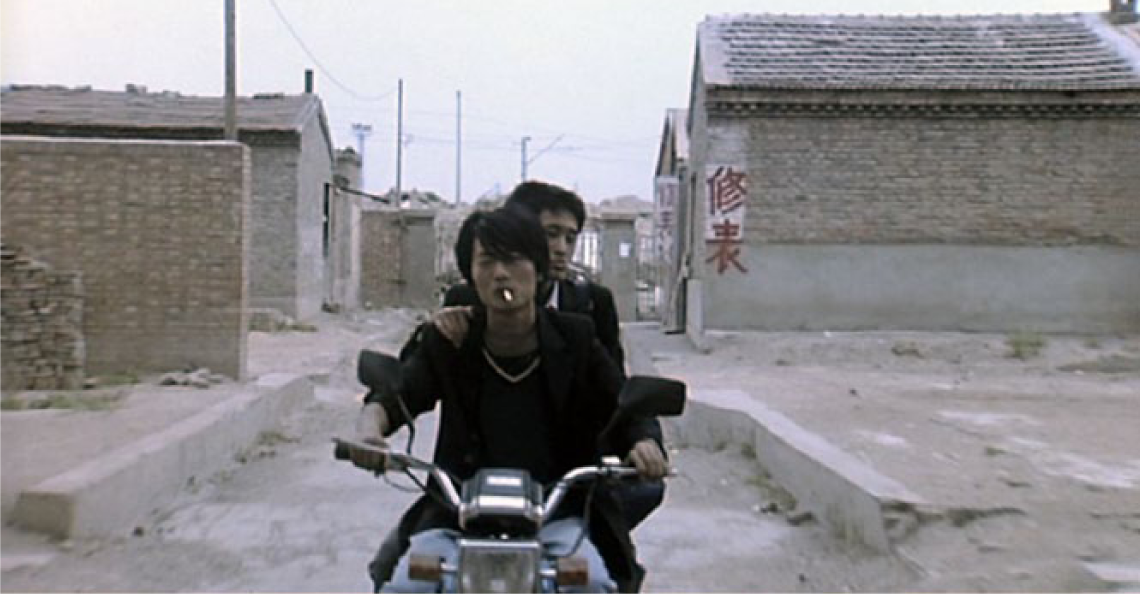
Xiu in Unknown Pleasures. Courtesy of Jia Zhangke and the Zhongguo Yinyuejia Yinxiang Chubanshe.
In the films that follow, Still Life and Dong, the threat of chai is again realized. Still Life is centred on two main protagonists and their searches for their missing spouses, while Dong is a documentary about the Chinese artist Liu Xiaodong (b. 1963). These films are both set in southern China’s Fengjie county and feature a landscape depicted in ruins, in which buildings are being dismantled in preparation for the Three Gorges Dam. Both movies offer breathtaking views of the Three Gorges, a landscape that has been praised in literature and art for centuries, but these scenic landscapes are juxtaposed with scenes of the area’s manual demolition and ruin, as walls are torn down and people are relocated in anticipation of the dam’s flooding. Regarding the imagery of the ruin in the film, Shelly Kraicer (2007) argues that: It is precisely the spectacular ugliness of the physical devastation of the urban environment around the Three Gorges that captures the camera’s gaze: an anti-still life that monumentalizes destruction, giving it an awful, sublime grandeur normally reserved for scenes of natural beauty.
In these films, destruction is proceeding full-throttle – chai is completely manifest and continues to expand exponentially, claiming the landscape and its residents, and has become a terrifying sublime.
As mentioned earlier, the mark of chai is inscribed by those civic authorities who have the power to decide what can be destroyed. This authority cannot be challenged – it is complete and unquestioning. In Still Life, the migrant worker’s humble hostel, the grandiloquently (and incongruously) named ‘Tang Dynasty Pavilion Guesthouse’ (唐人阁客栈), is branded with chai, announcing its impending destruction. When the agent sent to mark the buildings for demolition is caught in the act, the hostel owner angrily declares that his hostel cannot be razed, and makes allusions to being politically connected. His guesthouse, however, is still destroyed, ruined like the rest of the neighbourhood in the name of progress. This juxtaposition between the imagined elegance of an earlier age and the ruins brought from the modernization drive is echoed later in the film, as archaeologists work quickly to excavate a Han dynasty tomb site before the rising waters submerge it, saving even the hidden from the ruins that modernization brings, a scene that is followed by another featuring migrant workers breaking apart concrete buildings in anticipation of the area flooding. Thus, as the archaeologists unearth and record history before it is lost and reburied for a final time, the migrant workers are just as quickly destroying what remains, before it is ultimately obliterated and submerged by the Yangtze River and forever hidden from view.
Finally, 24 City is centred on the destruction and ruination of ‘Factory 420’, a military airplane engine manufacturing facility located in Chengdu, Sichuan province, and is structured around real and fictional interviews with former workers and their family members. A State Owned Enterprise (SOE) founded during the Maoist era, it was once one of China’s great state-led projects and a symbol of the country’s success during a period of mobilizing the people to build the nation. In the film, however, this symbol is in the process of being disassembled and destroyed, a metaphor of the glory of the Maoist state now reduced to ruin. In the film’s opening scene, workers in uniform congregate in the factory’s assembly hall for the transfer of land ceremony to the property developer. During the ceremony, the workers sing the patriotic anthem ‘Singing for our Nation’, which includes the lyrics: ‘The five star red flag flutters in the wind. How glorious our song of victory! Sing for our beloved motherland as she prospers and grows strong!’ Although the film begins with this song, its juxtaposition with the scenes of ruin that follow questions the alleged progress of the economic reforms that have been initiated by the state, as the factory is disassembled and its workers and residents dispersed. This message is later enforced in one of the final scenes when a slow pan records a group of retired factory workers singing the Communist hymn ‘The Internationale’. The scene fades to a long take of the factory and, as the workers sing the lyrics ‘arise ye toilers of the earth’, the building collapses, and a cloud of concrete dust slowly rises and drifts towards the camera, visually obliterating all in its wake (Figures 2 and 3). The factory is gone, reduced to rubble.
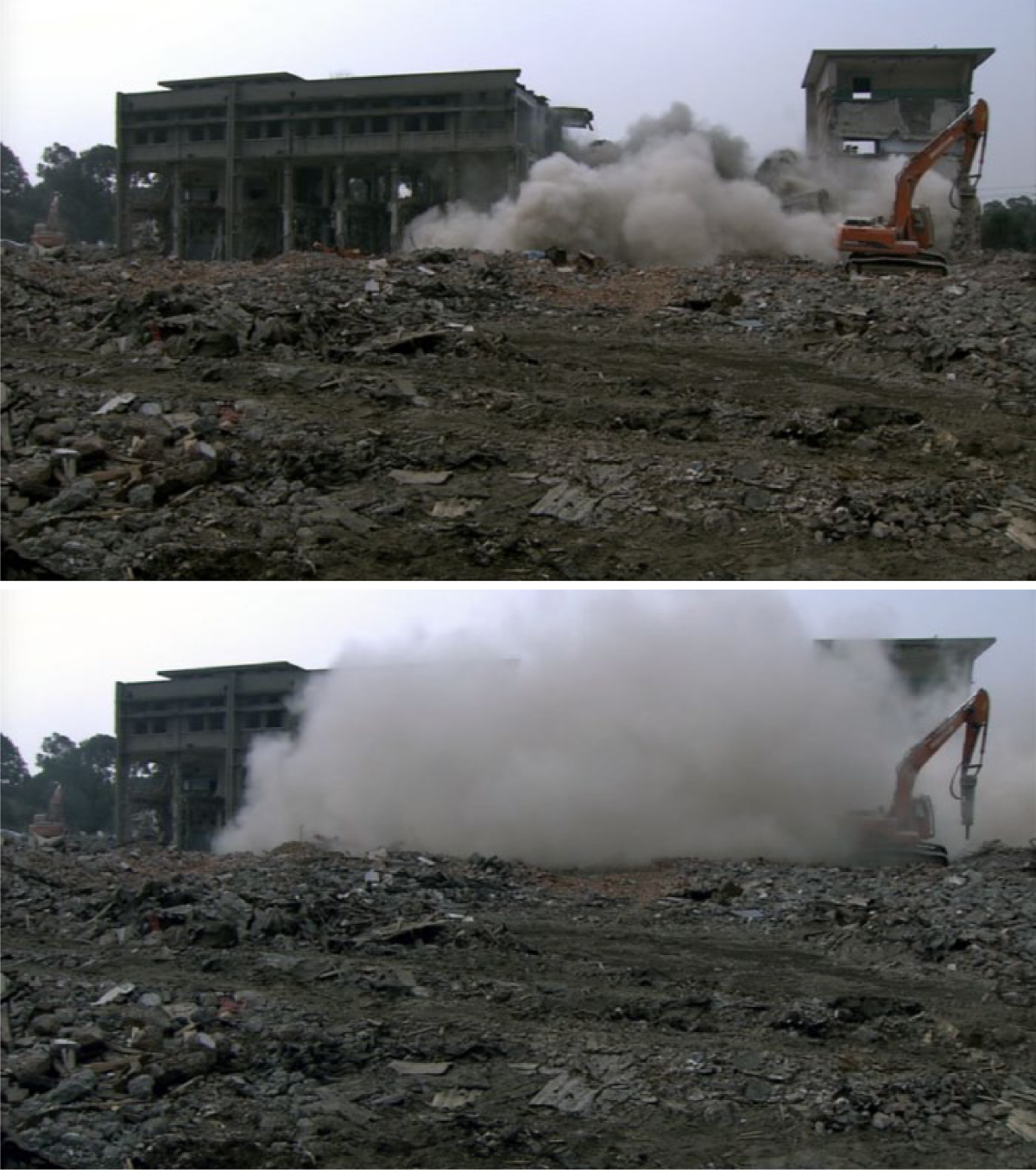
A factory building collapsing in 24 City. Courtesy of Jia Zhangke and CN Entertainment Ltd.
Destruction of Maoist Construction
Similar to the dismantled factory in 24 City, the ruin in Jia’s other films is functioning as a metaphor for the destruction of the Maoist construction during the period of economic reform. As the nation transitions from the socialist command economy to the postsocialist introduction of the market economy, society is also in transition in these films, and is in the process of being dismantled at the same time that it is being recreated into a different form. For instance, a character in Unknown Pleasures is a state factory worker who is later made redundant; Still Life features rootless peasant/migrant workers who are constantly on the move searching for employment prospects; and 24 City examines past generations of the Chinese worker class, the Maoist urban proletariat who have become disenfranchized in the Reform era. Many of the structures being ruined in these films are factories and employee housing that were constructed during the Maoist period of nation-building that was undertaken after the Communist Revolution in 1949. Not only were they once functional buildings, they also have deeper symbolic meaning and represent the earlier Maoist ideology; for instance, Still Life and 24 City feature the demolition of the aforementioned SOE factories, and Unknown Pleasures depicts the housing built for the urban proletariat workers as being run-down and in decay. Regarding these industrial ruins, Wu (2012: 241) posits that: Confronting such images, a contemporary Chinese viewer inevitably reflects on questions concerning the legacy of the Chinese revolution: not long ago, these factories constituted the foundation of the socialist economy and were considered symbols of a bright, Communist future, but now they are lifeless and on the verge of disintegration.
The scenes of destruction contrast with propaganda posters of the Maoist era, which often glorified industrialization and modernization (as represented by active smoke stacks, booming construction and powerful machinery) that were sometimes the focus of the posters and other times in the background. For instance, in the first poster (Figure 4), titled ‘Turn China into a Prosperous, Rich and Powerful Industrialized Socialist Country under the Leadership of the Communist Party and Chairman Mao!’ (1954), Mao waves from the centre frame. In the background, industrial development is progressing full throttle, as evidenced by the exhaust billowing from the smokestacks, the cranes constructing the dam, and a locomotive speeding forth, while the foreground displays the products of agriculture labour. In the second image (Figure 5), ‘Becoming More Prosperous Everyday’ (1972), the figures in the lower right are dwarfed by the factory that is being assembled. Enormous construction machinery and cranes are manoeuvring a gigantic silo into place, while the workmen look on in rapture. These industrial structures are the concretization of the Maoist dream – the construction from the destruction. But the ruins in Jia’s films are not the ruins that Mao proffered would herald the nation’s development; rather, they are the ruins of that development. Thus, chai, the symbol meant to invoke modernization and the benefits of the new economy, now also indicates the destruction of the Maoist construction, and xiu the inability to heal this rift.
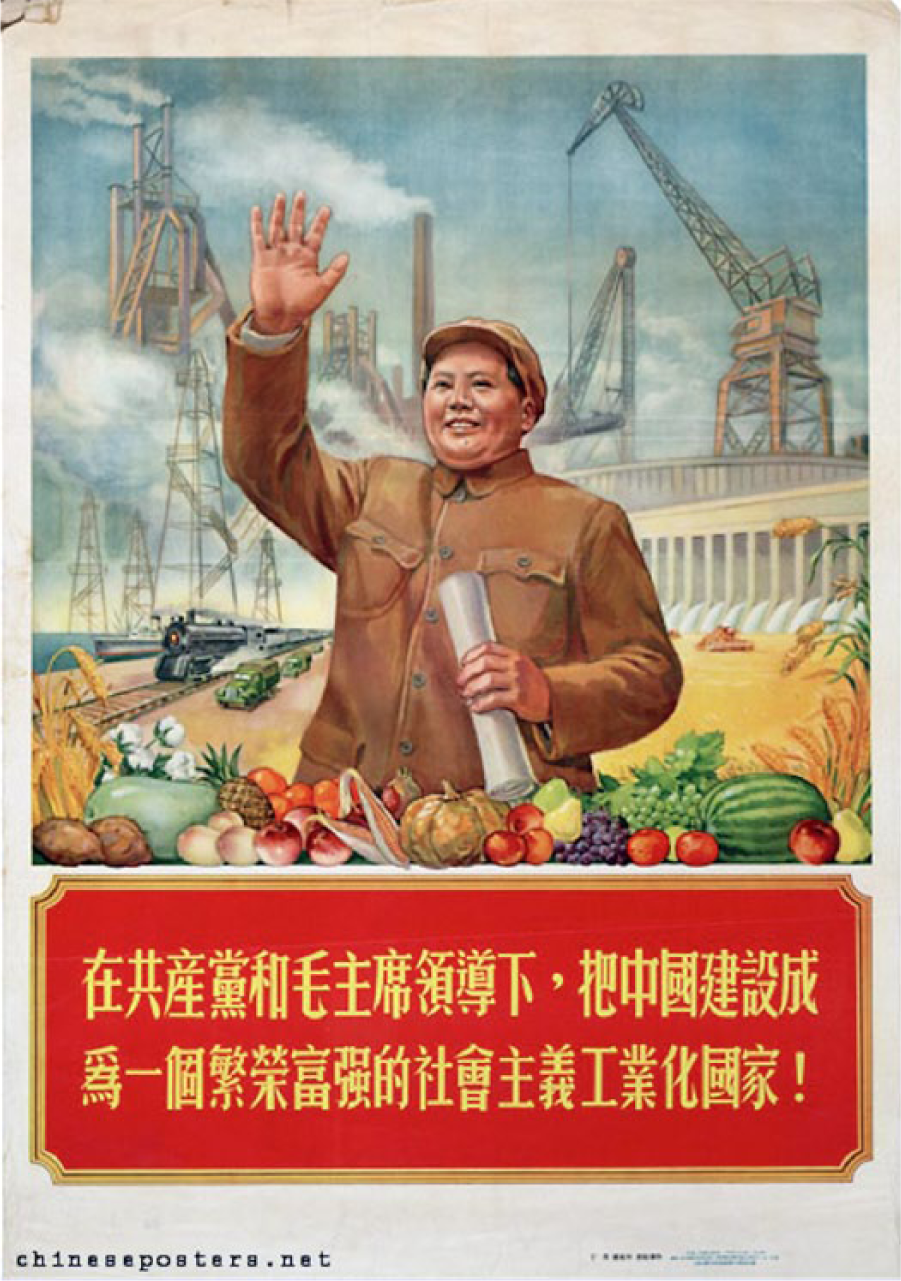
Turn China into a Prosperous, Rich and Powerful Industrialized Socialist Country under the Leadership of the Communist Party and Chairman Mao! (1954). Courtesy of the Stefan R Landsberger Collection.
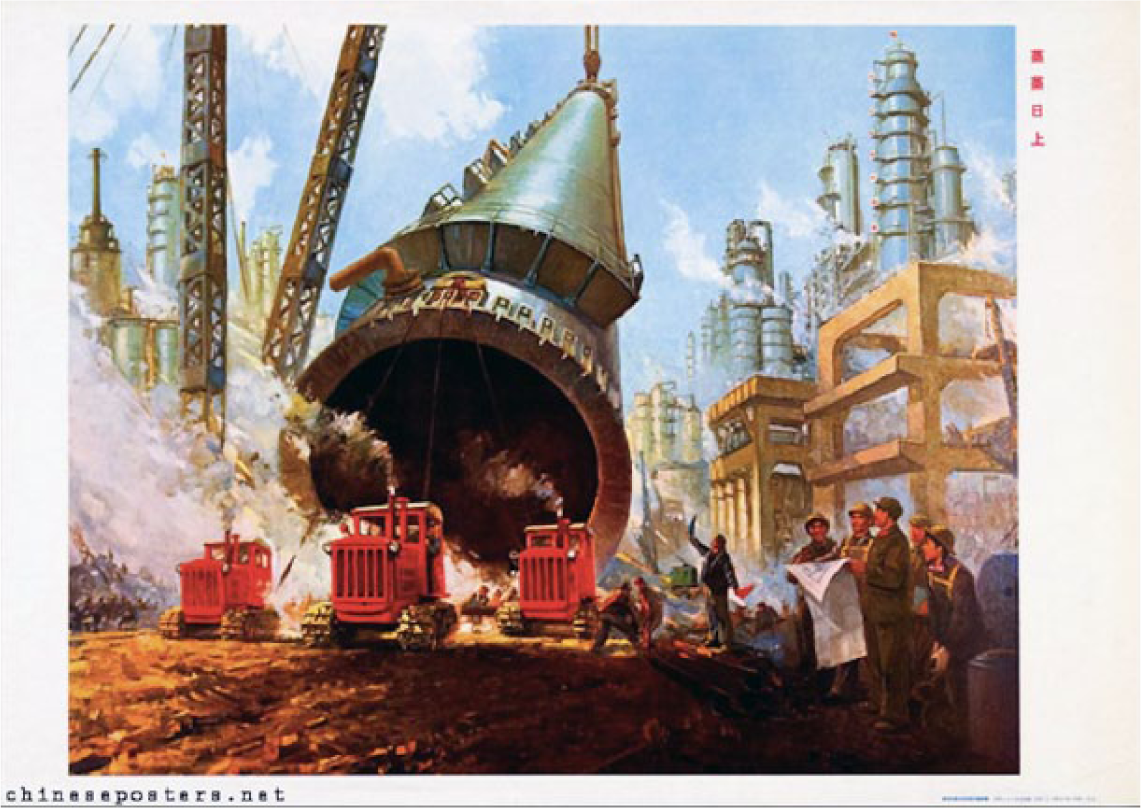
Becoming More Prosperous Every Day (1972). Courtesy of the Stefan R. Landsberger Collection.
Hongbing Zhang (2009: 143) sees the ruins in Still Life as the destruction of a community, describing them as the ‘leftovers of a local place and a local mode of daily life’, which are being destroyed so that the dam can power the country’s economy. He argues that the focus on residential ruins in particular is ‘an ideological as well as an aesthetic preoccupation of the film with home, family, and post-socialist individuals whose lives are now reduced to their ruinous minimum in the age of globalization’, and that by placing the people in the ruin in the film, ‘the major characters look particularly weak, small, inconsequential, and insignificant, dwarfed by these enlarged mise-en-scènes and struggling futilely under their weight’ (pp. 143, 131). Not only are communities being destroyed and the characters overwhelmed by the ruin, but the principal human subjects in Jia’s pre-2008 films were largely composed of workers and peasants, the two groups that comprised the Maoist era’s leading classes as the urban and rural proletariat. Unlike the workers in the propaganda poster, however, these figures have now become indigent during the Reform era. The juxtaposition of Jia’s wretched figures with those in the propaganda posters therefore communicates the underlying concept that China’s economic reforms are destroying the very society that they were meant to improve, thus countering the teleological discourse of the nation’s positive economic trajectory and modernization path. Instead of improving the nation, these changes have damaged the people and their environments, and have violently restructured society, creating an ‘army’ of peasant migrant worker at the same time that they have deposed the former leading worker class.
This dispossession has not only affected these people physically but also ideologically; for instance, in 24 City the workers have become dispossessed not only from both their factory and the factory-provided housing that is being literally destroyed as the film progresses, but also from their symbolic place in society as well. In the book written about the interviews conducted about the film, titled A Collective Memory of Chinese Working Class (2009), 3 Jia Zhangke (2009: 1) writes that the workers’ technical skills made them members of that time’s ‘leading social class’, and that this social standing, coupled with the factory’s material bonuses gave them an ‘inner pride in their social class’. 4 The factory’s closure therefore caused the former ‘leaders’ to lose their social status and become marginalized, working odd jobs to support themselves, a demotion that many were unable to come to terms with (p. 2). 5
Earlier, I wrote that Wu described the ruins of the Old Summer Palace as a monument to ‘national shame’. In this light, we can also consider how the ruins in these films also symbolize another type of shame – that of the state’s shame towards its treatment of the proletariat in the Reform Era. Most of the people portrayed in these films are not the beneficiaries of market reforms; rather, they have been alienated from the products that these reforms have created, and have also been dispossessed from the places that they once occupied. For instance, migrant workers in Still Life labour at dismantling buildings by hand in anticipation of the flooding caused by the construction of the Three Gorges Dam, while other migrants dismantle the factory and its housing in 24 City in preparation for the area’s gentrification into a luxury housing complex and shopping centre. These people are therefore constructing a ‘new’ China, but not one that they can inhabit; instead, they are rootless and will move on after their job is done, in search of other employment prospects in strange lands. They are a restless population that is not associated with the concept of a traditional Chinese rooted people, whose connections to place go back centuries. In this way, the dream projected in the Maoist period has finally come to fruition, but not as a utopia; rather, it is a dystopia, responsible for more destruction than construction, and a promise that has concretized as a nightmare.
Affect and Act of Ruination
In visual culture, the ruin has been used to represent a range of ideas and emotions – from history, memory, social crisis, and the destruction of the powerless by the powerful, to trauma, anxiety, fear, chaos, shame and the frightening sublime. Now I would like to consider how, in addition to the indexical and symbolic properties of the ruin, they also have effects, which are heightened by the camera’s phenomenological exploration of the ruin and its recording of the act of ruination. For example, in Still Life, workers are dismantling a bankrupt factory, and numerous close-ups linger on discarded tools and the metal structures that drip rusty water, like blood (Figure 6). This symbol of the Maoist state and once collective body is now imaged as an animal being butchered, bleeding pools of rust as it is slowly being slaughtered, and the viewer is positioned as witness to this visceral act. This positioning connects with Wu’s (2012) analysis of two perspectives to the ruined city; in the first, it is ‘an externalized aesthetic object for contemplation and longing’ that ‘evokes lamentation’, but in the second, ‘the viewer stays inside the city and constantly experiences its decay’, and remains ‘part of the ruined city’ (p. 211). The medium of film adds to this perspective in that it not only positions the viewer in the ruins, but moves through them. Such an example is found in 24 City, when the camera follows a security guard as he patrols the decaying factory that is soon to be demolished. As he walks past walls with peeling paint and broken windows, the scene’s soundtrack fades away and all we hear is the sound of his movement, including the crunch of debris and the splintering of glass underfoot as he walks through the decaying structure, affecting a feeling that Edensor (2005: 837) describes as the ‘sensual experience of moving inside a ruin’. This scene is followed by long takes of the factory being demolished by machines, images of destruction that are twinned with the sounds of drilling and hammering, emphasizing not only the ruin but its sensory experience.
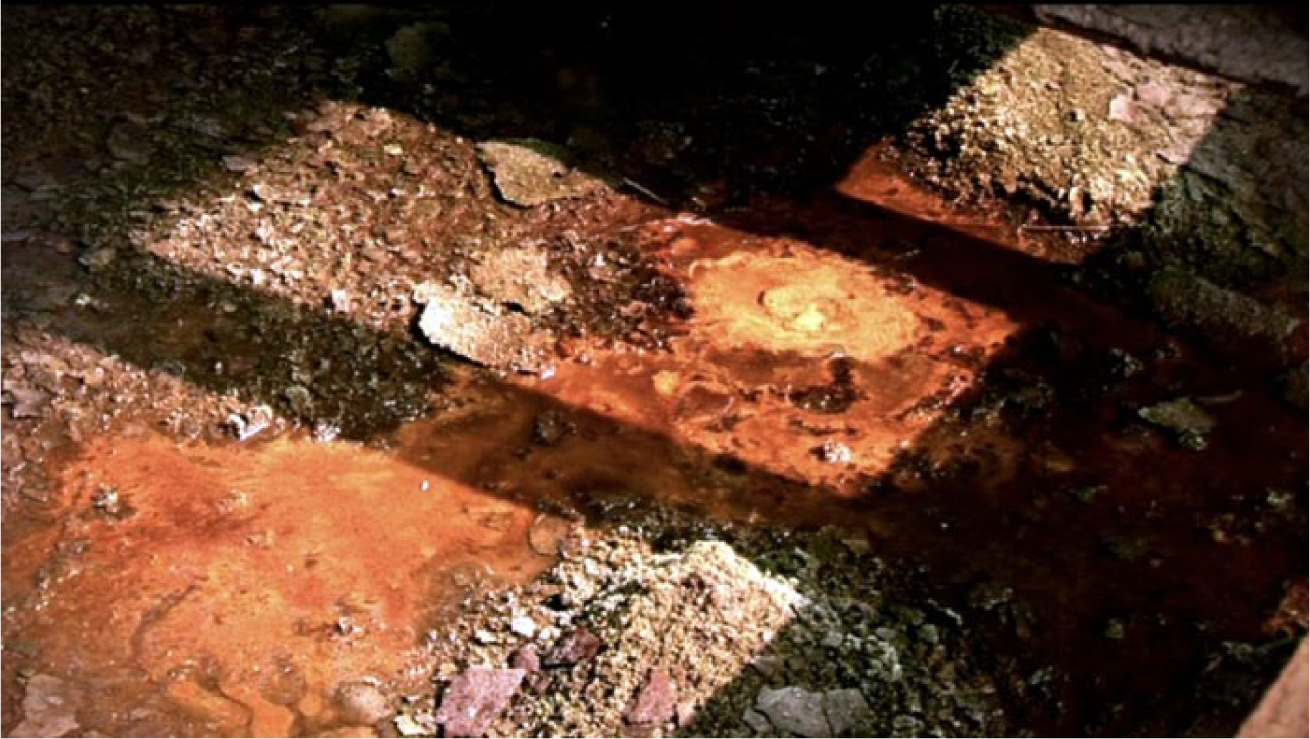
Rust in Still Life. Courtesy of Jia Zhangke and the Zhongguo Luyin Luxiang Chuban Zongshe.
In addition to exploring the ruin and recording the act of ruination by these human agents, the ruin is also a state of process. Similar to how society in these films is transitioning from a Maoist model to one dictated by the market economy, so too is the ruin. The ruin in Dong, Still Life and 24 City is not only a state of wreckage but is also a place of transition; it is a construct that is being literally de
Wu (1999: 112) writes about the emotional and psychological affects of the ruin, positing that the demolition of old areas, originally meant to signify modernization, actually alienated the residents from their city to the extent that ‘they no longer belonged to one another’. This notion of estrangement from the environment connects with the concept of ‘psychogeography’, defined by Guy Debord (2008[1955]: 23) as ‘the study of the precise laws and specific effects of the geographical environment, whether consciously organized or not, on the emotions and behavior of individuals’. The psychogeographic and affective power of the ruin and the emotional alienation from place that the ruin brings is poignantly expressed in Still Life when one of the protagonists hires a motorcycle taxi to take him to his estranged wife’s last known address. The driver takes him to where the dwelling once was, but it has now been completely submerged by the rising waters. When the passenger complains, the driver retorts that he has not cheated him – that is where the address emotionally still ‘is’, and tells the protagonist that his own home was located below where a boat is now moored, which he points to in the distance. Although the driver has been physically estranged from his home, he still remembers his personal geography of the place, a sense that continues to linger even after the building and the site have been destroyed.
This estrangement is a state that is as emotional as it is concrete. Glenn Albrecht (2005: 48) writes of ‘solastalgia’, a term he coined from ‘solace’ and ‘nostalgia’ to describe ‘the pain or sickness caused by the loss or lack of solace and the sense of isolation connected to the present state of one’s home or territory’. He elaborates further on this ‘pain’, writing that it is ‘an attack on one’s sense of place, in the erosion of the sense of belonging (identity) to a particular place and a feeling of distress (psychological desolation) about its transformation’. In this scene, the area has been flooded, and transformed from earth into water; thus, the ex-residents do not even have the capability of returning to the places where their homes once were, as even the earth that once supported the obliterated structures has disappeared and has been made permanently inaccessible. The viewer witnesses this complete and utter devastation, which has not even left a ruin to mourn what once was. The emotional connection to the space, however, still remains with the motorcycle taxi driver, even after the geographic area and its structures have been obliterated.
Earlier I wrote about the traditional concept of a ‘rooted’ people with deep ancestral ties to place. Now, I would like to consider how this annihilation of home and its emotional affects is also explored in the recorded destruction of home. In another scene in the film, people clothed in HAZMAT suits walk slowly through the site spraying the wreckage while other men work shirtless besides them, exposed to whatever chemicals are in the spray. The camera explores the decorations on the once-private internal walls of domestic spaces, voyeuristically presenting them to the viewer. These are places that have lost their outer shells and have now turned outwards, exposing these hidden, intimate spaces. Certificates, posters, calendars and photographs still cling to the walls; for example, the camera pans past the remains of a scroll hanging on a wall left standing that exhorts ‘nuli’ (努力) ‘make great efforts’, ironically urging on the workers who are destroying the buildings by hand. These certificates and decorations are mute testimonies to the structure’s history of vernacular and intimate human life, and their presence brings to mind Edensor’s (2005: 834) comparison of ruins to palimpsests in that they both ‘bear traces of the different people, processes, and products which circulate through their environs at different times’. This scroll is such a trace. It is an index of a past human presence that still clings to the ruin, and its presence resounds with the viewer because it emphasizes that the ruin was once a home – an emotional, intimate space, that someone has been expelled from. If industrial ruins are the ruins of the Maoist era’s construction, then the ruins of home, the spiritual centre, are even more intimate – the ruins of family and domestic life. Similar to the motorcycle driver who can still sense his vanished home, we can again consider how his estrangement from space is not only an estrangement from a previous living environment but is also an emotional estrangement, and a ‘sense of isolation’ from home.
Futuristic Construction
Earlier I wrote that Xiao Wu and Unknown Pleasures portrayed a nation in ruins – a destruction without construction. In Still Life and 24 City, the act of ruination is finalized and the ruin itself disappears - it is flooded by the Three Gorges Dam in Still Life and reduced to indistinguishable rubble in 24 City. Ruin still indicates what once was, but, at the conclusion of both films, buildings have now been completely and utterly obliterated. They have been reduced to their primary elements of concrete, brick, wood and mortar, and physically erased from the landscape. Furthermore, ruin was intended to be a necessary stage of destruction before construction, and buildings were ruined so that they could be re-created, made new, modern, and supposedly better. This future construction, however, is only realized in Still Life and 24 City and, when it is, it is represented as either threatening or more surreal than credulous.
In Still Life, the Three Gorges Dam is an ominous, largely unseen presence in the film, although its devastating effects are repeatedly witnessed. Its construction has doomed the area to a watery apocalypse, but the dam itself only appears near the conclusion when it serves as the backdrop to a character’s breakup with her spouse. After she leaves her soon-to-be ex-husband, she boards a ferry. The announcer on the ferry’s intercom welcomes the passengers and states: The Three Gorges Dam has been a dream of our leaders for several generations. The people of this region have made great sacrifices for it. On May 1, 2006, the water level here will rise to 156.30 meters. The houses on the riverbanks will all be submerged.
While this announcement is being made, the film records a TV broadcasting old news footage of Mao, celebratory parades, and the dam’s construction. But, after witnessing the destruction that its construction has caused throughout the film, the realization of this past Maoist dream and its negative impact on those labouring in its shadow instead questions the teleological progress of both the Maoist and the Reform eras, and represents the dam as somewhat of a Pyrrhic victory that has caused more suffering than success – the concretized dream that has instead become a nightmare.
The concreteness of the dam and its negative effects are also juxtaposed with the modern constructions that arise from the ruins, which sometimes appear fantastical. For instance, a futuristically-shaped building that appears in the background of several scenes suddenly sprouts rockets and flies into the heavens (Figure 7). Shelly Kraicer (2007) describes this ‘rocket ship’ as an ‘impossibly-shaped building’, which ‘takes off like a rocket before the men with the hammers can get to it’, and Jie Li (2009: 105) calls it ‘hideous … an example of “bumpkin surrealism”’. Both writers allude to the fantastical nature of the structure, implying that the building is as bizarre as its flight, but the structure was actually ‘realized’ – it was the ‘Monument to the Three Gorges Migrants’ (三峡移民纪念碑), also known as the ‘Monument to Progress and Posterity’ and the ‘Hua (China) Character Tower’, and was located in Fengjie, the setting for the film. Thirteen storeys high and constructed in the shape of the traditional character for ‘China’ (hua, 華), the core structure was built in 2003 by the local government but was demolished in November 2009 due to lack of funds to complete it (Anon, 2013).
6
McGrath (2008: 42–43) writes that the monument’s flight is an example of the film’s use of ‘magical special effects’ that ‘assert an ideal of freedom that sustains people through such traumatic transformations’, arguing: While the building’s departure seems only slightly more surreal from the repeated, and very real, images of buildings collapsing to the ground, the vision of flight counters those of destruction, suggesting that something will survive the demolition after all, if only aided by imagination.
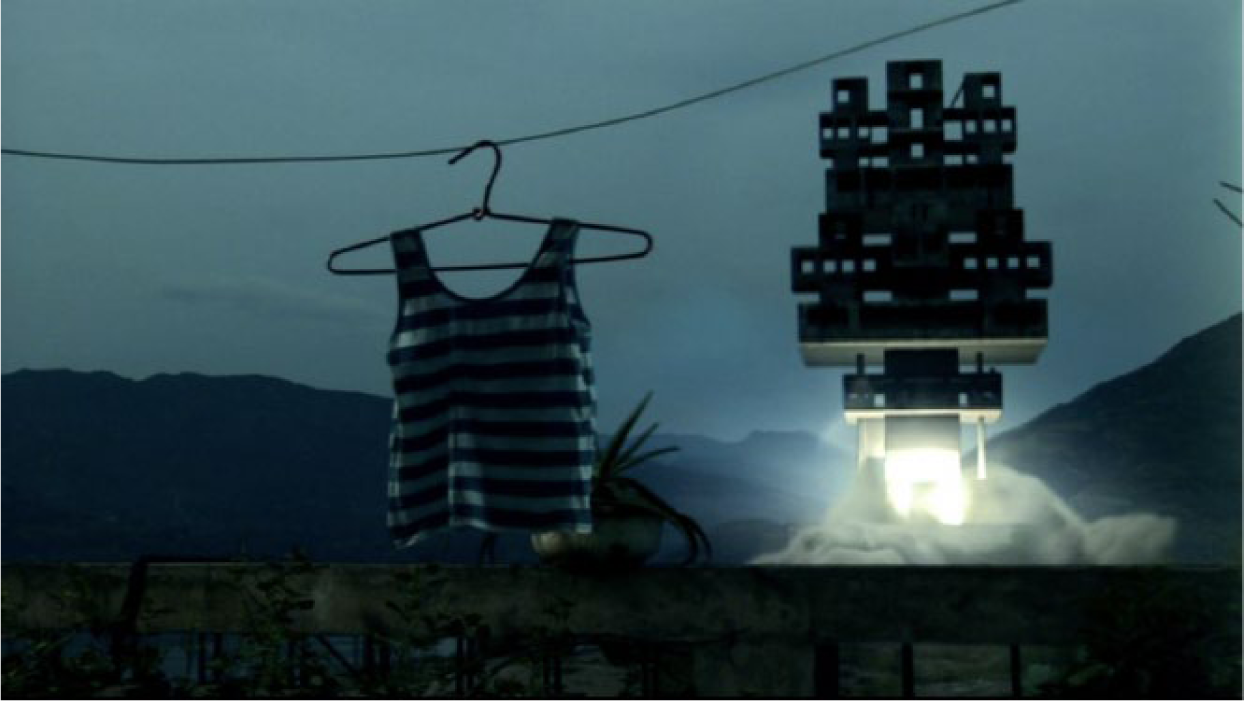
The ‘rocket ship’ in Still Life. Courtesy of Jia Zhangke and the Zhongguo Luyin Luxiang Chuban Zongshe.
In this interpretation, this scene is one of survival, but it also represents something else – that is, when construction is finally realized in the film (the construction from destruction), it is either threatening, such as the Three Gorges Dam which has flooded the area, or impermanent and fleeting, such as the Monument to Progress and Prosperity that literally vacates its physical setting, soaring into space.
Stefan Landsberger (1995: 188) writes that science-fiction like imagery was used in propaganda posters ‘to symbolize modernity’, and that ‘spacecraft’ were ‘ascribed with modernizing qualities that were to strike a chord with the people’. Thus, like Mao’s intended construction from the destruction, these images also imagined and projected a modernistic future utopia. Landsberger elaborates further on the use of these spacecraft and futuristic buildings, writing that, although they served as ‘backdrops’ that valorized economic development: No materials have been published that show the people themselves actually engaged in building activities, or, for that matter, in the process of operating spacecraft … by using these visual elements in the sense of a far, but not unattainable future, by placing them outside the central action itself, the posters take on a truly utopian quality. (p. 190)
There are two elements that I would like to analyse here: one is that these futuristic spaces are represented as separated from people, and the second is that their utopian elements project these spaces into the future, and are never part of the present. With these two concepts in mind, we can consider how the futuristic spaces are a different kind of estrangement; that is to say, they are neither physical nor temporal spaces to be inhabited or ‘lived’. Rather, like the ruin, they too have rejected human occupation and, like obliteration, nothing remains of what once ‘was’, since it never existed. The construction from the destruction in the film is a manifestation of a hyper-modern utopia, but it has instead taken flight, thus representing a future forever in the future, promised yet unattainable, still intangible even after it is ‘realized’. It is a utopia that will never be inhabited.
Similarly, in 24 City the only evidence of the eponymous luxury housing and shopping complex that is being built on the ruins of Factory 420 is the little plastic architectural model in the real estate showroom (Figure 8). The factory, a place of both political as well as personal memory, has therefore been reduced to a small simulacrum, dwarfed by little plastic towers. In Painting the City Red, Braester (2010: 150) writes of how such architectural models are used as propaganda that ‘accentuates the real estate as a commodity and at the same time endows the project with a dreamy aura. The promise of the future is literally tangible’. Similar to the road leading to nowhere in Unknown Pleasures, this model as the utopian construction from the destruction seems ‘literally tangible’ – in the anticipated and ‘not unattainable’ future, yet never realized; like the monument and bridge in Still Life, the ‘24 City’ housing and shopping complex remains a space of fantasy, a space of science fiction, a space of the intangible future, and not the concrete present. Thus, to return to Albrecht’s earlier concept of solastalgia, we can consider how the ruin combined with its futuristic replacement is not only a sense of estrangement from place but also from time as well. In this way, as the ruin physically estranges its previous residents from the space itself, so too does the ‘futuristic’ future that remains forever in the future and not humanly accessible estrange them chronologically from this anticipated future as well.
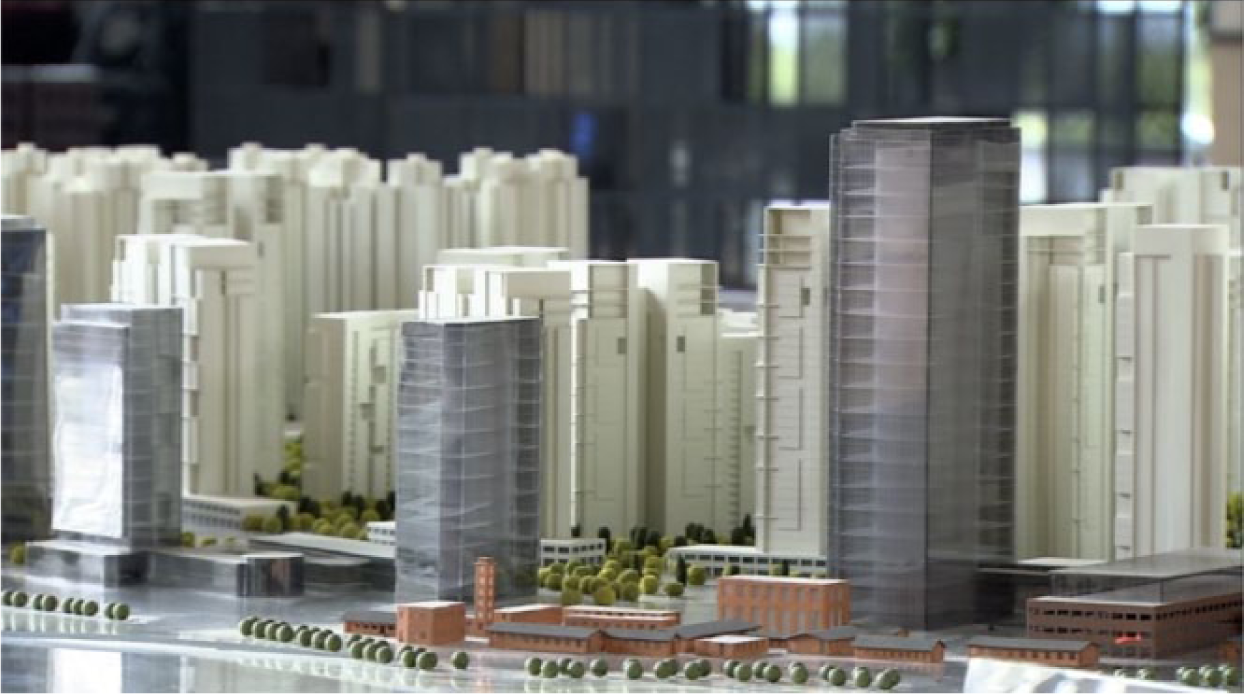
Architectural model of the proposed development in 24 City. Courtesy of Jia Zhangke and CN Entertainment Ltd.
Conclusion
Chinese society and the very landscape itself have undergone incredible change during the last 35 years of the Reform era. As I have argued, the repeating imagery of ruin in these films not only reflects this transition, but also symbolizes the destruction of Maoist construction and of home, as well as affecting this emotional and temporal estrangement as well. To again reference Mao, there can be no construction without destruction; yet, Jia’s pre-2008 films offer destruction, not development, and, when the futuristic construction is finally realized in the films, it is either threatening or intangible. Thus, the destruction and the construction are physical, emotional and temporal estrangements from a once-human space and an anticipated utopian future.
Although my analysis has focused primarily on the Chinese socio-aesthetic context of the ruin in Jia’s films, the ruin and its effects are not solely limited to this context, but are much more universal in scope. During the writing of this article, I have regularly commuted past the Heygate Estate found in London’s Elephant and Castle district, and in the past years I have witnessed its ruin – from threatened, to realized, to its budding replacement as workers have recently begun to pour the foundations for the new structure. Completed in 1974 and containing 1,260 homes, it was lauded as a model estate, built with the conviction that, according to the designer Tim Tinker, ‘local authority housing should be for all’ (Moss, 2011). It was an example of neo-brutalism, an architectural style descended from modernism that endeavoured to break with the past in order to become ‘newer’ and ‘better’, with the imperative to ‘Erase the Traces. Destroy, in order to create. Build a new world on the ruins of the old’ (Hatherley, 2008: 3). Thus, similar to the Maoist-era housing and factories in Jia’s films, the Heygate Estate was not just a building, but was a ‘phoenix’ that arose from the ‘ruins of the old’, and a symbol of its era’s utopian and socially-progressive ideology. Now, however, like the Maoist ruins in Jia’s films, its ruin represents both a failed utopian modernity as well as a failed collectivist idealism. When the new development is finally concretized – the construction from the destruction – it will not offer ‘housing for all’, but predominantly for those wealthy enough to purchase private residences in London’s ‘zone 1’. Although the council tenants have the ‘right of return’, it is currently unclear how that will manifest when the replacement is completed. Furthermore, those who had owned their housing in the Heygate Estate were forced to sell it to the council (via compulsory purchase orders followed by evictions if they refused), and, since they were only offered a fraction of the cost of similar properties in the area, this has therefore forced them to leave (Kitson, 2013). In this British example of ‘developmental progression’, not only have the residents been physically expelled from their homes, they have also been estranged from this symbol of a past collective idealism, and denied access to the site’s anticipated future. The Heygate Estate’s ruin and the structure that is destined to replace it estrange the former residents from the places in which they once lived, as well as estrange them from the projected future that it heralds.
Footnotes
Acknowledgements
I would like to thank Professors Patricia Berger, Thomas B Gold, and Andrew F Jones (University of California, Berkeley) for their feedback on an earlier version.
Funding
This research received no specific grant from any funding agency in the public, commercial, or not-for-profit sectors.
Notes
Biographical Note
Address: Department of Film, University of Southampton, University Road, Southampton SO17 1BJ, UK. [email: