



Abstract
Focusing on how children make food choices, this article presents research to support efforts to meet children’s information needs when it comes to food packaging. Using focus groups, the authors examine children’s perspectives on ‘most healthy’ and ‘least healthy’ packaged food. Findings reveal that children understand whole foods as ‘healthy’ foods, use the Nutrition Facts label to guide their decisions, and interpret package visuals as literal descriptions of what a food contains. These findings provide evidence-based support to improve food packaging design regulations. Finally, the authors call for transparent visual communication strategies, which aim to improve the critical thinking skills of children, and provide a foundation for informed decision-making across a lifetime.
Keywords
Introduction
With diet a modifiable risk factor for noncommunicable diseases (Lobstein and Brinsden, 2014; WHO, 2008, 2010, 2013), and increased attention on the marketing of foods high in saturated fats, trans-fatty acids, sugar and salt to children (WHO, 2010), how children make healthy choices is important to effective food packaging communication strategies. Policy interventions to promote healthier eating have been described as falling into three categories: information measures, measures to affect food and nutrient availability, and fiscal measures (Traill et al., 2010). This article explores the category of ‘information measures’, specifically what is depicted on packaged foods aimed at enabling consumers – in this case, children – to make informed choices through labelling, packaging design, and education.
Children are an integral part of consumption culture (Cook, 2008), and are extensively marketed to by food manufacturers (Linn and Novosat, 2008; WHO, 2010, 2012). Packaging is also a marketing vehicle (Hawkes, 2010), a form of visual communication that presents detailed product and promotional information at the point of sale. Packaging includes ‘package design’ (e.g. images, graphic elements, spokes-characters, colours, promotions, etc.) as well as ‘labelling’ (e.g. Nutrition Facts label, ingredient list). Visual strategies aim to capture the attention of young consumers, and remain relevant across a lifetime (Batada and Borzekowski, 2008; Connell et al., 2014; Macklin, 1996; McNeal and Ji, 2003) through an emphasis on brands, images, premiums and promotions, spokes-characters, celebrity endorsements, colours, and nutrition claims (Dixon et al., 2013; Elliott, 2008, 2009; Geraldo and Silva, 2012; Harris et al., 2009; Hawkes, 2010).
Researchers have noted that healthy food packaging communicates largely to adults (Pires and Agante, 2011). Despite the fact that children are capable of engaging in complex considerations for the categorization of food (Nguyen, 2007), they face challenges when trying to determine whether or not a packaged food is healthy (Elliott, 2009; Elliott and Brierley, 2012). Yet ‘package design is not subject to any of the regulatory approaches to food marketing to children’ (Hawkes, 2010: 298). Designing packaged food information for children acknowledges that they understand the concept of healthy eating (Dixey et al., 2001; Hesketh et al., 2005; O’Dea, 2003; Protudjer et al., 2010), can influence a family’s consumption decisions (Isler et al., 1987; McNeal, 1969; Namie, 2008; Swinyard and Sim, 1987), and are influential to parents’ food choices (Maher, 2012; O’Dougherty et al., 2006; Powell et al., 2011). Empirically-supported visual information design strategies could also further support opportunities for the development of children’s abilities of critical thought – as products are compared and contrasted – and act as a means for parents and children to share information about ‘healthy’ packaged food choices (Nørgaard and Brunsø, 2011).
Transparent Communication
The concept of ‘transparency’ is helpful for framing this discussion about food labelling and package design practices. ‘Narrative transparency’ means that narratives and images are literally seen through, and figuratively have meaning (Olson, 1999: 14). Narratives can be lucid, penetrating, clear or familiar, regardless of their origin, if they allow viewers to project their ‘indigenous values, beliefs, rites, and rituals into the media experienced’ (p. 4). While Olson applies the concept of narrative transparency to the success of American cultural exports, specifically Hollywood, the concept can equally be applied to the success of food production, packaging and marketing strategies to connect with, and be accepted by, a broad range of consumers (Winson, 2013).
Instead of asking what narratives have succeeded in making particular food products acceptable to consumers worldwide, this study redirects the question to the level of children’s food practices and asks how children’s ‘values, beliefs’ and rites are integrated into their interpretations of packaged foods. What information design techniques have yet to be explored so that children can make informed decisions about the content of packaged foods? Transparent communication considers food knowledge, how it is used to make packaged food choices, and where packaging as visual information can parallel the practices of our youngest consumers’ consumption choices.
This research furthers the evidence base on how children navigate packaged foods, addressing both food labelling and packaging techniques through the concept of ‘transparent visual communication’. Drawing on focus groups to explore how children make packaged food decisions, this article reveals how children negotiate their ‘most healthy’ and ‘least healthy’ packaged food choices. The discussion locates their answers in both the literature and in contemporary package design explorations; visual design solutions demonstrate the varied ways of interpreting the packaged food environment and the display of food contained within. Important to understanding this research and its findings is its focus on what children ‘do’ when making packaged food choices. Rather than promoting or discouraging foods deemed healthy or unhealthy, the approach aims to find visual solutions to help children analyze foods, embracing knowledge about their ‘cognitive/social’ resources as well as their interactions with the environment (Livingstone, 2009: 172). Evidence-based package design practices that meet the information needs of children have the potential not only to help children make informed decisions, but provide a foundation for critical thinking across a lifetime. The research also provides insight into the benefits of research collaborations between regulators and visual information designers for packaged foods.
Method
Focus group methodology accepts that participants are knowledgeable about the topics they are asked to discuss. Children are ‘major users of their local environments’, and ‘active risk assessors and problem solvers’ (Davis, 2001: 191); their approaches to decision-making are part of how they learn to live in a complex world. Focus groups with children are part of research strategies that include children’s experiences; it is a process of ‘research with’ children rather than ‘research on’ children, making children ‘“key informants” in matters pertaining to their health and wellbeing’ (Darbyshire et al., 2005: 419).
Focus groups were conducted with 58 children (grades 1–6), divided by age and sex, to explore how children make healthy food choices, and where they face challenges. Focus groups provide access to children’s perspectives (Levine and Zimmerman, 1996) as well as their interpersonal interactions (Kennedy et al., 2001; Krueger, 2009; Peterson-Sweeney, 2005). Observing the acts of people in their decision-making processes is valuable to understanding fully the complexities of situations (Caddy, 2005: 64). The method is particularly effective in complex contexts such as the food choice environment where ‘a broad array of interrelated socioenvironmental, personal, and behavioral factors’ are associated with food choices (Peterson-Sweeney, 2005: 105).
Subjects were recruited from a high socio-economic region of Calgary, Alberta, Canada. Letters were sent to parents through the school, along with ethics approval information granted by the Conjoint Faculties Research Ethics Board of the University of Calgary to engage with children grades 1–6. Consent for the children was given by parents; child assent was also collected. Twelve focus groups of 4–6 children were organized. In order to encourage participation from even the shyest children (Gibson, 2007; Heary and Hennessy, 2002; Morgan et al., 2002; Peterson-Sweeney, 2005) the small groups were similar in age and gender to promote group productivity (Greenbaum, 1988; Heary and Hennessy, 2002; Vaughn et al., 1996).
Focus group sessions were based on a moderator’s guide, took place during school hours, and lasted between 30 and 45 minutes to attend to the attention span of the children involved (Vaughn et al., 1996). After the children were seated, the moderator and a research assistant introduced themselves and asked the children to do the same. The moderator then described what a focus group is, clarified that there were no right or wrong answers, and emphasized that the children did not need to answer if they didn’t want to. The ice-breaker questions began with what packaged foods they asked their parents to buy, and were followed by questions such as ‘Name me one packaged food that you think is healthy?’ and ‘What makes that food healthy?’. While the moderator engaged the children through questioning, the assistant helped organize the materials necessary for the accompanying activities: a ‘shopping trip’ excursion, and a packaged food ‘product organization’ activity. For the ‘shopping trip’, children were asked to individually select the ‘most healthy’ and ‘least healthy’ foods from 6 types of crackers, 7 types of cookies, and 6 types of yogurt, and mark their answers on clipboards. Children then sat together to discuss their choices. For the ‘product organization’ activity, 6 cereal boxes were placed in the middle of the table, and participants were asked to sort them, as a group, into ‘most healthy’ and ‘least healthy’. Again, the children were asked to explain their decisions. The ‘shopping trip’ and the ‘product organization’ techniques were derived from focus group approaches that include ‘choosing among alternatives’, ‘picture sorting’ (Krueger, 2009), and ‘photoelicitation’ (Harper, 2002). In ‘choosing among alternatives’, and ‘picture sorting’, participants are offered several choices and asked to talk about the advantages and disadvantages of each, or asked to categorize images according to specific criteria (in this case ‘most healthy’ and ‘least healthy’ packaged foods) and when finished, discuss why they categorized the products in the manner they did. The ‘choosing among alternatives’ strategy has previously been used ‘in selecting from among visual displays, advertising layouts, promotional or educational materials, logos or even program options’ (Krueger, 2009: 45). Photoelicitation is useful when participants are presented with images, or asked to take their own photographs, and are subsequently invited to discuss their choices in an interview or a focus group context. Mengwasser and Walton (2013) asked children between ages 8–10 to take photos of what health meant to them, and then to categorize and discuss the photos that they took. The process provided children an opportunity ‘to reflect on their own ideas about health’ and to learn from the other children (p. 8). The approach reaffirmed that children are competent in expressing their views. These visual strategies are a means of generating an interactive conversation with children, increasing their engagement in order to identify their choice-making processes (Darbyshire et al., 2005: 420).
Transcriptions of the focus groups were provided by a professional transcription service and imported into qualitative data analysis software (NVivo, 2012). Transcripts were further synched with videos. Reviewing the transcription and video materials together allowed for a final review for accuracy of the texts, the option to watch interactions for conversation subtleties (particularly helpful for when children disagreed), and for swift recall and review of data once coding was underway. Analysis included ‘descriptive coding’ (organizing the focus group answers with the questions that were asked); topic coding (organizing discussions according to emerging themes); and the use of matrices to compare and contrast the themes of the Nutrition Facts labels, ingredient lists, images, and text.
Findings
The results reveal that children use literal interpretation of the images on packaged foods to make their ‘most healthy’ and ‘least healthy’ packaged food choices, a strategy that is hampered by images unrepresentative of a food’s ingredients. Children’s use of the Nutrition Facts labels and ingredient lists is also inadequately supported by their knowledge of these information sources. This section provides support for these findings and presents pertinent regulations in the United States and Canada.
1. Healthy packaged food is whole food
At the beginning of the focus group (before the children examined actual packages of crackers, cookies, yogurt and cereal), children were asked to name one packaged food they thought was healthy. Children largely answered packaged ‘whole foods’ such as fruits, vegetables, fish, meat, yogurt and bread as their initial interpretations of healthy packaged foods (Table 1). While one boy in grade 1 noted ‘granola bars’ as healthy, he did this only after another boy had mentioned apples, and furthered that the bars were healthy because they had an ‘apple taste’. The answers to this question revealed how children understood the concept of ‘healthy packaged foods’, and their interpretations of these foods as whole foods in packages.
Quotations to support that children believe a healthy packaged food contains whole foods. These quotations answered the questions: ‘Name me one packaged food that you think is healthy?’, and ‘What makes that food healthy?’
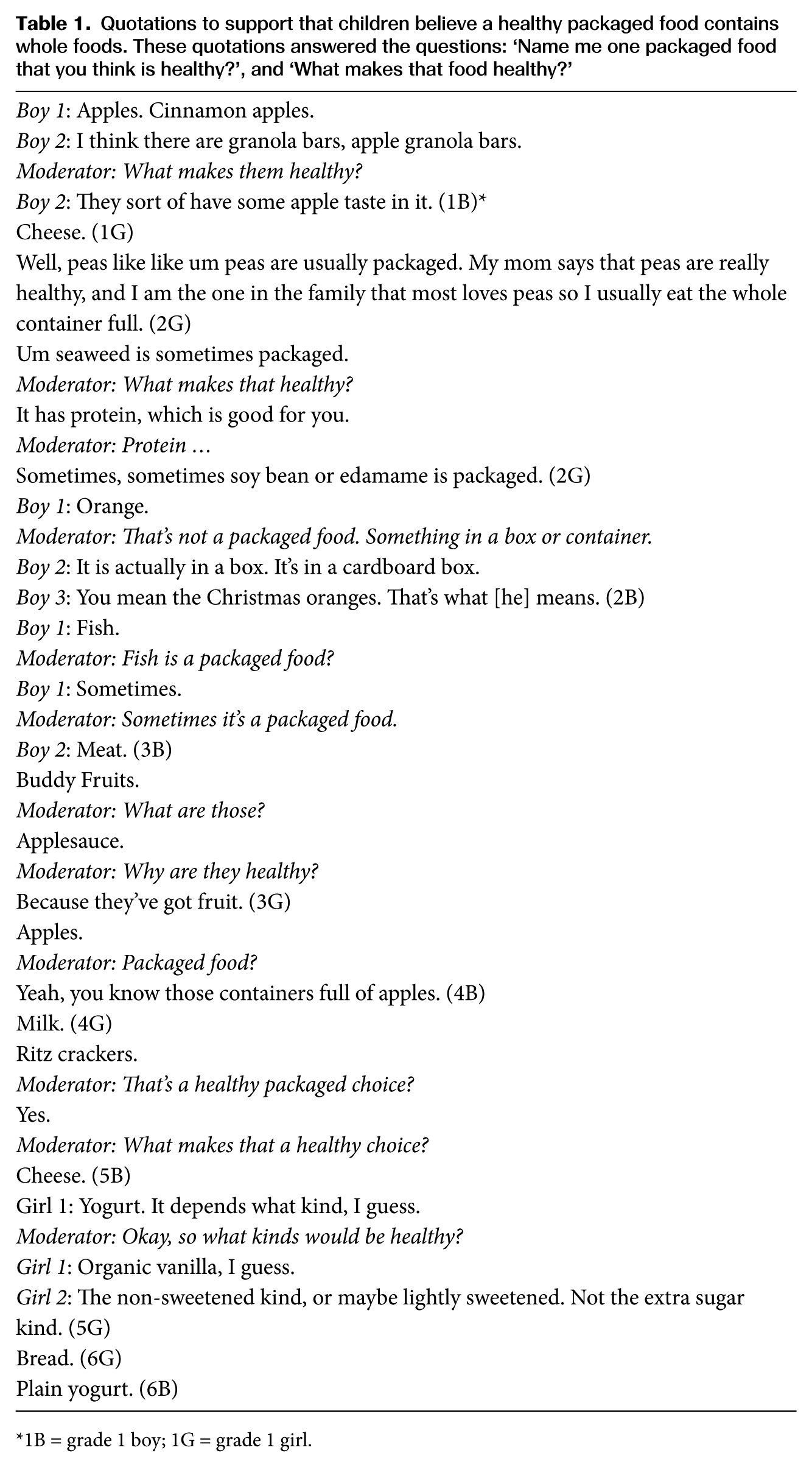
1B = grade 1 boy; 1G = grade 1 girl.
Regulations for images on packaged food are outlined by the Code of Federal Regulations (CFR) in the United States, and the Consumer Packaging and Labelling Regulations in Canada. In the United States, manufacturers are required to use artwork that does not hide or detract from the ‘prominence and visibility of required label statements’ or misrepresent the food (FDA, 2013). Manufacturers of beverages are further urged to use vignettes [images] that accurately depict each fruit or vegetable contained in the multiple juice products … a vignette depicting only some of the fruits or vegetables may not be considered misleading, if the name of the food adequately and appropriately describes the contribution of the pictured juice. (FDA, 2013)
In Canada, if a flavouring ingredient is not derived from natural substances, package design may present pictorial representation ‘that connotes the natural food flavour’, as long as the label contains ‘information that the added flavouring ingredient is imitation, artificial or simulated’ (Consumer Packaging and Labelling Regulations, 2014: 34[1]). In other words, images that are not substantial to the product may still be displayed on packages, even while flavour, colour, and aesthetic preferences dominate children’s choices (Elliott et al., 2013; Gollety and Guichard, 2011: 82). The textual features of food packaging are more heavily detailed in the regulations of both countries (e.g. CFR, 2014: title 21, sec. 101.105; Consumer Packaging and Labelling Regulations, 2014: 14). Ultimately, these regulations allow for an incongruity between what is permitted on a package’s visual messaging, and the content of food (Elliott and Brierley, 2012; Hayes, 2009; Maher, 2012), where images of ‘flavour’ and ‘suggested’ accompaniments to the packaged food are successful promotional devices, yet are particularly challenging to children’s reasoning processes.
These regulatory permissions are problematic when whole food representations are a visual cue for children’s healthy choices as demonstrated by this, and other (Sims et al., 2011) research. Providing visual information about what is in products, rather than focusing on flavour information, is one means of transparently communicating to children the ingredient integrity of the packaged food they are purchasing.
2. Children use Nutrition Facts labels and ingredient lists ineffectively
When examining packaged foods, children were willing to engage with nutritional components such as sugar, salt, fat, fibre and calories to make their ‘most healthy’ and ‘least healthy’ choices. They provided lists of disconnected nutritional components and ingredients, were unsure about what information was provided by the Nutrition Facts label and ingredient lists, and did not know how much of each nutrient was required for them to consume as part of their diet (Table 2).
Quotations demonstrating children’s use of the information supplied by Nutrition Facts labels and ingredient lists to argue their healthy choices. The quotations also demonstrate children’s lack of differentiation between the two information sources, and varied interpretations of nutrient and ingredient amounts.
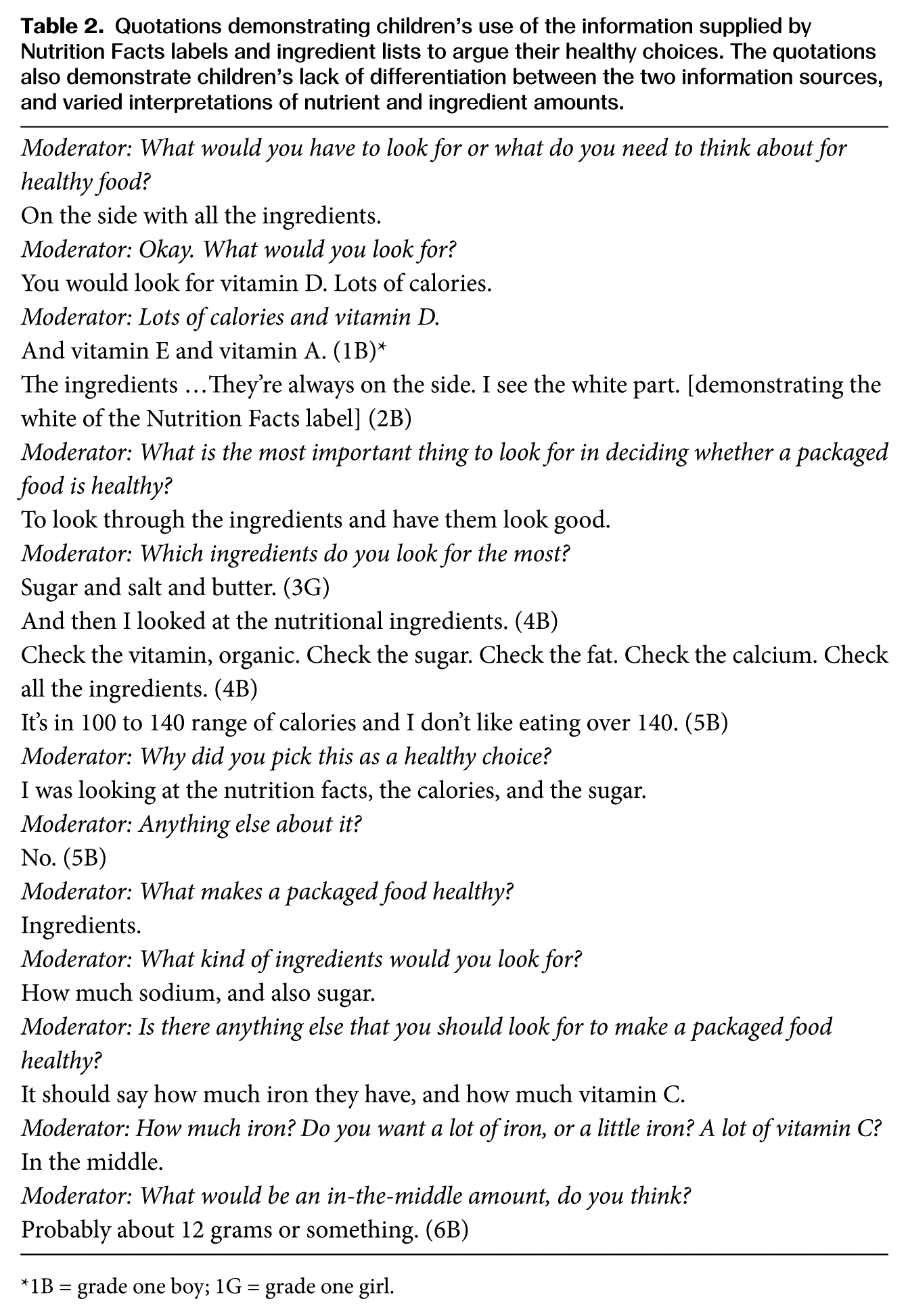
1B = grade one boy; 1G = grade one girl.
Children use ingredient lists and Nutrition Facts labels in their healthy choice arguments, yet are unable to effectively use this information to make decisions. Current approaches to the presentation of Nutrition Facts information do not address the needs of children, and have been shown as difficult to understand even for adults (Leathwood et al., 2007; Mhurchu and Gorton, 2007).
These findings contrast with the original hopes for the Nutrition Facts label in the United States. The label design process was complicated by the number of audiences it was required to communicate with: those with ‘low levels of literacy among a sizable chunk of the public’; ‘significant populations with English their second language’; ‘older Americans with failing eyesight and younger Americans just learning to read’ (Belser, 1994). By including ‘Americans just learning to read’, the original guidelines literally support that even children should be able to make their own food choices using the Nutrition Facts label. This research demonstrates that the visual design techniques used to produce a ‘simple label’ from a ‘monumentally complex political and design task’ certainly succeed in capturing the attention of children in focus groups. Yet the bold-titled, delineated, ‘easy roadmap’ of the information does not help children make informed decisions.
Children know food labels provide information about the health value of foods (Hesketh et al., 2005). Yet they are confused by the ‘extended information on food labels’ (Neeley and Petricone, 2006: 556) and the nutrition information provided (Lytle et al., 1997). The label encourages children to attend to a small area of information-dense, numerically-focused data rather than to the food itself. Using numbers as a means of making packaged food decisions has been shown to be successful with young adolescents (Hawthorne et al., 2006), yet challenging with younger children who are not yet capable of the abstract or hypothetical thinking necessary to understand even these basic concepts (Neeley and Petricone, 2006). Finally, the logistical challenges of inscribing the representation of a food only through the nutrition label bolster the need, and provide evidence for, considering front-of-package solutions in the presentation of packaged food information.
3. Children interpret images and text literally
Children interpreted package images and text as literal representations of what a food contains. For example, images of fruit representing the fruity flavours of a food were described as healthy by children even if fruit was not in the ingredients. Children made ‘most healthy’ and ‘least healthy’ decisions based on what food looked like. ‘Seeing’ the food was important to younger children’s rationale for making a healthy choice (Table 3).
Quotations to support how children look at packaged foods and use the visual information presented to make a healthy choice.
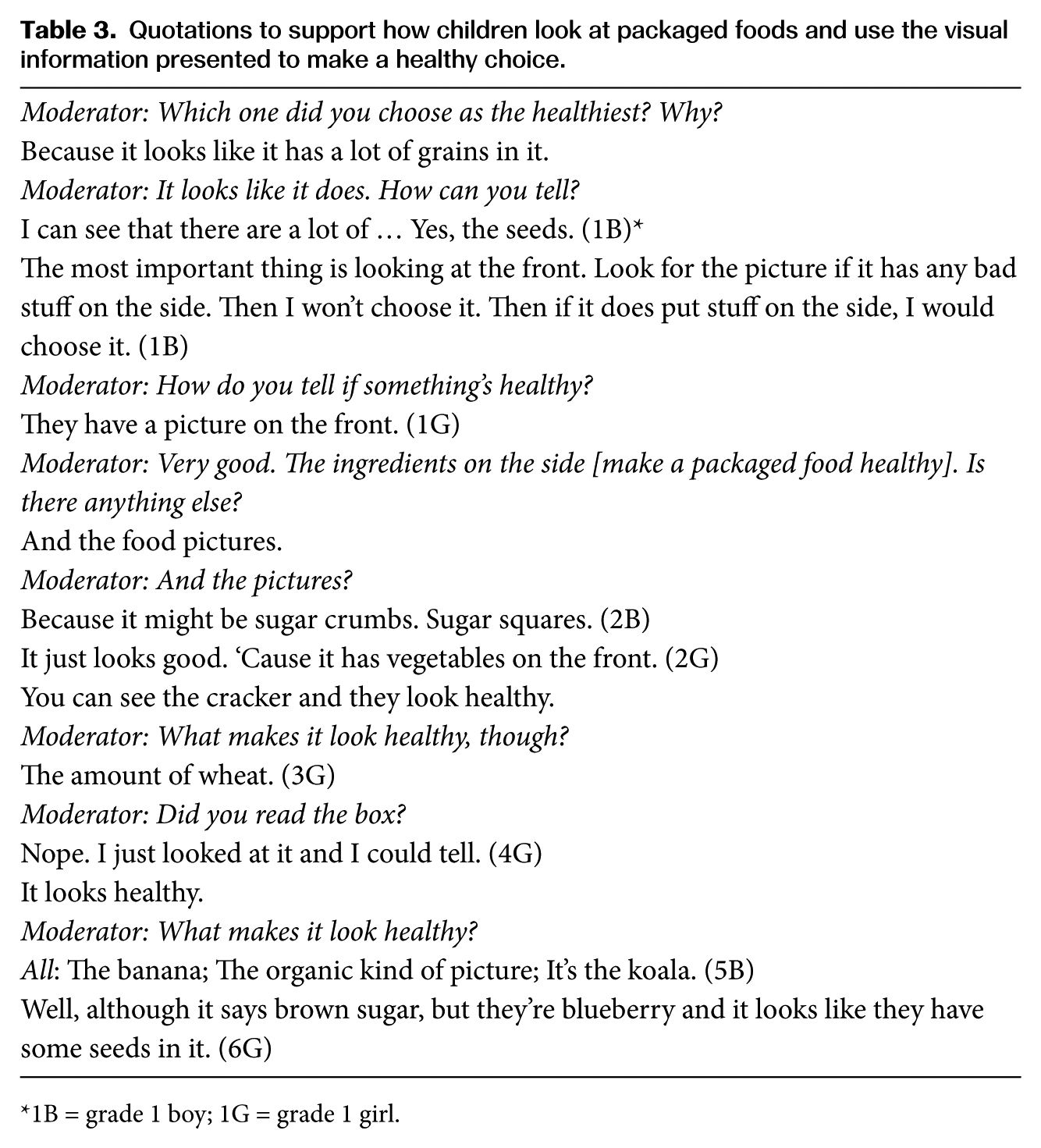
1B = grade 1 boy; 1G = grade 1 girl.
Presenting images solely of the whole foods contained within packages parallels children’s needs for literal imaging. Such visually-oriented approaches to food ingredients also respond to previous research-based recommendations that marketers, food companies, and health officials, need to consider more visually-presented models to communicate information to children (Neeley and Petricone, 2006: 556). Helping children make food choices might be simply promoted as encouraging clear, or ‘transparent’ packaging, where the food itself is featured. This would allow children to consider the contents of boxes, providing them with the visual information they state in focus groups as important to making packaged food choices.
When making healthy choices, children’s literal interpretation of packaged food content contrasts images that distract with images that inform. Promotions, spokes-characters, and celebrity endorsements direct attention away from the food to be consumed, and onto the packaging. These visual information considerations are currently not addressed by regulations for food packaging in the United States and Canada. As previously noted, while these marketing strategies have undergone serious critique in the context of advertising to children, they are not addressed in regulations of packaged food itself (Hawkes, 2010).
Transparent Visual Communication
Transparent visual communication is about informed choice, ensuring that ‘those responsible for food package information do not take advantage of vulnerabilities’ (Albert, 2014: 2). If children ‘reason in the same ways as adults from early in childhood [but] are more easily misled in their logic by interfering variables such as contextual variables, and because they are worse at inhibiting irrelevant information’ (Goswami, 2008: 2; cf. Livingstone, 2009), then addressing the visual information on food would help children make informed choices. Furthermore, because adults are also susceptible to reasoning ‘irrationally in situations when their contextual understanding is limited’ (p. 2), these research results become not only valuable to children, but also to adults.
Interacting directly with children about how they make their healthy and less healthy packaged food choices provides compelling evidence for further research-based design efforts that focus on regulations for food packaging design. As detailed in the findings, in the United States and Canada there are few regulations for images on packaged foods and no clear regulations for children. Children attempt to navigate the Nutrition Facts label and ingredient list, yet such information is too complex for children to make informed decisions, supporting communicating with them by other means, potentially on the front of packaged food. While children interpret the imagery on packages as literal presentations of what is inside, they are distracted from information about the food contained by a variety of marketing techniques. While regulating package design practices is challenging because ‘changing the package is essentially reformulating the product’ (Hawkes, 2010: 299), creating guidelines for approaches that inform children about the food contained, rather than acting as a distraction, have not yet been seriously considered. It is important to continue to examine the visual details provided by packaged foods to ensure that consumers of all ages and abilities are getting the information they need to make informed choices if they are interested in doing so.
In light of the lack of change in marketing practices despite marketing control policies (Cairns et al., 2013), recommendations for new policy approaches continue to be justified. The acknowledgement of children as influential consumers expands considerations for providing information across a lifetime and follows on recommendations to include a wide variety of age groups when testing and developing on-package claims (Miller et al., 2011: 129). The optimum use of food labels requires education and information (Albert, 2014; Kees et al., 2014); yet this presents challenges, since providing formal education strategies to all consumers of all ages may not be easy. Policy-makers might now take the approach of focusing on the information children need to make healthy choices (Dixon et al., 2013; Elliott, 2009; Elliott and Brierley, 2012; Hawthorne et al., 2006; Marshall et al., 2006; Miller et al., 2011; Neeley and Petricone, 2006; Neumark-Sztainer et al., 1999; Thompson et al., 2011), starting with their abilities to visually evaluate foods. The Institute of Medicine’s recommendations (Koplan et al., 2005) also promote the inclusion of children and youth in nutrition label design decisions for both government and industry: Nutrition labeling should be clear and useful so that parents and youth can make informed product comparisons and decisions to achieve and maintain energy balance at a healthy weight … Consumer research should be conducted to maximize use of the nutrition label and other food-guidance systems … The committee encourages the FDA to examine ways to give the food and beverage industries greater flexibility in making nutrient content and health claims that help consumers including children achieve and maintain energy balance. (Koplan et al., 2005: 171)
‘Clear and useful’ nutrition labelling requires further evidence about how young consumers access and use packaged food information.
Change in the imaged environment is challenging. As Jane Andrews, Corporate Nutrition Manager, Wegmans Food Market, states, ‘Consumers do get upset if you change their navigational ways’ (CSPI, 2014). Yet consumers are accustomed to changes in visual packaged food experiences (e.g. transitioning front-of-package claims, celebrity endorsements, food imagery), suggesting that the images used to market packaged foods may prove to be more accessible to regulatory change than adjusting the informational complexity of the Nutrition Facts label. Focusing on images of ingredients presents a means of levelling the playing-field through regulation (Hawkes and Buse, 2011), while still meeting the needs of industry to promote their food products through appealing packaging design.
Further research is needed to explore and expand on these findings across ages, gender and socio-economic status to reveal diverse perspectives and inform policy where current regulations fail to meet the needs of all consumers. To attain the best possible visual information outcomes, regulators are further invited to include the insight of diverse consumers as well as visual information designers at the earliest stages of food packaging decision-making, and over multiple research studies. Evidence-based food packaging design, with a goal to provide the information consumers need to make informed decisions, is only in its infancy.
Conclusion
This article supports evidence-based visual communication techniques for packaged food labelling and design. When making ‘most healthy’ and ‘least healthy’ packaged food choices, children in this study cited whole foods, the Nutrition Facts label, and literal interpretations of whole food images, as guiding their decisions. These findings emphasize the challenges children face in making informed decisions under current packaged food practices, and promotes research-based evidence aimed at ‘transparent visual communication’ – the visual representation of packaged foods – to help consumers in their packaged food choices.
Ultimately, the environment of packaged food marketed to children is not transparent. Children’s visual environment is complicated by spokes-characters, celebrity endorsements, images that are unrepresentative of packaged food content, and Nutrition Facts and ingredient lists displayed in a manner that children use ineffectively. The food navigation strategies children employed for this study, and the challenges they faced, have yet to be met with evidence-based solutions built into the visual design practices of packaged foods to help inform children about packaged food content rather than act as a distraction. With the link between food choice and noncommunicable diseases across a lifetime, marketers, food companies and health officials are further encouraged, with visual information designers, to seek the best ways to communicate the contents of packaged foods to children based on assessments of how children navigate their packaged food choices.
Footnotes
Funding
The project was funded by Alberta Innovates Health Solutions and supported by the Canada Research Chairs program and the Calgary Institute of the Humanities.
Biographical Notes
MEAGHAN BRIERLEY was a postdoctoral fellow in Food Marketing, Policy and Children’s Health at the Calgary Institute for the Humanities, 2013–2014. She has a BFA in Design Art from Concordia University, a MSc in Biomedical Communications from the University of Toronto and a PhD in Communication Studies from the University of Calgary. She is currently a research and evaluation consultant with the Health Professions Strategy & Practice portfolio of Alberta Health Services. Her articles have appeared in journals such as the Canadian Journal of Public Health, the International Journal of Men’s Health, and the Journal of Science Communication.
Address: University of Calgary, 2500 University Drive NW, Calgary, AB, T2N 1N4, Canada. [email:
CHARLENE ELLIOTT is Professor of Communication at the University of Calgary, and Canada Research Chair in Food Marketing, Policy and Children’s Health. She is jointly appointed with the Faculty of Kinesiology. She is editor of Food Promotion, Consumption & Controversy (AU Press, 2016), and has published extensively in the area of food marketing, policy, children’s culture, and health. Her research has been published in Social Science & Medicine, Critical Public Health, Canadian Journal of Communication, Canadian Public Policy, Pediatric Obesity, Canadian Journal of Public Health, Food, Culture and Society, Young Consumers, Senses & Society and other journals.
Address: as Meaghan Brierley. [email: