



Abstract
Digital landscape representation tends to be used mainly to provide illustrations of designed landscapes that have not been actualized, rather than to deploy operational design strategies during the design and reception process. The present study offers a critique of this direction of digital representation towards realism in current landscape design. To illustrate this pervasive trend, the authors have coined the term ‘photo-fake’: an image that imitates the actual existence of a designed and not-yet-actualized landscape. The study then discusses several photo-fake conditions (invisible frame and the viewer’s position, creating illusions, landscape as theatre and human figures as spectators, and digital aura), through which the visual materials developed in 2012 for the International Competition for the Master Plan of Yongsan Park, Korea, are scrutinized. Through this analysis, the authors contend that a photo-fake’s realism is not the actual realism of the physical world but rather depends on the established pictorial convention of fine arts and 18th-century picturesque aesthetics in landscape architecture.
Keywords
Introduction
Landscape design inevitably requires a blueprint that can represent a given designed landscape in the future tense. Before the physical construction of the landscape, the designer needs to produce visual representations to show the client – and at times, the public – a proposed image of the future landscape. Visual media are indispensable not only for landscape architecture but also for most other disciplines related to built environments. In disciplines related to the built environment, visual representations function as ‘communicative and creative instruments’ (Ivarsson, 2010: 172). However, those of landscape architecture are perhaps the most picturesque compared with visual media in other disciplines. As the concept of ‘landscape’ has historically derived from ‘prior images’, such as landscape painting, landscape architecture and its modes of representation have been inseparable from their origin (see Crandell, 1993; Corner, 1999a, 1999b). Visual representation often functions to satisfy the client’s stronger desire to possess the representation of the landscape rather than the actual landscape because highly artistic landscape representation is perceived as a work of art. The first professional ‘landscape gardener’, Humphry Repton, was often asked by his clients to produce high-quality watercolour sketches (which took the form of his ‘Red Books’) without any actual improvements to the property, as the clients wanted to show these visual artefacts to their peers (Rogger, 2007).
With the development of digital technology, photomontages that re-compose fragments of digital photographs function as one of the most frequently used technes of landscape representation. Digital photographs, in which the difference between the original and the copy is indistinguishable, are copied endlessly without loss or degradation of information, if they are not compressed (Mitchell, 1992: 6). Furthermore, sophisticated synthetic software, such as Photoshop®, has become more affordable and common, transforming landscape designers and the public from mere beholders to active users who create virtual landscapes.
Recent scholars of landscape architecture have tended to treat visual representation in an era of digital technology as a matter of utilization in pedagogy and practice (Belanger and Urton, 2014; Kingery-Page and Hahn, 2012; Kullmann, 2014); in particular, these studies have mainly addressed 3D digital rendering. Understanding the limitations of realism and offering alternative ways of representing landscapes are necessary for such innovative methods to be used in landscape design practice. However, 3D digital landscape images created with the aid of cutting-edge digital technology are still often synthesized with photographs that capture actual humans and nature to evoke a sense of reality; originality in photography lies in its objective character, ‘like a phenomenon in nature’ (Bazin, 1967: 13). Indeed, as all arts of representation have intended to create an illusion effect that allows viewers to see an image in terms of reality (see Gombrich, 1969), landscape representation has also tended to create realistic effects that can be perceived by the viewer in terms of reality. Thus, to understand fully the desire for realism in landscape representation, the first step is to rethink the ontological status of photographic image, that is, the pseudo-presence of images. In other words, consideration should be given to how an image can be experienced and even perceived as equivalent to the not-yet-actualized landscape it represents. 1
This work offers a critique of photographic realism in current landscape design. First, it briefly examines the landscape representations of the past couple of decades, during which the function of digital synthetic photographs in landscape design has transitioned from generating imaginative ideas in designing strategies to photo-realistically depicting not-yet-actualized landscapes. Presently, photomontages tend to be used only to offer illustrations of the physical world in terms of resemblance rather than to facilitate operational design strategies. To illustrate such pervasive trends, we have coined the term ‘photo-fake’: an image that imitates the actual existence of a designed but not-yet-actualized landscape.
In the sections that follow, this work examines several photo-fake conditions, including framing, point of view, composition, expression, landscape and human figure, and digital aura. Specifically, the International Competition for the Master Plan of Yongsan Park – held in Korea in 2012 – epitomized the current trend with regard to visual representation. 2 Methodologically, the research traverses theoretical discourses on pictorial and photographic representation in the history of the disciplines of built environment, such as landscape architecture and architecture, as well as in art history and media studies. Through the analysis, we argue that the realism of a photo-fake is not actual realism of the real world but that it lies in an established pictorial convention that traces back to the arts of the early 20th century – and even earlier picturesque depictions of the 18th century – within the discipline of landscape design.
Photo-Fake: Photomontage In The Digital Era
Photograph as index: ontology of the photograph
To understand the desire for realism in synthetic photography – that is, photomontage – the correlation between photographic images and real-world objects needs to be reconsidered. Photography is generally characterized by multiplicity and ubiquity as photographs can be reproduced and distributed widely and easily. However, of all its characteristics, the equivalence derived from photography’s relative reality is seminal to its ontology. In other words, photographic images are easily considered indices of actual objects. As Charles S Peirce (1960: 184) noted, a photograph is an index rather than an icon or symbol. An index denotes an object and has an actual connection with that object; without the existence of either connection or object, a sign cannot be interpreted as an index (p. 170). A photographic image is considered an index by virtue of its sensation of presentness, which makes it akin to seeing the subject.
Peirce’s typology of signs was followed by those of critics, whose medium-specific discourse on photographs sheds new light on the ontological aspects of photography by addressing its indexicality, which refers to the pseudo-presence of photographic images by virtue of their bearing witness to being present (see Barthes, 1981; Krauss, 1981; Sontag, 1977). As Susan Sontag (1977: 6) remarked, ‘photography – any photography – seems to have a more innocent, and therefore more accurate, relation to visible reality than do other mimic objects.’ Furthermore, Barthes (1981: 76) discussed the concept of ‘photographic referent’, describing it as ‘not the optionally real thing to which an image or a sign refers but the necessarily real thing which has been placed before the lens, without which there would be no photograph’. Such a discourse reveals that photographic images not only consist of a likeness or resemblance with regard to a subject but also depend on their degree of equivalence with the actual object.
Photomontage with spacing
Synthetic digital representation has its origin in photomontage. Photomontage generates ‘spacings’ through the cutting up and re-assembly of torn photographs. Such spacings are roughly divided into two types: visible and invisible. Photomontages are thus typed in accordance with the presence or absence of traces of manipulation, namely, spacing.
Visible spacings are meant to be discernible traces of cutting and assembling: the white areas between pasted photographs and the distortion of images by exaggeration or scaling down. Meanwhile, invisible spacings consist of cognitive inconsistencies constructed by putting together an artefact whose parts have disparate perceptual characteristics without an otherwise observable gap. The origin of visible spacing can be traced to Dadaism in the early 20th century (see Figure 1), whereas invisible spacing goes back to the work of contemporary Surrealists (see Figure 2). The former image shows ‘what they [Nazis] really were, not just bombastic but money-fed’ (Ades, 1986: 49), whereas the latter represents a surrealist scene in which the Paris Opera ‘rises in the middle of a field of cows’ (Ades, 1986: 136). Spacing in photomontages has been considered a ‘subversion of the photograph’, as it destroys the ‘Aristotelian unities of place and time’ (Mitchell, 1992: 163). Nonetheless, as in the previously mentioned works – paradoxically because of their very ‘subversion’ – the spacing serves as a series of gaps in which critical and imaginative ideas can be generated regarding the way the spacing manipulates and transforms the meaning of the original photographs (see Scott, 2004: 39). In fact, in the 1990s and early 2000s, such creativity of spacing was what landscape designers and theorists expected from visual representation. Furthermore, visual representations that involve spacing, such as mapping and diagrams, were conceived as new methods of representation; they were considered innovative for enabling ‘the virtual to be both conceived and actualized’ (Corner, 1999a: 8). James Corner believed that the creativity of collages could represent future landscapes. ‘Metaphorical/analogical drawing is thus radically different from analytical drawing, which is more instrumental and calculative than it is poetic and imaginative’ (Corner, 1992: 275). New representational tools can thereby be understood as one mode of montage creation: they do not correctly depict future landscapes in terms of resemblance but facilitate alternative conception or thought by producing spacings between visual images and the actual world (Corner, 1999c).

John Heartfield, Adolf the Superman Swallows Gold and Spouts Junk, 17 July 1932. Photomontage. Arbeiter-Illustrierte-Zeitung. Berlin. Visit the Official John Heartfield Exhibition at HeartfieldExhibition.com; see also http://www.johnheartfield.com/John-Heartfield-Exhibition.

René Magritte, Paris Opera, 1929. Photomontage. La Révolution surréaliste 12. Paris. Reproduced with permission.
Such photographic images with visible and invisible spacings appeared in the panels of the finalist teams in the Downsview Park International Design Competition (2000). As Julia Czerniak (2001: 13) stated, ‘The proposals were at once graphically stunning and rigorous, densely filled with diagrams, perspectives, photographs, sections, plans and details.’ Visuals of the proposals supported their design concepts on the appearance and function of landscapes. James Corner and Stan Allen’s team largely used a photomontage with visible spacing (see Figure 3). Their visuals supported the concept of ‘Emergent Ecology’, which was the title of their proposal and, more importantly, one of Corner’s major concerns: giving the impression of a dynamic and complex ecology. 3 Meanwhile, Bernard Tschumi and his team’s proposal, ‘The Digital and the Coyote’, included a photomontage with invisible spacing (see Tschumi, 2001: 87) that supported their strategy of coexistence of the digital and the wild. Although the image does not have visible traces of assemblage, the unrealistic coexistence of the wild (the shaded coyote and wilderness) and the digital (the cultural structure) give the viewer a surrealistic impression.
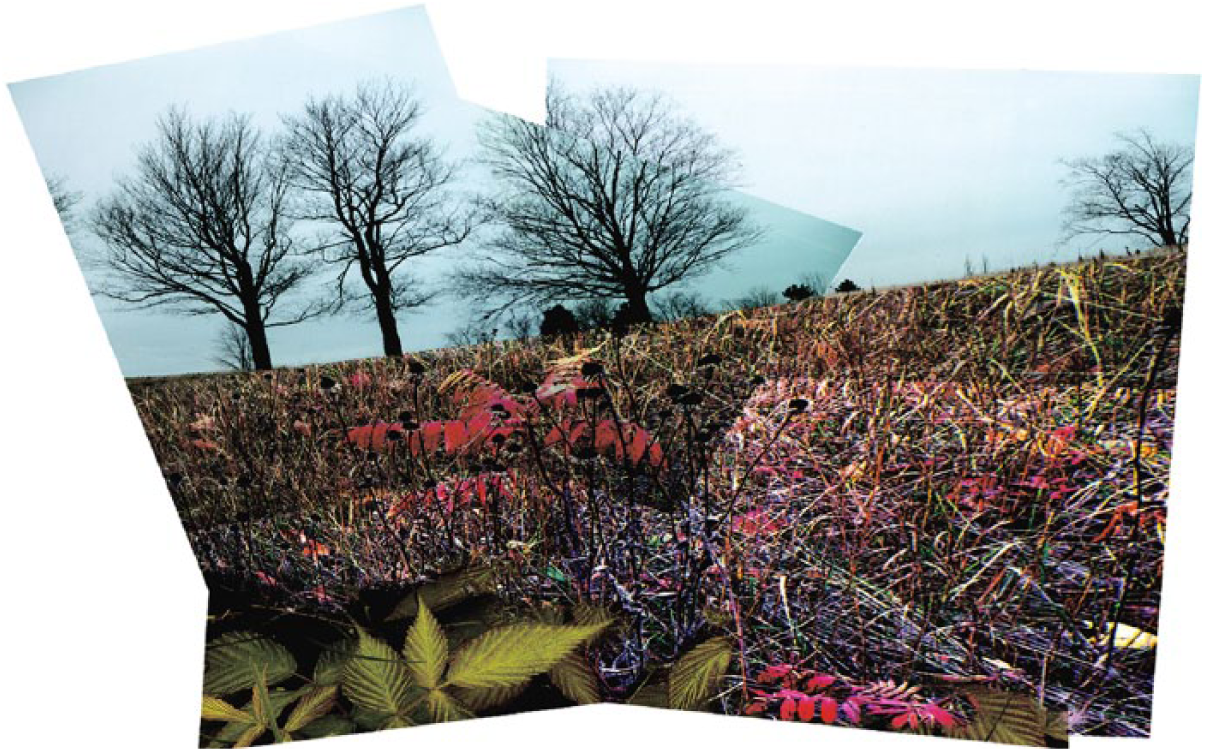
James Corner and Stan Allen et al., Emergent Ecologies, Downsview Park competition proposal, Toronto, 2000. Reproduced with permission.
Defining photo-fakes: photomontage without spacing
At present, however, photomontage in landscape design tends to eliminate such spacings. Visible spacings are delicately erased by such computational tools as Photoshop® filters. Meanwhile, invisible spacings do not come into being incidentally, as torn photographs with similar and familiar contexts are selected so that human awareness of their perceptual inconsistency is diffused when they are assembled. The complete representation is thus perceived as if it were a copy of an actual landscape. As Karen M’Closkey (2014: 117) argued, over the past quarter century, the functions of photomontages in North American practice have transitioned from imaginative ‘project ideation’ to photo-realistic ‘project depiction’. In a strict sense, a synthetic photograph without spacing does not have the authentic characteristics of photomontage, in which gaps that can generate imaginative and critical ideas are absent. 4 This phenomenon evokes the ‘double logic of remediation’ in media theory, argued by Jay David Bolter and Richard Grusin. They treated the history of media as a matter of contradictory modes of revealing or concealing the existence of media, namely, ‘hypermediacy’ and ‘immediacy’; the former wants ‘to multiply its media’, and the latter, ‘to erase its media’ (Bolter and Grusin, 1999: 5). In this logic, photomontages with visible and invisible spacings belong to ‘hypermediacy’, whereas images with no spacing belong to ‘immediacy’, by virtue of the concealed traces of media manipulation.
We have coined the term ‘photo-fake’ to refer to a synthetic photograph with its spacings removed. A visual representation with no spacing ‘fakes’ the actual existence of a designed landscape that has not been actualized. According to the theories mentioned above on the indexical nature of photography, photographs represent the ‘past’ of real objects in the present tense. In contrast, photo-fakes, similar to drawings in most other fields related to built environments, generally represent not-yet-actualized objects (i.e. potential future) in the present tense. In accordance with Baudrillard’s (1988: 167) definition, ‘to simulate [photo-fake] is to feign to have what one hasn’t.’
If a photo-fake is perceived as a photographic image with no sense of irritation, then the new synthetic image has the equivalence of a not-yet-actualized landscape – at least to the viewer – and the experience is evidence of the pseudo-presence of the image. Thus, the image, including its phenomenological and ontological dimensions, can be called the ‘image world’. Torn photographs that are dislocated from their original contexts are located on a new canvas, such as a computer monitor, and then given a new pseudo-presence in the context of a new image world. In turn, the new image world becomes unique because of its pseudo-presence with respect to the specific indexicality of the torn photographs.
Notably, the realism of a photo-fake is not a realistic one. Lev Manovich’s (2001: 200) statement on this point is eminently useful as a perspective on the analysis of a photo-fake’s realism: ‘what computer graphics have (almost) achieved is not realism, but rather only photorealism – the ability to fake not our perceptual and bodily experience of reality but only its photographic image.’ We would go further and rephrase as follows: what the photo-fake achieves is not realism but photorealism, and more generally, pictorial realism. 5 Specifically, landscape architecture remains affected by picturesque aesthetics, both aesthetically and practically (see Herrington, 2006). John Dixon Hunt (2012: 3) pointed out that landscape design has become ‘computeresque’ with the emergence of digital synthetic software, such as Photoshop®, and that the computeresque has ‘the very qualities that also characterized the original picturesque’. As such, the technes of pictorialization are important in the production of synthetic photographs – in this case, photo-fakes – because they are ultimately works of art, comparable to paintings, made from digital photographic materials that pursue a realistic (or more strictly, photorealistic) visual experience. 6 By virtue of the specific indexicality of torn photographs, the photo-fake conjures the actual existence of the not-yet-actualized landscape.
Media software products, particularly Adobe Photoshop®, enable seamless depiction (i.e. photo-realistic representation). Lev Manovich, a prominent scholar of media theory, argued that ‘what we as users experience as properties of media content comes from software used to create, edit, present, and access this content’ (Manovich, 2013, 150). In other words, except for computer programmers who use algorithms, the public generally interacts with digital media files via a number of operations, tools, or commands in media application. The main media software product pertaining to photo-fakes is Adobe Photoshop®. Specifically, the original torn photographs (on ‘layer palettes’) can be re-assembled (via the ‘merge layers’ command) into a final synthetic image; discernible traces of cutting and assembling (i.e. visible spacings) can be eliminated via Photoshop®’s filters (e.g. ‘clone stamp tool’ and ‘eraser tool’). As a result, the final synthetic representation is perceived as a photograph that seems to capture an actually existing landscape. These new aesthetic properties of digital landscape representation during production and reception come from the specific software product used, in this case Photoshop® (e.g. ‘filters’ and ‘layer palettes’).
Digital landscape representation in recent landscape design, exemplified by the 2012 International Competition for the Master Plan of Yongsan Park held in Seoul, Korea, embodies the technique of the photo-fake via media software product, in which pictorial expressions are employed to help the beholder view an image in terms of the actual world.
Photo-Fake Conditions
The invisible frame and the viewer’s position
A photo-fake’s frame is commonly invisible. The invisible rectangular border between the synthetic photographic image and the white canvas on which it is placed, such as a design panel, closes the boundary and tames the virtual landscape (see Figure 4). This setup is in contrast to a photomontage with visible spacings, as mentioned above, in which the rectangular frame is broken intentionally (see Figure 3). In the case of a visual image with visible spacing, the photographic pseudo-presence extends to the outside of the frame or intrudes into it, thereby playing an imaginative and critical role in manipulating the image. Photo-fake images, meanwhile, are cropped and reframed within a rectangular invisible spacing to create a stationary and safe state for viewers.
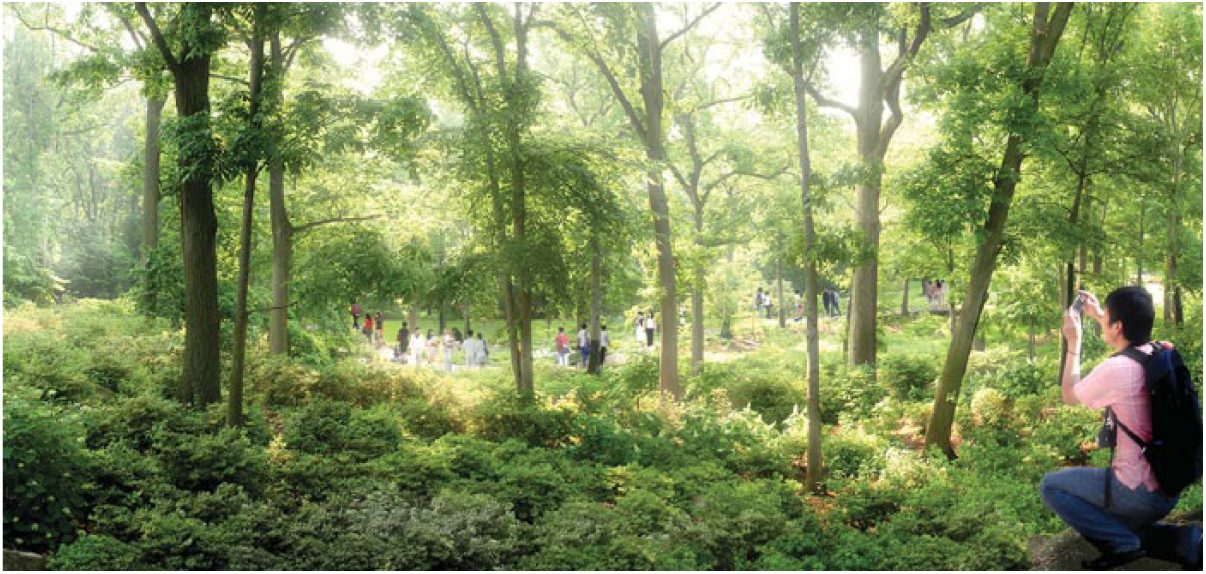
West 8 and Iroje et al., Healing: The Future Park, Yongsan Park competition proposal, Seoul, 2012. Reproduced with permission.
As such, the frame determines the viewer’s position – in this case, in front of the image. Likewise, a virtual viewer looking at a distant landscape within the image space is usually placed in the foreground of the image. The visual experience of a photo-fake epitomizes Jay Appleton’s (1996) prospect–refuge theory, in which the virtual viewer is able to view scenery without risk – in other words, without exposing himself or herself to others, or by putting himself or herself at a distance from the scenery. In visual culture, the tradition of positioning the virtual viewer and the scenery has a long history, dating back at least to Claude Lorrain’s historical landscape painting in the 17th century and to the later English Picturesque aesthetics of the 18th century. Lorrain’s Pastoral Landscape (1648) includes human figures contemplating the scenery depicted by the painting; the figures function as surrogate spectators mediating the real viewer and the represented landscape in the middle and background of the picture plane. This relationship is embodied in most visual representations involving not only landscape painting but also photographs and even films; thus, it is probably a universal visual experience of landscape.
In a photo-fake image, refuge elements, such as trees, buildings and caves, are generally placed in the foreground or the virtual viewer’s position, in which the viewer can safely contemplate the mid- and background. In the current work, the winning competition proposal, for example, involved several photo-fake images, one of which (see Figure 4) contained the prospect–refuge relationship: the virtual viewer can contemplate the scenery while hidden among a dozen tree trunks, which function as the element of refuge.
Creating illusions
Other photo-fake conditions involve pictorial structure and expression, which are significant in the creation of illusionist effects. The manner of creating illusions in a photo-fake owes its origin to the two established conventional modes of painting, namely, linear perspective and sfumato, invented during the Renaissance era.
The term ‘linear perspective’ refers to the art of generating depth in the pictorial space in the way that cropped photographs converge towards a vanishing point. As shown in Figure 5, construction is principally devoted to creating a visual experience of a linear streetscape and stream scene. The vanishing point, to which the eyes of viewers should be drawn, leads to a thorough investigation of the image world. The use of many photographic materials heightens the sense of depth and enables estimation of the full scale of the image world, where materials whose scale is well known are inserted. However, depth perception in such a picture plane does not correspond to that of a human view of an actual space. It is merely the product of an arrangement of cropped photographs orientated towards the vanishing point to be viewed as if it is the actual world.
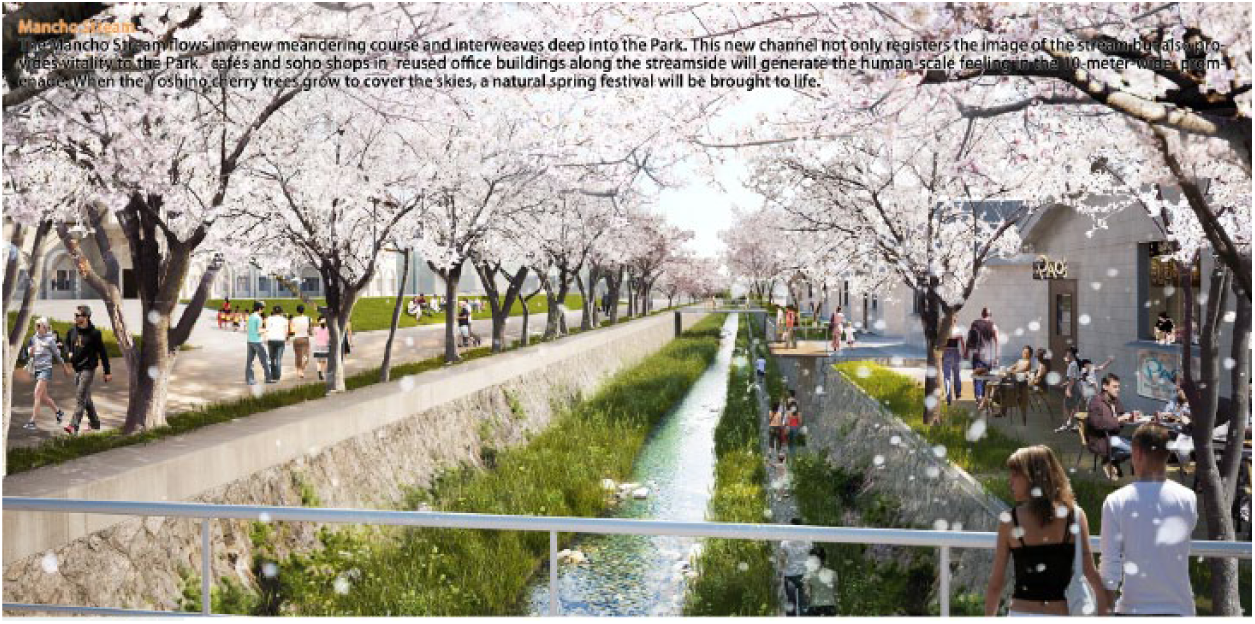
Synwha Consulting and SeoAn R&D Landscape Design et al., Yongsan Park for New Public Relevance, Yongsan Park competition proposal, Seoul, 2012. Reproduced with permission.
Figure 5 is the proposal that won the second prize in the competition, and it includes visual representations of a stream scene constructed using linear perspective. In the image, the linear form, as an axis of the picture plane, creates a sense of depth and a visual experience in which the viewers’ eyes follow the line, which is filled with blossoming cherry trees. The viewers’ oculus corresponds directly to that of the two tourists, the virtual viewers, in the foreground of the image; in other words, viewers are allowed to contemplate the landscape of the image in a similar way that tourists/virtual viewers do in their invisible gaze. Thus, the visually privileged image achieves realistic illusions, which was probably the intention of the producer of the image or designer of the landscape.
Sfumato, which creates a dreamlike atmosphere in an image space reconstructed within the picture plane, deliberately blurs distance in photographs (see Figure 6). This distance from the picture plane weakens viewers’ discriminating power and stimulates projective performance. It is an appropriate technique with which to produce an illusionist effect by reducing the visual information in the plane (Gombrich, 1969: 221–222). Unlike the composition of linear perspective, the technique of sfumato does not require many photographic materials. The dim, blurred image world leaves room for viewers’ imagination to work and creates an emotional atmosphere in the picture plane. Furthermore, the blur effect often extends to the trail of an object, producing a streaking after-image that creates the illusion of motion. Motion blur, a filter in Adobe Photoshop®, functions in the literal sense as a tool to create ‘motional’ illusion by ‘blurring’. This manipulation technique can be traced to the ‘stroboscopic effect’ popularized in the mid-17th century (Gombrich, 1969: 228–229). 7
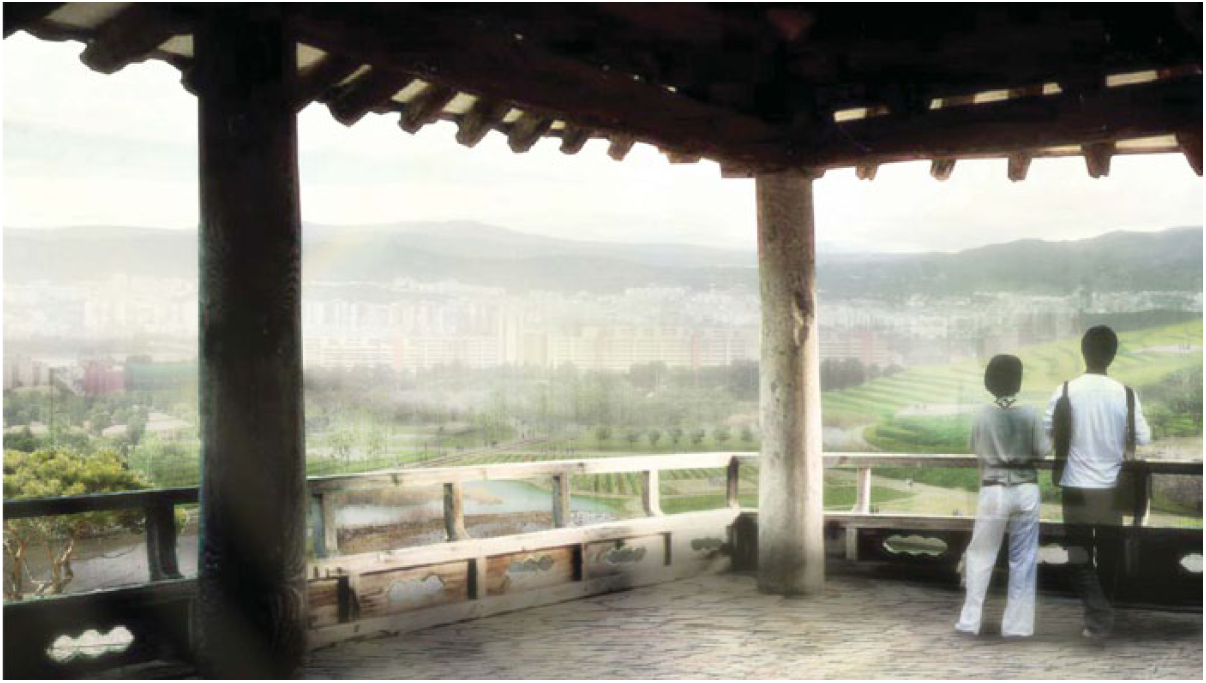
West 8 and Iroje et al., Healing: The Future Park, Yongsan Park competition proposal, Seoul, 2012. Reproduced with permission.
Healing: The Future Park, which won the first prize in the competition, effectively used sfumato to represent the atmosphere of the proposed landscape in the manner of a visualization of illusion (see Figure 6). This approach accords with that team’s design strategy, which was to generate a spatial illusion of a traditional Korean landscape and thus produce supportive, entrancing visual imagery. Similar to linear perspective, sfumato privileges the visual characteristics of a virtual landscape; it allows viewers to identify with their counterparts in the representation. The virtual viewers are often placed in the image foreground, contemplating the scenery in the midground and background. Thus, linear perspective leads viewers to observe the image world closely, whereas sfumato guides viewers to wander through it slowly and fluidly.
Landscape as theatre, human figures as spectators
The significance of landscapes and human figures in photo-fakes relates to their illusionist effects on reality. Although the development of computer graphic technology will continue indefinitely, photographic images that capture actual landscapes and people still provide a more realistic impression compared with purely computer-generated images. Thus, photographs of landscapes and people still frequently appear in most contemporary designers’ proposals because of the way they add to 3D modelling structures. 8
An image world exclusively filled with photographs of individual objects of nature, such as trees, water and grass, is often unable to allow viewers to identify the particular location of the image world. Unknown pictorial spaces are named when specific and familiar-looking (i.e. possessing an indexical function) landscape photographs with proper names are located inside the photo-fake plane. Most of the teams in the competition indicated the location of the image world – Namsan Tower, in Seoul, Korea – through the way the image was principally inserted in the background as a theatre, at the front of which human activities could proceed (see Figure 7). Thus, viewers are able to perceive the location of the place. This manipulation frequently acts as a trick to produce a scene effortlessly by inserting a specific landscape photograph in a general circumstance depicting cliché activities, such as relaxing and contemplating the scenery. Indeed, a photo-fake produced by one of the third-prize winners has a visual background that can be perceived and identified as a specific site, Namsan (South Mountain) in Seoul, only by virtue of the indexicality of the photograph of Namsan, which is inserted in the background of the plane (see Figure 7).
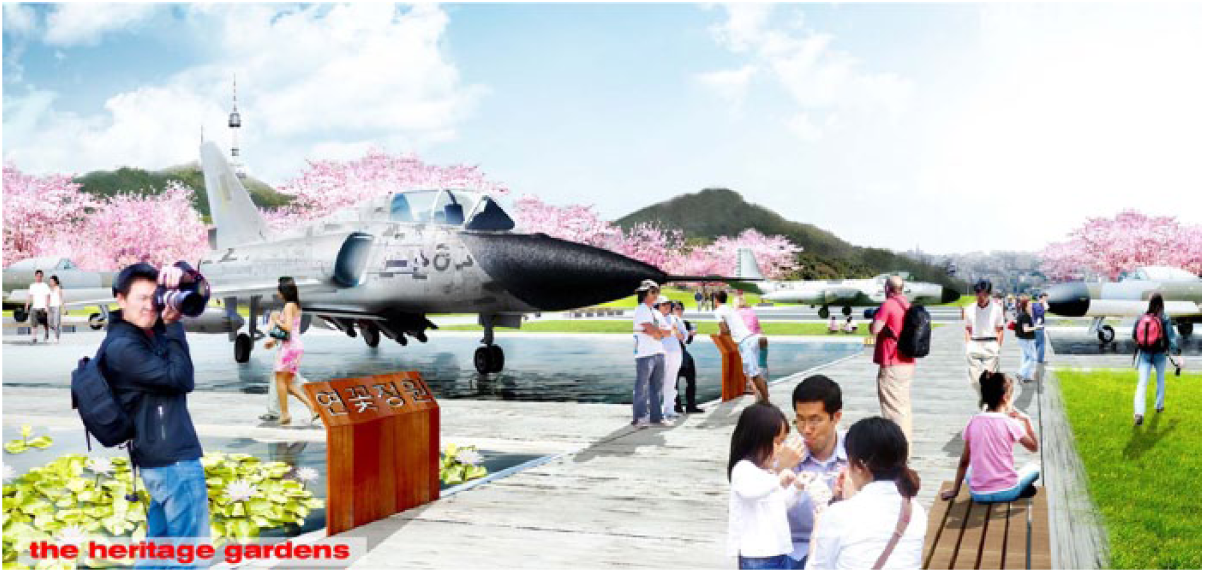
James Corner Field Operation and Samsung Everland et al., Openings: Seoul’s New Central Park, Yongsan Park competition proposal, Seoul, 2012. Reproduced with permission.
Landscape images – which do not generally depict wildernesses but spaces in which human civilization intervenes – are vitalized by the gestures of human photographs. When inserted in the photo-fake plane, human figures decontextualized from their original image worlds are given a renewed pseudo-presence that corresponds with a new image world. The image of a human figure functions as the scale of the image world, helping viewers to perceive its actual size. More importantly, the human figure demonstrates the function or performance of the landscape image. In this case, the positioning of human figures engaged in activities, such as sitting, running, or looking, becomes more important. Thus, the characteristic of signs as icons is stronger than their identification as indices of pseudo-presence.
The representation of human figures in the history of landscape design goes back to the picturesque depictions of the 18th century. John Dixon Hunt argued that the function of human figures in William Kent’s landscape sketches is divided into two types – ‘actors’ who use the landscape and ‘spectators’ who view the scenery – and that both are expected to engage with the virtual landscape (Hunt, 1992: 42). These elements frequently appear in landscape representation: in photo-fakes, human figures function to create imaginary but realistic visual experiences of virtual landscapes and provide a virtual experience for viewers. 9
Both the performer and onlooker of the photo-fake can be considered alter egos or agents that project the designer’s desire onto themselves. The human figure in the photo-fake reveals ‘the attitude of the designer towards the human being in that environment’; specifically, figures are ‘added’ to the image world already formed ‘for them’, not ‘by them’ (Treib, 2008: 20). The onlooker in the image, who often occupies a large portion of the foreground in the picture plane and contemplates the scenery in the midground and background, is intended to be identified with viewers’ own point of view. Viewers in the real world should contemplate the image world in terms of the onlooker placed in the foreground; in other words, viewers should follow the designer’s intention or desire, which tames the landscape into an object of visual pleasure. In this context, viewers ought to notice that the figure as onlooker is often holding a mechanical device, such as a camera (see Figure 7). The camera held by the figure can be interpreted as a substitute for the palette and brush held by the figure represented as a landscape painter in Humphry Repton’s landscape sketches.
In both landscape painting and photography, representing an object entails appropriating the object represented. Likewise, the word ‘photograph’ literally refers to ‘taking a picture’ of the object being photographed (Sontag, 1977: 4). Therefore, those who photograph the scenery in the photo-fake can be considered a projection of the producer’s desire, represented to capture an imaginary not-yet-actualized landscape, make it an object of visual pleasure and possess it. 10 Thus, the presence of a person with a camera shows that the photo-fake accepts, as well as transforms, the well-established pictorial canon that dates back to Picturesque aesthetics. No person appears accidentally in a photo-fake.
Paradox of the Photo-Fake: Digital Aura
The purpose of the current work is to offer a critique of photographic realism in current landscape architectural representation, which tends to be used mainly to offer illustrations of not-yet-actualized designed landscapes rather than to aid operational design strategies. To illustrate such a pervasive trend in photo-realism, we have coined the term photo-fake, which represents designed future landscapes in the present tense by utilizing the indexical nature of digitized photographic materials. In analysing the Yongsan Park competition, this work found that the photo-fake tends to borrow previous established pictorial conventions in other forms of visual representations, such as landscape painting and picturesque aesthetics. Media software products, such as Adobe Photoshop®, enable photo-realistic representation. The original torn photographs on ‘layer palettes’ can be re-assembled via the ‘merge layers’ command into a final synthetic image; discernible spacings of cutting assembling can be erased via the program’s filters, particularly ‘clone stamp tool’ and ‘eraser tool’. The resulting final synthetic representation is then perceived by viewers as a photograph that seems to capture an actually existing landscape. 11
At this point, the final condition of the photo-fake can be discussed: does an aura exist within it? Walter Benjamin argued that the aura of a work of art decays in the age of mechanical reproduction; he defined the term ‘aura’ as ‘the unique phenomenon of a distance, however close it may be’ (Benjamin, 1968: 222). With the invention of new reproduction technology, such as photography and cinema, numerous reproductions of a work of art – whose ‘exhibition value’ is experienced in public inside an art gallery or theatre – are substituted for the original, whose ‘cult value’, or authenticity of unique existence, is experienced only at the place where it happened (p. 225). This phenomenon is commonly called the ‘decay of aura’.
The photo-fake is fundamentally a type of assemblage that does not resemble the original photograph; therefore, it may be misunderstood by believing that the aura of the image disappears. However, where a play is a visual representation or realization of virtuality, in accordance with Gilles Deleuze’s phraseology, a virtual image is one of many realized landscapes that exist only in a designer’s mind; thus, the photo-fake can be appropriately understood to embody its own originality. 12 More importantly, its ‘cult value’ coexists with its ‘exhibition value’. Such visual representation is often found not only on the computer screen (privately) but also on display in a museum (publicly). At the same time, a high-resolution image file of a photo-fake can be stored on numerous users’ hard drives, to be recycled into other photo-fakes or admired by the users as if it is their private possession.
The seemingly paradoxical co-experience of exhibiting and admiring a photo-fake is a clear indication that it is appreciated as a work of art. Synthetic photographs, as the examples in the competition show, tend to produce realistic illusions using established pictorial conventions. They thereby permit viewers to view an artefact as a single original photograph of an actual landscape, as if it actually captured or depicted a landscape that exists in the world; in other words, the photo-fake is a type of landscape painting that is made of photographs. More critically, the photo-fake is only perceived as a reality by virtue of its high probability and renewed pseudo-presence; the image no longer functions in the imaginative, generative and critical roles that are authentic to photomontage. Thus, the experience of the photo-fake generates renewed or reformed aura by permitting viewers to be immersed in a not-yet-actualized landscape in the form of visual representation.
The pseudo-aura of the photo-fake strengthens the ability of the imaginary appropriation of the landscape that it represents, and it continues to exist until it is actualized. Viewers, whose eyes have been schooled in the pictorial principles of the photo-fake, might want to attempt to capture the physically constructed designed landscape in a way that is similar in appearance with the original photo-fake. With the growing popularity of social networking services and mobile applications, users can retouch photographs that capture actualized landscapes using image editing applications and then upload the revised versions to social networking sites; thus, users can appropriate the image world as desired. In other words, an image that has a more hierarchical existence than a not-yet-actualized (or even an actualized) landscape is one whose reality is even more perfectly real than the actual reality (see Figure 8). 13 This phenomenon is simultaneously the paradox of the photo-fake and its final condition.
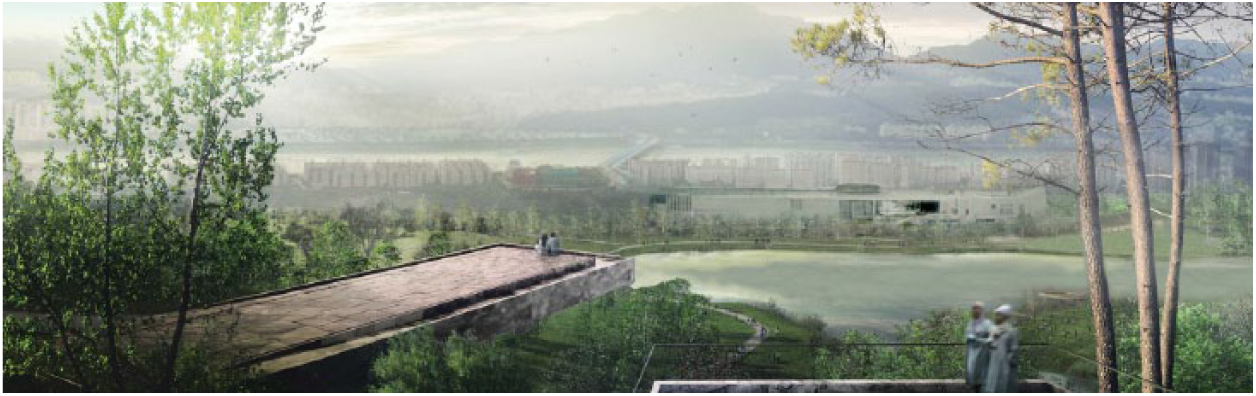
West 8 and Iroje et al., Healing: The Future Park, Yongsan Park competition proposal, Seoul, 2012. Reproduced with permission.
Footnotes
Acknowledgements
We are grateful to the anonymous readers for Visual Communication, whose insightful and thought-provoking comments assisted us in improving this manuscript.
Funding
This work was supported by the BK21 Plus Project of 2014 (Seoul National University Interdisciplinary Program in Landscape Architecture, Global Leadership Program Towards Innovative Green Infrastructure).