




Abstract
Both restorative justice and arts-based programs within the juvenile justice system provide offenders with promising alternatives to the punitive sanctions utilized by many courts. The present article represents an initial examination of how the restorative justice media-arts program – Young New Yorkers – employs restorative justice principles via the media-arts practice of digital storytelling. Findings suggest the digital storytelling allowed participants to create a narrative discourse about their crimes, their impact, and ways to improve their communities. Further, the production of digital stories enabled participants to process restorative values and apply them toward themselves and their social worlds through recontextualization and rearticulation and then realignment of selves in the digital storytelling process. Together these findings underscore the need for more research focusing on the participants’ perspective of restorative justice initiatives to promote greater and more consistent behavioral changes for youth.
Keywords
Introduction
Throughout the past two decades, juvenile crime legislation and policy have become more punitive. Youth offenders, sometimes as young as 14 years, have been tried as adults, blurring the lines between the juvenile and adult justice systems (National Research Council & Institute of Medicine, 2001). According to the Office of Juvenile Justice and Delinquency Prevention (as cited in Knoll and Sickmund, 2011), responding to juvenile crime requires both establishing programs to preclude youth from committing criminal acts as well as working with those who have committed offenses. One recent response to this need is the restorative justice youth initiative.
Restorative justice represents a different paradigm from the predominant, more adversarial justice process that often concludes with a punitive outcome. Restorative justice practices rely on ‘building social capital and achieving social discipline through participatory learning and decision-making’ (Wachtel and McCold, 2004: 3). These initiatives can be implemented as alternatives to incarceration, suspension, and expulsion for offenses comparable to misconduct, such as bullying, assaults, drugs, and property damage (Umbreit and Armour, 2010). In 2012, the Red Hook Community Justice Center, under the Adolescent Diversion Program Initiative and in collaboration with the Brooklyn Defender Services (a public defender office), piloted the Young New Yorkers program as one of many programs whose goal was to improve the judicial response to 16- and 17-year-old offenders.
Young New Yorkers program
The Young New Yorkers (YNY) program is a court-mandated, restorative justice media-arts program for 16- and 17-year-olds possessing at least two characteristics: they were charged with either a violent or non-violent misdemeanor, and they have open cases. Eligible defendants have the option to participate in YNY rather than do jail time. The pilot program comprised eight male juvenile offenders, who took part in six 4-hour workshops once a week during the summer of 2012 at the Brooklyn Defender’s office. Participants who completed YNY workshops and satisfied the other requirements of their sentencing avoided jail time, in many cases, criminal charges were dismissed, and criminal records sealed.
The YNY curriculum broadly uses a combination of restorative justice conferencing, and a strengths-based intervention, developed by Oesterreich and Flores (2009) called the ‘5 Cs’. The 5 Cs are connection, community, contribution, concentration, and completion. The YNY concepts and activities using the 5Cs are summarized in Table 1. The YNY curriculum encourages individuals to connect with their families and communities while concurrently taking responsibility for their unlawful actions through various art exercises, including photography, video, illustration, and design. The workshops culminate in a digital story about each participant’s arraignment, interviews with their families about how their crimes have affected the family, reflections about their crimes, and community public art ideas.
Framework of the YNY program.
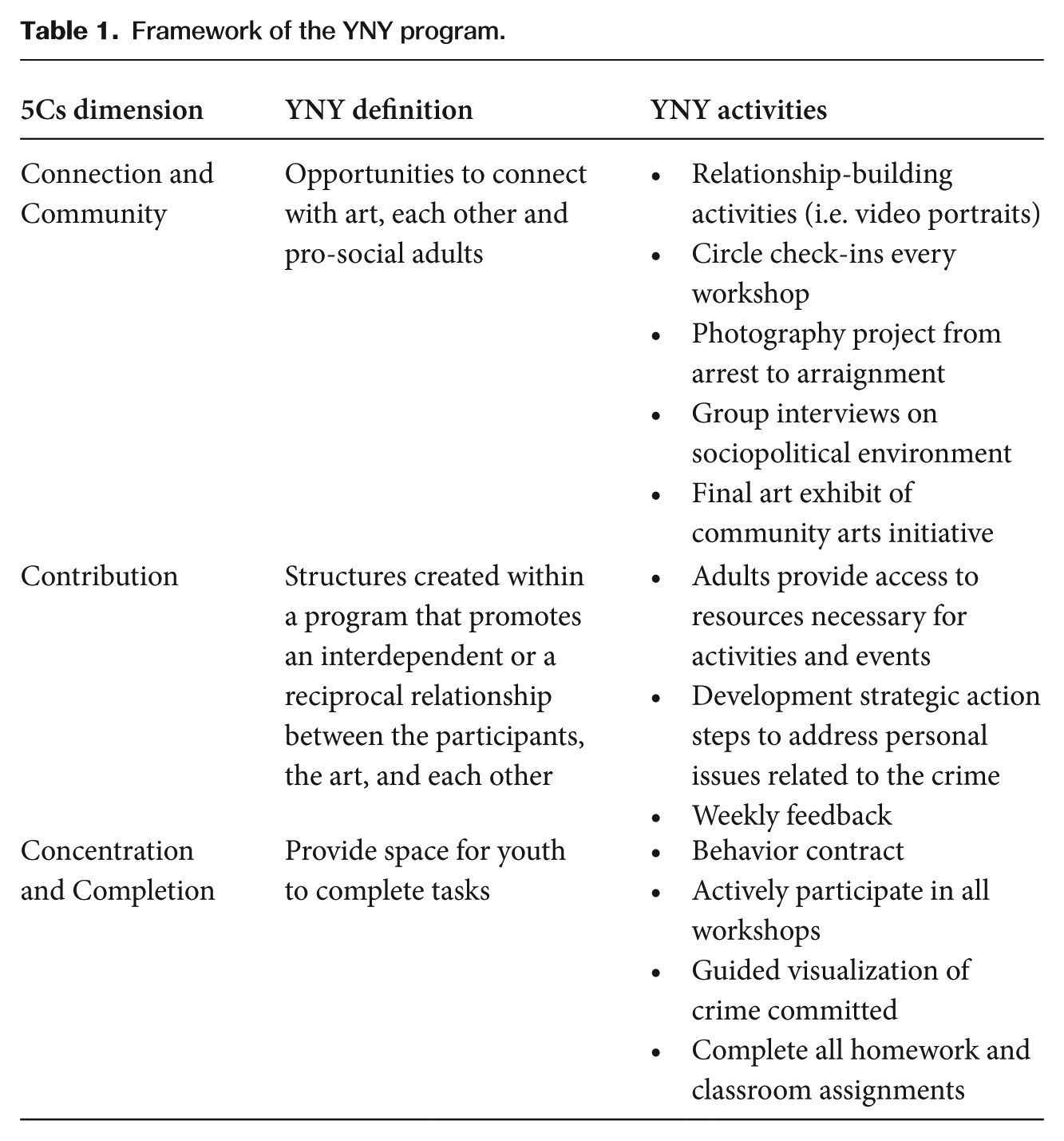
Restorative justice diversion programs such as that of YNY are viewed as positive alternatives to incarceration that strengthen community bonds and rebuild relationships with offenders, victims, and the community (Levrant et al., 1999). The framework of this program provides the juvenile justice system with an opportunity to offer a positive youth development program to assist both young people and their surrounding communities in building capacity, by developing skills and relationships, while also holding youth responsible for their crimes.
The Present Study
Both restorative justice and arts-based programs within the juvenile justice system provide offenders with promising alternatives to the punitive sanctions utilized by many courts. Implementing restorative justice and art-based programs with juvenile offenders signifies a positive trend in influencing adaptive behaviors that are essential to rehabilitating offenders and promoting positive youth development. Although there is a large body of literature on arts-based programs with juveniles confined to correction facilities, these interventions lack rigorous empirical research. Additionally, digital media has enriched arts-based programming by offering a greater repertoire of communication tools and resources, changing the way individuals engage with their communities and the world. Further, the growing literature on restorative conferencing (RC) with juveniles lacks participants’ perspectives on RC interventions.
The present study represents an initial examination of how combining media-arts practices and RC principles can enrich the RC process of juvenile offenders. Also, by focusing on the outcomes of participants’ digital stories, this research may improve understanding of how juveniles process RC values in order to encourage more meaningful engagement in the RC process. I argue that the production of YNY digital stories enabled participants to process restorative values and employ them toward themselves and their social worlds through recontextualization and rearticulation, and then realignment of selves in the digital storytelling process (Bauman and Briggs, 1990). To this end, the focused research questions are:
(1) What restorative values do YNY participants reveal in their digital stories?
(2) How does the use of digital storytelling enhance YNY participants’ processing of their crime?
Restorative Justice
Restorative justice presents the criminal justice system with an alternative way of thinking about and responding to criminal offences. Central to the restorative process is offender accountability. Restorative scholars assert that accountability involves facing up to what one has done and to ‘put right the wrongs’ to every degree possible (Zehr, 2002: 4). As a philosophy, restorative justice pursues harmony by focusing on problem-solving for the future as opposed to blaming offenders for their past behavior (Umbreit and Carey, 1995). Restorative justice seeks to address public safety and community protection, offender accountability, and offender competency and character development (Levrant et al., 1999) by rebuilding weakened, informal networks of community, social control, and support (Kraft et al., 2001). Such connections are built through restorative processes that place both victims and offenders in roles that encourage active, interpersonal, and collaborative problem solving to repair the damage inflicted by the crime (Zehr, 2002).
Research suggests that restorative initiatives hold promise for achieving increased community and victim involvement in the justice process, greater victim and community satisfaction with the case outcomes, improved offender compliance with restitution, and increased perceptions of procedural fairness (Latimer et al., 2005), and a reduction in recidivism rates (McCold and Wachtel, 1998). As a result, restorative justice methodologies have the potential to supplement punitive discipline and decrease the number of juveniles who are adjudicated and incarcerated for minor infractions (Latimer et al., 2005). There are a number of models that incorporate the principles and theories of restorative justice, but one program, in particular, most closely resembles the YNY framework: RC.
Restorative conferencing
RC, also known as family conferencing or group conferencing, originated in New Zealand and is based primarily on the ancient practice of the Maori as a ‘means of diverting young offenders from formal adjudication’ (Bradshaw and Roseborough, 2005: 2). RC is unique compared to other restorative justice models because it uses a collectivist approach by engaging a broader group of individuals (e.g. community members and agents of the criminal justice system) in the resolution process (Rodriguez, 2007). The RC philosophy is based on Braithwaite’s (1989) theory of reintegrative shaming. Reintegrative shaming theory promotes community and family affirmation and gives the victim a voice in order to induce shame in the offender. Offenses that are typically resolved through RC generally include theft, arson, minor assaults, drug offenses, and vandalism (Bazemore and Umbreit, 2001).
The fundamental processes of RC transpire in two ways. First, offenders confront their violations in the presence of the victim, family, friends, and other key supporters. This builds interconnectedness and a participatory culture, which empowers the community’s sense of capacity and collective efficacy. This collaboration encourages both informal social control and social support by strengthening community relations and networks, and ultimately is thought to build social capital (Kurki and Pranis, 2000).
Second, the victim, the offender, and the family, friends, and key supporters of both the victim and the offender are given the opportunity to tell their stories and to express their emotions about the violations (Bazemore and Umbreit, 2001). According to Koenig and Trees (2006), storytelling can give meaning to personal experiences, teach values and beliefs, construct and reaffirm one’s identity, and provide connections to the community. As individuals choose to share personal stories, they create and re-create their lives and engage in self-discovery and self-creation (Fisher, 1987). Bruner (1994) discussed ‘turning points’ within storytelling as instances when individuals report a sharp change in their lives, which is accompanied by dramatic changes in their representations of self. These instances function to help clarify an individual’s self-concept and symbolize how one conceives one’s life as a whole (Hull and Katz, 2006). These changes in self-concept, in turn, influence one’s performance. Overall, building social capital and learning to express oneself may result in improved long-term outcomes, such as a greater sense of capacity and stronger attitudes toward mutual responsibility and interdependence, for offending youth (Bazemore and O’Brien, 2002).
Effect of restorative conferencing with juvenile offenders
Several empirical RC studies that focused on juveniles in the United States have found positive outcomes related to victim and offender satisfaction, reparation, reintegration, and reduction in recidivism (Umbreit et al., 2002). McCold and Wachtel (1998) compared first-time juvenile offenders who have been processed through formal adjudication to cases diverted to RCs operated by the police in Bethlehem, Pennsylvania. In this study, 150 juveniles convicted of property offenses (e.g. burglary or theft) and 75 juveniles convicted of violent offenses (e.g. assault, murder, and rape) were randomly assigned to a control group (formal adjudication), RCs, and offenders selected for conferencing in which the individuals involved did not participate. Data included observations of RC sessions, interviews with participants, and an analysis of juvenile case records. McCold and Wachtel (1998) reported that 32 percent of juveniles who had committed a property offense and were also members of the RC group had reoffended, whereas only 21 percent of offenders in the control group had reoffended. In contrast, for violent offenders, 20 percent of individuals who had participated in the RC conferences reoffended compared to 35 percent of those in the control group. The results revealed a participation satisfaction rate of 96 percent and that 94 percent across the RC intervention of the offenders were in full compliance with restorative actions. This study demonstrated RC might be effective for offenders charged with violent crimes.
Hines (2000) compared the recidivism rates of 281 juveniles who had participated in the RC process in Woodbury, Minnesota, between 1995 and 1999 to a sample of non-conferencing juveniles in 1993. The results indicated that 33 percent of the RC youth reoffended compared to 72 percent of the non-conferencing youth. The Restorative Justice Conferencing Experiment in Indianapolis (as cited in McGarrel et al., 2000) involved the random assignment of 232 youths to RC and 262 to other diversion programs. Recidivism rates were measured by contact with the court during a 6- and 12-month period after the original offense and contact with the court after the individuals had completed the diversion program. The results showed a statistically significant reduction in recidivism rates at 6 and 12 months after the initial crime and at 6 months post-RC program completion.
Finally, Rodriguez (2007) analyzed the Maricopa County Juvenile On-Line Tracking System database from 1999 to 2001 in Maricopa County, Arizona. Researchers compared juvenile recidivism rates of 1,708 male and female youth after 24 months of successfully completing the RC program with 3,262 male and female youth who had undergone regular court processing. Data revealed there were no significant effects; juveniles in the restorative justice program had slightly lower rates of recidivism, respectively 34.0 percent vs 35.9 percent. Further, RC participants with zero or one prior offense had lower rates of recidivism than offenders in the comparison group, suggesting RC may be more useful for first-time offenders.
Empirical studies on RC in the United States are limited and mixed. Future investigations are required to continue evaluating the effectiveness of RC programing. Bradshaw and Roseborough (2005) note a gap in the RC literature with respect to the failure to conduct interviews with participants and staff. According to Forget (2003: 5), understanding the participants’ accounts (narratives) of their experiences ‘would benefit the participants as much as it would provide information needed to improve the justice process and promote the new vision of justice’. With greater information and understanding of a participant’s perspective, restorative justice initiatives can be customized and improved in order to promote greater and more consistent behavioral changes for youth. The current study begins to address this gap by capturing juvenile offenders’ own words and descriptions of their experiences with the restorative justice program through various art exercises.
Arts-Based Interventions Within The Juvenile Justice System
Programs with a cultural arts format have been shown to be particularly effective in working with juvenile offenders to teach valuable skills, such as logic, organizational teamwork, and patience, as well as in incorporating the realization that ‘failure’ is a critical element of discovery and learning (Stinson, 2009). These skills support youth offenders in acquiring adaptive social, vocational, and emotional skills that foster self-esteem and self-efficacy, and reduce the individual’s interest in committing crimes. The literature identifies four over-arching processes that participants experience in all arts programming: connecting, expressing, learning, and discovering (Ezell and Levy, 2003). First, participants are able to forge connections with teaching artists, their own pasts, and emotions, as well as with other participants as they develop and expand their talents and techniques. Second, arts-based workshops demonstrate the importance of the participants’ own experiences and voices and provide a welcoming and safe environment. Third, arts-based workshops emphasize experiential learning to facilitate the participants’ attempts to understand a variety of issues. Fourth, the process of making art provides an opportunity for personal inquiry and reflection and, thus, creates the potential for increased self-awareness (Smith-Shank, 2004).
Anderson and Milbrandt (2005) believe that art making is a transformative and powerful social practice that encourages individuals to reflect upon their own image, others’ images, and issues that they confront in everyday life. For youth in juvenile detention, the process of making art gives them a sense of control and an opportunity to reconnect with humanity (Venerable, 2005) by requiring participants to discuss ‘their world, to determine, their place within it and to conceptually re-envision that place through creation, reflection and discussion’ (Williams, 2002: 299). Consequently, the act of making art has the potential to increase motivation and cooperation as well as to promote behavioral and cognitive changes for youth (Oesterreich and Flores, 2009).
Effectiveness of arts-based programming with juvenile offenders
According to Hillman (2009), the juvenile justice system turned to local and state arts agencies to provide arts programs in the late 1980s and early 1990s because of their intrinsic therapeutic value and economical implementation. For example, arts-based program A Changed World was created in 1992 to provide juvenile offenders with a nonviolent outlet for tension. This initiative resulted in reduced recidivism rates, fewer disciplinary actions, and an increase in self-esteem among participating juvenile offenders (Ezell and Levy, 2003). Furthermore, Ezell and Levy noted that the arts intervention also offered team-building and problem-solving opportunities for juvenile participants.
In 1995, the Office of Juvenile Justice and Delinquency Prevention began a series of partnerships with the Endowment of Arts (Hillman, 2009). The first was the YouthARTS Development Project, which provided arts programming for first-time offenders in Atlanta, Georgia; San Antonio, Texas; and Portland, Oregon. The project also produced a toolkit of ‘best practices’ for communities that wanted to develop an arts-in-juvenile-justice program (Clawson and Coolbaugh, 2001). In 1999, Congress created the Arts Programs for Young Offenders in Detention and Corrections initiative, which focused on implementing arts-based programs for juvenile offenders in juvenile detention and correction facilities (Hillman, 2009). As a final product, a monograph was produced that described the elements of successful arts-in-juvenile justice programs, recounted problem areas (e.g. security concerns), reported the findings of 26 national arts-in-juvenile justice programs, and provided recommendations for future more rigorous evaluations for programs. Although the survey results indicated reduced recidivism rates, decreased rates of misbehavior and anti-social behavior within correctional institutions as well as enhanced educational achievement (Cross, 2010), the authors failed to provide any specific data related to these outcomes.
Programs that incorporate the arts have also proven to be effective in ameliorating mental illness symptoms and offending behavior in juvenile offenders (Rapp-Paglicci et al., 2009). Rapp-Paglicci et al. investigated the Prodigy Cultural Arts Program in Florida to determine its effect on the symptoms of mental health disorders in the participating youth. The researchers found that participants showed fewer mental illness symptoms and better anger management. In addition, among at-risk youth who have a history of arrest, arts programming has been effective in building social and emotional skills and, as a result, fostering mental health (Miller and Rowe, 2009) and self-esteem (Stinson, 2009). Moreover, youth in the juvenile justice system who have participated in art programs display important pro-social and positive mental health characteristics, including greater self-efficacy, an improved ability to express themselves, better attitudes toward school, and more appropriate behavior and communication with adults and peers (Hillman, 2009).
Nevertheless, there is still a need for more empirical research regarding the effects of arts programs for juvenile offenders. Ezell and Levy (2003) noted that these programs continue to be an untapped resource for the juvenile justice system because programs for juvenile offenders are either nonexistent, fail, or have been inadequately evaluated. Future empirical research based on qualitative and observational data is essential to improve research designs. This is especially true for art-based interventions such as YNY, which utilizes arts-based programming as an alternative to incarceration rather than working with juveniles in detention. Moreover, advances in technology have expanded and changed the mediums that interventions can utilize. These new areas in art now include digital media spaces, which offer a greater repertoire of communication tools and resources.
Media-Arts And Digital Storytelling
Media-arts practices are characterized as complex forms of multimodal communication that combine visual (including media images), audio, animated movement, written, and kinesthetic/interactive modes of communication (Peppler, 2010). Media arts can take many forms, including digital stories, digital photo essays, music videos, documentaries, and animation. YNY uses digital storytelling (DST) to effect change and growth in adjudicated youth. Digital stories can be personal narratives or creative original stories using a combination of computer-based tools (Center for Digital Storytelling, 2013). DST uses trained facilitators in a workshop environment and is sometimes combined with treatment programs, counseling, or after-school programs. Individuals can employ DST to tell a story of their lived experiences and to share how they were affected by these events in an environment in which they feel safe. They also control who hears their story and when, and the way in which their story is told (Curwood and Gibbons, 2010).
DST philosophies are based on participatory methods and the theoretical underpinnings of narratives combined with digital tools. Participatory methods are generally defined as a systematic inquiry in collaboration with individuals who have been affected by the issue being studied, for purposes of education, taking action or effecting change (Green et al., 2003). The narrative processes were discussed previously; however, using digital media, narratives can be creatively transformed to be multimodal and multifaceted representations, adding emphasis and nuanced meaning (Curwood and Gibbons, 2010; Gazarian, 2010). Nelson et al. (2008) believe that digital media productions are powerful expressions of selfhood. For youths from diverse racial, ethnic, and linguistic backgrounds, media-arts practices provide a landscape for cross-cultural understanding and knowledge production (Jocson, 2012).
Another distinguishing feature of DST is multimodality. Van Leeuwen (2005: 281) defines multimodality as ‘the combination of different semiotic modes – for example language and music –in a communicative artifact or event’. Hull and Nelson (2005) posit a multimodal text can communicate novel and more nuanced representations because of partiality. For instance, an individual may be partial to the use of images and music to make a statement, as opposed to video and words. Partiality requires us to question exactly how a specific mode of representation communicates a particular meaning.
Despite the expressive power of digital stories, research related to DST and identity development has been limited. The few empirical studies that do exist have reported the power and potential of DST, particularly those created by marginalized communities (Hull and Katz, 2006; Hull and Nelson, 2005). In their study, a multi-year DST project called Digital Underground Storytelling for Youth (DUSTY), researchers investigated the media-arts practices of low-income urban youth in an afterschool program. Through a multimodal analysis of two particular digital stories of youth participants, Randy and Dara, Hull and Katz (2006: 69) illustrate how, when combined with supportive social relationships and opportunities for participation in a community-based organization, youth were given the opportunity to critically reflect on their social life and ‘reposition themselves as agents in and authors of their own lives’.
DUSTY demonstrated how multiple media and modes, coupled with supportive social relationships and opportunities for participation, provide a powerful means and motivation for forming and representing an agentive self. DUSTY participants used DST as a means of engaging in social critique, and to pay homage to family. Within this understanding of DST, YNY involves youth offenders in a representational trajectory that begins with developing a story about their lives and moves toward a digital representation that reflects their understanding of their crimes and connects them to the larger community.
In this section, I have described RC, art-based interventions and the media-arts practice of DST. I have claimed that RC is a viable diversion technique for juvenile offenders, but lacks specific research related to understanding how juvenile offenders process these initiatives. I suggest that interventions at the intersection of media arts and RC can enhance our understanding of these processes by using DST. In the next section, I describe an initial effort to examine one program, YNY, and its approach to implementing a media-arts based restorative justice program, followed by a discussion of its effectiveness by examining participants’ digital stories.
Methods
Empirical studies employing quantitative comparative measures account for what we know to date about the effectiveness of restorative justice. Correspondingly, the lack of substantial research in media-arts based restorative justice programs represents an issue that would benefit from detailed scrutiny. Qualitative research offers an opportunity to engage in exploring restorative programming and its pairing with media-arts based programming. Creswell (2007) has argued that qualitative research should be conducted whenever an issue needs to be studied in depth. Therefore, an exploratory qualitative research design was employed to investigate the collaboration between media-arts practices and a restorative justice initiative.
Sample
Youth participants
The District Attorney of Brooklyn and the staff at the Red Hook Community Justice Center recommended each of the participants for this pilot program during the arraignment process. At the arraignment, the presiding judge offered potential participants the opportunity to take part in YNY, depending on the severity of their crime. Their violation could be no more than a Class C felony, which equates to second-degree burglary, second-degree robbery, and second-degree possession of a weapon. The director of YNY then interviewed interested participants and their families at the courthouse. To ensure full participation and cooperation, the YNY director required a verbal agreement between juvenile offenders and their families. At the end of this recruitment process, a total of eight males were chosen to participate in the YNY program (see Table 2).
YNY participants.
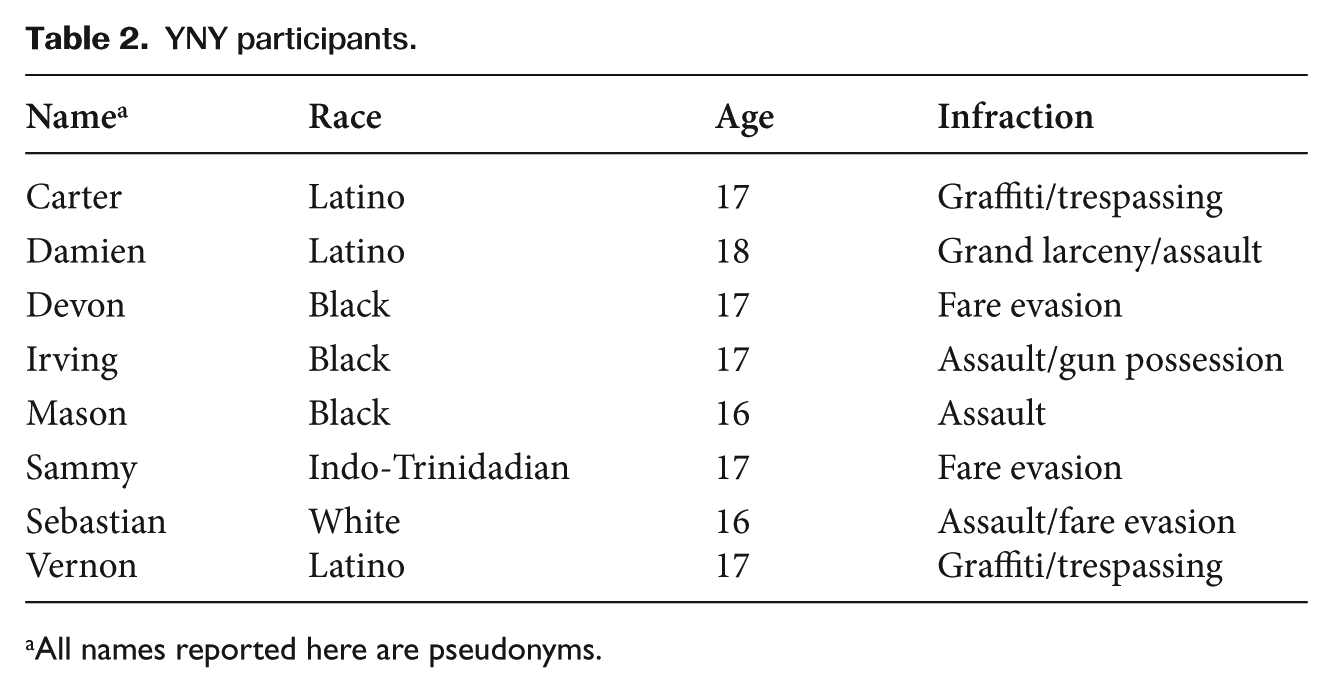
All names reported here are pseudonyms.
Staff participants
YNY staff comprised five core members: two visual artists, a psychotherapist, a social worker, and the co-founder of YNY. The co-founder of YNY and psychotherapist were selected because they were workshop facilitators and could therefore provide detailed descriptions of the program and the participants. The other staff members, a visual artist and social worker, were chosen because they acted as advisors to the program and had substantial arts education knowledge and details about how each participant created their digital story.
Data collection
The YNY program was not originally meant as a research study. Data was collected approximately five months after the initial pilot program was completed. Before data collection, permission was obtained from the Institution Review Board at the University of California, Los Angeles, to conduct the research. All YNY participants and staff gave written consent to use previously recorded workshop sessions and all artifacts produced during the pilot program.
The data was drawn from interviews and a collection of multiple youth-produced artifacts from the program. 1-hour semi-structured interviews were conducted with YNY staff members in the Brooklyn Defenders office. No participants were compensated. Staff members were interviewed in English about the YNY program in general as well as the efficacy of program implementation. No YNY youth participants were interviewed. Secondary data was provided by the Executive Director of the program, including the curriculum, handouts, photographs and video recordings of workshop sessions, as well as student-produced artifacts, such as participant portraits, photographic essays, collaged self-portraits, video diaries, and public art ideas. The final digital stories were constructed from these artifacts.
Data analysis
The YNY staff interviews were recorded and transcribed by me in English. The first phase of data analysis began by assembling the transcripts from staff interviews, as well as curriculum materials, including handouts, PowerPoint presentations, and homework assignments. Having collected the data, I created a priori codes based on three of the 5 Cs’ dimensions: connection, community, and contribution. These codes were used to complete a conceptual analysis of all data sources. Based on this macro-analysis, a focused coding rubric was devised, using the analytical methods similar to Hull and Katz (2006), focusing on ‘turning points’, ‘decontextualization’ and ‘retextualization’ in processing restorative values. I analyzed YNY participants’ digital stories focusing on ‘turning points’ in the processing of their crime related to restorative justice values; these ‘turning points’ were evident through video diary entries and their public art project compositions. Through these analyses, the creation and enactment of the following subthemes were established: taking personal responsibility, expressing a desire to grow and move past the event, and regaining stability in their lives and their communities.
Additionally, I used the framework of Bauman and Briggs (1990), which emphasizes the dual processes of ‘decontextualization’ and ‘retextualization,’ or removing a text (or portion of a text) from one setting and re-centering it in another. This technique allowed me to identify the display and exercise of restorative values through various semiotic systems (oral language, images, music). To look for evidence of restorative values, I examined how and to what effect YNY participants decoded restorative values from RC workshops and repurposed the messages through texts, images, photographs, and music in their final digital stories. For example, Carter decontextualized the restorative values contribution and social responsibility, and recontextualized them within his public art project. Carter’s project used video chat booths to create new and more active connections and understanding between Brooklyn communities that normally have conflicts with each other (see Figure 5). Finally, YNY staff members were asked to interpret the analysis of the digital stories, to increase validity (Lincoln and Guba, 1985).
Results
Each of the participants’ digital stories was linked by a common thread: taking personal responsibility for their offenses, and expressing a desire to grow and move past their criminal offense to gain stability in their lives and communities. The findings are organized around four specific themes that emerged from the digital stories. The themes included: (1) a welcoming and safe environment; (2) critical reflection on sociopolitical processes; (3) accepting responsibility and moving on; and (4) critical social empowerment. These themes build upon each other and underscore the participants’ desire to mature and gain stability in their lives and communities.
A welcoming and safe environment
YNY staff’s first and most imperative task was to create a community in which participants would feel valued, respected, encouraged, and supported. The first workshop activity was to use a video camera and a handout to interview the participant sitting on one’s left. As the camera was passed around, each participant answered very briefly. Participants were encouraged by staff to ask additional questions that did not appear on the handout; each refused. Only Carter, a 16-year-old Latino participant, answered the questions with any reference to the charges he was facing, ‘I got in trouble for graffiti.’ All the other participants made statements such as ‘The court sent me here’, and ‘I got caught.’ In the subsequent activity, participants took portrait shots of each other to practice using the camera. No participant looked directly at the camera. As noted in Figure 1, each participant looked to the side or used a hat to cover most of his face.

YNY participant portraits.
The turning point, as defined by analysis and confirmed by the staff, occurred during the next activity, in which the YNY staff facilitated a word cloud collage. This activity required participants to reflect about three different contexts: the criminal justice system, their communities, and the YNY community. Participants were asked to think about ‘the words they hear about themselves in each context’. Three workspaces were created, with each space representing a different context. Participants were given sponge markers and sharpies and asked to list words that expressed their identity within each context. Next, participants were asked to look at all the word clouds and discuss what they observed. Participants acknowledged that, although the words describing them were dramatically different, the words used within each setting were very similar. Table 3 displays the characteristics that stood out to the participants in each poster.
Word clouds.
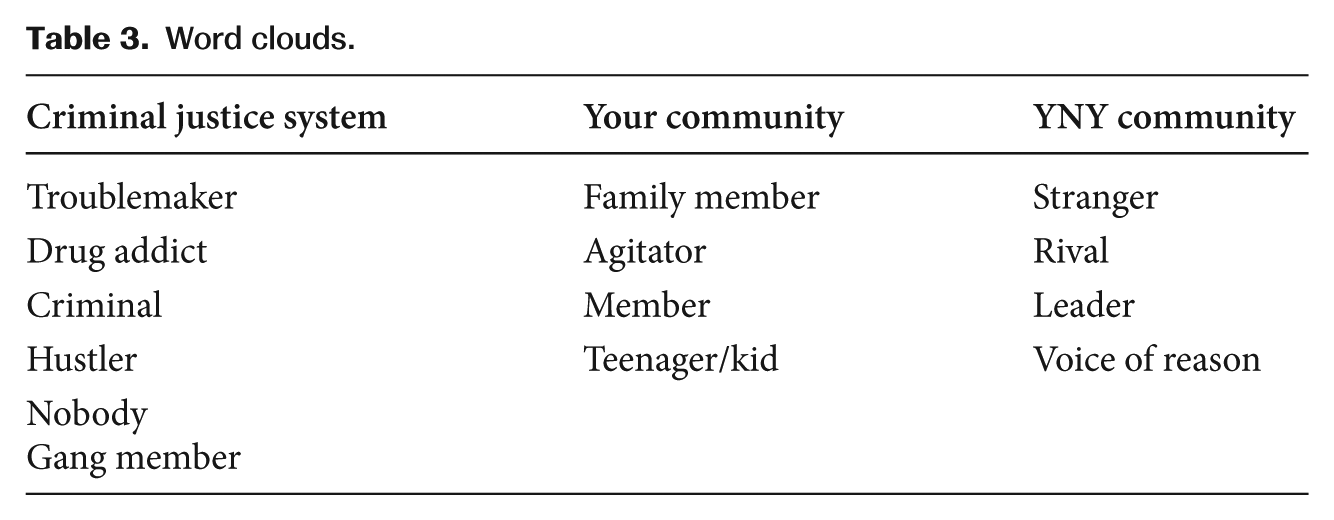
The participants were then asked to repeat the same video interview task as they had at the beginning of workshop and were given the same directions. This time, each participant spoke in more detail, discussed his sentence, and talked about important things in his life, including ‘having a close family’, ‘having things in control’, and ‘having a relationship with God’, which they had not expressed before. The production of the word cloud allowed participants to recognize that they were viewed and described by each context in the same manner, which created a common ground.
Other examples of participants acknowledging the safe space that YNY cultivated were documented in the youths’ video diaries. This recognition represented a turning point in the sense that the participants became more actively engaged contributors to the artistic and restorative justice content of the program, as opposed to merely being passive recipients of the workshop materials. The final video diary of Damien, an 18-year-old Latino participant, followed his journey from his home to the last YNY meeting. Damien’s journey included a ride on the Staten Island Ferry and the subway. In the video, he stated: I’m sad this is the last week. I wish it was longer to make me grow as a person … it showed me a lot. It showed me I could trust people within a couple of hours, it showed that you guys cared about me and you actually had time to put aside for all of us … this is how I am feeling.
Although the program consisted of only six 4-hour sessions, the YNY program created a connection and community with Damien and the other participants.
Critical reflection of sociopolitical processes
YNY facilitators aspired for YNY participants to attain ‘self-awareness’ by reflecting and sharing their experiences within their communities. Most participants were men of color and came from impoverished neighborhoods in Brooklyn (e.g. Brownsville and Red Hook). The ‘World Tour’ video diary activity invited participants ‘to show the essentials of your life’. Participants used video cameras and digital photography to present their lives, and communicate how their environment may have contributed to their crimes.
The video diary of Sammy, a 17-year-old Indo-Trinidadian, is about his home life from a point-of-view shot; it begins with him lying in bed. He walks from the bedroom into the bathroom. The camera refocuses as Sammy looks at himself in the mirror. As Sammy continues to his home, he lets the viewer peek into three different rooms on the top floor of the house, all dark and crammed with beds. The viewer gets the impression that many people live in this household. As he walks down the steps, he zooms in on the broken railing and then to the front door. Sammy walks outside to show the viewer his street. As he begins to walk down the street, the video fades to black. From the very beginning of the video diary, loud music is playing in the background: No Church in the Wild remix (by Rick Ross and Meek Mills) All the lil homies wanna eat … So settle your debts before there’s any regrets Ain’t no church in the wild for a nigga like me … the love flow thin And the pain run deep Cause its blood in the streets See the stains on the money. No love for the weak
Sammy explained he chose the song because ‘it just spoke to me, ya know’, it makes me feel like others know what I am going through … I connect.’ More specifically, he chose the song because ‘my mom is deeply devoted to our Hindu religion … but I don’t buy into it. We live in a place where God can’t save us; I have to be like an outlaw or else I will get caught up.’ For Sammy, his family’s devotion to the Hinduism does not connect with the place he lives; thus, he chooses a different path. That, he admits, got him into trouble.
Irving, a 17-year old black participant, used digital photography to articulate his response to his feelings about the police presence in his life. His first photograph was taken on the subway on the way to a YNY workshop; his second was taken on a YNY field trip to the Brooklyn Museum of Art (Figure 2).
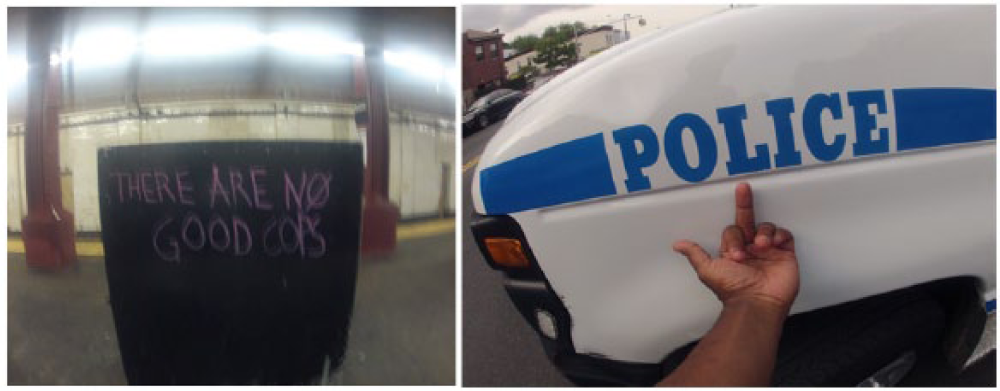
Irving’s photographs.
When Irving was asked why he chose those pictures, he responded, ‘The NYPD keep violating my rights. They target minorities, specifically Blacks and Latinos. I don’t like it, Babylon
1
you know so I don’t like them. And there ain’t nothing we can do because they got all the power.’ In relation to how this perpetuated his crime, Irving stated: I learn the hard way. I know I can’t carry anything on me … ’cuz the cops are always there … always watching, always trying to get me on some shit. But I guess by learning the hard way I accept things different in life. I can’t be in places the cops are gonna be because I get caught up. I can’t be doing nothin bad ‘cuz I know I am a target.
Many participants talked about their constant run-ins with the police, even when they were not doing anything wrong, and specifically referencing the ‘stop-and-frisk’ program in New York City. ‘Stop-and-Frisk’ is a program within the New York City Police Department, in which police officers stop and question pedestrians and frisk them for weapons and other contraband (see New York Civil Liberties Union, nd).
Accepting responsibility and moving on
In Workshop 5, after reflecting on the concept of choice, participants were asked to think about animal traits that they thought represented facets of themselves that needed development, attention, discipline, and care. YNY created this activity for participants to learn about different character qualities and what it takes to create a powerful future. The objective was to learn to live powerfully in the moment while remaining aligned with social morals and community values, which forms a young person’s perspective of life and relationship to his potential. Participants also created video diaries explaining their creations. The following quotes and pictures represented ‘turning points’ for Mason and Sebastian. Mason, a 16-year-old black participant, acknowledged wrongdoing in his third video diary, where he stated: Yo, I thought my life was game over because of my record. But you guys are teaching us, even if we got caught up in their [police] net, we still have to show up and take responsibility for actions. So in my picture the black represents the dark side of me, and the gold represents the light side of me. I have a vision and now I just gotta go for it. I’m trying to use my wings to rise above it all. (see Figure 3)

Mason’s animal metaphor.
Sebastian, a 16-year-old white participant, also accepted responsibility for his misbehavior and understood how important the YNY program was in processing these new ideas: The eagle represents my strength, and the wolf represents my mind because he is sharp … Through the program I have learned responsibility because I had to be committed to this program. Because if I do this program, my record will be clean and I will have a new life. (see Figure 4)
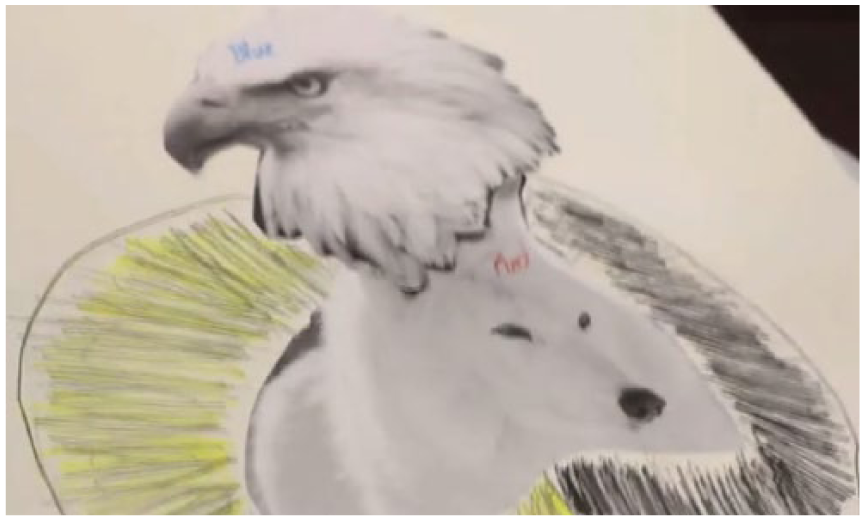
Sebastian’s animal metaphor.
Not all participants made these statements in relation to their animal metaphor. For example, Damien’s was best articulated in his third video diary in the fourth workshop: If I want to move forward, I have to realize my mistakes and choices, accept them and know I’m the one responsible for my mistakes … if I don’t I am going to be a low life and that’s not how I was raised. I’m not a bad kid … I just made bad choices and a lot of people misunderstand that.
Critical social empowerment
To emphasize the concept of contribution and reconnection with the community, each participant created a public art idea using eCollages; eCollages featured photographs produced by the digital media software, Adobe Photoshop. The summaries and pictures of the public art project ideas submitted by Carter, a 17-year old Latino participant, and Sammy, a 17-year-old Indo-Trinidadian participant, are shown in Figures 5 and 6.

Carter’s art project ‘Beyond Territories’.
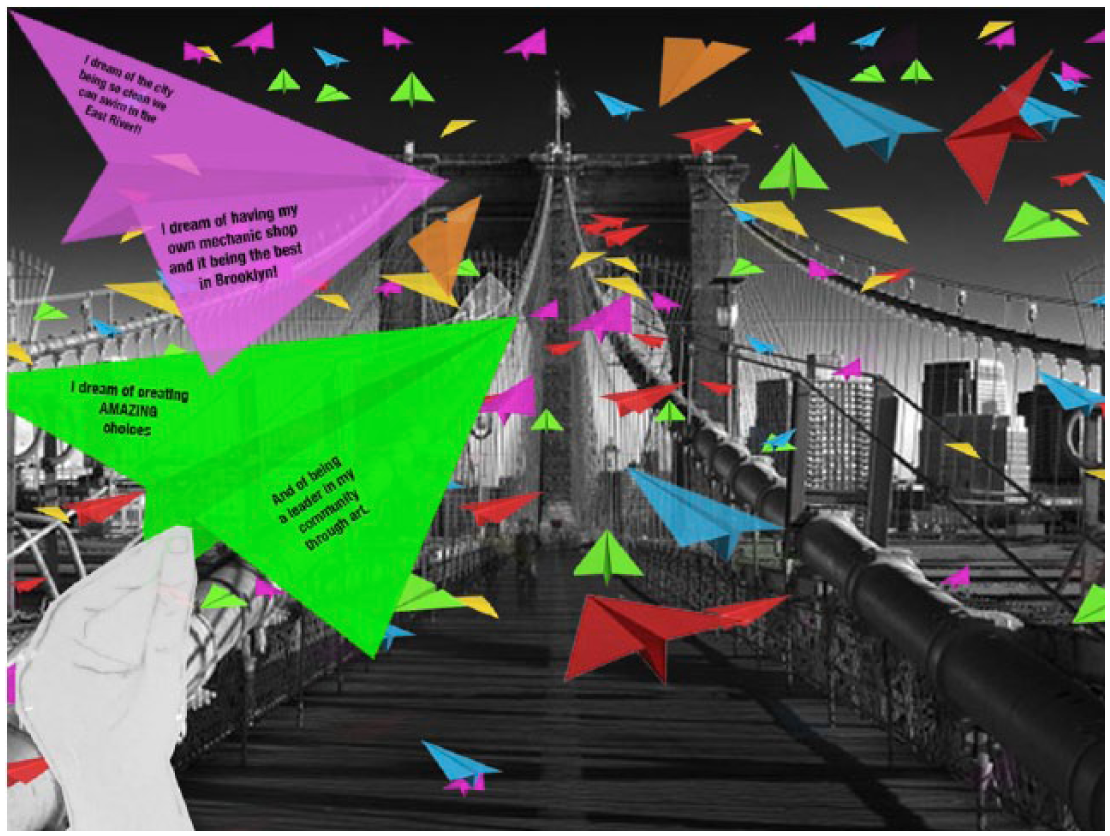
Sammy’s art project ‘Flying High’.
‘Beyond Territories’ by Carter
Carter’s personal turning point occurred while he was creating and presenting his public art projects. Although Brooklyn is the most populated borough in New York City, Carter said the divisions are based on ethnicity, gangs, and class, which can divide the community. He expressed a desire to combat these social issues by creating a technology-based art project in which different Brooklyn neighborhoods would have video chat booths set up for individuals to both record and watch videos. The project aims to create positive connections and understanding between communities that may normally have conflicts with each other. Carter asked some questions like: ‘How old are you?’; ‘What is your favorite memory?’; ‘Do you value your family?’; and ‘What do you live for?’
‘Flying High’ by Sammy
Sammy’s project (see Figure 6) aimed to bring the different ethnic communities in Brooklyn together to celebrate everyone’s dreams and inspire action to make the dreams into reality. Each ethnic community in Brooklyn would receive a paper airplane of various colors on which to write their individual goals. Next, all residents would come together to release the planes into the air simultaneously in a public space. Sammy stated: The resulting flight of color will be a memorable spectacle that the community can remember together. People are then free to take home someone else’s dream to inspire them. The paper planes could be made out of edible paper so that they are biodegradable and that the birds can eat them. That way, anything missed in the cleanup will not pollute the city.
During the final exhibit, everyone who attended was asked to write his or her dreams on a paper airplane, and, at the end of the show, to throw their planes in the air (see Figure 7).
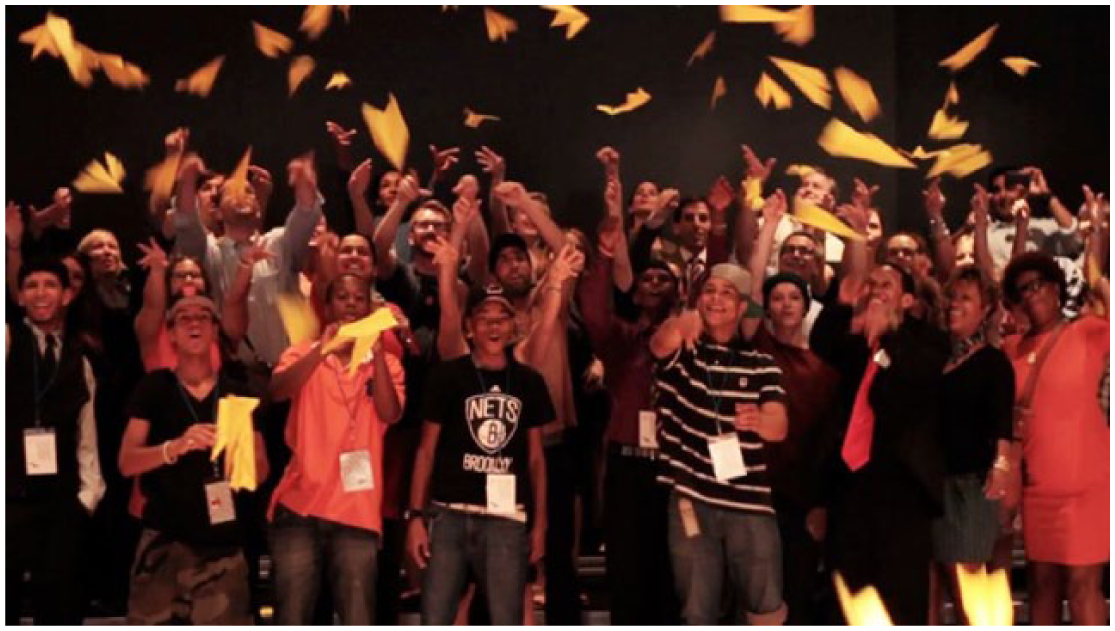
Flying high implementation.
Discussion
This study examined the use of DST in a media-arts restorative justice program, YNY, to assess how juvenile participants in the program process and adopt restorative justice values. The objectives of this study were twofold: to develop a better understanding of how participants process restorative justice values through RC and to investigate the combination of media-arts based practices and RC techniques. Findings from this study demonstrate that the use of DST within the restorative process constituted an effective intervention. Effectiveness, as defined by YNY, is the process of juvenile offenders coming together as a group, reflecting on the circumstances surrounding their crime, assuming accountability for their crime, and finding ways to empower themselves and their communities.
YNY’s use of multimodal tools, such as sound, image, and text was emotionally, socio-critically, and culturally powerful from the beginning to the end of the YNY program (Nixon, 2008). Creating a word cloud about how different environments perceived participants fostered a sense of community among the group. This activity established a ‘collective creativity’, which supported the foundations of a restorative environment – respect, interconnectedness, and participation (Cropley, 1999). Within this environment, participants had the freedom to be themselves, take risks, express their creativity, voice their feelings and opinions in the decision-making processes, and rise to new challenges (Jennings et al., 2006). According to Braithwaite (1989), this type of social support allows offenders to feel understood, and thus less likely stigmatized, leading them to work toward strengthening and restoring the community.
YNY values enhance the offenders’ understanding of their communities, including potential institutional and bureaucratic structures. The ‘world tour’ project allowed participants to use music, digital photography, and video to explore their communities and share their lives with other participants. Within this portion of YNY youth’s digital stories, a predominant theme was their dislike and lack of confidence in law enforcement. Research across the social sciences indicates a general lack of confidence in the fairness of the criminal justice system, particularly among minority communities (McCord et al., 2001). This lack of confidence is due, in part, to the fact that law enforcement disproportionately targets people of color for investigation, as illustrated by the ‘stop and frisk’ example. Researchers conclude that disparities exist between minority and non-minority juvenile offenders at all points within the juvenile justice system (Abrams et al., 2008).
According to Bazemore and Stinchcomb (2003), it is essential for the identity of the lawbreaker as an individual and a valued member of the community to be separated from the disapproval of his actions. The use of eCollages assisted participants in understanding that they represent more than just their crimes. By creating photomontages using various pictures of themselves, animals, and drawings, participants were able to piece together the different parts of their personalities. This process enabled participants to separate themselves from being identified only as criminals. Participants identified their strengths and weaknesses, and focused on how they could create a better future for themselves. This process allowed participants to shed their negative identity and to begin to move toward a pro-social identity, wherein they could begin to take action to repair the harm and the relationships that were damaged by the offense (Rodriguez, 2007).
The culminating aspect of the YNY program and the centerpiece of the participants’ digital stories involved developing a public art project. These public art projects took many different forms, from digital mixed media to a performance piece. All the participants in YNY expressed the main themes of contribution and social responsibility leading to engagement in community action. Through the YNY program, participants began to comprehend and value the formation of stronger community partnerships as a mechanism that could better serve the needs of the urban areas in which they lived. The public art projects show various ways in which one-time offenders are taking the action required to repair some of the harm caused by their crime (Ashley and Stevenson, 2005). The public art projects empowered offenders to remedy the harm they inflicted on others and to begin a rehabilitative and re-integrative process by connecting with the community. The participants’ final public art ideas embody YNY’s ability to promote participants’ understanding of restorative values.
Conclusions
This exploratory study of the YNY program offers glimpses into the restorative justice process from the perspectives of the youth and was cross-validated by key stakeholders. The YNY program demonstrates how participants engage with the restorative values, such as participation, respect, interconnectedness, accountability, empowerment, and hope with their art and other youth. The findings suggest that applying restorative principles and practices may provide a useful framework for meeting the needs of youthful offenders by holding them accountable for developing a heightened sense of empathy and respect. The findings further suggest that practitioners of such programs may want to consider developing other programs that foster empathy among victims through media-arts projects.
The DST process allowed offenders to take personal action and responsibility and to raise awareness of their capabilities to cope with adversity in a variety of ways. First, participants used their narrative voices to create a discourse about their crimes, their impact, and ways to improve their communities. For YNY youth, the multimodal options created a powerful form of communication and a means of representing themselves, the community and their social worlds (Hull and Katz, 2006). Second, the process of creating multiple artifacts to build a digital story assisted YNY participants in processing restorative values. The creation of digital stories promoted the decontextualization and retextualization of restorative justice values. I believe that the court system should continue to develop and implement media-arts programming for juvenile offenders to enable them to develop social and personal responsibility and to become productive members of our society.
A major limitation of this study was that data collection occurred several months after the pilot program had been completed. As a result, staff members had moved on to working on other projects and not all of the artifacts produced by the subjects were available for collection. Furthermore, youth participants were not available to be interviewed to provide a more in-depth explanation of their work. Nevertheless, this study does offer some initial insights into the processes and benefits of restorative justice conferencing.
Because the combination of restorative justice and media-arts practices is a fairly new type of intervention program for juvenile offenders, there are many opportunities for YNY and this type of programming to grow and expand. Future studies should include an examination of the short- and long-term impacts of the program on youth participants. Further, the choices that these youth made in their digital stories are important for meaning making and defining their values (Zittoun, 2006). Future studies should incorporate the use of ‘think-alouds’, written reflections, and small group interviews with the participants, to gain a deeper understanding of participants’ thought processes and meaning making through their digital stories.
Footnotes
Funding
This research received no specific grant from any funding agency in the public, commercial, or not-for-profit sectors and there is no conflict of interest.
Notes

Biographical Note
Jordan Morris is a Doctoral Candidate in the Social Welfare Department at the University of California, Los Angeles. Broadly, her research interests focus on the use of narrative technology to enhance the social identity of ethnic minorities. Her dissertation investigates the impact of narrative technology on the identity development of youth offenders in a restorative conferencing program in Brooklyn, NY. Currently, Jordan is working in collaboration with the Improvement by Design Lab (IBD) in the UCLA Graduate School of Education. Here, her work focuses on how schools integrate technology into their classroom to improve teaching and learning, and the effectiveness of e-portfolio platforms on student learning and faculty teaching in university settings.
Address: University of California, Los Angeles, 337 Charles E. Young Dr. East, Los Angeles, CA 90095, USA. [ email: