



Abstract
In this article, the author presents a multimodal discourse analysis of a digital video composed by five students (ages 11–12) in an urban, public-school classroom. The focal mockumentary video is distinctive in that it is difficult to interpret and has an artistic quality that turns the process of meaning-making back on itself, resisting the very idea of a single, determinable meaning. He examines this phenomenon as the sliding of the signified in the students’ video (as multimodal discourse), focusing on the ways in which the students tapped into discursive agencies that rupture meaning-making. In particular, he analyzes how visual and spoken signifiers are related or coordinated with one another across the film in the creation of multimodal discursive effects such as floating signifiers, networks of metonymic potential, and signifier condensation complexes. This study thus offers conceptualizations of multimodal discursive units that can be used to interpret and analyze the interactions of visual and spoken signifiers in films and digital videos.
Keywords
Introduction
This article features a multimodal discourse analysis of a digital video composed by five students (ages 11–12) in an urban, public-school classroom. The focal video, ‘Child Stars: The Life of Johnny Stars’, had the characteristic of markedly resisting coherence and a clear, concise, determinable meaning, thus coming across as absurd and ambiguous. The purpose of this analysis was to determine the multimodal signification processes that produced the slippage of meaning that was evident in the focal video. In order to do so, I turned to poststructuralist theorists of signifier operations in discourse (Derrida, 1981; Lacan, 1993[1981], 2002[1966]; Laclau and Mouffe, 2001; Metz, 1982; Silverman, 1983), who have referred to this slippage of meaning as an inherent impossibility of signification, non-closure between the signifier and signified, or the ‘sliding of the signified under the signifier’ (Lacan, 2002[1966]: 145).
Since De Saussure’s (1983[1916]) theorization of the signifier and signified as two aspects of the sign, poststructuralist theories of sign operations have discussed the slippage of meaning, or non-closure between a signifier and signified, noting that there is no ‘transcendental signified’, or signified that is independent of the constant interplay of signifiers and signifying chains that produce the various possible signifieds. Lacan (2002[1966]) has referred to this impossibility of completion in communication or meaning-making as an inherent impossibility of all signification, noting the ‘resistance of signification as constituted in the relations between signifier and signified’ (p. 155). The signified thus ‘slides’ under the signifier, remaining elusive and indefinite, since the signified is in fact another signifier, resulting in an indefinite deferral of the signified or situation in which ‘no signification can be sustained except by reference to another signification’ (p. 141). From this poststructuralist perspective on significations, since meaning is indeterminate, then the analysis of signifier operations or signification can proceed by looking at the relations or interplay amongst signifiers.
Scholars have begun to gain insights into the multimodal sign-operations at work in youth-composed films in pedagogical settings by looking closely at how signs are produced within and how they interact across the films (Burn, 2003, 2009; Burn and Parker, 2001; Hull and Nelson, 2005; Mills, 2011; Ranker, 2008, 2015). For example, Hull and Nelson (2005) closely examined the sign-interactions in a creative, multimodal narrative in a youth’s digital video composition. They focused on specific frames of the film in order to examine the interaction of language-based, image-based, and music-based signs, arguing that it is within these interactions that the creative power of multimodality lies. Burn (2009) and Burn and Parker (2001: 161) examined how, in youths’ digital videos, signs are arranged as syntagms (groups of signs) across both diachronic (across time) and synchronic (occurring at the same time or within a frame) dimensions, referring to synchronic syntagms and diachronic syntagms, or a ‘sequence of meaning produced by the temporal flow of images one after another’.
Mills (2011) examined the film-making practices of young students creating digital videos, focusing her study on the processes of transmediation (Siegel, 1995; Suhor, 1984), or movement of semiotic material across modes, noting that transmediation involves transformation of knowledge by degrees, and is a ‘process of continual adaptation of intentions for representing knowledge in response to the possibilities and limitations of sign-making systems’ (Mills, 2011: 58). In a previous study of student-video composing (Ranker, 2008), I looked closely at how students drew upon semiotic resources from across multiple modes in their digital video production, integrating them and coordinating these resources with one another according to the medium and social purposes. I have also looked specifically at the type of signifier connections evident in a youth-composed artistic video, drawing attention to how these signifier connections could be characterized along a continuum of divergence (in which case the signifiers do not anchor one another and are left to ‘float’) and convergence (fixation of potential signifieds or meaning potentials) (Ranker, 2017).
Post-Structuralist Theories Of Signifier Operations
Contiguity is a concept used to describe the relationship of two or more signifiers along a signifying chain (chain of signifiers), or a state of signifiers appearing next to one another or in proximity with one another within a signifying network (Jakobson and Halle, 1971; Lacan, 1993[1981]; Metz, 1982; Silverman, 1983). Metz (1982: 201) describes how the concept of contiguity identifies a relation of signifiers that are in ‘direct contact’ with one another. Contiguities occur constantly in discourse as signifiers occur together or come into contact with one another as part of a given utterance or arrangement of signs. These contiguities are of particular importance to the operation of discourse since they create the potentials for several types of meaning shifts, changes, substitutions, and replacements to occur.
In her discussion of the film, The French Connection I, Silverman (1983: 112) offers an example of a relation of contiguity between the signifiers of one of the main characters and a car, a Lincoln Continental, that occurs in an early scene and then recurs throughout the film, noting that ‘the adjacency of man to machine in this scene permits one subsequently to evoke the other.’ Silverman describes how this spatial contiguity (occurring on the same screen and in the same film shot or scene), ‘in which both terms are present, and the basis for the relationship between them established … each derives value and significance from the initial relationship of contiguity.’ Because of their initial and recurring contiguity and occurrence throughout the film, this car-image-as-signifier takes on some of the signification of the character – this semiotic action would not have been possible had not the signifiers of the car and of this character been contiguous, or co-present such that their potentials for discursive interaction could begin to work. In addition, Metz (1983) discusses the work of contiguity in the signification of ‘Bordeaux’ as a geographic region and as a red wine, noting how this meaning shift (from the region to the wine) was made possible by the co-presence, or contiguity, of the two signs as they co-occurred through geographic contiguity (signs occurring in conjunction with the same geographic place). It is through the material co-presences as uses of the signs in contiguity with one another that ‘Bordeaux’ comes to refer to the wine.
As evident in these examples, relations of contiguity between signifiers are important because they lay the foundation for metonymic interactions between signifiers. Lacan (1993[1981]: 219) notes that metonymy is associated with ‘relations of contiguity, alignment, signifying articulation, syntactic coordination’. Depending upon the discursive work that the signifiers are engaging in, this attention to arrangement is important since signifiers that are brought into contiguity with one another can enter into a metonymic relation whereby one signifier can come to take the place of or take on part of the signifying potential or another signifier. Silverman (1983: 112–113) describes ‘the “classic” metonymic situation, in which one term stands in for another to which it is in some way contiguous’. Thus, one way that scholars have examined the interaction of signifiers in contiguity with one another is through the concept of metonymy, drawn from linguistics and rhetoric, and applied to discourse studies (Burke, 1941; Lacan, 1993[1981], 2002[1966], Metz, 1982; Silverman, 1983). Silverman (1983: 87) notes that metonymic interactions are ‘central to any investigation of discourse since they orchestrate the interactions of signifiers and signifieds’.
Lacan (1993[1981]: 220–221) explains that metonymy ‘involves substitution for something that has to be named – we are in fact at the level of the name. One thing is named by another that is its container, or its part, or that is connected to it.’ Although contiguity can enable this type of interaction between signifiers, Metz (1982: 198) notes that ‘metonymy presupposes contiguity, but not all contiguities are metonymic’. Not all contiguities result in the transfer of the signifier that is seen in metonymic interactions. Lacan (1993[1981]: 228) provides an example of metonymy in Tolstoy, in which a reduction of a figure can stand for the entire figure:
We can also see metonymy in certain passages in Tolstoy, where whenever a woman approaches you see the shadow of a fly, a spot on the upper lip, etc., emerge in place of her – the metonymic process of a great stylist.
Lacan (1993[1981]) also draws upon the concrete speech of children as prime examples of the action of metonymy amongst signifiers. He presents the example of the speech of a 2½-year-old boy who refers to his mother as ‘my big girl full of bottom and muscles’. In this instance, features of the mother (her bottom and muscles as signifiers) have taken on the signifying charge of ‘mother’:
It’s clearly as a function of his early metonymic abilities that at a certain moment the bottom can become an equivalent of the mother for him … It’s on the basis of the metonymic articulation that this phenomenon is able to take place. The coordination of signifiers has to be possible before transferences of the signified are able to take place. (p. 229)
These examples resonate with Burke’s (1941) assertion, from the rhetorical point of view, that metonymy essentially involves a reduction. We can see further into the depths of metonymy by taking up Lacan’s (1993[1981]) reading of Freud (1999[1900]), through which he asserts that the action of the unconscious and the operations of discourse operate on the same plane, operating as functions of the signifier: ‘the unconscious is neither the primordial nor the instinctual, and what it knows of the elemental is no more than the elements of the signifier’ (p. 161). Freud elaborates on this point:
It is the whole structure of language that psychoanalytic experience discovers in the unconscious. This is to alert prejudiced minds from the outset that the idea that the unconscious is merely the seat of the instincts may have to be reconsidered. (p. 139)
Lacan (1993[1981], 2002[1966]), drawing upon Freud, thus puts the unconscious and discourse on the same plane, and examines discourse through the operation of signifiers. Lacan notes that the unconscious acts like discourse – elements, characters, and images in dreams can thus be read as signifiers (signifiers within psychic processes). This linkage to Freud also makes it possible for Lacan (1993[1981]: 221) to theorize that metonymy and Freud’s (1999[1900]) concept of displacement perform the same function. The two are linked, in part, since they both operate according to the principle of contiguity (Silverman, 1983: 87). In addition, they both involve a transfer of significatory potential or charge from one signifier to another. Freud uses displacement to describe situations where the psychic charge is transferred from one figure to another, and interpreted into a signifying framework. Displacements are then instances where the signifying charge (value, significance in discourse) is transferred from one signifier to another (p. 91). Like metonymy, displacement occurs and operates through the unconscious. In Freud, displacement is a primary process, a process at the unconscious level that works to undo itself in an effort to censor by shifting the meaning centers onto signifiers of less value and significance, rather than those that would be recognized by the conscious mind as needing to be censored or repressed. Freud (1999[1900]: 235) notes that displacement
on the one hand strips the psychically valuable elements of their intensity, and on the other creates new values … if this is what happens, then a transference and displacement of the psychical intensity of the individual elements has taken place. (emphasis in original)
Freud’s (1999[1900]) concept of condensation can also be used to describe the relations and interactions between a group of signifiers. Within a Lacanian reading of Freud, condensation can thus be understood as a reduction of the number of focal signifiers in the dream content since each focal signifier takes on elements of multiple other signifiers, which serves to condense the dream content. Silverman (1983: 91) refers to the process of condensation as a process in which ‘the part stands for the whole, a single figure represents a diverse group, and geographically remote locations converge in a composite image.’ Freud (1999[1900]: 226) further describes condensation as the ‘formation of new unities (collective figures, composite structures)’.
Background
Context
In this article, I present a multimodal discourse analysis of a focal film, ‘Child Stars: The Life of Johnny Stars’. This analysis was drawn from a larger qualitative case study (Glesne, 2016; Merriam, 2008) of the digital literacies of a class of 11- and 12-year old students composing short digital videos alone or in self-selected groups. I drew this video from the larger project because of its particular salience for illustrating the discursive signification processes associated with slippages of meaning. ‘Child Stars: The Life of Johnny Stars’, the focal discourse sample for this multimodal analysis, is a mockumentary-style film created by Megan (age 12), Tracey (age 11), Eric (age 12), Oliver (age 12), and James (age 11), who were fellow students in the focal classroom (all names used in this manuscript are pseudonyms). The focal class was a multi-age, alternative English/Language Arts class that the students attended for one class period each day. During the focal project (which was an informal and exploratory project), students produced short films using iMovie, according to their own choice and direction, while the teacher and I assisted them with any technical and logistical aspects. This was not typical of the students’ work; it was a special project that offered open-ended and unstructured opportunities to make videos, with students working on them for a one-hour session each week over the course of 10 weeks.
There were no lessons or planned activities, and the teacher did not direct the students’ work in any way by providing designed or directed experiences; their only activity during the project was to use the allotted time as time for directly composing the video (which also involved filming). (Students had worked with iMovie in another class under more directed circumstances, and thus had had experience composing with the program and with its basic functionality.) I was present during the project as a participant observer, helping the students and teacher with technical aspects of recording and digital composing, while also observing, taking field notes and gathering other relevant documents (such as digital files of the students’ videos and screenshots of the class blog) that I used to contextualize my analysis of the focal discourse sample (the focal film).
During the filming of the video, the students were able to go to various locations throughout and around the school in order to film their scenes. A unique feature of this project was that the class kept a blog, and the completed videos were posted to the blog and viewed by everyone in the class. The fact that there was an actual audience within the class gave a sense of purpose to the film and audience awareness. The students were given no specific directions and had no requirements for the film, other than posting it on the class blog for others to watch. The group of students who composed ‘Child Stars: The Life of Johnny Stars’ did not extensively plan out the video or write a script to perform and record. Instead, their composing process was emergent, spontaneous, and unplanned. I did also ask the students questions about their composing – however, this data source proved not to be useful since the students preferred not to talk about their video, not always having much to say about it reflectively, preferring instead to engage in work on it. They thus allowed for an unplanned, emergent process that enabled unconscious processes and elements to emerge.
Analysis
I developed a form of multimodal analysis that involved first multimodally transcribing or representing the entire film scene by scene across the following modes: speech, action, and the visual mode (see Tables 1–5 for examples of transcriptions). These tables represent these modes and the scenes of the film across the following elements: speaker/character, speech, action, and screen shots (multiple screen shots and repeated viewings were used for analysis of each scene). I then identified and isolated individual observable signifiers (words and images) from across modes that were materially inscribed in the film. My conception of a signifier draws upon Saussurian and post-Saussurian concepts of the signifier as one component of the sign (Barthes, 1977[1964]; De Saussure 1983[1916]); Lacan, 2002[1966]). The signifier has been characterized across various modes as a ‘minimal significant unit’ (Barthes, 1977[1964]), or ‘slice of sonority, visuality, etc.’ (p. 48) that can be ‘endowed with one meaning’ (p. 39). Examples of the focal signifiers that I identified included spoken signifiers (such as ‘Johnny Stars’, ‘tree’, ‘halls’) and image-based signifiers. The image-based signifiers were inscribed into the video and were apparent in the scenes. For example, significant images-as-signifiers that surfaced in the analysis included images of the following: hallways, a tree, and the characters that the students played.
Introductory segment.

Interview with Johnny’s Stars’s psychologist.
Narrator details about Johnny.
Dramatic interlude.

Final scene under the tree, where Johnny died.
My analysis drew upon a poststructuralist perspective on significations, in which, since meaning is indeterminate, the analysis of signifier operations or signification can proceed by looking at the relations or interplay amongst signifiers (Barthes, 1977[1964]; Lacan, 1993[1981], 2002[1966]; Metz, 1982; Silverman, 1983). As Lacan (2002[1966]: 145) notes: ‘signifier-to-signifier correlations provide the standard for any and every search for signification.’ I thus analyzed the relations between the identified focal spoken signifiers (intermodal relations) as well as relations between spoken and image-based signifiers (cross-modal relations), characterizing their potential signifieds by examining the signifier relations according to dimensions that have been theorized for this purpose (Barthes, 1977[1964]; Lacan, 1993[1981], 2002[1966]; Metz, 1982; Silverman, 1983). I was particularly interested in discursive agencies that operate through and with multimodal discourse in ways that are part of the unconscious, and in ways that undermine meaning-making. I thus focused my analysis of signifier-to-signifier connections on the identification of processes and occurrences of the following discursive agencies: metonymy (Lacan, 1993[1981], 2002[1966]; Metz, 1982; Silverman, 1983), condensation (Freud, 1999[1900]; Lacan, 1993[1981], 2002[1966]); displacement (Freud, 1999[1900]; Lacan, 1993[1981], 2002[1966]), floating signifiers (Laclau, 1996; Levi-Strauss, 1987) and overdetermination of signifiers (Freud, 1999[1900]).
Summary of the focal film, ‘Child Stars: The Life of Johnny Stars’
Although never featuring an image of Johnny Stars himself, ‘Child Stars: The Life of Johnny Stars’ (length: 1 minute, 32 seconds) focuses on the fictional, tragic life of Johnny Stars, a ‘child star’ who committed suicide by jumping off of a tree just outside the school that he attended. We are given little information about Johnny Stars, other than that he is variously described as both a child and a 24-year-old man who lived across the street in a run-down house. The casting for the film was as follows: Megan, as a narrator/show host, and later a griever of Johnny Stars in two scenes; Tracey, as a character referred to as Ivo (a griever of Johnny Stars – either a friend or his sister); David (a teacher’s assistant), as Johnny Stars’s psychologist; James, playing himself or an unidentified character; Eric, as narrator; and Oliver, as Johnny Stars’s father in one scene and an unknown character in another.
Segment one
The first segment features the host, played by Megan, who dramatically delivers the line to start the ‘documentary’: ‘Today, we explore the life of Johnny Stars.’ Then, in the second segment of the introduction, Oliver, playing Johnny Stars’s father, is walking down the hallway, while Eric, as narrator, says (about Johnny Stars), ‘He often saw dead people and such wandering the halls of this school.’ Next comes an interlude in the hallway in which Tracey, playing an unknown character, is walking down the hallway with James, who, when a hat falls from the ceiling and onto the ground, puts the hat on his head. Tracey then says, ‘Child superstar and other things such’. Table 1 is a multimodal representation of the three parts of this segment of the film, with columns to indicate the following: who is speaking; the actor’s spoken lines; the action; and a screenshot from the segment (acknowledging the limitations of screenshots for analyzing a sequence of moving images).
Segment two
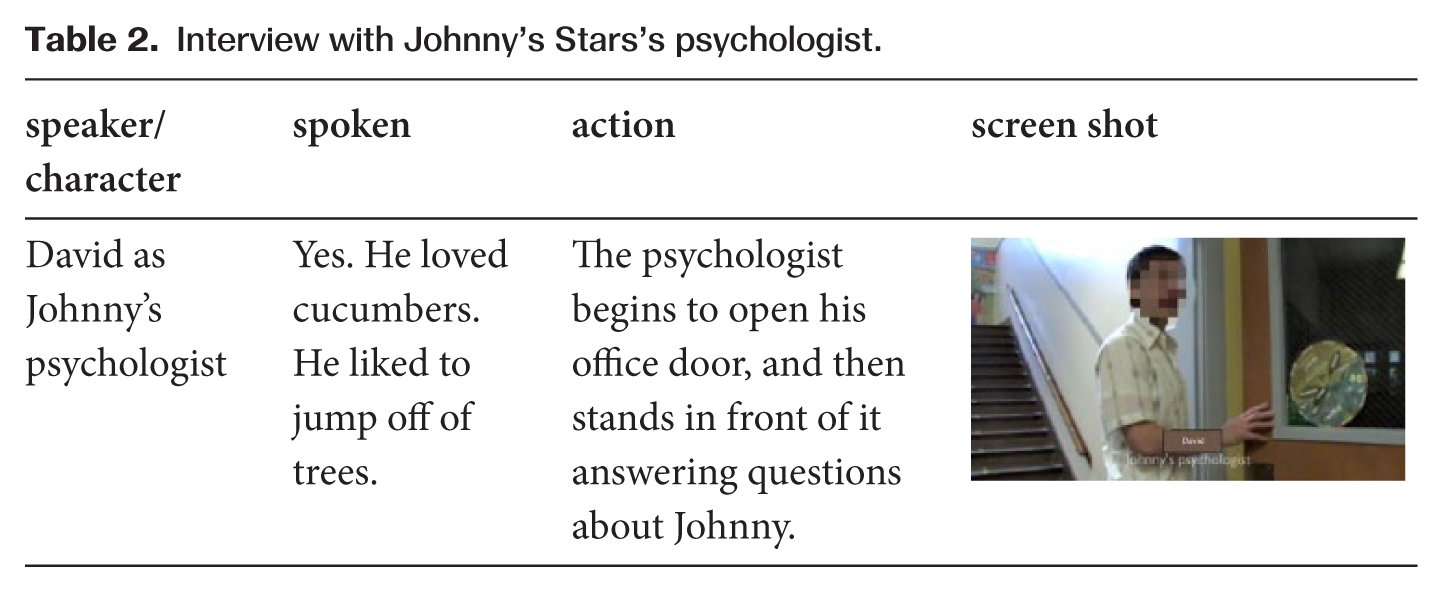
The next segment features a brief sample of the host interviewing Johnny’s psychologist, who is played by David, which takes place in front of the psychologist’s office door. The psychologist notes: ‘Yes, he loved cucumbers. He liked to jump off of trees.’ Table 2 is a multimodal representation of this third segment featuring the interview with the psychologist.
Segment three
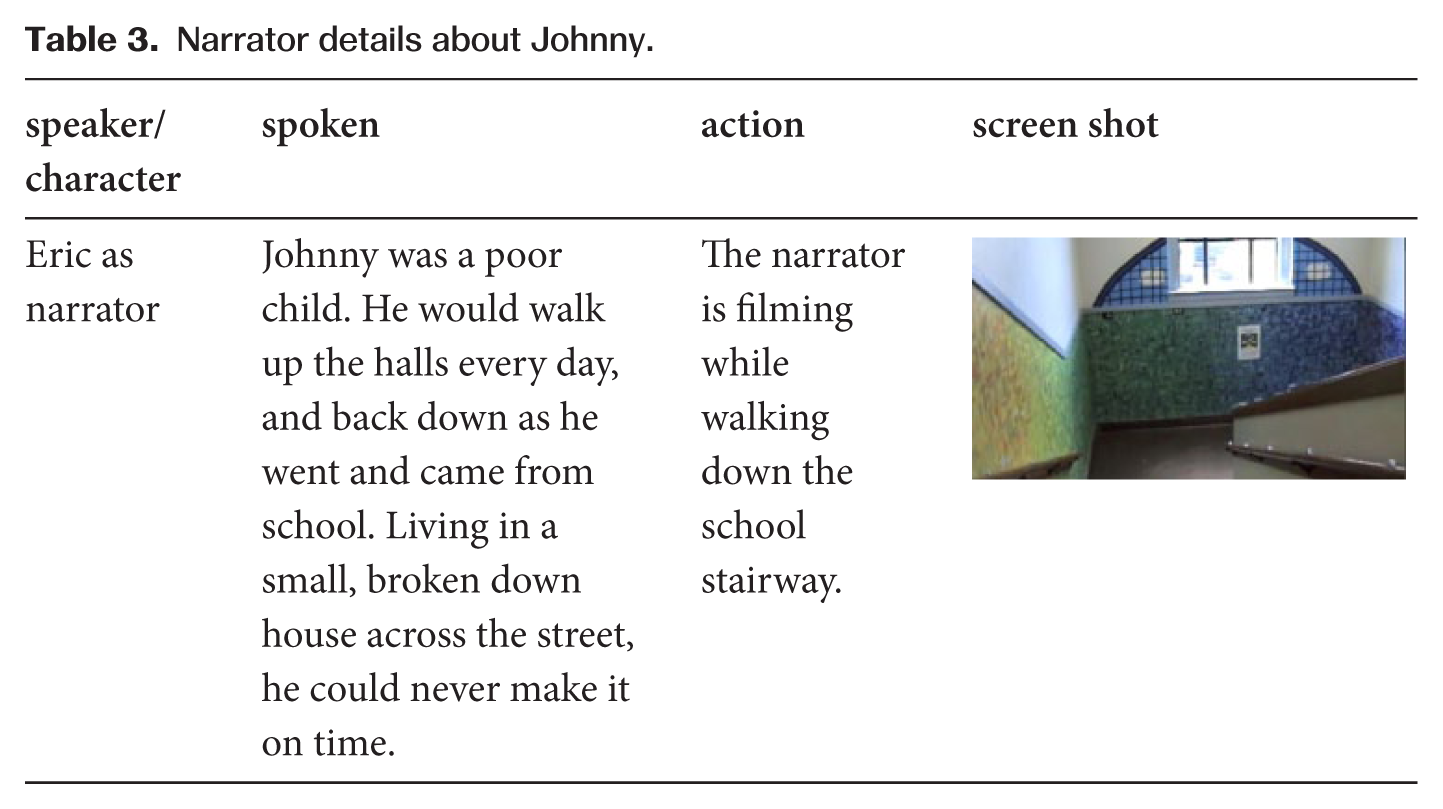
The third segment of the film consists of the narrator providing additional details about Johnny, delivering his lines as he holds the camera and walks down the hallway: ‘Johnny was a poor child. He would walk up the halls every day, and back down as he went and came from school. Living in a small, broken-down house across the street, he could never make it on time.’ Table 3 is a multimodal representation of this third segment in which the narrator provides details about Johnny.
Segment four
Next comes a dramatic interlude in which Megan is playing an unknown character (most likely a friend of Johnny Stars or his sister), accompanied by Oliver, who is playing Johnny Stars’s father. As they walk down the hallway side by side, Megan’s character, crying and wiping her eyes, dramatically delivers the following line: ‘He was jumping out of a tree and I couldn’t stop him – I just couldn’t! Could you please stop filming now?’ Table 4 is a multimodal representation of this dramatic interlude in the hallway.
Final segment
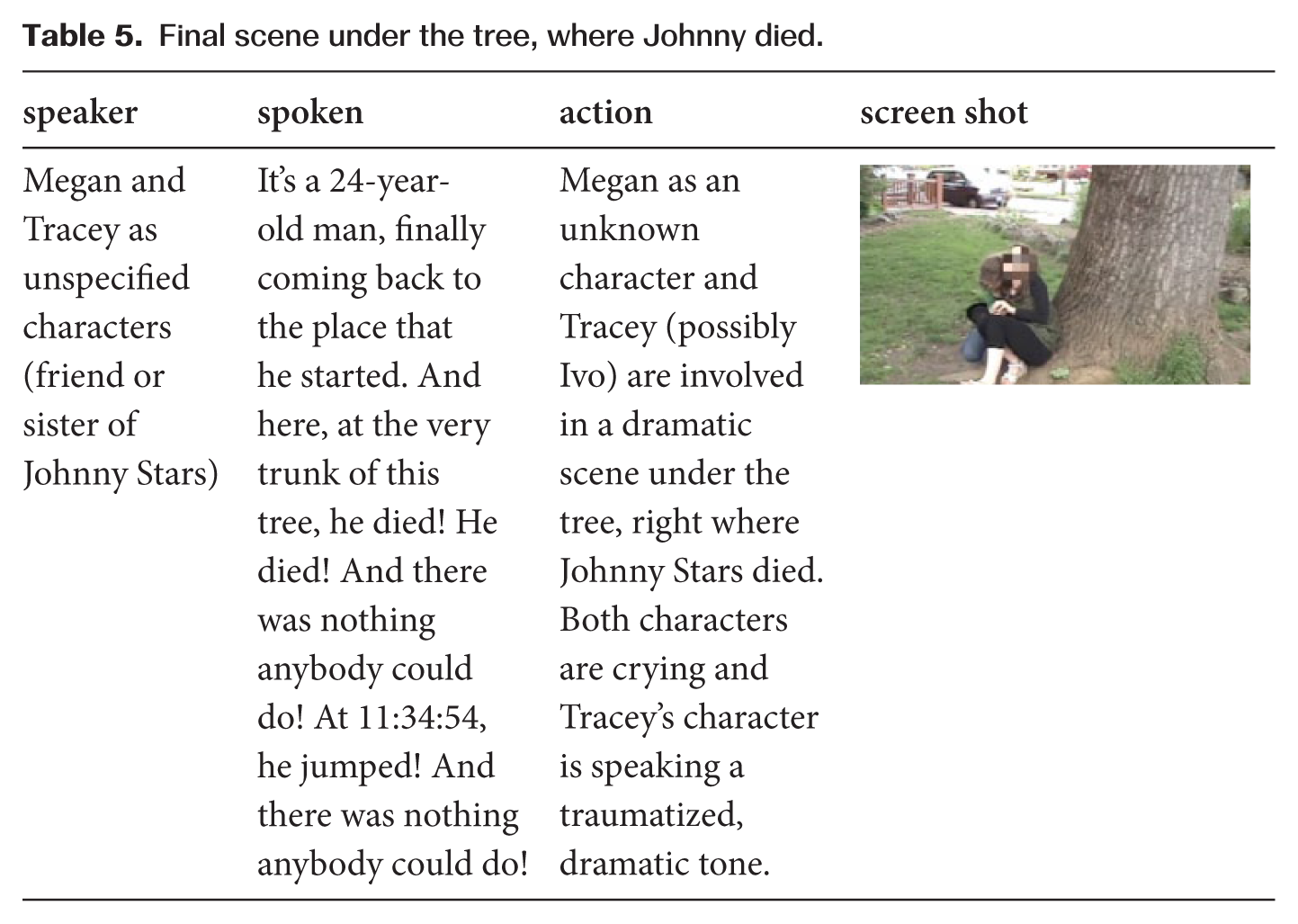
The final scene occurs outside, under the tree that Johnny Stars jumped from. This scene features Megan, playing an unknown character (friend or sister of Johnny Stars), and Tracey (also playing an unknown character, either Johnny Stars’s sister or friend). This final scene is the most dramatic, as both girls are on the ground under the tree, clutching one another and sobbing (ironically), while Megan delivers the following line: ‘It’s a 24-year-old man, finally coming back to the place that he started. And here, at the very trunk of this tree, he died! He died! And there was nothing anybody could do! At 11:34:54, he jumped! And there was nothing anybody could do!’ Table 5 is a multimodal representation of this final segment of the video.
Analysis of the focal film, ‘child stars: the life of johnny stars’
Signifiers of Johnny Stars as floating signifiers
The film takes a bizarre and dream-like tone as the focal figure and subject of the mockumentary, Johnny Stars, is never fully identified or described in detail. The viewer is never provided with an image of Johnny Stars, or much information about why he is the point of focus. Over the course of the film, Johnny Stars is identified as both a ‘child’ (Table 3) and ‘24-year-old man’ (Table 5). In addition, the viewer is provided with the following information: ‘he wandered the hallways and saw dead people’ (Table 1); ‘he lived in a run-down house across from the school’; and ‘he couldn’t make it to school on time’ (Table 3). The viewer is left to his or her own devices to wonder about what kind of child star Johnny was (since no details about the nature of his stardom are provided), as well as why the film focuses on this idea of stardom and his particular case of stardom, or whether to take any of it seriously (including trying to figure out who Johnny is).
The spoken signifiers of Johnny Stars (such as ‘Johnny Stars’, ‘Johnny’, as well as pronouns referring to him as ‘he’, and ‘his’) are floating signifiers, or signifiers without a clear signified (Laclau, 1996; Levi-Strauss, 1987). The viewer is provided with enough information to know that these signifiers literally refer to an individual named Johnny Stars. However, beyond that, there is little information that can be used to come to a clear sense of what ‘Johnny Stars’ means or represents. The signifiers of Johnny Stars are thus signifiers that remain detached, unanchored to a signified. Interestingly, from a post-structural perspective on signification processes, this ‘sliding of the signified under the signifier’ (Lacan, 2002[1966]: 145) is also a characteristic of all signifiers and of all meaning-making processes. However, floating signifiers amplify this effect of discourse. Laclau and Mouffe (2001: 113) have referred to this as ‘the relational character of every identity, the ambiguous character of the signifier, its non-fixation to any signified’. Signifiers of Johnny Stars thus float throughout the film, meanwhile being related to other signifiers. However, rather than attaching to any other signifier (by allowing it to serve as a signified), the floating signifiers do not link up with other signifiers as potential signifieds (rendering them relatively meaningless), and thus preventing closure in the viewer’s attempt to make meaning.
The sliding effect created by the floating signifiers is magnified by the simultaneous operation of signifiers of Johnny Stars as nodal point signifiers (Freud, 1999[1900]; Laclau and Mouffe, 2001), or ‘quilting point signifiers’ (‘points de capiton’) (Lacan, 1993[1981]). Lacan’s concept of a quilting point or nodal point signifier resonates with Freud’s insight that certain dream elements (words, images, characters) act as a point of intersection for many other elements (read as signifiers, with a Lacanian lens). Lacan defined quilting point signifiers as follows:
This point around which all concrete analysis of discourse must operate I shall call a quilting point … Everything radiates out from and is organized around this signifier, similar to these little lines of force that an upholstery button forms on the surface of material. It’s the point of convergence that enables everything that happens in this discourse to be situated retroactively and prospectively. (pp. 267–268)
Nodal point signifiers are central to any discursive formation since all of the signifiers must brush up against it, or signify in some way toward and through the nodal point signifier. In other words, the other significant signifiers must be interwoven with signifiers of Johnny Stars as nodal point signifiers. These nodal points are points of convergence that are also ‘overdetermined’ (Freud, 1999[1900]: 283; Silverman, 1983), or represented in the discourse many times over and in connection with many signifiers, with multiple possible meanings – to the point that its associations with other signifiers as possible signifieds are ‘saturated’. This saturation can create the effect of causing the signified to slide and the signifiers to float. Read through a Lacanian (signifying) lens, we can understand how Freud (1999[1900]) discovered that overdetermination of a signifier plays a role in the sliding of the signified. Freud pointed out that elements in dreams (which Lacan would read as signifiers) would occur over and over again, and thus were tied up in all of the other elements of a dream’s content. These elements were what he referred to as ‘overdetermined’, or ‘represented many times and in many ways in the dream-thoughts’ (p. 216).
Since signifiers of Johnny Stars are simultaneously floating signifiers and nodal point signifiers, the multimodal discourse within the film is built around a group of related floating signifiers that are also overdetermined. This adds fundamentally to the overall instability of the signifiers inscribed in the film, since the nodal point signifiers are the centers around which the networks of signifiers are established. As an overdetermined signifier, the spoken signifier, ‘Johnny Stars’, is placed throughout the film, and is by far the most commonly occurring signifier (although the least defined, emptiest signifier). These placements are important because it is through the other available signifiers that any potential signifieds might be located. As an overdetermined signifying domain, ‘Johnny Stars’ has many opportunities to associate with or come into contact with other signifiers (if not all) across the film. The opportunities for linkages, associations, and relations between signifiers are thus multiplied, and with this, the potential meanings that can be generated are also multiplied, causing the signified of ‘Johnny Stars’ to slide.
Networks of metonymic potential in the signification of ‘Johnny Stars’
Another way that the focal film achieves the perpetual slippage of the signified of ‘Johnny Stars’ is through the actions of metonymy, a discursive agency that uses contiguous signifiers as potential replacements for other signifiers. The absence of a suitable signified for ‘Johnny Stars’, as well as the absence of another signifier that might resemble or substitute for ‘Johnny Stars’, is central to the operation of metonymy in this case. Silverman (1983: 112–113) indicates that absence is central to the formulation of metonymic effects since signifiers always refer to an absent signifier for their constitution – no signifier is self-sufficient in its identity since it requires the entirety of language and its differences from other signifiers in order to constitute its identity. Because it has no identifiable signified, the floating signifiers of Johnny Stars seek to complete their identities through other available signifiers. This looking for completion (although fundamentally impossible) is part of the operation of multimodal discourse since the sign is always a duality that consists of a signifier and signified: while the signifier is present, the signified remains indeterminate. We see this reflected when, as interpreters or viewers, we attempt to make sense of a film or other viewed text: we attempt to pin down the signifiers and attach meanings. However, ‘Child Stars: The Life of Johnny Stars’ particularly diverts this tendency by tapping into metonymy as a discursive potential.
The tree-image and the spoken signifier, ‘tree’, as depicted in the final scene (Table 5), are the signifiers that come closest to engaging a metonymic potential in conjunction with the signifiers of Johnny Stars. The first requirement for the establishment of a metonymic relationship is that the signifiers under question are in contiguity with one another, or in a relationship of co-presence within or along a signifying chain. The spoken signifier, ‘Johnny Stars’, first comes into a contiguous relationship with the spoken signifier, ‘tree’, during the interview with the psychologist, when he says, ‘He liked to jump out of trees’ (Table 2). This offers the viewer an opportunity to imagine Johnny Stars jumping out of a tree, and a strong visualization of the tree can then become associated with Johnny Stars.
The second juncture where ‘Johnny Stars’ is linked with the spoken signifier, ‘tree’, is in the dramatic interlude in which the unknown figure played by Megan says, ‘He was jumping out of a tree and I couldn’t stop him’ (Table 4). Here, the spoken signifier, ‘tree’, is linked with the spoken signifier, ‘Johnny Stars’ – this time with an added, ironic emotional intensity, with the character crying and asking the person recording to stop filming, since she is so upset. And, in the final scene, this emotional intensity is seen again and associated with the tree-image-as-visual-signifier and ‘Johnny Stars’, with Tracey screaming, ‘He died! He died!’ and ‘There was nothing anybody could do!’ Meanwhile, Megan dramatically clutches her, both girls sobbing (ironically). Multiple instances of spoken signifiers of Johnny Stars (specifically, ‘he’ and ‘24-year-old man’) are brought into contiguity once again with the visual image of the tree, and with the intensifying emotional charge associated with the tree-image. As a result, a metonymic potential is engaged such that the tree-image (fortified by previous connections between ‘Johnny Stars’ and the spoken signifier, ‘tree’) is being offered up as a possible ‘container’ for the emotional charge and meanings about Johnny Stars.
Figure 1 illustrates the metonymic network that is engaged between the signifiers of Johnny Stars (the spoken signifiers ‘he’ and ‘24-year-old man’) and the tree-image (and the spoken signifier, ‘tree’). Figure 1 shows all three instances of this metonymic potential, as outlined above, placed in order from top to bottom: in the interview with Johnny’s psychologist, in the dramatic interlude featuring the grieving character played by Megan, and in the final, dramatic scene under the tree. I refer to this as a network of metonymic potential since it illustrates the network of signifiers across the film surrounding a specific metonymic potential between two key signifying domains: ‘Johnny Stars’ and the tree where Johnny died. A network of metonymic potential is a network of signifiers that occur in contiguity such that, through a process of a potential transfer of the signified, one begins to take on the signifying charge and meaning potential of another (although the process may remain incomplete). The figure is an illustration of these cross-modal metonymic processes at work, at the point where these multimodal linkages are created. The visual and spoken modes are illustrated since this focal metonymic network is occurring through and across those two modes. Each instance of a spoken signifier of Johnny Stars is in bold type, italicized, and linked (using a line to illustrate this linkage or metonymic signifier relation) to signifiers of the tree where Johnny Stars died (the ‘tree-image’ and the spoken signifiers ‘tree’ and ‘trees’). Also note that in the first and second segments represented (top and middle), there is only intermodal (between spoken signifiers) metonymic work being undergone (depicted with the line between the spoken signifiers, ‘he’ and ‘tree’ in both instances). Thus, no lines are depicted as linking the linguistic and visual modes in the top and bottom segments of the figure. The metonymic network depicted in the top and middle segments set the groundwork, so to speak, for the cross-modal (spoken-visual) metonymic potential opened up in the final scene (Figure 1, bottom).
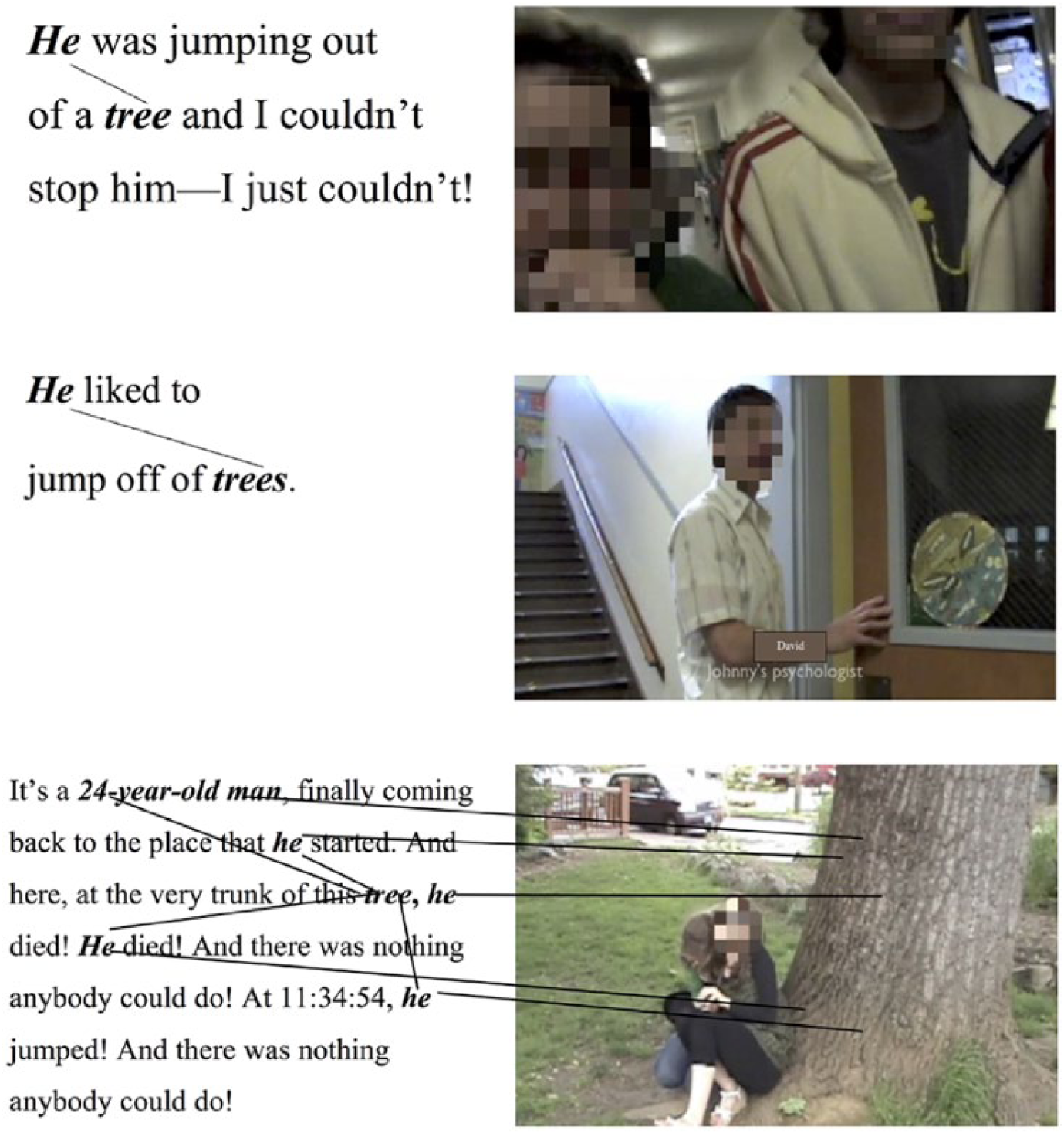
Network of metonymic potential between signifiers of Johnny Stars and signifiers of the tree where Johnny died.
As Lacan (1993[1981]: 221) notes, Freud’s concept of displacement is the operation of metonymy. Therefore, there is a partial displacement of the emotional charge from signifiers of Johnny Stars onto the tree-image, the very site of his death and focal point of emotional charge. This is in part because the viewer has nowhere else to rest the meaning and depicted emotional charge related to ‘Johnny Stars’. Displacement and the work of metonymy are key in the blurring of meaning, one of the key potentials in discourse as metonymy, and in the unconscious (acting like a language), in primary dream processes, which seek to undo, disguise, and censor (by causing the signified to slide so that meaning is unclear). Displacement effects are at play in the focal film since the signifiers of Johnny Stars link with the tree-image and spoken signifier, ‘tree’, in order to attempt to complete identity, closure, or anchorage. However, the signified for ‘Johnny Stars’ is never fully transferred to the tree. Since Johnny Stars is never depicted, the viewer is always positioned as ‘looking for’ Johnny Stars – and one of the few places to ‘look for’ Johnny Stars is at the base of the tree where he died. This mirrors the action of the signifier, which ‘reaches out’ across modes to make linkages with other signifiers in order to constitute its own signified.
Across the film, a metonymic potential is also initiated between signifiers of Johnny Stars, hallway-images, and the spoken signifier, ‘halls’. The first instance of this occurring is in the second scene of the introductory segment (Table 1, third segment, middle). In this segment, Eric narrates: ‘He often saw dead people and such wandering the halls of this school.’ In this segment, we are provided with an image of Oliver, playing the part of Johnny Stars’s father, walking the hallway. The scene is shot from behind the father, creating the perspective that we are seeing the world through Johnny’s eyes (Table 1, second segment, middle). As was the case with the Johnny Stars-tree metonymic processes, through co-presence, or contiguity, signifiers of hallways start to take on some of the signification that can be associated with the signifiers of Johnny Stars.
The metonymic potential, which is engaged as signifiers of hallways take on some of the signifying charge, continues in the next segment of the video, in which an unknown/unidentified character, played by Tracey, and another unknown character, played by James, are walking down the hallway when, for no apparent reason, a hat falls down from above (Table 1, second segment, bottom). The character played by James then puts the hat on his head while the figure played by Tracey says, ‘Child superstar and other things such’. In this segment, a metonymic potential is engaged between the signifier, ‘child superstar’, and the hallway-images. This connection is not brought about by a logic or by resemblance, but by contiguity as both the hallway and reference to Johnny Stars (‘child superstar’) are occurring simultaneously in this segment, which creates the opportunity for their significatory potentials to interact.
The third segment in which signifiers of Johnny Stars and ‘hallways’ enter into a metonymic relationship with one another is in the segment that I refer to as ‘Narrator details about Johnny Stars’ (Table 3). In this segment, Eric, the narrator, furthers the connection between the hallways and Johnny as he films his own walk down the hallways as he narrates. He uses the hand-held-camera recording style of many newer documentaries and mockumentaries that are shot from the narrator’s perspective, like a home video, saying: ‘Johnny was a poor child. He would walk up the halls every day, and back down as he went and came from school.’ This narration takes place while the viewer is taken down a staircase in the school hallway, almost as if the viewer is seeing things through Johnny’s eyes as he walked through the hallway.
Figure 2 illustrates the network of metonymic potential across the video between signifiers of Johnny Stars and signifiers of hallways (hallway images and the spoken word, ‘halls’). It features all three junctures in which a metonymic effect is opened up between signifiers of Johnny Stars and signifiers of hallways, from top to bottom, in order, with spoken signifiers in bold type and italicized (with the connections between the spoken signifiers, ‘halls’, ‘he’, ‘Johnny’, ‘child superstar’, and the hallway-images illustrated using lines). Through these linkages between signifiers, signifiers of hallways act as a partial container for the meaning that ends up being associated with, and thus signified by ‘Johnny Stars’. The spoken signifiers, ‘Johnny Stars’, ‘child superstar’, and ‘he’ (referring to Johnny Stars) come into contiguous relationships with images of hallways and spoken references to hallways and, in the process, the hallways come to take on some of the significance and emotional charge of ‘Johnny Stars’. But only partially: as is the case with the tree, the signifiers of hallways do not fully take on the signification. In addition, it is evident that this type of metonymic potential does not arise in the film out of one instance of connections between signifiers, but rather through repeated connections and an opening up of the potential over time.
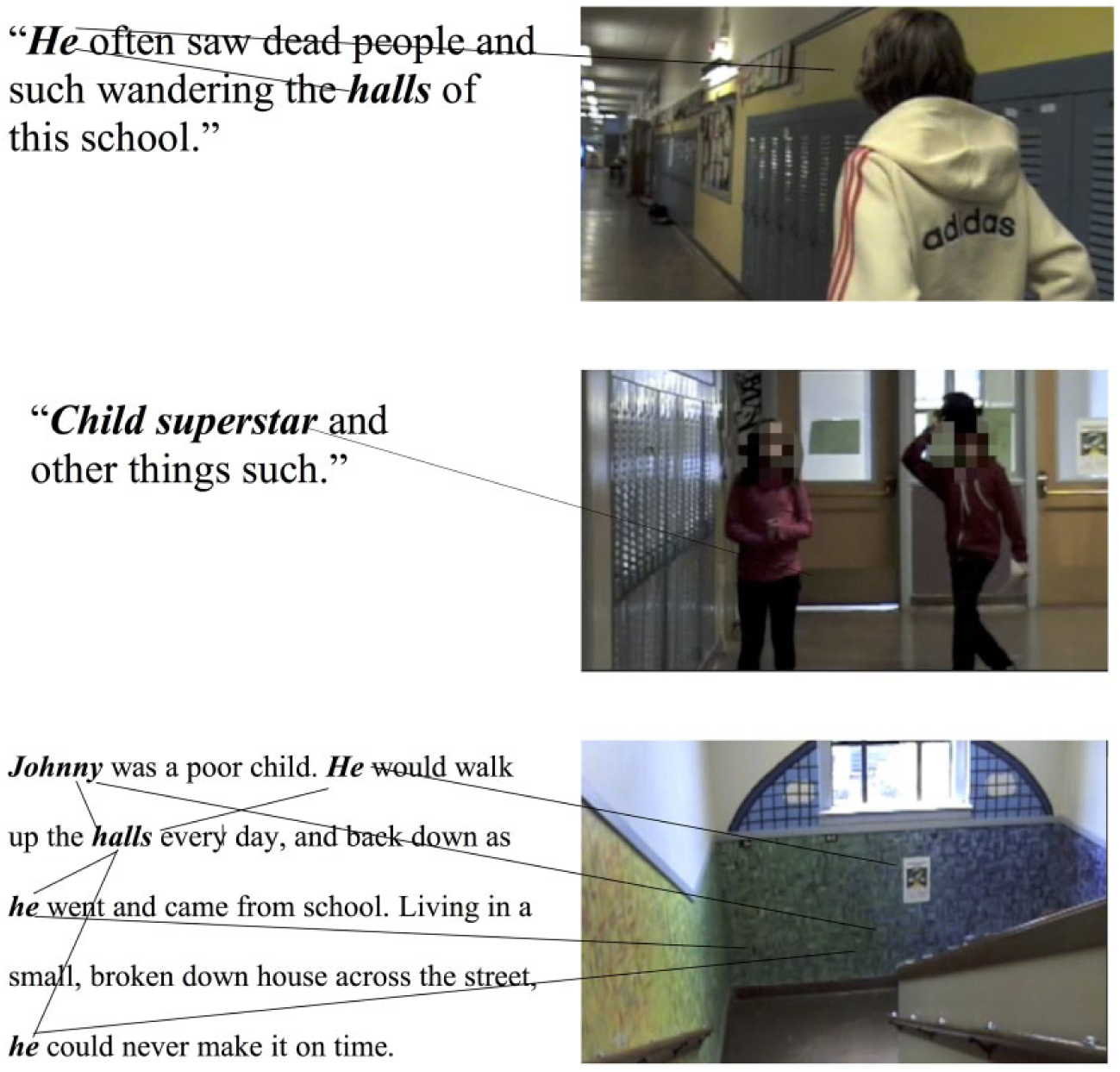
Network of metonymic potential between signifiers of Johnny Stars and signifiers of the hallways that Johnny walked.
What ‘Johnny Stars’ signifies, or, what his significance is, is never fully revealed, so the full metonymic potential here is never completely actualized. The viewer is given signifiers of a tree and of hallways as potential substitutes, but, in the end, these signifiers do not become substitutable for ‘Johnny Stars’. The viewer is led to wonder, even after the film has ended: Who is Johnny? The metonymic effects described in this section serve to reduce certainty and create slippage amongst the signifiers inscribed in the focal film. In addition, the hallways and tree also demonstrate the reductive character of metonymy (Burke, 1941) since they do not represent Johnny Stars in any complete way, but rather reduce the overall complexity of Johnny Stars to one aspect of his actions and character.
Condensation, collective images, and condensation complexes
In this multimodal discourse analysis, I approached condensation, through my application of a Lacanian reading of Freud, as an instance where two or more signifiers enter into a network oriented toward collapsing the signifiers into one another, thus condensing their signification. In ‘The Life of Johnny Stars’, condensation occurs as the characters (as they occur in the visual images of the characters as signifiers) condense into one another across the film to become what Freud (1999[1900]) referred to as a collective image. Freud defines a collective image through his analysis of a focal dream, and describes how one of the characters (Irma) took on the signification of other characters, thus creating a single collective image in ‘Irma’ by condensing multiple characters, elements of characters, characteristics, and ideas into one. He notes that Irma ‘becomes a collective image, though endowed, it is true, with contradictory features. Irma becomes the proxy for these other persons sacrificed in the process of condensation’ (p. 224).
The condensation processes related to the characters as signifiers in ‘Child Stars: The Life of Johnny Stars’ undergo several layers of condensation. This serves to destabilize the meanings of the characters and the film as the viewer attempts to assign roles and meanings to characters, which collapse into one another. For example, just by its conception and structure, the film undergoes a first level of character condensation since the depicted characters in the film are also reflective of the students themselves (the students all knew each other and were each other’s audience through the class blog). This created a film viewing situation in which the actors could not just play their roles anonymously: The viewer always knows who the actor is, and in fact has a social relationship (as fellow members of the class) with the actors, who are performing selves and characters for a known audience. In addition, the actors did not wear costumes or change their appearances in any way. This strengthens the visual linkage between the actors and each of the characters that they play. This idea – that the actors represent themselves (as well as their characters) in the film – is even explicitly stated in the casting credits slide included at the end of the film, which lists Megan as playing herself and James as playing James (see Figure 3, names changed where necessary to reflect pseudonyms).
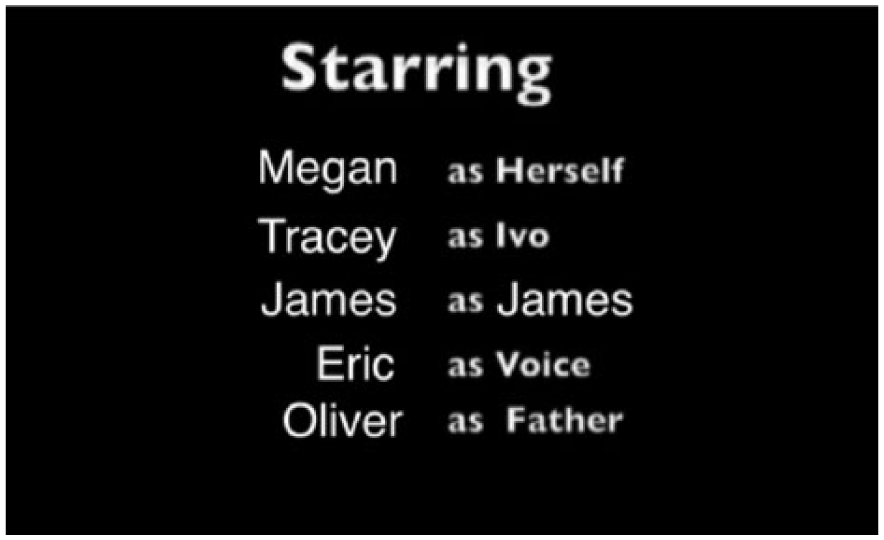
Casting slide for ‘Child Stars: The Life of Johnny Stars’.
Megan plays at least two (and potentially three) other characters in addition to herself. Her characters are as follows: ‘herself’, the host, the woman crying in the dramatic interlude (Johnny Stars’s friend or sister), and one of the girls/women crying in the final scene under the tree (who could be the same character as the dramatic interlude, or not – it is unclear). However, a slide that appears at the end of the film provides a clue (see Figure 4): ‘Johnny died as they told us. His mother died of depression shortly after his death. His best friend and older sister were viewed in this special! RIP Johnny Stars.’ From this, one can conclude that Megan is either playing the part of Johnny Stars’s best friend, or of his older sister, in at least one of the scenes. The characters enter into a blurred relation with one another such that the collective image of all of them comes under the signifier, ‘Megan’. Figure 5 illustrates the condensation complex surrounding ‘Megan’ and the characters she plays as signifiers. The quotation marks around the word ‘Megan’ are meant to capture the condensation processes at work with respect to Megan as a collective image, a blurred combination of multiple characters.
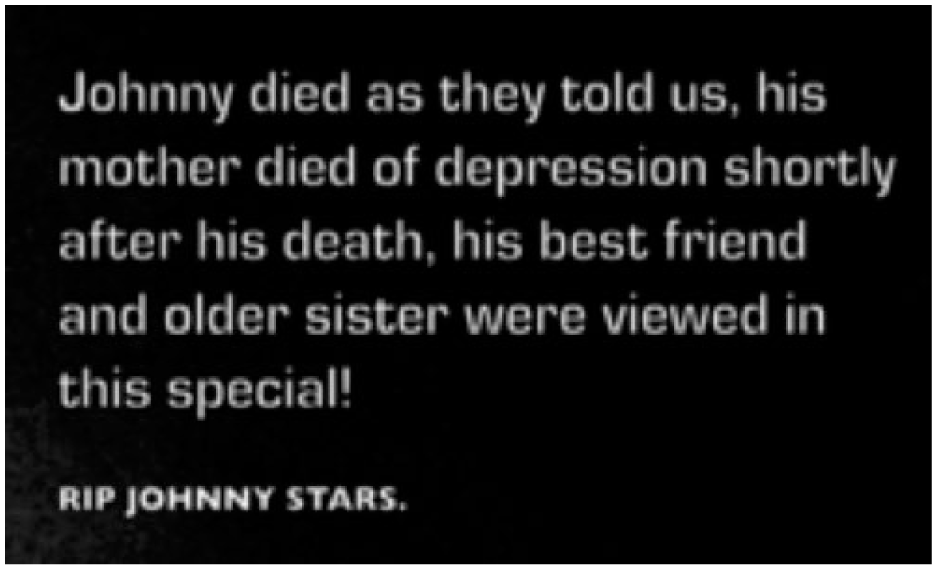
Closing text for ‘Child Stars: The Life of Johnny Stars’.
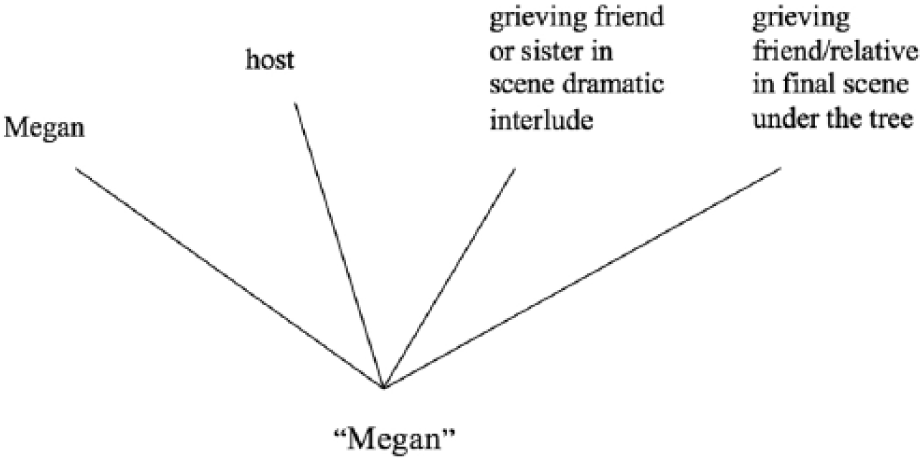
Condensation complex involving Megan and her characters.
Tracey’s roles are also unclear, which makes it possible for her to become a collective figure as well. Like Megan, Tracey is, to some degree, also playing herself in the film, in addition to the other characters that condense into the signifier, ‘Tracey’. In the introduction to the film, she walks down the hallway in the beginning and delivers the random line, ‘Child superstar and other things such’ (Table 1, segment 3). Tracy returns in the final scene to deliver the most dramatic lines of the film. This character in the final scene is presumably either Johnny Stars’s best friend or older sister, as indicated in the note provided at the end of the film (Figure 4). The casting slide also indicates that Tracey plays the part of Ivo (Figure 3), so the viewer is left to wonder whether this character in the final scene is Ivo, or whether Ivo was the unidentified character in the introductory segment, which adds to this blurring and condensing effect. As with Megan, Tracey’s various characters and performance of herself condense into the signifier, ‘Tracey’, as Figure 6 illustrates.

Condensation complex involving Tracey and her characters.
Conclusion
Upon close examination, it became apparent how, at the fundamental level of the sign, ‘Child Stars: The Life of Johnny Stars’ tapped into agencies or potentials of discourse that cause meanings to remain undone, incomplete, and indeterminable. Semiotically speaking, the video thus masked or undid its own meaning potentials, turning meaning back on itself, resulting in an ambiguous video that turned linearity, meaning-making, and clarity on its head. I thus developed a form of multimodal discourse analysis that closely examined the signifier operations that produced these processes, focusing on how the video’s qualities of ambiguity and non-closure were created through inter-modal and cross-modal signifier relations that emerged out of their contiguous occurrences within the signifying chains that constituted the focal video.
As a way of exploring the film’s resistance to meaning-making and anchorage, in favor of sliding, I examined the multiple ways in which multimodal discursive agencies foster the sliding of the signified that corresponds to signifiers of Johnny Stars. This sliding of the signified creates a multimodal discursive action whereby signifiers of Johnny Stars became floating signifiers whose meaning is indeterminable to the end of the film. The significance of the floating quality of signifiers of Johnny Stars is multiplied since they simultaneously act as nodal point signifiers. Nodal points are key anchor points that hold the entire signifying structure of the film together, and floating nodal points create a situation in which an entire signifying network of the film is dependent upon central nodal points that are not reliable, as an absent center, thereby creating a structural inclination toward the sliding of any potential signified of ‘Johnny Stars’. The overdetermination of ‘Johnny Stars’ adds to the nexus of discursive forces that are driving the focal signifiers toward sliding. ‘Johnny Stars’ is everywhere, popping up in all of the scenes and connected with almost all of the other available signifiers in a very direct way. Since it is in the signifier-to-signifier connections that the possibilities for meaning arise, the sheer number of these connections serves to spread any potential meaning a viewer might attach to ‘Johnny Stars’ very thin, dispersed amongst all of the various signifier associations encoded in the scenes.
Another means by which the signified of ‘Johnny Stars’ achieves its sliding effect is through the formation of networks of metonymic potential. In their search for a signified, across the film, the signifiers of Johnny Stars begin to form networks of metonymic potential constituted by linkages between visual and spoken signifiers. These networks of metonymic potential are established over the course of the film as signifiers of Johnny Stars are repeatedly associated with the signifiers of the tree and hallways through their contiguous relations along the signifying chains that constitute the film, each time increasing the potential that they might be able to serve as a possible container for the meaning of ‘Johnny Stars’. This metonymic discursive agency is dependent upon the action of contiguity, which establishes co-presence or co-occurrence along a signifying chain as the basis of the opportunity for displacement of meaning from one signifier of an emotional charge to the next.
These metonymic potentials, activated as an agency of multimodal discourse, contribute to the overall blurring of meaning by bringing signifiers of the tree where Johnny died and of the hallways that he walked into relation with ‘Johnny Stars’ such that it appears that they might be able to take up the meaning, or serve as a vehicle for the meaning of ‘Johnny Stars’. However, these metonymic relations never reach the point of making ‘Johnny Stars’ equivalent to or exchangeable with signifiers of hallways and the tree, which thus remain only partial replacements for ‘Johnny Stars’. Thus, the full displacement of the signifying charge from signifiers of Johnny Stars onto the signifiers of trees and hallways is never achieved, leaving signifiers of Johnny Stars to float, despite their interactions within networks of metonymic potential.
As it turns out, in the focal film, these metonymic potentials are only partially tapped. Thus, metonymic action is not a situation of an occurrence or non-occurrence, as a switch for the actions of metonymy to turn on or off. The potential agency within a metonymic network occurs along a continuum from very little metonymic action to a high degree of association between two signifiers such that the metonymic action is complete, and one signifier can act as a replacement of or substitution for another signifier. The operation of a full metonymic potential would be a full displacement of the signifying charge and meaning potential from one signifier to another along a signifying chain and within a network of metonymic potential. Thus, metonymic actions between signifiers in a network of metonymic potential can be described in terms of an equivalence potential, or potential for a signifier to act as a replacement for the meaning potential or emotional charge of another signifier.
Another way of conceptualizing equivalence potential is to conceive of it as the potential for the charge of a signifier to be displaced onto another signifier, such that the next signifier (signifier in a relation of equivalence) along the signifying chain can move forward with the same signifying potential as the original signifier from which the signifying charge was displaced. However, this displacement can be partial, and the degree of substitutability may be partial. This is the case in ‘Child Stars: The Life of Johnny Stars’, in which signifiers of the tree and of the hallways act as partial substitutes or replacements for ‘Johnny Stars’. However, we know that these are instances of metonymic potentials that are only partially activated, since signifiers of Johnny Stars are still left to float and thus do not become fixed by the potential replacement signifiers (signifiers of hallways and the tree). In the absence of the possibility of a more direct signified for ‘Johnny’ (for example, one that resembles him or indicates more about him), this partial displacement draws attention away from ‘Johnny Stars’ and onto the tree where he died and the hallways that he walked, allowing the signified in question to continue to slide.
The blurring effect associated with the action of signifier condensation adds another layer of slippage to the film’s signifying architecture. As the analysis showed, Megan and Tracey’s characters undergo several layers of character condensation to create a situation in which their multiple, somewhat undistinguishable characters become blurred with performances of themselves. The film thus becomes dream-like in the sense that it uses characters very economically: each signifier of a character can simultaneously refer to and reverberate with signifiers of other characters, since they are either partially or fully substitutable for one another, blending together as a vague representation of ‘Tracey’ or ‘Megan’. The film, like a dream, is thus condensed, with fewer characters, in a sense, doing the work of multiple characters. Each occurrence of a signifier of the characters (image or spoken name) reverberates with the other characters, thus constituting a single signifier as a collective image.
Another way of conceptualizing an equivalence potential between signifiers is through the discursive agency of metaphor, a complementary process to metonymy within the field of the signifier (Jakobson and Halle, 1971; Lacan, 1993[1981], 2002[1966]; Metz, 1982; Silverman, 1983). Lacan (1993[1981]: 221) has linked the processes of condensation with that of metaphor, noting that condensation ‘is the superimposed structure of signifiers in which metaphor finds its field’ (Lacan, 2002[1966]: 152). Through its discursive action, metaphoric potential (and degrees of it) opens up opportunities for two signifiers to become equivalent through what Lacan (1993[1981]: 220) refers to as the ‘rubric of similarity’. Silverman (1983: 112) refers to the ‘“classic” metaphoric situation, in which one term stands in for another which it in some way resembles’. The blurring and condensing effect with the characters occurs through the operations of similarity between the relevant signifiers. These operations of similarity underlie the discursive operation of metaphor, whereby two signifiers resemble one another enough to become equivalent, exchangeable, and can thus condense into a single signifier. In ‘Child Stars: The Life of Johnny Stars’, because there are not clear identifications of and distinctions between the various roles that the actors played, the characters, and the actors’ images-as-signifiers come to resemble one another within the condensation complex to the point that they enter into metaphorical discursive relations with one another. The individual character images are not contiguous and occur in separate scenes. However, their signifiers enter into a diachronic relationship that activates an equivalence potential through their similarity as signifiers, since they resemble one another visually, as well as structurally, as characters.
In Burn’s (2003: 20) study of adolescents’ digital videos, he examined how the students integrated the ‘signifying properties’ of the objects and images that they used with ‘those of the new media, in multimodal combinations which demand an expanded vocabulary from us if we are to describe them adequately’. It is toward this expanded vocabulary and deepened understanding of the sign-processes at work in youth-composed films that I strive in this analysis. Like Burn, I focus on a video that may be initially difficult to understand and whose significance may not be apparent given the official ways of understanding and purposes for student-created videos. When considering youth-composed videos that exceed traditional purposes, formats, and approaches, thus taking on a performative or artistic quality, a close examination of sign-processes can reveal new ways of understanding, appreciating, respecting, and responding pedagogically to the creative and unusual ways that youth may use digital video as a medium.
Footnotes
Funding
This research received no specific grant from any funding agency in the public, commercial, or not-for-profit sectors and there is no conflict of interest.
Biographical Note
JASON RANKER is a Professor of Education in the Department of Curriculum and Instruction at Portland State University in Portland, Oregon. His scholarship focuses on multimodality and multimodal discourse in pedagogical settings. His work related to these topics appears in journals such as Linguistics and Education, Social Semiotics, Pedagogies: An International Journal, Written Communication and Visual Communication, amongst others.
Address: Department of Curriculum and Instruction, Portland State University, PO Box 751, Portland, OR 97207-0751, USA. [email: