




Abstract
This article aims to analyse some of the popular activist posters and images related to the Gezi Park resistance that took place in Turkey in 2013. The author argues that the theoretical approach of détournement is the driving force in the formation of the activist ‘identity’ and ‘imagery’ related to Gezi protests. Further, through detourning the attacks of the government, the article examines how the activist posters and images caused shifts in meaning and generated the negation and recreation of signs and significations. In this way, it can be seen that détournement as a subversive theoretical approach can be reconstructive while deconstructing verbal and censorship attacks from the government. The article engages with the word Çapulcu (looters) in an address by the former Prime Minister against the Gezi protesters and the penguin documentary used as a censorship element during the protests. It analyses how détournement applied by the protesters to these attacks led to the creation of a shared Gezi identity and image.
Introduction
This article examines the political images of Gezi protests that took place in Turkey in 2013. According to Leland Griffin’s (1952) article, there are two types of movement that take place in society: those aimed at composing or defending institutions and counter movements, and others aimed at demolishing and overthrowing institutions. Unlike Griffin’s theorization, the Gezi movement was neither an attempt to support an institution, nor a challenge against an institution. Rather, it was what Smelser (1962) argued to be a collective movement that involved a group of social protesters who thought certain things in society were going wrong in terms of the surroundings in which they lived. This collective movement led to a tension in Istanbul, which later spread all round Turkey. Instead of brutality and attacks, the collective movement of Turkish subjects utilized activist imageries and posters that went viral on social media. The Rhetoric of Agitation and Control (Bowers and Ochs, 1971) is an important study that explains this way of protesting. The authors argue that symbols and images are passive resistance tools. Similarly, in Image Politics, Keven DeLuca (1999) looks at images that are utilized by activists. Through these images, the activists aim to gain popularity and support, and create polarity on particular issues. Similar to these studies, this article looks at the activist imagery of the Gezi Park protests, which were generated to produce a change in the policies of the leading political party at the time. According to Kahn and Kellner (2004: 94), individuals and social groups use emerging technologies in order to help the production of new social relations and political ideologies. Similar to Kahn and Kellner’s observations, the activist posters this article focuses on are chosen for their popularity in new media technologies (social media) during the Gezi Park demonstrations.
I will engage with ‘détournement’ as a theoretical approach to form my ideas related to the political Gezi Park posters and images. Through the subversive theoretical approach of détournement, I will show how attacks from the government were twisted and negated by the activists and used against the government. The neologism and posters related to the word çapulcu and the posters displaying the motif of the penguin are the main points and images of my analysis. The research questions are as follows: How does the connection between humour and protest manifest itself on the Gezi Park images and posters? How are anti-activist motifs and expressions of the government negated and transformed into pro-activist retaliation through détournement? How does détournement lead to a shift in meaning and signification in the activist visuals?
First, I will define what détournement is and provide visual examples related to it. Second, an introduction will explain how the Gezi protests broke out. This will be followed by an examination of particular anti-governmental posters of Gezi demonstrations before going into how the activists owned the attacks of the government and transformed them into motifs and signs to which they could relate.
Defining Dètournement
Détournement means a ‘detour’ or ‘diversion’ in English. However, in French, the word also means ‘hijacking’, ‘embezzlement’, ‘corruption’ and ‘misappropriation’ (Sadler, 1999). In a broad sense, détournement can be defined as ‘a method of interpretation and reinterpretation: reordering pre-existing materials in order to expose their banality or their function within a system of spectacular control and creatively reconstructing them in the service of authenticity’ (Elias, 2010: 824).
Détournement occurred in Europe during the 1950s and 1960s (Harold, 2004: 192). Through the subversive method of détournement, the situationists Debord and Vaneigem tried to ‘subvert spectacular (commodified) representations and practices’ that feed the system of capitalism (Trier, 2007: 274). In this respect, détournement manifests ‘some kind of critical derailment (to) the intended context, making it turn on itself, or contradict its claims’ (Gilman-Opalsky, 2013: 16). Figures 1, 2 and 3 show particular détournement illustrations related to capitalism and capitalist extensions in the form of labels such as McDonald’s and Nike. The images suggest a switch of perspective and offer a new angle on the way we perceive capitalism and capitalist labels. In this respect, metaphorically, the detoured images highlight the disturbing aspects of capitalism.
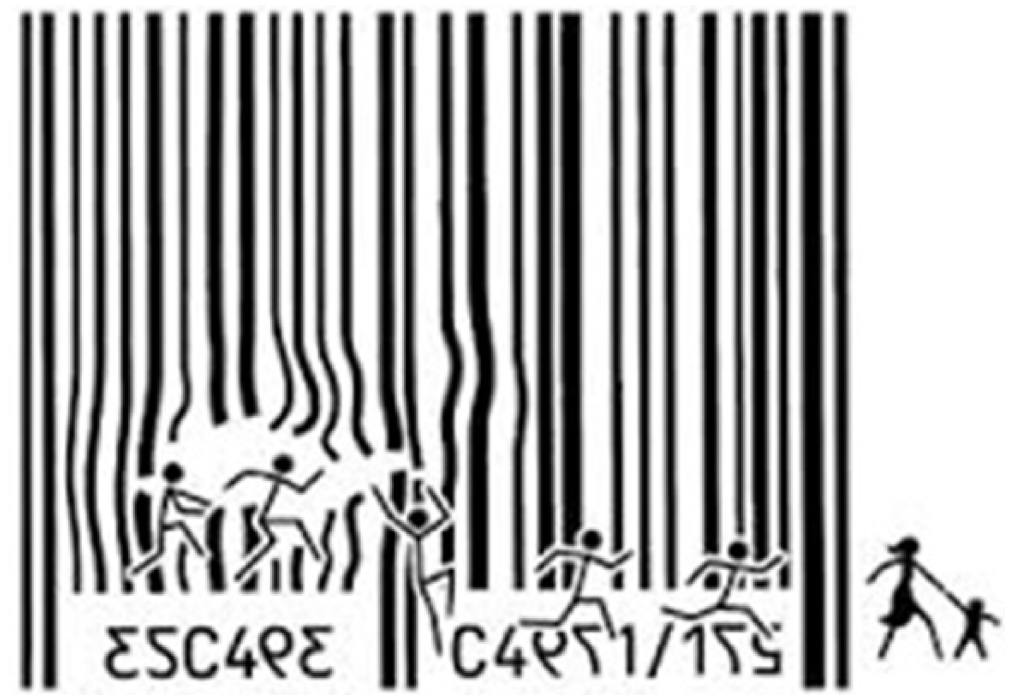
‘Escape Capitalism’ [as a prison]. Available at: https://notnumber.wordpress.com/2011/12/01/the-great-escape

‘I’m gainin’ it’ [utilizing and detourning the label’s own motto, I’m loving it]. Available at: http://artandcreativityjournal.blogspot.com.tr/2014/09/examples-of-detournment.html

‘JUST DO IT’ [unveiling and criticizing child labour and child exploitation of the label by its own motto]. Available at: https://www.pinterest.co.uk/pin/19281104626776947/
Détournement is also used in ‘anti’ positional contexts such as political activism. In this respect, détournement is an ‘insurrectionary style’, to which many protesters’ practices and demonstrations can be related (Debord, 1967: 144). Thus, today, détournement can be seen as ‘among the tools of a new activism, which function(s) primarily in the sphere of culture’ (Gilman-Opalsky, 2013: 19). For example, the 1968 revolt that occurred in France was generated under the influence of the Situationist International (SI). SI consisted of ‘the French provocateurs whose new media practices included manifestos, broadsheets, pranks and disinformation’ (‘Malcolm McLaren’, 2010). The uprising in France manifested many verbal and visual forms of détournement. Another political extension of détournement was witnessed in the Punk movement of the 1970s. Malcolm McLaren, the manager of the Punk music band, the Sex Pistols, was under the influence of the subversive attitude of the SI. The band projected nihilistic ideals that reflected many detourned political images, clothing styles, posters and visual images. Through the punk movement and the detourned images it projected, British youth expressed their disillusionment with the politics of the British government (English, 2007: 103). A further example of détournement seen away from Europe took place in Venezuela, in 2002. A media corporation forced President Hugo Chavez to leave his position through detourning media forms and images against him (Nelson, 2009).
One of the main qualities of détournement is the use of satire and humour. This is central to both the protests and the method of détournement: humour, satire and parody have become the tools of resistance and retaliation of political activists. As Gilman-Opalsky (2013: 27–28) remarks, détournement ‘attracts activists who are drawn to the risks of civil disobedience, but [are] interested in the joyful, witty, and even funny side of political engagement.’ Furthermore, parody can be seen as central to détournement as it ‘derides the content of what it sees as oppressive rhetoric, but fails to attend to its patterns’ (Harold, 2004: 191). In this sense, through humorous criticism, détournement suggests a different approach to reality and how it can be perceived. Thus, ‘instead of neutralizing existing reality’, the subversive method of détournement ‘denaturalize(s) and parody(parodies) it to expose and counter alienation’ (Debord, 1981: 824).
With its quality of metamorphosing something ordinary or serious into a witty joke or a satirical message, détournement brings out creativity that exists in each and every person. According to Vaneigem (1983: 167), everyone is endowed with ‘an irreducible core of creativity’. As a result, when its insurrectionary style is taken into consideration and blended with creativity, détournement offers what Debord and Wolman (1956: 14) call ‘extremist innovation’.
Today, détournement is also referred to as ‘culture jamming’ and it exists as an insurrectionary style in a variety of different contexts. Culture jamming, which occurred in the 1980s, has its roots back in the 1950s, which was the time when détournement first started to flourish (Carducci, 2006). Supporting Carducci, Harold (2004: 192) asserts that ‘many contemporary culture jammers describe themselves as political heirs to the Situationists’. Similar to détournement, culture jamming aims to unravel the methods of ‘domination’ related to mainstream society in order to generate a change of perspective (Nomai, 2008: 96). Further, similar to détournement, culture jamming tactics include ‘everything from rewording conversations between popular comic strip characters, to reworking the sign on a storefront, to making subversive collages out of familiar commercial and government images’ (Harold, 2004: 192).
Employing humour and wit as peaceful weapons, détournement marries these weapons with individual creativity and innovative resistance. First occurring in the mid 20th century, détournement, today, maintains its critical position, particularly in socio-political struggles and protests. It is one of the basic pacifist critical activities that protesters use when going against ideologies, institutions and political structures.
This section has explained what détournement is, what it aims at and opposes. The next section provides information on how the Gezi Park protests developed and will then move on to how détournement, as a subversive theoretical approach, can be applied to particular political Gezi Park posters and images.
The Protest Develops
On 27 May 2013, the current Justice and Development Party (Adalet ve Kalkınma Partisi) government started to cut down the trees of Gezi Park in Taksim, Istanbul without informing the Turkish public. The date marked the beginning of a social uprising within the history of the Turkish republic. Emerging as an environmental concern, the Gezi demonstrations encouraged Turkish citizens to get involved in a ‘political participation’. This political participation was a voluntary one (without any leader or any principles) that aimed at making a difference in the policies of the government (Yiğit and Tarman, 2013: 45). As part of this political participation, on 31 May 2013, many people spent the day and the night at Gezi Park to stop the government, which was trying to demolish the green area to build a huge shopping centre and military barracks (Topçu Kışlası).
Historically, Taksim Military Barracks were built on the area of Taksim Gezi Park in 1896. However, the buildings were damaged by a number of historical incidents and rebellions (the 1807 Kabakçı Rebellion, fires during the Sultan Abdulaziz period and the 31 March incident in 1909). With the founder of modern Turkey, Mustafa Kemal Atatürk’s invitation to the French urban planner Henri Prost, the barracks were annihilated in four steps, starting in 1940. Instead of the barracks, ‘residential and social buildings with a green space that stretched from Taksim to Harbiye’ were planned (‘Gezi Park: A big history for a small space’, 2013). The park was finally built in 1943 and since then, it has been a green breathing spot of Istanbul. However, in 2013 under the authority of AKP government, ‘an urban project was proposed without public participation or consultation, images were released showing the recreation of the former military barracks in the same style but housing a shopping mall. In order to provide an argument for the reconstruction of the barracks, Erdoğan stated that it was out of ‘respect for history’.
In reaction to the citizens trying to protect the park, the police burnt down the tents of people peacefully protecting against the park, as well as tear-gasing and randomly arresting subjects. Amnesty International (‘Turkey: End the Incommunicado Detention of Istanbul Protesters’, 2013) expressed the following, regarding the police force: Taksim received consistent and credible reports of demonstrators being beaten by police during arrest and transfer to custody and being denied access to food, water, and toilet facilities for up to 12 hours during the current protests in Istanbul, which have taken place for almost three weeks.
According to the Istanbul Doctors Association, there occurred ‘a high but an unknown number of first and second-degree burn injuries because of some substance mixed in pressurized water cannons’. Furthermore, Taksim German Hospital, where the wounded protesters were treated was also tear-gased by the police (Saymaz, 2013; ‘Water cannon attack on German hospital during 2013 Gezi Park protests’, 2013).
The brutality of the police led to an unprecedented solidarity amongst the citizens of Turkey; many subjects from different races, ideologies, nationalities, jobs and beliefs came together in a harmony that no political power had ever managed before (Benhabib, 2013). On the other hand, ultra conservative Muslims stood behind the government and the PM. In Rize, the homeland of Erdoğan, the Turkish Youth Union (Türkiye Gençlik Birliği) demonstrated against the policies of the AKP government and, in the meantime, a group of people in support of the government started to stage a protest against the union and attacked its members (‘Crowd Attacks Supporters of Gezi Park Protest in Turkish Prime Minister Erdoğan’s Homeland’, 2013). In addition to Rize, Konya, a very conservative city of Turkey, witnessed a similar lynching by a group of government supporters (‘People tried to lynch anti-government protesters in Turkish city of Konya’, 2013). The protests grew from Taksim Square (Istanbul) to all around Turkey, covering cities such as Ankara (‘Turkey protests spread from Istanbul to Ankara’, 2013), Izmir, Bursa, Antalya, Eskişehir, Balıkesir, Edirne, Mersin, Adana, İzmit, Konya, Kayseri, Samsun, Antakya (‘Solidarity protests with Gezi Park held across Turkey’, 2013), Trabzon, Isparta, Tekirdağ, Bodrum (Letsch, 2013) and Mardin (‘Gaziantep Böyle Gece Görmedi. Tam 20 bin kişi Yürüdü’, 2013).
There were various reasons for the protesters to participate in the Gezi events. Istanbul Bilgi University conducted a survey of the Gezi activists, asking them for the main reasons why they participated in the events: 92 percent said it was the ‘authoritarian attitude’ of the Prime Minister and 91 percent said it was the police’s ‘disproportionate use of force’. A further 91 percent mentioned the ‘violation of democratic rights’ and 84 percent the ‘silence of the media’ (‘Protesters are young, libertarian and furious at Turkish PM, says survey’, 2013).
Social media in the Gezi protests offered a suitable platform for the organization of subjects. According to Best and Krueger (2005), the internet constitutes an important source for providing information to the activists in protests. Further, Kahn and Kellner (2004: 88) write that, ‘the global internet, then, is creating the base and the basis for an unparalleled worldwide anti-war/pro-peace and social justice movement during a time of terrorism, war, and intense political struggle.’
There is a reason why social activists embrace the internet: it provides an open broadcast for activists to reveal their ideas that would not usually be broadcast on mainstream media channels (Atkinson, 2015: 49). A seminal work that examines resistance and alternative media against media forms that are controlled by institutions is Contesting Media Power (2003) by Nick Couldry and James Curran. As revealed by these authors, social media constituted the spine of the social uprising in Gezi Park protests as it provided fast ‘knowledge sharing’ and a ‘circulation of the affects of outrage, disbelief and defiance’ amongst the protesters (cited in Jussi, 2014: 91). As a result of the censorship in mainstream media, social media became the realm of free communication and correspondence. The active use of social media by the subjects led to a widespread ‘citizenship journalism’, which can be described as sharing information by non-professional people through the use of online sources (Yiğit and Tarman, 2013: 77–78).
Social media also provided the platform for the sharing of anti-governmental posters and images of Gezi resistance. According to Harold (2004), playing pranks is a rhetorical protest that utilizes media tools. It reverses the original direction of these media tools and turns it to their advantage. In a similar manner, Atkinson (2015) argues, pranks are played with the aim of attracting the attention of the media and thus destroy the power of authorities that control mainstream media. The images in the Gezi protests were endowed with elements of jokes, wit and irony, which pointed out a pranking rhetoric.
The following section analyses some detourned anti-governmental social media images in detail. It looks at how these images challenge the governmental attacks against the activists, activists’ retaliations to these attacks and how this leds to new patterns of signification amongst the activists. This analysis reveals how the creation of new significations also led to the formation of an activist Gezi identity and image.
From Government Against Government: Dètournement
Çapulcu and çapuling
The first type of dètournement for discussion is based on the Turkish word çapulcu, which President Recep Tayyip Erdoğan, who at the time served as Prime Minister, adopted to refer to the Gezi activists. By çapulcu, Erdoğan meant ‘looters, losers, loafers, terrorists and marginal people’ despite the fact that protesters peacefully asserted their right to protest by ‘sitting, reading, reading books to the police, camping, doing yoga, tai chi, capoeira, reading Darwish’ (Mee, 2014: 80). On 2 June 2013, Erdoğan referred to the protesters as çapulcu: We cannot just watch some çapulcu inciting our people … Yes, we will also build a mosque. I do not need permission for this; neither from the head of the Republican People’s Party (CHP) nor from a few çapulcu. I got permission from the fifty per cent of the citizens who elected us as the governing party. (‘Erdoğan: AKM Yıkılacak, Taksim’e Cami de Yapılacak’, 2013)
In response to these statements, the activists adapted and reappropriated the term as a way of humorous retaliation against the government. The way the Prime Minister referred to the protesters led to a subversive practice by the activists: the neologism of the word çapulcu and the creation of the verb çapuling. Gezi protesters, who labelled themselves as çapulcu, received worldwide support. This support came from prominent figures such as the American linguist and philosopher Noam Chomsky. Chomsky supported ‘the Gezi Park occupiers by sending a video message with a banner saying “I am also a çapulcu in solidarity”’ (‘US philosopher Chomsky supports Gezi Park movement with video message’, 2013).
As a reaction to the labelling of the Prime Minister, the word çapulcu became a unifying reference ‘for anyone resisting state oppression and corruption while concurrently demanding the rule of law, freedom of speech, and a truly participatory democracy’ (Gruber, 2014: 31). The adjective çapulcu was added by Gezi supporters to the names of their social media accounts. As Harding (2013) notes: ‘Twitter users have adopted it as their own, adding the prefix çapulcu to their accounts. For example, the name “ilhan” becomes “çapulcu ilhan”.’ The BBC called such reference attempts ‘an explosion of expression … in the form of satire, irony and outright mockery of the popular leader on Istanbul’s streets and social media’ (Sabral and Erdim, 2013). According to The Guardian reporter Luke Harding (2013), one of the Gezi Park protesters, Kiraz Deniz Gurel, 30, a local musicologist, was reported as saying: Turkish people are very humorous. They love making jokes. It was John Lennon who said: ‘When you give violence, you get back violence.’ It’s easy to respond with violence but humour is the better way. It means we are still alive, we are still human.
Another protester said that ‘rather than rejecting the humiliating and hurtful label of looters, protesters embraced it in an artistic way and applied it to their activism’, going on to explain çapuling as ‘acting in a peaceful and humorous manner to remind governments why they exist’ (cited in Harding, 2013).
Teune (2007) and Fominaya (2007: 257) assert that humour is an important element in terms of constituting a social unity and a shared identity. Further, Hart (2007: 12) argues that ‘the impact of humour … can strengthen and forge long-term responses like feelings of affection, solidarity, and loyalty among activists.’ Anyone that regarded himself or herself as a çapulcu pointed out a sense of belonging that transgressed social distinctions of all kinds. This transgression was manifested through a shared protective dress code of resistance and the belief in the ideal of modern Turkey. As Varol (2014: 570) remarks: For example, although the protesters in Turkey cut across socioeconomic lines, their dress code was the same: street clothes, goggles, and a gas mask. Once they donned their protest outfits, they abandoned their identities – whether it be a student, a teacher, a blue-collar worker, or a celebrity – and assumed the alter ego of a “çapulcu” [or chapuller]”.
As an extension of the neologism of çapulcu, activists sprayed the walls of Istanbul with lines that read: ‘Everyday I’m Çapuling’ (Figure 4). The line was an adapted version of the song Everyday I’m Shuffling by LMFAO. Shuffling is described as ‘to dance casually with sliding and tapping steps’ (Free Dictionary, np) and in Gezi protests the phrase ‘everyday I’m çapuling’ became the entertaining act of protesting. It was created as a verb to fight back the Prime Minister’s previous statement about the activists. The image of the expression would become widespread on social media. The satirical act of çapuling in Gezi demonstrations meant ‘standing up for your rights’, and ‘resisting state oppression and corruption while concurrently demanding the rule of law, freedom of speech, and a truly participatory democracy’ (Gruber, 2014: 3; Varol, 2014: 555).
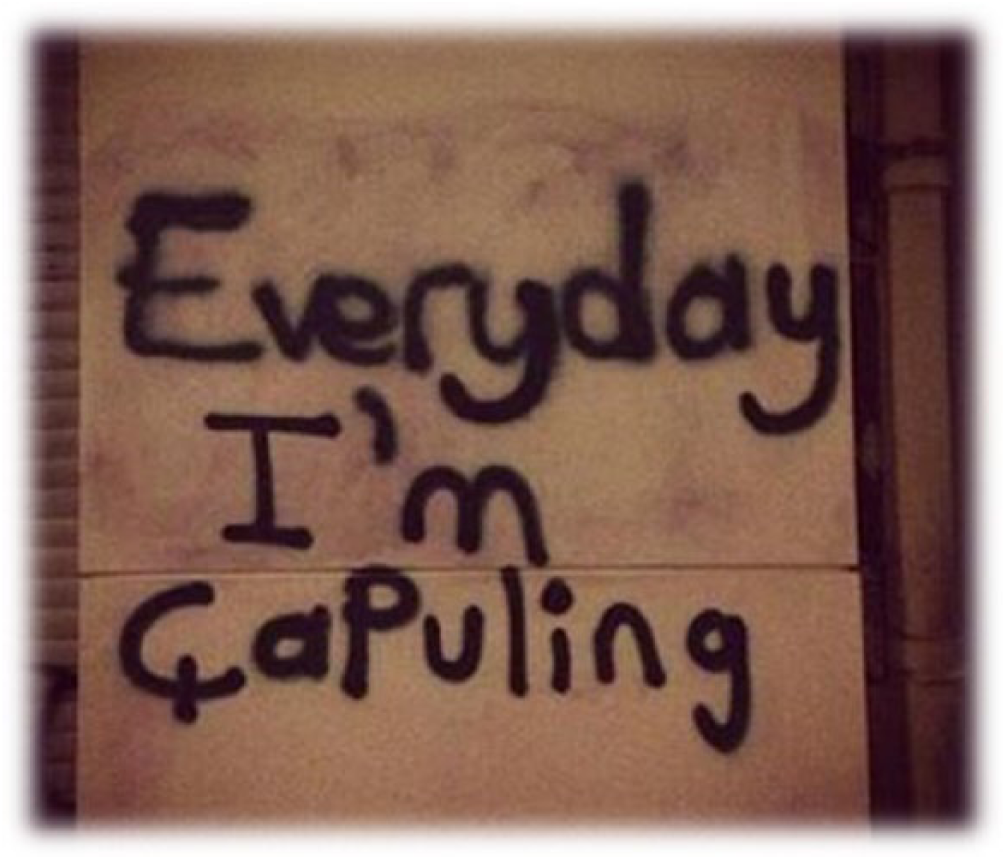
‘Everyday I’m Çapuling’ [instead of Shuffling]. Available at: https://www.suhakki.org/2013/06/korkunun-bittigi-yerde/everyday-i-am-chapulling/
The neologism related to çapulcu and çapuling occurs as a détournement that can be approached as political pranking. This kind of detourned neologism suggests a ‘direct challenge to all verbal and behavioural routines, and [it challenges] the sovereign authority of words, language, visual images, and social conventions in general’ (Vale and Juno, 1987, preface, np). The detourned version of the word subverts the humiliating effect of the PM’s reference to the Gezi activists. Furthermore, it destabilizes the actual meaning of the word by reconstructing a new form of signification. On these accounts, the Gezi activists took semiotic possession of the verbal attack from the Prime Minister and rendered it their own identity. As a result, the protesters made an attack from the government backfire and reinforced their solidarity.
A similar type of détournement was illustrated in the poster of Charlie Chaplin wearing a gas mask (Figure 5). The image was posted and reposted on social media accounts as a way of criticizing the Prime Minister and the policies of the AKP government. In the image, Chaplin, who delivered the speech of liberty, is leaning on a Turkish flag that signifies ‘a modern republican symbol’ against the conservative AKP government (Gürcan and Peker, 2015: 137). The use of Chaplin is arguably not a random choice, his liberty speech being the strongest element the activists identified with their struggle. At the bottom of the image is a quote from Chaplin’s speech of liberty, which reads ‘I believe in liberty – that is all my politics’, clearly the Gezi protesters identified this with their aim.
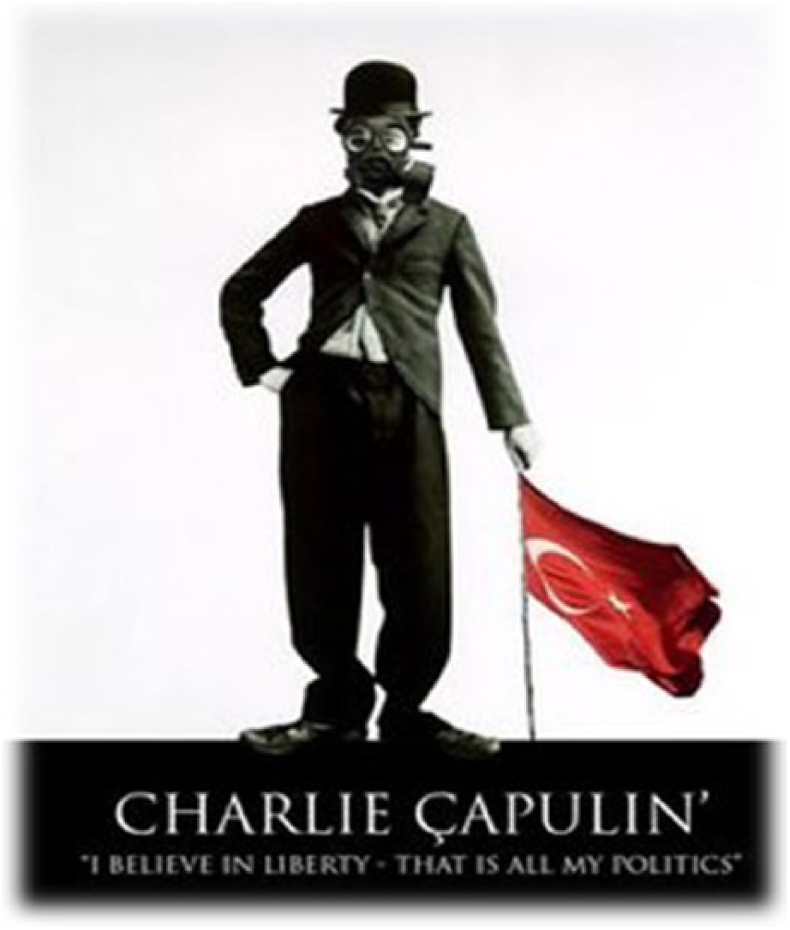
‘Charlie Çapuling’ [Chaplin]. Available at: https://www.pinterest.co.uk/pin/145452262938160568/?lp=true
In this poster, an intentional transformation of a surname into a neologism can be observed. The connections between the name and the word are caused by (1) the similarity of how both words sound and (2) how the protesters and Chaplin resonate with the concept of liberty. Transforming Charlie Chaplin into Charlie Çapuling is a direct satirical détournement that attaches the ideals of Chaplin to the protesters’ plight. What this means is that Chaplin, as a symbol of resistance, is being used as a signifier to advance the activists’ political message. This usage is not intended to alter the legacy of Chaplin, as Chaplin is not a ‘çapulcu’, but individual signs of resistance can be successfully linked together. Chaplin as a çapulcu supports the cause for a democratic approach in the policies of the government. Chaplin as a popular figure further reinforces détournement as it marks the recontextualizing of a world-known popular figure so as to subvert the way the Prime Minister referred to the Gezi activists. According to Emre et al. (2013: 8): Protesters using popular culture in an opposing and dissident way by preventing it from reproducing the dominant ideology, i.e. deconstructing the popular culture, strive to break down and invert the world-renowned popular culture during the process of creating an alternative culture. Culture jamming has widely been used during Gezi Protests as well; it helped the creation of a humour-based image produced through manipulation of popular advertising slogans, song lyrics, movie names and lines, and tabloid journalism materials, i.e. destruction of popular culture.
The use of Chaplin marks the appropriation of a popular cultural figure to construct a new cultural image that symbolizes the Gezi activists in general. In this vein, the use of Chaplin manifests the symbolic embodiment of the shared identity the word çapulcu signifies. The shared identity that the neologism of the word çapulcu formed also had its artistic reflections. These reflections were all related to the ordeals brought about by the Gezi experience but they carried traces of hope, humour and pacifist ideals. As The Guardian noted: The park and next-door Taksim Square have their own Capul art gallery – paintings by protesters hung on concrete walls. There is also an impressive Capul peace tree made from bits of fencing and stumps ripped up by government bulldozers after teargas-wielding riot police moved in. Istanbul residents have stuck hundreds of wishes on the tree, calling for anything from world peace to Erdoğan’s resignation. (Harding, 2013)
Censorship and the Image of the Penguins
Many images of penguins circulated widely in social media accounts during Gezi protests. On 2 June 2013, CNN Turk showed a documentary about penguins (an episode of Spy in the Huddle) (Oktem, 2013). Instead of showing the protests that occurred in Taksim, the documentary was intentionally shown; it censored the protests happening at the time. Similar to the reappropriation of çapulcu, the penguin motif was adapted and negated by the activists as a form of humorous détournement in retaliation to what the government had done.
To solidify claims related to the links between media channels and the AKP government, it is significant to contextualize Turkey’s politics mediascape and relation with one another. Ever since the election as the leading party in Turkey, the AKP government has increased its dominance over the media (‘Why the 3H sides with the Gezi Park protests?’, 2013). The various media outlets that operate under the control of the AKP government have been labelled as Yandaş Medya (Slanted Media) or Havuz Medyası (Pool Media) (‘Turkey protests: Clashes continue despite PM’s warning’, 2013). It was claimed that the AKP government has delimited and regulated freedom of press, content on TV (‘Gays in the Park: Why a rainbow flag has become one of the primary symbols of Occupy Gezi’, 2013) and internet access (‘Feminists join protests in Turkey as they call for equality’, 2013). Cook and Koplow (2013) explain that ‘over the last decade the AKP has built an informal, powerful, coalition of party-affiliated businessmen and media outlets whose livelihoods depend on the political order that Erdoğan is constructing. Those who resist do so at their own risk.’ As the BBC pointed out, in relation to the 2013 protests: Most mainstream media outlets – such as TV news channels Haber Turk and NTV, and the major centrist daily Milliyet – are loath to irritate the government because their owners’ business interests at times rely on government support. All of these have tended to steer clear of covering the demonstrations. (‘Statement Regarding BBC and NTV’, 2013)
Furthermore, media workers that published or produced content against AKP were left unemployed (‘2,5 million people attended Gezi protests across Turkey: Interior Ministry’, 2013; ‘2.5 Milyon Insan 79 İlde Sokağa İndi’, 2013; Gezi’ye Rekor Katılım: 7.5 Milyon Yurttaş’, 2013; ‘Türkiye İnsan Hakları Vakfı: Gezi Parkı Gözaltı Sayısı 3 Bin 773, Tutuklu Sayısı 125’, 2013).
CNN, the prestigious news channel, has a franchise that belongs to the Doğan Group in Turkey. The penguin documentary was a way of avoiding the censorship against showing the reality of the social uprising Taksim was facing. One Turkish citizen got so angry that he took photos of CNN Turk and CNN International side by side (Figure 6) and tweeted it. While CNN Turk was showing the penguin documentary, CNN International was showing the police spraying teargas at the crowds in Taksim. After the image went viral on social media, citizens labelled Turkish media as the ‘penguin media’ (Tüfekçi, 2014: 4). The censorship scandal was not only specific to CNN Turk. A satellite that can control and censor information has been confirmed as being used by CNN China (Vassileva, 2008).
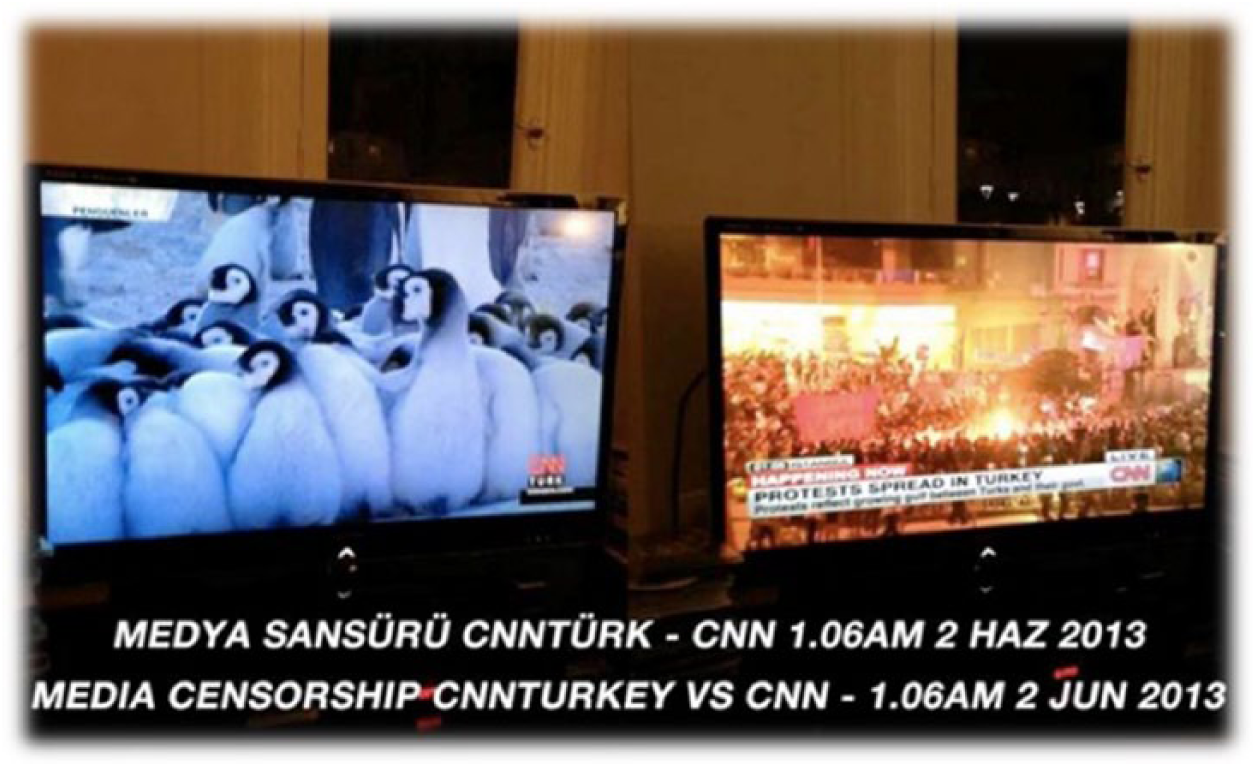
CNN Turk and CNN International side by side, 2 Jun 2013. Available at: http://bigthink.com/think-tank/why-you-should-care-about-whats-happening-in-turkey
Labelling Turkish media under the control of the AKP government as penguin media had visual reflections both on the walls of Istanbul and social media accounts. To illustrate, one activist image featured three penguins and wrote Antartika direniyor, which means ‘Antarctica resists’ (Figure 7). Another image presented a penguin wearing a gas mask and holding one hand up signifying the Gezi resistance of the protesters (Figure 8). As Kayabali (2013) writes: The stencil of a defiant penguin who also wears a gas mask symbolizes the media corruption in Turkey. Penguins are now associated with the self-censorship of the mainstream Turkish media after CNN Turk, a major news channel, broadcast a documentary on penguins while the civil protests and police violence were at their peak – instead of covering what was happening on the streets.
The penguin motif was primarily a censorship element of the government yet, similar to the neologism of the word çapulcu, the activists detoured it into a political play of resistance. ‘Antarctica is resisting! The penguins: It’s not about the melting glaciers!’ wrote one protester on Twitter (‘In Turkey, penguins become symbol of how media missed the story’, Radio Free Europe, 2013). Further, ‘We are all penguins’ T-shirts were made to be worn by the protesters (‘Chapulling: Turkish protesters spread the edgy word’, 2013).
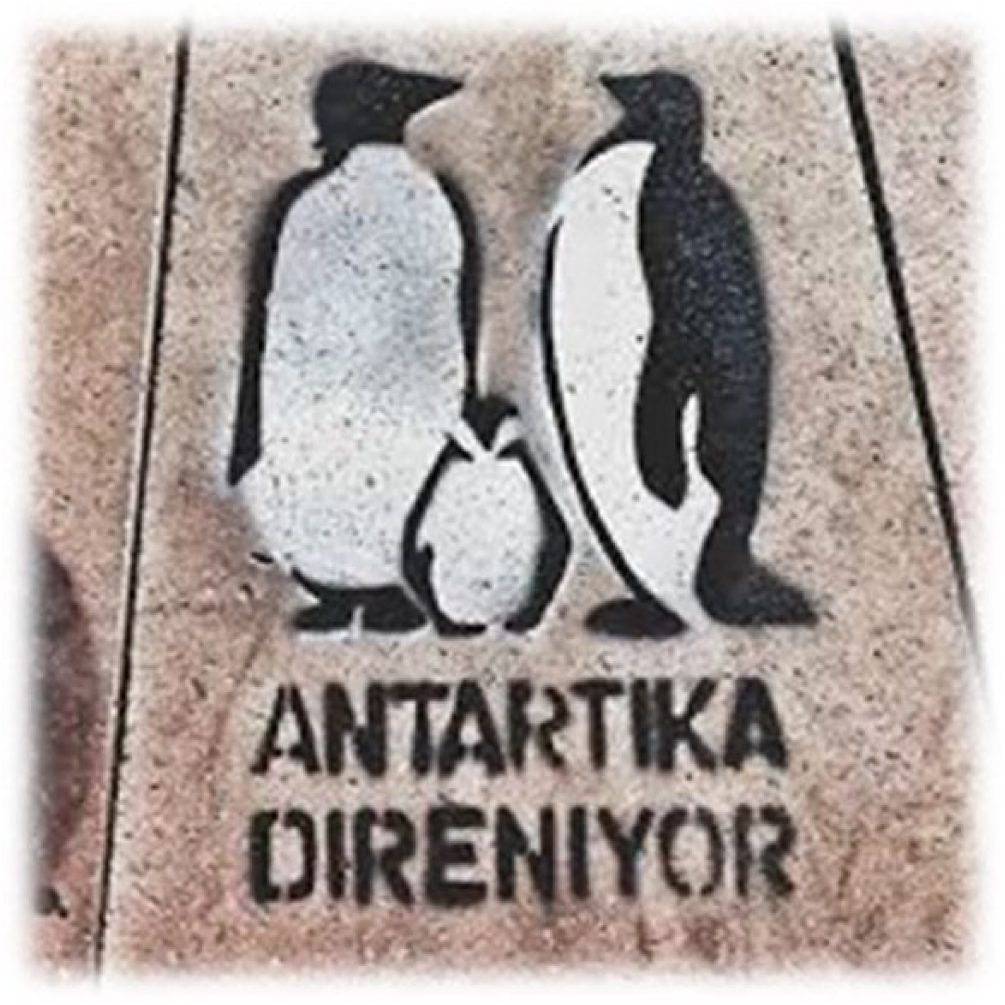
‘Antartika Direniyor’ [Antartica resists]. Available at: http://aestheticsofcrisis.org/2013/of-penguins-and-tear-gas/
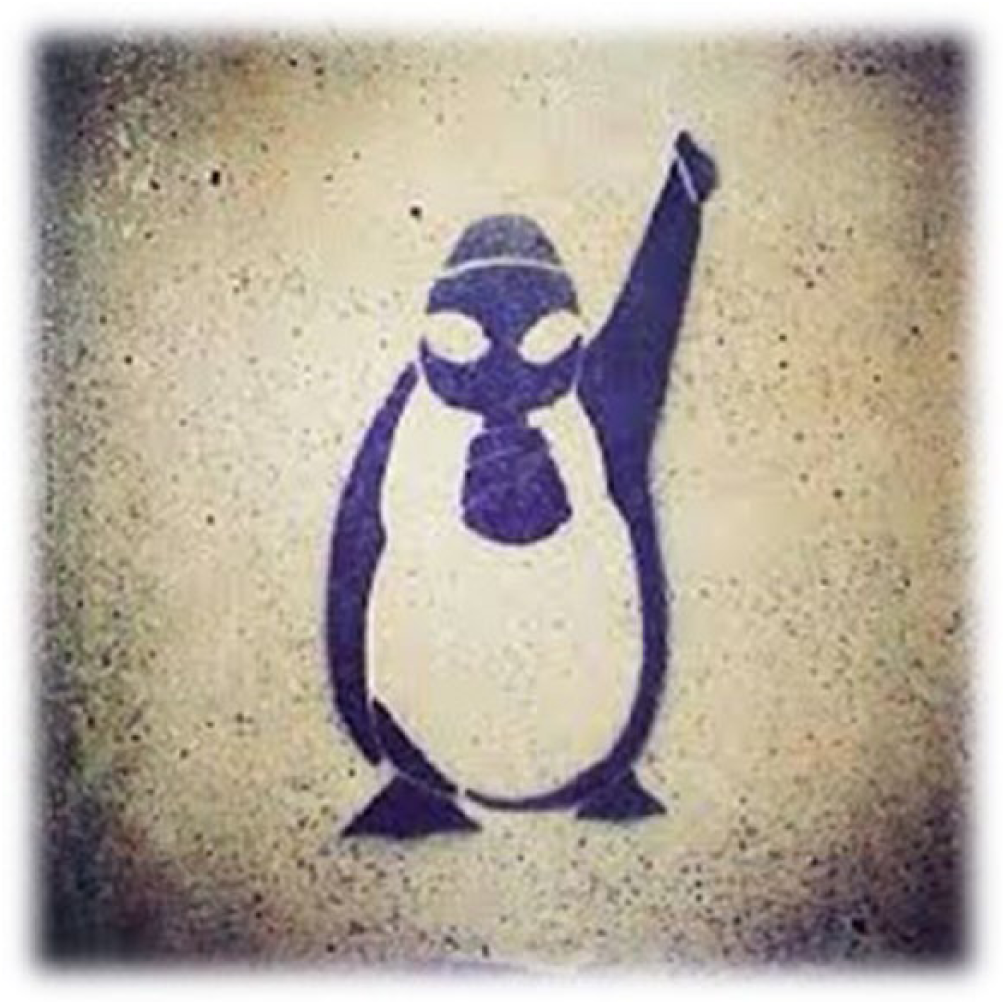
Penguin Resistance. Available at: http://aestheticsofcrisis.org/2013/of-penguins-and-tear-gas/-
By reconstructing the penguin motif, the protesters turned an element used against them and worked it to their advantage through witty retaliation.
Détournement displayed in these images and its humorous element provide a fruitful platform for resisting authority because: Laughing at a respected thing enables the laughing party to break free from the thing that is the source of fear and get rid of the oppressive burden of the past. According to Hannah Arendt, the biggest enemy of the authority is laughter (Avcı, 2003).
Through the reproduction of the penguin motif, the Gezi activists created a jokey motif from the oppressive actions of the governing party. As a result, censorship was counteracted with humour and oppression was negated through a rhetorical prank. In this vein, ‘acts of rebellion, subversion, and negation’ (Plant, 1992: 1) that détournement involves were aimed at the oppressive party by metamorphosing a censorship element into a marginalized motif. Thus, through the détournement conducted on the penguin motif, an activist imagery was created. The penguin motif was used by the activists against the AKP government through a ‘reversal of perspective’, or ‘a kind of anti-conditioning’ (Vaneigem, 1983: 164). In this way, the protesters turned an element of oppression used against freedom of information into a tool of sardonic resistance for freedom.
The Form of Opposition is what the Activists Embrace
The neologism of the word çapulcu and the penguin motif as humorous ways of protest were not the only two détournement examples. Many other plays on words and shifts of meaning took place in the form of visuals on the streets of Istanbul. According to The Guardian: After two weeks of protests the entire square and surrounding side streets have been daubed with humorous graffiti, including: “Stop Istanbullying!”, “Gas me baby one more time”, “In Gezi we trust”, and “I know the rules but the rules don’t know me”. On nearby wasteland someone spray-painted: “Have you ever çapulled so much, you thought you would faint?” (Harding, 2013)
Influenced by oppression and environmental concerns, détournement in Gezi protests resulted in inventiveness. Expressed through humour and satire, the images pointed out societal disappointments and expressed concerns for a change in the policies of the government. In regard to the relation between humour and protest, Simon Teune (2007: 116) writes that: Obviously, the focus on humour as a way to express grievances can also enrich the cultural analysis of social movements. We may, however, assume that social movements as agents of social change do not typically rely on ‘reinforcing humour’ that affirms the given social order, but rather on ‘subversive’ forms … Making fun of opponents distinguishes in and out-group members. Thus, humour can be a medium to assert identities, unite activists, and encourage them to continue their struggle.
In parallel to what Teune notes, the use of humour through détournement in Gezi protests formed unification amongst a wide variety of people from different segments of society. Because the Gezi protest had no leader, no manifesto or principles (Associated Press in Ankara, 2013), it was, in fact, the names and adjectives referred to by the Prime Minister against the activists and the censorship motifs of the government that the Gezi activists took on and embraced. The AKP government ‘aimed at marginalizing each and every one of the other fifty percent of Turkey’ by claiming that the activists were ‘marginal groups’ (Üstundag, 2013). In addition to the names and censorship motifs the activists took on, what brought activists together owed a lot to the marginalization of the activists by the leading party. Just like the neologism of çapulcu and the penguin motif, the activists embraced the way they were marginalized and created their own signs, significations and spaces through their use of images, words, artistic expressions and ways of living. The inspiration the verbal attacks and the censorship elements the AKP government used against the activists could be argued to be the most remarkable aspects of Gezi protests that led to the unification of the activists. Under the influence of these attacks, the activists found the missing common platform that would provide the power to unify them under an identity, an image and an activist soul.
Conclusion
Gezi Park events could be considered to be the most extreme friction point that, since its establishment, Turkey has ever witnessed between its citizens and its government. This friction is caused by the duality of the past and the future of Turkey. Reconstructing the military barracks could be considered to be a symbolic declaration of a recapturing of a well-known Ottoman past, as is evident in Erdoğan’s statement of the respect for history. Yet, the Turkish citizens preferred to look forward through subversive creativity, humour and wit. Thus, it could be argued that the polarization of looking back and looking forward constituted the core of the Gezi protests. The symbolic historical declaration of the government found retaliation in the detourned symbols of wit and humour by the Gezi activists. In this vein, what initially emerged as attacks from the government, (the word çapulcu and the penguin image) provided solidarity and common ground with which the Gezi activists identified themselves. The verbal and censorship attacks from the government offered the trigger the activists needed to relate to and bring them together. This trigger resulted in détournement. Détournement fuelled the urge for artistic resistance. It encouraged counterattacks from the activists against the government into forms of play through metamorphosing concepts such as protest, activism and resistance into fun and humour. Through this understanding of artistic resistance, the Gezi activists acted and expressed themselves on the streets and parks, transforming their surrounding into a stage of performance claimed by its own subjects.
Footnotes
Funding
This research received no specific grant from any funding agency in the public, commercial, or not-for-profit sectors and there is no conflict of interest.
Biographical Note
GIZEM KIZILTUNALI has completed her PhD in Media at Manchester Metropolitan University and has recently been working as a lecturer in the Department of Media at Yaşar University, Izmir, Turkey. Having majored in American Studies in her BA and MA, Gizem completed her MPhil in Media at Manchester Metropolitan University where she taught in the department of Media for three years. She attended many academic and interdisciplinary conferences that took place in prominent universities such as Oxford University and Harvard University. Gizem also attained professional teaching certificates from Oxford University and Trinity College, London. Her research interests include media forms and arts, media psychology, visual culture, semiotics, philosophy and cultural studies.
[email: