



Abstract
Students in technical fields use visual as well as verbal modes to express their meaning, employing ways of expressing meaning that are useful later in their professional lives. This study investigates visual meaning in student Builders’ Diaries, journals that are written by carpentry trainees to provide a record of their learning. In professional carpentry practice, Diaries function as a record of building work and are used in planning, billing and record-keeping. For this study, a corpus of 43 Builders’ Diaries, written by apprentices working in industry and by trainees in an educational institution, were analyzed. Findings reveal the role of visual meaning in the Builders’ Diary in developing the professional identity of the students. Compositional regularities were found, including regularities in image–image and image–text relations. These regularities suggest the extent to which our participants, who have no formal training in design, participate in culturally shared understandings of visual meaning.
1. Introduction
Technical writing has received increasing attention over the last few decades and, associated with this, so too has visual expression in technical writing (for example, Rowley-Jolivet, 2004; Wickman, 2015). In this article, our focus is on the use of visual meaning in a technical workplace genre that is important in the building trade: the Builders’ Diary. In particular, our study, which draws on data collected at a vocational training institution in New Zealand, concerns visual meaning in Builders’ Diaries written by student carpenters.
Visual meaning in construction discourse has been studied by Karlsson (2004), who compared industrial drawings by architects and engineers to visual meaning in popular hobby magazines. She found the industrial drawings to be highly abstract line drawings, while in the hobby magazines the drawings were more realistic and heavily supported with written text. The Builders’ diaries of carpentry students in our study fell between these two: like the hobby magazines, they were heavily supported by text and also by photographs (an even more realistic mode than the realistic drawings in the hobby magazines); on the other hand, they included line drawings which were more schematic than realistic. The relevance of Karlsson’s study to our investigation of visual expression in the Builders’ Diaries is not only the common context of discourse in the construction industry but also because, in building a house, carpenters are amongst the end users of the building plans referred to in Karlsson’s study.
A number of studies of images embedded in texts have concerned texts that are professionally produced. These include annual reports (De Groot et al., 2016), textbooks (Bezemer and Kress, 2009) and the world-wide web (Maier et al., 2007). In a study in an educational context, Bezemer and Kress (2009), who considered images in English textbooks from the 1930s to the 2000s, showed that the role of the visual has become increasingly important, growing from almost no images in the 1930s texts − 0.03 per page to 0.74 per page by the 2000s. They also found that the textbooks were increasingly organized by use of images, rather than by words. Another study, also concerning professionally produced texts, is Jewitt’s (2002) investigation of how changing the mode of a novel to a CD-ROM both simplified and restricted the interaction of the readers with the text. She showed that the CD-ROM placed an interpretation on the text that readers of the novel had to make for themselves.
In addition to studies of professionally produced texts, studies of visual meaning in an educational context include Wilson and Landon-Hays’ (2016) study of the images used in classroom teaching by six middle-school teachers of a range of disciplines. As in our study, the teachers who selected and used the images in this study were not professionally trained in design. They found that use of images is discipline-specific, and knowledge of communicative norms in a discipline is beneficial for learners. This suggests the likelihood that carpentry too has shared norms for expression of visual meaning and this is something that we explore in our study. Considering specifically multimodal texts produced by students, Archer (2011) notes that, increasingly, students’ academic writing contains images such as charts and tables, and that assessment increasingly includes visual texts such as posters and PowerPoint presentations.
Of relevance to our study because of its focus on technical disciplines is Rowley-Jolivet’s (2004) study of images in conference presentations in three different scientific disciplines. Like many studies of visual meaning, including ours, this study employed Kress and Van Leeuwen’s (2006[1996]) grammar of visual design (see section 2.3 for detail). Rowley-Jolivet (2004) found that professionals in the different disciplines she investigated had different strategies and different technologies for expressing visual meaning. This too confirms that expression of visual meaning is discipline specific.
In comparison with most studies, which are of professionally produced texts, our study concerns images produced by students who are not professional designers, photographers or artists. In addition, the texts on which we focus, the student Builders’ Diary, are akin to notes. They are not drafted, revised and reconsidered, but merely included as a record of what happened in their building work.
There is a relatively small body of literature that has considered student technical writing. As one example, Varpio et al. (2007), also employing Kress and Van Leeuwen’s framework, focused on optometry patient records as completed by student optometrists. They concluded that, visually, the patient record genre, which consists of a highly structured form to be completed by the student practitioner, favors the scientific voice of the practitioner and backgrounds patient-provided information.
Workplace technical writing has also received attention (for example, Bremner, 2012; De Groot et al., 2016; Karlsson, 2004). Our study of trainee carpenters’ writing is situated at the intersection between studies of student technical writing and studies of technical writing done in the workplace. Our study considers the role of visual meaning in a written workplace genre, the Builders’ Diary, which, in the vocational training context in which our study is placed, serves both educational and apprenticeship purposes.
The Builders’ Diary is a daily record kept by builders and, in the case of our study, by trainee carpenters. Their initial training is focused on building a house under the guidance of their tutor, an instance of learning situated in practice (Lave and Wenger, 1991). Trainee carpenters note in their diaries when and where the day’s work was done, the measurements, materials and tools used, what was done and how it was done. Photographs and sketches form part of this record (see Parkinson, Mackay and Demecheleer, 2018, for more detail).
Lave and Wenger (1991, 1999) have described the way that newcomers to a profession (such as apprentices) participate in communities of practitioners, over time gaining mastery of relevant knowledge and skills. In contrast with other kinds of tertiary education, apprenticeship provides opportunities for development that are situated in the context in which the apprentice will work once qualified. Lave and Wenger (1991) speak of the ‘legitimate peripheral participation’ of apprentices. This describes how apprentices start with only partial participation in professional knowledge, activities, values, and identity, moving to fuller membership of the profession during their apprenticeship. This movement from peripheral to fuller membership entails a gradual change in identity from trainee to professional.
Becoming a professional includes acquiring not only knowledge and skills, but also professional practices (such as writing the Builders’ Diary), as well as professional values and identities (Duff, 2008). For apprentices, the situated nature of their learning in a workplace context, in which they interact with experienced professionals, facilitates this learning. Examples of learning situated in the workplace are provided by Bremner (2012), who discusses the situated learning and acquisition of workplace values and discourse of a PR intern. Similarly Lingard et al. (2003) describe the situated learning and accompanying knowledge, and identity development of student doctors interacting with a team of health professionals. Situated learning is key to the identity formation of carpentry trainees who, in moving from peripheral to more central participation in their trade, come to share its values and perspectives. Their experience of building a house under the guidance of an experienced carpenter begins this process of situated learning, introducing them to the values of the building community and developing their sense of identity as a builder.
This study builds on our previous work, both Parkinson et al. (2018) and Parkinson, Demecheleer and Mackay (2017). Parkinson et al. (2018) showed that the Builders’ Diary follows a highly predictable rhetorical structure, expressing meanings relating to three main aspects of the building work, which are consistently dealt with in most daily entries in the diary. These three aspects include context (e.g. date, time, weather, and team members), materials and equipment, and detailing the work (what the task was, the method employed, and the purpose). This study indicated development over time and context, with apprentices already in the workplace expressing some meanings (such as meanings to do with costing) that were absent from those of the students in their initial year spent in an educational context. The present study will examine the extent to which such differences are echoed in differences in use of visual resources.
Parkinson et al. (2017) found an association between writing style in trainees’ Diaries and the year of study of the trainees. By year of study, we refer to an initial on-campus year compared to later years when the trainees are employed as apprentices. In our previous study, we found a statistically significant tendency for on-campus writers to use a personal narrative style, writing in full sentences, using the personal pronouns, I and we, and mentioning their team members by name. In contrast, we found that once the carpentry trainees became apprentices, they took on an impersonal telegraphic style, with few references to themselves as I and we. One purpose of the present study is to test the hypothesis that similar differences will be found in use of images by the carpentry trainees. For example, we hypothesize that on-campus writers use more ‘personal’ photographs, which feature themselves and their team mates, and that as trainees move into the workplace as apprentices, their writing will be found to favor ‘impersonal’ photographs which focus on the work being done rather than on human participants.
This choice between photographs that include or exclude human participants is just one of a wide range of choices that students have at their disposal in writing the Builders’ Diary. An even wider range of choice is available stemming from the multimodal nature of the diary, in which written text, photographs and drawings may be selected in making meaning. Discussing multimodal text, Kress (2010: 133) distinguishes two roles: that of the ‘rhetor’ (involved in framing the message for a particular audience to fulfil a particular social purpose) and that of the designer (involved in marshalling the semiotic resources available). These two roles are usually played by the same person, this being the case also in the case of the Builders’ Diary. In producing the Builders’ Diary, the student writer can draw on the multiple resources of written text, photographs and drawings to realize the rhetorical purpose of the writer in getting the message across to the reader.
In the production of multimodal texts (e.g. casual conversation, in which the speaker draws on gesture, facial expression, and spoken language), the producer may be unaware or only partially aware of the choices made in communicating the message. This can be compared to the linguistic production of speech and writing, in which the speaker/writer makes constant linguistic choices in expressing meaning (Halliday, 1994). Such a choice is complex and happens too quickly in general to be a wholly conscious process. As the student writers have no formal training in design, their training does not involve being asked to consider consciously the design choices they make. As Kress and Van Leeuwen (2006[1996]: 3) note, knowledge of visual design, although shared by members of a particular culture, may vary in explicitness.
A second purpose of our study is therefore to investigate the extent to which use of visual meaning (as described by Kress and Van Leeuwen) is shared by the writers of the texts that we studied. We hypothesize that, despite their lack of formal training in design, the writers of the Builders’ Diaries will show regularities in expression of visual meaning, which reflects a shared understanding of visual meaning.
2. Method
In this section, we describe the context of our study and our participants (section 2.1), as well as our data set of student Builders’ Diaries containing the images (section 2.2) which we coded using the analytical framework described in section 2.3. In section 2.4, we outline the qualitative method employed: interviews held with specialist informants, the carpentry tutors.
2.1 Context of the study
Our study took place at a vocational institution in New Zealand at which participants were enrolled as carpentry trainees. The initial year of their carpentry qualification took place on campus, where the trainees built a house in teams under the guidance of their tutor, a highly experienced carpenter and teacher. After the initial year, students become apprentices in the workplace, receiving periodic visits from their tutors and attending night classes at the vocational institution.
Vocational assessment in New Zealand is based on industry unit standards. These are outcomes – both content and procedural – that describe and are used to assess tasks that industry professionals need to be able to do in their work (New Zealand Qualifications Authority, 2010). For example, a trainee must demonstrate knowledge of the principles of erecting wall frames and show familiarity with methods, tools and materials for building wall frames. The Diary records and explains the building work the trainee has done. The tutor uses this record as evidence of ability to do a task and use the necessary tools. Visual expression of meaning is important, as photographs and drawings form important evidence that the trainee actually fulfilled the work associated with a particular unit standard.
2.2 The data set
Like a personal diary, each Builders’ Diary contains one year’s daily entries. In an educational context, the Builders’ Diary is a daily account of the writer’s building work. Examples of these can be seen in Figures 1–6. The daily entries in the diaries we collected varied in length from a few words to several hundred words, with an average length of 75 words.

Photograph in ‘given’ position and text in ‘new’ position.
Written text in given position and photograph in new position.

Photograph in ‘real’ position and sketch in ‘ideal’ position.

Temporal sequence of photographs.

Three images indicating spatial relations.

Two images in an overview–detail relationship.
The diaries of 43 trainees, written either by apprentices (10) or on-campus trainees (33), were included in this study. Writers were informed of the purpose of our study and gave written consent for their diaries to be included in the study. To ensure that each of the 43 diaries made the same contribution to our data set, the first 2000 words were selected from each diary. Some of the diaries contained notes copied from the tutors’ notes on the board, and these sections were omitted as not being the students’ own writing.
All images from each 2000-word extract were identified. Our definition of what constituted an image included sketches drawn by the writer and photographs (taken by the writer or possibly taken by a peer or tutor, and selected for inclusion by the writer).
2.3 Limitations of the study
Limitations of the study are firstly that we were unable to interview the diary writers because the diaries were collected two years before the analysis was done, and by that time the writers had left the institution. Such interviews would have allowed us to investigate the perspective of the authors of the Diaries and perhaps to discover what the various features of visual meaning meant to them. This might be a useful direction for future study. Another limitation is that we did not manage to obtain any professional Builders’ Diaries; for reasons of confidentiality, professional carpenters were reluctant to share their Diaries.
2.4 The analytical framework
Our analytical schema employed Kress and Van Leeuwen’s (2006[1996]) grammar of visual design. Drawing on Systemic Functional Grammar, Kress and Van Leeuwen consider three metafunctions: ideational, interpersonal and compositional. The ideational/representational meaning of each image concerns what the image is about. The interpersonal meaning of images concerns the relationship between viewer and producer of the image, and also between the viewer and the depicted images. The compositional meaning of images involves the spatial organization of images on the page with regard to other elements on the page, such as text; it also involves any meaning relationship between each image and other images, and the meaning relationship between each image and the text. We consider each of these below, giving greater weight to compositional meaning.
For every image from each 2000-word sample, firstly, representational meaning was captured in whether the image was a diagram/sketch (Figures 5 and 6), a photograph containing people (Figures 2 and 3) or a photograph with no people in it (Figure 6).
Interpersonal meaning was coded for each image by considering whether the image ‘offered’ information or ‘demanded’ social recognition of a human subject who made ‘eye contact’ with the viewer (Kress and Van Leeuwen, 2006[1996]: 124). Most photographs that included people did so incidentally; either people merely happened to be in the frame, often with their backs turned to the camera (Figure 3), or in some cases only part of the trainees’ bodies were included, such as the hands of trainees using tools (second photograph in Figure 4). These photographs, in which there is no interaction being depicted between people in the photograph, nor any ‘eye contact’ being made between the depicted person and viewer, are offer images: their purpose is to offer information about the building work being done. Similarly, all sketches in the diaries are offer images. Examples of offer images are found in Figures 1 –6.
In this article, we provide no examples of demand images, as, for ethical reasons, we do not wish participants to be identifiable in photographs. This is because, typically, there are a number of carpentry trainees in the demand images, and we cannot identify which of the depicted trainees have given informed consent for their photographs to be included. We are therefore restricted to descriptions of offer images. (Demand images are rare, as our results below show.) In our data set, demand images are photographs of carpentry trainees looking at the camera. These are mainly group photographs of the team/carpentry class. Some of these were informal, with the team posing around part of the building: for example, the first wall frame to be erected. In other demand photographs, the team posed like a sports team with a top, middle and lower row. In these team photographs, each member of the team made ‘eye contact’ with the viewer of the image.
Other aspects of interpersonal meaning in Kress and Van Leeuwen’s (2006[1996]) framework are, firstly, how viewers are positioned by the producer of the image: whether the viewer is placed in a more powerful position (high angle), a less powerful position (low angle), or equal position (horizontal angle). Interpersonal meaning is also reflected in how real or true the image is represented as being. Kress and Van Leeuwen extend the linguistic notion of modality to the visual mode, noting that the producer of an image can manipulate aspects of the image, such as degree of detail included or color saturation. A distinction can, for example, be drawn between the detail and the color saturation in a photograph compared to a line drawing. Because of the greater level of detail and the use of color in a photograph, Kress and Van Leeuwen note that photographs are probably more likely to be viewed as having the highest similarity to ‘reality’, that viewers are likely to view photographs as closer to the reality.
This view of the photograph as a reflection of what was really there at the time of taking the photograph is disputed by many researchers. For example, Rose (2012) argues that this greater truth value of the photograph (in the popular imagination) stems from the way it has been used, for example, as evidence in court. In addition, as Mirzoeff (2014) and others have argued, the ability in the last few decades to digitally alter photographs has lowered the truth value of photographs. In addition, this judgement of how real an image is varies with genre: in scientific texts, line drawings, which have the potential to be more analytical, showing salient features only, arguably have higher truth value. Machin (2007: 58) differentiates the truths depicted by photographs and drawings as the difference between the depiction of a specific instance (a photograph), compared to the depiction of a generic representation (a line drawing). This is likely to be the case also in technical genres such as the Builders’ Diary. Thus, the truth value of an image depends on the viewer and what the purpose of the image is for them.
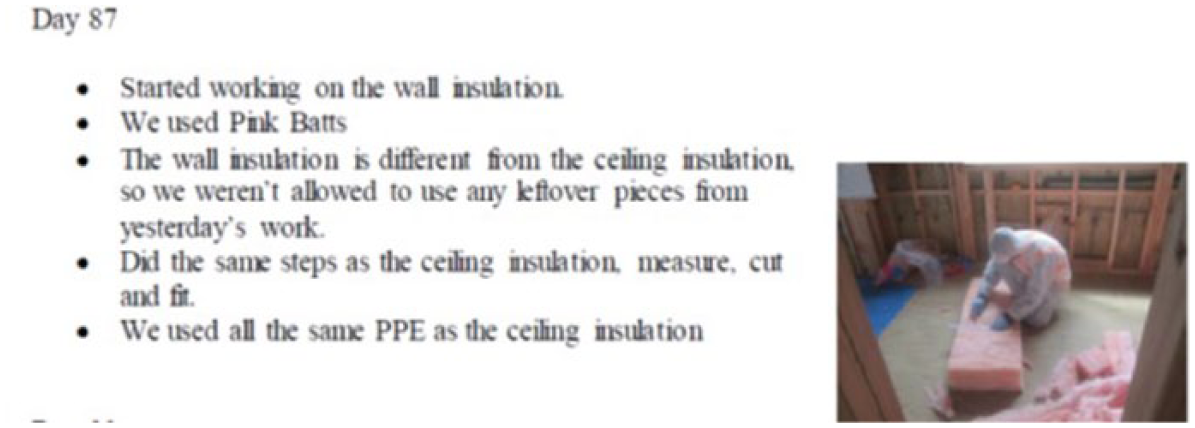
A number of aspects of compositional meaning were coded. These included placement on the page, relationship between images, and relationship between text and image. Firstly, with respect to image placement on the page, whether the image was placed at the left or right, top or bottom, or centre of the page was coded for each image. In Kress and Van Leeuwen’s (2006[1996]) schema, items (text or image) that are placed left of page are viewed as ‘given’ or familiar, while those on the right are ‘new’ (p. 186). This is comparable to the Systemic Functional Linguistics analytical framework of clausal meaning in a text, where writers/speakers typically place given/known meaning first in the clause and new information second. (This left–right reading path is, of course, specific to western contexts.) In the Builders’ Diary, if the diary writer places the image to the left and the text to the right, we can project that the writer views the image as familiar/known, and the textual accompaniment as new/unknown. Figure 1 provides an example, with the photographs in ‘given’ or known position and the written description of this in ‘new’ position. Conversely, if the text is placed first, the writer regards that as known and the image as new (Figure 2).
Kress and Van Leeuwen (2006[1996]: 193) view image(s) or text placed at the top of the page as being in the ‘ideal’ position and image(s) or text at the bottom of the page as in the ‘real’ position. ‘Ideal’ placement at the top of the page implied information that is more generalized and idealized (Machin, 2007: 145), while ‘real’ placement at the bottom of the page implies more realistic, ‘down to earth’, factual information. Thus, in the Builders’ Diary, placement of text at the top of the page indicates the diary writer’s view of the text as generalized and idealized, and the image at the bottom as realistic and factual. In Figure 3, the sketch at the top of the page in ideal position reflects a plan of an element of the house (the joists and dwangs); this is what the writer ideally planned to do before starting the work. The photograph at the bottom of the page reflects the reality of what was seen on site once this ideal plan had been put into effect.
In addition to a left–right and top–bottom layout, elements, whether image or text, may be placed in a centre-margin layout. Those that are placed in the centre of the page are being depicted as the nucleus or focus of the information, while marginal elements are being depicted as ancillary or dependent (Kress and Van Leeuwen, 2006[1996]: 203). This layout was unusual in our data and we therefore provide no example.
A second compositional feature that we coded was the relationship of each image to other images. Possibilities were: a series of images, photographs or sketches, in a temporal sequence (Figure 4); images showing a spatial relationship (Figure 5); images showing the relationship of overview and detail (Figure 6); and finally, images showing the logical relationship of instrument–achievement (Figure 1).
In Figure 4, the diary writer depicts a temporal sequence, using three photographs to illustrate the steps in the work done. This sequence includes a photograph of the installed window with no flashing attached above it, a photograph of the carpentry trainee’s hand holding the flashing that he is about to attach, and, finally, a photograph of the attached flashing.
In Figure 5, three images show spatial relations between the weatherboards used to clad exterior walls. The first image shows how the weatherboards are placed from bottom to top of a house’s outside walls; the second image shows how weatherboards are joined using an angle cut; the third image shows that the join must be directly over a piece of wood labelled a ‘cavity batten’.
In Figure 6, three images, two sketches and a photograph, are in a relationship depicting overview (the photograph at the bottom) and detail (the sketches above). The three images together show an overview of the skirtings of the house (the photograph) and the detail of the skirting joins (the sketches).
Figure 1 also depicts images showing the logical relationship of instrument–achievement. The instruments are tools, indicated in the first photograph, and materials (glue) in the second photograph. The achievement in the third photograph shows the wall with the skirting completed.
Finally, to consider the relationship between image and text, we relied on Van Leeuwen (1991) who distinguishes whether the relationship between the image and text is one of elaboration or extension. In elaboration, the image restates or respecifies what is in the text. For example in Figure 2, the photograph shows a builder measuring the wall insulation, and this information is restated in the accompanying text. In Figure 5, the written description of how to join weatherboards is repeated in the sketches (or vice-versa).
Meanings in image and text in a text–image relationship of extension are different but complement each other. This is the case in Figure 7: the sketches provide the design and measurements of the job, while the text provides costing of the job, followed by daily tasks accomplished.

Image–text relationship of extension.
2.5 Interviews with carpentry tutors
We are not carpentry professionals, but rather science educationists (the second author) and applied linguists with an interest in how learners learn to express disciplinary meanings (the first and third authors). We therefore found it essential to draw on insiders’ interpretations and perspectives in order to maximize the accuracy of our understanding of the meaning and purpose of the Builders’ Diaries. These interviews focused on all aspects of the diaries, such as what content was appropriate to include, what the pedagogical purposes and eventual workplace purposes of the diaries were, and what guidance tutors gave students in the written and other features of the diaries. We conducted interviews with six carpentry tutors who taught the student writers of the Builders’ Diaries. These took place both before data collection to confirm aspects such as the pedagogical purposes of the Diaries and after data analysis in order to confirm our interpretation of the content in the students’ visual representations. Tutors reported strongly encouraging the trainees to use images in their diaries, thus allowing the diaries to ‘show’ as well as ‘tell’ what the students do on the building site.
3. Results and Discussion
We begin this account of our results with a discussion of our prior analysis of the stylistic features of the Builders’ Diaries (Parkinson et al., 2017) also informed by interviews with carpentry tutors, before moving on to examine any regularities in expression of visual meaning in our data set.
3.1 Stylistic features of the Builders’ Diaries
As mentioned above, our prior research (Parkinson et al., 2017) found that less experienced on-campus trainees produced more personal narrative diaries, and the more experienced apprentices produced impersonal diaries written in a more telegraphic style. Examples of the fuller narrative style, which uses full sentences, and situates the writer in the diary by use of the personal pronouns I and we, are found in Figures 4 and 5:
Once window was installed, we used level to run across to other window … Then I measured flashing in between windows … (Figure 4) Starting from the bottom weather board we worked together to align corners and joints. Using a chalkline everytime we go up help keep the boards straight … (Figure 5)
In contrast, Figures 3 and 7 exemplify more telegraphic, impersonal language. Personal pronouns as subject are omitted, and preterit (started, measured) or imperatives/bare infinitives (Machine, Prime, Put, glue) expressed actions performed:
Started putting down dwangs. Measured 1800mm from outside of joist … (Figure 3) 9/5/13 3 Machine all frame joints/Prime 10/5/13 3 Put frame together/DHS cedar 13/5/13 2.5 Machine sash profiles, glue sashes together … (Figure 7)
We discussed the issue of personal versus impersonal language in our interviews with the tutors in our study, asking them which style they would teach their students. All said they would teach the fuller, more narrative style to on-campus students because it enables a fuller account of the work and, importantly, at this early stage in their training, it encourages them to identify as carpenters. We discuss this in greater detail below.
By the time students become apprentices, though, their tutors reported that they expected the students to write in the more telegraphic style. One tutor reported that:
I’m coaching that I don’t need all this (pointing to a diary entry in full sentences) just bullet points and just get the most important side of things.
Another tutor who also teaches apprentices, when asked if he explicitly teaches the telegraphic style replied that:
No I don’t actually. It sort of comes to them but I guess it starts at this point [pointing to the narrative excerpt] which is putting themselves into it. They should go to that style of writing [pointing to a telegraphic entry]. And they do do that… When they’re finishing up they’re becoming more brief … I think you begin to see a confidence in their style of writing … I wouldn’t expect a beginning student to be writing this [the telegraphic excerpt] because simply they wouldn’t have the expertise to do that because there’s a lot in this stage [telegraphic entry] of their writing which is unsaid.
This tutor views the personal style as functioning to ‘put themselves into it’. Through explicitly including themselves in the text by use of personal pronouns and, arguably, images depicting the trainees themselves, the writer identifies himself/herself as a carpenter, present on a building site and actively performing the building work.
Given that the on-campus trainees produced more personal narrative writing (Parkinson et al., 2017) and that the apprentices produced impersonal telegraphic writing, we hypothesized, firstly, that on-campus trainees, who were at the start of their training, would produce more photographs containing people. We also hypothesized that compared to the on-campus students, the apprentices would produce more photographs with no people in them.
Our reasoning in these hypotheses was that, in using significantly more personal pronouns than the apprentices, on-campus students had produced texts that were more personal. We viewed the photographs with human participants as another personalizing feature, and speculated that there would be an association between the use of personal pronouns and production of photographs with human participants. Similarly, we viewed photographs without human participants as impersonal, and suspected that the apprentices, who used fewer personal pronouns, resulting in impersonal texts, would produce more of these impersonal photographs.
3.2 Ideational meaning: sketches, photographs including people, and photographs excluding people
Our 86000-word data set, from 43 Builders’ Diaries, contained a total of 1739 images. To test our hypothesis that on-campus trainees would make more use of personal images, we categorized these in terms of image type: sketches, photographs including people, and photographs with no people. Sketches constituted 810 of the images, 591 were photographs containing people, and 338 were photographs without people. We compared the production of each category by the two groups of writers of our data set: 10 apprentices and 33 on-campus trainees. Table 1 shows mean numbers of the three image types produced by the two groups. We recorded our coding decisions for each image in an Excel spreadsheet.
Three types of image produced by apprentices and on-campus trainees.

It is clear from Table 1 that on average on-campus trainees produced far more images (average of 44.4 images per 2000-word extract) compared to the apprentices (average of 27.5 images per 2000-word extract). A t-test 1 showed that this difference was statistically significant (p < .05).
Interesting too are the different proportions of image types produced by the two groups: 57 percent of the apprentices’ images were photographs without people, only 6 percent were photographs with people, and 37 percent were drawings/sketches. The proportions for the novice on-campus writers were only 12 percent photographs without people, 39 percent photographs with people, and 48 percent drawings/sketches. In fact, the image type produced most commonly by the apprentices (photographs without people) was the image type least commonly produced by on-campus trainees.
On-campus trainees produced significantly more photographs that included people (p < .05), and significantly fewer photographs without people (p < .05). This supports our hypothesis that on-campus trainees would produce more photographs with people in them, adding to the personal nature of their Diaries.
The impersonal photographs without people are strongly favored by apprentices, who also produced few photographs with people. This supports our hypothesis that apprentices’ use of images in their Builders’ Diaries would, like the dearth of personal pronouns in their writing, contribute to their production of an impersonal text. In contrast, on-campus students included far fewer photographs without people and far more photographs that included people, equally congruent with their frequent use of personal pronouns in their writing. The apprentices’ apparent avoidance of producing personal photographs could also reflect the nature of their work environment, where, as apprentices, they have a less equal relationship with qualified co-workers than the on-campus trainees have with their classmates.
The ease of including photographs in a document like the Builders’ Diary has been enhanced by the widespread use of the Smartphone in the last few years (the i-phone was launched in 2007). This has expanded the multimodal potential of a text like the Builders’ Diary. Being able to include photographs of their building work, including site overviews and details of their work, is an advantage to the diary writer in being able to provide proof of what they have been doing on site. Photographs can provide evidence that the diary writer is able to do certain building tasks and can be credited with the corresponding unit standard.
Inclusion of photographs in Builders’ Diaries does not however remove the need for sketches, which show a subtly different kind of information. This includes, firstly, planning of measurements (Figure 7); secondly, a more abstract outline of the work, showing only the salient features (Figure 3); and, finally, a more abstract view of a detail, foregrounding only the salient features (Figure 6).
Within the context of everyday life, photographs have what Machin (2007: 46) calls ‘high modality’ (reliability and truthfulness), in that they depict what those present on the building site would have seen. By contrast, the sketches have high modality in the context of the building industry (Karlsson, 2004). Line drawings have greater truth value in architecture than do color photographs, for the very reason that they foreground what is important and omit irrelevant features (Varpio et al., 2007). So it can be argued that the sketches in the Builders’ Diaries, also line drawings, have greater truth value in the context of the building site than do the colored photographs. Indeed, one of the apprentices was an experienced professional builder, who was doing the qualification in order to get certification. He used only sketches in his diary (see Figure 7), and included no photographs. Although this difference may be partly related to the age of the diarists and to diarists’ use of different/new technologies, some mature builders we spoke to, including the tutors, use both sketches and photographs, taking advantage of the different affordances of the two types of image.
3.3 Interpersonal meaning: relationship between viewer and depicted participants in the Diary images
Almost all the images in our data set are offer rather than demand images. Demand images are rare: only 24 of the 1739 images. A further indication that these were atypical is that these 24 were produced by only four on-campus diarists. In the vast majority of photographs, the viewer has a ‘fly on the wall’ perspective (Kress and Van Leeuwen, 2006[1996]: 180), which does not acknowledge the presence of the photographer or viewer. In photographs that include people, the norm is for depicted trainees not to be facing the viewer; they also do not ‘look at’ or ‘make eye contact’ with the viewer. Often the trainee builder’s hands (photograph 2 in Figure 4), the backs of heads, or the lower part of the body are shown. Focus is on the building work, not on the depicted trainees. The trainees are present in many of the photographs, but depicted as an unremarkable part of the building site. The focus of the photographs is the building work, not the trainees or their relationship with the viewer.
In general, the 24 demand images are posed group photographs depicting groups rather than individuals. This speaks to the value of the team rather than the individual. These team photographs are not irrelevant to carpentry work as they are part of the building of team spirit, a sense of unity with one’s ‘mates’. They relate to the mention that writers made of ‘getting a mate to help you’ with certain tasks; mention by name of fellow builders was also common.
As shown in Table 1, the on-campus diaries are more personal in the sense of containing more human participants. Despite this, even in the on-campus diaries, the personal nature of the diaries is limited in the sense that, for the most part, the human participants are not making any social connection with the photographer or with the viewer of the photographs and focus is on the building work, rather than on the depicted participants themselves.
Emphasis therefore, in both the on-campus and apprentice Diaries, is on providing information, not making social connection with the viewer. This is even more prominent in the apprentice Diaries which seldom include human participants.
The issue of how powerful the viewer is constructed as being with regard to the depicted elements in the image, as coded by low, horizontal and high angle, was not coded in our data. This is because this was not productive in our analysis, as the viewer was usually given the same perspective that the person taking the photograph had (see Figure 2 and photograph in Figure 3), with little or no attempt to manipulate the angle from which the image was photographed. The exception to this was close-ups of details (see, for example, Figures 1, 4 and 6), where the focus was merely on providing enough detail, rather than on manipulating shot angle. Given this largely unmanipulated perspective of the photographer, we did not feel justified in reading meaning into this.
As Table 1 shows, the diary writers included both photographs and drawings in their diaries in close to equal numbers (810 drawings compared to 929 photographs). Despite the argument noted above that the truth value of photography is increasingly undermined by the capability for digital manipulation of photographs (Mirzoeff, 2014), the photographs in the Builders’ Diaries are, nevertheless, likely to be viewed as more ‘realistic’ than line drawings, showing what the building or part of the building looked like (e.g. Figure 4). This argument concerning apparent ‘reality’ or ‘truthfulness’ of an image is consistent with Kress and Van Leeuwen’s (2006[1996]: 158) observation that photorealism is currently ‘the dominant standard by which we judge visual realism’. However, as Kress and Van Leeuwen later go on to argue, in technological contexts (and here we include carpentry) ‘a technical line drawing, without colour or texture, without light or shade, and without perspective, can have higher modality than a photograph’ (p. 164). In comparison with the photographs in our data set, the drawings are more analytical (p. 161), with greater ability for selection to show only what is salient. They function in assisting in planning (e.g. the drawings in Figures 3 and 7). However, rather than viewing either of these as more ‘real’/’true’ than the other, we argue that drawings and photographs show different kinds of information in these texts, and that both are necessary.
3.4 Compositional meaning: placement of images on the page
Regularity in placement of images on the page is one of the factors that provides evidence for a shared ‘visual grammar’ as proposed by Kress and Van Leeuween (2006[1996]). Table 2 shows the tendency for images in the diaries to be arranged in a left–right/given–new orientation. Most commonly (50% of images), the image is placed to the left, with text at the right (see Figures 1 and 6). This suggests that the image is regarded as given, and the text relating to the image is the new.
Compositional meaning: placement of images on the page.

This suggests that to the Diary writer, the visual depiction is more familiar, with the textual description being less familiar. This is understandable, given that, at the time of writing, the diarist has performed the work and experienced the reality of the building work, so the visual mode is very familiar to him or her. The photographs in particular appear as an already experienced reality. Describing the work in words may require more thought, thus relegating it to a ‘new’ position. The second most common orientation has the written text (Figure 2) or another image (Figure 6) in left/given position, and the image in right/new position. As can be seen from Table 2, neither centre-margin, nor top–bottom placement of images was prominent in the data.
3.5 Compositional meaning: image–image relations
A total of 1268 images (73% of 1739 images) were related to one or more other images. The relationships between images were coded and the results are shown in Table 3.
Compositional meaning: image–image relations (%).

As the entries are relatively short (average 75 words), it is logical that each entry is likely to be focused on a single topic, and that the images in any one entry would, generally, be related to each other. As Table 3 shows, the most common image–image relation was a spatial one (56%), as depicted in Figure 5. This was followed in frequency by a temporal relationship (27%), depicted in Figure 4. Overview–detail relationships (13%), depicted in Figure 6, were less common. This suggests a primary concern with how the elements of the house fit together (spatial relationship), followed by a concern with the sequencing of steps in doing a particular task (temporal relationship).
3.6 Compositional meaning: image–text relationships
The final aspect of visual meaning that we considered was the relationship displayed between images and the text in which they were embedded. Compared to Karlsson’s (2004) description of engineers’ and architects’ drawings, which relied almost entirely on visual representation, the Builders’ Diaries are multimodal, with visual and written expression being important. Our results indicating the relationship between verbal and visual are recorded in Table 4.
Compositional meaning: image–text relationships.

Table 4 shows that the relationship between most images and the accompanying text was that of elaboration, where there is redundancy between the information in these two modes (see Figure 5, for example). Although both written text and visual image in Figure 5 express the same meaning, they complement each other, each doing what the other cannot do as well; together they provide a fuller, more comprehensible account. This meaning redundancy suggests that the writer (trainee) and the reader (tutor) benefit from both a visual and a textual expression of the same meaning. For the purposes of assessment, trainees are required to describe what they have done in words, but, as our study shows, they also record for future reference what the work looked like at various stages in the building process. This is likely to reinforce for the trainees how the building work is done. For the tutor, the visual expression of meaning provides visual proof of what was done to accompany the written claims by the trainee of what they did.
Table 4 shows that fewer images were in a relationship of extension with the accompanying text. For example, in Figure 7, the drawings show the carpentry design and measurement while the text indicates costing of the job and lists daily tasks. As explained above (section 1.3), the information in the two modes is different but complementary. Interestingly, the writer of this Diary was characterized by his tutor as a highly experienced carpenter, who was enrolled in the course in order to get certification. His Diary was viewed by his tutor as being close to that of a professional carpenter. Because of the knowledge and experience of this diarist, it is likely that redundancy of meaning between the two modes becomes unnecessary.
The tendency towards meaning redundancy in image–text relations was more pronounced in the Diaries of on-campus writers (91%) than those of apprentices’ (81%), as Table 4 shows. It may be that apprentices have a reduced need for such meaning redundancy because of their greater knowledge and experience.
4. Conclusions and Implications of The Study
There are two ways that this study resonates beyond the Builders’ Diaries of a group of Carpentry trainees in New Zealand. These relate firstly to evidence for culturally shared understanding of visual meaning, and secondly to pedagogy in technical classrooms.
4.1 Evidence for culturally shared understanding of visual meaning
This study of visual meaning in Builders’ Diaries produced by carpentry trainees has shown strong regularities in expression of this visual meaning. This provides evidence of use of culturally shared understandings of visual meaning by a group of non-designers.
Our results show, firstly, that more experienced trainees produced statistically fewer images overall, and those they produced were statistically less likely to feature people. Less experienced trainees were more likely to include more ‘personal’ photographs, which contained people as part of those images. This supports our prior findings (Parkinson et al., 2017) that early in their training carpentry students write linguistically more personal diaries, ‘putting themselves into’ their work by use of personal pronouns and names of classmates. Both verbal and visual ways of personalizing the diary play two important social roles. Firstly, personalizing the diary plays a role in ‘putting themselves into’ their work and the building site, and thus building an identity as a carpenter (Duff, 2008). In depicting themselves and their classmates in their photographs, novice carpenters take on the identity of a professional whose daily life as part of the building site is depicted in the diaries. Secondly, this depiction of themselves and their classmates working together on the building site stresses the team nature of the enterprise. This reflects the value of ‘mateship’ (Page, 2002) that is so important in New Zealand social culture and which appears to be part of what is being learnt in the on-campus year.
Although people are depicted in photographs in the diaries of on-campus students, the dearth of demand images in the diary is important. (In demand images, the depicted participants make a social connection with viewers by making ‘eye contact’ with them.) The lack of such images suggests that the primary focus of the Builders’ Diaries and their images is not on the carpenters themselves, but rather on their work. So, although the novice carpenters include people in their photographs, the outcome is to depict themselves as an integral but unremarkable part of the building site. Ultimately, their aim is to write an account of how to build a house, not to portray themselves as making a social connection with the photographer or the viewer.
A second finding related to regularities of expression of visual meaning is that the context of production of the Diaries and their images, whether on-campus in an educational context, or in a workplace context for the apprentices was reflected in statistically significant differences in the numbers of photographs containing the trainees themselves. The move from the educational to the workplace context is accompanied by a move from a personal narrative text in which the trainees often depict themselves visually as working on the building site to telegraphic impersonal text in which the apprentices avoid depicting themselves or others, and focus instead on depictions of their work (Parkinson et al., 2017). We have interpreted this as assumption of an identity (Duff, 2008) as a carpenter by the on-campus trainees, who signal their presence as part of the building site by use of I and we and by use of photographs of themselves working as carpenters. Signalling their developing identities as carpenters in these ways reflects their view of themselves as becoming professionals. The move to the workplace as apprentices, however, shows a group more confident in this identity, with less need to display it by use of personal pronouns or visual depictions of themselves on the building site. This has similarities with Bremner’s (2012) study of the situated learning (Lave and Wenger, 1991) of a PR intern, who, in moving from an educational to a workplace context, acquired workplace values and learnt workplace discourse in the workplace. Our participants moved from learning situated on a building site on campus in a team of classmates under the guidance of their tutor, to learning situated in a professional team of builders on a range of workplace building sites. This resulted in both stylistic changes in their writing (Parkinson et al., 2017) and changes in visual expression of identity.
A third finding is that, despite the fact that their authors have no design training, the Builders’ Diaries show some strong compositional trends. The first of these compositional trends is the dominant placement of images on the page in a ‘given’ position, to the left of the page. This we have interpreted as reflecting that, having already done the work, the visual mode is more familiar to the writer, while describing this process in words is less familiar/new. This parallels what tutors told us about their practical approach to teaching in which they show how a task is done on site, rather than just talk about it in the classroom.
A second compositional trend is that most diary images have a meaning relationship linking them to other surrounding images. The most common meaning relationship depicted is a spatial one, followed by temporal meaning relationships. This we have interpreted as reflecting the writers’ desire to record how elements of the building fit together, and what the sequential steps in this work are.
A third compositional trend is that images and text in the Builders’ Diaries are largely related to each other through a relationship of meaning redundancy, or elaboration. This meaning redundancy may reflect the pedagogical nature of the Builders’ Diaries as written by trainees. Such redundancy of meaning in the two modes is likely also to benefit both the writer and their tutors. For the writer, this meaning redundancy facilitates remembering for later use what the building work looked like, and also gaining experience at describing it in words. The tutor benefits from the added evidence that the student did the work, which is of use to the tutor in assessing it. Our study also provides some evidence that this meaning redundancy is reduced in the writing of more experienced carpenters, where written and visual modes express different meanings.
The importance of these strong regularities of expression in the Builders’ Diaries is that the carpentry trainees in our study are not trained in design. It cannot be claimed that they make conscious design choices in their choice of sketches and photographs, in the composition of their images or in the composition of individual pages of their diaries. Regularities that we observed in their use of images in their diaries can reasonably be assumed to arise from the culturally shared grammar of visual meaning that Kress and Van Leeuwen (2006[1996]) proposed.
Just as Systemic Functional Linguistics views every utterance made as being the result of grammatical choice between options (Halliday, 1994), so too can we extend this notion of meaning making to the use of visual meaning. Thus, it is not only those trained in design who can understand, read and use visual grammar although, compared to lay people, trained designers are likely to be better able to employ this grammar consciously to express their meaning. This is to be expected because if designers can rely on audiences to read and understand visual language (Machin, 2007: viii), then this is a shared language that is accessible to non-designers and able to be employed by them in some degree.
We have shown elsewhere (Parkinson et al., 2018) that one element of social purpose of the student Builders’ Diary is as evidence of the work that has been done as part of an assessment of industry unit standards. The Builders’ Diary proves to the tutor that the trainee did the work and can be credited with the unit standard. So the ideational meaning of what is depicted in images in the diaries is important. The sketches and photographs in the diaries play a key role in fulfilling this purpose.
A second element of social purpose of the trainee Builders’ Diary is as an aid to memory for the future. How to do the work, what the work looks like during the process, and the sequence of steps in achieving the work are likely to be important. These have all been shown by our analysis to be achieved by visually expressed meaning in conjunction with written text.
4.2 Implications for pedagogy in technical classrooms
A pedagogical application of this study is to assist carpentry trainees to be more deliberate in the photographs they include. The affordances of sketches compared to photographs might also be considered. For example, sketches highlight only important features compared to photographs which more easily depict ‘reality’ but do not focus on what is salient. Similarly, discussion of the affordances of verbal compared to visual expression of meaning may be useful. Explicit discussion of patterns of meaning relations between images – overview, temporal and spatial – may also be useful. For example, it might be helpful for trainees to consider the usefulness of sketches or photographs of details compared to overviews. Given the importance of the establishment of identity through diary writing, a prescriptive approach to what images ‘should/should not’ be included is not advisable, and such consideration of visual meaning should be descriptive rather than prescriptive.
Footnotes
Acknowledgements
We acknowledge the carpentry students who contributed to our corpus of Builders’ Diaries, and also the time and professional expertise of their tutors in assisting in our analysis.
Funding
We acknowledge too the generous funding support of Ako Aotearoa (NPF14-010). There is no conflict of interest.
Notes
Biographical Notes
Address: Victoria University of Wellington, Kelburn Parade, Wellington, New Zealand. [email:
Address: Wellington Institute of Technology, New Zealand. [email:
Address: As Jean Parkinson. [email: