



Abstract
Both Al Tahrir and Rabaa Squares have a significant iconized value especially after being involved as places in which to stage protests. Since, protests and revolts take place in public spaces, the visualization of these spaces reveals much about the representation and circulation of the protesters’ ideologies, trends and attitudes. This article explores the role of visual representations in the production of protest urban spaces. In so doing, the visual spatiality of the Al Tahrir protest and Rabaa camp, as presented in Getty Images’ online news gallery, are considered through a spatial semiotic lens. In this regard, the article draws upon tools for the analysis of semiotic resources in spatial texts, concepts of spatial semiotics (Stenglin, 2004, 2009, 2011) and spatial engagement (McMurtrie, 2012). These tools are employed to reveal the representational dimension of space (Lefebvre, 1991). The intersection between the spatial practices and representational space, as mediated by the visual medium, is then underlined.
Keywords
1. Introduction
Presenting images of protesters renders them symbolically powerful as it makes them visible to the public (Lim, 2014: 63). Visual representation is significant in communicating the identities and messages of protesters to a wider audience (Veneti, 2017). Moreover, visualization can rally support for protests or delegitimize protesters’ causes (DeLuca and Peeples, 2002; Veneti, 2017). Since protests are closely intertwined with urban space, this article aims to contribute to the literature on visualizing social movements by exploring the visualized spatial dimension of protests. The focus of the article, then, is not on the protest space per se as on its spatialization. The key aim is to investigate the intersection of notions of visuality and spatiality in relation to the iconization of protest identity. In so doing, the article examines, from a semiotic lens, how the spatial practices of protests in urban space are visualized.
Urban space is a cultural and political representation of power (Corner, 1992; Mitchell, 2002; Raaphorst et al., 2017: 125) that defines and empowers protest movements (Caldeira, 2015; Vicino and Fahlberg, 2017). ‘It is the staging of social movement in public space that translates the movement into visual power, a spectacle of political bodies’ (Lim, 2014: 63). Socio-political conflicts are realized spatially: ‘it is only in space that such conflicts come effectively into play, and in doing so they become contradictions of space’ (Lefebvre, 1991: 365). In this view, some studies explore the spatial dimensions of social movements (Dhaliwal, 2012; Jansen, 2001; Routledge, 1997) by addressing the relationship between the formation of identities and the symbolic practices of protesters such as presence, barricades, noise or music, which, in turn, redefine the protest urban space physically and symbolically as ‘terrains of resistance’ (Daphi, 2017). Since both the visuality and spatiality of protests perform a significant role in defining such movements and shaping power representations, scholars such as Brantner and Rodriguez-Amat (2016), Adams and Jansson (2012) and Thielmann (2010) argue for bridging the gap between the disciplines.
Investigating images of protests corresponds to the growing interest in an emerging protest culture and new ways of politics exposure ranging from the Arab Spring to the Occupy Movement as well as anti-austerity protests in Europe (Rovisco and Veneti, 2017). This ‘new wave of contention’ (Doerr et al., 2013) necessitates studying the visual representations of protest movements (Askanius, 2012, 2013; Doerr et al., 2013; Philipps, 2012) and the ways protest images are composed and symbolized (Rovisco and Veneti, 2017; Ziemann, 2008). In this view, this article explores the role of visual representations in iconizing protest urban space. Iconic photographs orient emotions. ‘They are described as being especially emotional images, and by their public character they channel affective response to animate roles and relationships’ (Hariman and Lucaites, 2007: 36). Photographs become iconic when displaying dramatic positioning, postures and gestures that have the ability to enact instant emotional reactions. However, the term ‘spatial iconization’ is introduced in this article to identify ‘the process of constructing visually based narratives about the potential of places … a process of brokering the best metaphor, in ways that will shift or consolidate public sensibilities’ (Bass Warner and Vale, 2001: xv).
This article is concerned with a relatively new trend in visual news reporting: the online news galleries. This particular type of multimodal text contributes to situating the photos in a professional, news story-telling context. Getty Images is one of the major photo galleries that took place after the advent of digital image storage technology in the late 1990s. Online news galleries propose a new multimodal genre creating a unique space for news story-telling tasks where images dominate (Caple and Knox, 2015). Being so familiar and unconsciously involving, stock photographs have a powerful ideological significance, enabling the ideas they promote to be accepted (Frosh, 2003: 2).
2. Background
The Arab world has recently witnessed a wave of revolution. Egypt has experienced two revolutions: one in 2011 that took place in Al Tahrir Square and the other one staged in 2013 in Rabaa and Al Nahda Squares. In the Al Tahrir events, protests aimed at toppling the Hosni Mubarak regime continued for 18 days starting with the Day of Anger on 25 January and ending with President Hosni Mubarak’s resignation on 11 February.
Mohamed Morsi won the presidential vote in 2012, becoming Egypt’s first democratically elected president. However, the issuing of the November 2012 Constitutional Declaration marks Morsi’s exclusionist policies and governance, which, in turn, triggered the anger of the Egyptians and isolated the Muslim Brotherhood group from Egyptian society and different political groups. Protesters took to the streets to demand the toppling of Morsi in reaction to his plan for Ikhwanization (Brotherhoodization) of the state (Arafat, 2017). In late June 2013, President Mohamed Morsi was ousted. This event led to massive protests from pro-Morsi and the Muslim Brotherhood who camped at Rabaa Al-Adawiya and Nahda Squares for several weeks.
3. Visual Representation of Urban Space
All social activities are almost urban and media related. ‘Being urban and communicative are pre-dominant features of contemporary and future societies’ (Eckardt, 2008: 7). Media representation of urban spaces provides a social realm where geography and communication overlap (Brantner and Rodriguez-Amat, 2016: 305). The analysis of spatial representations in the communication processes reveals how space is shared and commonly understood (Brantner and Rodriguez-Amat, 2016: 306; Rodriguez-Amat and Brantner, 2014). Moreover, mediatizing urban spaces through different media platforms multiplies the meanings driven from communication and place since the ‘textural links are increasingly fluid and their evolution via mediatization has numerous repercussions involving privacy, mobility, personal power, and security’ (Adams and Jansson, 2012: 310).
Urban space is socially produced and reproduced (Brantner and Rodriguez-Amat, 2016; Jansson, 2013; Lefebvre, 1991). Visually representing urban spaces adds to the process of social production. The social philosopher Henri Lefebvre’s Production of Space (1991) is significantly relevant here. Although a detailed description of Lefebvre’s model is beyond the scope of this article, a brief reflection of his notions of the space as social production which works within the areas of ‘spatial practices’, ‘representations of space’ and ‘representational space’ grounds the article’s consideration of the visual representation of protest urban space. ‘Spatial practices’ or ‘perceived spaces’ refer to daily experiences and routines. As for ‘representations of space’, it is the space of planners and bureaucrats, constructed through discourse. ‘Representational space is the lived experience of space through the complex symbols and images of its users’ (Lefebvre, 1991: 33). Photographs, editorial cartoons, movies and poetry can be perceived as representational spaces that, through deploying symbolism, construct counter-discourses and thus provide different prospects about space (McCann, 1999: 172). Representational space, as argued by Lefebvre (1991) (see Figure 1), involves the interpretations of people’s daily spatial practices which add new layers of meaning to these practices. Interpreting spatial practices, representational discourse ‘expresses human thought, fantasy and desire, and thereby represents human ontologies (beliefs, fantasies, values and desires about how the world is) and epistemologies (how better understandings of the world might be achieved)’ (Fahmi, 2005: 366).
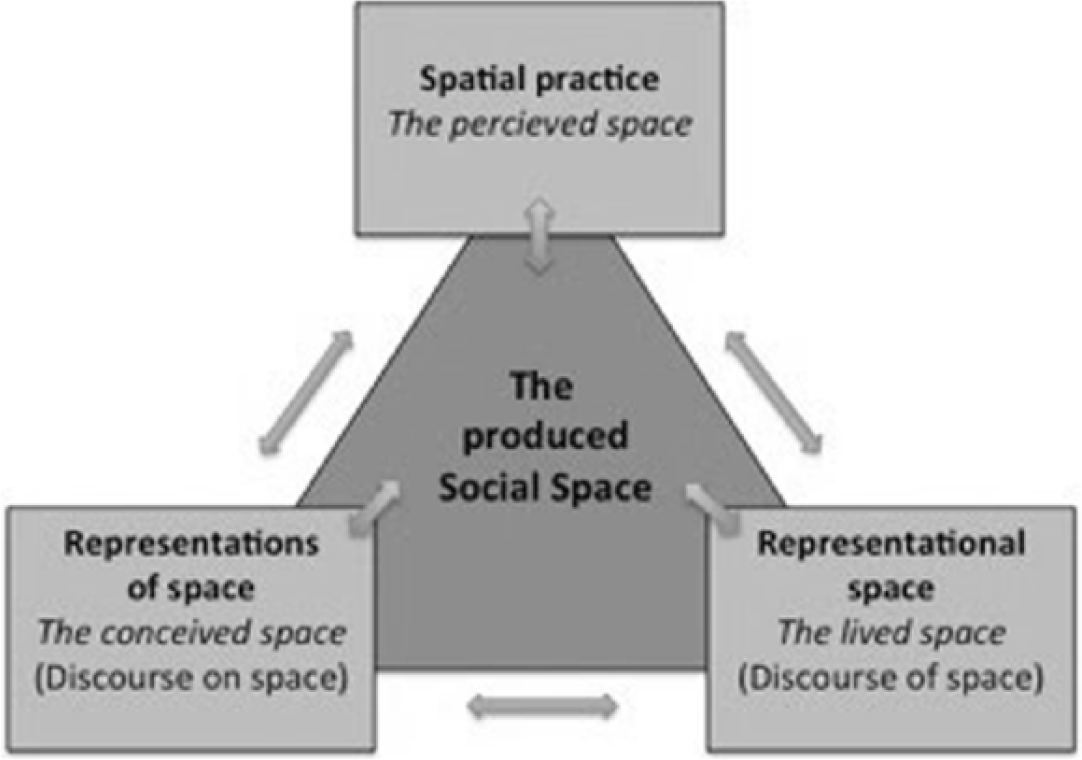
Lefebvre’s 1991 conceptual triad.
Being a social product, space is political and ideological (Lefebvre et al., 2009: 171). Visual representation of a space turns it into ‘a visual ideology’ (Cosgrove, 1984: 47):
The artist, through perspective, establishes the arrangement or composition, and thus the specific time, of the events described, determines – in both senses – the ‘point of view’ to be taken by the observer, and controls through framing the scope of reality revealed. (Cosgrove, 1984: 48, cited in Jaworski and Thurlow, 2010)
Although photos are governed by photographers’ choices and techniques (composition, framing, depth of the field, colour contrast, etc.), ‘photographic space is more complex than a photographer’s interest in a single object or viewers’ tendency to think of images as being about a single subject’ (Liggett, 2007: 10). Visualizing urban space transforms it into ‘a space where new forms of the social and political can be made, rather than a space for enacting ritualized routines’ (Sassen, 2011: 24). In this regard, visual discourse on urban space achieves ‘multiplicity’ of meaning (Massey, 2005) where spatial performance and the materiality of space intersect with representational space.
Iconizing urban spaces visually can be better examined through the workings of spatial semiotics. In this regard, Lefebvre’s notion of representational space is viewed in relation to Stenglin’s (2004, 2009, 2011) and McMurtrie’s (2012, 2016) approaches to spatial semiotics since ‘the study of the “semiotic dimension” of representational spaces becomes essential to transform transmitted signals into meaningful messages, i.e. into understanding’ (Hassenpflug, 2010: 20).
The adapted integration of representational space with spatial semiotics as shown in Figure 2 is used in analysing the visual iconization of protests in urban spaces in the photos under discussion.
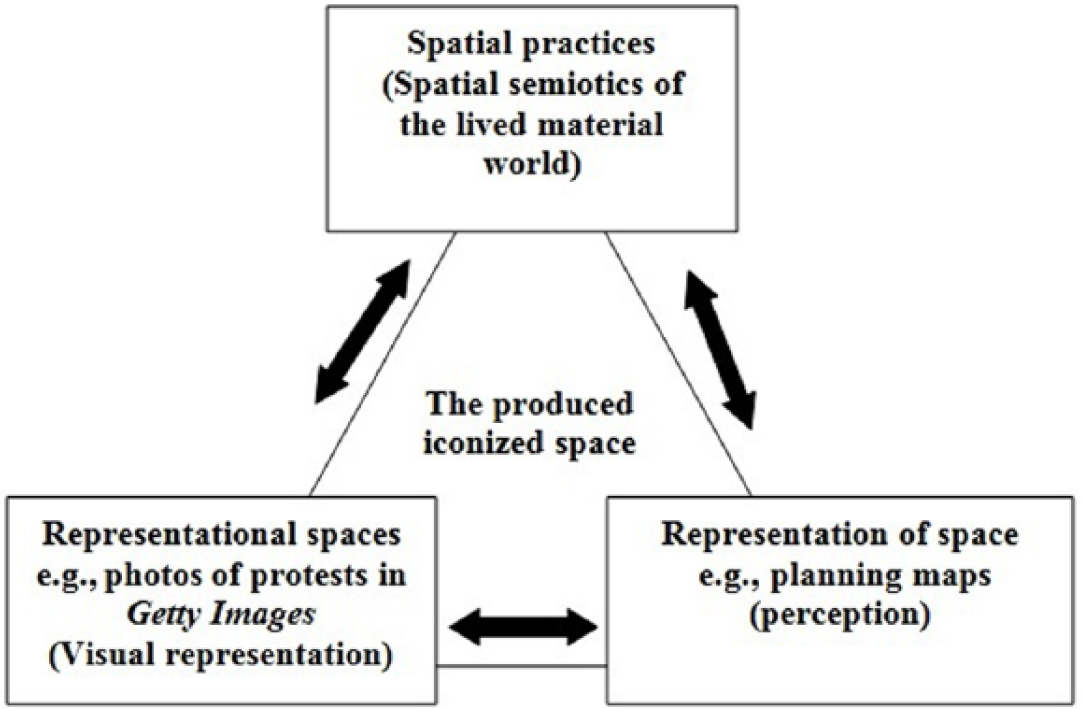
Integrating Lefebvre’s notion of representational space with spatial semiotics.
4. Spatial Semiotics
The approach of spatial semiotics (McMurtrie, 2012, 2016; Stenglin, 2004, 2008, 2009, 2011) is drawn from social semiotics (Halliday 1978; Kress and Van Leeuwen, 2006). Social semiotics is concerned with exploring how communicative resources, in their social contexts, can be used for purposes of communication (Van Leeuwen, 2005). Accordingly, social semiotics focuses on the social dimension underlying the contextualization processes. Commenting on the spatial dimension of semiotics, Fenwick et al. (2011) argue that space functions as a ‘static container’ for people’s actions. They refer to space as a dynamic representation influenced by social and material interactions. Spatial semiotics considers space as a setting for complex action (Van Leeuwen, 2008). Analysing a spatial text from a social semiotic perspective moves on from what is denoted to what is connoted (Ravelli and McMurtrie, 2016: 35).
Spatial semiotics, as stated by Ravelli and Stenglin (2008: 355), reveals interpersonal relations between the interactants and the space ‘buildings make us feel: they may seem inviting or intimidating; they may make us feel comfortable or uncomfortable: as if we belong or as if we are intruding’ (emphasis in original). In this sense, spatial semiotic analysis reveals much about the users who engage in the spatial text. The type of representations found in spatial texts helps to give an insight into the type of resident (user) who engages in the spatial text. Hill (2003) identifies three types of users of spaces: ‘reactive users’, ‘creative users’ and ‘passive users’. According to Hill, reactive users modify ‘the physical characteristics of a space as needs change but must select from a narrow and predictable range of configurations largely defined by the architect [or semiotic designer]’ (p. 28). As for creative users, they utilize spaces in different ways, by creating new spaces or by giving existing spaces new meanings. Hill points out that a passive user does not add to the use or transform the meaning of the provided space. Passive users merely perform useful tasks according to the functionalist principles enacted by the space. Following the same line, Ravelli and McMurtrie (2016) examine the role of the design and content of space in enabling users to participate in and assume certain roles. They investigate how some spaces enable users to be Actors (walking) or Sayers (talking) and how other spaces restrict them to being mere Behavers (sitting), for example.
5. Iconization
This article is concerned with how protest urban spaces are iconized due to the visualized spatial practices and semiotic performances of their users. It seeks to reveal how visualizing protesters’ spatial activities creates an individualized image about their protests and provides them with a ‘brand identity’ that affords immediate recognition. So the notion of iconization used here is distinguished by its spatial semiotic readings. Spatial iconicity refers to how people identify with and are identified by the space.
In general, iconization is defined as the process of instantiation whereby ‘ideational meaning is discharged and interpersonal meaning charged’ (Martin, 2010: 21). Wignell et al. (2016) point out that iconization is emphasized when meanings are condensed and interpersonally charged through various forms of semiosis, such as words, images, objects and practices in emblems, logos, flags, mottos and religious texts. An icon is formed when the ideational meaning of an activity or an object is reduced and instead members of a community focus on its emotional importance as a symbol of social affiliation. Wignell et al. (2016: 3) employ the iconization of a cross as an example. For them, the ideational meaning of a cross is superseded by its interpersonal associations when it symbolizes Christianity. As such, the iconization of the interpersonal meanings changes the object or activity into functioning as a Bonding icon, which aligns people into groups with a shared affiliation (Martin and Stenglin, 2007).
As for spatial iconization, which is the focus of this article, it considers how solidarity and social affiliation can be negotiated in three-dimensional 1 space (Stenglin, 2004). Spatial iconization operates through three principles: ‘Hybridization’, ‘Bonding icons’ and ‘Binding’.
5.1 Hybridization
One of the means through which spatial iconization is realized is ‘Hybridization’. Hybridization refers to embedding a space within a space. For example, spatial texts, such as art museums, might show movies, or a shopping centre might run craft classes for children (Stenglin, 2004: 405), and so a multi-functional space is established. By embedding a space within a space, Hybridization functions as a tool of recontextualization. In this regard, it is significant to building spatial Bonding as it not only influences how people interact with a given space but it serves to recontextualize and, then, transfers the values of one field to another. Doing so, Hybridization aligns people into a complex community. This, in turn, facilitates the construction of spatial iconicity, therefore, expanding how people identify with the space (Ravelli and Stenglin, 2008).
5.2 Bonding icons
Bonding is concerned with aligning people into groups with shared dispositions. Stenglin (2004) defines ‘Bonding icons’ as systems of instantiating in-groupness and social affiliation through the fusion of interpersonal and ideational meanings. This, in turn, allows community members to identify with and rally around these icons as symbols of that membership. Correspondingly, Bonding icons are symbols of solidarity that function as a rallying device. In terms of urban spaces, Bonding icons, then, negotiate the matter of belonging.
5.3 Binding
‘Binding’ is concerned with the interpersonal dimension that exists in the organization of space. It considers the meanings constructed through the organization of space beyond the materiality of architecture. In this regard, Binding refers to the affects resources established between a person and the surrounding space. In other words, it addresses the ways the users identify with and react to the space.
Stenglin (2004: 202–205) points out that the way people talk about how they feel in a space is directly related to the materials and intangible resources used in that space. For example, when people say ‘I feel secure in this small room; they are correlating “secure” with “small”.’ Stenglin’s research primarily focuses on issues of security and insecurity in spaces. Thus, the Binding scale, according to Stenglin (2016: 136), expresses security within two parameters: ‘Bound’ and ‘unbound’ spaces. Bound spaces, she argues:
… evoke feelings of comfort and protection. They do this by enveloping around people, both vertically and horizontally. Vertical enclosure is provided by walls that “wrap around” occupants whilst horizontal enclosure is provided by ceilings that enclose people together with floors that provide security underfoot.
As for Unbound space, Stenglin explains that security is sometimes achieved as partial freedom from enclosure since open space evokes in occupants a feeling of openness and expansiveness. This notion is expressed in Figure 3.
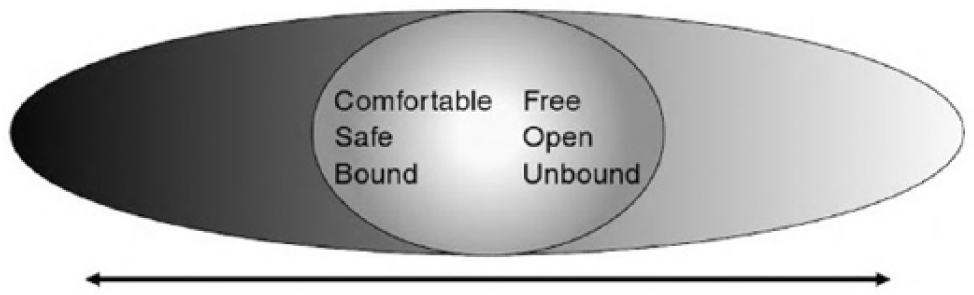
Binding choices for security (Stenglin, 2004).
However, Ravelli and Stenglin (2008) point out that insecurity may be invoked by spatial choices which are Too Bound or Too Unbound. They explain that spaces that are Too Bound evoke a suffocating feeling in their occupants. Too Bound spaces, they exemplify, are like caves, tunnels, prison cells, elevators and mines. On the other hand, Too Unbound spaces do not provide enough enclosure for occupants. Such spaces are often found in public buildings such as museums and cathedrals, and may make people feel diminished, vulnerable and overpowered.
Ravelli and Stenglin note that Binding is represented by a scale, so there is a distinction between spaces that are strongly, weakly, or moderately Bound or Unbound (p. 372). Consider Figure 4.
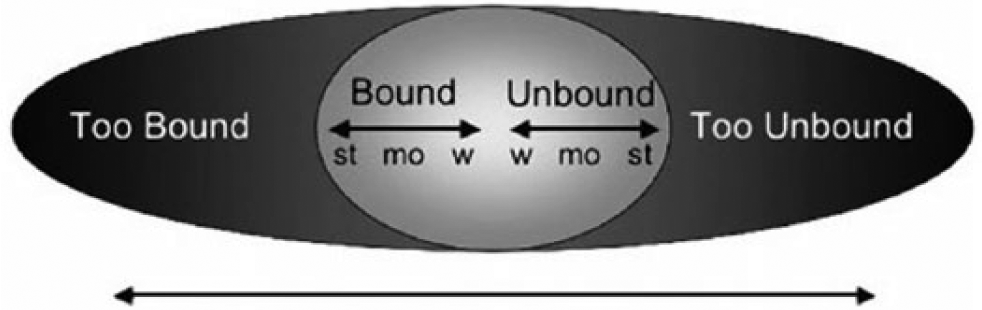
Binding Scale: strongly (st), moderately (mo), weakly (w) Bound and Unbound. (Ravelli and Stenglin, 2008).
As far as Binding is involved, there is more than just the invoking of affectual disposition. In spatial texts, the ways in which users are positioned within the space invoke a sense of dialogism (McMurtrie, 2012, 2016). Binding identifies how users react to the surrounding space and so evaluative Engagement resources are established (for more on Engagement and evaluative stance, see Martin and White, 2005). Engagement resources are concerned with the heteroglossice and monoglossic dimensions of discourse (see Bakhtin’s Dialogic Theory, 1981). Heteroglosic texts incorporate multiple voices, while monoglossic discourse presents only one authorial voice on a given issue.
The same goes with spatial engagement resources which deal with the extent to which the space allows for multiple voices. For example, they tackle whether the authorial voice of the institution is dominating and excluding other interpretations, or whether the design of the space enables more diverse interpretations. McMurtrie (2012, 2016) extends this proposition, arguing that spaces can invoke heteroglossic resources if there is enough room for the user to move around and have alternative perspectives within the space. On the other hand, monoglossic spaces offer only one perspective. As such, heteroglossic spaces are those spaces where users have the choice to do whatever they like, whereas monoglossic spaces are strictly controlled with firm restrictions. Consider Figure 5.
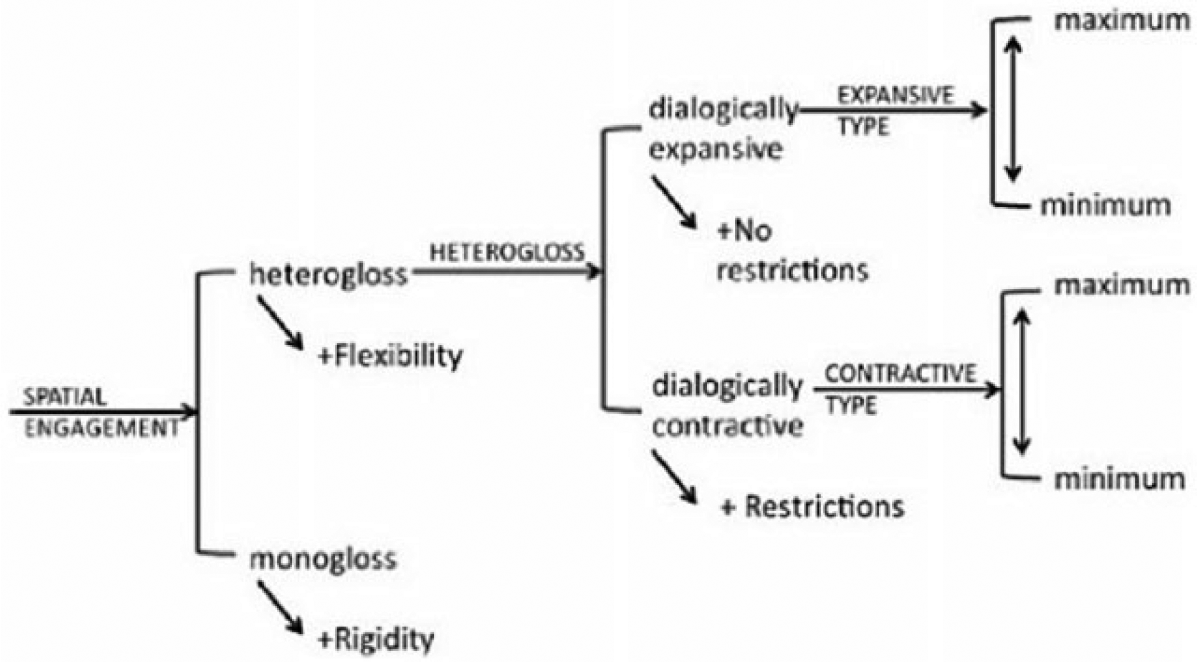
System network for spatial engagement (McMurtrie, 2012).
In monoglossic space, the users navigate the space according to some type of ‘a priori semiotic agreement’. In other words, the users have no say over the functions of the space and only use it for the purpose for which it has been designed. As shown in Figure 5, heteroglossic spaces are either dialogically expansive or dialogically contractive (Martin and White, 2005). In dialogically expansive spaces, the institutional voice is backgrounded for the users’ voices to be heard. Unlike dialogically contractive spaces, expansive spaces impose no restrictions as there is access to all areas and users are free to do different types of activities. Although allowing multiple positions, dialogically contractive spaces are designed in a way that prohibits users from accessing these positions freely (Ravelli and McMurtrie, 2016). Accordingly, space monoglossic, expansive and contractive resources are realized differently either by rigidity, no restrictions and restrictions, respectively. Moreover, the various heteroglossic resources can be gradated from maximally to minimally (see Figure 5).
6. Analysis
The data for the analysis are classified according to the ways in which the identities of the social actors and the representation of both Al Tahrir and Rabaa protests are spatially visualized. The examples of the images are classified with regard to the spatial configurations shown in the photographs: Hybridization, Binding and Bonding icons. The author conducted an analysis of a corpus of 50 images to come up with the underlying themes so as to draw a classification scheme for the analysis. Each selected image for the analysis represents a larger set of other images that carry the same theme and similar visualizing techniques found in Getty Images’ news gallery. The criterion for choosing specific images in the article for explaining the analysis is copyright permission.
6.1 Al Tahrir Square protests
Al Tahrir protest urban space is iconized in Getty Images by its open and Unbounded environment. However, such a spatial dimension represents another aspect of Binding that constructs a relationship of ‘security’ between the demonstrators and the square despite the Unbound dimension. Unboundedness is visualized through the use of different shooting techniques. One of these techniques is the employment of silhouette (see Figure 6). The contrast of colours between the foregrounded black colour of the participant (protester) against the backgrounded lighting creates a spacious dimension and provides a depth of field, which, in turn, stresses the notion of Unboundedness. Due to the silhouette effect, the participant is depicted with no facial details which can be translated to what Kress and Van Leeuwen (2006) refer to as ‘locative circumstance’. Locative circumstances images mainly describe an event without focusing on the action contained. They focus on visualizing the landscape rather than the participants. Focusing on the setting further emphasizes how the protesters of Al Tahrir dominate and reclaim the square (Jansen, 2001).
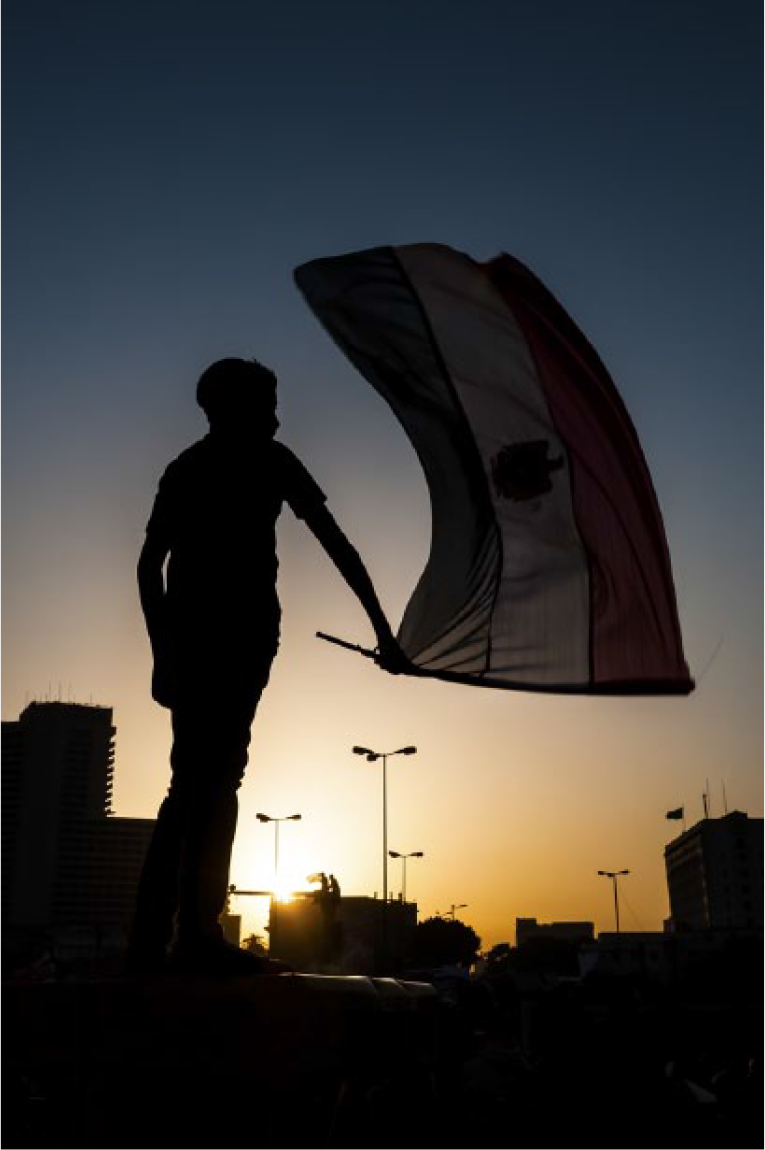
Silhouette image representing spatial Binding. © Joel Carillet/Getty Images. Reproduced with permission.
Silhouette depicts space as an abstract, unbounded notion. This visualization depicts Al Tahrir Square as a place of high aesthetic values that would create a visual ‘space of representation’ (Lefebvre, 1991) where bread, freedom and social justice are called for. A considerable number of photos depicting Al Tahrir Square are taken from above, a bird’s eye angle, so as to highlight spaciousness and exaggerate crowd density. Due to camera angle, the protesters are abstracted into undifferentiated ‘bodies’ (Butler, 2001). Al Tahrir is visualized as a place where it is equality that permeates the space created between the protesters.
Visually emphasizing the presence of the crowd in the square underlines the performance of a new spatiality through which the protesters defy the pre-defined spatial practices of the square while reclaiming it. Spatiality of Al Tahrir, as evident in Getty Images, iconizes how, in the words of Butler (2015: 71) in referring to Al Tahrir, ‘the collective actions [of crowd] collect the space itself, gather the pavement, and animate and organize the architecture.’ These visual techniques of silhouette and bird’s eye view shooting visualize Al Tahrir as a ‘space of appearance’. Butler (2015: 77) argues that the space of appearance is not ‘a location that can be separated from the plural action that brings it about; it is not there outside of the action that invokes and constitutes it.’ The existing forms of political legitimacy are thus contested and redefined by the presence of the protesters in Al Tahrir space.
Significantly, iconicity of the Al Tahrir protest is evident from the aesthetic visualization of an Unbound space. Visualizing spatial openness emphasizes the theme of freedom underlying 25 January photos. Unboundedness of Al Tahrir protest space is visualized as well in Getty Images through the insertion of street naming signs. Depicting street naming signs in Getty Images, photos of Al Tahrir protest are visually highlighted by the shooting technique of a ‘telephoto lens’. A telephoto shot is used to highlight background distant objects and make them appear as if close to the normal size of nearby objects. This shooting perspective renders the street-naming blue sign hung on the bridge the most salient visual element in the photo, stressing its spatial functionality.
Interestingly, the street-naming signs, in their abstract form, correspond to Lefebvre’s notion of ‘representations of space’. These signs act as a visual statement about the nature of Al Tahrir protests. They provide a spatial layout of different densely populated areas where the protesters rally mobilization. Visualizing street-naming signs, then, symbolizes protesters taking over the heart of Cairo’s public spaces. It reveals the nature and attitude of the 25 January protesters. These named places on the signs may be perceived as representative of the wide scale of opposition. The crowd in Al Tahrir was not confined to the square, but filtered into the surrounding streets, alleyways and bridges as well. Conveying spatial metonymy, these signs reinforce the argument of the spatial Unboundedness of Al Tahrir Square. They visualize the number of alternative routes and access points leading to Al Tahrir. The boundaries of the protest are poorly defined, recalling Canetti’s second type of protests, the ‘open crowd’ as opposed to the ‘closed crowd’. Canetti (1960) argues that an open crowd is characterized by its spontaneous manifestation that seeks limitless growth. On the contrary, a closed crowd maintains a boundary with a limited number of access and exit points. This boundary, according to Canetti, limits growth and enables dispersal. As such, the current photo is not about depicting a sign but visualizing an open crowd of protesters.
One of the tools that can be used in three-dimensional spaces to evoke Bonding is what Kress and Van Leeuwen (2006) refer to as ‘symbolic attributes’. According to them, symbolic attributes refer to two-dimensional signs that appear in visual images. Symbolic attributes are usually salient objects. This can be achieved by foregrounding the object, or through exaggerating its size. Figure 7 demonstrates how symbolic attributes act as tools for spatial iconization.
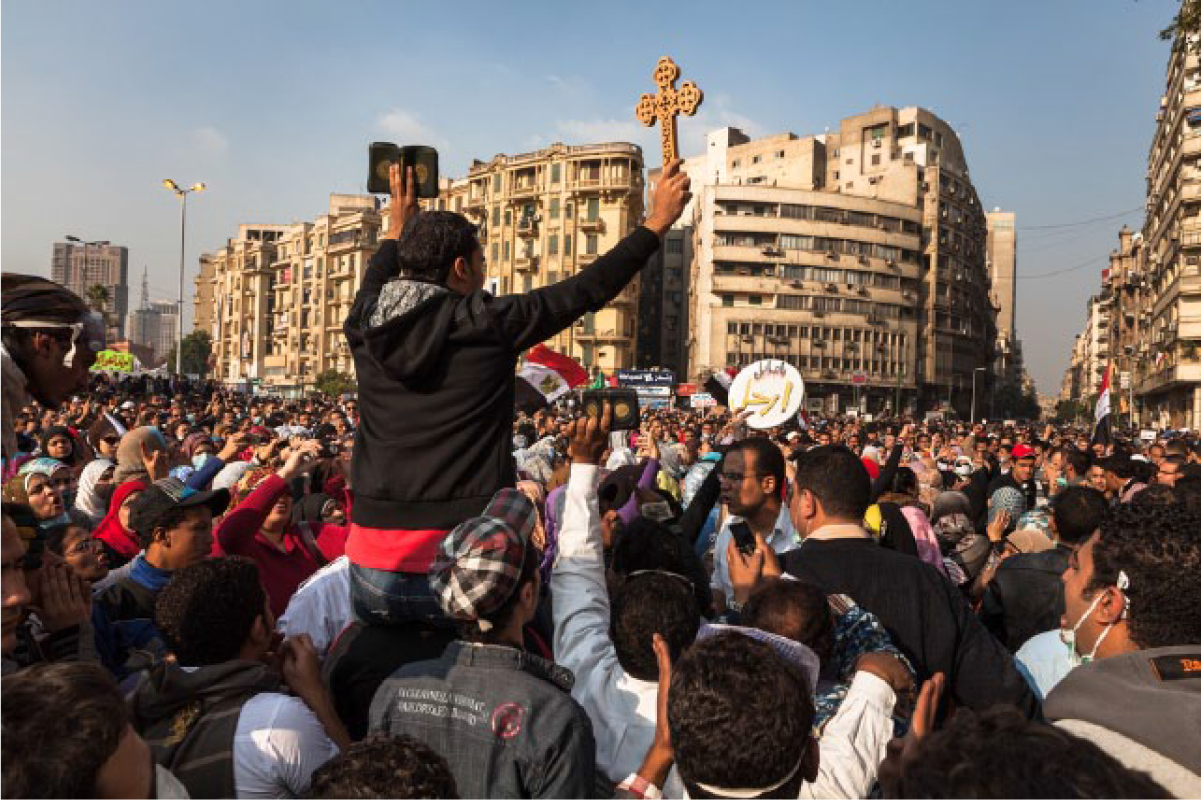
Symbolic attributes as tools for spatial iconization. © Karimphoto/Getty Images. Reproduced with permission.
Considering their salience and shooting angle, the Cross and the holy Quran with their inherent religious significance can be perceived as symbolic attributes. These two attributes act as tools of spatial inclusion. They suggest that the Al Tahrir protest is a place for all walks of Egyptian society and no one is excluded due to religion. As such, the photo identifies the heteroglossic nature of the Al Tahrir protest. In a built environment, using specific cues and symbols achieves both inclusion and exclusion, which in turn, stresses social identity and establishes boundaries (Rapoport, 1977: 248). In this view, the Cross and the Quran act as visual quotes for the various voices expressed in Al Tahrir.
The spatial visualization of the Al Tahrir protest in Getty Images represents it as a social event where freedom of speech and religious diversity are expressed. In other words, Al Tahrir is depicted as a place of collective expression.
Recalling Kress and Van Leeuwen’s (2006) notion of ‘symbolic attributes’, a number of Getty Images photos visualize what can be called ‘spatial attributes’ through the depiction of the protesters’ graffiti. The revolution graffiti can be perceived as spatial cues. Graffiti, as a distinctive visual expression, allow the transformation of the material dimensions of a given urban space. They are ‘aesthetic political acts’ (Philips and Montes, 2017) that revisualize Al Tahrir space and transform it into a ‘place of meaning’ (Creswell, 2004), that ‘detourned’ (Lefebvre, 1991) government-ruled spaces. Revisualizing urban space, graffiti here can be seen as imposing a process of spatial ‘automatization’ (Halliday, 1982) through which ‘the foregrounding of one [semiotic] is often accompanied (or achieved) by the backgrounding or “automatization” of other semiotics, to the point where they appear so normal and natural as to become “invisible”’ (Iedema, 2003: 40, cited in Lynn and Lea, 2005: 43). As such, the spatial representation of Al Tahrir is backgrounded and the semiotics of the protesters’ spatial practices and their ‘voice’ are foregrounded. Furthermore, graffiti are heteroglossic in nature since they create an immediate, direct form of engagement with the viewer (Jaworski and Thurlow, 2010: 21).
Graffiti also give the political activists the chance to build ‘counter-hegemonic’ spaces of representation in the urban landscapes in a manner that challenges the existing social order (Zaimakis, 2015: 373). As a visible record of a temporal event (Lynn and Lea, 2005), graffiti of Al Tahrir stand as an indexical sign to ‘ephemeral intervention’ which is ‘an event in which people convene in public space, using ephemeral elements such as images, texts, sounds, dance, chants, and massed bodies, in order to affect political change through revisualization of that space’ (Murphy and O’Driscoll, 2015: 328). In this regard, graffiti symbolize the protesters’ tight grip on the square.
Drawing graffiti, hanging an effigy, blowing a whistle, chanting, reciting poetry, playing music, or performing religious rituals such as praying are all hybridized forms that shape the identity of the urban space of Al Tahrir protests as visualized in Getty Images. Al Tahrir Square is depicted as an iconic place where festive protests take place, adding much to the heteroglossic nature of such protests where protesters have their own voice and have a say in the way they move through the space and what they can do in that space as no single political authority was in control (Gunning and Baron, 2014). Accordingly, Al Tahrir protesters correspond to Hill’s (2003) ‘Creative users’, since they give the square new and various meanings. The use of different ‘ephemeral elements’ such as slogans, placards, religious symbols, dance, chants and graffiti transforms Al Tahrir urban protest space into a ‘multimedia production’ (Murphy and O’Driscoll, 2015) where there is no dominant spatial practice but only an unorganized and uninstitutionalized search for freedom and social justice. Al Tahrir representational space as visualized in Getty Images emphasizes the protesters’ ‘creative’ spatial practices that contest Al Tahrir pre-defined urban space. Getty Images visualizes Al Tahrir protest as a flexible space that can afford different uses and activities where protesters provide a creative interpretation of the already organized space.
6.2 Rabaa sit-in
A considerable number of Getty Images photos demonstrate spatial iconization of Rabaa camp by the means of Hybridization. The depiction of tents and linen spread with pegs for drying, peddlers’ carts and a football pitch within the Rabaa sit-in represents a particular dimension of spatial Hybridization. These examples of spatial recontextualizations render the camp as a place for shopping, resting, entertainment and feeling at home. Combining different micro spaces creates a ‘multifunctional space’ (Lefebvre, 1991) where the users of space perform various activities that enact a ‘multiplicity’ of urban functions. It can be argued that such multifunctional properties embedded in the Rabaa sit-in create an interpersonal Binding that defines the relationship between the protesters and the protest space as being comfortable and familiar. As such, spatial iconization is achieved by visualizing the practices of solidarity, affiliation and belonging. By adding tents or personal belongings, protesters ‘privatize’ the protest urban space and metaphorize it into a home.
Rabaa protesters are defined in Getty Images through the ways in which they use the space. Urban users perform identity by using public space (Shortell, 2012: 26). Using public space ‘binds’ users into one community. It is no longer a mere space for pedestrian movement, but rather a place where a diversity of social, economic and recreational activities take place. However, Hertzberger (2005, cited in Ravelli and McMurtrie, 2016: 34), an architect, argues that when content is added to a spatial text, or in other words, when the content is multifunctional, as is the case with the Rabaa sit-in, the potential for the space to be more frequently used increases. This, in turn, increases the ‘accommodating potential’ which makes space more receptive to different situations, thus increasing the population of the space and potentially increasing a sense of community. However, the over presence of spatial uses and functions may come at the expense of personal freedom. Hertzberger states that adding multifunctionality to space renders it rigid and inflexible. In other words, it leaves users of the spatial object too little freedom to interpret its function in the way they want. ‘The user is thus subservient to the form and the concomitant a priori “agreement”’ (Ravelli and McMurtrie, 2016: 177). In this view, it can be argued that the ‘institutional’ voice of the Muslim Brotherhood Group is the dominant or even the only voice in the Rabaa sit-in. The authorial voice of the Brotherhood positions the protesters to use the urban space one way.
Accordingly, the residents of Rabaa may be perceived as, in Hill’s (2003) words, ‘passive users’, since they collectively, unlike the Al Tahrir protesters, preserve the spatial functionality of the sit-in as dedicated by the Brotherhood Group. They are compliant users who use space as it is meant to be by the Brotherhood Group, which was concerned with conveying the idea of an Islamic protest demanding the reinstatement of the legitimate president, Mohamed Morsi. However, the term ‘Passive’ used here, following Hill, rather challenges the commonsensical and traditional understanding of the word ‘passive’, meaning ‘doing nothing’, as in this case it means being compliant with the functionality of the space. Although they are involved in the hybridization of Rabaa Square, yet it seems that the protesters are doing so in an organized pre-planned way that serves the Brotherhood Group’s ‘exclusionist policies’ (Arafat, 2017). Such spatial practices deny the sit-in the spontaneous and ‘creative’ acts of protesting characterizing Al Tahrir protests, which gives new meanings to the square.
Another example of spatial Hybridization is evident in the photos depicting the protesters as praying. These photos echo spatial Hybridization since they embed the space of worship within the space of protest. Hybridization in the current example recontextualizes the values of a mosque to the Rabaa sit-in so as to align protesters religiously. The recontextualization of a place of worship dedicated to perform religious rituals into an urban protest space is significant. It underlines the transformation of an icon of protest, violence and threat into an icon of peaceful worship. Correspondingly, iconization here dissociates the sit-in from any posed threat to the national security. However, hybridizing a space eliminates or excludes certain representational contents, while preserving representational functionality (Ravelli and McMurtrie, 2016: 35). This, in turn, reveals the monoglossic nature of the camp where Islamic prayers are the only religious rituals that are allowed. Spatial Boundedness and social exclusion are conveyed through the depiction of barricaded entrances to Rabaa. The entrances to the sit-in were limited in number due to barricades constructed by protesters along the two streets of Al-Nasr and Al-Tayaran. Such barricades highlight the boundaries of the protest space and help the sit-in capacity to be calculated. This type of protest is called a ‘closed crowd’ (Canetti, 1960). Although indicating safety and protection, the spatial enclosure and Boundedness of Rabaa enact restriction and social exclusion as well. This is visually depicted in the over presence of bricks and concrete blocks. However, interpersonally, the iconic Boundedness of Rabaa provides a sense of enclosure and privacy for occupants, which, in turn, achieves social solidarity and in-groupness.
The notion of establishing spatial in-groupness and exclusion is further stressed in photos visualizing the supporters of the ousted Mohamed Morsi checking men at brick or sand barriers set up for protesters to enter Rabaa camp. This, however, visualizes the Rabaa sit-in as a monoglossic space. The construction of check points depicts the sit-in as being strictly controlled. The spatial interpersonal relation established between the urban space and the protesters here indicates that this space does not welcome any different voice to enter. The camp is shown as a political institution that has an authorial voice – the Muslim Brotherhood Group – over the protesters themselves. From the above examples, it can be said that Rabaa camp is a controlled space with limited entrances and controlled access points. This recalls Canetti’s (1960: 70) definition of the ‘closed crowd’ which ‘creates a space for itself which it will fill … The entrances to this space are limited in number … the boundary is respected whether it consists of stone, of solid wall, or of some special act of acceptance, or entrance fee.’
In photos depicting Rabaa camp, inserting symbolic attributes suggests spatial exclusion as well as in-groupness. Spatial exclusion is emphasized in the Rabaa photos by the visualization of the Quran and the posters carrying Morsi’s photo. Visualizing the holy Quran implies the affiliation of the protesters solely to Islam which refutes the presence of any non-Muslim protesters in the camp. As for the posters, they carry significant iconic values since posters contain a ‘high degree of visual impact and visibility … A poster aims to arrest, hold, persuade, implant an idea and give specific information’ (Teo, 2004: 189, 190). The posters evoke sharing solidarity with the Brotherhood Group, emphasizing exclusion. As such, the symbolic attributes found in the current group of photos are visually employed as bonding icons that help the protesters to mark their affiliation to the Muslim Brotherhood. Moreover, these attributes sustain the monoglossic nature of Rabaa camp which refutes the presence of any different voice.
Conclusion
This article contributes to the literature on visualizing social movements by exploring the visualized spatial dimension of protests. It demonstrates how a social semiotic approach can be applied to a visually mediated protest space to provide an understanding of how such a protest is iconized spatially. In so doing, the article intends to investigate the representational space of the protests as shown in the Getty Images’ news gallery. The article draws upon tools for the analysis of semiotic resources in spatial texts, concepts of spatial semiotics (Stenglin, 2004, 2009, 2011) and spatial engagement (McMurtrie, 2012). These tools are employed to investigate the representational dimension of protest urban space (Lefebvre, 1991). The intersection between the spatial practices and representational space, as mediated by the visual medium, is then underlined.
In this article, I have argued that the visualization of protest urban spaces and protesters’ spatial practices defines the protests along with providing a better understanding of the representation of the protesters, their ideologies and identities. Both Al Tahrir and the Rabaa Square protests represent an urban space contested and redefined by social movements. With respect to spatial semiotic attributes and spatial practices, a dialectical tension between the physical attributes of these protest spaces, their utilization by protesters and their photographic representation is highlighted. The photos depicting the Al Tahrir protests tend to aesthetically visualize spatial Unboundedness, spatial inclusion and heteroglossic voices. The Al Tahrir protest is represented as a social event where freedom of speech and religious diversity are iconized with no single political or religious authority hinted at being in control. On the other hand, photos presenting the Rabaa sit-in emphasize the religious inclinations and peaceful nature of the sit-in. However, the representational urban space of Rabaa camp assigns Boundedness and firm spatial enclosure, which, in turn, iconize in-groupness, spatial exclusion and monoglossia. Thus, the Brotherhood’s voice and its exclusionist policies are foregrounded.
The analysis reveals as well that the spatial manifestations of Al Tahrir define the protests as ‘open crowd’ and the protesters as Creative users who use their protest space in different ways. Photos of Al Tahrir depict no dominant or pre-planned spatial practice; rather an unorganized and uninstitutionalized protest is represented. By performing spontaneous spatial practices such as raising placards, chanting and drawing graffiti, the protesters reclaim Al Tahrir urban space by redefining it. On the other hand, the spatial semiotics of Rabaa identify the protests as a ‘closed crowd’ and the protesters as Passive users whose activities are predictable and who preserve the functionality of the protest space as dictated by the Brotherhood Group. Rabaa protesters hybridize the space into a home metaphor, thus, they reclaim the square by privatizing it. However, they organize the square, as depicted, in a way that is in line with the ideological premises of the Brotherhood. The institutional voice of the Brotherhood Group remains the driving force behind the political and religious practices of the sit-in.
The study signals how the iconization of protests and social movements can be understood with the help of spatial semiotics. As for the adapted methodological approach, the findings of this study have significant implications for future research directions. That is, it is shown that studying the semiotic dimension of representational spaces has the potential to shed further insights on the representation of the protesters themselves and the nature of protest urban space. Further studies are needed to investigate the role of the individual photographers, their institutional affiliations and the circulation of the photographs.
Footnotes
Funding
This research received no specific grant from any funding agency in the public, commercial, or not-for-profit sectors and there is no conflict of interest.
Notes
Biographical Note
RANIA MAGDI FAWZY, a Lecturer at the College of Language & Communication (CLC), Arab Academy for Science, Technology and Maritime Transport. My areas of research interest include critical discourse analysis, social semiotics, multimodality and translation. I am also interested in interdisciplinary approaches to political, cultural and new media studies.
Address: Arab Academy for Science, Technology and Maritime Transport, College of Language and Communication, Languages Department, Sheraton, Cairo 11799, Egypt. [email: