



Abstract
This study investigates how music is represented in musical-themed manga by visual components referred to as ‘visualized music’, and how embodied mechanisms of musical experience conceive these visual manifestations. Using Šorm and Steen’s (2018) Visual Metaphor Identification Procedure (VISMIP), the authors discovered four metaphors, and seven metonymies and ‘manpu’ (i.e. iconic signs used in manga) that are widely applied in visualizing music. In addition, they incorporated Juslin and Västfjäll’s (2008) framework and further proposed five major embodied mechanisms of musical experience: (1) brain stem reflex, (2) emotional contagion, (3) visual imagery, (4) emotional memory related to music, and (5) musical expectancy. Their results showed that these embodied mechanisms are the foundations of visualized music. The brain stem reflex, the underlying structure of most metonymies and manpu, triggers us to represent some acoustic characteristics by using sound symbolic components. These include emotional contagion-inducing metaphors representing emotional responses, such as ‘MUSIC/EMOTION IS WEATHER’, which further entails their acoustic characteristics and visual imagery, the most important mechanism, basing our overall comprehension of music and metaphorical mapping between music and image-schemata. Readers also use emotional simulations to understand the visual imagery that further constructs their impressions toward music, emotional memory grounding manifestations related to music used to build background stories and intensify reader empathy, and lastly, musical expectancy, involving the ability of prediction and consciousness, usually associated with ‘MUSIC IS LIGHT’. In this way, this study sheds light on our overall understanding of audio-visual cross-modality, musical experience, metaphor and embodied experience.
Introduction
Humans, with their ocular–manual preferences, convert knowledge into visible and tangible facts that correspond with their epistemology. Although there has been extensive research focusing on the auditory–visual transitions in manga/comics, most of the studies have only focused on the meaning of onomatopoeic words or speech balloons. Previous studies have indicated that not only onomatopoeic words or speech balloons can phonetically represent sounds (Forceville et al., 2014; Guynes, 2014), but also other visual components, such as font sizes or styles, are used to visualize the loudness of sounds (Carrier, 2000; Forceville, 2005; Petersen, 2009; Yannicopoulou, 2004). In addition to these visual components, there are still several visual components related to music that have not been carefully analysed.
This study refers to images related to music as ‘visualized music’, including the music itself and one’s musical experience. In other words, the term ‘visualized music’ refers to both representing the existence of music and manifesting our feeling of the music.
This is the first study to explore visualized music by analysing Japanese comic books, or ‘manga’. The study used the conceptual metaphor theory (Kövecses, 2010; Lakoff and Johnson, 1980) to explore the correspondence of the target domain (i.e. music) and source domain (i.e. image). For instance, visualized music ‘lightness’ might derive from the metaphor ‘MUSIC IS LIGHT’. The reason that music can be conceptualized as ‘light’ is because the metaphor finds the connections of music and light.
One of the important factors of the study is unveiling cross-modality (especially auditory–visual) transition. Although it is well known that music can be conceptualized with languages or visual components, few papers have examined music-related metaphors from a cross-modality perspective. Some studies have focused on how acoustic loudness, timbre or pitch can be transferred into visual colour or shape (Haverkamp, 2013; Van Campen, 2013). Some researchers have also suggested that listening to music is an abstract sensory experience that is described with more concrete senses, such as vision or touch (Bolognesi and Strik Lievers, 2018; Day, 1996; Williams, 1976; Yu, 2003). The cross-modality research can be more comprehensive and insightful if we can find a systematic transition between acoustic characteristics and visual components.
Another central concern of visualized music research is how metaphorical visualized music reflects our embodied experience. Previous researchers have established that our overall understanding of metaphorical language involves embodied experience (Gibbs, 2006; Gibbs and Matlock, 2008; Gibbs and O’Brien, 1990; Gibbs et al., 2006; Wilson and Gibbs, 2007), and yet they have not satisfactorily dealt with visual imagery, which is an essential embodiment in musical experience. Researchers have assumed that these visual images could be evoked by musical experience because of the metaphorical mapping between the target (i.e. music) and image-schemata (Cox, 2016; Juslin and Västfjäll, 2008; McKinney et al., 1997; Powell, 2016). Thus, manga authors depict their visual imagery based on their understanding of music, providing a precise picture for their readers.
In order to bridge the research gaps mentioned above, this study chose four music styles of musical-themed manga – Western classical, traditional Japanese, rock and metal music – to answer two research questions:
(1) What kinds of metaphors and representations are used (in manga) to visualize music and musical experience?
(2) What embodiments of musical experience initiate the metaphors of visualized music?
In order to solve the first research question, the study conducted the Visual Metaphor Identification Procedure proposed by Šorm and Steen (2018) to check whether visualized music is metaphorical. Besides metaphors, metonymy and ‘manpu’ (Japanese: 漫符, a manga term that refers to a series of conventional symbols and figures, i.e. iconic signs in manga) could also be used as visualized music. More than 1,400 manga panels of visualized music have been verified. They can be further categorized into four common metaphors – ‘MUSIC IS LIGHT’, ‘BEAUTIFUL MUSIC IS FLOWERS’, ‘MUSIC/EMOTION IS WEATHER’ and ‘MUSIC IS BREEZES’ – and seven common metonymies and manpu that include hands and instruments, facial expressions, sheet music, ideophones, speech balloons, speed lines, focus lines and musical notes.
In probing the second research question, we integrated the framework of Juslin and Västfjäll (2008) and further proposed five embodiments of musical experience: (1) brain stem reflex, (2) emotional contagion, (3) visual imagery, (4) emotional memory related to memory, and (5) musical expectancy to explain how our bodily experience induces music-related metaphors.
This study proposes that the visualized music in musical-themed manga is grounded in our embodiment of musical experience. These embodiments help manga authors to concretize music via metaphors.
Methodology
Visual Metaphor Identification Procedure: VISMIP
To identify whether visualized music is metaphorical, this article conducted the Visual Metaphor Identification Procedure (VISMIP) proposed by Šorm and Steen (2018). 1 According to VISMIP, it is crucial to identify whether a visual unit is congruous to the overall context. If the visual unit is incongruous, it needs to be further investigated. In the following section, we use Figure 1 2 as an example:
1(a) Describe in just a few simple phrases the referential meaning of the image.
Analysis 1(a): In a corridor, a male student overhears a female student playing a koto (13-string Japanese musical instrument) in a classroom. Sakura (cherry blossom) petals are flying around the female. The male appears stunned as he stands by the classroom door and his eyes widen.
1(b) Test whether there are any clues that tell you that whether more general and abstract meaning should be attached to what is described in step 1(a).
Analysis 1(b): The verbal cue ‘今までに聴いた箏と全然ちげぇ. . .!! (‘I’ve never heard a koto sound like this, until today . . .’)’ indicates that his emotional reaction is generated by the female’s excellent performance.
1(c) Reconstruct the point underlying the image.
Analysis 1(c): Taken altogether, the male’s stunned facial expression indicates that he is impressed by her performance.
1(d) Derive from step 1(c) the topic of the point.
Analysis 1(d): We can derive that the male had a positive musical experience, and the female’s koto performance is excellent.
Analysis 2: A male accidentally hears a female’s excellent koto performance and feels surprised and impressed. [Agent(male|stunning, wide-eyed) Action(heard) Object(female’s koto performance) Setting(school, in corridor and classroom)] [Agent(sakura, i.e. song) Action(flying around) Object(female)]
Analysis 3: The topic depicts a positive musical experience; most of the units are congruous to the topic. However, the sakura is incongruous to the topic. Since the setting is inside the building, it is clear that the sakura is an unrealistic visual unit in the scene.
Analysis 4: Since it is an auditory-related setting, the sakura is incongruous and unnecessary. Thus, the sakura needs to be integrated within the topic or scenario related to auditory senses by means of comparison with the following agent: ‘music’. In the figure, it is reasonable to describe the ‘sakura’ as: music surrounding the female [Agent(sakura = music) Action(surrounded) Object(female)]
Analysis 5: Based on the previous discussion, the sakura can be seen as ‘music’. This cross-modal comparison for sakura is from vision, but music comes from the auditory sense.
Analysis 6: From step 1(d), we claim that this figure is a positive musical experience for the male. To visualize his musical experience, the manga author first depicted his facial expression, and further visualized the music with the visual component of sakura. As a result, the comparison between sakura and music can be seen as an indirect discourse about the topic of the image. We should understand that sakura from ‘visualized music’ indicates her performance and further generates a positive musical experience for the male.
Analysis 7: The findings of tests 4, 5 and 6 are positive, so the incongruous Agent (sakura) should be marked as a metaphor. 3
Based on the VISMIP, the sakura surrounding the female is an incongruous and unnecessary unit in a music-related scenario. Thus, we conclude that it is a visualized music comparing sakura and music, and can be identified as the metaphor ‘MUSIC IS SAKURA (FLOWERS)’.
Using VISMIP, we discovered visualized music was generated from four dominant metaphors: ‘MUSIC IS LIGHT’, ‘BEAUTIFUL MUSIC IS FLOWERS’, ‘MUSIC/EMOTION IS WEATHER’ and ‘MUSIC IS BREEZES’.
For visual metonymy, there is no specific identification procedure for manga/comics at the present stage. Thus, we counted visual units that correspond with the definition of ‘A IS RELATED TO B’ (Pérez-Sobrino, 2016), as visual metonymy. If a visual unit is directly connected to musical performance or musical experience, we called it a visual metonym. For instance, hands and instruments can directly stand for playing music and facial expression represents the experience of listening to music.
As explained previously, manpu is a manga term describing ideophones, speech balloons, speed lines and focus lines, 4 which are used to represent actions and emotions, and also frequently used to refer music. They are iconic signs (Ahlner and Zlatev, 2010; Chandler, 2017) that are primarily based on the similarity between signifier and signified. We discovered that these sound-related manpu have specific manifestations in the descriptions of music.
In sum, besides metaphors, there are seven visual metonymies and manpu that are used to denote music, including hands and instruments, facial expressions, sheet music, ideophones, speech balloons, speed lines, focus lines and musical notes.
In addition to identifying the categorization of visualized music, we further examined whether the acoustic characteristics (e.g. timbre, loudness) of the target domain can be identified. For instance, the sakura in Figure 1 cannot be further identified, so we defined them as a ‘visual representation of a general feeling of the music’.

Kono Oto Tomare! Sounds of Life, Vol. 1: 114–115 (Amyuu, 2012).
Musical and embodied experience theory
This article aims to elaborate on how embodied experience initiates metaphors of visualized music. Kinesthetic properties (Cox, 2001, 2016; Johnson, 1997; Johnson and Larson, 2003; Patel, 2010; Pérez-Sobrino and Julich, 2014) and other embodied cognitions, such as physiological responses induced by the perception system, the intuitive linkage between hearing and other senses, and music-induced emotion might influence our conceptualization of music.
In musicology, music-induced emotion is an essential criterion for appreciating and evaluating music. The next section introduces Juslin and Västfjäll’s (2008) framework of music-induced emotion and explains how this framework helps us to understand the embodied experience of music.
Juslin and Västfjäll’s (2008) framework of music-induced emotion
Juslin and Västfjäll (2008) demonstrated that music-induced emotion determines our musical appreciation and evaluation. They proposed six embodied mechanisms that induce emotion as follows:
These mechanisms involve our sensations (e.g. brain stem reflexes) to the syntactical processing (e.g. musical expectancy), which contribute to a deeper understanding of how music-induced emotion affects our conceptualization of music.
Five embodied mechanisms of musical experience
This study asserts that musical experience’s embodied mechanisms are the foundation of visualized music. We conducted Juslin and Västfjäll’s (2008) framework, merging the evaluative conditioning and episodic memory as ‘emotional memory related to music’. 5 The five primary embodied mechanisms used in this study are: (1) brain stem reflex, (2) emotional contagion, (3) visual imagery, (4) emotional memory related to music, and (5) music expectancy. Figure 2 shows how music is transformed into visualized music.
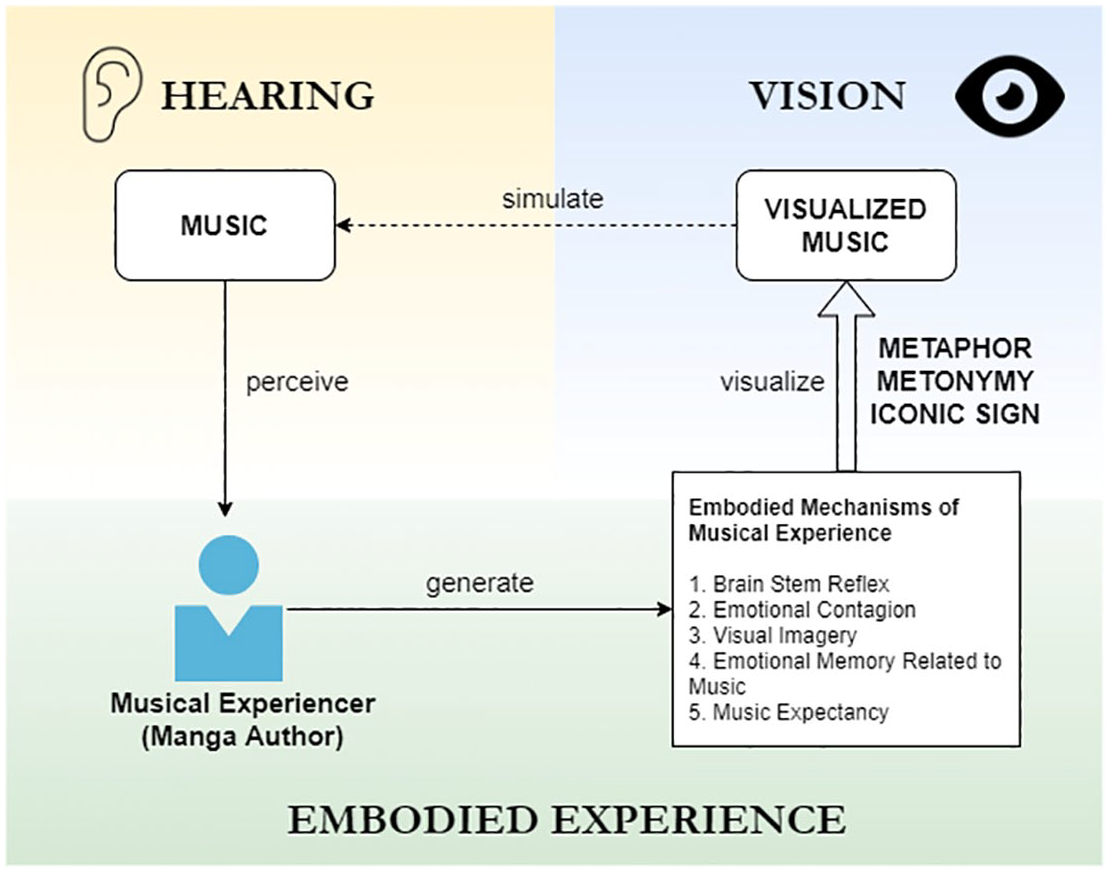
A diagram of how music is transformed into visualized music.
As shown in Figure 2, the person listening to music perceives music from the auditory system which generates the embodied mechanisms of musical experience. Based on these mechanisms, the manga author uses metaphors, metonymies or manpu to visualize what he or she hears as ‘visualized music’.
Research material
This article applied visualized music in Japanese musical-themed manga as research material. While it has been demonstrated that colour can be systematically used to represent music visually (Haverkamp, 2013; Van Campen, 2013), this perception cannot be considered part of Japanese manga due to its monochromatic style. If it is not possible to visualize music by means of colour, how does manga represent music with vision? If we unveil the secret, the results will generate a fresh insight into our conceptualization of music.
Four musical styles – Western classical, traditional Japanese, rock and heavy metal music – were analysed. 6 The research material (Table 1) includes six musical-themed manga in which more than 1400 panels related to music are scrutinized.
Research material.

Results and Discussion
Through VISMIP, we discovered four common metaphors and seven visual metonymies, and manpu that are used to visualize music in manga. These visual manifestations are, in fact, conceived or generated by the embodied mechanisms of musical experience. Table 2 provides an overview of embodied mechanisms of musical experience and their relationship with causes. The uppercase words indicate a metaphor, and the lowercase words indicate a visual metonymy or a manpu. 7 The third column shows whether the acoustic characteristics can be identified.
The relationship between cognitive/embodied mechanisms, rhetorical methods and their acoustic characteristics.

As shown in Table 2, metonymies and manpu are likely to be used to represent the experience of the brain stem reflex while listening to music, while metaphors tend to be associated with emotional responses. It also shows that the manpu tend to denote specific acoustic characteristics, but metaphors tend to convey a general feeling towards the music. Each embodied mechanism and its influence on visualized music will be discussed in more detail as follows.
Brain stem reflex
Based on the result, most of the metonymies and manpu are related to the experience of the brain stem reflex while listening to music. It is the most intuitive and easiest way to visualize music. Unlike other musical experiences, this method is quite straightforward since it only conveys specific acoustic characteristics or the experiencers’ basic emotions. Facial expressions or physiological responses (e.g. changes in heart rate and skin temperature) frequently occur in manga since they represent the intuitive brain stem reflexes induced by music. These responses are also highly related to our emotions and feelings (Blood and Zatorre, 2001; Juslin and Västfjäll, 2008; Koelsch, 2013; Krumhansl, 1997; Rickard, 2004), which are essential criteria for conceptualizing and appreciating music.
Surprisingly, we also discovered that sound symbolism is an important mechanism for visualizing music and can be further categorized into the reaction of the brain stem reflex. Sound symbolism means there is a systematic relationship between sound and meaning. Figure 3 illustrates differences of timbre, loudness and tempo between acoustic and electric guitar. The manga author deliberately changed the outline of speech balloons in order to distinguish between these two music styles. 8
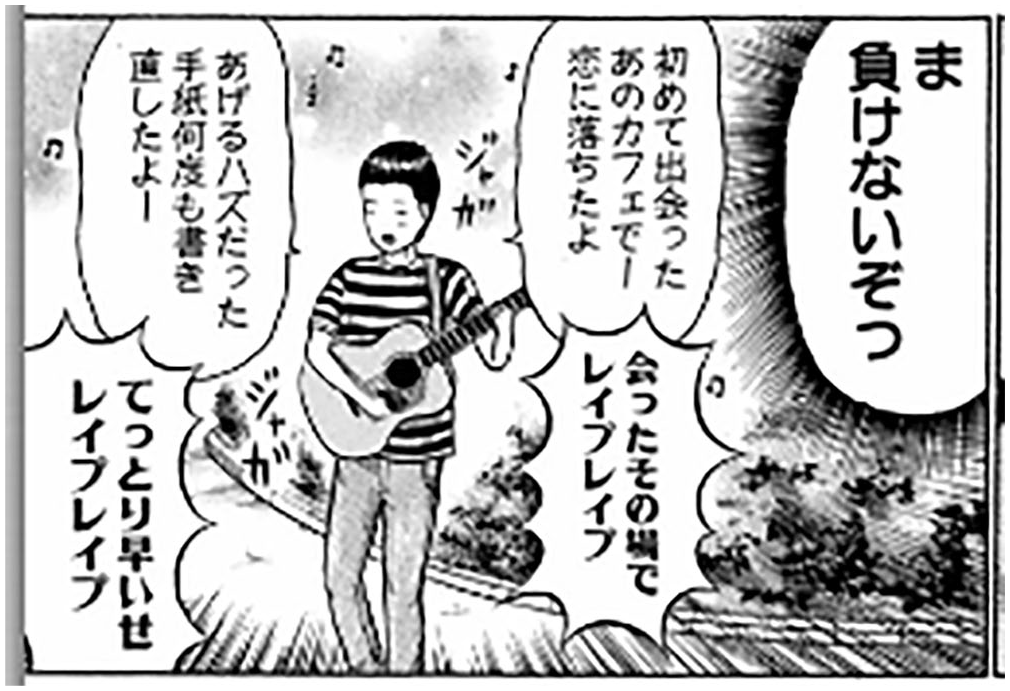
Detroit Metal City, Vol. 1: 56 (Kiminori Wakasugi, 2006).
Thus far, a number of studies on sound symbolism have revealed a correlation between sound and image. One significant psychological phenomenon, known as the bouba/kiki effect, confirmed that humans perceive a non-arbitrary, cross-cultural and intuitive association between sound and shape. In the experiments, over 90 percent of subjects linked ‘kiki’ with a spiky shape, but associated ‘bouba’ with a rounded shape (Köhler, 1945; Maurer et al., 2006; Ramachandran and Hubbard, 2001). 9 Based on this psychological experiment, linguists proposed sound symbolism, suggesting that sounds and meanings are not that arbitrary. For instance, transforming the external shapes, sizes or thickness of lines might convey different acoustic characteristics.
The speech balloons in Figure 3 present the auditory–visual transition, and the manifestation also relates to tactile senses. The rounded speech balloons, which were used to represent music played by acoustic guitar, might elicit the experience of touching a soft surface; this further becomes a symbol of a pleasant musical feeling. On the contrary, the word ‘ear-piercing’ implied by the spiky speech balloons illustrates a rough surface. Thus, unrounded images tend to relate to metal music due to their extremely high volume and very shrill sounds.
Other visual features, such as intervals, size or thickness of the visualized music, also convey specific acoustic characteristics, especially those that are highly relevant to our physiological responses. For instance, while describing metal music, manga authors tend to mimic its musical characteristics with long speed lines with narrow intervals. The results are in accordance with recent cross-modal metaphor research to indicate how the auditory can be transformed into the visual (Marks, 1974; Parise and Spence, 2012, 2013) or tactile (Watanabe et al., 2012).
Emotional contagion
The most common metaphor based on emotional contagion is ‘MUSIC/EMOTION IS WEATHER’, which is a metaphor that fuses both ‘MUSIC IS WEATHER’ and ‘EMOTION IS WEATHER’. In other words, the source domain can be identified as both music and emotion. If the weather represents emotion, then it reflects emotional contagion after listening to music; if the weather represents music, then it can further represent some musical characteristics with the manifestation of weather.
It is difficult to distinguish the actual target domain of the weather in musical-themed manga since both weather and music are highly correlated to emotion. Weather influences our emotions and, in Japanese manga, emotion is frequently visualized via the metaphor ‘EMOTION IS WEATHER’. Shinohara and Matsunaka (2009) demonstrated that the Japanese are accustomed to expressing their inner emotions with obscure representations. For example, several external environmental changes such as sunny or rainy are likely to be used to signify their happiness or sadness.
Also, representing weather in manga might further manifest as specific acoustic characteristics. For instance, since rock and metal music usually have high volume levels, people tend to describe them as ‘thunder’ due to their similarity of volume. High winds, gales and storms are also usually accompanied with high volume levels and fast speed, and can also be associated with loud and very fast music styles. Thus, the metaphor ‘METAL MUSIC IS BAD WEATHER’ represents not only listeners’ strong impression of the music, but their similarities of acoustic characteristics. An example using thunder in the background to represent metal music can be seen in the upper image in Figure 4. 10
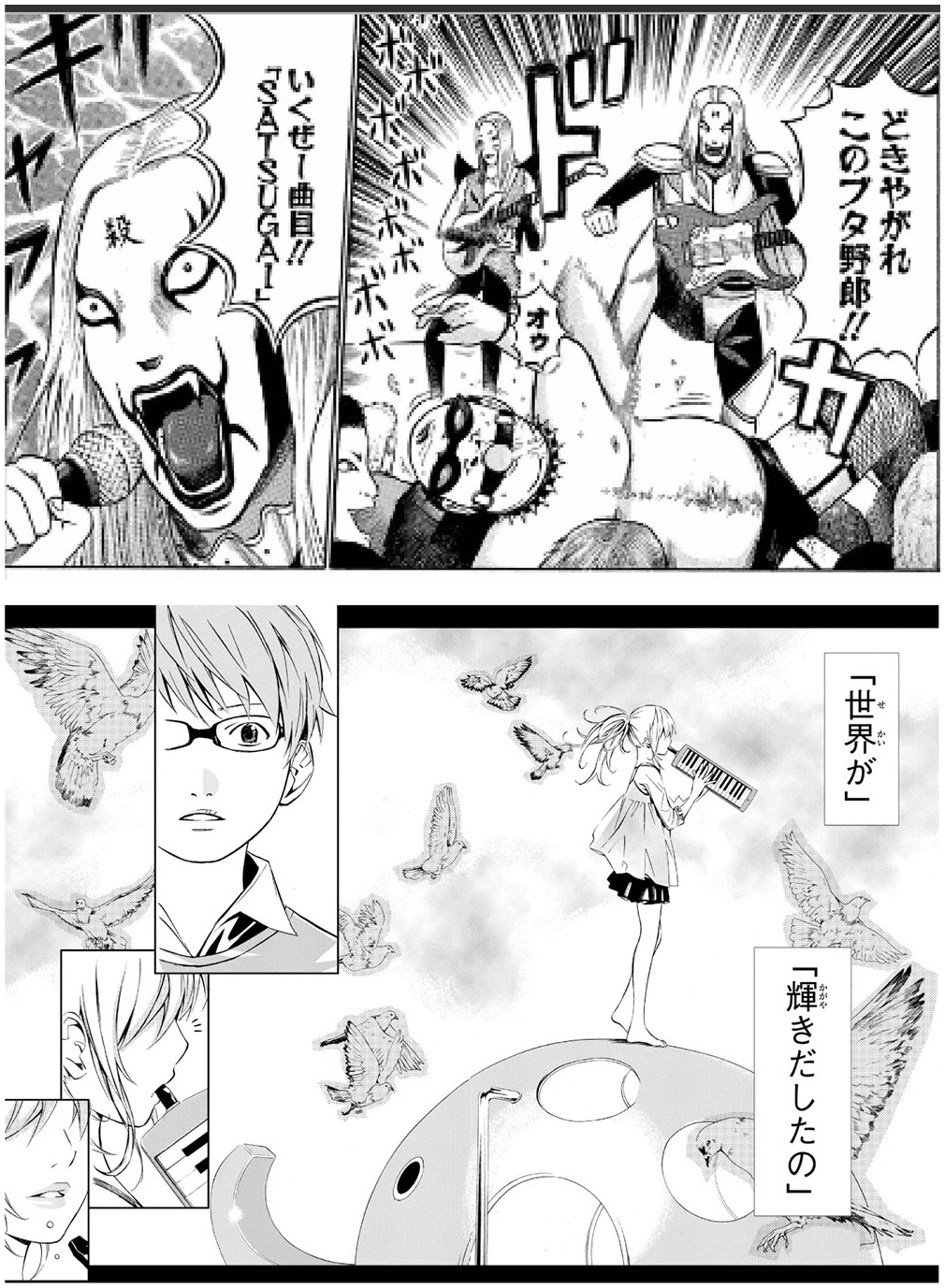
(Above) Detroit Metal City, Vol. 1: 56 (Kiminori Wakasugi, 2006).
On some occasions, ‘MUSIC IS LIGHT’ is also related to emotional contagion. For instance, when the male shown in Figure 4 unexpectedly hears the female’s performance, he thinks, ‘世界が輝きだしの (‘the world . . . began to sparkle!’)’ Both verbal cues and the visual representation use brightness to visualize his positive emotional contagion of musical experience. This metaphor might be generated from a well-known metaphor ‘HAPPINESS IS LIGHT’. Previous studies have established that verbal expressions such as ‘lighten up’ and ‘brighten up’ tend to use lightness to denote happiness. This metaphor can also be discovered in the pictorial metaphor. Humans are diurnal, so we tend to associate brightness or daytime as happy, safe and energetic. 11 Thus, this metaphor represents our emotional contagion of musical experience and entails our enthusiasm of brightness.
Visual imagery
Basically, we can account for all visualized music as being instances of visual imagery. ‘BEAUTIFUL MUSIC IS FLOWER’ is one of the typical metaphors that involves visual imagery. For instance, since both music and flowers have the impression of being gentle and soft, the sakura in Figure 1 is used to metaphorically visualize the acoustic characteristics of koto music. In addition, choosing sakura entails precise cultural imagery. Sakura is the national flower of Japan, and also symbolizes the ultimate beauty in its culture. Thus, using sakura to describe the performance indicates it is a supreme artwork. 12 Sakura, moreover, is also known for its short period of fluorescence, which withers in the most beautiful status of its life circle. Thus, the intangible and ephemeral impression also corresponds to the physical property of music. Based on these cultural, emotional and acoustic reasons, it is not surprising that the Japanese attribute such a beautiful and poetic visual imagery to koto performance.
Even though the precise nature of the visual imagery process remains to be ascertained, the most credible assumption is that visual imagery is a mechanism triggered by image-schemata grounded in embodied experience (Bonde, 2007; Juslin and Västfjäll, 2008). Unlike the basic image-schemata such as in/out or front/back, the visual imagery in the musical-themed manga is more abundant. The priming point of these image-schematic associations might be music styles and acoustic characteristics. Images and music can be mapped together via cognitive empathy (Bonde, 2007; Spitzer, 2004; Tsai, 2013; Zbikowski, 2002, 2008). If our emotion changes due to melodies, timbre or other characteristics, the visual imagery might change as well.
Moreover, visual imagery is closely related to emotions. Studies have confirmed that specific visual images conjuring up language and music are closely associated with emotions (Bonde, 2007; Cox, 2016; Juslin and Västfjäll, 2008; McKinney et al., 1997; Powell, 2016). For instance, Figure 4 shows a combination of positive emotional contagion and visual imagery. 13 Based on the context, other experiencers in the next two pages of this manga (p. 51) said that ‘The doves aren’t coming’, indicating that the doves are unreal visual imagery created by the male experiencer. Doves are the symbol of peace and tranquil emotional status; in addition, in some cultures, doves are the symbol of love, which perfectly predicts the romantic feeling between the two characters in the following story. Thus, these unreal visualized doves are visual imagery triggered by her performance. This imagery is grounded by his sensational, emotional and cultural concepts of ‘doves’.
Emotional memory related to music
Both evaluative conditioning and episodic memory involve the emotional memory of music. We found that both ‘MUSIC/EMOTION IS WEATHER’ and ‘BEAUTIFUL MUSIC IS FLOWERS’ involve these mechanisms because the manifestations are generated based on our memory. Memories are the best introductory remarks for arousing the empathy of the audience. Following the visual imagery in Figure 1, Figure 5 further represents the male’s episodic memory with his grandfather which was triggered by the koto performance. This episodic memory intensifies the excellence of the performance and the audience’s empathy. 14
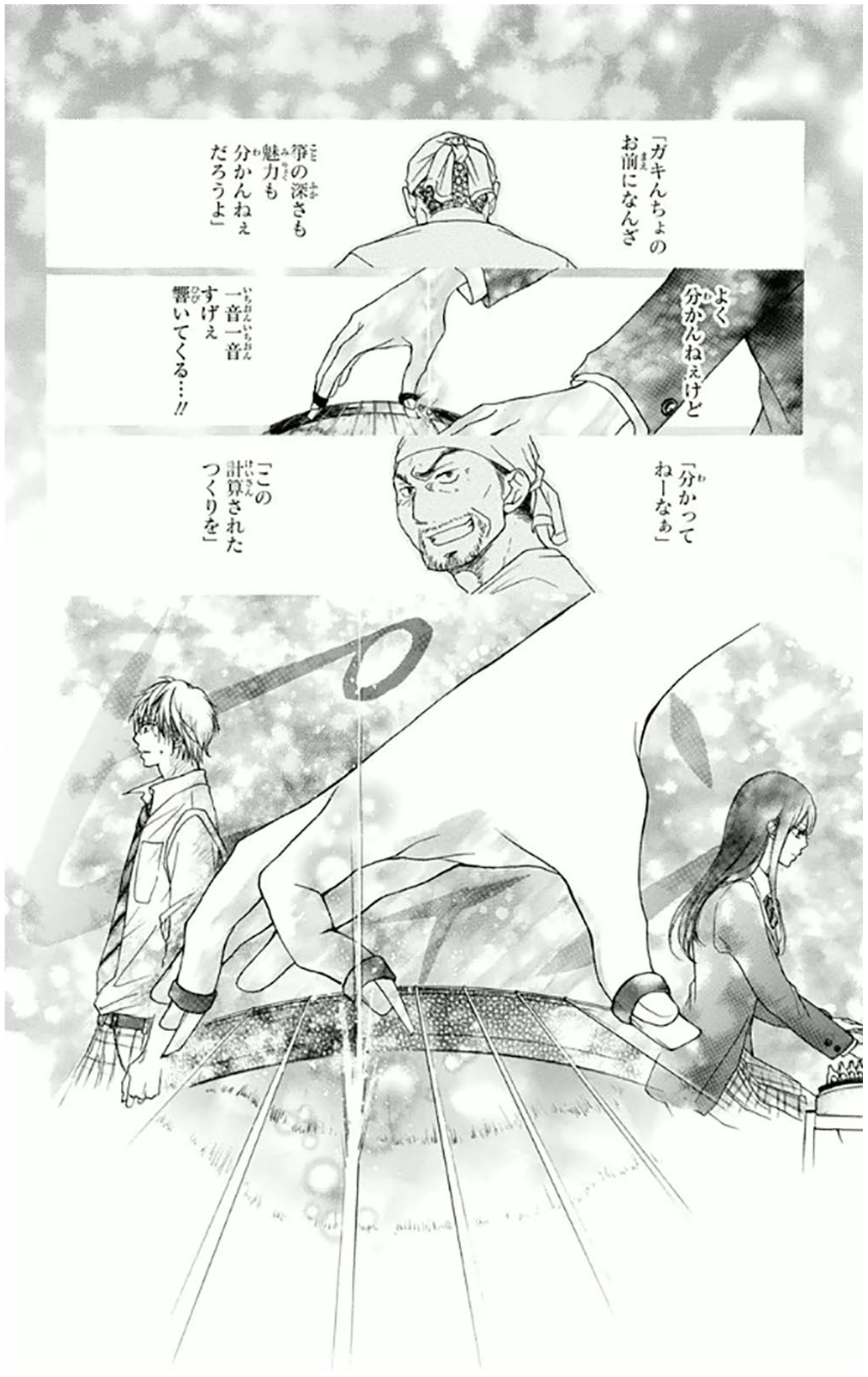
Kono Oto Tomare! Sounds of Life, Vol. 1: 116 (Amyuu, 2012).
These mechanisms are related to both personal life experience and memories. Although the manifestation might differ based on the situation, these mechanisms are essential in musical experience. In musical-themed manga, this mechanism is frequently used because it involves a memory of a particular event, which usually accompanies a specific time and location.
Musical expectancy
Musical expectancy is a mechanism that involves higher cognitive processing. There are two ways to present this mechanism; one is depicting facial expression; another is using ‘MUSIC IS LIGHT’. Depicting one’s facial expression is the simplest method. For instance, depicting a confused or unexpected facial expression indicates that the music does not correspond to the listerner’s expectation.
On some occasions, ‘MUSIC IS LIGHT’ represents one’s musical expectancy and the lightness becomes neutral symbols of visualized music. For instance, Figure 6 indicates a piano performer making a mistake and an audience member noticing it. The verbal cue says, ‘あ、ズレちゃった’ (‘Ah, she made a mistake’). An irregular shape in panel 1 is a sound symbolic unit, which is used to denote the performer’s wrong notes. Panel 4 depicts the performer’s confused facial expression to illustrate her reaction to the mistake. In addition, a light-shaped manpu next to the male’s ear indicates his awareness of the mistaken sound, showing that this mistake violated his musical expectancy towards the music.
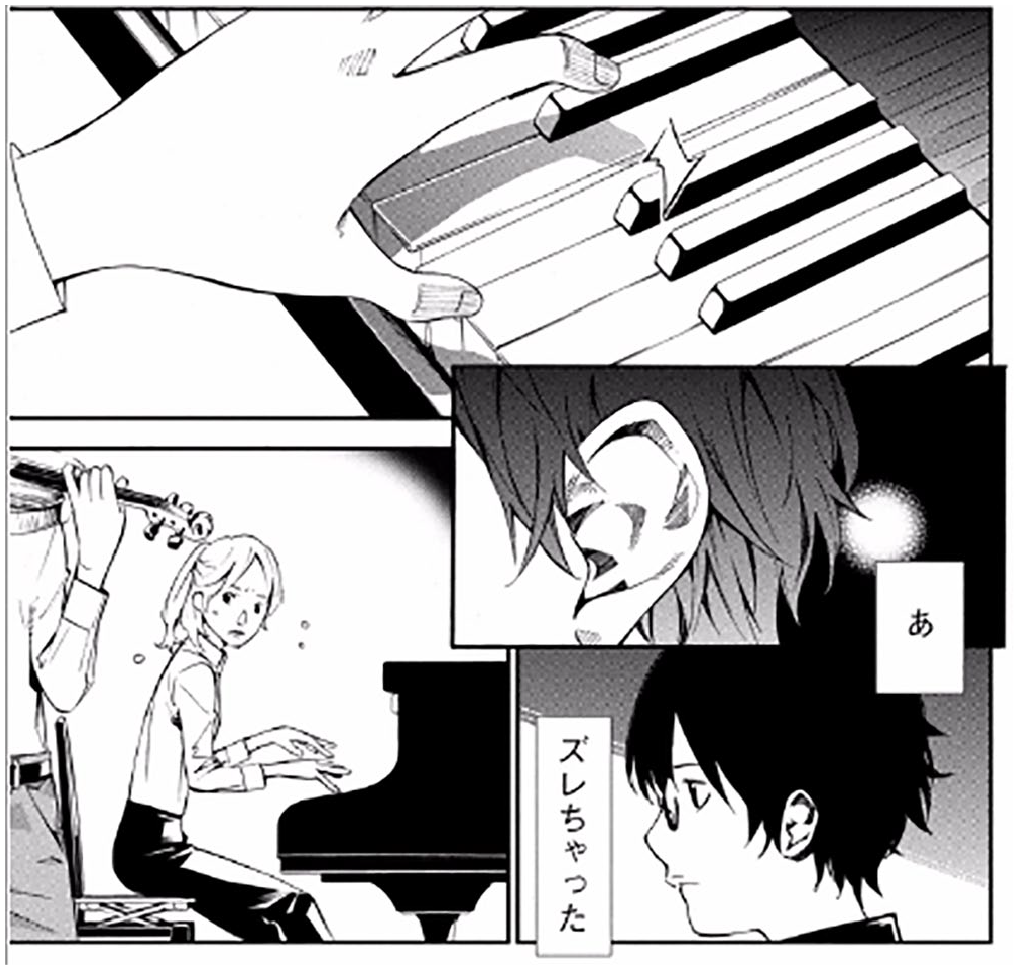
Your Lie in April, Vol. 1: 87 (Naoshi Arakawa, 2012).
One interesting finding is that all styles of musical-themed manga use the ‘MUSIC IS LIGHT’ to visualize music. A possible explanation for this might be that light is usually associated with our consciousness. Humans tend to correlate the vision with understanding or knowing. For instance, ‘UNDERSTANDING IS SEEING’, ‘KNOWING IS SEEING’ and ‘IDEAS ARE LIGHT-SOURCES’ all entail this visual-oriented concept (Cacciari, 2008; Lakoff and Johnson, 1980; Winter, 2008). This concept influences visual media. A conventional emoji, light bulb, is used to represent inspiration or a good idea. Therefore, the ball of light shape in Figure 6 is not only visualized music, but also a representation of the listener’s musical expectancy.
Conclusion
The aims of this study are to unveil our conceptualization of music via the research of visualized music and to discuss the interaction between metaphors and embodied mechanisms. Four metaphors, seven metonymies/manpu and five embodied mechanisms were identified as the origins of visualized music.
Generally, all visualized music is based on metaphors, metonymies and manpu, which are initiated by the embodied mechanisms of musical experience. Specifically, metonymies and manpu are more likely to represent the experience of the brain stem reflex while listening to music, while some acoustic characteristics can be directly depicted through sound symbolic components. Emotional contagion generates metaphors such as ‘MUSIC/EMOTION IS WEATHER’ or ‘MUSIC IS LIGHT’. Some of them simulate the acoustic characteristics and some are only related to emotions. Visual imagery is the most important embodied experience while visualizing music. The manga authors provided concrete and vivid visual imagery of the music to readers. Metaphors generated by emotional memory related to music are used to intensify readers’ empathy. Finally, musical expectancy can be represented by facial expressions, or the metaphor ‘MUSIC IS LIGHT’, since light is usually associated with our consciousness.
This study contributes to our understanding of how vision represents music and musical experience via metaphors. This is the first research to comprehensively use manga as research material to study hearing perception. The findings of visual imagery shed new light on the understanding of visual images and embodied experience. Visualized music in manga can be seen as a solid manifestation of the visual imagery of musical experience. By examining metaphors, metonymies and manpu in visual imagery, the results help us to understand how these concepts can convey musical elements as well as senses and emotions.
The results also offer a comprehensive investigation of auditory–visual transition. General ‘music’ can be manifested as ‘light’ because light is a representation of ‘seeing’. More specifically, acoustic characteristics can be described by other senses. For instance, loudness can represent an object’s size, the thickness of the speed lines or focus lines, or a spiky tactile. Tempo tends to be represented via speed lines and focus lines. If the interval of lines decreases, it means the tempo is fast.
Footnotes
Appendix: Sources of Japanese Music-Themed Manga
Amyuu (2012) Kono Oto Tomare! Sounds of Life 1. Tokyo: Shueisha.
Amyuu (2013) Kono Oto Tomare! Sounds of Life 2. Tokyo: Shueisha.
Naoshi Arakawa (2011) Your Lie in April 1. Tokyo: Kodansha.
Naoshi Arakawa (2012) Your Lie in April 2. Tokyo: Kodansha.
Tomoko Ninomiya (2002) Nodame Cantabile 1. Tokyo: Kodansha.
Tomoko Ninomiya (2002) Nodame Cantabile 2. Tokyo: Kodansha.
Tomoko Ninomiya (2002) Nodame Cantabile 3. Tokyo: Kodansha.
Harold Sakuishi (2000) BECK 1. Tokyo: Kodansha.
Harold Sakuishi (2000) BECK 2. Tokyo: Kodansha.
Harold Sakuishi (2000) BECK 3. Tokyo: Kodansha.
Harold Sakuishi (2000) BECK 4. Tokyo: Kodansha.
Kiminori Wakasugi (2006) Detroit Metal City, Vol. 1. Tokyo: Hakusensha.
Kiminori Wakasugi (2006) Detroit Metal City, Vol. 2. Tokyo: Hakusensha.
Ai Yazawa (2000) NANA 1. Tokyo: Shueisha.
Ai Yazawa (2000) NANA 2. Tokyo: Shueisha.
Ai Yazawa (2001) NANA 3. Tokyo: Shueisha.
Conflict of interest statement
The authors declare that there is no conflict of interest.
Funding
The author(s) disclosed receipt of the following financial support for the research, authorship, and/or publication of this article: Part of this work was supported by the Ministry of Science and Technology of Taiwan (ROC) under Grant 106-2917-I-002-019.

Notes
Biographical Notes
Address: Graduate Institute of Linguistics, National Taiwan University, No. 1, Sec. 4, Roosevelt Road, Taipei 10617. [ email:
Address: as Iju Hsu. [ email: