



Abstract
In this article, the author endeavours to analyse Gerhard Richter’s photo-paintings for the way they build an intersemiotic dialogue between photography and painting. On the one hand, he tries to characterize the modalities of this dialogue and to provide an original interpretation of Richter’s work. On the other hand, he uses the special case of Richter’s work as a starting point for a conceptual renewal in the analysis of visual languages, notably with regard to semiotic approaches. In particular, the author aims to define the mediatic dimension of images, which is concerned with the substances, substrates and devices through which images are produced. He does this in order to integrate the achievements of visual semiotics in regard to the compositional dimension of colours, shapes and figures. He takes into account the way in which the material and the substances of expression of images impact the construction of meaning, in accordance with the hypothesis of a superposition of technical and semantic aspects. The confrontation with Richter’s production leads him to go beyond plastic and figurative readings as he proposes the concepts of technical formats and techno-perceptions of images. While the former concern the historical recognition of images on the basis of the devices having produced their substance – leading to identifications such as ‘early cinema images’, ‘smartphone images’, ‘surveillance camera images’, etc. – the latter concern the perceptive configurations resulting from the formative work of the technical devices.
Introduction
This article examines the artistic production of Gerhard Richter and the challenges it poses for contemporary visual studies. Richter, a German painter born in Dresden and one of the most influential contemporary artists, has produced abstract works, photorealistic paintings, photographs and glass pieces. Of main concern here is the dialogue between painting and photography built into the photo-paintings he produced in the 1960s. Despite the numerous critical readings of Richter’s work, 1 dedicated as much to the relationship between his biography and his paintings as to particular and formal aspects of his work, the lack of a specific conceptual elaboration that could account for the relationship between these two media is striking. Moreover, the most influential and inclusive hypotheses within the field of image sciences and media studies, due to their generality, seem inadequate for accounting for this aspect.
With regard to visual studies (Mitchell, 2005), the now classic dichotomy between image and picture does not help to explain the complexity of the artistic and compositional operations developed by Richter. As is well known, William Mitchell’s proposal is to take into consideration the different media in which images are embodied and which allow them to circulate within the public domain: on the one hand, the concept of image indicates the purely formal and compositional aspects, the organization of colours and shapes, and the figurative and plastic configurations beyond the substrates that carry them; on the other hand, the term picture indicates an image in all its mediatic complexity, taking into account the different mediums and channels through which it is embodied and circulates within a culture. However, this important distinction does not help us in our investigation of the relationship between composition in photography and in painting, nor in that of the dialogical play between the substrates in Richter’s work. In his photo-paintings, the dialogue between image and picture is entirely internal to the painted image and, although it is possible to say that the works can be understood as both formal and purely visual configurations (images) and as material versions embodied in variety of media (pictures), this tells us nothing about the relationship that his images – whether they are images or pictures in Mitchell’s sense – establish with photographic images or through which processes they do so.
The classical concepts of remediation (Bolter and Grusin, 1999) and transmediality (Jenkins, 2008), developed within the theoretical field of media studies, encounter comparable difficulties. One could certainly say that Richter’s works remediate photography, and that his paintings are the result of a transmedia sensibility, but this does not add much to the perceptual evidence of a privileged relationship between the two media.
Even art history struggles to place his works within a unitary formal and ideological framework. As pointed out by Siri Hustvedt (2005: 150): Gerhard Richter’s painting manages to sit squarely inside the ongoing critical debate about the form itself while deftly eluding it at the same time. Richter’s work is one of active resistance to ideological category, a continual refusal to be squeezed into the perimeters of the very theories that, ironically, have helped to catapult him onto the aesthetic mountain where he now finds himself.
Within this context, our contribution intends to develop a semiotic perspective, taking its cue from the work done so far in the framework of the Paris school (Fontanille, 1989; Greimas, 1989). While visual semiotics has long focused on the formal composition of images, leaving aside purely media-related issues, in the last 15 years, through an original reinterpretation of the foundations of structuralism (Hjelmslev, 1953), it has begun to develop its own theory of the medium, based on the role played by the substance of expression of images (Dondero, 2020; Fontanille, 2005). According to Hjelmslev, three concepts must be considered in order to understand meaning: purport, substance and form. Purport corresponds to a linguistic materiality not yet segmented, which is then realized through two forms: the form of expression and the form of content. However, substance has long been set aside in favour of the study of forms alone, in accordance with the idea that substances are always already formed. In order to understand the role of the substrate of meaning, it is important to take into account not only the final forms resulting from any semiotic production, but also the processes of formation, which include the formation of the substance.
Faced with the compositional procedures used by Richter, and especially the intersemiotic and intermediatic dialogue between painting and photography, our proposal is to place a further dimension alongside the compositional dimension of images. In addition to the latter, which articulates, along the lines of Mitchell’s images, the form of expression through chromatic (colours), eidetic (lines and shapes) and topological configurations (organization of space), this article aims to consider the substrate, the substance of expression and the historically attested devices of production. We will call it the ‘mediatic’ dimension of images, and suggest that its components contribute decisively to the meaning of images, in accordance with an overlap between technical and semiotic characteristics.
The case of Richter’s photo-paintings is exemplary of the thesis this article aims to develop: technical aspects participate in signification in at least two respects. On the one hand, they concern the semiotic substances that remain meaningful within images because they express the technical modality of their production – in this case, the way in which the painted matter is formed in such a way as to construct a perceptive correlation with the modes of production of the photographic matter. On the other hand, technically produced images develop a privileged relationship with human knowledge, providing data situated somewhere between the realm of perception and the realm of categorical knowledge. These two tracks will lead us to develop two theoretical concepts, that of technical format and that of techno-percepts of images. The first concerns the historical recognition of images on the basis of the devices that produced their substance, for instance ‘early cinema images’, ‘smartphone images’, ‘surveillance camera images’, etc. The second pertains to the perceptual configurations resulting from the formative work of technical devices.
From form to substance: the question of media similarity
It must first be made clear that it is not possible to speak of a trivial similarity between painting and photography because, as Nelson Goodman (1968) has already observed, similarity is a symmetrical relationship. While it is perhaps possible to say that the images produced by Richter generally resemble photographs, although this does not tell us much about the nature of such resemblance, it is not possible to say that photographs resemble Richter’s photo-paintings. The concept of hypoiconic sign, elaborated by Charles Sanders Peirce, allows us to pose the question in a more satisfactory way. As is well known, a sign, according to Peirce, involves an interpretant and representamen that allows us to know the object in a certain respect, given a fully semiotic conception of knowledge. Iconic signs, or hypoicons, which include images, establish a relationship of similarity with the object, i.e. they select features of the object in order to exhibit them sensibly (Peirce, 1931–1935: Collected Papers 2.227–2.282). In other words, a hypoicon, in this case an image, does not identify itself by its relation of similarity, but invents this similarity by selecting certain characters of the object. As aptly summarized by Goodman (1968: 9): ‘In representing an object, we do not copy such a construal or interpretation – we achieve it’. And he specifies that ‘this is no less true when the instrument we use is a camera rather than a pen or brush.’ The question then becomes not the possible similarity between the photo-painting and photography, but the correlation that can be found between the modes of selection respectively operated by the photograph and by a painting with respect to an object. In other words, it is a question of relating two ways of establishing a similarity, the photographic and the painted, at the level of visual forms but, above all, at the level of substance formation.
If we consider some of the photo-paintings Richter produced in the 1960s, for instance the works Familie and Motorboot (Figures 1 and 2), we readily find formal elements on which the intersemiotic dialogue between painting and photography is based.
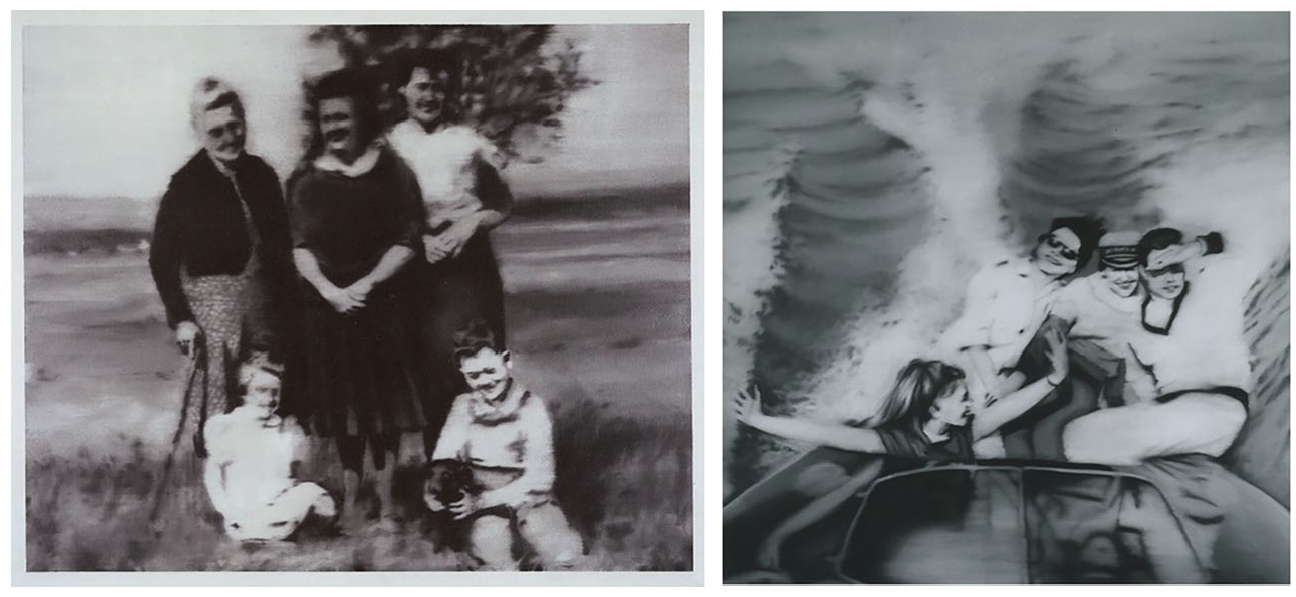
Two paintings by Gerhard Richter: Figure 1. Familie. Available at: https://www.gerhard-richter.com/it/art/paintings/photo-paintings/families-11/family-5500; Figure 2. Motorboot. Available at: https://www.gerhard-richter.com/it/art/paintings/photo-paintings/everyday-life-18/motor-boat-1-version-5564. © Gerhard Richter 2022 (05012022). Reproduced with permission.
These formal elements of the image can be situated at the level of their compositional dimension: the configurations of forms, colours and spaces, regardless of the substances, substrates and devices that produced them. In particular, the choice of framing presents us with a major break with the painterly tradition: the figures staged, as well as their arrangement, depart from the classical configurations developed in the painting genres (portrait, landscape, still life). The depiction of the subjects and elements represented also differs markedly from artistic photography. What Richter chooses to do is to borrow the mode of staging from non-authorial photographic traditions, drawing on the models of press photos, family photos and amateur photos. This choice allows a paradoxical renewal of pictorial composition and an adherence to different canons through the imitation of photographic models. Dietmar Elger (2009: 49) sums up this compositional dialogue achieved by Richter: ‘Photos in his family albums and images scavenged from newspapers and magazines . . . were the perfect source material for transforming the figurative into paintings without having to compose anything himself.’ Richter himself provocatively states about photography that ‘It had no style, no composition, no judgment. It freed me from my personal experience. For the first time, there was nothing to it: it was pure picture.’ 2 We can therefore locate the first level of the intersemiotic dialogue between photography and painting within Richter’s production as a dialogue based on compositional elements, which concern the organization of forms, the choice of subjects and motifs, framing models and discursive genres.
However, the compositional dimension only allows us to analyse the forms, and does not tell us much about the similarity between photography and painting at the level of substance, which is the pivot of the intersemiotic dialogue: it does not tell us much about the similarity of the grain of the images, about how the brushstroke on a canvas can be placed in a dialogical relationship with the process of photographic imprinting, and how this relationship is directly recognized through the perception of Richter’s works. Structural semiotics has long neglected the role of this substantial dimension of expression, as theoretical and methodological developments have focused primarily on form. This is particularly true of the analytical work of Jean-Marie Floch (1986) and Felix Thürlemann (1982), who developed a methodology for analysing visual discourse, making no distinction between a photographic text and a painterly one. As Maria Giulia Dondero (2020: 131) explains: Greimasian semiotics has left aside the analysis of the modes by which the form of expression is constituted, as if the forms were, in the end, integrated into no substance . . . In painterly and photographic images, the marking is directly linked to its substrate in the sense that the marking, as an application of writing, manifests through the substrate thanks to its interpenetration with the latter. Be it gauze or a wooden canvas, it makes a difference.
Since the 1990s, major progress has been made in considering the impact of the material production of utterances on discursive meaning, i.e. by going beyond a static conception of the substance so as to take its formation into account. Jacques Fontanille (1998) proposed distinguishing the material substrate from the formal substrate: the first concerns the object that will undergo the writing process and that already implies constraints, orientations and resistances. The second is consequent to the process of productive enunciation and concerns the form generated by the writing process. A great wall of marble (material substrate), for example, before the application of writing, already embodies a sense of monumentality, but productive enunciation can use this feature to build parodic effects, by imitating the formal organization of a comic strip (formal substrate). Fontanille, and more recently Dondero (2020), have integrated to the pair formed by the material and formal substrates the concept of application (apport in French), which concerns the writing process itself. The heuristic value of this proposal is evident in the case of inter-mediatic transposition and imitation as it allows us to describe the technical dimension of substrates in a more subtle way. In the case of photography, for example, we will normally have the application of light to a sensitive substrate (material substrate), but the photographer can play with the exposure, the aperture of the shutter, as well as with the angle of the shot, in order to obtain blurred outlines and saturated colours, imitating the texture of a painting (formal substrate), as in the case of Robert Demachy’s pictorial approach.
With regard to Richter’s photo-paintings, these proposals help us frame the problem of the alleged similarity with photography. The material substrate of his works fully belongs to painting because it exploits the canvas, just as that which is applied to the canvas is developed in accordance with the instrumentation and the consequent processes which are those of painting. It is rather the formal substrate, through peculiar expedients, that arranges the forms in such a way as to imitate and reinvent the processes of photographic production. In other words, the process of formation of painterly substance (application), by constituting the formal substrate, would extract from the material substrate of painting qualities belonging to another substrate, that of photography, which proceeds through the fixation of light (application) onto an inscriptible surface (material substrate), allowing forms to achieve a possible photographic organization (formal substrate). However, this arrangement has two limitations with respect to Gerhard Richter’s production. First of all, one might ask why it is the substrate that is duplicated into two instances (formal and material) during the process of semiotic formation (application), and whether it is not rather the latter which should be divided into a material application (of the painted matter) and a formal application (the ‘photographic’ result). Secondly, and although this theorization allows us to identify the fundamental junction where the intersemiotic correlation between photography and painting takes place, i.e. at the level of substance formation, it does not tell us much about the elements and procedures that establish this correlation.
We would thus like to understand one of the most famous quotes from Richter, when he said ‘I’m not trying to imitate a photograph; I’m trying to make one. And if I disregard the assumption that a photograph is a piece of paper exposed to light, then I am practicing photography by other means.’ 3 In order to question this peculiar correlation between the formation of the substances of painting and the formation of those of photography, a digression into the theory of linguistic enunciation, upon which the most recent achievements of visual semiotics are based, appears necessary. Our hypothesis is that, in relation to the modes of formation of verbal utterances, which is the field of elaboration of the theory of enunciation, Richter’s paintings imitate and reinvent the processes of formation of the photographic ‘voice’.
Enunciation as the formation of the substance of expression
Elaborated in its modern form by Émile Benveniste (1970), enunciation has slowly become, as linguistic and semiotic scholars have reread it, more than just a theory (Colas-Blaise et al., 2016): it is an epistemological device that brings order to all the key questions of language sciences. In its restricted form, enunciation is a theory built around the uses of language by speakers: We must take heed of the specific condition of enunciation: it is the very act of producing an utterance and not the text of the utterance that is our object. This act is the act of the speaker who mobilizes language for his [sic] own purposes. (Benveniste, 1970: 13, my translation)
By distinguishing and linking these two levels – the act of producing an utterance and the resulting utterances – enunciation is configured as a theory whose objects are the multiple mediations accomplished through the actual use of language. First of all, there is the mediation that concerns the passage from its virtual possibilities to discursive realizations: ‘before enunciation, language is only the possibility of language. After enunciation, language is made into an instance of discourse, which emanates from a speaker, a sound form that reaches a listener and elicits another enunciation in return’ (Benveniste, 1970: 14, my translation).
The mediations of enunciation then concern the relationship between the phenomenological coordinates of the dialogical exchange (the ‘here, I and now’ shared by the interlocutors) and the coordinates of verbal representation, i.e. the places, actors and times projected by each utterance. According to Benveniste, the speaker’s appropriation of language is achieved through specific categories, such as personal pronouns, ostension cues and verbal tenses. By configuring the formal apparatus of enunciation, these categories signal the way in which the relationship between the situation of enunciation and the structures of the utterances is renewed on the occasion of each speech act.
Finally, the mediations of enunciation also concern the relationship between the discourse and the subject, as well as the latter’s degree of presence and responsibility. 4 The famous distinction between discourse-enunciation and story-enunciation derives from this variable presence.
In contrast to textualist approaches, it is not a question of analysing utterances exclusively for their internal configuration, but rather of building the analysis of the utterance with respect to its production. Overall, we can say that the theory of enunciation studies the meaning of discourses and images by analysing the relations between production, meaning and subjective positions.
However, in its first formulation, as well as in the reiterations linked to the linguistic tradition, the technical dimension remains the great absentee of this network of mediations. The substantial components of enunciation, even those concerning verbal language, are understood by Benveniste as secondary or declared non-existent. In his founding text, Benveniste states that ‘the relation of the speaker to the language determines the linguistic characteristics of the enunciation.’ And, shortly after, he adds that it is necessary to consider this relation ‘as the fact of the speaker, who takes language as an instrument’ (Benveniste, 1970: 13, my translation). This reference to language being used as an instrument is also presented in De la subjectivité dans le langage (1966), before being clearly rejected: In fact, the comparison of language with an instrument . . . should fill us with suspicion, like any simplistic notion about language. To speak of an instrument is to place man and nature in opposition. The pickaxe, the arrow, and the wheel are not in nature. They are fabrications. Language is in the nature of man, who did not make it. (Benveniste, 1966: 259, my translation)
Jacques Fontanille (2008), among others, has specifically criticized this conception, as it risks idealizing the study of language. Even if the sound substrate, being one-dimensional, is not as tangible and durable as a two-dimensional medium such as writing or drawing, this does not imply that a materiality or instruments of formation are not involved in verbal language. These consist of the human phonation apparatus, which manipulates the passage of air (matter) in order to produce sounds (substance), articulated in a systematic and linguistic way (form). By possessing a substrate and an instrument of semiotic formation, language loses its ideal place among the systems of human expression, but it gains an additional dimension, a technical dimension, endowed with its own specificity. Before moving on to visual semiotics and returning to Richter, we should turn our attention to this dimension of vocal realization as it is involved in the material formation of utterances.
The ‘voice’ of photography
A quotation from Umberto Eco (2000) helps us to locate the level of relevance of this dimension: To perceive a phoneme as such amid the confusion of the sound environment I must make the interpretative decision that it is indeed a phoneme and not an interjection or groan or sound emitted by chance. It is a matter of starting from a sound substance in order to perceive it as the form of an expression. The phenomenon can be rapid, even unconscious, but this does not alter the fact that it is interpretative. (Eco, 2000: 382)
We are interested in the specific meaning of this sound substance, of its technical production, beyond – or before – the successive passages to the form of expression and to discursive semanticization. It is a matter of taking into account the work of the phonatory apparatus, its characteristic functioning in each speaker, and hence, the identity of the speakers themselves. A simple example of the role of this dimension is the way in which the perception of the voice allows us to recognize a familiar person, even if we do not have him or her in front of our eyes or if he or she speaks a foreign idiom. Another familiar example is the common judgements we make about the age and sexual identity of our interlocutors during telephone conversations. As stated by Hans Belting (2017: 20), ‘When we hear a voice on the telephone or in a recording, we recognize a person with greater certainty and clarity than by the face, which changes over the individual’s lifetime.’ Anne Beyaert-Geslin (2020: 23, my translation) adds that the ‘voice can in fact be considered as the main feature of identity.’ These examples and considerations show that the recognition of a voice is independent of the understanding of the discourse expressed through it. In other words, before or alongside the semanticization of language, which concerns the figures of content produced by discourse, there is a semiotization of the medium, which concerns the meaning involved in the technical production of utterances. We will call this the techno-semiotic – or simply the mediatic – dimension of enunciation. In verbal enunciation, this dimension of meaning is certainly rich, as it includes processes such as the recognition of the age, personal and even sexual identity of the speaking subjects. Another example of the semiotic richness of the mediatic dimension is the possibility of imitation of a human voice by another individual, as in stand-up comedy: the vocal substance is semiotically rich to the point of being used to ‘lie’ about identity.
The full complexity of the mediatic dimensions emerges, however, only when considering other systems of expression. If we turn to the case of visual languages, we find that the substance of expression is insufficient, taken alone, to understand the nuances of meaning involved in the mediatic dimension. 5 In fact, the difference between the verbal and graphic substances of verbal language is not comparable with the difference between photographic and painted images: the variables involved in the second confrontation concern different tools, different techniques and different effects of meaning linked to the semiotization of the medium.
We can return to Richter and say that in his photo-paintings, he too imitates a ‘voice’. It is not the voice of another individual expressing himself or herself through verbal language, but the imitation of the photographic voice through the resources of painting. The question becomes one of identifying the characters of this metaphorical ‘voice’ in order to describe the characters with which Richter engages in a dialogue that is centred upon the mediatic dimension of images.
The mediatic dimension: the technical formats of images
The first axis that allows us to describe this peculiar ‘voice‘ of photography concerns technical formats. In accordance with the processual postulate of enunciation, which concerns the act of forming utterances, by this concept, we mean those components of the substance of the expression of images that derive from their process of formation. Let us take the example of photographic and video formats: the evolution and diversification of video recording devices has entailed a significant differentiation in the material quality of the images produced. This is the case with the different standards of definition of photographic images, i.e. the number of pixels per area or the density of visual information. The same applies to the aspect ratio (the ratio between the height and width of the representation space), or to the distortion of perspective due to the use of a particular lens (a wide-angle lens, for example, makes it possible to increase the angle of the shots, but at the cost of a deformation of the lines at the edges of the images, which become curved). Now, the technical formats of the images include all these characteristics because they concern the residues of the formation of the substances of expression within the images, but they are also recognizable, perceptually, through observation. Consider the following photos (Figure 3). 6
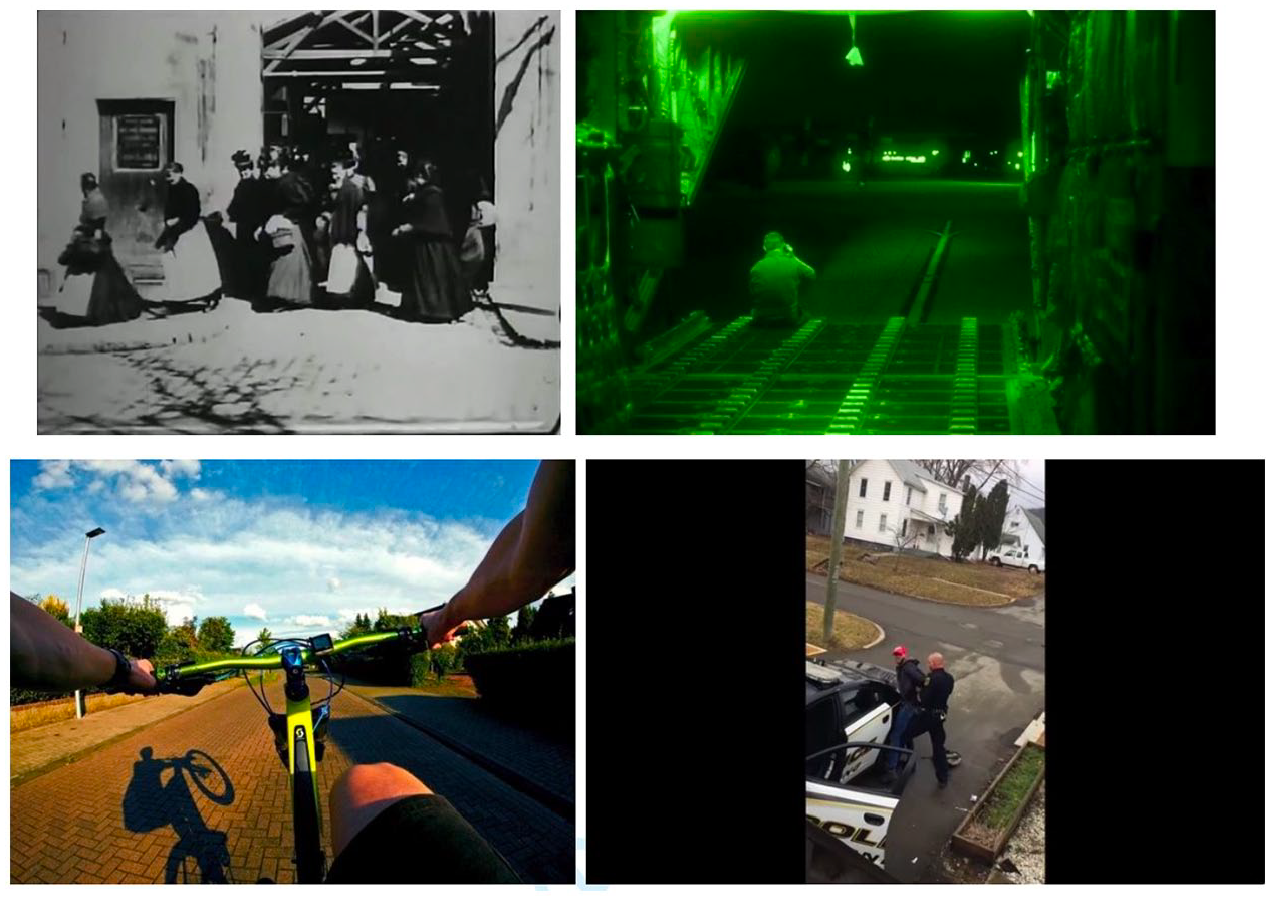
Four examples of technical formats of images.
At a glance, one can easily recognize that, respectively, they are: an early cinema image, because of the black and white and low definition; a night image taken by a surveillance camera, because of its typical green tones; an image produced by an action camera such as a GoPro or a wide-angle camera, because of the perspective distortion at the edges of the image; and finally, an image taken with a smartphone, because of the aspect ratio of the representation space.
If we return to Gerhard Richter’s work, we can identify the second axis around which the dialogue between the media of painting and of photography is organized. It is not a dialogue based solely on compositional choices – the subjects photographed, the setting, the framing inspiration from non-art photographs – but a dialogue based on the respective modes of production of painting and of photography, exemplified by the technical formats.
In the work Familie Fischer (Figure 4), for example, the proximity to the technical format of the Polaroid is clearly discernible. The almost square aspect ratio, together with the orange tones and the patina effect of ageing, contributes decisively to building an aesthetic and perceptive assonance between the painted image and a particular type of photographic format. In Mutter und Tochter (Figure 5), on the other hand, the typical aesthetics of a black-and-white photo is associated with an image texture that simulates, in addition to its low definition and blurred effect, its printing on newspaper, from which the source image was taken. In short, Richter seems not only to dialogue with photography as a medium, but also with the different ‘enunciative voices’ of photography, taking advantage of the mechanism of semiotization of the medium that we have identified above. Alongside the semanticization of forms, another dimension, relating to the substances of expression and identified here in the technical formats, allows us to recognize a particular type of photographic production, associating it with a device, a spatio-temporal framework of production and a particular techno-aesthetic effect. More specifically, we can identify three levels involved in the semiotization of the technical formats of photography.
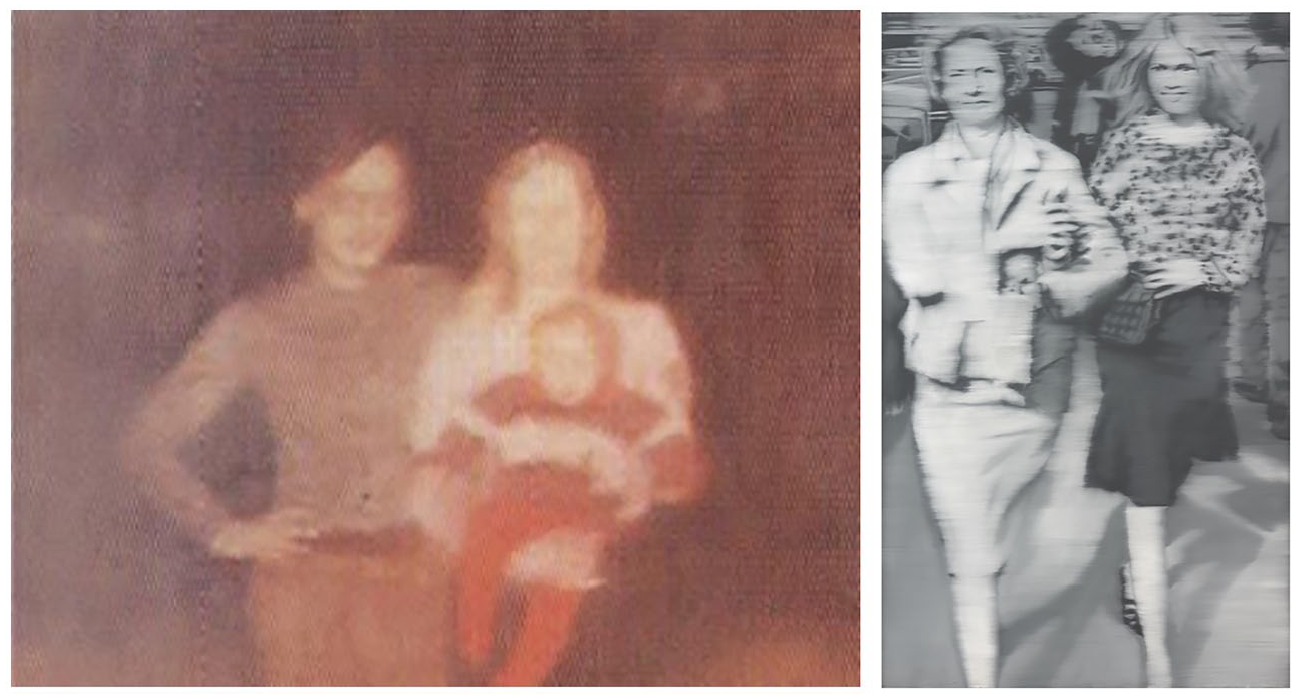
Two of Richter’s artworks that show the dialogue with photography realized through technical formats: Figure 4. Familie Ficher. Available at: https://www.gerhard-richter.com/it/art/paintings/photo-paintings/families-11/the-fischer-family-5811/?p=1; Figure 5. Mutter und Tochter. Available at : https://www.gerhard-richter.com/it/art/paintings/photo-paintings/families-11/mother-and-daughter-b-5594/?&referer=search&title=mutter+und+tochter&keyword=mutter+und+tochter. © Gerhard Richter 2022 (05012022). Reproduced with permission.
(1) Photography as the result of a material production: photos are certainly images, i.e. organizations of colours, shapes, and spaces, but they are at the same time material objects produced by specific devices. Technical formats embody the link between the image-utterance and the technical device of enunciation. It seems obvious that the substantial aspects we have identified – definition, aspect ratio, perspective distortion, and many others – are normally organized into recognizable configurations, which derive from the particularities of the production devices. Each image is recognized, through the semiotization of the medium, according to a complex profile, such as ‘early cinema image’ or ‘smartphone image’. Richter plays with this technical, historical, and aesthetic recognition of technical formats, through a visual effect of imperfect resemblance to certain photographic formats: through the semiotization of pictorial supports, his artworks question the technical and perceptive value of visual languages. In fact, each of the technical formats builds a peculiar techno-aesthetic aura, speaking to us visually about the past, even through the ageing of the photographic object. This plurality of photographic ‘voices‘ should not be understood as a linear succession of technological evolutions, but as a horizontal pluralization of devices and aesthetics (Polaroid, professional cameras, smartphones, etc.).
(2) Photography as a cultural object: photographic productions are also connected with specific social domains and semantic practices: advertising, entertainment, reportage, family photography. Between technical formats, photographic genres and social domains, a techno-semiotic bond associates them through more or less stable links. Richter plays with this cultural value of photographic images, at times even simulating the paratextual apparatus of specific photo genres, as in the case of Faltbarer Trockner, in which the captions and slogans of advertising are also evoked. This operation explicitly brings into play an inter-domain comparison between the painted artistic image and the advertising photo. The result is a questioning of the specificities of the artistic image: what is art, or rather, to take up Nelson Goodman’s provocative question (1985), when is it art?
In other works, the paratext is absent but the reference to the practice that produced the photographic object is perceptibly detectable, as is the case in many of the works taken from family photographs (cf. Figure 1). The theoretical question posed by these works becomes more general because it is no longer a question of a comparison between artistic painting and photographic practice, but a more primordial questioning. In this network of perceptual references, of visual norms that inhabit images, Richter seems to implicitly ask: if generic, visual and social references are short-circuited, then what is an image?
(3) Photography as a visual compositional organization: photography is also an image as in Mitchell’s acceptation, i.e. a set of configurations of plastic forms (colours, lines, spaces, textures, visual rhythms and rhymes, centrifugal and centripetal tensions) and figurative forms (recognizable objects, iconographic elements, visual motifs) that can enter into correlation. With respect to this level of semiotic organization, Richter’s production of photo-paintings exploits technical formats in such a way as to go beyond a specific tradition of abstract art. 7 Abstract art was in fact widespread in the 1960s: a visual art that deliberately chooses to base itself on the plastic dimension alone, without depicting any recognizable figures. As stated by Richter himself:
With Formalism, I mean, whenever someone views a painting formally and then concludes – and this really bothers me – up here there are three hooks, you must strengthen this rhythm, from the right come four more, then you set a balancing weight, and now it’s fine. That is a terrible way of looking. (Elger, 2009: 49)
The gesture of using the ‘voice‘ of photography allows Richter to conceptually go beyond abstract art. The answer is clear: it is still possible to renew figurative painting by filtering its pictures through the mediation of other images – in this case photographic images – thereby developing a visual way of thinking through perceptual and pictorial means.
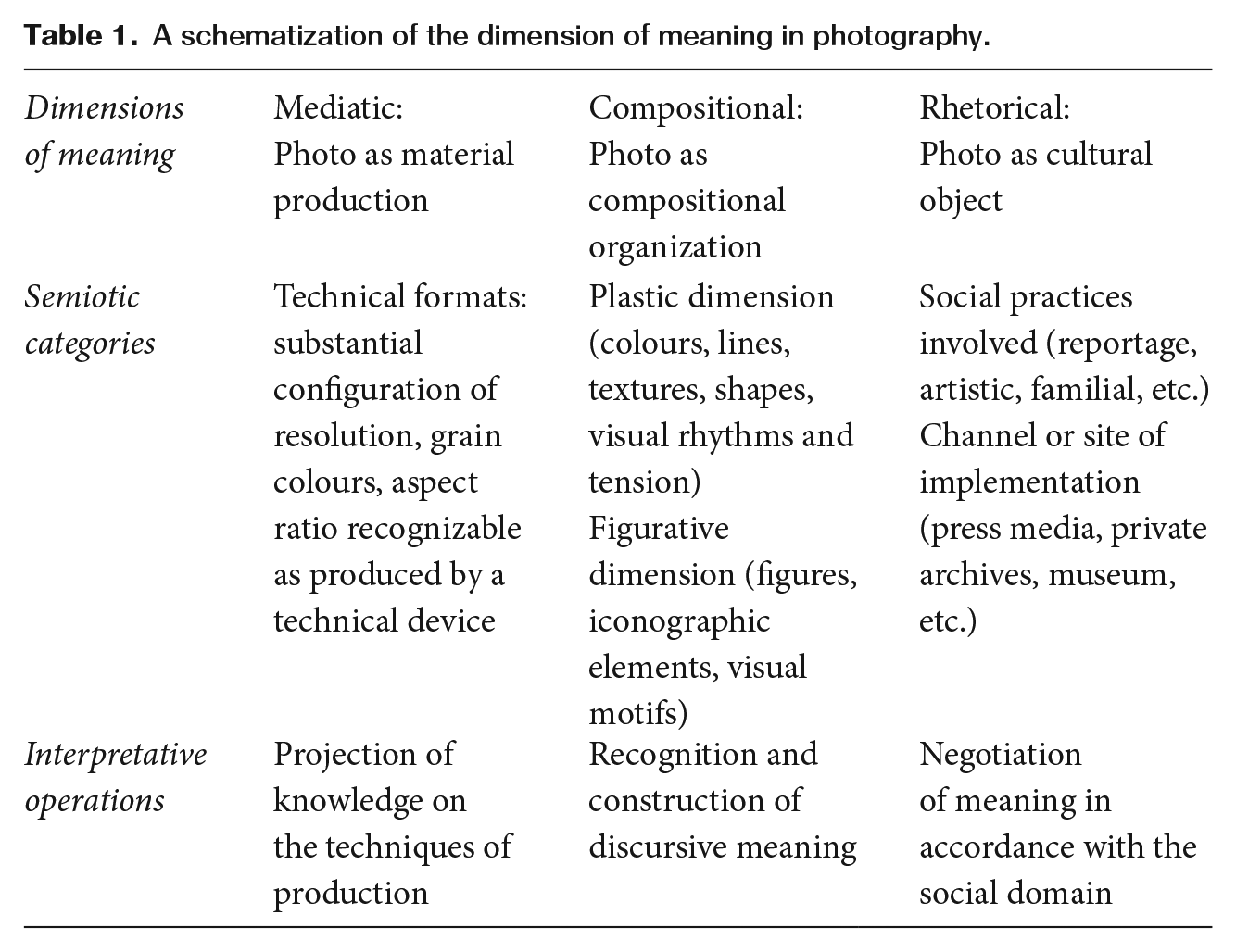
Richter’s answer to abstract art could also be interpreted in a more radical way, as the rejection of the idea that there is a universal visual grammar made up of purely formal and perceptive traits (weights, counterpoints and balances). By taking for a model a type of image that has inscribed, within it, the traces of its own material production and thus the visual history that has accompanied its evolution, Richter rejects the existence of such a universal and pure grammar. Conjuring up photographic models in fact means not only visually and perceptively imitating another type of figurative image, but also and above all challenging the universality of visual languages by exhibiting the temporal stratification that feeds them through different ‘voices’: black and white photos, Polaroids, press photos, family albums, etc (see Table 1).
A schematization of the dimension of meaning in photography.
Richter takes advantage of this progressive perceptual enlargement due to photography by dialoguing with its different historical voices, through technical formats. In fact, photo-paintings exploit an archive effect linked to the perceptual history of photographic production: an archive of visual traits, linked to the way in which the particular characteristics of photographic images constitute norms that nourish the cultural gaze. 8 The effect of realism also depends on this photo-perceptual archive, which, as noted among others by Goodman (1968), depends above all on the norms in force in a given era. In Richter’s case, it is clearly an effect of photo-realism, achieved through the visual dialogue with technical formats and from the historical stratification of different photographic perceptual norms. In other words, Richter establishes an archive effect by dialoguing with photography: not an archive strictly linked to knowledge, but an archive of traits and visual qualities that inhabit human perceptual norms thanks to photography. In this context, it becomes impossible to conceive of a universal visual language that is fixed once and for all, because technical and cultural evolution generates new technical formats, each of which has its own distinctive aesthetic characteristics.
The question of blurring: a dissonant perceptual similarity
However, this is only the first fundamental axis of the intersemiotic dialogue between photo-paintings and photography. The other axis concerns what differentiates Richter’s work from the photographic medium in the framework of this resemblance dialogue. In order to understand this sort of variation within similarity, we must take into account a more general effect of photographic production, because it is characteristic not of a particular technical format, of one photographic voice, but of all photographic voices, of which it represents the lowest common denominator: the blur effect. The blur is a visual effect exemplary of the technical functioning of photography: it is in fact the consequence of the natural movement of things being visually arrested by means of photographic fixation. As summarized by Bruno Bachimont (2010: 47, my translation), we must take into account the relation between technical devices and temporality: ‘the function of the device is to convert a relationship to time into a relationship in space; the technique at this level is a de-temporalization of becoming, in order to spatialize it.’ The photographic blur is a visual and perceptual effect resulting precisely from the transformation of time and movement into a spatial image fixed onto a substrate, realized by means of the photographic device: the technical operation of photography proceeds by imprinting light onto a substrate, starting from natural movement. This fixation often generates blurred shapes when the adjustment between natural movement and photographic fixation turns out to be imperfect. Over time, the blur has become one of the expressive parameters structuring the photographic language, with at least three varieties: motion blur, panning and bokeh. Motion blur is localized in a part of the photographic image, in correspondence with a moving body, as in the case of sports or motor racing photos, where the athlete or car is blurred while the rest of the image is in focus. Panning, on the other hand, is extended to the whole surface of the image because it is due to the movement of the camera at the moment of shooting. Notable and famous examples of this form of blur are war photos, for example those taken by Robert Capa. Finally, bokeh is a form of blur that allows the emphasis of what is in focus by wrapping and framing it within blurred portions of the image. Compared to the previous two forms, bokeh is not due to movement, but to particular aperture settings and to the distance from the represented objects. This is the case, for example, in photographic portraits, which feature a blurred background to emphasize the portrayed subject. Of course, these forms of blur are often combined to achieve particular artistic effects.
It is precisely with regard to this characteristic feature of the language of photography, which is derived from its peculiar technical functioning, that the uniqueness of Richter’s photo-paintings can be identified. As we know, this effect is widely used in his works and represents one of his most characteristic features. 9 However, this technique is used in a peculiar way, in a kind of dissonance within similarity.
With some of his paintings, one gets the impression that Richter uses bokeh, as in the famous portrait of his daughter Betty (Figure 6), in which the background is blurred and highlights the figure in focus, albeit taken from the back, or also in Blumen (Figure 7), where the blurring is more pronounced in the close-up and in the deeper part of the foreground, isolating the stems and flowers halfway closer to the viewer. In other works, such as Verwaltungsgebäude (Figure 8), the blur envelops the entire image as if the pictorial ‘shot’ were taken from a moving car, in accordance with the relative typology of panning blur. The use of motion blur seems rarer.

Three examples of the blur effect in Richter’s paintings: Figure 6. Betty. Available at: https://www.gerhard-richter.com/it/art/paintings/photo-paintings/children-52/betty-7668; Figure 7. Blumen. Available at: https://www.gerhard-richter.com/fr/art/paintings/photo-paintings/flowers-40/flowers-7922/?&categoryid=40&p=1&sp=32; Figure 8. Verwaltungsgebäude. Available at: https://www.gerhard-richter.com/it/art/paintings/photo-paintings/buildings-5/administrative-building-5511. © Gerhard Richter 2022 (05012022). Reproduced with permission.
The point is that in the majority of his photo-paintings, Richter uses blur in an original and personal way and betrays the technical and expressive function of the photographic blur, while perceptually and visually replicating its effects. It is possible to observe this paradoxical dissimilarity within similarity in many of his works, which realize multiple types of betrayal of the photographic blur. As stated by Elger (2009: 85): The blurring indexes the inexact relation between an object and its perception – or, as some critics explain it, a technical mistake that transpires if a camera (or its subject) moves at the instant the shutter is released. Because paint on canvas can never be out of focus, this creative blurring actually strengthens the tension and ambivalence between painting and photography.
In Terese Andeszka (Figure 9), for example, the blur particularly concentrates on the faces of the people portrayed, but its texture is very pronounced, with a strong reference to Francis Bacon’s blur. In Uncle Rudi (Figure 10), one of his most famous works, the blur envelops the entire image, as if it were a panning. However, the person portrayed is motionless, as the ideal type of portrait prescribes, and the ‘shot’ has no real reason to have taken place in movement. The result is an image that maintains a strong expressive kinship with photography, but the blur is organized as a relevant visual distortion, as the technical recording of a vision, and more precisely of a techno-vision. Even in Ema (Figure 11), one of Richter’s masterpieces, the fluorescent light envelops the entire image in a peculiar way, standing out together with the colour patches in a procedure fully belonging to the medium of painting and that has no counterpart in the photographic blur. The blur participates in an affective and auroral atmosphere, and the result is an image in which the dialogue between photography and painting is evident, the two being on a par, in a complete artistic synthesis that no longer gives the impression of imitation. 10

Three examples of the dissonant use of the blur effect in Richter’s paintings: Figure 9. Terese Andeszka. Available at: https://www.gerhard-richter.com/en/art/paintings/photo-paintings/families-11/terese-andeszka-5492/?p=1&sp=35; Figure 10. Uncle Rudi. Available at: https://www.gerhard-richter.com/it/art/paintings/photo-paintings/death-9/uncle-rudi-5595; Figure 11. Ema. Available at: https://www.gerhard-richter.com/it/art/paintings/photo-paintings/nudes-16/ema-nude-on-a-staircase-5778. © Gerhard Richter 2022 (05012022). Reproduced with permission.
This peculiar use of blur deserves further analysis because it builds a paradoxical form of the photorealism we mentioned in the previous section. We have observed that realism in images is certainly the result of cultural norms that vary over time. In Richter’s work, realism is achieved in relation to visual objects and photographic shots, and it therefore follows an idea of photo-realism based on technical and aesthetical norms. If we take into account semiotic attempts to explain the effects of realism in images with respect to ‘raw’ perception, a major feature of Richter’s work emerges. The concept of surrogate stimuli developed by Umberto Eco, for example, states that images are capable of replicating the perceptual effects of real objects or scenes through certain visual features.
I examined an advertisement showing a foaming glass of beer, which evoked a sense of pronounced coolness, because on the glass you could see a film of icy vapor. Clearly the image contained neither glass nor beer nor icy vapor: therefore it was suggested that the image reproduced some of the conditions of the perception of the object: where, on perceiving the object, I would have been struck by the incidence of light rays on a surface, in the image there were certain chromatic contrasts that produced the same effect, or an effect that was satisfactorily equivalent. (Eco, 2000: 353)
However, in his proposal, Eco argues that the realism of surrogate stimuli depends on their definition: the more defined a surrogate stimulus in an image is, the more it achieves the same perceptual effects as the real object. Exactly the opposite happens in Richter’s works, where the photo-realistic effects are realized through a peculiar form of blur, which makes them less defined. As he stated himself: ‘I blur things to make everything equally important and equally unimportant . . . Perhaps I also blur out the excess of unimportant information.’ 11
How can we explain this paradoxical photo-realistic effect, achieved on the one hand by imitating the technical formats of photography, and on the other by betraying the expressive function of the blur, which also involves a deliberate loss of definition in the images?
The techno-percepts of images and richter’s techno-impressionism
To summarize, on the one hand, Richter exploits the archive of visual traits generated by the evolution of technical photographic formats, thus historically rooting the ‘gaze’ of painting in the aesthetic and perceptual norms that have succeeded one another in the history of media. On the other hand, he takes a central character of photographic rendering – the blur – and uses it in a dissonant way, short-circuiting the technical and expressive functioning of photography. It is in this triangulation between the archive of visual traits, the dissonant use of the photographic blur and means belonging fully to the medium of painting that lies the originality and theoretical scope of Richter’s work.
In order to understand this difference within similarity, it is necessary to situate it with respect to the fundamental mechanisms of perception. It is now well known that visual languages exploit some of the fundamental mechanisms of perception, especially in the way the latter differs from conceptual and verbal signification, with which it is continuously put into relation. Authors such as Umberto Eco (2000) and Jean-François Bordron (2010) have rightly distinguished between perceptual and verbal meaning. Both images of perception and images objectified on a substrate do not rely on the forms of verbal predication, but on ‘visual composition’. Among the main differences, we can clearly oppose the linear syntax of verbal language and the tabular syntax of visual composition, organized according to centrifugal and centripetal tensions. Another major difference is linked to mereological mechanisms, which concern the relationship between parts of the image, and between the parts and the whole. A simple example of this assonance between visual signification and perception comes from the laws of gestalt and their application, or rather their composition, in visual languages: the relationship between the figure and background, much used in photographic portraits, exhibits one of the many mechanisms by which the image composes meaning. While fully categorical mechanisms of conceptual interpretation predominate in verbal language, in visual languages, mechanisms of iconic recognition are prevalent. Eco speaks of a process that starts from percepts, is organized into perceptual judgements, and then finally becomes fully categorical and general knowledge: from a yellow perceived during lived experience, which is characterized by its singularity – ‘that particular yellow’ – one passes to the general ‘yellow’ which is systematically organized with respect to more defined categorical fields of verbal language. The singular impression of ‘that particular yellow’ cannot be described, but only recognized, and is typical of human percepts. On the contrary, further confrontations between that yellow and other yellows build up perceptual judgments which are linked to categorial and verbal knowledge. Jean-François Bordron also takes up the Peircean trichotomy of icon, index and symbol to describe the fundamental mechanisms of perception: the moment of the percept is described as an iconic moment, in which the semantic qualities of perception are exploited by the compositional resources of images. In simple terms, perception builds aggregates of open and specific sensible traits, and is capable of recomposing and relaunching them in view of a more precise categorization through verbal language. Even if photographic and painted images are objectified signs and therefore symbols in their own right, they conform to this particular stage of meaning construction by exploiting the perceptual mechanisms of aggregation and composition, proposing arrangements of qualitative singularities (‘that yellow’, ‘that shape’, ‘that visual rhythm’). With respect to these considerations, now shared by the semiotic community and part of the image sciences, which rightly combat the use of an approach derived from the study of verbal language for visual meaning, we would like to go a step further.
Richter’s case clearly demonstrates that not only humans, but also images propose percepts, composing characteristics that cannot be categorized with verbal language, but only recognized and ‘composed’ visually. It is no longer a question of recognizing ‘that particular yellow’ during one’s perceptual experience, but of recognizing ‘that particular photographic yellow’ or ‘that particular photographic blur’, which is distinctive of the way a photographic image builds percepts. We will define these percepts produced by photography, and more generally by technical means of expression, as techno-percepts: visual configurations that are recognizable but not categorically articulated, and which constitute the way in which technical images elicit peculiar percepts.
It is precisely at this primordial level of perception that Richter’s dissonant resemblance to the photographic blur comes to question both the production mechanisms of photography and of human perception. By destabilizing photographic techno-percepts, while using its fundamental mechanisms, Richter achieves a perceptive interrogation concerning the realm of the visual: what is a photographic shot, in its historicity but also in its perceptive immediacy? And what is perception, if a fully pictorial image elicits an effect of dissonant similarity to photography? In other words, by using fully visual means, and paradoxically by mediation of another visual medium, Richter opens up the field for a more primitive image, that of our historically influenced perception. Through the dissonant resemblance to the technical formats and techno-perceptions of images, Richter composes an interrogation capable of going back to percepts, going beyond the higher levels of signification, such as interpretation and categorization. On the one hand, we somehow recognize a similarity with photographic images, owing to the technical formats imitated, but at the same time, our perceptive impressions are questioned by the betrayal of the photographic techno-percepts. The historical recognition is blocked and thrown into question by the perceptual dissonance. It is for this reason that the general statement of similarity between Richter’s works and photography fails to tell us much about his compositional solutions. It is not only the genres of photography that need to be retraced, nor only the compositional choices pertaining to framing, but also and above all the specific technical formats of photography with which he engages in a dialogue (archive of visual traits) and the way in which he betrays, through a personal use of blur, the technical functioning of photography as well as our perceptual impressions (techno-percepts).
A rather daring comparison allows us to clarify the matter once and for all. We would like to define Richter’s photo-paintings as techno-impressionism. As is well known, at least in school textbooks, Impressionism was first conceived of as a negative term used to emphasize the poverty of the image compared to the standards of realism in force at the time. This concept highlights the fact that Impressionist artworks are too anchored in subjective impressions. In particular, some Impressionist paintings display subjects immersed in an auroral form of landscape, dialoguing in an original way with human perceptual mechanisms. They are precisely impressions of views reinterpreted, or rather recomposed, in a visual, artistic and idiosyncratic way. This is exactly what Richter seems to achieve in his photo-paintings: to build an artistic and personal reinterpretation of photographic techno-impressions. This reinterpretation is built through a mix of rigorous imitation of technical formats and a significant betrayal of blur. The dissonant similarity with the aesthetic and technical mechanisms of photography allows Richter to question the relationship between human and technical perceptions, and to renew pictorial genres and procedures.
Conclusion
In this article, we have proposed an analysis of the photo-paintings, and more generally, of the works that build an intersemiotic dialogue between painting and photography among Gerhard Richter’s artistic production. On the one hand, we have tried to characterize the modalities of this dialogue and to provide an original interpretation of Richter’s work. On the other hand, we have used this peculiar case as a starting point for a conceptual renewal in the analysis of visual languages, in particular, with regard to the semiotic approach.
In the first part, we challenged the idea of a simple similarity between Richter’s works and photography, in order to identify a correlation in the ways of producing images through the means respectively characteristic of photography and painting. The concept of iconic sign allowed us to shift the axis of reflection from the similarity between two images to the ways in which images build a similarity with an object. In Richter’s case, the result is that similarity should be reread as a creative dialogue established between painting and photography’s way of forming images. After a brief overview of the theory of linguistic enunciation, we distinguished two fundamental dimensions of images, both of which are involved in the construction of this intersemiotic dialogue. On the one hand, the compositional dimension concerns the formal features of images: their internal composition in terms of figures, colours, spaces and rhythms. In Richter’s case, we have seen that the framing and internal composition of his works follow a variety of models from non-art photographs (advertising, family, reportage photography).
On the other hand, the mediatic dimension concerns the way in which the substrate is semiotized so as to build a supplementary level of meaning, alongside the semanticization of forms. The example of the human voice, which plays an important role in the identification of speaking subjects, of their sex and of their age, regardless of the understanding of their discourses, allowed us to isolate this dimension. With regard to images, we postulated the hypothesis that Richter imitates the ‘voices’ of photography. It is through the concept of technical format, defined as a configuration of the image’s substantial elements that refer to its production, that we identified these ‘voices’. Parameters such as definition, aspect ratio, perspective distortion, colour and grain are in fact organized into perceptually recognizable formats that are typical of a given device: ‘early cinema images’, ‘polaroid images’, ‘smartphone images’, ‘surveillance camera images’, etc. By imitating these formats, Richter reinserts a plural historicity into the art of painting, which is articulated on both a technical and expressive level. It is through the compositional dialogue with the formal genres of photography and the technical aesthetic dialogue with the technical formats that the impression of similarity is produced.
However, technical formats do not allow us to fully explain the artistic value of Richter’s paintings in relation to photography. Alongside the somewhat rigorous dialogue with technical formats, another dialogue, this time a dissonant one, is carried out with regard to photography’s most characteristic compositional procedure: the blur. Although it is a visual element characteristic of Richter’s painting, and an element that contributes decisively to building an effect of similarity with photography, its pictorial use betrays the technical and expressive functioning of photographic fixation. While photographic blurs are the result of different rhythmic adjustments between natural movement and photographic fixation, Richter’s blurs are more personal and dissonant. In order to understand this visual dissonance, we questioned the relation between perceptual meaning and visual languages. The blur is in fact a visual element that responds to pre-categorical iconic meaning, engaging our visual perception before it is organized into a fully verbal categorical system. The concept of percept describes this first step of meaning in human perception, which is characterized by its singularity: it is ‘that particular yellow’ and not the general idea of yellow of fully categorized knowledge. For this reason, just as with the singularity of human perceptions, we have proposed to understand these visual features of photography – ‘that particular photographic yellow’, ‘that particular photographic blur’ – as techno-percepts: recognizable visual configurations that are not categorically articulated, and that are produced by technical means. The result is that the betrayal of photographic techno-percepts in Richter’s artwork questions both human and technical perception through the means afforded by painting. It is a completely visual questioning, situated at the primordial level of perceptual meaning. For this reason, we have spoken of Richter’s photo-paintings in terms of techno-impressionism: just as Impressionism reinterprets subjective perceptual impressions in an original way, so does Richter artistically reinterpret photographic techno-perceptual impressions.
Globally, by imitating technical formats and by betraying the techno-percepts of the photographic blur, Richter engages in a dialogue situated on two opposite levels of complexity. On the one hand, by evoking the voices of photography, through the archive of visual traits, he reinstates a constitutive historicity into the gaze and images, contesting the existence of a universal visual language: the visual is a realm of historical, technical and aesthetic norms that nurture the gaze in a layered rather than progressive manner. On the other hand, betraying the techno-percepts of photography, Richter interrogates the level of immediate and singular perception elicited by the image. Faced with Richter’s works, we are forced into a confrontation between experiential perceptions, techno-perceptions and pictorial perceptions. This implicit and perceptual confrontation builds up a pre-categorical sensible ‘thinking’ capable of reopening the meaning of images.
Footnotes
Funding
This project received funding from the European Union’s Horizon 2020 research and innovation programme under the Marie Sklodowska-Curie grant agreement No 896835 – IMACTIS.

Notes
Biographical note
ENZO D’ARMENIO is a Marie Skłodowska-Curie Postdoctoral Researcher (IF) at the University of Liège, where he conducts the research project IMACTIS – Fostering Critical Identities through Social Media Archival Images – on the languages of images on social networks. During his PhD in Semiotics at the University of Bologna he worked on the rhetorical strategies of intermediality, analysing a corpus of fiction films, documentaries and TV series. In the field of communication, aesthetics and philosophy of language, he has published papers for international scientific journals (including Versus, Rivista di Estetica, Médiation et Information) and book chapters in collections such as Perspectives in Pragmatics (Springer) and Extensions sémiotiques (Academia-L’Harmattan). He is the author of the monograph Mondi parallel. Ripensare l’interattività nei videogiochi (Unicopli, 2014).
Address: Marie Skłodowska-Curie Postdoctoral Researcher (IF), Université de Liège, Place du 20 aout 7, Liege 4000, Belgium. [ email: